- “Republican political theories and institutions differed sharply from modern theories and models of international relations. Consequently, the history of international politics, the European system of states and state-formation must be re-conceptualized more in line with historical realities.” (pdf)
- The double life of Adam Smith Kwok Ping Tsang, AdamSmithWorks
- War at the end of history (Ukraine) Adam Tooze, New Statesman
- Taking nationalism seriously (Ukraine) Eteri Tsintsadze-Maass, Duck of Minerva
Links
Nightcap
- “To the extent that states figure into national histories, they often appear as one-dimensional foils for national state-builders or vehicles for parochialism and bigotry.” (pdf)
- How black America fell out of love with Africa Alden Young, Noema
- The contradictions of classical liberalism Gene Callahan, Modern Age
- Revisiting the collapse of the Soviet Union Christopher Caldwell, American Affairs
A couple of Monday Links
Climate Collaborations in the Arctic Are Frozen Amid War (Undark)
A War of World-Building (City Journal)
Nightcap
- Is anything going to change? Emily Sellars, Broadstreet
- Why I am not a liberal The Last Positivist, Sooty Empiric
- Hayek’s trap and the European utopia we need (pdf) Philippe Van Parijs
- Soviet children’s literature Evgeny Shvarts, Economist
Monday’s literal fantasies
Sciences of “Dune”: An Introduction (LA Review of Books)
A symposium on Dune’s medicine, ethnography, eugenics and others.
Why Do We Love the Brutality of “Grimdark” Fantasy? (LitHub)
Have neither read ASoIaF nor watched GoT, but I will leave the root of word “grimdark” here: In the grim darkness of far future there is only war.
On Tolkien and Orwell (Darcy Moore)
More common points than just “being peculiarly English authors with evergreen book sales“.
Ursula K. Le Guin’s biography gets a publisher and a release date (Oregon Live)
Just finished The Dispossessed, the 1974 SF novel by Le Guin. A worthy, humane read, definitely. Apart from the beautiful prose, the setting is compelling. Two planets: Urras, complete with states, money and war, and Anarres, a former mining outpost turned to colony by settlers from Urras. Governments of Urras offered to people adhering to the teachings of a semi-legendary woman (“Laia Asieo Odo”) the colony, so that they could do their thing without disrupting “civil order”. Le Guin explains:
Odonianism is anarchism. Not the bomb-in-the-pocket stuff, which is terrorism, whatever name it tries to dignify itself with; not the social-Darwinist economic “libertarianism” of the far right; but anarchism as prefigured in early Taoist thought, and expounded by Shelley and Kropotkin, Goldman and Goodman. Anarchism’s principal target is the authoritarian State (capitalist or socialist); its principal moral-practical theme is cooperation (solidarity, mutual aid). It is the most idealistic, and to me the most interesting, of all political theories.
Source
The book follows a scientist from the anarchist planet who travels to the old world. The chapters alternate between his interactions there and flashbacks from his homeland. The writer paints the capitalist state, that hosts the traveler, as funky, but sinister (she does not spare a neighboring socialist one, either), while she treats the anarchist world more generously. It even gives it some, let’s say, additional leeway, contrasting its arid, hostile landscape with the lush environment of Urras. The dichotomy is furthered by guarantees of isolation: The two worlds only do some limited communications and trade, no traveling in-between.
The outline of life in Anarres was the most interesting aspect, to me. Trust, mutuality and personal freedom are the basic elements in this anarchist society, which prides itself against those competitive, “archists”, “propertarians” of Urras. They also fear and loathe them (acknowledging that Anarres is practically defenseless at the face of tactical armies), and also need to trade with them ores for necessary goods.
The constructed language of Anarres expresses the core beliefs, for example, it uses “central” instead of “higher”, to denote significance in the absence of hierarchies. The word for “work” is the same as “play” (or was it “joy”?), and the really unpleasant tasks are shared on a rotating basis. This means that specialized and unspecialized individuals alike spend some considerable time laboring for society’s wellbeing. Professions are conducted through syndicates, which form and dissolve voluntarily. Individuals move freely across the planet’s communities. There is a unit that coordinates production, work postings and resources allocation (a Gosplan-lite, if you take away the imposing building and that 5-year fetish). It also has powers like emergency work postings in times of need (the closest thing to quasi-official “compulsion” in a society without the notion of it). Serial slackers deserve food and shelter, like anyone else, but at some point will probably get their asses kicked by their peers and/ or pressed to fuck-off to another location.

Each individual is responsible to the others. This simple standard of meeting social expectations, benevolent as it is at first, in the novel is seen as gradually taking the shape of an “orthodoxy” placed, and finally encroaching, upon individual freedom. The writer is also keen to pinpoint the effects of creeping hierarchies, even in organizations open to participation. For example, an anarchist argues that the coordination unit has assumed the bureaucratic attitude (“no to everything”). Other institutions, like research centers, are seen festering with dug-in cliques and “seniors”, that fend-off outsiders and boss around among supposedly equals. I think that anyone who has experienced office life can relate to this.
There is more, about self, relations, gender (not The Left Hand of Darkness – not read, or Tehanu – read, level), constraints and science (the last I cannot judge). A final note, the people of Anarres describe themselves as anarchists, Odonians and, of course, libertarians.
Some Monday Links
Famous Brand Logos Are Reimagined as Medieval Illustrations (My Modern MET)

The allure of cosmopolitan languages to courtiers and pop fans (Psyche)
The First Authoritarian (The Hedgehog Review)
The Korea Analogy (The Duck of Miverva)
Heading Into the Atom Age—Pat Frank’s Perpetually Relevant Novels (Quillette)
Got to appreciate the Atompunk aesthetics. I have also spent considerable time with the Fallout games (only the first two ones).
Some Monday Links
Tale Spin (Real Life)
People, Not Science, Decide When a Pandemic Is Over (Scientific American)
Good Citizens (Orion)
I flee on sight.
Ivy League Justice (Law & Liberty)
Insularity issues have also been raised for the top EU Court: Political appointees and the dominance of French language.
The Political Economy of Classical Music (Jacobin)
Some Monday Links
John Mearsheimer and the dark origins of realism (The New Statesman)
How Did Asian Countries Vote on the UN’s Ukraine Resolution? (The Diplomat)
Sisyphus’s breaktime (SMBC)
Some Friday Links – Ukraine in Moscow
Also, 1-year mark of blogging achieved
We visited Moscow twice, in late 2010 and mid-2011. I remember a clean, buzzing – if a bit intimidating – metropolis, rich in signature sites. I thought to share that where we stayed, Ukraine was all over: Across the street was located the Hotel Ukraina, one of the “Seven Sisters” (skyscrapers of the Stalinist era). Ukrainskyi bulvar, a pedestrian walkway run along our block. It featured a small park with a statue of writer Lesya Ukrainka. Down the green walk was the Kiyevski railway terminal, a badass station (it was in good company, I prefer no 5, Yaroslavsky station) that serviced metro lines and trains to the Ukrainian capital (Kiyv/ Kiev, see relevant link below).
Here be few links on the Ukrainian front, not of the “latest headline” kind. The discourse at least here in Greece is polarized, and geographically we are close enough that the infamous Chernobyl disaster haunted our parents when we were kids.
Understanding the War in Ukraine (A Collection of Unmitigated Pedantry. I picked this blog from Naked Capitalism).
A Drunken Grandfather Goes to War (Economic Principals)
Tocqueville and Ukraine: European Union, Freedom, and Responsibility (Quillette)
Why Is Ukraine’s Capital City Now Called ‘Kyiv,’ Not ‘Kiev’? (Mental Floss)
The Greek word is squarely in Kiev mode.
Thoughts, Hopes And Disappointments in Kyiv: A Street Photographer’s Photos of Ukraine – 2001-2021 (Flashbak)
Some Monday Links
The ‘Adam Smith of the North’: Meet Finland’s Founding Father of Classical Liberalism (FEE)
On Anders Chydenius. The Governor of Bank of Finland in a 2019 speech outlined his work, to stress the “joint Nordic and American societal heritage, which is fundamentally linked to economic liberalism and the market economy”.
The Fall Of The Meritocracy (The American Conservative)
The Communist Manifesto Shows Why Capitalism Won’t Last Forever (Jacobin)
Why Braveheart Is Considered One Of The Most Historically Inaccurate Films Ever (SlashFilm)
Some Monday Links
Why the Nineties rocked (UnHerd)
AV Dicey as Legal Theorist (The Modern Law Review)
Milton Friedman quoted Dicey here, so I was about to look him up, someday.
A twisted adaptation of the classic example of economic externalities: Golf club instead of serene houses, home day care in the place of noisy industrial unit.
Sumo Wrestlers In Mid-Air, A Day Of the Dead Icon, And Other Winning World Photos (Hyperallergic)
Some Monday Links
Ulysses at 100: why Joyce was so obsessed with the perfect blue cover (The Conversation)
“Context is that which is scarce” (Marginal Revolution)
I had sensed this in training modules, but couldn’t quite put my finger on it. A good instructor, apart from presentation skills, should also provide just the right amount (sic) of context.
America’s Long War on Cancer: What Was It Good For? (Bloomberg)
Some tidbits of context for things Vishnu wrote about here.
The Price of Nails since 1695: A Window into Economic Change (Journal of Economic Perspectives)
Yes, Let’s Call ‘Beijing’ Peking (National Review)
Some Monday Links
How to Tell Africa’s History? (LA Review of Books)
Lost in Translation (Commonweal)
The Attack of Zombie Science (Nautilus)
Yogurt’s Long Journey (Tablet)
Diego Rivera by Francisco de la Mora and José Luis Pescador review – rumbustious hymn to a radical artist (The Guardian)
Rivera has been featured in NOL a few times.
Monday’s Link
The battle over the Tomb of the Unknown Soldier (eKathimerini)
About one of the many similar monuments around the world. If you ‘ve been in Athens, Greece, you have probably visited it. An excerpt:
Such controversies, however, underscore the importance of how public space is designed – in terms of both architecture and art – and not just with regard to how it helps form relationships and movements, or determine how a city is viewed, but also in how it contributes to the creation of collective memory and identity. To the manner, in short, that the central authority and society of any given era chooses to cast its relationship to the past and to address the future.
Some Monday Links: Mostly Econ, again
The worldly turn (Aeon)
The chocolate route (Aeon)
For the Woke warriors, culture and economics are two sides of the same coin – just ask Mollie-Mae (CapX)
Optional.: Knowing who Mollie-Mae actually is.
Measuring the Essence of the Good Life (Finance & Development)
Nightcap: Development with Dignity (NOL)
Great Stories and Weak Economics (Regulation)
Digital currencies and the soul of money (BIS)
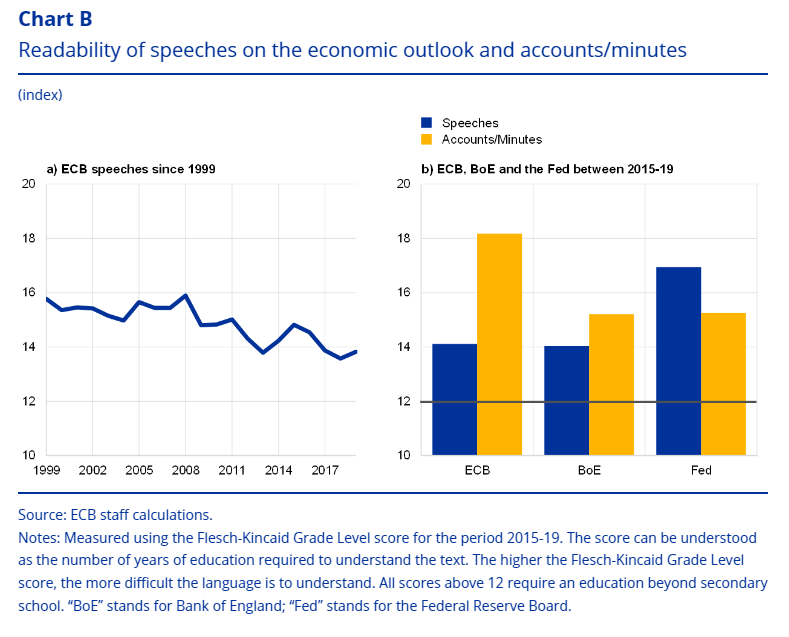
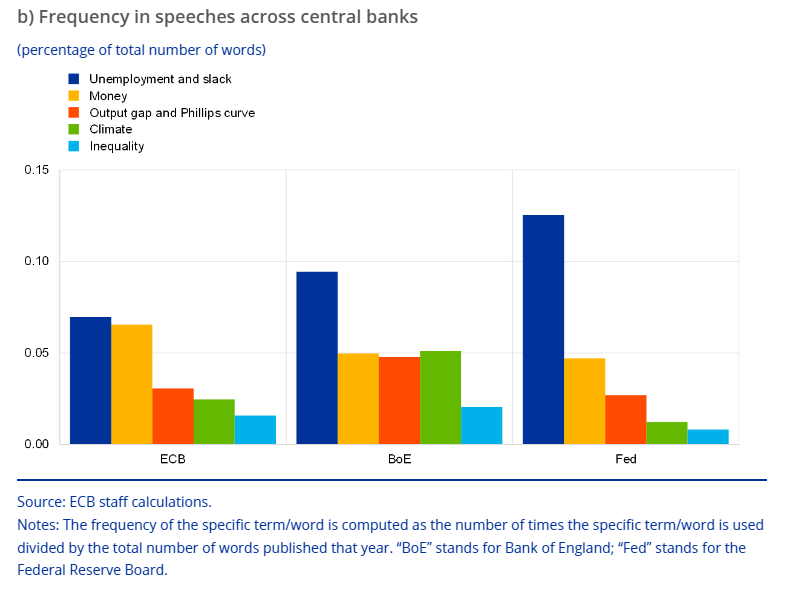
To close this, a couple of neat graphs from the European Central Bank. The first one shows a measure of central bank messages’ clarity , the lower the number, the better. The second graph demonstrates the frequency (a proxy for significance) of some buzzwords. As old Korean masters comment when comparing various strands of their art, the major central banks are “same, same, a little different“.
 Notes On Liberty