INDIA: A case study in the demise of representative democracy

India of 1947 had battled decades of colonialism to embrace self-rule. Whatever divisions seeped through party ranks, coalesced – and how beautifully – to fight for the right the people to a democracy. Having a common enemy helped. Compounded by the ability of the political leaders of that time to weave magic through words, connecting the plights of the millions to the queen-ship of one propelled movements across the breadth of the Indian subcontinent. While much has been said of the academic prowess as well as the oratory skills of the Founders, it was their ability to connect across barriers of identity that ultimately pushed the wheel. How dearly they protected their freedom of speech, expression and press is perhaps telling of the importance they assigned to being connected with those they had chosen to represent. How is it then that a deeply flawed election system and disjointed lines of public communication yielded one of the biggest civil disobedience movements the world had ever seen?

In terms of representation and reach, India 2018 is better abled than India 1947. And yet, it fell upon the unelected shoulders of four men and one woman to correct a deeply violent, colonial and bigoted law. The right to sexual identity was granted by five cis heterosexual individuals; the ones in need of representation reduced to being mere petitioners. India celebrated breaking off one more shackle, the Judiciary reveled in being the harbinger of liberal values to the Indian legal system yet one more time and the Parliament, as always, stayed mum. It is not that either of the institutions have embraced staunch anti/pro liberal positions. The Indian judiciary has its share of misogynists much like the Parliament. Misogyny is not illegal. But what is illegal is the Parliament’s distance from her electorate. Even if one were to contend that a majority of India does not support homosexuality, the increasing momentum of the movement should have propelled an informed debate within and without the Parliament. Instead, the government chose to not object to the petitions filed in favor of decriminalizing homosexuality as if that is the extent of the responsibility they owe to the LGBTQ community of the country. The distance between a judicial decriminalization of homosexuality and one done through a legislative device is the distance between a populist democracy and a representative one. The counter-majoritarian difficulty seems almost trivial when democratic institutions lose their representative character.

The biggest reason behind the rising legitimacy of an essentially non-democratic institution as the Judiciary is not a power grab by the Supreme Court judges. Howsoever activist they might get, the requirement of giving a reasoned decision tempers their emotions. The Indian Parliament, on the other hand, has come to rely on this increasing politicization of the judiciary to avoid political battles that might require concessions from their mostly unreasoned manifestos. The result is a lack of deliberation that is disturbingly dismal for a democracy as huge as India. The requirements of representation have come to be restricted to a periodical holding of elections. Members of Parliament are neither Burkean agents nor Pateman’s representatives. They are a political class unto themselves working towards a steady demise of the largest democracy in the world.

The Incomplete Counterfactual Fallacy

Mariana Mazzucato has some interesting ideas, but her basic thesis (which I’m guessing based only on her recent Freakonomics interview) forgets a simple fact: had the government not made GPS, not only would we not have GPS, resources would have been allocated somewhere else.

In other words, she’s right that without government involvement we’d miss all sorts of valuable things like the basic research it turns out government has financed, physical infrastructure (no matter how neglected), GPS, the specific form the Internet we got, etc., etc.

But that’s only half the story. What happens if DARPA closes shop just before starting on GPS? Those engineers end up somewhere else, the money for the project goes somewhere else, the steel and titanium for the satellites they would have built end up in some other shop.

If we could know that nothing else would have happened at that point, then GPS is a free lunch–some bold committee scooped up a handful of clay, handed it to brilliant engineers, and created something from nothing.

More likely some of those engineers would have made dozens of other projects a little bit better, and one or two of them might even have, through some series of unpredictable events, ended up creating some totally different innovation that would have put us on to an entirely different path.

Which is the better path? There’s no way to know. The people on that other path exist in a completely different paradigm from our own. It’s comparing meta-apples with meta-oranges. We are where we are and we ought to appreciate all the costs and benefits of the system we’ve inherited. I think Mazzucato is right that many of us have underrated the government. (Certainly 23-year-old-Rick was guilty of the over-complete counterfactual fallacy.)

She makes a compelling argument that Solyndra doesn’t look like such a boondoggle when you take the wider view we would expect of the smallest venture capital investor. But if it’s true that pointing at government failures is invalid, then so is pointing at government success.

What’s important is improving the future performance of our current institutional mess. To do that, I think we’re better off backing away from her broad claims and focusing on her more sensible (and jarring) arguments about how the current system encourages destructive rent seeking through intellectual property protection of basic research that might be better left in the public domain.

Are Swedish University Tuitions Fees Really Free?

University tuition fees are always popular talking points in politics, media, and over family dinner tables: higher education is some kind of right; it’s life-changing for the individual and super-beneficial for society, thus governments ought to pay for them on economic as well as equity grounds (please read with sarcasm). In general, the arguments for entirely government-funded universities is popular way beyond the Bernie Sanders wing of American politics. It’s a heated debate in the UK and Australia, whose universities typically charge students tuition fees, and a no-brainer in most Scandinavian countries, whose universities have long had up-front tuition fees of zero.

Many people in the English-speaking world idolize Scandinavia, always selectively and always for the wrong reasons. One example is the university-aged cohort enviously drooling over Sweden’s generous support for students in higher education and, naturally, its tradition of not charging tuition fees even for top universities. These people are seldom as well informed about what it actually means – or that costs of attending university is probably lower in both England and Australia. Let me show you some vital differences between these three countries, and thereby shedding some much-needed light on the shallow debate over tution fees:

The entire idea with university education is that it pays off – not just socially, but economically – from the individual’s point of view: better jobs, higher lifetime earnings or lower risks of unemployment (there’s some dispute here, and insofar as it ever existed, the wage premium from a university degree has definitely shrunk over the last decades). The bottom line remains: if a university education increases your lifetime earnings and thus acts as an investment that yield individual benefits down the line, then individuals can appropriately and equitably finance that investment with debt. As an individual you have the financial means to pay back your loan with interest; as a lender, you have a market to earn money – neither of which is much different from, say, a small business borrowing money to invest and build-up his business. This is not controversial, and indeed naturally follows from the very common sense principle that those who enjoy the benefits ought to at least contribute towards its costs.

Another general reason for why we wouldn’t want to artificially price a service such as university education at zero is strictly economical; it bumps up demand above what is economically-warranted. University educations are scarce economic goods with all the properties we’re normally concerned about (has an opportunity cost in its use of rivalrous resources, with benefits accruing primarily to the individuals involved in the transaction), the use and distribution of which needs to be subject to the same market-test as every other good. Prices serve a socially-beneficial purpose, and that mechanism applies even in sectors people mistakenly believe to be public or social, access to which forms some kind of special “human right.”

From a political or social-justice point of view, such arguments tend to carry very little weight, which is why the funding-side matters so much. Because of debt-aversion or cultural reasons, lower socioeconomic stratas of societies tend not to go to university as much as progressives want them to – scrapping tuition fees thus seems like a benefit to those sectors of society. When the financing of those fees come out of general taxation however, they can easily turn regressive in their correct economic meaning, disproportionately benefiting those well off rather than the poor and under-privileged they intended to help:

The idea that graduates should make no contribution towards the tertiary education they will significantly benefit from it, while expecting the minimum wage hairdresser in Hull, or waiter in Wokingham to pick up the bill by paying higher taxes (or that their unborn children and grandchildren should have to pay them due to higher borrowing) is highly regressive.

Although not nearly enough people say it, university is not for everyone. The price tag confronts students, who perhaps would go to university to fulfill an expectation rather than for any wider economic or societal benefit, with a cost as well as a benefit of attending university.

Having said that, I suggest that attending university is probably more expensive in your utopian Sweden than in England or Australia. The two models these three countries have set up look very different at first: in Sweden the government pays the tuition and subsidies your studies; in England and Australia you have to take out debt in order to cover tuition fees. A cost is always bigger than no cost – how can I claim the reverse?

With the following provision: Australian and English students don’t have to pay back their debts until they earn above a certain income level (UK: £18,330; Australia: $55,874). That is, those students whose yearly earnings never reach these levels will have their university degree paid for by the government regardless. That means that the Scandinavian and Anglophone models are almost identical: no or low costs accrue for students today, in exchange for higher costs in the future provided you earn enough income. Clearly, paying additional income taxes when earning high incomes but not on low incomes (Sweden) or paying back my student debt to the government only if I earn high incomes rather than low (England, Australia) amounts to the same thing. Changing the label of a financial transfer from the individual to the government from “debt-repayment” to “tax” has very little meaning in reality.

In one way, the Aussie-English system is somewhat more efficient since it internalises costs to only those who benefited from the service rather than blanket taxing everyone above a certain income threshold: it allows high-income earners who did not reach such financial success from going to university to avoid paying the general penalty-tax on high-incomes that Swedish high-earners do.

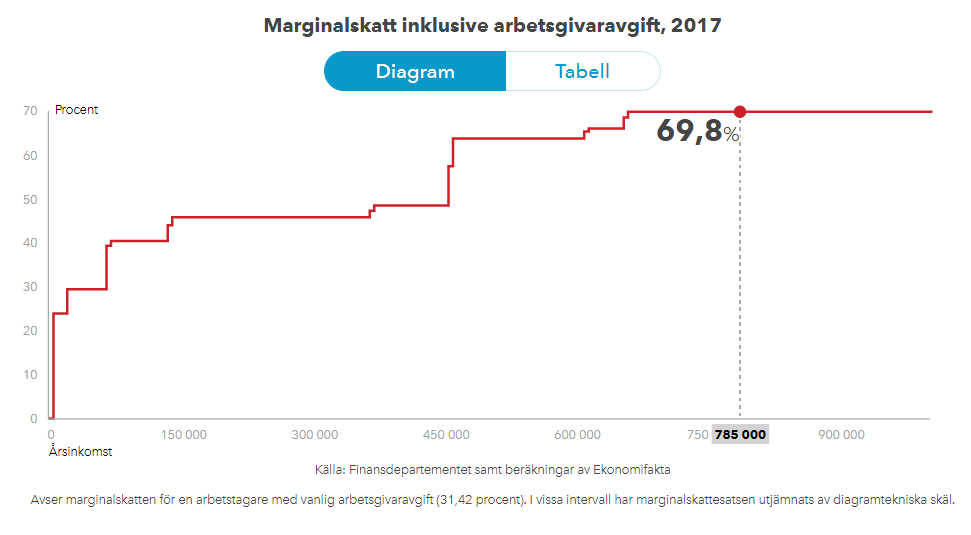
Let me show the more technical aspect: In England, earning above £18,330 places you at a position in the 54th percentile, higher than the majority of income-earners. Similarly, in Australia, $55,874 places you above 52% of Aussie income-earners. For Sweden, with the highest marginal income taxes in the world, a similar statistics is trickier to estimate since there is no official cut-off point above which you need to repay it. Instead, I have to estimate the line at which you “start paying” the relevant tax. What line is then the correct one? Sweden has something like 14 different steps in its effective marginal tax schedule, ranging from 0% for monthly incomes below 18,900 SEK (~$2,070) to 69.8% for incomes above 660,000 SEK (~$72,350) or even 75% in estimations that include sales taxes of top-marginal taxes:


If we would place the income levels at which Australian and English students start paying back the cost of their university education, they’d both find themselves in the middle range facing a 45.8% effective marginal tax – suggesting that they would have greatly exceeded the income level at which Swedish students pay back their tuition fees. Moreover, the Australian threshold would exchange into 367,092 SEK as of today, for a position in the 81st percentile – that is higher than 81% of Swedish income-earners. The U.K., having a somewhat lower threshold, converts to 217,577 SEK and would place them in the 48th percentile, earning more than 48% of Swedish income-earners – we’re clearly not talking about very poor people here.

The fact that income-earners in Sweden face a much-elevated marginal tax schedule as well as the simplified calculations above do indicate that despite its level of tuition fees at zero, it is more expensive to attend university in Sweden than it is in England or Australia. Since Australia’s pay-back threshold is so high relative to the income distribution of Sweden (81%), it’s conceivably much cheaper for Australian students to attend university than for it is for Swedish students, even though the tuition list prices may differ (the American debate is much exaggerated precisely because so few people pay the universities’ official list prices).

Letting governments via general taxation completely fund universities is a regressive measure that probably hurts the poor more than it helps the rich. The solution to this is not some quota-scholarships-encourage-certain-groups-version but rather to a) increase and reinstate tuition fees where applicable or b) cut government funding to universities, or ideally get government out of the sector entirely.

That’s a progressive policy in respect to universities. Accepting that, however, would be anathema for most people in politics, left and right.

We have seen the algorithm and it is us.

The core assumption of economics is that people tend to do the thing that makes sense from their own perspective. Whatever utility function people are maximizing, it’s reasonable to assume (absent compelling arguments to the contrary) that a) they’re trying to get what they want, and b) they’re trying their best given what they know.

Which is to say: what people do is a function of their preferences and priors.

Politicians (and other marketers) know this; the political battle for hearts and minds is older than history. Where it gets timely is the role algorithms play in the Facebookification of politics.

The engineering decisions made by Facebook, Google, et al. shape the digital bubbles we form for ourselves. We’ve got access to infinite content online and it has to be sorted somehow. What we’ve been learning is that these decisions aren’t neutral because they implicitly decide how our priors will be updated.

This is a problem, but it’s not the root problem. Even worse, there’s no solution.

Consider one option: put you and me in charge of regulating social media algorithms. What will be the result? First we’ll have to find a way to avoid being corrupted by this power. Then we’ll have to figure out just what it is we’re doing. Then we’ll have to stay on top of all the people trying to game the system.

If we could perfectly regulate these algorithms we might do some genuine good. But we still won’t have eliminated the fundamental issue: free will.

Let’s think of this through an evolutionary lens. The algorithms that survive are those that are most consistent with users’ preferences (out of acceptable alternatives). Clickbait will (by definition) always have an edge. Confirmation bias isn’t going away any time soon. Thinking is hard and people don’t like it.

People will continue to chose news options they find compelling and trustworthy. Their preferences and priors are not the same as ours and they never will be. Highly educated people have been trying to make everyone else highly educated for generations and they haven’t succeeded yet.

A better approach is to quit this “Rock the Vote” nonsense and encourage more people to opt for benign neglect. Our problem isn’t that the algorithms make people into political hooligans, it’s that we keep trying to get them involved under the faulty assumption that people are unnaturally Vulcan-like. Yes, regular people ought to be sensible and civically engaged, but ought does not imply can.

Eye Candy: garbage versus trash (American dialects)

NOL garbage versus trash USA

I’ve always said “garbage,” but down here in Texas they use the word “trash.” I have no idea where I found this, and I can’t verify the source, but it looks right to me.

Any contrary arguments about this map?

A Millennial’s New Perspective on Home Ownership

The last few years I’ve loudly protested that home ownership is overrated; it’s a bad investment plus lots of responsibility. And yet, this summer my fiance and I bought a 100 year old house on the south shore of Long Island.

Yes, I have lost my mind.

I basically stand by my earlier position, but with greater nuance. Owning a home is a complicated undertaking. But it’s given me a greater appreciation for the nuance involved in managing real estate.

Home ownership is a great big Gordian knot of inter-dependencies. It’s massive set of knowledge problems wrapped in externality problems.There’s a massive role for local knowledge which means policy makers’ attention should be less focused on things like home ownership rates, and more on guiding the right people into the right places to take advantage of that local knowledge.

With local knowledge comes local politics. I don’t know anything about local politics, but expect more posts about what’s going on in my town hall over the next few decades.

So what have I learned in this first month of home ownership?

  • There’s something to be said about pride in ownership

It’s still a real trip to turn on my lights in my kitchen so I can do my laundry in my laundry machines. I didn’t think I’d enjoy it this much. The endowment effect is real. One effect has been to increase my interest in contributing to local public goods via civic engagement and other routes.

I haven’t been to a town hall meeting yet, but I plan on going to one tomorrow. I suspect it will be awful. But I’m walking distance, so I’ll be a little bit drunk.

  • The real estate market has some serious frictions

This might be obvious, but it’s interesting. There are artificial and natural obstacles to the efficient use of real estate. Transaction costs are significant and property rights issues are hairy.

Buying a house is a complicated transaction and going through the process has really made clear to me how difficult it is to commodify land. Each piece of land has a unique location and history. Information asymmetries are substantial. The neighborhood you’re buying into is utterly out of your control. Put simply: Amazon won’t be selling real estate any time soon.

Part of the reason I’m happy with buying a house is that our rent had been increasing about $100/month/year. Land lords absolutely take advantage of real estate frictions to charge as much as they can. The alternative (which I chose) is to lock-in to a specific property.

  • The required knowledge to operate a home is significant and difficult to evaluate.

It takes a lot of knowledge to manage a house. If I were to take a wild guess (at this non-quantifiable variable), I’d say that between 5% and 50% of a homeowner’s brain is necessary to operate a house. Even if you bring in experts to do everything, evaluating those experts is a lot of work.

There are repairs and upgrades to make, and my formal education prepared me for exactly none of those projects. On the other hand, I’ve got the Internet. Without YouTube and Reddit I’d be a half dozen unlucky mistakes away from homelessness.

On the other other hand, I’ve learned a ton of stuff I’ve got no use for. Like how to grow asparagus (which it turns out it isn’t worth doing except out of boredom).

You can’t evaluate knowledge until it’s too late. And there’s more to learn than you ever will, so you have to make mistakes. It’s true of home ownership and it’s true of life more generally.

  • Gardening is a real trip.

In History of Economic Thought professor Gonzalez shared a story about two economists meeting in Switzerland during WWII. On showing his vegetable garden to the visiting economist, the visitor said “that’s not a very efficient way to grow food,” to which the gardener said, “yes, but it’s a very efficient way to grow utility.”

I’ve wanted to garden for some time, but the market for gardens is thin. So now I’m starting with almost no useful experience. My public stance has been that lawns are boring and dumb. But figuring out how to manage a little ecosystem ain’t easy. I now get why someone would just put in a lawn and be done with it.

At my old apartment complex the entire ecosystem was made of: humans, trees, lawns, cockroaches. I suspect the cockroaches did so well because all their competition was poisoned away. As an emergent order guy, I’m not really into that. But I get it now. In the same way the king wants everyone living in neat little taxable rows my life would be easier if I could just slash and burn all the complexity out of my yard.

Tl;dr: My biggest surprise as a new home owner is just how big a cognitive load owning a house is. You hear homeowners talk about how much work it can be, but I think it’s rare to hear someone talk about how much know-how is required.

Given the capacity to generate externalities, I’m a bit surprised that there isn’t more public policy devoted to issues of home ownership* (beyond subsidizing finance and increasing barriers to entry). I supposed I’ll learn a lot more about these issues as I learn about local politics.

*That isn’t to say I think it’s a good idea to get the government involved in trying to tell people how to go about the business of daily life. I think homeowners are (basically) doing fine left to their own devices.

The State and education – Part IV: Conclusion

On August 17, 2018, the BBC published an article titled “Behind the exodus from US state schools.” After taking the usual swipes at religion and political conservatism, the real reason for the haemorrhage became evident in the personal testimony collected from an example mother who withdrew her children from the public school in favour of a charter school:

I once asked our public school music teacher, “Why introduce Britney Spears when you could introduce Beethoven,” says Ms. Helmi, who vouches for the benefits to her daughters of a more classical education.

“One of my favourite scenes at the school is seeing a high-schooler playing with a younger sibling and then discussing whether a quote was from Aristotle or Socrates.”

The academic and intellectual problems with the state school system and curriculum are perfectly encapsulated in the quote. The hierarchy of values is lost, not only lost but banished. This is very important to understand in the process of trying to safeguard liberty: the progenitors of liberty are not allowed into the places that claim to incubate the supposed future guardians of that liberty.

In addition to any issues concerning academic curricula, there is the problem of investment. One of the primary problems I see today, especially as someone who is frequently asked to give advice on application components, such as résumés and cover letters/statements of purpose, is a sense of entitlement vis-à-vis institutional education and the individual; it is a sense of having a right to acceptance/admission to institutions and career fields of choice. In my view, the entitlement stems from either a lack of a sense of investment or perhaps a sense of failed investment.

On the one hand as E.S. Savas effectively argued in his book Privatization and Public-Private Partnerships, if the state insists on being involved in education and funding institutions with tax dollars, then the taxpayers have a right to expect to profit from, i.e. have a reasonable expectation that their children may be admitted to and attend, public institutions – it’s the parents’ money after all. On the other hand, the state schools are a centralized system and as such in ill-adapted to adjustment, flexibility, or personal goals. And if all taxpayers have a right to attend a state-funded institution, such places can be neither fully competitive nor meritocratic. Additionally, Savas’ argument serves as a reminder that state schooling is a manifestation of welfarism via democratic socialism and monetary redistribution through taxation.

That wise investing grants dividends is a truth most people freely recognize when discussing money; when applied to humans, people start to seek caveats. Every year, the BBC runs a series on 100- “fill-in-the-blank” people – it is very similar to Forbes’ lists of 30 under 30, top 100 self-made millionaires, richest people, etc. Featured on the BBC list for 2017 was a young woman named Camille Eddy, who at age 23 was already a robotics specialist in Silicon Valley and was working to move to NASA. Miss Eddy’s article begins with a quote: “Home-schooling helped me break the glass ceiling.” Here is what Eddy had to say about the difference between home and institutional schooling based on her own experience:

I was home-schooled from 1stgrade to high school graduation by my mum. My sister was about to start kindergarten, and she wanted to invest time in us and be around. She’s a really smart lady and felt she could do it.

Regarding curriculum choices, progress, and goals:

My mum would look at how we did that year and if we didn’t completely understand a subject she would just repeat the year. She focused on mastery rather than achievement. I was able to make that journey on my own time.

And the focus on mastery rather than achievement meant that the latter came naturally; Eddy tested into Calculus I her first year at university. Concerning socialization and community – two things the public schools pretend to offer when confronted with the fact that their intellectual product is inferior, and their graduates do not achieve as much:

Another advantage was social learning. Because we were with mum wherever she went we met a lot of people. From young to old, I was able to converse well with anyone. We had many friends in church, our home-school community groups, and even had international pen pals.

When I got to college I felt I was more apt to jump into leadership and talk in front of people because I was socially savvy.

On why she was able to “find her passion” and be an interesting, high-achieving person:

And I had a lot of time to dream of all the things I could be. I would often finish school work and be out designing or engineering gadgets and inventions. I did a lot of discovery during those home-school years, through documentaries, books, or trying new things.

In the final twist to the plot, Camille Eddy, an African-American, was raised by a single mother in what she unironically describes as a “smaller town in the US” where the “cost of living was not so high.” What Eddy’s story can be distilled to is a parent who recognized that the public institutions were not enough and directly addressed the problem. All of her success, as she freely acknowledges, came from her mother’s decision and efforts. In the interest of full honesty, I should state that I and my siblings were home-schooled from 1stgrade through high school by parents who wanted a full classical education that allowed for personal growth and investment in the individual, so I am a strong advocate for independent schooling.

There is a divide, illustrated by Eddy’s story, created by the concept of investment. When Camille Eddy described her mother as wanting “to invest time in us and be around,” she was simply reporting her mother’s attitude and motivation. However, for those who aspire to have, or for their children to attain, Eddy’s achievements and success, her words are a reproach. What these people hear instead is, “my mother cared more about me than yours cared about you,” or “my mother did more for her children than you have done for yours.” With statements like Eddy’s, the onus of responsibility for a successful outcome shifts from state institutions to the individual. The responsibility always lay with the individual, especially vis-à-vis public education since it was designed at the outset to only accommodate the lowest common denominator, but, as philosopher Allan Bloom, author of The Closing of the American Mind,witnessed, ignoring this truth became an overarching American trait.

There are other solutions that don’t involve cutting the public school out completely. For example: Dr. Ben Carson’s a single-, working-mother, who needed the public school, if only as a babysitter, threw out the TV and mandated that he and his brother go to the library and read. As a musician, I know many people who attended public school simply to obtain the requisite diploma for conservatory enrollment but maintain that their real educations occurred in their private preparation – music training, especially for the conservatory level, is inherently an individualistic, private pursuit. But all the solutions start with recognizing that the public schools are inadequate, and that most who have gone out and made a success of life in the bigger world normally had parents who broke them out of the state school mould. In the case of Dr. Carson’s mother, she did not confuse the babysitter (public school) with the educator (herself as the parent).

The casual expectation that the babysitter can also educate is part of the entitlement mentality toward education that is pervasive in American society. The mentality is rather new. Allan Bloom described watching it take hold, and he fingered the Silent Generation – those born after 1920 who fought in World War II; their primary historical distinction was their comparative lack of education due to growing up during the Great Depression and their lack of political and cultural involvement, hence the moniker “silent”[1]– as having raised their children (the Baby Boomers) to believe that high school graduation conferred knowledge and rights. As a boy Bloom had had to fight with his parents in order to be allowed to attend a preparatory school and then University of Chicago, so he later understandably found the entitlement mentality of his Boomer and Generation X students infuriating and offensive. The mental “closing” alluded to in Bloom’s title was the resolute refusal of the post-War generations either to recognize or to address the fact that their state-provided educations had left them woefully unprepared and uninformed.

To close, I have chosen a paraphrase of social historian Neil Howe regarding the Silent Generation, stagnation, and mid-life crises:

Their [Gen X’s] parents – the “Silent Generation” – originated the stereotypical midlife breakdown, and they came of age, and fell apart, in a very different world. Generally stable and solvent, they headed confidently into adult lives about the time they were handed high school diplomas, and married not long after that. You see it in Updike’s Rabbit books – they gave up their freedom early, for what they expected to be decades of stability.

Implicit to the description of the Silent Generation is the idea, expressed with the word “handed,” that they did not earn the laurels on which they built their futures. They took an entitlement, one which failed them. There is little intrinsic difference between stability and security; it is the same for freedom and liberty. History demonstrates that humans tend to sacrifice liberty for security. Branching out from education, while continuing to use it as a marker, we will look next at the erosive social effect entitlements have upon liberty and its pursuit.


[1]Apparently to be part of the “Greatest Generation,” a person had to have been born before or during World War I because, according to Howe, the Greatest Generation were the heroes – hero is one of the mental archetypes Howe developed in his Strauss-Howe generational theory – who engineered the Allied victory; the Silent Generation were just cogs in the machine and lacked the knowledge, maturity, and experience to achieve victory.

Between anarchy and minarchism

While sometimes we think of ideologies in strict terms of left and right, more and more frequently we look at political schemas that incorporate a dimension for statism. Big government is possible for both conservatives and progressives; so, maybe, is minarchy. If minarchy is possible, and achievable, it must attain popular support less it be thwarted by revolution or contrarian voting. From this, maybe it makes sense that a minarchism utilize fundamental values from each side, in order to be pragmatic and achieve democratic (and thereby maybe stable) ends. Here there may even be room for an ultraminarchy.

In Anarchy, State and Utopia, Robert Nozick defended a minimal state slightly more restrained than traditional classical liberalism. This minimal state arises through natural market forces from statelessness, and serves to enforce contracts and produce monopolistic law. Nozick, although countering his fellow Harvard academic Rawls, was also responding to the natural law anarchists, who criticized coercive states for violating human rights — which, in the American tradition, often boil down to rights of property and self-ownership.

However, before arriving at the minimal, night-watchman state, Nozick articulates an ultraminimal state, i.e. a private protection agency that claims exclusionary right over the use of force for a given geographical area. It has its voluntary clients; the extension of coverage to others makes the agency a “state” as it introduces taxation.

In ASU the state is an entity formed from an invisible hand to produce heavily right-libertarian functions of government like protecting negative rights. Because of this, the minarchist state was a refuge for archist libertarians to claim as their own, relatively consistent with centuries of Western liberal thought. Accordingly, in response, the anarchists question the viability of a lasting minimal state — cue David Friedman in Machinery of Freedom:

“It took about 150 years, starting with a Bill of Rights that reserved to the states and the people all powers not explicitly delegated to the federal government, to produce a Supreme Court willing to rule that growing corn to feed to your own hogs is instate commerce and can therefore be regulated by Congress.”

Government grows; modern government grows really, really fast. Minimalism hasn’t seemed to last. So the question is, what sorts of minimal governance could last?

The traditional ultraminimal and minimal state are concerned with, as stated, traditionally libertarian public functions such as police, the judiciary, and possibly roads and maybe even national defense. The problem with these utilities is that they feel wildly inadequate to the modern American used to entitlements, welfare, or, e.g., a president. The privatization of nearly all federal departments — even when their failures are widely acknowledged — is seen as wild enough for John Oliver to entertain millions of viewers, at the blight of Gary Johnson, and make hardcore eliminativism a losing electoral program. The contemporary world is too complicated, or our enemies are too powerful, or the market is too corrupt for the reinstitution of laissez-faire in the 21st century.

Nevertheless we want a smaller government, or no government, and losing to the tide isn’t a good death; we’d rather fight, and we’d rather win. A lasting minarchism satisfies the broad purposes of limited governance — basic liberty, protection, and preserving the benefits of the market — while sufficiently completing modern democratic demands, lest it erode into statism or collapse internally. (Keep in mind that statelessness, at least this week, is not a winning platform.)

Here’s what I think lies between anarchism and minarchism: the redistributive state. We can make a couple assumptions which I think are likely true: (1) every public service, including public goods, currently monopolized by the state could be provided (and, maybe, could be provided better) by the market and non-coercive communities instead, and (2) the entitlement theory of distributive justice offered by Nozick is correct, i.e. holdings are just if acquired by peaceful initial acquisition, voluntary exchange or gifting, or rectification of a previous unjust acquisition. Taking these assumptions, and leveraging the fact that the American populace will not currently settle for brutalist governance, the redistributive state (RS) seeks only to collect tax revenues and redistribute money progressively.

Instead of offering vouchers, EBT, or public options like housing, schools, security and roads, a RS would only tax its citizens and reallocate revenue based on some progressive variables like income, net worth or consumption. (These details are less important, for now.) The only administration is something like an Internal Revenue Service, Census Bureau, and investigation unit suffused together, with over ninety-five percent of the current staff eliminated, with tax escapees adjudicated through non-state means.

An RS violates rights based on a Lockean or Kantian conception; it also does something which sounds pretty socialist to right-wing circles. For this reason, though minarchist, it may not be libertarian. However, the pragmatic element is also very utilitarian and liberal, which may interest bleeding-hearts; and, being essentially one big welfare program, it may intrigue American leftists currently eyeing a state takeover of health care and socialized education. We would do well to keep in mind that Friedrich Hayek and Milton Friedman were not averse to basic income either — a redistributive state operates a universal basic allowance and abandons the productive functions of the state. I think it is generally clear that, in a situation where we are already giving a person $X in the illiquid form of schools, transfer payments, utilities, roads, defense, firefighters, social planning, arts, retirement investing, mail service, etc., instead we should just give that person $X to spend however they see fit, to reap more competitive pressure from consumer exposure to prices and to align their dollars with their own individual values. If anyone disagrees, they might be too top-down to consider minarchism in any scenario.

The RS has many benefits over our current, vague understanding of contemporary government. In the first case, the reductionist perspective of right-wing anarchists, such as the stationary bandits theory, is validated, and a lot of the mysterious machinery and ivory-tower political philosophy is dissolved. Some of the bright spots of recent cameral formalist thought are validated, too, without the unpleasant baggage. (And armchair philosophizing about the Rousseauian general will is finally put to rest.) And, for the Marxists, their critique of the state as a tool of the capitalist class, which is true enough, is answered, since the state now greatly serves labor more than capital: some of the income of the upper classes is directly confiscated from them and allocated to the lower classes. Also, the state ceases to be paternalistic — it no longer chooses what food is available through SNAP, or issues health and safety warnings; it just straight-up hands out the money without assuming value for consumers. It doesn’t determine what is taught in schools, or what color the roads are, or which country gets bombed on Tuesday.

Perhaps most popularly, the RS has the potential to all but eliminate bureaucracy. With one small administrative branch which functions like a hyper-specialized agency, there is little room or need for massive proliferation and government by permanent staffers, where we find ourselves now. Likely, all seats will be elected positions along with some underlings, with the marginal tax brackets pre-established constitutionally and open to a similar amendment process. But, that can all be figured out later.

Now, there are some obvious flaws for an RS. First of all, the very wealthy, prima facie, have little incentive to stay in a redistributive state. Their money is seized and without tangible benefit for themselves, like roads or security. They have to buy those things on their own dime. The redistributive state is the antithesis of Galt’s Gulch. The primary answer to this I can think of is that, in a society with less state omnipotence (in contrast to today, where everyone’s first answer to a problem starts with a “g”) community ties will be closer — the rich will want to pay their “fair share.” This is the Hoppean trust in private charity, except that it’s now “forced private” charity. Also, taxes would be much, much lower than the current situation and hopefully tolerable. The taxes are also going directly to other citizens instead of politician’s wallets, oil tycoons, and potassium chloride. Furthermore, they’re paying to live in — the government still has a coercive and unjustified monopoly on land — the freest nation in the world. An RS is significantly freer than the other statist regimes, and less stressful. Government plays no role at all in everyday life.

One other flaw — maybe an inherent flaw of government brightly illuminated by a raw redistributive state — is what Murray Rothbard saw as an eternal tension between net tax-payers and net tax-consumers. To the extent that the RS administration is elected, and to the extent that politicians have platforms, a lot rests on whether or not taxes will be raised (read: redistribution will increase) or not. The left will continually be concerned with income inequality, regardless of whether or not everyone is well-off. The goalposts might keep climbing, to where taxation is no longer about fairness or the difference principle, but about punishment. At the same time, dialectically, the very wealthy will want to keep the maximum amount of their money and protect profit, regardless of my arguments above. Raw societal tensions like these probably require a dynamic form of governance, with fluctuations in party dominance, but the RS is too brutalist to feature such parties or other contrivances. The only hope here, I guess, is that the tension will be less than in the current system we have, where people openly talk about murdering the other party. And very likely it will be. (Also, the market will correct much of the gratuitous wealth disparity presently built upon rent-seeking — so it becomes an empirical question about what levels of inequality create what levels of tension, as there will be large inequality in any non-patterned system of holdings.)

In conclusion, a redistributive state would be baldly organized around theft (in a libertarian interpretation) and using people as means rather than ends. To that extent it is hardly libertarian. It achieves Nozick’s end of minimal government but distorts the typical functions we correlate with small government. Still, it’s ultraminarchical, preserves innovation, balances right-wing virtues like liberty and industry and left-wing virtues like equality and positive freedom, and, for a radical populace not quite keen on revolution, has the potential to be politically attractive. It serves welfarist functions demanded by 21st century citizens without the corporatist empire of the present. Also, no one starves. For all of this, even if a redistributive state is not perfection incarnate, it seems far better than the current system, and provides a culturally-celibate political framework to possibly achieve success in totally disparate societies from the United States. I think it’s a useful, radical place to look for bipartisan solutions to a complicated and overwhelmingly statist world.

I’m pretty sure I’m the first one to suggest a state organized baldly and singularly around redistribution of private income, either because it’s too stupid or it’s too grossly unattractive, so I welcome all feedback. But, if voluntarist alternatives are possible at all, this implies all the state is is a redistributor anyway. The idea of an RS just accepts this conclusion and makes it efficient. Keep in mind I haven’t elaborated on the many complications of UBI, which is an entire field to articulate more extensively, and which has its own numerous difficulties. For now the only question is would this form of government be possible.

The Real Cost of National Health Care

Around early August 2018, a research paper from the Mercatus Center at George Mason University by Charles Blahous made both the Wall Street Journal and Fox News within two days. It also attracted attention widely in other media. Later, I thought I heard sighs of satisfaction from conservative callers on talk show radio whenever the paper came up.

One figure from the study came and stayed at the surface and was quoted correctly many times (rare occurrence) in the electronic media. The cost of what Senator Sanders proposed with respect to national health care was:

30 trillion US dollars over ten years (actually, 32.6 over thirteen years).

This enormous number elicited pleasure among conservatives because it seemed to underscore the folly of Senator Bernie Sanders’ call for universal healthcare. It meant implicitly, federal, single-payer, government-organized health care. It might be achieved simply by enrolling everyone in Medicare. I thought I could hear snickers of relief among my conservative friends because of the seeming absurdity of the gigantic figure. I believe that’s premature. Large numbers aren’t always all they appear to be.

Let’s divide equally the total estimate over ten years. That’s three trillion dollars per year. It’s also a little more than $10,000 per American man, woman, child, and others, etc.

For the first year of the plan, Sanders’ universal health care amounts to 17.5% of GDP per capita. GDP per capita is a poor but not so bad, really, measure of production. It’s also used to express average gross income. (I think that those who criticize this use of GDP per capita don’t have a substitute to propose that normal human beings understand, or wish to understand.) So it’s 17.5% of GDP/capita. The person who is exactly in the middle of the distribution of American income would have to spend 17.5% of her income on health care, income before taxes and such. That’s a lot of money.

Or, is it?

Let’s imagine economic growth (GDP growth) of 3% per years. It’s optimistic but it’s what conservatives like me think is a realistic target for sustained performance. From 1950 to 1990, GDP per capita growth reached or exceeded 3% for almost all years. It greatly exceeded 3% for several years. I am too lazy to do the arithmetic but I would be bet that the mean annual GDP growth for that forty-year period was well above 3%. So, it’s realistic and probably even modest.

At this 3% growth rate, in the tenth year, the US GDP per capita will be $76.600. At that point, federal universal health care will cost – unless it improves and thus becomes more costly – 13% of GDP per capita. This sounds downright reasonable, especially in view of the rapid aging of the American population.

Now, American conservative enemies of nationalized health care are quick to find instances of dysfunctions of such healthcare delivery systems in other countries. The UK system was the original example and as such, it accumulated mistakes. More recently, we have delighted in Canadian citizens crossing the border for an urgent heart operation their nationalized system could not produce for months: Arrive on Friday evening in a pleasant American resort. Have a good but reasonable dinner. Check in Sat morning. Get the new valve on Monday; back to Canada on Wednesday. At work on the next Monday morning!

The subtext is that many Canadians die because of a shortage of that great free health care: It nice if you can get it, we think. Of course, ragging on the Canadians is both fair and endlessly pleasant. Their unfailing smugness in such matters is like a hunting permit for mental cruelty!

In fact, though, my fellow conservatives don’t seem to make much of an effort to find national health systems that actually work. Sweden has one, Denmark has one; I think Finland has one; I suspect Germany has one. Closer to home, for me, at least, France has one. Now, those who read my blogging know that I am not especially pro-French or pro-France. But I can testify to a fair extent that the French National Healthcare works well. I have used it several times across the past fifty years. I have observed it closely on the occasion of my mother’s slow death.

The French national health system is friendly, almost leisurely, and prompt in giving you appointments including to specialists. It tends to be very thorough to the point of excessive generosity, perhaps. Yes, but you get what you pay for, I can hear you thinking – just like a chronically pessimistic liberal would. Well, actually, Frenchmen live at least three years longer on the average than do American men. And French women live even longer. (About the same as Canadians, incidentally.)

Now, the underlying reasoning is a bit tricky here. I am not stating that French people live longer than Americans because the French national healthcare delivery system is so superior. I am telling you that whatever may be wrong with the French system that escaped my attention is not so bad that it prevents the French from enjoying superior longevity. I don’t want to get here into esoteric considerations of the French lifestyle. And, no, I don’t believe it’s the red wine. The link between drinking red wine daily and cardiac good health is in the same category as Sasquatch: I dearly hope it exists but I am pretty sure it does not. So, I just wish to let you know that I am not crediting French health care out of turn.

The weak side of the French system is that it remunerates doctors rather poorly, from what I hear. I doubt French pediatricians earn $222,000 on the average. (Figure for American pediatricians according to the Wall Street Journal 8/17/18.) But I believe in market processes. France the country has zero trouble finding qualified candidates for its medical schools. (I sure hope none of my current doctors, whom I like without exception, will read this. The wrong pill can so easily happen!)

By the way, I almost forgot to tell you. Total French health care expenditure per person is only about half as high as the American. Rule of thumb: Everything is cheaper in the US than in other developed countries, except health care.

And then, closer to home, there is a government health program that covers (incompletely) about 55 million Americans. It’s not really “universal” even for the age group it targets because one must have contributed to benefit. (Same in France, by the way, at least in principle.) It’s universal in the sense that everyone over 65 who has contributed qualifies. It’s not a charity endeavor. Medicare often slips the minds of critical American conservatives, I suspect, I am guessing, because there are few complaints about it.

That’s unlike the case for another federal health program, for example the Veterans’, which is scandal-ridden and badly run. It’s also unlike Medicaid, which has the reputation of being rife with financial abuse. It’s unlike the federally run Indian Health Service that is on the verge of being closed for systemic incompetence.

I suspect Medicare works well because of a large number of watchful beneficiaries who belong to the age group in which people vote a great deal. My wife and I are both on Medicare. We wish it would cover us 100%, although we are both conservatives, of course! Other than that, we have no complaints at all.

Sorry for the seeming betrayal, fellow conservatives! Is this a call for universal federal health care in America? It’s not, for two reasons. First, every country with a good national health system also has an excellent national civil service, France, in particular. I have no confidence, less than ever in 2018, that the US can achieve the level of civil service quality required. (Less in 2018 because of impressive evidence of corruption in the FBI and in the Justice Department, after the Internal Revenue Service).

Secondly, when small government conservatives (a redundancy, I know) attempt to promote their ideas for good government primarily on the basis of practical considerations, they almost always fail. Ours is a political and a moral posture. We must first present our preferences accordingly rather than appeal to practicality. We should not adopt a system of health delivery that will, in ten years, attribute the management of 13% of our national income to the federal government because it’s not infinitely trustworthy. We cannot encourage the creation of a huge category of new federal serfs (especially of well-paid serfs) who are likely forever to constitute a pro-government party. We cannot, however indirectly, give the government most removed from us, a right of life and death without due process.

That simple. Arguing this position looks like heavy lifting, I know, but look at the alternative.

PS I like George Mason University, a high ranking institution of higher learning that gives a rare home to conservative American scholars, and I like its Mercatus Center that keeps producing high-level research that is also practical.

Why Hayek was Wrong about American and European Conservatism IV

Continuing a discussion from here inspired by F.A. Hayek’s essay ‘Why I am Not a Conservative’.

One central claim of Hayek’s essay is that American conservatism is not the same as European conservatism, as it is rooted in the classical liberalism of the Declaration of Independence, the Constitution, and the Bill of Rights. He notes that ‘European’ style conservatism exists in the US but claims it is an artificial import that looks odd. A really big problem here is Hayek’s assumption that there are native national forms of political culture which are authentic compared with alien intrusions. Of course national context and tradition are important, but that should not conceal understanding of pluralism, emergence from the margins of positions that have always been there, change, and influences across national frontiers.

Hayek’s talk of odd looking imports into American conservatism may cover Russell Kirk and William Buckley, both major influences on American conservatism in second half of the twentieth century and their influence lingers in central parts of US conservatism. Buckley’s conservatism was connected with his traditionalist Catholics. The founders of the American Republic were Protestants and anti-Catholicism has been a significant force in the United States until well into the 20th century.

Hayek himself was a person without religious belief from a Catholic culture who attributed great importance to the Catholicism of Alexis de Tocqueville and David Acton (see my comments in last post). He considered naming the Mont Pelerin Society the Acton-Tocqueville society, apparently because of the role Catholics played in the German groups resisting Hitler. This is all very strange, as it was certainly not only Catholics who resisted Hitler and there is no need to name a free market institution after a British and a French Catholic to get support from German liberals. Even leaving that aside there is an extraordinary tangle here with regard to how American conservatism relates to American and European religious traditions, along with the question of where Hayek fits.

Kirk brought Burkean conservatism into the US, where Burke’s most famous critic, Thomas Paine (what we might now call a left libertarian), is more associated with the early republican heritage. Of course, as I have pointed out, Hayek was a big Burke fan. So we see another tangle about how to connect American conservatism with Europe. In general the imports into American conservatism come from sources Hayek liked, Catholicism (though he was an atheist as well as divorced and twice married), and Burke. What was Hayek’s presence at the University of Chicago or his impact on US conservatives and libertarians then? Hayek was very much a late Habsburg in character, not at all American.

I also question how far US conservatism can be seen as an outgrowth of classical liberalism – distinct from a supposed European conservatism tied to non-liberal tradition and slowing down change. An account of American conservatism must acknowledge paleoconservatism along with paleolibertarianism, which are both outgrowths of neo-Confederate thought idealising the slave-holding and then white supremacist societies of the southern states, turning Abraham Lincoln into a villain. There is also southern Agrarianism, an idealisation of southern rural society. Most significantly for party politics, there is the tradition which goes back to the Bourbon Democrats (that is southern pro-slavery and segregationist Democrats) which became the Old Right of the Republican Party from which Ron Paul emerged.

We cannot go very far in discussing American conservatism without running into nostalgia for pre-liberal societies and organicist rural tradition, which looks remarkably like traditionalist conservatism in Europe. The early foundational documents of the American Republic are great things, but do not in themselves stand in the way of local illiberal communities undisturbed by the federal state. This is how slavery and then Jim Crow (segregationism and white supremacism) survived.

The story of an American system with a truly individualist, equal rights way-of-thinking enforced by the federal state for all only really starts with Abraham Lincoln (main text here is the Gettysburg Address of course, which in essence advocates ‘a new birth of freedom’ as the transformation of the union of states into a democratic nation), followed by the 13th, 14th, and 15th amendments which abolished slavery, gave the Federal state a bigger role in enforcing constitutional protections, and created a federal guarantee for voting rights.

Sadly the triumph of southern ‘Redemption’ over Congressional Reconstruction after the Civil war prevented proper protection of basic rights for African-Americans until the 1960s. Of course most American conservatives now see the slavery and Jim Crow periods as the wrong kind of conservatism, based on a failure to apply the best parts of constitutional and natural law thinking.

There are many other aspects to American conservatism, the important point is to emphasise that significant parts of it have been based on traditionalist admiration for pre-liberal communities and the violent state imposition of social hierarchies (often accompanied by illegal violence tolerated, or even encouraged by the state) denying basic rights to humans of the wrong ‘race’. This has also influenced the more ‘paleo’ forms of libertarianism.

However many good things we can find in the US constitution, it was not applied so as to guarantee citizen and personal rights for all more than a century and a half after its adoption. Its initial design incorporated measures to allow the persistence of slavery. Whatever one might think about its proper meaning, the reality is that veneration for it was not a barrier to slavery or Jim Crow, along with many other abuses.

Hayek was no doubt sincere in wishing to distinguish his thought from conservatism and I certainly do not think his best insights can be applied within a conservative framework, but clearly he prefers conservatism to the more radical republican end of liberal thought (which did have an impact on some of the best moments in American politics) and it is not a surprise that conservatives have found it easy to digest a version of Hayek. Hayek’s thoughts about European conservatism are inadequate and he becomes stuck in an extraordinary tangle in his view of American conservatism.

Evidence-based policy needs theory

This imaginary scenario is based on an example from my paper with Baljinder Virk, Stella Mascarenhas-Keyes and Nancy Cartwright: ‘Randomized Controlled Trials: How Can We Know “What Works”?’ 

A research group of practically-minded military engineers are trying to work out how to effectively destroy enemy fortifications with a cannon. They are going to be operating in the field in varied circumstances so they want an approach that has as much general validity as possible. They understand the basic premise of pointing and firing the cannon in the direction of the fortifications. But they find that the cannon ball often fails to hit their targets. They have some idea that varying the vertical angle of the cannon seems to make a difference. So they decide to test fire the cannon in many different cases.

As rigorous empiricists, the research group runs many trial shots with the cannon raised, and also many control shots with the cannon in its ‘treatment as usual’ lower position. They find that raising the cannon often matters. In several of these trials, they find that raising the cannon produces a statistically significant increase in the number of balls that destroy the fortifications. Occasionally, they find the opposite: the control balls perform better than the treatment balls. Sometimes they find that both groups work, or don’t work, about the same. The results are inconsistent, but on average they find that raised cannons hit fortifications a little more often.

A physicist approaches the research group and explains that rather than just trying to vary the height the cannon is pointed in various contexts, she can estimate much more precisely where the cannon should be aimed using the principle of compound motion with some adjustment for wind and air resistance. All the research group need to do is specify the distance to the target and she can produce a trajectory that will hit it. The problem with the physicist’s explanation is that it includes reference to abstract concepts like parabolas, and trigonometric functions like sine and cosine. The research group want to know what works. Her theory does not say whether you should raise or lower the angle of the cannon as a matter of policy. The actual decision depends on the context. They want an answer about what to do, and they would prefer not to get caught up testing physics theories about ultimately unobservable entities while discovering the answer.

Eventually the research group write up their findings, concluding that firing the cannon pointed with a higher angle can be an effective ‘intervention’ but that whether it does or not depends a great deal on particular contexts. So they suggest that artillery officers will have to bear that in mind when trying to knock down fortifications in the field; but that they should definitely consider raising the cannon if they aren’t hitting the target. In the appendix, they mention the controversial theory of compound motion as a possible explanation for the wide variation in the effectiveness of the treatment effect that should, perhaps, be explored in future studies.

This is an uncharitable caricature of contemporary evidence-based policy (for a more aggressive one see ‘Parachute use to prevent death and major trauma related to gravitational challenge: systematic review of randomised controlled trials’). Metallurgy has well-understood, repeatedly confirmed theories that command consensus among scientists and engineers. The military have no problem learning and applying this theory. Social policy, by contrast, has no theories that come close to that level of consistency. Given the lack of theoretical consensus, it might seem more reasonable to test out practical interventions instead and try to generalize from empirical discoveries. The point of this example is that without theory empirical researchers struggle to make any serious progress even with comparatively simple problems. The fact that theorizing is difficult or controversial in a particular domain does not make it any less essential a part of the research enterprise.

***

Also relevant: Dylan Wiliam’s quip from this video (around 9:25): ‘a statistician knows that someone with one foot in a bucket of freezing water and the other foot in a bucket of boiling water is not, on average, comfortable.’

Pete Boettke’s discussion of economic theory as an essential lens through which one looks to make the world clearer.

Why Hayek was Wrong about American and European Conservatism III

I am continuing from here, where I mainly discussed definitions of liberalism and conservatism. This sequence of posts was inspired by F.A. Hayek’s essay ‘Why I am Not a Conservative’. I am happy to share Hayek’s sentiment that market liberalism is not the same thing as conservatism, but I find some of the argument rather unsatisfactory. What I have concentrated on so far is what I see as the inadequacy of Hayek’s view of conservatism as just a position of slowing down change. What I am getting on to is firstly his view of European liberalism and then of American conservatism.

Hayek’s essay seems to me to contain rather odd claims about the difference between British and continental European liberalism. He suggests:

the majority of Continental liberals stood for ideas to which these men were strongly opposed, and that they were led more by a desire to impose upon the world a preconceived rational pattern than to provide opportunity for free growth. The same is largely true of what has called itself Liberalism in England at least since the time of Lloyd George.

I certainly sympathise with his suggestion that British (unfortunately Hayek makes the common place but still highly incorrect error of substituting England for Britain, particularly absurd here because David Lloyd George was Welsh) liberalism went to much in the direction of top down rationalism (i.e. statism) from about the time of Lloyd George in the early 20th century. It is of interest here that LG (as he was frequently know) split the Liberal Party and was Prime Minster with Conservative support, wishing his faction of the Liberal Party to merge with the Conservative Party, while advocating statism at home and foreign policy adventurism abroad (in Ottoman Anatolia, shortly before it became Turkey), topped by a rather Caesarist personal style.

Returning to the main issue, the sweeping views Hayek indicates of continental liberalism are rather reductive. He equates continental liberalism (or at least a very large part of it) with what comes out of the French Revolution. He can only be thinking of neo-Jacobin currents in France (known as ‘radicals’) and related national-republican currents elsewhere. There is certainly also a history of more individualistic market liberalism on the continent along with what could be called a kind of liberal moderate constitutional royalism.

It would be better, I suggest, to think of continental liberalism as tending to split between the poles of national-republicanism and constitutional royalism. Hayek concedes in this essay that conservatism can be aligned with nationalism, but claims he cannot follow this up because he is not sympathetic enough to nationalism to be able to talk about it. This does not stop him from a more unrestrained attack on the nationalist tendencies of neo-Jacobins, though frequently such people had a desire for a union of European nations. The Italian national-republican and admirer of British liberalism, Giuseppe Mazzini, is a good example.

It seems clear enough that Hayek leans in the conservative direction of the two pole distinction I mention above. We can see this in his list of liberal heroes in the essay: Edmund Burke, Thomas Babington (Lord) Macaulay, Alexis de Tocqueville, David (Lord) Acton, and William Ewart Gladstone. Burke is a hero of conservatism and my last post explains why I think he stands for conservatism rather than liberalism, calling Benjamin Constant as my prime witness.

Macaulay was a Whig Liberal, deeply attached to the landowning classes and the empire, the sort of people who abandoned Gladstone when he started to emphasise the rights of the Irish. Macaulay ought to be read by liberty advocates. He was a great historian and had some admirable pro-liberty sentiments, but we cannot doubt that he leaned towards the conservative imperial state end of liberalism.

Tocqueville is someone popular with conservatives, but then there are also many left leaning Tocqueville admirers. It is part of the character of his writing that there is something for almost anyone. There was certainly an aristocratic and imperial side of his thinking, with strong criticisms of the Jacobins during the French Revolution and after. However, it should also be noted that he was at least happy to work with moderate republicans in French politics, that is those following a toned down Jacobinism and preferred them to the strong royalists. He saw the world as taking a democratic turn, which he thought had some dangerous aspects, but which he said should be followed in a way foreign to Burke and Macaulay.

Acton’s view of liberty leaned strongly in the direction that any restraint on central power was a good thing, to an extent that meant disregarding universal rights. The most famous example of this is his support for the slave states during the American Civil War and his correspondence with Robert E. Lee, which expressed gushing admiration for this prominent Confederate general and slave holder. Acton had some very pertinent things to say about the dangers of democracy, but failed to see that the danger is unrestrained majoritarianism rather than democracy as such, or at least failed to see that democracy constrained by constitutionalism was a better corrective for democratic vices than his attempts to cling onto non-democratic forms of government, or at least very attenuated forms of democracy (as in indirect elections). We can safely place him on the extreme right of the liberty movement.

Gladstone was a friend of Acton and was strongly influenced by him for many years. However, Gladstone, who started off as a High Tory (traditionalist conservative), ended up as a radical promoting home rule for Ireland and Scotland (to the horror of the Whig, that is conservative, Liberals) and extension of the suffrage beyond the property owning classes, who restricted the rights of Irish and Scottish landowners when he saw how they were treating their tenants against natural justice. These measures led him to be condemned as a dangerous socialist at the time, which is of course nonsense. He had an understanding that traditional property rights could become abusive and oppressive over time and that it was the legitimate role of the representative state to use its law making capacity to to challenge such abuse despite the protests of traditional landowners. Though he was influenced by Acton in his view of the US Civil War, he took a rather more national-republican leaning view of the Risorgimento (Italian movement of unification), and his later policies certainly suggest a less Burke-Macaualy-Acton oriented approach.

Hayek’s views of 18th and 19th century liberalism show a strong inclination towards the conservative end of liberalism (even if we assume that we are only concerned with individualistic market based liberalism here) and a very strong reaction against any national-republican elements of liberalism, while evading the issue of conservative-nationalist affinities.

To be continued

Why Hayek was Wrong about American and European Conservatism II

The first post in this series concentrates on the more radical authoritarian populist side of conservatism in Europe. Before getting on to American conservatism and other aspects of European conservatism, I will respond to requests in the comments for definitions of what I mean by liberalism and conservatism. The shortest class definition I am aware of is that of David Hume in his essay ‘Of the Parties of Great Britain’ where he suggests that Whigs (liberals) favour liberty with a monarchy and that Tories (conservatives) favour monarchy with liberty. This can be expanded with little, if any controversy, to be taken as: liberals advocate liberty with order; conservatives favour order with liberty.

I will move from Hume to Benjamin Constant in Principles of Politics Applicable to all Governments. Constant is surely an unimpeachable source on what it is to be a classical liberal and it is important to note that Constant thinks there is something different in a politics based on principles of freedom than the thought of Edmund Burke. The distinction Constant makes is key to thinking about the relation between classical liberalism and conservatism, so is key to the claim that I make that (classical) liberalism are very distinct.

To increase the force of collective authority is never other than giving more power to some individuals. If the wickedness of men [an emphasis on this is a mark of conservative thinking], it is an even stronger one against power. For despotism is only the freedom of one or a few against the rest. Burke says that freedom is power. One can likewise say that power is freedom.(Book XV, Chapter 2)

This thought flows right into this thought from a later chapter:

Freedom is a power only in the sense that a shield is a weapon. So that when one speaks of possible abuses of the principle of freedom, such an expression is inaccurate. The principles of freedom would have prevented anything under the heading of abuses of freedom. These abuses, whoever their author, taking place always at the expense of another’s freedom, have never been the consequence of these principles, but rather their reversal.  (Book XVII. Chapter 1)

In my summary of the above: conservatism defines freedom as limited because of a dangerous power in excess, so requiring tradition, hierarchy, and the aggressive use of state sovereignty to to curb it, while liberalism suggests that more freedom is the answer to abuses of power.

Since Burke is a key figure for those advocating some kind of kind of intimate alliance, or even identity, between (classical) liberalism and conservatism or libertarian conservative fusionism, Constant’s criticism of Burke is important. I won’t get into the detail of Reflections on the Revolution in France, Burke’s central text on politics here, I will just note that the reader of this classic of conservatism will find many passages on the absolute sovereignty of the state, the virtues of rigid social hierarchy and of traditions supporting such hierarchy, along with the perfection of the British constitution of the time.

These passages, it seems to me, should raise concern to the advocate of liberty, which I believe derives its energy from the criticism of tradition, hierarchy, and existing institutions. As Constant recognises, we should not be quick to replace institutions that have grown over centuries with a perfect new design, but we should certainly not be afraid to innovate either, as we should not be slow to notice the growing faults of institutions over time as they come into conflict with new circumstances.

Burke was perhaps a bit more liberty-minded and a bit more innovation-friendly than the other famous critics of liberalism and Jacobinism – de Maistre, de Bonald and Donoso Cortés, but the understanding of liberty as particular Liberties inherited from tradition, upheld by a state that insists on its own absolute authority is something he has in common with them. For Constant, the excesses of the French Revolution are a reason to argue for more liberty, for Burke they are a reason to uphold hierarchy, tradition, and royal authority along with endless war against the French.

While addressing comments to the last post, I should refer to my fellow Notewriter, Edwin van de Haar, though thinking just as much of a previous social media conversation as his recent comment. As far as I understand, he advocates a definition of conservative liberalism that corresponds with F.A. Hayek’s views in The Constitution of Liberty and a share of GDP devoted to public spending substantially below the the average in advanced industrial countries. I’m not aware of anywhere in which Hayek used such a term, though he was certainly more sympathetic to Burke than I am here.

My argument is that there is nothing inherent to conservatism that makes it opposed to expanding the state in terms of welfare intervention or in terms of the police power of the state. Otto von Bismarck is just one particularly notable conservative from history who had a great belief in an intrusive state in various ways, including measures designed to take voters away from the strong Marxist-socialist current of the time, through incorporating socialist-friendly policies. Conservatism is a doctrine of order, state power (where national or imperial), and tradition.

Where conservatives have favoured market-friendly and relatively small state polices, they have done so in order to preserve order, the core of state power and tradition. Economically liberal conservatives like Margaret Thatcher and Ronald Reagan were also great believers in narratives of restored national grandeur, the security state, ‘law and order’ and ‘war on drugs’ polices expanding state power, while sucking an increasing number of people into the extreme state-socialist institution of prison.

As far as I can see Thatcher and Reagan are the heroes of ‘liberal conservatism’. With all due respect to their valuable economic reforms, the liberalism seems to me to be very subordinate to the conservatism. As I pointed out in the last post, ideas of aggressive populism are growing in the conservative world, ideas which have deep precedents in the ways that Bismarck figures have mobilised nationalism, statism, and reactionary identity politics against liberals.

Some Friday links

Actually, Curbing Uber Won’t Relieve Heavy Traffic (Liya Palagashvili, Professor at SUNY, in the New York Times)

CoinFund Is In The Heart Of The Blockchain Revolution (Alisa Cohn’s profile of Jake Brukhman and Alex Felix in Forbes)

The fatal conceit: the hubris of India’s planners (Shruti Rajagopalan, Professor at SUNY, in LiveMint)

Sovereign Entrepreneurship (Alex Salter , Professor at TTU at the Center for Innovative Governance Research)

Why Hayek was Wrong About American and European Conservatism I

The title of this post refers to F.A. Hayek’s essay ‘Why I am Not a Conservative’, which can be found as an appendix to his 1960 book The Constitution of Liberty. What this post is really about is the deficiencies of American conservatism and the general idea of liberal conservatism or a natural alliance between classical liberals and conservatives. However, first a few words about Hayek’s essay as Hayek is an important figure for liberty advocates. The essay in question is well known and particularly easy to find online.

Hayek’s criticism of conservatism overestimates the extent to which it is just a limiting position, slowing down change. The relation of conservatism to tradition is seem too much as conservatism being too slow to accept changes to tradition. Traditionalist conservatism, however, has been a much more active and dangerous force than that. ‘Traditionalism’ as far as I know is a 20th century term used particularly in France (René Guénon) and Italy (Julius Evola) to refer to a spiritual based for politics of an extreme conservative kind which found natural alliance with fascism. It seems clear enough that it has precedents in late 18th and 19th century conservative monarchist thinkers like Joseph de Maistre, Louis de Bonald, and Juan Donosó Cortes.

Carl Schmitt, who was maybe the greatest 20th century admirer of those thinkers, joined the Nazi Party in 1933, though found himself purged as not properly Nazi from his post as head of a jurists’ association in 1936. Not only did Schmitt admire the French and Spanish thinkers mentioned, he was a great admirer of Edmund Burke. Burke is a favourite of those claiming a conservative-liberty affinity. It would be unfair to suggest that Burke would have welcomed National Socialism (though the same applies to de Bonald, de Maiste, and Donosó Cortes).

It is a fact that a large part of conservative thinking of the time of the rise of Fascism, and allied forms of illiberal government such as corporatism, regarded it as a legitimate counter to Bolshevism and disorder. Even Ludwig von Mises defiled his own 1927 book Liberalism with generous words about Fascism as a counter to Bolshevism. The reality is that at the time such regimes came to power there was no immediate risk of Communist take over and this is a horrifying position, which cannot be justified by suggesting that Mises was writing in the heat of the moment as Bolsheviks stalked power in any particular country. Winston Churchill welcomed Fascism in Italy and even initially welcomed Hitler’s rise in Germany, before becoming acquainted with the reality of his regime. It is of course the case that Fascism and National Socialism had socialist roots as well as traditionalist conservative roots, but then a liaison between socialism and traditionalist conservatism as a counter to liberal individualism has a history going well back into the 19th century.

We can see right now in Europe the growing force of conservatism with a populist-nationalist emphasis targeting abnormals (as in everyone who does not fit their assumptions of a normal person in their country). This is not some new addition to the repertoire of the right. The strong man of the Northern League in Italy, Metteo Salvini, has aligned himself with Mussolini recently by tweeting a variation of Mussolini’s slogan ‘many enemies, much honour’ on Mussolini’s birthday. The Hungarian equivalent of Salvini, the Prime Minister Viktor Orbán, has rehabilitated the pre-war authoritarian leader Miklós Horthy. The Legue, Orbán’s Fidesz party, the Bannonite wing of the Republican Party and the like are stuffed with Vladimir Putin apologists, or at least as in Bannon’s case slippery arguments according to which he does not like Putin, but we should ally with him. In any case, Bannon is very active supporting the pro-Putin parties in Europe.

These parties draw on long traditions of conservative populism, monarchist anti-liberalism, and the like. The appeal to conservative love of monarchy, state church, and social conformity was a major weapon of monarchist conservative forces after the 1848 Springtime of the Peoples in Europe, helped by violent Russian intervention in the Austrian Empire to ‘restore order’. We see something like this now in the growing strength of a brand of conservatism which does not just limit change but fosters change in the direction of illiberalism, nationalism, xenophobia, Islamophobia, Christian identity, free trade, liberal protections of the individual from state power, the rights of civil society organisations to stand up to the state, and economic protection, seeking inspiration from the kleptomaniac nationalist authoritarian regime in Russia.

Enthusiasm for Recep Tayyıp Erdoğan is less obvious, but Orbán has put him on his list of ‘illiberal democracy’ heroes, and we can reasonably say that the rhetoric and methods of Erdoğan have been an inspiration for the populist right throughout Europe, even as, like Órban, it puts Islamophobia at the centre.

The role of Donald Trump and Steven Bannon as friends of, and models for, European populists should give reason to wonder whether Hayek misunderstood US conservatism. More on this in the next post.