Back in Brazil: first impressions

After almost two years living in the US, I’m back in Brazil, more precisely in Rio de Janeiro, for a short visit. When I left Brazil two years ago, I was hoping that Bolsonaro would be elect president and that with that things would start to change for the better. I still have hope, but change is slower than I would wish.

Things in Brazil are crazily expensive. One liter of milk is almost 4 reais. One liter of gasoline is 5 reais. Considering that a poorly skilled worker makes less than 2 thousand reais, imagine how much it costs to live in Rio de Janeiro. If you live in the US, just remember how much you pay for a gallon of milk or gasoline. And also how much a poor, very simple worker makes in the US.

But thankfully Brazil has universal healthcare! Only that hospitals have always been terrible here. Seems to me that Brazilian TV has a video that they just play in a loop, showing how terrible it is. Sadly, mainstream media continues to ask the government for better health (and better education, and better services in general) instead of admitting that government-run services will simply never be good.

Brazilians (or at least people in Rio) are also very aggressive. I believe I understand why. Everyone here has been deeply hurt.  “It´s the law of the jungle”. Or “grab what you can and let the devil take the hindmost”. Injustice has hurt these people pretty deeply.

So, yeah. Keeping desiring Socialism! Keep supporting the likes of Bernie Sanders and Alexandria Ocasio-Cortez. Nothing has helped poor people over the years more than free markets. Few things have hurt them more than socialism. Coming back to Brazil, I can tell.

The Centre Holds: European Union Election

Summary 

There is no populist right anti-EU surge. Voting participation increased. The old centre-right and centre-left in the European Parliament declined but the centre holds with a  stronger role for Greens and Liberals. The European Union is not anti-democratic and does not impose its will on member states. Its decision-making is complex, but that is to achieve consensus, not to eliminate democracy. The EU and the Euro currency are more popular. At least for the moment, the EU’s institutions, democracy, and projects are strengthened.

Turnout

Elections for the European Parliament (the Parliament of European Union) the took place between 23rd and the 26th of May this year. The official results can be found here. The turn out was the highest since 1994 at 51%. This is higher than for the US Congressional Elections of last year, though that was the highest turnout in an ‘off  year’ (a year in which the President is not up for election) for over a century. There is no equivalent figure to the President of the United States in the European Union. Roughly speaking the US President is equivalent to a combination of the President of the European Commission and the President of the European Council, neither of which are directly elected, and have a tiny bureaucracy compared with the machine of the United states federal government, at their service.  There is no reason then for European Union elections to generate as much voter participation as US elections when the President is elected. Even so, such elections in the United States have only generated marginally more participation than EP elections, 55.5% in the 2016 election. It seems reasonable to conclude that the European Parliament has had some success in establishing itself as a representative institution, even compared with an elected body as old as the Congress of the United States.

Political Groups in the European Parliament

The European Parliament is mostly composed of Members (MEPs) who sit in transnational political groupings, which usually have a transnational party, essentially serving as a framework for co-operation between national parties. The political groups in the European Parliament are prone to change in their political boundaries and composition, but the four biggest groups have existed in a mostly stable way over multiple elections. They are:

  • European People’s Party (EPP, also referred to as Christian Democrats, centre-right),
  • Progressive Alliance of Socialists and Democrats (S&D, often referred to as the Socialists, centre left),
  • Alliance of Liberals and Democrats for Europe (ALDE, also known as the Liberals, containing classical liberals, left liberals, various moderates and centrists),
  • Greens/European Free Alliance (G/EFA, often referred to as the Greens, left leaning environmentalists plus leftwing regionalists).

The other groups, which have been less stable so far or have not existed for very long are:

  • European United Left-Nordic Green Left (GUE/NGL, left socialists, communists and left-wing greens),
  • European Conservatives and Reformists (Eurosceptic right),
  • Europe of Freedom and Direct Democracy (EFDD, Eurosceptic right and centrists),
  • Europe of Nations and Freedom (EFN, nationalist right).

Results 

I take results from here, focusing on percentage of seats as the easiest way to understand  the proportional support of these groups both within the EP and the EU electorate. It makes comparison with the last Parliament (elected in 2014) easier as the number of seats has slightly increased (from 749 to 751) and most importantly because defections, expulsions and reconstruction within and across groups means that a comparison with the seats for political groupings of the 2014  parliament at the end of its term is easiest. Percentage of seats in the outgoing EP in brackets.

  • EPP 23.83 (28.84)
  • S&D 20.37 (24.70)
  • ALDE 13.98 (9.21)

(This result relies on assuming Emmanuel Macron’s Renaissance list in France and and the Save Romania Union will join ALDE though this has not been confirmed. It does seem overwhelmingly likely. )

  • G/EFA 9.85 (6.94)
  • ECR 8.39 (10.28)
  • ENF 7.72 (4.81)
  • EFDD 7.19 (5.61)
  • GUE/NGL 5.06  (6.94)

(the remainder is composed of non-aligned MEPs)

Stories and Trends

The big story in the build up to the election was whether there would be a populist right/eurosceptic breakthrough. The political groups that could be classified as such are ECR, ENF and EFDD. Their total at the end of the 2014 Parliament was 20.7%. Their total now is 23.3%. There was a swing in this direction, but only of 2.6% of seats which is a good deal less than a breakthrough. It is a long way short of the 30% which might have enabled them, presuming they could co-ordinate, to block the EP from progress in the wrong direction, from its point of view, though the way committee memberships and chairs are distributed. GUE/NGL is sometimes classified as left populist/eurosceptic, though it contains a variety of views. It fell back and if we add it to the right-wing eurosceptic seats, we still only get a total of 28.9%. There is little prospect of the right-wing groups co-ordinating closely and none at at all of close co-ordination of these three plus GUE-NGL.

The big story as the results came in was less the right-wing eurosceptic swing than the swing within the groups which support the EU with as much power as it has now, or movement towards more EU powers.

There was a notable shift from EPP and S&D to ALDE and G/EFA, so from the centre-right and centre-left to the liberal centre, greens, and regionalists.

Generally speaking the EPP has moved from previous domination by a grand coalition of EPP and S&D to  a more fragmented or pluralist situation in which a centre ground, pro-EU middle ground requires ALDE for a majority and is also likely to bring in G/EFA, with the place of the Eurosceptic right consolidated.

The Liberal swing is largely based on Liberal Democrat success in the UK and the new Macronist list in France. The Green swing is based in northwestern Europe. S&D remain comparatively strong in Spain and Portugal, with a good result in the Netherlands. ENF is dominated by the League in Italy and the National Rally in France. ECR is dominated by PIS in Poland.

Traditional centre-right and centre-left parties had very bad results in France and the UK. The radical and populist left has fallen back, particularly in France, Spain, Greece, and Ireland.

Misunderstandings

Despite what some reporting might lead you to believe, hard Brexit did not win in the UK and Marine Le Pen’s National Rally did not have a big success in France. The Brexit Party was the single most popular party in Britain, but even if its vote is combined with the United Kingdom Independence Party (from where its leader Nigel Farage came from), the no-deal hard Brexit vote (33.8%) was distinctly less than the combined vote for second referendum and remain supporting parties (39.8%): Liberal Democrats, Greens, Change UK, Welsh and Scottish Nationalists, Alliance Party (Liberal Democrat partners in Northern Ireland). The European trend for the traditional centre-right and centre-left to collapse was heightened by the inability of both the Labour and Conservative parties to find a clear direction on Brexit and achieve internal unity on the issue. UK participation in the election was the result of the failure of the pro-Brexit Conservative government to find a Brexit policy with majority support in the UK Parliament.

In France, despite transforming the National Front into the National rally with the aim of broadening support, Marine Le Pen lost ground compared with the 2014 European election. National Rally was slightly ahead of Emmanuel Macron’s Renaissance list, but given Le Pen has not increased her base and given that Macron is clearly ahead of all non Le Pen forces, it is likely that the next Presidential election in France will be between Le Pen and Macron again, with another victory for Macron.

Democracy, Law, and Bureaucracy in the European Union

Two ideas circulate widely about the European Union that cannot both be true, though the same people often state both. 1. The EU Parliament has no power. 2. The European Union imposes over-regulation and bureaucratisation on member states to an oppressive degree. As the European Parliament’s main role is as co-legislator in matters of regulation, it is a major actor in this issue. It co-legislates on regulation with the European Council, an assembly of government  ministers from member states varying according to the policy area in question.

The European Council and the European Parliament act under the direction of the Council of the European Union, which is composed of heads of governments of member states and the heads of EU institutions. The European Commission drafts legislation. It has the sole power to initiate legislation, but only under the direction of the Council of the EU and with the agreement of Parliament and the European Council.

Despite what is frequently assumed, the Commission is not an oligarchy of unaccountable permanent civil servants commanding a vast expensive, complex bureaucracy. The Commission is nominated by member states and is very largely, if not entirely, composed of commissioners who have been elected politicians at a senior level and not civil servants. The Commission has to be confirmed by the Parliament which can also forced the Commission to resign. The Commission did resign in 1999 before the Parliament could force it to do so. The Parliament has the right to suggest legislation to the Commission, and since it can sack the Commission, it cannot be ignored. The bureaucracy of the Commission is no greater in numbers than the larger units of local and municipal government in the UK.

The EU structure of decision making is complex and indirect. It is not anti-democratic rule  by bureaucrats. Laws and decisions are made by bodies  which are either directly elected by the citizens of the European Union or are made up of members of elected governments. The Commission can only exist through the will of elected member state governments and the Parliament. The President of the Commission tends to be the public face of the European Union, though recently that has been shared with the President of the Council of the EU. This public role tends to create confusion and exaggerated ideas about the power of the Commission. Though in EU thinking, the Commission is the civil service of the Union, it also a political body appointed to guard the treaties that have constituted the EU. The role of defending agreed basic law is not obviously an anti-democratic conspiracy, it is surely part of a stability of law necessary to the functioning of any political institution. Clearer lines of decision making would be preferable in some respects, but is difficult to achieve so long as the EU operates on a consensus between member states.

Those who are most hostile to the idea of a fully federalised European Union with strong decision making powers are also those most likely to claim that the EU is a bureaucratised conspiracy against member states, lacking clear and direct lines of political decision making. Decisive decision making by directly elected bodies would go beyond what is politically feasible now or in any feasible future. Such clear decision making would require a far far larger bureaucracy and much more intervention in member states. The EU works by consensus between member states and institutions. Unfortunately at any one time it tends to suit some people to claim that the EU is a conspiracy against member states, or a member state supposedly under siege from other members state, or the Commission turned into some monstrosity of unaccountable power which has no basis in reality.

I would certainly welcome less enthusiasm for regulating from above in the European Parliament and other institutions. The drive to the administrative and regulatory state long precedes the European Union and is a universal phenomenon across the globe of the last two centuries. There is no reason to think the member states of the EU would be less regulatory outside the Union. By creating common regulation, the EU at least ensures that regulation does  not impede continent wide trade.

The EU does things to promote trade that no existing free trade agreement has ever done. It has uniquely achieved a single market in services and human capital (that is labour), as well as goods, over a continent, over hundreds of millions of people. The creation of regulation at the EU level is a necessary aspect of this, which still leaves considerable scope for countries to have a relatively less statist approach, with a wide variety within member states regarding the scope of the state in the economy. This can be confirmed by careful examination of the Cato Institute’s Human Freedom Index.

The Political State of the European Union

Despite fears and hopes of a eurosceptic ‘populist’ right surge in the European Union leading to its weakening and possible disintegration, these political forces have stabilised at less than one-quarter elected seats in the EP. Support for the European Union and for the Euro currency (frequently pronounced dead in the past by sceptics) has increased in recent years. The continuing political confusion regarding Brexit in the UK has discredited claims about the benefits of leaving and have made it increasingly uncertain that the UK will leave.

Participation in European level voting has increased. The EU has been strengthened in credibility in recent years. Donald Trump’s enthusiasm for trade wars, and  bypassing the World Trade Organisation, has undermined claims that the UK could seek a place in the world after Brexit based on free trade with the US. An EU trade agreement with Japan soon after Trump pulled the US out of the Trans Pacific Trade Partnership, which includes Japan, has undermined the idea that the UK would be better off outside the EU in pursuing world trade. Trumps’s tolerance (along with Congress) of an ever increasing federal deficit in the US looks highly imprudent compared with the fiscal prudence imposed by Euro currency institutions and regulations.

Not everything is great about the EU, there are certainly some things the US does better with regard to innovation and regulation, but the EU is increasingly popular and and weakening or breakup would weaken a single market under a unified, predictable regulatory regime. The concentration of powers in national governments is not advantageous to liberty, as the Framers of the US Constitution recognised when they turned thirteen ex-colonies in a loose confederation into components of a Federation based on balance of powers and consensual decision making across institutions.
Some lessons from Brazil

Jair Bolsonaro has been in government for almost six months now. I believe I can proudly say that I saw this coming before many people: Bolsonaro would be the next president in Brazil. However, he might not be the best person for the job.

In my assessment, Bolsonaro is not the usual politician. As John Mearsheimer brilliantly observed, politicians lie. A lot. It should be a given: dogs bark, cats climb on trees, and politicians lie. Bolsonaro, as far as I can tell, doesn’t. And that might be part of the problem: he always speaks his mind. Nothing is concealed, even when strategy might call for that.

In the past week, Bolsonaro sent an open letter to some of his followers (not written by him) manifesting how hard it is to govern Brazil. The letter sounds like a vent for the president’s frustration: “You Either Die A Hero, Or You Live Long Enough To See Yourself Become The Villain”. But what Bolsonaro means by all that is not clear. For all sorts of reasons, corruption is a living part of Brazilian politics. Actually, of politics in general, just a little more down there. So why the president sounds surprised by that?

Some people in the press speculated that Bolsonaro plans a coup. Call that it is impossible to govern with the current congress and just close it. To be sure, that is not unthinkable, and Brazil has historical precedents for that. But that doesn’t sound like something that Bolsonaro would do. Sounds more like that he is trying to bypass Congress and govern with direct popular support.

Brazilian congress is fabulously corrupt, and Bolsonaro still enjoys great popularity. Maybe he wants to use that to press Congress for the changes Brazil needs. In any case, it is a good opportunity to remember some lessons: power corrupts and absolute power corrupts absolutely. Or, in other words, if men were angels, we wouldn’t need government. And if we were governed by angels, we wouldn’t need checks and balances. But we are not governed by angels. Therefore, checks and balances are necessary. The downside is that this makes the government slow when important changes are necessary. The temptation is to close democratic institutions and just do things the old fashion way: through a dictatorship. I don’t think that is where Brazil is going right now. But it’s important to remember that we need way more than a president. We need people who really understand and appreciate freedom. An uneducated people on these matters will always grow impatient and vote for an easy solution.

Liberalism & Jewish Emancipation

Crossposted at Liberal Currents

How did religious freedom first emerge? This is the theme of Persecution & Toleration (CUP, 2019). Here I focus on one part of this question: how did Jews obtain civic rights?

Antisemitism has a long history in Europe. Elsewhere, I discussed its institutional foundations in the Middle Ages. But even as pogroms and antisemitic violence waned, disabilities and restrictions on Jews remained in place. It was not until the 19th century that most were removed in Western European countries. In Persecution and Toleration, Noel Johnson and I argue that this discrimination reflected the political economy of fragile states. Religious freedom was impossible in weak states reliant on religious legitimacy. But this doesn’t answer the question: How did this discrimination end? How did we get religious freedom?

The struggle for Jewish emancipation was a long one. When it finally took place it was closely associated with the emergence of modern liberal states. It was only once the institutional basis for political authority had changed that granting Jews full civil rights became feasible or even conceivable.

Here I will focus on the removal of Jewish disabilities in England. And in particular, I’ll focus on one paradigmatic statement of religious liberty that Thomas Babington Macaulay made in Parliament in 1829 in favor of ending all civil disabilities on Jews. As a statement of religious freedom and liberalism more generally, it is sadly neglected.

Jews faced restrictions on their ability to settle, reside, work and practice their religion in all European societies before 1800. These societies were governed by religion-based identity rules, rules that treated individuals differently based on their religious faith. Britain was relatively liberal; when Jews settled in England following their invitation by Oliver Cromwell in 1655, they were free of most of the discriminatory legislation that burdened them across continental Europe. In particular, they were free of the onerous residency or marriage restrictions that burdened many communities. Nevertheless, they were excluded from political power and from occupations such as the law, government service, and the universities. They lacked religious freedom.

Attaining full religious liberty was a decades-long struggle. Even after disabilities were removed from dissenting Protestants and from Catholics, there was opposition to allowing Jews to sit in Parliament, to graduate from Oxford or Cambridge, or to serve as judges.

Understanding where this opposition came from one requires appreciating how religion upheld political order, even in a society as apparently modern as 18th-century England. Restrictions on dissenters, Catholics, or Jews did not only reflect simple prejudice. Britain was a Protestant nation. Loyalty to the state was inseparable from loyalty to the Protestant Settlement of 1689. The Church of England was a bulwark of the Constitution. Privileges and economic rents were monopolized by the Anglican elite. Catholics, Methodists, Quakers, and Jews were tolerated — they were largely free as private citizens — but they were kept away from political power.

Overturning this required a new basis for political authority. As discussed in an earlier piece on Catholic emancipation by the early 19th century the threat of militant Catholicism had receded while the Church of England was itself a diminished force. Meanwhile, the narrow oligarchic post-1689 settlement was being challenged. British elites were forced to reimagine the sources of political legitimacy.

One of the first to do so was Thomas Babington Macaulay (1800–1859). As an MP, Macaulay was an establishment figure and no radical. But the view of government he laid out was fundamentally different than what had animated his predecessors. It was a secular and liberal view of the role of the state, in which identity rules based on religion had no place. It was in his view only “because men are not in the habit of considering what the end of government is, that Catholic disabilities and Jewish disabilities have been suffered to exist so long”.

“We hear of essentially Protestant governments and essentially Christian governments, words which mean just as much as essentially Protestant cookery, or essentially Christian horsemanship. Government exists for the purpose of keeping the peace, for the purpose of compelling us to settle our disputes by arbitration instead of settling them by blows, for the purpose of compelling us to supply our wants by industry instead of supplying them by rapine. This is the only operation for which the machinery of government is peculiarly adapted, the only operation which wise governments ever propose to themselves as their chief object.”

Macaulay is outlining a liberal, non-heroic, instrumental, view of government. The state is not a project or painting; it is a mechanism for resolving disputes peacefully and facilitating social cooperation. It is a tool meant to serve specific practical purposes rather than a religion or work of art meant to fulfill a symbolic or spiritual need.

Accept this liberal view of the state and the rest of the case for religious freedom follows. As Macaulay put it:

“The points of difference between Christianity and Judaism have very much to do with a man’s fitness to be a bishop or a rabbi. But they have no more to do with his fitness to be a magistrate, a legislator, or a minister of finance, than with his fitness to be a cobbler. Nobody has ever thought of compelling cobblers to make any declaration on the true faith of a Christian. Any man would rather have his shoes mended by a heretical cobbler than by a person who had subscribed all the thirty-nine articles, but had never handled an awl. Men act thus, not because they are indifferent to religion, but because they do not see what religion has to do with the mending of their shoes. Yet religion has as much to do with the mending of shoes as with the budget and the army estimates. We have surely had several signal proofs within the last twenty years that a very good Christian may be a very bad Chancellor of the Exchequer.”

Why did this argument, which seems natural to us, shock Macaulay’s contemporaries? Israel Finestein observed that in “their view it was precisely the religious difference which unfitted the Jew to be a legislator in a Christian country. To them, Macaulay’s argument was dogmatic, even irrational and certainly question-begging”.

Herbert Butterfield observed that

“Those who are interested in the way in which liberty came to emerge will find themselves safeguarded against certain types of error if they will keep in mind that they are looking at the actions and purposes of men as these appear in retrospect — they are making their observations from the hither side of a great transition” (Butterfield, 1977, 574).

Macaulay’s liberal view of the state made sense only on the other side of this transition. It presupposed a state that had moved from religion-based identity rules to general rules.  And this transition, as we discuss in Persecution and Toleration, is the bedrock of modern liberal society.

Of course, once emancipated Jews excelled in numerous fields of endeavor and European society at large reaped huge economic and cultural benefits. Emancipation also had a transformative effect on Jewish communities themselves, giving rise to both the liberal Reform Judaism movement and to various strands of Orthodoxy.  But emancipation also provoked a backlash.

Though the transition from identity rules to general rules and the attendant rise of modern liberal societies and of economic growth brought huge net benefits,  there were many losers – individuals who lost relative status as industrialization reordered the economic order.  Many blamed the Jews, who were seen as the greatest beneficiaries of the new liberal order.

Modern antisemitism arose in the late 19th century just as the last restrictions on Jews were being removed.  In Bavaria, for instance, emancipation was opposed by a petition of citizens from the town of Hilders who did not wish to “humble themselves before the Jews” (Hayes, 2017, 23).

Liberalism has remained resilient in countries like Britain or the United States where its institutional and cultural foundations were strong, but it is not irreversible. To preserve these foundations it is helpful to remember where they made. From that perspective, the case of Jewish emancipation is both instructive and cautionary.

References

Butterfield, Herbert, “Toleration in Early Modern Times,” Journal of the History of Ideas,
1977, 38 (4), 573–584.

Finstein, Israel “A Modern Examination of Macaulay’s Case for the Civil Emancipation of the Jews.” Transactions & Miscellanies (Jewish Historical Society of England), vol. 28, 1981, pp. 39–59.

Hayes, Peter (2017). Why? Explaining the Holocaust. W.W. Norton & Company, New York.

Johnson, Noel D and Mark Koyama. Persecution and Toleration (Cambridge Studies in Economics, Choice, and Society) ( Cambridge University Press.

Thomas Babington, Lord Macaulay, Critical and Historical Essays contributed to the Edinburgh Review, 5th ed. in 3 vols. (London: Longman, Brown, Green, and Longmans, 1848). Vol. 1

Bourgeois III: Values in real-life

Today, there is a rising commercialization, a commodification of the character traits of the bourgeois. This in turn is leading toward a worldview in which bourgeois behavior is a “privilege,” instead of simply being an expectation of a civilized society. As part of such a change, the bourgeois, the real middle-class as exemplified by a set of genuine values and behaviors, not just income or the terrible Marxist clichés from authors such as Christina Stead (The Man Who Loved Children), have moved from being the group of idealized role-models to being portrayed as a slightly deviant clique. Now, words such as “censorious,” “sanctimonious,” “privileged [again],” “hectoring,” and “judgmental” are routinely thrown around concerning those of bourgeois persuasion by pundits and the commentariat on both sides of the political aisle.  

In 1960, psychologist Dr. Walter Mischel led the famous (or infamous depending on social leanings) marshmallow experiment. A young child, observed by researchers and parent(s), was left alone in a room deliberately devoid of stimulation outside of a candy marshmallow. The researcher who took the child into the room would tell the child he/she could eat the marshmallow but would promise a gift of two marshmallows if upon the adult’s return two minutes later, the original piece of candy was uneaten. Needless to say, once the researcher left the room, the majority of children promptly ate the thing. 

Mischel checked on them when they were teenagers and then located a smaller segment when they were almost 50 – those who had displayed deferred gratification had more successful lives than those who had gobbled the first marshmallow. Starting in 1990, when Mischel published the results of both the original test and the teenage checkup and revealed that those with self-control had achieved higher SAT scores and therefore received admission into the best universities, his work came under fire from the social justice coterie. The reason was that the results were an indictment of the difference in the parenting style of the majority, i.e. the single marshmallow gobblers, and the disciplined minority. In a logical world, the results should be cause for celebration because the two-marshmallow children came neither from a racially homogenous group nor from elite backgrounds, though the fact that the majority had one professional parent has formed a large part of “but the experiment is socially discriminatory” argument. 

The crux of the rejection is the evidence that the two-marshmallow children entered the experiment room having already learned self-control from their parents, while the candy wolfers had not. In an attempt to debunk Mischel’s study, a group of psychological researchers redid the experiment, publishing the results in 2018, with a larger sample and a thorough study of the home environments of the subjects. Instead discrediting Mischel, the second study upheld the macro principles of his work; those who did best on the “new and improved” version were children who came from homes with large numbers of books and had very attentive, responsive parents. In other words, two-marshmallow children came from a different type of family than was, or is, standard. Crucially, the study found that the culturally impoverished, those with money and possibly advanced degrees but no books, did not do significantly better than those from financial poverty, with both groups producing marshmallow snatchers. On an interesting side note on the book divide, parental attention did not seem to make much of a difference, though it is possible that this is because the book-readers were also the better parents – the language is a little ambiguous on this point. 

The Atlantic, for example, more or less gloated that Mischel and co.’s unconscious snobbishness had finally been unmasked to the world:

There’s plenty of other research that sheds further light on the class dimension of the marshmallow test. The Harvard economist Sendhil Mullainathan and the Princeton behavioral scientist Eldar Shafir wrote a book in 2013, Scarcity: Why Having Too Little Means So Much, that detailed how poverty can lead people to opt for short-term rather than long-term rewards; the state of not having enough can change the way people think about what’s available now. In other words, a second marshmallow seems irrelevant when a child has reason to believe that the first one might vanish. [….]

These findings point to the idea that poorer parents try to indulge their kids when they can, while more-affluent parents tend to make their kids wait for bigger rewards. Hair dye and sweet treats might seem frivolous, but purchases like these are often the only indulgences poor families can afford. And for poor children, indulging in a small bit of joy today can make life feel more bearable, especially when there’s no guarantee of more joy tomorrow.

It is important to note that Mischel’s critics completely distorted his findings. At no point did he claim one group was superior to the other in any sense. Nor, did he claim, as is often misrepresented, that “character was everything.” These were all things impugned to him by opponents. All he did was prove that patience and self-restraint at age five (the approximate age of his subjects) tended to translate into disciplined, high-achieving high school students.[1]

The real rub of the marshmallow test is that it forced recognition of the fact that different child-rearing methods convey value sets, and that these values can be a determining factor in success or failure. They have the potential to translate into material, cultural, and social capital, or to reveal the lack of these things to the world. To make things worse, from a social justice standpoint, the experiments appear to demonstrate that values of the upper echelons are better because they have consistently produced the same results. 

The excuse-seeking used by The Atlantic author, such as hair dye and sweets, is recognizable to anyone who has read George Orwell’s The Road to Wigan Pier because the logic’s template is his chapter on the dietary habits of the northern English working-class in the 1930s. What isn’t shown is Orwell’s own honesty. While he gave his subjects a pass on spending eight pounds[2] on sugar, as the only affordable indulgence, he excoriated them for spending on tinned corn beef and dried milk when fresh meat and dairy was both readily available and were much, much cheaper. For him, it was one of the little ironies in the social fabric that the middle-class, who preferred fresh products, lived cheaper and better than the working-class, whom he suspected bought canned meat and desiccated milk out of some misplaced notion that this was what the middle-class ate exactly because cans and boxes were more expensive.     

In his book The Wealth of Humans: Work and Its Absence in the Twenty-First Century, journalist-economist Ryan Avent wrote on the subject of social capital:

Wealth has always been sociable. The long process of cultural development that eventually yielded the industrial revolution was in many ways the process by which humanity learned ever better ways of structuring society in order to foster the emergence of complex economic activity. Wealth creation in rich economies is nurtured by a complex system of legal institutions (such as property rights and the courts that uphold them), economic networks (such as fast and efficient transportation and access to scientific communities and capital markets) and culture (such as conceptions of the ‘good life’, respect for the law, and the status accorded to those who work hard and become rich). No individual can take credit for this system; it was built and is maintained by society.

Avent is absolutely correct, especially in terms of this as the essence of a capitalist society. To return to the marshmallow test and its subjects, if one divides society into snatchers and waiters and then looks at Avent’s behavioral traits, such as “respect for the law,” or values – “property rights” – one immediately sees that one of the two groups is going to fare much better than the other. This is not because one group is inherently superior to the other; no, the difference is that one group received the value system, and therefore social capital, necessary to function acceptably in a capitalist system. The other did not. 

Training the values to be functional in a capitalist system has nothing to do with society at large, and everything to do with the family. That said, society does play a role in terms of upholding bourgeois values, but modern American society has, as previously indicated, not only disincentivized such values but has come to stigmatize them as unacceptable. Up next: examples of the bourgeois family!  


[1]Officially, he has not directly published the results of his check up with the available subjects at age 49; however, the APA report, hyperlinked above, indicates that the two-marshmallow children honored their potential and became successful, fulfilled adults. 

[2]He either observed that they spent eight pounds money, or that they bought eight pounds in weight; he was not clear in his wording.

How US foreign policy hurts Christians worldwide

Christians are the most persecuted religious group worldwide. The 20th century produced more Christian martyrs than any other period in history. During a great part of that century, Christians were mostly persecuted by totalitarian regimes in communist countries like the USSR and China. Today persecution still comes from communist governments, such as the ones in China, Cuba and North Korea, but mostly Christians are persecuted in countries where Muslims control the government. With that in mind, I would like to answer two questions: Why is that and can Christians in the West do something about it?

Typically, Christians (and other religious groups) are persecuted by totalitarian governments. The definition of a totalitarian regime is that it can comport no opposition or dissidence. A totalitarian regime is characterized by the attempt to control your whole life, including your religious life. Totalitarian regimes fear losing control over their population. Christians gathering for worship are mistaken for a seditious group. This is the reason why these governments persecute Christians.

Until World War I, US foreign policy was mostly characterized by what is typically defined as isolationism. US presidents since the Founding Fathers understood that Europe was a mess and that the US would do well to keep away from political entanglements with it. This changed with Woodrow Wilson. Wilson understood that it was the US’ mission to rebuild the World after its own image. With that in mind, he struggled, against the US population, to get the country into World War I.

US involvement in World War I proved to be essential for that war and for all US foreign policy since then. The tendency in Europe, since the 17th century, was for major wars to end with a new power equilibrium. This is not hard science, but pretty much every hundred years Europeans would fight a major war and then rest for another hundred. That was so with the 30 Years War, the War of Spanish Succession, and the Napoleonic Wars. All these conflicts had one thing in common: the emergence of a new great power in Europe moved other countries to balance that power. The tendency, in the end, was equilibrium. That was the case with World War I: the European system was balanced after the Napoleonic Wars. However, towards the end of the 19th century, Germany emerged as a new great power. Other countries allied against it. This scenario was delayed by Otto von Bismarck’s brilliant foreign policy but proved ultimately inevitable.

World War I should end like any other European War since the 17th century: that generation realizes that it is impossible for a single country to dominate the entire continent, diplomats accept the status quo and anyway, everybody becomes war-weary and more inclined to peace. But US intervention prevented that from happening. My hypothesis (that I have no idea how to test) is this: without US intervention, World War I would finish with peace without winners. It would be considered a draw. With US intervention, however, France managed to punish Germany for the War. Germany, on its part, became vengeful against France. England understood that it was better to stay on the other side of the channel. World War I became only the first half of a major conflict that continued some twenty years later with World War II. If in World War I US involvement was optional, in World War II it became inevitable. And after World War II came the Cold War, and the US hasn’t stop ever since.

US involvement in World War I had a number of consequences. German revanchism against France gave way to the rise of Nazism. In Russia, the Bolsheviks rose to power as well. Another effect of World War I was the end of the Turco-Ottoman Empire. Following Woodrow Wilson’s vision, that empire was to be divided into several countries, according to several ethnic groups identified by westerners. In actuality, England and France took the chance to divide the Middle East into several colonies. Christians were persecuted in Nazi-Germany and the USSR. The Middle East is a mess to this day. Before World War I, American missionaries were welcomed in the Turco-Ottoman Empire.

British ones were not, because that empire understood (I suppose correctly) that they would be hard to separate from the imperialist interests of Great Britain. The US mostly took England’s place in this regard. To make matters worse, oil was the fuel of the second industrial revolution that began at the end of the 19th century. Soon after, it was discovered that the Middle East had some of the greatest deposits on the planet. The US became the first world superpower, and to maintain that it needed oil. Lots of oil. It is a vicious cycle.

In sum, I am blaming Woodrow Wilson and his foreign policy for everything bad that happened ever since. The Founding Fathers had a very good foreign policy, that made the US and US citizens welcomed worldwide. Woodrow Wilson broke that pattern, much because he was a liberal Christian who thought that the US role was to make the world democratic by force.

I don’t think it’s too late to change. It might be unthinkable to just withdraw from every international commitment the US has today, but it is definitely time for a gradual change. A world without major US military intervention may be – counterintuitively – a world safer for Christians.

Epistemological anarchism to anarchism

I’ve been working on a paper — since I’ve long tabled the idea of a future in academia, or scholarship, I have only a few projects I want to get done in substitution — to expand the work of Paul Feyerabend into a political philosophy. Feyerabend’s primary discipline was the philosophy of science and epistemology, where he considered his central thesis to be “methodological” or “epistemological anarchism.”

His dialogues, essays, and lengthier expositions of (sometimes called) “epistemological Dadaism” can be roughly summed up as

For any scientific conclusion C, there is no one route from empirical premises P.

“Scientific” here being widely inclusive and contemporary with social standards, as a function of Feyerabend’s opposition to positivism. The hubbub of observation statements, empirical tests, auxiliary hypotheses, inferences, axioms, etc. that govern a research programme are only one possible set of multiple that have historically yielded similarly sanctified discoveries. For any B, there is no single route from A. Describing the scientific method as a route of Popperian falsification, for instance, cuts out Galileo, or cuts out Einstein, he would argue.

Feyerabend swore off the doctrine of political anarchism as a cruel system, although he was often inspired by revolutionary anarchists like Bakunin. Even still, his philosophy lends support for social power decentralization in general — even with sometimes grotesque deviations like his support for government suppression of academic inquiry.

I’ll be working on the paper on this, but in lieu of that, I think the primary connection between Feyerabend’s work on epistemology and a potential work in political science is the support of his epistemological thesis — for any scientific conclusion C, there is no one route from empirical premises P — for a broader methodological statement, namely, that for any outcome C, there is no one route from starting point A. For politics, this could mean:

For any social-organizational outcome O, there is no one route from given state of nature N.

Where “route” can clearly apply to ranges of government involvement, or zero government involvement. Feyerabend’s writings do not support this liberal of a reading in general, but in a constrained domain of social organization and especially knowledge-sharing (he was keen on dissolving hierarchies for their disruption of information), there might be a lot of connection to unearth.

This is, again, part of a larger project to bring Feyerabend more into the liberty spectrum — his writings are hosted on marxists.org, after all — or at least on the radar for inspiration. I’ll be posting more, and hopefully defending it, in the future.

Liberalism in International Relations

Besides Realism, Liberalism is one of the greatest schools of knowledge in International Relations. Just like Realism, it is not easy to define Liberalism, for liberals come in many shapes and colors. However, I believe we can point to some core characteristics of liberals in International Relations.

One of the difficulties we find when discussing liberalism in International Relations is the same difficulty we have with Liberalism in general. Different from Marxism, for example, Liberalism is a very broad intellectual tradition, with many different thinkers. Sometimes I ask my students “who is the most important Marxist thinker?”. I hope they will answer Marx! And then I ask “who is the most important liberal thinker?”. Besides that, Liberalism went through a major transformation between the 19th and 20th centuries. One of the ways to make a distinction between the old and the new liberalism is to talk of classical liberalism and modern liberalism. Classical liberalism is very similar to what we call conservatism (or even Realism!). Modern Liberalism is often associated with the Democratic Party in the US.

In any case, I believe that the central tenet of liberalism is the defense of liberty. Liberals (especially classical liberals) believe that if individuals are set free from outside constraints, the natural result is progress. In other words, Liberals have great faith in the possibility of change – positive change. This contrasts with the general pessimism of Realists.

In very practical terms, although they agree with Realists that the International System is anarchic, Liberals see more space for cooperation between states towards a more pacific and prosperous World. Where Realists see competition, Liberals see at least the potential for cooperation. One of the ways that states can cooperate with one another is through shared values. These values can be fleshed into international organizations, such as the UN or the WTO.

In sum, liberals agree on a lot with Realists but have much more hope for international cooperation. I must say that I really want them to be right, but think that they are wrong. Realists seem to have a very strong point when they show how much the anarchy in the international system stops greater cooperation. And Liberals themselves are not waiting for a World government that will somehow solve that. I’m not saying that cooperation and progress are impossible or that they are undesirable. I’m just saying that I’m not convinced that they can happen the way Liberal Theory of International Relations describes.

Theories of International Relations: Realism

Someone (I don’t remember who) said that International Relations is the academic discipline of disagreement. Internationalists disagree on mostly everything, beginning by how to view their object of study. With that said, the discipline of International Relations has been historically dominated mostly by two theoretical schools, Realism and Liberalism. Some other minor schools, such as Constructivism and the English School also have significant influence. With that in mind, I believe it might be useful to post something here about the theory of International Relations.

Although the chronology is highly disputed, it can be defended that Realism is the first theory of International Relations, going back to Thucydides in Ancient Greece or to Machiavelli in late medieval/early modern Europe. In any case, Realism is arguably the most influential theory of International Relations, partially for its influence in actual statecraft (in opposition to academic thinking). Realists come in many shapes and colors, but I believe that most of them present some core characteristics:

The first thing that most (or in this case, all) Realists believe in is that the international system is anarchic. Actually, this is something that virtually any student of International Relations believes in, because… it is! When we say that the international system is anarchic, we are not saying that it is a mess or a state of permanent war. In international relations, the definition of anarchy is more simple: it means that there is no formal hierarchy of power between countries. Of course, countries have a clear hierarchy of power, with some being much more powerful than others. However, all countries are formally sovereign and independent. Countries recognize themselves as their ultimate authority. Each one of them.

A second thing that Realists believe is that countries (or in the more technical vocabulary, states) are the main actors of the international relations. Although we can speak of international corporations and international institutions, in the end, the actors that really matter are countries, especially great powers. That is so mainly because they have military capabilities. Coca-Cola may have lots of money, but not an army.

Finally, Realists believe that countries have a relationship of competition. They tend to see each other as potential enemies. Maybe not actual enemies, but certainly potential ones. Because of that, countries have to defend themselves against one another.

There are many more characteristics that we could add to this list, but I believe that these are the essential points of realist thinking in International Relations. Realists call themselves realists because they believe they see reality as it is, not in an idealized manner. I tend to agree. I believe that history proves that unfortunately, International Relations work in a realistic way. And this is something that, I believe, is key for at least many realists, and that is too often misunderstood: realists are not saying that international relations should be this way. They are saying that [sadly] they are this way. If you analyze international relations objectively, you will find out that countries (even the ones you like) and politicians (even the ones you believe are so nice) act in very selfish ways.

Realists are accused of leaving little or no room for change. But is this a fair assessment? I wish! But most other schools of International Relations fail to present plausible ways in which the international system could be improved, leading to more peace and prosperity for all.

A Short Note on Fraudulent Banking

In my piece over at American Institute for Economic Research the other week, I discussed the phenomenon of selling property that one does not (yet) own. I mentioned a left-wing and a right-wing version, but focused my efforts mostly on the right-wing “Fractional-Reserve-Banking-is-Fraud” idea.

My main point was to, by analogy, point to other fiduciary relationship – specifically insurance and airline overbooking – that fulfil the same criteria of double-ownership that is so crucial for the right-wing view. Insofar as this analogy holds, rejecting fractional reserve banking as fraudulent and illegal requires one to similarly reject insurance policies and airlines’ practice of overbooking. Regardless of where one comes down on the legal relationship between a depositor and a bank, I thought the theme interesting to explore.

Unknown to me, in one of Hoppe-Hülsmann-Block’s (HHB) early articles they devoted about two pages to addressing my main points. To HHB, there’s a “fundamental distinction” between property and property titles that render these and other analogies “mistaken”: future vs present goods. Money titles such as fractionally issued bank notes are designated present goods whereas insurance policies, parking permits or flight tickets are considered future goods. Money is the “present good par excellence to use Rothbard’s words.

HHB claims that one can legally oversell future goods, but when overselling present goods, one is committing fraud. A narrow distinction, admittedly, and we’ll see that it doesn’t fare so well. Discussing the example of airline overbooking, this distinction does momentarily save HHB from condemning airlines; yes, the airline is selling a flight at a future date, which seems meaningfully different from the instantly-available present goods bank notes ought to be. But the thing about the future is that it inevitably and predictably becomes the present. Once that future arrives, HHB explicitly admits that having more passengers at the gate than they have seats on the plane does amount to fraud. Strangely, however, HHB exonerate airlines since they are “prepared to pay every excess ticket holder off”.

Oh, and fractional reserve banks aren’t?

At this point their already weak defense falls apart. Every instance of historical bank runs include management, shareholders and governments doing precisely that: slowing down the run by paying employees, friends or relatives to deposit funds; acquiring new funding (either debt or equity) to pay off skittish depositors who want their present goods right away; or my own personal favorite, as a good student of Scottish financial history: the Option Clause!

HHB say that airlines are not committing fraud since once at the gate – on the verge of having their oversold future goods transform into present goods – they stand ready to

“repurchase [the passenger’s] ticket at a price (by exchange of another good) that the holder considers more valuable than his present airline seat.”(HHB 1998: 47)

Let’s see what the financially innovative Scots did. Their notes were subject to a legal clause, allowing management to ‘mark’ particular notes when offered up for redemption. That meant deferring the redemption claim for six months, effectively transforming the present good (the money title) into a future good (money title in six months), at the maximum legal rate of interest of 5%. That sounds like a good “the holder considers more valuable”, especially considering that these notes were effortlessly accepted in trade – i.e., the holder could instantly turn around and buy things with this note, its value gradually appreciating as the six-month date arrived.  In practice, this deterrent was only used infrequently, and then almost exclusively against English currency speculators.

Indeed, extrapolating this point, as I do in a forthcoming piece on maturity-mismatch (and have flaunted in Austrian conferences), illustrate how little practical and economic difference there would be between the opposing and deeply-entrenched Fractional-Reserve-Banking camps.

Regardless, it seems the airline-insurance-parking permit analogy still stands.

The nonexistent moral decay of the west

Humankind’s struggle with moral is of course nothing new, it rather inherent to our nature to revolt against the meaningless world and the manmade system of reason. Furthermore, moral values vary over a specific period of time swinging from rather high moral standards to very low ones. Regarding morality as an abstract compass guiding our thought, goals and behaviour, Economist, in general, are not known for dealing in depth with the metaphysical reason behind our behaviour yet they explore and explain human actions through our surrounding incentives, which also structure and direct our action. Economist such as Daron Acemoglu & James Robinson or William J. Baumol have explored these changes in human behaviour through changing incentive structures thoroughgoingly.

However, folks mourning the moral decline of today’s west often fail to provide concrete evidence for their argument. They either cherry-pick events or legislatures to infer a macro trend inductively or they lose themselves in difficult language trying to somehow save their argument by making it incomprehensible. I cannot help feeling that mourning the moral decay of the west has somehow become a shibboleth for eloquently expressing the “Things used to be way better back then” narrative. However, I admit that there were probably a couple of sociological papers who have covered this issue very well which I am unaware of. Contrary, the public debate was dominated by a few grumpy intellectuals holding the above-named attitude. I was recently provided with a very concrete set of indicators to measure moral decline while digging through Samuel P. Huntington’s infamous classic “The clash of civilization” from 1996. He states that there are five main criteria which indicate the ongoing decline of moral values in the West. [1]

After being provided with a concrete framework to quantify the moral decline of the west, I was keen to see how the moral decline of the west has developed in the 20 years since the book has first been published in 1996. Although I also take issue with some of these indicators to measure moral decline, I avoid any normative judgement in the first part and just look at their development over time. Furthermore, since Samuelson himself mostly takes data from the USA representing the West, I might as well do so too for the sake of simplicity. So, let’s see what happened to moral values in the West in the last years by checking each of Huntington’s indicator one by one.

1. Increasing antisocial behaviour such as acts of crime, drug use and general violence

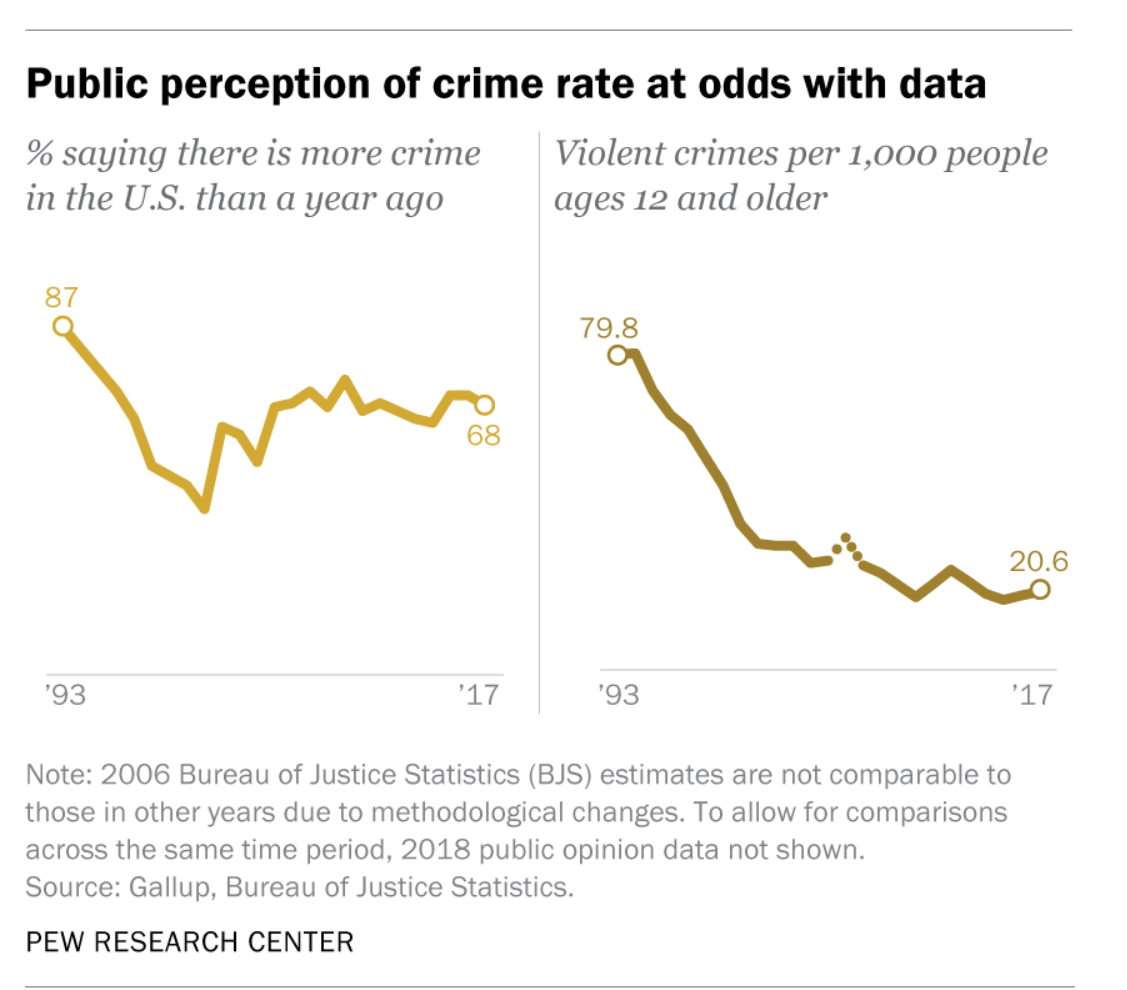
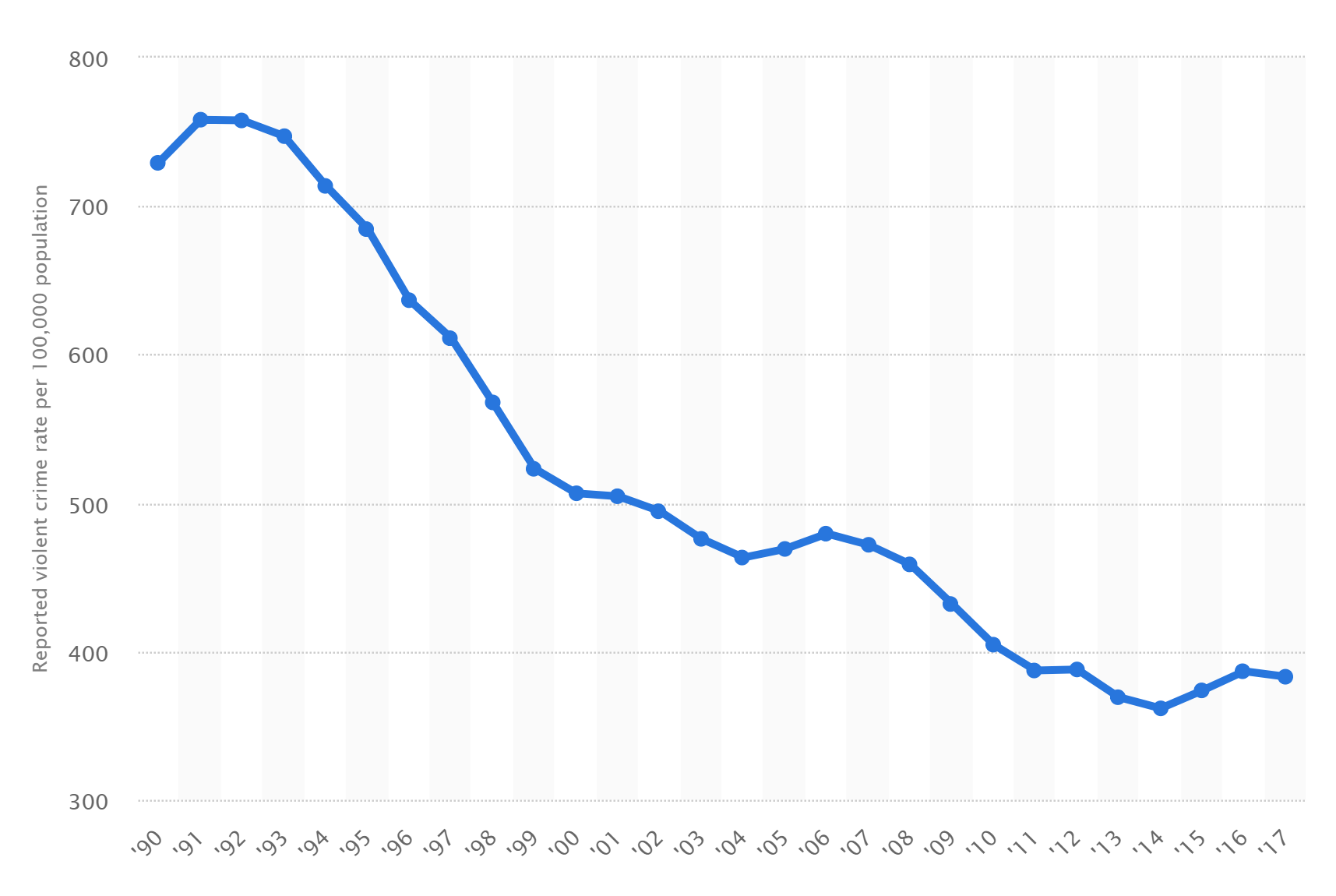
Apart from the global long-term trend of declining homicides, we can also observe a recent downward trend in the reported violent crime rate since 1990 in the USA. Scholars agree that the crime rate is in an extreme decline. Expanding the realm towards Europe, you will see similar results (see here).

1Source: Statista

Despite these trends, the public (as well as some intellectuals as well I assume) vastly still holds a distorted perception of the crime rate. The sharp decline in actual crimes strongly contradicts the fact that a majority of the people still uphold the myth of increasing crime rates.

2

Source: Pew Research Center

Regarding drug use in the USA, it is important to mention that the absolute amount of illicit drugs consumed has slightly gone up since 1990. This development is mostly driven by an increasing  consumption of marijuana: Use of most drugs other than marijuana has stabilized over the past decade or has declined., states the National Institute on drug abuse in 2015.

Contrary, the number of deadly injections are increasing. However, the share of the population with drug use disorders has remained on the same level of 5.3% over the last 20 years.

2. Decay of the family resulting in increasing divorce rates, teenage motherhood and single parents

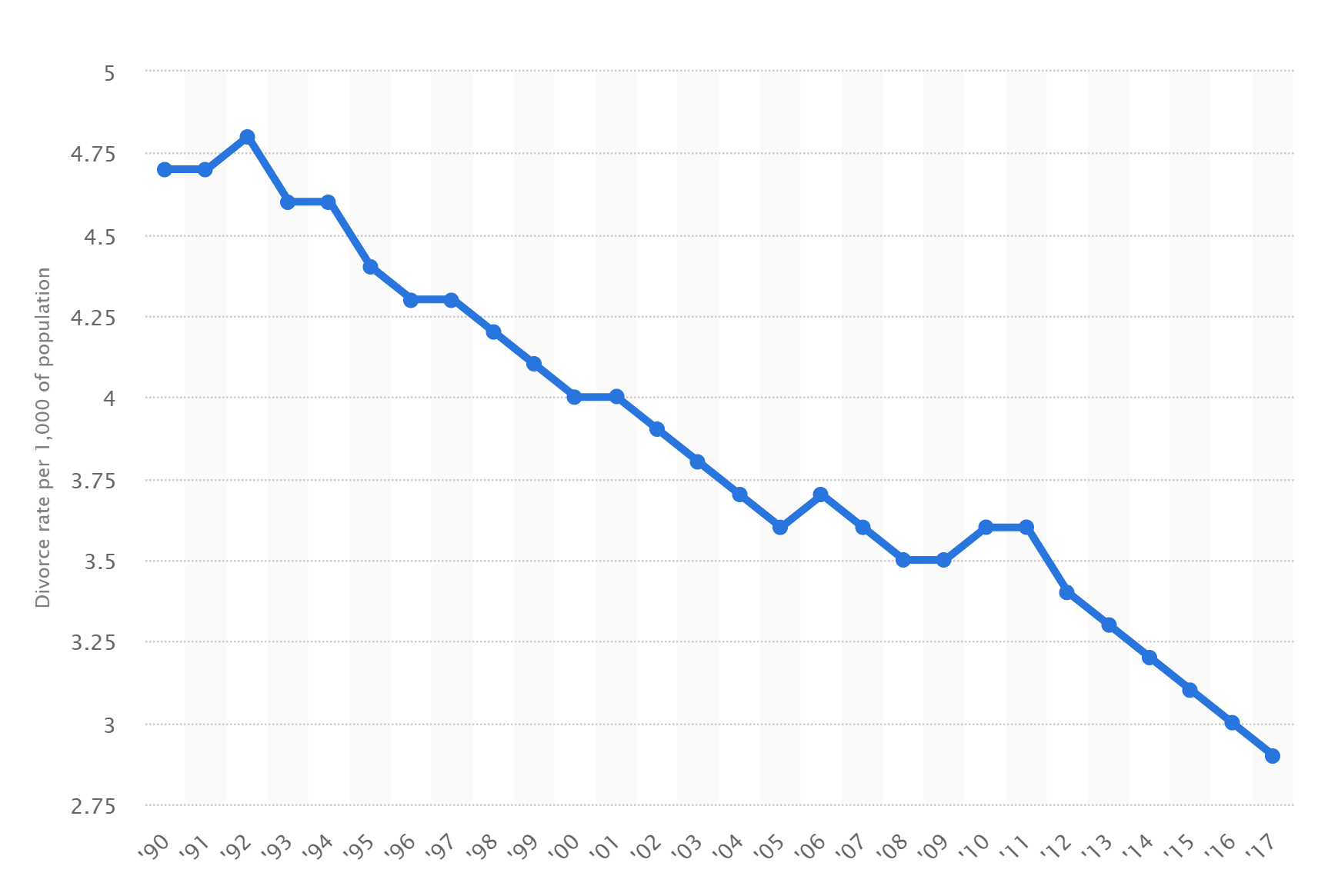
It is hard to measure the “Decay of the family” itself. Luckily, Huntington further concretizes his claim by naming some of the measurable effects. There is nothing much to do to refute these statement except for looking at the following graphs.

a) Firstly, the divorce rate is sharply declining.

3

Source: Statista

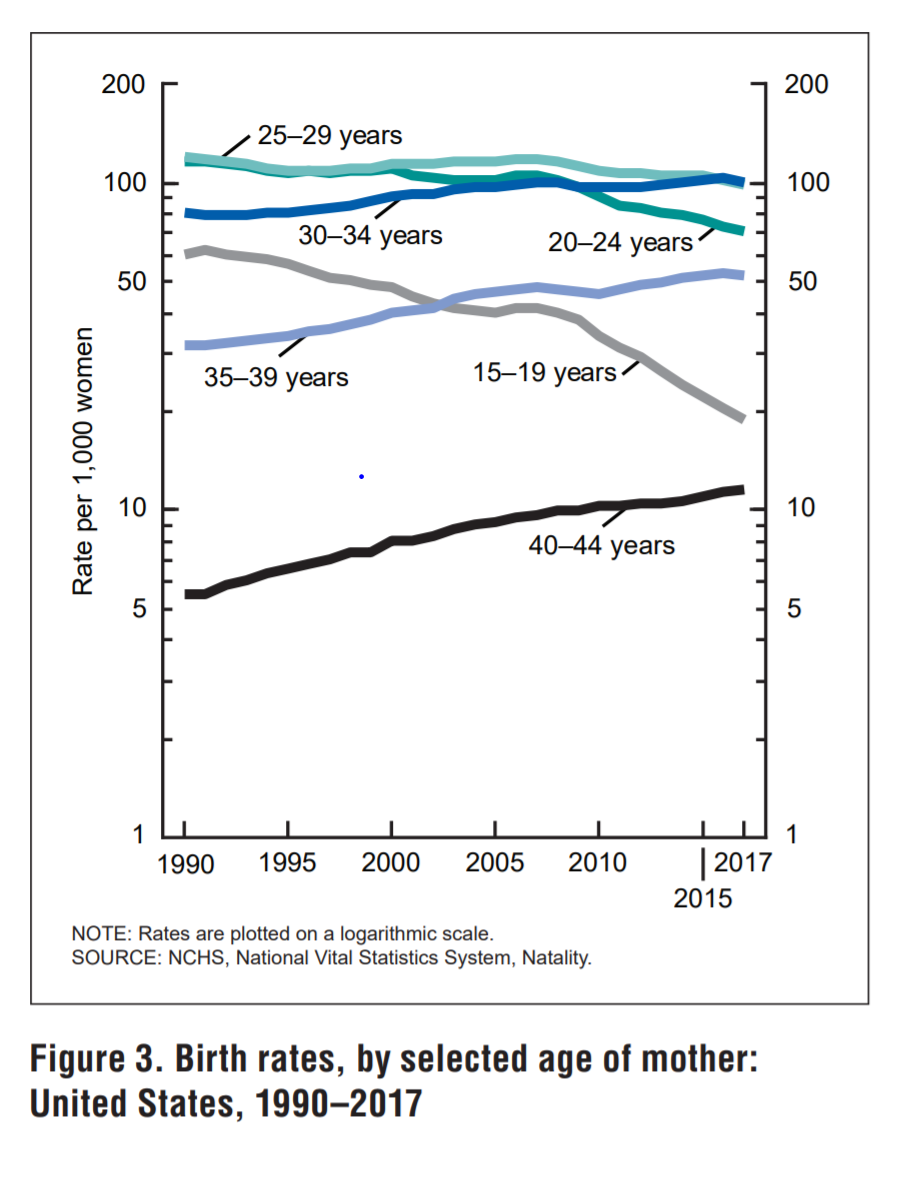
b) Second, teenage pregnancy rates are also dropping since 1990.

4Source: National Vita Statistics Report

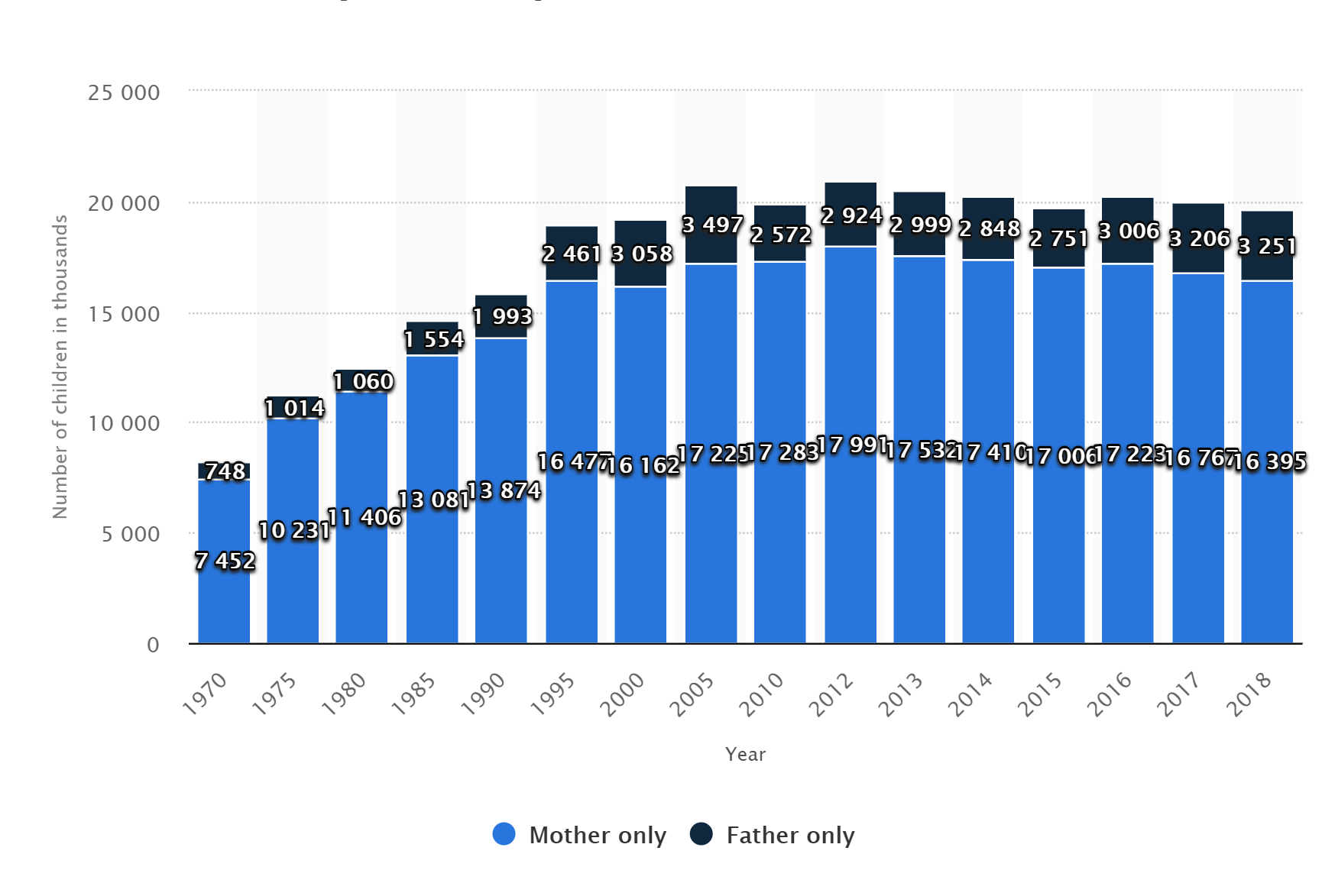
c) Third, the number of Americans living in single parenthood is not increasing drastically since 1990.

5Source: Statista

I often take issue when (especially conservative) scholars mourn the declining importance of family. Even if there are certain indicators which would back up Huntington’s claims, he does not name them himself. While it is indeed true that “family” as an institution is undergoing changes, there is no evidence (at least named by Huntington) to back up the claim of a decline of its importance.

3. Declining “social capital” and voluntarism leading to less trust.

It is indeed true, that the adult volunteering rate declined from early 2000 to 2016 from 27.4% to 24.9%. Interestingly, it recently bounced back to a new high in 2018, hitting the 30% target. Really the only point where one must agree to Huntington’s claim is the decrease of interpersonal trust as well as trust in public institutions. This trend is indeed very worrisome considering that trust is a major factor for flourishing societies.

4. The decline in work ethic

The research here is a little bit tricky and points in both directions. Although there has been wide academic coverage of the millennial work ethic scholars could not find a consensus on this issue. Its is especially difficult to extract the generational influence from other key determinants of work ethic, such as position or age. Academics warn to mistake the ever-ongoing conflict between young vs. old with the Boomer vs. Millenial conflict. I haven’t settled my opinion on this one. These Articles from Harvard Business Review and Psychology Today provide a good overview of both sides of the medal.

5. Less general interest in Education

This indicator is particularly interesting for me because as a member of the 90’ generation, I have experienced quite the opposite in Germany. But let’s have a look at the data.

Despite ranking only in the middle in a global country comparison, the US students still made a huge leap in terms of maths and reading proficiency, which only slowed down in 2015:

6

Source: Pew Research Center

Furthermore, the overall educational level of the USA continues to rise, resulting in the fact that  “the percentage of the American population age 25 and older that completed high school or higher levels of education reached 90% [for the first time ] in 2017.” Contrary, there are still major differences when one looks at features like race or parent household (See here), but the overall trajectory of the educational level is sloping upwards.

What do these criteria measure?

As you can see, there is little to no evidence to empirically back up the claim of western moral decay. Furthermore, while many case studies have shown that lack of interpersonal trust, lack of education or a declining work ethic can pose a great threat to society, I refuse to see a connection (a no known to me study disproves me here) between (recreational) drugs consumption, alternative family models, increasing hedonism and moral decline. Thus I believe that many advocates of the moral decay theory regard it as an opportunity to despise developments they personally do not like. I do not imply that everyone arguing for the moral decline of the west is unaware of the global macro-trends which heavily improved our life, but I highly doubt their assumption, that we are currently in a short-to-medium term “moral recession”. Even when one upholds the very conservative statements such as drug consumption adding to moral decline, is hard to argue that we are currently witnessing a moral decay of the west. Contrary, It may be true that Huntington has observed something different in the period before publishing “The clash of civilization” in 1996. Of course, I myself witness the ongoing battle against norms on the increasing hostility towards the intellectual enemy in the west, but one should always keep in mind the bigger picture. Our world is getting better – in the long- and in the short-run; There is no such thing as a moral decline of the West.


[1] Huntington, Samuel P. (2011): Kampf der Kulturen. Die Neugestaltung der Weltpolitik im 21. Jahrhundert. Vollst. Taschenbuchausg., 8. Aufl. München: Goldmann (Goldmann, 15190). P. 500

School choice at the Supreme Court

Another school funding case is knocking at the U.S. Supreme Court’s door. This case, Espinoza v. Walborn, hales from Montana, where the state’s fledgling school-choice program was killed moments after it left the crib. The Court now has a chance to revive it and land a major victory for educational choice across the country.

Montana’s first school-choice law, passed in 2015, took the form of a tax-credit scholarship program. If a taxpayer donated to an approved scholarship organization, she could claim up to $150 of the donation as a tax credit. The scholarship organizations then dished out scholarships to help parents afford to put their kids through private school.

Then the Montana Department of Revenue gutted it. The Department promulgated a rule that none of that scholarship money could go to religious private schools. This basically killed the program, since the vast majority of private schools in Montana–and in most states–are religious schools.

The Department claimed that the state constitution prohibited the scholarship dollars from going to religious schools because of the state ban on indirect public aid to religious schools. This is an absurd argument. The scholarship funds are privately donated dollars–they never touch a public coffer. The fact that someone can claim a tax credit hardly means that the donation becomes “public funds” because of diverted revenue. Such an argument, extended to its logical conclusion, would mean that all money is the government’s, and when it graciously declines to tax us, that extra money of ours is in fact part of the public fisc.

Nonetheless, the government prevailed at the Montana Supreme Court. In fact, the Court did the state one better–they just invalidated the whole tax-credit program, even for the few parents who might use a scholarship to send their kids to a secular school.

It’s a terrible blow to parents in Montana trying to find some genuine variety in education. But it also gives the Supreme Court a chance to right a wrong that has been festering in education policy for well over a century. The Supreme Court should hold that barring religious schools from accessing a neutral and generally available funding program violates the Free Exercise Clause and the Equal Protection Clause of the U.S. Constitution.

The portion of Montana’s state constitution that laid the tax-credit program in an early grave is known as a Blaine Amendment, named after 19th-century Congressman James Blaine. In 1875, Blaine proposed a federal constitutional amendment that would, among other things, prohibit states from funding “sectarian” schools with public money. Blaine’s federal amendment failed, but many states passed state-level amendments to the same effect, and Congress managed to make inclusion of such amendments a condition of statehood for new states entering the union.

The history is clear that these amendments are rooted in anti-Catholic bigotry. As the United States transitioned to a public school system, public schools had a distinctly Protestant flavor (often state-endorsed or even state-forced). Catholic migrants therefore began forming and attending private religious schools of their own. The backlash was fierce, and anti-Catholic sentiment often expressed itself in hostility to Catholic schools. James Blaine’s proposed amendment was a key manifestation of this bigotry.

And the bigotry lives on today. Ironically, however, now opponents of genuine choice in education have retrofitted Blaine Amendments as a partisan weapon to combat vouchers, tax credits, and education savings accounts. Montana’s law is only the most recent victim. If the Supreme Court doesn’t grant this case and strike down these state laws rooted in religious bigotry, it won’t be the last.

Old Property

Property is the basis for every right and ounce of autonomy we have. James Madison called property “that dominion which one claims and exercises over the external things of the world, in exclusion of every other individual.” Madison went on to argue that basically every right we enjoy is reducible to a property right. We have property in our opinions, in the free use of our faculties, in the safety and liberty of our body, and so on. He believed that “Government is instituted to protect property of every sort” and a government can only be just if it “impartially secures to every man, whatever is his own.”

But government has not remained impartial in this endeavor. It has become a massive property owner in its own right.  It has also become a gatekeeper, setting the terms for individuals’ uses of their own property. It has also become a broker and redistributor of property. And finally, it has =become a creator of property in the form of entitlements–what Charles Reich famously called “new property.” It’s this last role that I’d like to discuss here.

Government’s role as a creator of property has muddled and watered down the strength of property rights. The problem began when U.S. courts started grappling with claims that individuals had been deprived of a constitutional right when government stripped them of a government-created entitlement, such as social security.

Courts confronted with this problem basically held that while constitutional rights do attach to entitlements, the government has an increased authority to limit the rights to those entitlements. Essentially, since the government created the entitlement, the government can define the scope and terms of that entitlement.

This “new property” doctrine then became entangled with a different idea altogether. The United States Constitution protects against deprivations of life, liberty, and property without due process of law. The Constitution, however, does not define property. Courts have held instead that state law defines property , and the Constitution then protects rights to that property.

That does not mean, however, that all property can be whisked away at a whim as if it is all “new property.” Rather, even though state law may establish what property is, states do not have the power to mutate and redefine all property rights on a whim. In essence, there is “new property” and then there is “old property.”

“Old property” is a bundle of long-recognized property rights rooted in common law. But just because those rights have arisen from common law courts over the centuries does not mean that these are property rights created by government in the same sense as less-protected “new property.” There is a fundamental difference, for constitutional purposes, between government recognizing a boundary line and creating a food stamp program. In some sense, this difference strikes a deeper philosophical chord, one that distinguishes between positive law and natural law–or fundamental rights that are acknowledged and respected by government, and entitlements that are created and controlled by government.

What are these fundamental property rights? Most are intuitive and understood by babies as soon as their hands are capable of grasping. They include the right to exclude others (the first property right understood by all children everywhere), the right to quiet enjoyment, the right dispose of the property by sale or lease, the right to develop and improve the property, etc. That right extends to chattel and land–things the government does not create but simply exist and are brought under human ownership through a first-in-time rule or a transfer.

The idea that “new property” deserves lesser protection because government dictates its bounds has bled over into the “old property” rights. This stems from confusion between government recognizing the existence of a fundamental right and government creating an entitlement. Extensive permitting regimes have only exacerbated this confusion. When local governments demand a permit before a property owner can do something with their land, the government looks upon that permit as an entitlement–a privilege and not a right. Thus, “new property” ideas come to overlay and suffocate “old property.” As permitting regimes expand, the world of “old property” retracts. But that permit is not a “new property” entitlement–it’s a condition placed upon a fundamental background right–an intruder upon natural law. When a permitting authority tries to strip away or deny a permit, that denial should be subjected to the full rigor of constitutional scrutiny offered to “old property,” not the weak sauce protections for entitlements.

If a government is only just if it limits itself to protecting what is ours, as Madison believed, then we don’t have many just governments left to us. Courts could help by establishing a clearer distinction between the old and the new forms of property so that governments can’t get away with redefining or stripping away fundamental property rights.

Not all GDP measurement errors are greater than zero!

Bryan Caplan is an optimist. He thinks that economists do many errors in estimating GDP (overall well-being). He is right in the sense that we are missing many dimensions of welfare improvements in the last half-century (see here, here and here). These errors in measurements lead us to hold incorrectly pessimistic views (such as those of Robert Gordon). However, Prof. Caplan seems to argue (I may be wrong) that all measurements problems and errors are greater than zero. In other words, they all cut in favor of omitting things. There are no reasons to believe this. Many measurement problems with GDP  data cut the other way – in favor of adding too much (so that the true figures are lower than the reported ones).

Here are two errors of importance (which are in no way exhaustive): household output and adjustments for household size.

Household Output

From the 1910s to the 1940s, married women began to enter moderately the workforce. This trickle became a deluge thereafter. National GDP statistics are really good at capturing the extra output they were hired to produce. However, national GDP statistics cannot net out the production that was foregone: household output.

A married woman in 1940 did produce something: child-rearing, house chores, cooking, allowing the husband to specialize in his work. That output had a value. Once offered the chance to work, married women thought the utility generated from producing “home outputs” was inferior to the utility generated from “market work”. However, the output that is measured is only related to market work. Women entered the labor force and everything they produced was considered a net addition to GDP. In reality, any economist worth his salt is aware that the true improvement in well-being is equal to the increased market output minus the forsaken house output. Thus, in a transition from a “male-labor force” to a “mixed labor force”, you are bound to overestimate output increases.

How big of an issue is this? Well, consider this paper from 1996 in Feminist Economics. In that paper, Barnet Wagman and Nancy Folbre calculate output in both the “household” and “market” sectors. They find that even very small changes in the relative size of these sectors alter growth rates by substantial margins. Another example, which I discussed in this blog post based on articles in the Review of Income and Wealth, is that when you make the adjustment over four decades of available Canadian data, you can find that one quarter of the increase in living standards is eliminated by the proper netting out of the value of non-market output. These are sizable measurement errors that cut in the opposite direction as the one hypothesized by prof. Caplan (and in favor of people like prof. Gordon).

Household Size

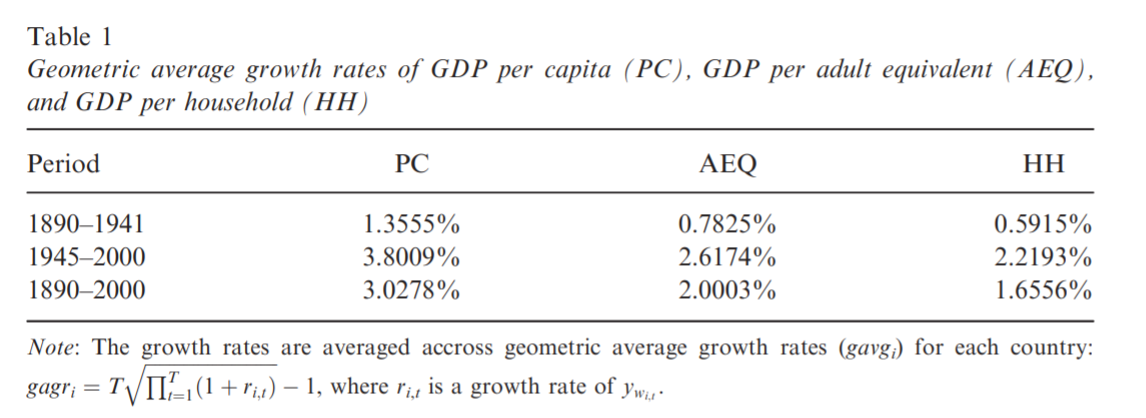
Changes in household sizes also create overestimation problems. Larger households have more economies of scale to exploit than smaller households so that an income of $10,000 per capita in a household of six members is superior in purchasing power than an income of $10,000 per capita in a single-person household. If, over time, you move from large households to small households, you will overestimate economic growth. In an article in the Scottish Journal of Political Economy, I showed that making adjustments for household sizes over time yields important changes in growth rates between 1890 and 2000. Notice, in the table below, that GDP per adult equivalent (i.e. GDP per capita adjusted for household size) is massively different than GDP per capita. Indeed, the adjusted growth rates are reduced by close to two-fifths of their original values over the 1945-2000 period and by a third over the 1890 to 2000 period. This is a massive overestimation of actual improvements in well-being.

HouseholdAdjust

A large overestimation

If you assemble these two factors together, I hazard a guess that growth rates would be roughly halved (there is some overlap between the two so that we cannot simply sum them up as errors to correct for – hence my “guess”). This is not negligible. True, there are things that we are not counting as Prof. Caplan notes. We ought to find a way to account for them. However, if they simply wash out the overestimation, the sum of errors may equal zero. If so, those who are pessimistic about the future (and recent past) of economic growth have a pretty sound case. Thus, I find myself unable to share Prof. Caplan’s optimism.

Mending Wall

Robert Frost’s lovely poem, “Mending Wall,” says something profound about the importance of the institution of property. The poem is about Frost and his neighbor meeting together to piece together a crumbling wall between their two properties. Frost pokes fun at the tradition; without a wall, will Frost’s apple trees sneak across the property line and gobble up the cones piled up beneath the neighbors’ pines? As the two walk the line, replacing a stone here and a stone there, the neighbor, in an almost ritualistic mantra, responds to Frost’s skepticism with the well-worn line, “Good fences make good neighbours.”

Some can and have interpreted Frost’s poem as a gentle argument against erecting barriers that separate us. I think that’s a mistake. Of course, I admit to overlaying my own political and philosophical views atop his writing. But with that in mind, the poem tells me to that clear property lines do indeed make good neighbors. In fact, this wall is what draws Frost and his neighbor together in a valuable social ritual. Even in the absence of an obvious need for the wall, the tradition stokes good will.

In a broader and more directly political sense, property does indeed make good neighbors. Where property rules are unclear or have not been established, social strife and distrust tend to proliferate. Where they are established by law or custom, parties have a neutral arbiter whose presence alone allows them to avoid dispute and uncertainty.

This seems to hold true on small and large scales. Parents of young children have all learned that allowing kids common ownership of toys is a recipe for constant conflict. If parents establish clear ownership of childrens’ possessions, then order settles in and kids can learn important social values like sharing–a virtue that will never arise if property rules are unclear or non-existent. Truly, in a home of common ownership, children only learn to cling desperately to everything and not give an inch.

The same appears true for communities and nations. Where countries do not have established customs and laws governing property, strife, distrust, and corruption fester (Russia is, unfortunately, a prime example of this problem). A similar phenomenon seems to have played its role in the rapid demise of the various utopian communal arrangements that cropped up during the Second Great Awakening in 19th century America.

Frost’s repeated refrain throughout his poem is: “Something there is that doesn’t love a wall.” I think Frost’s neighbor had the right of it–communities survive and thrive thanks to walls. We should take time to mend them.