Computational Economics is the Right Perspective

Here’s a vastly oversimplified picture of mainstream economics: We pick some phenomenon, assume all the context into the background, then build a model that isolates only the variables specifically relevant to that phenomenon.

Once you’ve simplified the problem that way, you can usually build a formal mathematical model, make a few more (hopefully) reasonable enough assumptions, and make some strong ceteris paribus claims about your chosen phenomena.

That’s a reasonable enough approach, but it doesn’t shed much light on big picture issues. I’m interested in root causes, and this “reduce things to their component parts” approach doesn’t give enough of a big picture to find those roots.

How do we broaden our perspective? One approach is to return to the more “literary” approach of the pre-Samuelson days. A bit of philosophy of science has me convinced that the primary flaw of such an approach is rhetorical. Written and mathematical arguments leave some assumptions in the background, but the latter is more convincing to a generation of economists trained to be distrustful of natural language (and too trusting of algebra).

As a pluralist, I think we should use as many approaches as we can. Different schools of thoughts allow you to build different imaginary worlds in your mind. But the computational approach isn’t getting enough play. I’d go so far as saying agent based modeling is the right form of mathematics for social science.

What does this mean? In a nutshell, it means modelling processes, simulating those processes, and seeing how interactions between different agents leads to different sorts of outcomes.

A common trope among Emergent Order folks is how ants are individually stupid but collectively brilliant. Neoclassical economics runs into the opposite problem: individually brilliant individuals who get trapped in Prisoners’ Dilemmas.

Computational economics starts with models that are more like ants than homo economicus. Agents are essentially bundles of heuristics/strategies in an out-of-equilibrium world. But these competing (and cooperating) strategies can interact in interesting ways. Each agent is a part of all the other agents’ environment, so the mix of strategies is a function of the success of the strategies which is a function of the mix of strategies in the environment.

In essence, computational economics starts from what the mainline economists have long recognized: human society is a complex, interwoven, recursive process. The world is, essentially, a sort of meta computer with a complex web of programs interacting and evolving. We don’t need to assume in any sort deus ex machina (that’s a bit of an overstatement, but we haven’t got time to explore it this week), we just need replicating entities that can change over time.

Such a view, to my mind, provides an end run around rationality assumptions that can explain the brilliance of entrepreneurship (without making heroes out of the merely lucky) as well as the folly unearthed by Behavioralist economics (without the smugness). We’ve always known it. It’s all just evolution. But the methodology hasn’t made its way into the main stream of economics. If there are any undergrads reading this on their way to a PhD program, let me know in the comments so I can point you in some interesting directions!

Be Our Guest: “The U.S. Economy: A Fading Illusion?”

This essay, by longtime NOL reader and CPA Jack Curtis, is the first essay of 2020’s “Be Our Guest” feature. Here is a snippet:

This widespread financial vulnerability seems a natural result of government policies that minimize interest rates and support monetary inflation as the Federal Reserve and other central banks have continued to do in recent decades. There is little incentive to save money when it offers no significant return and its value is inflated away. Governments that cling to such policies are imposing dependence upon their citizens, forcing them in essence to live hand to mouth, deprived of the ability to provide for their own futures.

Jack paints a pretty gloom picture of the U.S. economy. Does this square with what economists have been telling us about the state of the world? Please, read the whole essay, and if you have been thinking about writing for the public in 2020, give us a holler. We’d be happy to put your thoughts up for the whole world to read.

Sunday Poetry: Gender Equality where it matters? The Scandinavian Unexceptionalism

Deja-Vu! Social Democrats once again bring up the topic of “Democratic Socialism” to cure all of the evils of the world. Once again, the Scandinavian countries (Sweden, Finnland, Denmark and Norway) are used as an example of how “a third way Socialism” can work. Although I still would consider myself young, I have already lost all of my stamina to engage in the same debates all over again until they pop up again a few months after.

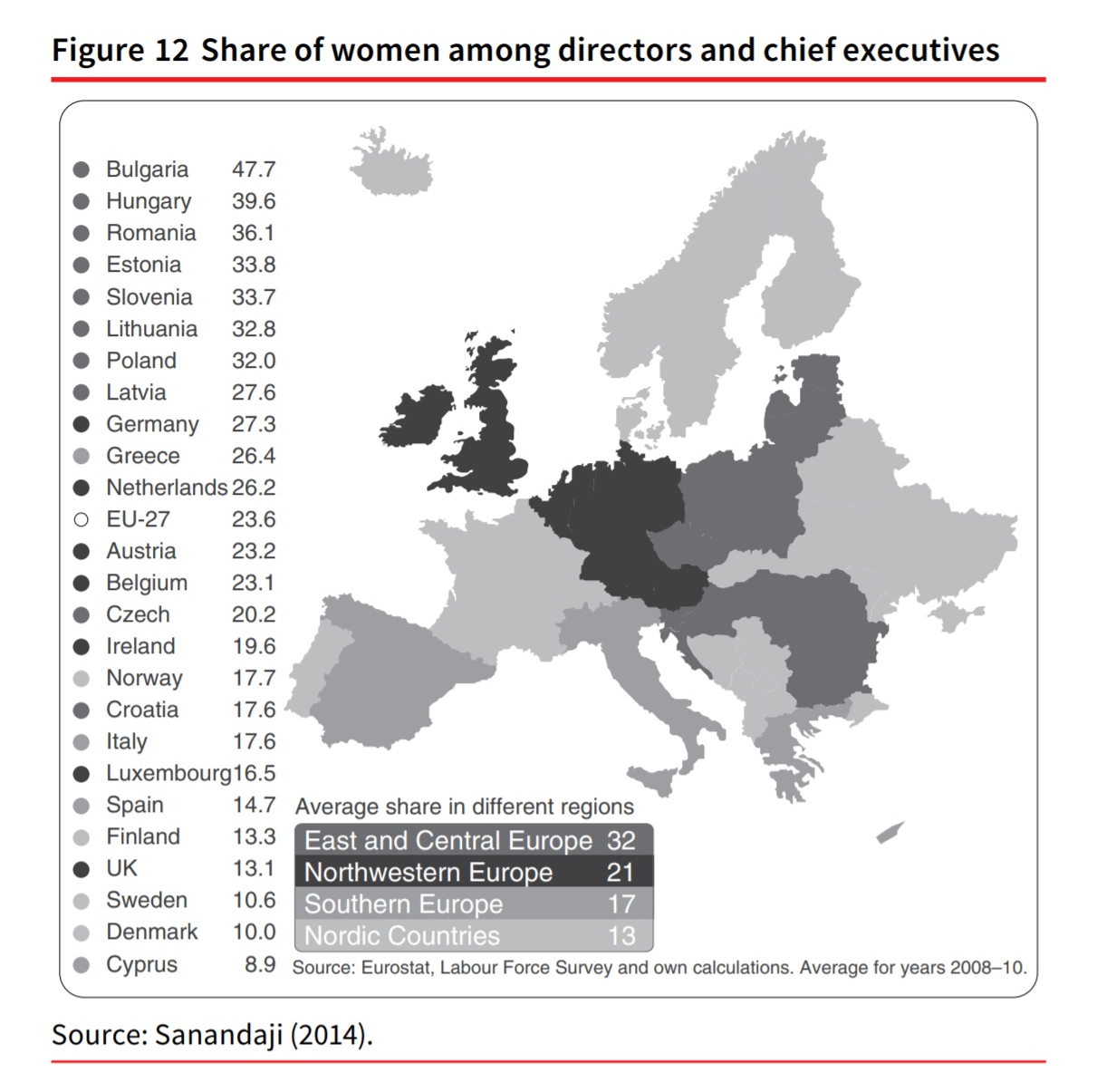
So, instead of pointing out the fallacy in labelling the Scandinavian countries moderately socialist (Nima Sanandaji, for example, does an excellent job in doing so), I want to look at one aspect in particular: The myth of peak emancipation of woman in the labour market in these countries. So apologies for neglecting Poetry once again for the sake of interesting information. Have a look at the following graphic and the remarks by Sanandaji:

“Some boards in Nordic nations are actively engaged in how the companies they represent are run. Others have a more supervisory nature, meeting a few times a year to oversee the work of the management. The select few individuals who occupy board positions – many of whom reach this position after careers in politics, academia and other non-business sectors – have prestigious jobs. They are, however, not representative of those taking the main decisions in the business sector. The important decisions are instead taken by executives and directors. Typically individuals only reach a high managerial position in the private sector after having worked for a long time in that sector or successfully started or expanded a firm as an entrepreneur. The share of women to reach executive and director positions is the best proxy for women’s success in the business world. Eurostat has gathered data for the share of women among ‘directors and chief executives’ in various European countries between 2008 and 2010. The data show that Nordic nations all have low levels of women at the top of businesses. In Denmark and Sweden, only one out of ten directors and chief executives in the business world are women. Finland and the UK fare slightly better. Those Central and Eastern European countries for which data exist have much higher representation.

sanandaji.png

[…]

A key explanation lies in the nature of the welfare state. In Scandinavia, female-dominated sectors such as health care and education are mainly run by the public sector.
A study from the Nordic Innovation Centre (2007: 12–13) concludes: Nearly 50 per cent of all women employees in Denmark are employed in the public sector. Compared to the male counterpart where just above 15 per cent are employed in the public sector. This difference alone can explain some of the gender gap with respect to entrepreneurship. The same story is prevalent in Sweden. The lack of competition reduces long-term productivity growth and overall levels of pay in the female-dominated public sector. It also combines with union wage-setting to create a situation where individual hard work is not rewarded significantly: wages are flat and wage rises follow seniority, according to labour union contracts, rather than individual achievement. Women in Scandinavia can, of course, become managers within the public sector, but the opportunities for individual career paths, and certainly for entrepreneurship, are typically more limited compared within the private sector.

If you are interested in the whole book, it is completely available online for free.

I wish you all a pleasant Sunday.

A Lesson in Inventing Your Own Statistics

Nothing makes me happier than pointing out when someone is wrong.

I admit, that’s a pretty sad life. And for some unfathomable reason that doesn’t endear me to the person who uttered the incorrect statement – which it really should as I’m correcting some mistaken belief of theirs, assisting them on the path to truth.

Perhaps, as Jonathan Haidt teaches us, my endeavour is a hopeless one as approaching truth is forever clouded by confirmation bias. Polarization runs rampant and scientific disciplines are scarred by replication crises and publication bias.

I don’t take issue with any of those points: reduce my ambitions to “a little less wrong” and what follows still holds.

A few days after the Riksbank had upped its interest rate to 0% last month, Daniel Lacalle, a Spanish economist, author and fund manager – and whose musings are usually quite insightful – decided to vent his (questionable) objections to central banks and negative interest rates (NIRP) in a very strange way:

  1. Deliver a bunch of vague one-liners about monetary policy and unsustainable capital markets.
  2. Make shit up about Sweden and Swedish capital markets.

Obviously, I don’t mind too much the rhetoric of those who vehemently oppose central banks, but I do mind people pulling numbers out of their behinds and just inventing things about the world that clearly are not true.

So let’s do some fact-checking.

It’s apparently really bad for governments to have public debt – and negative interest rates allegedly work like crack-cocaine for politicians in their endless desire for more and more and more underfunded expenditures. Spend away, minister!

Except that many (non-crisis) countries such as Sweden aren’t borrowing. In fact, Sweden’s debt-to-GDP ratio is at its lowest point since 2012 and has been dropping like a stone since about the time that the Riksbank first lowered its policy rate to below 0%. In fact, as the Riksbank sits on over 35% of the outstanding government debt, there’s been quite a scramble among commercial banks to meet their capital requirements; there aren’t enough bonds to go around. The big macro debate in Sweden right now is over how much more the government ought to spend given that the debt is so small.

My favorite part is when Lacalle starts inventing numbers to support his case. Strangely enough, he’s arguing that NIRP fuels an unsustainable boom such that increasing share prices and property prices (things that most of us individually tend to think are good or at least harmless) are, in Lacalle’s mind, actually evidence of how bad life is.

Ye, I too hate it when my retirement fund or house go up in value.

  1. Sweden’s “Real estate price index has increased 50 percent (from 160 points to 240).”

The official statistics agency, Statistics Sweden, reports a +17 increase in broad real estate indices since early 2015, but they only include data until late-2018. The index is also on a completely different level, suggesting that Lacalle used some other source. 

Using numbers from Ekonomifakta we find house price increases of 9% and 19% across various regions from Q1 2015 (when the Riksbank NIRP policy began) to Q3 2019. Again, wrong index numbers so couldn’t have been Lacalle’s source.

But maybe house prices have increased some in the last few months such that Lacalle’s 50% number is correct? No, they’ve been flat, reports the realtor industry organization Svensk Mäklarstatistik.

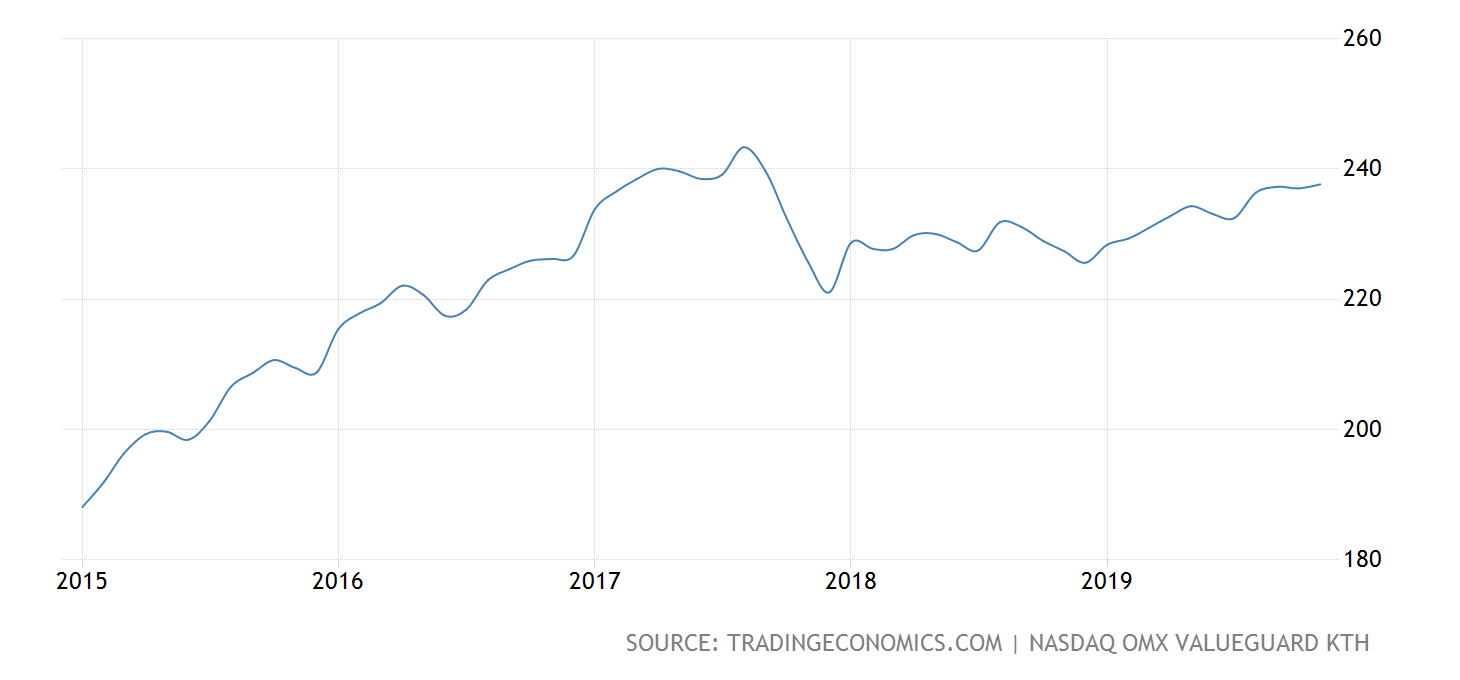
Searching high and low for a Swedish house price index that conforms to Lacalle’s peculiar range (160 to 240), I finally found a promising one at Trading Economics:

Trading econ Sweden House Price Index.png

Interestingly enough, Lacalle seems to have misread the chart; the index value for Feb 2015 is around 190 – not 160 – producing a much more reasonable +26% increase over the last five years. Even that, as we’ve seen with the more reputable sources above, might be tad exaggerated.

2. Sweden’s stock market is up “more than 20%”

Next up: the stock market – always a grateful subject for unsubstantiated rants.

“more than 20%” is cheating as technically anything above “20%” would work. Curiously enough, no index for the Swedish stock market shows those numbers between Feb 18, 2015, and today:

  • OMXS30, a commonly quoted index that does not include dividends, is up 8% since then.
  • Using indices that do account for (reinvested) dividends, OMXSPI shows 27.5% gain since NIRP was introduced;
  • OMXS30GI shows a 30.5% gain;
  • and OMXSCAPGI reports a 52% return.

Then again, if gradually increasing stock markets are a bad thing, then why didn’t Lacalle go with the highest, most inflated number he could find?

3. “Average residential index” is apparently up 27%

Not a statistics I’m familiar with, but I refer the reader to (1) above for sources on property prices.

4. “nonreplicable assets have risen between 30 and 70 percent”

First: that’s quite a range, Sir.
Second: ye, I’ve never heard that term before (let alone something to measure it) – and neither, it seems, has Google. I suspect Lacalle invented some more numbers to complement his already fake-y statistics. 

Tl;dr – don’t just make shit up, kids. Do look into your claims before you mindless utter them. You may be entitled to your own opinion (actually not really), but you can’t just believe whatever you want, making shit up along the way.

There is no Bloomberg for medicine

When I began working in medical research, I was shocked to find that no one in the medical industry has actually collected and compared all of the clinical outcomes data that has been published. With Big Data in Healthcare as such a major initiative, it was incomprehensible to me that the highest-value data–the data that is directly used to clear therapies, recommend them to the medical community, and assess their efficacy–were being managed in the following way:

  1. Physician completes study, and then spends up to a year writing it up and submitting it,
  2. Journal sits on the study for months, then publishes (in some cases), but without ensuring that it matches similar studies in the data it reports.
  3. Oh, by the way, the journal does not make the data available in a structured format!
  4. Then, if you want to see how that one study compares to related studies, you have to either find a recent, comprehensive, on-point meta-analysis (which is a very low chance in my experience), or comb the literature and extract the data by hand.
  5. That’s it.

This strikes me as mismanagement of data that are relevant to lifechanging healthcare decisions. Effectively, no one in the medical field has anything like what the financial industry has had for decades–the Bloomberg terminal, which presents comprehensive information on an updatable basis by pulling data from centralized repositories. If we can do it for stocks, we can do it for medical studies, and in fact that is what I am trying to do. I recently wrote an article on the topic for the Minneapolis-St Paul Business Journal, calling for the medical community to support a centralized, constantly-updated, data-centric platform to enable not only physicians but also insurers, policymakers, and even patients examine the actual scientific consensus, and the data that support it, in a single interface.

Read the full article at https://www.bizjournals.com/twincities/news/2019/12/27/there-is-no-bloomberg-for-medicine.html!

Sunday Poetry: Rüstow vs. Mises

One of the bests books I’ve read this year was Serge Audier’s & Jurgen Reinhoudt’s relatively unknown (unfortunately!) translation of the protocols of the Walter-Lippmann-Colloquium. The NOUS-Network organized a wonderful seminar in which we thoroughly discussed the book and the emergence of Neoliberalism. For the preparation of this weekend’s Hayek-Kreis seminar, I reread the book and stood once again in awe of the magnificence of the discussion during the Colloquium.

By the way: If you are an undergraduate, graduate, or PhD scholar, please consider joining the NOUS-Network for Constitutional Economics and Social Philosophy as a Young Affiliate! NOUS is an information platform and a community for interdisciplinary research. The network links all academic fields relevant for thinking about social order and liberty. It spans philosophy, politics, economics and fosters scholarly research, contact and exchange.

In the following excerpt, it becomes clear, that the participant’s opinion on the psychological and sociological causes of the decline of Liberalism differed significantly. Mr Rüstow eloquently captures the standpoints of the two opposing groups (not without bias to be fair) and even cheekily disses Ludwig von Mises.

“Mr Rüstow: ‘All things considered, it is undeniable that here, in our circle, two different points of view are represented. One group does not find anything essential to criticize or to change in traditional liberalism, such as it was and such as it is, apart from, naturally, the adjustments and the current developments that are self-evident.

In their view, the responsibility for all the misfortune falls exclusively on the opposite side, on those who, out of stupidity or out of malice, or through a mixture of both, cannot or do not want to discern and observe the salutary truths of liberalism. 

We, on the other hand, we seek the responsibility for the decline of liberalism in liberalism itself; and, therefore, we seek the solution in a fundamental renewal of liberalism. In order to justify in a positive manner this second point of view, I have to refer to what I have said and, especially, to the excellent arguments of Mr Lippmann.

Here, I would only like to draw attention to the fact that if the unwavering representatives of old liberalism were right, the practical prospects [for liberalism] would be almost hopeless. Because it does not really seem that old liberalism has gained in persuasive and in seductive force or that the arguments, no matter how shrewd they may be, of these representatives have the least possibility of bringing about a conversion movement within the realm of Bolshevism, Fascism, or of National Socialism. If they did not listen to Moses and the prophets—Adam Smith and Ricardo—how will they believe Mr. von Mises?'”

As always, I wish you all pleasant Sunday.


Confessions of a Fragilista: Talebian Redundancies and Insurance

I’ve been on a Taleb streak this year (here, here and here). Nassim Nicholas Taleb, that is, the options trader-turned-mathematician-turned public intellectual (and I even managed to get myself on his infamous blocklist after arguing back at him). Many years ago, I read Fooled by Randomness but for some reason it didn’t resonate with me and I wasn’t seeing the brilliance.

Last spring, upon reading former poker champion Annie Duke’s Thinking in Bets and physicist Leonard Mlodinow’s The Drunkard’s Walk, I plunged into Taleb land again, voraciously consuming Fooled, The Black Swan and Skin in the Game, followed by Antifragile just a few months ago.

Taleb is a strange creature; vastly productive and incredibly successful, everything he touches does not quite become gold, but surely stirs up controversy. What he’s managed to do in his popular writing (collected in the Incerto series) is to tie almost every aspect of human life into his One Big Idea (think Isaiah Berlin’s hedgehog): the role of randomness, risk and uncertainty in everyday life.

One theme that comes up again and again is the idea of redundancies: having several different and overlapping systems – back-ups to back-ups – that minimize the chance of fatally bad outcomes. The failures of one of those systems will not result in the extremely bad event you’re trying to avoid.

Focusing primarily on survivability – “absorbing barriers” – through the handed-down wisdom of the Ancients and the Classic, the take-away lesson for Taleb in almost all areas of life is overlapping redundancies. Reality is complicated, and the distribution from which events are drawn is not a well-behaved Gaussian normal distribution, but one of thick tails. How thick nobody knows, but wisdom in the presence of absorbing barriers suggest that taking extreme caution is a prudent long-term strategy.

Of course, in the short run, redundancy amounts to “wasted” resources. In chapter 4 of Fooled, Taleb relates a story from his option trading days where a client angrily calling him up about tail-risk insurance he had sold them. The catastrophic event from which the insurance protected had not taken place, and so the client felt cheated. This behavior, Taleb maintains quite correctly, is idiotic. After all, if an insurance company’s clients consist of only soon-to-be claimants, the company won’t exist for long (or it prices insurance at prohibitively high rates, undermining the business model).

Same thing applies for one of his verbose rants about airline “efficiency,” a rather absurd episode of illustrating “asymmetry” – the idea that downside risks are larger than upside gains. Consider a plane departing JFK for London, a trip scheduled to take 7h trip. Some things can happen to make the trip quicker (speedy departure, weather conditions, landing slot available etc), but only marginally; it would, for instance, not be possible to arrive in London after only an hour. In contrast, the asymmetry arises as there are many things that can delay the trip from mere minutes to infinity – again, weather events, mechanical failures, tech or communication problems.

So, when airlines striving to make their services more efficient by minimizing turnaround time – Southwest’s legendary claim to fame – they hit Taleb’s antifragile asymmetry; getting rid of redundant time on the ground, makes the process of on-loading and off-loading passengers fragile. Any little mistake can cause serious delays, delays that accumulate and domino their way through crowded airport networks.

Embracing redundancies would mean having more time in-between flights, with extra planes and extra mechanics and spare parts available at many airports. Clearly, airlines’ already brittle business model would crumble in a heartbeat.

The flipside efficiency is Taleb’s redundancy. Without optimization, we constantly use more than we need, effectively operating as a tax on all activity. Taleb would of course quibble with that, pointing out that the probability distribution of what “we need” must include Black Swan events that standard optimization arguments overlook.

That’s fine if one places as high a value on risks that Taleb does, and indeed they’re voluntarily paid for. If customers wanted to pay triple the money for airfares in order to avoid this or that delay, there is a market for that – it just seems few people value that price over the damage from (low-probability) delays.

Another example is earthquake-proving buildings that Nate Silver discussed in his The Signal and the Noise regarding the Gutenberg-Ritcher law (the reliably inverse relationship between frequency and magnitude of earthquakes). Constructing buildings that can withstand a high-magnitude earthquake, say a one-in-three-hundred-year event is something rich Californians or Japanese can afford – much-less so a poor country like the Philippines. Yes, Taleb correctly argues, the poor country pays its earthquake expenses in heightened risk of devastating damage.

Large redundancies, back-ups to back-ups, are great if you a) can afford them, and b) are risk-averse enough. Judging by his writing, Taleb is – ironically – far out along the right-tail of risk aversion; for most other people, we have more urgent needs to look after. That means occasionally “blowing up” and suffer hours and hours of airline delays or collapsing buildings after an earthquake.

Taleb rarely considers the trade-offs, and the different subjective value scales (or discount rates!) that differ between people. While Taleb may cherish his redundancies, most of us would rather eliminate them for asymmetrically small gains.

Insurance is a relative assessment of price and risks. Keeping a reserve of redundancies are subjective choices, not an objective necessities.

Changing the way doctors see data

Over the past four years, my brother and I have grown a business that helps doctors publish data-driven articles from the two of us to over 30 experienced researchers. However, along the way, we noticed that data management in medical publication was decades behind other fields–in fact, the vital clinical outcomes from major trials are generally published as singular PDFs with no structured data, and are analyzed in comparison to existing studies only in nonsystematic, nonupdatable publications. Effectively, medicine has no central method for sharing or comparing patient outcomes across therapies, and I think that it is our responsibility as researchers to present these data to the medical community.

Based on our internal estimates, there are >3 million published clinical outcomes studies (with over 200 million individual datapoints) that need to be abstracted, structured, and compared through a central database. We recognized that this is a monumental task, and we therefore have focused on automating and scaling research processes that have been, through today, entirely manual. Only after a year of intensive work have we found a path toward creating a central database for all published patient outcomes, and we are excited to debut our technology publicly!

Keith recently presented our venture at a Mayo Clinic-hosted event, Walleye Tank (a Shark Tank-style competition of medical ventures), and I think that it is an excellent fast-paced introduction to a complex issue. Thanks also to the Mayo Clinic researchers for their interesting questions! You can see his two-minute presentation and the Q&A here. We would love to get more questions from the economic/data science/medical communities, and will continue putting our ideas out there for feedback!

Why some countries are stuck in poverty

It is fairly common for young children in Brazil (or at least in Rio de Janeiro, the part of the country I know better) to call adults “uncle” or “aunt”. My closest friends’ children call me uncle and I’m totally ok with that. I do see them as my nephews and nieces. That also happens in schools: children up to 11 or 12 call the teachers “aunt”. Some people think that this is normal or even cute. However, I studied in a school that strictly forbid children to call the teachers aunt. The teachers were supposed to be called simply “teacher”. One interchange became folkloric in my house: “Am I your father’s sister? Am I your mother’s sister? Am I married to your uncle? Then I’m not your aunt.” Ouch! As gruff as it might sound, that’s the mentality I grew up with. My mother was also never totally comfortable with some of my friends calling her “aunt”.

One of my favorite interpretations of Brazil came from Sérgio Buarque de Holanda (1902-1982). In his book Raízes do Brasil (Brazil roots, 1936) he made an analysis of the country, saying that the problem with Brazilians is that they are cordial. Using Max Weber’s categories, Holanda said that Brazilians don’t know how to conduct formal, impersonal relationships. It is really hard for them (or I should say, for us) to understand that the guy in office is the guy in office and not our friend.

I would say that many times I saw Holanda’s interpretation in action. Students who thought they were my friends and that because of that I would go easy on their exams. Colleagues who thought I wouldn’t fine them when I was working in the library. People I barely knew, who were friends of my friends, who thought I would give them answers for the exams. I managed to be friends of some students, but that was the exception. Most students had a hard time distinguishing between “Bruno, my friend” and “Bruno, my professor”. Worse, some, I don’t know how, came to the conclusion that I was their friend.

Lula da Silva, Brazil’s former president, presented himself as a father. He introduced Dilma Rousseff, his successor, as a mother. Getúlio Vargas, the horrendous dictator from the 1930s was widely known as “the father of the poor”. I’m sad to say that Jair Bolsonaro, Brazil’s current and supposedly right-wing president, doesn’t really scape this logic. It may be nice and cute when little children call adults aunt or uncle, but it sickens me when grownups use this language. Even more so, when they use it to people they don’t even know!

Sergio Buarque de Holanda is one of the few things from college I profited from reading. It helped me to escape the Marxist bog that is much of Brazilian humanities academia. Years later I read Good Capitalism, Bad Capitalism and I discovered that Brazil was not alone. That is the problem with many so-called capitalist countries that still lag behind. They are not really capitalist in the sense that the US, much of Western Europe or Japan and other Asian countries are, and one of the main reasons for that is that people don’t know how to conduct impersonal, formal relationships. The teacher is not your aunt, and the country is not a big family.

Intellectuals You Should Know About

I read a lot. Wide, deep and across quite a number of different fields. As a self-proscribed ‘writer’ and ‘editor’, reading much is both satisfying an intellectual desire and a professionally useful practice in familiarize myself with various styles, voices and topics. A common tip for aspiring writers is to read someone they admire and try to imitate their style; at this, at least, I am somewhat successful, as a friend recently told me that my style reminded him of Deirdre McCloskey. Full of idolized admiration for Deirdre’s work, I couldn’t imagine a higher praise.

As readers, the eternal curse of modernity is our laughable inability to keep up with the couple of millions of books that are published every year. Not to mention written materials on blog or respectable outlets or in magazines and journals. As consumers of the written word, we are completely outstripped, utterly defenseless and overwhelmingly inundated.

When in September I published my discussion of geographer and anthropologist Jared Diamond’s impressive work, I got a lot of feedback of astonishment from friends and family – including the friend that praised me for occasionally (accidentally…?) write like McCloskey: “Wow,” he said, “I’ve never heard of him before!”

Huh, I thought. I wonder what other household names of public intellectuals are not read as much as they deserve.

My exact reaction of astonishment was more like a gaping “What?!”, betraying my wanna-know-everything attitude, slight elitism and writer lifestyle. Contrary to the belief that our times is one of all talking and no listening (well, writing and no reading), it takes a vast amount of reading before you can produce anything that others want to read. Sure, anybody with a laptop and an internet connection can start a blog and flush out their thoughts (I did so for years) but it takes knowledge to say something intelligent and interesting – knowledge acquired by extensive reading.

It also takes a lot of practice to develop a voice of one’s own. Authors with astonishing and recognizable writing styles are made, not born.

What, then, should you read?

In light of this surprise, I decided to make a list of intellectuals I would advise anybody to read. Note that this is not a list of the most important thinkers ever, nor is it a collection of the most profound academic contribution to various disciplines. Instead it’s a gathering of writers whose popular writing (often in addition to their rigorous academic work) is exactly that – popular. That means that a lot of others liked them (and if you’re anything like others, you might too) and more importantly: a lot of smart people you meet are rather likely refer to these authors or to the ideas contained in their work. Here are 11 authors I would consider to be household names and whose writing will make you a much smarter and interesting person.

Jared Diamond

Let’s begin our list with aforementioned Jared Diamond, whose trilogy on humanity is compulsory reading for pretty-much everyone. This year he released Upheaval, which received very mixed responses and that I decided to skip after hearing his pitch on Sam Harris’ Making Sense podcast. Diamond’s publisher maintains that this is the third installment of his “monumental trilogy” of how civilizations rise and fall, but to me that was The World Until Yesterday: 

  • Guns, Germs and Steel is the book that definitely made Diamond a well-known name, the kind of Big Picture civilizational economic history we have recently seen in Yuval Harari’s work – the author of Sapiens: A Brief History of Humankind, that strangely boring book that everyone seems to be reading these days – or the less well-known but more captivating Columbia professor Ruth DeFries’ The Big Ratchet. If you like, you could describe this Pulitzer prize-winning book as well-written geographical reasons for why the West is rich and the Rest isn’t. If that’s your thing, read away.
  • Collapse: How Societies Choose to Fail or Succeed, the book that my September piece was mostly concerned with, is a dense story of many different human civilizations falling apart: Easter Islanders, Native Americans in the dry southwest or central America and my favourite chapter: The Greenland Norse. Complemented with the Fall of Civilizations podcast and Dan Carlin’s recent book The End is Always Near would make you ridiculously interesting to talk to in these hyper-catastrophist times. Upheaval is a natural extension of Collapse so if you crave more, that one is for you.
  • I would rather point to The World Until Yesterday for Diamond’s third gem as it is a deep dive into the lives of traditional societies in general, but in practice mostly New Guinean societies. Somehow, Diamond made anthropology exciting!

Paul Collier

Rapidly moving up in controversy, Paul Collier is an Oxford development economist whose work most intellectuals have a distinctly firm opinion about. His popular claim to fame rests on:

  • Exodus, a very cool (and prescient!) take on global migration. Highly recommended.
  • The Bottom Billion, for a plunge into global poverty and development economics. It might be slightly outdated (published in 2007) as many of the 60 failing countries he identifies have seem quite some growth in the last decade.

I should also recommend his latest book, Future of Capitalism, but I wasn’t very impressed with it. In these times of political polarization, populist uprisings, urban-rural divides and worries about AI, it is still a relevant read.

Whenever Collier speaks, you want to listen.

The Four Horsemen of Atheism (or “New Atheism”):
Christopher Hitchens, Sam Harris, Richard Dawkins, and Daniel Dennett

to which we should add the “one Horse-woman“, Ayaan Hirsi Ali, whom I’m ashamed to only know as “the wife of Niall Ferguson” (yes, my background is money and history, OK, not politics or religion…).

Together, these 5 brilliant minds may have helped many out of their religiosity, but their contributions loom much larger than that. As most of the Western world has gradually abandoned faith, their religious inclinations have turned to other areas: environmentalism (Mike Munger’s take on recycling never gets old!), invented hierarchies or social justice. The writings of these five horsemen can be hugely beneficial here too. Some recommended reading includes:

Speaking of Ferguson, as I’m a big financial history guy, I am shamelessly squeezing in this prolific writer, professor (well, Senior Fellow at Hoover institution nowadays) and public intellectual:

I should also mention his two-volume biography of Henry Kissinger (first volume 2015, next probably finished next year), which I ignored (politics is boring) and his recent book The Square and the Tower, which I heard very bad things about – and so downgraded for now.

Steven Pinker

Ah, this Harvard cognitive scientist and linguist-turned-public-intellectual is a must-read. His top trilogy, which I voraciously consumed last fall, includes:

  • The Blank Slate, the best description of this book that I ever heard came from Charlotta Stern, sociologist at Stockholm University: every sound argument against the “Nurture Only”-idea that biology doesn’t matter compiled into a single book. Yes, you want to read it.
  • The Better Angels of Our Nature, a Big Picture humanity-scale look at violence, resurrecting Norbert Elias’ Civilizing Process theory to explain why we hurt and kill each other less than at probably any point in human history. Nassim Nicholas Taleb (see below) is decidedly not convinced
  • Enlightenment Now! The Case for Reason, Science, Humanism, and Progress, as if Better Angels wasn’t Big Picture enough, here’s the ultimate case for why humanity is doing pretty well, why doomsday sayers are wrong on every count and why we shouldn’t despair. Many of the topics of Better Angels re-occur in Enlightenment Now!, but I don’t regret reading both as Pinker’s prose is easy to follow and his content well-sourced should you require more convincing. Originally a cognitive scientist, he has a ton of more books you might wanna check out – The Language Instinct, for instance, ranks pretty high on my Next Up list:
  • The Language Instinct
  • How the Mind Works
  • The Stuff of Thought

Matt Ridley

Speaking of optimistic people taking a Big Picture view of humanity, zoologist and science writer Matt Ridley is a must. Tall (like me!), Oxford-educated (like me!) and techno-optimist (like me!), no wonder I like him.

At last, How Innovation Works is schedule for May 2020. 

Nassim Nicholas Taleb

Oh, boy – here’s a controversial one. Frequently does he get into loud and hostile arguments with other high-profile intellectuals, and rarely does he pull any punches. His popular writing is found in the “Incerto” serie – the Latin term for ‘doubt’ or ‘uncertainty’ that capture Taleb’s core work. The set of books are together described as “an investigation of luck, uncertainty, probability, opacity, human error, risk, disorder, and decision-making in a world we don’t understand:”

They are intended to push One Big Idea: that we frequently overlook how random the world is, ascribing causality where none belongs and overestimate what we can know from (relatively recent) past events. Black Swans, the proverbial unpredictable event, dominates the social sciences in Taleb’s view. While the 2000-odd pages worth of the Incerto series may seem daunting, the books (and even the individual chapters) are designed not to fall very far from each other. The interested reader can, in other words, pick any one of them and work backwards in accordance with whatever is of interest. You wanna read all – or any – of them.

Having read Fooled by Randomness first, I’ve always held that highest. Be ready for a lot of sarcastic and frequently hostile (but thoughtful) objections of things you took for granted.

In sum: just bloody read more

Any selection of important contemporary intellectuals is arbitrary, highly skewed and super-unfair. There are more, many more, whose fantastic writings deserve attention. As I said, the eternal curse of modernity is our laughable inability to keep up with avalanche of cool stuff written every year.

As readers, we are overrun – and the only thing you can do to keep is is to read more. Read widely.

Above are some amazing thinkers. Drop me a line or tweet me with readings you would add to a list like this.
Discovery Processes

A good friend of mine encouraged me to read this note published by James Jay Carafano, Vice President of The Heritage Foundation.

Despite being as compelling as it is well intentioned, the article misses to mention one of the main arguments for free markets: what once Friedrich Hayek described as “the competition as a discovery process.”

Indeed, the concept is insinuated in Carafano’s piece of writing: “He decided to make a splash in the sports car market by jumping into the race car racket. Initially, he planned to do it by buying the world’s premier race car manufacturer, Ferrari. But that plan fell flat. So Ford moved to Plan B: to field his own, all-American team.”

Businessmen, like any other kind of people, are rational: initially, they try to maximize their profits by avoiding competition. They are not heroes and nobody can ask them to be so. People, businessmen included, respond to incentives.

When there is not any other choice than competition, then innovation, ingenuity, and creativity arise. Not because of a change in the mind of certain businessmen, but for new innovative entrepreneurs outperform the non competitive ones.

The free market capitalist system James Jay Carafano praises is mostly an institutional arrangement named -once  again- by Hayek as “competitive order.” Nevertheless, the most interesting question for our times is not about the virtues of the said free market capitalist system -which seem to be out of discussion- but whether competition under the rule of law deserves to have a Kantian “Cosmopolitan Purpose.”

Some more borderline fraud from the higher education industry.

From the Wall Street Journal: For Sale: SAT-Takers’ Names. Colleges Buy Student Data and Boost Exclusivity

The title pretty much says it all: the College Board is selling data about test-takers (i.e. high school students) to colleges who use that to market to a wider pool of applicants. That wider pool often includes students who don’t stand a chance of getting in to the schools that are now marketing to them, but the marketing gives the false impression that the school wants them.

Joe Six-pack Jr. takes the SAT, fills out a survey, and that survey goes into a database. Some school that normally ranks near the middle of the pack buys a piece of that database, including Joe’s data. They send him a brochure and a letter that looks like it was written specifically for him (and he doesn’t know any better) so Joe, figures he’s being recruited. Instead of just applying to his local state schools, now he shells out an extra $50 to apply to Middling University. They summarily reject his application because his SAT scores were 1100 and they’re only accepting students who scored above 1300. MU now looks a little bit more prestigious in the rankings (which means their current administration can take credit before jumping ship to take a higher paying job at a school looking to also increase in the rankings). The College Board gets paid. The administrators get paid. The U.S. News rankings get a little less useful for incoming students, but they don’t know that. On the other hand the rankings get a little more important for decision makers at schools. And Joe Jr. is funding this whole mess despite being a) the least informed, and b) the least well funded player in this whole mess.

My Startup Experience

Over the past 4 years, I have had a huge transition in my life–from history student to law student to serial medical entrepreneur. Essentially, I have learned a great deal from my academic work that taught me the value that we can create if we find an unmet need in the world, create an idea that fills that need, and then use technology, personal networks, and hard work to create novelties. While startups obviously tackle any new problem under the sun, to me, they are the mechanism to bring about a positive change–and, along the way, get the resources to scale that change across the globe.

I am still very far from reaching that goal, but my family and cofounders have several visions of how to improve not only how patients are treated but also how we build the knowledge base that physicians, patients, and researchers can use to inform care and innovation. My brother/cofounder and I were recently on an entrepreneurship-focused podcast, and we got the chance to discuss our experience, our vision, and our companies. I hope this can be a springboard for more discussions about how companies are a unique agent of advancing human flourishing, and about the history and philosophy of entrepreneurship, technology, and knowledge.

You can listen here: http://rochesterrising.org/podcast/episode-151-talking-medical-startups-with-keith-and-kevin-kallmes. Heartfelt thanks to Amanda Leightner and Rochester Rising for a great conversation!

Thank you!

Kevin Kallmes

Three Short Stories on Housing Economics

Do you love housing economics but have struggled to get the basic ideas across the younger generation? Yes, you get excited about reading 60-page reports, but kids these days have better things to do. 

That’s why I wrote these three, action-packed, short stories which you can read to any child (or child at heart). 

So without further ado, here are three stories about how the supply of housing affects the prices of housing.

Continue reading

The Myth of the Nazi War Machine

Nazism and fascism, in the popular imagination, are associated with evil, immoral, inhumane treatment across conquered groups and their own subjects alike. These evil actions loom even larger because the thought of an entire society dedicated to military industry, extending its reach across and beyond Europe, inspires ghastly fears not only of evil intent but also astonishing military might that could overwhelm the Allies with the technological wonder of the V2 rocket, the deadly and ever-present U-boat threat, and the German “Royal Tiger” tank that was so well armored that Sherman-fired shells literally bounced off of it. This vision of the Nazis as conquering through technological and industrial superiority is not just a mistake of modern historians, but is actually based on the overestimation of their foes by the Allies and on the disastrously misplaced overconfident messaging of the Germans, Italians, and Japanese that their technology, industrial power, and elan gave them even a chance of victory. The miscalculation of the Hitler in extrapolating his successes in Poland and France to assuming his alliance could overwhelm the combined defenses of over 1.5 billion people represents the most astonishing delusion in military history.

The inspiration for this comes from Victor Davis Hanson’s fascinating economic and industrial history, The Second World Wars. One of his major arguments is that the Axis leaders lost because their commitment to their ideology became a fantasy that they had abilities that directly contradicted the reality of their actual abilities and those of their opponents. I heartily recommend the book and this shorter interview where he lays out the book’s central concepts. My major takeaway was that this fantasy has gone beyond the minds of Hitler, Tojo, and Mussolini, and the vision of a vast industrial empire looming over the world is now imprinted on our memory of World War II. I think it is past time that we recognize Nazism as not only immoral but also incompetent. Below, I hope to share some astonishing statistics that show beyond a shadow of a doubt that the modern concept of Nazi military might is a myth.

  1. The Allies rode in cars, the Germans rode horses. In 1939, the only transportation available to 85% of German infantry other than walking was horses. By 1945…it was still 85%. In total, the US and UK produced almost 4 million general-use vehicles, compared to 160,000 German vehicles. That is a 25-fold advantage. The Allies also had 1 million infantry-supporting artillery compared to less than 100,000 for all of the Axis.
  2. Where were the supplies? The Allies had 46 million tonnes of merchant shipping vessels to the Axis’ 5 million, five times as much aluminum (key for engines and planes), and by 1943 had cut off all German access to rare metals such as tungsten, one of the key metals used in munitions, manufacturing, and electronics. The US supplied Britain and the USSR through the Lend-Lease Act with almost $700 billion (inflation-adjusted 2019 dollars) in supplies throughout the war, which is roughly double the entire German annual GDP in 1939.
  3. The Allies swam to victory on a sea of oil. Though Rommel came within a battle of accessing the British Middle-Eastern oil fields, the Axis still had astonishingly little fuel (which they needed to power their King Tiger, which drank a gallon of gas every 700 yards, the vast Luftwaffe that put over 130,000 planes into action, and their gigantic battleship Bismark). The Axis as a whole used 66 million metric tonnes of oil, while the Allies used a billion. A 15X advantage.
  4. The panzers were neither numerous nor superior technologically. The Mark 1 and 2 panzers that conquered France were actually less numerous and less technologically advanced than France’s. While blitzkrieg and elan overwhelmed the French, even the Mark 4–the most commonly used panzer in the late war–underperformed Shermans in infantry support and reliability and were even considered inferior to the Soviet T34 by Hitler himself. Even including the outmoded Czech tanks repurposed by the Germans, they fielded only 67,000 tanks on all fronts to face 270,000 Allied tanks (with no help from Italy, with a pitiful 3,300 tanks, and Japan largely ignored mobile land armor and created only 4,500 tanks). The environment of idealogical zeal in Germany prevented a military researcher from telling Hitler about the true tank numbers of the Soviets, as Hitler himself recognized later in the war by repeating that if he had known the true number of T34’s he faced, he would never have invaded. The US and USSR deployed massive numbers of upgraded Shermans and the workhorse T34s, while Germany sank huge investments into specialized and scary duds the Royal Tiger–300,000 man-hours and ten times as much as a Sherman. Only 1,300 Royal Tigers were ever produced, and their 70 tonnes of weight, constant mechanical issues, and cost undercut their supremacy in tank-on-tank duels. The US and Britain used precision bombing to inflict major tank losses on Germany, and while German tanks outfought Soviet tanks roughly 4:1, by 1945 the Soviets still had 25,000 tanks against the Germans’ 6,000.
  5. Collaboration helps both tech and strategy. The Allies worked together–the Sherman’s underpowered 75mm (corrected) could be upgraded with a British gun because of interoperability of parts, and the US and Brits delivered over 12,000 tanks and 18,000 planes to the Soviets under Lend-Lease; the Germans did not even have replaceable parts for their own tanks, and the Germans never helped their Italian allies (who had lost a land invasion even to the collapsing French) develop industrial capabilities. Bletchley Park gave advance warning to US merchant convoys, but the Italians and Japanese found out that Hitler had invaded the USSR only after troops had crossed into Ukraine.
  6. Fascism is not industrially sound. Even though the Nazis put an astonishing 75% of their GDP toward the military by 1944 and despite taking on unsustainable debt to sustain their production, their GDP in 1939 was $384 billion, roughly equal to the Soviets and $100 billion less than the UK and France combined. By the end of the war, this fell to $310 billion, compared to a whopping $1.4 trillion US GDP. However, even these numbers do not fully represent how non-mechanized, non-scalable, and non-industrial Germany was even under military dictatorship. While German science and engineering had been pre-eminent pre-WW I, the central control and obsession with infeasible, custom projects before and during the war meant that the Germans had a lower percentage of their population that could be mobilized for wartime production than their opponents, not to mention that their GDP per capita was half of that of the US, and yet the Axis still took on opponents that had productive populations five times their size.
  7. The V2 was a terrible investment. After losing the Battle of Britain (largely because of inferior training, radar, and plane production), the Nazis tried to use ballistic missiles to bomb the Brits into submission. The less technologically sophisticated V1 delivered a respectable 1,000 kg of explosives, but despite launching over 10,000, by mid-1944 the British countermeasures stopped 80% of these, and many misfired, failed to explode, or had guidance system malfunctions. The V2 was more sophisticated, but was never mass produced: only 3,000 were launched, and more Nazis were killed as part of the development of the rocket than Brits by their launch. The V1 and V2 programs combined cost 50% more than the Manhattan project, and even compared to the US’s most expensive bombing program (developing the B29), the cost-per-explosives-delivered was thirty times higher for the V2.
  8. The Luftwaffe was completely overmatched even by the RAF alone. Before the Battle of Britain, the Luftwaffe (2,500 planes) outnumbered the RAF (about 1,500), and the RAF was using more outdated Hurricanes than they were the newer Spitfire; however, the Brits scaled up training and production and even put novel innovations into their manufacturing within the 3 months of battle.
  9. The Germans underestimated the scalability of their opponent’s production. By the end of the war, the Brits manufactured 177,000 planes, 44,000 more than Germany. Crucially, though they started the war with far fewer experienced pilots, the Brits used this production advantage to train their pilots far better (in fact, the Brits had over 40,000 training aircraft). The US was similarly underprepared in terms of both aircraft production and training, but within a year had increased production from one B-24 every two weeks in 1940 to one every two hours in 1942. The US manufactured almost 300,000 planes by the end of the war, with far superior bombers (the figher-resistant B-17 and the giant, sophisticated Super Fortress B-29). However, the German air force personnel still needed to be more numerous than either the US or Britain because of the lack of mechanization.
  10. The Germans could not replace their pilots. By early 1945, the Germans were losing 30% of their pilots every month, even after giving up on bombing campaigns because of high pilot and plane attrition. They never scaled training and were sending completely green pilots against well-trained Allied opponents who had numerical, technological, and experience superiority by 1943 and air supremacy by 1944.
  11. The Germans did not deploy new air technologies to their advantage. While the jet engine and V2 rockets would revolutionize air power after the war, they did not impact the outcome of the war except to drain German R&D. Germany also failed to develop a functional heavy bomber, did not update their fighters’ technology during the war, never fully or effectively deployed radar, and never matched the Allies’ anti-aircraft defenses.
  12. The Allies could win through strategic bombing, but the reverse was not true. Both sides targeted industry and killed civilians en masse in strategic campaigns, but Germany never had the ability to strategically reduce their enemies’ production. Though Germany dropped 760,000 tonnes of ordnance on the Soviets and systematically destroyed production west of the Urals, the Soviets moved their industry to the East and continued outproducing their opponents with respect to tanks, vehicles, artillery, machine guns, and munitions. The Germans never produced a functional 4-engine bomber, so they could not use strategic bombing to undercut industry beyond this; the Blitz killed 40,000 civilians and destroyed over a million homes, but never developed into a threat against British military production. This also cost the Luftwaffe over 2,200 planes and 3,500 of their best pilots. However, nearly every major German and Japanese city was reduced by an unbelievable 3.5 million tonnes of ordnance dropped by the Allies, which killed over 700,000 German and Japanese civilians and destroyed the majority of both empires’ military production.
  13. The U-boat campaign became a colossal failure by 1943. Though the unrestricted submarine warfare of 1940-41 was sinking enough merchant vessels to truly threaten British supplies, Allied countermeasures–code-cracking, sonar, depth charges, Hedgehogs, Squids, and the use of surface aircraft to screen fleets–systematically destroyed the U-boats, which had losses of over 80% by the end of the war. In fact, the Germans barely managed to exceed the total merchant losses inflicted in World War I, and in May-June 1943 only sank two ships for every U-boat lost, ending the Battle of the Atlantic in just two disastrous months. The US was producing ships and supplies so quickly and in such vast quantities that the U-boats needed to sink 700,000 tonnes of shipping every month just to keep up with this production, which they did in only one month (November 1942); this number sank to less than a tenth of that by early 1943.
  14. The US actually waged a successful submarine campaign. Unlike the Germans, the US completely neutered the Japanese merchant fleet using submarines, which also inflicted over 55% of total Japanese fleet losses during the war, with minimal losses of submarine crews. Using just 235 submarines, the US sank 1,000 ships, compared to roughly 2,000 sunk by Germany (which cost almost 800 U-boat losses).
  15. Naval war had changed, and only the US responded. After the sinking of the HMS Prince of Wales near Singapore, all nations should have recognized that naval air forces were the new way to rule the waves. And yet, the Germans only ever built a single aircraft carrier despite their need to support operations in North Africa, and built the Tirpitz, a gigantic Bismarck-class battleship (that cost as much as 20 submarines), which barely participated in any offensive action before being destroyed by successive air raids. Germany never assembled a fleet capable of actually invading Britain, so even if they had won the Battle of Britain, there were no serious plans to actually conquer the island. Japan recognized the importance of aircraft carriers, and built 18, but the US vastly overmatched them with at least 100 (many of them more efficient light carriers), and Japan failed to predict how naval air supremacy would effectively cut them off from their empire and enable systematic destruction of their homeland without a single US landing on Japanese home soil.
  16. The Nazis forgot blitzkrieg. The rapid advances of Germany in 1939 is largely attributable to the decentralized command structure that enabled leaders on the front to respond flexibly based on mission-driven instructions rather than bureaucracy. However, as early as Dunkirk (when Hitler himself held back his tank forces out of fear), the command structure had already shifted toward top-down bureaucracy that drummed out gifted commanders and made disastrous blunders through plodding focuses on besieging Sevastopol and Stalingrad rather than chasing the reeling Soviets. Later, the inflexibility of defenses and “no-retreat” commands that allowed encirclement of key German forces replayed in reverse the inflexibility of the Maginot line and Stalin’s early mistakes, showing that the fascist system prevented learning from one’s enemy and even robbed the Germans of their own institutional advantages over the course of the war.
  17. Even the elan was illusory. Both Germany and Japan knew they were numerically inferior and depended on military tradition and zeal to overcome this. While German armies generally went 1:1 or better (especially in 1941 against the Soviets, when they killed or captured 4 million badly-led, outdated Soviet infantry), even the US–fighting across an ocean, with green infantry and on the offensive against the dug-in Germans–matched the Germans in commitment to war and inflicted casualties at 1:1. At the darkest hour, alone against the entire continent and while losing their important Pacific bases one by one, the Brits threw themselves into saving themselves and the world from fascists; only secret police and brute force kept the Nazis afloat once the tide had turned. The German high command was neutered by the need for secrecy and the systematic replacement of talented generals with loyal idiots, and the many mutinies, surrenders, and assassination attempts by Nazi leaders show that the illusory unity of fascism was in fact weaker under pressure than the commitment and cooperation of democratic systems.
  18. The Nazis never actually had plans that could win an existential war. Blitzkrieg scored some successes against the underprepared Poles and demoralized French, but these major regional victories were fundamentally of a different character than the conflicts the Nazis proceeded to start. While the Germans did take over a million square miles from the Soviets while destroying a 4-million-strong army, the industry was eventually transferred beyond the Urals and the Soviets replenished their army with, over 4 years, a further 30 million men. But most of all, even if Hitler somehow achieved what Napoleon himself could not, neither he nor Tojo had any ability to attack Detroit, so an implacable, distant foe was able to rain down destruction without ever facing a threat on home soil. The Nazis simply did not have the technology, money, or even the plans to conquer their most industrially powerful opponent, and perhaps the greatest tragedy of the entire war is that 60 million people died to prove something that was obvious from the start.

Overall, the Nazis failed to recognize how air and naval air superiority would impact the war effort, still believed that infantry zeal could overcome technological superiority, could not keep pace with the scale of the Allies’ industry or speed of their technological advances, spent inefficiently on R&D duds, never solved crucial resource issues, and sacrificed millions of their own subjects in no-retreat disasters. Fooled by their early success, delusions of grandeur, and belief in their own propaganda, Hitler and his collaborators not only instituted a morally repugnant regime but destroyed themselves. Fascism a scary ideology that promises great power for great personal sacrifice, but while the sacrifice was real, the power was illusory: as a system, it actually underperformed democracy technologically, strategically, industrially, and militarily in nearly every important category. Hopefully, this diametrical failure is evidence enough for even those who are morally open to fascism to discard it as simply unworkable. And maybe, if we dispel the myth of Nazi industry, we can head off any future experiments in fascism and give due recognition to the awe-inspiring productivity of systems that recognize the value of liberty.

This is in no way exhaustive, and in the interest of space I have not included the analogous Italian and Japanese military delusions and industrial shortcomings in World War II. I hope that this shortlist of facts inspires you to learn more and tell posterity that fascism is not only evil but delusional and incompetent.

All facts taken from The Second World Wars, Wikipedia, or general internet trawling.