Dear Mr. Pirie, refrain from using the “neoliberal” label

A few days ago, Madsen Pirie of the Adam Smith Institute announced the publication of the Neoliberal Mind.  Basically, Pirie accepts the grab-everything-we-don’t-like tag that many would-be thinkers have tried for decades to stick upon what we can refer to as the “liberal right” (I prefer the French expression of droite libérale). All he does is take the same message that classical liberals have been using for centuries and puts a new label on it.

It is a PR stunt. To be fair, I have often made the joke that there should be a New Liberal Party of Canada so that its members may be called the “neoliberals” so as to ridicule those who use the word. As such, I am poorly placed to frown upon Pirie’s book. Nonetheless, I wish that Pirie (and the folks at the Adam Smith Institute) would refrain from using the label.

Why? Because for years, the word “neoliberal” has been the most efficient sorting tool to separate the wheat from the chaff.

There is no generally agreed upon definition of “neoliberalism”. Everyone has its own spin on it. Sometimes, academics who use that word sometimes to mean what classical liberalism entails. In other instances, they speak about subsidies to certain companies as “neoliberalism”. Once, and I am not joking, I debated a policy analyst from a left-wing think tank who told me that rising levels of public spending to GDP could be qualified as  part of a “neoliberal” agenda.

A concept without a concise definition which is meant to collect into a bag everything that is not liked is not a relevant one.

Generally, those who use the word have this épouvantail (the word strawman has a scarier sound in French) of the beast they claim to slay. But it is generally a caricature that does not hold basic scrutiny. They argue that “neoliberals” value profit and are “cold utility maximizers” who draw everything they believe from the cold hands of the economic sciences. They are generally unaware that economists (which are often lumped in the same bag as the main promoters of “neoliberalism”) adhere to no such simplicity. One merely needs to read James Buchanan, Vernon Smith, Elinor Ostrom, Deirdre McCloskey, Max Hartwell, William Easterly to be cleansed of this simplistic (and simpleton) view of the human mind. Using a concept that is ill-defined and does not even survive the most basic of ideological Turing tests has no value.

In the end, the sole value of those who spew the word “neoliberalism” is that they signal to readers and scholars that their work might be worth avoiding. To be fair, some of those who use the word produce interesting research and comments. Generally, they tend to use the word parsimoniously and they make it a point of honor to define it in clear and unambiguous terms. They are an exception and, generally, good research tends to be absorbed in the mainline if the point is valid. As such, the word “neoliberalism” is useful because it sorts out the wheat from the chaff.

I understand the PR value of accepting the cloak – which is what Pirie is doing. However, are we not forsaking the best weapon to identify bad social science in so doing?

First year in California for good, as an immigrant

Below is an excerpt from my book I Used to Be French: an Immature Autobiography. You can buy it on amazon here.


I met other interesting characters at the Moulin Rouge (a bar in San Francisco where I spent much of my time after immigrating for good). One was a Frenchman in his early forties who told me he was a pirate on vacation. He said he owned an old surplus US Navy PT boat armed with a machine gun he used to prey on Chinese ships in the Celebes (Indonesia). “How come you are not in prison for 20 or 25 years? How about the police, the local coast guard, the navy?” I asked. “Nobody cares about the rich Chinese in Indonesia; besides, we never, never kill anyone. We wave big guns at them, my crew and I, and they always pay up. Sometimes, they bargain a little with me. I am not unreasonable,” he explained. He invited me to join him in a piracy campaign on my next summer vacation. I told him that I would like to but I would probably have to study in the summer, too. Even at a young age, seasoned as I was by military service, I had my values straight: junior college first, piracy second, and the latter, only if there was time.

Why do we teach girls that it’s cute to be scared?

I just came across this fantastic op-ed while listening to the author being interviewed.

The author points out that our culture teaches girls to be afraid. Girls are warned to be careful at the playground while boys are expected… to be boys. Over time we’re left with a huge plurality of our population hobbled.

It’s clear that this is a costly feature of our culture. So why do we teach girls to be scared? Is there an alternative? This cultural meme may have made sense long ago, but society wouldn’t collapse if it were to disappear.

Culture is a way of passing knowledge from generation to generation. It’s not as precise as science (another way of passing on knowledge), but it’s indispensable. Over time a cultural repertoire changes and develops in response to the conditions of the people in that group. Routines, including attitudes, that help the group succeed and that are incentive-compatible with those people will persist. When groups are competing for resources, these routines may turn out to be very important.

It’s plausible that in early societies tribes had to worry about neighboring tribes stealing their women. For the tribe to persist, there needs to be enough people, and there needs to be fertile women and men. The narrower window for women’s productivity mean that men are more replaceable in such a setting. So tribes that are protective of women (and particularly young women and girls) would have an cultural-evolutionary advantage. Maybe Brandon can tell us something about the archaeological record to shed some light on this particular hypothesis.

But culture will be slower to get rid of wasteful routines, once they catch on. For this story to work, people can’t be on the razor’s edge of survival; they have to be wealthy enough that they can afford to waste small amounts of resources on the off-chance that it actually helped. Without the ability to run randomized control trials (with many permutations of the variables at hand) we can never be truly sure which routines are productive and which aren’t. The best we can do is to try bundles of them all together and try to figure out which ones are especially good or bad.

So culture, an inherently persistent thing, will pick up all sorts of good and bad habits, but it will gradually plod on, adapting to an ever-changing, ever evolving ecosystem of competing and cooperating cultures.

So should we still teach our girls to be scared? I’d argue no.* Economics tells us that being awesome is great, but in a free society** it’s also great when other people are awesome. Those awesome people cure diseases and make art. They give you life and make life worth living.

Bringing women and minorities into the workplace has been a boon for productivity and therefore wealth (not without problems, but that’s how it goes). Empowering women in particular, will be a boon for the frontiers of economic, scientific, technical, and cultural evolution to the extent women are able to share new view points and different ways of thinking.

And therein lies the rub… treating girls like boys empowers them, but also changes them. So how do we navigate this tension? The only tool the universe has given us to explore a range of possibilities we cannot comprehend in its entirety: trial and error.

We can’t run controlled experiments, so we need to run uncontrolled experiments. And we need to try many things quickly. How quickly depends on a lot of things and few trials will be done “right.” But with a broader context of freedom and a culture of inquiry, our knowledge can grow while our culture is enriched. I think it’s worth making the bet that brave women will make that reality better.


* But also, besides what I think, if I told parents how to act… if I made all of them follow my sensible advice, I’d be denying diversity of thought to future generations. That diversity is an essential ingredient, both because it allows greater differences in comparative advantage, but also because it allows more novel combinations of ideas for greater potential innovation in the future.

** And here’s the real big question: “What does it mean for a society to be free?” In the case of culture it’s pretty easy to say we want free speech, but it runs up against boundaries when you start exploring the issue. And with billions of people and hundreds (hopefully thousands) of years we’re looking at a thousand-monkey’s scenario on steroids… and that pill from Flowers for Algernon.

There’s copyright which makes it harder to stand on the shoulders of giants, but might be justified if it helps make free speech an economically sustainable reality. There’s the issue of yelling “Fire!” in a crowded theater, and the question of how far that restriction can be stretched before political dissent is being restricted. We might not know where the line should be drawn, but given enough time we know that someone will cross it.

And the issue goes into due process and business regulation, and any area of governance at all. We can’t be free to harm others, but some harms are weird and counter-intuitive. If businesses can’t harm one another through competition then our economy would have a hard time growing at all. Efficiency would grow only slowly tying up resources and preventing innovation. Just as there’s an inherent tension in the idea of freedom between permissiveness and protection, there’s a similar tension in the interdependence of cooperation and competition for any but the very smallest groups.

Immigration, Cultural Change, and Diversity as a Cultural Discovery Process

I have spent a couple of posts addressing various spurious economic and fiscal arguments against looser immigration restrictions. But, as Brandon pointed out recently, these aren’t really the most powerful arguments for immigration restrictions. Most of Donald Trump’s anti-immigrant rhetoric revolves around strictly alleged cultural costs of immigration. I agree that for all the economic rhetoric used in these debates, it is fear of the culturally unfamiliar that is driving the opposition. However, I still think the tools of economics that are used to address whether immigration negatively impacts wages, welfare, and unemployment can be used to address the question of whether immigrants impact our culture negatively.

One of the greatest fears that conservatives tend to have of immigration is the resulting cultural diversity will cause harmful change in society. The argument goes that the immigrant will bring “their” customs from other countries that might do damage to “our” supposedly superior customs and practices, and the result will be a damage to “our” long-held traditions and institutions that make “our” society “great.” These fears include, for example, lower income immigrants causing higher divorce rates spurring disintegration of the family, possible violence coming from cultural differences, or immigrants voting in ways that are not conducive to what conservatives tend to call “the founding principles of the republic.” Thanks to this insight, it is argued, we should restrict immigration or at least force prospective immigrants to hop through bureaucracy so they may have training on “our” republican principles before becoming citizens.

There are a number of ways one may address this argument. First, one could point out that immigrants face robust incentives to assimilate into American culture without needing to be forced to by restrictive immigration policies. One of the main reasons why immigrants come to the United States is for better economic opportunity. However, when immigrants are extremely socially distant from much of the native population, there a tendency for natives to trust them less in market exchange. As a result, it is in the best interest of the immigrant to adopt some of the customs of his/her new home in order to reduce the social distance to maximize the number of trades. (A more detailed version of this type of argument, in application to social and cultural differences in anarchy, can be found in Pete Leeson’s paper Social Distance and Self-Enforcing Exchange).

The main moral of the story is that peaceable assimilation and social cohesion comes about through non-governmental mechanisms far more easily than is commonly assumed. In other words, “our” cultural values are likely not in as much danger as conservatives would have you think.

Another powerful way of addressing this claim is to ask why should we assume that “our” ways of doing things is any better than the immigrant’s home country’s practices? Why is it that we should be so resistant to the possibility that culture might change thanks to immigration and cultural diversity?

It is tempting for conservatives to respond that the immigrant is coming here and leaving his/her home, thus obviously there is something “better” about “our” cultural practices. However, to do so is to somewhat oversimplify why people immigrate. Though it might be true that, on net, they anticipate life in their new home to be better and that might largely be because “our” institutions and cultural practices are on net better, it is a composition fallacy to claim that it follows from this that all our institutions are better. There still might be some cultural practices that immigrants would want to keep thanks to his/her subjective value preferences from his or her country, and those practices very well might be a more beneficial. This is not to say our cultural practices are inherently worse, or that they are in every instance equal, just that we have no way of evaluating the relative value of cultural practices ex ante.

The lesson here is that we should apply FA Hayek’s insights from the knowledge problem to the evolution of cultural practices in much the way conservatives are willing to apply it to immigration. There is no reason to assume that “our” cultural practices are better than foreign ones; they may or may not be, but it is a pretense of knowledge to attempt to use state coercion to centrally plan culture just as it is a pretense of knowledge to attempt to centrally plan economic production.

Instead of viewing immigration as a necessary drain on culture, it may be viewed as a potential means of improving culture through the free exchange of cultural values and practices. In the market, individuals are permitted to experiment with new inventions and methods of production because this innovation and risk can lead to better ways of doing things. Therefore, entrepreneurship is commonly called a “discovery process;” it is how humanity may ‘discover’ newer, more efficient economic production techniques and products.

Why is cosmopolitan diversity not to be thought of as such a discovery process in the realm of culture? Just as competition between firms without barriers to entry brings economic innovation, competition between cultural practices without the barrier to entry of immigration laws may be a means of bettering culture. When thought of in that light, the fact that our cultural traditions may change is not so daunting. Just as there is “creative destruction” of firms in the marketplace, there is creative destruction of cultural practices.

Conservative critics of immigration may object that such cultural diversity may cause society to evolve in negative ways, or else they may object and claim that I am not valuing traditions highly enough. For the first claim, there is an epistemic problem here on how we may know which cultural practices are “better.” We may have our opinions, based on micro-level experience, on which cultural practices are better, and we have every right to promote those in non-governmental ways and continue to practice them in our lives. Tolerance for such diversity is what allows the cultural discovery process to happen in the first place. However, there is no reason to assume that our sentiments towards our tradition constitute objective knowledge of cultural practices on the macro-level; on the contrary, the key insight of Hayek is it is a fatal conceit to assume such knowledge.

As Hayek said in his famous essay Why I’m Not a Conservative:

As has often been acknowledged by conservative writers, one of the fundamental traits of the conservative attitude is a fear of change, a timid distrust of the new as such, while the liberal position is based on courage and confidence, on a preparedness to let change run its course even if we cannot predict where it will lead. There would not be much to object to if the conservatives merely disliked too rapid change in institutions and public policy; here the case for caution and slow process is indeed strong. But the conservatives are inclined to use the powers of government to prevent change or to limit its rate to whatever appeals to the more timid mind. In looking forward, they lack the faith in the spontaneous forces of adjustment which makes the liberal accept changes without apprehension, even though he does not know how the necessary adaptations will be brought about. It is, indeed, part of the liberal attitude to assume that, especially in the economic field, the self-regulating forces of the market will somehow bring about the required adjustments to new conditions, although no one can foretell how they will do this in a particular instance.

As for the latter objection that I’m not valuing tradition, what is at the core of disagreement is not the value of traditions. Traditions are highly valuable: they are the cultural culmination of all the tacit knowledge of the extended order of society and have withstood the test of time. The disagreement here is what principles we ought to employ when evaluating how a tradition should evolve. The principle I’m expressing is that when a tradition must be forced on society through state coercion and planning, perhaps it is not worth keeping.

Far from destroying culture, the free mobility of individuals through immigration enables spontaneous order to work in ways which improve culture. Immigration, tolerance, and cultural diversity are vital to a free society because it allows the evolution and discovery of better cultural practices. Individual freedom and communal values are not in opposition to each other, instead the only way to improve communal values is through the free mobility of individuals and voluntary exchange.

Why did the Pseudo-Libertarians Bring a White Nationalist to ISFLC in the first place?

This weekend I attended the International Students for Liberty Conference in DC, the largest global meeting of libertarian students, professionals, and intellectuals. I was excited to meet a few friends I seldom get to see from across the world, listen to a few exciting talks by some of my favorite intellectual influences, such as Jonathan Haidt, Steve Horwitz, Edward Stringham, Sheldon Richman and the like. It was my third time attending the conference, and I always enjoy myself there.

However on Saturday afternoon, something that I did not want to see at all had reared its ugly face and even more hideous haircut: alt-right pseudo-intellectual think tank head and noted white nationalist blowhard Richard Spencer decided to come and troll us libertarians. I was just walking through the lobby when I looked over and saw him sitting at the hotel bar surrounded by a gang of ostensible thugs wearing “Make America Great Again” hats.

Now at this point, it is worth noting that Richard Spencer was in no way invited to this event by SFL in any official capacity. It is easy to be misled on this point as Spencer, being a complete fraud, had a sign next to him saying “Richard Spencer at ISFLC” as though he were invited. Immediately after seeing Spencer, I walked over to talk to some SFL staff who said he would not be allowed in the conference and, though he had every right to just hang out in a public space outside of the conference, he was in no way allowed in the conference itself.

Instead, Spencer was invited by a group calling themselves “The Hoppe Caucus,” named after noted bigot Hans-Hermann Hoppe. It is perhaps revealing that a bunch of students who want to invite a self-proclaimed white nationalist who does the Nazi salute to Trump and calls for “ethnic cleansing” of non-whites to a libertarian conference give themselves this name. The organizers were originally planning to invite Augustus Sol Invictus (the linked post was deleted) to do a similar event hijacking the conference, but were unable to pay for his travel. (The same Augustus Sol Invictus who was kicked out of a Libertarian Party Senate race for being a “neo-Nazi” who supports eugenics and participating in Satanic goat-sacrificing rituals.)

The “Hoppe Caucus” is nothing more than a Facebook page started by a couple of alt-right crypto-fascists masquerading as libertarians surrounding websites like the oxymoronically named The Liberty Conservative and the grossly misnamed trashy click-bait site  Liberty Hangout. I do have the misfortune of knowing a couple of the people who were involved in organizing Spencer. Only one of whom at any point in any official capacity associated with SFL as a low-level campus coordinator, and is mostly associated with YAL as a state chair and various other alt-right blogs. He shall remain unnamed as, from what I’ve seen, he’s been too cowardly to explicitly associate himself with the group publicly. Notably, he also recently left SFL’s CC program after some SFL staffers were blocking him from bringing Augustus. Another is a former YAL chapter leader who is now doing work with a number of right-wing think tanks in the midwest and writes for the Liberty Conservative, whose name is Mitchell Steffen.

I stood around at a distance observing Richard Spencer and the growing crowd around him, it appeared to me to be fairly standard relatively boring tone of conversations that happen at the conference, just with the notable difference of a fair amount of complete bigotry and Nazism. I went downstairs and decided not to feed the trolls. But about a half an hour to forty minutes later, I heard that Jeffery Tucker of the Foundation for Economic Education, a conference speaker who was actually invited there, went upstairs to confront Richard Spencer. You can watch a recording of the exchange here. After the conversation got heated, hotel security intervened and kicked Spencer out of the venue. As Robby Soave notes in Reasonsome have reported that Spencer requested for security to escort him out, though it is unclear if that is the case (there is at least one video, see around 40:33 which seems to suggest Spencer asked for security, though was being kicked out).

Now, to combat further misinformation put out by the same group of complete liars who brought Spencer at the Liberty Conservativeno, Richard Spencer did not “nearly start a riot.” Meanwhile in reality, while Tucker was visibly upset, he did not threaten nor engage in violence at all, nor did any other attendee at the conference. First, Spencer and Tucker talked for nearly twenty minutes without any physical altercation, and Tucker arrived after nearly an hour of peaceful discussion between Spencer and some students. You can watch the videos linked above for proof. If merely getting impassioned in a debate is “nearly a riot,” these Hoppe occultists are the true snowflakes who need a safe space.

Further, Tucker and the other attendees were not upset because Spencer “merely show[ed] up in the Hotel Bar.” We were upset because these frauds dishonestly put up a sign implying that Spencer was invited and was there in an official capacity. In order to attend, one needed to pay a registration fee for the conference, which Spencer didn’t, and needed to be invited to be a speaker, which he wasn’t. He was committing fraud and attempting to disrupt a peaceful private event, if he went unchallenged the press (like Liberty Conservative’s fact-free report implies) would assume he was invited there officially. Additionally, it is a complete lie to say that around fifty attendees was “one of the best attended breakouts” at the conference, of all the breakouts I attended the smallest was around 45 (Stringham’s lecture) and most were well above 150 (eg., Haidt’s lecture and Caplan and Wilkinson’s Basic Income debate). I know you alt-righters love your alternative facts, but just because you can put them on your dumpy little click-bait site doesn’t make them true.

Regardless of the reality of the situation, some pseudo-libertarians have rushed to Spencer’s defense saying Tucker reacted in a hyperbolic fashion and didn’t take Spencer’s right to free speech seriously. Some have even idiotically claimed that the “left libertarians” at SFL (I am one of the few, the majority of the conference attendees are not, by the way) used force to oust Richard Spencer. Somehow, when Tucker asserts the liberty and dignity of all human beings it’s some act of aggression because the fascist snowflakes didn’t like his tone, but if Hoppe fanboys demand that communists get thrown out helicopters and their homeboy Spencer demands the state ethnically cleanse black people, that’s hunky dory.

First, nobody from SFL ousted Spencer, he either left of his own accord because he couldn’t handle Tucker’s debate or the hotel kicked him out, which the hotel is well within its rights to do because of this thing these pseudo-libertarians have apparently forgotten called private property. Spencer intruded on a private event with the intention of misleading everyone about his involvement in it, Tucker cleared up Spencer’s and the Hoppe Caucus’ fraud, and the hotel kicked him off of their private property for trespassing. It’s amazing how these crypto-fascists think “free association” is primary if you’re a bigot who doesn’t want to serve a gay person a wedding cake, wants to “physically remove, so to speak” people they disagree with from society or is a racist who discriminates against black people. But when it comes to an actual libertarian not wanting a Nazi at their private event all of a sudden “free association” doesn’t matter because they can lazily caterwaul “free speech.” It’s almost like they don’t actually believe in free association unless you’re a white, straight Christian fascist like them.

Further, the idea that all ideas always get the same hearing is a gross misunderstanding of the point of free speech and the usefulness of public discourse in a liberal political order. The fact is, there is always an opportunity cost to inquiry. Racism, Nazism, white nationalism and the like were long ago proven to be continuously false and extremely dangerous, and it would be a misuse of intellectual resources to continually need to “engage with them.” This is for the same reason astronomers do not need to continually write academic papers disproving flat-earth conspiracy nutters, medical biologists do not need to continually refute anti-vaxxer cranks, and economists do not need to continually engage with erroneous labor theories of value in their original academic work. The intellectual resources of the community of inquiry can be better used by addressing new ideas that are actually relevant to our current situation, not by continually discussing with dogmatic cranks who spew pseudo-scientific lies about race.

Of course, it is arguable that this principle is not applicable in the current situation because ideas like Spencer’s have gained popularity, possibly in part because of a breakdown in discourse in the United States caused by some on the left refusing to engage in any serious discourse with anything they don’t agree with. This means one ought to write refutations of the odious seeds of the alt-right, like Tucker himself has done. But free speech, and even the necessity of engaging with an intellectual (or in this case, pseudo-intellectual) opponent does not mean you hand him the loudspeaker by inviting him to your conference, and it does not mean you let him defraud and defame you by pretending to be a part of a private event to which he was not invited. Just because a Nazi has the liberty right to free speech does not mean they have the claim right to oblige you to give them a platform for said speech. (The difference between claim-rights and liberty-rights is lost on both Hoppe fans and Hoppe himself.)

Even though I am happy that my libertarian peers stood up to Spencer at the conference, I think this is time for libertarians to engage in serious reflection. These weren’t just a group of odious, intellectually immature, adolescent edge-lords crashing an event. Though they were also that, this was a group of pugnacious kids who were to some extent legitimized by prominent student groups. One made it past the screening into SFL’s CC program, and while it is worth noting he’s one of a very few bad CC’s out of over a hundred across the country and is no longer a CC because SFL was stopping his excesses, the fact that he thought SFL would be a good platform for his nonsense and that he was a CC for this long (about six months) in the first place should cause some concern. Further, he and others involved are prominent in YAL, not only chapter presidents but even state chairs.

Why would a group of pretty overt fascists feel comfortable masquerading as libertarians and naming their fake news sites after the ideas of liberty? Why would they feel and think inviting a prominent neo-Nazi to a large libertarian event was a good idea in the first place? Why are pseudo-intellectual occultist hacks, snake-oil salesmen, bigots and conspiracy theorists like Milo, Molyneux, Cantwell, Hoppe, Alex Jones, and the like so revered by self-proclaimed “libertarians” in such large circles? Why, when I mention I’m a libertarian, do I feel the need to disassociate myself with so many other libertarian students who are newer to the movement? I think this points to a series of deep problems with the infrastructure of the “libertarian movement” as it exists, and I will chronicle them one by one: an overly intensive focus on activism, populism, a history of right-wing fusionism of various sorts, and immature contrarianism.

Activism
Activism is clearly something any political movement of any form is going to have to engage on at some level. By activism, here, I mean recruiting new people to your movement, spreading your ideas through popular culture, engaging a little in the political process and engaging in grass-roots movement building with activities like tabling, advertising for and organizing events, and the like. It’s something I’m admittedly not particularly good at nor do I enjoy doing it, so I do have reason to downgrade its importance on some personal level admittedly. However, I still believe that a number of student groups in the liberty movement–particularly YAL and to a lesser extent SFL–have put far more emphasis on it than is warranted, and I think it is doing legitimate damage to their cause.

Activism is all about the numbers–how many chapters did you start? how many emails did you get on your list from tabling? how many attendees do you have at your event? how many votes did your candidate get?–and not about the quality of participation or ideas–do your chapters actually do good work, if any at all? will the people you got on your email list ever actually engage with you? did your attendees at the event get anything meaningful or useful out of your event? did the voters actually vote for your candidate because he was good? Undoubtedly, the numbers are important–part of the reason why libertarianism was stifled for so long was high-quality white papers were just being written by think tanks and nobody would read them. However, lately numbers seem to be all that too many people in the development departments of political activist non-profits and think tanks and too many activists think about it alone. It’s all about quantity, not about quality.

YAL has next to no screening–at least that I’m aware of–for who can start a YAL chapter and who makes it up in their ranks. SFL, meanwhile, does have some screening and an application process for becoming a CC, but it’s still obviously pretty easy for alt-right entryists to make it pass that process. Because what seems to matter most to them–and all that seems to matter for YAL–is that they can brag that they have a hundred CCs and hundreds of YAL chapters. The result: you have a recently-resigned SFL campus coordinator and current YAL State Chair bringing a neo-Nazi to a prominent SFL event. Further, they train their activists to focus on these metrics and not metrics of quality (which they don’t even really provide often) for measuring their goals and success of their activism. The result: YAL presidents are trained not to worry that when they invited Milo to “#trigger” leftists that Milo said nothing even remotely related to libertarianism, or that the attendees of his event got nothing substantive out of it; all that mattered was that YAL scored a media-hit because their rabble were roused and their leftist ideological opponents were upset, and that they got a lot of attendees.

Now the reason for the focus on activism is understandable: it’s the easiest way to prove to your donors as an organization that their money is doable, and it is absolutely true that if you don’t have a readily available way to measure the success of your well-state goals means there’s no way to improve. Things like attendance numbers, number of email registrations, and number of chapters and media hits, are an easy way to do this. But when your activism has deteriorated in quality to the point that you have a bunch of entryist activists who are promoting ideas that are literally antithetical to your cause, when they–while representing your organization–are bringing Nazis to a libertarian event, maybe it’s time to reconsider the usefulness of your metrics. They are such a poor measure of quality and can easily be substituted for things like surveys of the attendees of the event for their perception on the event’s quality (IHS does this a lot, and I see SFL doing it more and more often). Further, why not train your activists not only to be activists but to be legitimately good ambassadors for your ideas, or even to be remotely familiar with the ideas they’re supposed to be promoting in the first place (which far too many activists are not beyond a very superficial level)?

Further, this activist mindset creates an in-your-face attitude almost akin to religious proselytizing. The activist thinks “I have the truth already and am now just looking to spread it” and uses in-your-face style evangelism to do so. That mindset is not likely to produce quality ideological ambassadors, but rather pugnacious little dogmatists. As my fellow Notewriter Brandon Christensen once noted in a Reason Papers article, it is at odds with the humility inherent in the libertarian ethos, but very much at home in morally chauvinist ideologies like fascism which Richard Spencer loves. It’s not surprising that YAL-style in-your-face activism is attracting the undesirables just because the type of social interaction it requires is not at home with the psychological mental state libertarianism requires, but is very at home with crypto-fascists like Hoppe.

Populism
I won’t spend a lot of time on this one since I spent ample time in an article on the dangers of populism to liberty last month. Suffice it to say, the events of this weekend reaffirms what I had to say in that article about how populism inherently will lack principles and turn into something nasty:

Because the main thing driving populist movements are “the people vs. the elites” rather than the core principles the movement tries to espouse, there’s good reason to think the base of that movement will abandon many of those principles as it grows simply on the basis that they have something similar to what “the elites” believe. It’s not surprising that many of the younger pseudo-libertarians who supported Ron Paul have since jumped on either the Trump or Sanders bandwagon, or, even worse, have defected into the crypto-fascist, dark corners of the alt-right (Stefan Molyneux and Chris Cantwell’s occultists are examples of this). Even left-wing populist movements often have abandoned leftist principles throughout history (the Jacobins in the French Revolution, for example).

Now add the pseudo-libertarians who have jumped on the Richard Spencer and Hans-Herman Hoppe bandwagon to the list of evidence for why populism is so toxic.

Right-Wing Fusionism
When libertarianism in its present form was first fomenting in the seventies, the biggest global conflict was between the communist Soviet Union and the United States. Further, at the time the biggest issues in domestic policy were about creeping state economic regulatory policy left over from the progressive era and social welfare programs with Johnson’s Great Society. All these were big issues for libertarian ideology so they formed a coalition with what was currently the biggest political opposition to those: the emerging post-war conservative movement. It was always an awkward marriage, with intellectuals lashing out against each other from both sides, and honestly both making good points about how libertarianism and conservatism were wholly incompatible. But the awkward coalition, it was argued, was necessary to resist the growing state at home and the specter of communism abroad (even though libertarians and conservatives at the time, obviously, deeply disagreed and fought about the Vietnam war and America’s militaristic impulse to resist the Soviets with foreign intervention).

Today, though, it is clear that this alliance is no longer working. The right in the United States, for one, has morphed into something even more incompatible with liberty than the old Buckley-Kirkian conservatism with which it was once awkward bedfellows with into an ultra-nationalistic program of protectionist economic planning, opposition to cultural pluralism, and hostility to religious liberty (for non-Christians).

If one knows the history of right-wing libertarian fusionism, it should surprise no one that modern ideological delinquent libertarians are are inviting a white nationalist to speak at your conference. There was, of course, the odious phase of “paleo-libertarianism” Rothbard and his cult tried to launch in the early nineties embracing Pat Buchanan like the Hoppe Caucus embraces Trump, the toxic fruit of which includes the infamous outright racist Ron Paul letters which read like some of Richard Spencer’s delusions. In fact, there is a direct line from this “paleo” poison and Hoppe himself to Richard Spencer, Spencer and another white nationalist Jared Taylor were invited to speak at Hoppe’s Property and Freedom Society Conference in 2010 and 2013 respectively on the alt-right and race relations. Hoppe started the Property and Freedom Society in 2006 after feeling that the old Mont Pelerin Society, started by Hayek and Friedman in the forties, wasn’t sufficiently racist-friendly for him.

Even one of my personal favorite libertarian thinkers, FA Hayek, fell for the fusionist vial of toxin in his uncomfortably close relationship with a certain Chilean fascist dictator (obviously not that this discredits his stellar academic work). The point is that even our best intellectuals, and obviously sophomoric college kids, wind up being more defined by what they oppose that they are willing to ally with anyone who’s an enemy of their enemy–including those most opposed to their ideas–at the expense of actually improving anyone’s lives when political alliance is valued over principle.

This does not mean we substitute right-wing fusionism with some left-wing fusionism where we let the likes of Elizabeth Warren get away with saying “The heart of progressivism is libertarianism” like Reagan did. This doesn’t mean we form an alliance with the left and pretend to be ideologically in the same place as politicians from major leftist political parties who poison our ideas by doing things that have nothing to do with our ideology. It would be a fool’s errand to institutionally ally ourselves on as many issues as we can with existing leftist institutions, like libertarians did with right-wing ones in the past. I much prefer the infuriatingly slow, though necessary, process of social and intellectual change through discourse, cultural engagement, entrepreneurship, and resisting state tyranny where we can. If need be, maybe ally with groups like the ACLU or Heritage on a single issue where we may agree with them. But don’t sit there and pretend that the alliance is anything more than a temporary, single-issue co-authorship for expedience. These little alliances should not make you delude yourself into thinking something like “liberaltarian” (in the American progressive sense of liberal) is anymore meaningful than the oxymoronic “conservatarian” and start bringing Stalinists to your conferences.

My point is that, obviously, fusionism has had a corrosive effect on libertarians to the point that it’s not even clear what self-identified libertarians believe at this point, if it claims to support liberty while its members feel comfortable giving a platform to white nationalist neo-Nazis. I understand the need for a movement to be big-tent and not fraction off with infighting, but when your movement includes people who work for self-identified white nationalists while everyone else is trying to claim something from the classical liberal tradition your big-tent is turning into a circus dominated by demented clowns.

Contrarianism
This last point is something pointed out well by Kevin Vallier a few years ago in reaction to one of Hoppe’s more vitriolic racist screeds:

Libertarianism is an unpopular view. And it takes particular personality types to be open to taking unpopular views. Some of these personality types are people who are open to new experience, love the world of ideas and have a disposition for independent thought. However, some of these personality types simply enjoy holding outrageous and provocative views, who like to argue and fight with others, who like insult and and shock. The contrarian is someone of the latter type.

…The worst flaw in the contrarian trap is that it makes libertarians open to views that deserve to be unpopular and despised, including the thinly-veiled racism of the sort the Hans Hermann Hoppe trades in from time to time. The social democratic left can’t just be wrong about the state, they have to be wrong about everything, and obviously wrong at that.

And this applies not just to libertarians, but also to the edge-lord alt-righters who have now successfully co-opted a number of American conservative institutions. In reality, these are just people with the psychological composition and intellectual (im)maturity of a 14-year-old troll in his mommy’s basement posting nonsense on 4Chan who use cartoon frogs to try to thinly veil their odious ideology. They are just contrarians who never grew out of going “No” when their teacher told them to do something in high school, but instead of the teacher telling Pink to “eat your meat” it’s Jeffery Tucker saying “respect the basic liberties of other human beings.” The problem is because libertarianism is still somewhat on the fringe, but just mainstream enough for it to be popular among contrarians, it is attractive to people with that level of immaturity. This is exacerbated by the fact that, for the reasons listed above, the libertarian movement are giving these immature edge-lords a platform.

My main reason for making these points is that while SFL is completely justified in pointing out about how they had nothing to do with Spencer’s presence and opposed it, and libertarians should be happy that we stood up to a Nazi in our midst, we need to remember: not playing footsies with Nazis is the bare minimum for being ideologically tolerable, and not something to be celebrated. We need to recognize that the reason Spencer even felt comfortable showing up and the reason minor leaders in libertarian student organizations felt comfortable inviting him his a symptom of a deeper disease that’s been in the making for quite some time. I do not know exactly how to address this disease, but the first step to fixing a problem is admitting that we have one.

Tour d’Amerique

Below is an excerpt from my book I Used to Be French: an Immature Autobiography. You can buy it on amazon here.


At eighteen, I spent one year in California. At the end of the school year, my group of “exchange students” was treated to a country-wide bus tour.

A big patch of attitudinal European-ness was stripped off me during the summer bus trip. I was in Virginia, the guest of a big-shot Washington lawyer. His family had a spacious, sprawling but elegant house on top of a hill, surrounded by white-painted horse corrals. We had dinner in silverware and crystal, served by a quiet black lady in a white uniform. The lawyer’s two sons, who were my age, lingered outside with me after dinner, smoking cigarettes. We were having an interesting conversation because they were curious about California and Europe, both. Nevertheless, around eleven, the guys announced that they had to turn in. “Why so soon?” I asked. “We have to get up at four.” “What do you do so early?” “In the summer, we have a garbage route; it pays really well.”

I am positive that no son of a rich French lawyer ever worked with his hands in the garbage industry, at any time in French history. Sorry for the cliché, but that brief exchange transformed me. It was a starting point to my turning me into a different person, more adaptable and more capable of the resourcefulness that my subsequent life demanded.

The Roots of Truth and the Roots of Knowledge

John Oliver raises a Hayekian point on the roots of knowledge:

Just because they believed you and you believed them, doesn’t make it true! This isn’t like Peter Pan where believing in fairies will keep Tinker Bell alive. This isn’t a magic thing Peter, she has Lou Gehrig’s Disease.

He’s rightly picking on Donald Trump, who has a) been a particularly bad epistemologist, and b) should be held to a higher standard because he’s the president.

But the truth is that we’re all in the same boat: we believe what we hear from what we believe are reputable sources (because we heard those sources were reputable from sources we believed to be reputable). Most of our knowledge we take on faith from other people. In essence, we can’t simply know the truth in a vacuum; we depend on the context created by our culture, language, and personal experience. It’s only by trusting others that we can stand on the shoulders of giants.

What’s so special about science is that the standards are higher than in other domains. Knowledge has been carefully curated over generations by fallable humans engaged in a particular subculture of society. To the extent science makes good predictions, it creates value in society, and to the extent it can verify and capture that value, its practitioners get funding and get taken (mostly) seriously by the educated public.

You might notice that there are many places where science can go wrong. And the history of science is replete with blind alleys and shameful episodes. But also glorious advances in our knowledge, capability, and humanity. The same is true of all areas of life that deal with knowledge from politics and journalism to how you clean your kitchen. To the extent we see both competition and cooperation (in a variety of institutional forms) we will tend to see knowledge and truth converge. (I think.)

In this respect, we’re all, essentially, in the same boat. We should expect fallability and adopt a humble attitude. As surely as I want to believe John Oliver’s portrayal of current events (most of the time), I’m not about to fly to DC to check things out for myself.

Because, this isn’t about belief, it can’t be… Faith and Fact aren’t like Bill Pullman and Bill Paxton. When you confuse them it actually matters. Real people get hurt when you make policy based on false information.

We face trade offs when it comes to knowledge. Received wisdom might be correct enough to operate a bed and breakfast. But we’ve created real fragility in our political system by vesting so much power in the White House. It means that the standard of truth has to be so high that not even a crazed billionaire hell-bent on becoming president (a segment of society usually celebrated for their levelheadedness!) can be trusted to pursue.

Let me sum up:

  1. Our knowledge is always based on the trust we place in others. As such we can be more or less certain about any thing we might know. I am very certain (0.99×10^-100) that gravity exists and keeps me rooted to the earth, but less certain (0.05) that I am organizing my bookshelves correctly.
  2. We can, and do, have different standards of truth in different areas of our lives. I don’t make any important decisions that don’t account for the severity of gravity. But I’m not going to sweat it if I put a new book on an inappropriate shelf.
  3. We absolutely need to hold our government to very high standards. Nuclear weapons are scary, but lesser powers also call for very high standards. The level of certainty I’d insist on for nukes is at least an order of magnitude higher than the level for regulating pollution. But the level of certainty for the latter is orders of magnitude higher than might be possible under alternative arrangements.
  4. At the same time, we have to accept our own fallability, particularly when it comes to our ability to accurately know the truth. But that’s no reason to be nihilistic; it should inspire a striving for constant improvement in general (while making the appropriate trade offs on the margin).

Dear Muslim Fellow Citizens:

President Trump’s executive order temporarily barring entry into the US to those coming from seven countries was a rude act.* To make things worse, it was badly implemented, causing inconvenience and even distress to a number of innocent travelers. What’s more, it’s unlikely to be very effective in its stated goal of keeping Americans safe. The reason the administration gave for the order was to give the appropriate agencies some time to improve their techniques for vetting ordinary travelers from those countries.

As I write, the bar is in circuit court where it will be decided whether a previous federal judge’s order suspending application of the bar holds or not. There is a mano-a-mano between a largely liberal circuit court and a fairly conservative and decisive new executive. Whether the executive prevails or not, the order was given and it will be remembered as one of the first acts of the Trump administration. It’s worth discussing.

Much of what has been said about the order is false, ridiculous, or dishonest. I urge you to preserve your collective credibility by not falling for the falsehoods, and worse, for partially true but misleading statements you have heard. Some, you have heard repeatedly.

Beyond this, I suspect you have not done enough collective self-examination. I suspect this because no one reasonable talks to you frankly about matters concerning you. There are plenty of ill-informed hysterical, obscene anti-Muslim shouts which you probably (rightly) shut out. The rest of America is too paralyzed by political correctness to say anything to you that may seem critical. I am reasonable and I am not paralyzed by political correctness. In addition, there is a good chance I am pretty well informed. (Go ahead, Google me.) Where I am not, I listen to advice and corrections with an open mind. I wish to talk to you about mistrust of Muslims and about what you may not have done to represent yourselves in a light inducing others to be fair. Lastly, I wish to address you about what you have done that has not been helpful.

The persecution of Muslims

Fact: The seven countries the executive temporary banning order targeted are all predominantly Muslim countries.

That does not make the order an anti-Muslim measure. If President Trump had wanted to persecute Muslims, Indonesia, Pakistan, Egypt and even India (yes, India) would be heading the list. There are something like forty predominantly Muslim countries in the world. How do you think the seven were chosen?

The seven were originally selected by the Obama administration as dangerous countries from which it was difficult to obtain enough information to vet travelers. This explains why most Muslim countries – by a long shot – did not make the list. In the case of five Arab Muslim countries on the list, they are there because they are failed states unable to provide credible information if they want to. Iran is a special case. President Trump, and some of us, think that the information should not be trusted that comes from a country where the political class has been smiling benevolently for the past thirty years on demonstrators whose main demand is “Death to America!” Taking people at their word is not a dirty trick, right? The sixth country on the list, Sudan, is there for both reasons. It’s an ineffective state and its leadership is openly hostile to America. It’s unable to cooperate in vetting and it will not.

Why should President Trump want to go to extraordinary lengths to vet travelers from those particular countries, you wonder suspiciously? It’s because – you are right – the Muslim world is widely thought to be a privileged source of terrorism. That’s in the 21st century. In the 20th century, it would have been (largely Catholic) Ireland, the (Catholic) Basque area of Spain and, especially, the (Hindu) Tamil area of Sri Lanka. The fact that no IRA terrorist, no ETA terrorist and no Tamil Tiger terrorist ever claimed to be acting in the name of God or of his religion may make a difference though. What do you think?

Personally I don’t see how anyone can disagree with the proposition that Muslim countries (not all, some, of course) generate large numbers of terrorists when those same terrorists massacre many more Muslims than they do anyone else? I can’t believe you are not aware of the many car bombs detonated near mosques during prayer from Pakistan and Afghanistan to Iraq. And have you ever thought of what the proportion of Muslims must have been at the massacres in the French night club or during the Bastille Day festivities, in Nice, France? Let me tell you: Many French Muslims are immigrants from rural areas in Africa. It’s been true for a long time. They have more children than people born in France. Whenever you find children and young people, in France, you are looking at many young Muslims. And, go back to the “Underwear Bomber” trying to blow up a plane over largely Muslim Detroit, during Christmas Eve, of all times. Who do you think would have died, primarily? How many Christians are on a plane on that night? (Reminder: He is a young man from a good Nigerian family. He is having a bad time in federal prison, right now.) It’s your duty to be informed about the people who are massacring both your people and your neighbors, I think.

Incidentally, the fact that Muslims die much more than other people under the knife of neo-jihadists does not give your passivity a pass.

This all is sufficient to explain well why there are only Muslim countries on the ban list. It would have been more polite of the Trump administration to add, say Iceland, Paraguay, and Laos, or Timor. Perhaps, they did not think of it. No one is perfect. Perhaps they did think of this trick and decided to not implement it to signal that political correctness has to go, at last.

Before I move on, note what the paragraphs above do not (NOT) say, lest your memory tricks you later: They do not say that “most Muslims are terrorists,” as stupid liberals allege such statements mean. I don’t think most Muslims are terrorists. I do not think that many Muslims are terrorists. I am not even sure the terrorists who claim to be Muslims are Muslims, or good Muslims. I don’t really know. However much I regret it, I can see how it is easy to find justification for religious acts of violence in the Islamic sacred Scriptures. (Ask me or tell me plainly that I am wrong, that there are no such justifications in the Scriptures.)

Trump’s order was intended to keep terrorists where they are for the time being, until we learn better to spot them. It was intended to protect me and my children, and you and your children. I have my doubts about its efficacy, as I have said elsewhere. You should feel free to criticize it on that ground without going to motives you have little way of knowing. “Stupid” is not the same as “prejudiced.”

The Muslim contribution to the mistrust of Muslims: Inaction

Next, I need to ask you if Muslims collectively have done anything to contribute to widespread mistrust of Muslims in America. First I need to ask what American Muslims did not do that they should have done – and can still do. This can be brief.

Large American Muslim organizations have put themselves repeatedly on the public record denouncing terrorism perpetrated by those who claim to be inspired by Islam. They are quick to assert that religious violence is incompatible with Islam, that the neo-jihadists are simply bad Muslims, or even, not Muslims at all. This is all for the good although – I am sorry – most of the protestations sound hollow. One of the things missing, incidentally – is condemnations by obvious religious authorities.

What bothers me personally, and probably others who don’t have the time to think about it, is the lack of individual faces to accompany condemnations of neo-jihadist barbarism. There are two exceptions I know of, two Arab-American men who sometimes come on TV to reject barbarism or any links to American Muslims vigorously. I don’t have either name in mind right now and I would not name them anyway because I don’t have a clear idea of the risks they are taking.

What I am missing is reactions from individual, private persons of Muslim faith, people with a face. I ask how many of you said anything – outside the family – when ISIS was beheading an American journalist and then, an American social worker, all on video. I wonder if you said anything, at work, even if only at the water fountain, when ISIS was burning people alive in cages. How many of you expressed horror aloud or when it was turning thousands of young women and girls into sex slaves. How many dismiss Boko Haram which is burning its way through North Western Nigeria as a (black) African monstrosity?

Some of you, most of you, or all of you, think these questions are superfluous and even, that my expectations are outrageous. I have a friend, a young Muslim woman who tells me straight up that terrorism is no more her problem than mine. It’s unrealistic and it’s false. The abstract category “American Muslims” (I am not using “community” deliberately) turns out enough terrorists and would-be terrorists to destroy this presumption of distance between you and the prevalent kind of barbarism. Note also that, irrespective of provocations, since the masterful, well-planned, very successful aggression of 9/11, there has not been a single act of private terrorism against Muslims or Muslim institutions in America. (Hectoring of women wearing the hijab in public places does not quite count as terrorism.) Mind what I am really saying: It’s not your job to stop terrorism committed in your names but you would be wise to reject it forcefully and loudly, and also in person when you have a chance.

The Muslim contribution to mistrust of Muslims: Actions

There are also the things American Muslims did that contributed to the process leading to the Trump administration temporary ban on travel from seven Muslim countries.

Let me help you remember. In 2008, you voted for Barack Obama in large numbers although he was a leftist of zero demonstrable achievement but one. (He did pass the bar exam.) I don’t know if you did it because the father he never knew was a Muslim (a drunken Muslim), or because his middle name is “Hussein,” or because you were caught up in the great Democratic emotional sweep. Later, in 2016, you largely supported the candidacy of an obvious liar and cheat who had already sold some of the country to foreign powers before even being elected. What’s more, she presented herself squarely as President Obama’s successor. Many of you just bet on the wrong horse without much of an excuse for doing so. (I think I have read somewhere that American Muslims are better educated than the average American. Correct me if I am wrong.)

Had more of you voted Republican, they just might have influenced the result of the primary, perhaps, Marco Rubio (my candidate) would have won it, or the honorable Mayor Giuliani. The presidential election could have played out differently. If it hadn’t, there is a chance you would have still earned a voice within Republican politics. You chose instead to trust in liberal cliches to go with the easy flow of falsely generous liberalism.

Even with Donald Trump as president, you would have avoided getting trapped in the Democratic identity mishmash. You would have saved yourselves the embarrassment of ending up squeezed in their book between illegal aliens from China and transgender activists. At this point, your main public, visible representation in American politics – by default, I realize – is the pathetic, corrupt loser’s personal assistant. She is very elegant but she is married to a gross pervert. The fact that her parents are members of the Muslim Brotherhood does not help. It’s not a terrorist organization exactly but it’s very unfriendly to America and to its main values. By the way, you appear to still not be paying enough attention. The fact is that, right now, thousands of Americans are talking (and screaming) in the streets in defense of, and often in the names of, Muslims in general. Yet, the voices of American Muslims themselves are hard to perceive in the din. It makes no difference; when the fog clears up, some Americans are going to blame you for the riots. You are innocent, of course but, to a large extent, you put yourselves there.

There is danger in letting others speak in your place on the public square. It’s the same others who recently used the armed power of government to force others to violate their conscience. (By forcing a Catholic nuns’ order, for example, to provide contraceptive services to their employees.) How is this going to play out tomorrow when your own religious practice needs protection, I wonder.

The executive order and our constitutional order

There is much misunderstanding everywhere about the legal nature of the order. It’s all over the media and elsewhere. One Iranian woman, a distinguished MD, I am told, is suing the federal government because she suffered some travel inconvenience as a result of the executive order. (I don’t know if she is a Muslim; it does not matter.) I hope the suit only shows confusion about the American Constitution rather than some sinister plot. Whatever some little liberal judge in the boondocks may say, the Constitution does not apply to those who are not under the power of the US government. This includes citizens, legal permanent residents, illegal permanent residents, prisoners of war, to some extent, and those who are already on US soil by whatever means, or otherwise under exclusive US control. It does not apply to Mr Yokama in Osaka, to Mrs Dupont in Marseille, or to Ms Reza in Iran, or on a layover in Dubai.

The media have also shown growing confusion about the nature of a visa. It’s not a contract between a government and a private foreign party. It’s not enforceable in any court. It’s a promise to admit and evidence that someone is considered acceptable at a particular time. Either of these assessments can change in minutes. Incidentally, American immigration officers at all levels have always had discretion to do what they think is best: You can arrive at LA International from Finland, with a perfect visa, and have a fat federal employee in short sleeves get suspicious of you and deny you admission on the spot. There is no legal recourse, never has been.

Nation-states avoid canceling visas in ways that would look arbitrary, for two reasons. First it makes the relevant government lose international credibility. That’s a subtle phenomenon. No one knows how much denials and cancellation push the relevant country over the brink. Thus, any government, including, the Trump administration assumes it has a good deal of discretion in this matter. The second possible consequence of many negative visa events is that other governments may take retaliatory measures: You do it to us, we do it to you or even, we deny your citizens any visa. It’s not surprising that some governments of small, poor countries just don’t care much about serving up reciprocation to a large, desirable country such as the US. If you are an alien and you have a visa for the US, it means that you have a good chance to get in. It’s not a guarantee.

The president and his conservative supporters are not responsible for the confusion about the Constitution whipped up and smartly supported by liberal opinion.

Islamophobia

By now, I suspect, you are thinking “Islamophobia.” I don’t quite know how to defend myself against accusations sitting in your mind about what’s going on in my own mind. It’s like suspecting me of watching porn inside my head. How can it convince you that I don’t? Nevertheless, for what it’s worth, nothing predisposes me to a blind, irrational hatred of Islam or of Muslims. I have known Muslims all my life. I have had nothing but harmonious personal relationships with them. I think there is much to love in Islamic culture. For example I am fond of calligraphy in Arabic, the language of the Koran, so fond that the Profession of Faith (the Sha’hada) hangs over my bed. (I wouldn’t be surprised if this usage by a non-believer is considered blasphemy, somewhere or other.) The few times I have lived among Muslims, I have liked it. There is even a Muslim country where I would like to live permanently now that I am old. (My wife won’t hear of it; what do you know!)

“Islamophobia” is not a real concept anyway. It was invented by liberal intellectuals to shut up debate up. If it were not so, there would be other similarly formed words such as “Protestanphobia” and “Bhuddistphobia.” The impression that Muslims in America take refuge behind that rotten old hyena hide is deplorable. It feeds many unfair stereotypes.

And, by the way, what would be wrong with being an Islamophobe? I mean in the American tradition of freedom of conscience and freedom of speech? Being a Muslim is not a race, an unalterable fact about a person. It’s a choice. If I understand a little about Islam, it’s even the supreme choice. There is widespread confusion there also.

Why should anyone not be morally, intellectually allowed to detest a choice you can reverse any time you wish? Take me, for example. I used to be a Catholic. I am not anymore. I am an ex-Catholic. Anyone could have blamed me for being a Catholic, a believer in fairy tales and a supporter of an organization massively complicit with child rape. “Catholicophobe” would not become an insult; it did not. Why would you deserve special treatment, in this regard?

No one at all blames me either for being an ex-Catholic, by the way. There is (well-founded) Catholicophobia in this country. There is no such thing as “ex-Catholicophobia.” I am also aware as I write that changing religion is called “apostasy.” I am further aware that apostasy is punishable by death in a number of countries. They are all Muslim countries, as far as I know. (Please, correct me if I am wrong on this.) One of the advantages of living in the US, as you and I do, is that there is no penalty here for transgressions of conscience. There is no punishment for walking away from a set of beliefs. This is never discussed in narratives that use the word “Islamophobia.” We don’t speak enough about such matters. Muslims, in particular, don’t speak enough. (And, I don’t believe the media suppress such conversations. The liberal media will print anything said by anyone identified as “Muslim,” especially if the speaker wears a hijab.) I realize that one can find many statements by American Muslims on the Internet. That’s not good enough; I shouldn’t have to do research.

There is also much confusion – often spread by the liberal media – about the First Amendment to the US Constitution. That main amendment to the Constitution is widely misunderstood, by native-born citizens and by many others as well. It states categorically that government cannot have a favorite religion; it says that government cannot interfere with religious practice or belief. Moreover, the Constitution forbids government to administer religious tests as a precondition to holding any government office. That’s it!

There is no part of the US Constitution that protects anyone from criticism by private parties. There are countries where such criticism is illegal; the US is not one of them. Personally, I hate Communism and Devil worship, and I also detest obsessive talk about baseball statistics, for example. Do I have a right to my dislikes? May I express them openly? Should I count on the protection of my government – whose first assignment is to protect me – when I express these dislikes? May I say safely, “Devil worship is an abomination”? How about, “Christianity is a false religion”? Should you, personally, have to forbid yourselves from detesting Devil worship aloud? How does the Constitution answer these questions?

Since I began talking calmly about things some Muslims don’t enjoy hearing, let me continue a little way. Let me affirm as a preamble that you have as much right to be here as anyone. If you are an immigrant like me, you might have even a little bit more right than most. (Immigrants contribute somewhat more than the native-born.) Irrespective of your rights, if you are a person who dislikes the separation of Church and State, if the gap between religion and government is anathema to you, I hope you will leave. I won’t do anything about you but you must know that I don’t want you as a fellow-citizen. And, if you take my suggestion, please, take with you as many Baptists, Lutherans and Catholics of the same belief you can find. I hope our government will do its best to limit or prevent the entry of people who hold such beliefs.

To end: It’s likely that most of you are people with whom I would like to have a cup of coffee or a meal. I suspect that we have more in common than not. You would yourselves be astonished at what a pleasant person of culture I am in real life. (Go ahead, Google me.) We would talk about our children and our grandchildren. We would share our experiences in the country I chose. This probable commonality creates no obligation for me to tolerate nonsense. The Trump temporary executive order of mention may well be regrettable. If it’s unlawful – I don’t see how – it will not be implemented. Our institutions are working. In the meantime, it’s not the end of the world. We, Americans, you and I, have bigger fish to fry.

About Syria: There are tens of thousands of Syrian refugees we could take in without endangering ourselves. We should do it, for two reasons. First, it the right thing to do and it’s good for our souls. Second, we are partly responsible for the unending disaster in Syria. I have not forgotten the red line in the sand the dictator Assad was not supposed to cross or else…. That was before the Russians were heavily involved. At the time, the US Air Force and the US Navy could have destroyed 95% of Assad’s planes and helicopters in one morning if there had been political will. It would have made it extremely more difficult for him to continue fighting and to massacre civilians. We did not intervene. Now, we have to give a hand, a big hand. I don’t see why this help should include a path to citizenship.


*The executive order has been suspended by a judge (a single judge) as I write. The Administration fast track appeal has been rejected. Afterwards, the administration appealed to the 9th Circuit Court. Our institutions are doing their work even if it’s at the cost of some judges believing it’s their job to make laws. To my mind, the fact that the order was issued at all is important whether it’s ultimately put to work or not.

A non-argument against immigration

I often encounter the argument that immigrants, especially Muslims, are so different from the populations of their host countries that they threaten the institutional foundations of these societies. As a result, the logic goes, we must restrict immigration.

I do not accept that argument as valid nor do I accept it as sufficient (in the case I am wrong) to make the case in favor of further restrictions on immigration.

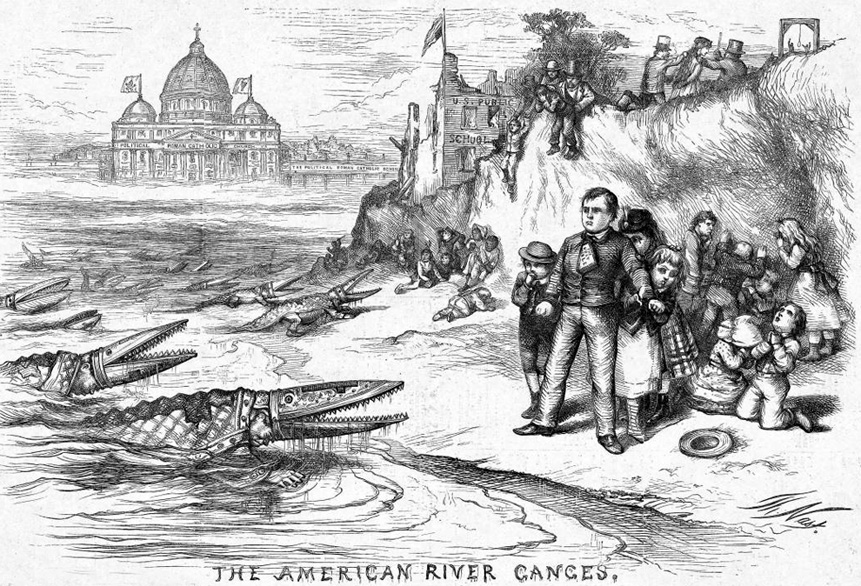
First of all, the “social distance” between immigrants and the hosts society is very subjective. The caricature below offers a glimpse into how “unsuited” were Catholic immigrants to the US in the eyes of 19th century American natives. Back then, Catholics were the papist hordes invading America and threatening the very foundations of US civilization. Somehow, that threat did not materialize (if it ever existed).  This means that many misconceptions will tend to circulate which are very far from the truth. One good example of these misconceptions is illustrated by William Easterly and Sanford Ikeda on the odds of a terrorist being a muslim and the odds of a muslim being a terrorist. Similar tales (especially given the propensity of Italian immigrants to be radical anarchists) were told about Catholics back then. So let’s just minimize the value of this argument regarding going to hell in a hand basket.

nast1

But let us ignore the point made above – just for the sake of argument. Is this a sufficient argument against more immigration? Not really. If the claim is that they hinder “our” institutions, then let them come but don’t let them participate in our institutions. For example, the right to vote could be restricted to individuals who are born in the host country or who have been in the country for more than X-number of years. In fact, restrictions on citizenship are frequent. In Switzerland, there are such restrictions related to “blood” or “length of stay”. I am not a fan of this compromise measure (elsewhere I have advocated the Gary Becker self-selection mechanism through pricing immigration as a compromise position).*

The point is that if you make the argument that immigrants are different than their host societies, you have not made the case against immigration, you have made the case for restrictions against civic participation.

* Another “solution” on this front is to impose user fees on the use of public services. For example, in my native country of Canada, provincial governments could modify the public healthcare insurance card to indicate that the person is an immigrant and must pay a X $ user fee for visiting the hospital. Same thing would apply for vehicle licencing or other policies. Now, I am not a fan of such measures as I believe that restrictions on citizenship (but offering legal status as residents) and curtailements of the welfare state are sufficient to deal with 99% of the “problem”. 

Angry? Learn economics!

The election didn’t go your way (and if it did, just think about past elections… at least some of those didn’t go your way) and now you’re itching to do something about it. You’re angry and motivated, and at risk of making things worse

Economics isn’t just about money. In fact, it’s barely about money. It’s mostly about cooperation between strangers. But economists also study competition. Most importantly, we study decision making which is essential to understand if you want people to make different decisions!

More importantly, economics helps us understand how to navigate costs and benefits wisely. It turns out wise decision making isn’t as straight forward as we’d hope. So if you care enough to work hard to make the world better, economics is worth your time.

Still here? You really want to make the world a better place! Let me suggest that you study social science. Something I’ve learned during my first decade of studying economics (Jan. 2018 will by my 10 year mark) is that thinking clearly about something as complex as society requires mental tools that we aren’t born with. Our intuitions will lead us astray. The good news: economics mostly boils down to common sense rigorously applied.

Economics doesn’t have a monopoly on the truth (if we did, this post would be shorter but you’d have to pay to read it). But I think econ is the best place to start in an intellectual exploration of society. It will help you build a robust and modular framework for understanding the world. Economics is the ultimate modular social science; you can plug-and-play with insights from anywhere.

So why econ? Because at the end of the day, economics deals with the most important aspect of life: how to live life well. It boils down to this: every choice comes at the cost of a foregone alternative. Opportunity cost. All (good) economics comes down to this profound truth. Whether your goal is to reduce poverty, pollution, or parenting woes, learning to think of cost in these terms will serve you well.

Let’s take that concept for a test drive… would banning plastic bags reduce environmental harm? The benefit is that you’ll eliminate the problems associated with these bags (litter, use of oil, etc.). But we need to understand the costs before we know if we’re helping or hurting the environment. Notice that link starts with the question “paper or plastic” and goes on to say nothing about paper bags; it’s looking at the silver lining without acknowledging any possibility of a storm cloud. That lack of economic thinking opens us up to new problems: making heavy paper bags also creates pollution and could very well create more.

In other words, this simple concept showed us that it’s possible to do harm by doing something that sounds good (the road to hell is paved with good intentions!).

It’s easy to miss the forest for the trees: economists specialize in researching very specific areas–foreign exchange markets, agricultural futures, political change, pirates–and it’s easy to get bogged down in the details. Studying economics in school means studying under specialists. But once you’ve got the basics of the economic way of thinking down, you’ll see that those specializations are really just applications of the same general concepts and the same basic way of thinking. It’s easier to understand once you speak our language, but there are lots of great resources. Two places I would start:

Now get to it! Start making things better!

The culture that is Argentina

In Argentina, lawyers take vacations in January and physicians in February.

Those months are the hottest of the Summer in the Southern Hemisphere and, thus, are of the lowest productivity. Moreover, every agreement you reach with somebody during January and February goes void in March!

Cheers!

Even More Sex

Below is an excerpt from my book I Used to Be French: an Immature Autobiography. You can buy it on amazon here.


My mother routinely spoke irresponsibly in front of her children, as if we did not understand the language. Many times, in my early years, I overheard her describing a wayward female movie star, sometimes even a neighborhood woman, as “a prisoner of her senses.” She did not say this in a censorious manner but sympathetically, with a tinge of envy perhaps. The repetitiousness of the assertion loosened high expectations in me. In adolescence and even later, I kept looking for such “prisoners.” It took me a long time but, when I recognized one, I married her without hesitation.

I am not sure when my mother tried to provide formal sex education per se. I may have been eight or nine. I declined her instruction, not because I was prudish about the facts but because her pompous language style, derived on that occasion from bodice-buster serials in her weekly newspaper, made me uncomfortable. I would have been more at ease with concrete descriptions of the exchange of body fluids.

On other, more casual instances her wording was often quite vigorous. When the first blue jeans appeared in Paris, I may have been about twelve, or so. My mother declared then and there her opposition to this new type of garment on the ground that they were explicitly designed to emphasize men’s private parts thus inflaming the young women. One of her many off-hand remarks that contributed to make me optimistic about women’s erotic vulnerability and the ease of their conquest. My mother could describe an innocent, practical article of clothing as a kind of more or less gratefully accepted form of public rape. For this talent, I forgave and I forgive much that she did that was truly evil.

Public Support for OReGO: Preliminary Results

tldr version;

Road pricing can be a useful means of addressing infrastructure fiscal issues, reducing congestion, and improving environmental quality and it has a chance of being implemented if advocates focus on mobilizing urban voters.

Thanks to all respondents.


This post is a quick detour from the NoL Foreign Policy Survey posts.

Among other projects I am working on, I am tinkering with a public opinion project aimed at the OReGO project. The OReGO is a pilot program operated by the State of Oregon to experiment with an alternative to the existing gasoline tax. Currently Oregonians pay 30 cents per gallon of gasoline, on top of the federal 18.4 cent per gallon tax. Volunteer participants of OReGO instead pay a charge of 1.5 cents per mile driven on state roads.

orego

The primary goal of the program is to find a better way to fund the state’s infrastructure. The current system is inadequate because automobiles are becoming increasingly more fuel efficient and so, on a per mile basis, pay less for road use. Despite paying less these automobiles still rack up costs in road damage.

Advocates of OReGO, and other road pricing schemes, also hope that the program will serve as a means of combating congestion by making drivers more conscious of the marginal cost of their driving and encouraging them to avoid excess driving. The gasoline tax does this already, but very crudely in comparison.

Some advocates also hope to use road pricing as a means of improving local environmental quality and addressing climate change. Automobiles are a significant source of pollution and so reducing their use would yield environmental benefits. Even if the program kept the same number of cars on the road it could reap benefits if it reduced stop and go traffic; automobiles pollute more in stop and go traffic than free flow.

There is quite a bit of research from economists and urban planners on the issue, but public opinion research on it is relatively rare. What research exists tends to focus on either toll roads or in foreign regions. The reason for the gap in the literature is simple enough to explain – no jurisdiction in the United States has adopted road pricing. There have been a few small scale experiments, but they were largely engineering tests and surveyed only the opinion of participants. I hope to fill this gap in the literature by (eventually) conducting a large scale public opinion study of Oregonians.

The below pilot study had 220 respondents recruited through various Oregon sub-reddits (e.g. Portland, Eugene, and Salem). Respondents were obviously not representative of Oregon at large. The sample size was also small for an academic study of Oregon and there is a lot of noise. Most of the results presented are statistically insignificant. As a convenience sample though this survey was nonetheless useful. My goal in this survey was more about testing the survey before fielding it more broadly.

I thank all respondents to the survey – you’ve all helped the progress of science.

Survey Experiment Results:

The survey had a survey experiment. The purpose of survey experiments is to see how changes in phrasing, or other survey elements, influences response.

The experiment was in how OReGO was presented. Respondents were split into three sub-groups and received slightly different explanations of the program. In the base scenario they were told the program was simply a funding mechanism. In the congestion scenario they were also told about its possible congestion benefits. In the final they were additionally told about its possible environmental benefits.

OReGo is a pilot program currently being operated by the Oregon Department of Transportation. Participating drivers are being given the opportunity to pay 1.5 cents per mile they drive on public roads instead of the current 30 cent per gallon tax that the state of Oregon currently charges.

Advocates of OReGO, and similar road pricing schemes, argue that the program serves as a more dependable means of funding infrastructure than the current gasoline tax. They point out that as vehicles become more fuel efficient the amount that drivers pay per mile is decreasing, but costs associated due to road damage are not similarly decreasing. This means that in the long term the current gasoline tax will be unable to cover infrastructure costs. (/End of Base Scenario)

Advocates of OReGO also point out that the program can help reduce congestion by discouraging excessive driving and encourage the use of alternative means of transportation such as bicycling, walking, or transit. Although drivers currently pay for their automobile use in the form of the gasoline tax, many view it as a fixed payment. OReGO, which is charged on a per mile basis, may serve to make drivers more conscious of the marginal cost of their driving. (/End of Congestion Scenario)

OReGO could lead not only to reduced congestion, but could also serve to improve local air quality. One of the major sources of air pollution is automobiles, especially in stop and go traffic. (/End of Environmental Scenario)

Looking at support for adopting OReGO within five years the different treatments are little different from one another. The congestion treatment received a decline in support, but it is pushed back up in the environmental treatment.

I regret not adding a fourth group where respondents are told about the base option and the environmental benefits, but congestion is not added. As it is, it is hard to tell if the decline in support for OReGO in the congestion treatment is because people don’t care about ways to address congestion, or they dislike attempts at social engineering.

favororegobytreatment

When we look at treatment effects among only those who identified living in an urban area the effects get more interesting. Urban voters were very responsive to the idea of environmental benefits and increased support for OReGO by over 10 percentage points.

FavorOregobyTreatmentUrban.png


favororegobyurban

What seems to be driving the difference in support for OReGO is inter-regional differences in perceived local air quality. Those who perceive local air quality to be ‘very good’ are least likely to support OReGO. This finding is exaggerated when looking at only urban respondents.

I played around to see if this was a statistical artifact from the above treatment; i.e. it is possible those who lived in ‘very good’ air quality regions received the ‘environmental treatment’  and I am picking up the latter effect. This was not the case.

favororegobylocalair

favororegobylocalairurban

Is this a simple case of those living in high quality areas having no interest in improving the region? A “I have mines” attitude. No. When I look at support for OReGO by how respondents judged local air quality had changed in the past five years, those who thought their local air quality was improving also had the highest support for OReGO.

There is a definite relationship here between support for OReGO and perception of one’s local air quality. I can’t put my finger on it just yet.

favororegobychangeairurban

Bonus result: daily bicyclists are those most supportive of OReGO.

favororegobybikefreq

French Expatriates and Foreign Francophiles

First, a definition: an expatriate is someone who lives outside the country of his birth on a more or less permanent basis. I am dealing here with French expatriates specifically, a fairly rare breed in relation to the size of the French population, rarer than English and American expatriates, for example.

The French expatriates often land in a particular town of a particular country at a particular time for no particular reason. They may have been heading somewhere else and gotten stuck along the way. They always include wives and former wives of natives who may have divorced them, or died. Coming from different epochs (such as before and after the establishment of French social democracy in the 1980s), they form historical strata. Each stratum remembers a different France, and the strata may entertain disparate and often incompatible visions of the fatherland.

They have developed new habits in the country where they live and, without knowing it, they have drifted far from their culture of origin. Many disseminate patently false notions about the country where they were raised; they do it more or less innocently because myth-making and absence go well together. Their French self is forever a young person, or even a child. Their own children are simply natives of their land of residence with a smattering of the French language and no real curiosity, forever strangers to their parents.

The Francophiles are yet another story. They are people who don’t have the luck to have been born French but who love what they imagine is French culture with a degree of repressed hysteria. No part of the world is free of them. I have bumped into them everywhere I have been; they have victimized me everywhere with their undeserved love. Many but by no means all are also francophone to some extent. Some gain standing in their own mind via their real or imagined mastery of what they have decided is a superior national culture.

They are usually very parochial, doubly so because they are fixated on France and on their own country, to the exclusion of knowledge of any other part of the world. Others are teachers of French who feel professionally obligated to revere that which they teach and, by extension, everything French. Often, they don’t even know the language very well, limited as they are by the cramped discourse of textbooks, without awareness of the vigor, of the colorfulness, and, especially, of the frequent crudeness of the real French language of both literature and everyday life. (“Cul-de-sac,” for example, means “ass of a bag.”)

Once, a long time ago, in Bolivia of all places, I observed that the two groups mixed well. It was at a Bastille Day celebration at the French consulate. The French expats and the Francophiles shared the rudimentary popular imagery of the 1789 French revolution, that beheaded a king for the sake of “public salvation,” and his pretty, frivolous young queen, just in case. (That was after storming a prison-fortress, the Bastille, that was largely undefended.)

Think of reading my book: I Used to Be French: an Immature Autobiography. It’s available from Amazon, under my name. I need the bucks. Please!

Our Daily Bread and a Horse’s Ass

Below is an excerpt from my book I Used to Be French: an Immature Autobiography. You can buy it on amazon here.


A little later, the old man harnessed his plow horse to the cart. The women climbed with great caution onto the wooden benches in the back, all three in their Sunday best, including hats, and leather shoes instead of the usual wooden clogs. The old man motioned me to the seat near him, up front. While this seemed the normal place for a boy, I was suspicious because he kept cackling unnaturally and his wife reprimanded him in dialect several times from the back of the cart. Before we had gone a hundred feet, the horse started blowing powerful and odoriferous farts right into my face. It never let off until we reached the church. The old man had deliberately fed him a breakfast of oats to which the beast was unaccustomed. Everyone thought that was a good joke but the old lady was concerned about my big city sensitivities. I just thought it was the old man who was the horse’s ass but his precise planning and his foresight impressed me all the same, not to mention his control over the animal’s gut.