On film choruses. There is so much behind this curtain. An excerpt:
I wanted to find out who among this massive group would be the one to say “hey, let’s add a chorus and have it sung in Sanskrit” or something along those lines. The answer turns out to be: Pretty much any of them can and sometimes do. What film choruses offer us is a perfect synecdoche for the collective, frenzied, and deeply mercenary magic that creates movies in the first place. It’s as likely that a director had the screenwriter invent specific lyrics early in post-production as that a subcontractor, assistant composer, or orchestrator jotted down some words or went on a Wikipedia deep-dive eight weeks out from release in a desperate late-night quest for a non-copyrighted text to use with a cue that might please a bunch of suits half a world away.
Although the sentiment may seem paradoxical, libertarians should cheer this week’s decision by a federal judge upholding Indiana University’s vaccine mandate for students.
So argues professor Stephen L. Carter in this interesting piece. In short, a mandate checks the boxes if it is instated in a decentralized and narrow fashion.
A review of four books challenging mainstream, neoclassical economics. In The Corruption of Economics, the author Mason Gaffney (btw, he passed away just over a year ago) proposes that the 19th century’s American universities perceived Georgist ideas as a threat to their vested interest in land-owning, and actively suppressed them. His work on the Stratagem against Henry George has been referenced in a NOL piece by – the also late – Fred Foldvary.
On the Cuba events. Governments and protests, now that’s a strained relationship. Talking about the so-called “Second World” countries, Nikita Khrushchev did not even know what booing is, until he encountered it in his visit to London in 1956.
Few years later, during a massive strike in the Russian city of Novocherkassk, a crowd stormed the central police station. Whether it was a genuine assault, or a naive display of defiance from a people inexperienced in protesting, the government’s fearful puzzlement turned to cold, brutal aggression. Unarmed protesters at the center of the city, mistakenly thinking that those days were over, remained steadfast at the face of warnings to disperse. That is, until security forces opened direct fire against them. The ensuing massacre was covered-up for three decades. Since this was an à la Orwell un-event, no high-ranking officials’ records were stained.
Khrushchev’s aloof ignorance strikes a nerve, contrasted with the people’s heartbreaking one. Both glimpses are captured in the brilliant (though somewhat uneven) Red Plenty, by Francis Spufford.
The Greek government, like its French counterpart, is escalating the push for vaccinations. As constitutional scholars argue the limits of state power regarding personal freedom and the public good, historical precedents are brought forth (for the US, c. early 1900s), involving mandatory vaccinations, quarantines and discrimination. The discussion draws from equal protection of the laws jurisprudence and smoothly led me to Yick Wo v. Hopkins(1886):
The decision set a milestone and has been cited some 150 times.
The backdrop of the case is rich. As it turns out,
An 1880 ordinance of the city of San Francisco required all laundries in wooden buildings to hold a permit issued by the city’s Board of Supervisors. The board had total discretion over who would be issued a permit. Although workers of Chinese descent operated 89 percent of the city’s laundry businesses, not a single Chinese owner was granted a permit.
The regulation was one in a series of many that reflected the anti-immigrant (especially anti-Chinese) sentiment, following the influx due to the Gold Rush (1849).
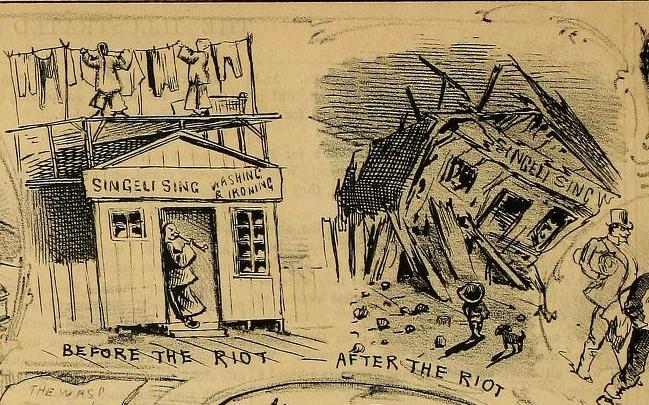
An illustration of the time, echoing the 3-day pogrom vs Chinese immigrants, San Francisco Jul. 1877 – Source
A particularly badass line, from the unanimous opinion authored by Justice Stanley Matthews, shows that the Court did not hold back:
Though the law itself be fair on its face and impartial in appearance, yet, if it is applied and administered by public authority with an evil eye and an unequal hand, so as practically to make unjust and illegal discriminations between persons in similar circumstances, material to their rights, the denial of equal justice is still within the prohibition of the Constitution.
How the Jewish mob fought American admirers of the Third Reich. An excerpt:
Judd Teller, a reporter for a New York Jewish daily, relates how he met one day with “several men who said they were from ‘Murder, Incorporated’ and wanted a list of ‘Nazi bastards who should be rubbed out.’” Teller took the request to Jewish communal leaders. They told Teller that if the plan would be put in motion, “the police would be informed promptly.” Teller relayed this warning to his Murder, Inc. contact. Upon hearing this, the mobster angrily replied, “Tell them to keep their shirts on. OK, we won’t ice [murder] the bodies; only marinate them.” According to Teller, this is exactly what they did. He said the attacks by the Jewish mobsters was sufficient “marination” to drastically reduce attendance at Nazi Bund meetings, and discouraged Bundists “from appearing in uniform singly in the streets.”
On the Politics and the English Language essay. I try to stick to the six rules, but I fear I am not totally “outright barbarous”-proof. Another list with writing rules – a more light-hearted one – comes from Umberto Eco, the noted Italian scholar:
Speaking of proper phrasing, here is a passage from Lysander Spooner (Thomas L. Knapp posted it in the comments section of a NOL piece by Jacques Delacroix):
[W]hether the Constitution really be one thing, or another, this much is certain — that it has either authorized such a government as we have had, or has been powerless to prevent it. In either case it is unfit to exist.
Now, I may have found the second prospective opening for my public policy course, should I ever offer one (the absurd part is that I lack almost everything else to supply it, demand included). It is pithy, sharp and, importantly, timeless. The alternative one-liner I would possibly pen day one at the imaginary class:
Property imposes obligations. Its use by its owner shall at the same time serve the public good.
Weimar Constitution (1919), art. 153(c)
While not as punchy as Spooner’s aphorism, it has qualities and can raise eyebrows. Both phrases are metal. Independent of context, they have more or less exactly what it takes to pick and stick. Perhaps both of them should set the opening, leaving the audience free to choose the way forward.
Back to Spooner. Another prominent figure (of American individualist tradition this time) I had not heard of till this day.
Lysander Spooner (Online Library of Liberty). The particular passage comes from his No Treason. No. VI. The Constitution of No Authority (1870).
I took note that he challenged the government monopoly in mail services (a field with quasi-military structure, typically used as a matrix to consolidate state bureaucracy/ power, btw) with his American Letter Mail Company, on ethical and economic grounds. The state finally forced him out of business in 1851, though competition temporarily drove fees down.
(If you care about post stamps – I don’t – USPS to issue Ursula K. Le Guin stamp this month (Book Riot). I enjoyed Le Guin’s Earthsea and plan to read The Dispossessed, a veiled study of social systems I hear, before summer end)
If anything, Spooner seems to have shared the fiery convictions and language of his contemporaries at the First International. That was a time of memorable lines, obviously. This easily comes to mind:
The history of all hitherto existing society is the history of class struggles.
The Communist Manifesto (1848)
They also sported some serious beards. Those of Spooner and Marx are respectable, but I would award James Guillaume’s bonus points for the extra menacing vibe.
NOL has revisited works of Diego Rivera here (this particular mural, aka Pan American Unity) and here (another mural, Frozen Assets – Fondos Congelados – from 1931).
This is a long, but enrapturing piece (I am not familiar with McCloskey’s work, which was also referenced en passant in another fresh NOL post). An excerpt:
I happened in 1958 to devour in the Andrew-Carnegie financed public library of Wakefield, Massachusetts the Russian prince Pyotr Kropotkin’s Mutual Aid: A Factor of Evolution (1902) and the gullible American journalist John Reed’s Ten Days That Shook the World (1919). If I had instead come across Rose Wilder Lane’s The Discovery of Freedom (1943) or Ayn Rand’s Atlas Shrugged (1957) I suppose I would have gotten a better grasp of market pricing, earlier. Many market-loving classical liberals came to liberalism by that free-market path, and were never socialists. Yet the socialism-to-liberalism route is very common in 20th century political biographies, such as Leszek Kołakowski’s or Robert Nozick’s or, to descend a couple of notches, D. N. McCloskey’s. (The contrary route from market liberal to state socialist is vanishingly rare.)
Or, some Monday links on flavors, figurative flags and fails
I mean, it would be impossible to have a business like this in the States, a wood-burning fire – illegal, the meat – illegal, the dog – illegal, the cheese sitting out uncovered – illegal. Basically, everything that makes this place good would be illegal in the United States.
Anthony Bourdain: No Reservations ep. 1 – 01 France: Why the French don’t suck (Jul. 2005)
The other day, Brandon highlighted (the review of) a cultural history book, one that documents the postwar shift of cultural gravitas from Paris to New York. So, the talk is about the big league, the respectful duo of countries that gave us, among other things, modern constitutionalism and an understanding of the natural hue of fundamental rights. Here, I venture to present a sincere, if arbitrary (and somewhat superficial, since I never learned French, to my mother’s disappointment) selection of other Franco-American bites, that shadowed greater trends, or even shaped them.
160 years ago, chef Charles Ranhofer, a Frenchman, traveled to the US for a second time. A year and a false dawn at another premise after, he was hired at Delmonico’s in New York, an already established name. There, he proceeded in making it the definite flagship of American fine dining for the next 30-35 years.
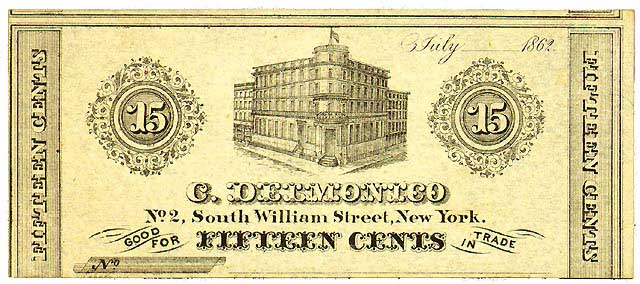
A note issued by the restaurant at the time chef Ranhofer joined the team (1862) – source
His achievements include the invention of renowned dishes, innovations in the dining business model and a massive Franco-American culinary encyclopedia (The Epicurean, 1894, complete with nearly 1000 dishes and thorough guidelines for the proper tables/ menu setting, depending on the occasion). The story fits well in the Gilded Age picture, though I would guess not at front center.
My pastry trilogy came a full circle only last year, having started some ten years ago: a Mississippi mud pie, a cheesecake (early 2010s, both under the guidance of my wife) and a tarte Tatin (May ‘20 lockdown, unsupervised, our then nearly-5-year old provided merry company). Of the three creations, the final was the most refined, as deserves to a French recipe from late 19th century. Like, it needed some real – if basic – technique, not the average ingredient gathering I was used to. It was also a mild failure.I followed a modern take, one to safely blame without retort. Will try again, someday. There are relevant recipes aplenty, though not in its contemporary Epicurean.
The Gilded Age was nearing its end when the famous Lochner v New York decision was delivered (1905). The Supreme Court struck down a New York state law on regulating working hours, as a breach of the liberty of contract, which was protected under the Due Process Clause of the Fourteenth Amendment. A few decades later, in United States v Carolene Products Company (1938), an interstate trade case, the Court lowered the standard of review for economic legislation, effectively demoting economic liberty vis-à-vis the other personal liberties.
Both decisions refer to the food industry, bakeries and milk manufacturers respectively. They hold vast importance and warrant further study (for starters – note to self – judicial activism in Lochner, individual rights in Carolene).
As a certain minstrel in a certain fantasy realm would have it, the truth of these decisions became something bigger than the facts. The two cases work as handy banners of the paradigm shift from “unrestrained economic liberty” to “state interventionism”, which happened as right/ left-wing totalitarianisms convincingly challenged the prewar liberal order. Liberal-minded thinkers from the two sides of the Atlantic tried to revitalize the liberal creed in the interwar years. Some of them convened at Paris – few months after the Carolene decision – to honor the visit of the American journalist/ author Walter Lippmann, a notable critic of the New Deal.
There were deep differences, but also a strong agreement on the threat posed by central planning and some tentative overlapping on the perceived failings of “old” classical liberalism and, interestingly, the potential of the state in enhancing personal freedom by pursuing limited social goals. The – middle – way forward needed free markets in a solid, impartial legal frame, which would enforce competition and even provide for a modicum of social justice. By one account, it was during this meeting that the term “neo-liberalism” took root (other ideas included “left-wing” or “constructive” liberalism. Chicago theorists – not represented at the Colloque Lippmann- had previously written about “positive” liberalism), though the term is older. The resolution led to nowhere in particular, since World War II broke out shortly after. It is nonetheless considered a kind-of precursor to the Mont Pelerin Society, the well-known organization founded after a conference in 1947, at the invitation of Hayek.
The neoliberal position is nicely summarized by Milton Friedman (who was present at the 1947 proceedings) in a short piece from 1951:
Neo-liberalism would accept the nineteenth century liberal emphasis on the fundamental importance of the individual, but it would substitute for the nineteenth century goal of laissez-faire as a means to this end, the goal of the competitive order… The state would police the system, establish conditions favorable to competition and prevent monopoly, provide a stable monetary framework, and relieve acute misery and distress.
The term can also be found in scholarly papers from 50s-60s, but upon closer inspection they mostly focus on its German variant, “ordoliberalism”, which was closely associated with the “social market economy” – the postwar platform that defined West Germany (though voters could hardly tell what it exactly was).
My understanding is that, at some point postwar, the French involvement dwindled. Also, some German theorists fell from grace in the Mont Pelerin Society context, while US membership increased in number and clamor. The whole approach tilted closer to classical liberal/ libertarian (another note to my – European – self, Edwin van de Haar offers precious nuance regarding such terminology in a fresh post) and away from the “free market, strong state” convictions of Colloque Lippmann.However, Hayek retained cordial relations with the University of Freiburg – where the original ordoliberal theses formed.
Then the shade of neo-liberalism faded, only to be invoked as a nebulous catch-all characterization of free market policies a couple of decades later, almost devoid of its competitive and social security chops. It got a life though, since it was fleshed in the founding Treaties of the EU of the 50s. The institutional apparatus of the Union smugly radiates “free market within the properly defined lines” (the US influence is not be discounted, of course. Case in point, competition law).
EU, as with the Colloque: The French grabbed a coffee with the Americans and threw a party. Then, they took a step back as the Germans stopped being shy and hit the decks.
Back to the kitchen. Late 60s and into the 70s, gastronomic developments trace the retooling of society-at-large. That was the time various “new” national cuisines rose, with the French Nouvelle cuisine once again leading the way and the New American Cuisine taking clue from it (in Greece we usually talk about the “(new) urban cuisine” of that period, as the country experienced a rapid urbanization wave in the preceding decades).
Fantasy unchained: A cooking center in 1980 as imagined in 1973 – source
In the meantime: Political turmoil, be it protests or terrorism, there go Bretton Woods arrangements, productivity flattens, environmental concerns kick-in, enter competition from Asia, human rights against the Soviet Block, university studies expand, telecommunications and transport improve, oil crises, the lights go out in Britain and elsewhere, inflation runs, and so on and so forth. The next decade coincided with the emergence of new political leaderships across the West, as the turbulence discredited the previous guard.
The consensus got a drift for privatizations, deregulation and liberalization of international transactions, with US and Britain adhering to it (though to say that they indeed rolled-back the size and scope of State is questionable). This time, the Nobel Memorial Prizes in Economic Sciences awarded to Hayek (1974) and Friedman (1976) served as a flag (or a scarecrow) for the transition to market-based prescriptions.
The endgame was meant to play out in France. In May 1981, Mitterrand won the presidential election on a pretty standard socialist agenda. The program of nationalizations, hiked taxation, capital controls, grants and subsidies run its course till 1983, when the bad results in deficit, employment, inflation and the exchange rate – underlined by an equally poor performance in local elections – prompted a turn to anti-inflationary rigor and a realignment with more market-oriented policies (Spain and Greece, btw, more or less copycatted the French experience).
In a twist in the myth, three Mitterrand guys even went to assume head posts in international bodies, like the IMF (a member of the unholy trinity of the “Washington Consensus”), and promote capital account liberalization from there.
Endnote: The No Reservations show of late Anthony Bourdain had a role in our family’s inconsistent knack for things cooking/ baking. While writing this, I found out that a documentary on the man’s life just premiered at the Tribeca Film Festival.
Or, some Monday links on central banks, manners over matters and hard-boiled decisions
That bond salesman from the Jazz Age was right. Reserving judgement, at least sometimes, allows for a fairer outcome. Take for example the Brick film (2005), a neo-noir detective story set in a modern Southern California high school. Here in Greece it made some ripples, then it was forsaken for good. Not sure about its status in the US or elsewhere, but “overlooked”/ “underrated” seem to go with it in web searches. I agree now, but when I first watched it, its brilliance was lost to me ( and no, it was not allegedly “ahead of its time”, as some lame progressive metal bands of late 90s hilariously asserted when they zeroed in sales…).
The film’s peculiarity was obvious from the titles. A couple of gals left the theater like 10’ in. My company and I were baffled for most part, by the gritty atmosphere. And I have not even begun with the dialogue. The language was something from off the map. As late Roger Ebert noted:
These are contemporary characters who say things like, “I got all five senses and I slept last night. That puts me six up on the lot of you.” Or, “Act smarter than you look, and drop it.”
You see, the whole thing was intended to serve tropes, archetypes and mannerisms from the hard-boiled fiction of 1920s-30s. A manly man vs crime and (corrupted) government, and so on and so forth. We went there, un-f-believably how, clueless about all these. We did, however, make a recurring joke from the following lines:
Brendan: You and Em were tight for a bit. Who’s she eating with now? Kara: Eating with? Brendan: Eating with. Lunch. Who.
Seen in this light, everything made sense to my gusto. Anyway, seems that reserving judgements not only does better assessments, but also protects the lazy unaware.
Now, I have previously indicated that I have a soft spot for the “technology of collective decisions” that are central banks. I usually reserve my judgements on them, too. This comment summarises recent developments, including a few interesting links:
The author argues that central banks, supposedly the bastions of technocratic approach, tend to “respond” (i.e. be nudged by and directly appeal) to a perceived “will of the people”, as it is expressed on-line or via events like the “FED Listens” series. This bend acts as a claim to legitimacy and accountability, in exchange of trust and extended discretion, leading to a self-reinforcing circle almost beyond the democratic election process. In other words, not quite the “Bastilles” contra “modern Jacobinism” (to remember how Wilhelm Röpke deemed independent central banks in 1960). A way out could be made, concludes the author, by introducing of a rule-based monetary policy.
Central banks, as institutional arrangements developed mostly during the 20th century, share a common mojo and tempo with the FED. They gradually assumed more independence, and since the emergence of modern financial markets, (even more) power. This rise has been accompanied by increasing obligations in transparency and accountability, fulfilled through an ever-expanding volume of communication in terms of hearings, testimonies, minutes, speeches etc. This communication also plays a role in shaping economic actors’ expectations, a major insight that transformed our understanding of macroeconomic outcomes. Andy Haldane talks all these, along with other delicious bits, in an excellent speech from 2017 (his speeches have generally been quite something):
Plot twist: The endeavor of more communication has a so-so record in clarity, as documented by the rising number of “education years” needed to follow and understand central banks’ messages. The same trend goes for the pylons of rule of law, the supreme courts, at least in Europe. We certainly have come a long way since that time at the 70s, when a former Greek central bank Governor likened monetary decisions to a Talmudic text, ok, but we are not there yet.
As a parting shot, let us return just over a year back, when the German Federal Constitutional Court delivered a not exactly reserved decision (5 May 2020) about the European Central Bank’s main QE program. The FCC managed to:
scold the top EU Court for flawed reasoning and overreach in confirming the legality of the program in Dec 2018 (the FCC had stayed proceedings and referred the case to the Court of Justice of the EU, for a preliminary ruling in Jul 2017. Europe’s top courts are not members of the Swift Justice League, apparently).
indirectly demand justifications from ECB, which is beyond its jurisdiction as an independent organ of EU law, by
warning the German public bodies that implement ECB acts to observe their constitutional duties, while
effectively not disrupting the central bank’s policy.
The judicial b-slapping provoked much outcry and theorising, but little more, at least saliently. The matter was settled by some good-willed, face-saving gestures from all institutions involved, while it probably gave a push to the Franco-German axis, to finally proceed in complementing monetary policy measures with the EU equivalent of a generous fiscal package. The rift between the EU and the German (in this case, but others could follow) respective legal orders may never be undone, though. If anyone feels like delving deeper into the EU constellation, here is a fresh long slog:




 Notes On Liberty
_-_Local_Chips_(cropped).jpg)
