A short note on Klimt and Schiele

I hope y’all have been enjoying my new “Nightcap” series. Many of the articles eventually end up at RealClearHistory (my bad ass editor has the final say-so), so I thought I’d be doing y’all a favor by sharing them here, in smaller doses, first.

This BBC article on Gustav Klimt and Egon Schiele, a couple of Austrian artists, won’t make the cut (RCH‘s readers don’t really enjoy art history), but I thought you’d love it. Vienna was the center of intellectual life for not only economists and philosophers in the late 19th-early 20th centuries, but also for artists and other academics and critics as well.

Klimt (bio) is my favorite painter, ranking just above Picasso, Chagall, BoschHokusai, and Dalí. Check this out:

[…] a decision was made to permanently display the paintings in a gallery rather than on the ceiling [because they were so scandalous]. Klimt was furious and insisted on returning his advances and keeping the paintings. The request was refused but after a dramatic standoff in which Klimt allegedly held off removal men with a shotgun, the Ministry eventually capitulated.

Tragically the paintings were destroyed by retreating SS forces in 1945 and all that remains are hazy black and white photographs.

How could you not like the guy?

PS: I’ve heard, through the grapevine, that Lode and Derrill have posts on the way. Stay tuned!

Nightcap

  1. In 1948, Israel lost 1% of its population Marcel Surr, War is Boring
  2. How Nazis Celebrated Murdering Jews Edward Westermann, Aeon
  3. Croatia: the Fragile Heart of the Balkans Matthew Engel, New Statesman
  4. How Marvel Comics’ Wakanda Got Its Name Thomas McDow, Origins

Nightcap

  1. The new age of great power politics John Bew, New Statesman
  2. Before We Cure Others of Their False Beliefs, We Must First Cure Our Own Christopher Preble, Cato Unbound
  3. Libertarians (FDP) ruin coalition talks in Germany Christian Hacke, Deutsche Welle
  4. The Rich You Will Always Have With You Brandon Turner, Law & Liberty

Tech’s Ethical Dark Side

An article at the NY Times opens:

The medical profession has an ethic: First, do no harm.

Silicon Valley has an ethos: Build it first and ask for forgiveness later.

Now, in the wake of fake news and other troubles at tech companies, universities that helped produce some of Silicon Valley’s top technologists are hustling to bring a more medicine-like morality to computer science.

Far be it from me to tell people to avoid spending time considering ethics. But something seems a bit silly to me about all this. The “experts” are trying to teach students the consequences of the complex interactions between the services they haven’t yet created and the world as it doesn’t yet exist.

My inner cynic sees this “ethics of tech” movement as a push to have software engineers become nanny-state-like social engineers. “First do no harm” is not the right standard for tech (which isn’t to say “do harm” is). Before 2016 Facebook and Twitter were praised for their positive contribution to the Arab Spring. After our dumb election the educated western elite threw up our hands and said, “it’s an ethical breach to reduce our power!” Freedom is messy, and “do no harm” privileges the status quo.

The root problem is that computer services interact with the public in complex ways. Recognizing this is important and an ethics class ought to grapple with that complexity and the resulting uncertainty in how our decisions (including design decisions) can affect the well being of others. My worry is that a sensible call to think about these issues will be co-opted by power-hungry bureaucrats. (There really ought to be ethics classes on the “Dark Side of Ethical Judgments of Others and Education Policy”.)

I don’t doubt that the motivations of the people involved are basically good, but I’m deeply skeptical of their ability to do much more than offer retrospective analysis as particular events become less relevant. History is important, but let’s not trick ourselves into thinking the lessons of 2016 Facebook will apply neatly to whatever network we’re on in 2026.

It hardly seems reasonable to insist that Facebook be put in charge of what we get to see. Some argue that’s already the world we live in, and they aren’t completely wrong. But that authority is still determined by the voluntary individual decision of users with access to plenty of alternatives. People aren’t always as thoughtful and deliberate as I’d like, but that doesn’t mean I should step in and be a thoughtful and deliberate Orwellian figure on their behalf.

Nightcap

  1. The Persistence of Tyranny Ken White, Popehat
  2. The father of consumer sovereignty Henry Farrell, Crooked Timber
  3. UK’s Labor (Left-wing) Party and the Custom’s Union Chris Dillow, Stumbling and Mumbling
  4. Kosher Salt Stefan Kanfer, City Journal

Free speech and campus conservatives: good news

The Weekly Standard recently posted an open letter from a very brave sociology professor at UCLA that’s worth mentioning here. I have just three things to add.

First, the sociologist, a self-identified conservative, is doing the right thing by urging the Bruin Republicans to cancel its proposed speech by a shock jock. The subject? “10 Things I Hate About Mexico.”

Second, as alumni I’m embarrassed. I’ve never been a fan of Bruin Republicans, but aping the tactics of Republican groups at less selective schools is pathetic.

Third, back to the open letter: it’s amazing and you should read it (link, again). Apparently, it was so convincing that the Bruin Republicans cancelled the event. What Rossman does – subtly, clearly, and powerfully – is point out to not only Bruin Republicans but everybody else involved in this fiasco that being politically conservative is not the same thing as being a member of the Republican Party. More importantly, by defending the right to speak while vehemently opposing the subject matter, Rossman makes an excellent case for moving the Republican Party in a more classically liberal direction.

Sticking up for your beliefs is important. Always has been, always will be. The pen is still mightier than the sword.

Nightcap

  1. How Capitalism Tamed Medieval Europe Ed West, CapX
  2. Guns and the British Empire Priya Satia, Aeon
  3. When Government Drew the Color Line Jason DeParle, NY Review of Books
  4. In Praise of American History Marilynne Robinson, Times Literary Supplement

Nightcap

  1. Iran’s Afghan fighters, in Syria Ahmad Shuja Jamal, War on the Rocks
  2. The Africans of 16th Century Britain David Dabydeen, New Statesman
  3. What Books Did American Blacks Read Before the 1960s? Jonathan Rose, History News Network
  4. Padmaavat loathed by fundamentalists of all stripes Barkha Dutt, Washington Post

WP: Does Bitcoin Have the Right Monetary Rule?

The growing literature on Bitcoin offers little more than passing mentions to Bitcoin’s monetary rule. This is the topic of this short paper.

The growing literature on Bitcoin can be divided in two groups. One performs an economic analysis of Bitcoin focusing on its monetary characteristics. The other one looks takes a financial look at the price of Bitcoin. Interestingly, both of these groups have not given much more than passing comments to the problem whether or not Bitcoin has the right monetary rule. This paper argues that Bitcoin in particular, and cryptocurrencies in general, do not have a good monetary rule, and that this shortcoming seriously limits its prospect of becoming a well-stablished currency.

Download from SSRN.

Nightcap

  1. Lessons from World War I and British Grand Strategy John Bew, War on the Rocks
  2. Trump prefers spectacle to strategy Danny Sjursen, the American Conservative
  3. A better way to talk about politics Conor Friedersdorf, the Atlantic
  4. It’s not just about big government Scott Sumner, theMoneyIllusion

If causality matters, should the media talk about mass shootings?

My answer to that question is “maybe not” or at the very least “not as much”. Given the sheer amount of fear that can be generated by a shooting, it is understandable to be shocked and the need to talk about it is equally understandable. However, I think this might be an unfortunate opportunity to consider the incentives at play.

I assume that criminals, even crazy ones, are relatively rational. They weigh the pros and cons of potential targets, they assess the most efficient tool or weapon to accomplish the objectives they set etc. That entails that, in their warped view of the world, there are benefits to committing atrocities. In some instances, the benefit is pure revenge as was the case in one of the famous shooting in my hometown of Montreal (i.e. a university professor decided to avenge himself of the slights caused by other professors). In other instances, the benefit is defined in part by the attention that the violent perpetrator attracts for himself. This was the case of another infamous shooting in Montreal where the killer showed up at an engineering school to kill 14 other students and staff. He committed suicide and also left a suicide statement that read like a garbled political manifesto. In other words, killers can be trying to “maximize” media hits.

This “rational approach” to mass shootings opens the door to a question about causality: is the incidence of mass shootings determining the number of media hits or is the number of media hits determining the incidence of mass shootings. In a recent article in the Journal of Public Economicsthe possibility of the latter causal link has been explored with regards to terrorism.  Using the New York Times‘ coverage of some 60,000 terrorist attacks in 201 countries over 43 years, Michael Jetter used the exogenous shock caused by natural disasters to study they reduced the reporting of terrorist attacks and how this, in turn, reduced attention to terrorism. That way, he could arrive at some idea (by the negative) of causality. He found that one New York Times article increased attacks by 1.4 in the following three weeks. Now, this applies to terrorism, but why would it not apply to mass shooters? After all, there are very similar in their objectives and methods – at the very least with regards to the shooters who seek attention.

If the causality runs in the direction suggested by Jetter, then the full-day coverage offered by CNN or NBC or FOX is making things worse by increasing the likelihood of an additional shooting. For some years now, I have been suggesting this possibility to journalist friends of mine and arguing that maybe the best way to talk about terrorism or mass shooters is to move them from the front page of a newspaper to a one-inch box on page 20 or to move the mention from the interview to the crawler at the bottom. In each discussion, my claim about causality is brushed aside with either incredulity at the logic and its empirical support or I get something like “yes, but we can’t really not talk about it”. And so, the thinking ends there. However, I am quite willing to state that its time for media outlets to deeply reflect upon their role and how to best accomplish the role they want. And that requires thinking about causality and accepting that “splashy” stories may be better left ignored.
Nightcap

  1. The applied theory of bossing people around Deirdre McCloskey, Reason
  2. How to survive being swallowed Ed Yong, the Atlantic
  3. Soviet architecture, then & now Noah Sneider, 1843
  4. The Atlantic Ocean before Columbus David Abulafia, History Today

Nightcap

  1. How Men In The Middle Ages Dealt With Gossiping Wives Katie Serena, ATI
  2. King’s Men & Bum’s-bailiffs Jonathan Healy, Social Historian
  3. Trump Shouldn’t Talk to Feds. And Neither Should You Ken White, Reason
  4. Frankenstein in Baghdad Robin Yassin-Kassab, New Statesman

Do risk preferences account for 1.4 percentage points of the gender pay gap?

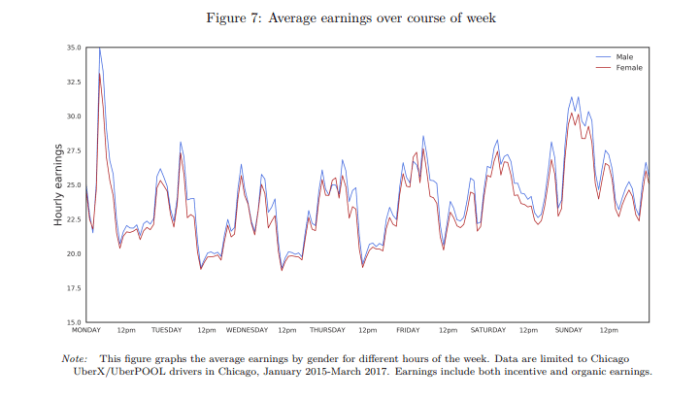
A few days ago, this study of gender pay differences for Uber drivers came out. The key finding, that women earned 7% less than men, was stunning because Uber uses a gender-blind algorithm. The figure below was the most interesting one from the study as it summarized the differences in pay quite well.

DataUber

To explain this, the authors highlight a few explanations borne out by the data: men drive faster allowing them to have more clients; men have spent more time working for Uber and have more experience that may be unobserved; choices of where and when to drive matters. It is this latter point that I find fascinating because it speaks to an issue that I keep underlining regarding pay gaps when I teach.

For reasons that may be sociological or biological (I am agnostic on that), men tend to occupy jobs that have high rates of occupational mortality (see notably this British study on the topic) in the forms of accidents (think construction, firemen) or diseases (think miners and trashmen). They also tend to take the jobs in further removed areas in order to gain access to a distance premium (which is a form of risk in the sense that it affects  family life etc.). The premiums to taking risky jobs are well documented (see notably the work of Kip Viscusi who measured the wage premium accruing to workers who were employed in bars where smoking was permitted). If these premiums are non-negligible but tend to be preferred by men (who are willing to incur the risk to be injured or fall sick), then risk preferences matter to the gender wage gap.

However, there are hard to properly measure in order to assess the share of the wage gap truly explained by discrimination. Here with the case of Uber, we can get an idea of the amplitude of the differences. Male Uber drivers prefer riskier hours (more risks of having an inebriated and potentially aggressive client), riskier places (high traffic with more risks of accidents) and riskier behavior (driving faster to get more clients per hour).  The return to taking these risks is greater earnings. According to the study, 20% of the gap stems from this series of choices or roughly 1.4 percentage points.

I think that this is significantly large to warrant further consideration in the future in the debate. More often than not, the emphasis is on education, experience, marital status, and industry codes (NAICS code) to explain wage differences. The use of industry codes has never convinced me. There is wide variance within industries regarding work accidents and diseases. The NAICS codes industries by wide sectors and then by sub-sectors of activities (see for example the six-digits codes to agriculture, forestry, fishing and hunting here). This does not allow to take account of the risks associated with a job. There are a few study that try to account for this problem, but there are … well … few in numbers. And rarely are they considered in public discussions.

Here, the Uber case shows the necessity to bring back this subtopic in order to properly explain the wage gap.

Nightcap

  1. Scandinavians and the boons of empire Miles Macallister, Aeon
  2. Europe’s populists are waltzing into the mainstream the Economist
  3. Toughing it out in Cairo Yasmine El Rashidi, NY Review of Books
  4. Knowledge of the Holocaust Bart van der Boom, OUPblog