- I thought the Nancy MacLean’s book attacking James Buchanan was great for present-day libertarianism, in that it only weakens the already weak Left. Henry Farrell and Steven Teles share my sensibilities.
- What is public choice, anyway? And what is it good for?
- One of the Notewriters reviews James C Scott’s Seeing Like A State
- Aztec Political Thought
- Turkey dismisses 7,000 in fresh purge
- 10 Chinese Megacities to See Before You Die
state-building
Geopolitics and Asia’s Little Divergence: State Building in China and Japan After 1850
Crossposted at the Medium
Why did Japan successfully modernize in the 19th century while China failed to do so? Both China and Japan came under increasing threat from the Western powers after 1850. In response, Japan successfully undertook a program of state building and modernization; in China, however, attempts to modernize proved unsuccessful and the power of the central state was fatally weakened. The failure to build a modern state led to China’s so-called lost century while Japan’s success enabled it to become the first non-western country to industrialize. In a paper with Chiaki Moriguchi (Hitotsubashi University) and Tuan-Hwee Sng (NUS), we explore this question using a combination of historical evidence and formal modeling.
On the surface this East Asian “little divergence” is extremely puzzling. Qing China, as late as the end of the eighteenth century, was a powerful centralized empire. An impersonal bureaucracy selected by exams, and routinely rotated, governed the empire. In contrast, the institutions of Tokugawa Japan are usually described as feudal. The shogun directly ruled only 15% of the country. The remainder was divided into 260 domains ruled by lords known as daimyo who collected their own taxes, possessed their own armies, and issued their own currencies. To the outside observer China would have seemed much more likely to have been able to establish the institutions or a centralized state than Japan.
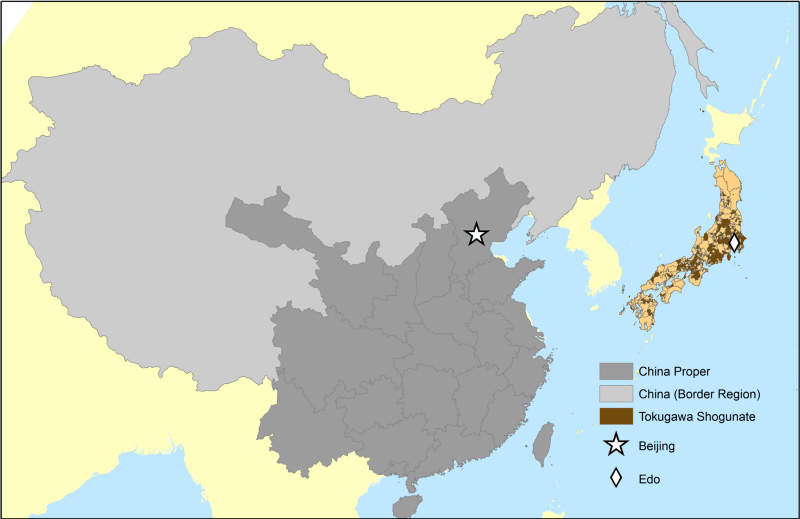
For much of the early modern period (1500–1700) China and Japan possessed military capabilities that made them more than a match for any western power. This changed dramatically after the Industrial Revolution and their vulnerability exposed by the Opium War (1839–1840) and the Black Ships Incident of 1853, respectively. During the First Opium a small number of British ships overpowered the entire Chinese navy, while Commodore Perry’s show of force in landing in Japan in 1853 convinced the Japanese of western naval superiority. Within a few years, political elites in both countries recognized the need to modernize if only to develop the military capacity required to fend off this new danger.
* * *

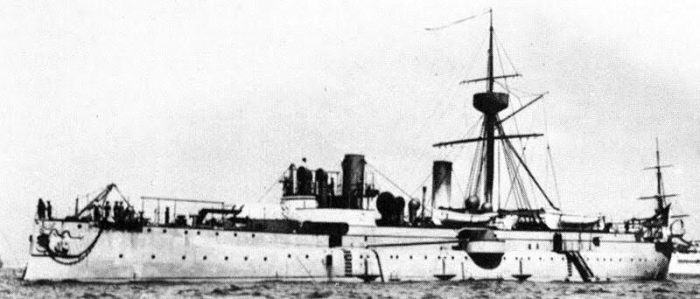
In China, after the suppression of the Taiping Rebellion, there were attempts at modernizing — notably the Self-Strengthening movement associated with Li Hongzhang and others. Recent scholarship has reevaluated this movement positively. At the purely military-technological level it was in fact quite successful. The Jiangnan Arsenal and the Fuzhou Shipyard saw the successful importation of western military technology into China and the Chinese were soon producing modern ships and weaponry. However, these developments were associated with a process of political decentralization as local governors took on more and more autonomy. The importation of military technology was not associated with more far-reaching societal or political reforms. There was no serious attempt to modernize the Qing state.
In contrast, Japan, following the Meiji Restoration, embarked on whole scale-societal transformation. The daimyo lost all power. Feudalism was abolished. Compulsory education was introduced as was a nationwide railway system. A new fiscal system was imposed in the teeth of opposition from farmers. The samurai were disarmed and transformed from a military caste into bureaucrats and businessmen.
Qing China and the newly modernized Meiji Japan would collide in the first Sino-Japanese war (1894–1895). Before the war, western observers believed China would win in part because of their superior equipment. But the Chinese lacked a single national army. It was the Beiyang army and the Beiyang fleet that fought the entire Japanese military force. The fact that Japan had undergone a wholesale transformation of society enabled them to marshal the resources to win a rapid victory.
* * *
Why did the Japanese succeed in modernizing while Qing China failed to do so? Historians have proposed numerous explanations. In our paper, however, rather than focusing on cultural differences between Japan and China, we focus on how different geopolitical incentives shaped their decisions to invest in state capacity and state centralization.
Before the mid-19th century China only faced a threat from inner Asia from where historically nomadic invasions had routinely invaded and threatened the sedentary population of the Chinese plain. Due to this threat, historically China tended to be a centralized empire with its capital and the bulk of its professional army stationed close to the northern frontier (see Ko, Koyama, and Sng (2018)). In contrast, Japan faced no major geopolitical threats prior to 1850. This meant that it could retain a loose and decentralized political system.
After 1850 both countries faced major threats from several directions. China was threatened on its landward borders by Russian expansionism and from the coast by Britain and France (and later Germany and the United States). Japan was threatened from all directions by western encroachment.
We build a simple model which allows for multidirectional geopolitical threats. We represent each state as a line of variable length. States have to invest in state capacity to defend against external geopolitical threats. Each state can use centralized fiscal institutions or decentralized fiscal institutions.
If there is strong threat from one direction, as China faced prior to 1850, the dominant strategy is political centralization. In the absence of major geopolitical threats decentralization may be preferable as was the case in Tokugawa Japan.
The emergence of a multidirectional threat, however, changes things. A large country facing a multidirectional threat may have to decentralize in order to meet the different challenges it now faces. This is what happened in China after 1850. In contrast, for a small state with limited resources, an increase in the threat level makes centralization and resource pooling more attractive. For a small territory like Japan, the emergence of non-trivial foreign threats renders political decentralization untenable.
We then consider the incentives to modernize. Modernization is costly. It entails social dislocation and creates losers as well as winners, the losers will attempt to block any changes that hurt their interests. We show that for geographically compact polities, it is always a dominant strategy to modernize in the face of a multidirectional threat as the state is able to manage local opposition to reform. This helps to explain why all members of the Japanese political elite came around to favoring rapid modernization by the late 1860s.
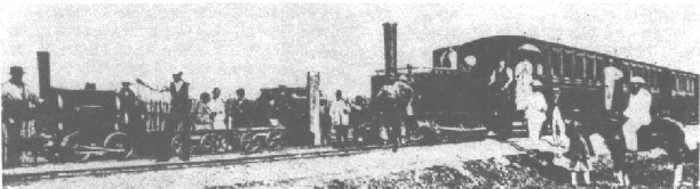
Consistent with our model, modernization was more difficult and controversial in China. The Qing government and particularly the Empress Dowager famously opposed the building of railroads. The most well-known example of this was the Wusong Road in Shanghai. Built using foreign investment it was dismantled in 1877 after locals complained about it. The Qing state remained reactive and prepared to kowtow to local powerholders and vested interests rather than confront them. Despite local initiatives, no effort was made at wholesale reforms until after China’s defeat at the hands of Japan in 1895.
* * *
By 1895 it was too late, however. The attempts of the Qing state to reform and modernize led to its collapse. Needless to state, East Asian’s little divergence would have lasting consequences.
Japan’s modernization program astonished foreign observers. Victory over Russia in 1904 propelled Japan to Great Power status but also set Japan on the path to disaster in the World War Two. Nevertheless, the institutional legacy of Japan’s successful late 19th century modernization played a crucial role in Japan’s post-1945 economic miracle.
Following the collapse of the Qing dynasty China fragmented further entering the so-called warlord era (1916–1926). Though the Nationalist regime reunified the country and began a program of modernization, the Japanese invasion and the Second Sino-Japanese War (1937–1945) devastated the country. The end result was that China came to be reunified by the Communist party and to experience more conflict and trauma until it began to embrace market reforms after 1979.
On power-display bias and the historians
This is an excerpt from my upcoming book at Palgrave McMillan which discusses Canadian economic history. This excerpt relates to a point that I have made numerous times on this blog regarding the bias for power held by historians and how it often leads them to inaccurate conclusions (here and here):
When the great historian Lord Acton warned that, “absolute power corrupts absolutely,” he was not only referring to imbuing certain fallible humans with excessive powers, but also as a caution to historians for their assessment of politicians. Too often, politicians become known for “greatness” because of their actions, regardless of how much they impoverished society or put in place measures that would ultimately erode their citizens’ quality of life. By the same token, some eminent figures remain unknown, relegated to a footnote in the history books, even though they have contributed in a more significant way to economic enrichment, cultural development, and social cohesion. Grand gestures and large-scale social projects inspired by good intentions do not always yield great results – or desirable ones.
If we truly want to assess the Quiet Revolution and the “Great Darkness” with any clarity, we must consider politicians’ actions in a more realistic scope, and sift through the quantitative and qualitative data that show how people thought and acted in the everyday. Through the use of rigorous tools, statistical methods and economic theories, we ought to consider how things might reasonably have developed otherwise without the Quiet Revolution. This is what I have tried to do in this book. (…)
The discourse on Quebec modernity that emerged along with the Quiet Revolution coincided with the emergence of a strong interventionist State. When we compare Quebec to other Western countries, however, our analysis reveals that the State did not play a major role in modernization here. After all, it was in a period when Quebec’s State apparatus was less active compared to the rest of Canada that it was able to progress in leaps and bounds. Of course, the State must have had some effect in certain areas, but the Quiet Revolution was not responsible for the bulk of positive outcomes that came to term during this period. Analyzing trends, causes, explanations and secondary forces at play in Quebec society’s metamorphosis definitely requires a degree of patience and effort. It would be much less onerous to take the easier path of only looking at the State’s activities as worthy of attention in this regard. If we fail to make these efforts, we risk succumbing to the “Nirvana Fallacy.” In order words, we tend to put the State on a pedestal: it becomes a kind of disembodied entity in a virtual reality where it plays the VIP or starring role. Comparing reality with a utopia necessary leads us to conclude that utopia is better, but this approach is utterly fruitless.
Where the state came from
One of the questions that led me to libertarianism was “what is the state?” More than that: Where did it come from? How it works? What’s the use? Analogous questions would be “what is politics?” and “what is economics?” If my classroom experience serves as a yardstick for anything, the overwhelming majority of people never ask these questions and never run after answers. I do not blame them. Most of us are very busy trying to make ends meet to worry about this kind of stuff. I even sought an academic training in politics just to seek answers to these questions. For me it’s nothing to have answers, after all, I’m paid (albeit very poorly paid) to know these matters. Still, I wish more people were asking these types of question. I suspect that it would be part of the process to review the political and economic situation in which we find ourselves.
Many times when I ask in the classroom “what is the state?” I receive in response that Brazil is a state. In general I correct the student explaining that this is an example, not a definition. The modern state, as we have it today, is mainly the combination of three factors: government, population, and territory. The modern state, as we have it today, can be defined as a population inhabiting a specific territory, organized by a centralized government that recognizes no instance of power superior to itself. Often, in the academic and popular vocabulary, state and government are confused, and there is no specific problem in this. In fact, the two words may appear as synonyms, although this is not a necessity. It is possible to distinguish between state and government thinking that the state remains and governments go through.
The state as we know it today is a product of the transition from the Middle Ages to the Modern Age. I believe that this information alone should draw our attention enough: people have lived in modern states only in the last 500 years or so. Throughout the rest of human history other forms of political organization have been used. I am not saying (not here) that these other forms of organization were better than the modern state. I am simply saying that the modern state is far from being natural, spontaneous, or necessary. Even after 1500 the modern state took time to be universally accepted. First, this model of organization spread throughout Europe at the beginning of the Modern Era. It was only in the late 18th century and early 19th century that this model came to be used in the American continent. The modern state spread globally only after the decolonization movement that followed World War II. That is: the vast majority of modern states are not even 70 years old!
What is the purpose of the state? At least in my experience, many people respond by “providing rights” or “securing rights.” People think about health, education, sanitation, culture, security, etc. as duties of the state towards society. It is clear that many people think about health, education, housing, etc. as rights, which in itself is already questionable, but I will leave this discussion for another time. The point I want to put here is that empirically states have only cared about issues like health and public education very recently. In the classic definition of Max Weber (late 19th century), the state has a monopoly on the legitimate use of violence. In other words, virtually anyone can use violence, but only the state can do it legally. That is: the primordial function of the state is to use violence within a legal order. Other functions, such as providing health and education, came very late and only became commonplace with the welfare state that strengthened after World War II.
I find it always interesting to see how we live in a young world. Basically the entire world population today lives in some state and expects from this state a minimum level of well-being. However, this reality is only about 70 years old. The idea that we need to live in states that provide us with a minimum of well being is not natural and far from obvious. To understand that the modern state is a historical institution, which has not always existed, it is fundamental to question its validity. Moreover, to note that the functions of the state that seem obvious to us today did not exist 70 years ago leads us to question whether it is valid to expect things such as health and education from the state.
My personal perception is that the modern state (defined by territory, population, and government) is better than any alternative that has already been proposed. However, the state of social well-being is only a sugar-watered socialism. Socialism, by definition, does not work, as Ludwig von Mises very well shows. Partial socialism is as likely to function as full socialism. Expecting the state to use violence within legal parameters is valid and even fundamental. But to expect that this same state may successfully diversify its activities entering the branches of health, education, culture, etc. is a fatal conceit.
The Coup in Turkey
I am based in Turkey and have been at the edge of some dramatic events. Before I was in Turkey, I was in the Turkish sector of Cyprus (officially designating itself the Turkish Republic of Northern Cyprus, but only recognised as such by Turkey), where I followed the Postmodern or Indirect Coup of 28th February 1997 when military representatives on the National Security Council were able to force the collapse of a coalition government under an Islamist Prime Minister. Later that year I relocated to Istanbul where I experienced sporadic terrorism from Kurdish separatists and Jihadists. In June of this year I landed at the Atatürk airport just after an ISIS suicide attack. In a more gradual way I saw the disappearance of a Turkish political system under the guardianship of Jacobin laicist army generals, known as Kemalists after the first President of the Republic of Turkey, Kemal Atatürk.
The changes in Turkey came about through a de facto alliance between a party with Islamist roots, the AKP (JDP, Justice and Development Party) and the followers of Fetullah Gülen. Gülen was himself a product of Nurcu Islam, which developed in the early years of the Republic before World War Two as a reaction against the state-led secularisation of Turkey. Gülen was a not very well educated preacher who operated in the context of a fragment of the Nurcu movement, which is not as a whole connected with him. Given the enormous tension between laic Kemalists and the religiously observant population, there was room for a movement devoted to developing conservative Muslim power in civil society and the state.
The Gülenists were preceded in this by the Nakşibendi community, which targeted the state bureaucracy and had followers in politics, notably Türgüt Özal, Prime Minister and then President in the 1980s. Secretive and manipulative politics has been a feature of Turkish and Ottoman politics for a long time. The power of the Janissary elite military and bureacratic corps during the Ottoman period was tied to a religious community, the Bektaşis, creating a parallel system to the legal power of the Sultan until they were violently crushed in the late eighteenth century.
The Committee of Union and Progress, which came to power with military support in the last phase of Ottoman history, developed into a conspiratorial organisation rather than a parliamentary political parry, and a secret arm of it was at the centre of the destruction of Anatolian Armenians in 1915. Secretive groups of Unionists provided a power base for Kemal Atatürk when he revolted against the restored power of the Sultanate and its subservience to the partition/occupation of what is now Turkey after World War One.
The idea of a secret part of the state was maybe not so strong during the early years of the Republic when a one-party system (though in principle the republic was under popular sovereignty) under the dominance of Kemal Atatürk and then İsmet İnönü maybe made it less necessary. Nevertheless, the conditions were established for a revived politics of manipulation behind the scenes. Unfortunately, İnönü’s decision to join the west after World War Two played a part in this. The reorientation resulted in free elections in 1950, with a change in government, and Turkish membership of NATO in 1952.
As in some other countries, the Gladio units played a role in dark political activities. These were the units established to engage in resistance in the event of a Soviet invasion. They had a secretive army within an army aspect and were inevitably a magnet for the most fiercely anti-communist officers, including Alparslan Türkeş, who played an important role in the 1960 Coup. Türkeş was expelled from the coup government, which found him too radical, but he founded the extreme right party in Turkey, Nationalist Action, which is comparatively moderate now, but was heavily involved in political destabilisation and terrorism along with the most anti-communist parts of the state.
What came later was infiltration of the state by Nakşibendis and then Gülenists. Their activity was rather overshadowed by the darker activities of the army and its extreme right allies, often also connected with the Mafia. This network is often known in Turkey as the Deep State. It tended to favour a secular democratic system in terms of formalities, but with concessions to religious conservatism along with an anything goes attitude to covert war against communists and then more importantly Marxist Kurdish autonomists, as well as very limited tolerance for the Left. The hard right element of the army with a base in Gladio was not the whole story. There were far left army officers, particularly up to 1971 and a general staff that tended to be in the middle, though the middle tended to move further right from 1960 to 1980, and then became unwilling to launch anymore violent coups after the 1980 military council stepped down in 198. The general staff itself became increasingly concerned about infiltration by Islamists, including Gülenists.
As it turns out the army’s fear was more than justified. The country liberalised, from a very illiberal base, in the late 1990s, and while the army to some degree went along with that, it launched a peaceful ‘post-modern’ coup in 1997 against the Islamists and was left with the image of the pillar of anti-democracy and anti-liberalism in Turkey. This is an important part of the background to the AKP ‘moderate’ Islamist/conservative democrat electoral victory of 2002 along with the economic crisis of 2001, which along with the 1997 coup left the secular parties very fragmented. The AKP gained a lot of liberal and libertarian support (a very small proportion of Turkey though) and more general reformist support from those who believed it would be a vehicle for reducing the military role in politics and for generally less nationalist-statist politics.
The AKP had very few supporters in place in the military, in the state bureaucracy, or in senior positions in education. The Fetullah Gülen campaign to turn his supporters into the dominant force in Turkey meant they had people in these positions, partly through infiltration of state institutions and partly through founding private educational institutions. This was just one part of the Gülen empire, which include major media groups, banks, and industrial companies in Turkey, and in many countries outside Turkey including the USA. Gülen himself moved to the USA to avoid prosecution by the Kemalist old guard before AKP came to power, claiming to have no links with the economic and educational empire of his supporters which is clearly less than honest of him.
The Gülenists expected a large role in the AKP government and served them most spectacularly in purging the armed forces after an attempted website coup in 2007. In that year the armed forces, unwilling to launch an outright coup, hoped to influence public opinion and the political process by placing a message on its website proclaiming the army’s guardian role in relation to secularism. This turned into the final political defeat of the army’s Kemalist guardian-tutelary role. The AKP won a general election and a referendum to change the method of electing the President. This triumph of civil electoral politics was, however, undermined by the trials of supposed armed coup plotters in the armed forces. Such trials gave the impression of completing the civilian dominance over the army, but were themselves rigged using weak and outright faked evidence. The judges and prosecutors were from the Gülen movement and were creating space for their own people to take the high offices in the armed forces.
The AKP began a campaign against the Gülenists after making its own illiberal core attitude very clear in 2013 in its highly intolerant and authoritarian reaction to the Gezi protest movement. It was increasingly clear to the (even then) most enthusiastic of liberal fellow travellers with the AKP that it was Islamo-nationalist and statist at its core, reducing democracy to the unlimited will of the party elected to government. The Gülenists and the AKP now found the state was not big enough for both of them and the Gülenists decided to use conspiratorial methods against the AKP. Audio files and video tapes of AKP figures and associates, which had evidently been kept in reserve and which suggested widespread corruption were released. Recep Tayyıp Erdoğan (then Prime Minister and now President) and the AKP government succeeded in sacking, retiring and transferring enough Gülenist police officers, prosecutors and judges to stop this evidence coming to court. They then declared the Gülenists to be a parallel state and a terrorist group, entering into a process of purging the state of Gülenists and seizing their assets in the media, educational and other sectors. The coup conspiracy convictions against army officers, and others, were overturned and it became widely accepted that Gülenists had rigged the trials.
On 15th July this year, I was at a small party on a terrace in the Üsküdar district of Istanbul, overlooking one of the Bosphorus bridges, though by quite a large distance. We could see traffic interrupted on the bridge and news began filtering through of a confrontation between police and army units in what was described as an anti-terrorist operation gone wrong, but was beginning to sound like the beginning of a coup. It turned out that a coup had started and for a brief part of the night it appeared that the old Kemalist-Guardian army had come back to dispose of a government that was elected but increasingly authoritarian. Any welcome in the party where I was, of secular anti-AKP Turks and foreigners was strongly outweighed by a fear that a coup regime would be authoritarian, would create new problems, and the AKP or something like it, if not worse, would be in power for ten or twenty years by way of reaction. This turned out to be the mood of anti-AKP and anti-Erdoğan Turkey. It also became increasingly reported and accepted across the political spectrum that though the putschists had adopted Kemalist language, they were for the most part Gülenists rising up before a purge of the army in a last grasp at domination of the Turkish state.
Since then a purge has unfolded against the Gülenists in state and society, covering the universities (the sector where I work), which has already led to the sacking and arrests of about 60 ooo, including constitutional court judges, army generals and university rectors. The number will certainly at least double before the purge and the current state of emergency is over. Such sweeping action is understandable up to a point given the violent actions of 15th July, and the accumulating evidence over the years of Gülenist infiltration to create a Gülenist-controlled state and society, but clearly the potential exists for massive and systematic individual injustice with abuses of state power affecting over enemies of the state, real and imagined. Some of the language President Erdoğan has used since the coup has been highly polarising and vengeful, demanding submission to state power; some of his rhetoric has been more conciliatory, recognising that all political parties opposed the coup and that deputies across the spectrum sheltered together in the basement of the National Assembly fearing for their lives. I cannot say I am hopeful that the post-coup atmosphere will be beneficial to liberty, but we should hope for and work for the best in Turkey, while being vigilant in working against further declines of liberty.
One thing is for sure: republican politics will not come from the army now and Turkish republicanism must renew itself through engagement and re-engagement with the whole history of republican thought, which is at the origin of classical liberal and libertarian thought. In theoretical and philosophical terms, which is where I work, the discussions of republicanism and liberty going back to Hannah Arendt in the last century, along with the revived study of Machiavellian–Renaissance–Early Modern Republicanism and the way the classical liberals were dealing with the republican legacy of ancient Greece, ancient Rome and medieval city-states are particularly apposite given that Turkish politics, avowedly Kemalist or not, deals so much in a republican language of shared sovereignty and popular mastery.
A short note on two types of political structures
I just came across an excellent review by Herman Belz of a book on American history recently published by Nicolas Barreyre, a French history professor. The main thrust of the book Belz is reviewing has to do with American Reconstruction, but the theoretical thrust of the book is all about state-building and political economy. The whole article is worth your time, but I wanted to hone in on a particular paragraph that caught my attention:
In the 20th century, Progressive “living-Constitutionalism” dedicated to constructing a centralized administrative state […] undermined the Founders’ establishment of a territorial federal republic as the constitutional ground of American liberty. Americans were the territorial people of the United States. Sovereignty resided in the people of the state in which they lived as well as in the states united as a national whole. In the 21st century, the aspirations of Progressive statism reach beyond national borders to the conceit of transnational global authority.
In this paragraph Dr Belz draws a distinction between two political structures:
- a centralized administrative state
- and a territorial federal republic
The centralized administrative state is a much worse option than a territorial federal republic in Belz’ view (and my own), mostly because in the federal republic sovereignty resides in both “the people” and in the various “states” that have federated to form a republic (Belz suggests this made the United states “a national whole,” but I don’t think that’s true, largely because of Belz’ own description of what Barreyre calls “sectional” politics at the time, but I digress; see Michelangelo for conceptions about “the nation”).
The territorial federal republic is thus a bottom-up approach to a more inclusive, more open society, whereas the centralized administrative state relies on experts, many of whom are unelected and unknown, to govern public affairs.
Belz is largely correct in his summaries of these two political structures, but I think his conclusion (“the aspirations of Progressive statism reach beyond national borders to the conceit of transnational global authority”) misses the mark. This is not because he is right to suspect the Left of wanting to create and sustain a centralized administrative state with a global reach (i.e. the UN), but because he leaves out the possibility that a territorial federal republic can also have a global reach while still avoiding the pitfalls of morphing into a centralized administrative state. Belz is probably more conservative than I am, and hence more pessimistic about the chances of a “transnational global authority” being republican in nature rather than administrative, but I still think my argument is better…
The State versus Society, Part 12,908
Taken together, the evidence suggests that the Kuba state is associated with a deterioration of intrinsic motivations to follow the rules. This does not mean that the Kuba Kingdom was not a successful and well-functioning state. From the historical and anthropological literature, we know that it was. Although the state was prosperous and orderly, the evidence suggests that it eroded the intrinsic propensity of its subjects to follow rules even when enforcement is absent. (28)
Here (pdf)
An update from Memphis (Russo-Baltic edition)
Dr Znamenski (bio, posts) sent me an email updating me on his recent shenanigans:
I also appreciate your remark that we need to reach out to other libertarian-leaning people rather than singing to only a libertarian chorus. Even though I am notorious for not contributing to NOL, I devoted this summer to reach out to liberty-minded people in Europe by going to St. Petersburg, Russia, and delivering there a public talk (in Russian) on “Heroics of the New Deal and Its Critics” at a downtown hotel and afterwards I met with the audience for a free-style interactive talk on current challenges to individual liberty. Then I proceeded to Tallinn, Estonia, where I met a group of Estonian libertarians and delivered a talk (in English) on geopolitical imagination of Russian nationalism (used current Alaska-related Russian patriotic rhetoric as an example). Then proceeded back to Russia, where at Samara University again I gave a talk on the mythology of FDR and New Deal Keynesianism and how it was appropriated in 2003-2008 by the Putin regime that was building the “vertical” of its power. My argument was that politico-economic regime whose “validity” was “scientifically” proven by Keynes in 1936 by now became a kind of a fetish that is associated with a good government. Hence, the “Heroics of the New Deal” title. The Estonian visit was especially pleasant and inspiring.
I also met an informal leader of Estonian libertarians […] Very productive and charismatic guy. I need to navigate him to you and to NOL, which will greatly benefit from his contributions (if any). His English is impeccable too. See his picture attached to this letter (they have Mises Institute of Estonia) in addition to a few other images from Estonia (the country where all paper work exists only in electronic form and a flat tax return occupies only one page!). The country [Estonia] was the first in Europe to introduce universal flat tax (1994), which replaced three tax rates on personal income and one on corporate profits. The flat tax rate was on 26%, which later was reduced to 20%. Several countries of Europe followed the suit and benefited from this. Very simple system, which helped this tiny backwater country of 1 million plus something people to dramatically raise its well-being. To their frustration, even Russian nationalists, who remain quite influential in Estonia due to the presence of a large Russian minority, have little economic discontent among Russians to chew on. The latter simply compare their economic situation in their historical homeland where average salary is $500 and Estonia where this salary is $1150.
Dr Znamenski has some excellent ideas brewing (on US-Russian relations in the Arctic, Crimean secession, and Foucault), and hopefully he can find the time to post them in the very near future. Notice, too, that Dr Znamenski refers to Russians as Europeans (or, at least, considers St Petersburg to be European). A small observation, I know, but one that I suspect has big sociological implications. Check out these pictures he sent me:



Myths of Sovereignty and British Isolation XVIII: Laws, Juridification and the Administrative State
The last post focused on the distinction between civil and common law, with regard to Britain’s position as a common law country in contrast with the civil law tradition of the rest of Europe. The promise at the end was to move onto laws, charters, and constitutions in this post. However, I have found it necessary to discuss the idealisation of common law further and look at how a large part of this looks back to a world which is lost, regardless of predominant legal system as societies have roughly speaking moved from customary law to ‘juridification’ (state centred comprehensive law penetrating all social relations), and then the world we live in now of the administrative state.
The British sovereigntist and Eurosceptic position tends to emphasise a supposed unique British exception from the statist rationalism of civil law, in the ‘common sense’ of the accumulation of law arising from judicial precedent in the decisions of judges in previous cases. This supposedly British exception looks rather challenged when we consider the thoughts of the influential German philosopher Hans-Georg Gadamer in his 1960 book Truth and Method. Gadamer refers to French rationalist Enlightenment in contrast with a German form of Enlightenment based on the original understanding of ‘prejudice’.
Prejudice, in Gadamer’s account, did not begin as a negative term for the constraints of false assumptions, but in a legal process in which the court forms a preliminary opinion in an early stage of proceedings. For Gadamer this represents the continuity of custom and the communal sense of justice in contrast to abstract rationalism. What he describes is not the same as the common law tradition, but represents another way in which the apparent underlying advantages of common law can appear in another system.
The idealisation of common law is really a claim to prolong the role of custom in law into the age of state statutes and deliberately constructed legal codes. Not that an age can be identified in which pure custom operated and no state created laws existed. It can be said that laws used to be less in number and articulated in terms of defending the wisdom of ancestors as part of a generally shared sense of justice.
However, the destruction of such a world, which depends on accepting fictions about the harmonious origin of laws outside the interests of power, was not from the triumph of civil law. The heroic moments of civil law in the process that leads from 1789 French Revolution through constitutional monarchy, republic, and Bonapartist autocracy, are the product of the decay of traditional societies in which localised and regionalised kinds of authority operated in ways which mixed statute and customary law, and where even in conditions of political autocracy the state ruled over either a very small community unified by common experience, or larger units which aggregated such communities rather than enforcing a very uniform and unitary form of sovereignty back by a hierarchical bureaucratic-military state machine.
There were of course elements of the latter, as in the eleventh century Norman Conquest of England, but even this established only a minute state machine by modern standards, which recognised the ‘privileges’ and ‘liberties’ of the City of London, the church, the barons, and so on. The idea of civil law is generally traced back to Rome, bracketed by the Twelve Tables of fifth century BCE Rome and the Corpus Juris of Civilis (often identified with the Institutes which form just one part of it) Justinian promulgated in the New Rome of Constantinople in the sixth century CE.
This civil law prevailed in Roman Britain for four centuries as it did from the Rhine to the Euphrates. The Roman world, including the Greek empire governed from Constantinople, that emerged in the sixth century, was nevertheless a world of localised traditional authority in which central state institutions were more like connecting threads rather than an all inclusive structure.
The Middle Ages saw a process of juridification, as Roman law continued in the church and was revived for the state, in which the uniform administration of justice became strong enough for a system of dominating unifying state military-bureaucratic power to emerge underneath sovereignty that was beginning to become more distinct from the person of a king (or occasionally the persons of an aristocratic assembly).
All European states went through a process, which has been implemented elsewhere, leading to what is now known as an administered society, administrative state, biopower, and all the other terms referring to the inclusive, comprehensive and unifying power of state law and state bureaucracy in relation to society. This was simultaneous with the development of capitalism as a dominant economic system working through unified national markets and trade between states.
A lot of what is said about the difference between common law and civil law represents a wish to return as far as possible to go back to a time before administered societies and even before juridification. There is no time at which law was purely traditional and consensual and no current possibility of even approaching that ideal. Concerns about the administered-juridified society have to be addressed with that world.
The common law tradition might or might not on average be better than the civil law tradition from that point of view, but common law is not what its strongest defenders wish it was and it is not obvious that civil law states in northern Europe including Switzerland, the Netherlands and Denmark, and in a slightly more qualified but real way, Germany are doing worse for liberty and prosperity than the English speaking common law countries. France, the homeland of modern civil law, is itself not doing at all badly compared with most countries in the world as it is and certainly in terms of human history.
For the next post the intention is to finally get onto charters and constitutions.
Myths of Sovereignty and British Isolation XVII: Common and Civil Law
The last post referred to the need to investigate ideas about law and related ideas in discussing Britain’s relation both with the Anglosphere (USA, Canada, Australia, New Zealand) and with the rest of Europe. The big issue here is Anglosphere common law tradition versus Roman or civil law tradition in the European mainland and indeed most of the world outside the Anglosphere. Common law in this context refers to judge-made law based on precedent versus civil law referring to statute laws based on the will of the sovereign. Statute laws are laws instituted by the state, in writing, in public explicit acts of law making.
Judge-made laws based on precedent refers to the ways in which judges, using a general sense of justice, make judgements according to that sense of justice with the precedents of previous relevant judgements shaping the sense of justice along with the whole set of laws and their general principles. Civil law judges look at the text of statutes, as do common law judges, but apparently the latter category of judges are also concerned with the mixture of precedents and general spirit of the laws.
There are certainly some real differences between common law and civil law traditions, but how straight forward are these difference? The phrase ‘common law’ itself comes from the codification and national harmonisation of laws undertaken by French-speaking kings of England, after William, Duke of Normandy, conquered England. So the phrase ‘common law’ itself refers to the opposite of what common law has come to mean: the English legal tradition since the High Middle Ages has come out of conquest by an external power. We can argue about how far Anglo-Saxon laws and judicial formalities survived the Norman and Angevin re-codification, but there is no denying that the re-codification happened and that nothing now survives from the Anglo-Saxon era.
England started off in the earlier Middle Ages where all of post-Roman Europe stood, that is Roman law had collapsed and Germanic tribes introduced their own laws in conquered territories, where some elements of Roman law survived in the canon law of the church. The Roman law system itself reached a peak with the final codification undertaken under the Emperor Justinian in Constantinople during the sixth century. The transformation of the eastern part of the Roman Empire into a Greek empire included a decline in knowledge of Latin so understanding of the definitive law text was limited, but survived in the Empire including the last Roman-‘Byzantine’ holdings in Italy.
Knowledge of Roman law increased in the thirteenth century, in association with the growth of new universities where legal education played a very large role. England was not outside this process, but it is fair to say that it was less influenced by it than some continental powers, particularly France. The process of Revolution and Bonapartist rule, from 1789, produced a large scale deliberate construction of law as a unified system based on the will of the sovereign (whether elected assembly or absolute monarch) with regard to the laws, which was exported to other parts of Europe in the Revolutionary and Napoleonic wars.
The British commitment to common law was not entirely consistent since Scotland has always retained some differences from England in its legal system, which place it closer to the civil law tradition, at least compared with England. In the United States, there was a parallel to the French republican and Bonapartist experience of redesigned institutions in the process of adopting first the Articles of Confederation and then the Constitution of the United States, which unified the thirteen British colonies in a common structure.
The difference between French and American constitution making is often held to be that the French constitutions claimed that laws are the will of the people and the product of nature, while the American constitution is designed to disperse any idea of a single political law-making will between the different branches of federal government and the ‘several states’. However, the preamble to the US Constitution refers to ‘we the people’ and therefore asserts that it is the product of a single political will of the people in the union.
While the US Constitution does not refer directly to good laws as the work of nature, there were shared underlying assumptions in France and the US concerning the ‘natural’ status of good laws, good political institutions, and justice. It is at least true that the US constitution federalises rather than centralises, while the French process of about the same time ended in a very centralised state. This cannot be the difference between common and civil law systems though, since there are federal civil law states like Germany and Switzerland and unitary common law states like the UK and New Zealand, though the UK has been evolving in a more federal direction, if in a rather ad hoc and limited way, since the turn of the century.
Next, laws, charters and constitutions
Myths of Sovereignty and British Isolation XVI, Britain’s Significant Others: France and Germany (1)
Moving on from the narrative of British history concluded in the last post, some thoughts about the way that Britain has existed as a European nation in comparison with other nations, mostly Germany and France. Britain has been defining itself in comparison with these two, in more or less friendly ways since Germany emerged as a modern unified state in 1871. The comparisons with France go back further, as has been partly explored in the narrative posts from Æthelred II’s (the Unready) marriage to a French princess to the Tudor loss of Calais.
The attitude to Germany has been coloured by the pre-1870 Prussian monarchy which became the imperial family of Germany, while retaining the Prussian royal title, in 1871. Even the Prussian monarchy, though, is new compared with the French state. The Prussian kingdom only goes back to 1701, as an elevated form of the Margravate of Brandenburg in which the Hohenzollern family had been the Margraves since 1415, and even that is rather recent compared with the beginning of the history of France. Anyway, we cannot think of Brandenburg-Prussia as a pre-formation of the German state until the early nineteenth century when it took lands on the Rhineland and emerged as the joint leading power in Germany, along, with Austria, after the European settlement at the end of the Napoleonic wars.
It is not entirely clear when we can date the beginning of the French state, since the earliest form, or preformation, of it was the Frankish kings who became rulers of some part of what is now France in the fifth century with the collapse of Roman rule in what had been Gaul. The Franks were German and the sense that the aristocracy of France had a different national origin from the common people lingered into the nineteenth century. It is only in the ninth century that Old French emerges as a written language of state business while the title of King of the Franks was separated from that of the dominant ruler of Germany, holding the title of Emperor of the Romans since the Frankish king Charlemagne was crowned by the Pope in 800.
The official title King of France only stated to replace King of the Franks in the late twelfth century, but it is safe to say that something like a swell defined the French state with a very broadly defined sense of shared culture between king and French speaking subjects goes back to the ninth century, after a preformation going back to the fifth century. Of course it should be remembered in relation to that it was only in the nineteenth century that a shared mass competence in the French of Paris prevailed across France including communities which were historically Basque, Flemish, Breton, German, Italian and Occitan (southern versions of French including Povençal), though a linguistic unity of the educated goes back much further.
One aspect of the sketches of French and German history above, is that the history of the dominant power in western Europe is often the history of France and Germany in various sometimes overlapping forms. This continues into the European Union which is at its heart a Franco-German union and that can be seen in the Euro which comes out of the French belief that it could import German economic success and discipline through a common currency, as well as the belief that it could mitigate German influence in Europe after post-Cold War unification though a shared monetary mechanism. One problem with British membership, maybe the most important, is a lack of interest in the French and German belief in a shared destiny best managed by some pooled sovereignty in a unified Europe, largely if not entirely consisting of countries strongly influenced in their history by contacts with France and Germany.
The most important issue in this post, though, is that France has a history as old and as grandiose as that of Britain, in fact preceding the unified British state history of England and Scotland only going back to 1603. The reason for emphasising this is the British sovereigntist-Eurosceptic tendency to regard France, like all European nations other than Britain in their view, as somehow less proud of their nationality, less patriotic, and less real as nations than Britain.
Really this is preposterous nonsense, and it should not be said that all British eurosceptics hold to this view, but it is hard to imagine the Eurosceptic current existing in Britain without this aspect of its culture, and hard to imagine even many of the more fastidious Eurosceptics do not believe this in their guts. The apparent willingness of France to share sovereignty with Germany in the EU even when Germany has become clearly the dominant EU country may to some degree explain this, but does not justify it.
More on this in the next post
 Notes On Liberty