Climate Change and Flat Earthers

“There has been no universal trend in the overall extent of drought across the Unites States since 1900.”

“Trends in severe storms, including the intensity and frequency….are uncertain and being studied intensively.”

Both quotes are from the fine lines in the 829-page quadrennial National Climate Assessment. That’s the report Pres. Obama flogged on national television recently for nearly an hour. The president insisted something had to be done right now.

I have not read the report, of course, why should I ? (See below.)

(The first quote is in the report according to a Wall Street Journal editorial on 5/9/14. The second is in the report according to my frequent reader and commenter McHenry. He is a young man who does, or used to, believe in the threat of man-made climate change. He has good scientific training.)

A few months ago, when the Great Lakes were 90% frozen, that great scientist, Secretary of State Kerry relegated me to the ranks of “Flat Earthers.” He did this because I am very skeptical (and growing) of the climate change thesis. (See definition below.)

Of course, anyone who has been observing him from his political beginnings knows that John Kerry has no scientific competences, no competences about anything at all, except windsurfing and marrying rich widows. (I don’t knock either, no sir!) It’s also possible that he knows some French. That would tend to contribute to his misinformation, I think.

I suspect, in fact, I am almost sure, that Mr Kerry’s self-assurance is based on the belief that 97% of scientists, blah, blah, blah…

The climate change thesis deconstructs as follows:

1 There is a global rise in temperature.

That’s from some undetermined date. Hasn’t been any for the last fifteen years according to federal government’s own reports.

2 It’s caused by human activity.

This includes the burning of fossil fuels, of course but yet, there is no call for an increase in nuclear energy production which is a reliable and lasting way to relieve worldwide reliance on fossil fuels. No reason is ever given for this absence. Sometimes, perfectly serious climate change partisans also include among the causes of man-made global warming belching and flatulence by the large worldwide cattle population. The latter “cause,” of course, calls for a quick conversion to vegetarianism. (That is where secret evangelists show their hand.)

3 The world, or parts of it, or us, or some of us, are in imminent danger of a variety of catastrophes that will be caused by climate change.

Note that the three propositions are logically linked: If there is no global rise in temperature, we don’t care about human activity. If human activity does nothing to the globe ( to what, exactly?) there is no emergency. If there is a global rise in temperature and it’s not man-made, there is not much we can do. If there is global warming and it is the result of human activities and it does no harm, there is nothing we should do. If it does both harm and good (longer growing seasons in the north, access to minerals near the North Pole) then, there is something important to discuss internationally.

As the evidence in support of the thesis becomes more complicated and contradictory, the alarmist cries are becoming shriller. This makes a sort of macabre sense. Simple rationality is getting lost along the way. What we are told about urgent policy requirements does not fit with the evidence that is presented by the same people who demand urgently a new policy of de-industrialization. The climate change book is like a novel whose cover would proclaim “Joe Is the Killer” while the inside pages would sow doubt on the idea that Joe has ever killed, or even harmed anyone, has ever so much as spat on the sidewalk.

Sometimes, downright fraud is also prominently involved. That’s the case for the “97% of scientists” that I think certified incompetents like Sec. Kerry rely on. Personally, I have always known and said that there was nothing to the number. There is no 97% of anything anywhere, except in some banana republics and in North Korea. Now, we have good evidence of fraud on this matter.

In past postings on the climate change or global warming, I have been at great pains to declare, even to prove my ignorance in matters of climate science. I did this because I wanted to step resolutely away from jargon-filled experts’ and pseudo-experts’ discussions that can only befuddle people who have to make a living, rear children, prepare their taxes, pay a mortgage, go to the gym.

In fact, I have fair general scientific training: I easily recognize a good study design. (They don’t grow on trees!) I can spot bad measurements from a mile away, like a jealous wife a single long hair of the wrong color on her husband’s lapel. I also possess a skill that is rare in the general literate population but common among those who have acted as referees for scholarly journals: a keen sense of studies’ formal conclusions that shout when the findings would only merit whispering.

Note that I don’t claim I have ever committed this last little sin myself when I was a scholar. It’s damned tempting though. How can you admit, “Yes, I and two colleagues worked hard on this study for three years and, frankly, what we found does not amount to a hill of beans.”

And then, there is the vertiginous, nightmarish situation where you would have to report, “The consensus is that X causes Y. Our study, carefully conceived in every way – go ahead and check everything – suggests that X does not cause Y.” This is like yelling, “Go ahead, don’t publish my study!” (I actually published two such studies in my time, one at the beginning of my career, one at the end. The last one took twenty years! See on my vita linked to this blog: Delacroix, Jacques. “The export of raw materials and economic growth: a cross-national study.” American Sociological Review. 42:795-808. 1977. Delacroix, Jacques and François Nielsen. “The beloved myth: Protestantism and the rise of industrial capitalism in 19th century Europe.” Social Forces 80-2:509-553. 2001.)

There is also a general, well known anti “negative findings” bias in all scientific disciplines. Few journals have the intestinal fortitude to publish articles that proclaim: “We did not find anything.” I doubt that the climate sciences constitute an exception. Do you?

Here is a fictitious but realistic example of such a conclusion:

“Humans have been pumping ‘greenhouse gases’ into the atmosphere with increasing intensity* for one hundred and ten years and yet, there is no rise in the frequency of droughts.”

How does this work for your career, do you think?

Here is an example of bad design, specifically.

Several years ago in one of the respected American scientific magazines there appeared an article authored by three Australian professors with impeccable scientific credentials. (I am very sorry I don’t have the reference. However, my memory forgets but it does not make up stuff.) The article purported to tackle the issue of long term global warming. It was an attempt to recoup after the disaster of the “hockey stick scandal”** which involved downright cheating.

The issue is this: If it was warmer in 1000 that it is today, it’s hard to argue that gases specific to industrial societies are an exclusive or even a primary cause of global warming. (It’s difficult but not impossible; it would involve heavy scientific lifting.)

Anyway, that article relied on one form of measurement of temperature, tree rings, I think, for the longest period, extending from about year 1000, to about year 1800. Then the authors switched to other, probably better, more sensitive measurements, based on other than tree rings, for the period extending from about 1800 to the present.

That’s impossibly bad scientific design, of course. Here are the reasons. If the first measurement somehow underestimates temperature then, it’s necessarily true that temperatures in the other period from 1800, will appear higher. If the second type of measures somehow overstates or simply detects more accurately high temperatures, the years 1800 to present will necessarily seem warmer. Both false effects would tend to be seem true irrespective of the real temperatures in both periods .

It tuns out that 1800 to present is the period of interest. If you are going to prove a sharp rise of temperature coinciding with industrialization, you have to demonstrate a big uptick for that period . The design is thus not neutral with respect to results. It favors some rather than others.

It’s such breathtakingly bad design that I had to read the article twice to believe it. (That’s what caused me to check the authors’ academic credentials. As I said, they were excellent.)

The alert reader will have noticed that the potential bias I describe above can work either way: If the measurements to 1800 overestimate temperatures while the measurements from 1800 to present happen to underestimate temperatures, you may find that you have demonstrated that there is no warming that corresponds to the industrializing period although one exists. You might even show that temperature has declined on the whole although it has actually risen.

Now, suppose that the study of reference showed precisely either no change or change in the “wrong” direction. That would be no change in global temperatures, 1000 to 2000, or a slight decline of temperatures beginning, say, in 1810.

My educated first guess is that, in the intellectual climate of the past fifteen years, the authors would not then have presented their research for publication. My second, also well informed guess, is that if they had presented it, the journal editor would have turned them down. He would have turned them down irrespective of his religion toward climate change. That’s because, journals don’t like negative results of the form: “Nothing happened.” See above.

That’s in addition to the fact that many editors are members of the same intellectual class that has lost its way on climate as it lost its way previously on communism and on Third World revolutions (another story I plan to tell soon on this blog).

In conclusion: Our current system of scholarly publication almost guarantees that there is little chance that scientific findings of high quality that contradict the belief in the thesis described above will see the light of day. It does not take a real conspiracy to arrive at such a situation, just the perpetuation of well-established bad habits.

How about the three credentialed Australian professors who committed the dramatically faulty research design? Are they scum? That’s were religion comes in. It’s helpful in pretending that the bad actions you commit are not really sinful. Did you know that the crusaders who captured Jerusalem in 1099 put all its inhabitants to the sword while shouting “God wants it”?

So, OK, I am a Flat Earther. It’s not so bad, really. One of these days, I will figure out the truth by noticing that no one ever falls off the earth, no matter how far he travels. I might even figure out why some get back home simply by moving in a straight line. Paying attention to negative evidence like this pays off. On the other hand, those who live inside a square box will never learn anything. Their blindness is dangerous for everyone.

* I don’t know the actual numbers but I would be surprised if we did not, collectively, burn one hundred times more than we did in 1800. One thousand times would not surprise me, not even 10,000 times.

**Look it up. Great story!
Energy Primer for Libertarians (or anyone else)

One of these days Brandon’s going to kick me off this blog for posting notes that aren’t “on liberty.” But maybe he’s not looking. I’ll take a chance.

This piece is about energy and on second thought, it is relevant to libertarians. We need to know what we’re talking about when we enter into controversies on current topics like energy. Insights into how markets work are crucial, of course, but not sufficient. We should arm ourselves with a few facts and Lord knows, maybe even a little understanding of basic physics.

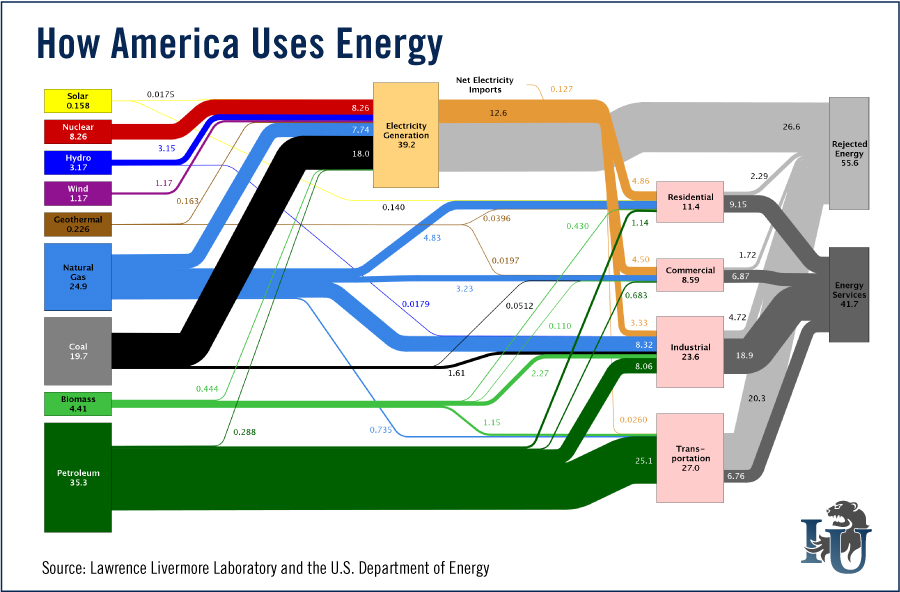
I base my remarks on an excellent chart produced by (gasp!) a government agency, Lawrence Livermore National Laboratory. It appears here but if it’s illegible please find a better copy here.  Blame Brandon for squeezing our posts into a narrow column!Image

We see energy sources on the left. A couple of facts stand out. At the top, notice that solar and wind are negligible. The yellow line representing solar may be thinner than a single pixel on your monitor and therefore invisible. Geothermal is on the radar, but barely; same for biomass (wood chips, organic leftovers, corn used for ethanol instead of feeding people) that can either be burned or processed into methane or ethanol. Our three main sources are, and will be for the foreseeable future, petroleum, coal and natural gas.

At the top center we see electricity generation. We don’t consume electricity directly except maybe for executing criminals. We use it to power devices in the four broad categories shown on the right: residential, commercial, industrial, transportation.

Notice the fat grey line coming out of the electricity generation box called “rejected energy.” It tells us that about two thirds of the energy coming into power plants goes up in smoke or steam or other waste heat rather than electricity. That sounds like a terrible loss and indeed, there is always room for efficiency improvements at the margin. But, boys and girls, there’s something called the Second Law of Thermodynamics which puts an iron limit on how much energy in a particular situation is available to do useful work. In other words, a certain amount of the “waste” represented by that fat gray line is inevitable. It would be great if the good people at LLL could supply that calculation, but I suspect that reliable estimates of the necessary data would be difficult to come by.

Look at the residential box on the right. It only represents 11% of energy consumption meaning that relative to the big picture, home energy efficiency measures like insulation, solar panels, etc. can never do much for the big picture. I say this too keep things in perspective, not to deny the possibilities for cost-effective marginal improvements in many homes.

If your monitor resolution allows it, you’ll see a tiny orange line running from electricity generation to transportation. That means electric vehicles are, and for some time will be, utterly insignificant, though again, marginally beneficial in very special situations.

Another fat gray line comes out of transportation. When you burn gasoline, most of the energy goes out the tailpipe or the radiator; only a little ends up as kinetic energy and even that ends up as waste heat when you apply the brakes. (In the long run, it all ends up as waste heat. Look up “heat death” on Wikipedia.)

The overall message of this chart is: if we want to maintain anything like our present industrial civilization with its abundant heat/cooling, light, transportation, etc., we’d better keep the present main sources going – petroleum, coal, natural gas, nuclear because renewable energy sources are advancing only slowly and in many cases (wind and ethanol, especially), uneconomically. The stakes couldn’t be higher – significant losses of energy, more than anything short of nuclear war, will make life nastier, more brutish, and shorter.

How to decide which energy R&D projects deserve scarce resources? Solyndra, anyone? No, central planning of energy is just as much a disaster as any other form of central planning or maybe more so. Energy is a highly specialized field. A biomass expert, for example, may be ignorant of nuclear fusion. A transformer guy may know nothing of transmission line losses. I suspect there are dozens or hundreds of subspecialties within the biomass field. Knowledge, as Hayek taught us, is dispersed and often tacit. We need to let all these specialists use their particular knowledge and facilities to experiment around the edges, comparing present or expected future marginal costs and benefits. Other than an occasional nice chart like you see here, the Energy Department just gets in the way. (To see a boondoggle that dwarfs Solydra, google “national ignition facility.”)

Speaking of costs and benefits, one of these days I’ll comment on the strange notion that energy accounting – a perfectly legitimate engineering practice – should be used to judge the economic value of energy projects. Tallies of income/expenses and assets/liabilities, should, say proponents, be carried out not in dollars but in energy units (joules or BTUs.) Why is this wrong? Because the economic value of a joule depends on time and place and most critically, people’s ability to make good use of it. In fact, natural resources aren’t resources at all until and unless someone figures out how to make good use of them.  More generally, value never inheres in physical objects and materials but only in the minds of people who believe those objects and materials can help satisfy wants, theirs or others’.

Postscript: The oceans store unimaginable amounts of thermal energy. You can calculate this yourself: using your favorite system of units, just multiply the volume of water by its mass density by its specific heat at constant pressure. You’ll discover that if we were willing to lower the ocean temperature by a thousandth of a degree per year, we would have abundant energy from now till Kingdom Come. Try this idea on a “progressive” friend sometime, keeping the answer momentarily in your back pocket: the Second Law forbids it. Stated differently, even with perfect technology, you would have to put more energy into the conversion process than the usable energy end product.

Are GMOs Bad For Me?

I am vaguely perceiving that there is a battle brewing someplace about labeling food containing genetically modified organisms (GMOs). It happened in California before. The initiative lost by referendum.

Of course, I am almost always in favor of more information for the public (even when it’s likely to be used for mischief). However, I can’t avoid wondering why sellers of food products don’t just do it on their own to gain a marketing advantage over their competitors. Not getting an answer to this question, I am wondering whether this is not just another case of a minority using the power of the state to impose its views (by force) on the indifferent majority. Keep in mind that this is what the word “law” means: If you break it, you expose yourself to official violence.

I honestly don’t know what’s wrong with GMOs. I only know that they (one?) allowed for a reduced use of pesticides. This has to be a good thing because exposure to large amounts of pesticides is bad for the health of producers and handlers. (I doubt today’s pesticides cause much harm to consumers but I always wash fruits and salad components.) I invited a local libertarian who addressed the topic on Facebook to write an essay for this blog explaining the answer. That was only a couple of days ago. He has not responded. I repeat the invite, to anyone.

What am I supposed to do, I, simple citizen and consumer not especially well equipped to ascertain if GMOs are a threat or not to my beloved? As I keep telling you, fortunately, I don’t necessarily have to go to graduate school yet three or four more years to get an idea. Instead, I look at the proponents I know.

In my area, the people who fight GMOs are mostly (but not only) foofoo heads who overlap a great deal, I think, with those who cancel erotically promising dates on the basis of astrology. They are largely the same people who advocate policy which, taken together, would take us back to what Karl Marx called, “the idiocy of village life,” with a life expectancy hovering around thirty five and a 30% infant mortality They, themselves, wouldn’t survive there more five weeks or less, by the way, because they are too coddled, too self-indulgent, and not alert enough. The wolves about which they keep crying now and here really lived then on the outskirts of such villages. They would gobble up anti-GMOist for a snack.

All the same, I keep an open mind. Anyone who wants to post a comment on GMOs can be sure it will not be censored or modified in any way. I will also consider with great interest any essay on this topic for this blog. Anyone can also send me reading assignments. I will post them but I will not read them unless the sender explains clearly why I should, beginning with the source. (See the standards I apply here)

Eye Candy

Below the fold… Continue reading

“Cybernetics in the Service of Communism”

In October, 1961, just in time for the opening of the XXII Party Congress, a group of Soviet mathematicians, computer specialists, economists, linguists, and other scientists interested in mathematical model and computer simulation published a collection of papers called “Cybernetics in the Service of Communism”. In that collection they offered a wide variety of applications of computers to various problems in science and in the national economy.

From this video interview of MIT Lecturer (and historian) Vyacheslav Gerovitch conducted by the website Serious Science. The interview is only 15 minutes long.

Nice Weather, Female Exhibitionism, and Scientific Research

Something interesting happened in Santa Cruz the past two or even three weeks. (I write on January 25 2014.) Or rather, something did not happened that should have. (I am alert to the dog that did not bark, as in Sherlock Holmes.)

For a long time now in the winter of 2013-014, comments on the weather have been in the national news much more frequently than is usual.

It’s been rather warmer here in Santa Cruz this January than it usually is in the middle of August. The Japanese cherry tree across the street has even been fooled into blooming! Although it’s a small city, I think Santa Cruz is a world center for warmism and for climatism (also for organic foodism, for vegetarianism, for nutism – it means eating only nuts – for deadly bicyclism,* for primitive feminism, for obligatory lesbianism, for residual Trotskysm, for holistic medicine, and perhaps also for holistic plumbing, I am not completely sure.)

Yet, yet, I never heard a peep through the local grapevine in the past few weeks about how the unseasonably warm weather was another proof of global warming. I only refer to the informal grapevine; I wouldn’t know if the local press had said anything. I don’t read it much; I have many unimportant things to do.

I have two explanations for this apparent surprising silence, one pretty sure, one tentative.

First, warm weather in January puts people in a good mood, even in California, even if they don’t want to be in a good mood. For one thing, the young women were walking around for days with the smug little look of nearly all women, everywhere, who get to show a bit of skin at a completely unexpected time. Their ebullient mood is catchy. The young men appreciate though they have been taught to avert their eyes lest they be accused of visual rape. The old guys frankly stare and smile, trying to remember why they do. (I know wherewith I speak!) The older women don’t seem to mind; it brings back warm memories, I would guess.

How about this: The strength of a national feminist movement is inversely correlated with mean winter temperatures?

My second, and tentative hypothesis about the lack of sententious comments about the warm weather in California is that ordinary people have finally caught on: You cannot argue that unexpectedly high temperatures in one fifth of the country are proof of global warming while maintaining that unprecedented low temperatures, at the same time, in three fifth of the countries do not contradict this view. You can’t have it both ways.

Of course, there is that other, newer beast, “climate change.” It goes like this:

If it’s warmer than usual, it’s because of man-made greenhouse gases. If it’s colder, it’s because of man-made greenhouse gases.

I laugh, I laugh stupidly but I could actually see this kind of argument made in a legitimate manner. You could try to show oscillations around a baseline. The baseline would have to be fixed. You couldn’t chose another baseline every time you did not like the weather facts. You would have to show that the oscillations have greater amplitude than was/is the case in some other test period or place (planet?). The greater amplitude oscillations would have to last for some reasonable period (not six years, for example). Finally, you would have to make a credible effort to show that high-magnitude oscillations are causally linked to greenhouse gas emissions. You couldn’t simply show two graphs looking a little bit alike and beginning and ending at times of your convenience, for example.

You would also have to publish prominently all the results of well designed research that indicated no greater oscillations than usual or no link between greater oscillations and the magnitude of man-made greenhouse gas emissions. Honestly, you would also have to explain which man-made emissions do what: car exhausts, air pollution from nuclear plants, cattle belches. (The seconds don’t exist, I am just toying with your minds; the third is not a joke at all; look it up.)

Note that I did not use at all the word “proof.” A reasonably objective demonstration satisfying all the above would give this denier pause. Also, climate scientists who, I am told, overwhelmingly “believe” in climate change would have to make an creditable effort to stop the irresponsible media bullshit spread every day in their names. (More on the last point another day soon.)

Not much to ask and a tall order!

* See my piece “Global Warming and Child Sacrifice” at Facts Matter

The Paleo Diet and the Vegetarians

I have been defending the “Paleo diet,” named after the book of the same name by Loren Cordain. Unlike many of its critics, I have actually read the book. I like the fact that it rests on an overall defensible viewpoint based on evolutionary theory while its specific claims are explicitly and painstakingly related to modern research.

The Paleo diet or v “caveman’s diet” simply says that our genetic apparatus cannot have changed much since the spread of agriculture, 7,000, 8,000 or 9,000 years ago (more like 6,000 for people of European ancestry). Therefore, the author argues, we should limit our food intake to what our pre-agriculture ancestors ate: Vegetables, fruits, nuts, and especially fish and meat. Thus, it excludes cereals, beans, dairy products and sugar, among other staples. That’s the general argument. As I have said, there are also specific arguments pertaining to different classes of food that are linked to contemporary scientific research.

I have been observing the Paleo diet, with some systematic cheating, for a little less than a year. The cheating involves two items: wine and coffee. Cavemen obviously had the solace of neither (but they had the thrill of trying to escape giant cave bears). Basically, I would rather be unhealthy than give up either drug. My adherence to the Paleo diet is not a “faith.” It’s completely rational, as the accommodation I make at this stage in my mind with the information available to me. I could turn on a dime on this.

Two things have happened since I started the Paleo diet: First, I have had Diabetes Type II for twenty years. Less than three months after I started, my basic blood sugar number became almost normal. (That’s the same number I have been monitoring for fifteen yeas.) It became completely normal another three months later and has stayed there.* Second, I have lost a little weight without even trying. I keep losing. It’s very little but it’s consistent. (I use to gain a little weight consistently.) There is no mystery about why I lose weight: I seldom feel hungry and when a I do, I am able to cut hunger with ten almonds.

Of course, the coincidence in time of this positive health development with the diet may just be that, a coincidence. This is how I am thinking about it: For twenty years, there are no good news; I go on a specific diet that promises specific improvements; shortly thereafter, I get specific good news pertaining to the improvement the diet promises.

Of course, it’s possible that in addition to positive health outcomes, the Paleo diet is destroying my heart, or my kidneys. As to the first, my Stanford Medical school cardiologist is not concerned. My other doctor, the internist who hates fads has not said anything about danger to my kidneys.

The Paleo diet has not made me more handsome, nor smarter, nor yet kinder, I must admit.

My testimony just remains this, a personal testimony; it’s a truthful one. The critique below is more than a personal testimony though if you believe that the nature of its warriors tells you something about the validity of a particular war.

Of course, the Paleo diet has triggered the anger of vegetarians and “sustainable” agriculture advocates, and well it should have. Sustainable Ag people simply don’t have a leg to stand on. Veggies are apparently tired of simply arguing that theirs is an ethically superior stance. (I believe it is.) There is an article in the June 3 2013 issue of Scientific American that just came to my attention. I surmise, it’s an expression of this anger. It treats the Paleo diet as just another unscientific fad. In the middle of the article, the author uses the following words with respect to our ancestors: “[they] evolved a mutation.” Cut, stop press! Mutations don’t “evolve,” they just happen; they happen all the time. The verb matters, it suggests that a particular mutation appeared in response to something. Mutations are not (adaptive) responses to anything; they are the material on which evolution plays. Natural selection simply retains spontaneous mutations.

End of story; end of reading. The author just demonstrated that he lacks a basic understanding of evolutionary theory, the main material of the view he is criticizing. How about the editors of Scientific Americans, what were they thinking when they allowed this monstrosity? Is there a reason for the laxness? Is there an agenda or is it just an expression of ordinary slothfulness?

This big mistake in a big publication dedicated to the spread of science does not make the Paleo diet right of course. I will await with interest a critique by someone who know what he is talking about.

* I am still taking the full complement of diabetic drugs. It’s a precaution and my doctor, a skeptic, does not seem to know how to phase them out without risk.

Global Junk Science: a Small Window

I meet two young traveling Frenchmen at the coffee shop. I like the new French more than I liked the old. For one thing, they tend to know English fairly well. This helps them shed the monumental French parochialism (“provincialisme,” in French). Perhaps as a consequence, they are generally more friendly than the previous generations of French people I have known. And, by the way, I wish I had the power to end a tenacious legend once for all: It is not the case that the French “hate Americans.” They just don’t like anyone very much; they are not cordial to any strangers. I feel a glacial wind blow all over me whenever I land in France, that’s although my French is perfect, by the way.

OK, that was a digression. I was also well disposed toward these two young French men because they reminded me of me: It’s true that I itched-hiked across the country and back, at their age. One of them is helping his mother with two restaurants, one on the Riviera, one in Strasbourg; the latter is called, “le globe-trotter.” I like that. The other French guy, age 22, is studying engineering, engineering of “sustainable energy,” he specifies.

I am a weak man, I have trouble with temptation; I can’t resist this one, of course.

Why sustainable, I ask. Isn’t it true that we have more proven reserves of petroleum than ever before?

He readily assents but, he asserts, petroleum is very bad for the environment.

Interestingly, that young man is not especially eager to tell me about climate change. Instead, he affirms that the burning of fossil fuels causes holes in the ozone layer with deadly consequences for humans. This sounds like deja vu (as we say in English), something from ten years ago, but what do I know? It’s possible that the problem has come back and that I am not aware of it. I make a note to check into it.

What kind of alternative power producing methods do you favor? I ask him further. I am eager to avoid discussions of solar power because I live in Santa Cruz where I get more info about the topic than I can begin to digest, including a solid dose of mendaciousness.

Let me sum up my non-dogmatic position about solar power. First, I recently disconnected my old passive solar water pre-heating system because it did more harm than good. Perhaps, a better person, a more virtuous person (I was going to say a more pious person) would have obtained better results from it than I did. Me, I don’t have the time or the patience; I have many unimportant things to do. Second, every time I ask for estimates about installing a modern solar heating or electricity producing system in my house, I am forced to realize that amortizing it would take thirty years. It’s not worth the bother. Perhaps, if I were a twenty year-old home owner. Perhaps if I put a little religious zeal behind the project. Third, I think solar power is wonderful doing what it’s currently doing all over America. I mean providing power for emergency telephones on highways and keeping boat batteries charged during long lulls in boat use.

Incidentally, reliance on solar power in poor countries such as India is another topic altogether. I said nothing about it this time

More incidentally, my skepticism is not of the same nature as the faith of many solar advocates. It’s no symmetrical to it. I don’t “believe” that solar power is worthless. All it would take would be a single good technical innovation in solar energy production to erase my skepticism. It would not take a profound experience of the kind St Paul experienced on the way to Damascus, for example. If I became converted, I would still be the same person, with all the same few virtues and, I hope, the same vices.

What sustainable technologies do you favor? I ask the young man pretend-innocently.

Tide-activated power plants, he answers simply.

It turns out I have some familiarity with the topic. I lived near the first one ever built anywhere. It was in France, inaugurated in the early sixties. I skin dived and speared fished and collected shellfish both upstream and downstream of it. I have no objection to this technology. Forty years later, we know it does not do any serious damage to anything. Even sailors have become used to it. There is even a certain elegant simplicity in its design: Tide comes up, turbines activate, water comes back down, turbines activate again. That first tidal dam doubles as a bridge that was needed at that spot anyway. No problem, as far as I am concerned. I am pretty sure the tidal power technology must have improved in fifty years; it should have, yet….

I ask the engineering student: Why are there only four in the whole world? Does this indicate something wrong, impractical, uneconomical, or something with this technology?

No, he states with perfect self-assurance but with courtesy, you must be wrong; there are thousands of them worldwide.

So, if I looked, I reply, I would easily find hundreds of tide-powered plants?

Absolutely, he affirms.

I go home and I do the obvious, the easiest thing: I look it up in Wikipedia. I was wrong, it turns out; there aren’t only four tidal plants in the world in actual operation, there are eight (8). I was wrong by fifty percent or one hundred per cent depending how you count.

Then I turn to the Wikipedia entry on “ozone hole.”

It has an unfinished look. It seems much like a work in progress or perhaps, a work abandoned in mid-course . The only citation in anything resembling a scholarly journal dates back to 1985. It’s side by side with references to the Huffington Post and even to Mother Jones. There is also in the entry interesting and reasonable speculation about nefarious indirect effects of ozone depletion on melanoma (skin cancer). There is no real health study, not even a crude one.

My young French interlocutor seems wrong here too.

Is it possible that the a deeper search would shore up more sturdily the case for ozone depletion and human health? It’s possible. I think it’s frankly unlikely. There are enough English speakers on the globe interested in such issues for the Wiki entry to be reasonably well updated.

How about the tidal plants? Could there be many more? My answer is a resounding “No.” Power plants are easy to count and hard to miss. Perhaps Wikipedia is much out of date, perhaps there are twice more than it indicates. That would be sixteen (16). That is still a tiny number. My original question remains intact: What’s wrong with this superficially appealing technology?

Why did I find out in my conversation with this young hands-on environmental activist and through its follow-up?

1 The French educational system (or his particular engineering school) is very bad;

2 He does not care about facts. He does not care enough to check with ten keystrokes something important to him. Sounds familiar?

You decide.

From the Comments: Incentives, Academe, Science and Grants

In my experience scientists [including social scientists and including me] are incented to get more money for their research. The effects of funding on research can be worrisome. For example for reasons of politics and public opinion a disproportionate amount of money was devoted to HIV research. By disproportionate I mean that in my opinion there would be more bang for buck on bigger public health problems like malaria, certain cancers etc.

However does that mean that I should doubt the findings of the virologists, immunologists, and all the other -ists doing the research? I think not. Certainly not in the aggregate. Chasing the bucks might lead them to doing research in the ‘wrong’ area so to speak but it won’t lead them to falsify their results.

This is from Dr Amburgey (he’s real) and it comes from an exchange on climate change/global warming. I raised a concern I had about the incentive structure built into the scientific community of the West, but Dr Amburgey’s logic has put my skepticism to rest.

Climate Change Worse (No Matter How You Look At It)

In some places, it’s much warmer than usual. That’s so many instances of climate change, of course.

I some places, it’s much colder than usual. That’s also evidence of climate change.

Good technical article in the Wall Street Journal of  5/8/13  to remind us that  CO2 is plant food. The more CO2 the more plants, and the more food for humans. It’s by NASA astronaut Harrison H. Schmitt and W. Happer, a professor of Physics at Princeton.

Self-identity and self-awareness

В России достаточно популярны юмористические картинки, отражающие суровую действительность: мэр Лондона едет на работу в метро, мэр Нью-Йорка едет на велосипеде – и рядом многокилометровая пробка, созданная каким-то русским предпринимателем, который в состоянии позволить себе кортеж и эскорт с мигалками. Такова действительность: каждый человек, чего-то достигший в жизни, стремится это все облечь во власть, и показную напыщенность, которая, тем не менее, не отражает внутреннего богатства. К сожалению, подобная черта присуща многим моим землякам. Многим – но не всем. Я всегда держу в памяти историю с физиком Перельманом из России, который отказался от престижной международной премии за доказательство теоремы Пуанкаре. При этом, я хочу сказать, он принадлежит к касте небогатых деятелей науки, которые ездят на работу на метро и с трудом оплачивают коммунальные счета. Однако это не помешало ему отказаться от денег ради общей идеи. В этом плане все люди одинаковые. Если человек работает ради конечной цели (политик, ученый, спортсмен, журналист) – то внешняя мишура будет для него на последнем месте. Все настоящие деятели одинаковы, вне зависимости от расы и национальности, и это нас всех объединяет.

Чтобы делать что-то полезное на благо общества либо какой-либо отрасли науки, нужно обладать высокой степенью самосознания и национальной ответственности, представлять результаты своей работы в конечной стадии производства с оглядкой на общество и на полезность нововведений. В таком случае просто не остается времени и сил на всякие декоративные элементы, однако коэффициент полезного действия максимален.

What Good Are Mathematical Models for the Science of Economics?

This question comes from co-blogger Warren Gibson’s piece in Econ Journal Watch titled “The Mathematical Romance: An Engineer’s View of  Mathematical Economics”:

Mathematics can be very alluring. Professional mathematicians speak frequently of “beauty” and “elegance” in their work. Some say that the central mystery of our universe is its governance by universal mathematical laws. Practitioners of applied math likewise feel special satisfaction when a well-crafted simulation successfully predicts real-world physical behavior.

But while the mathematicians, some of them at least, are explicit about doing math for its own sake, engineers are hired to produce results and economists should be, too. It’s fine if a few specialists labor at the outer mathematical edge of these fields, but the real needs and real satisfactions are to be found in applications.

Western civilization has brought us an explosion of human welfare: prosperity, longevity, education, the arts, and so on. We very much need the wisdom that economists can offer us to help understand and sustain this remarkable record. What good are engineers’ accomplishments in crash simulations if the benefits are denied to the world by trade barriers, stifling regulation, congested highways, or bogus global warming restrictions? What can mathematical economics contribute to such vital issues?

You can read the whole thing here (it’s also in the newly-renovated ‘recommendations’ section). Highly, uh, recommended! Mathematics is an important aspect of economics, I think, but Dr. Gibson and other Austrian critiques are more focused on the models that economists create rather than all of the wonderful data that can be quantified for calculation purposes.

I may be wrong, and I hope that my co-bloggers or others will correct me if I am, but either way Dr. Gibson’s critique of the mathematical models employed in the economics profession needs another good look.

From the Comments: Climate Change Advocates and Religion

Jacques Delacroix has a thoughtful response to an equally thoughtful comment by a climate scientist (full disclosure: the climate scientist is also a childhood friend of mine and a fairly decent man; I say “fairly decent” because he sometimes associated with people like me!) in his post on the peer review process. I thought I’d reproduce the whole thing here: Continue reading

Organic Food and Red Herrings

I use my editor’s privilege to respond here to Ryan MH’s argument in the piece entitled: “The Cost of Organic Food: An Exchange.” I do this for the sake of clarity alone. Ryan has unfettered access to this blog.

Let me begin by stating that I congratulate myself for having elicited a serviceable and seemingly complete definition of “organic” from Ryan. This is the first time someone give me a definition, in my whole life!

Ryan MH is all over the place  to such an extent that I felt like crying in my turn as I read. So, let me specify what I am interested in.

The issue of the high cost of organic food only matters to me because I believe that it is not different from a health standpoint from non-organic food grown in this country. I think it has no merits for the consumer except in his head.

I am focusing on the portion of the organic definition that had to do with the genetic modification of organisms by methods others than the traditional methods of artificial, guided, purposeful selection and hybridization by sex methods and such. This means pretty much methods that existed before World War Two.

Ryan said in my presence that  foods modified by new methods (“genetically modified” except that these terms have no meaning.), that such food have adverse effects on human health.

If Ryan MH did not say this or something identical, for practical purposes, I have no discussion with him. I must have misunderstood him and I apologize for wasting his time and yours. Continue reading

The Holographic Universe

Warning: this is not a libertarian post and I may get kicked out of this blog group for going way, way off topic! (It does have repercussions for Objectivists and others interested in ontology and epistemology.) This is an invitation to share a fascinating idea from modern physics: the holographic universe.  As I understand it, the idea is that everything within a volume of space can be thought of as encoded on the boundary of the region – like a conventional hologram.  (You can find runaway interpretations of the idea online which I suspect are bogus.)

Further warning: I am not a physicist.  I do have a Ph.D. in engineering and a decent grasp of mathematics and I have been studying modern physics with Prof. Leonard Susskind at Stanford.  His continuing education classes are just right for the likes of me – people who know elementary calculus, complex variables, etc. but cannot undertake a full-blast graduate physics course.

I commend to you Prof. Susskind’s lecture, The World as Hologram.  He is talking to a lay audience so he uses very little math.  But in his Stanford class he carefully took us through the math that leads to the conclusion that a black hole’s entropy is proportional to its surface area and not its volume as common sense would suggest.

If there’s a lesson here for a libertarian like me, perhaps it’s this: that we shouldn’t let ourselves get into a rut.  Don’t focus exclusively on libertarian issues, but stretch your mind from time to time in a new direction. Allow the possibility that you might learn something from a socialist like Lenny Susskind.  He’s someone I admire very much and I’m fortunate to have gotten personally acquainted with him.

By the way, you could hardly find a more moronic commentary on modern physics than this one, posted on the web site of the Ayn Rand Institute, from which I quote:

Today, physicists suppose that a particle can travel many different paths simultaneously, or travel backwards in time, or randomly pop into and out of existence from nothingness. They enjoy treating the entire universe as a “fluctuation of the vacuum,” or as an insignificant member of an infinite ensemble of universes, or even as a hologram. The fabric of this strange universe is a non-entity called “spacetime,” which expands, curves, attends yoga classes, and may have twenty-six dimensions.

Again, I’m not a physicist, but I have learned enough to recognize this paragraph as a preposterous know-nothing caricature of ideas that have been carefully worked out by physicists who almost without exception remain ruthlessly dedicated to experimental facts and correct logic.