Ottomanism, Nationalism, Republicanism II

In the last post, I gave some historical background on how the Ottoman state, whether in reformist or repressive mode (or some combination of the two), was on a road, at least from the early nineteenth century, that was very likely to end in a nation-state for the Turks of Anatolia and the Balkan region of Thrace, which forms a hinterland in its eastern part for the part of Istanbul on the Balkan side of the Bosphorus. Despite the centuries of the Ottoman dynasty (the founder Othman was born in 1299 and this is usually taken as the starting point of the Ottoman state, though obviously there was no such thing when Othman was born), it was also an increasing possibility that the nation-state would be a republic on the French model.

The obvious alternative being a style of monarchism mixing populism and (rather constructed) tradition, born out of a national movement and accommodating the idea of a popular will represented by the monarch, mixed in varying degrees with constitutional and representative institutions. The clearest example of this style is maybe Serbia, to which can be added Montenegro, Bulgaria, Romania and Greece. The older monarchies of imperial Germany and Russia incorporated elements of populist-national monarchy. The Austro-Hungarian Empire, as the Habsburg empire based in Vienna for many centuries became known in 1867, was the Empire most lacking in a core and not surprisingly suffered the most complete disintegration after World War One (that great killer of Empires).

France was the exception in Europe as a republic, particularly as a unitary republic, and was only continuously a republic from 1870. In 1870, Switzerland was the only other republic, but known as the Swiss Confederation, with strong powers for the constituent cantons. The example of French republicanism was still supremely important because of the transformative nature of the 1789 French Revolution, and the ways its development became central events in European history. Part of that came out of the preceding status of France as the premier European nation and the biggest cultural force of the continent. Educated Ottomans were readers of French, and Ottoman political exiles were often in Paris.

High level education often meant studying in Paris. This had such a big influence on the fine arts, including architecture, that apparently 19th century architecture in Istanbul was more based on French Orientalism than earlier Ottoman architecture. The religious conservatives and neo-Ottomanists in power today, who claim to represent authenticity and escape from western models, in reality promote imitation of these 19th century imports.

Ottoman intellectuals and writers read French and were familiar with the idea of France as intellectual and political leader. There were other influences, including important relations with Imperial Germany, but French influence had a particular status for those aiming for change.

Namık Kemal, the ‘Young Ottoman’ reformer who has some continuing appeal to the moderate political right in Turkey, as demonstrated in the foundation of a Namık Kemal University in Thrace 4 years after the AKP came to power, appearing more moderate conservvative than it does now, translated Montesquieu’s The Spirit of the Laws into Ottoman Turkish (modern Turkish is based on major changes from Ottoman).

The more radical reformers who came to power in 1908 were known as Young Turks, that is Jeunes Turcs, often now written in half-Turkish, half-French style as Jön Türkler. The more radical reformers wanted less role for Islam in public life and at the most radical end even regarded Islam as responsible for backwardness. French laicism was therefore a natural pole of attraction, as were the ways nationalism and republicanism came together in the French revolutionary legacy as an expression of the sovereignty of the people.

The Ottomans studying in France were strong influenced by the sociology of Emile Durkheim, who is usually counted as one of the three founders of the discipline of sociology, along with Karl Marx and Max Weber. Durkheim’s social thought was very influenced by an understanding of Montesquieu and Jean-Jacques Rousseau as precursors of sociology. This partly reflects the social analysis they engaged in, but also their idea of how a society is constituted legally and politically, particularly Rousseau’s theory of the social contract. Durkheim’s social thought is permeated by concerns with what kind of social solidarity there can be in modern societies in ways which build on the long history of republican thinking about a community of citizens. This was very important in the late Ottoman and early republican period.

The German

Max Weber was also a major influence. His ideas about disenchantment (a version of secularisation) and the role of the nation-state were of definite interest to Turkish thinkers inclined towards republicanism, nationalism, and secularism. One of the consequences of this is that criticisms of the Turkish republican tradition, as it passed through Kemal Atatürk (‘Kemalism’), are tied up with criticisms of Weber. Some of this Turkish absorption of Durkheim and Weber can be found in English in the work of Ziya Gökalp (1876-1924) and Niyazi Berkes (1908-1988).

It is also worth finding Atatürk’s Great Speech of 1927 (a book length text read out over several days), which is a political intervention not a discussion of social theory, but does show how ideas connected with social theory enter political discourse in Turkey. It is very widely distributed in Turkey, I’ve even seen it on sale in Turkish supermarkets; and it has been translated into English. Berkes is the social scientist and has a rather more academic way of writing than Gökalp (a famously ambiguous thinker) or Atatürk. His The Development of Secularism in Turkey (published in English 1964, while he was working at McGill University in Montreal) must be the single most influential work of social science by a Turk or about Turkey.

Unfortunately a discussion  of republicanism in relation to Durkheim, Weber, or any other major thinkers declined after the 1920s and Berkes is really the last great flowering of this tradition in Turkey. This is part of the story of how Turkish republicanism as a mode of thinking declined into defensive gestures and the repetition of dogmas, so is also the history of how extremely superficial gestures towards liberalism by leaders of the Turkish right had undue influence over the more liberal parts of Turkish thinking.

The weakness of thought about republicanism and the superficial absorption of liberalism was the main thread on the intellectual side leading to the disaster of Erdoğan-AKP rule. The rise of AKP was welcomed by many (I suspect most, but I don’t know any ways in which this has been quantified) Turkish liberals until the suppression of the Gezi movement in 2013 and even in some cases until the wave of repression following the coup attempt of 2016.

To be continued

Ottomanism, Republicanism, Nationalism I

The Republican experiment in Turkey goes back formally to 1923, when Mustafa Kemal (later Kemal Atatürk) proclaimed the Republic of Turkey after the deposition of the last Ottoman Sultan, becoming the first President of the Republic after holding the office of Speaker of the National Assembly. The office of Caliph (commander of the faithful), which had a symbolic universalism for Muslim believers world wide and was held by the Ottoman dynasty, was abolished in the following year. The Republic, as you would expect in the early 20s, was founded on intensely nationalistic grounds, creating a nation for Turks distinct from the Ottoman system which was created in an era of religiously defined and personalised rule rather than ethnic-national belonging.

The move in a republican-national direction can be taken back to the Young Turk Revolution of 1908, which itself put down a counterrevolution in 1909, and might be taken as a model for current political divisions (in a qualified clarification through simplification manner). The name rather exaggerates the nationalist element of the revolution. The governments which came after 1908, ruling under an Ottoman dynasty reduced to a ceremonial role, were torn between Turkish nationalist, Ottomanist, and Islamist replacements for the personalised nature of Ottoman rule.

In this context Ottomanist refers to creating the idea of an Ottoman citizenship and shared institutions rather than restoring the political power of the dynasty. Variations on these ideas include Pan-Turkism/Turanism (the unity of Turkish peoples from the Great Wall of China to the Adriatic Sea) and a Dual Monarchy of Turks and Arabs modeled on the Habsburg Dual Monarchy of Austrians and Hungarians (that is the Habsburgs were Emperors of Austria in the Austrian lands and Kings of Hungary in the Magyar lands).

The move away from a patrimonial state based on the hereditary legitimacy of dynasties, who were not formally restricted by any laws or institutions, goes back to the Tanzimat edict of 1839, issued by Sultan Abdulmejid I in 1839, establishing administrative reforms and rights for Ottoman subjects of all religions. This might be taken as providing a model of moderate or even conservative constitutional reformism associated with the Young Ottoman thinkers and state servants. It has its roots in the reign of Mahmud II. Mahmud cleared the way for the reform process by the destruction of the Janissary Order, that is the military corps which had expanded into various areas of Ottoman life and was an important political force. The Tanzimat period led to the constitution and national assembly of 1876, which was suspended by Sultan Abdul II in 1878.

Abdul Hamit carried on with administrative reforms, of a centralised kind which were seen as compatible with his personal power, accompanied by war against rebellious Ottoman subjects of such a brutal kind that he became known as the Red Sultan. His status has been greatly elevated by President Erdoğan who evidently wishes to see himself as a follower of Abdul Hamit II, rather giving away his tendency to regard democracy and constitutionalism as adornments to be displayed when they can be bent and twisted to his end, rather than as intrinsic values. The brutality of Abdul Hamit II, the violent reactionary, was foreshadowed in the reformism of Mahmud II. His destruction of the arch-conservative corps of the Janissaries was a highly violent affair in which an Istanbul mutiny provoked by Mahmud was put down through the execution of prisoners who survived the general fighting.

In this sketch, I try to bring out the ways in which the Ottoman state used systematic violence to reform and to push back reform, when giving rights and when taking them away. There is no Ottoman constitutional tradition respecting the rights of all and the pre-republican changes were just as violent as the most extreme moments of the republican period.

The ‘millet system’ of self-governing religious communities under the Sultan was a retrospective idealisation of ways in which the Ottomans accommodated religious diversity, at the time the capacity of the state to have legitimacy over non-Muslim subjects was declining. Serbia started revolting in 1804, leading to self-government within the Empire in 1817, on the basis of national post-French Revolution, not the ‘millet’ tradition rooted in classical Muslim ideas of ‘protected’ minorities. The strength of modern nationalism in the Ottoman lands is confirmed by Greek Independence, internationally recognised in 1832, following a war in which western educated Greeks familiar with ideas of nationalism and sovereignty provided the ideology.

The republican national tradition in Turkey is sometimes seen as a fall away from Ottoman pluralism and therefore as regressive. The ‘regression’, as in the influence of nationalism and reconstruction of the Ottoman state through centralisation and centrally controlled violence, actually goes back much further. The Ottoman state was not able to find ways of accommodating the aspirations first of non-Muslim subjects then even of Muslim subjects outside Anatolia and Thrace. In this process the Ottoman state was step by step becoming what is now Turkey, based on the loyalty of mostly ethnic Turkish subjects, including Muslim refugees from break-away states who fled into Anatolia, and to some degree on the loyalty of Kurds in Anatolia to the Ottoman system. Antagonism towards Ottoman Armenians was one part of this.

To be continued

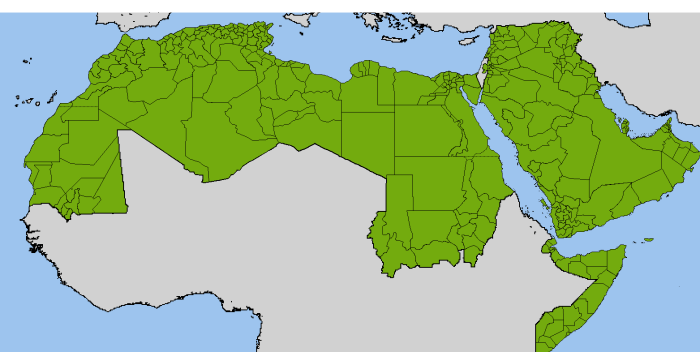
Eye Candy: the Arab world’s administrative divisions

NOL map Arab world admin divisions
Click here to zoom

Imagine if these divisions were all states in a federal republic. Myself, I think some of them,maybe even half of them, could be combined, but if that ever happened, and the resulting combined administrative divisions of the Arab world federated, the region would be in much better shape. (The federation of Arabia would need a Senate, of course.)

What if the OECD did the same? Or simply the US and it’s closest allies?

Nightcap

  1. Neo- and other liberalisms David Glasner, Uneasy Money
  2. How neoliberalism seeks to limit the power of democracies Patrick Iber, New Republic
  3. The Unacknowledged Success of Neoliberalism Scott Sumner, Econlib
  4. From oligarchy to republic: Lessons from the American South James H. Read, Law & Liberty

Revisiting Epstein’s Freedom and Growth


I was fortunate to be invited give the Epstein Lecture at LSE this March. The series is named after the great LSE economic historian Larry (Stephen) Epstein. Here I’ll summarize why it was such an honor to give the lectures. The content of the lecture will be another post.

Epstein was a historian whose origin field of expertise was medieval Italy. I encountered him through Freedom and Growth. Published in 2000, I first read it a couple of years later, perhaps in 2002 or 2003. At the time I was devoted to a story of economic growth shaped by Douglass North, particularly Structure and Change in Economic History (1981).

The focus of Structure and Change was on transaction costs. High transaction costs limited market exchange and kept societies poor for most of history. Sustained economic growth could only occur once transaction costs fell to a level that allowed markets to expand and the division of labor to develop. On this view, market expansion or Smithian growth was itself a stimulus to technological innovation. But what kept transaction costs high?

One answer North gave was the state. To paraphrase: the state had the ability to both keep a society mired in poverty through predatory behavior and to provide the preconditions for growth by securing property rights. The origins of sustained economic growth for North lay in institutional changes that occurred secured property rights and lowered transaction costs. The most important such institutional change was the Glorious Revolution of 1688.


North’s account received many challenges, but the issue that Epstein honed in on was the assumption that there was such a state, able to either revoke or secure property rights. It was assumed that “rulers rule”. Epstein contested this arguing that New Institutional Economists

“project backwards in time a form of centralised sovereignty and jurisdictional integration that was first achieved in Continental Europe during the nineteenth century; they therefore fundamentally misrepresent the character of pre-modern states.”

North, Wallis, and Weingast would address this in their 2009 Violence and Social Orders. But Epstein’s criticism was spot on in 2000. Epstein argued that alongside the problem of predatory states, a central problem was the lack of integrated markets. He attributed market disintegration to coordination and prisoners’ dilemma problems between political authorities. In so doing, Epstein set the agenda for the subsequent “state capacity” research agenda.

Epstein made several points which continued to be expanded upon by current research (see here). First, he documented that the lower interest rates that the British state paid after 1688 were characteristic of city republics from the middle ages onwards. He argued that the English monarchy in the 17th century was characterized by an anomalously backwards financial system. Lower interest rates after 1688 partly represent a convergence to the Republican norm achieved by Italian city-states centuries earlier.

Second, he challenged the argument that monarchies “overtaxed” cities. There was “no evidence that townspeople paid higher taxes under monarchies than republics”. Per capita taxes were likely higher in Republican city-states.

Third, he disputed that Republican city-states like Florence brought economic freedom noting that “republican subjects faced several limitations to their economic and political freedoms that monarchical subjects did not”. All of this challenged generalizations made by historical sociologists like Charles Tilly and economic historians like North.


Epstein’s historical evidence came from medieval Italy. Late medieval Italy was highly urbanized and prosperous by pre-industrial standards. According to Broadberry’s estimates, per capita GDP in Italy in 1450 was not matched by England until 1750. Like growth elsewhere in the premodern world, it was Smithian growth, driven by trade, market integration, and the division of labor. But unlike in England, this Smithian growth did not continue and blossom into modern growth. Epstein’s explanation for why this did not take place was that late medieval Italy suffered an “integration crisis”.

He saw the late medieval period as characterized by new opportunities for growth and innovation. Urbanization increased. Capital markets expanded and deepened. Interregional trade developed. Proto-industrialization took place. But Epstein contended these opportunities were only seized in areas where political authority was centralization.

In reference to proto-industrialization, he observed that

“Crucially, the success of regional crafts was inversely proportional to the concentration of economic and institutional power in the hands of a dominant city.”

With respect to the establishment of permanent fairs, he noted that

In fifteenth-century Lombardy, new fairs proliferated only after the balance of power shifted decisively from the former city-states to the territorial prince with Francesco Sforza’s victory in 1447.

Market integration was complemented and perhaps driven by political integration. Integrated urban hierarchies were themselves the product of political centralization.

“Centralisation underlies all the major institutional changes to market structures previously described. It lowered domestic transport costs, made it easier to enforce contracts and to match demand and supply, intensified economic competition between towns and strengthened urban hierarchies, weakened urban monopolies over the countryside, and stimulated labour mobility and technological diffusion.”

The more centralized parts of Italy — notably Lombardy — were better able to benefit from these trends than was Tuscany. But in general, political fragmentation and regional diversity were “distinctive features of pre-modern Italy” in general and an impediment to its long-run growth prospects.

Unlike in his analysis of interest rates, Epstein brought little data to bear on these claims and I am unaware of subsequent research on late medieval Italy. As such, the thesis of a late medieval integration crisis laid out in Freedom and Growth remains speculative. Epstein would no doubt have fill in the details had he lived longer. Subsequent research has mostly focused on early modern rather than medieval Europe (see here).  But the larger message: the importance of the state for premodern economic development has been central to subsequent research, including my own work (e.g. here).

Nightcap

  1. Piracy in Antarctica Philip Hoare, Spectator
  2. Federalism, good (Canada) and bad (E.U.) Nick Rowe, Worthwhile Canadian Initiative
  3. Why Macedonia’s name is such a problem Nikola Zečević, National Interest
  4. How international hegemony changes hands Kori Schake, Cato Unbound

10 Greatest Speeches of All Time

That’s the topic of my latest column over at RealClearHistory. Obviously, I took a break from my World War I-themed posts to do this one. Here is an excerpt:

4. Duty, Honor, Country speech by Douglas MacArthur: May 12, 1962. General Douglas MacArthur was a divisive figure in his day. For many, he was too martial for a constitutional republic, too outspoken for a General, and some of the policies he argued for (foreign and domestic) were a bit too hawkish for my stomach. William Manchester’s biography of Douglas MacArthur, American Caesar, helped show me how important republican governance was to the General, though. MacArthur thought deeply about republicanism and the effects that war had on a republican citizen’s virtues and characteristics. I have the slight advantage of having Manchester’s work on MacArthur etched into the back of my mind while reading through the latter’s speech, given to cadets at West Point two years before his death: “His name and fame are the birthright of every American citizen. In his youth and strength, his love and loyalty, he gave all that mortality can give. He needs no eulogy from me; or from any other man. He has written his own history and written it in red on his enemy’s breast.” You can read the whole speech here.

These columns are aimed at a different crowd that what I am used to here at NOL, but I think I do a pretty decent job of weaving rather mundane topics (great speeches from an American point of view) into the fabric of more fundamental questions about our global society. Read the rest to find out if I’m way off the mark on this one.

North Korea, the status quo, and a more liberal world

The tension on the Korean Peninsula can be felt throughout the entire Pacific Rim right now. North Korea, a dictatorship with a shaky grasp on its populace, has nuclear weapons and is launching non-nuclear missiles over Japan and threatening South Korea and the United States. To make matters worse, the only state in the region that Pyongyang deems worthy of dialogue, China, refuses to engage in much multilateral work to defuse the situation.

If I were South Korea and China I would have an advanced missile shield system right on the border of North Korea, and if I were Japan I would have an advanced missile shield system spread all along my massive coastline. However, China is engaging in trade sanctions against South Korea for trying to build a missile shield along it’s border with North Korea, ostensibly because such a missile shield would threaten Beijing’s territorial integrity. This is a huge strategic mistake on China’s part. North Korea is ruled by the son of a brutal dictator who is in the midst of remaking the People’s Republic in his image. Pyongyang is launching missiles over wealthy democracies and threatening perceived enemies with nuclear annihilation. China is ignoring all of this, and undertaking policies designed to underwhelm multilateral efforts at containing North Korea because Beijing wants North Korea to serve 3 purposes: 1) a useful buffer state (but read this), 2) a hostile reminder that it considers Taiwan as part of China, and 3) as a good bargaining chip when dealing with the United States in the region.

Given that the United States is not geographically a part of East Asia, and given that Washington figures prominently in not one, not two, but all three major reasons why China refuses to engage robustly in more multilateral actions against such a destructive neighbor, we must ask ourselves: Why is the United States still in South Korea? The answer is that Koreans want them there.

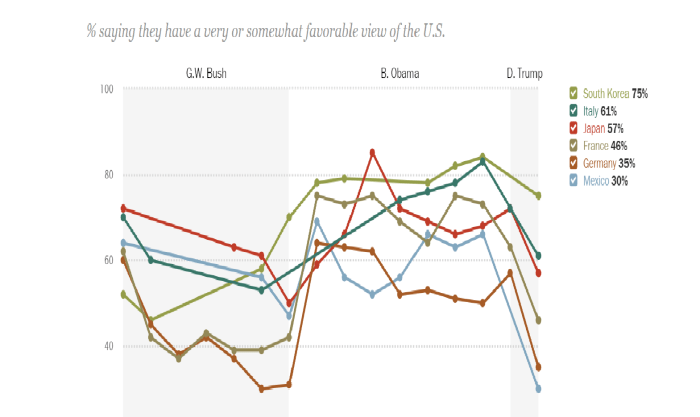
Check out the latest results of a Pew Survey asking people what they think about the United States:

blog Pew American 2
(source)

75% of South Koreans have a favorable or somewhat favorable view of the US even after the election of Donald Trump. That’s higher than the other baseball-friendly countries like Italy (61%) and Japan (57%), and much higher than next-door neighbor Mexico (30%) and longtime NATO partner Germany (35%).

China is wrong to believe that an American withdrawal would suddenly make North Korea a breezy member of the international community of states. Kim Jong Un’s regime depends on foreign enemies to survive. James Madison put it best:

The means of defense against foreign danger have been always the instruments of tyranny at home. Among the Romans it was a standing maxim to excite a war whenever a revolt was apprehended. Throughout all Europe, the armies kept up under the pretext of defending have enslaved the people.

North Korea would bully Seoul and Tokyo and cajole Beijing even moreso because Washington would not be there to bear the burden of Liberal Hegemonic Boogieman.

But I’m not a Chinese citizen and this is a post about a more liberal world, so I’d like to switch gears and focus on something that all libertarians are secretly obsessed with: money.

What kind of deal is the US getting by having troops stationed along the 38th parallel? I know the US is a target of a dictator’s nuclear arsenal because of troops along the 38th, and I know the US has to expend considerable resources on the Korean Peninsula to protect Seoul, so costs are understood, but what about benefits? What about payment? What does US get in return for protecting South Korea?

Trade – a big aspect of libertarian foreign policy – is not that big of a deal for either country: the United States makes up about 14% of South Korea’s exports, and South Korea makes up nearly 3% of the United States’ exports. This means that China, for example, is a larger, more important trading partner to both countries than either is to each other.

One of the benefits I’ve found is South Korea’s participation in multilateral military actions undertaken under the umbrella of US military leadership. South Korea has provided troops for dozens of current UN missions in sub-Saharan Africa and post-British Asia, and also participated in the US-led invasions and occupations of Afghanistan and Iraq (Seoul’s troops left Iraq in 2008 and Afghanistan in 2014). I also learned that South Korea deployed 325,000 soldiers to South Vietnam from 1964-1973, losing roughly 5,100 soldiers and welcoming home another 11,000 wounded soldiers.

Seoul’s participation in Vietnam was a shocking discovery for me. It forced me to reassess America’s relationship with South Korea. The status quo is actually a decent trade-off. The status quo is cooperative, not coercive. The status quo isn’t so bad from a libertarian standpoint: There is a trade-off with mutually beneficial exchange involved, there is a cooperative rather than coercive relationship between both sides, and tens of millions of people are freer than they otherwise would be because of it.

We can still make the alliance marginally better, though. We can still take small steps to a much better world. Consider federation between the two countries.

On the face of it, such an event is ludicrously radical and completely anathema to liberty and cooperation. I would have had the same reaction just a couple of years ago, but two books have fundamentally changed my mind about this: Daniel Deudney’s Bounding Power: Republican Security Theory from the Polis to the Global Village and David Hendrickson’s Peace Pact: The Lost World of the American Founding. Both scholars are American political scientists and, as far as I can tell, card-carrying Democrats.

Deudney’s book uses theory and history to show that, among other things, republican security theory is, and always has been, from antiquity to the present day, the most important question that scholars of international relations have had to grapple with. For centuries, republics started out with the best of intentions, the best of circumstances, and always managed to decay into despotism or succumb to conquest by neighboring despots. The United States, Deudney goes on,  managed to get out of this trap through federal union and, because of its peculiar geographic situation, a full-fledged republican security bargain was able to come to full fruition.

Deudney bases this part of his argument on Hendrickson’s little-known but immensely persuasive book. Hendrickson argues that the newly independent 13 states and their eventual federal union should best be viewed in an international relations framework. In order to protect themselves not only from powerful empires but more importantly from each other, the 13 states entered into a federal union that held them responsible for a limited number of shared responsibilities (such as international security and ensuring republican government in their domestic realms) and left plenty of space for each of them to exercise policymaking as they saw fit. In order to avoid a race to the bottom – where the 13 states formed security blocs between themselves and used Spain, France, and the UK to undermine their rivals – the 13 states built, piece-by-piece, a cooperative international system and called it a federation.

With America’s domestic liberties under increasing assault, largely because the current situation places so much emphasis on certain checks and balances over others, adding additional “states” in the form of South Korea’s provinces would breathe new life into all of the institutions necessary for both security and republican domestic governance.

The inevitable Korean bloc

The biggest fear that such a federation would bring about is the fear of a Korean bloc, or the disintegration of the precarious balance of power between the two parties in the US. Although partisans on both sides no doubt loathe that their side is even with the other in terms of influence and numbers, most Americans are very happy with the two party status quo (if they weren’t happy there would no longer be a two party status quo).

Admitting 5 to 7 new “states,” former Korean provinces, makes it seem like this delicate two party balance would be quickly destroyed with the advent of a Korean bloc which has no interest in traditional American politics. I assure you there would be no Korean bloc. Look at the most recent Korean elections:

blog korea elections map
You’ll notice there’s 5 parties instead of 2 like in the States. That’s because South Korea uses proportional representation whereas the United States uses the FPTP system. The end result of both systems is the same: a center-right bloc and a center-left bloc. In South Korea’s case, the red and the grey districts are right-wing, and the other three colors are left-wing. (source)

There is a Left-Right divide focused on policy and to a lesser extent ideology rather than an ethnic one, just like here in the States.

The Korean Left would line up nicely with Democrats (it even has an anti-American streak that isn’t anti-American at all, only anti-GOP, just like the Democrats!). The conservative wing of South Korea might form a Korean bloc but it would be ineffective in the House and Senate because of its small number.

Libertarians are often dissatisfied with the status quo, even though they’re often the first to point out that life in Western states continues to get better and better. The status quo relationship between South Korea and the United States is great. But it could always be a little bit better.

Lunchtime Links

  1. Trophy-taking and dismemberment as warfare strategies [pdf]
  2. optimally vague contracts and the law [pdf]
  3. Germanic and Carthaginian republicanism
  4. traditional resurgence in tropical Africa [pdf]
  5. crisis bureaucracy: homeland security and the political design of legal mandates [pdf]

Taxes, Free-riding, and Federation

Check out Adam Smith complaining about the rent-seeking that the UK’s North American colonies were practicing back in 1776:

The expence of the ordinary peace establishment of the colonies amounted, before the commencement of the present disturbances, to the pay of twenty regiments of foot; to the expence of the artillery, stores, and extraordinary provisions with which it was necessary to supply them; and to the expence of a very considerable naval force which was constantly kept up, in order to guard, from the smuggling vessels of other nations, the immense coast of North America, and that of our West Indian islands. The whole expence of this peace establishment was a charge upon the revenue of Great Britain, and was, at the same time, the smallest part of what the dominion of the colonies has cost the mother country. If we would know the amount of the whole, we must add to the annual expence of this peace establishment the interest of the sums which, in consequence of her considering her colonies as provinces subject to her dominion, Great Britain has upon different occasions laid out upon their defence. We must add to it, in particular, the whole expence of the late war, and a great part of that of the war which preceded it. The late war was altogether a colony quarrel, and the whole expence of it, in whatever part of the world it may have been laid out, whether in Germany or the East Indies, ought justly to be stated to the account of the colonies. It amounted to more than ninety millions sterling, including not only the new debt which was contracted, but the two shillings in the pound additional land tax, and the sums which were every year borrowed from the sinking fund.

This comes from Book 4, the third (and last) part (“Part Third”) of Chapter 7 in Smith’s famous book The Wealth of Nations (TWON). (Here is a great link to the whole chapter, courtesy of the Library of Economics and Liberty. I read the Bantam Classics version for my Honors seminar on Liberty in Western Political Thought, led by Andrew Sabl, who is currently a Visiting Professor at Yale, though I don’t have it with me so I can’t cite, let alone remember, the page numbers.)

Let me throw a little bit of historical context for this excerpt at you. Smith wrote TWON before the onset of the first Anglo-American war (TWON was published in 1776, which means it did not influence the American colonists in any way, shape, or form; think about the way information spread back in those days), and the war was largely the result of a quarrel between the UK and its North American colonies over taxation. The taxation, though, was needed in order to pay for a war (the Seven Years’ War) that the colonies had initially lobbied the British government to fight for them. The British colonies in North America had much more leeway than their French, Spanish, Portuguese, and Dutch counterparts, and a number of these colonies wanted to expand westward, into the Ohio Valley, where the French state had made claims that were recognized under international treaties.

To make a long story short: Several colonial factions picked a fight with the French and their Native American allies, and this little schoolyard brawl turned into a global war (with fighting in North America, India, Africa, South America, and East Asia) that saw the United Kingdom become the world’s preeminent imperial power and France lose almost all of its North American colonial possessions.* When the war was over, the British parliament wanted to tax the colonies to pay for their fair share of the war, and the colonists said “No taxation without representation!” Smith summed up the situation as thus:

In order to put Great Britain upon a footing of equality with her own colonies […] it seems necessary, upon the scheme of taxing them by parliamentary requisition, that parliament should have some means of rendering its requisitions immediately effectual, in case the colony assemblies should attempt to evade or reject them […] The parliament of Great Britain insists upon taxing the colonies; and they refuse to be taxed by a Parliament in which they are not represented.

This is quite the conundrum, and Smith put forth a proposal that I found quite novel when I first read it as an undergraduate. But before I get to his proposal, I want to make sure that everyone understands the situation here. The UK fought an expensive war at the behest of its colonies, and the colonies, once the war was over, refused to pay for it. Sound familiar? It should. Today the United States finds itself in this situation often (just replace the word “colonies” with “allies”).

Smith proposed the following deal instead of war or civil oppression (such as economic sanctions):

If to each colony […] Great Britain should allow such a number of representatives as suited the proportion of what is contributed to the public revenue of the empire, in consequence of its being subjected to the same taxes, and in compensation admitted to the same freedom of trade with its fellow-subjects at home. [Were British America] to send fifty or sixty new representatives to parliament, […] there is not the least probability that the British constitution would be hurt by the union of Great Britain with her colonies. That constitution, on the contrary, would be completed by it, and seems to be imperfect without it. The assembly which deliberates and decides concerning the affairs of every part of the empire, in order to be properly informed, ought certainly to have representatives from every part of it. That this union, however, could be easily effectuated, or that difficulties and great difficulties might not occur in the execution, I do not pretend. I have yet heard of none, however, which appear insurmountable. The principal perhaps arise, not from the nature of things, but from the prejudices and opinions of the people both on this and on the other side of the Atlantic. […]

Why didn’t the UK just federate with its North American colonies? Smith cited British fears of an unbalanced political constitution that the North American colonies might bring to such a union, and North American fears of being completely dominated by a faraway parliament were they to join such a federation. He countered both fears well, but check out what he predicted would happen if such a federation were to actually take place:

The distance of America from the seat of government […] would not be of very long continuance. Such has hitherto been the rapid progress of that country in wealth, population, and improvement, that in the course of little more than a century, perhaps, the produce of American [taxation] might exceed that of British taxation. The seat of the empire would then naturally remove itself to that part of the empire which contributed most to the general defence and support of the whole.

Interesting, right? Smith argued that the American colonies would become so rich and so populous that the capital of his proposed British federation would “naturally” move from London to somewhere in North America.

Smith was wrong in a general way, but correct in an even more general way. Let me explain.

Smith was wrong because the United States – once separated from the United Kingdom – evolved into the wealthiest, most innovative society the world has ever known. The reason for this is the aristocratic upper house of a legislative institution (“Senate”) that the 13 states had to create in order for all of them to join a federation. If Smith had had his way, the world would have never known the American Senate, and I doubt very much that the 13 colonies would have grown to become as innovative and wealthy as they are today without this vital institution of governance.

Smith was also wrong to make his argument for such a federation to be based on tax revenue rather than principled representation (though see Warren’s infamous post arguing for just such a proposal). The tax revenue argument might be more economically efficient, but it would not give polities seeking federal bonds the guarantee of some sort of equality (two representatives in the aristocratic chamber of the legislative assembly) that they would need to join such a federation. On these two points Smith’s argument was wrong, but what did he and other republicans and federalists get right?

To answer that I think it’s best to ask another question: What would happen if the UK and the US were to federate today?

The UK would be the poorest state in the union (as measured by GDP PPP per capita), if it were admitted as one state.

The stark difference in living standards doesn’t stop there, though. Suppose the SNP finally gets its way and Scotland leaves the UK. Even if England (intl$ 32,669), Wales (intl$ 25,947), and Northern Ireland (intl$ 27,573) were admitted into the US as three separate states, they would all be at the bottom of the living standards barrel. Were Scotland to go along with the other polities in the UK and federate with the US as a separate state, she would rank second-to-last (intl$ 33,791), just in front of Mississippi but behind Idaho. The rankings would look like this:

49. Idaho

50. Scotland

51. Mississippi

52. England

53. Northern Ireland

54. Wales

Smith’s argument suddenly looks a whole lot better, right? At least if you think living standards as they are measured by economists are a good way to gauge the overall health and wealth of a given society.

A federation is basically a huge, actual free trade zone (both capital and labor can move freely) coupled with a binding military pact and some institutions that allow factions to openly argue and contest for spoils that end up in a state’s treasury, but that’s not what the US has with any of its military allies or trading partners. What I find interesting is that the objections to federation between the UK and its North American colonies that Smith listed are essentially the same ones that crop up when such a federation is proposed between the US and its various allies and partners. The difference between now and then, though, is the Senate. Sending representatives based purely on population or tax revenue would most likely contribute to an unbalanced political constitution, but having two guaranteed representatives in a political body that’s heavily aristocratic and lightly democratic would surely guarantee an equality that all sides could eventually agree upon.

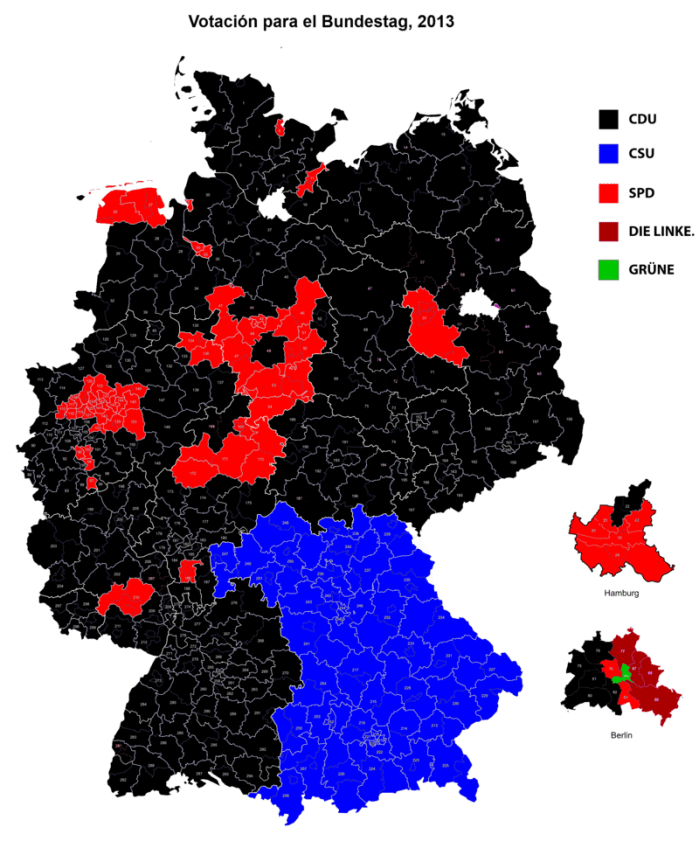
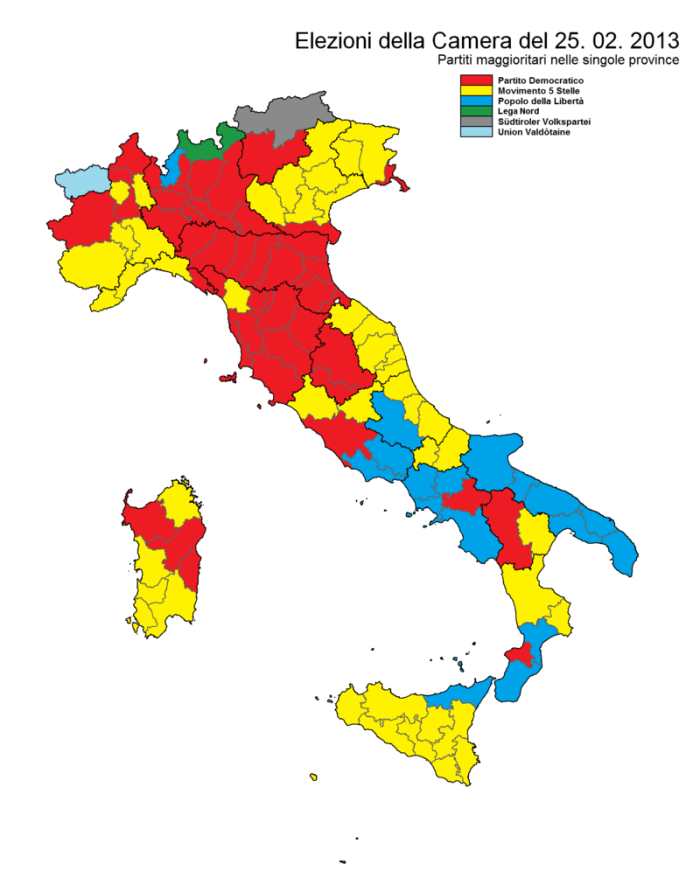
There is also an interesting cultural development to think about as well. The states in Western Europe and East Asia sans China have helped to develop a political culture that is more closely aligned with the one found in the US, Canada, and Australia/New Zealand, one where citizenship trumps ethnic identity. Identity based on citizenship is not as strong as the one found in the Anglo-Saxon world, and ethnic differences do pop up from time to time (largely due to linguistic differences), but the states of Western Europe and East Asia have taken many steps in the right direction to help eradicate the parochial tribalism that has long plagued European and Asian societies and replace it with citizenship. Take a look at the political constituencies of the following three countries:

blog-2013-elections-germany
Germany’s 2013 federal elections (source)
blog-2016-elections-south-korea
South Korea’s 2016 legislative election (source)
blog-2013-elections-italy
Italy’s 2013 legislative election (source)

They are largely based on a Left-Right divide rather than the ethnic ones we find in less economically-developed, less politically-integrated, post-colonial states. This Left-Right divide would fit in perfectly with the Madisonian constitution, as administrative units (i.e. Northern Ireland, Gangwon, Bavaria, or Trentino instead of the UK, South Korea, Germany, or Italy) could be added in a manner so as not to upset the balance between Left and Right currently found in the US. Political coalitions would wax and wane with time, of course, but if we want a world where the East Asians and Western Europeans pay their fair share, and where they are protected from Moscow and Beijing, then federation is as moderately radical as you can get.

Just ask Adam Smith.

What sort of “Meritocracy” would a libertarian endorse, if he had to?

The first attempt to answer this question should say: “none.” Notwithstanding that this is the correct approach, we can’t help but feel uneasy about it. Libertarians have had to deal with this uncomfortable truth for so long. In respect to my own personal experience, I remember where I was when I read, for the first time, “Equality, Value, and Merit,” the title of Chapter 6 in Friedrich A Hayek’s The Constitution of Liberty. I was attending a weekly reading group about that book, and we were gathered in a cafê in Buenos Aires. The number of attendees was enough to find every kind of reader you could expect (and not expect) to meet in such a group:

  • There was the one who had already studied and condensed each chapter and then was re-reading and re-assessing the whole book; the one who did his “homework” without any effort;
  • the one who the embarrassment of failing to accomplish the reading requirements for the meeting overcame the pleasure of any type of procrastination (i.e. me, mostly because I was one of the promoters);
  • and the one who gave to the group the enthusiasm to last for six months in a row and finish the whole book. The latter, in this case, was a truly “natural Libertarian,” the one who had the pure Libertarian position for each subject by not showing an excessive regard for what Hayek was actually saying.

I remember that I arrived to the “Equality, Value, and Merit” meeting with a feeling of uncertainty. Hayek argued that there is no merit to acknowledging in a market process, none of any sort, a just compensation for the value of one’s apportation – a value whose magnitude depends on the relative scarcity of the marginal product. The reader who always accomplished his reading duties without any effort shared my sentiment of awe. Almost the whole meeting was conducted by our companion who was reading the book for a second – or perhaps third – time. In effect, Hayek left no place to meritocracy, since it is impossible to decide democratically among any scale of merit (remember Kenneth Arrow’s theorem on the impossibility of democracy, cited later on the third volume of Law, Legislation and Liberty), so retributions based on value enable the system to adapt spontaneously to the changes in the environment with more efficiency. The explanation was a bit of an unpopular one, but accurate. Not without reluctance, almost all of us accepted it. All of us but one: our true spontaneous Libertarian. She would under no condition surrender her convictions on the merit of the retributions that the market process assesses spontaneously to each one in accordance to the marginal value of their activity. While we acknowledged no merit to the results of the market process, she was prone to endorsing a moral value to the blinded results of the allocation of goods adjusted to the changes in their relative scarcities.

Many years after our debate took place, I am now starting to acknowledge that there might be a particle of truth in the statements of our natural Libertarian and, what is most outstanding, that these statements could be deducted from other chapters of the same book (The Constitution of Liberty), particularly the one which concerns on the definition of liberty (“Liberty and Liberties”). I said a particle of truth, not the whole truth, but at least that particle which is needed to start an intellectual quest.

In The Constitution of Liberty, written in 1960, Hayek made a quick outline of the different notions of liberty that were popular at that moment in time. Positive liberty, negative liberty, inner liberty, individual liberty, freedom from, freedom to, and freedom of were some of the categories mentioned. He made it clear that an in-depth discussion of each notion was not his main aim, but instead that was trying to make a quick account of them in order to give a conceptual frame to the one of his choice: a variant of the individual negative liberty defined as “the absence of arbitrary coercion.”

Slavery is the subjection to the will of another person, without boundaries of any kind. A slave could be subject to a good master who allows him to keep a normal life, but he could lose all of his freedom on a whim of his master at any time. On the other hand, the boundaries to the freedom of a free man are imposed by abstract and general laws and by contracts and the judicial decisions based on those contracts. The ordinary experience of a man enables him to discover principles and patterns of what would be regarded by others as just conduct, and to form in such way expectatives on how a given conflict could be solved. This concept of individual liberty as an absence of arbitrary coercion stated by Hayek in 1960 finds a strong resemblance today in the notion of liberty as an “absence of domination” by contemporary republican authors such as Quentin Skinner, Philip Pettit and, here in Argentina, Andrés Rosler.

The outcome of such a system is that every individual is enabled with a set of possible actions to be taken at his sole will, which we call an “individual sphere of autonomy.” In principle, these spheres are delimited by general and abstract laws and any controversy on the limits between two of them will be solved by an impartial court whose decision will be based on principles expressed by these norms. These judicial decisions would be in accordance to the patterns of just conduct that everyone had previously formed by ordinary experience, so they will prove correct the expectatives of most people and then will be regarded as non-arbitrary.

Of course, we could find that some judicial decisions would be taken by equity or that some administrative decisions would be based on expediency. But such a system could stand some exceptions, most of them aimed to solve an unexpected situation. Some of these new “precedents” are compatible with the principles which inform the existing laws and then their formulation will be a sort of “discovery” of new norms that until that moment were “implicit” in such a normative system. A criterion to distinguish the discovery of new norms from a decision based on expediency might be that the universalisation of the former brings about stability to the system; it makes the law work as a negative feedback system while the universalisation of the latter would only cause an increasing process of disorder.

Friedrich Hayek developed his theory of law – savagely summarised in the previous paragraphs – in Law, Legislation and Liberty and it provides us with an accurate modelization of how it would work a legal system that could not be experienced as “arbitrary” by the individual. In Hayek’s legal model, the fulfillment of the law would imply the respect of individual freedom as the absence of arbitrary coercion, since all boundaries to one’s will are previously known or reasonably expected and, then, our individual plans are conceived and accomplished regarding such limits.

After such a long digression we may come back to our initial enquiry: if a Libertarian had to “do meritocracy,” what sort of meritocracy would it be? The usual answer is, as we noted above, “none.” But I suspect that the wrong statements of some intuitive Libertarians carry within them a kernel of truth: the assignment of functions and subsequent retributions are expected not to be arbitrary, because even the changing value of the marginal products implies (1) some sort of predictability, (2) an impersonal process, and (3) a learning feedback system that fosters increasingly correct pattern predictions.

If we state that liberty is one, be it political, economic or social, we cannot use a definition of liberty in the political realm and another notion of it in the economic one. The “none answer” implies just plain individual negative liberty (absence of coercion) in political economy issues, while our definition of individual liberty is “absence of arbitrary coercion,” and this should be applied to the definition of economic liberty as well.

Therefore, I dare to state that a non-arbitrary distribution of functions and its subsequent remunerations should be a central problem to economic liberty, if we define it as “absence of arbitrary coercion.” Since our spheres of individual autonomy are delimited by a system of norms of just conduct, general and abstract, which distinguish arbitrary from just coercion, the economic liberty is expected to be found in such a framework.

Usually, the legal framework of a free market is regarded to be a neutral one: general and abstract rules, whose source could be the legislation sanctioned by an assembly of deputies of the people and notable citizens or the customs acknowledged as mandatory by the judiciary courts. In any case, general and abstract rules that are not conceived by a single will but have the impartiality of a plurality of legislators or juries. In this sense, “absence of arbitrary coercion” is identified with “absence of coercion by discretionary powers of the state.” Nevertheless, we consider that this is not enough: we should be conceptually endowed to do an evaluative judgement about the outcome of such economic system. We need to determine if the result of a neutral legal framework produces a non-arbitrary distribution of functions and retributions.

A neutral legal framework works like a peaceful, predictable, and secure Lockean Civil Society – i.e. the opposite of a Lockean Civil Society. Since we accept that legal norms express rules of just conduct whose obedience brings about a rightful delimitation of each individual sphere of autonomy, the remaining normative conflicts will be related to moral and social norms. But these normative conflicts will not occur among competitive orders, such as legal order against moral order or against social order, since we acknowledge the preeminence of the rule of law over any other source of obligations. Modernity relegates moral and social norms to the inner of each individual sphere of autonomy or, at most, to conflicts among different individuals which will never escalate and balloon into physical violence. That means that morals and social customs will not bring about an alternative order to society, but that they will enable the individual with an order to rule the inner aspects of his personality and a limited scope of his interactions with other individuals. These sets of moral and social rules will not integrate the formal institutions – to use the categories coined by Douglass North – but will be embodied in “packs of precepts of life” that we usually name “virtues” (a term cherished by the republicans mentioned above and by libertarian authors such as Deirdre McCloskey.)

These “virtues” are expected to contribute to the fulfilment of most individual plans in a system of inner stability. What we regard as good and wrong are a set of received values accrued after generations of trial and error processes. “Being honest,” for example, might be considered as a pack of precepts of life which successfully spread all over the members of the society structured by a neutral legal framework. The unit of evolution is neither the society nor even the individuals, but the “virtues” that are spread among the individuals that compounds that society.

At this stage, we must admit that what we regard as “neutral” is just an analytical category that means a set of fixed elements that work as a framework for other elements which change their respective relative positions. This framework is what Hayek named “order” (we can find in his Sensory Order the most accurate definitions of this concept: more than one). These notions allow us to do a clear distinction between the concepts of “evolution” and “change.” Change occurs among the relative positions of different elements given a stable framework – a Hayekian “order” – while “evolution” – in our terms – is related to a modification in the framework where the ordinary events occur. In the words of Douglass North, “evolution” is an incremental change in opposition to a disruptive change – or revolution. Notwithstanding this use of the terminology at hand, only Hayekian orders “evolve,” while their elements (or events) simply “change” their relative positions.

Nevertheless, to use an Arthur Schopenhauer image, events are the eyes of the blind machine which is the spontaneous order. Given a certain abstract order, the population with some types of virtues extended among the individuals will prevail over other ones. For example, Max Weber, in his Protestant Ethic, showed how the habits of frugality, self-confidence, hard work, and so on, were once considered by most people as eccentric but eventually took over whole communities and changed the meaning of good and evil in a process that ended up in an “iron cage of liberty”: the dissolution of the transcendent values that had previously given a religious sense to those habits into a neutral framework of standard moral duties immanent to the social system.

Another classical book that illustrate a process of “natural selection” of virtues might be The Prince by Nicoló Machiavelli: from the very beginning, the author warns us that a different set of virtues would be needed to be develop in a Republic and that he treated that matter in another book, The Discourses on the First Decades of Titus Livius. The Prince, instead, is focused on determining which virtues is a Prince to be enabled with in order to survive in a realm where no one has the sense to be bound by any moral or legal obligation, i.e.: in a set of non-cooperative games. The whole book can be read as a succession of mental experiments about which virtue could make the Prince survive over his competitors. In Richard Dawkins terms, the ones which are competing are the virtues, and the politicians who struggle with each other are the “vehicles” of those virtues. A very well-known example shows how the population of the ones who seek to be feared at the risk of being hated will displace the population of the ones who seek to be loved at the risk of being scorned. To put this another way: in the “ethical pool” the trait “seek to be feared” will outshine the trait “seek to be loved.” Finally, at the last paragraph of the book, the very virtue of the Prince rules supreme among the other ones: the initiative.

Besides the fact that The Prince – as Quentin Skinner pointed out – should be regarded as a satire (but see Barry here and here for a contrary account) , the emergence of the virtue of the initiative as the inner quality of a political leader of a non-republican system scraps any moral sense of the term “virtue.” Virtues are a compound of personality traits that conditions the agent’s decisions from the inner. But certain virtues depend on the legal framework to spread over the “ethical pool.” As we have said, the virtues that will prevail in an authoritarian regime will be different from those which flourish in a republic. The “republican virtues” described by Machiavelli in his Discourse on the Decades can only proliferate among people within a given set of procedural rules. A similar distinction was made later by David Hume: “natural virtues,” such as empathy, can emerge at any given circumstances, as they are embodied in human nature, but artificial virtues such as “justice” will depend upon a determinate legal framework.

Virtues will erode or shore up a formal institutional framework by incremental change (D. North), yet this will occur only as a response to the change in the environment (virtues as the eyes of the blind machine of the spontaneous order). For example, Gutenberg’s press discovery allowed the evangelical movement to gain force since anyone could then start to count with a Bible. Within the Evangelical movement took place a Puritan one, which at its turn changed the sense of morality in the people for whom it took place. This resulted, for example, in the anti-slavery political movement in certain states of the US or cities of the UK such as Bristol, even at a price of high economic cost.

Nevertheless, while spontaneous changes in virtues lead to incremental political and legal change, a disruptive change of the latter could bring about a dramatic shift in uses and customs of the people involved. This need not to be a violent revolution, since democratic institutions are enabled to issue the required laws to make a significant change for the good – or for the bad – in the said virtues to spread among the society. Sound money is a condition for the virtue of frugality to appear, for example. On the other hand, the Adam Ferguson’s book When Money Dies shows how the people change their main traits due to the phenomenon of hyperinflation.

Since virtues are – in the definition stated here – a mere pack of ethical traits that condition the individuals who are their vehicles from the inner, allowing them to survive and pass their virtues to the next generation of individuals, on what basis should we endorse some virtues over other ones? Our theory cannot provide us with a normative answer by itself, since it leads us to the conclusion that what we regard as good and evil comes from a process of blind evolution. As we have said, a learned libertarian would not endorse a meritocracy of any kind.

However, the complex order compounded by the legal framework and the moral and social virtues extended in society might be “neutral” for each individual involved in such society, but the legal framework will not be neutral to the moral and social virtues that are spread in that society. Different types of frameworks will deliver different sets of virtues to be spread. An authoritarian regime will deliver the set or virtues described by Machiavelli in The Prince, while a republic will spread the virtues of The Discourse on the Decades of Titus Livius. Moreover, the difference between the former and the latter is found in the proportion of decisions taken on the basis of expediency and the ones taken on the basis of principles. The whole message of Hayek’s Road to Serfdom might be exemplified in the transition from a system of public decisions based on principles (i.e.: a republic), to a system of public decisions based on expediency. Each system will deliver a different set of “virtues.”

Thus, we are now in a better position to answer the question “what sort of meritocracy would a libertarian would endorse, if he had to?” A natural libertarian will expect that the distribution of functions and retributions will correlate with the virtues most expected to be found in a legal and political system in which most decisions are taken on the basis of general and abstract principles. Such a system of norms and values will be experienced by the individual as “non arbitrary” and then the ideal of negative individual liberty as “absence of arbitrary coercion” will be achieved, not only in the political realm, but also in the economic and social ones.

In a “Keynesian turn,” we could point out that a system whose decisions are taken purely on the basis of principles is an “especial case” and that we usually find mostly the opposite. In most constitutional systems the “macroeconomic policy” is not a matter subject to the courts and we have to acknowledge that the spreading of some virtues over other ones are more conditioned by monetary or tariff policies than by a neutral legal framework. Nevertheless, this reality is not a reason to disregard the value of the virtues that would arise should those policies be neutral (i.e. not being policies at all, but legal norms). Moreover, these objections just pointed out are good reasons to claim for a republican system of liberties as a fairer system.

To summarize: natural libertarians are not so wrong when they aim to achieve a special kind of meritocracy – the one in which the functions and retributions would correlate with the virtues spread in a society where liberty as absence of arbitrary coercion is respected. In such a system, most political decisions will be taken on the basis of general and abstract principles. After all, the dissatisfaction manifested by a natural libertarian when most of the wealth of a society goes to the rent seekers is rooted in a well founded claim for a “free and virtuous society.”
The Coup in Turkey

I am based in Turkey and have been at the edge of some dramatic events. Before I was in Turkey, I was in the Turkish sector of Cyprus (officially designating itself the Turkish Republic of Northern Cyprus, but only recognised as such by Turkey), where I followed the Postmodern or Indirect Coup of 28th February 1997 when military representatives on the National Security Council were able to force the collapse of a coalition government under an Islamist Prime Minister. Later that year I relocated to Istanbul where I experienced sporadic terrorism from Kurdish separatists and Jihadists. In June of this year I landed at the Atatürk airport just after an ISIS suicide attack. In a more gradual way I saw the disappearance of a Turkish political system under the guardianship of Jacobin laicist army generals, known as Kemalists after the first President of the Republic of Turkey, Kemal Atatürk.

The changes in Turkey came about through a de facto alliance between a party with Islamist roots, the AKP (JDP, Justice and Development Party) and the followers of Fetullah Gülen. Gülen was himself a product of Nurcu Islam, which developed in the early years of the Republic before World War Two as a reaction against the state-led secularisation of Turkey. Gülen was a not very well educated preacher who operated in the context of a fragment of the Nurcu movement, which is not as a whole connected with him. Given the enormous tension between laic Kemalists and the religiously observant population, there was room for a movement devoted to developing conservative Muslim power in civil society and the state.

The Gülenists were preceded in this by the Nakşibendi community, which targeted the state bureaucracy and had followers in politics, notably Türgüt Özal, Prime Minister and then President in the 1980s. Secretive and manipulative politics has been a feature of Turkish and Ottoman politics for a long time. The power of the Janissary elite military and bureacratic corps during the Ottoman period was tied to a religious community, the Bektaşis, creating a parallel system to the legal power of the Sultan until they were violently crushed in the late eighteenth century.

The Committee of Union and Progress, which came to power with military support in the last phase of Ottoman history, developed into a conspiratorial organisation rather than a parliamentary political parry, and a secret arm of it was at the centre of the destruction of Anatolian Armenians in 1915. Secretive groups of Unionists provided a power base for Kemal Atatürk when he revolted against the restored power of the Sultanate and its subservience to the partition/occupation of what is now Turkey after World War One.

The idea of a secret part of the state was maybe not so strong during the early years of the Republic when a one-party system (though in principle the republic was under popular sovereignty) under the dominance of Kemal Atatürk and then İsmet İnönü maybe made it less necessary. Nevertheless, the conditions were established for a revived politics of manipulation behind the scenes. Unfortunately, İnönü’s decision to join the west after World War Two played a part in this. The reorientation resulted in free elections in 1950, with a change in government, and Turkish membership of NATO in 1952.

As in some other countries, the Gladio units played a role in dark political activities. These were the units established to engage in resistance in the event of a Soviet invasion. They had a secretive army within an army aspect and were inevitably a magnet for the most fiercely anti-communist officers, including Alparslan Türkeş, who played an important role in the 1960 Coup. Türkeş was expelled from the coup government, which found him too radical, but he founded the extreme right party in Turkey, Nationalist Action, which is comparatively moderate now, but was heavily involved in political destabilisation and terrorism along with the most anti-communist parts of the state.

What came later was infiltration of the state by Nakşibendis and then Gülenists. Their activity was rather overshadowed by the darker activities of the army and its extreme right allies, often also connected with the Mafia. This network is often known in Turkey as the Deep State. It tended to favour a secular democratic system in terms of formalities, but with concessions to religious conservatism along with an anything goes attitude to covert war against communists and then more importantly Marxist Kurdish autonomists, as well as very limited tolerance for the Left. The hard right element of the army with a base in Gladio was not the whole story. There were far left army officers, particularly up to 1971 and a general staff that tended to be in the middle, though the middle tended to move further right from 1960 to 1980, and then became unwilling to launch anymore violent coups after the 1980 military council stepped down in 198. The general staff itself became increasingly concerned about infiltration by Islamists, including Gülenists.

As it turns out the army’s fear was more than justified. The country liberalised, from a very illiberal base, in the late 1990s, and while the army to some degree went along with that, it launched a peaceful ‘post-modern’ coup in 1997 against the Islamists and was left with the image of the pillar of anti-democracy and anti-liberalism in Turkey. This is an important part of the background to the AKP ‘moderate’ Islamist/conservative democrat electoral victory of 2002 along with the economic crisis of 2001, which along with the 1997 coup left the secular parties very fragmented. The AKP gained a lot of liberal and libertarian support (a very small proportion of Turkey though) and more general reformist support from those who believed it would be a vehicle for reducing the military role in politics and for generally less nationalist-statist politics.

The AKP had very few supporters in place in the military, in the state bureaucracy, or in senior positions in education. The Fetullah Gülen campaign to turn his supporters into the dominant force in Turkey meant they had people in these positions, partly through infiltration of state institutions and partly through founding private educational institutions. This was just one part of the Gülen empire, which include major media groups, banks, and industrial companies in Turkey, and in many countries outside Turkey including the USA. Gülen himself moved to the USA to avoid prosecution by the Kemalist old guard before AKP came to power, claiming to have no links with the economic and educational empire of his supporters which is clearly less than honest of him.

The Gülenists expected a large role in the AKP government and served them most spectacularly in purging the armed forces after an attempted website coup in 2007. In that year the armed forces, unwilling to launch an outright coup, hoped to influence public opinion and the political process by placing a message on its website proclaiming the army’s guardian role in relation to secularism. This turned into the final political defeat of the army’s Kemalist guardian-tutelary role. The AKP won a general election and a referendum to change the method of electing the President. This triumph of civil electoral politics was, however, undermined by the trials of supposed armed coup plotters in the armed forces. Such trials gave the impression of completing the civilian dominance over the army, but were themselves rigged using weak and outright faked evidence. The judges and prosecutors were from the Gülen movement and were creating space for their own people to take the high offices in the armed forces.

The AKP began a campaign against the Gülenists after making its own illiberal core attitude very clear in 2013 in its highly intolerant and authoritarian reaction to the Gezi protest movement. It was increasingly clear to the (even then) most enthusiastic of liberal fellow travellers with the AKP that it was Islamo-nationalist and statist at its core, reducing democracy to the unlimited will of the party elected to government. The Gülenists and the AKP now found the state was not big enough for both of them and the Gülenists decided to use conspiratorial methods against the AKP. Audio files and video tapes of AKP figures and associates, which had evidently been kept in reserve and which suggested widespread corruption were released. Recep Tayyıp Erdoğan (then Prime Minister and now President) and the AKP government succeeded in sacking, retiring and transferring  enough Gülenist police officers, prosecutors and judges to stop this evidence coming to court. They then declared the Gülenists to be a parallel state and a terrorist group, entering into a process of purging the state of Gülenists and seizing their assets in the media, educational and other sectors. The coup conspiracy convictions against army officers, and others, were overturned and it became widely accepted that Gülenists had rigged the trials.

On 15th July this year, I was at a small party on a terrace in the Üsküdar district of Istanbul, overlooking one of the Bosphorus bridges, though by quite a large distance. We could see traffic interrupted on the bridge and news began filtering through of a confrontation between police and army units in what was described as an anti-terrorist operation gone wrong, but was beginning to sound like the beginning of a coup. It turned out that a coup had started and for a brief part of the night it appeared that the old Kemalist-Guardian army had come back to dispose of a government that was elected but increasingly authoritarian. Any welcome in the party where I was, of secular anti-AKP Turks and foreigners was strongly outweighed by a fear that a coup regime would be authoritarian, would create new problems, and the AKP or something like it, if not worse, would be in power for ten or twenty years by way of reaction. This turned out to be the mood of anti-AKP and anti-Erdoğan Turkey. It also became increasingly reported and accepted across the political spectrum that though the putschists had adopted Kemalist language, they were for the most part Gülenists rising up before a purge of the army in a last grasp at domination of the Turkish state.

Since then a purge has unfolded against the Gülenists in state and society, covering the universities (the sector where I work), which has already led to the sacking and arrests of about 60 ooo, including constitutional court judges, army generals and university rectors. The number will certainly at least double before the purge and the current state of emergency is over. Such sweeping action is understandable up to a point given the violent actions of 15th July, and the accumulating evidence over the years of Gülenist infiltration to create a Gülenist-controlled state and society, but clearly the potential exists for massive and systematic individual injustice with abuses of state power affecting over enemies of the state, real and imagined. Some of the language President Erdoğan has used since the coup has been highly polarising and vengeful, demanding submission to state power; some of his rhetoric has been more conciliatory, recognising that all political parties opposed the coup and that deputies across the spectrum sheltered together in the basement of the National Assembly fearing for their lives. I cannot say I am hopeful that the post-coup atmosphere will be beneficial to liberty, but we should hope for and work for the best in Turkey, while being vigilant in working against further declines of liberty.

One thing is for sure: republican politics will not come from the army now and Turkish republicanism must renew itself through engagement and re-engagement with the whole history of republican thought, which is at the origin of classical liberal and libertarian thought. In theoretical and philosophical terms, which is where I work, the discussions of republicanism and liberty going back to Hannah Arendt in the last century, along with the revived study of MachiavellianRenaissanceEarly Modern Republicanism and the way the classical liberals were dealing with the republican legacy of ancient Greece, ancient Rome and medieval city-states are particularly apposite given that Turkish politics, avowedly Kemalist or not, deals so much in a republican language of shared sovereignty and popular mastery.

A short note on two types of political structures

I just came across an excellent review by Herman Belz of a book on American history recently published by Nicolas Barreyre, a French history professor. The main thrust of the book Belz is reviewing has to do with American Reconstruction, but the theoretical thrust of the book is all about state-building and political economy. The whole article is worth your time, but I wanted to hone in on a particular paragraph that caught my attention:

In the 20th century, Progressive “living-Constitutionalism” dedicated to constructing a centralized administrative state […] undermined the Founders’ establishment of a territorial federal republic as the constitutional ground of American liberty. Americans were the territorial people of the United States. Sovereignty resided in the people of the state in which they lived as well as in the states united as a national whole. In the 21st century, the aspirations of Progressive statism reach beyond national borders to the conceit of transnational global authority.

In this paragraph Dr Belz draws a distinction between two political structures:

  1. a centralized administrative state
  2. and a territorial federal republic

The centralized administrative state is a much worse option than a territorial federal republic in Belz’ view (and my own), mostly because in the federal republic sovereignty resides in both “the people” and in the various “states” that have federated to form a republic (Belz suggests this made the United states “a national whole,” but I don’t think that’s true, largely because of Belz’ own description of what Barreyre calls “sectional” politics at the time, but I digress; see Michelangelo for conceptions about “the nation”).

The territorial federal republic is thus a bottom-up approach to a more inclusive, more open society, whereas the centralized administrative state relies on experts, many of whom are unelected and unknown, to govern public affairs.

Belz is largely correct in his summaries of these two political structures, but I think his conclusion (“the aspirations of Progressive statism reach beyond national borders to the conceit of transnational global authority”) misses the mark. This is not because he is right to suspect the Left of wanting to create and sustain a centralized administrative state with a global reach (i.e. the UN), but because he leaves out the possibility that a territorial federal republic can also have a global reach while still avoiding the pitfalls of morphing into a centralized administrative state. Belz is probably more conservative than I am, and hence more pessimistic about the chances of a “transnational global authority” being republican in nature rather than administrative, but I still think my argument is better…

Should Somaliland be recognized as a state by the international “community”?

I’ve gone on record here at NOL as stating that one of the big problems facing advocates of individual liberty today is the failure of the international system to recognize calls for autonomy from sub-state actors, and that one of the best ways to do this is by counterintuitively incorporating that new autonomy into the international system in some way (you can do this by admitting such regions into the UN and other IGOs, or by admitting such regions into suprastate organizations like the United States or the European Union).

Mary Harper, a journalist writing for the BBC, has a new piece up that suggests I may be entirely wrong in my approach for a more individualistic and peaceful world:

The differences between Somalia and Somaliland raise interesting questions about recognition.

Somalia is a fully recognised country. Billions of dollars have been spent and many lives lost trying to restore a country devastated by more than a quarter of a century of conflict.

There has been some progress but there are no signs of full stability returning any time soon.

Somaliland is not recognised and does not receive much outside help. But it has built itself up from the devastation of civil war.

I first visited the territory in the early 1990s, when the capital Hargeisa had been reduced to rubble. When I returned in 2011, as I stood on a hill above the city, I was astonished is to see a whole new Hargeisa below me.

With the international gaze so firmly fixed on Mogadishu, it is unlikely Somaliland will be recognised in the near future – but that may be a blessing in disguise.

Maybe, but Somaliland’s plight could be a whole lot better, too. Imagine, for example, Somaliland joining the EU…

The Re-Privatization of Security (World Peace edition)

Sean McFate, a political scientist at National Defense University in Washington, DC, has a fascinating article in Aeon about the reemergence of mercenary and quasi-mercenary security firms throughout the world. The whole article is fulfilling throughout, especially if you’re a well-read anarchist or a history buff, but I wanted to highlight this tangent:

With the fall of the South African apartheid regime, unemployed soldiers from special forces units such as the 32nd Battalion and the Koevoet (‘crowbar’ in Afrikaans) special police formed the first modern private military company, appropriately named Executive Outcomes. Unlike WatchGuard, Executive Outcomes was not a military enterpriser but a true mercenary firm, waging war for the highest bidder. It operated in Angola, Mozambique, Uganda and Kenya. It offered to help stop the genocide in Rwanda in 1994, but Kofi Annan – then head of UN peacekeeping – refused, claiming ‘the world may not be ready to privatise peace’. Annan’s was an expensive ideology, given the fact that 800,000 people died. By 1998, the company closed its doors, but the mercenary market for force surged.

Two aspects are important here, one said and one unsaid. First, the unsaid. If this mercenary outfit was “waging war for the highest bidder,” why did it offer to go in to Rwanda to stop the bloodshed? I think scholars assume the worst when it comes to stateless actors and warfare. Why has Anheuser-Busch begun shipping free cans of water into Flint, MI? Why does Wal-Mart donate billions of dollars to charity? When it comes to reputation, costs may sometimes not make sense to outside observers who don’t have a sufficient understanding of benefits. Why on earth would a corporation built solely to wage war for the highest bidder be interested in offering its services to a country that would not be able to afford its services? To ask the question is to answer it, of course, but understanding incentives using a costs-benefits framework requires more effort than you might suspect.

There is simply no logical coherence to the idea that, in a world where stateless mercenary firms are the prominent form of security, violence and lawlessness will reign supreme; nor is there any evidence whatsoever to suggest that “[m]ore mercenaries means more war, as they are incentivised to start and expand wars for profit, and turn to criminality between contracts.” Indeed, as McFate notes in his excellent article, the market for security is already becoming freer and while he ends his piece on a depressing note, lamenting this indisputable fact of the present-day world, I couldn’t help but remember the now-famous graph on battle death trends produced by political scientist Jay Ulfelder (using data from the Uppsala Conflict Data Program [UCDP]), which illustrates nicely the overall decline in deaths due to warfare violence around the world:

blog battle deaths
Notice that the most deadly conflicts are the ones involving states with armies that had been nationalized?

The always excellent Max Roser and his Our World in Data project has another graph worth highlighting, with this one using data from Steven Pinker’s The Better Angels of Our Nature… and the UCDP:

blog battle deaths pinker data

Now, two graphs showing that deaths from warfare have been in decline for half a century does not necessarily mean that a freer market in security services has led directly to this overwhelmingly good news. I am confident in claiming, though, that the freeing up of security services markets, combined with the steady presence of a few, still-powerful nationalized armies has led to a reduction in war-related deaths (and violent conflict in general). Both graphs illustrate well what happens when there are too many nationalized armies vying for power and prestige. (It is worth noting here that the main goal of diplomats and policymakers everywhere, no matter their ideological orientation or citizenship status, is still to avoid another world war.)

Second, the said. Annan’s refusal to decriminalize mercenary activities led directly to the 800,000 Rwandan deaths. How is this moral failing any better than when a mercenary firm breaks its contract and ends up killing a few dozen more people than it was supposed to? Again, the graphs are useful here: When conflict is nationalized, everybody suffers; when it is privatized, atrocities happen but not on the same scale we have seen with nationalized conflicts. It’s not even close. Annan’s short-sightedness reminds me of economist Scott Sumner’s 2012 summary of Hillary Clinton’s view of the War on Drugs:

[…] in response to a final question on drugs (from a Latin American reporter), she said drug legalization would do no good because drug dealers are really bad people, and they would simply do other crimes. No discussion of how America’s murder rate fell in half after alcohol was legalized in 1933.

Like drug use, the privatization of security services causes many people, well-educated or otherwise, to bristle at the notion without quite thinking through its logical implications. While ugly, mercenary firms are far more efficient and effective at quelling “bush wars” than are nationalized armies and, in turn, mercenary outfits are far less capable of sowing the type of destruction that nationalized armies routinely carry out.

I don’t think that a world with a few nationalized armies and an abundance of mercenary firms is necessarily the best option going forward, though. It is, however, a better option than most scholars and analysts give it credit for. In fact, it’s the best option at the moment, and while the status quo may sometimes be ugly, remember the graphs. Privatization of security services has contributed, at least in part, to a more peaceful and less violent world.

In order to move forward from this status quo it is best not lament the way things are going, but to acknowledge that things are the way they are for a reason, and then look for avenues to alter the status quo without falling back on a blanket policy like nationalizing security services again. The horrors of the World Wars should still be fresh in our minds, and the horrors of those wars were enabled and encouraged by nationalized security forces.

The best way to move forward is by looking at where these “bush wars” are taking place and begin thinking about ways to incorporate these regions into the global order (such as it is). This policy represents a departure from traditional post-war thinking about international relations, but it doesn’t make it radical or unfeasible. Indeed, there is a long tradition of republican thinking in Western thought pertaining to international relations. The West needs to start recognizing the legitimacy of secessionist sentiments in the post-colonial world, even if it means friction with Russia and China.

Washington and Brussels will have to endure charges of hypocrisy when it comes to ignoring the lobbying efforts of places like Tibet and Dagestan, but Biafra should have become a member state of the United Nations long ago. Baluchistan should have access independent of Pakistan and Iran to the IMF and World Bank. Two or three soccer teams from the region known as Kurdistan could easily be present in all major FIFA tournaments. Examples abound throughout the world. The West should also be open to recognizing arguments made by Russia and China for the independence of regions. There is no good reason why Western diplomats should ignore Moscow’s recognition of places like South Ossetia and Donetsk; doing so only hardens Russia’s stance on recognizing secession in parts of the world where its influence is limited or non-existent and forces the West into bed with unsavory post-socialist regimes.

The West needs to start being more inclusive when it comes to its own federal and republican institutions, too. Morocco, for example, should have had its 1987 application to join the European Union taken seriously (same goes for Turkey). The US federation needs to be actively courting polities like Puerto Rico, Coahuila, Alberta, and Micronesia to join the union. Both the EU and US are contracts designed to dampen violent conflict by fostering diplomatic, economic, and cultural intercourse between provincial polities. The reasoning behind exclusionary policies simply doesn’t answer why these republican, supranational organizations should not be actively recruiting neighboring or geopolitically useful administrative units into their representative systems.

Without this change in mindset the status quo will continue, which again if we remember the graphs is not all that bad, but something worse may happen: There could be a reversion to the blanket nationalization of security services that we saw during World Wars I and II.