The Best Book I Have Read Recently

I make some notes about almost all the books I read. I am thinking my notes may be useful to others. Here is an instance; it’s about a good book I read recently:

Jared Diamond’s 2012 The World Until Yesterday: What Can We Learn from Traditional Societies?

A confession first: When I die, I want to come back as Jared Diamond. He had the exemplary academic career; he wasted no time; he took advantage of academia’s largess and low standards to change himself several times into a different kind of scholar. He addresses ordinary literate people with much success. He is a great teacher.

What Diamond means by “traditional societies”  (in the title) is an imaginary aggregate of what social scientists call “hunters-gatherers” and “horticulturalists.” The latter are largely hoe cultivators, people who don’t use the plow but who grow food. Horticulturalists live entirely in tropical and equatorial climates.

Diamond’s book makes very good reading and, in addition, he tries to make it practical, useful at every step. His guiding theme is that by observing traditional people more closely, we may be able to improve many of our civilized practices. He visits in turn how his traditional societies define strangers and how they deal with war, child rearing, the treatment of the aged, attitudes toward danger, religion, language and health.

Traditionals, in general (also called “primitives”) live in fairly small units because their technologies (plural) cannot support large concentrations of people. They have no cities; they are not “civilized.” Diamond makes the implicit assumption (implicit, I think) that small scale and the preservation of “traditional beliefs” go hand in hand. He makes the further assumption – a fairly common one – that today’s traditional societies are similar to the societies in our own past. Thus, the part of the title that says, “Until Yesterday.” According to this assumption, the observation of such societies has much to teach us about how we – civilized people – grew up, so to speak, and about what we lost while growing up.

I am skeptical about both assumptions, not rejecting, skeptical. First, I don’t really believe that tradition does not change. I think that traditional people live in environments that change to some extent, sometimes rapidly. They change, in particular, because the powerful civilized societies in which they are embedded tend to grow, thus threatening or reducing the traditionals’ physical space and their resources. The tragedy of the Plains Indians reduction to near nothing must have happened many times before. Thus the thing that defines traditional people, “tradition” itself must change to some extent to accommodate change in their environments. The mere fact that traditional societies are around to be observed at all tells us that they must have adjusted to some extent. Thus, when considering them we don’t know if we are looking at our own past, or at pathetic survivors next to extinction, or on the contrary, at extraordinarily skillful ones. That’ s a problem for the generalizing Diamond invites us to engage in. That’s my second main objection to Diamond’s overall approach.

In point of fact, the traditional societies to which Diamond alludes include none situated in the temperate zone. It’s not his fault, of course, Lapps in Northern Scandinavia and Finland may be the only ones left more or less intact. But this fact aggravates my skepticism about the exemplarity of the primitive groups Diamond describes. I cannot eliminate from my mind the fact that civilization arose only in temperate zones, in the Middle East, in Europe, and in China. And independently, in the temperate elevations of meso-America and of South America. Perhaps, possibly, probably this is not a coincidence. Diamond’s tropical, desert, and far north groups may be in no way similar to our ancestors.

Beyond these general remarks, I have two specific quarrels with Diamond. The first is about health and the second about language acquisition. Diamond contends that the maladies of old age that affect civilized people today, including arthritis, cardiac illness, and diabetes, are practically non-existent among primitive people. He also says that primitive people have low life expectancy, I think he means at all ages. So, I am wondering if the first statement is not simply the result of a major sampling error, of a major optical illusion: If people seldom live beyond age fifty-five there will be few of the illnesses associated with old age in their society. It would seem like a gross error for a man of Diamond’s intellectual distinction to make. He may have in fact taken care of this objection and I missed it. Or, he did not do it loudly enough and then, why?

My second specific objection concerns one of the many statement he makes on language acquisition. At one point, he declares himself in favor of “crib bilingualism.” That’s the practice of speaking to babies in more than one language from birth. Personally, I think it’s a dangerous gamble. I don’t have any systematic data. My judgment relies on anecdotal evidence spread over fifty years. So does his. I believe he has not done enough due diligence of tracking possible downsides of the practice. (I don’t need to track its upsides because they are obvious: Get two languages for the same price, same as heads of cabbage at the flea market.)

I may write Prof. Diamond soon at UCLA where he teaches to ask him to discuss these points. Don’t wait on me to act to read this wonderful book though. Do it, do it critically if you can.

Also, read my book : I Used to Be French: an Immature Autobiography

From the Comments: Foucault, Obscurity, and Liberty

Jacques and Barry had an excellent back-and-forth on Barry’s post about Foucault’s contributions to liberty. Here is Dr Stocker’s final response to Dr Delacroix’s questions:

Well Jacques, my last comment was not supposed to be the full reply to your preceding comment, as I tried to make clear. As I said I needed time to think before posting anything from Foucault. I was just preparing the way with comments on the background to Foucault’s style. On Montaigne, how easy is Montaigne? Maybe he seems clear to you and other French people who read him in the Lycée. I teach a lot of Montaigne in Istanbul and students don’t find him easy. Maybe his style at a sentence by sentence level is clearer than Foucault, but I would say only Foucault at his most supposedly obscure. Montaigne can seem clear because he writes in a conversational way, appearing to just comment informally on something in his mind. However, his essays are endlessly digressive and shifting in viewpoint and claim within just one essay, some of which are very long and very detached from the starting point. He mixes quotations from classics, historical illustrations, unreliable anecdotes, and personal memories, in ways which could be often said to obscure as much as clarify any underlying claim, though sometimes a relatively simple maxim seems to be the point. Even there, one really has to think about the relation between the apparent maxim and Montaigne’s shifting point of view to get the underlying point/points. The way that the style interacts with Montaigne’s mind and the uncertainties of his point of view, and the persistent anxieties about saving his world of experience from extinction in death, all have some echoes in Foucault and in various ways it seems to be me that Foucault works on a basis in Montaigne, even if adding the kind of abstract language, vocabulary and sentence construction coming from a mixture of German philosophy since Kant, and poetic-literary language since the Romantics.

Now for a couple of quotations. The first is a random selection from the book that first made him famous, History of Madness. The second is a less random selection from his late essay ‘What is Enlightenment?’.

History of Madness, page 29 (2006 Routledge edition translated by Murphy and Khalfa)

Rising up in spirit towards God and sounding the bottomless depths into which we find ourselves plunged are one and the same, and in Calvin’s experience madness is the measure of man when he is compared to the boundless reason of God.

In its finitude, man’s spirit is less a shaft of the great light than a fragment of shadow. The partial and transitory truth of appearances is not available to his limited intelligence; his madness discovers but the reverse of things, their dark side, the immediate contradiction of their truth. In his journey to God, man must do more than surpass himself—he must rip himself away from his essential weakness, and in one bound cross from the things of this world to their divine essence, for whatever transpires of truth appearances is not its reflection but a cruel contradiction.

‘What is Enlightenment?’ (as published in Michel Foucault Essential Works vol 1, ed. Rabinow, 2000), p 315

We must obviously give a more positive content to what may be a philosophical ethos consisting in a critique of what we are saying, thinking, and doing, and through a historical ontology of ourselves.
1. This philosophical ethos may be characterised as a limit-attitude. We are not talking about a gesture of rejection. We have to move beyond the outside-inside alternative; we have to be at the frontiers. Criticism indeed consists of analysing and reflecting upon limits. But if the Kantian question must was that of knowing what limits knowledge must renounce exceeding, it seems to me that the critical question today must be turned back into a positive one: In what is given to us as universal, necessary, obligatory, what place is occupied by whatever is singular, contingent, and the product of arbitrary constraints? The point in brief, is to transform the critique conducted in the form of necessary limitation into a practical critique that takes the form of a possible crossing-over.

In the first passage above, Foucault uses a language recognisable to anyone who has read much Heidegger to discuss the thought of the 16th century religious reformer Calvin. Since Heidegger’s thought in Being and Time has some roots in Reformation theology this maybe a particularly intriguing way of using Heidegger. The finitude of man compared to God is something that alludes to Heidegger’s understanding of the essential mortality, finitude, temporality of humanity. It also brings out how for Calvin, madness is an aspect of the limitation of human consciousness compared with that of God. In this passage Foucault is bringing together 16th century religious thought, the way that some 20th century philosophy approaches the themes of earlier philosophy and religion when concerned with questions of the limit of experience, how the question of defining ‘madness’ relates to the questions of defining consciousness, experience and limits from the viewpoints of the dominant ways of thinking and organising experience at the time, the ideology operating in the institutions and laws which are applied to the ‘mad’. What Foucault also brings out is that madness’ was closely related to a positive idea of transcending human bounds, so that the stigmatisation of madness then as now is intimately associated with altered states of consciousness that are given value. The use of a ‘mad’ perspective in 20th century Surrealism is one of the aspects that Foucault is alluding to here, an the ways that such aestheticised encounters with the limits of consciousness and rationality relate to earlier religious ideas of exalted spiritual states.

In the second passage above, Foucault is still concerned with the limit and while individual passages in Foucault may seem obscure, he had a very persistent interest in limits of experience, and related questions over some decades, so it is possible to build up an accumulating familiarity with Foucault’s treatment of the issue. The ‘message’ in that passage is the value of moving from Enlightenment of a Kantian kind, which places limits on the claims of universality, to a a kind of Enlightenment based on exploration of the non-necessity of limits, the exploration of the plurality of individual instances unlimited by rationalistic limitations. This is a very Montaigne-like thought, even if the language is more ‘obscure’. There is a commitment to a ‘historical ontology’, that is the understanding of ourselves as individuals and of the ‘human’ in general as the product of contingency and circumstances rather than a deep self or deep humanity detached from experience and history. This is both a proposal for the study of human institutions and discourses as Foucault already had been doing for decades and a proposal for an ethics which values subjectivity in its variability and different contexts. There is no clear limit to knowledge or consciousness, just as there is no clear limit between different areas of knowledge or experience. Foucault’s idea of Enlightenment knowledge and ethics is to keep exploring and pushing at the limits that have been assumed, which is a way of showing their continent constructed nature as well as the way that consciousness is always dealing with a sense of inside and outside that is open to transformation.

In both passages above, I would argue, Foucault uses allusion and compression of multiple allusions, to show connections and differences, and to make us think about those connections and differences. Calvin’s thought about theology has implications for defining ‘madness’, Enlightenment scientific inquiry is related to assumptions about limits of reason and experience. The ‘obscurity’ arises from the way that the syntheses, allusions, and challenges to a priori boundaries are put in a language which shows these things at work rather than just saying that they exist and makes us aware that the language we constantly use is structured and energised by the unions and tensions contained within these thoughts.

If one simply wants the ideas about institutions, history, discourse and so on in Foucault, without the ‘obscure’ language, then to some degree these can be found in Foucault’s lectures, and then maybe more so in those commentators committed to a clarification of Foucault for those not immersed in the use of philosophical language to convey meaning beyond the most literal transmission of messages, commentators including Gary Gutting, Ian Hacking, and Hans Sluga. I recommend them to anyone who finds Foucault’s style to be a chore but wants to find out about ideas which have certainly influenced a lot of work in the humanities and the social sciences.

The whole dialogue between the two starts here, if you’re interested.

The Origin of Expression “Nazi” and How it was Introduced into English Usage

My hearty greetings to the Notes on Liberty “tribe” and special thanks to Brandon for inviting me to become part of this forum. I would like to share with you my side project that recently mutated into an article submitted to Independent Review. Last June, I was doing research in Vienna, Austria, working on a totally different topic (Mongol-Tibetan religious prophecies (Shambhala and the like) and their perceptions by Westerners). Taking advantage of my stay in that gorgeous city, in my spare time, I visited local museums and various prominent landmarks.

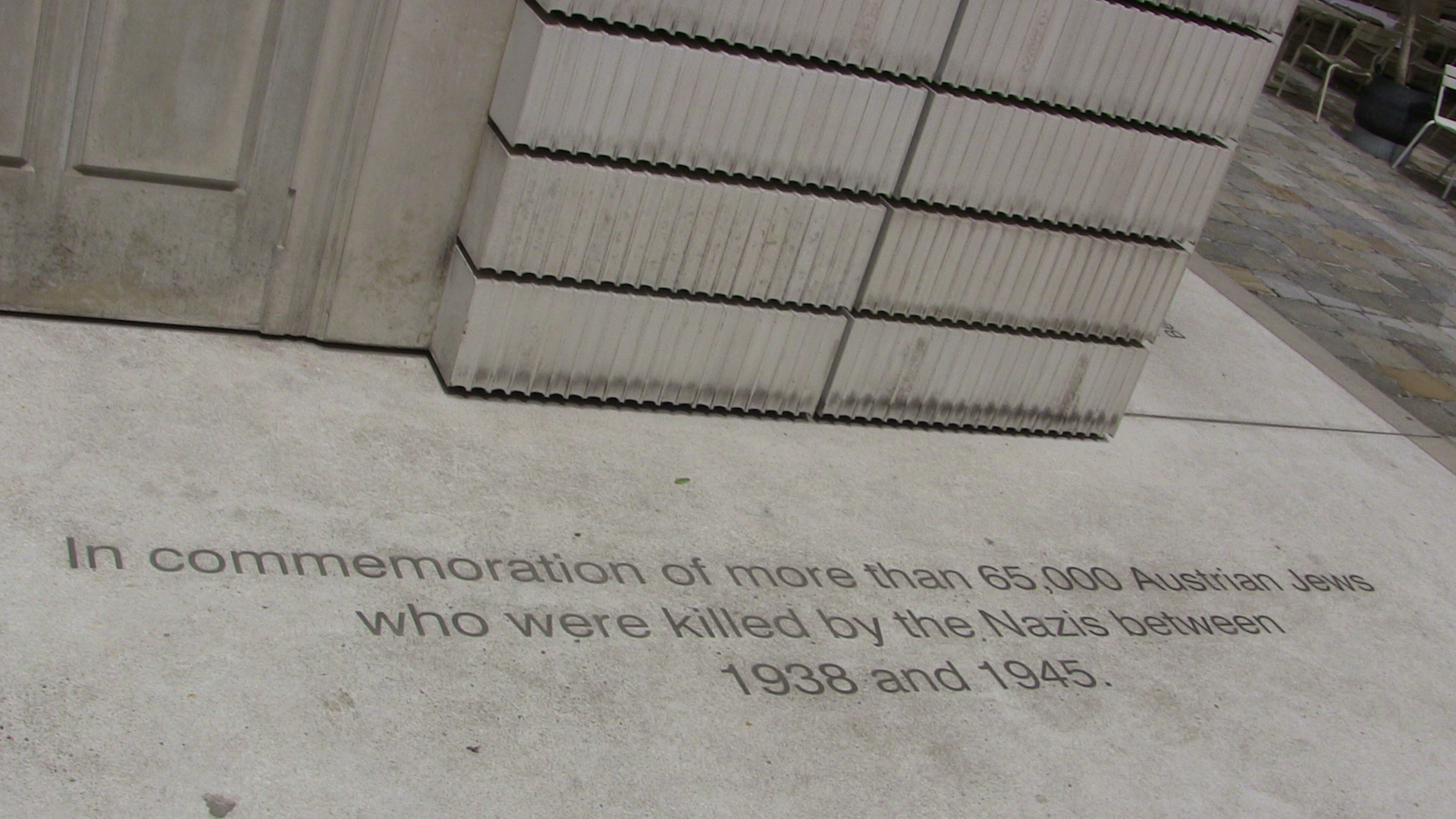
Thus, I strolled into so-called Jewish Plaza in downtown Vienna. The place has a monument that commemorates the memory of 65,000 Austrian Jews murdered by Hitler’s regime during World War II. In fact, I briefly visited this place earlier during one of my previous trips to Vienna. Yet, now looking at three identical inscriptions in three languages at the foundation of the monument I noticed something that earlier had not caught my attention. The inscription on the left is in German, the one on the right is in English, and the one in the middle is in Hebrew. The German one says, “In commemoration of more than 65,000 Austrian Jews who were killed by the National Socialists between 1938 and 1945.” So does the Hebrew one in the middle. Yet, the English version reads: “In commemoration of more than 65,000 Austrian Jews who were killed by the Nazis between 1938 and 1945.”

IMG_0687

IMG_0694

IMG_0698

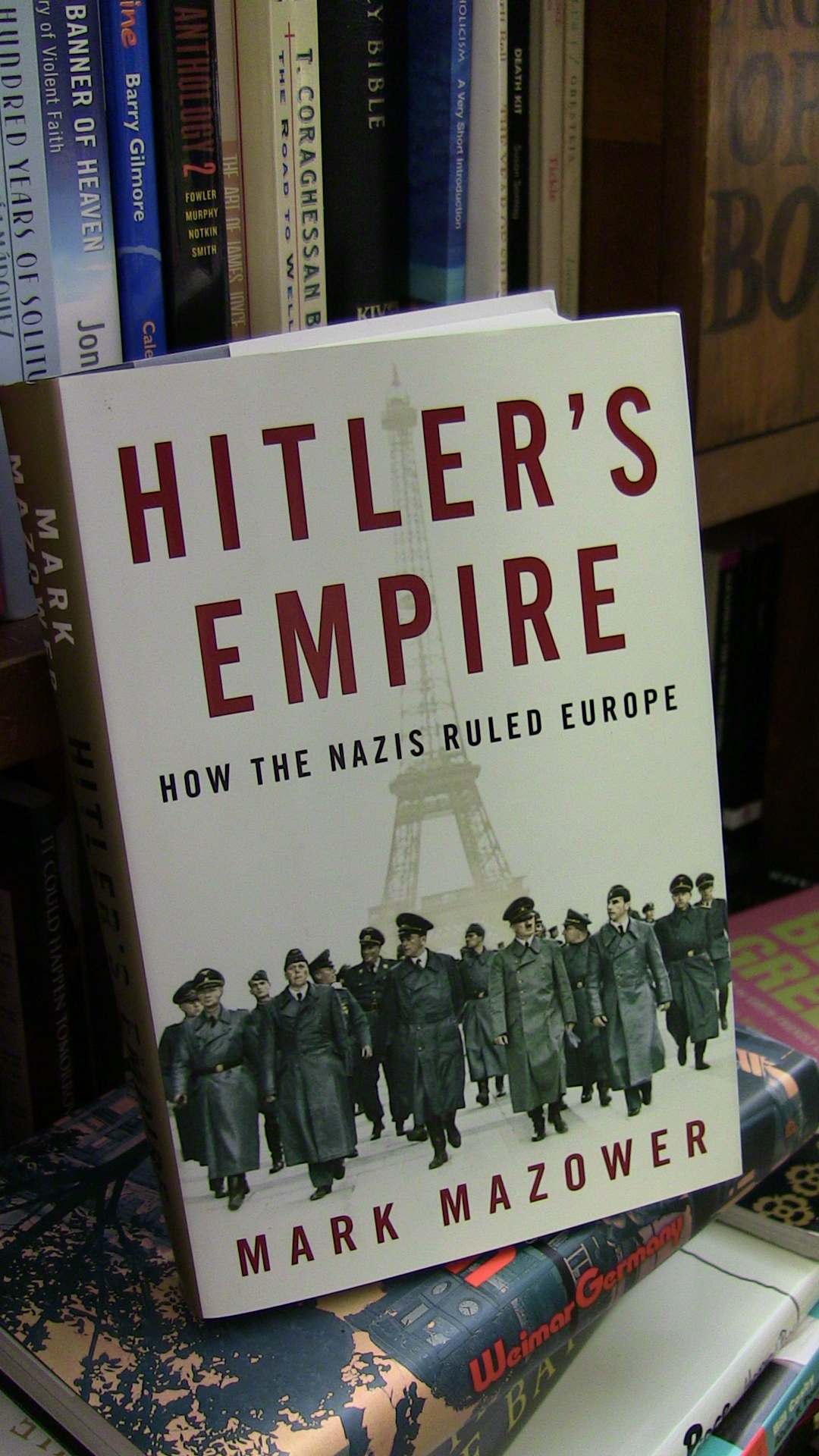
The same day I happened to go to Thalia, the biggest bookstore in Vienna. There, browsing shelves with social science and humanities literature that I stumbled upon a German translation of Hitler’s Empire: How the Nazis Ruled Europe, a 2009 book by the noted American historian Mark Mazower. The German edition of that book, which has the same cover picture, reads Hitlers Imperium: Europa unter der Herrschaft des Nationalsozialismus [Hitler’s Empire: Europe under the National Socialism Rule.]

IMG_0951IMG_0855

So I became curious about this linguistic discrepancy. Eventually, my curiosity took me further and further. The first thing one notices is that when English-speaking people write and talk about the 1930s-1940s’ Germany, more often than not they routinely use the word “Nazi.” Thus, in English we have books and articles about Nazi economy, Nazi labor policy, Nazi geopolitics, Nazi genetics, and so forth. In contrast, when Germans refer to the same turbulent years, they usually say “National Socialism” (Nazionalsozialismus).

So here is the result of my quest – an attempt to answer why in English we use “Nazi” and also who and why introduced this expression in English. The article has not been published yet. At first, I decided to prepare a brief digest of that paper and post it on this forum. Then I changed my mind. To make things more interesting, I decided to prepare a small multimedia audio presentation about why, how, and when the expression “Nazi” emerged in the first place and how it was introduced in English language and post it as a 20-minute video clip on my YouTube channel maguswest. Here it is:

National Socialists into Nazi: Politics and the English Language

A good friend of mine, who is an excellent narrator, assisted me in this. Click this link to see/listen to this talk and, if you wish, give me your critical feedback: Do not skip the ending of the clip, for it features a music tune (so-called Aviation march) that was shared by both Soviet Stalinist and National Socialist marching bands in the 1930s (words are different but music is the same).

The Republican Proposal on Illegal Immigrants and, the French Are Coming

I am responding to a Republican radio and TV ad about illegal immigration. It’s presented as the Republican counter-proposal or response to Pres. Obama demand for “comprehensive immigration legislation.” It displays involuntarily some of the main fallacies Republicans commonly entertain in connection with illegal immigration and other topics. It demonstrates disturbing collective ignorance in my camp. (I am a registered Republican.) Here are four major fallacies in that short ad:

1 The ad continues to be based on the false notion that there exists an alternative to illegal immigration in the form of some orderly visa queue. In this perspective, illegal immigrants are rude, unprincipled line jumpers. Everyone hates such people.

In fact, there is no such queue. The average unmarried Mexican has no way (zero) way to come live in the US legally. (An unmarried Mexican can try to marry a US national or legal immigrant to gain a quick visa. Some do. This is hardly a more principled way to immigrate into this country than overstaying a tourist visa, for instance.)

2 The Republican proposal demands “no amnesty.” The Republican proposal contains an amnesty: amnesty for those who entered the country illegally. It rewards those who took the matter into their own hands against other foreigners who would like to move to the US but do not wish to violate laws to do so. Again, illegal immigration is the only way to enter the US and stay for almost everyone in the world.

There is no way to regularize the status of current illegals living in this country without an amnesty of some kind. I predict that neither the federal government nor the individual states will ever engage in the massive police action that would be required to hunt down illegal aliens in their homes, places of work, churches, and schools (including kindergartens). Everyone else also knows this to be true. Republican leaders have yet to acknowledge this simple fact of life.

3 The Republican proposal would require illegal aliens to “learn English” as a condition of their legalization. This is ill-informed as well as downright stupid.

First, illegal aliens are very busy learning English. They are all aware of the fact that knowing the main local language is a condition of real economic success in this country. To say otherwise is to make a tremendously xenophobic statement by implicitly calling immigrants stupid. That’s in addition to ignoring the facts on the ground.

Second: What are we going to do with Juan if he flunks his English midterm? Throw him over the border? How about Mr Lee, who has been here (illegally) for fifteen year and who owns a restaurant employing six people? Do we ship him back to Canton if he gets two C- in a row on his English grammar test?

Plus, what is the federal government going to do when some ill-intentioned academic reveals that a significant percentage of American-born US citizens also flunked the midterm, the same midterm?

Is this “obligation” to learn English, specifically, even constitutional? The last time I checked, the US had no official language. Why not Navajo?

This all smacks of the insane dreams of comfortably monolingual individuals who believe they would master Spanish if they could only clear a dozen Saturday mornings. Do these people take advice from anyone? Do they read anything?

“Securing the border” has become a mindless Republican incantation. It’s increasingly irrelevant for the purpose of immigration control, at least closing the southern border is. Several relevant points. At them same time as we were having our endless economic crisis killing thousands of jobs, the Mexican economy was doing better than before. And, Mexican population growth has almost ceased. The huge hordes of hungry Mexicans massed at the border to jump in and take over everything American have evaporated. Mexicans have almost stopped coming. Those who do use a student visa or a tourist visa and just don’t go home until they are good and ready.

Securing the border may serve a purpose in the context of a drug war. If that’s the issue, Republicans should have the coraje (same as “cojones” but more polite) to tell the truth.

And now, what the Republican leadership is not doing or not doing enough: Shout to the rooftops that legalizing illegals and awarding them citizenship are only artificially linked (by artful Democrats seeking free votes for generation). European countries have established successfully for many years the fact that citizens of another country can live in forever without acquiring political rights at all. (A recent well publicized Swiss vote on immigration does not deal with this matter.) Fellow immigrant Nikiforov and I explored this idea in depth in connection with the US and Mexico in our article “If Mexicans and Americans Could Cross the Border Freely” featured in the libertarian journal Independent Review.

Here is a real immigration issue the Republican leadership is not attending to: Tens of thousands of younger French people want to move to this country. The issue is so serious that there is a brand new French cabinet post dedicated to stemming the flow. Many of the would-be French migrants possess to a high degree the kind of training Silicon Valley companies say they can’t find. Many of the same well-educated French citizens who wouldn’t dream of opening a lollipop stand under French conditions discover that they possess a big entrepreneurial gene a couple of years after landing here. Let me also point out that the quality of food improves automatically after a surge of knowledgeable and demanding French customers. (Yes, some stereotypes are well founded.)

At this point, there is no legal way to bring in these high quality immigrants. Our immigration system is forcing into illegal immigration the most determined and least law-abiding segment among exactly the kind of immigrants we want.

Language and Informational Prisons: The Case of Arabic

What language you are born into matters. It matters because it’s a means of communication and it matters even more because it’s a kind of soft prison. I regularly turn off the French language media because I become cumulatively irritated at the number of absurd statements I hear coming out of the mouths of presumably university-educated French newsmen and newswomen. There are fewer absurd affirmations in the news in this English-speaking country simply because good information is more abundant in English than it is in French.

We are used to believing that whoever is intelligent is also well informed. The reverse, we know, is not true. There are plenty of people who accumulate information and who are perfect fools. The best way I have heard it put is from an anonymous author played recently on my local radio station (KSCO Santa Cruz 1080 AM): Being aware of the fact that a tomato is a fruit is to be well-informed; to abstain from putting tomatoes in a fruit salad is to be wise!

The assumption that intelligent people are automatically well informed is so general that when we come across someone who is obviously intelligent but ill-informed we study him like an infinitely interesting creature. I have known several people like that in my life. They drove me crazy. One I know now, is smarter than I, I suspect but nearly everything he believes to be true is false. My friend has made a philosophical decision not to have any electronic media in his house. He usually carries a book. Over time, I have come to suspect that he does not read very well, that he is dyslexic (whatever that means) or something like that. In general, we don’t think enough of this rare case: The ignorant intelligent person. Continue reading

Dr D. on Sex, Homosexuality, Language Usage

A reader, MM, sent a comment criticizing an off-hand, snide remark I had made in my micro-essay, “Sex Advice.” I welcome the opportunity MM gives me to take him into the alley and beat him to a pulp. His full comment:

Though usually considered much of a stick-in-the-mud regarding language, and especially neologisms, I must offer a cordial disagreement regarding the word “gender” when used instead of “sex.”

Ordinarily I despise changing the language (you should see, for example, my battles with the ignorami who say “healthy” when they mean “healthful”), but when a change improves and clarifies, then I can not only accept but embrace it.

You are right that “gender” was originally intended for language references — more important in French and other furrin tongues — but since “sex” has become such an important, or at least such an ever-present, part of everyday life, having a separate word, such as “gender,” keeps the meaning clear.

I mean, I have compromised my formerly inviolate principles so that now I even use the word “gay” rather than “homosexual,” after swearing I would never degrade the language in that fashion.

But, after all, “gay” is the polite term, the one preferred by the people to whom it applies.

So, if I can change, linguistically, so can you.

MM’s justification for the widespread substitution of “gender” for “sex”makes sense. I agree that it clarifies. However, it ignores the fact that such a change rarely occurs as a result of a technical-rational process. Such changes, this one in particular, are loaded with sociological and, with political importance. To ignore them is to assent. Winning the substitution of one word for another is like winning an election forever, an election in which the winning party never even ran and the opposition never campaigned. What I am going to say about “gender” applies even better to “gay.” Continue reading

Department of Huh?

The dialectic between pragmatics and metapragmatics is the way in which

explicit metapragmatic registers instantiated in metapragmatic discourse encapsulate ideologies of language use and play an obvious role in the institutionalization of discursive mechanisms of society.

This is from Michael Silverstein, a linguistic anthropologist and somebody who I have to read for a degree requirement. Life could be worse, I guess…