- Interview with a secessionist
- Ducking questions about capitalism
- The perverse seductiveness of Fernando Pessoa
- “Yet in this simple task, a doffer in the USA doffed 6 times as much per hour as an adult Indian doffer.”
- Conflicted thoughts on women in medicine
- The Devil You Know vs The Market For Lemons (car problems)
gender
Is persecution the purpose?
Last week, Rebecca Tuvel, an Assistant Professor of Philosophy, had her recent article in Hypatia, ‘In Defence of Transracialism’, denounced in an open letter signed by several professional scholars (among others). They accused her of harming the transgender community by comparing them with the currently more marginalized identity of transracialism. William Rein, on this blog, and Jason Brennan at Bleeding Heart Libertarians, have written valuable defences of Tuvel’s right to conduct academic research in this area even if some find it offensive.
Events have moved fast. The associate editors initially seemed to cave in to pressure and denounced the article they had only just published. The main editor, Sally Scholz, has since disagreed with the associate editors. Critically, Tuvel’s colleagues at Rhodes College have given her their support so it looks like the line for academic freedom might be holding in this case. Without wishing to engage too much in the hermeneutics of suspicion, I think there are grounds to doubt the depth of the critics’ attitudes. I base this on my reading of Judith Butler, who is one of the signatories to the open letter arguing for Tuvel’s article to be retracted.
Seven years ago, I managed to read Judith Butler’s Gender Trouble. Although there are many variations in the movement, Butler is a central figure in the post-structuralist , non-gender-essentialist, feminism that inspires much of the contemporary ‘social justice’ movement. When I got past Butler’s famously difficult prose, I found a great deal of ideas I agreed with. I wrote up a brief piece comparing Butler’s concerns with violently enforced gender conformity to classical liberal approaches to personal autonomy. I also identified some problems.
First, Butler’s critique of the natural sciences seems to completely miss the mark. Butler associates gender essentialism with the study of genetics, when, in fact, genetics has done more than almost anything else to explore the contingency and variation of biological sexual expression in nature. The same applies to race and ethnicity.
Second, more importantly, Butler insists that there is no underlying authentic gender or sexual identity. All identities are ultimately constituted by power relations and juridical discourses. You find this argument repeated among social justice proponents who insist all forms of identity are products of ‘social construction’ rather than ever being based on natural facts. As a result, all personal identity claims are only ever historical and strategic. They are attempts to disrupt power relations in order to liberate and empower the subaltern and oppressed albeit temporarily
I don’t think this is perfectly factually true but lets accept it for now as roughly true. This means that transracialism itself might become, or could already be, another example of the strategic disruption of contemporary juridical discourses, this time about race and ethnicity. The same people currently denouncing Tuvel could very easily insist on the acknowledgement of transracial identity in five or ten years time, and denounce those who hold their current views. From their own position, which explicitly rejects any ultimate restrictions on identity formation, we have no warrant to know otherwise.
In this sense, Tuvel might not be ‘wrong’ at all, just slightly ahead of the social justice curve. And her critics wouldn’t actually be changing their minds, just changing their strategies. Meanwhile, people who actually take their identities seriously should be wary of their academic ‘allies’. They can quickly re-orientate their attitude such that a previously oppressed identity comes to be re-configured as an oppressive and exclusionary construct.
If all claims in this area are strategic, rather than factual, as Butler claims, then why try to damage a philosopher’s career over it? Why provoke an academic journal almost to self-destruct? Rather than working out which ideas to denounce, we should critique the strategy of denouncement (or calling out) itself. In that vein, much as I disagree wholly with the stance of its editorial board, I think calling into question Hypatia’s status as an academic journal, is premature.
Race as a bundle and its implications
As I mentioned in my last post, I have been given the topic of race increased thought recently.
One of the recent developments in political science has been thinking of race not as a dichotomous variable, but as a bundle of related but distinct characteristics. Race is not simply phenotype, but a mixture of such things as one’s dialect, diet, and socioeconomic status among other things.
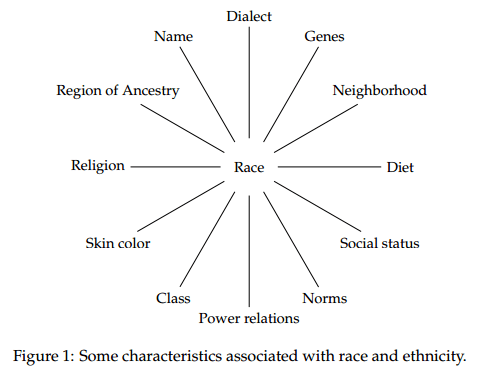
The idea to me seems obvious, which makes me inclined to believe it. The thing is, if we take this broader approach to what race is, what are the implications for prior work not only in regards to race but the effect of demographic characteristics generally.
Race is already difficult to conduct research in because it is assigned at birth which makes it difficult to manipulate and which influences other characteristics we would ordinarily ‘control’ for in statistical analysis. To my knowledge there isn’t a ‘race ray’ that we can use to randomly assign being ‘black’ in an experiment. Tracing causality is possible, but difficult enough even in ideal situations.
Take for example the gender wage gap argument. When you control for education, presence of children, and other characteristics the gap in wages between males and females vanishes. However many of these characteristics are impacted by one’s gender. While females are not discriminated against ceteris paribus, being female does increase one’s likelihood of having to be the primary care taker for children and has historically decreased educational outcomes. In this broader sense there is a gender wage gap.
What can be done about it though? Men can try to share more of the house duties with their wives, but my general observation in life has been that children prefer being cared for by their mothers over their fathers. Should we try to do something about it? Are there advantages to one member of the household specializing in housework?
Or, if you prefer to think of the question purely in regards to race let us consider crime rates by race. I am not convinced that blacks have any higher propensity to crime than whites. However blacks are more likely to grow up in poverty and have lower educational outcomes than other races, which in turn leads to higher crime rates statistically speaking. Where should the arrow of causality be pointed towards: race, education, socioeconomic status?
Race is a difficult concept to think about. However it is precisely the difficulty with discussing it which begs that it be thought about more. I believe we liberals have a particular duty to think about race more because if we don’t then our ideological rivals will continue to dominate the conversation.
See here for an un-gated draft of the relevant paper: Sen, Maya, and Omar Wasow. “Race as a Bundle of Sticks: Designs that Estimate Effects of Seemingly Immutable Characteristics.” Annual Review of Political Science 19 (2016): 499-522.
To Women Voters:
I take the liberty to point out a small number of issues that I am told are important to women. I do it because I used to be a respectable social scientist and because I have been retired for ten years which gives me plenty of time to stay informed.
Women voters have been misled for years by propaganda explicitly pointed at them. It wasn’t necessarily a conspiracy though but a kind of uncritical cultural convergence. Many of those who spread misinformation believe it themselves. So, in a way, they are morally innocent. That’s no reason to follow them down the wrong path, and down the cliff. Below are five topics about which you may have received false information that has been repeated over and over until it sounded true.
The first female president
There is a widespread feeling among American women that it’s time finally to elect a female president. For some, it’s a sort of symbolic restitution. I can’t speak to this because I am only a man. Other voters, both females and males, seem to think that a female presidency would result in significant improvements in the lives of American women. A relevant reminder: Eight years ago, Americans elected the first African-American president. For many, it was a vote filled with hope for positive change in the area of race. After two Obama administrations, almost eight years later, it’s time to take stock. However you evaluate the Obama administrations in general, two facts stand out. First, race relations in American have not improved (to say the least). Second, African-Americans are not better off than they were eight years ago. In fact, they are slightly worse off economically. (My own position on having a woman President is straightforward: I would vote for Stanford Professor Condoleeza Rice, for President, in a heartbeat.)
Abortion
The 1973 Roe vs Wade decision made abortion on demand available throughout the territory of the United States. Candidate Trump has provided a list of potential nominees to the Supreme Court . Some of those nominees are pro-life. This raises the question of what would happen in the unlikely event that Roe vs Wade were overturned by a new Supreme Court. You may have been led to believe that abortion would become illegal. That’s simply not true. Legislation on abortion – if any – would revert to the individual states as the Constitution requires (same as murder, theft, sequestration, and spitting on the sidewalk). The likelihood that all fifty states would forbid abortion on demand is simply zero. The likelihood that half of them would is also zero, I believe. The worst case scenario is that abortion would become geographically inconvenient. (In case you wonder, I believe, just like former President Bill Clinton, that abortion should be legal, safe, and rare.) There is no chance that not electing Mrs Clinton will make abortion illegal.
Pay disparities
We have been told that women received interior pay for equal work for so long that it has almost become the truth. Even my local female Republican candidate for Congress uses this line. It’s not the truth. The reality is that women receive unequal pay for unequal work. There are various reasons why this is. (A broader treatment of this matter is on my blog and accessible through these two links.) In fact, paying women unequal pay for equal work has been against federal law for more than thirty years. Doing it is an invitation to costly class action suits. It’s probably important not to vote for someone on the basis of “facts” that are not facts at all. And then, there is the issue of why anyone would mislead you so badly. (Myself, I am going to vote for the Republican lady candidate for Congress although I think she should check her facts better.)
Immigration
Candidate Clinton has said clearly that she is is for open borders. This may come from a generous heart. Yet there are too many people from poor countries who want to come to the US to live. Even, if all of them are good people, the USA is like a lifeboat: If too many climb aboard, the boat capsizes and everybody drowns, the original passengers (Americans as well as existing immigrants) and the newcomers (would-be immigrants). To remain a decent society, a generous society, the US has to somehow restrict admission. Open borders is not a possible policy, it’s a dangerous fantasy. (In case you are wondering: I am an immigrant myself, so is my wife.)
Civility
Candidate Trump bragged – thirteen years ago – about making crude sexual gestures. There has not been a single formal complaint or any charge brought against him on this account. That’s although – unlike former Pres. Bill Clinton at the same stage – he has temptingly deep pockets, the kind of pockets that would give fighting courage to any moderately aggressive attorney. Candidate Trump often also has a filthy mouth, and he occasionally uses sexist language, that’s a fact. Candidate Clinton is good friends with and approves of, and patronizes artists who routinely sing of perpetrating gross sexual violence on women (including in the last days of her campaign). They too use obscene words. They do so routinely, every time they perform. (I don’t use such language myself but my wife of forty years does, another story, obviously.)
Please share this and ask your friends to share.
BC’s weekend reads
- NATO sends a message to Russia
- Iraq doesn’t need to break up to be successful (so says a scholar at Brookings)
- Benedict Anderson (political science) reviews Clifford Geertz (anthropology)
- The Muddled Mystique of Karl Polanyi
- The prison house of gender
- Investigating Madison’s Political Religion (central planning is hard to do)
New issue of Econ Journal Watch is out!
For those of you who don’t already know, Warren is the math reader for EJW and one of NOL‘s co-founders, Fred Foldvary, is an editor for the journal, so this is very much a family affair. Here are some of the articles that caught my eye:
You get what you measure: Daniel Schwekendiek explains how South Korea followed a proven template of incentivizing exports to boost Web of Science publications and raise the rankings of its academic institutions.
Now entering a Republican-free zone: Mitchell Langbert, Anthony J. Quain, and Daniel Klein report on the voter registration of faculty at 40 leading U.S. universities in Economics, History, Journalism, Law, and Psychology.
Whither science in gender sociology? Charlotta Stern investigates whether gender sociologists blinker themselves from scientific findings about sex differences.
How to Do Well by Doing Good! In this 1984 essay, Gordon Tullock counsels young economists that doing well and doing good go together.
You can download and read the whole thing here (pdf).
At a Muslim Wedding
I was on that free diving and fishing trip through Algeria I have written about before. The French, who had seemingly deeply colonized the country, had been gone for a few years. They had left behind their language and many buildings in the big cities and in some other, fertile parts of Algeria. In remote areas though, it was almost as if they had never been there. I was in one of those areas with my then-future-ex-wife (“TFEW”) in our VW camping bus.
It was in the east, in Kabylia, in a small town squeezed between the mountains and the sea. There was a tiny harbor protected by a tiny breakwater that sheltered four or five boats. There was also a café a hundred yards away. A big rock with steep sides emerged within swimming distance of the harbor. The town was a spear fisherman’s dream as well as a vacationer’s dream. It was the kind of place that travel agencies use to arouse you on TV in the winter and never, never deliver.
When we arrived, in the middle of a hot afternoon, there was no human being in sight; even the café was empty. I was an instinctive believer in the adage that it’s easier to ask for forgiveness than for permission even before I heard it spoken. So, we parked at the harbor and had our cheese, bread, and figs lunch. I prepared instant coffee on the stove. I thought I was giving whatever authorities might exist in the town ample time to chase us off if they wished. Nobody came.
Toward evening, I walked to the café where four or five men were sitting and talking quietly. I said Hello in French and they replied in the same language. I could read the curiosity in their eyes but they were too polite to inquire. So, I ordered some tea and explained briefly what I was doing in Algeria. This interested them. Being a fisherman works everywhere as an introduction. Everyone knows what fishing is (unlike “touring,” for example). Every man either is a fisherman or wishes he were. Or has a brother-in-law who is a fisherman. One of the men volunteered that the café served wine. I ordered a glass for myself and offered to treat the men. Only one accepted.
My companion and I has a small dinner under the light of an oil lamp and went to sleep in the back of the bus. In the morning, I quickly located a bakery by smell. There was hot fresh bread. (Good bread is an undeniable gift of French colonialism.) After breakfast; I cinched on a light weight belt and grabbed my speargun; I put on my mask and snorkel and my flippers. I entered the clear water of the harbor and swam to the offshore rock. The sea was bountiful. There were groupers there that did not even know I was a predator and various edible fish that seemed to only have Arabic names. (If you don’t believe me, I have a picture.)
The location was so idyllic that we lingered on. In truth, we didn’t even have anyplace to go in a hurry anyway. We ate fresh fish at every meal, with fresh bread and tomatoes, plus some fruits. There were no authorities. Only the village kids came to visit. They were sweet and full of good questions. We gave them fish. I had become almost an old-timer at the café. One of the guys there told me his name was Pierre. He was the same guy who had accepted a glass of wine the first day; I should have known. I never got the story of why he had stayed behind after all the other French left. Maybe, there was a woman involved. Or, he had no relatives in France. Asking would have been pushy
One morning, early, two older children with solemn expressions came by with a message. There was going to be a wedding the next day and we were invited. We were both flattered and intrigued. The TFEW immediately went into a flurry of activity looking for a suitable present for the bride. It was no easy task because we were camping, with minimalist baggage. Eventually, she found a small silk kerchief that she thought might do because, frankly, the locals seemed so poor. She (and I too) was thinking in terms of what we knew about: American and French weddings, pretty much variations on the same basic model: The bride is the queen and she gets presents, the bride’s mother is the dictator, the groom is a little drunk, so are many of the guests, including children. There is dancing. Most unmarried women are a little or much turned on; single guys try their luck.
On the wedding day, we cleaned up as well as we could, birdbath manner. My companion even washed her hair in cold water. Fortunately, she was wearing it in a very short afro, almost a buzz cut. She put on a light cotton mumu that looked almost ironed. It was a decent, loose garment but with discreet curves in the right areas. I thought she looked more than presentable. I don’t know about myself. I had on clean jeans and my only shirt with a collar. The kids had been vague about time. Around noon, we walked up the steep street with the same children guiding us.
A whole other street, a flat one, had been blocked off and long tables, benches and chairs lined up on the sidewalks. It appeared that our being invited had not been such an extraordinary honor after all. We guessed the whole village was invited and it would have been unseemly to leave the tourists out. (But wait….) However, we saw only male human beings on the street, from boys in short pants to bent old geezers. A band played somewhere close-by but we couldn’t see it and there were no dancers in sight. The action took place behind bed sheets hung from a rope that stretched across the street. We were instructed with smiles to sit down. After a few minutes, young men came bearing enamel basins of food. They placed a piece of mutton next to us on the table oilcloth and a bowl of semolina (grits, more or less) with two spoons. Another boy set a recently rinsed glass full of limonade in front of each of us. We noticed that other guests were waiting for our seats.
We were going to hurry off the table but a tall, handsome man in a dark suit – the only suit in sight – came by. He was the groom and he had taken it to heart to greet us personally, which he did graciously, in perfect French. We were told later that he was a fighter pilot back from training in the Soviet Union who had returned to his native town just to get married. The man was elegant and he had a great deal of presence. He would not have been out of place in an upscale bar in Palo Alto, California where we lived most of the time. I told him that my wife had a small gift she would like to give to the bride in person. He said not to move, that he would send us someone quickly.
After a short time, an older man came to tell my companion to follow him. He took her a few feet away behind a low wall where I could still see her. There, he handed her over to two old crones. One of them had red dyed hair that would not have fooled a blind man ten feet away. The three women walked away through an unlit area but in the direction of a brightly lighted structure where I lost sight of them.
About ten minutes later, the TFEW came back by herself steaming. (I was a grown man; I felt the vibes; I knew the signs.) So, I asked, did you meet the bride and did you give her the present? She said she had and she had and the bride, sitting all made up and coiffed in a gilded armchair, surrounded by her handmaidens, seemed touched. But, she said, you won’t believe what happened before that. Just as we reached the bridal pavilion, one of the two old women held me by the shoulders while the other lunged for my crotch and tried for a grab.
What do you think? Would I make this up? Do I have the talent, the imagination?
Several things. First, yes, of course, this is intended to be a pop-sociological story. It’s a commentary on something. Your guess.
Second, it should be obvious that I liked everyone I met during that stay and in that episode, every single person. That’s more than I can say for the people with whom I cross paths daily in California, for example. And, don’t get me started on the French! (Many of whom are holes in the ice as my decorous granddaughter would say.) Now, I know why I liked them but it’s hard to tell why they were so likable. Everyone in the small town was courteous and generous if he had a chance to be, even if only by offering a glass of hot tea after my long stay underwater. Again, I can’t tell why they were so gracious. Perhaps small towns are like that. Perhaps people used to be generally like that when they live in places small enough to be real communities. I can’t really believe this though because I have read too many stories (beginning with Maupassant’s), seen too many movies, where small town people behave in a completely beastly manner.
In the absence of perfect sampling, I tend to put some faith in cultural redundancy: If blondes keep treating me shabbily, I begin suspecting that there is something wrong with blondes (or about blondes and me). So, I have been treated courteously by Muslims and by people who appeared to be Muslims whenever I spend time in Muslim surroundings, even thousands of miles apart. So, until proven otherwise, I think it’s their culture that makes them friendly. Yet, naturally, I find the crotch grabbing incident and what I take to be its many implications repulsive. I don’t think it would have happened anywhere in the formerly Christian West.
The gesture and its sexual implications have a historical association with Islam, I believe. (See how carefully I chose my words.) Yet, there is almost certainly nowhere in the Islamic Scripture that mandates, commands, or even condones such behavior. Contrary to many Muslim apologists I hear on TV and on radio, that’s not the end of the story, as far as I am concerned, however. You are responsible for the baggage your religion carries. So, there is absolutely nothing in the Christian Scriptures ordering that theological deviants be burned alive. And yet, it happened in Christian lands, over and over again. Historically, it’s a sort of Christian specialty although Christ would not have applauded the practice, I am pretty sure. If you are a Christian, it’s disingenuous to say that burning people alive has nothing to do with you. It’s as much part of your heritage as are the glorious Gothic cathedrals.
And, yes, you are right; I loaded the dice by entitling this story “A Muslim Wedding.” I could have called it equally well: “An Algerian Wedding,” or “A Kabyle Wedding” (for the area), or “An Amazigh Wedding” (after the local people’s ethnicity), even “A Village Wedding.” Was I wrong? You decide.
A Muslim Woman and the Sea
Here is another short story. (I don’t have the talent to compose characters so, most of my stories are autobiographical by default.)
I am on the same free-diving and spear fishing expedition I mentioned in another story. We are driving and living in a VW bus I equipped myself for the purpose. This time, my then future ex-wife (“TFEW”) and I are stopped in a small town in coastal western Algeria. We just arrived and it’s a sunny quiet morning. We are enjoying a rare cup of real coffee at the also rare terrace of a small café. I will never forget that insignificant non-event, because, suddenly, out of nowhere, a baby camel came ambling down the street. The charming animal walked straight up to me and began browsing my hair. (Go ahead, don’t believe me; I have a picture!)
So, we are just lingering when a handsome teenage boy stops by to make conversation (in French, of course): Where are you from? What are you doing here? What kind of fishing, again? How do you like Algeria?
We invite him to sit down and have coffee with us but he insists he is in a hurry. He wishes us a good vacation and walks away. Then, suddenly, he wheels around to tell us he would like to invite us to his house for couscous. He is too young to be married and to have his own house. I ask him how his mother would respond to sudden unannounced guests. He replies that she would love it, that she misses her old French bosses; that she likes to speak French with real French people. I am beginning to feel peckish. Against my better judgment, we follow him around the corner.
We drive through a metal gate he closes behind us. The young man stops at the door to the house and calls out with several sentences in Arabic. A woman’s voice responds and the door opens immediately. A woman in her early forties stands smiling at us. Her dark shiny hair is partially covered. She has beautiful apricot skin and dancing black eyes. Under other circumstances, in spite of a fifteen-year age difference, I might have fallen in love with her on the spot. I must have been fairly obvious because the TFEW secretly yanked hard on the back of my shirt.
We sit down on cushions in the living room. There is an opening into the kitchen so we can communicate with the mother while she works. Actually, I am pretty much the only one doing the communicating because the TFEW is not a native French speaker and she is a little hesitant on that account. The thought crosses my mind that the mother is flirting with me verbally a little from the kitchen where I cannot see her face. The charming son soon serves us tea and two quiet teenage girls dart in and out on what I think is a mission to keep us company although they do not say anything. I am not sure whether they were shy or if they did not know French. There is no man in sight and no mention of any adult male.
After quite a long time bantering back and forth without the help of an adult beverage precisely, the steaming couscous garni appears on the rug in front of our knees. (Tech note: “couscous” is the grits-like grain; it’s “garni” when it is accompanied by a vegetable stew including chickpeas, and meat, usually boiled mutton, sometimes chicken.) Everyone is starving by that time and the family sits around and next to us each holding a bowl into which the mother dishes out couscous topped with veggies and mutton. One of the girls has thoughtfully placed a spoon in front of us, the visitors, which we make a point of honor to ignore, of course because we want to appear cool.
The mother tells us gaily how she had worked for fifteen years for a French family, as a servant with broad responsibilities, including the care of small children and the kitchen. She says she loved the lady of the house and the lady of the house loved her “like a niece.” I guess that’s how she has learned her grammatically perfect and lively French. After the French left, suddenly, feeling threatened (and probably with good reason) there was no work for a woman with her skills. Nothing is said, again in this story, about a husband. There is no explanation about how the family sustains itself.
It’s often difficult to say how poor people are following a revolution. Those don’t look poor. They are all well though simply dressed. The house in which they live is consequential and Western-style. (I mean that I would have moved into it in a minute.) As far as I know, it is her beloved lady boss’s house they are all occupying. Perhaps, the lady boss has slipped her the title before fleeing. I am told there was a lot of that that went on. I am also told the new Algerian government, its hands full of pressing matters, was happy to let sleeping dogs lie on this issue. I can’t judge what the family’s everyday food is like but none of them look skinny and the couscous was well garnished and ample. (But then again, the latter is not a good indicator of anything in North Africa where a feast is a feast however meagre the fare on ordinary days.)
If you eat enough food and it’s tasty enough, at the end of the meal, you will feel a little like drunk. Those who talk after dinner, including the Mom, talk louder. The pleasant son tells me of his wish to go work in France and of his modest ambitions in general. Even the young girls smile more broadly. Perhaps seeing their mother happy makes them feel happy. I am asked to explain for the tenth time in Algeria what I am doing there. I explain my quest for big fish and spiny lobster (and also for slipper lobster, a grotesque looking but delicious creature). I describe how I go under water holding my breath to shoot them in the face with a rubber spear gun. The family seems a little incredulous but they are visibly charmed by the concept. They have already made themselves believe that the TFEW and I really sleep in the VW bus as we travel from place to place. (The bus was parked out of view in their courtyard while we ate.)
Then, out of nowhere, the mother says something astounding: I envy you – she says to spend so much time looking at the sea. I love the sea and I haven’t seen it for so long. Say this again, I request. Isn’t this house, your house, about four or five blocks from the sea cliff? It is, she said but I can’t go there (“Je ne peux pas y aller.”) French does not not distinguish between physical impossibility and moral interdiction. So, I am a little confused but not for long. I guess quickly what’s on her mind.
I have an idea, I say. I tell you what: Tomorrow morning at five when the sun is up but everyone is still asleep, you will put on your hijab and wear a shawl around your shoulders that you can raise to hide your face if necessary. Your son will open the gate to let my bus out and then, he will sit next to me in front where everyone can see him. You will be in the back next to my wife with the curtains drawn. Your son will direct me to a suitable point on the cliff where I will park. There, you will raise the curtain as much as you want to and look at the sea as long as you wish. She agrees and her face is filled with anticipation.
Early the next morning, the son wake us up with cups of hot coffee. There is a defeated look on his face. He tells us that his mother has changed her mind and that she will not take up my proposal after all; that she says thank you and good-bye. He adds she is too embarrassed to get up and wish us a good trip face-to-face. We shake hands and leave with much sadness in our hearts.
Is this a story about religion? All Algerians were Muslims, if nothing else, by default; so was our pleasant hostess, no doubt Yet Muslim intellectuals will point out that there is no part of the Islamic sacred scriptures that enjoins women to hide at home. There is certainly nothing in the same scriptures that says they can’t enjoy contemplating the sea, one of God’s first creations, in Islamic as well as in Jewish and Christian tradition.
Personally, I disagree. I think this is a story about religion although indirectly. If the woman had been a Lutheran, a Catholic, a Buddhist, a Zoroastrian, or a Mormon, she would have had her fill of the sea before I met her. I can even imagine a Hindu woman being somewhat self-cloistered but not one fluent in a foreign language, not one with a long history of happy interaction with Westerners.
Two main points. First, every follower of a religion is not a scriptural expert. What people think is their religion often differs a great deal from what theologians say is true religion. I addressed this issue in an article in Liberty Unbound. (“Religious Bric-a-Brac and Tolerance of Violent Jihad.”) Second, religions are vehicles for all kinds of cultural practices that are not religious or only in a distorted manner. Thus, Catholicism, besides its rich history of burning people alive for their opinions, is largely responsible for the consumption of fish among inland Catholics. It probably even had a lot to do with the establishment of the long lasting Newfoundland cod fishery. (Ask me.) It’s fair to judge religions for the cultural baggage they carry and that they could put down if they really wanted to. Passive assent is a form of complicity.
Goose Pimples and Hypocrisy
This is a micro alert. Be careful, reading this might make you uncomfortable.
It’s a November afternoon, a rather nice November but November all the same. There is a wedding on the little lawn on the cliff right above Steamer Lane. (Note for my overseas friends in Germany, Turkey, and Illinois: Steamer Lane is a famous cold water surf championship spot in Santa Cruz, California. The whole area, on the Monterey Bay, is exceptionally beautiful.)
The bride is late; surprise! The groom’s buddies are milling around in their comfortable enough tuxedos.* The bridesmaids are sitting and flocking together in their bareback, bare-arms, low-cut long dresses. A cool sea breeze is blowing, of course. Anyone could have predicted it. The ladies are obviously cold, as they should be. Anyone would be. Exemplary social scientist that I am, I make it a point to pass close enough to verify that goose pimples prevail. This goes on for at least an hour. It’s true nippling weather. Maybe that’s the point and I am just missing it.
I don’t know why no one in charge of the women of the bridal party planned for this weather. I don’t know why the bridesmaids’ uniform could not have included a tasteful shawl. Frankly, I don’t know if any of them would have used a shawl in preference to shivering though. (One young woman in my entourage says, “No way!”) At any rate, it’s difficult to take seriously the claim that women are tired of being considered sex objects. Those women, and the women of every American bridal party I have ever seen are bravely and determinedly on display. It’s not an intellectual display; it’s not a talent show; it’s not an IQ contest. I would swear they are disturbed, possibly enraged at the thought of not being considered sex objects on this occasion, after so much effort. The chasm between public discourse and reality has rarely been so wide since the Victorian Age. In the long run, political correctness is sure to induce some sort of collective schizophrenia, it seems to me.
Just to be painfully clear: I am not criticizing the bridesmaids’ behavior – bless their hearts! I hear that young men are ever more reluctant to commit. And you don’t catch flies with vinegar. And there must be a reason why Mother Nature placed women’s breasts on their chests rather than on their backs. (It’s so they can watch men watching them and take it from there.) I am not deriding the women in the bridal party at all. Female exhibitionism has been an attractive part of my worldview ever since I can remember (maybe since three or four years of age). I am just not becoming used to the grossly hypocritical denial that forms today the social context of such displays. It even bothers me worse than ever.
Someone has to shout, “Bullshit!” I wish older women would do it. In their regretted absence, here I am! You can count on me.
* “How gauche,” my snobbish Parisian side is thinking. Tuxedos are evening attire; they should never see the sun.
Small Town Exhibitionism
I have had plenty of nasty things to say about the People’s Green Socialist Republic of Santa Cruz where I live. (I remain here for two reasons. First, its superb ocean sites, second I like to stay close to the enemy where I can keep an eye on it.) There are also some nice things to say about the town.
First, street musicians abound here, on weekends but also on any warm evening. I always give them money, sometimes if only so they may take music lessons. Incidentally, this is also a town with an immensely rich musical life after dark. I am mostly asleep at that time but I sleep pleasantly in the knowledge.
Second, there are many murals about. I hate a few of them but they are not the ones that show People’s Heroes in the 1920′s Bolshevik style, as you might expect. They are the ones done in simplistic fake-childish style, according to an old-man’s cliché-filled unimagination about childhood. I won’t name him because I can’t afford the lawsuit right now against a man who is successful enough to be becoming rich on my local businesses stubborn bad taste. (I am still awaiting the fat oil company check promised to me because I “deny” global warming!)
Third, this is a town with not one, not two, but three bookstores. Everyone can buy his books on Amazon after I am gone, as far as I am concerned. In the meantime, I want the eye candy of rows after rows of new books. I do my small share by agreeably paying the couple of dollars more per book the privilege costs me.
Fourthly this is a university town with many restaurants although I would call few of them very good: It’s hard to maintain high culinary standards where your average cook is a Mexican who has not idea of what the food he prepares is supposed to taste like and the average diner is 23 and has never tasted anything beyond burgers and pizza.
Fifthly, there is much arresting street spectacle on nice days. A couple of days ago, on a sunny morning, a young man is walking up the main drag with his skateboard in one hand, his laptop in the other, and his plastic cup of coffee in his teeth. Dynamism, athleticism, intellectualism, and resourcefulness all rolled into one person, a sight that makes you smile.
Then, two teenage girls also walk by. One, the busty one, is wearing a tight white t-shirt with yellow bananas printed and the word “bananas” in black in several places. She is carrying her purse against her chest in a futile attempt to cover up. I am guessing she was feeling very brave this morning in her room, choosing her daring-vulgar clothes. Then, she walked on Pacific Avenue, crossing paths with dozens of guys, eye rapists each and everyone of them. I wonder if she is thinking that Mom is right, some of the time.
By the way, how I am longing for a no holds-barred debate between women on relentless female exhibitionism! It would go a long way toward countering the pernicious feminist simplification that has dominated our culture for two decades. I wouldn’t get involved in such a debate, I am too smart for this. I wonder though why it is that at the gym, all men who wear shorts were long shorts while all women who wear shorts wear short shorts. Go figure!
Equal Pay for Equal Work: The New/Old Trojan Horse; Unfairness
I am a sore loser. Thoughts of re-emigration dance around in my head. However, I am too old. And the very mechanism that I fear is trapping this whole society has entrapped me: I am dependent on Medicare which is not transportable. I am a ward of the federal government which took loads of my money for forty years and turned it against me, like a two-bit dope-dealer. Like other conservatives I know, I am tempted by the option of personal, psychological secession from the new Obama Peronista United States. But, finally, there is nothing to do right now but to continue to sound a voice of reason and of conscience in the hope that it will reach some of the inner children Pres. Obama has been singing to.
(Personally, I make it a practice to take my inner-child out every so often and to beat his ass.)
President Obama won re-election handily not by winning arguments but by side-stepping deftly vital issues of the solvency of this society, present and future, and of the role of government in restricting our freedoms. (There was also quite a bit of slime he threw at hapless Romney but that was secondary in his victory, I think.) After his inauguration speech I wonder if he is going to succeed in side-stepping central matters again by raising silly issues such as that of homosexual marriage. (I don’t use the word “gay” because it carries a political agenda. I am not against homosexuals, however. I don’t even think they have a greater chance of burning in Hell than I do, for example.) Continue reading
Dr D. on Sex, Homosexuality, Language Usage
A reader, MM, sent a comment criticizing an off-hand, snide remark I had made in my micro-essay, “Sex Advice.” I welcome the opportunity MM gives me to take him into the alley and beat him to a pulp. His full comment:
Though usually considered much of a stick-in-the-mud regarding language, and especially neologisms, I must offer a cordial disagreement regarding the word “gender” when used instead of “sex.”
Ordinarily I despise changing the language (you should see, for example, my battles with the ignorami who say “healthy” when they mean “healthful”), but when a change improves and clarifies, then I can not only accept but embrace it.
You are right that “gender” was originally intended for language references — more important in French and other furrin tongues — but since “sex” has become such an important, or at least such an ever-present, part of everyday life, having a separate word, such as “gender,” keeps the meaning clear.
I mean, I have compromised my formerly inviolate principles so that now I even use the word “gay” rather than “homosexual,” after swearing I would never degrade the language in that fashion.
But, after all, “gay” is the polite term, the one preferred by the people to whom it applies.
So, if I can change, linguistically, so can you.
MM’s justification for the widespread substitution of “gender” for “sex”makes sense. I agree that it clarifies. However, it ignores the fact that such a change rarely occurs as a result of a technical-rational process. Such changes, this one in particular, are loaded with sociological and, with political importance. To ignore them is to assent. Winning the substitution of one word for another is like winning an election forever, an election in which the winning party never even ran and the opposition never campaigned. What I am going to say about “gender” applies even better to “gay.” Continue reading
 Notes On Liberty