Santa Cruz, California is really Silicon Valley Beach. It’s the closest; the next one is quite far. That’s in addition to drawing visitors from deep into the Central Valley of California, and a surprising number of European visitors.
One attractive beach close to its municipal wharf has only two (2) toilets. On Labor Day weekend Sunday, one of the two toilets was out of order. I estimate there were between 500 and a thousand people on that particular beach.
The day before, Labor Day weekend Saturday, the same toilet was already out of order. It was still out of order on Monday, Labor Day itself.
It was only a few months ago that the City of Santa Cruz joined a class action suit by a number of government entities against major oil companies for causing climate change. The first judge to look at the suit send the plaintiffs packing, of course.
So, this city of 60,000 wants to stop global warming but it does not have the ability to place two working toilets at the disposal of hundred of visitors who leave thousands of dollars in its coffers. The city cannot afford to hire a competent plumber on an emergency basis to fix the problem immediately. It does not have the timeX2 that would be required. Make it timeX3 on the outside. The total would come to $500 tops. Make it $1,000. It does not change anything.
The same happened last year or the year before. Surprise!
This is pathetic. We are governed by morons. Their gross incompetence is not natural, I am guessing. It’s learned stupidity. Our fault. We vote them in – with big help from UC Santa Cruz undergraduates who don’t care one way or the other, just want to feel good by electing “progressives.”
No one told our City Manager that Labor Day weekend, and its crowds, were coming. How was he supposed to know?
Although global warming zealots continue their religious crusade, more research reveals skepticism toward the doomsday prophecies. Recently Finnish scientists published research that further debunks claims about the role of humans in generating global warming. Their thesis is that global temperatures are controlled primarily by cloud cover, which is a natural occurance that is beyond human control:
It is OK and normal to have debates within scientific community. We, regular lay tax paying people are understandably not shrewd in all intricacies of scientific debates around so-called climate change. Yet, I am sure many of us want to make sure that no financially ruinous global or nationwide social engineering scheme would be enforced on all of us by social activists who decided to side with a group of aggressive academic zealots claiming scientific consensus and squashing dissenting views.
In his Counterrevolution of Science (1955), F. A. Hayek wrote about the dangerous hubris of “science worshippers” who wanted to extend their theories, which at best had narrow application and limited experimental database, to reshape the life of entire humankind. The first aggressive spearheads of this hubris were “generation X” socialists, acolytes of Henri St. Simone, who congregated in and around Paris Ecole Politechnique from the 1810s to 1860s. They dreamed about New Christianity – a creed based on the religion of science. With its “Council of Newton,” it was to regulate entire life of society. In the past century, we already lived through projects designated to reshape the life of humanity through “scientific” societal laws peddled by Marxism. We also lived through national socialist attempts to breed the better race of human beings based on “scientific” laws. More recently, in the 1970s, driven by the same scientific hubris backed by moral considerations, we resorted to global ban of “evil” DDT. This led to the outbursts of yellow fever and mass deaths in the Third World.
During a brief period of soul searching and self-scrutinizing among the left in the wake of communism collapse in the 1990s, in his Seeing Like a State (1998), James Scott, a leftist academic, gave a severe critique of that hubris that he called high modernism arrogance. Not naming socialism directly and sparing the ideological feelings of his fellow comrades, who have been dominating humanities and social sciences, he subtitled his book as follows How Certain Schemes to Improve the Human Condition Have Failed. Still, it was a devastating accusation of the “science”-based social engineering, from German attempts to breed perfect healthy forests in the 18th century to the “scientific socialism” of the Soviets who methodically ruined Russian agriculture by their aggreesive collectivization. The current left are not as modest as Scott’s generation. They quickly moved on, sweeping their own history under the rug. Being emboldened by the crisis of 2008 (a new “sign” of capitalism end of times), the left are now ecstatic about the Green New Deal and its Stalinist global warming regulations that are peddled by the big-eyed “democratic” socialist of “color” from Congress. It seems we are invited again to step on the same rake in order to smash our forehead once again by adopting another scientific Utopia.
But as abstract ideas go, pollution taxes are pretty appealing. Holding constant lots of things that we can’t really hold constant, it means replacing the inefficiency resulting from poorly defined/enforced property rights with a world where prices more accurately reflect the costs of one’s decisions.
Let me come back to the things we’re “holding” constant in a bit. Why do I want to throw my weight behind shifting public perceptions in favor of pollution taxes?
Which is not to say a carbon tax isn’t overrated by the median policy wonk. There are a ton of important caveats, but on balance, as a policy for use in the next 50 years, I think they’re a useful tool to enhance efficiency or replace worse tools.
Again, there are no panaceas. I’m also not a huge fan of the “Economists’ Statement on Carbon Dividends” as written (for reasons I’ve hopefully mostly addressed). I suspect the best case scenario for my preferred carbon tax policy would be a modest improvement. I think the bulk of the gain would be a cultural shift away from “let’s regulate our problems!” to “let’s leverage incentives to address our problems!” Not Earth shattering, but a step in the right direction.
So let me state my position, then we can dig into criticisms and caveats.
Let’s make marginal shifts away from taxing investment and towards taxing negative externalities. As we go, let’s spend a lot of effort trying to study the impacts and adjust accordingly. Let’s heavily agument that with abatement policies rather than trying to return to some pre-industrial climate target.
Okay, let’s dig into criticisms and caveats.
Public choice considerations
Geoengineering and other alternatives
Cost
Coordination
Uncertainty
1-Public choice considerations
A Green New Deal will be a rent-seeking bonanza. Pollution taxes will face the same sorts of problems that plague the tax code in general. There will be intentional loop-holes and accidental screw ups.
We have to continue to push for reducing the complexity of tax codes in general. But I can’t deny that a carbon tax would be a step back on this margin.
Minus a hundred points for my position.
2-What about geoengineering?
Geoengineering sounds like a possible panacea. Maybe it is. But I’m not willing to flip a switch and find out the hard way all at once.
First off, geoengineering is scary. The climate is a complex system and complex systems are difficult-impossible to manage well. And that’s especially concerning if it means that anyone with a few million bucks can try to fiddle with Earth’s thermostat.
But it seems like a plausible tool that might be used to address climate change. Similar to my take on a carbon tax, I think the way to go is baby-steps plus research.
What about subsidizing “green _____”
Personally, I’m skeptical. Solar sounds appealing, and I (personally) think windmills are beautiful. But I don’t think the government will do a good job of picking winners and losers. Pollution taxes are appealing to me because they don’t require bureaucrats to choose. Again, I think the way to go is to use pollution taxes to offset other taxes–while continuing to advocate for reduced size/scope of government and a return to federalism.
Plus five points for my position.
3-Cost
We should also remember that GDP is an imperfect measure of well being. The current figures aren’t directly comparable to the figures we’d get in a post-carbon-tax world. A one-time fall in GDP doesn’t (necessarily) mean we’ve screwed things up.
Still, it’s worth remembering that a) we can go too far with a carbon tax, and b) we don’t have access to a silver-bullet solution. So let’s start small and gradually increase carbon taxes till we get close to (our best estimate of) the optimal level.
Plus epsilon points for my position.
4-Coordination
The basic idea of a carbon tax is that we’re dealing with a global-scale externality problem. But small scale taxes are unlikely to do much beyond shifting where pollution happens. A fully effective tax would require multi-lateral coordination. And, as a country, we aren’t very good at that.
Trying to create a tax on imported carbon-intensive goods that didn’t face a tax at home seems a) sensible at first blush, and b) a massive opportunity for public choice problems.
On the other hand, we could justify a tax commensurate with the local impacts (something like 10% of the global impact). This fits nicely with my idea of starting small and adjusting at the margin.
But even within the U.S. there are coordination issues. Long Island will likely face net costs from climate change, but other areas will benefit from a longer growing season.
Plus 10 points for my position, but also minus 10 points.
5-Uncertainty
Uncertainty cuts both ways: we’re currently accidentally manipulating the climate and that could turn out to be catastrophic. Trying to intentionally manipulate it in the other direction is also dangerous. Again, the appropriate focus is on marginal tinkering [much as it clashes with my non-interventionist priors] rather than ambitious global engineering [which grabs my priors by the lapels and knees them in the groin].
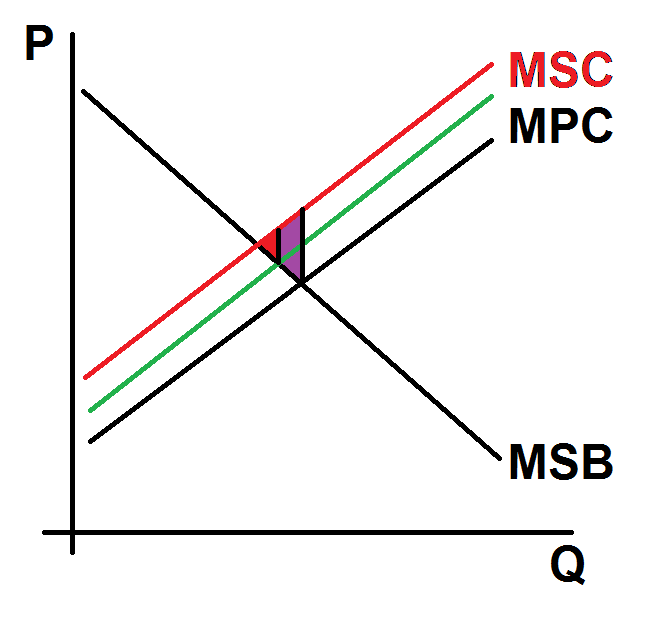
When I teach externalities, I draw a graph like this:
Negative externalities when we magically know their magnitude.
In this market, we end up with an equilibrium quantity defined by the point where Marginal Private Cost equals Marginal Social Benefit (MPC = MSB). But the Marginal Social Cost (MSC) is greater, so we get a deadweight loss equal to the triangle I’ve shaded in red and purple.
It’s important to note: we don’t actually know where the MSC curve is. It’s somewhere above MPC, but we’re basically in the position of trying to eliminate a subsidy we don’t know the size of.
The relevant models–climate models and economic models–are filled with uncertainty that we simply cannot resolve without real life experience.
What does the economic way of thinking tell us? Act on the margin. Setting a tax that pushes supply (MPC) up to the green line doesn’t fully address the problem (as I’ve assumed it to be in this graph), but it’s an improvement.
Even better, it’s an improvement where the biggest returns are experienced up front. This modest tax fails to get rid of the red deadweight loss (DWL) area, but it eliminated 3/4 of the total DWL.
Plus X points for my position where X is a random variable with an unknown distribution, positive first derivative, and negative second derivative.
tl;dr:
At my friend’s behest I’ve been looking at Bob Murphy’s critique of carbon taxes. I find it’s shifted the magnitude of my prior opinion, but not the direction. I still think carbon/pollution taxes are a good idea, but I no longer think they’re a great idea. My take away from Murphy’s work is that the optimal carbon tax is fairly modest. My response is to advocate for getting a very modest carbon tax on the books, then gradually shift tax policy in that direction.
For climate change (and any other problem) we ought to be pluralists. A mix of approaches is ideal. Part of the appeal of Pigouvian taxes is that they allow and encourage a wide range of responses. The best pollution abatement scheme isn’t something we can look up in a binder. We have to discover it, and crowdsourcing is the appropriate way to do that.
But carbon taxes are only one part. We should also advocate for changes that will ameliorate harm. I am more bullish on these policies than I am on a carbon tax:
Make it easier for the world’s poorest people to move to rich countries that will be better able to cope with climate change.
Quit subsidizing flood insurance.
Quit subsidizing polluting industries (and other industries).
Even though geoengineering scares me, we should try to learn more. Ditto for any other possible tools that come along.
A lot has been said about Trump pulling the US out of the Paris Accords. Leftists have been apoplectic, foaming at the mouth even. Conservatives are baffled, if they have anything to say at all. What should libertarians think?
Libertarians in the United Kingdom, States, and Provinces are generally unilateralists (not isolationists), whereas libertarians in Europe, South Africa, and Latin America are generally multilateralists. I’m of the opinion that American libertarians are wholly wrong to claim that their foreign policy is libertarian. It’s not libertarian at all. Unilateralism is combative rather than cooperative and relies on nationalism rather than internationalism to make its arguments.
Multilateralism forces factions to come to a consensus, thus slowing down government action at the international level, while also forcing factions to interact with each other in a diplomatic manner at that same international level. Unilateralism allows states to do whatever they want, regardless of what others may think. Now let me remind you of what libertarianism stands for: peace, prosperity, and freedom through mutually beneficial exchange and agreed-upon rules that can be changed provided they go through the proper channels (legislation, judiciary, executive). (Am I wrong here?)
Which sounds more libertarian to you?
Now that we have issues of doctrine out of the way, what’s really interesting to note is the Left’s inability to see what Trump is actually doing: wagging the dog. Trump’s term as executive is not going well (surprise, surprise). And so, he does a mean-spirited thing that he hopes will distract.
Here’s how I see the Paris Accords (chime in if you disagree):
They (it?) have not, and will not – ever – accomplish anything in regard to climate change, but
because of this it is also an organization that is wholly non-threatening. It’s just a bunch of countries getting together, in good faith, to solve a problem (real or imagined)
Some hardline factions on the conservative wing in the US didn’t like that the Paris Accords are essentially glorified intern conventions, and some Leftist factions on the American Left absolutely revere green initiatives (even if they’re no good at greening anything other than lobbyist’s pocketbooks), so Trump pulled the plug.
ATTN published a video of An-huld (the really cool guy who made my childhood by being in all my favorite action movies like Predator* and who ended up being the governor of California). In that short clip, Schwarznegger starts by saying that 7 million individuals die from pollution-related illnesses.
That number is correct. But it is misleading.
People see pollution as “all and the same”. But some forms of pollution increase with development (sulfur emissions and some would argue that too much CO2 emissions is pollution as it causes climate change). However, others drop dramatically – especially heavy particules (Pm10) which are a great cause of smog. Julian Simon (the late cornucopian economist who is one my greatest intellectual influence) pointed out this issue and noted that the deadliest forms of pollution are those that relate to underdevelopment.
Back in 2003, Jack Hollander published the Real Environmental Crisis: Why Poverty, Not Affluence is the Environment’s Number One Enemy. Hollander pointed out that simply from the combustion of organic matter (read: firewood and animal manure – literally burning fecal matter) indoors for the purposes of heating, cooking and lighting was responsible for close to 2 millions deaths.
True, richer countries pollute and there are policy solutions (I have often argued that governments are better at polluting than at reducing pollution, but that is another debate) that should be adopted. But, these forms of pollution do not harm human life as much as those that come with poverty.
* By the way, when you watch Predator, do you realize that there are two future American governors in that movie? I mean, imagine that when Predator came out, some dude from the future told you that two of the main actors would end governing American states. Pretty freaky!
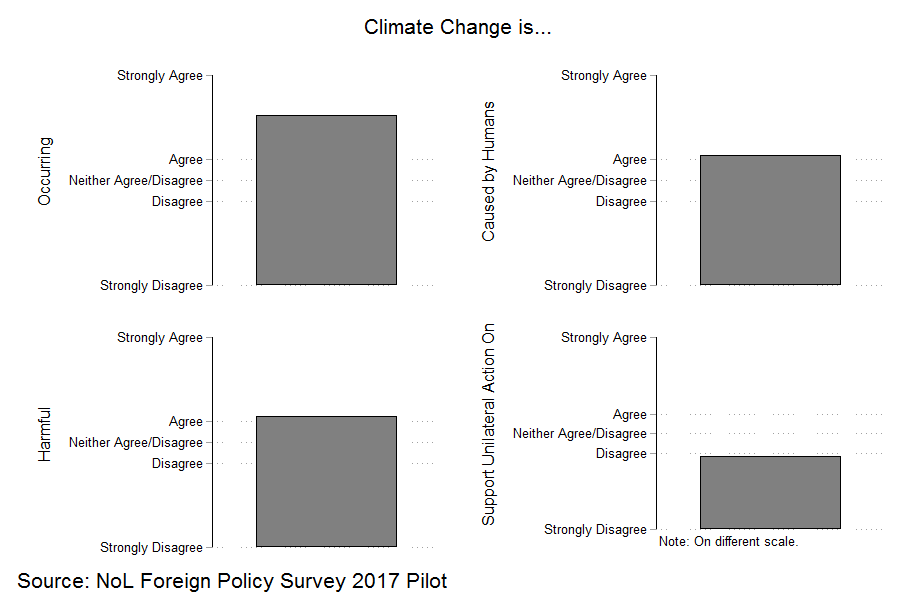
This post is part of the preliminary results of the NoL Foreign Policy Survey 2017 Pilot. I will be posting results throughout the week as I play around with the data. As always, I strongly emphasize that this is a pilot survey and these are just preliminary results.
Are libertarians climate change deniers? No. The majority agree that it is occurring, caused by human activity, and that it is harmful. They do not however support unilateral action by the United States government. At least not the average libertarian respondent.
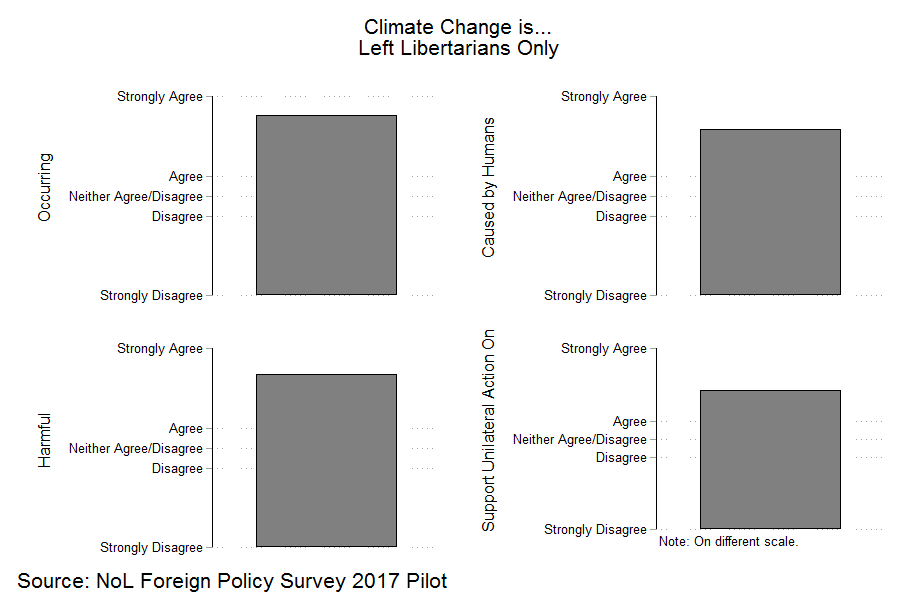
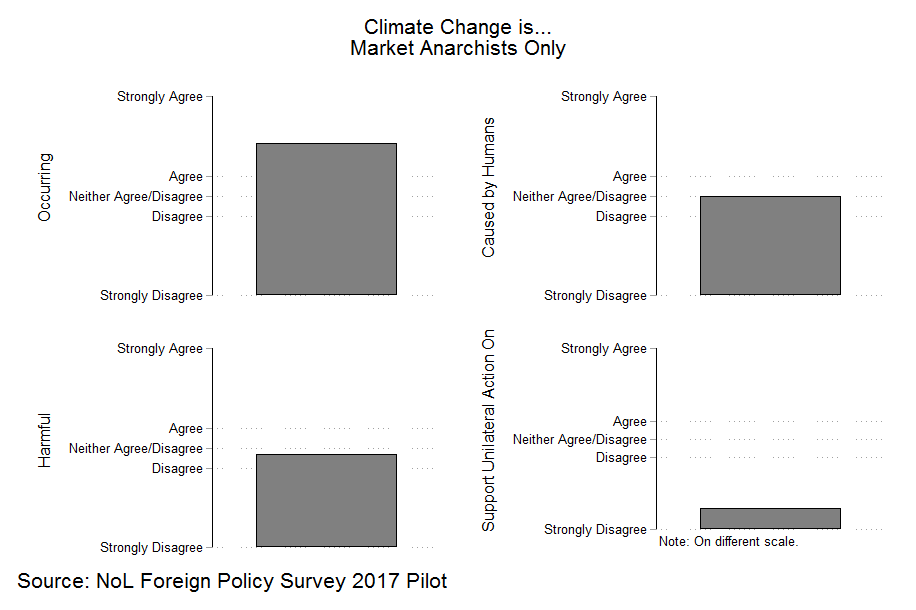
Note that the last question, asking about supporting unilateral action, is on a different scale from the other three.
When you drill down by type of libertarian though you start to see stark differences. Left-libertarians agree much more strongly that climate change is occurring, caused by human activity, and harmful. They are also much more in support of unilateral action to prevent climate change.
What is driving the differences between type of libertarian? Part of the story seems to be that those who think climate change is harmful are more willing to act to address it, but I suspect a large part of the story is also that some libertarians, particularly market anarchists, simply do not trust the government. Market anarchists are less likely to believe climate change is harmful or caused by humans compared to libertarians at large, but the big difference in opinion is whether the government should act on it.
Thoughts? Tomorrow I will be posting the demographics of those who took the survey.
Is climate change government-made? For some years, I have been saying to my colleagues that climate change is real. Nonetheless, I am not an alarmist and I do not believe that stating that there is a problem is a blank cheque for any policy. Unlike many of my colleagues who believe that climate change is “anthropogenic”, I argue that it is “statogenic” in the sense that government policies over the last few decades basically amplified the problem.
Obviously, there is a social cost to pollution – an externality not embedded in the price system. On that basis, many have proposed the need for a carbon tax to “internalize the externality”. The logic is that anything that brings the “market price” closer to the “social cost” is an improvement.
Rarely do they consider the possibility that governments have “pushed” the market price away from the “social cost” (Note: I really hate that term as it has been subverted to mean more than what economists use it for). Consider the example of road pricing. In my part of Canada (Quebec), road pricing was eliminated in the 1970s. By eliminating road pricing, the government incentivized the greater use of vehicles and, basically, the greater burning of fossil fuels. Thus, by definition, the return of road pricing would bring the market price and the social cost closer together (and it might do so more efficiently than a carbon tax). Thus, there can be “statogenic” climate change because governments encourage indirectly the greater use of fossil fuels.
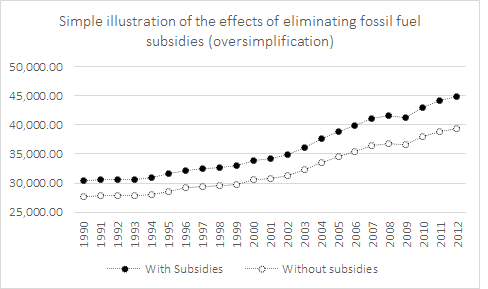
How big is that “statogenic” climate change? I think it is pretty “yuge.” For the last few months, I have been involved in a research project with Joanna Szurmak and Pierre Desrochers of the University of Toronto regarding environmental indicators in the debates between Paul Ehrlich and Julian Simon (see Joanna’s podcast with Garrett Petersen here at Economics Detective Radio). In that paper, we mention the fact that roughly a quarter of the world consumption of fossil fuels is subsidized directly or indirectly (through price controls setting local prices below world prices). That is a large share of total consumption and, according to an OECD paper, 14% of the effort needed to attain the most ambitious climate change mitigation plan could be made by eliminating those subsidies.
Now imagine that estimate was made in 2011. These policies have existed since the 1970s! One paper from the World Bank from the 1990s argued that eliminating them back in the 1980s would have reduced greenhouse gas emissions by 5% to 9%. Imagine a level lower by 9% (just for the sake of illustration) and imagine that the growth rate of greenhouse gases would have been reduced by 9% as well. Using CAIT data, we can see how this oversimplified scenario (which is by no means a general equilibrium scenario – which is the only way to measure the overall lower levels) means in terms of lower levels of GHGs. Relative to the observed data, a 9% drop back in 1990 with a 9% reduction in the growth rate of GHGs mean that the level of GHGs in 2012 in a world without subsidies would have been more than 12% lower relative to what they were in a world of subsidies.
Again, this is an oversimplification. However, it works against my claim. The use of sophisticated methods is likely to yield much larger differences over time. Think about it for a second – alone the policy of fossil fuel subsidies explains a lot even with the oversimplification. Now, imagine adding the fact that many countries do not practice road pricing; that some countries tax the resale of used goods forcing the production of more goods; that they discourage construction in urban environments forcing a greater population sprawl; that trade barriers in agriculture prevent us from concentrating production where it is the most efficient; and the list goes on!
When people say “anthropogenic” climate change, I hear “incentives-driven” climate change or “statogenic.”
This is a travel story of sorts, of travel through time, to an extent. Be patient.
Directly to the west of Marseille, the second largest city in France are a series of beautiful, narrow coves, like fjords, situated in a sort of desert. They are called “calanques” in French. They are accessible only by sea or through a long walk on hot rocky ground. Although they constitute a separate world, the calanques are close to Marseille, as the crow flies. They used to be a major fishing resource for the city. You can be sure they were never forgotten during the 2600 years of the city’s existence. Also, the city was founded by Greeks and thus, it always had a literate population, one that kept records.
Marseille and its environs are where SCUBA was invented, the first practical solution to the problem of men breathing underwater. Accordingly, the calanques were always and thoroughly explored after 1950. In 1985, one of the co-inventors of SCUBA discovered a deep cave in one of the calanques. He couldn’t resist temptation and swam into it until he reached a large emerging room. I mean a cave where he could stand and breathe regular air. His name was Cosquer.
Cosquer visited there several times without saying a word about his discovery. Soon, he observed dozens of beautiful paintings belonging to two distinct periods on the upper walls of his cave. The art of the first period was mostly hand imprints or stencils. The art of the second, distinct period, comprised 170-plus beautiful animals including many horses, ibex and others mammals, also fish, seals and other sea creatures. Archaeologists think the painting of the first period were done about in about 25 000 BC, those of the latter period date back to about 18 000 BC, they believe.
Today, the entrance to the cave is about 125 feet below sea level. We know that paleolithic men did not have SCUBA. They simply walked into the cave for their own reasons, with their own purposes in mind. Thus, the sea level was at least 125 feet lower then than it is today. The people of Marseille never saw the cave. They would have written about it. There would be records. They would not have forgotten it. They simply did not know of its existence during the past 2600 years.
Sometimes in the past 20 000 years, the sea rose 125 feet or more. That’s an amplitude several times greater than any of the direst predictions of the official United Nations Intergovernmental Panel on Climate Change for the next century. The IPCC squarely blames a future ocean rise (one that has not been observed at all, yet) on abnormal emission of several gases, especially CO2 . These abnormal emissions in turn, the IPCC affirms are traceable to human activities such as driving cars and producing many useful things by burning fossil fuels.
It seems to me that basic good science requires that causal analysis begin with a baseline. In this case, it would mean something like this: In the absence of any burning of fossil fuels, the ocean rose 125 feet sometimes during the past 20,000 years. Let’s see if we can find evidence of the ocean rising above and beyond this order of magnitude since humanity began burning fossil fuels in large quantities, about 150 years ago.
The conclusion will likely be that nothing out of the ordinary happened. Hence, fossil fuel emissions are probably irrelevant to this particular issue. (This leaves open the possibility that such emissions are odious for some other reason. I mean that CO2 is plant food. Too much CO2 may promote weed growth in our fields and gardens. )
The ocean is not currently rising and if it is, the existence of the Cosquer cave suggests that it’s rising to a tiny degree. Let’s keep things in perspective. Let’s discard openly and loudly every part of the building of a complex hypothesis that does not work. Those who don’t take these obvious cleansing measures simply have a lot of explaining to do. They should not be allowed to wrap themselves in the mantle of science while violating Science 101 principles.
One of the conceits of the Warmist movement is that you don’t have a right to an opinion unless you possess a doctorate in Atmospheric science. By this dictate, anybody who has to keep a job, raise children, or pay a mortgage is out of the discussion. This is the typical posturing of intellectual totalitarianism. Note what’s missing in the story above: It says nothing about what did cause the ocean to rise between 18 000 B. C. and today. It’s enough to know that whatever it was, it was not the massive burning of fossil fuels. The story is complete as is. Don’t quit your job and apply to graduate school!
I am currently working on adaptation to climate change and would appreciate a bit of feedback. I find feedback can be useful, if only to get me out of the ivory tower.
A brief background: When addressing climate change the popular idea is to reduce carbon emissions through a carbon tax, cap-and-trade or regulations. However focusing on emission reductions alone:
Ignores the political difficulties of trying to reduce emissions. Regions that rely heavily on coal use are not going to be in favor of reducing its use or paying extra to use it, see the chart. Notice that states like California or Washington, which are trying to reduce their emissions independently, don’t use much coal anyway to meet their energy needs and would be minimally harmed by a carbon tax.
Reductions today would not address the climate change that will occur even if we stopped all emissions today. Even if
We therefore need to adapt to climate change. We can adapt:
Individually by adopting technologies (e.g. air conditioning) or migrating to locations we expect to have better climates.
At the urban level by investing in the necessary infrastructure (e.g. seawalls to counter sea level rises), or by allowing cities to ‘move’ by letting old buildings deteriorate and focusing new development inland or building up near the coasts depending on local conditions.
At the (inter)national level by sharing technical information.
Economics, my home field, has plenty to say about the above three forms of adaptation. It is however lacking in discussing cultural adaptation.
For example, in Spain and other Mediterranean countries, it is customary to take a long mid-afternoon break to take a long lunch at home or take a nap. To compensate for this break work may end later than is customary elsewhere, and family-friendly social life is active well into the late evening. This custom was transplanted, to varying degrees, in Latin America; I am most familiar with the Mexican version due to family stories and personal experience. This custom helps to avoid working during the hottest time of the day and shifts activity towards the cooler part of the day. My understanding is that a similar custom exists in the warmer southeast Asian countries, but my personal knowledge is limited.
Are there any other examples of cultural adaptation to climate change that my fellow note writers can think of? Examples don’t need to be in regard to contemporary climate change and can be adaptations that took place during the Medieval Warm Period, the Little Ice Age, etc etc.
US States by % of Electricity Produced from Coal.
Source: The U.S. Energy Information Administration, 2013.
Note: Rhode Island, Vermont, and D.C. excluded due to minimal coal use for electricity production.
So many inane things have been said about climate change by silly unqualified sources and so many others by dishonest qualified sources that it’s hard to keep separating the wheat from the shaft (Ah, ah!)
On the Monday June 29th of the Wall Street Journal, former Mayor Bloomberg of New York City delivered himself of advice about the forthcoming 2015 fall United Nations conference on climate change. It will take place in Paris. Right there, you know they are not serious. At any one time, half the delegates will be seeing the sights, or tasting the flavors.
Below is the excerpt that flummoxed me. I am retired, I have the time to be flummoxed. Other readers may not have had the time or the peace of mind to notice. This is for them.
“…The Paris conference has already proven successful in one respect: It has pushed heads of state to prioritize climate action” (Bolding mine.)
And further down:
“Whether they live in a capitalist or communist society [sic], people want to breathe clean air. They know that air fouled with carbon pollution causes death and disease,….” (Bolding mine, again.)
Wait a minute, I have been told a thousand times if I have been told once that CO2 is the primary cause of “climate change”! I flunked high school physics (not bragging, just admitting the facts) but I am sure that CO2 does not cause disease. And, I remember from a diving class long ago that it does not even cause death except insofar as it physically replaces oxygen. That’s hard to do in your lungs, by the way. It takes practice. Accordingly, suicide by CO2 is extremely rare!
So, is Mr Bloomberg referring to another kind of carbon pollution? Is there a faction of the Warmist Movement that’s on the edge of admitting that mere CO2 is just plant food, as we believed before the Apocalypse began? I ask because if the real enemy is either carbon monoxide or any of the visible sooty components that result from burning coal, I am not sure which side I am on anymore. Speak of agonizing re-appraisal!
I don’t know which side to take because I am squarely against both carbon monoxide and particulate (soot) pollution. The only people who are in favor of carbon monoxide are people who failed physics even worse than I did and confuse this deadly gas with the innocuous plant food CO2. As for particle pollution, the only ones who would say a single good thing about it, don’t. They are power industry spokesmen and other users of coal. They are not even arguing that they are good; they asked for more time to clean up their dirty act. The US Supreme Court declared last week that they were actually entitled to more time.
I remember well breathing the heavy smog in Paris in the fifties; I remember seeing pictures of the even worse smog in London. I remember the largely automobile-based smog in LA in the sixties. All these cities cleaned up their act. They did it to a large extent under demanding legislation. That legislation was not very controversial because it did not rest on mysterious, esoteric, contorted, and ever-changing science largely propagated by the incompetent, the irrepressibly stupid, and those who leave political judgment to experts. Besides, the application of the legislation walked in lockstep with perceptible progress. The air in Paris cleaned up in a few years during my childhood even while the population grew. The air in LA improved quickly after unleaded gasoline was introduced, etc. I hope someone will correct me if I am wrong but I don’t think the research involved or its presentation comprised crude fraud as in the “hockey stick” scandal about global warming.
If they were concerned with CO1 (mono) or with particle pollution, there would be no struggle, or little resistance. They invoke CO2 threat because cleaning up carbon is not going to give them the de-industrialization and the government control they crave. Think it through.
Incidentally, we wouldn’t even have this discussion if the US had continued building nuclear power plants twenty years ago. I mean, like France, where absolutely nothing dangerous happened. Like Japan where the worst happened in Fukushima and nothing happened. Nuclear energy releases no carbon particles, no carbon monoxide, and negligible amounts of CO2. Want to save the planet or not?
So, is mayor Bloomberg calling for UN conference in Paris re-dedicated to better breathing rather than to the never-ending struggle against “climate change’? Is he honestly confused? (Wouldn’t be the first time.*) Is he a dupe or a fiendish accomplice? Is he aiming for a typical “liberal Republican” middle course between truth and falsehood? Or, he is pushing forward a genuine Trojan Horse to finally reduce the already tottering, rickety citadel of misrepresentations, exaggerations, conflicting truths, bad measurements, worse logic, unscientific reasoning, an outright lies of Warmism?
* I am not casting the first stone, in this case. I demonstrated that the UN “Summary” for officials and political decision-makers was incomprehensible.
My favorite podcast really hit the Big Time this week. Marc Maron interviewed President Obama last week and released the episode today. Marc Maron does a great job interviewing his guests but this episode is (naturally) pretty different. Obama mostly gives a lot of fluff, but he did make some interesting points on the role of political institutions in polarizing politics, as well as the role of [implicit] property rights in shaping political outcomes.
While I was waiting for this episode to be released I wondered what I would have done in Maron’s position. It’s tempting to say “just scream non-stop for an hour until the president agrees to be better.” But of course, that wouldn’t do anyone any good (although I think it would sell advertising on cable news). The question is then “how do I avoid throwing softballs, maintain a good conversation, and still nudge in the direction of change I’d like to see?”
One thing I think would be important were I in that position is to restrict the number of issues I bring up. The limits of human attention mean that we simply can’t handle more than a handful of things at once. Piling on all the issues and complexities of the world would only serve to reduce anyone’s ability to do anything positive. Another thing I think would be important is focusing on areas where we already mostly agree. Nobody over the age of 25 is likely to change their opinion on just about anything, so why waste your energy. That’s sunk ideology. And besides, even if you’re talking to a real piece of work, you have some obligation to do a good job of being a conversationalist, and focusing on differences is less likely to lead to a good conversation.
Will you please push for a bill that allows any law-abiding person to work in the United States without giving them access to the Welfare state? (I would word that differently if I were actually interviewing the president, but you get my drift…)
Would you please let Nassim Taleb explain his risk-management argument for climate change interventions? And can he please also be required to comment on his argument’s relationship to the Law of Unintended Consequences?
What is your favorite episode of South Park?
That third point should be at least a little bit controversial. I’m agnostic on whether there’s anything to be done about climate change (although I’m all for using it as an excuse to liberalize immigration for the world’s poor). I’m seriously skeptical of governments’ ability to do any good in that arena. I’d really rather not add fuel to the fire, but I think it’s important to raise the standards of debate, and I think Taleb’s argument* is the most sensible one. Not only that, it has wide applications that should push (benevolent/benign) politicians to support simpler rules and fewer interventions.
Oh yeah, and I’d ask him if he’s a secret gay muslim. (“Does your mom know you’re a secret gay muslim?” Anyone else remember playing that game?)
* Taleb’s argument goes roughly as follows: We face uncertainty, but there is a non-zero probability of a catastrophically bad outcome. Maximizing expected utility is not the appropriate risk-management strategy in this case. Our most urgent need (our highest marginal benefit course of action) is to eliminate the possibility of the catastrophic outcomes–and perhaps after that start thinking about maximizing expected utility. Essentially the argument is “don’t play Russian Roulette!” But an essential underpinning is that a probability distribution describing outcomes in complex systems often exhibits “wild randomness”. In contrast to the “mild randomness” of the normal distribution, in wildly random situations it’s difficult or impossible to even have an expected utility. The conclusion I would hope they would draw is that intervening in complex systems (and particularly creating new complexity through increased regulation and more tax loopholes) is best avoided, and particularly at the national level.
Accepting the views of experts on a question you are not competent to answer for yourself, assuming that you can figure out who they are and what they believe, is often a sensible policy, but one can sometimes do better. Sometimes one can look at arguments and evaluate them not on the basis of the science but of internal evidence, what they themselves say.
He goes on to give examples of inconsistent claims made by global warming alarmists. His (short) post is worth the read. Here are my 2 cents:
First, (in response to the block quote) deferring to experts is sensible but requires a certain degree of expertise in picking out who they are which is a difficult task. We’re all human, and it’s hard to hold something in your head without thinking it’s true. That makes it hard to not be arrogant. We need to emphasize strongly that interpreting information is hard, and the outcomes are not at all obvious. Those concerned with anthropogenic climate change (myself included) are better served by stressing the uncertainty involved and making arguments centered on appropriate risk management.*
Second, The issue of climate change boils down to a series of sub-issues that need to be considered carefully:
We need to think about costs and benefits. A warmer world would be a boon for many people. If we could set the average world temperature, we would want it to be higher than 0 Kelvin. We might even want it to be warmer than it is today.
(This one’s a bit of a non sequitur.) We should use this as an excuse to do things that would help reduce the costs of climate change that we should be doing anyways. Specifically, we need to liberalize immigration policy in wealthy nations. Let’s say there’s a 0.00001% chance that climate change has a bad outcome, and that specifically that outcome is that the entire country of Bangladesh will catch fire and kill everyone. That’s a good excuse to let Bangladeshi’s come to America, but we should be doing that anyways. It’s a low cost (actually a negative net-cost) solution to a potential problem of climate change.
Here’s one that I think the smarter alarmists/deniers already recognize: this is a political discussion. Politics and the truth don’t mix. But recognizing this point and making it widely known may allow people to tone down and argue something closer to the truth.
Global warming will lead to catastrophic… life?
Both sides like to think of themselves as skeptical (as demonstrated by that masthead which warns that we might have to suffer through the addition of a habitable continent (?)), and good for them. We should value skepticism in this. But that skepticism shouldn’t lead us to make bold claims on one side or the other. It should lead us to ask a lot of “what if?” questions. This is a risk management issue, not a social engineering one.
* I like Taleb but I’m not as worried by GMO’s as he apparently is, but I haven’t read that paper either.


 Notes On Liberty