In Praise of Academia

This week I got the happy news that my article on Ayn Rand’s views on international relations was accepted for publication. Once it is posted ‘online first’, I shall write a bit about its content. For now I would like to make a two other points, though.

One of the reason for my happiness is that this article took an exceptional time to get accepted. I started working on it in 2010, doing the initial reading (in this case all published works of Ayn Rand). The actual drafting started in 2011, I solicited commentary, and came to an acceptable first version in 2013. To be sure: I did not work on the paper on a full time basis, and there were many other distractions, not least my day time job, other academic projects, and family affairs. Still, the article kept nagging in the back of my head, perhaps not daily, but certainly on a weekly basis. I got the first few rejections by journals in 2013, then again a few in 2015, and another one this summer. So reason enough to be happy to get accepted and all the more exciting to see it through the production phase in the coming months, with actual printed publication still in the somewhat distant future.

I am not writing this to congratulate myself in public. My reason for this blog is to show young (aspiring) scholars, that it is completely normal to work on a project for ages, and to get rejected a few times. Yet the reward is sweet. As long as you persevere, are ready to change and edit your text, overcome your anger when you get unjust blind reviews (and believe me: writing on Rand regularly solicits angry, malicious and/or erroneous responses, also from editors and reviewers of high ranked reputed journals), and keep the faith in the possible value of your modest contribution to the world’s knowledge base.

This is a lesson I learned from experience in the past decade or so. But early on, I also greatly benefitted from one of the best and useful guides to PhD research and academic life I have ever come across: LSE professor Patrick Dunleavy’s Authoring a PhD. It realistically describes what to expect of academic life, it’s ups and also it’s downs. So get it, if you are still unsure what to expect of academic life.

The other remark I would like to make is about the unique and open character of academic publishing. It is really great, as a part-time academic, to be able to get published in reputable journals. I am sure the editors of journals and presses are more keen to see academics from highly reputed universities submitting papers and book manuscripts. Yet they first and foremost value content. If you have something interesting to say, and live up to the academic standards, you will get the same chance and treatment as everybody else. That is pretty unique, compared to many other professions.

So: academia be praised!

Highly recommended work on Ayn Rand

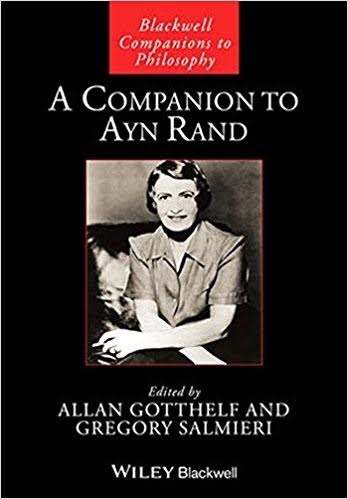
Most scholarship on Ayn Rand has been of mediocre quality, according to Gregory Salmieri, the co-editor of A Companion to Ayn Rand, which is part of the series “Blackwell Companions to Philosophy.” The other co-editor of the volume is the late Allan Gotthelf, who died during it’s last preparatory stages.

The reasons for the poor scholarship are diverse. Of course Rand herself is a large element. She hardly ever participated in regular academic procedures, did not tolerate normal academic criticism on her work and strictly limited the number of people who could authoritatively ‘explain’ her Objectivist philosophy to herself and Nathaniel Branden. Before her death she appointed Leonard Peikoff as ‘literary heir’. She inspired fierce combat against the outside world among her closest followers, especially when others wrote about Rand in a way not to their liking. The result was that just a small circle of admirers wrote about her ideas, often in a non-critical way.

blog ayn rand

On the other hand, the ‘rest of the academy’ basically ignored her views, despite her continued popularity (especially in the US), her influence, particularly through her novels, and large sales, especially after the economic crisis of 2008. For sure, Objectivists remain a minority both inside and outside academia. Yet despite the strong disagreement with her ideas, it would still be normal to expect regular academic output by non-Randians on her work. Suffice it to point to the many obscure thinkers who have been elevated to the academic mainstream over the centuries. Yet Rand remains in the academic dark, the bias against her work is strong and influential. This said, there is a slight change visible. Some major presses have published books on Rand in the past years, with as prime examples the books by Jennifer Burns, Goddess of the Market: Ayn Rand and the American Right (2009), and Anne C Heller, Ayn Rand and the World She Made (2010). And this volume is another point in case.

One of the strong points of The Blackwell Companion on Ayn Rand is that the contributions meet all regular academic standards, despite the fact that the volume originates from the Randian inner circle. It offers proper explanation and analysis of her ideas and normal engagement with outside criticism. The little direct attack on interpretations or alleged errors of others is left to the end notes, albeit sometimes extensively. Let us say, in friendly fashion, that it proves hard to get rid of old habits!

It should not detract from the extensive, detailed, clearly written and plainly good quality of the 18 chapters in this companion, divided in 8 parts, covering overall context, ethics and human nature, society, the foundations of Objectivism, philosophers and their effects, art and a coda on the hallmarks of Objectivism. The only disadvantage is the large number of references to her two main novels, The Fountainhead and Atlas Shrugged, which makes some acquaintance with these tomes almost prerequisite for a great learning experience. Still, as a non-Randian doing work on her political ideas, I underline that this companion offers academically sound information and analysis about the full range of Rand’s ideas. So, go read it if you are interested in this fascinating thinker.

Liberty and the Novel II (Austen and After)

(Click for Part I) In Austen’s novels, we find something ‘unheroic’ in that they are concerned with the search of upper class women, bound by codes of gentility, for both a satisfying place in the world and emotional authenticity through marriage. Though there is none of the religious fervour of Pilgrim’s Progress, the message is sent that an ideal community is a small rural community guided by sincerely godly priest, concerned with the daily lives of his congregation.

There is none of the extremism of Quixote’s fantasies and adventures, but the simultaneous process of  triumph over illusion and the growth of inner authenticity, is there in Pride and Prejudice, Sense and Sensibility, Mansfield Park, Emma, Persuasion, and Northanger Abbey, as the characters find marriages worthy of their growing ethical capacities in self-judgement and judgement of others.

Ethical growth means confirming a place in the landowning classes and taking a decidedly ambiguous attitude to making new money in trade. Landed property and religion are the starting points of an ethically tolerable community for Austen. We can see the growth there of what we might now think of as social and political values based on self-ownership and individual responsibility though somewhat constrained by respect for earlier aristocratic expression of these values.

We can see a version of Lukács’ split between heroic progressive bourgeoise and backward looking conformist bourgeoise there. Though it is absurdly crude to take 1848 as the line of of separation between the two tendencies, it is useful to think about the distinction as it evolved over time, including the events of 1848. Over time the basic bourgeois goals of rule of law, individual rights, representative government, and free trade tend to be achieved. The word radical is used less and less for the advocate of bourgeois individualism and more and more for advocates of a socialist state.

In literature the themes of the individual triumphing over circumstances, enduring disaster, awaking from illusions, developing individual moral strength, and finding some moment of authenticity continues. The novel keeps developing as a form, but in many people’s opinion, including my own, it reaches a peak in the early twentieth century (James Joyce, Franz Kafka, Marcel Proust, Virginia Woolf, Thomas Mann) which it has never matched, though ambitious and admirable novels continue to be written.

The more straight forward kinds of heroism are not so prevalent as in earlier novels, but the irony and ambiguity about heroism develops what was already in the genre and intensifies individualism, even while questioning it. Some of these writers were sympathetic to socialism though born into a largely bourgeois liberal world, at least compared with developments after World War One.

Coincidentally or not, this coincides with the transitions from a limited-state individualist nineteenth century liberal politics to the welfarist-administrative state we now know and which is stronger than ever, despite all the cries of ‘neoliberalism’ and ‘market fundamentalism’ that arise in reaction to any attempt to limit the statist drift.

There is a danger of rivaling Lukács’ tendency towards a moralising tendentious Marxism from a pro-liberty point of view, but I am anyway tempted to say that the reduction of the significance of the novel is a symptom of societies which aim to remove individual responsibility in the struggle with circumstances. Or I can put it in terms more amenable to those who welcome the welfarist-administrative tendency. The novel has lost some part of its significance as individualist ways of thinking are less influential in politics.

In fact I can wholly agree with this stereotypical imaginary progressive that Ayn Rand’s attempts to revive the grand individualist heroic aspects of the earlier novel are rather embarrassing. The Peruvian novelist Mario Vargas Llosa (Aunt Julia and the ScriptwriterThe War of the End of the World, The Feast of the Goatetc), who is an eloquent liberty advocate, is a far better novelist, and is as good as anyone currently active, so still not rising to the level of the Modernist greats of about one hundred years ago. Liberty advocates are also part of this cultural shift or loss, however you prefer to see it.

(crossposted at Stockerblog)

Declining to Wed Gay Couples: Right or Wrong?

News item: the Georgia governor has just vetoed a bill that would, among other things, have allowed ministers to decline to wed gay couples.

What a tangle. Let’s see if we can sort things out.

First of all, many decent people, your humble servant included, find the concept of “gay marriage” troubling. I believe any two adults (or three or more) should be free to make any contract they like regarding sharing assets, pledging fidelity, and so forth. I just wish they wouldn’t call it “marriage.” That term is taken.

Second, hate is not a crime. Some people express repugnance or hatred for homosexuality. Ayn Rand called the practice immoral, an attitude that is hard to fathom in this day and age but perhaps understandable given the tenor of her times. Some go farther and express hatred for homosexuals per se. But as long as these people refrain from initiating force or fraud, they should not be molested. Boycotts, shunning, and criticism are legitimate responses to such people, but forcible restraint is not.

Third, rights are not granted by governments. Rights derive from our basic nature as humans, as thinkers such as Ayn Rand and Murray Rothbard have so eloquently demonstrated. Contractual “rights” should have a different name, perhaps “privileges.” These are actions that have been legitimized by a voluntary agreement. Thus for example, no one has free speech “rights” on a campus. Students may have free speech “privileges” on a campus if the owners of the campus have granted that privilege in a written or implied contract.

Fourth, freedom of association is a basic human right, and includes freedom of dissociation, whether in personal or business relations. Some years ago I posted a defense of the late Lester Maddox who famously attempted to exclude blacks from his chicken restaurant. My post generated considerable blowback, but I stand by it and note that in this day and age, anyone who tried to exclude blacks would not be elected governor of Georgia as Maddox was, but instead lose most of his customers and close his doors.

In summary, no minister needs permission from the state to deny wedding services to a gay couple. And religion has nothing to do with it. Anyone should free to decline business or personal relationships with anyone, for any reason whatever, or for no reason at all.

From the Comments: Ayn Rand on extremism

I’m glad you highlighted the Ilya Somin/Will Wilkinson debate [here – bc], but I just found the whole thing so damn confused. I’m not a libertarian (or an Objectivist) but I ended up leaning more toward Somin than toward Wilkinson. But the real problem is that the terms “moderation” and “extremism” are left undefined throughout. Extremism in the pursuit of clarity is no vice, and moderation in the pursuit of muddle is no virtue.

In that respect, at least, I think Ayn Rand’s analysis of “extremism” makes more sense than anything that either Somin or Wilkinson are saying. As she puts it, “‘extremism’ is a term which, standing by itself, has no meaning. The concept of ‘extreme’ denotes a relation, a measurement, a degree….It is obvious that the first question one has to ask, before using that term, is: a degree–of what?…Measurements, as such, have no value-significance–and acquire it only from the nature of that which is being measured” (Rand, Capitalism, pp. 196-97). The nature of what’s being measured is the one thing that neither Somin nor Wilkinson discuss (though Somin certainly comes closer). Which is why the debate they’ve having is relatively pointless.

Wilkinson treats his youthful encounter with Ayn Rand as nothing more than that. If he took a closer look at what she said, I think he’d find that there’s more there than he remembers.

That’s from the infamous Dr Khawaja, who does his blogging at the always excellent Policy of Truth group blog. You can find a link to Rand’s Capitalism here. I think Dr Khawaja is wrong to suggest that this debate is relatively pointless, though, at least to libertarians who care about electoral politics. I do agree with him that Wilkinson should revisit his familiarity with Rand’s work, though.

So you think war can be eliminated?

You might be one of those libertarians, or you belong to some other creed, who think war can be eliminated. For example through international trade, the better use of our ratio, or more influence for regular people on foreign policy decisions. In my own work I have tried to make clear all of these claims are false, and many related ones as well. This is all in the writings of Hume, Smith, Hayek or Rand. The base line is that in human nature reason cannot overcome the emotions, at least, not with all people, at all times. This means that conflict is one of the perpetual characteristics of human action, both in domestic and international settings.

In the unlikely case you do not want to take my word for it, read this book. Coker is a professor of International Relations at the London School of Economics and Political Science, specializing in the study of war. In this short but powerful book, he clearly sets out the different reasons why war will not be eliminated, providing evolutionary, cultural, technological, geopolitical and a number of other reasons. Buy it, and your world view and view of human nature will be even more aligned to the great classical liberals.

http://www.amazon.com/Can-War-Eliminated-Christopher-Coker/dp/0745679234/ref=sr_1_1?ie=UTF8&qid=1424447372&sr=8-1&keywords=can+war+be+eliminated

Riding Coach Through Atlas Shrugged: Part 4 – Governor’s Ball

Pages 48 – 53

Chapter Summary – A group of industrialists sit around a shadowy table plotting the downfall of our favorite rugged individualist.

[Part 3]

I love how cliché this chapter is. Four figures sitting around a table, their faces shrouded in darkness as they scheme over the fate of the world, the sycophant politician sniveling his consent to their plans. This is one of those times where I am not quite sure if the fiction created the trope or the fiction is following the trope but it is okay either way, it is delightful to read.

We have at our table:

James Taggert: Who is far less whiny when not in the presence of his sister.

Orren Boyle: Our socialist-industrialist representative in the story.

Wesley Mouch: Our aforementioned politician, in the pay of Hank Rearden but in the pocket of Orren Boyle.

And finally –

Paul Larkin: The man at Rearden’s dinner party last chapter.

Essentially they spend the chapter plotting against Hank Rearden and promoting a philosophy of non-competition among businesses. From a historical standpoint this is essentially what happened with Hoover and the industrialists leading up to the great depression. A series of price and wage controls were set up that distorted normal market activity leading to the boom-and-bust cycle as described by Ludwig von Mises. As a side-note it is an interesting historical misconception that Hoover “did nothing” during the great depression. Hoover was arguably the most meddling president up to that point in regards to the economy except perhaps for Abraham Lincoln, but total economic warfare is hard to beat.

But to get back on track here, for what it lacks in literary creativity this chapter makes up for with pure economic and political insight that is delightful to read. The most illuminating part is a speech, or perhaps rant, by Orren Boyle that goes as follows, some of Taggert’s responses are edited out for brevity:

“Listen Jim…” He began heavily.

“Jim, you will agree, I’m sure, that there’s nothing more destructive than a monopoly.”

“Yes.” Said Taggart, “on the one hand. On the other, theres the blight of unbridled competition.”

“That’s true. That’s very true. The proper course is always, in my opinion, in the middle. So it is, I think, the duty of society to snip the extremes, now isn’t it.”

“Yes,” said Taggart, “it isn’t fair.”

“Most of us don’t own iron mines: How can we compete with a man who’s got a corner on God’s natural resources? Is it any wonder that he can always deliver steel, while we have to struggle and wait and lose our customers and go out of business? Is it in the public interest to let one man destroy an entire industry?”

“No,” said Taggart, “it isn’t.”

“It seems to me that the national policy ought to be aimed at the objective of giving everybody a chance at his fair share of iron ore, with a view towards the preservation of the industry as a whole. Don’t you think so?”

“I think so.”

This exchange is a fantastic summary of the process involved when the government gives special privileges to favored industries under the guise of regulation. Essentially Rearden is out-competing his fellow steel producers and since they cannot compete under market conditions they intend to compete politically by ham-stringing his business through the legal process.

This process has happened time and time again throughout history and the ironic part is that these actions have almost universally been heralded as “anti-business” when in fact it is the businesses itself that propose this regulation. The first anti-monopoly laws in America were lobbied for by the competitors of the successful oil, rail, and steel businesses which resulted in the *rise* in prices of those goods. It seemed the “natural” monopolies were pro-consumer while the regulation was pro-business.

There are also historical comparisons to be made to the great depression. The whole concept of “protecting an industry” at the expense of a single, productive, individual was the cornerstone of “Hoover-nomics” especially in the farm industry. The industrial revolution brought about a massive increase in farming productivity which naturally led to a decline in prices and a surplus of labor in that industry that came to a head during the “dirty thirties”.

The natural course of the market would be for inefficient firms in that industry to liquidate; with the entrepreneurs and workforce moving to other industries. This would cause a short period of transitional unemployment as workers moved into similar or growing industries while the more efficient firms and prospective entrepreneurs would buy the liquidated capital goods of the inefficient businesses at a discount.

Consumer goods prices would fall to equilibrium where only firms able to produce goods below that price would be able to maintain production. This would have the net effect of expanding the labor pool and be a net gain for society as new areas of production would be made available by the increases in productivity. Instead, Hoover organized industrial cartels that maintained price and wage controls over the entire economy propping up inefficient businesses that continued to waste and malinvest resources resulting in what we know today as the great depression.

To summarize, this chapter is a fantastic must read five page tour de force of economic insight.

Next chapter: More Dagny, more snark, and more family drama.

Riding Coach Through Atlas Shrugged Part 3: Hit The Switch

50th Anniversary Edition pages- 33-48

[Part 2]

Chapter Summary: We meet our industrialist protagonist, he makes some metal, is weirdly sentimental, and doesn’t understand basic human interaction.

This chapter is very important for a number of reasons. Several (presumably) important characters are introduced, the MacGuffin is introduced, and several elements of Rand’s writing style and her personality are revealed. Because of this final revelation I, for the first time, am going to start one of these reviews off with the negative.

Ayn Rand’s descriptions of characters and those characters’ reactions to others in the story are both highly questionable. The protagonists, so far, all have crippling social issues that are not only glossed over but indeed are celebrated; while the antagonists are universally whiny, sycophantic, card-carrying bad guys who talk with each other like Bond villains; but more about them in the next chapter.

Let me provide some examples of our pseudo-autistic heroes from previous chapters.

Eddie:

“But he still thought it self-evident that one had to do what was right; he had never learned how

people could want to do otherwise; he had learned only that they did. It still seemed simple and incomprehensible to him: simple that things should be right, and incomprehensible that they weren’t.”

While I can relate to his feeling, I think it is imperative that libertarians understand completely why people want to do the things we consider “wrong” and to do that we need to have a solid foundation of what is right or wrong. The latter belief is why I hold so strongly to natural-rights libertarianism rather than any subjective based ethical system such as rule-utilitarianism.

Once we have a strong ethical foundation to build our beliefs on we begin to understand why most people operate outside those beliefs in practice despite the fact that most people would agree to them in theory. How many people would openly advocate violence against person or property when stated in such clear terms? Very few would, which is why society functions. It is only when we hide violence in plain sight through the control of language and education that most people begin to agree with their necessity. Extortion becomes taxation. Kidnapping becomes imprisonment. Murder becomes war and fraud becomes inflation.

Dagny:

“[b]ecause she thought that such a feeling was not within the humanly possible”

“She had always avoided personal reactions, but she was forced to break her rule when she saw the expression on Taggart’s face.”

Another clear lack of empathy in regards to dissimilar belief systems as well as some more personal social awkwardness. I wish I knew why Dagny “avoided personal reactions”. Did Rand think that emotion was a weakness? I cannot wait to spend more time with Dagny because she seems like such an unnecessary enigma.

And finally we have our new character, Hank Rearden whose complete lack of empathy boggles my mind. Hank begins the chapter at his foundry as the first batch of Rearden metal is poured. He waxes sentimentally over his past, especially his status as a self-made man; however the real story begins to be told when he leaves his work and returns to his home where his family is having a dinner party; or rather, the end of a dinner party. This scene provides us with two important sets of information.

First, Rearden’s family resents him for his aloofness and his lack of understanding of their problems and second he resent his family for not empathizing with him.

Let’s start with the relationship with his brother.

Phillip Rearden is a man who “had not been able to decide on any specific ambition.” A fact that Hank is generally disgusted by, he believes that “[T]here was something wrong…with a man who did not seek gainful employment.” When we meet Phillip he is a representative of a charitable foundation called “The Friends of Global Progress”. This organization is in dire need of ten-thousand dollars in its quest for “free lectures on psychology, folk music, and co-operative farming”.

Phillip is distraught that he cannot convince enough people to donate to the cause and Hank, in an attempt to improve his brother’s morale, simply donates the needed sum of ten-thousand dollars. Hank is then surprised when Phillip rebuffs his generosity. Hank misses the entire point though; Phillip isn’t upset that that he doesn’t have the money. Phillip is upset that more people don’t believe in his cause, something libertarians should have some measure of empathy for. We have to ignore the fact that Rand chose a completely ridiculous organization for Phillip, the scope of that organization is irrelevant. It is the relationship between the brothers that is vital.

Hank’s reaction, on the other hand, is far more vitriolic. He resents the fact that Phillip is acting selflessly to the point of wanting to hit him. “He wanted to slap Phillip’s face. But an almost unendurable contempt made him close his eyes instead.” Who seems more reasonable in this situation? Our “hero” or the villain?

Here is where Rand either rejects or misunderstands praxeological reasoning. Phillip, though acting selflessly, is also acting selfishly. Mises said that every action is taken in order to remove a “certain uneasiness”; this uneasiness is what drives human action. Even the most selfless act is done for the benefit of the person acting. How often has someone who risks their life for another uttered the phrase “I just couldn’t live with myself if I hadn’t done such-and-such.” It all comes down to a question of subjective valuations. No two people’s values are identical and there is no way to compare or rate those values against one another. Despite Hank’s objection that he “would not impose his standards on Phillip…” that is exactly what he does at every turn.

Next we have Hank’s wife Lillian. Our first reference to Lillian is as follows:

“He touched the bracelet in his pocket. He had had it made from that first poured metal. It was for his wife. As he touched it he realized suddenly that he had thought of an abstraction called ‘his wife’ – not of the woman to whom he was married.”

I think it is very telling that the first we hear of Hank’s wife he isn’t even considering her as a person, barely even as an object. “An abstraction” that throughout the rest of the chapter is the only one who even remotely stands up for Hank, even though she seems to do it only out of duty and not love. Another case where I can relate more to the character portrayed as the villain than the hero.

Lillian ends the chapter by holding up the aforementioned bracelet Hank had given her and calls it “the chain he uses to hold us all in bondage.” This rings true on several levels. Hank supports his family out of duty to them and then gets upset when they cannot stand on their own. Hank is proud of having earned everything he has on his own but then doesn’t expect the same from his family. He wants them to support him in his endeavors but only pays lip service to theirs. They pursue senseless causes but he supports them financially at every turn.

At this point in the story Hank is a contradiction. He is attempting to live in two worlds and because of that is failing at both. His family is biting at his heels and he cannot see the political danger right in front of him which will be revealed in the next chapter.

P.S. I forgot about his mother. She is essentially a high-class snob. I don’t really have any sort of insight on her other than she is insufferable.


P.P.S.  I have been scarce as of late due to a recent promotion and an increased workload as well as a series of outrageous summer adventures.  Thanks to Brandon for not kicking me out yet.
Human Nature, War and Armed Conflict

The list of ongoing armed conflicts in the worlds is long (see, for example, here) and has been long for centuries. There are many websites and research institutes that keep track of their number, the parties involved, the main issues, et cetera. There are many different definitions of war and armed conflict. Here, wars are simply defined as armed conflicts with participation of one or more states whose sovereignty is internationally recognized, whereas armed conflicts do not require state involvement. Armed conflicts have always been around in great numbers, often state-sponsored, for example the numerous and seemingly never ending conflicts in the Middle East, or recently in Northern Africa following the so-called Arab Spring. The recent collapse of Libya into civil war may serve as evidence.

The number of interstate wars dramatically decreased after the end of the Cold war, giving stimulus to loads of academic papers about democratic or liberal peace. Yet this era might well be over, given the situation in the Ukraine, but also many explosive situations in North-East Asia and South-East Asia.

Academic research resulted in a long and varied list of possible causes for wars and armed conflicts.  Think for example of geopolitical factors (land, borders), natural resources (oil, gas, mines), population related issues (minorities of other countries living in a particular area, people demanding  their own country), religious conflicts, the protection of one’s own people abroad, global political reasons (participation is war as a consequence of an alliance, or to preserve the balance of power), humanitarian reasons (genocide), et cetera. In contrast to popular belief, wars and conflicts are often multicausal, so there is not just a single but a number of reasons for their initiation and continuation.

War and conflict are the result of human action. Despite all the peace talks and agreements, treaties, other forms of international law, arbitration, the work of international organizations, and the pre-emptive actions by great powers in world politics, war and armed conflicts have never been eradicated. So it seems fair to assume this has something to do with human nature as well. Here the literature is much smaller, perhaps as a consequence of the dominant belief (at least in the Western world) in rational human beings capable to overcome war and armed conflict. As a matter of fact international relations as an academic discipline owes much of its origin to this idea. After the First World War many academic positions and departments were established, with the explicit aim to search for ways to prevent such disasters from happening again. Unsurprisingly, without much result.

The ‘human are guided by rationality thesis’ has been defended by many liberals in the American tradition (also known as social liberals or high liberals) and some libertarians as well. In fact most liberal IR theories are based on this idea. However, the idea that that human beings and conflict cannot be separated has been prominent in the writings of classical liberals such as Hume, Smith, Hayek and Mises, but also by Ayn Rand.  Interestingly, for this latter position there is now increasing evidence from other academic disciplines, such as psychology and neurosciences. For example the famous book Thinking Fast and Slow by Daniel Kahneman, or more specifically War and Human Nature by Stephen Peter Rosen, Thayer’s Darwin and International Relations, or Donelan’s Honor in Foreign Policy.

While much more work needs to be done in this field, it is safe to conclude that liberals should not think about how to abolish war. Instead, the relevant question is how to deal and limit the inevitable occurrence and continuance of war and armed conflicts.

Fiction Reading

I’m not really a big fan of fiction. I’m a big non-fiction kind of guy. I like my economics from textbooks, my ethnographies under 200 pages, my political theory in thick books, my history riddled with theory, and my law in blog form. If I do read fiction I normally pick up something by a Nobel Laureate or a popular foreign work rather than whatever is in fashion at the moment here in the States. Over the past four months, though, I’ve found myself delving in to some stuff I never thought I’d be interested in. I recently read Ayn Rand’s The Fountainhead and have just begun reading George RR Martin’s Game of Thrones series.

Rand’s book was excellent. The speech at the end was weird, though, but it was not enough to keep me from putting Atlas Shrugged on my “to do” list. I know many of the Notewriters have issues with Rand’s non-fiction work, and many of them have clashed with Objectivists over the years (libertarians and Objectivists are old enemies, largely because the latter are a cultist bunch), but I found myself unable to put down The Fountainhead. I have a tendency to put a work of fiction into the context of the time period it was written in, so for me Rand’s work is all the more compelling (The Fountainhead came out when news traveled slowly and uneven reports of communist atrocities in the USSR and China were derided as ‘political’ by Western Leftists).

Martin’s book is equally excellent. I have never tackled a fantasy book before, but I have so far been pleasantly surprised. Fantasy books are looooong, but I am enjoying the plot line so far. I like the Night Watch guys the best (I am only in Chapter 17, of 72, so nobody spoil anything!), and I do not like the Lannisters.

Nobody leave any spoilers!

Riding Coach through Atlas Shrugged: Chapter 2 – Whistling In the People’s Key.

Part One

50th Anniversary edition pages 20-32

Chapter Summary – We are introduced to Dagny Taggart, brother of James, who reflects on neo-classical music, throws her family name around a bit, cuckolds her brother’s business, and smokes, also Kellogg turns down an offer he can’t refuse.

Dagny is one of the characters who I am somewhat familiar with due to cultural osmosis. Her strong willed antagonism, her intelligence and stubbornness, her anger, her misery, and her smoking. All things that I expected that were confirmed in her first chapter in Atlas Shrugged.

What I didn’t expect however was the amazing paragraphs about Richard Halley’s symphony.

“It was a symphony of triumph…”

the notes of the symphony

“spoke of rising and were the rising itself.

Emphasis mine. The way Dagny is enveloped by the symphony, it consumes her, and just for a moment she can do nothing but feel when she hasn’t in so long.

Then it is revealed that she is merely hearing it being whistled from across the train car by some blond brakeman. If one man whistling one part of that symphony can fill Dagny with such joy then what effect would a full orchestra have on her, on the people, on society?

That feeling is the very thing I hope to gain from this project. The sense of wonder that Dagny is overwhelmed with and a reminder that

“[T]his is why the wheels have to be kept going, and this is where they’re going.”

The brakeman is interesting as well. Rand’s description of him as a worker with no loose muscles was very telling to me. This blue-collar laborer is the one carrying the tune that is Dagny’s hope. This is in stark contrast to the train conductor for example who doesn’t seem to care about the problems he faces and simply hopes everything will work out.

He jerked his head up at the red light. “I don’t think the signal is going to change. I think it is busted.”

“Then what are you doing?”

“Waiting for it to change.”

I almost wonder if this theme of hard working but uneducated versus apathetic educated middle class will continue. I always felt that Rand was somewhat anti-laborer, that those who were not entrepreneurs were merely leaches on the productive members of society but I am beginning to think that impression may have been unfounded.

Speaking of entrepreneurs there were two major economic principles stated in this chapter. First was Dagny exemplifying the attributes of an entrepreneur when she makes the call to use Rearden Metal for the new railroad tracks. When James protests the use of the new metal she tells him that she is making the call using her own judgment, knowledge, and personal experience. She is willing to assume the risk for this venture based on a gut feeling and her own personal belief that it will work. It is important to notice that she doesn’t deflect responsibility or assume some other person or entity will absorb any losses if she is wrong.

The second economic point was in regards to monopolies. A great exchange takes place between Dagny and James that goes as follows:

“It isn’t fair,” said James Taggart.

“What isn’t?”

“That we always give all our business to Rearden. It seems to me we should give somebody else a chance, too. Rearden doesn’t need us; he’s plenty big enough. We ought to help the smaller fellows to develop. Otherwise, we’re just encouraging a monopoly.”

“Don’t talk tripe, Jim,”

“Why do we always have to get things from Rearden?”

“Because we always get them.”

“I don’t like Henry Rearden.”

“I do. But what does that matter, one way or the other? We need rails and he’s the only one who can give them to us.”

“The human element is very important. You have no sense of the human element at all.”

“We’re talking about saving a railroad, Jim.”

“Yes, of course, of course, but still, you haven’t any sense of the human element.”

“No. I haven’t.”

This exchange exemplifies the free market vs anti-property positions on monopolies but misses one crucial point. This anti-monopoly activity is driven solely by the free choice of the individual. Taggart is perfectly able to restrict his business from any source he chooses for any reason he chooses and this is the pure libertarian position on the matter.

Now, don’t get me wrong, he is making a poor entrepreneurial choice since Associated Steel has repeatedly failed to deliver on the contract and from a purely economic standpoint Dagny is correct. From a libertarian standpoint however, both are correct.

James is totally justified running his business into the ground for any reason he chooses and Dagny has every right to seek out new opportunities. Assuming of course she owns part of the company or has been granted the authority to act in the company’s name. The latter is the case here as far as I can tell.

I would also like to point out that other non-humanistic arguments against monopolies are almost universally false. Predatory pricing for example has essentially never happened successfully even in the case that made it illegal.

Now for the negatives.

Primarily I feel like James is a bit too obvious as a villain, he is almost too petulant and whiny. I just don’t buy that anyone would follow him and that the board of directors would have kicked him off years ago. I suppose Rand is pushing the whole feudalism thing. How many nations have fallen because of a weak King or Queen?

Also, I just don’t know how to feel about Dagny yet. The quirkiness is what bothers me the most. Sitting on the arm of the chair, her snarkyness and her general self-importance. I am not sure how much I am going to like her character yet but there is plenty of book to go so we shall see.

Finally I have to give the last story beat in this chapter credit. The final conversation Dagny has with Kellogg was an amazing piece of the mystery that literally gave me chills of anticipation. Where are these people going? Why are the best and brightest suddenly missing but still creating? And most importantly…

Who is John Galt?

Riding Coach Through Atlas Shrugged. Chapter 1: The Calendar Hung Itself.

50th Anniversary Edition pages 11-20*

*Note: The actual chapter ends on page 33 but I am splitting these up based on POV changes for easier digestibility.

Chapter Summary: White-collar worker Eddie Willars runs into a peculiar homeless man, reflects on a decaying city, and attempts to convince his boss of an urgent matter in Colorado.

My initial impressions are all pretty positive. The opening line: “Who is John Galt?” accomplishes everything an opening should and most importantly sets up a mystery to pique the reader’s interest.

Even with my limited knowledge of small parts of this book I was still immediately hooked by the questions presented on the first page: “Who is John Galt?”, “Why does it [the above question] bother you?”, and without missing a beat (or answering those questions) Rand describes the world that frames these questions quite beautifully with several potent, if a bit obvious, metaphors.

The bum as the faceless masses, intelligent but wearied and cynical without the energy to change their station but able to if inspired. “The face was wind-browned, cut by lines of weariness and cynical resignation; the eyes were intelligent.”

It also seems to be relevant that the bum is our introduction to the character of John Galt. The nameless, faceless masses knowing about the coming change almost instinctively and long before the more comfortable and well off middle class.

The city, in my estimation, represents society as a whole. Once beautiful but now decaying and, like the old tree on the Taggart estate, hollow and rotting from within. “…the shafts of skyscrapers against them were turning brown, like an old painting in oil, the color of a fading masterpiece.” The seed of beauty and triumph is there but it has rotted from within.

Eddie is who really intrigued me though; he reminded me a lot of Tolstoy’s Ivan Ilyich. A middle man in society who knows something is wrong but doesn’t have the skills to do anything about it. While he cannot identify the sinking feeling that permeates every fiber of his being he does have a stable foundation to latch onto.

“When he was asked what he wanted to do [in life], he answered at once, “whatever is right”…”twenty two years ago. He had kept that statement unchallenged ever since; the other questions had faded in his mind…[B]ut he still thought it self evident that one had to do what was right; he had never learned how people could want to do otherwise.”

As a natural-rights libertarian I believe that there are absolute moral and ethical truths and Eddie’s commitment to a similar personal philosophy deepened my ability to relate to the character. It also stands in stark contrast to more modern interpretations of ethics such as “rule utilitarianism” which will always decay to subjective act-utilitarianism.

“David Lyons argued that collapse occurs because for any given rule, in the case where breaking the rule produces more utility, the rule can be sophisticated by the addition of a sub-rule that handles cases like the exception. This process holds for all cases of exceptions, and so the ‘rules’ will have as many ‘sub-rules’ as there are exceptional cases, which, in the end, makes an agent seek out whatever outcome produces the maximum utility.”

In short, any attempt to prevent the “ends justify the means” outcome of utilitarian ethics, without some sort of higher moral authority, inevitably fails and the system is reduced to one of pure utilitarianism. I was actually under the impression that Rand was a bit of a utilitarian herself so I will be interested to see if this commitment to the universal “right” turns out to be a character flaw in Eddie or whether it remains an ideal to be upheld.

Eddie’s confrontation with James Taggart was also quite inspiring. A man who knows he is stepping out of line but is willing to do so for the sake of his personal convictions is an ideal that many of us could due to imitate. I will save my examination of James until the next installment but the important thing I took from this interaction between James and Eddie was how uncomfortable James grew when Eddie looked into his eyes.

“What Taggart disliked about Eddie Willars was this habit of looking straight into people’s eyes. Eddie’s eyes were blue, wide and questioning; he had blond hair and a square face, unremarkable except for that look of scrupulous attentiveness and open, puzzled wonder.”

If, as I suspect, Eddie is the everyman (or reader avatar) in this story and James is an (the?) antagonist then what I am supposed to take from this is that the villains in this world, and in ours, cannot stand up to scrutiny. They are filled with uneasiness when we examine their actions and question their motivations. If Eddie is an ideal, then his attentiveness is an ideal as well.

Eddie’s relationship with the Taggarts as a whole is something I hope is explored more. It is obvious he admires and respects Dagny since they grew up together and the fact that he still has some sort of respect for James leads me to believe that the latter wasn’t always so insufferable. What made Eddie so devoted to this family? Was it simply their entrepreneurial spirit or was there something more?

I had a few small criticisms but I am going to have to wait to see how they play out. As I mentioned briefly at the start of this entry Rand’s metaphors were really straight forward which isn’t bad in and of itself but simply something I am taking note of and will look for as the chapters go by.

I cringed a bit when Eddie admitted that he was simply a serf pledged to the Taggart lands. The whole feudalism angle is one that I am going to keep an eye on since one of the most common attacks on libertarianism is that it would descend into a neo-feudal corporatist society.

Of course I may be taking the line a bit too seriously since Eddie was simply trying to get James to agree to his requests to support the Rio Norte line. In fact it could very well turn out to be a rebuke of that attack once all is said and done.

Finally I have no idea what the giant calendar is supposed to represent or foreshadow. Perhaps it is simply a literal translation of the city’s days being numbered which would both be very clever and kind of groan-worthy at the same time. Hopefully Eddie shows up again soon to let us know but I have a sneaking suspicion that our protagonist isn’t Mr. Willars despite my initial preoccupation with his character.

Check in next time for first impressions of Dagny, a word of support for monopolies, and our first real look at James Taggart. I wish this was a George R.R. Martin novel so maybe he would be dead before the book was over. Hey, I never said I would be impartial.

Part 2

Into the ear of every anarchist that sleeps but doesn’t dream…

We must sing, We must sing,We must sing…


There is no libertarian art.

Well, that is a slight exaggeration, but not much of one. Art is a vital part to any social movement and it is one area where libertarians suffer immensely. Sure there are libertarian leaning authors such as Robert Heinlein and modern Austrian economic art like the guys over at www.econstories.tv but for the most part there are few non-academic ways to inspire potential libertarians.

This is a problem I lament when I am feeling negative about the prospects for a free society which, to be fair, is usually the case. Sometimes reading an article about Intellectual Property just isn’t enough to get the passion flowing.

“But Wait!” You say, “you failed to mention the author who brought tens of thousands of people into the libertarian fold. The late, the great, the Ayn Rand!”


….yea about that.


I don’t like Ayn Rand. There, I said it. Bring out the pitchforks and tie me to a Rearden Steel railroad track if you must but I stand by my statement. Now I know what you are all thinking: “But her works exemplify the individual freedoms that a libertarian society should strive for!” or “Dagny is a strong independent woman who don’t need no government!”

Yes, I am aware, but it isn’t Ayn Rand the author I dislike. Actually it isn’t even Ayn Rand the person that I dislike. I don’t like the idea of Ayn Rand. The metaphysical zeitgeist that surrounds and worships her throughout every circle of the libertarian movement from Walter Block to Milton Friedman to every other subscriber on www.reddit.com/r/libertarian.

All too often I have had to argue about libertarianism through the lens of someone whose only exposure to the philosophy is Ayn Rand and the objectivist selfishness that nearly everyone associates with capitalism. In short, I think she is bad for libertarianism and provides no end of ammunition that can be used against those of us with a more nuanced moral/ethical position.

Here is the kicker though. I have not read a single Ayn Rand novel. Not Anthem, not the Fountainhead, and especially not her magnum opus Atlas Shrugged. My knowledge of her works (outside of objectivist philosophy) comes mostly through a bit of osmosis during many diatribes in my conversion to libertarian thought and the first few chapters of Anthem I read in high school before being bored to tears.

I feel that my lack of personal experience with the work of Ayn Rand is a great injustice to someone so influential to many (but certainly not all) of the ideals that I hold so dear and maybe, just maybe, I can siphon off some of the passion that so many others feel when reading her novels.

So it is my objective to spend the next several weeks (months perhaps) reading Atlas Shrugged along with you, the faithful readers here at www.notesonliberty.com, and recording chapter based summaries of my thoughts, opinions, and analysis from a literary, ethical, and philosophical standpoint. These will be full of personal anecdotes and armchair analysis so be prepared for a tumultuous ride through one of the “great?” works of the 20th century.

Part one of many comes tomorrow morning.

My Summer of ’63: Bureaucracy, Sex and Alternating Current

Brandon’s comment about just finishing The Fountainhead reminded me of the summer of 1963, a pivotal time in my life. I can’t imagine why anyone but me would care about such personal stuff, but here goes.

I had the good fortune to attend a fine private engineering school, Case Institute of Technology (now part of Case Western Reserve University). Tuition was modest by today’s standards, even if adjusted for inflation – something like $1,400 per year, but still substantial. There were no student loans and my parents were just a little too well off for scholarships. They and my grandparents provided more than half my tuition and I used my own savings and job earnings to cover the rest. I didn’t work during the school year because the engineering curriculum demanded all my time and energy.

Toward the end of my sophomore year as a civil engineering major, I began to look for a summer job. An opening advertised in the administration building seemed like it would offer good experience and good pay for the time: $295 per month. I applied and got the job, little knowing that three huge life lessons were coming my way. The value of those lessons, in the long run, overwhelmed the monetary reward.

The first benefit was to learn meticulous work. I was an assistant in the Bridge Department of the City of Cleveland. No technology of any kind, beyond dial telephones and possibly an electric typewriter (more likely manual) had penetrated the department. The engineers drew their plans in pencil on large sheets of paper mounted on drafting tables. It was my job to make archival copies of final plans.

Think about how we make copies these days. It’s pretty much a quick “save as” operation, or, in a throwback to past times, people still make photocopies. Although Xerox copiers were available by 1963 (Case had at least one), they were nowhere to be seen at City Hall. Typists made copies using carbon paper (look it up). I made copies of drawings by mounting the original on my board, placing a special sheet of linen over it, and tracing the drawing using india ink. Every line had to be duplicated at the proper width and every character of text carefully drawn by hand. Erasers? No such thing. A tiny slip could be scraped off with a knife but otherwise the only resort was to start over.

Astoundingly, a technological advance that had become universal more than seventy years previously – alternating current – was absent from City Hall. The whole building ran on direct current, a legacy of the Municipal Power authority that was launched early in the century to undercut the monopoly Cleveland Electric Illuminating Company. Fluorescent lights were out of the question as, I presume, were were any motor-driven devices like electric typewriters.

My second benefit was to learn some realities of bureaucratic life. There were six engineers on staff of whom three actually worked. Mr. Sevcik, who sat in front of me, had the same drawing on his table for the whole three months I was there. He appeared to put himself into a state of suspended animation. Somehow he could sit there motionless all day without falling off his stool. His wall calendar was blank except for every other Friday where he wrote “haircut.” Another fellow was constantly out of the office. Nobody seemed to know where he went or why.

One of the actual workers took me under his wing. He trained me in my job but also explained the facts of bureaucracy. All that could be done about the slackers was to keep them out of the way. They couldn’t be fired.

The third and most important benefit – actually two benefits – I got from Sam. Sam was a girl; I never did learn her real name. I say “girl” advisedly because in those days adult women in the workforce were typically, and without malice, called girls. She was a technician of some sort, not an engineer, and she was a worker. Her nickname may have reflected the fact that she was something of an intruder in this man’s world.

Slacks for women were gaining more acceptance by then but generally not in the workplace. I remember her wearing only skirts, and shorter skirts were coming into fashion then. So when Sam sat on her stool at her board, her skirt invariably rode up.  I mean, all the way up to there! Sometimes I would get to sit next to her to consult on some work issue. Needless to say I found it difficult to concentrate.

I made no attempt to hit on Sam. She was probably five years older than me and was clearly savvy about many things beyond her years. I was a nerd and unsavvy to say the least. It just wasn’t in the cards.

Sam was perfectly well aware of her effect on me and she charitably deflected my energy by taking it upon herself to educate me a bit in the ways of the world. After work we would usually walk together to the Terminal Tower to catch our trains. She would tell me about her boy friends – what attracted her to them and how she liked to be treated. She said nothing about her sex life and I didn’t ask. Open and frank talk about sex was still in the future.

One day Sam mentioned a novel she had just finished – The Fountainhead. “I think you’d like it,” she said. I don’t think I read it before leaving my summer job, but I soon did and I found it transformative. The character of Howard Roark was electrifying but it was many years before I understood Dominique. At that time I was trying to figure out who I was and what I stood for, and Rand got me started on my libertarian path. Later in the sixties I had read all her work and took tape-transcribed courses on objectivism from the Nathanial Branden Institute. Fortunately I never became groupie and in hindsight I see many shortcomings, as well as strengths, in Rand’s objectivism.

Not knowing Sam’s real name, I have no way to trace her. If she’s around, she’s well into her seventies. I hope her life has been good. She deserved it.

Around the Web

  1. Criminal defense attorney Ken White has the most thoughtful take on the recent SCOTUS ruling that pit Clarence Thomas against Antonin Scalia
  2. Ayn Rand versus evolutionary psychology. Economist Bryan Caplan explains why Ayn Rand was wrong
  3. Why were American Economics textbooks so Pro-Soviet? A great question from Caplan (again)
  4. Inequality: Haven’t we had this discussion before? Economist Peter Boettke, a specialist in the history of economic thought, asks the question
  5. Remembering Why Hayek Mattered. A political scientist from Princeton, Keith Wittington, provides a great example