anarchism
Lunchtime Links
- Interview with a secessionist
- Ducking questions about capitalism
- The perverse seductiveness of Fernando Pessoa
- “Yet in this simple task, a doffer in the USA doffed 6 times as much per hour as an adult Indian doffer.”
- Conflicted thoughts on women in medicine
- The Devil You Know vs The Market For Lemons (car problems)
What is a “left libertarian”?
I often hear a contrast drawn between “left-” and “right-libertarians.” In fact, I hear it so often, that I have no idea what it could possibly refer to. The history of the word makes it particularly confusing.
The word “libertarian,” prior to, perhaps, the later 20th century, referred to (definitely) left-wing, anarchist philosophies. The point is well-known and harmless. The modern day, American usage of the term refers to a different branch of philosophies, with a common root in classical liberalism. Comparing the left-wing anarchists of old to the Libertarian Party, for instance, would draw an obvious line between left-wing and right-wing politics. There’s nothing wrong or appropriative about this name change. The word “liberal” has also suffered a large definitional change in the United States that it hasn’t in most other countries. It could be argued that most political groups have shifted around under various names, at times co-opting even their ideological opponent’s.
So, “libertarian” to the average joe nowadays means something different than the libertarian socialism espoused by Proudhon or Bakunin. However, it could still be applied; it might just be an anachronism: two very different referents.
Then, for the modern libertarian movement, there again appears a “left” and “right” division. For instance, I hear Cato or the Institute for Humane Studies regarded as left-libertarian, and the Mises Institute as right-libertarian. Bleeding Heart Libertarians is called left-libertarian. These “left” groups are, however, all clearly in favor of mostly free market capitalism. Then there’s Center for a Stateless Society, which labels itself “pro-market anarchist,” and then, when people confuse it for just, I don’t know, anarcho-capitalism, Kevin Carson says he wants to use the word market instead. Maybe capitalism is too long to spell. In any case C4SS is considered left-libertarian. Michelangelo seems to use the term to refer to, again, capitalism-inclined folks. (I also hear Students for Liberty referred to as left- and Young Americans for Liberty more right-libertarian.)
“Left-libertarians” are not all anarchists intent on abolishing the state, but some are; meanwhile, libertarian socialists would hardly call market anarchism an “anarchism” at all, since they oppose private property rights. If you ask them, they generally seem pretty pissed off about the whole name co-opting. Noam Chomsky is, anyway.
So, it looks like there’s the left libertarians, who may be using an American anachronism, but maintain their philosophical etymology just as classical liberals try to. And then there’s the left-libertarians, who would still fall in the bottom-right of the modern political compass, directly to the left of the right-libertarians. Does that sound right? What is the sense in which a libertarian qua libertarian would use the term “left-libertarian”?
It doesn’t usually seem like libertarians use the term left-libertarian to refer to anarchic socialists, but it sometimes does. Hanging out with Marxists only makes it worse. I’m looking for someone who has been around the liberty movement longer than I have to make sense of it.
Minarchism, Anarchism, and Democracy: A Shared Challenge
Minarchism–basically as small a government as we can get away with–is probably the most economically efficient possible way to organize society. A night watchman state providing courts of last resort and just enough military to keep someone worse from taking over.
The trouble (argues my inner anarchist) is that if we’ve got a government–an organization allowed to force/forbid behaviors–we’re already on the slippery slope to abuse of powers through political trading. Without an entrenched culture that takes minarchism seriously it’s only a matter of time before a) the state grows out of control and you’re no longer in a minarchist Utopia, or b) a populace unwilling to do their part allows violent gangs to fill the power vacuum.
Having a government at all is a risky proposition from the perspective of someone worried about the abuse of that power. Better not to risk it at all.
Anarchism relies on the right culture in a similar way. This is clear to critics of anarchism (basically it’s just the minarchists who are willing to take anarchists seriously at all) and is the crux of an important argument against anarchism. Without the right culture, what’s to stop people from just creating some new government? Nothing at all.
In fact, we face the same problem in the military-industrial-nanny-state complex of our imperfect real world. For any government–or lack of government–to work, the ideological framework of the people living in that society has to line up properly. To the extent people are ignorant, distracted, short-sighted, biased, or mean-spirited, we get governance that reflects those flaws.
If we want to live in a better world, we can argue all day about what sort of government we do or don’t want. But ultimately we have to work on improving the culture, because the median voter is still in charge.
A short note on monarchical nostalgia
Kingship organizes everything around a high centre. Its legitimacy derives from divinity, not from populations, who, after all, are subjects, not citizens. In the modern conception, state sovereignty is fully, flatly, and evenly operative over each square centimetre of a legally demarcated territory. But in the older imagining, where states were defined by centres, borders were porous and indistinct, and sovereignties faded imperceptibly into one another. Hence, paradoxically enough, the ease with which pre-modern empires and kingdoms were able to sustain their rule over immensely heterogeneous, and often even contiguous, populations for long periods of time. (19)
This passage, from Benedict Anderson’s much-cited book on nationalism (Imagined Communities), does a good job of summarizing what the world looked like politically prior to the Industrial Revolution. It does a less good job of summarizing what monarchy is, politically (see this or this), but does do a great job of explaining why monarchies were able to exert governance over populations that were linguistically, religiously, and ethnically diverse.
What is less clear in this passage is its explanation for why paleolibertarians are so enamored with monarchy and why some non-paleo libertarians often write nostalgically about imperial pasts. Even though this is not clear in the passage (I doubt Anderson had intra-libertarian squabbles in mind when he wrote Imagined Communities), it is a great way to explore why libertarians have nostalgia for monarchy and empire.
Let’s start from the top, though. Libertarians don’t like nation-states because of nationalism, because of borders with taxes and restrictions on movement of goods and people, and because of the power that governments can exert over well-defined spaces of territory. So, instead of delving into the intricacies of why nation-states are around, some libertarians reach back to an older age, where “borders were porous and indistinct,” state sovereignty was not the end game of geopolitics, and governments had ways other than nationalist propaganda to bring diverse populations to heel. So on the surface, nationalism was non-existent, borders were open, and diverse groups of people lived together in relative harmony under one roof. What libertarian wouldn’t like that? Fred Foldvary’s post on restoring the Ottoman Empire is a good example of this kind of historical naivety. (Barry and Jacques have both written good rebuttals to this kind of wishful thinking.)
Historical naivety is one thing, but the arguments of so-called “anarcho-monarchists” are quite another. Arguing that monarchy is anarchy because monarchs don’t reign over a nation-state (instead they rule over the private property of the crown) is disingenuous at best, and nefarious at worst. Royal property and private property are two different things (“L’etat c’est moi“). This argument leads directly to the awful, embarrassing arguments of Hans-Hermann Hoppe and his acolytes, who have a bad habit of claiming that anarcho-monarchism is somehow libertarian. I’m going to skip over the specifics of their arguments (Zak has done great work on this topic, but in short Hoppeans claim that anarcho-monarchist societies would be able to physically remove undesirable people from their societies; “undesirables” mostly mean socialists, homosexuals, and non-Europeans), and instead point out that Hoppe and company are simply wrong about what a monarchy actually is.
Monarchies had porous borders, they constantly warred against their neighbors (sometimes for “interests of state”), and their populations were polyglot and illiterate. I haven’t spent any time reading Hoppe, so maybe I am treating him unfairly here and he is perhaps an advocate of a new type of monarchy, but as a student of Habermas I would assume Hoppe likes to use history as a guide for understanding and explaining the world around him. How on earth could he be so wrong about what monarchy actually is, unless he is being disingenuous about his whole anarcho-monarchist utopia?
On a completely unrelated note, Benedict’s Anderson’s book on nationalism is published by Verso Books, rather than a traditional academic press (such as Princeton University Press or University of California Press). Verso Books is a left-wing publishing house dedicated to radical critiques of everything non-leftist, so I find it a bit odd that Anderson’s book has come to be so well-cited in the academic literature on a number of topics. It’s a great book, don’t get me wrong, but I think it’s popularity, despite being an explicitly ideological book rather than an academic one, explains much of the strife currently happening on campuses across the West regarding freedom of speech and freedom of assembly.
Anarchism
Below is an excerpt from my book I Used to Be French: an Immature Autobiography. You can buy it on amazon here.
I had my first revolutionary encounter at another Cub Scout camp near a different lake. We were organized in squads of six, as I said, each with its appointed leader. One day, my squad leader gave me an order I did not like. Or maybe, I just did not like his tone. I said “No.” He insisted. Our voices rose. His authority contested publicly, he shoved me lightly. I shoved back and I called him out formally. We repaired out of sight to the lakeside. It was not the Clash of the Titans because I must have been nine and he, eleven. The leader must have lacked faith in his own charisma, or else, I got lucky because I gave him a bloody nose. This stopped the fight in accordance with the ancient dueling rule of “first blood drawn.” He washed off the blood in the lake. We walked back to our tent separately. It was sunset; everyone went to bed. Nothing more was said.
I remember the fight clearly and I remember well that the squad leader was the furthest thing from a bully. He was not a bad guy and I did not even dislike him. I just did not like hierarchies. I was a natural anarchist in the true, etymological sense of the term: I did not want to have a chief, or a leader, or whatever you call them these days. This trait never changed. I am just the same as I was at nine in this respect. I have never had any desire to exercise power over others either. Most exercises of power repel me viscerally. I suspect many or most are unnecessary. Moreover, I now think coercion is the worst way to obtain the orderliness that is necessary to a good society. I am pretty sure coercion causes more disorder overall than it eliminates or avoids. Its costs are usually too high.
“Growing up” did not help me in that department either. I never “learned through experience;” life did not “beat it into me.” In this respect, as in many others, I keep marveling at the constancy of individual characters from childhood, perhaps from infancy. I don’t know why there isn’t more mention of this constancy except that it contradicts the namby-pamby liberal faith in environmental determinism. If you believe religiously that societal influences – such as poverty, emotional abuse, being deprived of cookies, being fed the cookies of the wrong color – decide what the adult’s character will be, it’s hard to notice that much of the character was already in the child, or even in the toddler. It’s difficult to even imagine that it was possibly already in the zygote. This possibility was an academic taboo subject for the best part of forty years. Hardly anyone felt free to study it.
Reply to Matthew Strebe on Hoppe and Immigration
In response to my recent post on immigration, fellow Notewriter Matthew Strebe asserts two main objections to my defense of open borders: freedom of movement is not a right in the first place so immigration restrictions are not violating anyone’s rights, and that citizenship is relevant to the debate over the impact of policies. In order to make the case for the first, Strebe relies on Hans-Hermann Hoppe’s anarcho-capitalist counterfactual, which has been debated at length over the past twenty or so years by libertarians. I think the second argument is inconsistent with the first and winds up begging the question. Before I delve into the argument, I should mention that I neglected to bring it up in my first post because I hadn’t really seen many people bring it up in recent years and was addressing arguments which I considered most pertinent to the current discussion on this topic among libertarians. That said, it is worth addressing again since Mr. Strebe has brought it up.
The Anarcho-Capitalist Counterfactual
Mr. Strebe presents the argument that the right to freedom of movement is not really a right at all because, in the absence of a state, people would not have the right to traverse across owned property, and ultimately free movement would become a privilege to be handed out at the whims of private property owners, an argument originally made by Hans-Hermann Hoppe.
This argument gets off to a bad start when Mr. Strebe, quoting Hoppe, claims the argument for free movement to work “it is – implicitly – assumed that the territory in question is unowned, and that the immigrants enter virgin territory (open frontier).” This assumption need not be made. Typically, when an immigrant seeks to come to another country they want to buy or rent some previously owned property which is being voluntarily sold or rented out to them. This would be perfectly acceptable under anarchism as, without a state to control who can contract with whom, there is little reason why person A can’t contract with person B just because a third party forces A away. Even from Hoppe’s perspective, borders are arbitrary; and this is hinted at when Hoppe himself calls them “unnatural” and “coercive.”
Even ignoring this, Mr. Strebe continues:
In Hoppe’s example of an anarcho-capitalist society, all land is privately owned, and so freedom of movement becomes absurd. How could one individual have the untrammeled ability to traverse another person’s property? The only proper relation is one of mutual freedom of association – one property owner may decide to hang out with, say, Mexicans, while another would not. Freedom of movement becomes dependent on individual consent, which in turn (using the historical example of the monarchy) is based on calculated self-interest. This leads to another possibility: all property owners could willingly confederate and decide they will not associate with Mexicans or some other group, and freedom of movement to that group, such as it was, ceases to exist. Thus, freedom of movement as a human right is absurd in an anarcho-capitalist society because there is no freedom to traverse the unowned land.
Even though this federation could hypothetically happen under anarchism, this does not mean freedom of movement is a farce. Freedom of movement does not simply mean freedom to traverse land, it also means freedom to buy land regardless of location, or contract with other consenting individuals regardless of location. Immigration restrictions not only forbid movement across land, they also forbid freedom of contract. When I said “freedom of movement,” I was referring to a bundle of rights. Even if you do not accept that freedom to traverse land is a human right other rights would exist under anarcho-capitalism are still trampled upon by immigration restrictions.
Further, what government does by restricting immigration is not at all analogous to what happens when a private owner of land puts up no trespassing signs. Government not only restricts immigrants from entering publicly owned land (such as the area near the border, or national parks), they also restrict the immigrants from entering privately owned land, most of which they would be welcome to buy up for themselves or work on by its rightful owners, simply because that land is on the other side of a line in the sand called the border. It would be as if two people agreed to contract together on a piece of privately owned land in anarcho-capitalism, yet a third person who owned another piece of land unaffected by the contract used force to stop the contract from happening. Government is not only restricting movement to land that it properly owns, but it also restricts movement to lands privately held by its citizens.
Hoppe himself acknowledges this in his discussion of “forced exclusion:”
Now, if the government excludes a person while even one domestic resident wants to admit this very person onto his property, the result is forced exclusion (a phenomenon that does not exist under private property anarchism). Furthermore, if the government admits a person while there is not even one domestic resident who wants to have this person on his property, the result is forced integration (also non-existent under private property anarchism).
Of course, Hoppe still favors immigration restrictions because he believes it will result in more “forced integration,” a point Mr. Strebe brings up which will be addressed at length in a moment. My point: even under Hoppe’s own argument, it is incorrect to say “in a monarchy, the king owns all the land, and in a democracy, an association of elected bureaucrats holds sovereignty over all land[.]” The government doesn’t own all the land, private citizens do. Restricting citizens from voluntarily contracting with non-citizens is, in fact, restricting those citizens’ own freedom of association as well.
But even if we concede that government owns some public land, this would still not be analogous to anarcho-capitalism as Hoppe argues for it. For Hoppe, the state is illegitimate in the first place because it acquires its existence (including the ownership of public land) through an immoral monopoly on force. To bring back the example of anarchism, suppose that I claimed ownership over all the land in a region which I gained by killing the previous owners and forcing everyone else on the territory into submission with guns. Does this grant me the moral right to stop people from moving onto land I stole and do not rightfully own? If so, then we have an extremely perverse notion of property rights. Government doesn’t really “own” any property, it steals it through force.[1] Private citizens own most of the land within a geopolitical border to begin with, and the land the government does own it does not rightfully own as it only acquires land through coercion.
Even if we grant that anarcho-capitalism would end all immigration and freedom of movement, how does this carry any normative force for what policies an existing state should have? As Don Boudreaux points out, under anarcho-capitalism, one is not allowed to speak freely on private property, and hypothetically a group of property owners could form a federation and ban the expression of certain opinions. Does this mean the government is justified in restricting free speech in publicly owned areas, or in the nation at large? Of course not. Further, no one would argue that this makes “freedom of speech” a farce as a human right because there is a scenario in which it hypothetically wouldn’t exist in its pure form under anarcho-capitalism.[2]
This brings us to the point about “forced integration.” To call allowing individuals to contract with other members of a nation-state or own land in a nation state “forced integration” is really bizarre. As Don Boudreaux argues:
[L]abeling open immigration as “forced integration” is disingenuous. Such a practice is identical to labeling the First Amendment’s protection of free speech as “forced listening.” But keeping government from regulating speech is not at all the same thing as forcing people to listen. Likewise, allowing people to immigrate to America is not the same thing as forcing Americans to associate against their wills with immigrants. Under a regime of open immigration, I need not hire or dine with anyone whom I don’t wish to hire or dine with. Indeed, whenever government restricts immigration it coercively prevents me, as an American, from hiring or dining with whoever I choose to hire or dine with. An immigrant who receives no welfare payments engages only in consensual capitalist acts with those (and only those) domestic citizens who choose to deal with the immigrant. Just as trade restraints are, at bottom, restrictions on the freedoms of domestic citizens, so, too, are immigration restraints restrictions on the freedoms of domestic citizens.
As Walter Block and Anthony Gregory point out, this type of argument could justify many other statist interventions:
Hoppe’s position that keeping illegals off public property because of their supposed “invasiveness” could easily be extended to other matters, aside from free trade. Gun laws, drug laws, prostitution laws, drinking laws, smoking laws, laws against prayer—all of these things could be defended on the basis that many tax-paying property owners would not want such behavior on their own private property. Such examples are hardly without a real-world basis. Large numbers of Americans would not allow guests in their homes if those guests had machineguns or crack cocaine in their possession. The principle of the freedom to exclude and set conditions for entry onto private property simply cannot be extended to the socialized public sphere, or else all sorts of unlibertarian, illiberal policies could be as easily justified as border controls. In other words, just because an individual—or many individuals—would not want act X to occur on their property does not mean that, according to libertarian law, it can be prohibited as a general principle, even on so-called “public property.”
To me, forced integration as a concept is incoherent. Allowing someone to exist within geopolitical borders is not the same as forcing others to associate with that person. It confuses the public-private distinction, which has been fundamental to classical liberal thought throughout the entire tradition.
But even if we accept it as a legitimate argument, Mr. Strebe and Hoppe need to prove why “forced integration” is more of a problem than “forced exclusion.” They believe they have shown this under democracies because democratic politicians will be a more predominant problem in democracies because democratic leaders are more likely to admit stupid riff-raff who will vote for them rather than people who the landowners would not want to associate with. Empirically, this argument seems implausible. If this were the case, then why does the US government need to forcibly stop private citizens from engaging in labor contracts with illegal immigrants?
But even if this were the case, wouldn’t that be an argument in favor of open borders? Open borders as a policy mean that democratic politicians can make no judgments on who can and cannot enter the country, including the “bums” and “parasites” Hoppe doesn’t like get in as well as the immigrants “superior” people would want to associate with. If the citizenry truly do not want to associate with these “bad” immigrants then the immigrants will have problems finding others to contract with (meaning they won’t find a job and will be destitute), face severe social exclusion by the citizens, and will be less likely to immigrate in the first place or will go back to their country due to their misery here. Freedom of association would win out under open borders. Why would closed borders—when democratic politicians really are the only ones making decisions about who can come into the country and who cannot—result in more forced integration than open borders?
Hoppe does have somewhat of a response to this when he points out how government owned roads and non-discrimination laws will increase “forced integration.” But as Alexander Funcke argues, these arguments are based on some pretty faulty assumptions:
As he notes that migrants may “proceed on public roads and lands to every domestic resident’s doorsteps […] and to access, protected by a multitude of non-discrimination laws, […]”, etc., he need to explain why they would be a greater nuance than the current population. To argue this, he claim a strong human ethno-cultural homophilia, e.g.: “[In a residential area, the] desire for undisturbed possession—peace and quite—is best accomplished by a high degree of ethno-cultural homogenity.” This claim, hinges on two questionable assumptions. First, that the ethno-cultural distances within countries dwarfs the between-state distances. This is far from obvious, New York City and London seem ethno-culturally closer than the two U.S. cities, New York City, NY, and Albuquerque, NM. El Paso, TX, seem closer to El Ciudad Juarez, Mexico, than to Boston, MA. Secondly, as Thomas Schelling and many after him has shown, what on the surface look like strong homophily often is a product of path-dependency and at most weak preference for at least someone similar.
Even if “forced integration” were a coherent concept and more of a prevalent problem, that in itself wouldn’t refute a policy of open borders. Many immigrants choose to relocate because of conditions of poverty or oppression, to find for themselves a better life. Is it just that the state should forcibly keep non-citizens impoverished simply because some citizens feel uncomfortable existing in the same geopolitical borders as someone they do not like? It’s a pretty counter-intuitive and morally questionable argument to make.
In sum, border restrictions are not consistent with anarcho-capitalism because they restrict freedom of contract and freedom of association as well as freedom of movement, even if you deny that freedom of movement is a fundamental human right. And even if anarcho-capitalism would abolish immigration, that carries no normative force for why existing states should do so.
Ingroup vs. Outgrouping on Citizenship is Inconsistent with Anarcho-Capitalism
Mr. Strebe thinks that he can show why my reduction ad absurdum doesn’t work because it is enforced on non-citizens and not citizens:
[I]t assumes there is an equivalency between immigration and any other government policy, such as Medicare or eugenics. Without such an equivalency, Mr. Woodman’s appeal to the faulty logic of his interlocutors’ argument falls apart, as his own argument no longer possesses the balance between its two examples it relies upon for its logical and persuasive force. Here’s the problem: Medicare or eugenics are internal policies that affect the ingroup, the citizenry, only. Immigration is an external policy that affects both an outgroup, the immigrants, and the ingroup, the citizenry.
This is simply begging the question: why would such an ingroup-outgroup dynamic in regards to citizenship be morally relevant in the first place? Mr. Strebe tries to address this in his conclusion:
It should be clear that this is a non-sequitur: non-citizens do not have rights to the sovereign territory of a country, which is held either by private citizens or the public. The government does not restrict their rights when it refuses to grant them the privilege of traversing land that is publicly held for the ingroup because they had no rights to that land to begin with. Because the government is nominally beholden to the ingroup, and not to any outgroup, rights discourse concerning the outgroup is fundamentally absurd when considered in terms of Hoppe’s arguments.
I’m not sure why asking for a major premise to be justified is a non-sequitur, but Hoppe’s arguments are contradictory with what Mr. Strebe says here. Hoppe’s argument hinges on the idea that the government and its citizens are the only ones who have the right to exist within a nation. Here’s how Mr. Strebe’s argument above works, correct me if I’m wrong:
- If an individual or group has rightful ownership over a property, they may rightfully exclude others from trespassing on the property.
- The government and its citizens rightfully own the territory within a nation-state.
- Therefore, the government is justified in prohibiting non-citizens from entering a nation-state but not citizens.
How does 2 at all follow from Hoppe’s argument?[3] Hoppe claims that government is an illegitimate monopoly on force. If this is the case, how can the state have rightful sovereign ownership over any property in the first place? If it is the case that the state is illegitimate, and the ingroup-outgroup of citizenship and borders distinction is itself only a result of the state’s “unnatural” existence (which Hoppe himself admits), then how can you claim that only citizens as defined by an illegitimate government “have sovereign rights over the territory of a country?” It’s an argument that is inconsistent with the whole premise of anarcho-capitalism in the first place, and again confuses the private nature of property ownership with the coercive, public nature of government. If it is the case that the distinction between non-citizens and citizens is simply the result of the illegitimate, arbitrary use of government force, then the analogies to Medicare and eugenics are still valid.
Conclusion
I think this whole discussion is misleading because I do not believe in deontological natural rights and think Hoppe’s conception of property is untenable in the first place. Despite this, Mr. Strebe and Hoppe’s anarcho-capitalist counterfactual fails on its own terms. A state which stops its citizens from contracting with non-citizens is a fairytale in the absence of the state because the concept of “citizen” and “noncitizen” is dependent on the existence of the state in the first place. Of course, property owners could prohibit certain individuals from trespassing on their property, but that is not at all analogous with what the state does when it restricts immigration. And even if we accept everything about the anarcho-capitalist counterfactual argument, there still is no moral reason to treat non-citizens differently than citizens.
But Mr. Strebe is right about one thing: my original post did not address the problem of tribalism, which I agree is the root cause of most opposition to immigration, but that seems to be a separate issue from Hoppe’s argument and I don’t see very many libertarians making purely tribalist arguments. There are two ways to coherently argue that my reductio ad absurdum is invalid: 1) by claiming that there is some moral reason for treating citizen’s rights differently than non-citizens (tribalism) or 2) by claiming that immigration restrictions are not really violating anyone’s rights in the first place. Hoppe’s argument doesn’t make a libertarian case for tribalism: at most, it can make the case that freedom of movement isn’t really a right and so immigration restrictions are not rights-violations. I believe it fails to make this case, but that’s a separate argument from tribalism. Even if I agree that freedom of movement understood simply as the ability to traverse land isn’t a right, I can easily reply: “Sure, freedom of movement per se isn’t a right, but immigration restrictions also violate freedom of contract, so the reductio still stands.” If Mr. Strebe wants to show why the reductio ad absurdum is invalid, he will need to 1) provide an argument for why treating citizens differently than non-citizens, or tribalism, is justified or 2) show that freedom of contract isn’t really a right or that immigration restrictions do not really violate this right.
I thank Mr. Strebe for this opportunity to discuss these topics with him, and look forward to his response.
[1] It is worth noting at this point that I think that discussion over who has the “natural right” over property based on past ownership is not the best way to approach property rights, which are themselves an ever-changing result of tacit knowledge and spontaneous order, see Hayek’s discussion of property in chapter two of the Fatal Conceit. Also, I think Hoppe’s vision of anarcho-capitalism is likely not what would happen and tends too far in the direction of a perverse crytpo-feudalism. However, the point is that to say government owns property and therefore is justified in forcibly controlling who can or cannot enter a country is inconsistent with Hoppe’s own deontological arguments against government in the first place.
[2] At this point, it is worth mentioning that David Gordon argues this is not self-evidently absurd because we do not talk about “rights” when discussing the use of public land, but prudential consequences. So it is fine to restrict the “riff raff” in, for example, an airport just as it is fine to restrict movement across public roads. Even if we accept this premise, then Hoppe’s argument that we should not consider consequences and only the morality of immigration, which is how he starts his argument, is thrown out the window and we are going into the realm of consequentialist arguments, which Hoppe admits are in favor of pro-immigration even with the added caveat that economic growth isn’t the end-all-be-all of welfare because value is subjective. Hoppe’s argument against immigration will then have to hinge entirely on consequentialist cultural-based argument, such as his rhetoric about “forced integration.”
[3] I would also heavily qualify 1 with a more nuanced notion of “possession” versus “property” inspired by mutualism, but that is a discussion for another day.
Libertarians and Pragmatists on Democracy Part 4: Why Market Anarchism is more Democratic than Democracy
Note: This is the final part of a series on democracy. It is assumed the reader is familiar with part one, defining democracy, part two, summarizing classical liberal perspectives on democracy, and part three, which analyzes how pragmatists conceive of democracy as a broader philosophy. Here, I will argue that a synthesis of libertarian and pragmatist perspectives on democracy will yield an argument in favor of market anarchy.
The insights of classical liberalism, and particularly modern libertarianism, have shown that democracy is likely to lead to a tyranny of an irrational and ignorant majority and public choice theory has shown how it results in awful policies thanks to a number of collective action issues. However, as pragmatists have argued, democracy’s philosophical aspirations to scientific public deliberation, seeking the consent of the governed, valuing the dignity of every individual, and decentralizing political authority to take advantage of dispersed intelligence are still admirable. However admirable these philosophical aspirations are, real-world democracies completely fail to fulfill them.
The natural question is, if not democracy, what political arrangements can live up to the philosophical goals of Dewey and Hook? I think the answer lies in market anarchism. In what follows, I will show how market anarchism could succeed in realizing the aspirations of philosophical democracy where political democracy has failed.
Before we get started, let’s take into account a few minor housekeeping notes. It is assumed that the reader has at least a cursory knowledge of how market anarchism and polycentric law works. If you are not familiar with these concepts I highly recommend watching this video by David Friedman before continuing. Also, I am in no way arguing that any of the thinkers discussed in this series are “really” anarchists unless they’re obviously so such as Huemer. I will not even claim that any of them “should have been” anarchists (with the exception of Hayek). I am simply arguing that if we take into account the insights of their various perspectives, one could plausibly defend market anarchism.
Market Anarchism, Unlike Democracy, Does Rest on the Voluntary Consent of the Governed
As Michael Huemer convincingly has shown, democracy does not actually “rest upon the freely given consent of the governed” as Sidney Hook claims. The bar tab example illustrates that we would not consider majority rule “consent” in any everyday interaction and there is little reason to think it should be any different in the context of political institutions. By contrast, market anarchism is almost by definition based off of consent. This is the primary reason why many deontological market anarchists, such as Murray Rothbard, are market anarchists in the first place and why they oppose the coercive, non-consensual nature of the state. While democracy’s claim to legitimacy is that the governed vote but they are still forced to follow the (unjustified) authority of a state that has the monopoly on force whether they agree or not to, market anarchism is based off of voluntarily consented to contracts between individuals and defense agencies and contracts between those defense agencies and private, voluntary court systems and arbitrators. Further, the content of the laws is agreed to and law becomes a product one buys in voluntarily agreeing to sign up with a defense company, just as one buys a car, a piece of furniture, or any other good.
It is curious that many pragmatist defenses of democracy sound very similar to what many market anarchists and libertarians write. Not just in Sidney Hook’s definition of a democracy as a government that “rests upon the freely given consent of the governed,” but perhaps most strikingly in John Dewey’s 1939 essay “I Believe.” In this essay, Dewey walked back some of his early Hegelian collectivist lines of his early years:
My contribution to the first series of essays in Living Philosophies put forward the idea of faith in the possibilities of experience at the heart of my own philosophy. In the course of that contribution, I said, “Individuals will always be the center and the consummation of experience, but what the individual actually is in his life-experience depends upon the nature and movement of associated life.” I have not changed my faith in experience nor my belief that individuality is its center and consummation. But there has been a change in emphasis. I should now wish to emphasize more than I formerly did that individuals are the final decisive factors of the nature and movement of associated life.
Indeed, throughout the whole essay he emphasizes “the idea that only the voluntary initiative and voluntary cooperation of individuals can produce social institutions that will protect the liberties necessary for achieving development of genuine individuality.” Throughout the essay, he decries (like many left-anarchists do) “state socialism” just as much as he does “state capitalism.” Dewey’s opposition to capitalism is well-known, but what is less known is his opposition to so-called “public collectivism.” His criticisms here could just as easily have been written by someone like Hayek:
Recent events have shown that state socialism or public collectivism leads to suppression of everything that individuality stands for. It is not too late for us in this country to learn the lesson taught by these two great historic movements [ie., the rise of state capitalism and state socialism]. The way is open for a movement which will provide the fullest opportunity for cooperative voluntary endeavor. In this movement, political activity will have a part, but a subordinate one. It will be confined to providing the conditions, both negative and positive, that favor the voluntary activity of individuals.
It is interesting that, like anarchists who favor direct action, he emphasizes that political activity is subordinate to the political movement he sees as necessary.
Of course, there are still notable differences between Dewey and libertarians, he still defends what he calls “functional socialism” in the socialization of medicine and still berates more than many libertarians would be comfortable with (except, of course, for left-anarchists) inequality caused by state capitalism. His vision of a truly individualist society, even in his later years, was one with localized, experimental democratic institutions and economics controlled by those localized governments in a “functional socialist” fashion (as I mentioned earlier, that economic vision is at odds with Dewey’s epistemological commitments).
However, I would argue that it is more than a mere superficial coincidence that Dewey’s criticisms of state capitalism are almost identical to those of market anarchists who decry “crony capitalism,” that his criticisms of state socialism are very similar to some individualist libertarian criticisms, and his overall rhetoric defending democracy on the grounds of “voluntary cooperation of individuals” sounds remarkably similar to many libertarians. This is because, largely, the philosophical ends Dewey seeks in politics are the same as those sought by libertarians, market anarchists, and classical liberals. However, the institutional means he advocates are very different and fail to meet those ends.
There is, conversely, one potential criticism that Sidney Hook would raise at this point: that market anarchism does not really rest upon the freely-given consent of the governed due to its allowance for economic inequality. Hook argued that income inequality undermines consent in democracy and, as a result, economic organization should be controlled by a democratically elected government. There are two points to be made. First of all, when economic organization is controlled by government in democracies it exacerbates the problem of income inequality. Rent-seeking culture arises in which concentrated interests use, through lobbying power, government force to accumulate and protect their wealth. Indeed, as I mentioned earlier, there have been empirical studies showing how over-regulation lobbied for by those concentrated benefits have regressive effects. Even fairly anti-free market economists such as Joseph Stiglitz have argued that income inequality is not an inevitable result of market institutions, but a result of bad government policies such as corporate welfare.
Second, it is questionable to what degree income inequality would exist in pure market anarchy. Of course, much of the bad inequality experienced under state capitalism is the result of bad policies, but some if it is also just a result of market’s tendencies to disrupt economic distributions (which, as Mises argued in Liberalism: The Classical Tradition is not a bad thing because it allows for luxury markets which can serve as an experimental market for expensive, new goods that one day become popular consumer goods). Some market anarchists, such as Anna Morgenstern, have argued that the type of mass accumulation of capital under capitalism would be impossible under market anarchism. I am unsure to what extent I agree, and a systemic analysis of the economic roots of inequality is outside of the scope of this post. However, suffice it to say that it is an open, empirical question whether purely free markets would result in problematic levels of inequality, as Hook seems to think, and we have some good reasons to think it would not. At the very least, it is clear that the democratic institutions favored by Hook are not a serious solution to the problem.
Market Anarchism, Unlike Democracy, Relies on a Decentralized Process of Political Decision Making
Dewey argued in “Democracy and Educational Administration” that “it is the democratic faith that [the distribution of knowledge and intelligence] is sufficiently general so that each individual has something to contribute and value of each contribution can be assessed only as it enters into the final pooled intelligence constituted by the contributions of all.” He seems to echo Hayek’s knowledge problem critique of socialism when he argues that the democratic faith is based on the wisdom that “no man or limited set of men is [sic] wise enough or good enough to rule others without their consent[.]” As we have seen, democracies tend towards heavily centralized governments that undermine this faith and fail to take advantage of the dispersed knowledge (in Hayekian terms) among individuals in society.
Market anarchy, on the other hand, by definition takes advantage of this feature of dispersed intelligence. Rather than having law be designed by a centralized legislature, law arises out of voluntary market exchanges between individuals and, like common law, the precedent of judges in private courts. Of course, both Dewey and Hayek embraced democratic institutions (in Hayek’s case, as well as free market economic coordination) to take advantage of decentralized knowledge. However, both Dewey and Hayek, particularly the ladder (Dewey never wrote about market anarchism as it did not exist as a unique perspective until almost a decade after his death), failed to appreciate the extent to which a polycentric legal system does this much better. Peter Stringham and Todd Zywicki have noted this tension in Hayek’s thought in particular, as they put it in an abstract for their excellent paper on the issue:
Should law be provided centrally by the state or by some other means? Even relatively staunch advocates of competition such as Friedrich Hayek believe that the state must provide law centrally. This article asks whether Hayek’s theories about competition and the use of knowledge in society should lead one to support centrally provided law enforcement or competition in law. In writing about economics, Hayek famously described the competitive process of the market as a “discovery process.” In writing about law, Hayek coincidentally referred to the role of the judge under the common law as “discovering” the law in the expectations and conventions of people in a given society. We argue that this consistent usage was more than a mere semantic coincidence — that the two concepts of discovery are remarkably similar in Hayek’s thought and that his idea of economic discovery influenced his later ideas about legal discovery. Moreover, once this conceptual similarity is recognized, certain conclusions logically follow: namely, that just as economic discovery requires the competitive process of the market to provide information and feedback to correct errors, competition in the provision of legal services is essential to the judicial discovery in law. In fact, the English common law, from which Hayek drew his model of legal discovery, was itself a model of polycentric and competing sources of law throughout much of its history. We conclude that for the same reasons that made Hayek a champion of market competition over central planning of the economy, he should have also supported competition in legal services over monopolistic provision by the state — in short, Hayek should have been an anarchist.
There is one possibly fatal objection to this line of reasoning, that is also the most substantial objection to market anarchism as a whole: the possibility that market anarchy, like democracy, will eventually lead to a centralized state that undermines its attempt to take advantage of dispersed knowledge. This argument was initially hinted at by Robert Nozick in Anarchy, State, and Utopia in his argument about the “immaculate conception of the state” but was expanded on most convincingly by Tyler Cowen. Ultimately it is an empirical question whether market anarchy would eventually lead to more centralization, and it is outside the scope of this post to analyze that fascinating question in any satisfactory amount of detail. I will say, however, that Bryan Caplan has given more or less convincing reasons why this may not be the case.
Market Anarchism, Unlike Democracy, Values the Dignity of the Individual
One of the features central to the pragmatist “democratic faith” is the belief that “belief that every individual should be regarded as possessing intrinsic worth or dignity[.]” As I argued, the conflation of democratic governments with the “collective will” of the people undermines this faith as political dissenters and individual thinkers become viewed as opponents to “the people.” Indeed, it seems that the type of “public” and “private” collectivisms that Dewey ridiculed in “I Believe” are a result of democratic institutions run amuck.
Market anarchism, meanwhile, suffers from no such issues. Instead, the intrinsic worth of the individual is respected as their free choices and associations is the main driving mechanism for political organization. There is no violation of free speech and free thought by a deliberative government as such a government does not exist in the first place under anarchy, and thus the intrinsic worth and dignity are not found in the “will of the people” as in democracies, but in the sovereign individual’s choice of which defense provider to contract with.
Market Anarchism, Unlike Anarchy, is Scientific and Deliberative
Contrary to Dewey and Hook’s characterization of democracy as a deliberative, intelligent application of the scientific method to social issues, democracy is instead characterized by polarizing populist pandering and rationally ignorant and irrational voters casting meaningless ballots based cultural associations rather than reasoned consideration of policy issues. Market anarchism, meanwhile, does have the deliberative, scientific nature the pragmatists vainly hope democratic institutions could aspire to. While under democracy the cost of casting an informed vote is very high and the benefits very low resulting in massive amounts of rational ignorance, under market anarchism individuals have every incentive to ensure they are informed about the legal rules they are purchasing, so to speak, by contracting with rights defense agencies. Unlike in democracy where the benefits of casting an informed vote are extremely low because your vote has an infinitely small probability of making a difference, under market anarchy the rights defense agency you chose to contract with has immediate and certain impacts upon your life, thus creating a much larger incentive to cast an informed (metaphorical) vote by choosing to purchase the services of a preferred rights defense agency.
Deliberation about legal policy is far more likely to be more reasoned in market anarchy than in democracy. First, because market anarchism is more radically experimental than political democracy. Freedom of speech and of thought in democracy is often likened to a metaphorical “marketplace of ideas,” but in market anarchy it is a literal marketplace in which the ideas are not chosen just by speculation and public deliberation, but actually experimented with and acted upon in practice. Democracy is only “experimental” in a priori public deliberation about policies, but market anarchy is “experimental” in actually applying those policies and assessing their results a posteriori. Under democracy, once a policy is chosen it becomes difficult to assess counterfactually if another potential policy could have yielded better results, thus it is difficult to ascertain which was the superior policy. It is as if scientists in a lab simply talked about the hypothetical results of various hypothetical experiments and chose theories based on their discussions rather than actually testing the theories by actually running the experiments. Because of the polycentric nature of law under market anarchy, multiple policies are taken on at the same time, making it easier to tell which is more desirable in practice rather than simple theoretical deliberation.
Another reason why political deliberation is more likely to be reasoned in market anarchy than democracy is because of the institutional mechanisms for choosing policy. The main way law is “made” in democracy is through legislation voted on by representatives, who are ultimately accountable to the public through general elections. Often, debate on the floor of legislative bodies is anything but reasoned and deliberative, and clearly discussion about elections quickly devolves into mindless partisan bickering, sensationalist “scandals,” and populist rhetorical flair rather than reasoned discussion about policies. In market anarchy, however, law is “discovered” by private arbitrators and judges who are ultimately accountable to the defense firm’s consumers in the marketplace. It is pretty clear that real-world courtrooms tend to have a more elevated level of dialogue than legislative bodies, to say less of public elections, and I fail to see why this would not be the case under market anarchism.
Further, there wouldn’t be a need for partisan bickering and debates that bring down the level of public discourse in market anarchy, for similar reasons why there isn’t nearly as nasty debates about preferences for consumer goods as there are about politics. To use an analogy, in democracy, if we’re voting on what soda to consume, whoever wins the vote gets a monopoly on their preferred soda; so my preference for Coke could possibly eliminate your ability to enjoy Pepsi; but in a market, if I prefer Coke you still can drink Pepsi, meaning we don’t need to bicker about our consumer preferences. It is similar (though clearly not identical because when we’re talking about law it’s quite a bit more consequential) with legal policies: in democracy, if I prefer one set of legal rules to another which you prefer, we must fight over how to vote because the two are mutually exclusive; but in market anarchy, because law is polycentric and not monolithic, they are not mutually exclusive so we don’t need to fight nearly as hard for it. There’s a good reason why debates among consumers for products they prefer (Coke v. Pepsi, Apple v. Windows, Android v. iPhone) rarely get as nasty as debates in democratic politics, because there is room for disagreement at the end of the day in a market that there is not in politics.
Conclusion
Clearly, democracy is far from the ideal method of political organization. As classical liberals throughout history have shown, despite the fact that it may be possible to other political forms such as oligarchy and monarchy, it has a tendency towards the tyranny of the majority and massive collective action problems. However, the philosophical aspirations of the most ardent defenders of democracy are still extremely valuable, even if their preferred institutions fail to deliver. Market anarchism is a reasonable synthesis of these two insights; it has the potential to live up to the aspirations of pragmatist democrats without the major, systemic problems of real working democracies that undermine those aspirations.
John Dewey once said “democratic institutions are no guarantee for the existence no guarantee for the existence of democratic individuals,” what is needed is a better set of institutions that have a higher probability to cultivate Dewey’s idea of “democratic individuals.” Market anarchism appears to be a viable candidate for such a set of institutions.
Unanimous direct democracy
I was recently introduced to a few positive arguments for this in R. P. Wolff’s In Defense of Anarchism. Lacking the book to cite, he was absorbed with the problems of democracy, namely, the triumphant majoritarian democracy, in the manner that the minority suffers exclusion from representative processes and alienation in their laws. Philosophically he thinks contemporary liberalism leads to an illegitimate government, and anarchism is the only legitimate form of governance.
He proposed a possible method in which unanimity might be lost (as is the case in any large enough governed society), but directness and egalitarianism sustained and an authentic “rule by the people” enacted: socially-funded television sets, installed at large community centers or subsidized for private homes, with featured debates at every election season. Specialists, e.g., in fields like economics, American history and foreign policy, could feature, from various recesses of the political spectrum, to explain the more complicated issues in a collaborative, unpedantic effort. Middle Eastern history, for example, could be briefly clarified before candidates discuss their stances. (Of course, biases would find an entry point through specialists. Further discussion is necessary for this.) At the end of the week of debates, once issues are clarified and nominees understood, the remote control could be used to cast a vote for each member of the household according to the census. This system would greatly increase voter participation, and make domestic politics worthwhile for the average citizen, returning policy-making to everyone affected.
This is an idea of working within the current society on a system for better voter say: it should be judged on these merits as such.
Is it feasible? Is it at all admirable? Discuss.
Is there an Implied Consent to be Governed?
Implied consent means that what one may or may not do is understood without having to ask or say explicitly. In personal relationships, having established some interactions, it is implied that one may continue doing these. If a store is open for business, it is implied that customers may enter, and also that the customers will pay for what they take.
Implied consent has also been applied to the relationship between a resident and the government. The idea is that a person may not agree with some policies, but benefits from others, so it all evens out, and therefore there is an implied consent by all regarding government policies. Some say that if one does not move out, one implicitly agrees with the laws.
Being under the jurisdiction of a government is a major “state” of affairs. We might consider what Lysander Spooner, a 19th-century American philosopher, had to say in his book No Treason: The Constitution of No Authority.
“Neither law nor reason requires or expects a man to agree to an instrument, until it is written; for until it is written, he cannot know its precise legal meaning. And when it is written, and he has had the opportunity to satisfy himself of its precise legal meaning, he is then expected to decide, and not before, whether he will agree to it or not. And if he do not then sign it, his reason is supposed to be, that he does not choose to enter into such a contract.”
In the laws of the United States and many other countries, important relationships are required to be in writing and signed. When one buys real estate, the new buyer must sign a contract. When one gets married, there is a signed agreement. Being under the jurisdiction of a government is just as important.
When one buys a unit of a condominium or homeowners association, one is presented with the community documents, the master deed and bylaws, and the buyer signs an agreement. But this is not done when one moves into a governmental jurisdiction. Why not? Spooner says:
“The most they can say, in answer to this question, is, that some half, two-thirds, or three-fourths of the … adults of the country have a tacit understanding that they will maintain a government under the Constitution; that they will select, by ballot, the persons to administer it; and that those persons who may receive a majority, or a plurality, of their ballots, shall act as their representatives, and administer the Constitution in their name, and by their authority.”
But, says Spooner:
“No body of men can be said to authorize a man to act as their agent, to the injury of a third person, unless they do it in so open and authentic a manner as to make themselves personally responsible for his acts. None of the voters in this country appoint their political agents in any open, authentic manner, or in any manner to make themselves responsible for their acts. Therefore these pretended agents cannot legitimately claim to be really agents. Somebody must be responsible for the acts of these pretended agents; and if they cannot show any open and authentic credentials from their principals, they cannot, in law or reason, be said to have any principals. The maxim applies here, that what does not appear, does not exist. If they can show no principals, they have none.”
Although Spooner thought that his arguments against a governmental implied consent supported anarchism or voluntary governance under explicit contracts, there is another possibility. Coercion is the opposite of consent, and no consent is needed to defend against invasions. Therefore if there is a government whose sole function is to protect people from coercive harm, and that government does not itself commit coercive harm both in its laws and its public finances, then no consent is needed.
The function of natural moral law is the proper governance of humanity, to prohibit coercive harm. Therefore, as I wrote in Soul of Liberty, “There is no moral authority for government other than to enforce the Universal Ethic.” If government only enforces natural moral law, as expressed by the Universal Ethic, then no consent is needed, regardless of how the governors are selected, even if the governor is a dictator, as there is only protection from coercive harm.
However, in human reality, there is no perfect governance, and people disagree on the details of law, and so, as a practical matter, if we take human equality to its logical conclusion, no person should be above any other. That implies a voluntary governance among peaceful persons, enacted with the explicit consent of signed contracts. As to those who choose to not be peaceful, since they do not honor consent, they implicitly agree to be punished. That is the real implied consent in governance – those who coercively harm others imply that they may be resisted, put on trial, and punished.
——————————–
This article also appears in progress.org under “Implied Consent.”
The Re-Privatization of Security (World Peace edition)
Sean McFate, a political scientist at National Defense University in Washington, DC, has a fascinating article in Aeon about the reemergence of mercenary and quasi-mercenary security firms throughout the world. The whole article is fulfilling throughout, especially if you’re a well-read anarchist or a history buff, but I wanted to highlight this tangent:
With the fall of the South African apartheid regime, unemployed soldiers from special forces units such as the 32nd Battalion and the Koevoet (‘crowbar’ in Afrikaans) special police formed the first modern private military company, appropriately named Executive Outcomes. Unlike WatchGuard, Executive Outcomes was not a military enterpriser but a true mercenary firm, waging war for the highest bidder. It operated in Angola, Mozambique, Uganda and Kenya. It offered to help stop the genocide in Rwanda in 1994, but Kofi Annan – then head of UN peacekeeping – refused, claiming ‘the world may not be ready to privatise peace’. Annan’s was an expensive ideology, given the fact that 800,000 people died. By 1998, the company closed its doors, but the mercenary market for force surged.
Two aspects are important here, one said and one unsaid. First, the unsaid. If this mercenary outfit was “waging war for the highest bidder,” why did it offer to go in to Rwanda to stop the bloodshed? I think scholars assume the worst when it comes to stateless actors and warfare. Why has Anheuser-Busch begun shipping free cans of water into Flint, MI? Why does Wal-Mart donate billions of dollars to charity? When it comes to reputation, costs may sometimes not make sense to outside observers who don’t have a sufficient understanding of benefits. Why on earth would a corporation built solely to wage war for the highest bidder be interested in offering its services to a country that would not be able to afford its services? To ask the question is to answer it, of course, but understanding incentives using a costs-benefits framework requires more effort than you might suspect.
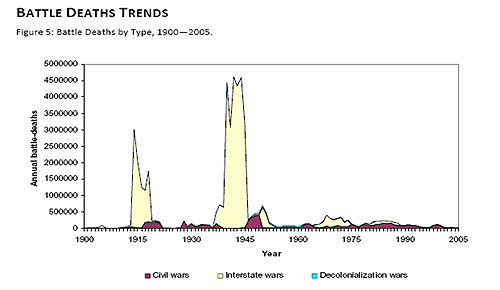
There is simply no logical coherence to the idea that, in a world where stateless mercenary firms are the prominent form of security, violence and lawlessness will reign supreme; nor is there any evidence whatsoever to suggest that “[m]ore mercenaries means more war, as they are incentivised to start and expand wars for profit, and turn to criminality between contracts.” Indeed, as McFate notes in his excellent article, the market for security is already becoming freer and while he ends his piece on a depressing note, lamenting this indisputable fact of the present-day world, I couldn’t help but remember the now-famous graph on battle death trends produced by political scientist Jay Ulfelder (using data from the Uppsala Conflict Data Program [UCDP]), which illustrates nicely the overall decline in deaths due to warfare violence around the world:
The always excellent Max Roser and his Our World in Data project has another graph worth highlighting, with this one using data from Steven Pinker’s The Better Angels of Our Nature… and the UCDP:
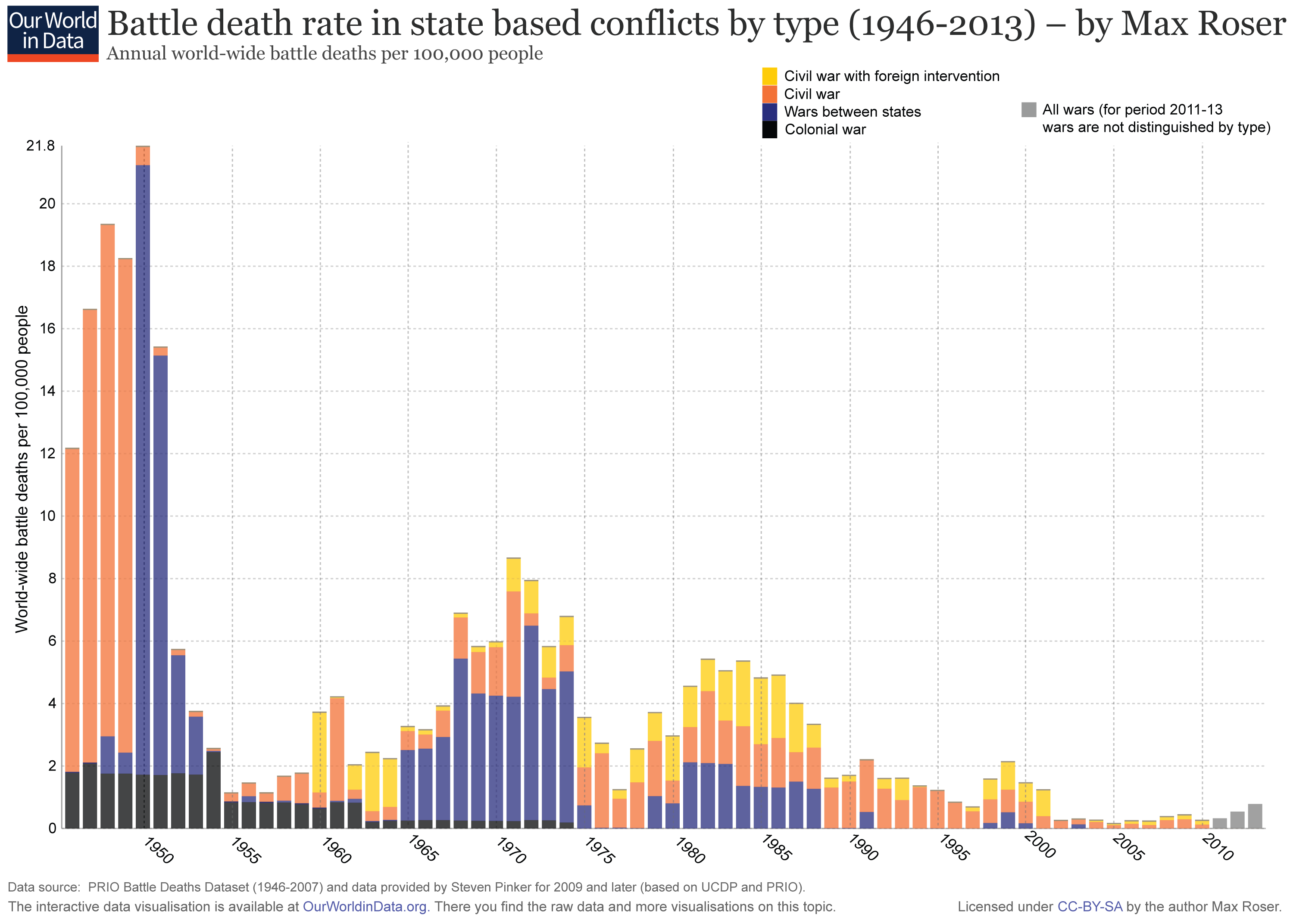
Now, two graphs showing that deaths from warfare have been in decline for half a century does not necessarily mean that a freer market in security services has led directly to this overwhelmingly good news. I am confident in claiming, though, that the freeing up of security services markets, combined with the steady presence of a few, still-powerful nationalized armies has led to a reduction in war-related deaths (and violent conflict in general). Both graphs illustrate well what happens when there are too many nationalized armies vying for power and prestige. (It is worth noting here that the main goal of diplomats and policymakers everywhere, no matter their ideological orientation or citizenship status, is still to avoid another world war.)
Second, the said. Annan’s refusal to decriminalize mercenary activities led directly to the 800,000 Rwandan deaths. How is this moral failing any better than when a mercenary firm breaks its contract and ends up killing a few dozen more people than it was supposed to? Again, the graphs are useful here: When conflict is nationalized, everybody suffers; when it is privatized, atrocities happen but not on the same scale we have seen with nationalized conflicts. It’s not even close. Annan’s short-sightedness reminds me of economist Scott Sumner’s 2012 summary of Hillary Clinton’s view of the War on Drugs:
[…] in response to a final question on drugs (from a Latin American reporter), she said drug legalization would do no good because drug dealers are really bad people, and they would simply do other crimes. No discussion of how America’s murder rate fell in half after alcohol was legalized in 1933.
Like drug use, the privatization of security services causes many people, well-educated or otherwise, to bristle at the notion without quite thinking through its logical implications. While ugly, mercenary firms are far more efficient and effective at quelling “bush wars” than are nationalized armies and, in turn, mercenary outfits are far less capable of sowing the type of destruction that nationalized armies routinely carry out.
I don’t think that a world with a few nationalized armies and an abundance of mercenary firms is necessarily the best option going forward, though. It is, however, a better option than most scholars and analysts give it credit for. In fact, it’s the best option at the moment, and while the status quo may sometimes be ugly, remember the graphs. Privatization of security services has contributed, at least in part, to a more peaceful and less violent world.
In order to move forward from this status quo it is best not lament the way things are going, but to acknowledge that things are the way they are for a reason, and then look for avenues to alter the status quo without falling back on a blanket policy like nationalizing security services again. The horrors of the World Wars should still be fresh in our minds, and the horrors of those wars were enabled and encouraged by nationalized security forces.
The best way to move forward is by looking at where these “bush wars” are taking place and begin thinking about ways to incorporate these regions into the global order (such as it is). This policy represents a departure from traditional post-war thinking about international relations, but it doesn’t make it radical or unfeasible. Indeed, there is a long tradition of republican thinking in Western thought pertaining to international relations. The West needs to start recognizing the legitimacy of secessionist sentiments in the post-colonial world, even if it means friction with Russia and China.
Washington and Brussels will have to endure charges of hypocrisy when it comes to ignoring the lobbying efforts of places like Tibet and Dagestan, but Biafra should have become a member state of the United Nations long ago. Baluchistan should have access independent of Pakistan and Iran to the IMF and World Bank. Two or three soccer teams from the region known as Kurdistan could easily be present in all major FIFA tournaments. Examples abound throughout the world. The West should also be open to recognizing arguments made by Russia and China for the independence of regions. There is no good reason why Western diplomats should ignore Moscow’s recognition of places like South Ossetia and Donetsk; doing so only hardens Russia’s stance on recognizing secession in parts of the world where its influence is limited or non-existent and forces the West into bed with unsavory post-socialist regimes.
The West needs to start being more inclusive when it comes to its own federal and republican institutions, too. Morocco, for example, should have had its 1987 application to join the European Union taken seriously (same goes for Turkey). The US federation needs to be actively courting polities like Puerto Rico, Coahuila, Alberta, and Micronesia to join the union. Both the EU and US are contracts designed to dampen violent conflict by fostering diplomatic, economic, and cultural intercourse between provincial polities. The reasoning behind exclusionary policies simply doesn’t answer why these republican, supranational organizations should not be actively recruiting neighboring or geopolitically useful administrative units into their representative systems.
Without this change in mindset the status quo will continue, which again if we remember the graphs is not all that bad, but something worse may happen: There could be a reversion to the blanket nationalization of security services that we saw during World Wars I and II.
Philosophical Research on Seasteading
The Seasteading Institute has recently published my philosophical dissertation on ‘Seasteading’. You can find it in the key research section of their Law and Policy page: http://www.seasteading.org/law-and-policy/.
Wayne Gramlich and Patri Friedman[1] founded the Seasteading Institute in 2008 in order to promote the seasteading movement, which has intellectually attracted mostly libertarian-minded individuals. The institute has also attracted funding from Paypal cofounder and early facebook investor Peter Thiel.[2]
A seastead is a permanent habitable dwelling on the ocean that preferably lies outside governmental waters. The Seasteading Institute believes that the creation of permanent societies on the seas can provide an experimentation space for innovative forms of socio-political organizations. The ultimate aim of seasteading is that newly emerging societies will inspire social changes around the world and contribute to human flourishing. First seasteads will be small-scale projects and they may even be constructed within existing governmental territories. However, seasteads could expand organically as technologies improve and innovative ideas of the functions of seasteads would emerge. One of the core ideas of seasteading is that an open experimentation space for social organizations will lead to progress in social rules and legislations, just as an experimentation space for new technologies leads to technological progress.
It is undeniable that social rules and legislations heavily influence all aspects of life, including technological progress and social well-being. One could for example compare North and South Korea, two countries that separated from each other in 1945. Both countries have had more or less the same culture and similar natural resources. However, what differs is their form of social organization; the North came under communist rule, whereas the South embraced western-style capitalism and democracy. Almost 70 years later, the differences in wealth, technological advancement, and social well-being are striking. South-Korea’s GDP per capita is for example 18 times larger, its internet penetration is more than 815 times greater, its life expectancy rate is 10 years longer, and the heights of South Korean pre-school boys are on average 4 centimeters longer. (Taylor, 2013, April 8).
The Seasteading Institute believes that, given that social progress and well-being heavily depend on how society is structured, mankind could make a huge step forward by letting social entrepreneurs start up seasteads to compete with governments in the industry of law-making and by letting millions engage in the experimentation with new forms of social organization.
In the paper, I provide a philosophical investigation of the concept of seasteading from a libertarian anarchist perspective. My investigation revolves around the following research question: “given that governments are resistant to structural changes of governance, how can mankind discover better forms of social organization?”
I argue that seasteading can fulfill that important role of moving mankind forward by experimenting with and finding new forms of social organizations that are best for human flourishing.
In the first chapter, I maintain that one core focus of political philosophy is to deal with the realities of value pluralism and political disagreements. I also contend that the most common form of social organization, representative democracy, does not satisfactorily deal with these realities. Hence, we should look for political possibilities beyond representative democracies. In order to discover these possibilities, we should experiment with new forms of social organization.
Chapter two discusses why there is currently little experimentation with social orders. I approach the issue from a meta-system level perspective and contend that all land on earth is more or less already claimed by states, which leaves little opportunity for people to start new societies on land. By applying the theory of monopoly economics, I maintain that the state’s monopoly on jurisdiction and coercion does not encourage them to provide good rules of law. It rather makes states extremely resistant to large-scale social changes. The obvious solution for finding better forms of governance then would be the introduction of competition into the industry of governments.
Chapter three deals with the epistemological attitude required for the experimentation space. I maintain that this attitude consists of having a sociological imagination, being epistemologically modest, realizing that social order can emerge spontaneously, and that the utopian dream of a single perfect society is impossible.
Chapter four discusses seasteading as the means by which the experimentation space could be realized. By homesteading the seas, a community can build and test new forms of social organization outside the scope of current governments’ control. It could generate new knowledge on social orders, thereby contributing to political philosophy and the social sciences. It could moreover also ease political tensions between citizens with different comprehensive doctrines.
Finally, I raise two objections to seasteading and address them accordingly.
If you would like to see an awesome seastead design, you should watch this video here:
Footnotes
[1] It may be interesting to know that Patri Friedman is the grandson of Milton Friedman and the son of libertarian anarchist David Friedman.
[2] Peter Thiel, previously a student of Political Philosophy at Stanford University, is also founder of the libertarian-minded newspaper The Stanford Review. He is a venture capitalist who is very much influenced by the Austrian School of Economics. With this in mind, it may not be surprising that the early mission of PayPal was to give its users more control over their money by enabling them to switch currencies. The goal of PayPal was to make it, in Thiel’s words (1999), “nearly impossible for corrupt governments to steal wealth from their people through their old means [inflation and wholesale currency devaluations] because if they try the people will switch to dollars or Pounds or Yen, in effect dumping the worthless local currency for something more secure” (Jackson, 2004).
References
Jackson, E.M. (2004). The PayPal Wars: battles with eBay, the media, the mafia, and the rest of planet earth. Los Angeles: World Ahead Publishing, Inc.
Taylor, A. (2013, April 8). A Crazy Comparison of Life in North Korea and South Korea. Retrieved from http://businessinsider.com
Thiel, P. (2009). The Education of a Libertarian. Retrieved from http://cato-unbound.org
The Crypto Anarchist Manifesto (1988)
Crypto-anarchism is a subversive philosophy that extends anarchism into the world of cyberspace. Crypto-anarchists attempt to protect their privacy and political freedom through the use of information technologies. Timothy May, one of the co-founders of Cypherpunk and writer of the ‘Crypto Anarchist Manifesto’, describes Crypto-anarchism as
“the cyberspatial realization of anarcho-capitalism, transcending national boundaries and freeing individuals to make the economic arrangements they wish to make consensually.”
In this article I would like to post Timothy May’s ‘Crypto Anarchist Manifesto’, which was first spread among like-minded tech-anarchists in mid-1988 at the “Crypto ’88” conference. The Manifesto was also discussed at the first physical Cypherpunk meeting in 1992. Most people have never heard of Cypherpunk, but they might know their most notable member: Julian Assange, founder of Wikileaks.
See here the full Manifesto:
A specter is haunting the modern world, the specter of crypto anarchy.[1]
Computer technology is on the verge of providing the ability for individuals and groups to communicate and interact with each other in a totally anonymous manner. Two persons may exchange messages, conduct business, and negotiate electronic contracts without ever knowing the True Name, or legal identity, of the other. Interactions over networks will be untraceable, via extensive re- routing of encrypted packets and tamper-proof boxes which implement cryptographic protocols with nearly perfect assurance against any tampering. Reputations will be of central importance, far more important in dealings than even the credit ratings of today. These developments will alter completely the nature of government regulation, the ability to tax and control economic interactions, the ability to keep information secret, and will even alter the nature of trust and reputation.
The technology for this revolution–and it surely will be both a social and economic revolution–has existed in theory for the past decade. The methods are based upon public-key encryption, zero-knowledge interactive proof systems, and various software protocols for interaction, authentication, and verification. The focus has until now been on academic conferences in Europe and the U.S., conferences monitored closely by the National Security Agency. But only recently have computer networks and personal computers attained sufficient speed to make the ideas practically realizable. And the next ten years will bring enough additional speed to make the ideas economically feasible and essentially unstoppable. High-speed networks, ISDN, tamper-proof boxes, smart cards, satellites, Ku-band transmitters, multi-MIPS personal computers, and encryption chips now under development will be some of the enabling technologies.
The State will of course try to slow or halt the spread of this technology, citing national security concerns, use of the technology by drug dealers and tax evaders, and fears of societal disintegration. Many of these concerns will be valid; crypto anarchy will allow national secrets to be trade freely and will allow illicit and stolen materials to be traded. An anonymous computerized market will even make possible abhorrent markets for assassinations and extortion. Various criminal and foreign elements will be active users of CryptoNet. But this will not halt the spread of crypto anarchy.
Just as the technology of printing altered and reduced the power of medieval guilds and the social power structure, so too will cryptologic methods fundamentally alter the nature of corporations and of government interference in economic transactions. Combined with emerging information markets, crypto anarchy will create a liquid market for any and all material which can be put into words and pictures. And just as a seemingly minor invention like barbed wire made possible the fencing-off of vast ranches and farms, thus altering forever the concepts of land and property rights in the frontier West, so too will the seemingly minor discovery out of an arcane branch of mathematics come to be the wire clippers which dismantle the barbed wire around intellectual property.
Arise, you have nothing to lose but your barbed wire fences!
Footnote
[1] This is clearly a wordplay on the opening sentence of Karl Marx’ and Friedrich Engels’ The Communist Manifesto which reads: “A spectre is haunting Europe—the spectre of communism.”
Chuang Tzu: The natural disposition of man is Political Anarchism

I just read this great article on ‘Anarchism and Taoism’. I find the Taoist case for anarchism extremely compelling. They sought after the harmonious nature of spontaneous order, the Tao, and internalized it into a tremendously rich personal philosophy of life. It makes me wonder: can a person ‘live’ a Libertarian life? Libertarianism is mostly regarded as a political philosophy in the west, but can it, like the Taoists believe, be regarded as a way of life that is most fulfilling on a personal level as well? These are questions that I still have to find out for myself.
After reading the article on Anarcho-Taoism, I’d like to share a small part of Chuang Tzu’s thoughts on the natural disposition of man here:
Horses live on dry land, eat grass and drink water. When pleased, they rub their necks together. When angry, they turn round and kick up their heels at each other. Thus far only do their natural dispositions carry them. But bridled and bitted, with a plate of metal on their foreheads, they learn to cast vicious looks, to turn the head to bite, to resist, to get the bit out of the mouth or the bridle into it. And thus their natures become depraved.
As with horses, so it is with human beings. Left to themselves they live in natural harmony and spontaneous order. But when they are coerced and ruled, their natures become vicious. It follows that princes and rulers should not coerce their people into obeying artificial laws, but should leave them to follow their natural dispositions. To attempt to govern people with manmade laws and regulations is absurd and impossible: ‘as well try to wade through the sea, to hew a passage through a river, or make a mosquito fly away with a mountain!’. In reality, the natural conditions of our existence require no artificial aids. People left to themselves will follow peaceful and productive activities and live in harmony with each other and nature.
In an essay ‘On Letting Alone’, Chuang Tzu asserted three hundred years BC the fundamental proposition of anarchist thought:
There has been such a thing as letting mankind alone; there has never been such a thing as governing mankind. Letting alone springs from fear lest men’s natural dispositions be perverted and their virtue left aside. But if their natural dispositions be not perverted nor their virtue laid aside, what room is there left for government?
Lao Tze, The First Libertarian
 From the very first moment I read into Taoist philosophy, 5 years ago, I had grown extremely fond of Taoism. It also bears many similarities with the political philosophy of libertarianism. In this post I would like to trace the libertarian concept of Spontaneous Order to the Tao.
Lao Tze (~6th century BC) is regarded as the founder of Taoism. He is also the writer of the Tao Te Ching, one of the most translated books in history, which consists of 81 short chapters about leadership, modesty, and how to live in accordance with your own nature.
From the perspective of a personal philosophy of life, the Tao Te Ching teaches you to flow with life and to be in touch with your inner self so that your actions never contradict your personal being, and so that you can live a truly authentic and enriched life. This may sound too lofty to some, but reading the book one will realize how practical the philosophy actually is. To illustrate the practicality of Taoism, I have written about an interesting application of Taoism in Bruce Lee’s Jeet Kune Do – the martial arts that Bruce Lee had developed – in this post of mine.
One can also read the Tao Te Ching from the perspective of political philosophy. Taoism proposes a society in which there is little or even no central authority (government), since the government is counterproductive and the grand source of social misery. Taoism is therefore libertarian, and stands very much in contrast with Confucianism with its multifarious laws and regulations. Mr. Libertarian, Murray Rothbard, had recognized that Lao Tze was the first libertarian intellectual who saw the government as “a vicious oppressor of the individual, and ‘more to be feared than fierce tigers’” (Rothbard, 1995, p. 23). Taoists and Libertarians believe that society functions most efficient and most just when the government does not meddle and regulate the people.
The skeptics may ask: how can there be order without a central authority? Some modern philosophers, like for example Hobbes, have referred to this anarchistic state as the ‘state of nature’; a state of “a mere war of all against all; and in that war all men have equal right unto all things” (Hobbes, 1651, p. 34). Taoists and Libertarians however, believe that this view is wrong. They believe that it is in the nature or instinct of individuals to be collectivist, because the person who lives in solitude is hardly able to survive in nature. In order to survive, human beings will naturally develop collective customs and laws to work out their disputes. The collective coordination of human beings has therefore always “depended decisively on instincts of solidarity and altruism” (Hayek, 1988, p. 12).
What, according to the Taoist and the Libertarian encourages society to become well-functioning? The Taoist calls it the ‘Tao’, and the libertarian calls it ‘Spontaneous Order’.
Tao and Spontaneous Order
The two concepts, Tao and Spontaneous Order, are similar to one another. Spontaneous Order is a spontaneous emergence of self-organized order out of seeming chaos. One can find such examples in language, the internet, the free market etc. Without any central authority we have realized language, internet, and productive orders that are so complex that not a single person would have been able to create by himself. No one can predict how the order will look like, because it is forever in flux. It can therefore only be experienced and observed. From our observation we can find that the Spontaneous Order is better than any artificial human construct.
Likewise, the Tao is an underlying natural order of the universe whose essence cannot be described in words, but which can only be experienced and observed in nature. In the first verse of the Tao Te Ching, Lao Tze writes:
The Tao that can be told is not the eternal Tao.
The name that can be named is not the eternal name. (Tao Te Ching, Chapter 1).
The Tao is neither a thing nor a substance. It is a universal trend that flows in the natural world. According to the Taoist, one can be in touch with the Tao and achieve most when one does not act against the nature of things (‘wu wei’). Lao Tze therefore writes:
Whenever you advise a ruler in the way of Tao,
Counsil him not to use force to conquer the universe.
For this would only cause resistance.
Thorn bushes spring up wherever the army has passed.
Lean years follow in the wake of a great war. (Tao Te Ching, Chapter 30)Tao abides in non-action,
Yet nothing is left undone.
If kings and lords observed this,
The ten thousand things [world] would develop naturally. (Tao Te Ching, Chapter 37)The more laws and restrictions there are,
The poorer people become.
The sharper men’s weapons,
The more trouble in the land.
The more ingenious and clever men are,
The more strange things happen.
The more rules and regulations,
The more thieves and robbers.Therefore the sage says:
I take no action and people are reformed.
I enjoy peace and people become honest.
I do nothing and people become rich.
I have no desires and people return to the good and simple life. (Tao Te Ching, Chapter 57)Why are the people starving?
Because the rulers eat up the money in taxes.
Therefore the people are starving.
Why are the people rebellious?
Because the rulers interfere too much.
Therefore they are rebellious.
Why do the people think so little of death?
Because the rulers demand too much of life.
Therefore the people take death lightly.
Having little to live on, one knows better than to value life too much. (Tao Te Ching, Chapter 75)
The Taoists have this concept called ‘mutual arising’, which means that order comes into being through a harmonious interplay of different forces. This is expressed as follows by Lao Tze:
The Tao begot one. One begot two. Two begot three.
And three begot the ten thousand things.
The ten thousand things carry yin and embrace yang.
They achieve harmony by combining these forces. (Tao Te Ching, Chapter 42)
We, human beings, are incapable of understanding how these forces play out against each other. Every time we interfere with the Tao, unintended consequences will happen. Since we cannot apprehend what forces have led to the unintended consequences, we will create more unintended consequences by trying to offset the previous unintended consequences. Man can therefore fall into a state of perpetual interference with nature and become evermore unnatural. Is that not the state we are in right now; the state of unnaturalness due to our thousandfold petty laws that attempt to regulate our conduct, relationships, and ethics?
Is it realistic to have no central government and expect spontaneous orders to emerge?
It certainly is realistic. Bruce Benson has written an insightful book called The Enterprise Of Law: Justice Without The State (2011) in which he discusses historic examples of how law and order emerged spontaneously. Many scholars are currently acknowledging that during the time of the expansion of the American frontier, those areas where people moved faster westward than the central government was not wild or lawless. It was actually more peaceful than modern day America. For an interesting read into this issue, see Anderson & Hill’s ‘An American Experiment in Anarcho-Capitalism: The Not So Wild, Wild West’ (1979).
See also this talk of Thomas Woods on the ‘not so wild, wild west’:
Bibliography
Anderson, T.L. & Hill, P.J. (1979). An American Experiment in Anarcho-Capitalism: The Not So Wild, Wild West. Journal of Libertarian Studies, 3, 1, 9-29.
Benson, B. (2011). The Enterprise Of Law: Justice Without The State. San Francisco: Independent Institute.
Hayek, F.A. (1988). The Fatal Conceit: the errors of socialism. London: Routledge.
Hobbes, T. (1651). De Cive. (H. Warrender, Ed.) New York: Oxford University Press.
Lao Tze. Tao Te Ching. Retrieved from http://www.schrades.com/tao/taotext.cfm?TaoID=1
Rothbard, M.N. (1995). Economic Thought Before Adam Smith: An Austrian Perspective on the History of Economic Thought Volume I. Retrieved from http://mises.org
 Notes On Liberty