A Lesson in Inventing Your Own Statistics

Nothing makes me happier than pointing out when someone is wrong.

I admit, that’s a pretty sad life. And for some unfathomable reason that doesn’t endear me to the person who uttered the incorrect statement – which it really should as I’m correcting some mistaken belief of theirs, assisting them on the path to truth.

Perhaps, as Jonathan Haidt teaches us, my endeavour is a hopeless one as approaching truth is forever clouded by confirmation bias. Polarization runs rampant and scientific disciplines are scarred by replication crises and publication bias.

I don’t take issue with any of those points: reduce my ambitions to “a little less wrong” and what follows still holds.

A few days after the Riksbank had upped its interest rate to 0% last month, Daniel Lacalle, a Spanish economist, author and fund manager – and whose musings are usually quite insightful – decided to vent his (questionable) objections to central banks and negative interest rates (NIRP) in a very strange way:

  1. Deliver a bunch of vague one-liners about monetary policy and unsustainable capital markets.
  2. Make shit up about Sweden and Swedish capital markets.

Obviously, I don’t mind too much the rhetoric of those who vehemently oppose central banks, but I do mind people pulling numbers out of their behinds and just inventing things about the world that clearly are not true.

So let’s do some fact-checking.

It’s apparently really bad for governments to have public debt – and negative interest rates allegedly work like crack-cocaine for politicians in their endless desire for more and more and more underfunded expenditures. Spend away, minister!

Except that many (non-crisis) countries such as Sweden aren’t borrowing. In fact, Sweden’s debt-to-GDP ratio is at its lowest point since 2012 and has been dropping like a stone since about the time that the Riksbank first lowered its policy rate to below 0%. In fact, as the Riksbank sits on over 35% of the outstanding government debt, there’s been quite a scramble among commercial banks to meet their capital requirements; there aren’t enough bonds to go around. The big macro debate in Sweden right now is over how much more the government ought to spend given that the debt is so small.

My favorite part is when Lacalle starts inventing numbers to support his case. Strangely enough, he’s arguing that NIRP fuels an unsustainable boom such that increasing share prices and property prices (things that most of us individually tend to think are good or at least harmless) are, in Lacalle’s mind, actually evidence of how bad life is.

Ye, I too hate it when my retirement fund or house go up in value.

  1. Sweden’s “Real estate price index has increased 50 percent (from 160 points to 240).”

The official statistics agency, Statistics Sweden, reports a +17 increase in broad real estate indices since early 2015, but they only include data until late-2018. The index is also on a completely different level, suggesting that Lacalle used some other source. 

Using numbers from Ekonomifakta we find house price increases of 9% and 19% across various regions from Q1 2015 (when the Riksbank NIRP policy began) to Q3 2019. Again, wrong index numbers so couldn’t have been Lacalle’s source.

But maybe house prices have increased some in the last few months such that Lacalle’s 50% number is correct? No, they’ve been flat, reports the realtor industry organization Svensk Mäklarstatistik.

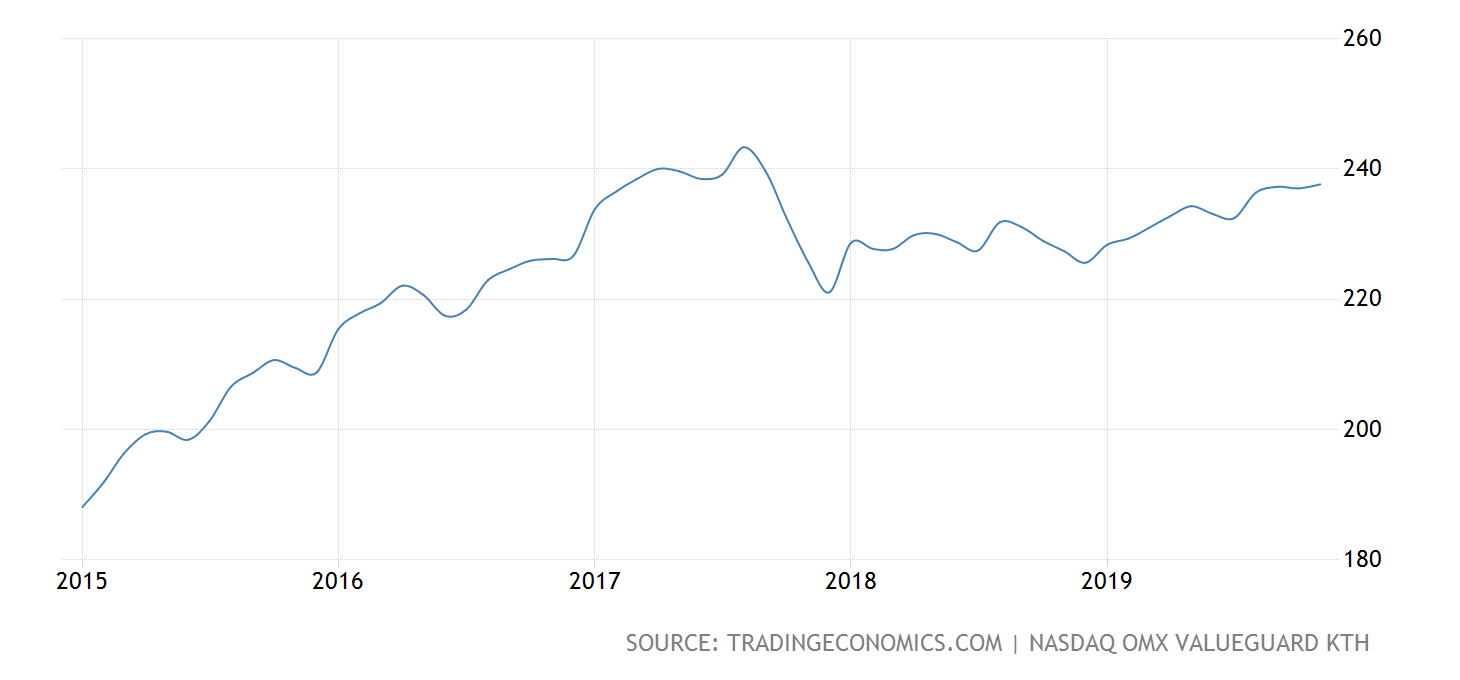
Searching high and low for a Swedish house price index that conforms to Lacalle’s peculiar range (160 to 240), I finally found a promising one at Trading Economics:

Trading econ Sweden House Price Index.png

Interestingly enough, Lacalle seems to have misread the chart; the index value for Feb 2015 is around 190 – not 160 – producing a much more reasonable +26% increase over the last five years. Even that, as we’ve seen with the more reputable sources above, might be tad exaggerated.

2. Sweden’s stock market is up “more than 20%”

Next up: the stock market – always a grateful subject for unsubstantiated rants.

“more than 20%” is cheating as technically anything above “20%” would work. Curiously enough, no index for the Swedish stock market shows those numbers between Feb 18, 2015, and today:

  • OMXS30, a commonly quoted index that does not include dividends, is up 8% since then.
  • Using indices that do account for (reinvested) dividends, OMXSPI shows 27.5% gain since NIRP was introduced;
  • OMXS30GI shows a 30.5% gain;
  • and OMXSCAPGI reports a 52% return.

Then again, if gradually increasing stock markets are a bad thing, then why didn’t Lacalle go with the highest, most inflated number he could find?

3. “Average residential index” is apparently up 27%

Not a statistics I’m familiar with, but I refer the reader to (1) above for sources on property prices.

4. “nonreplicable assets have risen between 30 and 70 percent”

First: that’s quite a range, Sir.
Second: ye, I’ve never heard that term before (let alone something to measure it) – and neither, it seems, has Google. I suspect Lacalle invented some more numbers to complement his already fake-y statistics. 

Tl;dr – don’t just make shit up, kids. Do look into your claims before you mindless utter them. You may be entitled to your own opinion (actually not really), but you can’t just believe whatever you want, making shit up along the way.

Sunday Poetry: Rüstow vs. Mises

One of the bests books I’ve read this year was Serge Audier’s & Jurgen Reinhoudt’s relatively unknown (unfortunately!) translation of the protocols of the Walter-Lippmann-Colloquium. The NOUS-Network organized a wonderful seminar in which we thoroughly discussed the book and the emergence of Neoliberalism. For the preparation of this weekend’s Hayek-Kreis seminar, I reread the book and stood once again in awe of the magnificence of the discussion during the Colloquium.

By the way: If you are an undergraduate, graduate, or PhD scholar, please consider joining the NOUS-Network for Constitutional Economics and Social Philosophy as a Young Affiliate! NOUS is an information platform and a community for interdisciplinary research. The network links all academic fields relevant for thinking about social order and liberty. It spans philosophy, politics, economics and fosters scholarly research, contact and exchange.

In the following excerpt, it becomes clear, that the participant’s opinion on the psychological and sociological causes of the decline of Liberalism differed significantly. Mr Rüstow eloquently captures the standpoints of the two opposing groups (not without bias to be fair) and even cheekily disses Ludwig von Mises.

“Mr Rüstow: ‘All things considered, it is undeniable that here, in our circle, two different points of view are represented. One group does not find anything essential to criticize or to change in traditional liberalism, such as it was and such as it is, apart from, naturally, the adjustments and the current developments that are self-evident.

In their view, the responsibility for all the misfortune falls exclusively on the opposite side, on those who, out of stupidity or out of malice, or through a mixture of both, cannot or do not want to discern and observe the salutary truths of liberalism. 

We, on the other hand, we seek the responsibility for the decline of liberalism in liberalism itself; and, therefore, we seek the solution in a fundamental renewal of liberalism. In order to justify in a positive manner this second point of view, I have to refer to what I have said and, especially, to the excellent arguments of Mr Lippmann.

Here, I would only like to draw attention to the fact that if the unwavering representatives of old liberalism were right, the practical prospects [for liberalism] would be almost hopeless. Because it does not really seem that old liberalism has gained in persuasive and in seductive force or that the arguments, no matter how shrewd they may be, of these representatives have the least possibility of bringing about a conversion movement within the realm of Bolshevism, Fascism, or of National Socialism. If they did not listen to Moses and the prophets—Adam Smith and Ricardo—how will they believe Mr. von Mises?'”

As always, I wish you all pleasant Sunday.


Sunday Poetry: Junger’s War Observations

Without noticing it, I heavily built my reading schedule this year around of what one might call a “post-liberal reading list”. The idea, that the demise of social institutions might be the inevitable consequence of an ongoing individualization of society struck me as initially convincing. I am currently in search of good examinations on the ultimate effect Liberalism has on the development of social institutions. Hopefully, Steven Horwitz’ “Hayek’s Modern Family” will provide me with some compelling arguments to refute the post-liberal agenda.

Not directly being post-liberal, but pointing towards the importance of “homecoming and belonging”, Sebastian Junger’s book “Tribe” has had a lasting influence on me. I found the following observations of a war refugee voluntary reentering Sarajevo during its siege both fascinating and devastating.

“What catastrophes seem to do – sometimes in the span of a few minutes – is to turn back the clock on ten thousand years of social evolution. […]

“‘I missed being that close to people. I missed being loved in that way’, she told me. ‘In Bosnia – as it is now – we don’t trust each other anymore; we became really bad people. We didn’t learn the lesson of the war, which is how important it is to share everything you have with humans being close to you. The best way to explain it is that the war makes you an animal. We were animals. It’s insane – but that’s the basic human instinct, to help another human being who is sitting or standing or lying close to you.’

I asked Ahmetašević if people had ultimately been happier during the war. 
‘We were the happiest,’ Ahmetašević said. Then she added: “And we laughed more.'”

I wish you all a pleasant Sunday.

Psychedelics versus modern philosophy

Anyone who studies philosophy has run into the assumption that psychoactive drugs and philosophy go hand-in-hand. Really, after analytic and continental, and whatever other traditions people come up with, there could be another sect, that of “stoner philosophy,” which is something like Mister Rogers, Alan Watts and Bob Ross thrown into a peaceful blender. This is when you’re sitting around getting high, wondering if aliens exist, instead of sitting in a classroom, wondering if other people’s minds exist.

A historical study of this connection, from East to West, would probably scandalize a lot of “serious” philosophers, and show some regular inebriation, but in general, I think the two are opposed (tragically or not). Particularly, the institutionalization of philosophy, when “natural philosophy” and “moral philosophy” etc all became separated some time after Hobbes, is opposed to what it sees as a lay way of thinking about the world. As my philosophy of science professor told me – you become a philosopher when you have your doctorate.

Professional philosophers and “psychonauts” are in opposition to each other. The analytics and continentals have spent centuries building elaborate systems – developing monstrous levels of specificity, so as to make their work completely incomprehensible to the rest of the world – and earning credentials to close the gates of access. Meanwhile, the casual or professional tripper is able to buy a tab for less than $10 and experience, or imagine they experience, market-price existentialism without reading a page of Camus.

The professional philosopher sneers in bad faith at psychedelic profundity because it makes them seem irrelevant.

On the other hand, the inarticulate tripper is not in such a great place. The psychonaut rests on intuition, and is probably not equipt with the critical thinking and logical itinerary to make sense of the journey on the comedown. A trip promises insight but also promises that neither your epistemic priors nor a rational reconstruction will be enough to establish its validity – by its very nature. (Psychedelic knowledge is “revealed,” not “discovered,” right?) You might get an insight that looks good, but is bad, without you knowing it. (I wrote about this in college. Holy shit my writing was bad.)

What happens when you irrationally, psychonautically attach to an idea that’s immune to logical tinkering? If you believe something for irrational reasons you’ll hang on to it for even longer than something that you believed for rational reasons, because new rational reasons can talk you out of a logogenetic idea, but not an irrationally-formed one. Depending on the centrality of the belief, of course.

The psychonaut claims easy knowledge, but could have trouble organizing it in the other, orderly web of belief of his coldly-discovered priors. However, this kind of knowledge has taken a high prestige today, with help from accredited social figures like Steve Jobs dosing LSD. In a way, the win of casual inebriated profundity is a “people’s victory” over the esoteric, pretentious toils of the professional philosophers. If you can figure out Truth by serotonin-fucking yourself on any day of the week then there’s no need to study Heidegger… and there’s even less reason to get a PhD in phenomenology, making institutional philosophy obsolete.

So, philosophers will be opposed to the psychonauts because it trivializes their hard-earned degrees (bad faith), and trivializes all their carefully crafted logic (slightly less bad faith). Psychonauts will be opposed to the philosophers for their specialized field which must explicitly reject such spontaneous routes to knowledge. The people taking psychedelics find themselves fighting some sort of anti-scientific elitism war, doing Feyerabend’s work. The tension is worse with the professional, modern philosophical class, but still exists in general.

A survey of history would show a lot of intertwining, but ultimately, I think the newer age of philosophy has a lot more overlap with other drugs than psychedelics (specifically Epicurean as opposed to elucidatory drugs, e.g. Adderall, analgesics, cocaine) — which is its own interesting question.

Sunday Poetry: Camus about Europe

Albert Camus is the most influential writers to me (See here why). This passage is from his third “Letter to a German Friend” (1944), depicting his unbroken love for European culture in the dark times of the second world war.

“Sometimes on a street corner, in the brief intervals of the long struggle that involves us all, I happen to think of all those places in Europe I know well. It is a magnificent land moulded by suffering and history. I relive those pilgrimages I once made with all the men of the West: the roses in the cloisters of Florence, the gilded bulbous domes of Krakow, the Hradschin and its dead palaces, the contorted statues of the Charles Bridge over the Vltava, the delicate gardens of Salzburg. All those flowers and stones, those hills and those landscapes where men’s time and the world’s time have mingled old trees and monuments! My memories have fused together such superimposed images to make a single face, which is the face of my true native land. … It never occurred to me that someday we should have to liberate them from you. And even now, at certain moments of rage and despair, I am occasionally sorry that the roses continue to grow in the cloister of San Marco and the pigeons drop clusters from the Cathedral of Salzburg, and the red geraniums grow tirelessly in the little cemeteries of Silesia.”

I wish you all a pleasant Sunday.

Intellectuals You Should Know About

I read a lot. Wide, deep and across quite a number of different fields. As a self-proscribed ‘writer’ and ‘editor’, reading much is both satisfying an intellectual desire and a professionally useful practice in familiarize myself with various styles, voices and topics. A common tip for aspiring writers is to read someone they admire and try to imitate their style; at this, at least, I am somewhat successful, as a friend recently told me that my style reminded him of Deirdre McCloskey. Full of idolized admiration for Deirdre’s work, I couldn’t imagine a higher praise.

As readers, the eternal curse of modernity is our laughable inability to keep up with the couple of millions of books that are published every year. Not to mention written materials on blog or respectable outlets or in magazines and journals. As consumers of the written word, we are completely outstripped, utterly defenseless and overwhelmingly inundated.

When in September I published my discussion of geographer and anthropologist Jared Diamond’s impressive work, I got a lot of feedback of astonishment from friends and family – including the friend that praised me for occasionally (accidentally…?) write like McCloskey: “Wow,” he said, “I’ve never heard of him before!”

Huh, I thought. I wonder what other household names of public intellectuals are not read as much as they deserve.

My exact reaction of astonishment was more like a gaping “What?!”, betraying my wanna-know-everything attitude, slight elitism and writer lifestyle. Contrary to the belief that our times is one of all talking and no listening (well, writing and no reading), it takes a vast amount of reading before you can produce anything that others want to read. Sure, anybody with a laptop and an internet connection can start a blog and flush out their thoughts (I did so for years) but it takes knowledge to say something intelligent and interesting – knowledge acquired by extensive reading.

It also takes a lot of practice to develop a voice of one’s own. Authors with astonishing and recognizable writing styles are made, not born.

What, then, should you read?

In light of this surprise, I decided to make a list of intellectuals I would advise anybody to read. Note that this is not a list of the most important thinkers ever, nor is it a collection of the most profound academic contribution to various disciplines. Instead it’s a gathering of writers whose popular writing (often in addition to their rigorous academic work) is exactly that – popular. That means that a lot of others liked them (and if you’re anything like others, you might too) and more importantly: a lot of smart people you meet are rather likely refer to these authors or to the ideas contained in their work. Here are 11 authors I would consider to be household names and whose writing will make you a much smarter and interesting person.

Jared Diamond

Let’s begin our list with aforementioned Jared Diamond, whose trilogy on humanity is compulsory reading for pretty-much everyone. This year he released Upheaval, which received very mixed responses and that I decided to skip after hearing his pitch on Sam Harris’ Making Sense podcast. Diamond’s publisher maintains that this is the third installment of his “monumental trilogy” of how civilizations rise and fall, but to me that was The World Until Yesterday: 

  • Guns, Germs and Steel is the book that definitely made Diamond a well-known name, the kind of Big Picture civilizational economic history we have recently seen in Yuval Harari’s work – the author of Sapiens: A Brief History of Humankind, that strangely boring book that everyone seems to be reading these days – or the less well-known but more captivating Columbia professor Ruth DeFries’ The Big Ratchet. If you like, you could describe this Pulitzer prize-winning book as well-written geographical reasons for why the West is rich and the Rest isn’t. If that’s your thing, read away.
  • Collapse: How Societies Choose to Fail or Succeed, the book that my September piece was mostly concerned with, is a dense story of many different human civilizations falling apart: Easter Islanders, Native Americans in the dry southwest or central America and my favourite chapter: The Greenland Norse. Complemented with the Fall of Civilizations podcast and Dan Carlin’s recent book The End is Always Near would make you ridiculously interesting to talk to in these hyper-catastrophist times. Upheaval is a natural extension of Collapse so if you crave more, that one is for you.
  • I would rather point to The World Until Yesterday for Diamond’s third gem as it is a deep dive into the lives of traditional societies in general, but in practice mostly New Guinean societies. Somehow, Diamond made anthropology exciting!

Paul Collier

Rapidly moving up in controversy, Paul Collier is an Oxford development economist whose work most intellectuals have a distinctly firm opinion about. His popular claim to fame rests on:

  • Exodus, a very cool (and prescient!) take on global migration. Highly recommended.
  • The Bottom Billion, for a plunge into global poverty and development economics. It might be slightly outdated (published in 2007) as many of the 60 failing countries he identifies have seem quite some growth in the last decade.

I should also recommend his latest book, Future of Capitalism, but I wasn’t very impressed with it. In these times of political polarization, populist uprisings, urban-rural divides and worries about AI, it is still a relevant read.

Whenever Collier speaks, you want to listen.

The Four Horsemen of Atheism (or “New Atheism”):
Christopher Hitchens, Sam Harris, Richard Dawkins, and Daniel Dennett

to which we should add the “one Horse-woman“, Ayaan Hirsi Ali, whom I’m ashamed to only know as “the wife of Niall Ferguson” (yes, my background is money and history, OK, not politics or religion…).

Together, these 5 brilliant minds may have helped many out of their religiosity, but their contributions loom much larger than that. As most of the Western world has gradually abandoned faith, their religious inclinations have turned to other areas: environmentalism (Mike Munger’s take on recycling never gets old!), invented hierarchies or social justice. The writings of these five horsemen can be hugely beneficial here too. Some recommended reading includes:

Speaking of Ferguson, as I’m a big financial history guy, I am shamelessly squeezing in this prolific writer, professor (well, Senior Fellow at Hoover institution nowadays) and public intellectual:

I should also mention his two-volume biography of Henry Kissinger (first volume 2015, next probably finished next year), which I ignored (politics is boring) and his recent book The Square and the Tower, which I heard very bad things about – and so downgraded for now.

Steven Pinker

Ah, this Harvard cognitive scientist and linguist-turned-public-intellectual is a must-read. His top trilogy, which I voraciously consumed last fall, includes:

  • The Blank Slate, the best description of this book that I ever heard came from Charlotta Stern, sociologist at Stockholm University: every sound argument against the “Nurture Only”-idea that biology doesn’t matter compiled into a single book. Yes, you want to read it.
  • The Better Angels of Our Nature, a Big Picture humanity-scale look at violence, resurrecting Norbert Elias’ Civilizing Process theory to explain why we hurt and kill each other less than at probably any point in human history. Nassim Nicholas Taleb (see below) is decidedly not convinced
  • Enlightenment Now! The Case for Reason, Science, Humanism, and Progress, as if Better Angels wasn’t Big Picture enough, here’s the ultimate case for why humanity is doing pretty well, why doomsday sayers are wrong on every count and why we shouldn’t despair. Many of the topics of Better Angels re-occur in Enlightenment Now!, but I don’t regret reading both as Pinker’s prose is easy to follow and his content well-sourced should you require more convincing. Originally a cognitive scientist, he has a ton of more books you might wanna check out – The Language Instinct, for instance, ranks pretty high on my Next Up list:
  • The Language Instinct
  • How the Mind Works
  • The Stuff of Thought

Matt Ridley

Speaking of optimistic people taking a Big Picture view of humanity, zoologist and science writer Matt Ridley is a must. Tall (like me!), Oxford-educated (like me!) and techno-optimist (like me!), no wonder I like him.

At last, How Innovation Works is schedule for May 2020. 

Nassim Nicholas Taleb

Oh, boy – here’s a controversial one. Frequently does he get into loud and hostile arguments with other high-profile intellectuals, and rarely does he pull any punches. His popular writing is found in the “Incerto” serie – the Latin term for ‘doubt’ or ‘uncertainty’ that capture Taleb’s core work. The set of books are together described as “an investigation of luck, uncertainty, probability, opacity, human error, risk, disorder, and decision-making in a world we don’t understand:”

They are intended to push One Big Idea: that we frequently overlook how random the world is, ascribing causality where none belongs and overestimate what we can know from (relatively recent) past events. Black Swans, the proverbial unpredictable event, dominates the social sciences in Taleb’s view. While the 2000-odd pages worth of the Incerto series may seem daunting, the books (and even the individual chapters) are designed not to fall very far from each other. The interested reader can, in other words, pick any one of them and work backwards in accordance with whatever is of interest. You wanna read all – or any – of them.

Having read Fooled by Randomness first, I’ve always held that highest. Be ready for a lot of sarcastic and frequently hostile (but thoughtful) objections of things you took for granted.

In sum: just bloody read more

Any selection of important contemporary intellectuals is arbitrary, highly skewed and super-unfair. There are more, many more, whose fantastic writings deserve attention. As I said, the eternal curse of modernity is our laughable inability to keep up with avalanche of cool stuff written every year.

As readers, we are overrun – and the only thing you can do to keep is is to read more. Read widely.

Above are some amazing thinkers. Drop me a line or tweet me with readings you would add to a list like this.

Discovery Processes

A good friend of mine encouraged me to read this note published by James Jay Carafano, Vice President of The Heritage Foundation.

Despite being as compelling as it is well intentioned, the article misses to mention one of the main arguments for free markets: what once Friedrich Hayek described as “the competition as a discovery process.”

Indeed, the concept is insinuated in Carafano’s piece of writing: “He decided to make a splash in the sports car market by jumping into the race car racket. Initially, he planned to do it by buying the world’s premier race car manufacturer, Ferrari. But that plan fell flat. So Ford moved to Plan B: to field his own, all-American team.”

Businessmen, like any other kind of people, are rational: initially, they try to maximize their profits by avoiding competition. They are not heroes and nobody can ask them to be so. People, businessmen included, respond to incentives.

When there is not any other choice than competition, then innovation, ingenuity, and creativity arise. Not because of a change in the mind of certain businessmen, but for new innovative entrepreneurs outperform the non competitive ones.

The free market capitalist system James Jay Carafano praises is mostly an institutional arrangement named -once  again- by Hayek as “competitive order.” Nevertheless, the most interesting question for our times is not about the virtues of the said free market capitalist system -which seem to be out of discussion- but whether competition under the rule of law deserves to have a Kantian “Cosmopolitan Purpose.”

Sunday Poetry: Adorno about traffic lights

I hate the Frankfurt School. Even more, I hate Theodor W. Adorno. Apart from his atrocious Sociology (I think his philosophy is ridiculous too, but I have not dealt with it in depth yet), he had a very bizarre opinion on Jazz.
However, he seemed to be a heavy fan of traffic lights. In 1962 he wrote the following words to the local newspaper:

“When crossing the Senckenberg plant, near the corner of Dantestraße, one of our secretaries was run over and seriously injured after a passerby had been killed in an accident at the same place a few days earlier. On the way to university, one has to run across the street in an unworthy way, as if one was running for his life. If a student, or a professor, is in the state that is actually appropriate for him, namely in his mind, then the threat of death is immediately prevalent.” 

In consequence of his rant, albeit 25 years later, the city built the now-famous Adorno-Ampel in Frankfurt near his faculty. Kind of lovely anecdote.

I wish you all pleasant Sunday.

Sunday Poetry: Rilke’s “Autumn Day”

It has been a more than stressful week. To indulge in Rilke’s dreamy thoughts is not only a perfect stress-relief but also a chance to reminisce about the most beautiful moments of this autumn.

Rainer Maria Rilke – Autumn Day

“Lord: it is time. Great was the summer’s feast.
Now lay upon the sun-dials your shadow
And on the meadows have the winds released

Command the last fruits to round their shapes;
Grant two more days of south for vines to carry,
to their perfection thrust them on, and harry
the final sweetness into heavy grapes.

Who has not built his house, will not start now.
Who is now by himself will long be so,
Be wakeful, read, write lengthy letters, go
In vague disquiet pacing up and down
Denuded lanes, with leaves adrift below.”


I wish you all a pleasant Sunday.

Rawls, Antigone and the tragic irony of norms

Is civil disobedience justified when it invokes a moral objection to target a law that has been enacted through a legitimate process? The reason societies seek to establish a legitimate process in law making is because they want to set up common rules and norms which people who disagree with them will still have to abide by. However, history shows us many instances in which, even in a democratic system, civil disobedience both triggered and animated a debate on legitimately enacted rules and, often, led to their revision as well as the reform of the procedural rules that allowed their enactment in the first place.

Rawls’ position on civil disobedience struggles with this question. His position is that, once society has set up principles of justice in an institutional setting, acts of civil disobedience are just insofar as they appeal to the sense of justice of the majority and should be willing to bear the consequences of their actions. We may read the Rawlsian perspective as follows: these acts are still of value because they re-launch a process of public reasoning regarding the law itself.

However, the implications from this statement are broader and baffling. First, we don’t know how far this revision can go. Will it be allowed to cast doubt on the basic principles of justice which society previously agreed to observe? Can it challenge the procedural source of legitimacy for the contested norms?

Second, civic disobedience cannot be reduced to appeals to a sense of justice demanding the revision of law through the same process. Instead, the rationale behind civil disobedience reminds us that there will always be competing conceptions of justice that go as far as challenging the source of legitimacy – what some have come to accept as the just process may no longer seen as just by others. A society’s prior decision at a single historical moment that this is a just process for law making does not end the debate over different perceptions of justice concerning both norms and processes.

Moreover, acts of civil disobedience appear in moments in which different moral norms clash and judgment should be passed regarding which one takes precedence over the other. Episodes in the US history, particularly regarding the civil rights of African Americans, epitomize the important role of acts of disobedience in invoking a higher moral ground against norms approved by the majority through the institutions of a democratic system. We have learnt from history that these moments spawned animosities and brought about new episodes of conflict. They were emotionally disturbing episodes.

This implies that social contract theories tend to adopt an a-historical approach to norm-building and a, strangely- a-social view of public reasoning. Norm-building is seen as cleansed of emotions and often dismissive of the idea that there will be unintended and unforeseen consequences. A reduced historical and social conception of justice is what acts of civil disobedience reminds us of. The process of defining justice as norms and as process remains an open turf for never-ending, reflective social interactions that no constitutional moment can capture, crystallise and entrench indefinitely.

These three elements – the historicity and sociability of norms, normative contradiction, and the emotional dimension in the conflict over norms – is manifested in Sophocles’ masterpiece, Antigone. Sophocles’ theatrical play on civil disobedience was written around 441 BC, about 2,400 years before Rawls’s work. It conveys a nuanced message on norms, normative debates, public deliberation and reasoning, and sees the social nature of all as a human tragedy.

The play is set in the aftermath of a civil war in Thebes and the final battle which Thebes survives the attack of seven exiled Theban generals. One of the generals, Polynices, son of King Oedipus, fights his own brother, Eteocles, a defender of the city. In that fight, the two brothers kill each other.

Creon, the legitimate King of Thebes and uncle of the two brothers, issues a public order for Eteocles to be buried with honours and for Polynices to be left outside the walls to rot unburied as punishment for his betrayal. Creon also orders that whoever tries to bury Polynices’s body shall be arrested and executed.

Polynices’s sister, Antigone, defies Creon’s order and secretly buries her brother in accordance with the religious tradition that demands that the dead must be buried. Soon after, Antigone gets arrested and is brought by guards before Creon and the city. She chooses not to apologize for her actions or claim ignorance of law. Instead, she confronts Creon by invoking that the law of the gods is superior to the law of men.

Creon sentences her to death, publicly stating that everyone should be treated equally before the law. He would make no exception for her niece. Creon presents himself as a just leader who firmly adheres to ‘equality before the law’ even if that means he would sentence to death one of closest family members. The law, he stresses, is above everyone.

Antigone’s public act with an emotional appeal to the law of gods initially fails to trigger sympathy from the people of Thebes and Creon insists on his sentence. Antigone is taken off stage to be buried alive in a cave.

Creon’s own son and Antigone’s fiancé, Haemon, rushes to defend Antigone but he too fails to convince his father to change his decision. Even against his son, Creon reiterates his conviction that the law takes precedence over personal relations. But gradually the people of Thebes, the chorus of the play, changes its stance and starts showing more sympathy to Antigone’s drama.

In the next scene, a respected prophet named Tiresias makes a public interference. He tells Creon and the city that their neglect of the moral law will displease the gods and will bring more sorrow and pain to Creon’s family and the city of Thebes. The leader of the chorus changes his mind and asks Creon to reconsider his decision and set Antigone free. We are witnessing here that public is changing its views following a morally charged debate triggered by an act of civil disobedience. Antigone disobeyed the law guided by her love for her brother, but she was also honouring the law of the gods. Creon decides to spare Antigone. Emotions and fears have a drastic effect on public perceptions political decision making.

But Creon’s decision came too late. Antigone committed suicide. So did Haemon and, following the news of his death, her mother and Creon’s wife, Eurydice. The play ends with Creon devastated, isolated, discredited and vulnerable, and the city of Thebes descending back into chaos.

Rather than a clear clash between a hero and a villain, the two protagonists are tragic figures and so is the city itself. Creon wants to demonstrate that he is a prudent ruler who obeys the law that he rightfully sets. But he has to listen to the people he commands. His confrontation with Antigone is his own public act in which he defends his decision. The chorus, representing the people, initially sides with Creon but turns against him after observing a human drama unfolding and after hearing the menacing words of a prophet about the incoming doom. Perceptions of justice are drastically reshaped through an interplay of feelings, reasons and fears. Deliberation is emotionally charged.

Unlike Rawls, Sophocles’ theatrical play presents us with a richer blend of public reasoning, emotions, emotive responses, and unforeseen and unintended consequences in a debate over clashing norms and perceptions of justice. Creon – the personification of equal rules for everyone including his own relatives – is the legitimate political authority but his decision creates a personal and civic catastrophe. Thebes descends into a spiral of death and civil unrest. A just act of disobedience triggers a spiral of turmoil and tragedy. Emotions and personal affections guide decisions that produce unforeseen dramatic developments for the protagonists and the city as a whole.

The Greek drama is purposefully presented as a morally inconclusive story. Antigone had no initial intentions to make her actions a public statement and did not wish to bring down the entire political system. But after her arrest she did make a dramatic public defence of her stance invoking the moral law. Creon was surprised and angered, torn between his adherence to the rule of law and his duty towards his family. The Theban public watches all this astounded, emotional and anxious. This is far from a society that can be equilibrated into an orderly state. It cannot even rest secure about its own convictions.

Sophocles grasped much of what political theory tends to shy away from: the complexity and ambiguity surrounding normative thinking in human societies that tends to bring about tragic or fatal results for every system of norms shaken by its own contradictions. In short, Sophocles lyrically presents us the tragic irony of norms creation. Rather than taking a nomothetic stance, his play helps us reflect on the tragedy of human interactions from a nearly anthropological viewpoint.  

Sophocles allows the audience to pass their own judgment through both logical and emotional engagement. The audience is baffled by the merits of each of the opposing viewpoints – Creon’s defence of formal equality before the law and Antigone’s defence of a higher moral ground. But it is also touched and distraught by how tragic the protagonists are, trapped in the consequences of their own moral standing and reasoning. In Sophocles’ play, society is watching and reflecting on behaviors and norms through pathos, ethos and logos. After each performance, the verdict is a flow of tears rather than a canonical judgment.

You’re Not Worth My Time

In our polarized and politically intolerant times, intellectuals worry about the divisions in our societies. You might call it inequality or absence of social mobility, racism or rigid social structures but all pundits seem to agree that despite our apparent cosmopolitanism, many people’s opinions on lifestyles, politics, or economics are diverging. More so, their opinions about others’ opinions is less accepting. We disapprove of people that believe the wrong things, and we shun them in favor of like-minded people.

Economists like Paul Collier (The Future of Capitalism), Raghuram Rajan (The Third Pillar), and Branko Milanovic (Capitalism, Alone) are producing well-publicized books about how the social world of our current societies are collapsing – “coming apart at the seams”, as Collier phrases it. A recent book on technology and the environment by MIT researcher Andrew McAfee, states the following:

more and more people are choosing to have fewer ties to people with dissimilar values and beliefs, opting instead to spend more time among the like-minded. The journalist Bill Bishop calls this phenomenon ‘the big sort’. (2019:227)

The observation could have come straight out Jonathan Haidt, a scholar I greatly admire. Why do we do this Bishop-style sorting? A common assessment is that having people challenging my beliefs hurts my identity and I don’t like it. We rather go for echo chambers.

Let me be contrarian and obnoxious for a minute and defend this Big Sort: is it really that bad to distance oneself from those with different views and opt for like-minded people?

The Irrelevance of Political Opinion

It’s long been recognized by social scientists that politics drive people apart (together with ‘Economics’, ‘Religion’ and ‘Abortion’, forming the acronym R.A.P.E, the avoidance of which is key to successful social conversations). From being friendly customers in a decentralized marketplace, politics urges us to become enemies and opponents, demands that we confiscate one another’s stuff rather than cooperate in creating value for each other. Bringing up your position on some labor market reform or the taxation of the rich (of which your familiarity is probably quite limited) is likely to deteriorate a relation rather than improve it.

Here’s the thing: Life is much more important than politics. Life is the experiences we’ve had, the sunrises we’ve seen, the friends and relationships we’ve had and lost and the stories that came with them. Not to mention the food we ate and the things we did. What your stance is on the environment or what you think the long-term consequences of QE is going to be are all very secondary issues. They might be much more interesting to those of us who care about such things, but for the majority of people, they remain pretty immaterial.

What happens when you trumpet these R.A.P.E. topics in your indecent search for like-minded people – or even an experience-widening tolerant search for opponents? Consider the typically loud liberty-minded American: within five minutes in his (yes, his) presence, you know what his views are and he throws them in people’s faces whether they like it or not. Your group of acquaintances, likely consisting of people who couldn’t care less, gets annoyed. While some people may engage in serious conversations about politics or economics (or religion or abortion) once in a while, their lives are generally concerned with more worthwhile topics. Having some loud-mouthed libertarian invade their everyday life with provocative statements and logical argument is not just annoying, it is bad manners.

I can lecture anyone and everyone I meet on the brilliancy or markets or how Scottish banks operated in the 18th century, with the sole outcome that I will have no friends or even acquaintances. Sharing your political and economic views rarely endear you to other people; it merely makes you a nuisance.

In short: Don’t be an arse. Stop ruining our great time with mindless, hurtful, harmful politics.

What about the perspectives and knowledge of others?

If you must invade others’ lives with your pesky politics, speaking to people with diverging opinions and different background might be interesting and fruitful. Key words “might be”. More accurate words: “is rarely”.

It is true that you might learn some exciting things from random strangers, but it’s unlikely. Most people are less informed about the world than I am (if you doubt that, ask your conversation partners to take Rosling’s Gapminder test) – what are they going to “teach” me but inaccuracies and misinformation…?

Sure, my car-loving friends can teach me something *fascinating* about some new car, a topic a could care less about. My baseball-crazy friends could recount the latest Sox game or why Tom Brady is the greatest – oh, ye, that’s a different sport. Soz. But is an environmentalist really going to teach me anything worth knowing about the impacts of climate change? (No, how could they – they don’t understand markets or even capitalism). Is an Occupy Wall Streeter going to lecture me about how financial markets work and what banks really do? How is my mother contributing to my perspectives on monetary policy when the sheer extent of her monetary wisdom comes from a novel where the ostensibly private Federal Reserve was purchased and controlled by some millionaire?

Don’t get me wrong: these are all amazing people that I highly cherish. I enjoy spending time with them and sharing stories about life. Point is: I’m under no illusion that they offer intellectually valuable perspectives that I could benefit from.

If I wanted to get such perspectives, I’d much rather spend time around two kinds of people: smart or curious. The majority of people you meet are neither:

Smart People are those who actually know things about the world, and I don’t meant boring things like why Israel celebrates this or that holiday, why the sky is blue (OK, that could be cool) or how one assembles a roof out of palm leaves. I mean a fair and favorable view of markets and a data-driven optimism. I mean a basic grasp of statistics. I mean a big picture understanding of what matters and the intellectual capabilities to explore them.

Curious people are those of whatever political persuasion that have thick enough skin to have their positions questioned and willing to reason to reach mutual understanding. One does not have to be smart or well-informed to be interesting – it’s enough to be sceptical and hungry for knowledge.

They rarely make ’em like that no more. So I take my probability-informed chances and avoid politically-minded people.

Elitist and Snobby?

Probably. But consider this: I have 24 hours a day, of which I sleep maybe 8. For maybe another 8 a day, I need to produce value, and so can’t be interrupted by loud and obnoxious libertarians (or environmentalists, or anthropologists or whoever). The last third of my days contain a lot of tasks: washing, workout, food, reading, wonders of the world. At best, it leaves a couple of hours a day for curious intellectual disputes. Let’s say 3. Statistically, I have another 56 years to live, for little over 60,000 hours worth of intellectual endeavors. There is an almost an endless supply of materials from interesting people out there – actually smart people: authors of books and journal articles, podcast interviews, lectures etc, all on topics that interest me. And more is produced every day. For every hour you take away from me with your “enriching perspectives” and uninformed opinions, I lose an hour of engaging with the treasure trove of actually smart people. Besides, the depth of their knowledge, the clarity of their formulation, the well-researched (and sourced!) material and examples they bring are almost certainly better than whatever you’re about to bring me. Consider the opportunity cost for me of having to listen to you “bumble-f**k your way through it“, as my beloved Samantha (Lily Collins) says in Stuck in Love. Even if you only take 10 minutes of my time, is whatever you’re about to say better than 1/360,000 of the sum of humanity’s current (and future) literary, statistic and economic treasure?

I don’t think so either. It’s simply not worth it.

This is a good reason to stick to people of similar mindset – people who are curious and open to having every argument re-examined, every proposition questioned. People with thick enough skin and sharp enough intellect not to mistake your objection for insult. People who might jump that 1/360,000 bar.

It’s not really the content of someone’s ideas that we’re shunning; it’s the intolerance and ignorance that we’re avoiding, carefully taking the opportunity cost into account. Talking to people who don’t share those views – the meta-views of intellectual discourse if you wish – is mostly a waste of time. The book on my desk is almost certainly more valuable.

With all due respect, you’re simply not worth my time.

Sunday Poetry: Stefan Zweig’s “Royal Game”

A Sunday is perfect for me to cure hangovers, slurp coffee in bed, and most vital, for a couple rounds of chess. The miraculous yet material nature of chess could not have been better described than by Stefan Zweig in his “Royal Game“:

“I was well aware from my own experience of the mysterious attraction of the royal game, which among all games contrived by man rises superior to the tyranny of chance and bestows its palm only on mental attainment, or rather on a definite form of mental endowment. But is it not an offensively narrow construction to call chess a game? Is it not a science, a technique, an art, that sways among these categories as Mahomet’s coffin does between heaven and earth, at once a union of all contradictory concepts: primeval yet ever new; mechanical in operation yet effective only through the imagination; bounded in geometric space though boundless in its combinations; ever-developing yet sterile; thought that leads to nothing; mathematics that produce no result; art without works; architecture without substance, and nevertheless, as proved by evidence, more lasting in its being and presence than all books and achievements; the only game that belongs to all peoples and all ages; of which none knows the divinity that bestowed it on the world, to slay boredom, to sharpen the senses, to exhilarate the spirit?”

I wish you all a pleasant Sunday.

Wiener Moderne and Austrian Economics – A product of times of turmoil

There are some certain incredibly rare constellations of time and space which result in one of a kind decades. The peak of Greek civilization from 5th to 4th century BC, the Californian Gold Rush from 1848–1855 and the Fin de Siecle from 1890-1920. The latter one is of specific interest to me for a long time. Some of the most worlds most famous painters (Gustav Klimt, Oskar Kokoschka), philosophers (Ludwig Wittgenstein, Karl Popper, Edmund Husserl) or authors (Georg Trakl, Hugo von Hofmannsthal, Arthur Schnitzler) coined the decade. Even more intriguing for me is that the Viennese intellectual live happened in very close circles. All intellectuals being witnesses of the downfall of one of the greatest empires of the 19th century, each discipline coped with this fate in their very own way. Especially if one compares the movements of that time in literature and economics, it becomes clear that the self-imposed demands of the authors and scientists on their science differ considerably.

The Wiener Moderne:  Flight into the irrational

Driven by the predictable crumbling of the Austro-Hungarian empire, the anticipated increasing tensions in the multi-ethnic empire and the threating of financial recession, the civil society was teetering on an abyssal edge. Furthermore, the Halleyscher comet was predicted to “destroy” the world in 1910, the titanic sunk in 1912, a European war was lingering just around the corner. Concerning the breakdown of stable order, people sought a way out of ruins of what once has been a stable authoritarian order. When existential threats become more and more realistic, one would expect cultural life to totally drain or at least decrease sufficiently. However, the complete opposite was the case.

At first, art merely revolted against the prevailing naturalism. Why would anybody need a detailed, accurate depiction of reality if reality itself is flawed with incomprehension, irrationality and impenetrability? Missing a stable external framework, many writers turned the back against their environment and focused on the Ego. To express the inner tensions of most contemporary people, many authors sought to dive deep into the human consciousness. Inspired by the psychoanalytical insights provided by Sigmund Freund, who had vivid relationships with many important authors such as Arthur Schnitzler, human behaviour and especially human decision making became a topic of increasing interest. Therefore, news ways of narrating such as interior monologue were founded.

Many writers such as Albert Schnitzler, Hugo von Hofmannsthal and Georg Trakl found in transcendence a necessary counterbalance to supra-rational society. Reality and dream blurred into a foggy haze; rational preferences gave way to impulsive needs; time horizons shortened, emotions overcame facts. The individual was portrayed without any responsibility towards society, their family or other institutions. In the Dream Story (By far my favourite book) by Arthur Schnitzler, the successful doctor Ferdinand risks his marriage and his family to pursue subconscious, mysterious sexual needs. If you have the time, check out the movie based on the novel “Eyes Wide Shut” by Stanley Kubrick, truly a cinematic masterpiece.

Karl Kraus, on the other hand, founded the satirical newspaper “The Torch” in 1899 and offered often frequented point of contact for aspiring young talented writers. The content was mostly dominated by craggy, harsh satirical observations of the everyday life which sought to convince the public of the predictable mayhem caused by currents politics. Franz Wedekind, Adolf Loos and Else Lasker-Schüler could use the torch as a stepping stone for their further careers.

What they have in common is their understanding of their craftmanship: It is not of the concern of art to save civilization or to convince us to be better humans, but to describe, document and in a way aestheticize human behaviour. This does by no way means that the Viennese authors of the early 20th century were not politically or socially involved: Antisemitism (Karl Kraus & Arthur Schnitzler), Free Press (Karl Kraus), Sexuality (Franz Wedekind and Arthur Schnitzler) were, for example, reoccurring themes. However, in most works, the protagonist struggles with these problems on an individual level, without addressing the problem as a social problem. Also, the authors seemed to lack the entire puzzle picture: Although many individual pieces were criticized, the obvious final picture was rarely recognized (Especially Schnitzler).

Economics – Role of the scientist in society

Meanwhile in economics another exciting clash of ideas took place: The second wave of the Historical School economist, mainly Gustav Schmoller, Karl Büchner and Adolph Wagner, were waging a war against Austrian School of Economics, mainly Carl Menger. The Historical School sought to identify the patterns in history through which one could deduce certain principles of economics. Individual preferences are not the result of personal desires, but rather the sum of social forces acting on the individual depending on space and time, they asserted. Thus, instead of methodological individualism, methodological collectivism must be used to conduct economic research. To determine the historical-temporal circumstances, one must first collect an enormous amount of empirical material, based on which one could formulate a theory. Austrian Economists, in turn, claim that individual preferences stem from personal desires. Although the Austrian emphasize the constraints emerging from interpersonal interactions, they rejected the idea, that free individuals are confined in their will through culture and norms. Thus, economics is a science of aggregated individual preferences and must be studied through the lens of methodological individualism.

As Erwin Dekker (Dekker 2016) has argued, the works of Austrian Economists must be seen as an endeavour to understand society and civilization in the first place. One must carefully study human interaction and acknowledge the ridiculously small amount of knowledge we actually possess about the mechanism of a complex society before one can “cure” the many ills of humankind. With the socialist calculation debate, Austrian Economist tried to convince other academics of the impossibility of economic calculation in the absence of prices.

Apart from their academic debates, they were very much concerned with the development of common society: Authoritarian proposal, the constant erosion of norms as a foundation for civil society, the increasing overall hostility lead them to the decision to leave the ivory tower of economics and argue for their ideas in public discourse. “The road to serfdom” is THE peak of this development. Hayek impressively explains to the general public the fragility of liberal democratic order and how far-reaching even well-intended governmental interferences can eventually be. Joined by Karl Popper’s masterpiece “The open society and its enemies”, Austrian Economist were now defending the achievements of liberal democracy more vigorously than ever.

Conclusion

It would be exaggerated to claim that the literary-historical “flight into the irrational” had excessive influence on the economic debate between the historical school and the Austrian school. Nevertheless, it has already been proven that intellectual Viennese life took place in a few closely networked interdisciplinary circles. There is no direct connection between the Viennese literary circles and famous contemporary economic circles such as the Mises-Kreis. However, the intellectual breadth of contributions and the interwoven relationships of many contributors became an important point of study in recent years (See: Dekker 2014). Especially Sigmund Freud could have been a “middle man” between Austrians (especially Hayek) and the authors of the Wiener Moderne (especially Schnitzler).

What definitely is remarkable is how different the various scientists and artist reacted to the existential threats of the early 20th century.
Resignation? Internal Exile? Counterattack? There were many options on the table.

The “flight into the irrational” pursued by many, by far not all, authors of Wiener Moderne was a return to surreality, irrationality and individualism. Austrian Economist, however, went from individualism to social responsibility. According to them, scientists had an obligation to preserve that kind of liberal democratic system, which fosters peaceful human cooperation. To achieve this shared goal, many Austrian Economists left the ivory tower of academic debates, where they also fought for the same purpose, and temporarily became public intellectuals; starting a much more active defence of liberal democracy.

Thoughts on Time from a College Library

Note: This was written by my brother Keith, and he did not originally post it online but sent it to our family members. For being a younger brother, he brings a hell of a lot of wisdom to the table, and I think this thought-provoking epistle deserves to be shared more widely. I am publishing it here, with permission:

From Keith:

I learn a great deal from my family.  The facts, figures, and articles that commonly result from discussing and arguing with each other are a reward in and of themselves.  As might be expected, many of these experiences and facts are soon forgotten, making way for new debates.  Once in a while, however, when discussing a topic, we–or I–stumble upon an insight which radically changes, clarifies, or re-enforces my understanding.

In recent months, I had two routine, incidental, and unrelated conversations, one with my brother, and the other with my sister.  The conversation with my sister did not start during some contentious economic debate, but when we were eating dinner together.  Offhand, my sister said to me:  “Keith, I have really come to appreciate the ideas from your econ classes you told me about, like opportunity cost, especially the opportunity cost of time spent on one task being a loss of all other possible actions.  When I applied those ideas to my everyday life, I saw a marked improvement, because I had become more efficient, simply from valuing my time appropriately.”  We often complain that few people these days recognize how econ is not a theory of how society works but of how math can represent human reality at any level. This is one case where there are real, personal benefits from understanding the math of limited lifespan.

My second recent conversation of note did not concern this day and age, in fact, it concerned the ideas of a wealthy 2000-year-old Roman by the name of Seneca.  My brother had recently been translating his Epistulae morales ad Lucilium (literally “Moral letters to Lucilius” in Latin, courtesy of Wikipedia), and had stumbled upon Roman intellectual gold.  Any attempt of mine to summarize the ideas in the letter would be less than adequate, so I shall copy it here.  I know that it is long, and rather Latin-ish, but I would encourage anyone to take the time to read it, if only because reading it will pay your time back, with interest:

Greetings from Seneca to his friend Lucilius.

Continue to act in the way you described, my dear Lucilius: set yourself free for your own sake; gather and save your time, which till lately has been forced from you, or stolen away, or has merely slipped from your hands. Make yourself believe the truth of my words, that certain moments are torn from us, that some are gently removed, and that others glide beyond our reach. The most disgraceful kind of loss, however, is that due to carelessness. Furthermore, if you will pay close heed to the problem of lost time, you will find that the largest portion of our life passes while we are doing ill, a goodly share while we are doing nothing, and the whole while we are doing that which is not to the purpose. What man can you show me who places any value on his time, who reckons the worth of each day, who understands that he is dying daily? For we are mistaken when we look forward to death; the major portion of death has already passed, Whatever years be behind us are in death’s hands.

Therefore, Lucilius, do as you write me that you are doing: hold every hour in your grasp. Lay hold of today’s task, and you will not need to depend so much upon to-morrow’s. While we are postponing, life speeds by. Nothing, Lucilius, is ours, except time. We were entrusted by nature with the ownership of this single thing, so fleeting and slippery that anyone who will can oust us from possession. What fools these mortals be! They allow the cheapest and most useless things, which can easily be replaced, to be charged in the reckoning, after they have acquired them; but they never regard themselves as in debt when they have received some of that precious commodity: time! And yet time is the one loan that even a grateful recipient cannot repay.

You may desire to know how I, who preach to you so freely, am practising. I confess frankly: my time account balances, as you would expect from one who is free-handed but careful. I cannot boast that I waste nothing, but I can at least tell you what I am wasting, and the cause and manner of the loss; I can give you the reasons why I am a poor man. My situation, however, is the same as that of many who are reduced to slender means through no fault of their own: everyone forgives them, but no one comes to their rescue.

What is the state of things, then? It is this: I do not regard a man as poor, if the little which remains is enough for him. I advise you, however, to keep what is really yours; and you cannot begin too early.  For, as our ancestors believed, it is too late to spare when you reach the dregs of the cask. Of that which remains at the bottom, the amount is slight, and the quality is vile.  

Farewell

After listening to my brother dictate the whole of this letter, I felt genuine chills.  The truth it contains is so blatant, a simple calculation could yield the same result:  life is made up of a limited number of hours, therefore life is time.  Whenever you work, you are giving up your time for money (hence the old adage that time is money).  This means that whenever you waste time, or money, you are wasting your life, and wasted life is death.  This single fact horrifies me every day, because like most every other human, I waste an obscene amount of time.  Time watching a movie I have already seen, trolling through Facebook without really reading any of the posts, or having the same argument all over again:  rarely, when I am doing these things do I think about what else I could be doing.

Therein lies the link, which most will have already seen, between my two conversations.  Our time is not free.  Every moment we spend sleeping, eating, studying, etc., has a cost–an opportunity cost–and once it has been spent, if it was not truly the best way to spend it, then some small part of your life has been lost without reward.

I see this nearly everywhere:  students doze off in class or idly check their email or texts, they, when “studying” in the library, will spend a majority of the time effectively idle.  Writing this, I am in a college library, and with sample size n=11, I may, without prying too much, say that ~7/11ths  of my fellow computer users are not doing what they came intending to do.  They are wasting time they will not get back.

And so I say to you, whoever you may be reading this (perhaps idly), much the same as what Seneca might say to you, only I will say it less eloquently, and more directly:  value your time.  Do not waste it.  Work on being efficient not for the sake of productivity, but for the sake of leisure, for we all have our jobs to do, and if we get them done faster then there is more time for enjoyment.  If you spent less time complaining, you might spend that time actively addressing your problems, solving them rationally and thus eliminating your cause for complaint.

Vale.

There is no such thing as a sunk cost fallacy

The advocates of the sunk cost fallacy state that, since an agent ponders in his decisions marginal costs against marginal incomes, any consideration upon sunk costs would be irrational. Notwithstanding, as soon as we accept the arguments of the said sunk cost fallacy and try to put its recommendations into practice, we discover that we have just become an easy prey of a more severe kind of irrationality: the one that concerns with intransitive preferences.

Jon Elster exemplifies the sunk cost fallacy with the case of a huge snowfall that pours onto the city the very same day we were planning to attend a theatre play whose tickets we had bought the previous days and are not refundable. Elster points out that, since our attendance to the play will not bring the money we had paid for the tickets back, there is no reason to make the decision on whether or not to attend the play on the basis of the sunk costs of the tickets. The correct reasoning should take into account only the cost of enduring the heavy snowfall in order to reach to the theatre where the play would be performed. Nevertheless, the same Jon Elster makes the disclaimer that a zealous observance of avoiding the sunk cost fallacy could lead to make choices following non transitive preferences.

If we change our mind every day, discarding previous decisions and assuming a new direction just because a new opportunity has arisen, we risk to end up in the ruin. Transitive preferences tend to assure the agent of a certain profit and non transitive ones exposes him to losses. In evolutionary games simulations, agents who act according to transitive preferences outshine agents who do not. It seems, then, that the rational agents walks on the edge of the razor, between sunk cost fallacies and non transitive preferences.

That is why there is not such a thing as a sunk cost fallacy. The rational agent, to be such, must ponder a whole plan against an alternative plan in a whole as well, which in some cases, both of them last several periods of time. It is true that in the “very short term” all past costs are sunk and that it only matters the opportunity costs, but most decisions are made in the short term, which lasts more than just a moment. Otherwise, the very concept of transitive preferences would lack any meaning.

Of course certain costs are sunk: if the flux of earnings that a good of capital produces just covers the variable costs of putting it to work (for example, a truck whose earnings just pay for the gas and the salary of the driver), the more rational choice is to use it until it becomes full obsolete and do not replace it with a brand new unit.

But the sunk cost fallacy does not provide a criterion to distinguish sunk costs from just mere costs of a single plan. What a rational agent with transitive preferences discards in his considerations will be named sunk costs, and what he does not, will not. A pure tautology.

Even the snowfall case does not explain satisfactorily the said fallacy: when the agent bought the tickets, their cost were inferior to the income of watching the play, but a heavy snowfall adds not a marginal cost but increases the marginal cost of the plan composed by the cost of the tickets plus the cost of enduring the snowfall.

Notwithstanding, the sunk cost fallacy derives into a philosophical puzzle: what is the subject? How are relations between time and being and between being and becoming. It seems that our permanence as rational agents depends mostly upon not to put into practice the opportunistic approach of the sunk cost fallacy ad libidum.

Moreover, the matter has a political strand: constitutional constraints demand from the authorities to take into account the weight of certain principles in their decisions and those principles could be disregarded if the decisions are purely made on the basis of expediency. If it is the same authority the one who decides whether certain constitutional principle should be followed or not, then all the citizens would be left exposed to arbitrariness.

The considerations about the length of the period a plan should last, the responsibility upon the consequences of our past choices, and the weight of the constitutional principles on the legitimacy of political decisions, become rational if they are not pondered by an isolated agent but in the framework of the interplay among several agents.

This framework of human interaction upon which the agent’s choices take place had been characterised by Friedrich A.Hayek as a spontaneous, or abstract or extended order. He proposed to leave the term “economics” to the explanation of the choices made by an isolated agent and to establish the science of “catallaxy” as the study of the complex phenomena involved in the said structure of interactions. In the same line, James M.Buchanan labelled the interplay of individual agents as “symbiosis” and proposed to redefine the task of the political economy to its study.  More recently, in 2009, Douglass C. North, John Joseph Wallis and Barry R. Weingast, in Violence and Social Orders: A Conceptual Framework for Interpreting Recorded Human History, coined the term “open access orders” to analyse the same set of events. To this stream of thought, it also belongs Vernon L. Smith’s own account of the concept of ecological rationality.

Catallaxy, Symbiosis, Complex Phenomena, and Open Access Order or Ecological Rationality are some of the aspects of what Karl Popper once called “critical rationalism” and supersedes old problems such as those of the instrumental or subjective reason. An authentic “toolbox,” ready to be used.