Debunking the Wage Slavery Myth

By Adam Magoon

It is often stated by those who are ignorant of economics that work is not a voluntary endeavor even when a wage is agreed upon voluntarily by both parties.  The rationale behind this claim is that a human being must eat, drink, and have shelter and therefore the employer has this leverage to use in order to strangle wealth from the poor worker.  In order to examine this erroneous belief we must start as we do with all economic examination with the Robinson Crusoe scenario.

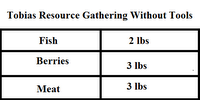
Assume a shipwrecked sailor (Tobias) on an island with no resources but his own two hands and his ingenuity.  To survive he has a number of options:  He can gather fruit/berries for a return of 3 pounds of berries per day, he can fish in the shallows(without tools) for a return of 2 pounds of fish per day, or he can hunt wildlife(without tools) for a return of 3 pounds of meat per day.
wageslavery1

Tobias requires 2 pounds of consumer goods per day to survive.  On this island consumer goods are either Berries, Meat, or Fish and given Tobias’ productive capacity of either 2 pounds of berries or 3 pounds of the other two consumer goods any intake of resources allows him to maintain his existence (subsistence).  It is at this point we must examine whether Tobias’ work is slave labor.

The definition [1] of a slave is:

1.

a person legally owned by another and having no freedom of action or right to property

2.

a person who is forced to work for another against his will

In our scenario is Tobias the property of anyone other than himself?  The answer is clearly “no” since Tobias is quite literally the only person on this island.  While he is “forced” to work due to his innate need for sustenance it would be counter-factual to claim he is somehow a slave to himself since the definitions of slave-master and slave are incompatible with another [2].  It is also absurd to say that because they provide his method of survival that Tobias is somehow slave to the ocean or the land [3].  So as we can see; when Tobias is alone on the island working to survive he is a slave to no one.

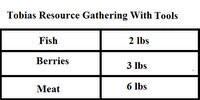
To this point we have been dealing with Tobias merely using his nature given resources to obtain and consume consumer goods.  However by collecting berries or hunting for two days (6pounds collected – 4 pounds consumed) he obtains 2 pounds of excess goods he can save.  Through this method of saving and then consuming the saved goods on the third day he can then use that time to create capital goods.  This means that on the third day, instead of hunting he can fashion himself a spear from collected wood.  The spear allows him to take on larger game and thus increases his collection of meat to 6 pounds per day.
 wageslavery2

At this point we need to examine two things.  First, at this point it would be foolish for Tobias to do anything other than hunt.  He has a decisive gain in resources due to his construction of the Spear and can use the vast amount of saved food to create even more goods (extra spears, traps, shelter, etc…).  As foolish as it may be objectively that diagnosis ignores his subjective valuations; perhaps he finds it distasteful to kill animals even in his situation, or simply prefers to pick berries due to the relative safety.  The reasons are irrelevant, just keep in mind that despite the obvious advantage of hunting in this scenario he can always choose not to.

The second thing we need to examine is whether Tobias is now a slave.  All of the evidence from the previous examination applies; he is still not a slave to himself.  The only thing that has changed is the creation of a spear from the saving of consumer goods.  It is clear that Tobias cannot be a slave to either the spear or his own saved consumer goods, again due to their nature as objects.  So we have seen that a worker working, both with and without capital goods, is a slave to no one.

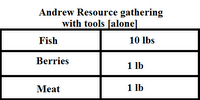
Now here is where the hypothesis comes into question.  Let us assume a second person becomes stranded on the island; except this person (let’s call him Andrew) has been able to scavenge from his wrecked ship a small life boat and netting that is suitable for fishing.  Using his tools while alone Andrew can Hunt for 1 pound of meat, gather 1 pound of berries, or gain 10 pounds of fish.
 wageslavery3

In this economy Tobias will gain the most by hunting and Andrew will gain the most by fishing and they both are likely to pursue those activities [4].  Now we must again identify if this change in circumstance has resulted in slavery.  Tobias’ situation has not changed at all, so he is not a slave to anyone.  Andrew is not interacting with Tobias in any way, he cannot be a slave to his boat, his net, the ocean, or himself so he is also obviously a slave to no one either.

However Andrew soon comes to believe that if he had someone to operate the net while he piloted the boat he could obtain 20 pounds of fish per day, this may be an erroneous prediction but that is the entrepreneurial risk Andrew must take to earn a profit.  For the sake of this examination we will assume that Andrew is an amazing entrepreneur and his prediction is exactly right; but to obtain the 20 pounds of fish Andrew needs an employee.

Here we reach the concept of wages.  In the economy where both Andrew and Tobias work alone they obtain 10 pounds and  6 pounds of consumer goods respectively for a total of 16 pounds.  Andrew, as an entrepreneur, sees that if he employed Tobias they would obtain 20 pounds of total consumer goods which is an increase in the size of their economy by 4 pounds of consumer goods.    At this point Andrew needs to hire Tobias.

If you remember; the subsistence level for Tobias is 2 pounds of consumer goods per day; so any attempt to hire Tobias for less than that will be ignored since he could not survive at that wage.  Currently though Tobias is producing 6 pounds of meat using just his own intelligence and skill so any attempt to hire Tobias below that rate will also be denied.

Andrew would obtain 10 pounds of goods without Tobias’ help so he would be amiss in paying Tobias more than that since then Andrew would then be taking a loss.  Using our final profit of 20 pounds if Tobias agrees to work for Andrew the wage rate must be between 6 and 10 pounds of goods per day.

In this scenario let’s assume Andrew offers to pay Tobias 7 pounds of goods in exchange for his work operating the net [5].   Tobias would then be gaining 1 pound of goods over his efforts if he worked alone.  Andrew would be gaining 3 pounds of goods compared to his work alone.  Tobias agrees to this arrangement and both parties are better off.  Here is where the proponent of wage slavery points to the fact that Tobias is seemingly generating 10 pounds of goods but only obtaining 7 pounds and thus he is being exploited by the capitalist-pig Andrew but let’s examine whether there is a master-slave arrangement here.

Andrew has freely chosen to hire Tobias at the cost of 7 pounds of consumer goods with the expectation of gaining 13 pounds for his own use.  He is free to terminate this agreement at any time.   Tobias is in a voluntary agreement to help Andrew obtain a total of 20 pounds of consumer goods in exchange for a payment of 7 pounds of goods.  He is free to leave at any time if the agreement becomes unsatisfactory and hunt for himself, though he would suffer a net loss of 1 pound of consumer goods to do so.

There is nothing here that fits the definition of slavery, Tobias is not forced to work against his will and Andrew is not forced to hire him.  Both parties own their own property and neither owns the other in part or in whole.  Even though Tobias would be taking a loss by leaving Andrew’s employment the loss to Andrew would be even greater!  Andrew would be losing 3 pounds of profit and Tobias would only be losing 1 pound.  Therefore despite Tobias’ innate need to work this does not cause a master-slave arrangement or “exploitation”.  It is true Tobias has to work to survive but he does not need to work for Andrew; but he voluntarily will continue to do so as long as it benefits him.

Finally, what of the “missing” 3 pounds of goods that Tobias is somehow losing?  The answer is obvious; it is the price put on Tobias’ use of Andrew’s capital goods which in this scenario are his boat and net.  Without these capital goods Tobias would not be able to generate 10 pounds of consumer goods and therefore there is a premium placed upon them by Andrew; after all they are his property and he must maintain them.  If Andrew’s boat was to spring a leak or his net tear Tobias would not have any responsibility to fix them and could happily take his 1 pound loss and go back to hunting while Andrew (if he had not achieved some profit) would suffer the far greater loss of both his 3 pounds of goods and the destruction of his capital goods.

It is worthwhile to note how this scenario compares to the classic opinion that people born into wealth have somehow acquired it illegitimately.  In our scenario Andrew did not need to save consumer goods like Tobias did in order to obtain capital goods, he simply has them due to luck, or fate, or what-have-you.  This does not change the fact that he does indeed own them and can utilize them how he wishes and that utilization is totally legitimate.  Would anyone scoff if Tobias handed down the hunting spear to a future son for his protection and livelihood?  To remain consistent we cannot then harry Andrew for passing down his fishing equipment for the sole reason that it would give his own heirs an “unfair competitive advantage”.

It is evident by now that the entire concept of wage slavery is simply a misunderstanding of economic principles.  Even the myth that somehow the wage earner does not get “his fair share” has been debunked.  The simple reason why so many find these concepts hard to extrapolate in the real world is due to the hundreds of years of savings, production of capital goods, and the highly specialized division of labor that has made worker productivity increase to such an extent that the fall to subsistence seems unfathomable.

The productivity of the workers in the industrialized world has become so great that any work outside of this world, such as gathering berries or fishing to feed an entire family, would require a massive drop in quality of life.  This is somehow turned around to be a slight on employers when they are the ones who have made this increase in the quality of life possible.

If we had replaced Andrew’s life boat in our scenario with a commercial fishing trawler that allowed Tobias to obtain 500 pounds of fish per day would we then say he is Andrew’s slave because he would be “forced” to return to hunting only 6 pounds of meat per day should he choose to leave?  Would Andrew be a villain for hiring Tobias and paying him such a vast increase over the wage he could obtain by working alone?  No! Of course not! It doesn’t logically follow!  Yet that is the accusation from the proponents of wage-slavery and it is clearly absurd.

[1] http://dictionary.reference.com/browse/slave?s=t

[2]  It is true that a slave could himself be the master of a third slave, but a slave master logically cannot be a slave to his own slave since either one slave or the other would end his own involuntary servitude.

[3] By their nature as objects they cannot own other objects.

[4] Whether they actually trade goods at this point is irrelevant because both parties are satisfying their base needs through their own effort.

[5] We are also assuming that the number of hours worked are the same and subjective preferences of hunting over fishing or vice versa are non-existent.

Obama’s Utilitarian Foibles

The utilitarian insists that the morally right way to act is to promote the greatest good for the greatest number (of people but perhaps of all sentient beings). This goes for public policy as well! The goal overrides any individual rights, so if to secure it some people’s rights to life, liberty and/or property need to be violated, so be it!

For example, if to provide health insurance for elderly folks it is necessary to coerce young people to purchase health insurance, then coerce them! Never mind their right to liberty and property. Those are irrelevant, even though they are supposed to be unalienable rights no one may violate, not in the American political tradition.

Here, then, is a clear example of how the Obama regime departs significantly, in its political philosophy and program, from the uniquely American framework. This framework supports securing the protection of individual rights as the primary job of government. Read the Declaration of Independence and see for yourself. That is indeed the central feature of the American Revolution, with its Bill of Rights and its Constitution.

Not only does that render the country one that’s free – under which all citizens may live as they choose provided they do not violate anyone’s rights – but is responsible for the great prosperity of the country, its freedom from arbitrary government intervention in people’s lives. Even the public good or interest does not permit it. While this may appear to be a restriction that stops the country from achieving utilitarian objectives, the very opposite is the result! That’s because free men and women make the most productive use of their liberty.

The idea is that human beings are by their very nature proactive. They think of ideas that they will implement and these are usually good ideas, ideas their fellows can make good use of. This is the essence of entrepreneurship. They don’t just daydream but think purposefully, which is to say their ideas can be marketed to others. Out of this process arises the bustling economy of a country and, indeed, of the world.

So long as men and women are free to think creatively and productively, they will make sure their work will have payoffs, either economic or personal or even charitable. This is how a free society works, creates products and services, and leads to high employment to boot.

But the likes of Obama & Co. want to step in and regiment how free men and women act and they believe or pretend to know what others should do to be productive. And that means, usually, that they misguide the economy. (The most notorious recent example of this was all those five-year plans Stalin and his gang unleashed upon Russia and its satellite states, which brought the Soviet Socialist system to its knees!)

But Mr. Obama & Co. fail or refuse to grasp any of this. Shame on them!

Liberty & Productivity

Statists routinely suggest their distrust of human initiative. This is why they keep advocating government stimuli instead of free markets.

In a free market, one which prohibits government intrusions, regulations and regimentation, it is understood that when men and women are free of such intrusions, they will most likely – though never certainly – engage in entrepreneurial initiative, the main result of which is productivity. No guarantee exists that free men and women will innovate and produce but that is most likely. Indeed, while slaves can be scared into work, free men and women will usually see the point of work and engage in it with gusto.

Statists, of course, deny this and claim that only if government creates artificial incentives or issues threats will citizens become productive. That is the basic theory behind stimulus packages, tax breaks, subsidies and so on.

But notice that all this omits the issue of why bureaucrats and politicians would be motivated to work. Why are they exceptions to the rule that statists assume, namely, a lethargic citizenry? How can we trust government agents to go to work, to produce, to innovate, etc., but not free men and women? Statists never address this as they advocate pushing citizens around, nudging them, stimulating them, etc. Who will nudge the nudgers?

At the heart of this issue lies a basic philosophical dispute: Are free men and women capable of initiative, of getting to think and work on their own or must they be dealt with like barnyard beasts that need to be driven to work by masters? Statists see people as such animals, incapable of innovation, of initiative, of creativity, so they need to be pushed around by bureaucrats and politicians. Yet this is completely inconsistent with the powers they grant to themselves. Why would only those running government possess the power to undertake productive, creative projects while the citizenry is deemed too passive?

Actually, a better way of understanding this is to realize that statists want to reserve to themselves the prerogative of spending resources on various projects – public works, they like to call them – and rob the rest of the citizenry of their resources to do as they judge sensible, prudent and wise.

In short, the statist wants to be in charge of what projects get to be undertaken, use everyone’s labor or property for these and not permit the rest of us to allocate our resources, including our labor, to projects of our own.

What do Mexicans read for intellectual nourishment?

I asked an old friend of mine (I think he’s a professional economist these days, but I deactivated my FB and haven’t been able to keep up with anyone) to help me find some Mexican media outlets to troll for knowledge and information. I also wanted to know how influential Mexico’s press is outside of Mexico (especially in regards to her smaller neighbors in Central America but also to Spain). He gave me the following heads up:

I’d recommend searching for articles in Nexos and Letras Libres magazines, which are something like the The Atlantic.

Mexico is very insular and there is almost no influence from media outside or from here to other places. However, I believe El País from Spain usually does a good job reporting about Mexico.

My friend and I actually met at a summer seminar put on by the Institute for Humane Studies back in 2009. It’s the same seminar that I met Rick at as well. If you are young and want to be a competent defender of liberty then I would highly suggest checking out the IHS’s programs.

Investment & Prudence

To be prudent amounts to making sure that one takes good care of oneself in all important areas of one’s life. Health, wealth, family, friendship, understanding, etc. are all in need of good care so that one will achieve and sustain one’s development as a human individual. It all begins with following the edict: “Know thyself!”

All those folks who make an effort to keep fit and to eat properly are embarking on elements of a prudent life. Unfortunately, the virtue of prudence has been undermined by the idea that everyone automatically or instinctively pursues his or her self-interest.

We all know the rhetorical question, “Isn’t everyone selfish?” Because of certain philosophical and related doctrines, the answer has been mainly that everyone is. In the discipline of economics, especially, scholars nearly uniformly hold the view that we all do whatever we do so as to please ourselves, to feel good. No room exists there for pure generosity or charity, for altruism, because in the final analysis everyone is driven to act to further his or her own wellbeing, or for carelessness, recklessness. If people do not achieve the goal of self-enhancement, it is primarily out of ignorance – they just don’t know what is in their best interest but they all intend to achieve it and even when they appear to be acting generously, charitably, helpfully and so on, in the end they do so because it gives them satisfaction, fulfills their own desires and serves their idea of what is best for them.

This is not prudence but what some have dubbed animal spirit. People are simply driven or motivated to be this way, instinctively, if you will. The virtue of prudence would operate quite differently.

One who practices it would be expected to make a choice to pursue what is in one’s best interest and one could fail also to do so. Practicing prudence is optional, not innately produced. Like other moral virtues, prudence requires choice. It is not automatic by any means. The reason it is thought to be so, however, has to do with the intellectual-philosophical belief that human conduct is exactly like the behavior of non-human beings, driven by the laws of motion!

Once this idea assumes prominence, there is no concern about people having to be prudent. They will always be, as a matter of their innate nature. What may indeed be needed is the opposite, social and peer pressure to be benevolent or kind, to adhere to the dictates of altruism, something that requires discipline and education and does not come naturally to people.

It would seem, however, that this idea that we are automatically selfish or self-interested or prudent doesn’t square with experience. Consider just how much self-destructiveness there is in the human world, how many projects end up hurting the very people who embark upon them. Can all that be explained by ignorance and error?

Or could it be, rather, that many, many human beings do not set out to benefit themselves, to pursue their self-interest? Could it be that human beings need to learn that they ought to serve their own wellbeing and that their conduct is often haphazard, unfocused, even outright self-destructive (as, for example, in the case of hard drug consumers, gamblers, romantic dreamers, fantasizers and the lazy)?

It seems that this latter is a distinct possibility if not outright probability. It is a matter of choice whether one is or is not going to be prudent, in other words. And once again, ordinary observation confirms this.

One can witness numerous human beings across the ages and the globe choosing to work to benefit themselves, as when they watch their diets or work out or obtain an education, and many others who do not and, instead, neglect their own best interest. Or, alternatively, they often act mindlessly, thoughtlessly, recklessly, etc.

The contention that they are really trying to advance their self-interest, to benefit themselves, seems to be one that stems from generalizing a prior conviction that everything in nature moves so as to advance forward. This is the idea that came from the philosopher Thomas Hobbes, who learned it from Galileo who took it from classical physics.

Accordingly, acting prudently, in order to advance one’s wellbeing, could be a virtue just as the ancient philosopher Aristotle believed it to be. And when one deals with financial matters, careful investing would qualify as prudence, just as is working out at a gym, watching one’s diet, driving carefully, etc.

What is Reality?

by Fred Foldvary

Reality is what actually exists. The philosophical question is how can we know reality. Idealists say that all we can do is perceive, and we cannot prove that objects exist in the way we perceive them, and so there is no objective reality. Some idealists go further and claim that all knowledge is based on language. In contrast, realists claim that there is indeed an objective reality apart from our perceptions.

In my judgment, the two methods that best justify a view of reality are foundationalism and coherentism. In foundationalism, truth is founded on a foundation of premises from which a structure of proposition is constructed or derived using on logic and evidence. In coherentism, truth is based on the logical consistency of observations. Coherentism has to have a foundation in order to judge consistency, so the two methods are perfect and necessary complements.

The outcome of coherent foundationalism is what philosopher Edward Pols calls “radical realism.” As I analyze it, the proposition of radical realism is that there is an objective reality apart from any perceptions. However, all that human and other living beings can know is logical propositions and observations. The problem with observations is that they can be false, and that facts are necessarily interpreted.

Reality is derived from observations that are filtered by logical consistency. A person can judge the consistency of objects over time. If I wake up and see a picture, and it is also there the next day, and every day, then this consistency leads me to believe that the picture is actually there. Consistency also involves agreement by a group of persons that their observations are the same. If I see a cat, maybe I imagined it, but if you see it also, and so do many others, then the conclusion that the cat is there is warranted by consistency across persons.

An idealist will reply that even if many people agree about some object, and it is observed consistently over time, it could be a continuing mass illusion. It is still no more than an observation. Radical realism does not deny that what is observed – seen, heard, touched, tasted, smelled – are sensations in the brain. What makes this realism radical, going to the roots of the issue, is the proposition that this is what reality is. Radical realism is the proposition that empirical reality consists of consistent observations and their logical deductions.

Radical realism differs from merely empirical realism in claiming that the observed objects actually exist, so that perceptions are not merely accepted as being useful. Idealists say that when an ordinary person accepts observations as real, this, what is called “direct knowing,” is “native realism” or “vulgar realism” because one cannot logically derive from observations the objective reality of the objects. But radical realism does not blindly accept the reality of observations. It sieves the observations through a filter of logic. It then proclaims that the results of consistent observation is reality, because reality cannot be anything better. We could call it “coherent reality.”

Radical realism also recognizes that facts are always interpretive. Facts are theory-laden. If I see a man wearing blue clothing and a badge, I interpret this as not just a man, but a police officer. But interpretations are also subject to logical consistency. The man might be going to a costume party. But if the actions of the man are consistent with that of a police officer, such as citing people for infractions, we can conclude that the interpretation is reality. Contrary to idealism, reality is not created by thoughts, but rather, reality consists of conclusions from consistent mind observations filtered through logic.

Radical reality recognizes that what we perceive as solid objects are actually made up of molecules, atoms, and other particles we cannot directly observe. But the existence of atoms derived from the observed tracking of the their effects, hence from consistent observation.

The foundation of radical realism is the acceptance of cause and effect, of inductive and deductive reasoning, and the criterion of consistency. If all human beings are somehow fooled into thinking that water exists even when it does not, the consistent perception of water and conclusions from its consequences become the coherent reality.

Radical realism is radical in going to the roots of how we can know reality. This grounding saves it from being merely vulgar or naive. There is much more that we can analyze regarding idealism and realism. Two good books on this topic are The Slightest Philosophy by Quee Nelson, available at Google Books, and Radical Realism by Edward Pols. Most folks handle their daily activities with naive realism, but they fall victim to perverse ideologies ultimately derived from idealism. Thus is it good philosophy to question your beliefs with the Socratic questions, “What do you mean?” and “How do you know?”

Libertarianism and Psychology

by Fred Foldvary

Recently there have been a stream of negative critiques of libertarianism. All of them are misunderstandings.  It seems that these critics are just dressing up their antagonism with pseudo-scientific textiles.

The latest attack is in Psychology Today. Peter Corning, Ph.D., asks and answers “What’s the Matter with Libertarianism?” under the rubric “The Fair Society.”

He says, “The libertarian model of individual psychology is grounded in the utilitarian, neo-classical economics model of ‘Homo economicus,'” by which he means selfish economic man. Corning provides a couple of quotes by Nozick and Dawkins, but no general evidence that such is the viewpoint of most libertarians.  Is there a survey?  Is there  inductive logic leading to this conclusion? No, there is nothing. And this is supposed to be a scientific finding of a scholarly psychologist.

He cites the Wealth of Nations by Adam Smith, but is evidently unaware of Smith’s other book, The Theory of Moral Sentiments, in which Smith explained the other human motivation, sympathy for others.  Most libertarians that I know personally or from writings believe that it is quite good to be benevolent.

Perhaps Corning is confusing libertarianism with an extreme version of Randian Objectivism. He cites Ayn Rand as writing “Man’s first duty is to himself.”  But libertarian philosophy posits no such “first duty.”  The only libertarian moral duty is to avoid coercive harm to others.

Some libertarians are “anarcho-capitalists” who seem to envision an atomistic society of individuals contracting with protective agencies.  But libertarianism includes the communitarian vision of consensual communities with collective goods.

Corning claims that “libertarians generally have no model of society as an interdependent group with a common purpose and common interests.”  But no libertarian denies that society is interdependent. What is denied, and properly so, is that all the persons in a country have some common purpose and interests.  A multicultural society such as the USA consists of many interests, sometimes in conflict.  The interest of a thief clashes with that of peaceful victims.  If libertarianism is applied to society, the diverse interests can co-exist, the rule being that one may not force one’s interests on others.

Corning then notes that corporate interests sometimes perpetrate malfeasance. Yes, and if they commit fraud, that is theft, and libertarian policy would be to punish this.

He writes, “our first collective obligation is to ensure that all of our basic needs are met.” Now we see his political agenda.  Corning is a statist collectivist who favors the governmental welfare state. There is no abstract moral collective obligation. All obligations are individual. There can be a group with a mutual contract that then creates a collective obligation, but only from individual delegation.  As to basic needs, libertarian policy enables people to apply their labor and keep all the wages from that, which enables them to provide for their needs.  It is today’s statist restrictions and taxes that deprive workers of the ability to obtain their needs.  The few adults unable to work would get charity. The mass poverty of today is caused by government, not by the non-existent free market.

Evidently Corning believes that a libertarian world would be too selfish to care about the few who fall into misfortune.  But there is no evidence that greater freedom results in greater selfishness in the sense of not caring about others.  So here we have an article that seeks to apply psychology to an ideology, but with no evidence and with flaws in logic.  Psychology here is being applied as a cover for ideological views.  Has this been peer reviewed, or are the peers just as biased and lacking in scientific principle?

Lies and Untruths

Big lies are pretty much the same on all ends of the political starfish. I am more interested in persistent white lies and in the mechanisms of collective self-delusion. I think they are more common on the Left. In fact, I believe they underlie liberal thinking to a large extent.

Although I have been living most of my adult life with these kinds of untruths, in academia, I am only now trying to gain a precise understanding of the relevant psychology. It takes leisure time and some perspective, I suppose. I have spotted two big sources of half-involuntary mendacity, so far .

I have frequent conversations with a young liberal I chose deliberately because he is thoughtful, curious and he seems intellectually honest. (I don’t waste time on older people and I don’t waste time with liars; they are almost always boring.) We have had several exchanges on the reality of global warming. He sent me a long email explaining why he believed it was real while admitting he did not understand the science behind the claim and did not try to. I don’t try either; I don’t understand it either; I don’t have to. I know a liar and a fabricator when I see one. If your cause or your theory is good, you never have to lie about it. The last sentence of his last email stated that he had to go, on this issue, with the “majority” of scientists. I heard a click go off in my brain. This sounds oddly familiar though I have not heard it said so clearly. Continue reading

A Good Society: The Coffee Proof

We still live in a good society. I keep forgetting this and life keeps reminding me.

I have a younger friend who graduated with honors and with a major in Philosophy. I liked him just for that. It sure beats a major in”Psychology,” or one in “Management.” Incidentally, I know that some of my readers know that I used to teach from a “Management Department.” My excuse is that I tried very hard never to teach whatever you think is “management” and that I pretty much succeeded overall. (This story will have digressions. It’s one of those days. Go with the flow.)

Anyway, my friend takes care of several coffee shops. He has become the owner’s right hand by din of being hard working and just plain reliable. Two things happened to him as a result. The first is political. My friend went to the University of California at Santa Cruz, where Stalinists communists are considered conservative. So, of course, he used to be kind of a left-winger. (That would be the honest kind, the kind that does not knowingly make false statements.) Nowadays, though, the closer the he gets to the books, to the actual accounting of the coffee shops, the more he moves to the political center. Who ever said philosophy is “useless?”

The other thing that happened to my friend through his work is that he became a coffee connoisseur. One day that he inquired about a present for me, I said, “ Surprise me with coffee.” He did. He brought me a small quantity of a variety I had never heard about. “How did you like it? “ he asked two days latter.

Well, I stopped lying – except in emergencies – at about the time I stopped lying to women. And, incidentally, there was never much reason to believe that I ever, ever deceived a single woman. Mostly, they listened to my lies smilingly because they liked the poetry of them.

At any rate, I replied to my friend that his gift coffee did not paint my particular town red. He had this superb response I have not been able to get out of my head for days now; he said that that particular coffee was “divisive.” I am so lucky! I live in a society so peaceful, so prosperous, so fulfilling that here, expensive coffee can be considered divisive!