AEM Europe and PCPE in Prague, April 21-24 2016

I have recently returned home from 4 days of Prague, Czech Republic, where I attended two conferences: Austrian Economics Meeting Europe and the Prague Conference on Political Economy. After having been secluded from Austrian economists and Libertarians for almost 2 years, it felt like a homecoming to be surrounded again by people who share similar thoughts. This was after all the only place in the last two years where I was able to fully express my (´controversial´) ideas about society. Being surrounded by tremendously smart people – you have to be rather smart and geeky to give up part of your free time or professional work in order to visit conferences and discuss philosophy, politics and economics – within the beautiful city of Prague made it a wonderful experience.

The AEME came about after the summer of 2014 when those from Europe who visited Mises University that year decided to come together again to discuss classical liberal ideas in the spirit of Carl Menger, Ludwig von Mises, Friedrich von Hayek and Murray Rothbard. The first AEME event took place in 2015 in Vienna, Austria, the city where the Austrian School of economic thought emerged from the works of Carl Menger, Eugen von Böhm-Bawerk, Friedrich von Wieser, and others. The Austrian School is famous for its methodological struggle against the Prussian Historical School and their idea that economics is culture- and time-specific and therefore does not contain universal validity. The Austrian School is also famous for such theoretical contributions as the subjective theory of value (as opposed to Marx’ labour theory of value), theory of marginal utility, opportunity cost doctrine, Austrian business cycle theory, the time structure of production and consumption, methodological individualism and the economic calculation problem that was first formulated by Ludwig von Mises in 1920 and later expanded upon by Friedrich von Hayek to show that pricing systems in socialist economies were necessarily deficient. From a socio-political perspective, the School argues for limited government and some even for libertarian anarchism.
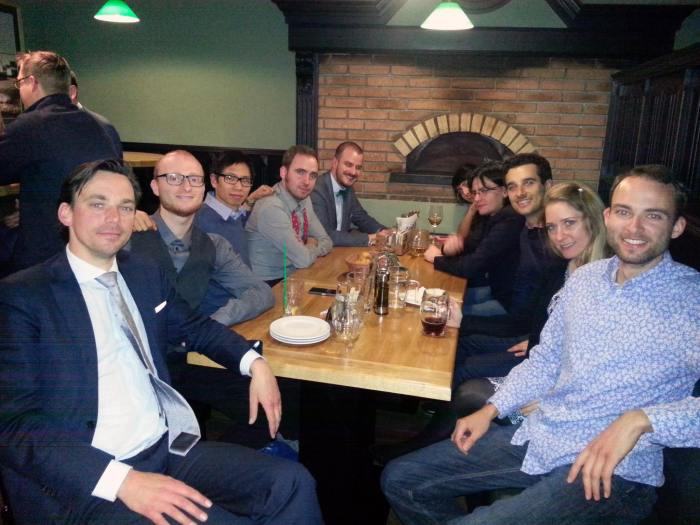
AEME pub
AEME participants sharing their last evening in Prague in a local pub

What was great about the second AEME is that it took place right before the PCPE conference at the CEVRO Institute. Most of us who attended AEME have stayed two extra days to attend the PCPE conference as well. The CEVRO Institute is a private university founded in 2005 that is located in the very centre of the city of Prague. The university prides itself in its emphasis on freedom, markets, and its innovative character that is for example manifested in its PPE (Philosophy, Politics, Economics) programme taught by such international illustrious professors as Michael Munger who is also director of Duke University’s PPE programme, Peter Boettke who is the director of the F.A. Hayek Program at George Mason University, David Schmidt who is director of the Center for the Philosophy of Freedom at the University of Arizona, Boudewijn Bouckaert who was the former dean of the Faculty of Law at the University of Ghent, and Josef Sima who is the president of the CEVRO Institute. The institute has invited several prominent speakers for its conference. Prof. Mark Pennington (London School of Economics) was for example invited to present “Why most things should probably be for sale”. Prof. Benjamin Powell who is the director of the Free Market Institute at Texas Tech University, the University to which I almost applied to to pursue my PhD in the academic year of 2015 but eventually decided to work as a software engineer, was there as well to speak about “Migration, Economic Calculation, and the European Situation.” Prof. Mario Rizzo (New York University) had the honour to be the keynote speaker and spoke about “The four pillars of new paternalism” which was followed by commentaries from Prof. Pascal Salin, former president of the Mont Pelerin Society.
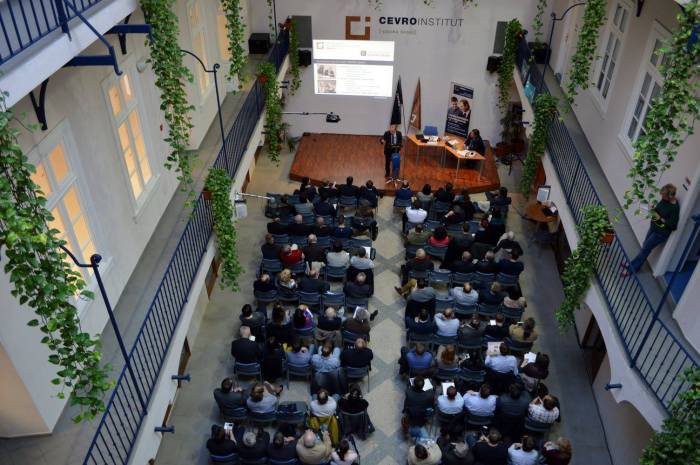
PCPE 2016
Mario Rizzo’s welcome speech to PCPE

The second day of the PCPE conference, there were 27 speakers spread over 9 sessions on such topics as economic theory, anarcho-capitalism, the Austrian School, entrepreneurship, cryptocurrencies, the role of family and more. I was one of the speakers and spoke on the “Philosophical investigation of seasteading as the means to discover better forms of social organization”. The thesis of my talk was that one core focus of political philosophy is to deal with the realities of value pluralism and political disagreements. I contended that the most common form of social organization, representative democracy, does not satisfactorily deal with these realities. Therefore, we should look for political possibilities beyond representative democracies and that in order to discover these possibilities, we should experiment with new forms of social organizations. By approaching the issue from a meta-system level perspective and realizing that governments are resistant to structural societal changes we should then introduce competition into the industry of governments. Seasteading, the creation of habitable dwellings on the oceans, could serve as a means to introduce more competition in the industry and lessen political tensions between citizens who hold different comprehensive doctrines.
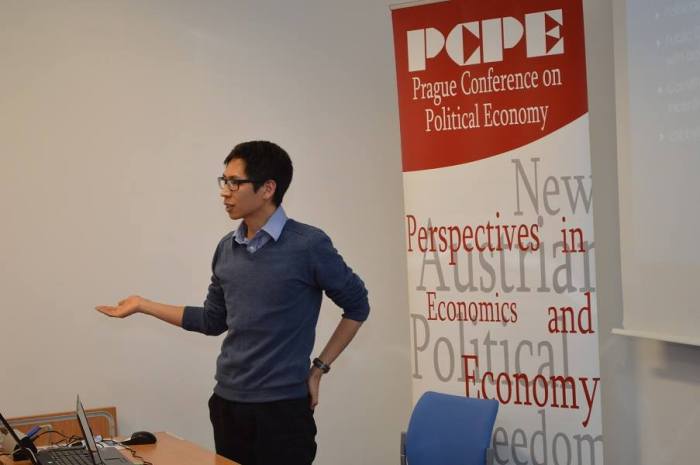
Chhay Lin - PCPE
Me speaking at PCPE about Seasteading as the means to deal with such political realities as value pluralism and political disagreements

If I could mention one thing that has made the most remarkable impression on me, it would be the warning issued by Prof. Stephen Baskerville (Patrick Henry College, USA) that the most immediate threat to our liberties is feminism and the social justice movement. He maintained in his talk that there is an ensuing crisis of the family which is perpetuated by the state. According to Prof. Baskerville, family courts can enter homes uninvited, take away people’s children, confiscate their property, and incarcerate them without trial, charge or counsel. With over 50% of all first marriages ending in divorce and more than half of all these divorces involving children, the greatest threat to our liberties is the colluding social work state bureaucracies with radical feminism. These groups have colluded to suppress information on such injustices. Listening to Baskerville’s talk, I felt the great urgency to engage in an intellectual battle against feminism and the social justice movement.

Other than the many intellectually invigorating moments, the city itself provided many magnificent sites. To mention several sights: we visited a beer garden, experienced a classical music concert at the Mirror Chapel, walked over the Charles Bridge, and visited the Prague Castle.
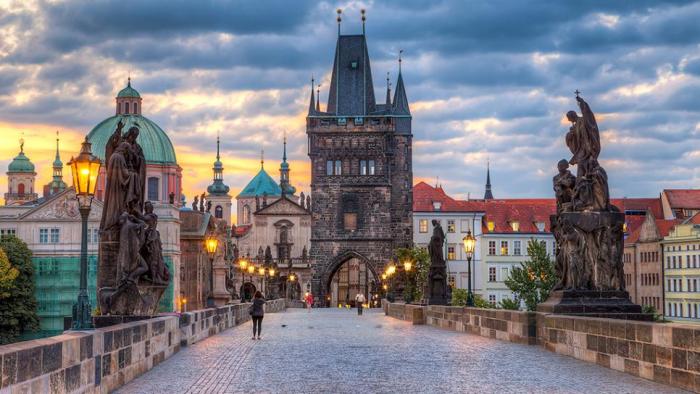
Prague Charles Bridge
The beautiful Charles Bridge crossing the river Vltava

All in all, the city of Prague, AEME and PCPE were an unforgettable experience! It has already been decided that next year’s AEME conference will take place in Krakow, Poland. The conference will be open for anyone who is interested in Austrian economics and libertarianism. For more information on AEME and the papers that were presented in the previous editions, you can find our website here. In case you are interested in studying at the CEVRO Institute and its MA PPE programme with specializations in “Austrian Economics”, “Studies of Transition”, and “International Politics”, you can visit their website here.

Vote Different. Be A Libertarian. Let Life Live

John McAfee’s latest political campaign ad is inspiring as it asks voters to vote libertarian. It is an homage to Apple’s “Think Different” ad as well as to individual freedoms, creativity and intellect.

The video shows ‘rebels’ and game-changers who have moved the world forward. You do find Steve Jobs, Elon Musk, Edward Snowden, Julian Assange, Peter Thiel, Bradley Manning, Ross Ulbricht, Martin Luther King, Ayn Rand and many more. You even see Bitcoin and crypto-capitalism which is simply another form of libertarian anarchism. Ending with the lift-off of a spaceshuttle, the ad presents a message of hope for libertarians and a message of progress as long as we “let life live”.

The same celebration of human individualism and message of hope was also apparent in McAfee’s earlier campaign ad that was released two weeks ago.

Objective Moral Rules

“Moral realism” is the proposition that objective moral rules exist. A moral rule assigns a moral value (good, evil, or neutral) to an act done by a person. A moral rule, such as “theft is evil,” is intended as a fact.

Moral realism is non-nihilist and non-relativist. Nihilists and relativists believe that no act is inherently good or evil, that there is no morality beyond personal and cultural beliefs. Moral realism is based on an ontology, a way to show that an objective morality exists.

The existence of an objective and universal ethic cannot be based on intuition. Intuition consists of ideas believed without conscious thinking. What people think of as intuition is heavily influenced by the prevailing culture. One person’s intuition may tell him that gambling is bad, while other may think that gambling is harmless fun.

Many ontologies of morality have been proposed. The one I think is warranted in reason is the natural moral law proposed by John Locke, although he did not present a derivation. In my judgment, the ontology consistent with Locke is as follows.

1. There are criteria that are necessary for the existence of a universal ethic. The ethic has to be universal to all persons, comprehensive to all acts, non-arbitrary in its premises, and logically consistent. If one presents an ethic which fits these criteria, then the universal ethic exists.

2. The premises of natural moral law are the biological independence of individual thinking and feeling, the moral equality of persons, and the existence of a personal ethic in each person’s mind. The first two were proposed by John Locke in his Second Treatise of Government. The equality premise is based on the common observation that there is in human nature no inherent basis for one group of persons to be superior masters over a second, inferior, group.

3. The derivation of natural moral law, as expressed by the universal ethic, provides rules for the three moral values (good, evil, and neutral). Good acts are welcomed benefits. Evil acts coercively harm others, as invasions, in contrast to merely offensive acts that depend only on the beliefs and values of those affected. All other acts are morally neutral.

Those who reject moral realism ask about the fact-value problem, the proposition that one cannot derive a moral value from any observed fact. The answer is that the universal ethic does not create any values. The values are held by individuals, in accordance with the third premise, the existence of personal ethics. The universal ethic is a production function which inputs individual moral values (good, evil, and neutral) and transforms them into universal ethic moral values. For example, if a theft takes place, the individual moral value is that it is evil, and since the theft is an invasion, a coercive harm, this individual value becomes a universal ethic value.

If, in contrast, a person observes someone who is walking naked on his property, and judges that to be evil, the universal ethic inputs that value and makes it neutral for the universal ethic, since that is an offense rather than an invasion into another’s property.

Therefore, the natural moral law does not generate values from facts, but rather, produces natural moral law values by inputting personal values and then applying its rules to output universal-ethic values.

Some skeptics reject natural-law moral realism because its premise of personal equality cannot be proven true the way that, say, the law of gravity is shown to be true. The proposition that there is in human nature no inherent master/slave relationships can be observed and inferred, but the conclusion is not apodictic, i.e. absolutely certain. However, the alternative is either supremacism, the alleged superiority of some religion or creed, or else nihilism, the absence of any transcendent morality, and either one leads to war.

The purpose of the universal ethic is the moral basis of proper governance, and since to my knowledge, nobody has come up with a superior moral idea, the ontology is good enough for the practical purpose of providing social peace and harmony with nature.

The Moral Case for Fossil Fuels

If you’re interested in energy and environmental issues, especially climate change, have a look at this 15-minute appearance by Alex Epstein before the Senate Environment and Public Works committee. In a pressure-cooker atmosphere, he argues persuasively for the benefits of fossil fuels and for a sensible approach to climate issues.

I also highly recommend his book, The Moral Case for Fossil Fuels.  He reasons carefully about fossil fuels, alternative energy, and climate change.

Liberty and the Novel II (Austen and After)

(Click for Part I) In Austen’s novels, we find something ‘unheroic’ in that they are concerned with the search of upper class women, bound by codes of gentility, for both a satisfying place in the world and emotional authenticity through marriage. Though there is none of the religious fervour of Pilgrim’s Progress, the message is sent that an ideal community is a small rural community guided by sincerely godly priest, concerned with the daily lives of his congregation.

There is none of the extremism of Quixote’s fantasies and adventures, but the simultaneous process of  triumph over illusion and the growth of inner authenticity, is there in Pride and Prejudice, Sense and Sensibility, Mansfield Park, Emma, Persuasion, and Northanger Abbey, as the characters find marriages worthy of their growing ethical capacities in self-judgement and judgement of others.

Ethical growth means confirming a place in the landowning classes and taking a decidedly ambiguous attitude to making new money in trade. Landed property and religion are the starting points of an ethically tolerable community for Austen. We can see the growth there of what we might now think of as social and political values based on self-ownership and individual responsibility though somewhat constrained by respect for earlier aristocratic expression of these values.

We can see a version of Lukács’ split between heroic progressive bourgeoise and backward looking conformist bourgeoise there. Though it is absurdly crude to take 1848 as the line of of separation between the two tendencies, it is useful to think about the distinction as it evolved over time, including the events of 1848. Over time the basic bourgeois goals of rule of law, individual rights, representative government, and free trade tend to be achieved. The word radical is used less and less for the advocate of bourgeois individualism and more and more for advocates of a socialist state.

In literature the themes of the individual triumphing over circumstances, enduring disaster, awaking from illusions, developing individual moral strength, and finding some moment of authenticity continues. The novel keeps developing as a form, but in many people’s opinion, including my own, it reaches a peak in the early twentieth century (James Joyce, Franz Kafka, Marcel Proust, Virginia Woolf, Thomas Mann) which it has never matched, though ambitious and admirable novels continue to be written.

The more straight forward kinds of heroism are not so prevalent as in earlier novels, but the irony and ambiguity about heroism develops what was already in the genre and intensifies individualism, even while questioning it. Some of these writers were sympathetic to socialism though born into a largely bourgeois liberal world, at least compared with developments after World War One.

Coincidentally or not, this coincides with the transitions from a limited-state individualist nineteenth century liberal politics to the welfarist-administrative state we now know and which is stronger than ever, despite all the cries of ‘neoliberalism’ and ‘market fundamentalism’ that arise in reaction to any attempt to limit the statist drift.

There is a danger of rivaling Lukács’ tendency towards a moralising tendentious Marxism from a pro-liberty point of view, but I am anyway tempted to say that the reduction of the significance of the novel is a symptom of societies which aim to remove individual responsibility in the struggle with circumstances. Or I can put it in terms more amenable to those who welcome the welfarist-administrative tendency. The novel has lost some part of its significance as individualist ways of thinking are less influential in politics.

In fact I can wholly agree with this stereotypical imaginary progressive that Ayn Rand’s attempts to revive the grand individualist heroic aspects of the earlier novel are rather embarrassing. The Peruvian novelist Mario Vargas Llosa (Aunt Julia and the ScriptwriterThe War of the End of the World, The Feast of the Goatetc), who is an eloquent liberty advocate, is a far better novelist, and is as good as anyone currently active, so still not rising to the level of the Modernist greats of about one hundred years ago. Liberty advocates are also part of this cultural shift or loss, however you prefer to see it.

(crossposted at Stockerblog)

Liberty and the Novel I (Before Austen)

I’ve been working on Jane Austen and ethics recently. These ethical investigations have overlapped with considerations of politics and liberty, with regard to the progress of such ideas in the early nineteenth century when Austen was writing, along with the immediately preceding and following periods.

There is a well known Marxist view of the history of literature, which is that the novel (and other literary genres, but mostly the novel) can be seen as developing along with the development of the bourgeoisie, so that is progressive and emancipatory until the turning point year of 1848 when the bourgeois class at least in part turns against the progressive-democratic, working class, and national revolutions of the European Springtime of the Nations.

At this point the capitalist class flees from democracy, allying with the royalist and aristocratic forces to prevent a revolution that might overturn property relations as well as pre-democratic political forms. After 1848, the novel largely becomes inward looking and alienated from social reality, because of the ties of writers and readers to a bourgeois class trying to hold back socialist working class politics, or at least fears to ally with it.

The classic exponent of this view is the Hungarian philosopher Georg Lukács who was born into the Habsburg Empire and so wrote in German, very much continuing themes from German language philosophy, literary studies, and social science. The relevant texts include The Historical Novel and Studies in European Realism.

I do not write to advocate Lukács’ literary history and of course even less do I advocate his Leninist politics. However, he undoubtedly makes an important contribution. Not many people now, Marxist or otherwise, would advocate the more schematic elements of his literary history. Nevertheless he was continuing ideas he had before his turn to Marxism, as expressed in Theory of the Novel and Soul and Form and he was onto something with regard to the heroic and less heroic phases of literature.

The novel itself has non-heroic and even anti-heroic aspects. If we take Miguel de CervantesDon Quixote (1605 and 1615) as the starting point of the modern novel, a debatable proposition but not outrageously so, then the novel is something that starts with the mockery of the heroes of medieval knightly romance through a character trying to imitate them in real life Castile. It is a crude piece of social history to say this, but nevertheless it is roughly true that Don Quixote coincides with the growth of commercial Europe, trading across the Mediterranean and the Atlantic, as there is a growth of cities along with the increase in membership of the merchant and financial classes.

This is the sweet commerce rightly advocated by Charles-Louis de Secondat, Baron Montesquieu, but also the violent consolidation of European states and the growth of their overseas empires. This is not all pleasant, but then that makes it to some degree ‘heroic’, as heroism refers to struggle and triumph with limited regard for other concerns. The ‘heroism’ of Quixote is to observe the Spain of his time in his bizarre adventures, learning from experience and awakening from his illusions, if only on the point of death. He becomes disillusioned by experience so achieving a more inner awareness freed from the illusions of romances in an idea of authenticity which has its own romance. A romance that is very visible in the subsequent development of the novel.

Other inputs into the development of the novel include John Bunyan’s The Pilgrim’s Progress (1678), a religious story from England of salvation in an allegory focused on a hero called Christian. There was nothing new about texts of salvation, but this is a novel length narrative devoted to individual struggles with externalised representations of distractions from faith. It was read very widely in the English speaking Protestant world, turning theological concerns into a popular heroic narrative of release of the self from ungodly illusions, and references to it abound in later literature of a kind less guided by strict Reformation Protestantism. (to be continued)

Also posted at Stockerblog

Voter Participation: Something Has to Be Done

In California, 70% of eligible voters are registered, and 47% of those turned out in a recent election. Thus about a third of those who could vote do so. These are dismaying numbers.

Dismaying because they are too high.

Why? First, some more dismaying numbers:

When Newsweek recently [2011] asked 1,000 U.S. citizens to take America’s official citizenship test, 29 percent couldn’t name the vice president. Seventy-three percent couldn’t correctly say why we fought the Cold War. Forty-four percent were unable to define the Bill of Rights. And 6 percent couldn’t even circle Independence Day on a calendar.

Too many ignorant fools are casting votes. People who believe that minimum wage laws create wealth, free trade destroys wealth, or clergymen should be forced to marry gay couples, to pick just a few examples. We need to bar these ignoramuses from the voting booth.

How? For starters, ditch the 26th amendment to the Constitution and the raise the voting age to at least 30. Get the 20-somethings out of the way; too many still believe in free lunches.

Second, change the 24th amendment to require poll taxes rather than forbid them. There is no justice in forcing non-voters to pay election costs.

Third, institute stiff qualification exams. Voters need know the vice president’s name, understand the Cold War, identify July 4 as Independence Day, and a whole lot more. Informed voters would be mostly immune from pandering demagoguery.

Disenfranchisement will lead to alienation and rebellion, some will say. Perhaps, and this could be alleviated by a phase-in of the changes. But then voting will become a privilege that young people can aspire to, as they might aspire to a corporate management position.

Another objection: my proposal is elitist. Of course it is! If there’s one thing we desperately need in this country, it’s a reversal of the egalitarian sentiments that have poisoned so much public discourse. We need to encourage and acknowledge the best and the brightest. Ignorant fools should not be allowed to operate dangerous machinery or pull levers in voting booths.

The Myth of Primitive Communism

Juhoansi02In my new article at FEE, “The Myth of Primitive Communism,” I argue that hunter-gatherers like the Ju/’hoansi share food with each other, not because they are selfless communists, but because favors and obligations are their most valuable commodities.

Please take a look. I’d be very interested in my fellow Notewriters’ erudite responses.

A metaphor for the Socialist Calculation Debate

This week’s episode of EconTalk was fantastic, and in particular drew an important parallel between the complexity of the human brain and the complexity of market economies. The guest was discussing radical nanotechnology (basically the idea that engineers could out do bacteria by applying good design principles in place of random mutation and natural selection), and Russ pointed out that the logic is basically the same as in Socialism. Radical nanotechnology runs into a fundamental problem as long as it ignores the emergent processes occurring at the molecular/cellular level.

Later, the guest discusses the issue of artificial intelligence and points out that the fundamental unit of biological computing is not the neuron (which we simulate on computers using neural networks), but the molecule. In other words, natural intelligence is the outcome of a complex process that isn’t simple enough for us to easily replicate on a computer.

All that in mind, the idea of socialism* is like the idea that we could replace a brain with a pocket calculator. Yes, the idea is to get a very powerful calculator, but the problem is that it’s replacing a computer that’s far more complex and sophisticated.


* i.e. Centralized control of the means of production… socialism has nothing to do with sharing (you’re thinking “Egalitarianism”) and everything to do with control, and particularly the attempt to rationalize complex systems.

When Europe Rejected Morocco

Did you know that in 1987 the government of Morocco formally submitted an application to become a member of the European Union?

Brussels flatly rejected the application, arguing publicly that Morocco was not a European country and also that Morocco had a poor human rights record. This rejection marks one of the biggest mistakes that Brussels has ever made in its short-but-brilliant history (along with instituting a central bank).

Does anyone know of any scholarly literature showing that the admittance of authoritarian states to the EU or other federal-esque institutions will have the effect of liberalizing the political regimes of such states, as long as the republics admit these states one or two at a time? I did a blog post on it awhile back, but a blog post is not a peer-reviewed journal article.

The best counter-example of federalism-as-a-path-to-liberty that I can think of is the pre-Civil War US. The US federal system was made up, in part, of a number of authoritarian states that promoted and enforced chattel slavery. This example does not address the EU model, however, where Brussels admits neighboring poor states and a gradual liberalizing effect takes place.

In the US example, factions within the slave states benefited economically from the use of slaves, and this economic prosperity was tied up directly to the political institutions of the US. So, the US Senate had a number of pro-slavery representatives that not only made sure slavery could not be attacked politically, but also that the interests of slaveholders were advanced at the expense of the non-slaving states (and, of course, the slaves themselves). In other words, a powerful minority with interests very different from the general intent of the classical liberal framework of Madison’s constitution.

Once the number of free states became great enough to overcome the number of slave states in the Senate, a war became much more likely. It became more likely because the interests of the (illiberal) slaveholders were directly challenged by the numerical superiority of free state representatives in both houses.

In short, the pre-Civil War US was made up of two factions – one liberal and one illiberal – that were almost equal in power. The EU does not have to worry about this, though. It should be much bolder in admitting despotic, neighboring states into its apparatus. (The same goes for the US.) Imagine if Morocco had been admitted into the EU in 1987. There would likely be representatives in Brussels bitching about austerity instead of representatives of the King torturing and imprisoning Moroccan citizens for reasons unknown.

Why Don’t Tribes Transition to Market Defense?

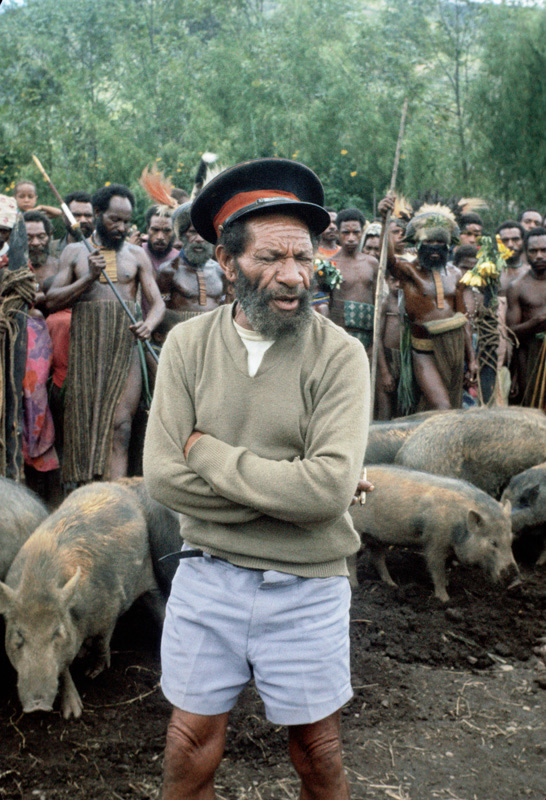
Ongka
Ongka, a “big man” of the Kawelka tribe. Image from http://www.stewartstrathern.pitt.edu/

Watch almost any anthropological film about a newly discovered “isolated tribe,” and you’re likely to see at least one “tribesman” wearing a t-shirt.

People in bands and tribes and chiefdoms — who have since time immemorial handled most of their economic transactions for food, clothing, and shelter through traditional economies of gift exchange and family sharing — eagerly become buyers and sellers for products on the global market as soon as they get the chance.

They grow coffee beans or trap furs, and they use the money to buy firearms, machetes, cell phones, and jean shorts. In other words, they jump right in to the market. And usually, the tendrils of global trade have arrived way before the anthropologists and their film crews.

But people in the same bands, tribes, or chiefdoms seem to hang on to their family and gift-based economies for political, military, and legal services.

They do not jump to create or hire market solutions (mercenaries, defense corporations), and they instead eventually transform — by hook or by crook — into a state or into a people subjugated by a state.

Why does this happen? Why do we get states for defense and markets for everything else?

Let me back up and explain my terms:

In the examples I’m familiar with, humans use one of four main methods to organize law enforcement and military protection:

1. Kin-based. Your extended family (a “band,” “clan,” or a “lineage”) and maybe an alliance of intermarried and neighbouring extended families (a “tribe” or a “village”), protects you. You are technically free to leave the family or the village, but that could leave you without protection unless you are marrying into a new one.

Examples: Cree, Tahltan, Ju/‘hoansi

2. Prestige-based. A famous leader (a “big man” or “chief”) and his warriors protect you in return for material gifts and social deference. You can pull your support from the leader — more easily if he’s just an informal “big man” and less easily if he’s a formal “chief.” And there are usually other nearby leaders or aspiring leaders who would happily accept your patronage.

Examples: Yanomamo, Kawelka, Trobriander

Systems #1 and #2 are often blended together, as in the Trobriander case, where each man’s connections to the chief are determined partly by family relatedness and partly by gift exchange.

3. State-based. A compulsory ruler (a “king” or “president”) and his warriors protect you in return for taxes and/or labor. You are never free to pull your support, although you are sometimes free to leave through emigration.

Examples: Aztec Empire, Canada, People’s Republic of China

4. Market-based. A private enterprise (a “defense contractor”) protects you in return for money. You are free to pull your support and choose another contractor, or go without.

Example: Detroit’s Threat Management Center

Now, we could also sketch out the same 4 methods for the basic kinds of economic exchange people do for food, shelter, and all the other goods and services in life besides defense. People can give and receive the things they want and need through #1 family networks, #2 prestige-oriented gift exchange, #3 state redistribution, and #4 markets.

What I see throughout the world in the last 500 years is that as globalisation advances, people in all or almost all cultures eagerly take their systems of food, shelter, etc. out of systems #1 and #2 and go into system #4. In other words, people in bands, tribes, and chiefdoms all over the world desperately want the metal tools, firearms, t-shirts, cell-phones, and everything else that the market offers, and so they find ways to sell goods or services and thus money that lets them buy that stuff.

For instance, hunter-gatherers who once collected food to share with their family now collect furs to sell internationally, or instead serve as bush guides to wealthy tourists from foreign cultures.

But people almost never eagerly or rapidly take their law and defense systems out of kin and prestige and into markets.

Instead, they tend to hang on to kin or prestige-based methods of law enforcement and warfare until they (a) get conquered by a state or (b) organize themselves as a state (whether to fend off would-be conquerors or to become conquerors themselves).

So in highland Papua New Guinea for instance, the Dani and the Kawelka were happy to grow coffee beans and other crops to put on the market by the 1970s. But they didn’t start hiring mercenaries for defense. Instead, they stuck to their big men and their tribes until their military organizations were absorbed into state militaries or turned into paramilitary movements aiming to create or seize control of a state.

Markets became the center of food production. States became the center of defense production.

Later on, after states have arrived as military organizations, sometimes they start expanding and controlling parts of the economics of food, shelter, education, etc., through compulsory redistribution.

Conversely, shifts to market-based defense seem to occur after a society has already had state-based defense — like in Moresnet or Kowloon (PDF). And the market organizations arise when, for some reason, the state-based defense system relaxes or collapses.

Why does this bifurcated trend keep happening?

Why do people in these societies transition into markets for most goods and services but states for law and war?

Do state-based militaries and police forces simply outcompete (or outfight) market ones?

Am I missing major counterexamples, or even misunderstanding my own examples?

Declining to Wed Gay Couples: Right or Wrong?

News item: the Georgia governor has just vetoed a bill that would, among other things, have allowed ministers to decline to wed gay couples.

What a tangle. Let’s see if we can sort things out.

First of all, many decent people, your humble servant included, find the concept of “gay marriage” troubling. I believe any two adults (or three or more) should be free to make any contract they like regarding sharing assets, pledging fidelity, and so forth. I just wish they wouldn’t call it “marriage.” That term is taken.

Second, hate is not a crime. Some people express repugnance or hatred for homosexuality. Ayn Rand called the practice immoral, an attitude that is hard to fathom in this day and age but perhaps understandable given the tenor of her times. Some go farther and express hatred for homosexuals per se. But as long as these people refrain from initiating force or fraud, they should not be molested. Boycotts, shunning, and criticism are legitimate responses to such people, but forcible restraint is not.

Third, rights are not granted by governments. Rights derive from our basic nature as humans, as thinkers such as Ayn Rand and Murray Rothbard have so eloquently demonstrated. Contractual “rights” should have a different name, perhaps “privileges.” These are actions that have been legitimized by a voluntary agreement. Thus for example, no one has free speech “rights” on a campus. Students may have free speech “privileges” on a campus if the owners of the campus have granted that privilege in a written or implied contract.

Fourth, freedom of association is a basic human right, and includes freedom of dissociation, whether in personal or business relations. Some years ago I posted a defense of the late Lester Maddox who famously attempted to exclude blacks from his chicken restaurant. My post generated considerable blowback, but I stand by it and note that in this day and age, anyone who tried to exclude blacks would not be elected governor of Georgia as Maddox was, but instead lose most of his customers and close his doors.

In summary, no minister needs permission from the state to deny wedding services to a gay couple. And religion has nothing to do with it. Anyone should free to decline business or personal relationships with anyone, for any reason whatever, or for no reason at all.

How Fascism Will Come To America

John T. Flynn’s As We Go Marching was written in 1944, but there isn’t a line in this excerpt that doesn’t fit today’s situation perfectly.  I read the book many years ago and will pull it out and read it again.

Fascism will come at the hands of perfectly authentic Americans who have been working to commit this country to the rule of the bureaucratic state; interfering in the affairs of the states and cities; taking part in the management of industry and finance and agriculture; assuming the role of great national banker and investor, borrowing billions every year and spending them on all sorts of projects through which such a government can paralyze opposition and command public support; marshaling great armies and navies at crushing costs to support the industry of war and preparation for war which will become our nation’s greatest industry; and adding to all this the most romantic adventures in global planning, regeneration, and domination, all to be done under the authority of a powerfully centralized government in which the executive will hold in effect all the powers, with Congress reduced to the role of a debating society.

HT: Jacob Hornberger, Future of Freedom Foundation

What does complexity theory tell us about government?

I’m reading Complexity: The Emerging Science at the Edge of Order and Chaos which has the absolute best testimonial on the front cover: “If you liked Chaos, you’ll love Complexity.”

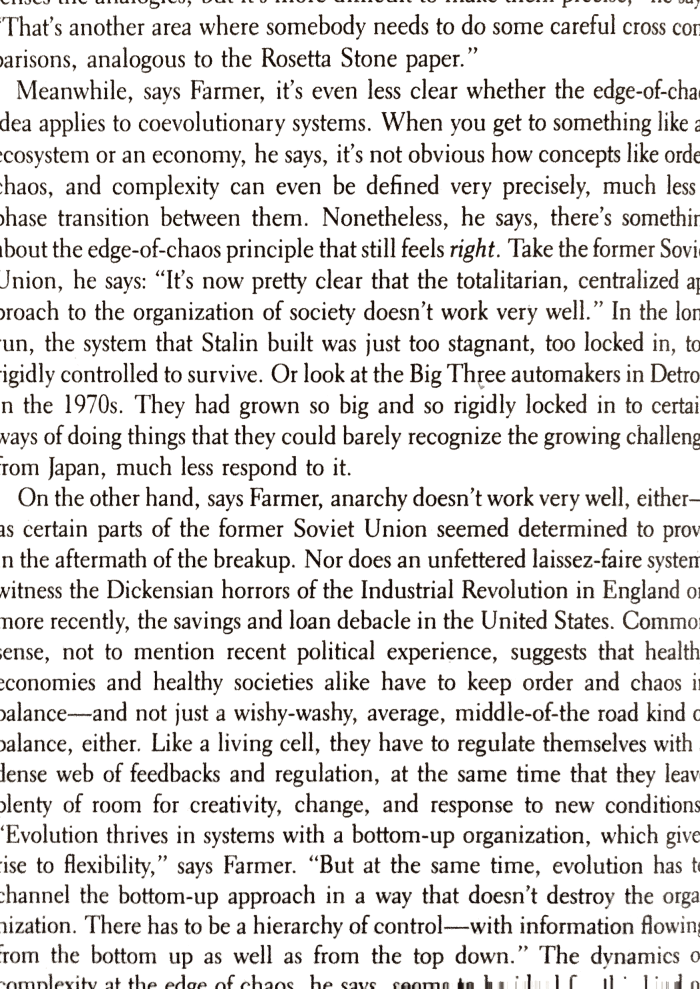
This book was written in 1993 so I’m pretty late to the show, but it’s worth raising the issue: complex systems require governance, but that need not mean government.

In the copy below the author is writing about how complex systems–systems with components that affect one another in simple ways resulting in emergent orders at the system-wide level–occupy an interesting space between chaos and order. Too much order and you end up with something fixed and unchanging. Too much chaos and you’ve got noise.

The second full paragraph misses an important point that should have been obvious to the author and the researchers who he’s paraphrasing. The government is an endogenous element in the wider economy. If we think of the economy as a network of people (individual nodes) who cluster into sub-networks (organizations), the government is just a collection of nodes and clusters that follow different rules than the rest. Granted, these clusters often serve important roles (e.g. courts). But the anarchist branches of economics have pretty clearly demonstrated that removing the state from these roles doesn’t always lead to chaos. Ripping the state out like a band-aid would be an awful idea, but gently scaling (scoping?) back the state need not be a disaster.

This band between chaos and order is wider than they’re giving it credit for. We can only examine this band from our own perspective… as human beings who are tiny components of this much larger network of networks. The range of configurations that could allow a peaceful, flourishing society is essentially infinite. Yes, governance is necessary, but strengthening any particular set of nodes cannot allow for governance of the system as a whole. It can only allow for governance of a sub-set of the wider network.

Emergent orders cannot be controlled from within.

Evernote Snapshot 20160316 202147

A hypothesis implied by Galbraith

pp. 171-172 of Competition and Entrepreneurship has J.K. Galbraith asserting, “that independently determined consumer desires [do not] dictate the pattern of production. The ‘institutions of modern advertising and salesmanship…cannot be reconciled with the notion of independently determined desires, for their central function is to create desires–to bring into being wants that previously did not exist.'”

Beyond the obvious first step (recognizing that consumers’ desires could not possibly be determined independently of the market process), this raises an interesting hypothesis: Advertisers should a) recognize that they’re selling snake oil and consume significantly less than similar people, or b) be particularly excited about the prospects of new and exciting products generally. In either case advertising should affect them differently than regular consumers and they should consume a different amount than consumers generally. At the very least, their consumption patterns should be different from regular consumers in the particular goods that they are advertising.

The criticism of advertising as socially wasteful (i.e. using up resources without actually making consumers better off) may hold up if evidence is found in support of the above hypothesis. In the case of pattern ‘a)’ it may be clear that advertising is manipulative and anti-social. But in the case of pattern ‘b)’ or the null (advertisers buy the same junk as the rest of us) we either have to abandon the criticism of advertising or come up with some ad hoc story about how everyone is stupid and their preferences shouldn’t matter.