Courts as Modern Civic Churches?

India is in the middle of an anachronistic power tussle. Watching The Tudors right when the Indian Supreme Court is hearing submissions in the Sabrimala case placed before me an interesting hypothesis – the King v Church tug of war is replicating itself, albeit democratically, in the controversy surrounding the Essential Practices Test.

First introduced in the Shirur Mutt case (1954 AIR 282), the doctrine provides for a test that would make state interference justified under a Constitution that gives to her citizens (Article 25), the freedom to practice and profess their religion, and to religious denominations (Article 26), the right to manage affairs and administer properties, both being subject to restrictions on public order, morality, and health. Essentially, the test gives the Court the power to determine what constitutes “essential to the practice of the religion” and holds that everything non-essential is subject to legislative action by the State.

A number of scholars (Gautam Bhatia, Shreya Atrey) have commented on the un/desirability of the consequences of such a test. The clearest of them all comes from Jacobsohn who characterizes the test as an attempt to internally reform the religion by allowing the judges to “re-characterize the religion in a more progressive light”.

What has given these objections much weight is the support Justice Chandrachud has lent to the skepticism of judicial discretion bestowed by the doctrine. He questions the ecclesiastical function of the court and proposes to use constitutional morality as the one stop test for determining the constitutionality of a religious practice, instead of going the long way of finding the non-essential elements that may be subjected to progressive restraints. This adherence to the constitutional word is consistent with the treatment of the constitution as the new-age charter of a civic religion, a notion oft repeated and celebrated in India.

King Henry VIII’s ostensible zeal for reform came out of his hatred for papal supremacy. Divine rights of the Kings placed the King directly under God, and God alone. He would then become the supreme mortal in terms of matters relating to governance and spirituality. The Indian courts do not wish to claim any such supremacy over spiritual matters (yet). What they seek to do is social reform – a venerable objective behind the framing of the Indian constitution. In that, they seek to be not just interpreters and guardians of the constitution, but active participants of change in realizing the aims of the constitution.

But one must question this insistence that in religion, like with the legislation, there is an umbra and a penumbra and that the latter is so hierarchy placed that it may be interfered upon, whereas the umbra is so essential that it may not be touched. What is religion but not faith? And what is faith but not a collection of beliefs organically coalesced to create charters that may look different for each generation? Is it not possible that a religion undergo change so as to value a tenet A over B within a span of decades? Is it also not possible that A and B exist simultaneously without harming the essentiality of each other, howsoever inconsistent they might seem to an educated rational mind? Since when has religion been the epitome of moral consistency?

Much can be said on the justifiability of this aspiration. Much more can be said of the legitimacy of the court’s position on such matters. Democratically speaking, ridding a society of its ills is more likely to give positive results if it comes from a joined political action rather than from a bench of judges who, in all their wisdom, are not privy to a large section of the society. Of course, the Indian supreme court has “grounded itself” (a phrased used by Dr. Rajeev Dhavan) and has acquired the kind of legitimacy that demands respectful obedience from its supporters. And this has been primarily because of the non-traditional use of judicial description for activism against a falling parliament often mired in political games to care much about the legal and policy lacunae deserving attention.

Sabrimala is an especially thorny issue, not just because the judges must conclusively decide the path the judiciary wishes to take with respect to social reform but also because they can either be the ecclesiastical court and inform the citizens of the immorality (grounded in the constitution, no doubt but then looking at the vastness of the Indian constitution, it can probably accommodate all moral philosophers barring Peter Singer) of their actions or they can let arguably unethical practices live, giving individual liberty the space that separation of church and state demands.

Defending Political Liberty in an Administered World

This is a very rough work in progress continuing on from my recent post on ‘Law, Judgement, Republicanism’.

The problems with a free and open political and judicial culture were diagnosed by Max Weber in his discussion of bureaucracy, which itself draws directly and indirectly on various accounts of the problems of bureaucratisation and administration of the social world (which itself began in the 18th century, at least in terms of explicit discussion  of bureaucracy). Wilhelm von Humboldt’s comments on bureaucracy in Limits of State Action is, as far as I can see, the first clear instance. Before that, the closest precedents are, I believe, in comments on the rigidity of Roman law in Montesquieu, which may have been at least in part against the laws and legal institutions of France in his own time.

Bureaucratisation and an administered world can themselves be seen as resting on the necessity of an integrated, hierarchical, rigid, and institutionalised legal system of a ‘Roman’ model, which is true even when thinking of ‘common law’ jurisdiction in England and its off-shoots (England, not Britain, because Scotland has its own more Roman system, and differences between English and Scottish legal institutions survived political union). This process, described in various ways by Weber, Schmitt and Foucault, Austrian school liberals and Frankfurt School Marxists, also rested on the simultaneous formation of commercial society and national economy described by Arendt. Arendt’s account is particularly enriched by comparison with Foucault on the emergence of the art of government. 

The consequences of these legal, administrative, governmental, and economic processes  is that the political sphere is deprived of content as a means for addressing the community as a community of judging, reflective individuals. Politics becomes competition for control of administration and the distribution of economic benefits that come with with this control. The political world is influenced by a drive to the kind of homogenisation favoured by the world of administration and positive law, which turns into struggles about identity and ‘political correctness’. That is, the struggle to define the dominant identity, with claims to a pluralist position still governed by the wish to establish the dominating identity as more tolerant (which can happen in a ‘progressive’ manner), as in a community seen as a community of communities or a ‘conservative’ manner, where there are distinct communities tied to nations or possibly non-interacting historical communities within nations. 

Arendt suggests a perspective aristocratic contest in politics taken from Greek antiquity, particularly Athens, as the antidote to the above. Foucault also has a perspective taken from Greek antiquity, of care of the self, which can also be understood as aesthetic techne, in which our capacity for self-affection is developed in self-creation and recreation, though not as a purely aesthetic play. Machiavelli was in some respects the advocate of the modern integrated state, of sovereignty concentrated in an individual who integrates society through the power of his political skill and creation of a dominating rhetoric or symbolism. In Machiavelli, though, we can also see much that comes from Ancient republicanism filtered through the republicanism of the late medieval city states of northern Italy.

There is not just the remnants of ancient republicanism but its transformation in a world where the state is increasingly invested in territorial control, distinct from the personalised nature of the state as understood before (either in the person of the monarch or the persons making up a republic). The ‘cynicism’ of Machiavelli has its starting point in Aristotle’s Rhetoric, where reason is applied to speech in public places, particularly the courts of law and the political assembly. Though Aristotle distinguishes between the rhetoric of courts and assemblies, he does show a commitment to the idea that they belong to a common world of persuasive speech. Rhetoric appeals to the less deductive parts of human judgement, even the parts of human judgement which come from immediate emotional reactions, but never just that.

The prince who is human and animal, moral and self interested, is also the strong lion and the cunning fox, within his animal self. There is a sense of the total possibility: symbolism and self invention of individuals engaged in the political world. The judicial connection with politics and the social world for whom law is in some sense dead, an accumulated wisdom from the ancients now codified and open to commentary, but not part of political life except in the administrative and governmental roles that Machiavelli himself had for a while on the basis of his legal training, mingled with humanistic (Latinate and literary) education.

Even so, we can see some ideas lingering in Machiavelli of the importance of law in political life, so that it is the ‘parlements’, partly independent and locally representative law courts, of France which gives its monarchy some of the liberty of a republic. In The Prince it is the case that the energy of the people defending its state and its liberties, where they have some history, outweighs the power of the princely ruler, so that classical Polybian republicanism of the Discourses is never completely absent from The Prince.

Most significantly, Machiavelli leaves a legacy which can be seen behind the 20th century attempts to find an alternative to an administered social world. There is the charismatic leader in Weber, the agonistic aspects of politics in Arendt, and the ethics of self-creation and transformation of the self in Foucault. The charismatic leader in Weber should not be understood as a dictator or a person above politics, but as the way in which legally and formally constrained politics can still engage with the social world and the free judgements of individuals. The agonistic politics in Arendt is not just nostalgia for Athens, but an account of what it is to have individual goals and public awareness in a political community. Ethics in Foucault is not just self-creation out of nothing or a non-political playfulness, it is about how we can have free judgement in politics and law. The glory the prince seeks in Machiavelli, and by the citizens of a republic, is a way of seeing that politics combines autonomy and prestige as driving forces in a historically located and contingent political community. Machiavelli anticipates the ways that Arendt understands political freedom to be related to a Homeric culture of seeking fame in public life.

Why protect speech?

The U.S. Supreme Court has extended more protection for speech than other major courts that adjudicate rights, such as the European Court of Human of Rights. Nonetheless, the Supreme Court is frequently wrong about why speech deserves constitutional protection. That error has undermined the First Amendment that the Court purports to protect. Continue reading

The Why of Religious Freedom

The blogosphere has exploded over wedding cake. The Supreme Court has splattered the internet with fondant and rage. Baker Jack Phillips, who refused to bake a cake for a same-sex wedding, has achieved a modest win: human rights commissions cannot exhibit a hostility toward religion when enforcing anti-discrimination laws.

When a major religious-rights case hits the news, I’ve noticed a pattern. The outrage extends not to just the individual case but to the concept of religious freedom generally. Angry bloggers and tweeters love to insert scare quotes around the phrase “religious freedom,” as if donning latex gloves to handle toxic sludge. And the Colorado judge below certainly showed deep disdain for Mr. Phillips’ religious beliefs, which is perhaps the major reason that Phillips won. This pattern of skepticism toward religious freedom writ large signals that we should perhaps retreat to first principles. Why do religious practices and beliefs receive special treatment? Continue reading

Role of a Citizen in Hegemonic Authoritarianism

I want to begin a n-part series on Hannah Arendt. Why Arendt? Because I wrote a paper on her last semester and have been obsessed ever since. I will pick up one theme (or a sentence and sometimes just a phrase) from her work and try to either describe it in contemporary political terms or evaluate it against legal theories, political and moral. All this, I will do under the presumption that there are some political ideals like democracy, constitutionalism, liberalism that exist within the domain of possibility for polities irrespective of their legal culture. What I will also presume is that all political ideals function on a spectrum and it is difficult to accurately pin point exactly when something has turned from being tolerable to just plain rotten.


At various points in history, societies become obsessed over a political concept. Every once in a while, societies experience an onslaught of violations. Violations of their personal, maybe innate, sense of justice. I am not going to argue on the nature of this sense of justice. Instead, I will point towards our basest moral instincts. If you agree that there is such a thing as conscience that can not only exist but also develop outside of the legal system, you will see that it relates to how we think about what is wrong and what it right. Ergo, justice.

The violation of justice shakes things up enough for us to evaluate and figure out which political ideal, if protected, could have saved us. Against the Nazi regime it was the Rule of Law, for feminists it is Equality, against the Nanny State, it is liberty, and so on. In a bid to make amends, we compensate by institutionalizing it, giving it a place of honor in public discourse, and protesting all violations, big or small.  Every once in a while, the political concept finds a life of its own – growing differently in different parts of the world, becoming an essentially contested concept. After a point of time, the omnipresence of the principle starts to define the terms of the debate in matters unconnected with it.

Today, it is Authoritarianism. Not one where the ruler does not even wish to keep up the pretense of legality and justice but the kind which creeps up when no one is looking. Hannah Arendt was worried about the latter. She worried not just about the big bureaucratic state with its mechanical application of law and antipathy towards political moral ideals, but also about the citizen under such a regime who observed and obeyed and said not a word because the violations were too minor and too remote to care about.

The citizen who refuses to think is the power source of authoritarian regimes. One can ask if Arendt expects her model citizens to practice constant vigilance, continuously evaluating the judgements of their sovereign for potential violations of some sense of justice. After all, her theory of power is based on a conception of power working through communication and co-operation as opposed to the traditional understanding of power emanating from coercion and commands. ‘Power corresponds to the human not just to act, but to act in concert’, said Arendt. She challenges the notion of power having a mandatory connection with sovereignty.

We must take note of the existing political background to her writings. She, along with half the world, stood against the Soviet Union. Communism was not just a bad word, it was inherently evil. So strong was her position against Marx’s writings that she blamed ‘the social’ for the destruction of the political realm. The political realm was the place for public discourse. Deliberation helped in protecting freedom whereas the urge for leveling down of human life resulted in the destruction of democratic practices. However, what was most egregious was the tendency of communism to regularly violate the autonomy of the individuals.

The ‘social’ was not just a command of a sovereign, it was implicit in hegemonic structures through which obedience was guaranteed. Why is this relevant today? It is relevant for its implications on how we judge regimes. Are we to be satisfied with just a form of legality or do we want to prevent violations to whatever principle it is that we have chosen to hold dear, albeit for the century? If we choose the latter, then Arendt’s expectations from a model citizen do not seem too demanding. We must constantly sit in judgment, not just of the laws that govern us (plenty of people do that already) but of the tools of reasoning we use in our political discourse. It is our justifications and not just our positions in a political debate that catalyzes hegemonic authoritarianism.

The Impossible Trinity of Liberal Democracy

In the first part of my series on democracy published a few years ago, I made a distinction between four senses in which the term “democracy” is used. To briefly recap, I made they were: a) a term of empty political praise for policies which partisans like b) an institutional decision-making process emphasizing the primacy of majoritarian opinion c) a generic term for the type of procedures which have been prevalent in the west, and d) an overarching term for the ethical commitments of liberals. In that series, I focused on the tension b) and d), mostly ignoring a) and c). (For Present purposes, my highly speculative musings on anarchism are irrelevant.

In a recent podcast of the Ezra Klein show  (which I highly recommend) discussing his book The People vs. Democracy: Why Our Freedom Is in Danger and How To Save It, Harvard political theorist Yascha Mounk and Ezra Klein were debating how pessimistic we should be about the prospects for the future of American Democracy. I don’t really wish to comment on whether we should be pessimistic or not, but I want to make a further distinction that clarifies some of the disagreements and points towards a deeper issue in the workings of democratic institutions. I will argue that democracy consists of a liberal, majoritarian, and procedural dimension and these dimensions are not reconcilable for very long.

Mounk makes a similar distinction to the one I made between democratic majoritarianism and liberalism as a reason to be pessimistic. Klein tended to push back, focusing on the ways in which modern American political culture is far more ethically liberal than it has ever been, as seen through the decline in racism since the middle of the twentieth century and decline in homophobia since the 1990s. Mounk, however, emphasized how respect for procedure in the American political process has declined during the Trump Era, as evidenced by Trump’s disrespect for the political independence of courts and agencies like the Department of Justice.

However, throughout Klein’s and Mounk’s debate, it became clear that there was another distinction which needed to be made explicitly, and one which I have tended to heavily under-emphasize in my own thinking on the feasibility of democracy. It seems to me there are at least three dimensions by which to judge the functioning of democracies which are important to distinguish:

  1. Majoritarianism—the extent to which a democracy is sensitive to majority public opinion. Democracy, in this dimension, is simply the tendency to translate majority opinion to public policy, as Mounk puts it.
  2. Liberalism—this refers to the ethical content towards which democracies in the west try to strive. This is the extent to which citizens are justly treated as moral equals in society; whether minority religious freedoms are respected, racial and ethnic minorities are allowed equal participation in society (economically and politically), and the extent to which general principles of liberal justice (however they may be interpreted) are enacted.
  3. Legal proceduralism—the extent to which political leaders and citizens respect the political independence of certain procedures. This dimension heavily emphasizes the liberal belief in the rule of law and the primacy of process. This can include law enforcement agencies such as the Department of Justice or the FBI, courts, and respect for the outcomes of elections even when partisan opponents are victorious.

It seems that there are reasons why one would want a democracy to retain all three features. Majoritarianism could be desirable to ensure stability, avoiding populist revolutions and uprising, and perhaps because one thinks it is just for government to be accountable to citizens. Liberalism, clearly, is desirable to ensure the society is just. Proceduralism is desirable to maintain the stability of the society given that people have deep political and philosophical disagreements.

Klein and Mounk’s debate, considering this explicit triadic distinction, can be (crudely) seen as Mounk initially emphasizing the tension between majoritarianism and liberalism in modern democracies. Klein pushes back saying that we are more liberal today than we’ve ever been, and perhaps the current majoritarian populist turn towards Trump should be put in context of other far more illiberal majoritarian populist impulses in the past. Mounk’s response seems to be that there’s also been a decline in respect for legal procedure in modern American politics, opening a danger for the instability of American democracy and a possible rise of authoritarianism.

First, it seems to me that both Mounk and Klein overemphasize respect for procedure in the past. As Robert Hasnas has argued, it has never been the case that anyone treats the law as independent simply because “the law is not a body of determinate rules that can be objectively and impersonally applied by judges” and therefore “what the law prescribes is necessarily determined by the normative predispositions of the one who is interpreting it.” There is always an ethical, and even a partisan political dimension, to how one applies procedure. In American history, this can be seen in ways that courts have very clearly interpreted law in motivated ways to justify a partisan, often illiberal, political view, such as Bowers v. Hardwick. There has always been a tendency for procedures to be applied in partisan ways, from the McCarthyite House Unamerican Committee, to the FBI’s persecution of civil rights leaders. Indeed, has Hasnas argues, the idea that procedures and laws can be entirely normatively and politically independent is a myth.

It is true, however, that Mounk does present reason to believe that populism makes disrespect for these procedures explicit. Perhaps one can say that while procedural independence is, in a pure sense, a myth, it is a constructive myth to maintain stability. People believing that elections are not independent, Trump’s disrespect for the independence of courts and justice, allows for a disintegration of those institutions into nothing but a Carl Schmitt-style, zero-sum war for power that can undermine stability of political institutions.

On the other hand, it seems worth emphasizing that there is often a tension between respect for procedure and the ethics of liberalism. Klein points out how there was large respect for legal procedure throughout American history that heavily undermined ethical liberalism, such as southerners who filibustered anti-lynching laws. Indeed, the justification for things such as the fugitive slave law was respect for the political independence of the legal right to property in slaves. All the examples of procedure being applied in politically biased and illiberal ways given moments ago support this point There is nothing in the notion that legal and electoral procedures are respected that guarantees those procedures in place will respect liberal principles of justice.

I remain agnostic as to whether we should be more pessimistic about the prospects for democracy in America today than at any other point in American history. However, at the very least, this debate reveals an impossible trinity, akin to the impossible trinity in monetary policy, between these three dimensions of democracy. If you hold majority opinion as primary, that includes populist urges to undermine the rule of law. Further, enough ink has been spilled on the tensions between majoritarianism and liberalism or effective policy. If you hold respect for procedure as primary, that includes the continuation procedures which are discriminatory and unjust, as well as procedures which restrict and undermine majority opinion. If you hold the justice of liberalism as primary, that will generate a tendency for morally virtuous liberals to want to undermine inequitable, unjust procedures and electoral outcomes and to want to restrict the ability of majorities to undermine minority rights.

The best a conventional democrat can do, it seems to me, is to pick two. A heavily majoritarian democracy where procedures are respected, which seems to be the dominant practice in American political history, is unlikely to be very ethically liberal. An ethically liberal and highly procedural government, something like a theoretically possible but practically unfeasible liberal dictator or perhaps a technocratic epistocracy (for which Jason Brennan argues), is a possible option but might be unstable if majorities see it as illegitimate or ethically unpalatable to procedural democrats. An ethically liberal but majoritarian democracy seems unworkable, given the dangers of populism to undermine minority rights and the rational ignorance and irrationality of voters. This option also seems to be what most western democracies are currently trending towards, which rightly worries Mounk since it is also likely to be extremely unstable. But if there’s a lesson to be learned from the injustice of American history and the rise of populism in the west it’s that choosing all three is not likely to be feasible over the long term.

On the rift between economics and everything else

The line is often heard: economists are “scientific imperialists” (i.e. they seek to invade other fields of social science) jerks. All they try to do is “fit everything inside the model”. I have this derisive sneer at economists very often. I have also heard economists say “who cares, they’re a bunch of historians” (this is the one I hear most often given my particular field of research, but I have heard variations involving sociologists and anthropologists).

To be fair, I never noticed the size rift. For years now, I have been waltzing between economics and history (and tried my hand at journalism for some time) which meant that I was waltzing between economic theory and a lot of other fields. The department I was a part of at the London School of Economics was a rich set of quantitative and qualitative folks who mixed history of ideas, economics, economic history and social history. To top it all, I managed to find myself generally in the company of attorneys and legal scholars (don’t ask why, it still eludes me). It was hard to feel a big rift in that environment. I knew there was a rift. I just never realized how big it was until a year ago (more or less).

There is, however, something that annoys me: the contempt appears to be self-reinforcing.  Elsewhere on this blog (here and here) (and in a forthcoming book chapter in a textbook on how to do economic history), I have explained that economists have often ventured into certain topics with a lack of care for details. True, there must be some abstraction of details (not all details are useful), but there is an optimal quantity of details. And our knowledge grows, the quantity of details necessary to answering each question (because the scientific margin is increasingly specialized) should grow. And so should the number (and depth) of nuances we make to answer a question.  There is a tendency among economists to treat a question outside the usual realm of economics and ignore the existing literature (thus either rushing through an open door or stepping in a minefield without knowing it).  The universe is collapsed into the model and, even when it yields valuable insights, other (non-econs) contributors are ignored.  That’s when the non-econs counter that economists are arrogant and that they try to force everything into a mold rather than change the mold when it does not apply. However, the reply has often been to ignore the economists or criticize strawmen versions of their argument. Perceived as contemptuous, the economists feel that they can safely ignore all others.

The problem is that this is a reinforcing loop: a) the economists are arrogant; b) non-economists respond by dismissing the economists and ridiculing their assumptions; c) the economists get more arrogant. The cycle persists. I struggle to see how to break this cycle, but I see value in breaking it. Elsewhere, I have made such a case when I reviewed a book (towards which I was hostile) on Canadian economic history. Here is what I said for the sake of showcasing the value of breaking the vicious circle of ignoring both sides:

These scholars (those who have been ignored by non-economists) could have easily derived the same takeaways as Sweeny. Individuals can and do engage in rent-seeking, which economists define as the process through which unearned gains are obtained by manipulating the political and social environment. This could be observed in attempts to shape narratives in the public discourse. According primacy to the biases of sources is a recognition that there can be rent-seeking in the form of actors seeking to generate a narrative to reinforce a particular institutional arrangement and allow it to survive. This explanation is well in line with neoclassical economics.

This point is crucial. It shows a failing on both sides of the debate. Economists and historians favorable to “rational choice” have failed to engage scholars like Sweeny. Often, they have been openly contemptuous. The literature has evolved in separate circles where researchers only speak to their fellow circle members. This has resulted in an inability to identify the mutual gains of exchange. The insights and meticulous treatments of sources by scholars like Sweeny are informative for those economists who consider rational choice as if the choosers were humans, with all their flaws and limitations, rather than mechanistic utility-maximizing machines with perfect foresight (which is a strawman often employed to deride the use of economics in historical debates) . In reverse, the rich insights provided by rational choice theorists could guide historians in elucidating complex social interactions with a parsimony of assumptions. Without interaction, both groups loose and resolutions remain elusive.

See, as a guy who likes economics, I think that trade is pretty great. More importantly, I think that trade between heterogeneous groups (or different individuals) is even greater because it allows for specialization that increases the value (and quantity) of outputs.  I see the benefits of trade here, so why is this “circle of contempt” perpetuating so relentlessly?

Can’t we just all pick the 100$ bill on the sidewalk?

Leftism = Victim blaming

Trying his best to become a martyr, former President Lula didn’t surrender to the police as it was stipulated by judge Sergio Moro.

Lula and his gang stole billions of dollars from the Brazilians. Now, all of a sudden, the left is worried about the rule of law.

Lula wanted to surrender Brazil to the interests of Foro de São Paulo, a supranational organization whose aim is to transform Latin America into a new USSR. Now, all of sudden, the left blames judge Sergio Moro for destabilizing Brazil’s democracy.

The only faction responsible for Brazil’s predicament is Lula and his gang. Thanks, judge Sergio Moro and his team for giving Brazilians a glimpse of hope.

The President’s commission on opioids (2/2)

Here’s the second half of an abridged essay I wrote for a public policy course. First half is here, and next week I’ll write about the FDA’s new enemy, kratom.


Epidemic status

The DEA’s 2015 declaration of an opioid epidemic was the first sign of large-scale federal attention to prescription analgesics, to my knowledge. On the CDC’s official glossary, “outbreak” and “epidemic” are interchangeable: “the occurrence of more cases of disease than expected in a given area or among a specific group of people over a particular period of time.”

The classification of addiction as a disease is sometimes controversial. (See also Adam Alter’s Irresistible for a popularized form of the psychological takes on addiction.) For the opioid problem to be an epidemic, the focus must be the addition rate, and not the overdose or death rate alone. The federal government usually refers to the opioid situation as an epidemic or emergency (which presupposes a value judgment), and when media has covered it (as with the deaths of Philip Seymour Hoffman, Heath Ledger and Prince) they use the same language. One definitive media moment might have been last year, when John Oliver announced for a young progressive crowd that “America is facing an epidemic of addiction to opioids.”

Oliver was referring specifically to addiction — criticizing companies like Purdue Pharma (creator of OxyContin) for misleading or misinformative advertising about addictiveness. But usually it does not seem like the focus is on addiction. As stated, nonmedical usage of opioids is generally down or stabilized from the last couple years, and the problem is mostly overdoses. (True, these are intimately connected.) This might indicate that cutting the pills with other drugs or general inexperienced use are greater problems than general addiction. So, there is an epidemic in the colloquial usage — extensive usage of something which can be harmful — but only questionably in the CDC’s medical definition, as the usage rates are expected to be up as synthesized morphine-, codeine- or thebaine-based pain relievers diversified, and these have mostly stabilized except for heroin (thought as often beyond opioid status) and fully synthetic derivatives which get less attention (fentanyl, tramadol).

Why the standard of abuse fails

John Oliver — worthy to talk about because much of the public plausibly started paying attention after his episode — noted that the pills are assigned to patients and then, even if the patient doesn’t develop an addiction, they end up in the “wrong hands.” What happens at this point? The Commission recommends that companies design their prescription drugs for “abuse-deterrent” formulations (ADF). After spikes in opioid abuse, Purdue Pharma and other companies began researching mechanisms to prevent abusers from easily obtaining a recreational high by tampering with the pill or capsule. In a public statement, FDA commissioner Scott Gottlieb asserted that the administration’s focus is on “decreasing unnecessary exposure to opioids,” but, recognizing the real role that prescription opioids play in pain relief, Gottlieb continues that “until we’re able to find new nonopioid forms of pain management … it’s critical that that we also continue to promote the development of opioids that are harder to manipulate and abuse, and take steps to encourage their use over opioids that don’t offer any form of deterrence.” Some of these abuse-deterrent options are crush resistance or wax coating to make dissolving more difficult.

However, opioid abuse comes in two forms which are conflated by the legal language. The first is when a patient takes more than their recommended allocation or takes it in the wrong way. The second is when someone with or without a prescription consumes them purely for recreation. Many drug savvy abusers of the second variety have adapted methods to get a recreational high but avoid potential health risks, the most popular method being “cold water extraction” (CWE). Most opioid pills contain both a synthesized opium alkaloid (from morphine, codeine or thebaine) and acetaminophen: Percocet contains oxycodone and paracetamol; Vicodin contains hydrocodone and paracetamol. The acetaminophen or APAP has no recreational benefits (a pure pain reliever/fever reducer) and can cause severe liver problems in large quantities, so recreational users will extract the opium alkaloid by crushing the pill, dissolving it in distilled water, chilling it to just above freezing, and filtering out the uncrystallized APAP from the synthesized opium. This way a greater quantity of the opioid can be ingested without needlessly consuming acetaminophen. Other recreational users that want less of the opium derivative can proceed without CWE and insufflate or orally ingest the particular pills.

ADFs might be able to dent the amount of abusers of the second variety. If the pills are harder to crush (the route of Purdue’s 2010 OxyContin release) or, for capsules, the interior balls are harder to dissolve (the route of Collegium Pharmaceutical’s Xtampza), amateur or moderately determined oxycodone enthusiasts may find the buzz is not worth the labor. As the Commission observes, more than 50% of prescription analgesic misusers get them from friends and family (p. 41) — these are not hardcore aficionados, but opportunists who might be dissuaded by simple anti-abuse mechanisms. Abusers of the first variety, though, are unaffected: at least in the short term, their abuse rests on slightly-over-the-recommended doses or a natural tendency to develop an addiction or non-medical physical dependency. And, if the political core of the opioid emergency is patients that develop an addiction accidentally (those that stay addicted to pharmaceuticals and those that graduate to heroin), abuse-deterrent focuses are unlikely to create real change in addiction rates. It could even have the unintended consequence of higher overdose deaths for amateur narcotics recreationalists, who aren’t skilled enough to perform extractions and opt to consume more pills in one sitting instead.

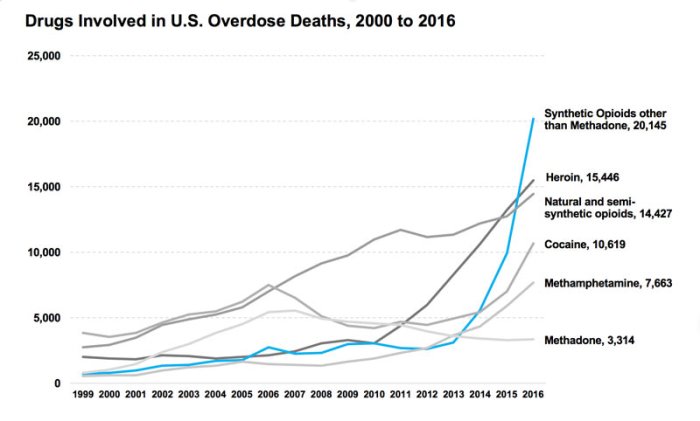
And furthermore, ADFs can be incorporated into the naturals and synthetics that are usually bonded with APAP like codeine, oxycodone, hydrocodone and tramadol, but cannot for the drugs that come in pure form like heroin or fentanyl. And those are the problem drugs. The NIDA research on drugs involved in overdose deaths across the board, for one, shows that overdose deaths are on the rise as a whole (except for methadone), and also that the synthetic opioids are much more deadly than the naturals and semi-synthetics: fentanyl is the biggest prescription analgesic killer (it’s much more potent than morphine, and tramadol is not very good for recreation).

drugoverdosedeaths

(This graph also shows, however, that the natural/semi-synthetic usage rate was possibly leveling out but resuscitated in 2015.) So ADFs are useless for the drugs most massively causing the “opioid epidemic.” Making them harder to abuse only dents the second category of abuser, and does not limit their addictiveness for those prescribed them for postsurgical pain or otherwise.

Moreover, from a libertarian standpoint, the second category of abuser does not really belong in the “public health crisis” discussion. Those who knowingly consume opioids for recreation are not a problem, they are participants in a pleasure-seeking activity that doesn’t tread on others. So long as their costs are not imposed on other people, it might be better to separate them from the “epidemic” status. Blurring the lines between the groups that fall under “abusive” means that those with a side-interest in OxyContin on Friday nights are lumped in with addicts suffering from physical dependency. Someone who has a glass of wine each night is not “abusing” alcohol, but we can recognize someone who is an alcoholic; the same distinction should be applied medically to opioid users. By painting all consumers outside of direct medical usage as “abusers,” there can be no standard for misuse, and thus no way for a recreationalist to know how much is too much, when health problems might set in, if they are really trapped in their recreation, etc. Research and knowledge are threatened by the legal treatment and classification.

Conclusion

To summarize, the government terminology of “abuse” obscures a legitimate distinction that is justified on both medical-political and civil liberty grounds. Some of the approaches in the Commission report, like the market-based CMS package recommendation, will likely succeed at quelling opioid exposure (and thus addiction and overdoses), while other maneuvers like an education campaign or ADFs should be treated with cautious skepticism. The trends show that heroin and fentanyl are actually the biggest contributors to the opioid epidemic, although semi-synthetics are climbing again in overdose deaths after leaning toward stabilization two years ago. Evidence that prescription abuse and street use are linked, as well as testimony from former addicts, indicates that drug users easily swing between the legal and black market.

The President’s commission on opioids (1/2)

Given Zachary’s post on the drug war and opioid crisis, I thought I would share parts of an essay I wrote for a class last semester about Trump’s commission on opioids, which is the first policy step the new administration took in dealing with the issue. It’s edited for links and language and whatnot.


One of the more recent executive steps to combat the opioid crisis — the “abuse” of prescription and illegal opioid-based painkillers — was the creation of The President’s Commission on Combating Drug Addiction and the Opioid Crisis (hereafter, the Commission) two years ago by the Trump administration. The commission, led by Chris Christie, was instituted to investigate the issue further and produce recommendations for the government and pharmaceutical industry. It released its final report in November and seems set to work on opioid use with the same sort of strategies the federal government always treats drugs, except maybe a little more progressive in its consideration of medicinal users. Looking at the Commission’s report, I argue that a refusal to treat unlike cases dissimilarly will lead to less than effective policy.

The President’s Commission

The DEA first asserted that overdose deaths from opioids had reached an epidemic in 2015. In March of last year, Donald Trump signed an executive order establishing the policy of the executive branch to “combat the scourge of drug abuse” and creating The President’s Commission. The Commission is designed to produce recommendations for federal funding, addiction prevention, overdose reversal, recovery, and R&D. Governor Chris Christie of New Jersey served as Chairman alongside Gov. Charlie Baker (R-MA), Gov. Roy Cooper (D-NC), representative Patrick J. Kennedy (D-RI), former deputy director of the Office of National Drug Policy and Harvard professor of psychobiology Bertha Madras, and Florida Attorney General Pam Bondi.

Included in the final report is a short history of opioid use in the United States, characterized by a first crisis in the mid- to late-19th century of “unrestrained … prescriptions,” eventually reversed by medical professionals “combined with federal regulations and law enforcement.” A public distrust of opioids developed afterward, but this was “eroded,” and now the new crisis, traceable to 1999, has become more perilous by innovations since the 19th century: large production firms for prescription drugs, a profitable pharmaceutical industry, cheaper and purer heroin, new fentanyl imports from China.

Since the Commission’s report, several bills have been introduced in the House or Senate currently awaiting judgment (e.g., H.R.4408, H.R.4275, S.2125). Declaring widespread addiction and overdoses to be a national emergency in August, Trump fulfilled one of the interim steps proposed by Christie in an early draft of the report; since, the President has met with drug company executives to discuss nonopiate alternatives for pain relief. Within the next few months we should start to see large scale moves.

Through all of this, the treatment of opioids by the Commission and the US government uses a traditional framing. The National Institute on Drug Abuse (NIDA) defines drug abuse in the following way:

[Use of substances] becomes drug abuse when people use illegal drugs or use legal drugs inappropriately. This includes the repeated use of drugs to produce pleasure, alleviate stress, and/or alter or avoid reality. It also includes using prescription drugs in ways other than prescribed or using someone else’s prescription. Addiction occurs when a person cannot control the impulse to use drugs even when there are negative consequences—the defining characteristic of addiction.

This definition by the federal government does not discriminate between various levels of damaging consumption behavior. The weakness of this definition is that, because all illicit drug consumption is categorized as abuse, there can be no standard for misuse of a black market drug for recreation. An entry-level dose of heroin qualifies as equally “abusive” as a lethal dose because of the binary character of the definition. Other federal agencies give similar definitions; in its report on recommendations for abuse-deterrent generic opioids (see below), the HHS and FDA use a definition of abuse characterized by the “intentional, nontherapeutic use of a drug product or substance, even once, to achieve a desired psychological or physiological effect.” This terminology still characterizes any and all recreational consumption of opioid analgesics as abuse, and not misuse, regardless of dosage or long-term dependency. It will be seen that this is a problem for the success of any sort of policy aimed at quelling usage, and particularly hazardous for the opioid problem.

Legal Background

First, the legal background and a more extensive history. The category “opioid” covers much drug terrain both prescription and illegal. Opioids in the most expansive sense are synthetic derivatives of alkaloids in the opium of the West Asian poppy species Papaver somniferum. Opium resin contains the chemicals morphine, codeine and thebaine. Morphine is the basis for powerful pain relievers like heroin and fentanyl. Codeine is considered less powerful for pain relief but can be used to produce hydrocodone; it also doubles as a cough suppressant. Lastly, thebaine is similar to morphine and is used for oxycodone. 90% of the world’s opium production is in Afghanistan.

All opioids are criminalized under federal Drug Scheduling. Heroin is a Schedule I drug as part of the Controlled Substances Act. Several synthetic opioid drugs that contain hydro- or oxycodone are Schedule II (Vicodin, Dilaudid, OxyContin). Fentanyl is also a Schedule II drug. Heroin is just a brand name for the chemical diacetylmorphine (invented by Bayer), still used as treatment in plenty of developed nations like the United Kingdom and Canada; after heroin was completely criminalized in the United States (“no medical benefits”), synthesized opiate drugs became more popular for prescriptions.

The Pure Food and Drug Act of 1906 introduced labels on medicine containing codeine and opium in general after Chinese immigrant workers introduced the drug to the states. Through 1914, various federal laws restricted opium further until the Harrison Narcotics Tax Act on opium and coca products (which are not narcotics, and the colloquial language has been messed up ever since) effectively criminalized the prescription of opioid products to addicted patients. Shortly afterward, the amount of heroin in the U.S. skyrocketed. Only in recent decades have synthesized opiates occupied the public mind, however. Between 1999 and the present, deaths from overdoses of opioids and opioid-based painkillers like OxyContin, Vicodin, morphine and street heroin have risen almost fourfold.

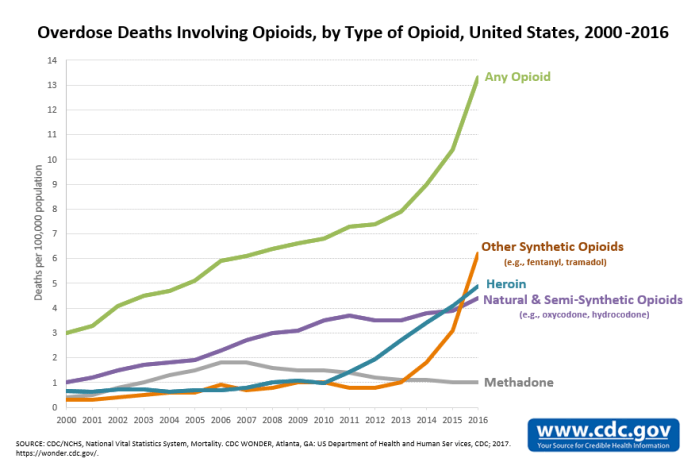
The data on overdoses and deaths does not paint a straightforward picture, and the group “opioid” obscures the different trends between drugs. The CDC classifies data according to four varieties of opioids: natural/semi-synthetic opioid analgesics like morphine, codeine, oxy- or hydrocodone, and oxy- or hydromorphone; synthetic opioid analgesics like tramadol and fentanyl; methadone; and heroin. The last is the only completely illegal opioid. Overdose deaths that have included heroin and completely synthetic opioids have increased exponentially from 2010 and 2013, respectively, while deaths from natural/semi-synthetic opioids and methadone have roughly stabilized or gone down over the last decade. Taken altogether, the deaths from opioid overdoses per 100,000 from 2000 to 2015 have increased from three to eleven people. (As of 2016, natural/semi-synthetic opioid deaths have actually started to go up again, but its still recent in the trend.)

OpioidDeathsByTypeUS

In 2016, the CDC issued guidelines for treating chronic pain that warned physicians against prescribing high dose opioids and suggested talking about health risks. It also advised to “start low and go slow” — a slogan later mocked by John Oliver in a segment on opioids. And, according to a CDC analysis, prescriptions for the most dangerous opioids have dropped 41% from 2010 to 2015, and so have opioid prescriptions in general dropped. This has resulted in patients with physical dependency suffering withdrawal, often without programs to ease the transition to nonopioid pain relievers. Opioid dependants with withdrawal, or average citizens in need of pain relief, often turn to stronger street narcotics, since heroin is the cheaper and stronger alternative to oxycodone. For example, with the drop in first-time OxyContin abuse since 2010, heroin use has spiked. In Maine, a 15% decrease in opioid analgesic overdoses came with a 41% increase in heroin overdoses in 2012. The use of prescribed opioids, then, looks like it might be strongly connected to the use of street narcotics. The Commission, for its credit, notes that “the removal of one substance conceivably will be replaced with another.”

One fact lost in the discussion is that the use of nonmedical opioids has decreased but the amount of overdose deaths has increased. And “opioid epidemic” when discussing overdoses highly obscures that heroin is the major contributor alongside fentanyl — not merely prescription analgesics. We hear a lot about OxyContin and Vicodin, which are actually leveling out (or were until 2015), and less about the drugs which are already policed more, have been policed longer, and cause more physical problems.

What the Commission proposes

In its report, the Commission concludes the goals of its recommendations are “to promote prevention of all drug use with effective education campaigns and restrictions in the supply of illicit and misused drugs.” The President’s Commission doesn’t want to interfere too strongly, despite all of Trump’s suggestions of a revamped drug war. The report notes that coming down hard on opioids will hurt patients with real needs, as has already happened, and, in a way, has happened since 1924. Much of the Commission’s recommendations come from a market approach, e.g. the suggestion (Rec. 19) to reimburse nonopioid pain treatments. The current Centers for Medicare and Medicaid Services (CMS) policy for reimbursement for healthcare providers treats nonopioid, postsurgical pain relief treatments the same as opioid prescriptions, issuing one inclusive payment for all “supplies” at a fixed fee. Nonopioid medications and treatments cost more, and so hospitals opt for dispensing opioids instead. The Commission recommends “adequate reimbursement [for] a broader range of pain management” services, changing the bundle payment policy to accommodate behavioral health treatment, educational programs, “tapering off opioids” and other nonopioid options.

Trump himself suggested an educational approach in a public announcement, which triggered critical comparisons to the failed D.A.R.E. program and “your brain on drugs” commercials. Educational programs are a less coercive option than direct regulation of opioids, but their effectiveness seems to be hit and miss. The Commission cites the Idaho Meth Project from 2007 (ongoing), conducted by a private nonprofit to inform young adults on the health problems associated with methamphetamine use, as a success story: “The Meth Project reports that 94% of teens that are aware of the anti-meth campaign ads say they make them less likely to try or use meth, and that Idaho has experienced a 56% decline in teen meth use since the campaign began.” This meth project is one success story out of many failures. For instance, the Montana Meth Project from 2005, on which the Idaho project was modelled, “accounting for a preexisting downward trend in meth use,” was determined to have “effects on meth use [that] are statistically indistinguishable from zero,” according to an analysis by the National Library of Medicine. Then again, one large scale anti-drug educational campaign, truth, which encourages youth to avoid tobacco, might be having success. Their modern guerrilla tactics are a major improvement on the old model of Partnership for a Drug-Free America. 

In another market approach to help recovering addicts reenter society, the Commission recommends decoupling felony convictions and eligibility for certain occupations (Rec. 50). The report cites Section 1128 of the Social Security Act, which prohibits employers that receive funding from federal health programs from hiring past convicts charged with unlawfully manufacturing, distributing or dispensing controlled substances. Any confrontation with law enforcement is a barrier to landing a job — a protected area of discrimination — and government laws that specifically ban their hiring make it worse on ex-users and -dealers trying to get clean. Recommendations like these lessen the role that the state has in keeping ex-convicts out of work. 

Much of the funding requested by the President’s Commission is authorized by the Obama administration’s major contribution to combating opioid usage, the Comprehensive Addiction and Recovery Act (CARA), signed into law July 2016 and credited as the “first major federal addiction legislation in 40 years.” CARA helped implement naloxone (an opioid overdose-reversal nail spray) in firefighting departments and strengthen drug monitoring programs. 


I’ll post the second half soon, and then a bonus post on my personal favorite solution.

Brazil top court delays decision on blocking prison for ex-president Lula

Brazil’s Supreme Court decided that leftist former president Luiz Inacio Lula da Silva cannot be sent to prison for a corruption conviction until he exhausts all possible appeals. About that:

“It will be of little avail to the people, that the laws are made by men of their own choice, if the laws be so voluminous that they cannot be read, or so incoherent that they cannot be understood: if they be repealed or revised before they are promulg[at]ed, or undergo such incessant changes, that no man who knows what the law is to-day, can guess what it will be tomorrow.” – James Madison (16 March 1751 – 28 June 1836), fourth President of the United States (1809–1817), co-author, with John Jay and Alexander Hamilton, of the Federalist Papers, and traditionally regarded as the Father of the United States Constitution.

“Brazil is not for beginners.” – Antônio Carlos Jobim (January 25, 1927 – December 8, 1994), also known as Tom Jobim, Brazilian composer, pianist, songwriter, arranger, and singer. Widely considered as one of the great exponents of Brazilian music.

Are voting ages still democratic?

Rather par for the course, our current gun debate, initiated after the school shooting in Parkland, has been dominated by children — only this time, literally.

I’m using “children” only in the sense that they are not legally adults, hovering just under the age of eighteen. They are not children in a sense of being necessarily mentally underdeveloped, or necessarily inexperienced, or even very young. They are, from a semantics standpoint, still teenagers, but they are not necessarily short-sighted or reckless or uneducated.

Our category “children” is somewhat fuzzy. And so are our judgments about their political participation. For instance, we consider ourselves, roughly, a democracy, but we do not let children vote. Is restricting children from voting still democratic?

With this new group of Marjory Stoneman Douglas high school students organizing for political change (rapidly accelerated to the upper echelons of media coverage and interviews), there has been widespread discussion about letting children vote. A lot of this is so much motivated reasoning: extending suffrage to the younger demographic would counter the current proliferation of older folks, who often vote on the opposite side of the aisle for different values. Young people tend to be more progressive; change the demographics, change the regime. Yet the conversation clearly need not be partisan, since there exist Republican- and Democrat-minded children, and suffrage doesn’t discriminate. (Moreover, conservative religious groups that favor large families, like Mormons, could simply start pumping out more kids to compete.)

A plethora of arguments exist that do propose pushing the voting age lower — 13, and quite a bit for 16 (ex. Jason Brennan) — and avoid partisanship. My gripe about these arguments is that, in acknowledging the logic or utility of a lowered voting age, they fail to validate a voting age at all. Which is not to say that there should not be a voting age in place (I am unconvinced in either direction); it’s just to say that we might want to start thinking of ourselves as rather undemocratic so long as we have one.

An interesting thing to observe when looking at suffrage for children is that Americans do not consider a voting age incompatible with democracy. If Americans do not think of America as a democracy, it is because our office of the President is not directly elected by majority vote (or they think of it as an oligarchy or something); it is not undemocratic just because children cannot vote. The fact that we deny under-eighteen year olds the vote does not even cross their minds when criticizing what many see as an unequal political playing field. For instance, in eminent political scientist Robert Dahl’s work How Democratic is the American Constitution? the loci of criticism are primarily on the electoral college and bicameral legislature. In popular parlance these are considered undemocratic, conflicting with the equal representation of voters.

Dahl notes that systems with unequal representation contrast to the principle of “one person, one vote.” Those with suffrage have one or more votes (as in nineteenth-century Prussia where voters were classified by their property taxes) while those without have less than one. Beginning his attack on the Senate, he states “As the American democratic credo continued episodically to exert its effects on political life, the most blatant forms of unequal representation were in due time rejected. Yet, one monumental though largely unnoticed form of unequal representation continues today and may well continue indefinitely. This results from the famous Connecticut Compromise that guarantees two senators from each state” (p. 48).

I quote Dahl because his book is zealously committed to majoritarian rule, rejecting Toqueville’s qualms about the tyranny of the majority. Indeed, Dahl says he believes “that the legitimacy of the Constitution ought to derive solely from its utility as an instrument of democratic government” (39). And yet, in the middle of criticizing undemocratic American federal law, the voting age and status of children are not once brought up. These factors appear to be invisible. In our ordinary life, when the voting age is brought up, it is nearly always in juxtaposition to other laws, e.g., “We let eighteen year olds vote and smoke, but they have to be 21 to buy a beer,” or, on the topic of gun control, “If you can serve in the military at 18, and you can vote at 18, then what is the problem, exactly, with buying a gun?”

What is the explanation for this? We include the march for democracy as one progressive aspect of modernity. We see ourselves as more democratic than our origin story, having extended suffrage to non-whites, women and people without property. We see America under the Constitution as a more developed rule-of-the-people than Athens under Cleisthenes. So, we admit to degrees of political democracy — have we really reached the end of the road? Isn’t it more accurate that we are but one law away from its full realization? And of course, even if we are more of a representative republic, this is still under the banner of democracy — we still think of ourselves as abiding by “one person, one vote” (Dahl, 179-183).

In response, it is said that children are not properly citizens. This allows us to consider ourselves democratic, even while restricting direct political power from a huge subset of the population while inflicting our laws on them.

This line of thought doesn’t cut it. The arguments for children as non- or only partial-citizens are riddled with imprecisely-targeted elitism. “Children can be brainwashed. Children do not understand their own best interests. Children are uninterested in politics. Children are not informed enough. Children are not rational. Children are not smart enough to make decisions that affect the entire planet.”

Although these all might apply, on the average, to some age group — one which is much younger than seventeen, I would think — they also apply to all sorts of individuals distributed throughout every age. A man gets into a car wreck and severely damages his frontal lobe. In most states there is no law prohibiting him from dropping a name in the ballot, even though his judgment is dramatically impaired, perhaps analogous to an infant. A nomad, who eschews modern industrial living for the happy life of travel and pleasure, is allowed to vote in his country of citizenship — even though his knowledge of political life may be no greater than someone from the 16th century. Similarly, adults can be brainwashed, adults can be stupid, adults can be totally clueless about which means will lead to the satisfaction of their preferred ends.

I venture that all Americans do not want uninformed, short-sighted, dumb, or brainwashable people voting, but they will not admit to it on their own. Children are a proxy group to try to limit the amount of these people that are allowed in on our political process. And is banning people based on any of these criteria compatible with democracy and equality?

Preventing “stupid” people from voting is subjective and elitist; preventing “brainwashable” people from voting is arbitrary; preventing “short-sighted” people from voting is subjective and elitist, and the same for “uninformed” people. We come to the category of persons with severe mental handicaps, be their brain underdeveloped from the normal process of youth, or injury, or various congenital neurodiversities. Regrettably, at first glance it seems reasonable to prevent people with severe mental defects from voting. Because, it is thought, they really can’t know their interests, and if they are to have a voting right, it should be placed in a benefactor who is familiar with their genuine interests. But now, this still feels like elitism, and it doesn’t even touch on the problem of how to gauge this mental defect — it seems all too easy for tests to impose a sort of subjective bias.

Indeed, there is evidence that this is what happens. Laws which assign voting rights to guardians are too crude to discriminate between mental disabilities which prevent voting and other miscellaneous mental problems, and make it overly burdensome to exercise voting rights even if one is competent. It is hard to see how disenfranchising populations can be done on objective grounds. If we extended suffrage from its initial minority group to all other human beings above the age of eighteen, the fact that we prolong extending it to children is only a function of elitism, and consequently it is undemocratic.

To clarify, I don’t think it is “ageist” to oppose extending the vote to children, in the way that it is sexist to restrict the vote for women. Just because the categories are blurry doesn’t mean there aren’t substantial differences, on average, between children and adults. But our reasoning is crude. We are not anti-children’s suffrage because of the category “children,” but because of the collective disjunction of characteristics we associate underneath this umbrella. It seems like Americans would just as easily disenfranchise even larger portions of the population, were we able to pass it off as democratic in the way that it has been normalized for children.

Further, it is not impossible to extend absolute suffrage. Children so young that they literally cannot vote — infants — could have their new voting rights bestowed upon their caretakers, since insofar as infants have interests, they almost certainly align with their daily providers. This results in parents having an additional vote per child which transfers to their children whenever they request them in court. (Again, I’m not endorsing this policy, just pointing out that it is possible.) The undemocratic and elitist nature of a voting age cannot be dismissed on the grounds that universal suffrage is “impossible.”

It is still perfectly fine to say “Well, I don’t want the boobgeoisie voting about what I can do anyway, so a fortiori I oppose children’s suffrage,” because this argument asserts some autocracy anyway (so long as we assume voting as an institutional background). The point is that the reason Americans oppose enfranchising children is because of elitism, and that the disenfranchising of children is undemocratic.

In How Democratic is the American Constitution? the closest Robert Dahl gets to discussing children is adding the Twenty-Six Amendment to the march for democratic progress, stating that lowering the voting age to eighteen made our electorate more inclusive (p. 28). I fail to see why lowering it even further would not also qualify as making us more inclusive.

In conclusion, our system is not democratic at all,
Because a person’s a person no matter how small.


Deep Learning and Abstract Orders

It is well known that Friedrich Hayek once rejoiced at Noam Chomsky’s evolutionary theory of language, which stated that the faculty of speaking depends upon a biological device which human beings are enabled with. There is no blank slate and our experience of the world relies on structures that come from the experience in itself.

Hayek would be now delighted if he were told about the recent discoveries on the importance of background knowledge in the arms race between human beings and Artificial Intelligence. When decisions are to be taken by trial and error at the inside of a feedback system, humans are still ahead because they apply a framework of abstract patterns to interpret the connections among the different elements of the system. These patterns are acquired from previous experiences in other closed systems and provide with a semantic meaning to the new one. Thus, humans outperform machines, which work as blank slates, since they take information only from the closed system.

The report of the cited study finishes with the common place of asking what would happen if some day machines learn to handle with abstract patterns of a higher degree of complexity and, then, keep up with that human relative advantage.

As we stated in another place, those abstract machines already exist and they are the legal codes and law systems that enable their users with a set of patterns to interpret controversies concerning human behaviour.

What is worth being asked is not whether Artificial Intelligence eventually will surpass human beings, but what group of individuals will overcome the other: the one which uses technology or the one which refuses to do so.

The answer seems quite obvious when the term “technology” is related to concrete machines, but it is not so clear when we apply it to abstract devices. I tried to ponder the latter problem when I outlined an imaginary arms race between policy wonks and lawyers.

Now, we can extend these concepts to whole populations. Which of these nations will prevail over the other ones: the countries whose citizens are enabled with a set of abstract rules to based their decisions on (the rule of law) or the despotic countries, ruled by the whim of men?

The conclusion to be drawn is quite obvious when we are confronted with a so polarised question. Nevertheless, the problem becomes more subtle when the disjunction concerns on rule of law vs deliberate central planning.

The rule of law is the supplementary set of abstract patterns of conduct that gives sense to the events of the social reality in order to interpret human social action, including the political authority.

In the case of central planning, those abstract patterns are replaced by a concrete model of society whose elements are defined by the authority (after all, that is the main function of Thomas Hobbes’ Leviathan).

Superficially considered, the former – the rule of law as an abstract machine – is irrational while the latter – the Leviathan’s central planning – seems to respond to a rational construction of the society. Our approach states that, paradoxically, the more abstract is the order of a society, the more rational are the decisions and plans that the individuals undertake, since they are based on the supplementary and general patterns provided by the law, whereas central planning offers to the individuals a poorer set of concrete information, which limits the scope of the decisions to those to be based on expediency.

That is why we like to state that law is spontaneous. Not because nobody had created it -in fact, someone did – but because law stands by itself the test of time as the result of an evolutionary process in which populations following the rule of law outperform the rival ones.

On Antitrust, the Sherman Act and Accepted Wisdom

I am generally skeptical of “accepted wisdom” on many policy debates. People involved in policy-making are generally politicians who carefully craft justifications (i.e. cover stories) where self-interest and common good cannot be disentangled easily.  These justifications can easily become “accepted wisdom” even if incorrect. I am not saying that “accepted wisdom” is without value or that it is always wrong, but more often than not it is accepted at face value without question.

My favorite example is “antitrust”.  In the United States, the Sherman Act (the antitrust bill) was first introduced in 1889 (passed in 1890). The justification often given is that it was meant to promote competition as proposed by economists. However, as often pointed out, the bill was passed well before the topic of competition in economics had been unified into a theoretical body.  It was also rooted in protectionist motives. Moreover, the bill was passed after the industries most affected saw prices fall faster than the overall price level and output increase faster than the overall output level (see here here here here and here). Combined, these elements should give pause to anyone willing to cite the “accepted wisdom”.

More recently, economist Patrick Newman provided further reason for caution in an article in Public Choice. Interweaving political history and the biographical details about senator John Sherman (he of the Sherman Act), Newman tells a fascinating story about the self-interested reasons behind the introduction of the act.

In 1888, John Sherman failed to obtain the Republican presidential nomination – a failure which he blamed on the governor of Michigan, Russell Alger. Out of malice and a desire of vengeance, Sherman defended his proposal by citing Alger as the ringmaster of one of the “trusts”. Alger, himself a presidential hopeful for the 1892 cycle, was politically crippled by the attack (even if it appears that it was untrue). Obviously, this was not the sole reason for the Act (Newman highlights the nature of the Republican coalition which would have demanded such an act). However, once Alger was fatally wounded, Sherman appears to have lost interest in the Act and left others to push it through.

As such, the passage of the bill was partly motivated by political self-interest (thus illustrating the key point of behavioral symmetry that underlies public choice theory). Entangled in the “accepted wisdom” is a wicked tale of revenge between politicians. At such sight, it is hard not to be cautions with regards to “accepted wisdom”.

2018 Hayek Essay Contest

The 2018 General Meeting of the Mont Pelerin Society will take place from September 30 – October 6, 2018 at ExpoMeloneras and Lopesan Hotels in Meloneras, Gran Canaria, Canary Islands. As with past general meetings, the Mont Pelerin Society is currently soliciting submissions for Friedrich A. Hayek Fellowships. The fellowships will be awarded through the Hayek Essay Contest.

The Hayek Essay Contest is open to all individuals 36 years old or younger. Entrants should write a 5,000 word (maximum) essay that addresses the quotation(s) and question(s) detailed on the contest announcement (available at the above link). The deadline for submissions is May 31, 2018. The winners will be announced on July 31, 2018. Essays must be submitted in English only. Electronic submissions should be sent in PDF format to this email address (mps.youngscholars@ttu.edu). Authors of winning essays must present their papers at the General Meeting to receive their award. The essays will be judged by an international panel of three members of the Society.

Please feel free to share this announcement with any individuals who may have an interest in submitting an essay for consideration of a fellowship award. All questions may be directed to the MPS Young Scholars Program Committee by email at mps.youngscholars@ttu.edu or phone at +1.806.742.7138.

MPS Young Scholars Program Committee