Ottomanism, Nationalism, Republicanism III

Previous posts in this series have looked at the preconditions for the proclamation of the Republic of  Turkey in 1923. The Ottoman Empire was in a very difficult situation from the early 19th century, effectively lacking the capacity to prevent erosion of its territory, extraterritorial legal rights for the stronger Great Powers which were extended to non-Muslim subjects the powers claimed to protect, and ‘mediation’ regarding break away groups within the Empire. The survival of the Empire was certainly in doubt by 1914 and World War One killed it, along with three other empires: Russian, German, and Austro-Hungarian. In a more long term way, the war hastened the end of colonial European empires, though the French and British Empires gained territory from the Paris Peace Treaties.

It is hard to see how the Ottoman Empire could have survived except as a rump state, even without the war. It might have been smaller than the current republic and certainly would not have been larger. Had its German and Austro-Hungarian allies won the war, it would have survived with some territorial gains in north Africa, but as an effective dependency of Germany.

Defeat in the war destroyed the power of the Trio (Enver, Talat and Cemal) of military and bureaucratic figures who ran the Empire under the continuing nominal sovereignty of the Sultan in a secretive and unaccountable manner. They came of the Committee of Union Progress, the political party expression of the Young Turks who came to power in 1908. The methods of the trio are the culmination of the rapid movement of the CUP from a constitutional party to a conspiratorial and authoritarian political force: Kemal Atatürk was a member of the CUP but resigned because of its lack of republican radicalism, with perhaps some motivation from more personal kinds of dispute.

As World War I ended in 1918, the Sultan regained powers and followed a policy of appeasement towards Britain, continuing the logic of earlier dependency on Germany, that is the logic in which the state could only survive through appeasement of at least one Great Power. The government was superficially more liberal than what came before, but had so little basis in the residual Empire it’s hard to see any circumstance in which it would not have collapsed or resorted to state violence to replace the power of Britain, which was occupying Istanbul.

The 1920 Treaty of Sèvres gave all the remaining Arab provinces to Britain and France, who also occupied parts of Anatolia along with Italy and Greece (which was given most of eastern Thrace). An American backed Armenian state was envisaged in eastern Anatolia and a confederation of Kurdish majority provinces in the southeast with the British mandate in Mesopotamia-Iraq. As far as the elements of the Ottoman elite influenced by nationalism and republicanism were concerned, particularly those who were, or had been, active in the CUP this was entirely unacceptable, leaving a rump Ottoman state in the central and northern parts of Anatolia, separated from Istanbul in the southeast, the east, the south, and the west. A Greek invasion of Izmir and other parts of the west to enforce its Sèvres gains met with armed force.

Though the Ottoman state appeared to be completely defeated and helpless, the CUP had left a legacy of public and conspiratorial political and security organisation which led to considerable resistance. A general known as Mustafa Kemal Paşa, later Kemal Atatürk, was able to leave Istanbul and join up with anti-Sèvres forces in the east, under cover of ‘inspection’ of Ottoman forces, possibly with the connivance of elements of the residual Sultan regime. Atatürk’s strength of personality and political vision, along with military prestige from the Battle of Gallipoli, enabled him to become the military and political leader of these forces, so that a secularist radical vanguardist republican was at the head of a national assembly full of traditional Ottoman Muslims.

The consequences of this formative national movement (which had Kurdish as well as Turkish support) was that Mustafa Kemal was able to defeat the Greek expansion into Anatolia, push other occupying forces out, and that he was able to insist on a replacement for the Treaty of Sèvres, which is the Treaty of Lausanne. The whole process continued the ethnic violence which marked movements of rebellion against the Ottoman Empire and state counter-violence. It is very had to see how any postwar Ottoman or republican state could have avoided the continuation of early ethnic violence.

The republican regime emerged from a national movement against ethnically inspired partition and occupation, so was not going to aim for a consociational or federalist state to get ethnic groups to share a state. It was not even going to aim for pluralism within a unitary state. Turkish republicanism was based on nationalism, and ethnic nationalism at that, as the only likely basis for an enduring state. The means by which this was obtained during the War of Independence and the early republican regime were ugly, but the alternative was ugly attacks on Anatolian Muslims, principally Turks and then Kurds.

With all due respect to the dangers of ‘whataboutery’, the process in which parts of the Ottoman state kept breaking away to form Christian majority states was no more pleasant. The same applies to the Russian annexation of what had been Ottoman lands in the Caucasus, which appears to have led to the killing of one million, or more, Cherkez (Circassian) Muslims.

From the time of  Albanian revolts of the early years of the 20th century, the Ottoman Empire was beginning to part ways with its Muslim population outside Anatolia and Thrace. The conflict between Arabs and the Ottoman state was extremely ugly on both sides. As I have mentioned, the Austria-Hungary fragmentation at the end of the First World War was unique in not leaving a state which represented the core of the Empire.

It is not an easy subject, but the evidence of the First World War and the 1920s is that a state needs some kind of core nationality and territory to survive, which we see even in a the multi-ethnic Yugoslav state, which had Serbs at its core. In Turkey the ethnic core of Turks, in alliance with a lesser number of Kurds and various ethnicities including Cherkez and Bosnşian which had been refugees from the post-Ottoman states, based in the territorial core of Anatolia, provided a basis for a national movement. The national movement was strongly influenced at elite levels by republican ideas of unified popular will, which could fit with nationalism.

To be continued

Ottomanism, Nationalism, Republicanism II

In the last post, I gave some historical background on how the Ottoman state, whether in reformist or repressive mode (or some combination of the two), was on a road, at least from the early nineteenth century, that was very likely to end in a nation-state for the Turks of Anatolia and the Balkan region of Thrace, which forms a hinterland in its eastern part for the part of Istanbul on the Balkan side of the Bosphorus. Despite the centuries of the Ottoman dynasty (the founder Othman was born in 1299 and this is usually taken as the starting point of the Ottoman state, though obviously there was no such thing when Othman was born), it was also an increasing possibility that the nation-state would be a republic on the French model.

The obvious alternative being a style of monarchism mixing populism and (rather constructed) tradition, born out of a national movement and accommodating the idea of a popular will represented by the monarch, mixed in varying degrees with constitutional and representative institutions. The clearest example of this style is maybe Serbia, to which can be added Montenegro, Bulgaria, Romania and Greece. The older monarchies of imperial Germany and Russia incorporated elements of populist-national monarchy. The Austro-Hungarian Empire, as the Habsburg empire based in Vienna for many centuries became known in 1867, was the Empire most lacking in a core and not surprisingly suffered the most complete disintegration after World War One (that great killer of Empires).

France was the exception in Europe as a republic, particularly as a unitary republic, and was only continuously a republic from 1870. In 1870, Switzerland was the only other republic, but known as the Swiss Confederation, with strong powers for the constituent cantons. The example of French republicanism was still supremely important because of the transformative nature of the 1789 French Revolution, and the ways its development became central events in European history. Part of that came out of the preceding status of France as the premier European nation and the biggest cultural force of the continent. Educated Ottomans were readers of French, and Ottoman political exiles were often in Paris.

High level education often meant studying in Paris. This had such a big influence on the fine arts, including architecture, that apparently 19th century architecture in Istanbul was more based on French Orientalism than earlier Ottoman architecture. The religious conservatives and neo-Ottomanists in power today, who claim to represent authenticity and escape from western models, in reality promote imitation of these 19th century imports.

Ottoman intellectuals and writers read French and were familiar with the idea of France as intellectual and political leader. There were other influences, including important relations with Imperial Germany, but French influence had a particular status for those aiming for change.

Namık Kemal, the ‘Young Ottoman’ reformer who has some continuing appeal to the moderate political right in Turkey, as demonstrated in the foundation of a Namık Kemal University in Thrace 4 years after the AKP came to power, appearing more moderate conservvative than it does now, translated Montesquieu’s The Spirit of the Laws into Ottoman Turkish (modern Turkish is based on major changes from Ottoman).

The more radical reformers who came to power in 1908 were known as Young Turks, that is Jeunes Turcs, often now written in half-Turkish, half-French style as Jön Türkler. The more radical reformers wanted less role for Islam in public life and at the most radical end even regarded Islam as responsible for backwardness. French laicism was therefore a natural pole of attraction, as were the ways nationalism and republicanism came together in the French revolutionary legacy as an expression of the sovereignty of the people.

The Ottomans studying in France were strong influenced by the sociology of Emile Durkheim, who is usually counted as one of the three founders of the discipline of sociology, along with Karl Marx and Max Weber. Durkheim’s social thought was very influenced by an understanding of Montesquieu and Jean-Jacques Rousseau as precursors of sociology. This partly reflects the social analysis they engaged in, but also their idea of how a society is constituted legally and politically, particularly Rousseau’s theory of the social contract. Durkheim’s social thought is permeated by concerns with what kind of social solidarity there can be in modern societies in ways which build on the long history of republican thinking about a community of citizens. This was very important in the late Ottoman and early republican period.

The German

Max Weber was also a major influence. His ideas about disenchantment (a version of secularisation) and the role of the nation-state were of definite interest to Turkish thinkers inclined towards republicanism, nationalism, and secularism. One of the consequences of this is that criticisms of the Turkish republican tradition, as it passed through Kemal Atatürk (‘Kemalism’), are tied up with criticisms of Weber. Some of this Turkish absorption of Durkheim and Weber can be found in English in the work of Ziya Gökalp (1876-1924) and Niyazi Berkes (1908-1988).

It is also worth finding Atatürk’s Great Speech of 1927 (a book length text read out over several days), which is a political intervention not a discussion of social theory, but does show how ideas connected with social theory enter political discourse in Turkey. It is very widely distributed in Turkey, I’ve even seen it on sale in Turkish supermarkets; and it has been translated into English. Berkes is the social scientist and has a rather more academic way of writing than Gökalp (a famously ambiguous thinker) or Atatürk. His The Development of Secularism in Turkey (published in English 1964, while he was working at McGill University in Montreal) must be the single most influential work of social science by a Turk or about Turkey.

Unfortunately a discussion  of republicanism in relation to Durkheim, Weber, or any other major thinkers declined after the 1920s and Berkes is really the last great flowering of this tradition in Turkey. This is part of the story of how Turkish republicanism as a mode of thinking declined into defensive gestures and the repetition of dogmas, so is also the history of how extremely superficial gestures towards liberalism by leaders of the Turkish right had undue influence over the more liberal parts of Turkish thinking.

The weakness of thought about republicanism and the superficial absorption of liberalism was the main thread on the intellectual side leading to the disaster of Erdoğan-AKP rule. The rise of AKP was welcomed by many (I suspect most, but I don’t know any ways in which this has been quantified) Turkish liberals until the suppression of the Gezi movement in 2013 and even in some cases until the wave of repression following the coup attempt of 2016.

To be continued

Ottomanism, Republicanism, Nationalism I

The Republican experiment in Turkey goes back formally to 1923, when Mustafa Kemal (later Kemal Atatürk) proclaimed the Republic of Turkey after the deposition of the last Ottoman Sultan, becoming the first President of the Republic after holding the office of Speaker of the National Assembly. The office of Caliph (commander of the faithful), which had a symbolic universalism for Muslim believers world wide and was held by the Ottoman dynasty, was abolished in the following year. The Republic, as you would expect in the early 20s, was founded on intensely nationalistic grounds, creating a nation for Turks distinct from the Ottoman system which was created in an era of religiously defined and personalised rule rather than ethnic-national belonging.

The move in a republican-national direction can be taken back to the Young Turk Revolution of 1908, which itself put down a counterrevolution in 1909, and might be taken as a model for current political divisions (in a qualified clarification through simplification manner). The name rather exaggerates the nationalist element of the revolution. The governments which came after 1908, ruling under an Ottoman dynasty reduced to a ceremonial role, were torn between Turkish nationalist, Ottomanist, and Islamist replacements for the personalised nature of Ottoman rule.

In this context Ottomanist refers to creating the idea of an Ottoman citizenship and shared institutions rather than restoring the political power of the dynasty. Variations on these ideas include Pan-Turkism/Turanism (the unity of Turkish peoples from the Great Wall of China to the Adriatic Sea) and a Dual Monarchy of Turks and Arabs modeled on the Habsburg Dual Monarchy of Austrians and Hungarians (that is the Habsburgs were Emperors of Austria in the Austrian lands and Kings of Hungary in the Magyar lands).

The move away from a patrimonial state based on the hereditary legitimacy of dynasties, who were not formally restricted by any laws or institutions, goes back to the Tanzimat edict of 1839, issued by Sultan Abdulmejid I in 1839, establishing administrative reforms and rights for Ottoman subjects of all religions. This might be taken as providing a model of moderate or even conservative constitutional reformism associated with the Young Ottoman thinkers and state servants. It has its roots in the reign of Mahmud II. Mahmud cleared the way for the reform process by the destruction of the Janissary Order, that is the military corps which had expanded into various areas of Ottoman life and was an important political force. The Tanzimat period led to the constitution and national assembly of 1876, which was suspended by Sultan Abdul II in 1878.

Abdul Hamit carried on with administrative reforms, of a centralised kind which were seen as compatible with his personal power, accompanied by war against rebellious Ottoman subjects of such a brutal kind that he became known as the Red Sultan. His status has been greatly elevated by President Erdoğan who evidently wishes to see himself as a follower of Abdul Hamit II, rather giving away his tendency to regard democracy and constitutionalism as adornments to be displayed when they can be bent and twisted to his end, rather than as intrinsic values. The brutality of Abdul Hamit II, the violent reactionary, was foreshadowed in the reformism of Mahmud II. His destruction of the arch-conservative corps of the Janissaries was a highly violent affair in which an Istanbul mutiny provoked by Mahmud was put down through the execution of prisoners who survived the general fighting.

In this sketch, I try to bring out the ways in which the Ottoman state used systematic violence to reform and to push back reform, when giving rights and when taking them away. There is no Ottoman constitutional tradition respecting the rights of all and the pre-republican changes were just as violent as the most extreme moments of the republican period.

The ‘millet system’ of self-governing religious communities under the Sultan was a retrospective idealisation of ways in which the Ottomans accommodated religious diversity, at the time the capacity of the state to have legitimacy over non-Muslim subjects was declining. Serbia started revolting in 1804, leading to self-government within the Empire in 1817, on the basis of national post-French Revolution, not the ‘millet’ tradition rooted in classical Muslim ideas of ‘protected’ minorities. The strength of modern nationalism in the Ottoman lands is confirmed by Greek Independence, internationally recognised in 1832, following a war in which western educated Greeks familiar with ideas of nationalism and sovereignty provided the ideology.

The republican national tradition in Turkey is sometimes seen as a fall away from Ottoman pluralism and therefore as regressive. The ‘regression’, as in the influence of nationalism and reconstruction of the Ottoman state through centralisation and centrally controlled violence, actually goes back much further. The Ottoman state was not able to find ways of accommodating the aspirations first of non-Muslim subjects then even of Muslim subjects outside Anatolia and Thrace. In this process the Ottoman state was step by step becoming what is now Turkey, based on the loyalty of mostly ethnic Turkish subjects, including Muslim refugees from break-away states who fled into Anatolia, and to some degree on the loyalty of Kurds in Anatolia to the Ottoman system. Antagonism towards Ottoman Armenians was one part of this.

To be continued

Separation of Children: an American Tradition

Many Americans deplore the forced separation of children from their parents when they attempt an unauthorized entry into the USA. The recorded crying of children traumatized from having their parents taken away is terrible to hear for anyone with empathy. Administrations excuse this by claiming that they are only enforcing a legally mandated zero tolerance, that this separation acts as a useful deterrent to immigration, and that the law is ordained by God.

The claim by those opposing this policy is that this cruel separation is un-American. But in fact, the forced separation of children is an American tradition. Under slavery prior to the end of the Civil War, children were sold separately from their parents. This action too was presumably a law ordained by God.

The separation of children from their parents was also imposed on native American Indians. Children were forcibly removed from their homes and put into boarding schools, the aim being the assimilation of Indians into Euro-American culture. Indian children were not allowed to speak in their native languages. Rather than being un-American, this physical and cultural separation was seen as an Americanization. Canada had a similar program for its Indians.

This separation continued the genocide of Indians by having a high rate of death. The misery that children felt in their familial and cultural separation was compounded by abusive treatment and a high mortality rate.

Since the current child separation is a continuation of past policies, we can expect similar outcomes: abuse, death, and suicides. Feeling no hope of ever seeing their parents again, confined to small cages, suffering from boredom, and constantly hearing other children crying, there could be substantial illness and even suicide in these detention camps. It would at first be covered up, and then exposed, and denied as “fake news.”

This anti-family policy is supported by many Republicans and conservatives. The conservative claim of supporting “family values” has now been shown to be fake. The real conservative stance is the imposition of traditional European culture and supremacy. Most of the migrants from Central America and Mexico are of native Indian ancestry. When they are rejected and sent back to their home countries to get killed by the violence from which they fled, this is in accord with the American tradition of European racial supremacy over native American Indians. If those seeking to immigrate were Norwegians, those families would not be split up.

Indeed, those subjected to forced family separation were races that were conquered and regarded as inferior. A large immigration from Mexico and Central America would repopulate the USA with native Indian “blood,” unacceptable to Euro-American supremacists.

Therefore the forced separation of native Indians from their parents and the rejection of further immigration is as American as one could get.

RCH: the Cherokee Nation and the US Civil War

That’s the topic of my Tuesday column over at RealClearHistory. An excerpt:

Ross was critical of the success of the death warrants against the Treaty Party Men, but the most interesting aspect of the two mens’ rivalry was the fact that they used the rule of law to fight their battles. Now, the rule of law in the 19th century meant the use of violence between factions (think here about Tombstone, Ariz., where Wyatt Earp and his friends were U.S. Marshals and the friends of the Clantons were Sheriffs), but there was a belief held at the time that violence could only be used by civilized men if the law was on their side. Ross and Watie were both firm believers in this form of rule of law.

Please, read the rest and share it with your friends.

The State in education – Part III: Institutionalization of learning

In The State in education – Part II: social warfare, we looked at the promise of state-sponsored education and its failure, both socially and as a purveyor of knowledge. The next step is to examine the university, especially since higher education is deeply linked to modern society and because the public school system purports to prepare its students for college.

First, though, there should be a little history on higher education in the West for context since Nietzsche assumed that everyone knew it when he made his remarks in Anti-Education. The university as an abstract concept dates to Aristotle and his Peripatetic School. Following his stint as Alexander the Great’s tutor, Aristotle returned to Athens and opened a school at the Lyceum (Λύκειον) Temple. There, for a fee, he provided the young men of Athens with the same education he had given Alexander. On a side note, this is also a beautiful example of capitalist equality: a royal education was available to all in a mutually beneficial exchange; Aristotle made a living, and the Athenians received brains.

The Lyceum was not a degree granting institution, and only by a man’s knowledge of philosophy, history, literature, language, and debating skills could one tell that he had studied at the Lyceum. A cultural premium on bragging rights soon followed, though, and famous philosophers opening immensely popular schools became de rigueur. By the rise of Roman imperium in the Mediterranean around 250 BC, Hellenic writers included their intellectual pedigrees, i.e. all the famous teachers they had studied with, in their introductions as a credibility passport. The Romans were avid Hellenophiles and adopted everything Greek unilaterally, including the concept of the lyceum-university.

Following the Dark Ages (and not getting into the debate over whether the time was truly dark or not), the modern university emerged in 1088, with the Università di Bologna. It was more of a club than an institution; as Robert S. Rait, mid-20th century medieval historian, remarked in his book Life in the Medieval University, the original meaning of “university” was “association” and it was not used exclusively for education. The main attractions of the university as a concept were it was secular and provided access to books, which were prohibitively expensive at the individual level before the printing press. A bisection of the profiles of Swedish foreign students enrolled at the Leipzig University between 1409 and 1520 shows that the average male student was destined either for the clergy on a prelate track or was of noble extraction. As the article points out, none of the students who later joined the knighthood formally graduated, but the student body is indicative of the associative nature of the university.

The example of Lady Elena Lucrezia Cornaro Piscopia, the first woman to receive a doctoral degree, awarded by the University of Padua in 1678, illuminates the difference between “university” at its original intent and the institutional concept. Cornaro wrote her thesis independently, taking the doctoral exams and defending her work when she and her advisor felt she was ready. No enrollment or attendance at classes was necessary, deemed so unnecessary that she skipped both the bachelor and masters stages. What mattered was that a candidate knew the subject, not the method of acquisition. Even by the mid-19th century, this particular path remained open to remarkable scholars, such as Nietzsche since Leipzig University awarded him his doctorate on the basis of his published articles, rather than a dissertation and defense.

Education’s institutionalization, i.e. the focus shifting more from knowledge to “the experience,” accompanied a broader societal shift. Nietzsche noted in Beyond Good and Evil that humans have an inherent need for boundaries and systemic education played a very prominent role in contemporary man’s processing of that need:

There is an instinct for rank which, more than anything else, is a sign of a high rank; there is a delight in the nuances of reverence that allows us to infer noble origins and habits. The refinement, graciousness, and height of a soul is dangerously tested when something of the first rank passes by without being as yet protected by the shudders of authority against obtrusive efforts and ineptitudes – something that goes its way unmarked, undiscovered, tempting, perhaps capriciously concealed and disguised, like a living touchstone. […] Much is gained once the feeling has finally been cultivated in the masses (among the shallow and in the high-speed intestines of every kind) that they are not to touch everything; that there are holy experiences before which they have to take off their shoes and keep away their unclean hands – this is almost their greatest advance toward humanity. Conversely, perhaps there is nothing about so-called educated people and believers in “modern ideas” that is as nauseous as their lack of modesty and the comfortable insolence in their eyes and hands with which they touch, lick, and finger everything [….] (“What is Noble,” 263)

The idea the philosopher pursued was the notion that university attendance conveyed the future right to “touch, lick, and finger everything,” a very graphic and curmudgeonly way of saying that a certain demographic assumed unjustified airs.

Given that in Anti-Education, Nietzsche lamented the fragmentation of learning into individual disciplines, causing students to lose a sense of the wholeness, the universality of knowledge, what he hated in the nouveau educated, if we will, was the rise of the pseudo-expert – a person whose knowledge was confined to the bounds of a fixed field but was revered as omniscient. The applicability of Socrates’ dialogue with Meno – the one where teacher and student discuss human tendency to lose sight of the whole in pursuit of individual strands – to the situation was unmistakable, something which Nietzsche, a passionate classicist, noticed. The loss of the Renaissance learning model, the trivium and the quadrivium, both of which emphasize an integrated learning matrix, carried with it a belief that excessive specialization was positive; it was a very perverse version of “jack of all trades, master of none.” As Nietzsche bemoaned, the newly-educated desired masters without realizing that all they obtained were jacks. In this, he foreshadowed the disaster of the Versailles Treaty in 1919 and the consequences of Woodrow Wilson’s unwholesome belief in “experts.”

The philosopher squarely blamed the model of the realschule, with its clear-cut subjects and predictable exams, for the breakdown between knowledge acquisition and learning. While he excoriated the Prussian government for basing all public education on the realschule, he admitted that the fragmentation of the university into departments and majors occurred at the will of the people. This was a “chicken or the egg” situation: Was the state or broader society responsible for university learning becoming more like high school? This was not a question Nietzsche was interested in answering since he cared more about consequences. However, he did believe that the root was admitting realschule people to university in the first place. Since such a hypothesis is very applicable today, we will examine it in the contemporary American context next.
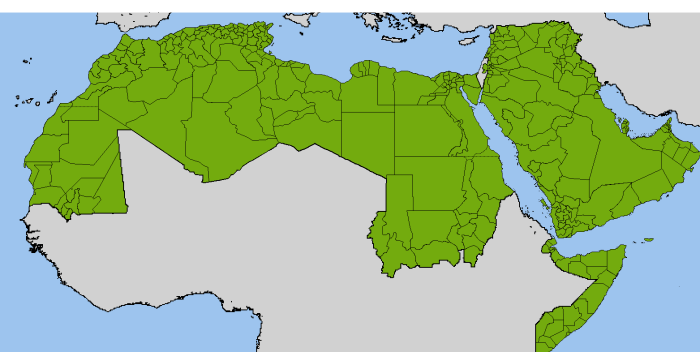
Eye Candy: the Arab world’s administrative divisions

NOL map Arab world admin divisions
Click here to zoom

Imagine if these divisions were all states in a federal republic. Myself, I think some of them,maybe even half of them, could be combined, but if that ever happened, and the resulting combined administrative divisions of the Arab world federated, the region would be in much better shape. (The federation of Arabia would need a Senate, of course.)

What if the OECD did the same? Or simply the US and it’s closest allies?

RCH: the Ottoman Empire

My subject for this weekend’s RealClearHistory column is battles that shaped the Ottoman Empire. Here is an excerpt:

On June 4, 1915, the Third Battle of Krithia was fought between the Ottoman Empire and its Allied enemies, composed of mostly French and British troops. The Ottomans won, handily and somewhat surprisingly. The Allies had to retreat and regroup as a result, and the Balkans campaign had to go through a more careful re-think by Allied strategists.

World War I marked the end of the Ottoman Empire, of course, but the “sick man of Europe” had more fight in it than many Western historians give it credit for. Scholarship on the Ottoman Empire has improved over the years, but there is still plenty of opportunity to do more. The Ottoman Empire spanned three continents, after all, and lasted for 623 years.

The Ottoman Empire was actually one of three multi-ethnic, multi-religious empires in Europe that perished as a result of World War I, along with Austria-Hungary and tsarist Russia. To the east of the Ottomans were two other, long-lasting empires, the Persian empire ruled by the Qajar dynasty (which perished in 1925) and the Mughal empire of India (which perished in 1857). These eastern empires are referred to by many historians as “gunpowder empires” and they controlled the Eurasian trade routes that Chinese and especially European merchants used for exchanging goods and ideas. Here are 10 battles that shaped the Ottoman Empire:

Please, read the rest. And have a good weekend.

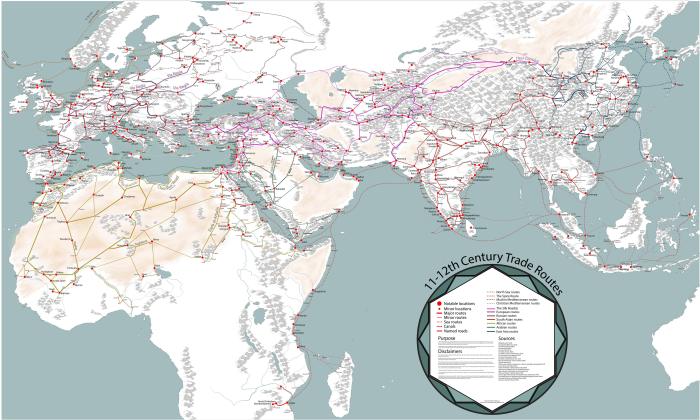
Eye Candy: medieval trade networks

NOL map medieval trade networks
Click here to zoom

‘Nuff said, and don’t forget to zoom in!

On “strawmanning” some people and inequality

For some years now, I have been interested in the topic of inequality. One of the angles that I have pursued is a purely empirical one in which I attempt to improvement measurements. This angle has yielded two papers (one of which is still in progress while the other is still in want of a home) that reconsider the shape of the U-curve of income inequality in the United States since circa 1900.

The other angle that I have pursued is more theoretical and is a spawn of the work of Gordon Tullock on income redistribution. That line of research makes a simple point: there are some inequalities that are, in normative terms, worrisome while others are not. The income inequality stemming from the career choices of a benedictine monk and a hedge fund banker are not worrisome. The income inequality stemming from being a prisoner of one’s birth or from rent-seekers shaping rules in their favor is worrisome.  Moreover, some interventions meant to remedy inequalities might actually make things worse in the long-run (some articles even find that taxing income for the sake of redistribution may increase inequality if certain conditions are present – see here).  I have two articles on this (one forthcoming, the other already published) and a paper still in progress (with Rosolino Candela), but they are merely an extension of the aforementioned Gordon Tullock and some other economists like Randall Holcombe, William Watson and Vito Tanzi. After all, the point that a “first, do no harm” policy to inequality might be more productive is not novel (all that it needs is a deep exploration and a robust exposition).

Notice that there is an implicit assumption in this line of research: inequality is a topic worth studying. This is why I am annoyed by statements like those that Gabriel Zucman made to ProMarket. When asked if he was getting pushback for his research on inequality (which is novel and very important), Zucman answers the following:

Of course, yes. I get pushback, let’s say not as much on the substance oftentimes as on the approach. Some people in economics feel that economics should be only about efficiency, and that talking about distributional issues and inequality is not what economists should be doing, that it’s something that politicians should be doing.

This is “strawmanning“. There is no economist who thinks inequality is not a worthwhile topic. Literally none. True, economists may have waned in their interest towards the topic for some years but it never became a secondary topic. Major articles were published in major journals throughout the 1990s (which is often identified as a low point in the literature) – most of them groundbreaking enough to propel the topic forward a mere decade later. This should not be surprising given the heavy ideological and normative ramifications of studying inequality. The topic is so important to all social sciences that no one disregards it. As such, who are these “some people” that Zucman alludes too?

I assume that “some people” are strawmen substitutes for those who, while agreeing that inequality is an important topic, disagree with the policy prescriptions and the normative implications that Zucman draws from his work. The group most “hostile” to the arguments of Zucman (and others such as Piketty, Saez, Atkinson and Stiglitz) is the one that stems from the public choice tradition. Yet, economists in the public-choice tradition probably give distributional issues a more central role in their research than Zucman does. They care about institutional arrangements and the rules of the game in determining outcomes. The very concept of rent-seeking, so essential to public choice theory, relates to how distributional coalitions can emerge to shape the rules of the game in a way that redistribute wealth from X to Y in ways that are socially counterproductive. As such, rent-seeking is essentially a concept that relates to distributional issues in a way that is intimately related to efficiency.

The argument by Zucman to bolster his own claim is one of the reason why I am cynical towards the times we live in. It denotes a certain tribalism that demonizes the “other side” in order to avoid engaging in them. That tribalism, I believe (but I may be wrong), is more prevalent than in the not-so-distant past. Strawmanning only makes the problem worse.

On Household Size and Economic Convergence

A few days ago, one of my papers was accepted for publication at the Scottish Journal of Political Economy (working paper version here). Co-authored with Vadim Kufenko and Klaus Prettner, this paper makes a simple point which I think should be heeded by economists: household size matter. To be fair, economists are aware of this when they study inequality or poverty. After all, the point is pretty straightforward: larger households command economies of scale so that each dollar goes further than in smaller households. As such, adjustments are necessary to make households comparable.

Yet, economists seem to forget it when times come to consider paths of economic growth and convergence across countries. In the paper, we try to remedy this flaw. We do so because there was a wide heterogeneity of household size throughout history – even within more homogeneous clubs such as the countries composing the OECD.  If we admit, as the economists who study poverty and inequality do, that income per person adjusted for household size is preferable to income per person, then we must recognize that our figures of income per capita will misstate the actual differences between countries. In addition, if households grew homogeneously smaller over a long period of time, figures of income per capita will overstate the actual improvements in living standards. As such, we argue there is value in modifying the figures to reflect changing household sizes.

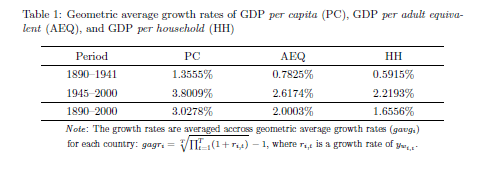
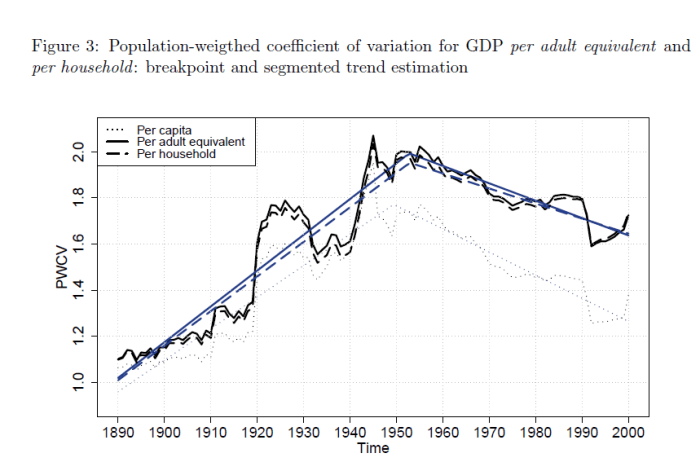
For OECD countries, we find that the adjusted income figures increased a third less than the unadjusted per capita figures (see table below). This suggests a more modest growth trend. In addition, we also find that up to the structural break in variations between countries (NDLR: divergence between OECD countries increased to around 1950) there was more divergence with the adjusted figures than with the unadjusted figures (see figure below). We also find that since the break point, there has been less convergence than previously estimated.

While the paper is presented as a note, the point is simple and suggests that those who study convergence between regions or countries should consider the role of demography more carefully in their work.

GrowthHouseholdSize

ConvergenceHouseholdSize.png

Fogel on economics and ideology

Many, upon reading the conclusions of economists, believe that economics has an ideological bent. I often respond that this is not the case. True, the “window” of political opinions in economics is narrower but that is largely because the adhesion of economists to methodological individualism precludes certain ideological views that rest on holistic approaches or concepts. However, when you consider more complex situations than “party affiliation”, you will find economists all over the place. They will often cross ideological lines or even have a foot in two antagonistic camps.

Recently, I was reading Robert Fogel’s lectures on the “Slavery debates” which retells the intellectual history of American slavery from U.B. Phillips to … well … Fogel himself. One must remember that Fogel was, and remained from what I can tell, a quite strongly left-leaning economist for most of his life (see here). As such, it is hard to consider Fogel as an ideologue preaching for free market economics. Yet, in the lectures, Fogel (p.19) makes a point that supports the contention that I often make regarding economists and ideology that I believe must be shared:

The ability to view Phillips (NDLR: the dominant interpretation of slavery pre-1960) in a new light was facilitated by the sudden intrusion of a large corps of economists into the slavery debates during the 1960s. This intrusion was welcomed by neither the defenders of the Phillips tradition nor the neoabolitionist school led by Stampp (NDLR: Kenneth Stampp, author of The Peculiar Institution). The cliometricians, as they were called, refused to be bound by the established rules of engagement, and they blithely crossed ideological wires in a manner that perplexed and exasperated traditional historians on both sides of the ideological divide.

Given that the source of this quotation is Fogel, I admit that I am particularly fond of this passage. Maybe the distrust towards economists is because economists can be both friend and foes to established interlocutors in a given discussion.

Divergence and Convergence within Italy

Two years, I wrote a post on this blog on the process of regional convergence in Italy. In that post, I made the observation that it seems that, economically, Italy was as fragmented at the time of the unification as it is today which made it an oddity in terms of regional convergence. To make that claim, I used this table of relatively sparsed out observations produced by Emanuele Felice: which was published in the Economic History Reviewitaliangdp


As one can see, there is a pronounced “lack” of integration for the Italy in terms of living standards. This is reinforced by a more “continuous” set of estimates produced, again, by Emanuele Felice (this time, its a working paper of the Bank of Italy) that now include the 1870s and go to 2011 (as opposed to 2001). This is the result, which I find fascinating. The first graph shows GDP per capita – for which there is divergence to 1951 and then a mild convergence thereafter but still well above the levels at the time of unification.  More fascinating is the fact that productivity is at its most integrated since unification (2nd figure) suggesting a divergence in levels of labor activity (3rd figure). In these three graphs, you have a neat summary of Italian labor markets since 1870.

Italian Convergence

Eye Candy: the US Asian population, circa 2010

NOL map US Asian population
Click here to zoom

“Asian” is a pretty broad term. Racial classifications are, perhaps, the dumbest thing in the world.

Imagine seeing something like this in the press today, or this as an advertisement. There’s been lots of progress in this country, it’s just hard to see sometimes.

The great global trend for the equality of well-being since 1900

Some years ago, I read The Improving State of the World: Why We’re Living Longer, Healthier, More Comfortable Lives on a Cleaner Planet by Indur Goklany. It was my first exposition to the claim that, globally, there has been a long-trend in the equality of well-being. The observation made by Goklany which had a dramatic effect on me was that many countries who were, at the time of his writing, as rich (incomes per capita) as Britain in 1850 had life expectancy and infant mortality levels well superior to 1850 Britain. Ever since, I accumulated the statistics on that regard and I often tell my students that when comes the time to “dispell” myths regarding the improvement in living standards since circa 1800 (note: people are generally unable to properly grasp the actual improvement in living standards).

Some years after, I discovered the work of Leandro Prados de la Escosura who is a cliometrician who (I think I told him that when I met him) influenced me deeply in my work regarding the measurement of living standards and who wrote this paper which I will discuss here.  His paper, and his work in general, shows that globally the inequality in incomes has faltered since the 1970s.  That is largely the result of the economic rise of India and China (the world’s two largest antipoverty programs). Figure1Leandro

However, when extending his measurements to include life expectancy and schooling in order to capture “human development” (the idea that development is not only about incomes but the ability to exercise agency – i.e. the acquisition of positive liberty), the collapse in “human development” inequality (i.e. well-being) precedes by many decades the reduction in global income inequality. Indeed, the collapse started around 1900, not 1970!

Figure2LEandro.png

In reading Leandro’s paper, I remembered the work of Goklany which had sowed the seeds of this idea in my idea. Nearly a decade after reading Goklany’s work well after I fully accepted this fact as valid, I remain stunned by its implications. You should too.