In the Ruins of Public Reason, Part III: When the Barbarians Are at the Gates; Fascism, Bullshit, and the Paradox of Tolerance

Note: This is the third in a series of essays on public discourse. Here’s Part 1 and Part 2

Three years ago, I started this essay series on the collapse of public discourse. At the time, I was frustrated by how left-wing and progressive spaces had become cognitively rigid, hostile, and uncharitable to any and all challenges to their orthodoxy. I still stand by most everything I said in those essays. Once you have successfully identified that your interlocutors are genuinely engaging in good faith, you must drop the soldier mindset that you are combating a barbarian who is going to destroy society and adopt a scout mindset. For discourse to serve any useful epistemic or political function, interlocutors must accept and practice something like Habermas’ rules of discourse or Grice’s maxims of discourse, where everyone is allowed to question or introduce any idea to cooperatively arrive at an intersubjective truth. The project of that previous essay was to therapeutically remind myself and any readers to actually apply and practice those rules of discourse in good-faith communication.

However, at the time, I should have more richly emphasized something that has been quite obviously true for some time now: most interlocutors in the political realm have little to no interest in discourse. I wish more people had such an interest, and still stand by the project of trying to get more people, particularly in leftist and libertarian spaces, to realize that when they speak to each other, they are not dealing with barbarian threats. However, recent events have made it clear that the real problem is figuring out when an interlocutor is worthy of having the rules of discourse applied in exchanges with them. Here is an obviously non-exhaustive list of such events in recent times that make this clear: 

  1. The extent to which Trump himself, as well as his advisors and lawyers, engage in lazy, dishonest, and bad-faith rationalizations for naked, sadistic, unconstitutional executive power grabs.
  2. The takeover of the most politically influential social media by a fascist billionaire rent-seeker has resulted in a complete fragmentation and breakdown of the online public square
  3. The degree to which most on the right and many on the left indulge in insane conspiracy theories, which have eroded and destroyed the epistemic norms of society, for reasons of rational irrationality.
  4. Even the Supreme Court, the institution that ostensibly is most committed to publicly justifying and engaging in good-faith reasoning about laws, is now giving blatantly awful, authoritarian opinions so out of step with their ostensibly originalist and/or textualist legal hermeneutics and constitutionalist principles (not to mention the opinions of even conservative judges in lower courts). It certainly seems the justices are just as nakedly corrupt and intellectually bankrupt as rabble-rousing aspiring autocrats. Indeed, the court is in such a decrepit state of personalist capture by an aspiring fascist dictator that they aren’t even attempting to publicly justify ‘shadow docket’ rulings in his favor. One can only conclude conservative justices are engaging in bad-faith power-grabs for themselves, whether they intend to or not. Although this has always been true of statist monocentric courts to some extent, recent events have only further eroded the court’s pretenses to being a politically 

All these were obvious trends three years ago and have very predictably only gotten more severe.  You may quibble with the extent of my assessment of any individual example above. Regardless, all but the most committed of Trumpanzees can agree that there is a time and place to become a bit dialogically illiberal in times like these. Thus, it is time to address how one can be a dialogical liberal when the barbarians truly are at the gates. The tough question to address now is this: what should the dialogical liberal do when faced with a real barbarian, and how does she know she is dealing with a barbarian? 

This is an essay about how to remain a dialogical liberal when dialogical liberalism is being weaponized against you. This essay isn’t for the zealots or the trolls. It’s for those of us who believed, maybe still believe, that democracy depends on dialogue—but who are also haunted by the sense that this faith is being used against us.

Epistemically Exploitative Bullshit

I always intended to write an essay to correct the shortcomings of the original one. I regret that, for various personal reasons, I did not do so sooner. The sad truth is that a great many dialogical illiberals who are also substantively illiberal engage in esoteric communication (consciously or not). That is, their exoteric pretenses to civil, good-faith communication elide an esoteric will to domination. Sartre observed this phenomenon in the context of antisemitism, and he is worth quoting at length:

Never believe that anti‐Semites are completely unaware of the absurdity of their replies. They know that their remarks are frivolous, open to challenge. But they are amusing themselves, for it is their adversary who is obliged to use words responsibly, since he believes in words. The anti‐Semites have the right to play. They even like to play with discourse for, by giving ridiculous reasons, they discredit the seriousness of their interlocutors. They delight in acting in bad faith, since they seek not to persuade by sound argument but to intimidate and disconcert. If you press them too closely, they will abruptly fall silent, loftily indicating by some phrase that the time for argument is past. It is not that they are afraid of being convinced. They fear only to appear ridiculous or to prejudice by their embarrassment their hope of winning over some third person to their side.

If then, as we have been able to observe, the anti‐Semite is impervious to reason and to experience, it is not because his conviction is strong. Rather, his conviction is strong because he has chosen first of all to be impervious.

What Sartre says of antisemitism is true of illiberal authoritarians quite generally. Thomas Szanto has helpfully called this phenomenon “epistemically exploitative bullshit.” 

One feature of epistemically exploitative bullshit that Szanto highlights is that epistemically exploitative bullshit need not be intentional. Indeed, as Sartre implies in the quote above, the ‘bad faith’ of the epistemically exploitative bullshitter involves a sort of self-deception that he may not even be consciously aware of. Indeed, most authoritarians (especially in the Trump era) are not sufficiently self-aware or intelligent enough to consciously realize that they are deceiving others about their attitude towards truth by spouting bullshit. As Henry Frankfurt observed, bullshit is different from lying in that the liar is intentionally misrepresenting the truth, but the bullshitter has no real concern for truth in the first place. Thus, many bullshiters (especially those engaged in epistemically exploitative bullshit) believe their own bullshit, often to their detriment.

However, the fact that epistemically exploitative bullshit is often unintentional, or at least not consciously intentional, creates a serious ineliminable epistemic problem for the dialogical liberal who seeks to combat it. It is quite difficult to publicly and demonstrably falsify the hypothesis that one’s interlocutor is engaging in epistemically exploitative bullshit. This often causes people who, in their heart of hearts, aspire to be epistemically virtuous dialogical liberals to misidentify their interlocutors as engaging in epistemically exploitative bullshit and contemptuously dismiss them. I, for one, have been guilty of this quite a bit in recent years, and I imagine any self-reflective reader will realize they have made this mistake as well. We will return to this epistemic difficulty in the next essay in this series.

To avoid this mistake, we must continually remind ourselves that the ascription of intention is sometimes a red herring. Epistemically exploitative bullshit is not just a problem because bullshitters intentionally weaponize it to destroy liberal democracies. It is a problem because of the social and (un)dialectical function that it plays in discourse rather than its psychological status as intentional or unintentional. 

It is also worth remembering at this point that it is not just fire-breathing fascists who engage in epistemically exploitative bullshit. Many non-self-aware, not consciously political, perhaps even liberal, political actors spout epistemically exploitative bullshit as well. Consider the phenomenon of property owners—both wealthy landlords and middle-class suburbanites—who appeal to “neighborhood character” and environmental concerns to weaponize government policy for the end of protecting the economic rents they receive in the form of property values. Consider the similar phenomenon of many market incumbents, from tech CEOs in AI to healthcare executives and professionals, to sports team owners, to industrial unions, to large media companies, who all weaponize various seemingly plausible (and sometimes substantively true) economic arguments to capture the state’s regulatory apparatus. Consider how sugar, tobacco, and petrochemical companies all weaponized junk science on, respectively, obesity, cigarettes, and climate change to undermine efforts to curtail their economic activity. Almost none of these people are fire-breathing fascists, and many may believe their ideological bullshit is true and tell themselves they are helping the world by advancing their arguments. 

The pervasive economic phenomenon of “bootleggers and Baptists” should remind us that an unintentional form of epistemically exploitative bullshit plays a crucial role in rent seeking all across the political spectrum. This form of bullshit is particularly hard to combat precisely because it is unintentional, but its lack of intentionality in no way lessens the harmful social and (un)dialectical functions it severe.

Despite those considerations, it is still worth distinguishing between consciously intentional forms of aggressive esotericism and more unintentional versions because they must be approached very differently. Unintentional bullshitters do not see themselves as dialogically illiberal. Therefore, responding to them with aggressive rhetorical flourishes that treat them contemptuously is very unlikely to be helpful. For this reason, the general (though defeasible) presumption that any given person spouting epistemically exploitative bullshit is not an enemy that I was trying to cultivate in the second part of this essay series still stands. In the next essay, I will address how we know when this presumption has been defeated. However, for now, let us turn our attention to the forms of epistemically exploitative bullshit common today on the right. We have now seen how epistemically exploitative bullshit can appear even in technocratic, liberal settings. But that phenomenon takes on a more virulent form when fused with authoritarian intent. This is what I call aggressive esotericism.

Aggressive Esotericism

The corrosiveness of these more ‘liberal’ and technocratic forms of epistemically exploitative bullshit discussed above, while serious, pales in comparison to more bombastically authoritarian forms of it. The truly authoritarian epistemically exploitative bullshiter aims at more than amassing wealth by capturing some limited area of state policy. While he also does that, the fascist aims at the more ambitious goal of dismantling democracy and seizing the entire apparatus of the state itself.

 Let us name this more dangerous form of epistemically exploitative bullshit. Let us call this aggressive esotericism and loosely define it as the phenomenon of authoritarians weaponizing the superficial trappings of democratic conversation to elide their will to dominate others. This makes the fascistic, aggressive esotericist all the more cruel, destructive, and corrosive of society’s epistemic and political institutions.

It is worth briefly commenting on my choice of the words “aggressive esotericism” for this. The word “esoteric” in the way I am using it has its roots in Straussian scholars who argue that many philosophers in the Western tradition historically did not literally mean what their discursive prose appears to say. Esoteric here does not mean “strange,” but something closer to “hidden,” in contrast to the exoteric, surface-level meaning of the text. We need not concern ourselves with the fascinating and controversial question of whether Straussians are right to esoterically read the history of Western philosophy as they do. Instead, I am applying the general idea of a distinction between the surface level and deeper meaning of a text, the sociological problem of interpreting both the words and the deeds of certain very authoritarian political actors. 

I choose the word “aggressive” to contrast with what Arthur Melzer calls “protective,” “pedagogical,” or “defensive” esotericism. In Philosophy Between the Lines Melzer argues that historically, philosophers often hid a deeper layer of meaning in their great texts. In the ancient world, Melzer argues, this was in part because they feared theoretical philosophical ideas could disintegrate social order (hence the “protective esotericism”), wanted their young students to learn how to come to philosophical truths themselves (hence the “pedagogical esotericism”), or else wanted to protect themselves from authorities for ‘corrupting the youth’  (as Socrates was accused) with their heterodox ideas. 

As the modern world emerged during the Enlightenment, Melzer argues esotericism continued as philosophers such as John Locke wrote hidden messages not just for defensive reasons but to help foster liberating moral progress in society, as they had a far less pessimistic view about the role of theoretical philosophy in public life (hence their “political esotericism”). Whether Melzer is correct in his reading of the history of Western political thought need not concern us now. My claim is that many authoritarians (both right-wing Fascists and left-wing authoritarian Communists) invert this liberal Enlightenment political esotericism by engaging—both in words and in deeds, both consciously and subconsciously, and both intentionally and unintentionally—in aggressive esotericism. Hiding their esoteric will to domination behind a superficial façade of ‘rational’ argumentation.

Aggressive esotericism is a subset of the epistemically exploitative bullshit. While aggressive esotericism may be more often intentional than more technocratic forms of epistemically exploitative bullshit, it is not always so. You might realize this when you reflect on heated debates you may have had during Thanksgiving dinners with your committed Trumpist family members. Nonetheless, this lack of intention doesn’t cover up the fact that their wanton wallowing in motivated reasoning, rational ignorance, and rational irrationality has the selfish effect of empowering members of their ingroup over members of their outgroup. This directly parallels how the lack of self-awareness of the technocratic rentseeker ameliorates the dispersed economic costs on society.

Aggressive Esotericism and the Paradox of Tolerance

Even if one suspects one is encountering a true fascist, one should still have the defeasible presumption that they are a good-faith interlocutor. Nonetheless, fascists perniciously abuse this meta-discursive norm. This effect has been well-known since Popper labelled it the paradox of tolerance.  

The paradox of tolerance has long been abused by dialogical illiberals on both the left and the right to undermine the ideas of free speech and toleration in an open society, legal and social norms like academic freedom and free speech, and to generally weaken the presumption of good faith we have been discussing. This, however, was far from Popper’s intention. It is worth revisiting Popper’s discussion of the Paradox of Tolerance in The Open Society and Its Enemies:

Unlimited tolerance must lead to the disappearance of tolerance. If we extend unlimited tolerance even to those who are intolerant, if we are not prepared to defend a tolerant society against the onslaught of the intolerant, then the tolerant will be destroyed, and tolerance with them. In this formulation, I do not imply, for instance, that we should always suppress the utterance of intolerant philosophies; as long as we can counter them by rational argument and keep them in check by public opinion, suppression would certainly be most unwise. But we should claim the right even to suppress them, for it may easily turn out that they are not prepared to meet us on the level of rational argument, but begin by denouncing all argument; they may forbid their followers to listen to anything as deceptive as rational argument, and teach them to answer arguments by the use of their fists. We should therefore claim, in the name of tolerance, the right not to tolerate the intolerant. We should claim that any movement preaching intolerance places itself outside the law, and we should consider incitement to intolerance and persecution as criminal, exactly as we should consider incitement to murder, or to kidnapping, or as we should consider incitement to the revival of the slave trade.

His point here is not so much to sanction State censorship of fascist ideas. Instead, his point is that there are limits to what should be tolerated. To translate this to our language earlier in the essay, he is just making the banal point that our presumption of good-faith discourse is, in fact, defeasible. The “right to tolerate the intolerant” need not manifest as legal restrictions on speech or the abandonment of norms like academic freedom. This is often a bad idea, given that state and administrative censorship creates a sort of Streisand effect that fascists can exploit by whining, “Help, help, I’m being repressed.” If you gun down the fascist messenger, you guarantee that he will be made into a saint. Further, censorship will just create a backlash as those who are not yet fully-committed Machiavellian fascists become tribally polarized against the ideas of liberal democracy. Even if Popper himself might not have been as resistant to state power as I am, there are good reasons not to use state power.

Instead, our “right to tolerate the intolerant” could be realized by fostering a strong, stigmergically evolved social stigma against fascist views. Rather than censorship, this stigma should be exercised by legally tolerating the fascists who spout their aggressively esoteric bullshit even while we strongly rebuke them. Cultivating this stigma includes not just strongly rebuking the epistemically exploitative bullshit ‘arguments’ fascists make, but exercising one’s own right to free speech and free association, reporting/exposing/boycotting those, and sentimental education with those the fascists are trying to target. Sometimes, it must include defensive violence against fascists when their epistemically exploitative bullshit manifests not just in words, but acts of aggression against their enemies. 

The paradox of tolerance, as Popper saw, is not a rejection of good-faith dialogue but a recognition of its vulnerability. The fascists’ most devastating move is not to shout down discourse but to simulate it: to adopt its procedural trappings while emptying it of sincerity. What I call aggressive esotericism names this phenomenon. It is the strategic abuse of our meta-discursive presumption of good faith.

Therefore, one must be very careful to guard against mission creep in pursuing this stigmergic process of cultivating stigma in defense of toleration. As Nietzsche warned, we must be guarded against the danger that we become the monsters against whom we are fighting. I hope to discuss later in this essay series how many on the left have become such monsters. For now, let us just observe that this sort of non-state-based intolerant defense of toleration does not conceptually conflict with the defeasible presumption of good faith.

In the next part of this series, I turn to the harder question: when and how can a dialogical liberal justifiably conclude that an interlocutor is no longer operating in good faith?

Some arbitrage free Byzantine rates of return

Byzantium. The surprising life of a medieval empire – by Judith Herrin

In the economy chapter, apart from the often overlooked hard-ass (gold) and long-ass (700 years) of monetary stability, the author discusses some social aspects of economic life. The Byzantine elites, following on Ancient Rome’s disdain for commercial endeavors, typically opted to invest in three things: Land, administrative offices (which could confer some coin in unofficial ways), and titles in the Court.

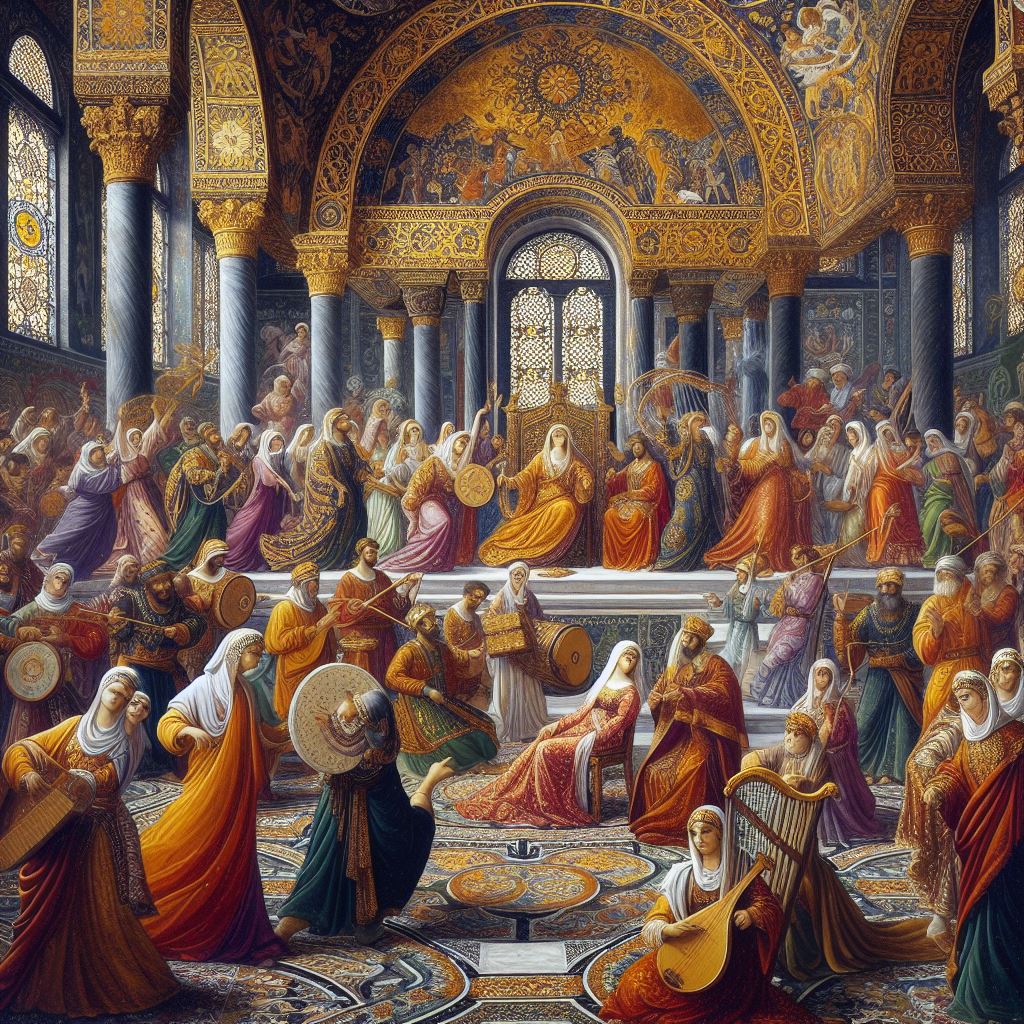
A Byzantine celebration, as copilot imagined it. In the other versions, people were so hardcore eastern orthodox christians that even had halos.

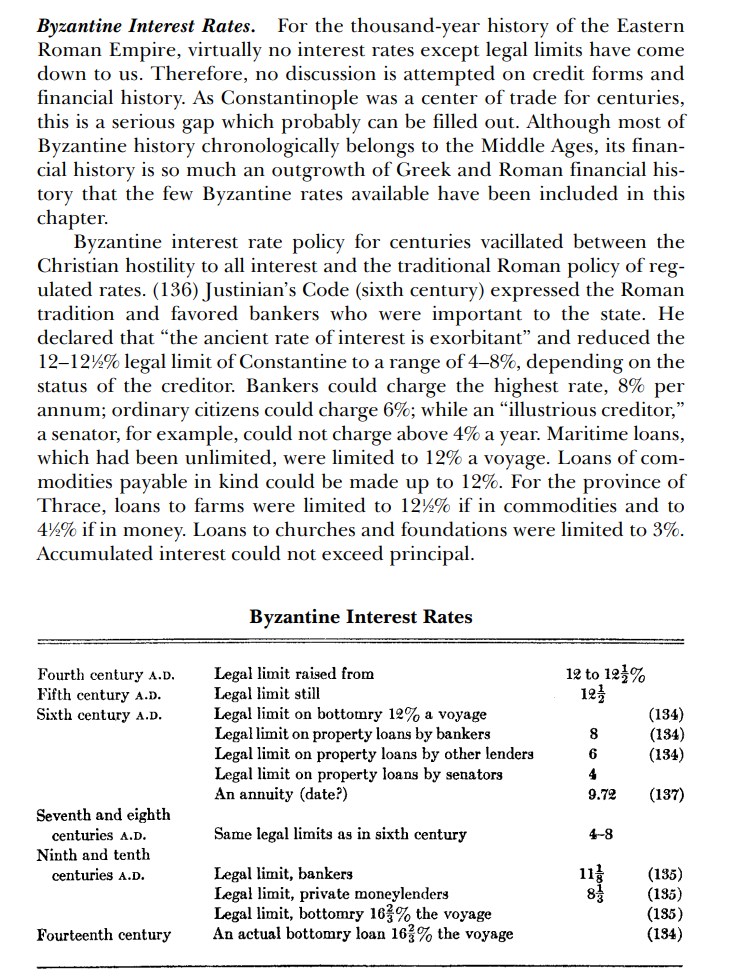
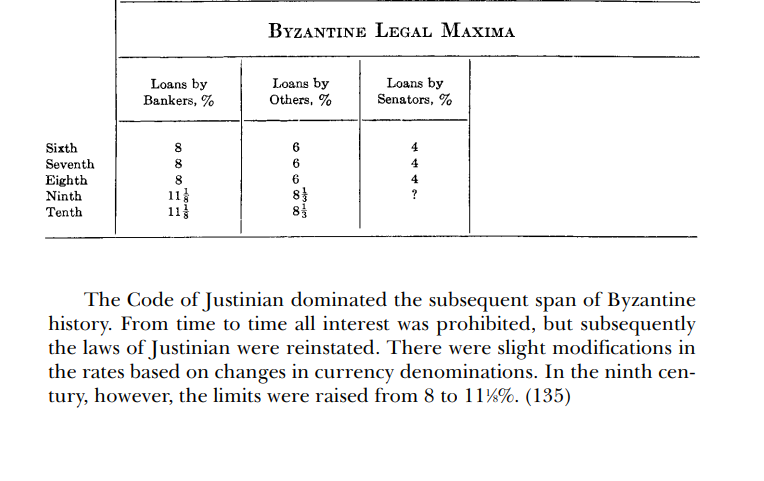
The Court titles had fancy names and came with regular allowances. The more mundane ones had a rate of return of 2.5%- 3.0%, while the higher-ups (like Protospatharios, loosely meaning First Sword Bearer, with responsibilities that oscillated among Chief Bodyguard, Receptionist and Master of Ceremonies) reached 8.3%. Since Byzantines had also inherited Rome’s practise of capping interest rates, we know that a simple citizen could lend at a rate of 6.0% (a banker at 8.0% and a distinguised person like a Senator at 4.0%).

Re: Byzantine interest rates, from the impressive but rather dry, A History of Interest Rates – by Sidney Homer & Richard Sylla

So, it mostly did not make sense to buy a Court title, money-wise. Unless you did manage to land as the Protospatharios, so you could enter a risk-free carry trade of 2.3% and also enjoy lovely red robes with gold lining or white robes and a golden mantle (the latter attire was reserved for eunuchs). Half-joking aside, the titles were not transferable (that is, no secondary market), so you could not probably even get back the initial investment. It turns out, fancy names / clothes/ duties/ company were a major factor, after all. And secondary markets serve a purpose, at least sometimes.

Lit in Review: Things that move people

Three papers from this year’s American Economic Journal: Economic Policy deal with shocks that change people’s willingness to migrate to another location. As usual with these, I’m reporting on recent research results that readers might find interesting, but I’m not otherwise commenting.

Nian and Wang, “Go with the Politician

In a study of crony capitalism in China: when a Chinese local leader is transferred from one prefecture to another, large firms in the old prefecture buy up 3x more land than average in the new prefecture at half the normal price. These land parcels show lower use efficiency afterwards. For the last 30 years, land sales make up 60% of local government revenue. There is no effect going the opposite direction (firms in the new prefecture buying land in the old one) and there is no effect when that politician subsequently moves to the next prefecture.

Moretti and Wilson, “Taxing Billionaires: Estate Taxes and the Geographical Location of the Ultra-Wealthy

Following the Forbes 400 richest Americans from 1981-2017, it is clear that they are very likely to move away from states with estate taxes, particularly as they get older. They “find a sharp and economically large increase in estate tax revenues in the three years after a Forbes billionaire’s death.” Putting the two effects together, they find that it is still profitable for most states to adopt estate taxes despite some departures with a cost/benefit ratio of 0.69.

Liu, Shamdasani, and Taraz, “Climate Change and Labor Reallocation: Evidence from Six Decades of the Indian Census

A panel fixed-effect model looking at how the climate changed decade by decade shows that fewer Indian workers move from rural to urban or ag to non-ag firms within a district, but no effect on movement between districts. They also show this comes from changes in demand patterns: higher temperatures lower rural yields and incomes, so they buy less from non-ag sectors, which reduces the demand for non-ag labor. These effects are larger in districts with fewer roads and/or less access to the formal banking sector.

An infinite (or maybe indefinite) loop of good and bad sense in public policy

A case of couleur locale

Peloponnese in Southern Greece features one of the most spectacular rack trains in the world, “Odontotos”. The short route connects a seashore town (Diakofto) with the mountainous Kalavryta plateau (700m altitude), up and through the impressive Vouraikos Gorge. Visited it for the first time recently. I kind of knew that railways were built in 1880s/90s? Something like that. The relatively young Greece acquired the large Thessalia flatland in the north at the time, putting integration via transport into perspective. Government was frantically trying to develop inter/ intra-national trade routes and at the same time bring forth a late to the party industrial mojo. Railway became a smoking symbol of this endeavor.

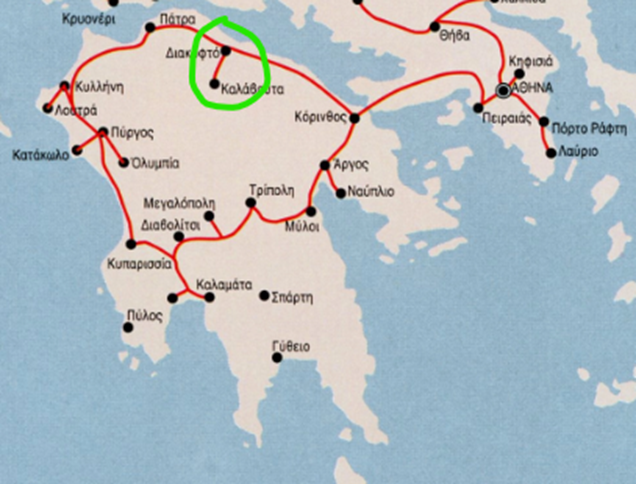
The initial expansion from Athens to the Peloponnese makes sense: Apart from the obvious pros (accessibility, speed, safety, mass character, for natives and visitors alike) of the railway, there were some major ports and established trade houses there, while agricultural production was also of note. The rails formed a curve around the northern/ western coastal line of Peloponnese and cut through its mainland in the southern/ eastern sides, in order to form a ring of sorts:

It’s all Greek to you (source)

This is the 1882 plan, which mostly went through. The network was constructed in a “regular” manner, albeit with rails less wide than the international standard ‘cause cost, including cities, towns, ports and a couple of special sites (i.e., Olympia). And then we have the green-circled outcrop, the rack rail. The recent trip there left me perplexed. Why decide to undertake such a difficult task in rugged terrain, that needed expertise and special rails (different from those of the rest)?

Surely, Kalavryta was (and still is) a place of national significance. The Greek Revolution of 1821 is said to have started at a monastery (Agia Lavra) there, where the local Metropolitan blessed the gathered leaders of the upcoming war. A celebratory 1896 edition, on the occasion of the first modern Olympic Games (hosted in Athens that year), even chronicles the Peloponnese railway saga.  Regarding the rack train, it references the exquisite natural environment, Agia Lavra and another historical monastery as good reasons to give it a ride. Fair enough, but still somewhat vague. What else was there that made that region stand out from the others? Here the rationale gets a step up.

source

Kalavryta was home to a wealthy, powerful family. It happened that a member of the family served as Member of Parliament when the railway project was on fire. This man persuaded the PM of the vital role a railway connection was to play in the development of the surrounding areas. Provided that a scion of the same family serves in the current Greek Parliament, too, this “local interest cuddling” reasoning gets some traction, in my view.

Even if the decision was just that, local patronizing, it still held some more rational economic – political water: Back then, the cost of sending wheat from the (fertile) plateau down to sea level was twice as high the cost of shipping said wheat from fucking Russia to Greece (compare 22km to, dunno, 2200km). And why not just import the dang thing then? Well, Greece had had the “honor” to be at the receiving end of a naval pacific blockade by the era’s great forces in 1886, so it perhaps had reached the conclusion that food security was something to be pursued.

source

The rack train project was initiated by law in 1889 and (after absorbing 3x the envisaged cost plus 5x the scheduled time of completion, effectively cutting short any ideas of expanding it further towards Tripoli) began its inaugural journey in, well, 1896.

It turns out that the whole railway affair was overhyped and demand for train services did not to really stretch that far to meet supply, not to mention the appearance of competitive means of transport (steamboats and roads). The rack train, however, remained the sole anchor of reliable transport till the 1970s, when roads proper were built. In the meantime, it also became a traveler’s sensation, too, confirming the positive light that celebratory book shone on it 120+ years before.

Africa’s quest for sovereignty

That’s the title of this excellent piece by Toby Green, a historian at King’s College London. Green does a wonderful job of highlighting all of the problems that African societies face today: corruption, poverty, and my personal favorite, “neoliberalism.” Neoliberalism is just shorthand for loans that Western financial institutions give to African states. These loans are usually only given if African states promise to follow certain guidelines that Western financial institutions have drawn up. The end result is corruption and poverty.

I can agree that it’s a terrible system, even if I think the name Green has given it is dumb.

Throughout the piece, Green makes a good case for fundamental change in Africa. The problem is that he mistakenly thinks that this change can occur via the states that are currently in place in Africa. He mistakenly thinks that Ghana, Nigeria, Uganda, or Angola, to name some of the more prominent examples, have what it takes to enact the changes necessary for a fundamental shift.

Green argues that “unipolar American and Western European hegemony” (which by definition cannot be unipolar if there’s two poles, unless…) is responsible for Africa’s problems, and that the continent’s early independence leaders should be looked to for guidance. The problem with this, as Hendrik Spruyt has pointed out, is that the continent’s early independence leaders didn’t listen to anybody but themselves. They simply sought to graft their visions of what Africa should be onto the existing colonial governance system of the various European powers.

These early independence leaders sought to forge nations out of the colonies that the Europeans had haphazardly patched together. There were other elites on the African continent who wanted something different from what Africa’s early independence leaders wanted. Some of these elites were nationalists who wanted their states to be fully recognized equals on the world stage, just like the early independence leaders. The difference between these nationalists, and the early independence leaders, was that they wanted to abolish colonial boundaries and restore pre-colonial boundaries which would then be recognized as states within the Westphalian states-system. Like so:

Early Independence LeadersOther, actual Nationalists
Wanted African states to inherit colonial boundariesWanted African states to abolish colonial boundaries and restore old ones to prominence
Wanted to create and forge national identities out of these colonial boundariesWanted to harness the power of already-existing national identities by tying them to internationally-recognized states

The early independence leaders obviously won out. The borders of European colonialism were maintained and enshrined within the Westphalian states-system that soon encompassed the globe.

Green and other Leftists think that the above column on the left is a perfectly acceptable way to continue, and that the problem is not the states-system that Africa’s early independence leaders established, but rather the “unipolar hegemony of America and Europe.” Without a rethink of the fundamentals, Green and other Leftists are going to continue inadvertently contributing to the immiseration of Africa.

Don’t get me wrong! The current loan system is awful. It’s terrible. But it’s exactly what you’d expect to get from an order like the one outlined above.

If people are serious about unleashing Africa then they need to look to the above column on the right. The map of the nations that were ignored by Africa’s early independence leaders (ignored, and eventually slaughtered, oppressed, persecuted, and imprisoned) is still there. You can find good maps of nations in Africa — often condescendingly referred to as “ethnic groups” rather than nations – that are superimposed on the map of African postcolonial states. Here’s the best one in the world at the moment.

Green implicitly recognizes that there’s something wrong with the postcolonial African state of Africa’s early independence leaders. He can tell that the column on the left is somehow off:

[…] in many African countries, traditional chiefs [are] more respected than elected officials […] A more damning indictment of the failings of the democratic model promoted across Africa […] is hard to find.

What he can’t seem to do is see that the column on the right lines up almost perfectly with the views that Africans have of their chiefs. Now, the chiefs are by no means revered by everybody in Africa, and there is a strong, if minute, anti-chief current throughout the continent because not everybody wants an Africa based on the tenets of nationalism. The columns above only highlight two strains of thought on how Africa should be governed. There are others, most notably Islamist proposals, but the one that libertarians (and, indeed, most Leftists) should find most attractive is that of the African federalists.

African federalists competed with the two nationalist camps when it became apparent that things were about to change vis-à-vis Africa’s relationship with Europe. While the nationalists embraced decolonization, which meant independence from European colonial rule, the federalists embraced integration with their colonizers. They argued that African colonies could, and should, federate with European countries. This federation would mean that African provinces would stand on equal footing with older provinces of European states. African provinces would be able to practice self-government without resorting to autarky. Like so:

Early Independence LeadersOther, actual NationalistsFederalists
Wanted African states to inherit colonial boundariesWanted African states to abolish colonial boundaries and restore old ones to prominenceWanted African colonies to become represented provinces in federated European polities
Wanted to create and forge national identities out of these colonial boundariesWanted to harness the power of already-existing national identities by tying them to internationally-recognized statesWanted full citizenship rights within the federated polities that would replace the old European empires

In hindsight, the federalists were right to deplore the idea of independence from Europe. The Westphalian nation-state, at least as it was envisioned by Africa’s early independence leaders, has been a disaster for Africa. It’s also clear that the federalists had an uphill climb, not only because decolonization-nationalism were all the rage but also because several of the Europeans who ran the colonies did not themselves have federated orders. The French and Portuguese had no experience with federalism, and the Spanish and British had weird federalisms based on monarchical principles. The Dutch and the Americans both had good models to emulate, but they didn’t have any African colonies and the idea of African colonies federating with Dutch or American states was out of the question in the 1960s and 1970s. That doesn’t have to be the case for today.

There’s nothing in this world that says the ideas of Africa’s federalists can’t be put in to practice today. There’s nothing to prevent the world’s most powerful polity, the compound republic of the United States, from entertaining the ideas put forth by Africa’s federalists. Nothing, that is, except the conservatism of Western and Western-educated elites, who believe that Africa’s early independence leaders were somehow right, because even though the results of their actions have gone horribly wrong, their ideals were pure in motive.

Sovereign territory and decolonization movements

But while adopting sovereign territoriality as the dominant script, they were far more cautious in accepting the principle of self-determination for all nationalist claims. While claiming the right of national self-determination as a rhetorical tool in the struggle with the metropolitan powers, they simultaneously denied those claims to indigenous groups within the territorial state that the nationalist leaders envisioned. The Dutch were not incorrect in asserting that the nationalist (Javanese) claim for Indonesian independence subverted the possible independence of many areas and ethnic groups within the East Indies. Sukarno himself of course recognized that “the Dutch had invented Indonesia” given that it had never been a coherent political entity before. [Sukarno] was eager to lay claim to the entire territory as a unified state on the principle of sovereign equality with other states, disregarding local demands for true national self-determination.

This is from the great Hendrik Spruyt, and you can read the whole thing (pdf) here.

I have two takeaways for NOL: first, the people who led decolonization efforts after WWII exploited the maps drawn up by imperial powers; they were not nationalists, they were cosmopolitans who had been educated in European capitals and who had borrowed the logic of nationalists in those capitals. Calls for federation instead of independence/decolonization were few and far between, but they did exist. Adam Smith called for union between the UK and its North American colonies. Several African statesmen called for federation between their lands and France. I believe some Indians called for federation between their land (which included present-day India, Pakistan, and Bangladesh) and the UK, but I need to do more research on this. In Hawaii, the federalists actually won out.

Second, the current narrative, or script as Spruyt calls it, still doesn’t give local/indigenous actors their due. The current Westphalian script — undergirded by the principle of sovereign equality with other states – still treats the leaders of decolonization like victims of imperialism who fought against the odds to defeat intransigent European oppression. There is simply not much being said about the people who called for greater representation within the European imperiums and for federal restructuring of these imperiums.

A third takeaway is that libertarians have a much better alternative to adopt than shallow anti-imperialism, which is just a form of antiwar nationalism: they could call for federation with polities as a foreign policy doctrine. They could actively build alliances with those factions that were squashed by nationalists who disregarded the claims of other groups, with the aim of integrating these societies into a federal order.

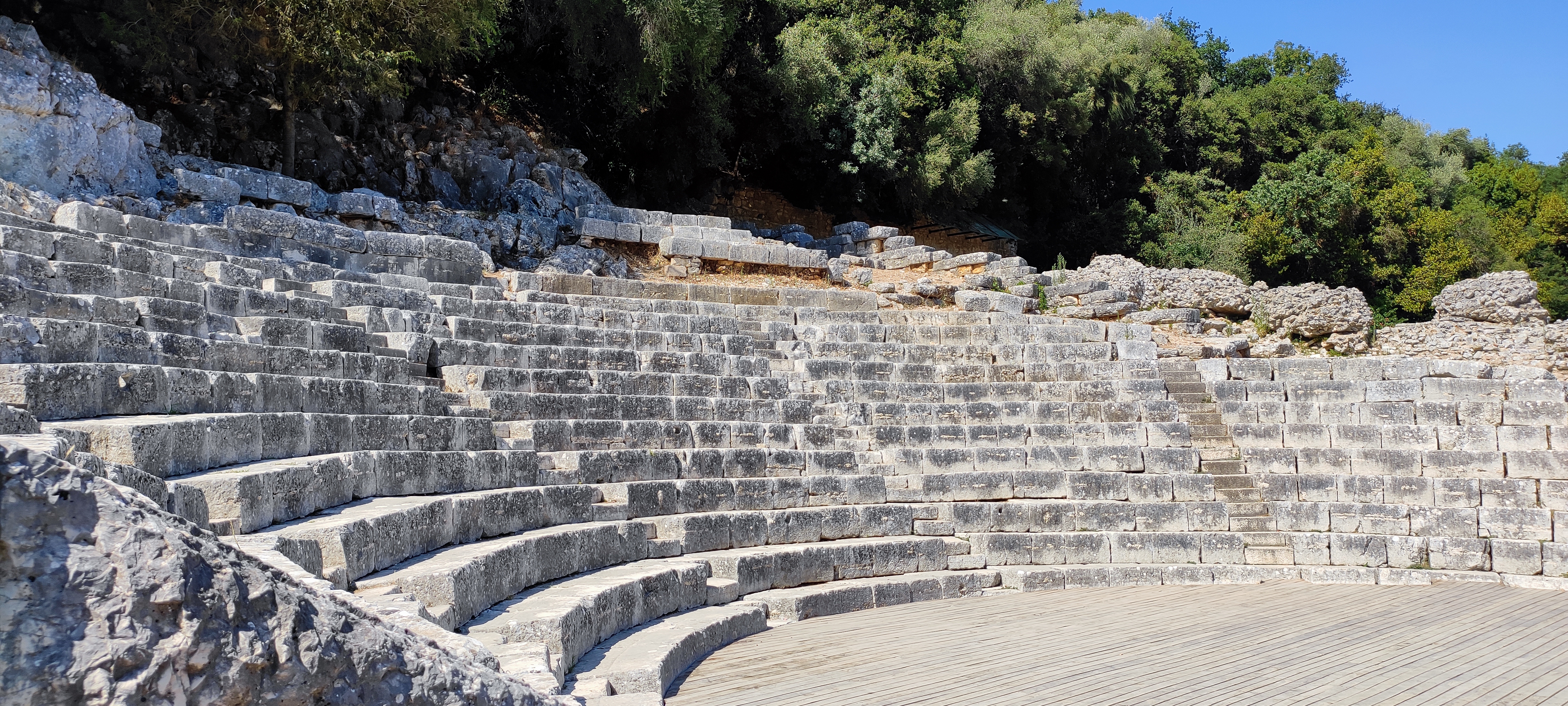
Albania: People and Ruins

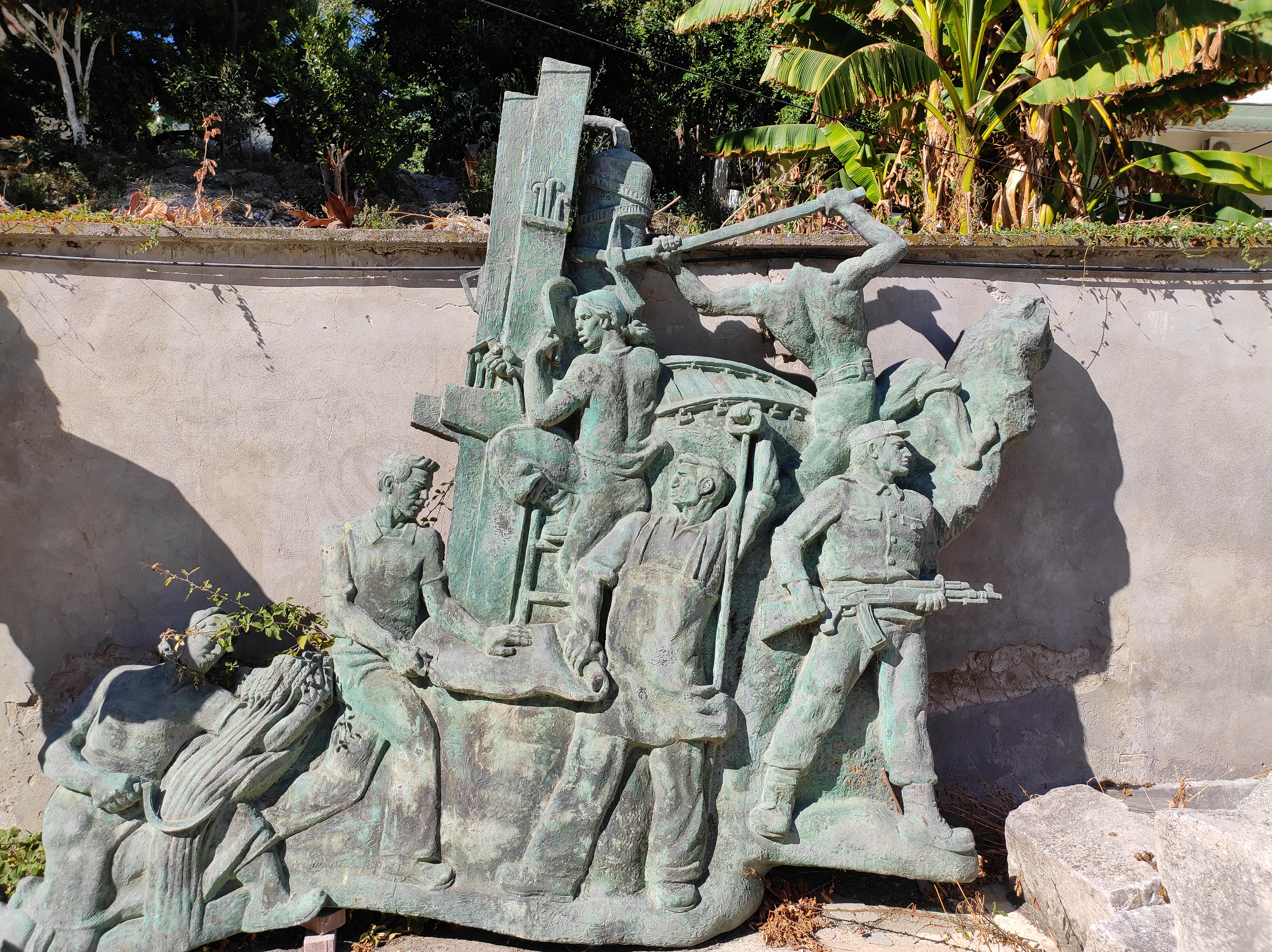
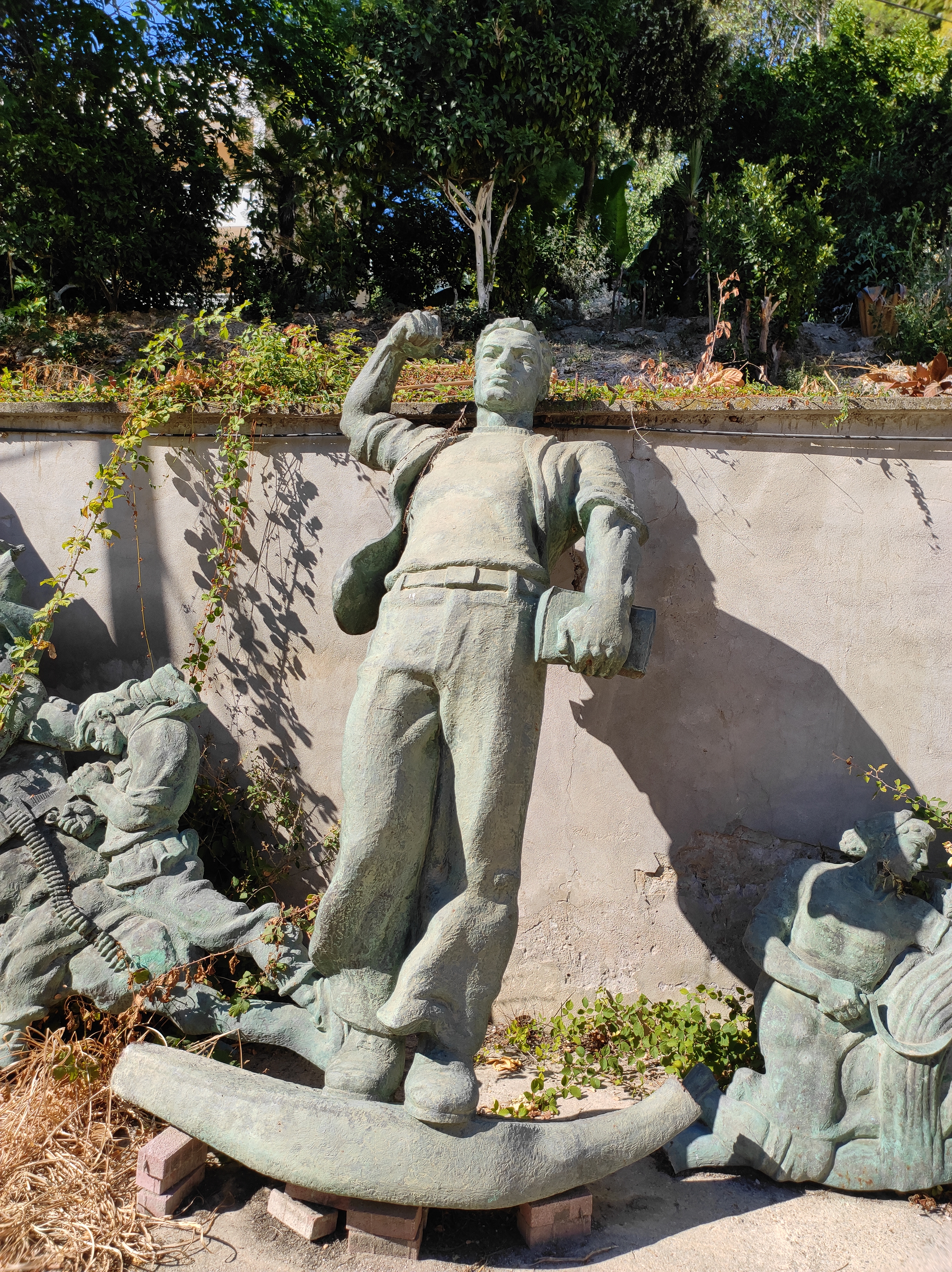
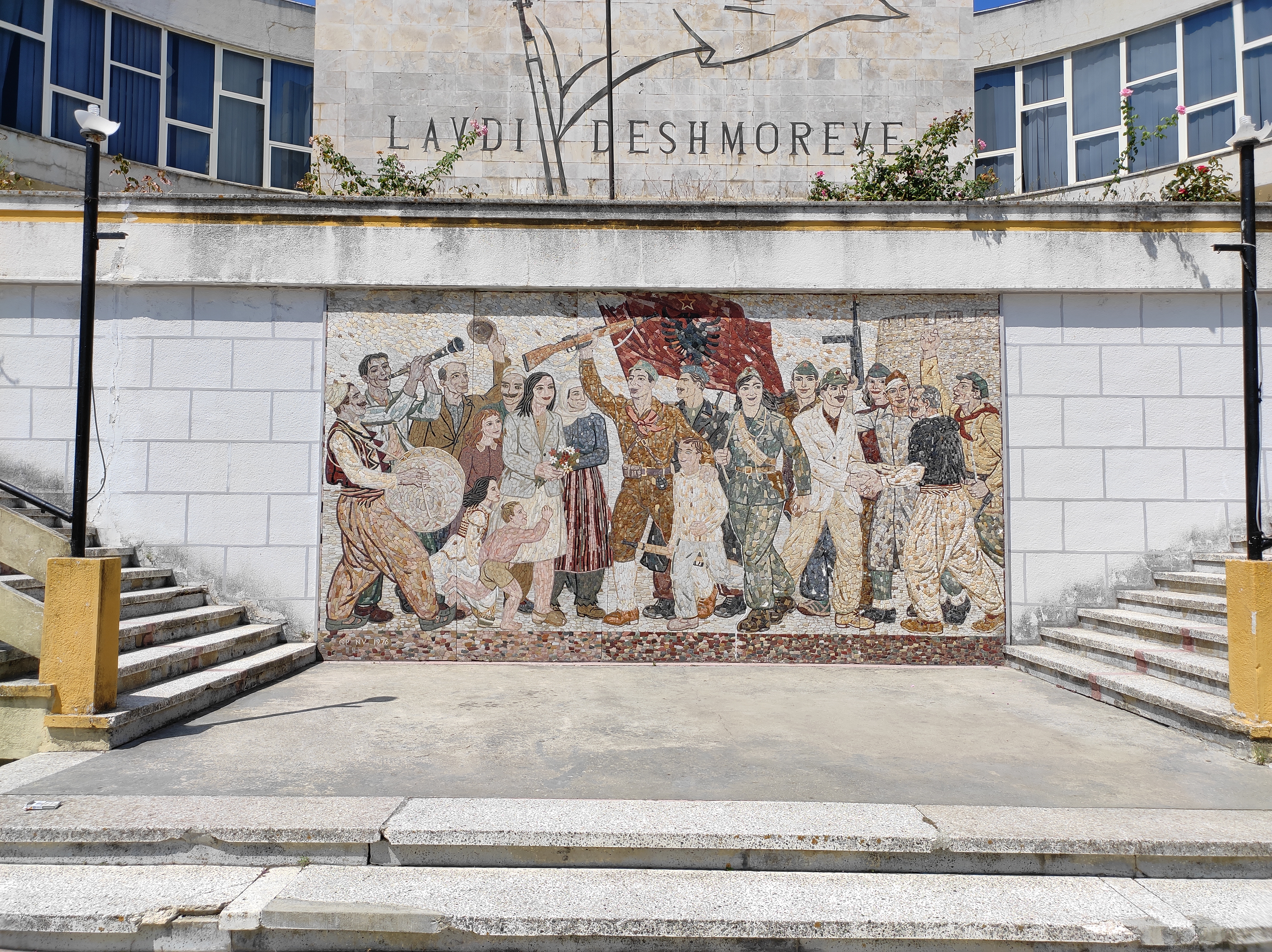
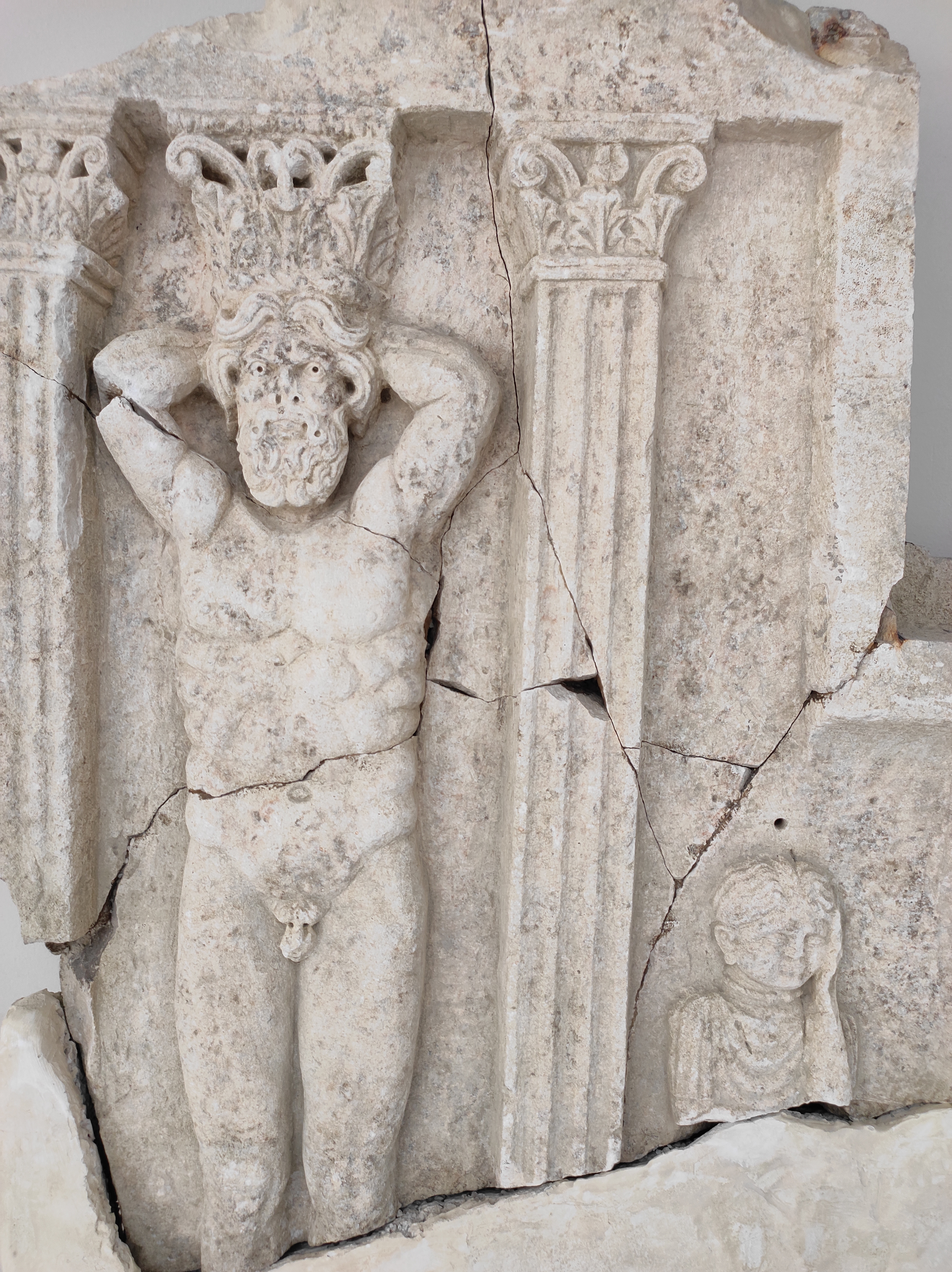
During my long traveling over Europe this summer, among other areas, I ventured to Albania, a country where houses frequently do not have numbers and where I located the building where a friend of my youth now lives by a drawing on a gate. This is a country where the so-called oriental bazaar is buzzing everywhere, where towns literally hang on cliffs, and where one easily runs across the ruins of the Roman, Byzantine, and Ottoman legacy of the country and the “archaeology” of the recent communist past (small concrete family bunkers, tunnels for the former communist nomenklatura, monumental sculptures and mosaics in the socialist realism style).

It was interesting to see how this country, which lived much of the 20th century under the most vicious communist dictatorship (1944-1990), is now trying to live a normal life.  To some extent, Albania is very similar to present-day Russia: decades of the negative natural selection under communism killed much of self-reliance, individual initiative, and produced the populace that looks up to the government for the solutions of their problems. For the past thirty years, a new generation emerged, and things did dramatically change. Yet, very much like in Russia, much of the populace feels nostalgia for the “good” old days, which is natural.

According to opinion polls, 46% of the people are nostalgic for the developed communism of dictator Enver Hoxha (1944-1985), an Albanian Stalin, and 43% are against communism; the later number should be higher, given the fact that many enterprising Albanians (1/4 of the population) live and work abroad.  During the last decades of its existence, Albanian communism slipped into a wild isolationism of the North Korean style. Except for Northern Korea and Romania, all countries, from the United States, Germany, UK (capitalist hyenas) to the USSR, China, and Yugoslavia (traitors to socialism), were considered enemies.  Incidentally, Albanian communism was much darker and tougher than the Brezhnev-era USSR. Nevertheless, as it naturally happened in Russia and some other countries, in thirty years, the memory of a part of the population laundered and cleansed the communist past, and this memory now paints this past as a paradise, where everyone was happy and looked confidently into the future, where secret police and labor concentration camps existed for a good reason, and where the vengeful dictator appears as a caring father.

In the hectic transition to market economy and with the lack of established judicial system, there naturally emerged a widespread corruption, nepotism. But, at the same time, small business somehow flourishes. The masses and elites of the country aspire to be united with neighboring Kosovo since both countries are populated by Albanian majorities. On top of this, Kosovo is the birthplace of Albanian nationalism.  However, unlike current Russia, which is spoiled with abundant oil and gas resources (the notorious resource curse factor), corrupt Albanian bureaucrats that rule over a small country exercise caution. Although that small country is too blessed with oil, natural gas, chromium, copper, and iron-nickel, they do not waste their resources on sponsoring geopolitical ventures and harassing their neighbors. For themselves, the Albanians resolved the Kosovo issue as follows: we will be administratively two different states, but de facto economically and socially we will be tied to each other, and all this makes life easier for people, preventing any conflicts. Not a small factor is that, unlike, for example, Russia or Turkey, Albanian nationalism is devoid of any imperial syndromes, and therefore there is no nostalgia for any glorious lost empire. The fact that Albania is a member of NATO also plays a significant role, which forces the Albanian elites behave. Acting smartly, instead of geopolitical games, they decided to fully invest in the development of the tourism business, believing that, in addition to mining their resources, this is the best development option.

Hayek, or the Recursive Model of the Rule of Law

What Friedrich A. Hayek sought with his three volumes of Law, Legislation and Liberty was to propose a legal-political system in which the Rule of Law principle would not be de facto replaced by the rule of men through laws (Rule by Law).

To do this, he built a recursive model of a legal system whose initial conditions were the legal customs as the only source of law. Thus, in such a system, the rule of recognition  –in the sense of H.L.A. Hart’s concept– would initially regard the customary law as the only set of rules to be enforced by the government.

In the said model of legal system, the law is separated from the state, which enforces the former and legitimises itself by that enforcement. Sovereignty resides in the law and the state is its agent and executor – but, without the said enforcement, the customary law -the initial condition of the recursive model- would only be natural law.

From a genealogical point of view, in Middle Ages monarchs were entitled as rulers by a law of succession derived from customary norms and it is from that mediaeval period that the term “Rule of Law” comes: Since their prerogative of ruling had come from legal customs, the rulers had the moral duty of enforcing them – which, in turn, acted as a limit to the power of the rulers, or at least to their legitimacy.

Evolutionarily, the administration of public affairs -as related by Max Weber in his General Economic History– ceased to be in the hands of wise men and mandarins, advisers to the monarchs, to become a matter managed by jurists, who incorporated for the decision-making and its justification the procedures and figures of private law: the social contract, the commission, decisions based on evidence, etc.

Such evolutionary emergence of the public law set new boundaries to the legitimate use of power by the rulers, in many occasions needing a written document to warrant them, such as the Magna Carta, the Bills of Rights or the declarations inserted in the Modern constitutions.

Consequently, successive layers of legality were added to the initial conditions of Hayek’s model of political legal system: constitutional laws, declarations of rights, principles and guarantees, procedural laws and statutes. It was these same legal concepts of private law that allowed giving a legal foundation to the nascent republics of the Late Middle Ages, for example, the legal figures of association, representation, etc..

However, Hayek already complained in The Constitution of Liberty –and later in Law, Legislation and Liberty again- about the consequences of the sovereignty of parliaments, that is, the competence of the legislative chambers to enact laws, replacing legal customs. It was the principle of popular sovereignty that rendered obsolete the principle according to which customary law acted as a limit to the rulers separated from the people, since the people went on to govern themselves and make their own laws.

This emancipatory narrative -in terms of Jean Francois Lyotard- collides with the evidence that, on numerous occasions, we do not obtain in return the Rule of Law but rather the rule of men through laws emanating from political will. Consequently, the path is open for critics of the Rule of Law to denounce its inconsistencies: a government of laws created by the rulers themselves is a mere masking of the political will, which is not legitimated by law but by the pure imposition of the force.

That is why the ultimate message of Hayek’s legal and political works consists of a sort of return to initial conditions of his model of relations between law and politics: legal norms are ineffective without the enforcement provided by the public force, but the process of creating them can be disentangled from that enforcement.

Of course, the choice by the political system on which norms to enforce -that is, the enunciation of a rule of recognition- can mean in itself an act of creation of law; but if, on the other hand, a constitutional system foresees the separation of the legislative functions from the functions of government, obliging the latter to enforce the laws emanating from the former, the distinction between the Rule of Law over the rule of the men is restored.

As Hayek himself recognized in his work, his proposal to create two separate assemblies, one legislative and the other governmental, is not really a proposal intended to be put into practice, but rather an ideal model that exemplifies a concept that is as fundamental as it is abstract and elusive: the separation between law and political power.

Beyond the feasibility of Hayek´s model, it does provide a demarcation criterion between liberal democracy and authoritarianism: the one that indicates that the main duty of a government towards its citizens is to enforce the rules of peaceful coexistence that respect the so-called fundamental rights, such as life, personal liberty and property, and that any program of social transformation or economic development can never justify their abrogation. Thus, any rulers who do not take into account such institutional restrictions to their policies would be involved in a true road to serfdom.

Two Bald Eagles: Symbols of Divided Attitudes?

I spotted two Bald Eagles today in Cincinnati, which is really fitting for the Fourth of July. The two Bald Eagles—one indolent and one vigilant—capture not only the attitudes of two influential figures in American politics about this national symbol that was hotly debated till 1789, but they also reflect the fractured character of these United States.

You probably already know that Benjamin Franklin was an outspoken detractor of the bald eagle. He stated his disinterest in the national symbol in a letter to a friend:
“I wish the bald eagle had not been chosen as the representative of our country; he is a bird of bad moral character; like those among men who live by sharping and robbing, he is generally poor, and often very lousy. The turkey is a much more respectable bird and withal a true, original native of America.”

In contrast, President John F. Kennedy wrote to the Audubon Society:
“The Founding Fathers made an appropriate choice when they selected the bald eagle as the emblem of the nation. The fierce beauty and proud independence of this great bird aptly symbolizes the strength and freedom of America. But as latter-day citizens we shall fail our trust if we permit the eagle to disappear.”

The two Bald Eagles, which symbolize, in my estimation, two divergent historical viewpoints, show us that American history is splintered into sharp conceptions of the past as it has been politicizedly revised to forge a more perfect union. There is little question that the tendency toward seeking out varied intellectual interpretations of US history is unabating and maybe essential to the growth of a mature republic. On holidays like the Fourth of July, however, a modicum of romanticism of the past is also required if revisionist histories make it harder and harder for the average person to develop a classicist vision of the Republic as a good—if not perfect—union and make it seem like a simple-minded theory. 

The two Bald Eagles aren’t just symbolic of the past; they also stand for partisanship and apathy in the present toward issues like inflation, NATO strategy, Roe v. Wade, and a variety of other divisive concerns. In addition, I learned there is an unfortunate debate on whether to have a 4th of July concert without hearing the 1812 Overture. For those who are not familiar, it is a musical composition by the Russian composer Tchaikovsky that has become a staple for July 4th events since 1976. 

In view of this divisiveness here is my unsophisticated theory of American unity for the present moment: Although the rhetoric of entrenched divisiveness and the rage of political factions—against internal conflicts and international relations—are not silenced by the Fourth of July fireworks, the accompanying music, festivities, and the promise of harmony, they do present a forceful antidote to both. So why have a double mind on a national ritual that serves as a unifying force and one of the few restraints on partisanship? Despite the fact that I am a resident alien, I propose preserving Tchaikovsky’s 1812 Overture, arousing the inner dozing Bald Eagle, and making an effort to reunite the divided attitude toward all challenges. The aim, in my opinion, should be to manifest what Publius calls in Federalist 63 the “cool and deliberate sense of community.”

Have a happy Fourth!

Stimuli For Your Moral Taste Buds [June 2022 Edition]

Today’s food-for-thought menu includes Eco-Feminism, Indics of Afghanistan, the Fetus Problem, a Mennonite Wedding, the Post-Roe Era, and the Native New World. I’m confident the dishes served today will stimulate your moral taste buds, and your gut instincts will motivate you to examine these themes in greater depth.

Note: I understand that most of us are unwilling to seek the opposing viewpoint on any topic. Our personal opinions are a fundamental principle that will not be altered. However, underlying this fundamental principle is our natural proclivity to prefer some moral taste buds over others. This series represents my approach to exploring our natural tendencies and uncovering different viewpoints on the same themes without doubting the validity of one’s own fundamental convictions. As a result, I invite you to reorder the articles I’ve shared today using moral taste buds that better reflect your convictions about understanding these issues. For instance, an article that appeals to my Care/Harm taste bud may appeal to your Liberty/Oppression taste bud. This moral divergence reveals different ways to look at the same thing.

The Care/Harm Taste Bud: Eco-feminism: Roots in Ancient Hindu Philosophy

The Nature-Culture Conflict Paradigm today reigns supreme and seeks to eradicate cultures, societies, and institutions that advocate for and spread the Nature-Culture Continuum Paradigm. Do you see this conflict happening? If so, can you better care for the environment by adopting a Nature-Culture Continuum paradigm? Is there anything one may learn from Hindu philosophy in this regard?

The Fairness/Cheating Taste Bud: 9/11 FAMILIES AND OTHERS CALL ON BIDEN TO CONFRONT AFGHAN HUMANITARIAN CRISIS

Due to a focus on other issues in Afghanistan, such as terrorism, food and water shortages, and poverty, the persecution of religious minorities in the nation is not as generally known, despite the fact that it has been a human rights crisis for decades. Ignorance of this topic poses a serious risk to persecuted groups seeking protection overseas. Western governments have yet to fully appreciate the risks that Afghan Sikhs and Hindus endure. I also recommend this quick overview of the topic: 5 things to know about Hindus and Sikhs in Afghanistan.

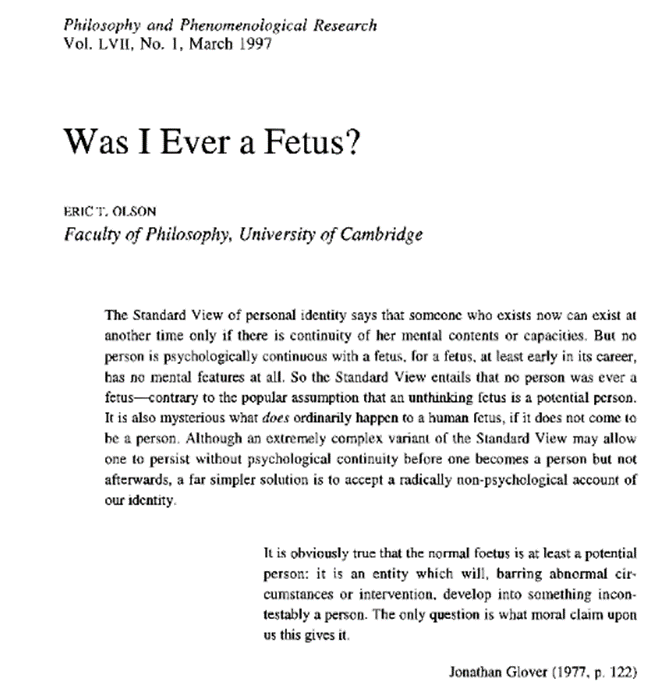
The Liberty/Oppression Taste Bud: Biological Individuality and the Foetus Problem

As I’ve discovered, abortion was one of the earliest medical specialties in American history when it became entirely commercialized in the 1840s. As a result, the United States has been wrestling with moral issues about abortion for 182 years! The abortion debate has gone through rights-based assertions and advanced to claims about the policy costs and benefits of abortion and now appears to have returned to rights-based arguments in the last 50 years. Regardless of where you stand on this debate, this much is clear: in the U.S., the circle of moral quandary surrounding abortion never closes. Nevertheless, what is the source of the moral ambiguity surrounding abortion? Can the philosophy of biology help us better comprehend this moral quandary?

Some philosophers would argue that the issue of biological individuality is central to this moral dispute. But why is biological individuality even a point of contention? Counting biologically individual organisms like humans and dogs appears straightforward at first glance, but the biological world is packed with challenges. For instance, Aspen trees appear to be different biological units from above the ground; nonetheless, they all share the same genome and are linked beneath the ground by a sophisticated root system. So, should we regard each tree as a distinct thing in its own right or as organs or portions of a larger organism?

How Aspens Grow?

Similarly, humans are hosts to a great variety of gut bacteria that play essential roles in many biological activities, including the immune system, metabolism, and digestion. Should we regard these microorganisms as part of us, despite their genetic differences, and treat a human being and its germs as a single biological unit?

NIH scientists find that salmonella use intestinal epithelial cells to colonize the gut

Answers to the ‘Problem of Biological Individuality’ have generally taken two main approaches: the Physiological Approach, which appeals to physiological processes such as immunological interactions, and the Evolutionary Approach, which appeals to the theory of evolution by natural selection. The Physiological Approach is concerned with biological individuals who are physiological wholes [Human + gut bacteria = one physiological whole], whereas the Evolutionary Approach is concerned with biological individuals who are selection units [Human and gut bacteria = two distinct natural selection units].

Is a fetus an Evolutionary individual or a Physiological individual? If we are Evolutionary individuals, we came into being before birth; if we are Physiological individuals, we come into being after birth. While the Physiological Approach makes it evident that a fetus is a part of its mother, the Evolutionary Approach makes it far less clear. But is there an overarching metaphysical approach to solving the problem of biological individuality? Can metaphysics (rather than organized monotheistic religion) lead us to a pluralistic zone where we can accept both perspectives with some measure of doubt?

Philosophy and Phenomenological Research

The Loyalty/Betrayal Taste Bud: What I Found at a Mennonite Wedding

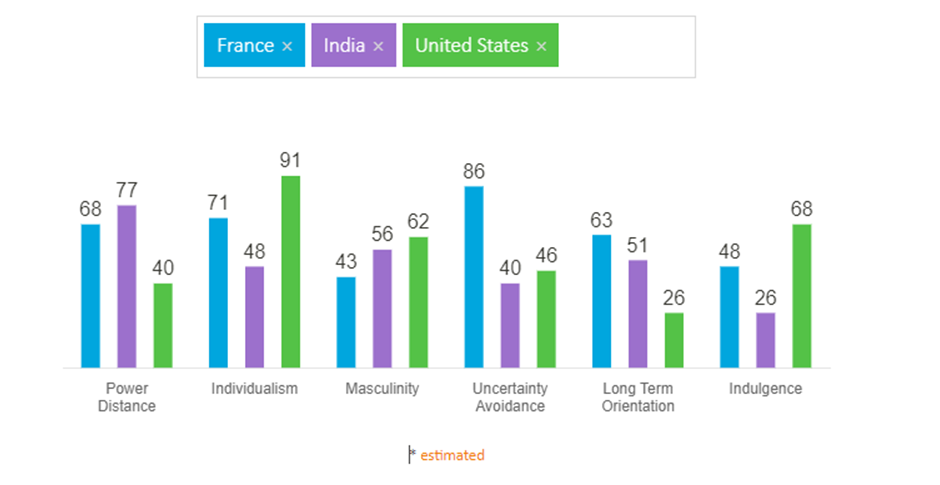
Do you consider the United States to be a high-power-distance or low-power-distance culture? Coming from India, I used to see the U.S. as the latter, but in the last 12 years of living here, it is increasingly becoming the former.

Does your proximity to an authority strengthen or lessen your loyalty?

https://www.hofstede-insights.com/country-comparison/france,india,the-usa/

The Authority/Subversion Taste Bud: The Post-Roe Era Begins Political and practical questions in an America without a constitutional right to abortion.

[In the link above, make sure to listen to both Akhil Amar and Caitlin Flanagan]

I also recommend reading Why Other Fundamental Rights Are Safe (At Least for Now)

Is there a flaw in the mainstream discussion of the U.S. Constitution that the abortion debate has brought to light? In my opinion, although predating the U.S. federal constitution and being significantly more involved in federal politics and constitutional evolution, each American state’s constitution is widely ignored. Keep in mind that state constitutions in the United States are far more open to public pressure. They frequently serve as a pressure release valve and a ‘pressuring lever’ for fractious U.S. national politics, catalyzing policy change. Regrettably, in an era of more contentious national politics, mainstream U.S. discourse largely ignores changes to state constitutions and spends far too much time intensely debating the praise or ridicule the federal Constitution receives for specific clauses, by which time the individual states have already shaped how the nation’s legal framework should perceive them. Altogether, a federal system, where individual state constitutions are ignored, and conflicts are centralized, is the American political equivalent of Yudhishthira’s response to the world’s greatest wonder in the thirty-three Yaksha Prashna [33 questions posed by an Indic tutelary spirit to the perfect king in the Hindu epic of Mahabharata].

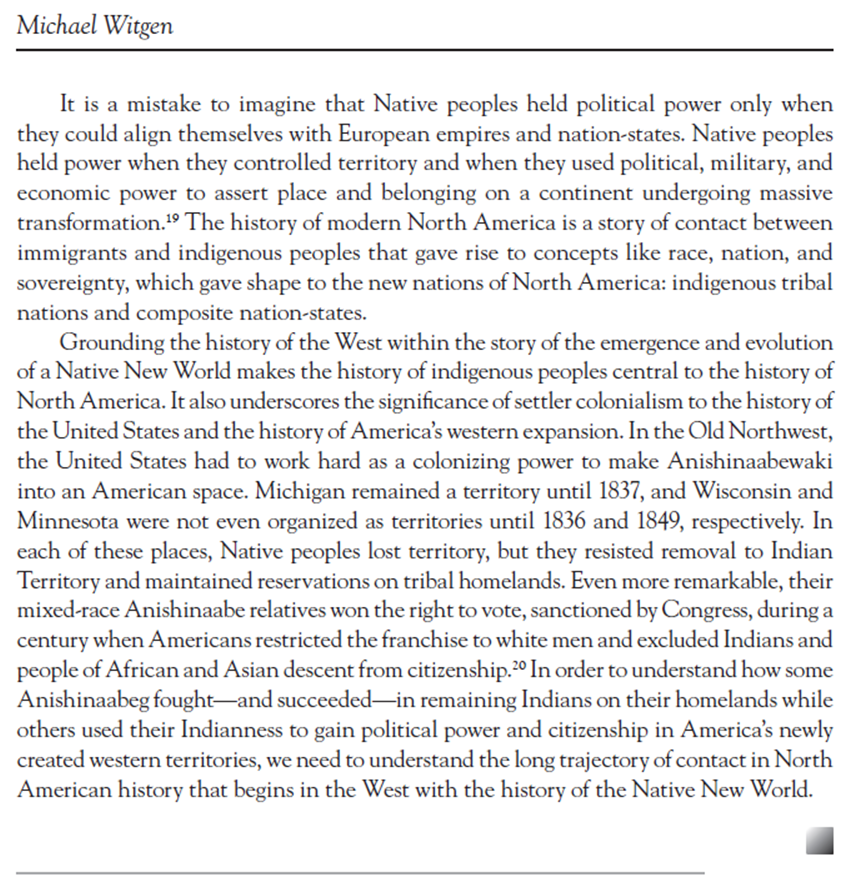
The Sanctity/Degradation Taste Bud: The Native New World and Western North America

The emergence of a distinctly Native New World is a founding story that has largely gone unrecorded in accounts of early America. Here’s an excerpt from the article:

To round off this edition, a Western movie question: Are there any examples of American Westerns developed with the opposing premise—valuing the First Nation’s People’s agency, which has gained historical support? Why not have a heroic Old World First Nation protagonist who safeguards indigenous practices and familial networks in a culturally diverse middle ground somewhere in the frontier country, shaping and influencing the emerging New World? Can this alternate perspective revitalize the jaded American Western movie genre?

[Here’s the previous edition of Stimuli For Your Moral Taste Buds]

Lit in Review: The impact of epidemics on historical economics, part 1

The most recent Journal of Economic Literature includes four essays on how historical epidemics and pandemics affected major macroeconomic variables. Together, they account for 170-someodd pages, which I will summarize below. Each of them is a detailed literature review on decades of historical research. While they are dense, they are for the most part readable. Part 2 will summarize three articles from The Journal of Economic Perspectives on Macro Policy in the Pandemic.


“Modern Infectious Diseases: Macroeconomic Impacts and Policy Responses” – D. Bloom, M. Kuhn, and K. Prettner The greatest strength of this paper is in critically discussing the various methodologies and theories we have available to even answer the question of how epidemics affect the economy. This is aside from the problem that “narrow economic considerations take inadequate account of the ethical, normative, and political dimensions of decisions that relate to saving lives.”

Generally, micro-based methods that focus on the impacts on individuals and add them up ignore indirect, complex interactions that macro-based methods do capture. For instance, increasing the probability that a 15 year old survives to age 60 by 10 percentage points (roughly equivalent to moving from India to China) increases labor productivity by 9.1 percent. On the other hand, most macro models miss behavioral responses are an insufficiently complex. One problem is that my individual incentive to take preventative actions depends on everyone else. This is something I noticed in my own life – here in Texas where almost no one wore a mask, I had a strong incentive to stay masked myself; when we traveled to any state west of us, almost everyone was masked and surfaces were regularly cleaned, so I felt much less urgency to wear a mask myself. Their conclusion is that diseases will be difficult to eradicate via “private actions alone.” They therefore conclude that some form of government lockdown is likely to be warranted.

Epidemics will have different impacts on the economy depending on a) disease-specific characteristics (how much do they impact working-age population, how much long-term damage do they do, etc) b) population characteristics, particularly how much poverty there is and c) country characteristics, particularly government capacity. Because of this, the same epidemic might have minor impacts in one country, create a poverty trap in a second, impose economic hardship in a third while leaving long-run health mostly untouched, or leaving the economy mostly unaffected but harming health and increasing the incidence of other diseases in a fourth.

“Epidemics, Inequality, and Poverty in Preindustrial and Early Industrial Times” – G. Alfani Most important point: epidemics reduce poverty by either a) changing society/laws/markets in ways that are pro-poor and b) killing more poor people than other socioeconomic groups. If a particular disease leads more to the latter, then there will be very small impacts of disease on poverty. Standard intermediate macroeconomics says that wages come from productivity and the more land or physical capital each worker has, the higher their wages will be. Because of this, the usual story I tell my students about the Black Death that killed off 20-35% of western Europe but left the capital alone is that it raised wages for the poorest and created a large middle class, setting the stage for the Renaissance. Alfani shows Gini coefficients [measures of inequality] falling by 30 percent or more.

But this didn’t happen everywhere. “Government intervention may have suppressed wage bargaining for an extended period of time” in post-Colombus Mexico (Scheidel 2017), or Black-Death-era Spain (Álvarez-Nodal and Prados de la Escosura, 2013), and Poland.

And it didn’t happen always. Repeated epidemics in the 17th century that were as deadly as the Black Death in some communities didn’t seem to reduce inequality at all, either in total or compared to what happened in communities that were unaffected. Why not? One difference is that when epidemics happened more often, governments changed inheritance rules to ensure large amounts of wealth stayed controlled by only a few. He also argues that demand for labor will decrease, and if it decreases as much as the labor supply, wages may not increase at all. On top of these effects, I infer from his paper that later epidemics killed a higher percent of skilled workers than the Black Death did, and that stunted any change in the skill premium. Then there are diseases like cholera that not only hit poor areas hardest, but tended to increase and concentrate the negative aspects of poverty.

Alfani and Murphy (2017): “From the fifteenth century, most plagues were particularly harsh on the poor. This has to do both with the poor’s relatively unhealthy living areas, but also with how they were treated during the epidemics. Once doctors and health authorities noticed that plague mortality tended to be higher in the poorest parts of the city, they began to see the poor themselves as the potential culprits of the spread of the infection.” That attitude is contrasted with efforts to improve sanitation and nutrition to both reduce disease and improve the lives of the poor.

“The 1918 Influenza Pandemic and Its Lessons for COVID-19” – B. Beach, K. Clay, and M. Saavedra “The first lesson from 1918 is that the health effects were large and diffuse” and we may never know just how large because of inaccurate record keeping, “issues that also undermine our ability to quantify the impact of COVID-19.” The second lesson: The Spanish flu epidemic was more likely to kill working-age adults, so it had a major long-run labor supply shock which COVID is unlikely to cause, even though both have caused recessions.

Among the differences between the two are that epidemics were not unusual in 1918 and it happened right at the end of World War I, which had upset many economies already and led to falling productivity for reasons unrelated to the pandemic. We have also documented a wide range of negative health impacts from the 1918 epidemic and are only beginning to document the longer-term impacts of COVID, which will have to be studied in the future.

Interestingly, while there was some attempt at social distancing and closing society down in 1918, it was much shorter-lived and not as severe as what we tried during COVID. While they were “somewhat effective at reducing mortality in 1918, … the extent to which more restrictive [regulations] would have further reduced pandemic mortality remains debated.”

“The Economic Impact of the Black Death” – R. Jedwab, N. Johnson, and M. Koyama There are three primary lenses through which economists have viewed the Black Death. Malthusians argue that smaller populations increase wages (by raising the capital/labor or land/labor ratios) and lower inequality. The “Smithian” view is that larger populations are necessary for a greater division of labor, specialization, and larger markets that support important technologies. The third strand focuses on the role of institutions, both as causes and effects.

“In the very short run [the Black Death] caused a breakdown in markets and economic activity more generally.” In a longer run sense, though, England, Spain, and Italy had very different divergences between wages and productivity. Put another way, England had larger Smithian effects than Spain or Italy and Italy had the largest Malthusian effects. Thus, rather than one model being “right” and the other “wrong,” there is more of a continuum, moderated in part by institutions.

In the years after the plague, people moved out of rural areas to the cities that had been hardest hit because wages had increased more there, which also increased reforestation. In Western Europe, workers’ bargaining power increased, eroding the institution of serfdom. Craft guilds increased dramatically, though their net effect is questionable – decreasing competition through monopoly power but increasing human capital accumulation through apprenticeships. States grew in size and influence, perhaps because there were fewer people to oppose them, with growing taxation accompanying investment in public health and the ability to impose quarantines.

On Persons, Individuals, and Humans

It is only from a notion of the human, common to all men, that the concept of person can be dissolved into the idea of individual.

The relevance of the concept of person lies in its ability to describe functional relationships with its environment: sui juris or alieni juris, noble, patrician, commoner, serf or lord, father, minor, capable, incapable, etc. In pre-modern times, according to each function, a normative system exclusive to caste, position or estate, known as “privilege”, corresponded.

Rather, Modernity dissolves fixed personal relationships into an undifferentiated diagram of spheres of individual autonomy. Each human being ceases to be a person attached to a certain fixed function in the social fabric and, by the mere fact of being human, is the holder of his sphere of individual autonomy, equal to that of any other human being.

The legal system ceases to govern particular relationships between people to become a structure empty of intentions and purposes, which only determines procedures and delimits equal and predictable fields of interaction and clear methods for the resolution of disputes among the holders of the different spheres of individual autonomy.

The principle ceases to be that of difference to become that of equality. The difference becomes the exception, to be justified on a functional basis that results in a public benefit.

However, in the non-political sphere, that of civil society, the difference does not disappear, but is expressed in each of the individual exceptionalities, within each respective sphere of individual autonomy, while it is accidental and irrelevant to the legal-political system.

There are certain special situations framed within specific legal regimes, such as minority and intra-family relations, which enshrine assistance obligations, usufruct rights and a system of representation and guardianship.

Consequently, the role of the public sphere within civil society is defined by the procedure to be followed to settle the conflicts that could arise from the collision of the different spheres of individual autonomy.

From the moment in which each human being is an autonomous individual, the legitimate exercise of power in relation to the population does not consist in giving specific orders to subjects but in administering a set of procedures whose specific purpose is to serve as a means for different individuals settle their disputes peacefully.

Of course, in Modernity and in liberal democracies relations of command and political obedience subsist, but within the governmental structures themselves, which in turn incorporated procedural rules that limit discretion in the exercise of power and establish functions and hierarchies that define competencies and delimit individual responsibilities.

However, both modern government structures and the legal consecration of a social structure composed of equal individuals in dignity and respect are not the result of an invention but the consequence of a historical evolution whose becoming does not cease and whose hindrances persist in the field of the aforementioned civil society.

That the differences between people are exclusively functional and that such functions report a benefit to all the individuals involved, in such a way that none of them is used exclusively as a means, but is seen as an end in itself, is an imperative for the public sphere, but only a programmatic aspiration in the field of civil society.

In turn, that each person deserves equal consideration and respect is a discovery in the true sense of the word. Quentin Skinner in “The Foundations of Modern Political Thought” recounts the role played in the Late Middle Ages by the discussion that every person was endowed with an immortal soul, deserving of salvation, for the subsequent conceptualization that every human being is worthy also of legal protection regarding their fundamental interests, such as their life, their personal freedom, or their possessions.

Regarding the natural law doctrine of human rights, which states that human beings enjoy a certain set of guarantees and rights against the state and against other people, it is usually dismissed as metaphysical.

However, such statement can be understood more clearly if it is related to its historical evolution: the different freedoms already existed but assigned to different people according to their caste or status, who had an immediate and specific interest in their protection.

To cite an example, in the Partidas of Alfonso X of Castille, we find every detail of social life regulated: some had the right to bear arms but not to work, since they had to be available to the king in his court to eventually go to war; others had the right to exercise a certain trade or profession, excluding those who did not belong to their corporation, but they were not free to change their activity, neither in terms of their subject matter nor their geography. In the pre-modern world, the holders of freedoms had a specific interest in defending them, but their ownership depended on circumstances that, in the vast majority of cases, were out of their control and, in others, obsolete in terms of their functionality.

Given that this legal-political system had very little plasticity to adapt to changes in the surrounding circumstances, it was generally inefficient, stagnant, and unstable and, therefore, conflicts manifested themselves in recurrent revolts.

Modernity consisted in the universalization of liberties. This means that freedoms – or immunities against power – that already existed and whose entitlement was limited to reasons of belonging to certain castes or estates, to the exclusion in many cases of one another, began to be extended to all human beings by the mere fact of being such.

That is to say, there is nothing metaphysical in the natural law doctrine of human rights. It actually consists of the universalization of rights that already existed and were recognized.

The novelty that this brought is that each human being ceased to be considered as a person in relation to his family, his social status or his caste, to be considered as an autonomous individual and equal in rights to any other, holder of rights that he was actively interested in exercising as well as others whose content he hardly had any news or specific interest.

In turn, men exchanged differentiated rights that protected certain personal interests in exchange for new abstract freedoms, the same for each of the remaining individuals. As a result, each person gained potential spheres of action and saw specific regions of power restricted.

The nobleman gained a freedom to work and trade that he may or may not have an interest in exercising, but he lost the power he had over his serfs or was displaced by commoner bureaucrats in government functions. The shoemaker gained the freedom to emigrate to other cities or to change his trade to that of a blacksmith, in which he may or may not be interested, but he also received competition in his own town from other new shoemakers who emigrated from other latitudes, who effectively exercised such rights.

Such transformations and their discontents can be verified in the conservative authors of the beginnings of the Contemporary age, as is the case of Charles Dickens, among others.

That is why the universalization of fundamental rights -for the English tradition- or natural rights -for the American conception- constitutes both a discovery of intellectual research on historical evolution and a political program.

Whether such an extension is desirable and to what extent it should be continued or reversed largely defines political positioning from right to left. For this reason, historical evolution is not a legitimizing device in itself, but a process of discovery of various forms of social and political organization that is subject to a critical evaluation regarding which institutions and practices to incorporate, preserve, resist or modify.

On the open texture of conflicts

Just as language carries with it a phenomenon of open texture, according to which the reference and meaning of some of its terms are modified in response to changes in the environment — for example, saying that the head of state is commander in chief of the armed forces implies different denotations and connotations as war machines, communications, and command styles evolve -, conflicts that are prolonged over time also undergo changes in the terms that define them, as their surrounding context varies.

Thus, a dispute between individuals about the ownership of a certain asset, such as that of two heirs in dispute over the award of a property that is part of the hereditary heritage, will have to vary in intensity according to the changes in the market value of the said asset and according to the changes in the needs of those heirs as well.

Note, likewise, that the said transformation of the conditions in no way affects the conformation of the hereditary rights, but rather it is in the interest of each of the parties to enforce them.

Under certain circumstances, some of the said heirs will have to prefer to maintain the undivided inheritance and under others they will have to activate the dissolution of the hereditary community, generating a conflict in case of disparity among the heirs.

Although rights protect interests -such as life, personal liberty or stability upon possession-, not all interests deserve legal protection -such as the claim of an individual to hold a monopoly in the production of a certain good- and, among those interests which do enjoy legal protection, it will be relative and hierarchical.

Given that a legal system forms a set of consistent normative parameters, the changes in the decisions of individuals are motivated by variations in the relative value of the interests protected by said legal system, also assuming that such individuals are rational agents – i.e., they have transitive preferences.

As a corollary of the above, the normative system, while remaining identical to itself, will have to be neutral for the dynamics of the conflict, since the parties will have shaped their plans and expectations in accordance with their prescriptions.

That is why we often find analyses devoid of axiological and merely descriptive approaches. This does not mean that the rules, be they positive or natural, are not observed, but rather that a degree of compliance and constant enforcement is verified, which makes it possible to look for the reason for the changes in the decisions of the agents in other conditioning factors, such as the technology, the relative prices of goods, climatic phenomena, etc., etc..

Nor does this mean that the law does not evolve or undergo disruptive changes: there are legislative changes and judicial precedents that are modifying the content of the norms and, in turn, the norms themselves suffer the consequences of the open texture of the language in which they are expressed.

When these changes do not respond to a change in the value of the interests, but respond to a need of the legal system itself to maintain a stable and predictable order of events, the legal system maintains its neutrality, since it is transformed, jurisprudential or legislatively, when its formulations – even when they have a high degree of enforcement – are not sufficient to maintain a peaceful order of human interaction and, therefore, legal innovation has the function of reinforcing the maintenance of peace.

At this point in the discussion, it is appropriate to venture into the consequences of a legislative or jurisprudential change that had in view a different purpose than strengthening the function of law as a mechanism of social control aimed at maintaining peace between individuals who interact with each other.

If the change is jurisprudential, many times the law solves such a phenomenon endogenously: any jurisdictional pronouncement by a judge or court that departs from the content of the legal norms or that such departure is motivated by the transgression of its legal duty of impartiality with respect to of the parties to the conflict will render such pronouncement null and void and the judges will have incurred prevarication.

However, when a law is sanctioned by the legislature in contravention of its duty to dictate general and abstract norms and, instead, has the aim of favouring vested interests, little can be done beyond achieving a declaration of unconstitutionality, either by part of a constitutional court or by an ordinary court in the exercise of diffuse control of constitutionality.

This is for those cases in which the law in question also violates laws of a higher rank such as the Constitution.

Notwithstanding, when a norm is constitutional and, however, it was not enacted for the purpose of legislating in general and abstract terms, but instead sought with its sanction to favour certain vested interests to the detriment of others or public interests, little can be done for the legal system to correct itself according to an endogenous mechanism and the law, therefore, will have lost its neutral character.

It is this lack of neutrality of the legal system that delegitimizes it as a peaceful means of resolving disputes between individuals and, consequently, sharpens the intensity of conflicts, whether they consist of disputes between individuals or escalate into political questioning regarding the legitimacy of the legal-political system itself.

It was not for nothing that there were revolutions, such as the French one, which led to the enactment of civil codes, as a way of crystallising the reestablishment of a neutral normative order, generally described as fair. Note, likewise, that the Napoleonic Code did not contain any innovations, but rather consecrated –and synthesised- legislatively the jurisprudential evolution of the previous centuries.

Similarly, a territorial dispute between two countries could remain diplomatic for decades and, under a change of circumstances, escalate the conflict to a warlike stage.

This change in circumstances may be due to a redefinition of the interests of one or both countries, discoveries of wealth in the disputed territories, or technological innovations that modify the relationship of the respective countries with the geography of the disputed territory.

Note that in no way do these changes in the conditions surrounding the conflict affect a change in the titles of sovereignty over the disputed territory, but what changes is the intensity of the interest in it and the calculation of the chances of success in the event of a war escalation.

However, at the international level we find a plurality of normative sources -international custom, treaties, the norms of international organisations-, without courts of application in most cases and without a clear enforcement system to guarantee impartiality.

Despite arbitral awards can be found among small nations, which submit a territorial issue to the arbitration of a third power or institution that enjoys prestige between both countries, an issue that the parties involved do not consider of vital importance to them; but in most cases we are faced with conflicts or claims that will last over time, as long as the war alternative is disadvantageous for both parties.

Sustaining the principle that all agents who make decisions are rational, it is appropriate to ask under what conditions for such agents it is still reasonable to maintain a negotiation and under what others the most reasonable indicates escalation in the intensity of the conflict.

When the controversy occurs between two parties subject to the jurisdiction of a state and the object of the controversy has a certain relevance, the options of the parties follow one another between negotiating or going to trial.

On the other hand, among sovereign nations, although there is the alternative of submitting to an arbitration award, when the disputed issue interferes with a vital interest or makes the country’s own survival, the military confrontation constitutes the option to negotiation.

Paradoxically, when two individuals have a confrontation that is so insignificant as to be taken to court, the options also lie between negotiation or the deployment of violence -verbal or moderately physical, below the threshold of what the law would consider a crime. This occurs because both the international sphere and certain spheres of human interaction are naturally regulated.

From our point of view, this is one of the most relevant theoretical controversies: if such a natural system can be entirely deduced from reason -as maintained from Hugo Grotius onwards- and, therefore, can be stated and agreed upon by the consensus of the parties through a rational discussion, or if we can characterize natural law as an empirical normative system -as conceived by David Hume in the 18th century and later rescued by Friedrich A. Hayek- that grows spontaneously.

This last conception about the empirical character of the international rule-based order can be a convincing alternative to both realism and idealism. Even more so when the question of the neutrality of the liberal international order is questioned, both from realism and from critical currents. Since the empirical rule system emerges at the same time as the expectations of the agents, the neutrality of the resulting order will be highly probable.

Therefore, in accordance with this vision, the variation in the intensity of the conflicts will not have to be sought or justified in a modification of the rules of the game, but in a change in the relative weight of the interests in dispute, that is, in the open texture of the nature of conflicts.

May the Fourth…

On May 4, 1919, a student protest against the ceding of Chinese territory to Japan by the Versailles Treaty initiated a reassessment of China’s attitude to its own past in the face of Western modernity and domination. The May Fourth Movement, as this ongoing reassessment came to be called, rejected the early liberal emphasis on piecemeal reform and constitutionally limited, elite-led government, but its own brand of liberalism remained indebted to the categories and concerns of late Imperial and early Republican liberal debates.

This is from the amazing Leigh Jenco, and it’s titled “Chinese Liberalism.” Read the whole thing (pdf).

A few words — and many quotations – about the influence of Ludwig Wittgenstein on Friedrich Hayek

In a brief autobiographical note, Friedrich Hayek refers to the influence he had received in his younger years from both his teacher Ernst Mach and his distant cousin Ludwig Wittgenstein:

But I did, through these connexions, become probably one of the first readers of Tractatus when it appeared in 1922. Since, like most philosophically interested people of our generation I was, like Wittgenstein, much influenced by Ernst Mach, it made a great impression on me.”

F. A. Hayek – Remembering My Cousin, Ludwig Wittgenstein

This can be seen in the analytical rigor present in his essays published in the 1920s and in his book Monetary Theory and the Trade Cycle (Geldtheorie und Konjunkturtheorie) (1929), translated by N. Kaldor and H. M. Croome from the German. However, such influence was not exclusively limited to Hayek’s youth. He was also present in the conception and writing style of The Sensory Order, published in 1952, and Law, Legislation and Liberty, the first volume of which, Rules and Order, was published in 1973.

From my point of view, the following aphorism of the Tractatus Logico-Philosophicus is the one that best allows us to appreciate the reflection of said work in Hayek:

4.12 „Der Satz kann die gesamte Wirklichkeit darstellen, aber er kann nicht das darstellen, was er mit der Wirklichkeit gemein haben muß, um sie darstellen zu können -die logische Form.

Um die logische Form darstellen zu können, mußten wir uns mit dem Satze außerhalb der Logik aufstellen können, das heißt außerhalb der Welt.“

Which could be translated as follows:

4.12 “The proposition can represent the whole of reality, but it cannot represent what it must have in common with reality to be able to represent it – the logical form.

To represent the logical form, we should have to be able to station ourselves with the proposition somewhere outside the logic, i.e.: outside the world.”

This statement about the limits of representation later finds its correlation in the following aphorisms from Hayek’s The Sensory Order, about the limits of knowledge and of the transmission of information:

8.14. While there can thus be nothing in our mind which is not the result of past linkages (even though, perhaps, acquired not by the individual but by the species), the experience that the classification based on the past linkages does not always work, i.e., does not always lead to valid predictions, forces us to revise that classification (6.45-6.48). In the course of this process of reclassification we not only establish new relations between the data given within a fixed framework of reference, i.e., between the elements of given classes: but since the framework consists of the relations determining the classes, we are led to adjust that framework itself.

Note that if there is something that “does not always work,” then we are confronted with the limits to our representation. I think that the said “framework of reference” could play the role of the “logic form” and what Hayek is describing here is the dynamics of a negative feedback process.

8.18. The new experiences which are the occasion of, and which enter into, the new classifications or definitions of objects, is necessarily presupposed by anything which we can learn about these objects and cannot be contradicted by anything which we can say about the objects thus defined. There is, therefore, on every level, or in every universe of discourse, a part of our knowledge which, although it is the result of experience, cannot be controlled by experience, because it constitutes the ordering principle of that universe by which we distinguish the different kinds of objects of which it consists and to which our statements refer.

Here, the subject, instead of being outside the world is inside another universe of discourse.

8.67. Apart from these practical limits to explanation, – which we may hope continuously to push further back, there also exists, however, an absolute limit to what the human brain can ever accomplish by way of explanation—a limit which is determined by the nature of the instrument of explanation itself, and which is particularly relevant to any attempt to explain particular mental processes.

Nevertheless, there are certain universes of discourse that human beings can never access to -so, they are outside their world.

8.69. The proposition which we shall attempt to establish is that any apparatus of classification must possess a structure of a higher degree of complexity than is possessed by the objects which it classifies; and that, therefore, the capacity of any explaining agent must be limited to objects with a structure possessing a degree of complexity lower than its own. If this is correct, it means that no explaining agent can ever explain objects of its own kind, or of its own degree of complexity, and, therefore, that the human brain can never fully explain its own operations. This statement possesses, probably, a high degree of prima facie plausibility. It is, however, of such importance and far-reaching consequences, that we must attempt a stricter proof.

Here, Wittgenstein’s logic form delimits the said structures of a higher degree of complexity which the subject given in a simpler universe of discourse could never trespass.

8.81. The impossibility of explaining the functioning of the human brain in sufficient detail to enable us to substitute a description in physical terms for a description in terms of mental qualities, applies thus only in so far as the human brain is itself to be used as the instrument of classification. It would not only not apply to a brain built on the same principle but possessing a higher order of complexity, but, paradoxical as this may sound, it also does not exclude the logical possibility that the knowledge of the principle on which the brain operates might enable us to build a machine fully reproducing the action of the brain and capable of predicting how the brain will act in different circumstances.

8.82. Such a machine, designed by the human mind yet capable of ‘explaining’ what the mind is incapable of explaining without its help, is not a self-contradictory conception in the sense in which the idea of the mind directly explaining its own operations involves a contradiction. The achievement of constructing such a machine would not differ in principle from that of constructing a calculating machine which enables us to solve problems which have not been solved before, and the results of whose operations we cannot, strictly speaking, predict beyond saying that they will be in accord with the principles built into the machine. In both instances our knowledge merely of the principle on which the machine operates will enable us to bring about results of which, before the machine produces them, we know only that they will satisfy certain conditions.

Thus, the knowledge of the principle enables us to build an abstract machine such as language, the price system, or the law, in order to form expectations of future human actions. Since such abstract machine would be built using the knowledge of the principle, it would not be deliberated designed but grown from the experience.

While Ludwig Wittgenstein confronted the subject of knowledge against the limits of the conceptual representation and threw him into the silence and into the realms of mysticism, Friedrich Hayek, on the other hand, chooses to place the said limit instance in an order of discourse more complex than the human mind, which could be the market, the language itself, or the extended society.

For Hayek, the social order works as an abstract machine, which continuously processes information and appears in the event horizon of the subjects to confirm or readjust their own classificatory systems. These classificatory systems that, in an abstract plane, each individual has and that are in a continuous process of readjustment based on the novelties that come from the spontaneous order, are abstract but, at the same time, empirical.

Among such abstract orders are the normative systems and the first volume of Law, Legislation and Liberty is devoted to their study.

‘Learning from experience’, among men no less than among animals, is a process not primarily of reasoning but of the observance, spreading, transmission and development of practices which have prevailed because they were successful-often not because they conferred any recognizable benefit on the acting individual but because they increased the chances of survival of the group to which he belonged. The result of this development will in the first instance not be articulated knowledge but a knowledge which, although it can be described in terms of rules, the individual cannot state in words but is merely able to honour in practice. The mind does not so much make rules as consist of rules of action, a complex of rules that is, which it has not made, but which have come to govern the actions of the individuals because actions in accordance with they have proved more successful than those of competing individuals or groups.”, Chap. 1, Reason and Evolution

Here we find a process of natural selection of rules of conduct, thus, provided not by representational reason, but from experience.

The first of these attributes which most rules of conduct originally possessed is that they are observed in action without being known to the acting person in articulated (‘verbalized’ or explicit) form. They will manifest themselves in a regularity of action which can be explicitly described, but this regularity of action is not the result of the acting persons being capable of thus stating them. The second is that such rules come to be observed because in fact they give the group in which they are practised superior strength, and not because this effect is known to those who are guided by then. Although such rules come to be generally accepted because their observation produces certain consequences, they are not observed with the intention of producing those consequences-consequences which the acting person need not know.  Chap. 1, Reason and Evolution

Here we find a concept that Hayek will use extensively along the rest of Law, Legislation and Liberty, the articulated and the unarticulated. In the terms previously used in The Sensory Order, the unarticulated is what belongs to another universe of discourse, of a more complex level.

The process of a gradual articulation in words of what had long been an established practice must have been a slow and complex once the first fumbling attempts to express in words what most obeyed in practice would usually not succeed in expressing only, or exhausting all of, what the individuals did in fact take into account in the determination of their actions. The unarticulated rules will therefore usually contain both more and less than what the verbal formula succeeds in expressing. On the other hand, articulation will often become necessary because the ‘intuitive’ knowledge may not give a clear answer to a particular question. The process of articulation will thus sometimes in effect, though not in intention, produce new rules. But the articulated rules will thereby not wholly replace the unarticulated ones, but will operate, and be intelligible, only within a framework of yet unarticulated rules. Chap. IV, The Changing Concept of Law

Thus, the process of articulation of new rules is not a labor of creation of new ones, but of discovering them through the limits of the universe of discourse of the individuals.

The contention that a law based on precedent is more rather than less abstract than one expressed in verbal rules is so contrary to a view widely held, perhaps more among continental than among Anglo-Saxon lawyers, that it needs fuller justification. The central point can probably not be better expressed than in a famous statement by the great eighteenth-century judge Lord Mansfield, who stressed that the common law ‘does not consist of particular cases, but of general principles, which are illustrated and explained by those cases’. What this means is that it is part of the technique of the common law judge that from the precedents which guide him he must be able to derive rules of universal significance which can be applied to new cases.

The chief concern of a common law judge must be the expectations which the parties in a transaction would have reasonably formed on the basis of the general practices that the ongoing order of actions rests on. In deciding what expectations were reasonable in this sense he can take account only of such practices (customs or rules) as in fact could determine the expectations of the parties and such facts as may be presumed to have been known to them.

And these parties would have been able to form common expectations, in a situation which in some respects must have been unique, only because they interpreted the situation in terms of what was thought to be appropriate conduct and which need not have been known to them in the form of an articulated rule. Chap. IV, The Changing Concept of Law

Here, “rules of universal significance” should be understood as knowledge of the principle. The general practices denote that the said order, despite of being abstract, is, nevertheless, empirical. The common expectations are readjusted through a process of articulation of rules which redefine the universe of discourse of the individuals of a given community or society.

This conception of rules allows us to a better comprehension of the notion of natural rights, since they are empirical, despite their enforcement:

Whether we ought to call ‘law’ the kind of rules that in these groups may be effectively enforced by opinion and by the exclusion from the group of those who break them, is a matter of terminology and therefore of convenience. For our present purposes we are interested in any rules which are honoured in action and not only in rules enforced by an organization created for that purpose.

It is the factual observance of the rules which is the condition for the formation of an order of actions; whether they need to be enforced or how they are enforced is of secondary interest. Factual observance of some rules no doubt preceded any deliberate enforcement. The reasons why the rules arose must therefore not be confused with the reasons which made it necessary to enforce them. Chapter V. Nomos: The Law of Liberty.

Finally, despite being the enforcement of natural rights a matter which depends upon a political decision, the authority is a subsystem inside of the same level of discourse of the individuals of the same political order. Thus, the political authority could not trespass the limits of the knowledge of the said empirical order without consequences concerning its stability. It should deal with the rules which act as the framework of individual interaction using just knowledge of the principles, articulated in general and abstract rules. As we succinctly have seen, the youth influence of Ludwig Wittgenstein on Friedrich Hayek endured until the last books of the latter. I dare not say that the Tractatus encloses the clues of interpretation of the most intricated works of F. A. Hayek, but its reader will find some common ground upon which to build a more prolific interpretation of his legacy.