Would regulation stop the mistakes of rating agencies that contributed to the 2008 crisis?

I remember watching The Big Short and feeling great indignation at the S&P employee who told Steve Carell that rating agencies were pressured into issuing unreasonably high ratings because they were beholden to their customers. If true, this represented an unbelievable moral hazard, which is often cited as the reason for the failures of the ratings agencies–and as a reason for regulating these agencies.

However, more in-depth research and consideration reveals that this answer is incomplete and, in many ways, incorrect. Claire Hill, a law professor at the University of Minnesota Law School and director of the Institute for Law and Rationality, clearly and convincingly critiques this simplistic explanation by recognizing market influences and proposing alternate causes, which also means that if we are looking to avoid a future crisis, we need to look to alternative solutions to the regulatory measures that we currently employ. I don’t think it could be said better than she does in her abstract:

Why did rating agencies do such a bad job rating subprime securities? The conventional answer draws heavily on the fact that ratings are paid for by the issuers: Issuers could, and do, “buy” high ratings from willing sellers, the rating agencies.

The conventional answer cannot be wholly correct or even nearly so. Issuers also pay rating agencies to rate their corporate bond issues, yet very few corporate bond issues are rated AAA. If the rating agencies were selling high ratings, why weren’t high ratings sold for corporate bonds? Moreover, for some types of subprime securities, a particular rating agency’s rating was considered necessary. Where a Standard & Poor’s rating was deemed necessary by the market, why would Standard & Poor’s risk its reputation by giving a rating higher (indeed, much higher) than it knew was warranted?

Finally, and perhaps most importantly, giving AAA ratings to securities of much lower quality is something that can’t be done for long. A rating agency that becomes known for selling its high ratings will soon find that nobody will be paying anything for its ratings, high or low.

In my view, that issuers pay for ratings may have been necessary for the rating agencies to have done as bad a job as they did rating subprime securities, but it was not sufficient. Many other factors contributed, including, importantly, that rating agencies “drank the Kool-Aid.” They convinced themselves that the transaction structures could do what they were touted as being able to do: with only a thin cushion of support, produce a great quantity of high-quality securities. Rating agencies could take comfort, too, or so they thought, in the past – the successful, albeit short, recent history of subprime securitizations, and the longer history of successful mortgage securitizations.

“Issuer pays” did not so much make the rating agencies give higher ratings than they thought were warranted as it gave the agencies a “can do” mindset regarding the task at hand – to achieve the rating the issuers desired, working with them to modify the deal structures as needed. That the issuers were paying motivated the agencies to drink the Kool-Aid; having drunk the Kool-Aid, the agencies gave the ratings they did. My account casts doubt on the efficacy of many of the solutions presently being proposed and suggests some features that more efficacious solutions should have.

I very much recommend reading the full article, which gives more nuance and information about the weaknesses of proposed solutions for rating agency mistakes or malfeasance. This should also be food for thought concerning the general perspective we should have in examining “market failures,” as there are often market feedback systems that mitigate problems, and turning to regulation by reflex can cause unintended harm or even miss the mark entirely.


Reference: Hill, Claire. “Why Did Rating Agencies Do Such a Bad Job Rating Subprime Securities?” University of Pittsburgh Law Review (2010): 10-18. https://papers.ssrn.com/sol3/papers.cfm?abstract_id=1582539.

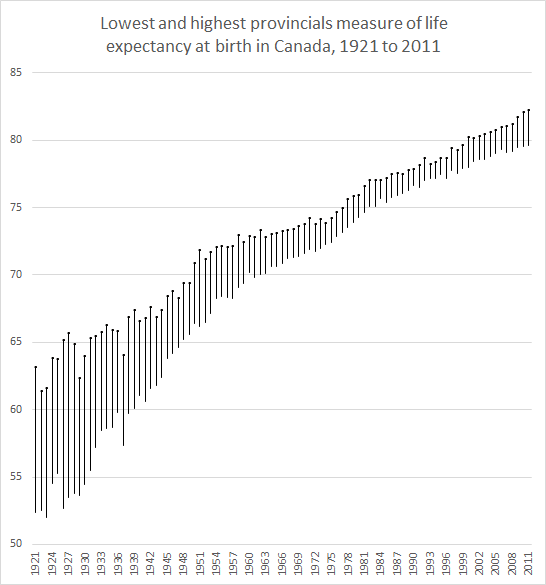
Differences in life expectancy within Canada, 1921 to 2011

I’ve been playing around with some data for a paper I have been trying to write about the economic history of Canada in the 20th century. In the process, I assembled the data from the Base de données sur la longévité canadienne regarding life expectancy at birth. Then, I thought that it would be interesting to see how large were the differences between the provinces and how fast did they close. They closed pretty dramatically during the 20th century – see for yourself.

LifeExpectancyCanada

Pride and Subsidies

Freakonomics had an episode on the dramatic impact of subsidies on the visual effects (VFX) industry. Long story short: 1) VFX companies operate on razor thin margins, 2) the industry chases subsidies from competing local governments–Canada and London are  currently important locations, 3) Californian politicians want to bring these jobs back to LA, but doing so would probably be a net burden.

(Let’s put aside the issue of the state of California trying to play central planner by effectively creating different tax rates for different industries. That’s a bad idea for reasons we can explore later.)

Putting yourself in the head of a Californian, something about the policy feels right (maybe not for the typical NOL reader, but probably for the median voter). I’m sure you could convince the median voter that these subsidies are a bad idea, economically. But even so, I’d be willing to bet that you’d still get significant support.

I’m confident that if you were to talk this issue over with a representative sample of California voters–or X industry in Y region for similar industry upheavals–you could convince them of the probable negative impact of such policy and still see many voters at least weakly supporting the policy. Why? Because being able to point to a movie and say “that awesome explosion was made in my backyard,” is worth some degree of sacrifice for these people.

Perhaps people want our government to give us something to be proud of (God knows they give us enough things to be ashamed of!). Perhaps people have some latent willingness to pay to be able to say that some high status industry is in their community/city/state/country.

We like pride, but it costs us. This puts us squarely in the domain of economics. How do we figure out how to make the trade off between pride, and the price we must pay for it? Some cases seem easy, at least in hindsight–the sacrifice of the civil rights movement was a small price to pay for the pride generated–but cases like the VFX industry, aren’t so obvious, but still high stakes.

I don’t think we’re likely to be able to figure out the bill. We can be proud of NASA, movies, the post office, and whatever else. But how much of the cost can we attribute to engaging in activities that make us proud? We get the same issue in markets. I have more than brand loyalty for Honda (the maker of my motorcycle); I’m also proud to associate with Honda as an innovative company with a history of liberating the world’s poor.

A clever statistician or economist could estimate some important facts about how people tend to make these trade offs. Doing so could help us make better decisions, but can’t ultimately replace our own judgment.

Given the uncertainty we face we really have to make a decision about whether to err on the side of over- or under-provision of pride goods–and this is true in a variety of settings.

I suspect that the “let 1000 flowers bloom” approach is the appropriate one here. We don’t want to have one Secretary of Pride deciding to err on the side of over-provision and the result is that a bunch of children die from preventable causes so that we can all feel proud about how cool the latest domestically produced Fast and Furious movie is going to be. On the other hand, it would be a tragedy of slavery was never ended because it would interrupt business as usual.

Markets, civil society, and government face different sorts of pros and cons with respect to how they might make these trade offs. Arguing about them could create a new academic discipline at the intersection of ethics, economics, and sociology.

In all three spheres, there will be many very bad decisions made. But if you aren’t free to be wrong, you aren’t free. The question to ask is what sort of pride goods will tend to survive, and in which spheres?

What we can say for sure is that private, voluntary exchange and cooperation (free markets and civil society) at least allow us to choose our associations. And they require us to choose, and choose again on a regular basis. Our nation is mostly based on luck. Where we live tends not to change much. Voting with your feet is costly, so we should expect it to be that much harder to dismantle big mistakes. The political process routinely results in outcomes we’re ashamed of (about half of voters are ashamed of the results every presidential election!).

There aren’t markets in pride so it’s hard to know how the benefits compare to the costs. But we can (and do) exhibit pride in markets. We should probably do more of it. And perhaps we should also be more skeptical of government, even though we normally think of them as providing pride goods. On the margin, anyways, I think this is a good direction for most people to move. Be proud of your community because the people have whatever unique traits they do. Be proud of the brands you buy from for their contributions to the state of the art. Be proud of your local sports team.

The GDP, real wages and working hours of France since the 13th century

Every few years, an economic historian in training spends thousands of hours in archives assembling a long quantitative essay. It’s the work of monks (in fact, when you go far back in history, you also end up working with monks and nuns – which was my case on Canadian economic history). It’s the kind of work that requires patience, attention to details and (did I say it already?) patience.

I did that for my own work on Canadian economic history. For two years, I locked myself in the archives of two religious congregations to collect and transcribe close to a million price and wages information. For these two years, I did not write one single paper. I just collected the data and constituted a list of the papers I could write. However, once its finished, you may party like a sailor fresh off the boat because you end up with a wealth of data to answer hundreds of questions. When I finished my own thing on Canada, I was thrilled as I thought it constituted a great advance in quantitative knowledge (which I could use to assess tougher historical questions).

However, compared to the work of Leonardo Ridolfi, my own work looks like a dwarf (I confess envy here).  Ridolfi spent hundreds of hours assembling a quantitative essay on France’s economy since 1250. This is monumental!  France has generally been a statistical abyss (except for demography and some price series) especially when compared to England. Yet, the country is highly relevant to western economic history. After all, the question of why did the Industrial Revolution take place in Britain is the mirror of asking why it did not happen in France. As a result, Ridolfi’s work fills one of the largest voids in the field of economic history and will end up being one of the most cited dissertations for the next ten years I expect.

He constructed estimates of real wages, prices, incomes and working hours. As such, he provided the widest possible statistical portrait possible which (I wont get into details here) circumvents tons of empirical complications that may limit the quality of each variable taken separately (see for example the manner in which GDP is calculated and the role that estimating working hours plays).

I invite anyone interested in economic history to read his work. But, I will give you the main conclusion I gathered: France was not as poor as many believed. I recently pointed this out in an article which I am trying to get published, but Ridolfi’s work proves my point beyond my wildest expectations. I assembled the most relevant figures below.

Ridolfi.png

On the reversal of fortune, urbanization and Canada

One of the more famous articles of economist Daron Acemoglu is his 2002 article on the reversal of fortunes where he points out that countries colonized by Europeans in 1500 that were relatively rich then are relatively poor now. In the paper, they use urban density as a proxy for economic development at that point in time.

I was not particularly convinced by this because of the issue of ruralization in colonial economies. I am still not convinced in fact. As many scholars interested in American colonial history point out, the country de-urbanized (ruralized) during the colonial era as cities grew at a slower pace than the general population. As such, the share of the US population in rural areas increased. But Jeffrey Williamson and Peter Lindert documented that in 1774, the United States were the richest place in the world (beating England on top of being more egalitarian). 

This is normal. Economies on the frontier had land to labor ratios that were the exact opposite of those in Europe. The opportunity cost of congregating in one area was high given the abundance of land that could be brought under cultivation. This is why the Americas (North America at least) was the Best Poor Man’s Country. As such, areas with low population density are not necessarily poor (even if urbanization is a pretty strong predictor of wealth).

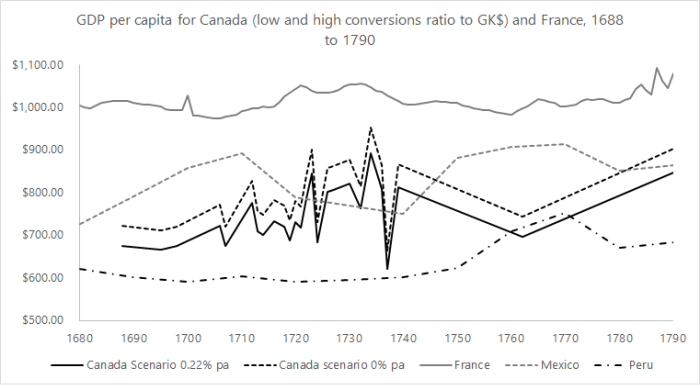
This is where Canada comes in. Today, the country easily fits in the “relatively rich” group. According to the figures 1 and 2 in the work of Acemoglu, Johnson and Robinson, it would have been in the “relatively poor” group well behind countries in Latin America. However, I recently finished compiling the Canadian GDP figures between 1688 and 1790 which I can now compare with those of Arroyo Abad and Van Zanden for Peru and Mexico. With my Canadian data (see the figure below), we can see that Canada was as poor as Latin America around 1680 (the start date of my data).

GelosoGDP.png

So, Canada was a relatively poor country back which was equally poor (or moderately richer) than Latin American countries. Why does that matter to the reversal of fortune story? Well, with the urbanization data, one shows that the non-urbanized of 1500 are the rich of the today. With the GDP data for the 1680s, we see that the more urbanized countries were also poorer than the less urbanized countries.

Now, my argument is limited by the fact that I am using 1680s GDP rather than 1500 GDP. But, one should simply extend the urbanization series to circa 1700 and the issue is resolved.  In any case, this should fuel the skepticism towards the strength of the reversal of fortune argument.

What makes robust political economy different?

17760989_10211701794931604_8034787751519057151_o

I encountered what would later become important elements of Mark Pennington’s book Robust Political Economy in two articles that he wrote on the limits of deliberative democracy, and the relative merits of market processes, for social and ethical discovery, as well as a short book Mark wrote with John Meadowcroft, Rescuing Social Capital from Social Democracy. This research program inspired me to start my doctorate and pursue an academic career.  Why did I find robust political economy so compelling? I think it is because it chimed with my experience of encountering the limits of neo-classical formal models that I recount in my chapter, ‘Why be robust?’, of a new book, Interdisciplinary Studies of the Market Order.

While doing my master’s degree in 2009, I took a methodology course in rational choice theory at Nuffield College’s Center for Experimental Social Science. As part of our first class we were taken to a brand new, gleaming behavioural economics laboratory to play a repeated prisoners’ dilemma game. The system randomly paired anonymous members of the class to play against each other. We were told the objective of the game was to maximise our individual scores.

Thinking that there were clear gains to make from co-operation and plenty of opportunities to punish a defector over the course of repeated interactions, I attempted to co-operate on the first round. My partner defected. I defected a couple of times subsequently to show I was not a sucker. Then I tried co-operating once more. My partner defected every single time in the repeated series.

At the end of the game, we were de-anonymised and it turned out, unsurprisingly, that I had the lowest score in the class. My partner had the second lowest. I asked her why she engaged in an evidently sub-optimal strategy. She explained: ‘I didn’t think we were playing to get the most points. I was just trying to beat you!’

The lesson I took away from this was not that formal models were wrong. Game theoretic models, like the prisoners’ dilemma, are compelling and productive analytical tools in social science, clarifying the core of many challenges to collective action. The prisoners’ dilemma illustrates how given certain situations, or rules of the game, self-interested agents will be stymied from reaching optimal or mutually beneficial outcomes. But this experience suggested something more complex and embedded was going on even in relatively simple social interactions.

The laboratory situation replicated the formal prisoners’ dilemma model as closely as possible with explicit rules, quantified ‘objective’ (though admittedly, in this case, low-value) payoffs, and a situation designed to isolate players as if they were prisoners in different cells. Yet even in these carefully controlled circumstances, it turns out that the situation is subject to multiple interpretations and understandings.

Whatever the textual explanation accompanying the game, the score on the screen could mean something different to the various players. The payoffs for the representative agents in the game were not the same as the payoffs in the minds of the human players. In a sense, my partner and I were unwittingly playing different games (although I lost within either rules of the game!).

When we engage with the social world, it is not only the case that our interests may not align with other people. Social interaction is open-ended. We do not know all the possible moves in the game, and we do not know much about the preference set of everyone else who is playing. Indeed, neither they nor we know what a ‘complete’ set of preferences and payoffs would look like, even of our own. We can map out a few options and likely outcomes through reflection and experience but even then we may face outcomes we do not anticipate. As Peter Boettke explains: ‘we strive not only to pursue our ends with a judicious selection of the means, but also to discover what ends that we hope to pursue.’

In addition, the rules of the game themselves are not merely exogenous impositions on us as agents. They are constituted inter-subjectively by the practices, beliefs and values of the actors that are also participants in the social game. As agents, we do not merely participate in the social world. We also engage in its creation through personal lifestyle experimentation, cultural innovation, and establishing shared rules and structures. The social world thus presents inherent uncertainty and change that cannot be captured in a formal model that assumes fixed rules of the game and the given knowledge of the players.

It is these two ideas, both borrowed from the Austrian notion of catallaxy, that makes robust political economy distinct. First, neither our individual ends, nor means of attaining them, are given prior to participation in a collective process of trial and error. Second, the rules that structure how we interact are themselves not given but subject to a spontaneous, evolutionary process of trial and error.

I try to set out these ideas in a recent symposium in Critical Review on Mark Pennington’s book, and in ‘Why be robust?’ in Interdisciplinary Studies of the Market Order edited by Peter Boettke, Chris Coyne and Virgil Storr. The symposium article is available on open access and there is a working paper version of my chapter is available at the Classical Liberal Institute website.

The End of the Past


On Branko Milanovic’s recommendation, I read Aldo Schiavone’s The End of the Past. Scholarly and elegantly written, it provides one of the best imaginative reconstructions of the ancient Roman economy.

Previous posts have touched on the economies of late antiquity, the modernist primitivist debate, and diagnosed problems in many recent assessments of the ancient economy (here, here, here, and here). I want to use Schiavone’s book to revisit a question raised by Peter Temin in The Roman Market Economy. How advanced was the Roman economy? Specifically, how did it compare to the economy of Europe in late medieval or early modern times? Was the Roman economy only as developed as that of Europe circa 1300 or was it as advanced as that of western Europe on the eve of the Industrial Revolution in say 1700.

This question is not mere idle speculation. It matters for our understanding of the causes of long-run economic growth whether an industrial revolution could have happened in Song China or ancient Rome. This type of counterfactual history is crucial for pinning down the casual mechanisms responsible for sustained growth, especially as historians like Bas van Bavel are now proposing explicitly cyclical accounts of growth in societies as varied as early medieval Iraq and the Dutch Republic (see The Invisible Hand? (OUP, 2016))

Temin’s GDP estimates suggest that Roman Italy had comparable per capita income to the Dutch Republic in 1600. The Empire as a whole, he suggests, may have been comparable to Europe in 1700 (Temin 2013, 261). My gut reaction is that this is plausible as an upper-bound. Schiavone (who was writing several years before Temin), however, raises important points that I had fully not considered previously.

Schiavone opens with an account of a speech given by Aelius Aristides celebrating the wealth of the Roman empire in the mid-2nd century AD.

“Whatever each culture grows and manufactures cannot fail to be here at all times and in great profusion. Here merchant vessels arrive carrying these many commodities from every region in every season and even at every equinox, so that the city takes on the appearance of a sort of common market for the world. One can see cargoes from India and even from southern Arabia in such numbers that one must conclude that the trees in those lands have been stripped bare, and if the inhabitants of those lands need anything, they must come here to beg for a share of what they have produced….

Your farmlands are Egypt, Sicily, and all of cultivated Africa. Seaborne arrivals and departures are ceaseless, to the point that the wonder is, not so much that the harbor has insufficient space for all these merchant vessels, but that the sea has enough space (if it really does). Just as there is a common channel where all waters of the Ocean have a single source and destination, so that there is a common channel to Rome and all meet here: trade, shipping, agriculture, metallurgy— all the arts and crafts that are or ever were and all things that are produced or spring from the earth. What one does not see here does not exist” (Aristides, The Roman Oration).

This is a panegyric addressed to flatter the emperor but its emphasis on long-distance trade, commerce, manufacturing is highly suggestive. Such a speech is all but impossible to imagine in an predominantly rural and autarkic society. Aristides is painting a picture of a highly developed commercialized economy that linked together the entire Mediterranean and beyond. Even if he is grossly exaggerates, the imagine he depicts must have been plausible to his audience. In evaluating the Roman economy in the age of Aristides, Schaivone notes that:

“Until at least mid-seventeenth century Amsterdam, so expertly described by Simon Schama — the city of Rembrandt, Spinoza, and the great sea-trade companies, the product of the Dutch miracle and the first real “globalization of the economy — or at least, until the Spanish empire of Philip II, the total wealth accumulated and produced in the various regions of Europe reached levels that were not too far from those of the ancient world” (Schiavone, 2000, 94).

This is the point Temin makes. Whether measured in terms of the size of its largest cities — Rome in 100 AD was larger than any European city in 1700 — or in the volume of grain, wine, and olive oil imported into Italy, the scale of the Roman economy was vast by any premodern standard. Quantitatively, then, the Roman economy looks as large and prosperous as that the early modern European economy.

Qualitatively, however, there are important differences that Schiavone draws out and which have been obscured in recent quantitative debates about GDP estimates.

Observe that Roman history leaves no traces of great mercantile companies like the Bardi, the Peruzzi or the Medici. There are no records of commercial manuals of the sort that are abundant from Renaissance Italy; no evidence of “class-struggle” as we have from late medieval Europe; and no political economy or “economics”, that is, no attempts to systematize one’s thoughts and insights concerning the commercial world. The ancient world, in this view, only superficially resembled that of early modern Europe. Seen from this perspective, the latter contained the potential for sustained growth; the former did not. Why is this?


The most obvious institutional difference between the ancient world and the modern was slavery. Recently historians have tried to elevate slavery and labor coercion as crucial causal mechanism in explaining the industrial revolution. These attempts are unconvincing (see this post) but slavery certainly did dominate the ancient economy.

In its attempt to draw together the various strands through which slavery permeated the ancient economy, Schiavone’s chapter “Slaves, Nature, Machines” is a tour de force. At once he captures the ubiquity of slavery in the ancient economy, its unremitting brutality—for instance, private firms that specialized in branding, retrieving, and punishing runaway slaves — and, at the same time, touches the central economic questions raised by ancient slavery: to what extent was slavery crucial to the economic expansion of period between 200 BCE and 150 AD? And did the prevalence of slavery impede innovation?

It is impossible to do justice to the argument in a single post. Suffice to say that after much discussion, and many fascinating interludes, Schiavone suggests that ultimately the economic stagnation of the ancient world was due to a peculiar equilibrium that centered around slavery.

One can think of this equilibrium as resting on a two legs. The first is the observation that the apparent modernity of the ancient economy — its manufacturing, trade, and commerce rested largely on slave labor. The expansion of trade and commerce in the Mediterranean after 200 BC both rested on, and drove, the expansion of slavery. Here Schiavone note that the ancient reliance on slaves as human automatons — machines with souls — removed or at least weakened, the incentive to develop machines for productive purposes.

The existence of slavery, however, was not the only reason for the neglect of productive innovation. There was also a specific cultural attitude that formed the second leg of the equilibrium:

“None of the great engineers and architects, none of the incomparable builders of bridges, roads, and aqueducts, none of the experts in the employment of the apparatus of war, and none of their customers, either in the public administration or in the large landowning families, understood that the most advantageous arena for the use and improvement of machines — devices that were either already in use or easily created by association, or that could be designed to meet existing needs — would have been farms and workshops”

The relevance of slavery colored ancient attitudes towards almost all forms of manual work or craftsmanship. The dominant cultural meme was as follows: since such work was usually done by the unfree, it must be lowly, dirty and demeaning:

“technology, cooperative production, the various kinds of manual labor that were different from the solitary exertion of the peasants on his land — could not but end up socially and intellectually abandoned to the lowliest members of the community, in direct contact with the exploitation of the slaves, for whom the necessity and demand increased out of all proportion . . . the labor of slaves was in symmetry with and concealed behind (so to speak) the freedom of the aristocratic thought, while this in turn was in symmetry with the flight from a mechanical and quantitative vision of nature”

Thus this attitude also manifest itself in the disdain the ancients had for practical mechanics:

Similar condescension was shown to small businessmen and to most trade (only truly largely-scale trade was free from this taint). The ancient world does not seem to have produced self-reproducing mercantile elites. Plausible this was in part because of the cultural dominance of the landowning aristocracy.

The phenomenon coined by Fernand Braudel, the “Betrayal of the Bourgeois,” was particularly powerful in ancient Rome. Great merchants flourished, but “in order to be truly valued, they eventually had to become rentiers, as Cicero affirmed without hesitation: ‘Nay, it even seems to deserve the highest respect, if those who are engaged in it [trade], satiated, or rather , I should say, satisfied with the fortunes they have made, make their way from port to a country estate, as they have often made it from the sea into port. But of all the occupations by which gain is secured, none is better than agriculture, none more delightful, none more becoming to a freeman’” (Schiavone, 2000, 103).

Such a cultural argument fits perfectly with Deirdre McCloskey’s claim in her recent trilogy that it was the adoption of bourgeois cultural norms and specifically bourgeois rhetoric that distinguished and caused the rise of north-western Europe after 1650 (here, here, and here).


Having taken note of the existence of such a powerful equilibrium — one resting on both material and cultural foundations, we can now return to Schiavone’s argument for why a modern capitalist economy did not develop in antiquity. He argues that given the prominence of slavery and the prestige of the landowning elite, economic expansion and growth of the kind that took place between c. 200 BCE to 150 CE was not self-reinforcing. It generated a growth efflorescence that lasted several centuries, but it ultimately undermined itself because it was based on an intensification of the slave economy that, in turn, reinforced the cultural supremacy of the landowning aristocracy and this cultural supremacy in turn eroded the incentives responsible for driving growth.

Compare and contrast with early modern Europe. The most advanced economies of early modern Europe, say England in 1700, were on the surface not too dissimilar to that of ancient Rome. But beneath the surface they contained the “coiled spring”, or at least the possibility, of sustained economic growth — growth driven by the emergence of innovation (a culture of improvement) and a commercial or even capitalist culture. According to Schiavone’s assessment, the Roman economy at least by 100 CE contained no such coiled spring.

We are not yet at the point when we can decisively assess this argument. But the importance of culture and the manner in which cultural and material factors interacted is clearly crucial. The argument that the slave economy and the easy assumptions of aristocratic superiority reinforced one another is a powerful one. For whatever historical reasons these cultural elements in the Roman economy were relatively undisturbed by the rise of merchants, traders and money grubbing equites. Likewise slavery did not undermine itself and give rise to wage labor.

Why this was the case can be left to future analysis. The full answer to the question why this was the case and a more careful consideration of the counterfactual “could it have been otherwise” are topics deserving their own blog post.

Did Inequality Fall During the Great Depression ?

Inequality

The graph above is taken from Piketty and Saez in their seminal 2003 article in the Quarterly Journal of Economics. It shows that inequality fell during the Great Depression. This is a contention that I have always been very skeptical of for many reasons and which has been – since 2012 – the reason why I view the IRS-data derived measure of inequality through a very skeptical lens (disclaimer: I think that it gives us an idea of inequality but I am not sure how accurate it is).

Here is why.

During the Great Depression, unemployment was never below 15% (see Romer here for a comparison prior to 1930 and this image derived from Timothy Hatton’s work). In some years, it was close to 25%. When such a large share of the population is earning near zero in terms of income, it is hard to imagine that inequality did not increase. Secondly, real wages were up during the Depression. Workers who still had a job were not worse off, they were better off. This means that you had a large share of the population who saw income reductions close to 100% and the remaining share saw actual increases in real wages. This would push up inequality no questions asked. This could be offset by a fall in the incomes from profits of the top income shares, but you would need a pretty big drop (which is what Piketty and Saez argue for).

There is some research that have tried to focus only on the Great Depression. The first was one rarely cited NBER paper by Horst Mendershausen from 1946 who found modest increases in inequality from 1929 to 1933. The data was largely centered on urban data, but this flaw works in favor of my skepticism as farm incomes (i.e. rural incomes) fell more during the depression than average incomes. There is also evidence, more recent, regarding other countries during the Great Depression. For example, Hungary saw an increase in inequality during the era from 1928 to 1941 with most of the increase in the early 1930s. A similar development was observed in Canada as well (slight increase based on the Veall dataset).

Had Piketty and Saez showed an increase in inequality during the Depression, I would have been more willing to accept their series with fewer questions and doubts. However, they do not discuss these points in great details and as such, we should be skeptical.

The Antebellum Puzzle, Anthropometric History and Quebec

I recently gave an interview on Economics Detective Radio with Garrett Petersen to talk about my forthcoming article in Economics & Human Biology (with Vadim Kufenko and Alex Arsenault Morin). In the interview, I explain why anthropometric history is important to our understanding of living standards, their evolution and short-term trade-offs in economic history. The interview is below, but you should subscribe to Garrett’s podcast as he is well on his way to becoming a serious competitor to EconTalk with the bonus that he does lots of economic history.

Podcast link (download).

Can Median Voter Theorem explain political polarization?

When I began dipping my toes into game theory and rational choice theory, like many others, I learned about the Median Voter Theorem (MVT). This theory is essentially the Hotelling’s Law of voting, in which two competing politicians, on any given issue, will adopt views similar to the median on a spectrum of views of that issue, in order to maximize the number of votes they receive. Any movement toward either extreme, so the theory goes, would allow the opponent to gain the votes of centrists by moving in the same direction, but not as far, effectively gaining all voters on the other extreme AND the centrists. According to MVT, the most successful politicians should, if rational choice theory can be said to apply to elections, represent (if not hold) the views closest to those of the median voter, who should be relatively “centrist” even if extremist voters outnumber centrists.

This is, rather dramatically, not the case. History and current events offer a plethora of examples: a brief look at the makeup of the US government implies that centrist voices (and especially centrist voters) are outnumbered and drowned out. If MVT has any effect at all, why is increasing political polarization such a hot topic?

What are the possible explanations for this? Is MVT fundamentally wrong in its core idea, and is voting in fact not possible to model in rational choice theory? I do not think so, so here are several ideas, some old and one novel, about why the application of MVT does not lead to centrist politicians winning most elections in practice:

  • Voter preferences are polarized. If voter opinions are not only not normally distributed, but are in fact gathered at two poles with no centrist voters, MVT may actually function, but it would predict that centrists would lose a lot (because the median voter would be at one pole or the other). The idea that voters resemble a barbell graph more than a normal distribution may be very salient, because many issues are dominated by extreme views. However, the voting population is demonstrably more centrist on some issues, so this cannot fully explain the difference between reality and MVT.
  • Third parties spoil things. This hearkens back not only to Arrow’s Impossibility Theorem, but also to the influence of Ross Perot and Ralph Nader on presidential elections. Third party participation does not spoil MVT, because it still fundamentally follows the idea of rational choice theory about elections, but it complicates two-candidate models.
    • Further note: multi-party systems are vulnerable to extremists. The possibility of invasion by extreme views is higher in multi-party systems, because if multiple centrist parties compete for median voters, extreme groups gain power disproportionate to their constituency.
  • Primaries spoil things. This is an old idea in US politics: in primaries, you have to run to the extremes, and then in the general election, run to the center. The very logic behind this idea, and any empirical evidence of it, proves the viability of MVT, but it does introduce complications to any model of it that fails to account for the two different elections many politicians must win. Also, we must remember to factor in the fact that politicians have a negative utility in abandoning past positions (especially recent decisions) of seeming inauthentic or losing their base.
  • The Electoral College spoils things. Outside of US presidential elections, “swing states” may not have the same power, but in the US, candidates would be “rational” to pursue votes in swing states much more assiduously than they do in states that are nearly sure bets. This is only narrowly applicable, but the campaign focus on swing states indicates that candidates do at least campaign rationally (see academic studies or news reports), in that they seek votes strategically and not indiscriminately.
  • Voter turnout skews MVT. In elections without mandatory voting, those who are less committed to the issues at stake—who are more likely to be centrists—tend to vote less than those who care greatly one way or another. Therefore, voting may be more about mobilizing one’s base than appealing to centrists. (Note: this is not an endorsement of mandatory voting, which can allow more zero-sum games in politics and the enforcement of which seems worse than the problem).
  • People do not vote based on rational weighing of stances. This would be a troubling conclusion, and suggests that people may align with parties and candidates based on motives other than matching candidate views to their own. While this is certainly true to some extent, MVT can still predict the overall “centrism” of politicians. Also, just because many people have an irrational method of weighing stances does not mean that the aggregate result does not mean that the utility of favoring centrist positions would not be positive.
  • Voting is multidimensional. Since single candidates represent dozens if not hundreds of salient issues in a single election, voters are forced to compromise on some issues in order to win others. This multidimensionality is not a counterargument to MVT, but an extreme complication, because “median” politicians could lose based on voter preference not within an issue, but between issues. That is, a politician can gain voters by recognizing weighting each voter’s stance by how likely that issue is to change their vote. This can be observed in the fact that referenda tend to follow MVT in a more straightforward fashion than elections. It is also a possible explanation for the rise of certain coalitions: no matter if constituents have deep disagreements on many issues, they end up aligned behind the same candidate based on inter-issue preferences. This may have been a major motivation for federalization and separation of power: different decisions are constrained to certain elections, allowing voters to communicate on each individual issue more clearly because of the reduced multidimensionality. The game theory on multidimensional voting is well developed, but still has some complications that have not been specifically argued:
    • Complication: Special interest compared to general interest. Multidimensional voting allows politicians to promise concentrated special interest to voters on certain issues in order to gain votes rather than appeal to general interest across many issues. The implications of this have been shown in game form, especially in special interest influence on enforcement. In this, public choice theory proves the idea that governments tend to favor dispersed costs and concentrated gains.
    • Complication: Singe issue voters. This is a subset of the above, or at least related to it. In multidimensional elections, voters obviously have to weigh issue preferencing. However, if a voter decides that they would choose a candidate so long as he agrees with the voter on a single issue, then on that issue, the single-issue voter has a hugely disproportionate influence on the candidate’s opinion on that issue. The reason: if the candidate runs to the center on that single issue, he risks his opponent capturing the vote of all single-issue voters on that side by running slightly more to the extreme. The Nash Equilibrium of such a situation would depend on how many single-issue voters there are at either extreme (I assume here that single-issue voters are not centrists, based on examples shown below, but I am open to argument) and how much of the non-single-issue constituency is ceded by focusing on single-issue voters, but it is distinctly possible that issue preferencing, especially the power of the ultimatum implied in single-issue voting, makes it rational for politicians to run to the extremes. Interesting examples of this phenomenon include background checks for guns, defense spending, and possibly marijuana legalization. (Please note that this does not constitute an endorsement of these ideas—whether the majority is correct is a different question from whether the majority idea is enacted by politicians).
      • The single-issue voter idea continues to fascinate me. Most of all, it fascinates me how little (apart from some basic preferencing models in the literature) I can find that either theorizes or empirically examines the specific influence of single-issue voters and voter preferencing. I hope it is out there, and I just can’t find it (so send it to me if you have found one!). But if not, is anyone out there a public choice theorist who wants to help me figure this out?

Thanks for sticking with a long read, and please give me feedback if you have any examples of this phenomenon or another angle on MVT!

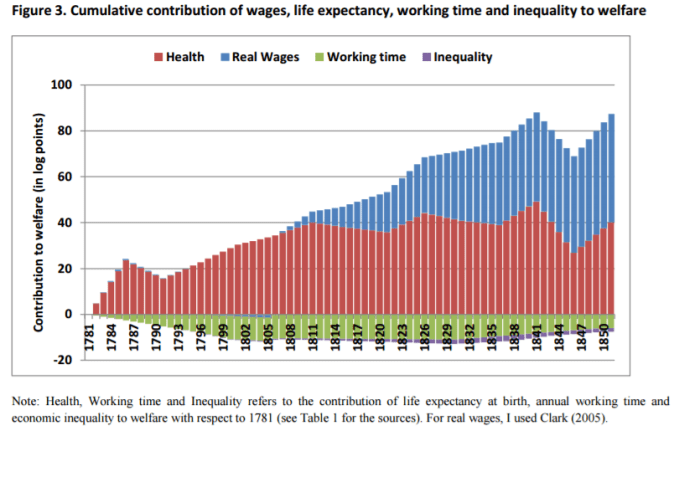
Aggregate measures of well-being, England 1781-1850

I went in the field of economic history after I discovered how much it was to properly measure living standards. The issue that always interested me was how to “capture” the multidimensional nature of living standards. After all, what weight should we give to an extra year of life relative to the quality of that extra year (see all my stuff on Cuba)?

However, I never tried to create “a composite” measure of living standards. I thought that it was necessary, first, to get the measurements right. However, I had been aware of the work of Leandro Prados de la Escosura who has been doing considerable work on this in order to create composite measures (Leandro also influenced me on my Cuba reasoning – see this article).

A year ago, I discovered the work of Daniel Gallardo Albarrán from the University of Groningen at the meeting of the Economic History Society (EHS). Daniel’s work is particularly interesting because he is trying to generate a composite measure of well-being at one of the most important moment in history: the start of the British industrial revolution.

Because of its importance and some pieces of contradicting evidence (inequality, stature, amplitude of real wage increases, amplitude of income increases, urban pollution leading to increased mortality risks etc), the period has been begging for some form of composite measure to come along (at least a serious attempt at generating it). Drawing on some pretty straightforward microeconomic theory (the Beckerian in me likes this), Daniel generates this rich graph (see the paper here).

Daniel

The idea is very neat and I hope it will inspire some economic historians to attempt an expansion upon Daniel’s work. I have already drawn outlines for my own stuff on Canada since I study an era when (from the early 1800s to the mid-1850s) real wages and incomes seem to be going up but stature and mortality are either deteriorating or remaining stable while inequality is clearly increasing.

Star Trek Did More For the Cultural Advancement of Women Than Government Policies

The fondest memories of my childhood center on the time I spent with my father watching Star Trek. At the time, I simply enjoyed science fiction. However, as an adult I have often revisited Star Trek (on multiple occasions) and I realized that I had incorporated subconsciously many elements of the show into my own political reasoning.

Not to give too much away about my age, my passion with Star Trek started largely with the Voyager installments. As a result, I ended up seeing Kate Mulgrew as Captain Janeway. And that’s what she was: the captain. I never saw the relevance that she was a woman. A few years ago, I saw her speak at the Montreal Comic-Con (yes, I am that kind of Trekkie) and she mentioned how crucial she thought her role to be for the advancement of women. By that time, I had already started to consider Star Trek as one of the most libertarian-friendly shows ever to have existed. While its economics were strange, its emphasis on tolerance, non-intervention and equality of rights make it hard to argue that it is not favorable to broadly-defined liberal mindset. However, I had not realized how much so until I heard Mulgrew speak about her vision of the role. After all, I had somehow forgotten that Mulgrew was a woman and how novel her role was.

One person who understands how important was this point is Shannon Mizzi who wrote a piece for Wilson Quarterly which I ended up reading while I was still a PhD student. Her core point was that in Star Trek, women were simply professionals. They were rarely seen doing other things than their work. While she argues that this meant that Star Trek played an underappreciated role in the history of women’s advancement, I am willing to go a step further. That step is to assert that the cause of the cultural advancement of women has been better served by Star Trek than by governments. (Please note that I am only considering cultural advancement)

The pre-1900 economic and social history of women would be sufficient in itself to make this point of mine. After all, women were given a lesser legal status by governments. This is both a necessary and sufficient element to assert that, overall, governments have been noxious to women’s advancement over many centuries. One century of legal emancipation would still leave Star Trek as a net positive force. But that would be a lazy argument on my part and I should simply focus on the present day. In fact, thanks to a wealth of data on wage gaps, gender norms and measures of legal institutions, I can more easily back up the claim.

My friend Rosemarie Fike of Texas Christian University is the first person that comes to mind in that regard. Her own doctoral dissertation, Economic Freedom and the Lives of Womenintroduced me to a wide literature on the role of economic freedom in the advancement of women. To be sure, Rosemarie was not the first to try to measure the role of economic freedom (which we should understand as how small and non-interventionist a government is). There had already been some research showing that higher levels of economic freedom were associated with smaller hourly wage gaps between genders and how liberalizing reforms were associated with wage convergence between genders. However, some economists have been arguing that there are other “soft sides” to economic freedom – like in the promotion of cultural equality and norms that promote certain types of attitudes. This is where Rosemarie’s work is most crucial. In a section of her dissertation, she essentially builds up on the work of (my favorite Nobel laureate) Gary Becker regarding preferences and discrimination. Basically, the idea is that free markets will penalize people who willingly discriminate. After all, if an employer refuses to hire redheads for some strange reason, I can compete by hiring the shunned redheads at a lower wage rate and out-compete him. In order to stay in business, the ginger-hating fool has to change his behavior and hire redheads which will push wages up. Its hard to be a racist or misogynist when it costs you a lot of money.

However, if you prevent this mechanism from operating (by intervening in markets), you are making it easier to be bigoted-chauvinistic-male-pigs. As a result, laws that prevent market operations (like the Jim Crow laws did for blacks) enshrine discriminatory practices. Individuals growing up in such environment may accept this as normal and acceptable behavior and strange beliefs about gender equality may cement themselves in the popular imagination. When markets are allowed to operate, beliefs will morph to reflect the actions taken by individuals (see Jennifer Roback’s great story of tramways in the US South as an example of how strong markets can be in changing behavior and see her article on how racism is basically rent-seeking). As a result, Rosemarie’s point is that societies with high levels of economic freedom will be associated with beliefs favorable to gender equality.

But the mirror of that argument is that government policies, even if their spirits have no relation to gender issues, may protect illiberal beliefs. Case in point, women are more responsive to tax rates than men – much more. In short, if you reduce taxes, women will adjust their labor supply more importantly at the extensive and intensive margin than men will. This little, commonly accepted, fact in labor economics is pregnant with implications. Basically, it means that women will work less in high tax environments and will acquire less experience than men will. Since it is also known that differences in the unmeasured effects of experience weigh heavily in explaining the remaining portion of the gender pay gap, this means that high tax rates contribute indirectly to maintaining the small gender pay gap that remains. Now, imagine what would be the beliefs of employers towards women if they did not believe that women are more likely to work fewer hours or drop out of the workforce for some time? Would you honestly believe that they would be the same? When Claudia Goldin argues that changes in labor market structures could help close the gap, can you honestly say that the uneven effect of high tax rates on the labor supply decisions of the different genders are not having an effect in delaying experimentation with new structures? This only one example meant to show that governments may, even when it is not their intent, delay changes that would be favorable to gender equality. There are mountains of other examples going the larger effects of the minimum wage on female employment to the effects of occupational licencing falling heavily on professions where women are predominant.

With such a viewpoint in mind, it is hard to say how much governments helped the cultural advancement of women (on net) over the 20th and 21st centuries . However, Star Trek clearly had a positive net effect on that cultural advancement.  That is why I am willing to say it here: Star Trek did more for the cultural advancement of women than governments did.

Why do we teach girls that it’s cute to be scared?

I just came across this fantastic op-ed while listening to the author being interviewed.

The author points out that our culture teaches girls to be afraid. Girls are warned to be careful at the playground while boys are expected… to be boys. Over time we’re left with a huge plurality of our population hobbled.

It’s clear that this is a costly feature of our culture. So why do we teach girls to be scared? Is there an alternative? This cultural meme may have made sense long ago, but society wouldn’t collapse if it were to disappear.

Culture is a way of passing knowledge from generation to generation. It’s not as precise as science (another way of passing on knowledge), but it’s indispensable. Over time a cultural repertoire changes and develops in response to the conditions of the people in that group. Routines, including attitudes, that help the group succeed and that are incentive-compatible with those people will persist. When groups are competing for resources, these routines may turn out to be very important.

It’s plausible that in early societies tribes had to worry about neighboring tribes stealing their women. For the tribe to persist, there needs to be enough people, and there needs to be fertile women and men. The narrower window for women’s productivity mean that men are more replaceable in such a setting. So tribes that are protective of women (and particularly young women and girls) would have an cultural-evolutionary advantage. Maybe Brandon can tell us something about the archaeological record to shed some light on this particular hypothesis.

But culture will be slower to get rid of wasteful routines, once they catch on. For this story to work, people can’t be on the razor’s edge of survival; they have to be wealthy enough that they can afford to waste small amounts of resources on the off-chance that it actually helped. Without the ability to run randomized control trials (with many permutations of the variables at hand) we can never be truly sure which routines are productive and which aren’t. The best we can do is to try bundles of them all together and try to figure out which ones are especially good or bad.

So culture, an inherently persistent thing, will pick up all sorts of good and bad habits, but it will gradually plod on, adapting to an ever-changing, ever evolving ecosystem of competing and cooperating cultures.

So should we still teach our girls to be scared? I’d argue no.* Economics tells us that being awesome is great, but in a free society** it’s also great when other people are awesome. Those awesome people cure diseases and make art. They give you life and make life worth living.

Bringing women and minorities into the workplace has been a boon for productivity and therefore wealth (not without problems, but that’s how it goes). Empowering women in particular, will be a boon for the frontiers of economic, scientific, technical, and cultural evolution to the extent women are able to share new view points and different ways of thinking.

And therein lies the rub… treating girls like boys empowers them, but also changes them. So how do we navigate this tension? The only tool the universe has given us to explore a range of possibilities we cannot comprehend in its entirety: trial and error.

We can’t run controlled experiments, so we need to run uncontrolled experiments. And we need to try many things quickly. How quickly depends on a lot of things and few trials will be done “right.” But with a broader context of freedom and a culture of inquiry, our knowledge can grow while our culture is enriched. I think it’s worth making the bet that brave women will make that reality better.


* But also, besides what I think, if I told parents how to act… if I made all of them follow my sensible advice, I’d be denying diversity of thought to future generations. That diversity is an essential ingredient, both because it allows greater differences in comparative advantage, but also because it allows more novel combinations of ideas for greater potential innovation in the future.

** And here’s the real big question: “What does it mean for a society to be free?” In the case of culture it’s pretty easy to say we want free speech, but it runs up against boundaries when you start exploring the issue. And with billions of people and hundreds (hopefully thousands) of years we’re looking at a thousand-monkey’s scenario on steroids… and that pill from Flowers for Algernon.

There’s copyright which makes it harder to stand on the shoulders of giants, but might be justified if it helps make free speech an economically sustainable reality. There’s the issue of yelling “Fire!” in a crowded theater, and the question of how far that restriction can be stretched before political dissent is being restricted. We might not know where the line should be drawn, but given enough time we know that someone will cross it.

And the issue goes into due process and business regulation, and any area of governance at all. We can’t be free to harm others, but some harms are weird and counter-intuitive. If businesses can’t harm one another through competition then our economy would have a hard time growing at all. Efficiency would grow only slowly tying up resources and preventing innovation. Just as there’s an inherent tension in the idea of freedom between permissiveness and protection, there’s a similar tension in the interdependence of cooperation and competition for any but the very smallest groups.

Famine and Finance: Credit and the Great Famine of Ireland

41YjUSWp3JL._SX351_BO1,204,203,200_I have recently finished reading Famine and Finance by Tyler Beck Goodspeed. While short, it should have a prominent place on the shelves of economic historians interested (obviously) in Irish history and (less obviously) in Malthusian theory.

Famine and Finance is a study of the response of Irish farmers to the potato blight. As it is known to many, many individuals simply left Ireland. However, where micro-credit was available, Goodspeed finds that farmers adapted by shifting to different types of activities – notably livestock. These areas experienced a smaller decline in population. Basically, where the institution of micro-credit was present, the demographic shock was much less severe. If only for this nuance, the book makes a sizeable contribution to the historiography of Ireland. The methods used are also elegantly simple and provide an interesting road map for anyone interested in studying the responses of local population to environmental shocks.

However, the deeper point comes from it tells us about institutions. In Goodspeed’s story, the amplitude of the collapse of the Irish population in the 19th century depends on the presence of the institution of micro-credit. Basically, the institution determined the amplitude of the shock. Since Ireland’s potato blight is often presented as the textbook case of Malthusian pressures, Goodspeed’s results are particularly interesting. In his chatper titled”Was Malthus Right?”, he shows that when controls for the institution of micro-credit is present, the typical Malthusian variables fail to explain population changes. In other words (i.e.  my words) , Malthusian pressures (the change in population) are in fact institutional failures.

This is a point I have often made elsewhere (see here, here and here and a blog post here). And because Goodspeed backs this point of mine, he has earned himself a place on my shelf of “go-to” books.

The Heights of French-Canadian Convicts, 1780 to 1830

A few days ago, it was confirmed that my article with Vadim Kufenko and Alex Arsenault Morin on the heights of French-Canadians between 1780 and 1830 was accepted for publication in Economics and Human Biology. In that paper, we try to introduce French-Canadians before 1850 to the anthropometric history literature by using the records of the prison of Quebec City. Stature is an important measure of living standards. As it is heavily related to other aspects of health outcomes, it is a strong measure of biological living standards. More importantly, there are moments in history when material living standards and biological living standards move in opposite directions (in the long-run, this is not the case).

We find three key results. The first is that the French-Canadians grew shorter throughout the era when living standards did not increase importantly (and were very volatile). This puts them at odds from other places in North America where increases in stature were experienced up until the 1820s. Furthermore, stature stops falling around 1820 when economic growth picked up. This places the French-Canadians in a unique category in North America since it seems unlikely that they experienced a strong version of the antebellum puzzle (decline in stature with increases in material living standards which is what the US experienced). The second key result is that the French-Canadians are the shortest in North America, shorter even than Black Americans in slavery. However, they are considerably taller than most (save Argentinians) Latin Americans. More importantly, they are considerably taller than their counterparts in France. The third key result is related to the second key result. Today, French-Canadians are noticeably shorter than other Canadians. However, the gap was more important in the late 19th century and early 20th century. Pegged as a “striking exception” within Canada, we do not know when it actually started. Thanks to our work, we know that this was true as far back at the early 19th century.

The working paper (dramatically different than the accepted version) is here and I am posting key results in tables and figures below.  Moreover, I will be talking about anthropometric history and economic history with Garrett Petersen of Economics Detective Radio this Tuesday (I do not know when the podcast will be made available, but you should subscribe to that show anyways).

Heights.png

Table3.png