Tocqueville on the Russians

There was a winter storm that blew through Austin last night. The entire city, which isn’t big population-wise (1.5 million give or take) but large geographically, shut down and I have the day off. So, I am working hard on my weekly column for RealClearHistory, and came across this sociological gem of Alexis de Tocqueville, who wrote the best book on America, ever:

The American struggles against the natural obstacles which oppose him; the adversaries of the Russian are men; the former combats the wilderness and savage life; the latter, civilization with all its weapons and its arts: the conquests of the one are therefore gained by the ploughshare; those of the other by the sword. The Anglo-American relies upon personal interest to accomplish his ends, and gives free scope to the unguided exertions and common-sense of the citizens; the Russian centres all the authority of society in a single arm: the principal instrument of the former is freedom; of the latter servitude.

Keep in mind that Tocqueville’s book was published in 1835. During the Cold War, this passage, which is the last paragraph in Volume 1 of Tocqueville’s 2-volume treatise, this passage was almost a necessary introduction to anything related to Soviet-American interactions.

Now, I fear, my generation must also heed Tocqueville’s prophecy about Russian and American society. Trump is a loudmouthed demagogue, but he is restrained by the people, most of all his base, which, for all its many faults, is democratic in its mores. Free-thinking Russians left Russia en masse while they could, after the collapse of the Soviet Union, for the West and their children and their children’s children will grow up free. The Russian people will continue to serve a despotism they think they need to survive. There is a conspiratorial, somber, and pessimistic tone in the voice of most Russian authors, even those who have managed to make a life for themselves in the West, and I get it.

When I think of Russia, with all its beautiful biodiversity, its people, and its potential, I brood.

What is the best book about Argentina?

A couple of days ago, Tyler Cowen asked which is “the best book about each country:”

To count, the book must have some aspirations to be a general survey of what the country is or to cover much of the history of the country.   So your favorite book on the French Revolution is not eligible, for instance…

He explicitly skips South America. I can’t blame him, as I’ve never found a book that fully captures (the interrelationship between) the five things that make Argentina Argentina:

1. The fight between Buenos Aires and the Interior for fiscal resources. This was the main cause behind the civil wars of the XIXth century, and the eventual solution — the creation of a federal state that could check the power of Buenos Aires, and where the provinces of the interior would be politically over-represented — continues to be a defining feature of the country’s political economy to this day.

2. The division between “unitarios” and “federales,” which also began in the XIXth century. Although this cleavage was ostensibly about how to organize the country territorially, we should not forget that “politics is not about policy:” the actual division was about the relative status of different social groups. Specifically, he federales fell in the “Trumpian” side of the spectrum, praising the common, unsophisticated man “from here” as opposed to the high-brow cosmopolitanism promoted by the unitarios. Again, this division did not end in the XIXth century; Argentina’s political history during the XXth and beyond — and most notably the phenomenon Peronism — simply cannot be understood without making reference to this opposition.

3. The great immigration. Between the end of the XIXth and the beginning of the XXth century, Argentina embarked in a great social experiment that sought to transform the country by importing huge numbers of European immigrants. During this period, Argentina was the country that most immigrants received as proportion of its population, being second only to the US in the absolute number of immigrants it received. The assimilation of such immigrants was mostly successful, but also had profound consequences in terms of demographics, language, culture, cuisine and surnames (where do you think mine comes from?), as well as the way Argentineans perceive themselves: as a middle-class country of immigrants in which hard work allows you to get ahead in life.

4. Nationalism. One of the unintended consequences of the great immigration was the (government-sponsored) construction of a new national identity, defined in terms of territory rather than blood, race, or national history. This is the origin of Argentines’ sickly relationship with national boundaries, most patently seen in relation to the Malvinas/Falklands issue.

5. Pretorian politics. Between 1930 and 1983, Argentina was governed by no less than five different military regimes (in 1930, 1943, 1958, 1966 and 1976, respectively). The last of them (1976-1983) was especially murderous, as the military  systematically “disappeared” thousands of guerrilla members, political activists, union leaders and Left-wing sympathizers in a vain attempt to engineer a new political system. It is impossible to make sense of the political, social and cultural attitudes that have predominated in the country since 1983 without understanding this past.

Unfortunately, no book comes even close to capturing all these factors simultaneously. That said, the ones that best approach this ideal are the following:

1. Juan José Sebreli, Crítica de las Ideas Políticas Argentinas [A Criticism of Political Ideas in Argentina]. As far as I’ve seen, it’s only available in Spanish, however.

2. Larry Sawers, The Other Argentina. The Interior and National Development. As far as I know, it hasn’t been translated; please tell me I’m wrong.

3. Nicolas Shumway, The Invention of Argentina. There is also a Spanish edition.

PS. If you’re going for some XIXth-century work, don’t get swayed by the beguiling prose of Sarmientos’s Facundo; it’s too dominated by mood affiliation. Juan Bautista Alberdi’s Bases y Puntos de Partida para la Organización Política de la República Argentina [Bases and Starting Points for the Political Organization of the Argentine Republic] is a far better choice.

*The Islamic Enlightenment* | A critical review

De Bellaigue, Christopher. (2017) The Islamic Enlightenment: The Struggle Between Faith and Reason 1798 to Modern Times. Liveright Publishing Corporation (Norton & Company) New York, London.

In 1798, in view of the Pyramids, a French expeditionary force defeated the strange caste of slave-soldiers, the Mamlukes, who had been ruling Egypt for several centuries. The Mamlukes charged the French infantry squares on horseback, ending their charge with the throwing of javelins. The Mamlukes were thus eliminated from history. The French lost 29 soldiers. In the conventional narrative, the battle woke up the whole Muslim world from its long and haughty slumber. The defeat, the pro-active reforms of Napoleon’s short-lived occupancy, and the direct influence of the French scholars he had brought with him lit the wick of the candle of reform or, possibly, of enlightenment throughout the Islamic world.

De Bellaigue picks up this conventional narrative and follows it to the beginning of the 20th century with a dazzling richness of details. This is an imperfect yet welcome thick book on a subject seldom well covered.

This book has, first, the merit of existing. Many people of culture, well-read people with an interest in Islam – Islam the sociological phenomenon, rather than the religion – know little of the travails of its attempted modernization. Moreover, under current conditions of political correctness the very subject smells a little of sulfur: What if we looked at Muslim societies more closely and we found in them some sort of intrinsic inferiority? I mean by this, an inferiority that could not easily be blamed on the interference of Western, Christian or formerly Christian, capitalist societies. Of course, such a finding could only be subjective but still, many would not like it, and not only Muslims.

Second, and mostly unintentionally, possibly inadvertently, the book casts a light, an indirect light to be sure, on Islamist (fundamentalist) terrorism. It’s simple: Enlightened individuals of any religious background are not likely to be also fanatics willing to massacre perfect strangers. Incidentally, I examine this issue myself in a fairly parochial vein, in an essay in the libertarian publication Liberty Unbound: “Religious Bric-à-Brac and Tolerance of Violent Jihad” (January 2015). With his broader perspective, with his depth of knowledge, De Bellaigue could have done a much better job of this than I could ever do. Unfortunately he ignored the subject almost entirely. It wasn’t his topic, some will say. It was not his period of history. Maybe.

Continue reading

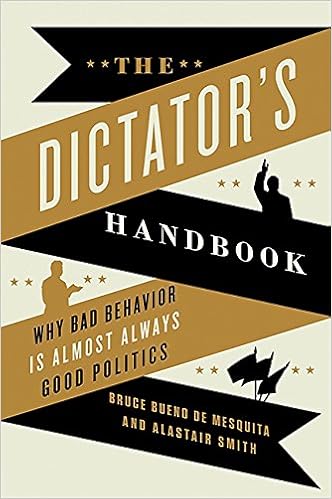
The Dictator’s Handbook

I recently pointed you towards a book that has turned out to be a compelling and interesting read.

At the end of the day, it’s a straightforward application of public choice theory and evolutionary thinking to questions of power. Easy to understand theory is bundled with data and anecdotes* to elucidate the incentives facing dictators, democrats, executives, and public administrators. The differences between them are not discrete: they all face the same basic problem of compelling others’ behavior while facing some threat of replacement.

Nobody rules alone, so staying in power means keeping the right people happy and/or afraid. All leaders are constrained by their underlings. These underlings are necessary to get anything done, but they’re also potential rivals. For Bueno de Mesquita and Smith the crucial facts of a political order are a) how big a coalition (how many underlings) the ruler is beholden too and b) how replaceable the members of that coalition are.

The difference between liberal and illiberal orders boil down to differences in those two parameters. In democracies with a larger coalition and less replaceable coalition members, rulers behave better.


I got a Calculus of Consent flavor from Dictator’s Handbook. At the end of the day, collective decision making will reflect some version of “the will of the people… who matter.” But when we ask about the number of people who matter, we run into C of C thinking. Calling for bigger coalitions is another way of calling for an approach to an effective unanimity rule (at least at the constitutional stage).

In C of C the question of the optimal voting rule (majority vs. super majority vs. unanimity) boils down to a tradeoff between the costs of organizing and the costs of externalities imposed by the ruling coalition. On the graph below (from C of C) we’re comparing organization costs (J) against externality costs (I) (the net costs of the winning coalition’s inefficient policies). The idea is that a unanimity rule would prevent tyranny of the majority (i.e. I is downward sloping), but that doesn’t mean unanimity is the optimal voting rule.

Figure 18.  Click to open in new window.

But instead of asking “what’s efficient” let’s think think about what we can afford out of society’s production, then ask who makes what decisions. In a loose sense, we can think of a horizontal line on the graph above representing our level of wealth. If we** aren’t wealthy enough to organize, then the elites rule and maximize rent extraction. We can’t get far up J, so whichever coalition is able to rule imposes external costs at a high level on I.

But I‘s height is a function of rent extraction. Rulers face the classic conundrum of whether to take a smaller piece of a larger pie.

The book confirms what we already know: when one group can make decisions about what other groups can or must do, expect a negative sum game. But by throwing in evolutionary thinking it shed light on why we see neither an inexorable march of progress nor universal tyranny and misery.

As you travel back in time, people (on average) tend to look more ignorant, cruel, and superstitious. The “default state” of humanity is poverty and ignorance. The key to understanding economics is realizing that we’ve bootstrapped ourselves out of that position and we aren’t done yet.

The Dictator’s Handbook helped me realize that I’d been forgetting that the “default state” of political power is rule by force. The liberalization we’ve seen over the last 500 years has been just the first part of a bootstrapping process.

Understanding the starting point makes it clear that more inclusive systems use ideas, institutions, capital, and technology to abstract upward to more complex levels. Something like martial honor scales up the exercise of power from the tribe (who can The Chief beat up) to the fiefdom (now the Chief has sub-chiefs). Ideology and identity can tie fiefdoms into nation-states (now we’ve got a king and nobility). Wealth plus new ideologies create more inclusive and democratic political orders (now we’ve got a president and political parties). But each stage is built on the foundation set before. We stand on the shoulders of giants, but those giants were propped up by the non-giants around them.

Our world was built by backwards savages. The good news is that we can use the flimsier parts of the social structure we inherited as scaffolding for something better (while maintaining the really good stuff). What exactly this means is the tricky question. Which rules, traditions, organizations, and processes are worth keeping? How do we maintain those? How/when do we replace the rest? And what does “we” even mean?

Changing the world involves uncertainty. There are complex interrelations between every part of reality. And the knowledge society needs is scattered through many different minds. To make society better, we need buy-in from our neighbors (nobody rules alone). And we need to realize that the force we exert will be countered by an equal and opposite force some plural, imperfectly identifiable, maybe-but-probably-not equal, and only-mostly-opposite forces. There are complex and constantly shifting balances between different coalitions vying for power and the non-coalitions that might suddenly spring into action if conditions are right. Understanding the forces at play helps us see the constraints to political change.

And there’s good news: it is possible to create a ruling coalition that is more inclusive. The conditions have to be right. But at least some of those conditions are malleable. If we can sell people on the right ideas, we can push the world in the right direction. But we have to work at it, because there are plenty of people pitching ideas that will concentrate power and create illiberal outcomes.


*I read the audiobook, so I’m basically unable to vouch for the data analysis. Everything they said matched the arguments they were making, but without seeing it laid out on the page I couldn’t tell you whether what they left out was reasonable.

**Whatever that means…

On Nancy MacLean’s Thesis

Nancy MacLean’s Democracy in Chains continues to yield surprises. Just a few days ago, Phil Magness now shows a “typo” that plays a significant role in MacLean’s thesis.

Despite all these detailed scrutiny of her work, it is not clear that MacLean understand the type of error is being pointed out about her book. There are two types of errors regarding a thesis: (1) the thesis is correctly defined, but the proof is flawed, or (2) the thesis is incorrectly defined, in which case there is no need to test the thesis. What MacLean and her supporters don’t seem to realize is that Democracy in Chains is built on the second error, not on the first one. Instead of ignoring her critics, MacLean should be up to the academic game and engage accordingly. Her behavior is very telling. If her research is so solid, what’s the problem?

Consider he following example. Let’s say you find a book built on the thesis that Milton Friedman was a french communist who lived in the 18th century. You don’t need to read this book to know that the author is wrong on her argument. This book on Friedman is both factually (Friedman did not live in the 18th century and was not French) and theoretically (Friedman was not a communist) wrong. This is how wrong MacLean’s thesis on Buchanan is for anyone with some minimal exposure to his work and Public Choice.

There a few reasons why someone would still read Democracy in Chains. For instance, if the book is a preach to the choir To try to understand how such a misguided thesis can actually be supported by by an author with so little knowledge and expertise on Buchanan and Public Choice. Etc. But a reason why MacLean thinks that their critics are unwilling to consider her thesis is because she is unaware her error is the second one mentioned above. Her thesis is just wrong from the go.

On the Difference between Hayek’s Road to Serfdom and Increasing Central Planning

Once, in another place, I had pointed out the misunderstandings of the common interpretation of Hayek’s road to serfdom thesis. This was not an unintended process by which government intervention on markets inevitably leads to further and increasing interventions. That might be Ludwig v. Mises’ thesis, but not Hayek’s.

What Hayek stated in The Road to Serfdom was that the checks- and-balances system of modern constitutionalism appears as an obstacle to the quick achievement of the concrete ends that an interventionist policy aims for. Thus, the road to serfdom is an unintended process by which legal constitutional processes are eroded by decisions based on expediency.

On that occasion it was left pending to solve the question of where the confusion on the central thesis of “The Road to Serfdom” came from.

The source of the answer to this question is yet Ludwig v. Mises. The Road to Serfdom was first published in 1944, but, previously, in essays published in 1935, we find Hayek, still heavily influenced by L. v. Mises, stating opinions that are very similar to the common confusion about the meaning of the road to serfdom: “In fact, however, if by planning is meant the actual direction of productive activity by authoritative prescription to be used, or the prices to be fixed, it can be easily shown, not that such a thing is impossible, but that any isolated measure of this sort will cause reactions which will defeat its own end, and that any attempt to act consistently will necessitate further and further measures of control until all economic activity is brought under one central authority” (“Socialist Calculation I: The Nature and History of the Problem”, first published in Collectivist Economic Planning, London,  1935, and reprinted in Individualism and Economic Order, Chicago, 1948).

F. A. Hayek did not change his opinions of 1935 in The Road to Serfdom (1944), he just shifted the realm of his inquiry from economics to political philosophy. Nevertheless, it would be a crass error to judge Hayek’s political and legal theory -for good or for bad- using his former opinions as an economist.

Inventions that didn’t change the world

Have you ever learned about an amazing invention–whether it was the Baghdad battery or the ancient Roman steam engine or Chinese firecrackers–and wondered why it didn’t do more to change the world? In this podcast, we examine a selection of curiosities and explore hypotheses for why their inventors didn’t use them to full effect.

We move VERY quickly through a range of fascinating examples and hypotheses, and therefore leave a lot up to discussion. We hope to see your thoughts, feedback, and additions in the comments section!

For any invention that you want to learn more about, see the links below:

Knossos’ toilets

In the 2nd millennium BC, a “palace” (now thought to be a building that served as administrative, trade, and gathering hub) had running-water toilet flushing. Much like the Roman Cloaca Maxima, likely a HUGE public-health benefit, but basically died out. Does this show that military protection/staving off the “Dark Ages” was the only way to maintain amazing inventions?

Link: http://www.nature.com/news/the-secret-history-of-ancient-toilets-1.19960;

The Nimrud lens

Whether it was a fire-starter, a magnifying glass, or (for some overeager astronomy enthusaists), the Neo-Assyrian ground-crystal Nimrud lens is an invention thousands of years out of place. While the Egyptians, Greeks, and Romans all used lenses of different sorts, and glass-blowing was certainly popular by the 1st century BC in Roman Egypt, no glass lenses were made until the Middle Ages and the potential scientific and engineering uses of lenses–that can hardly be understated even in their 16th-to-18th-century applications–had to wait another couple millennia. Many devices like the Baghdad battery and Antikythera device are heralded for their possible engineering genius, but this seems like a simple one with readily available applications that disappeared from the historical record.

https://en.wikipedia.org/wiki/Nimrud_lens

Hero of Alexandria’s steam engine

In the 1st century AD, Hero was a master of simple machines (that were mostly used for plays) and also invented a force pump, a wind-powered machine, even an early vending machine. However, he is likely most famous for his Aeolipile, a rotating steam engine that used heated water to spin an axle. The best attested use of this is for devotion to the divine and party tricks.

https://en.wikipedia.org/wiki/Aeolipile

The ancient mechanical reaper

Ancient Gallo-Romans (or just Gauls) invented a novel way of grain harvesting: rather than using sickles or scythes, they used a mechanical reaper, 1700 years before Cyrus McCormick more than tripled the productivity of American farmers. This antiquated device literally but the cart before the oxen and required two men to operate: one man to drive the beasts, and another to knock the ears off the stalk (this reaper was obviously far less sophisticated than McCormick’s). This invention did not survive the Volkswanderung period.

http://www.gnrtr.com/Generator.html?pi=208&cp=3

http://reapertakethewheel.blogspot.com/2013/03/impacts-of-invention.html

Note: the horse collar (which allowed horses to be used to plow) was invented in 1600-1400 BC in China AND the Levant, but was not applied widely until 1000 AD in Europe. https://en.wikipedia.org/wiki/Horse_collar.

Inoculation

Madhav, an Indian doctor, compiled hundreds of cures in his Nidana, including an inoculation against smallpox that showed an understanding of disease transmission (he would take year-old smallpox-infected flesh and touch it to a recently made cutaneous wound). However, the next 13 centuries did not see Indian medical understanding of viruses or bacteria, or even copied techniques of this, development. https://books.google.com/books?id=Hkc3QnbagK4C&pg=PA105&lpg=PA105&dq=madhav+indian+smallpox+inoculation&source=bl&ots=4RFPuvbf5Y&sig=iyDaNUs4u5N7xHH6-pvlbAY9fcQ&hl=en&sa=X&ved=0ahUKEwic8e-1-JXVAhUp6IMKHfw3DLsQ6AEIOjAD#v=onepage&q=madhav%20indian%20smallpox%20inoculation&f=false

At least, thank god, their methods of giving nose jobs to those who had had their noses cut off as a punishment survived: https://en.wikipedia.org/wiki/History_of_rhinoplasty

The Chinese:

List of all chinese inventions:

https://en.wikipedia.org/wiki/List_of_Chinese_inventions#Four_Great_Inventions

Gunpowder

Gunpowder was discovered by Chinese alchemists attempting to discover the elixir of life (irony, no?)

https://www.thoughtco.com/invention-of-gunpowder-195160

https://en.wikipedia.org/wiki/Four_Great_Inventions

(maybe a good corollary would be Greek fire, which was used effectively in naval warfare by the Byzantines, but which was not improved upon and the recipe of which is still secret: https://en.wikipedia.org/wiki/Greek_fire)

Printing

The Chinese invented the printing press possibly as early as the 6th century. However, unlike the explosion of literacy seen in much of Europe (particularly Protestant Europe–see our last podcast), the Chinese masses never learned to read. In fact, in 1950 fewer than 20% of Chinese citizens were literate. Compare this to Europe, where some societies saw literacy rates of as high as 90% (Sweden, Male population) in some societies within a few centuries of the introduction of the printing press. Why? There may be several reasons–cultural, religious, political–but in our opinion, it would have to be the characters: 100,000 blocks were needed to create a single set.

http://www.nytimes.com/2001/02/12/news/chinas-long-but-uneven-march-to-literacy.html

https://en.wikipedia.org/wiki/History_of_printing_in_East_Asia

They also invented pulped paper by the 2nd century BC: https://en.wikipedia.org/wiki/List_of_Chinese_inventions.

The compass

Invented by 200 BC for divination and used for navigation by the Song dynasty; despite this and the availability of easily colonizable islands within easy sailing distance, the Chinese did not colonize Indonesia, Polynesia, or Oceania, while the Europeans did within the century after they developed the technology and first sailed there.

https://en.wikipedia.org/wiki/History_of_the_compass.

The rudder

While they did not invent the rudder, they invented the “medial, axial, and vertical” sternpost rudder that would become standard in Europe almost 1,000 years before it was used in Europe (1st century AD vs 11th century).

Natural gas

The Chinese discovered “fire wells” (natural gas near the surface) and erected shrines to worship there.

https://link.springer.com/referenceworkentry/10.1007%2F978-1-4020-4425-0_9568

They even understood their potential for fuel, but never developed beyond primitive burning and bamboo piping despite having advanced mining techniques for it by the 1st century BC.

Chinese miscelleni:

Hydraulic powered fan: https://en.wikipedia.org/wiki/Fan_(machine)#History

Cuppola furnace for smelting and molding iron: https://en.wikipedia.org/wiki/Cupola_furnace.

Coke as a fuel source: https://en.wikipedia.org/wiki/Coke_(fuel).

Belt-drive spinning wheel: https://en.wikipedia.org/wiki/Coke_(fuel).

The Precolumbian wheel

The pre- and early Mayans had toys that utilized primitive wheels, but did not use them for any labor-saving purpose (even their gods were depicted carrying loads on their backs). This may have been because scaling up met with mechanical difficulties, but the potential utility of wheels in this case with a bit of investment literally sat unrealized for centuries.

https://tcmam.wordpress.com/2010/11/11/did-pre-columbian-mesoamericans-use-wheels/

The Tucker:

http://www.smithsonianmag.com/history/the-tucker-was-the-1940s-car-of-the-future-135008742/

The following book contained some of our hypotheses:

https://books.google.com/books?id=ynejM1-TATMC&pg=PA399&lpg=PA399&dq=roman+and+greek+labor-saving+devices&source=bl&ots=BI6GVGTrxC&sig=8ZJqirOVUyjH7TNq0fcW6UUPn1k&hl=en&sa=X&ved=0ahUKEwj55O7395XVAhVqwYMKHSb2Dy4Q6AEIKTAB#v=onepage&q=roman%20and%20greek%20labor-saving%20devices&f=false


The rest of our hypotheses were amalgamated from our disparate classes in economics and history, but none of them are our own or uncommon in academic circles. Thanks for listening!
The Deleted Clause of the Declaration of Independence

As a tribute to the great events that occurred 241 years ago, I wanted to recognize the importance of the unity of purpose behind supporting liberty in all of its forms. While an unequivocal statement of natural rights and the virtues of liberty, the Declaration of Independence also came close to bringing another vital aspect of liberty to the forefront of public attention. As has been addressed in multiple fascinating podcasts (Joe Janes, Robert Olwell), a censure of slavery and George III’s connection to the slave trade was in the first draft of the Declaration.

Thomas Jefferson, a man who has been criticized as a man of inherent contradiction between his high morals and his active participation in slavery, was a major contributor to the popularizing of classical liberal principles. Many have pointed to his hypocrisy in that he owned over 180 slaves, fathered children on them, and did not free them in his will (because of his debts). Even given his personal slaves, Jefferson made his moral stance on slavery quite clear through his famous efforts toward ending the transatlantic slave trade, which exemplify early steps in securing the abolition of the repugnant act of chattel slavery in America and applying classically liberal principles toward all humans. However, this very practice may have been enacted far sooner, avoiding decades of appalling misery and its long-reaching effects, if his (hypocritical but principled) position had been adopted from the day of the USA’s first taste of political freedom.

This is the text of the deleted Declaration of Independence clause:

“He has waged cruel war against human nature itself, violating its most sacred rights of life and liberty in the persons of a distant people who never offended him, captivating and carrying them into slavery in another hemisphere or to incur miserable death in their transportation thither.  This piratical warfare, the opprobrium of infidel powers, is the warfare of the Christian King of Great Britain.  Determined to keep open a market where Men should be bought and sold, he has prostituted his negative for suppressing every legislative attempt to prohibit or restrain this execrable commerce.  And that this assemblage of horrors might want no fact of distinguished die, he is now exciting those very people to rise in arms among us, and to purchase that liberty of which he has deprived them, by murdering the people on whom he has obtruded them: thus paying off former crimes committed against the Liberties of one people, with crimes which he urges them to commit against the lives of another..”

The second Continental Congress, based on hardline votes of South Carolina and the desire to avoid alienating potential sympathizers in England, slaveholding patriots, and the harbor cities of the North that were complicit in the slave trade, dropped this vital statement of principle

The removal of the anti-slavery clause of the declaration was not the only time Jefferson’s efforts might have led to the premature end of the “peculiar institution.” Economist and cultural historian Thomas Sowell notes that Jefferson’s 1784 anti-slavery bill, which had the votes to pass but did not because of a single ill legislator’s absence from the floor, would have ended the expansion of slavery to any newly admitted states to the Union years before the Constitution’s infamous three-fifths compromise. One wonders if America would have seen a secessionist movement or Civil War, and how the economies of states from Alabama and Florida to Texas would have developed without slave labor, which in some states and counties constituted the majority.

These ideas form a core moral principle for most Americans today, but they are not hypothetical or irrelevant to modern debates about liberty. Though America and the broader Western World have brought the slavery debate to an end, the larger world has not; though countries have officially made enslavement a crime (true only since 2007), many within the highest levels of government aid and abet the practice. 30 million individuals around the world suffer under the same types of chattel slavery seen millennia ago, including in nominal US allies in the Middle East. The debates between the pursuit of non-intervention as a form of freedom and the defense of the liberty of others as a form of freedom have been consistently important since the 1800’s (or arguably earlier), and I think it is vital that these discussions continue in the public forum. I hope that this 4th of July reminds us that liberty is not just a distant concept, but a set of values that requires constant support, intellectual nurturing, and pursuit.

For more underrecognized history surrounding the founding of America, see my Before the Fourth series!

Adam Smith on the character of the American rebels

They are very weak who flatter themselves that, in the state to which things have come, our colonies will be easily conquered by force alone. The persons who now govern the resolutions of what they call their continental congress, feel in themselves at this moment a degree of importance which, perhaps, the greatest subjects in Europe scarce feel. From shopkeepers, tradesmen, and attornies, they are become statesmen and legislators, and are employed in contriving a new form of government for an extensive empire, which, they flatter themselves, will become, and which, indeed, seems very likely to become, one of the greatest and most formidable that ever was in the world. Five hundred different people, perhaps, who in different ways act immediately under the continental congress; and five hundred thousand, perhaps, who act under those five hundred, all feel in the same manner a proportionable rise in their own importance. Almost every individual of the governing party in America fills, at present in his own fancy, a station superior, not only to what he had ever filled before, but to what he had ever expected to fill; and unless some new object of ambition is presented either to him or to his leaders, if he has the ordinary spirit of a man, he will die in defence of that station.

Found here. Today, many people, especially libertarians in the US, celebrate an act of secession from an overbearing empire, but this isn’t really the case of what happened. The colonies wanted more representation in parliament, not independence. London wouldn’t listen. Adam Smith wrote on this, too, in the same book.

Smith and, frankly, the Americans rebels were all federalists as opposed to nationalists. The American rebels wanted to remain part of the United Kingdom because they were British subjects and they were culturally British. Even the non-British subjects of the American colonies felt a loyalty towards London that they did not have for their former homelands in Europe. Smith, for his part, argued that losing the colonies would be expensive but also, I am guessing, because his Scottish background showed him that being an equal part of a larger whole was beneficial for everyone involved. But London wouldn’t listen. As a result, war happened, and London lost a huge, valuable chunk of its realm to hardheadedness.

I am currently reading a book on post-war France. It’s by an American historian at New York University. It’s very good. Paris had a large overseas empire in Africa, Asia, Oceania, and the Caribbean. France’s imperial subjects wanted to remain part of the empire, but they wanted equal representation in parliament. They wanted to send senators, representatives, and judges to Europe, and they wanted senators, representatives, and judges from Europe to govern in their territories. They wanted political equality – isonomia – to be the ideological underpinning of a new French republic. Alas, what the world got instead was “decolonization”: a nightmare of nationalism, ethnic cleansing, coups, autocracy, and poverty through protectionism. I’m still in the process of reading the book. It’s goal is to explain why this happened. I’ll keep you updated.

Small states, secession, and decentralization – three qualifications that layman libertarians (who are still much smarter than conservatives and “liberals”) argue are essential for peace and prosperity – are worthless without some major qualifications. Interconnectedness matters. Political representation matters. What’s more, interconnectedness and political representation in a larger body politic are often better for individual liberty than smallness, secession, and so-called decentralization. Equality matters, but not in the ways that we typically assume.

Here’s more on Adam Smith at NOL. Happy Fourth of July, from Texas.

Against Guilt by Historical Association: A Note on MacLean’s “Democracy in Chains”

It’s this summer’s hottest pastime for libertarian-leaning academics: finding examples of bad scholarship in Nancy MacLean’s new book Democracy in Chains. For those out of the loop, MacLean, a history professor at Duke University, argues in her book that Nobel-prize winning public choice economist James Buchanan is part of some Koch-funded vast right-libertarian conspiracy to destroy democracy as inspired by southern racist agrarians and confederates like John Calhoun. This glowing review from NPR should give you a taste of her argument, which often has the air of a bizarre conspiracy theory. Unfortunately, to make these arguments she’s had to cut some huge corners in her federally-funded research. Here’s a round-up of her dishonesty:

  • David Bernstein points out how MacLean’s own sources contradict her claims that libertarian Frank Chodorov disagreed with the ruling in Brown v. Board.
  • Russ Roberts reveals how out-of-context Tyler Cowen was taken by MacLean, misquoting him to attribute to Cowen a view which he was arguing against.
  • David Henderson finds that she did the same thing to Buchanan.
  • Steve Horwitz points out how wildly out-of-context MacLean took a quote from Buchanan on public education.
  • Phil Magness reveals how much MacLean needed to wildly reach to tie Buchanan to southern agrarians with his use of the word “Leviathan.”
  • Phil Magness, again, reveals MacLean needed to do the same thing to tie Buchanan to Calhoun.
  • David Bernstein finds several factual errors about MacLean’s telling of the history of George Mason’s University.

I’m sure there is more to come. But, poor scholarship and complete dishonesty in source citation aside, an important question needs to be asked about all this: even if MacLean didn’t need to reach so far to paint Buchanan in such a negative light, why should we care?

I admittedly haven’t read her book yet (so could be wrong), but from the way even positive reviewers paint it and the way she talks about it herself in interviews (see around 15:30 of that episode), one can infer that she is in no way interested in a nuanced analytical critique of Buchanan’s public choice models or his arguments in favor of constitutional restrictions on democratic majorities. Her argument, if you can call it that, seems to be something like this:

  1. Democracy and majority rule are inherently good.
  2. James Buchanan wants stricter restrictions on democratic majority rule, and so did some Southern racists.
  3. Therefore, James Buchanan is a racist, evil corporate shill.

Even if she didn’t need to establish premise 2, why should we care? Every ideology has elements of it that can be tied to some seedy elements of the past, it doesn’t make the arguments that justify those ideologies wrong. For example, the pro-choice and women’s health movement has its roots in attempts to market birth control to race-based eugenicists (though these links, like MacLean’s attempts, aren’t as insidious as some on the modern right make them out to be), that does not mean modern women’s health advocates are racial eugenicists. Early advocates of the minimum wage argued for wage floors for racist and sexist reasons, yet nobody really thinks (or, at least, should think) modern progressives have dubious racist motives for wanting to raise the minimum wage. The American Economic Association was founded by racist eugenicists in the American Institutionalist school, yet nobody thinks modern economists are racist or that anyone influenced by the institutionalists today is a eugenicist. The Democratic Party used to be the party of the KKK, yet nobody (except the most obnoxious of Republican partisans) thinks that’s at all relevant to the DNC’s modern platform. Heidegger was heavily linked to Nazism and anti-Semitism, but it’s impossible to write off and ignore his philosophical contributions and remain intellectually honest.

Similarly, even if Buchanan did read Calhoun and it got him thinking about constitutional reform, that does not at all mean he agreed with Calhoun on slavery or that modern libertarian-leaning public choice theorists are neo-confederates, and it has even less to do with the merits of Buchanan’s analytical critiques of how real-world democracies function. In fact, as Vincent Geloso has pointed out here at NOL, Buchanan has given modern scholars the analytical tools to critique racism.

Intellectual history is messy and complicated, and can often lead to links we might—with the benefit of historical hindsight—view as situated in an unsavory context. However, as long as those historical lineages have little to no bearing on people’s motivations for making similar arguments or being intellectual inheritors of similar ideological traditions today (which isn’t always the case), there is no relevance to modern discourse other than perhaps idle historical curiosity. These types of attempts to cast guilt upon one’s intellectual opponents through historical association are, at best, another intellectually lazy version of the genetic fallacy (which MacLean also loves to commit when she starts conspiratorially complaining about Koch Brothers funding).

Just tell me if this sounds like a good argument to you:

  1. Historical figure X makes a similar argument Y to what you’re making.
  2. X was a racist and was influenced by some racists.
  3. Therefore, Y is wrong.

If it doesn’t, you’re right, 3 doesn’t follow from 2 (and in MacLean’s case 1 is a stretch).

Please, if you want to criticize someone’s arguments, actually criticize their arguments; don’t rely on a tabloid version of intellectual history to dismiss them, especially when that intellectual history is a bunch of dishonest misquotations and hand-waving associations.

Adam Smith: a historical historical detective?

9781107491700

Adrian Blau at King’s College London has an on-going project of making methods in political theory more useful, transparent and instructive, especially for students interested in historical scholarship.

I found his methods lecture, that he gave to Master’s students and went onto publish as ‘History of political thought as detective work’, particularly helpful for formulating my approach to political theory. The advantage of Blau’s advice is that it avoids pairing technique with theory. You can be a Marxist, a Straussian, a contextualist, anything or nothing, and still apply Blau’s technique.

Blau suggests that we adopt the persona of a detective when trying to understand the meaning of historical texts. That is, we should acknowledge

  • uncertainty associated with our claims
  • that facts of the matter will almost certainly be under-determined by the available evidence
  • that conflicting evidence probably exists for any interesting question
  • that interpreting any piece of evidence through any exclusive theoretical lens is likely to lead us to error

To make more compelling inferences in the face of these challenges, we can use techniques of triangulation (using independent sources of evidence together). This could include arguing for an interpretation of a thinker’s argument based on a close reading of their text, while showing that other people in the thinker’s social milieu deployed language in a similar way (contextual), and also showing how helpful that argument was for achieving a political end that was salient in that time and place (motivation).

Continue reading

Highly recommended work on Ayn Rand

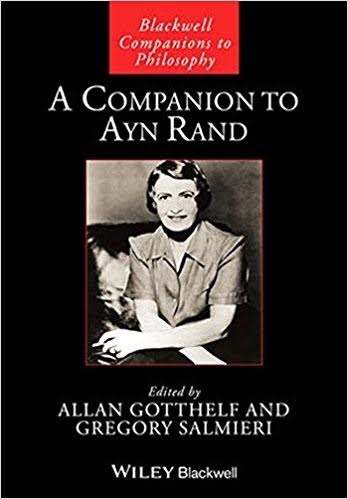
Most scholarship on Ayn Rand has been of mediocre quality, according to Gregory Salmieri, the co-editor of A Companion to Ayn Rand, which is part of the series “Blackwell Companions to Philosophy.” The other co-editor of the volume is the late Allan Gotthelf, who died during it’s last preparatory stages.

The reasons for the poor scholarship are diverse. Of course Rand herself is a large element. She hardly ever participated in regular academic procedures, did not tolerate normal academic criticism on her work and strictly limited the number of people who could authoritatively ‘explain’ her Objectivist philosophy to herself and Nathaniel Branden. Before her death she appointed Leonard Peikoff as ‘literary heir’. She inspired fierce combat against the outside world among her closest followers, especially when others wrote about Rand in a way not to their liking. The result was that just a small circle of admirers wrote about her ideas, often in a non-critical way.

blog ayn rand

On the other hand, the ‘rest of the academy’ basically ignored her views, despite her continued popularity (especially in the US), her influence, particularly through her novels, and large sales, especially after the economic crisis of 2008. For sure, Objectivists remain a minority both inside and outside academia. Yet despite the strong disagreement with her ideas, it would still be normal to expect regular academic output by non-Randians on her work. Suffice it to point to the many obscure thinkers who have been elevated to the academic mainstream over the centuries. Yet Rand remains in the academic dark, the bias against her work is strong and influential. This said, there is a slight change visible. Some major presses have published books on Rand in the past years, with as prime examples the books by Jennifer Burns, Goddess of the Market: Ayn Rand and the American Right (2009), and Anne C Heller, Ayn Rand and the World She Made (2010). And this volume is another point in case.

One of the strong points of The Blackwell Companion on Ayn Rand is that the contributions meet all regular academic standards, despite the fact that the volume originates from the Randian inner circle. It offers proper explanation and analysis of her ideas and normal engagement with outside criticism. The little direct attack on interpretations or alleged errors of others is left to the end notes, albeit sometimes extensively. Let us say, in friendly fashion, that it proves hard to get rid of old habits!

It should not detract from the extensive, detailed, clearly written and plainly good quality of the 18 chapters in this companion, divided in 8 parts, covering overall context, ethics and human nature, society, the foundations of Objectivism, philosophers and their effects, art and a coda on the hallmarks of Objectivism. The only disadvantage is the large number of references to her two main novels, The Fountainhead and Atlas Shrugged, which makes some acquaintance with these tomes almost prerequisite for a great learning experience. Still, as a non-Randian doing work on her political ideas, I underline that this companion offers academically sound information and analysis about the full range of Rand’s ideas. So, go read it if you are interested in this fascinating thinker.

Is persecution the purpose?

takentobestoned

Last week, Rebecca Tuvel, an Assistant Professor of Philosophy, had her recent article in Hypatia, ‘In Defence of Transracialism’, denounced in an open letter signed by several professional scholars (among others). They accused her of harming the transgender community by comparing them with the currently more marginalized identity of transracialism. William Rein, on this blog, and Jason Brennan at Bleeding Heart Libertarians, have written valuable defences of Tuvel’s right to conduct academic research in this area even if some find it offensive.

Events have moved fast. The associate editors initially seemed to cave in to pressure and denounced the article they had only just published. The main editor, Sally Scholz, has since disagreed with the associate editors. Critically, Tuvel’s colleagues at Rhodes College have given her their support so it looks like the line for academic freedom might be holding in this case. Without wishing to engage too much in the hermeneutics of suspicion, I think there are grounds to doubt the depth of the critics’ attitudes. I base this on my reading of Judith Butler, who is one of the signatories to the open letter arguing for Tuvel’s article to be retracted.

Seven years ago, I managed to read Judith Butler’s Gender Trouble. Although there are many variations in the movement, Butler is a central figure in the post-structuralist , non-gender-essentialist, feminism that inspires much of the contemporary ‘social justice’ movement. When I got past Butler’s famously difficult prose, I found a great deal of ideas I agreed with. I wrote up a brief piece comparing Butler’s concerns with violently enforced gender conformity to classical liberal approaches to personal autonomy. I also identified some problems.

First, Butler’s critique of the natural sciences seems to completely miss the mark. Butler associates gender essentialism with the study of genetics, when, in fact, genetics has done more than almost anything else to explore the contingency and variation of biological sexual expression in nature. The same applies to race and ethnicity.

Second, more importantly, Butler insists that there is no underlying authentic gender or sexual identity. All identities are ultimately constituted by power relations and juridical discourses. You find this argument repeated among social justice proponents who insist all forms of identity are products of ‘social construction’ rather than ever being based on natural facts. As a result, all personal identity claims are only ever historical and strategic. They are attempts to disrupt power relations in order to liberate and empower the subaltern and oppressed albeit temporarily

I don’t think this is perfectly factually true but lets accept it for now as roughly true. This means that transracialism itself might become, or could already be, another example of the strategic disruption of contemporary juridical discourses, this time about race and ethnicity. The same people currently denouncing Tuvel could very easily insist on the acknowledgement of transracial identity in five or ten years time, and denounce those who hold their current views. From their own position, which explicitly rejects any ultimate restrictions on identity formation, we have no warrant to know otherwise.

In this sense, Tuvel might not be ‘wrong’ at all, just slightly ahead of the social justice curve. And her critics wouldn’t actually be changing their minds, just changing their strategies. Meanwhile, people who actually take their identities seriously should be wary of their academic ‘allies’. They can quickly re-orientate their attitude such that a previously oppressed identity comes to be re-configured as an oppressive and exclusionary construct.

If all claims in this area are strategic, rather than factual, as Butler claims, then why try to damage a philosopher’s career over it? Why provoke an academic journal almost to self-destruct? Rather than working out which ideas to denounce, we should critique the strategy of denouncement (or calling out) itself. In that vein, much as I disagree wholly with the stance of its editorial board, I think calling into question Hypatia’s status as an academic journal, is premature.

Ricardo and Ringo for a free-trade Brexit

maxresdefault

My colleague, Shruti Rajagopalan, points out that today is the 200th Anniversary of the publication of David Ricardo’s  On the Principles of Political Economy and Taxation. It was here that the notion of comparative advantage began confounding protectionists and nativists. Shruti offers this famous example of it in practice:

Apparently, when asked if Ringo Starr is the best drummer in the world, John Lennon quipped, “Ringo isn’t the best drummer in the world. He isn’t even the best drummer in the Beatles.” And while Lennon may have fancied himself a better singer, guitarist, songwriter, and drummer, than Ringo, the Beatles are still better off with Ringo at the drums.

The essence of comparative advantage is that you don’t need to possess a great talent to benefit from trade within a group, whether we are talking about individual people or nations. So long as there exists some variation in relative talents, people will be able to benefit from specialization and trade.

This message is as relevant as ever. The British Parliament has just voted to hold fresh elections. This is supposedly to strengthen the Prime Minister’s hand when negotiating new terms of trade when Britain leaves the European Union. Politicians act as if trade is dangerous, always a threat to the national interest unless carefully constrained. They negotiate complex deals and regulation on market access, essentially holding their own consumers hostage, preventing them from buying foreign goods unless other countries agree to open their own markets. They fear that their domestic producers will be out-competed by superior, or cut-priced, businesses from abroad.

What comparative advantage shows is that even if that happened to be true for every single industry, domestic businesses could still specialize so as to be competitive on the world market, and improve domestic living standards at the same time. Britain could open its ports and wallets to foreign goods and services with no tariffs, even without any reciprocal deal from the EU, and yet still benefit from trade.

Why? Because it doesn’t matter if you have to be the drummer, just so long as you are in the band.

What makes robust political economy different?

17760989_10211701794931604_8034787751519057151_o

I encountered what would later become important elements of Mark Pennington’s book Robust Political Economy in two articles that he wrote on the limits of deliberative democracy, and the relative merits of market processes, for social and ethical discovery, as well as a short book Mark wrote with John Meadowcroft, Rescuing Social Capital from Social Democracy. This research program inspired me to start my doctorate and pursue an academic career.  Why did I find robust political economy so compelling? I think it is because it chimed with my experience of encountering the limits of neo-classical formal models that I recount in my chapter, ‘Why be robust?’, of a new book, Interdisciplinary Studies of the Market Order.

While doing my master’s degree in 2009, I took a methodology course in rational choice theory at Nuffield College’s Center for Experimental Social Science. As part of our first class we were taken to a brand new, gleaming behavioural economics laboratory to play a repeated prisoners’ dilemma game. The system randomly paired anonymous members of the class to play against each other. We were told the objective of the game was to maximise our individual scores.

Thinking that there were clear gains to make from co-operation and plenty of opportunities to punish a defector over the course of repeated interactions, I attempted to co-operate on the first round. My partner defected. I defected a couple of times subsequently to show I was not a sucker. Then I tried co-operating once more. My partner defected every single time in the repeated series.

At the end of the game, we were de-anonymised and it turned out, unsurprisingly, that I had the lowest score in the class. My partner had the second lowest. I asked her why she engaged in an evidently sub-optimal strategy. She explained: ‘I didn’t think we were playing to get the most points. I was just trying to beat you!’

The lesson I took away from this was not that formal models were wrong. Game theoretic models, like the prisoners’ dilemma, are compelling and productive analytical tools in social science, clarifying the core of many challenges to collective action. The prisoners’ dilemma illustrates how given certain situations, or rules of the game, self-interested agents will be stymied from reaching optimal or mutually beneficial outcomes. But this experience suggested something more complex and embedded was going on even in relatively simple social interactions.

The laboratory situation replicated the formal prisoners’ dilemma model as closely as possible with explicit rules, quantified ‘objective’ (though admittedly, in this case, low-value) payoffs, and a situation designed to isolate players as if they were prisoners in different cells. Yet even in these carefully controlled circumstances, it turns out that the situation is subject to multiple interpretations and understandings.

Whatever the textual explanation accompanying the game, the score on the screen could mean something different to the various players. The payoffs for the representative agents in the game were not the same as the payoffs in the minds of the human players. In a sense, my partner and I were unwittingly playing different games (although I lost within either rules of the game!).

When we engage with the social world, it is not only the case that our interests may not align with other people. Social interaction is open-ended. We do not know all the possible moves in the game, and we do not know much about the preference set of everyone else who is playing. Indeed, neither they nor we know what a ‘complete’ set of preferences and payoffs would look like, even of our own. We can map out a few options and likely outcomes through reflection and experience but even then we may face outcomes we do not anticipate. As Peter Boettke explains: ‘we strive not only to pursue our ends with a judicious selection of the means, but also to discover what ends that we hope to pursue.’

In addition, the rules of the game themselves are not merely exogenous impositions on us as agents. They are constituted inter-subjectively by the practices, beliefs and values of the actors that are also participants in the social game. As agents, we do not merely participate in the social world. We also engage in its creation through personal lifestyle experimentation, cultural innovation, and establishing shared rules and structures. The social world thus presents inherent uncertainty and change that cannot be captured in a formal model that assumes fixed rules of the game and the given knowledge of the players.

It is these two ideas, both borrowed from the Austrian notion of catallaxy, that makes robust political economy distinct. First, neither our individual ends, nor means of attaining them, are given prior to participation in a collective process of trial and error. Second, the rules that structure how we interact are themselves not given but subject to a spontaneous, evolutionary process of trial and error.

I try to set out these ideas in a recent symposium in Critical Review on Mark Pennington’s book, and in ‘Why be robust?’ in Interdisciplinary Studies of the Market Order edited by Peter Boettke, Chris Coyne and Virgil Storr. The symposium article is available on open access and there is a working paper version of my chapter is available at the Classical Liberal Institute website.