Coup and Counter Coup VI: Presidential Authoritarianism in Turkey

(Previous posts here, here, here, here and here). The state of emergency proclaimed by President Erdoğan in Turkey on 20th July last year, in response to the coup attempt of five days before, is not a situation that will come to an end in a return to normality. It is the model for the presidential system that Erdoğan has been pushing for since 2007, when he was still admired by many liberal minded people inside Turkey (though not me) and abroad. One of the key provisions of the state of emergency is that the President can issue decrees with the force of law. There are doubts about the constitutionality of this form of ‘law making’ but two members of the Constitutional Court were arrested after the coup attempt and the chances of the court starting up to executive power are now extremely remote. Judges and prosecutors have been demoted and even arrested after making the ‘wrong’ decision during the state of emergency and I do not think Erdoğan and his associates would have any scruples at all about further arrests of judges in the Constitutional Court.

The Presidential system, or one person rule system, which Turks will vote on, will retain the decrees as law powers of the Presidency. There are some limits on the decrees issued, but as the President will control the appointment of most of the senior judiciary there are serious questions about whether the Constitutional Court will put any effective break on these powers to legislate through decree. There is no sign of the state of emergency ending, though at least now everyone can see the deception in the original decision to declare a state of emergency for three months only instead of the six months maximum allowed in the Constitution. The state of emergency is renewed every three months with no debate and no indication of when it will come to an end. Does Erdoğan have any intention of ending the state of emergency before he becomes a President elected with the new powers? In principle these powers should only be implemented after the next presidential election in 2019, coinciding with elections to the National Assembly. Erdoğan may wish to bring these elections forward, particularly for the National Assembly if he loses the referendum. While it may seem outrageous for the Council of Ministers to keep prolonging the state of emergency until 2019, the AKP government has been doing more and more previously outrageous and even unimaginable things now for some years, particularly since the Gezi protests of 2013.

What the state of emergency also means is that suspects can be held without charge and access to lawyers if charged with ‘terrorism’, which is defined in absurdly broad ways to cover any kind of contact with the Gülenists or sympathy for the Kurdish autonomy movement. Torture has been making a return in Turkey after becoming relatively unusual since the PKK terror campaign began again in 2015. The state of emergency conditions have now normalised it completely and though the government denies torture charges, in the normal manner of authoritarian regimes, claiming the charges are terrorist propaganda, you have to wonder how seriously they expect anyone to take the denials. Photographs of the alleged coup plotters immediately after the coup attempt showed they had been badly beaten, though of course this is explained away as the result of ‘resisting arrest’, another time-honoured evasion. Consistent reports suggest prisoners are denied food, placed in stress positions for long periods of time, beaten and sexually assaulted. In the more moderate cases, the prison officials merely restrict prisoners to a diet of bread and bad quality tap water in conditions of psychological abuse. There is amongst everything else in Turkey a growing problem of mental and emotion health problems amongst the survivors of these ordeals, which are of course excluded from the mainstream media.

The rhetoric and abuse used by police ‘special teams’ invading the media and political offices of ‘terrorist’, that is Kurdish autonomy and other leftist groups, involve extreme nationalism and Ottomanism. Kurds are insulted as covert Armenians. Actual Armenians are told that the Ottomans destroyed the Armenians and that Turks are the masters of Armenian. A particularly disgusting reference to the massacre of 1 500 000 Armenians during World War One. These are not aberrations, this behaviour reflects the deep ideology of the AKP, mixing extreme nationalism and Ottomanism, of course ignoring the tensions between these positions. The torture and abuse is legitimated in the minds of perpetrators by a political rhetoric and government measures which present opponents as terrorist and part of international conspiracies against the ‘innocent’ Turks who are so good they are naive. This I am afraid is no exaggeration of the political discourse of the moment.

There is no reason to think the abuse and political extremism will end, though of course we should hope it does. If all Gülenists – real and imagined – and all sympathisers with Kurdish autonomy or the far left are targeted, then there are essentially endless opportunities for authoritarianism, polarising dehumanising rhetoric and abuse. I can only presume the current atmosphere will last indefinitely, as Erdoğan has found it a successful strategy for staying in power and increasing his power.

It is of course not just a question of his own political power. There is the question of how his family occupy places of privilege in large Muslims NGOs (at the same time as non-AKP oriented NGOs come under increasing pressure) with huge budgets and sit on the boards of major companies in Turkey. Erdoğan does not envisage any situation in which these activities are placed under mainstream media examination, and even less legal investigation. The issue of legal immunity is a huge one in Turkish politics. The amended constitution would allow the President to appoint anyone to two vice presidential positions and to the cabinet. Like the President all these people would have lifetime immunity from prosecution for activities undertaken while in office. Though the National Assembly would have the power to send the President to the Constitutional Court, this requires a very high threshold, clearly designed to protect Erdoğan even if the AKP loses a large part of its support.

As mentioned above, there is an expectation that Erdoğan will call an early National Assembly election if he loses the referendum. It seems likely on current polling that two out of the three opposition parties currently in the National Assembly would fail to meet the electoral thresh hold of 10%. This means the National Action Party, which has split over the referendum, and the Kurdish radicals who have lost some of their more moderate support since the revival of PKK violence. In such a National Assembly, the AKP could certainly put any constitutional proposal to referendum and very possibly could have enough votes to amend the constitution without referendum. So even if Erdoğan loses the election, he could get the same measures, or close enough, through other means.

(Last post in the current series, though I will post an appendix on Ottomanist and Atatürkist legacies in Turkey, along with comments on related political thought.)

BC’s weekend reads

  1. Could Kurds hold independence referendum this year?
  2. Meet Germany’s Alt-Right
  3. Tolerated theft, suggestions about the ecology and evolution of sharing, hoarding and scrounging [pdf]
  4. It’s time for some game theory, United Airlines edition
  5. Mormon Transhumanists

Coup and Counter Coup V: Jacobins and Grey Wolves in Turkey

Previous posts here, here, here and here. The post coup atmosphere created the impression of an invincible block of the AKP and the MHP, backed by some parts of Kemalist (Jacobinism alla turca) opinion, which would provide a massive majority for the Presidential republic desired by Erdoğan. The MHP did provide the votes in the National Assembly, for the super majority necessary to trigger a constitutional referendum. This was a complete turn about from the MHP’s previous position.

The background to this turn is partly in the state-PKK polarisation, but also in an internal female challenge to the MHP leader Devlet Bahçeli from Meral Aksaner. She is very popular with the Grey Wolf community and would have probably won a leadership election if a special party congress had been called. This became an issue in the courts, which did not in the end force the MHP leadership to act in accordance with an interpretation of laws on political parties (which are very prescriptive in Turkey), which in turn would require a congress. That Bahçeli was so resistant to calling a special congress tells its own story. He lost support within the MHP after their votes went down in the second general election of 2015, presumably also reflecting some previous accumulating weariness with his leadership. The whole story has raised suspicion of AKP supporting judges who twist the law in order to promote a MHP-AKP partnership, but there is no proof of this.

It can at least be said that Bahçeli hopes for some kind of deal in which the AKP-dominated media (that is a very large majority of the media, though not necessarily reflecting the inner views of journalists) treats the MHP gently, the AKP does not campaign against it, and the MHP can continue to get the minimum ten percent of votes necessary for a party list to have deputies in the National Assembly. He may also be hoping that in the Presidential system which Turks are voting on in the 16th April referendum, he or one of his surrogates will get one of the two vice-presidential positions and that the MHP has cabinet seats (which will all be appointed by the President, like the Vice-Presidential positions, with no parliamentary vote or scrutiny).

Meanwhile there is less of a story to tell about the Kemalists, who anyway do not have a clear leader or party. The CHP is their natural home but may be perceived as not pure enough. The bizarre character Doğu Perinçek provides a point of reference, but used to be pro-PKK and is generally just too strange and marginal. In any case, Perinçek has now recently and very publicly withdrawn his support from Erdoğan in reaction to Turkish support for the missile attack on a Syrian air force base. In general, the hardcore Kemalists have drifted back to opposing Erdoğan and supporting the CHP’s ‘No’ campaign. In at least some cases, there may have been second thoughts about how far exactly the government has gone in persecuting Gülenists, real and imagined, along with Kurdish movement politicians and activists; and a feeling that defending the Republic might also mean defending proper legal standards. Perinçek is at a vanguardist extreme where this is not an issue, but for those more influenced by foreign centre left parties and the wish for robust international standard rule of law, there has been a reaction, and a recollection of earlier objections to Erdoğan and his ambitions.

The Kurdish autonomy movement, the Grey Wolves, and the Kemalists will not disappear in Turkey. Positive developments in rule of law, constitutional democracy, individual liberties, and tolerant political culture require evolution in these movements. No government can come to power in Turkey which does not appeal to the concerns of at least one of these groups, and probably two. Erdoğan has never managed to completely absorb or eliminate any of them, though he has to some degree succeeded in keeping some appeal to both nationalist Turks and identity-oriented Kurds, particularly religious and socially conservative Kurds who may regard both CHP and HDP with suspicion. When the MHP and the Kemalist hardcore seemed to be behind Erdoğan after the coup, it seemed he might get more than 60% in the referendum. The MHP has now split in practice, and may well formally split after the referendum. Aksaner is the most popular MHP politician in Turkey and is campaigning for now. The CHP, and those most motivated by the CHP’s Kemalist roots, is solidly behind ‘No’. Right now, though ‘Yes’ may well win, it seems highly unlikely it will win with 60% plus and most expect a very tight vote. (to be continued)

Mid-Week Reader: The Justice of US Intervention in Syria

I’d like to announce a new weekly series of posts that I will be making: the Mid-Week Reader. Every Wednesday (hopefully), I will post a series of articles that I find interesting. Unlike most ventures in micro-blogging, though,  I will try to make all the articles focus on a specific topic rather than leave you with a random assortment of good articles (which Branden already does so well most weekends). This week’s topic: with Trump bombing Syria last week despite ostensibly being a dove (hate to say I told you so), I give you a series of articles on the justice, historical background, and press reaction to the bombing.

  • Fernando Terson and Bas van der Vossen, who are co-authoring on the topic of humanitarian intervention, each have interesting pieces at Bleeding Heart Libertarians debating the bombing of Syria from the perspective of Just War Theory. Terson argues that it was just, Vossen disagrees.
  • Over at The American Conservative, John Glasser of the Cato Institute has an article arguing that Trump’s invasion is neither legally authorized nor humanitarian.
  • Any discussion of foreign policy is incomplete without Chris Coyne’s classic paper “The Fatal Conceit of Foreign Intervention,” a political-economic analysis of foreign policy which concludes all sorts of foreign intervention are likely to fail for similar reasons that socialist economic intervention fails.
  • As perhaps a case study of Coyne’s analysis, Kelly Vee of the Center for a Stateless Society has an article summarizing the history of United States’ actions in Syria going back to World War II and how it’s gotten us into the current situation.
  • At Vox, Sean Illing interviews CUNY professor of journalism Eric Alterman on how the press fails to critically assess military intervention.

Coup and Counter Coup IV The Kurdish issue in Turkey

Previous parts here, here and here. As mentioned in the last post, in the immediate post coup atmosphere President Erdoğan appeared to have the support of some significant part of Kemalist (as in Kemal Atatürk who shaped the Turkish republic with reference to secularism, modernisation, national sovereignty and statism) opinion, the more hard core part, seeing shared enemies in both violent Kurdish separatists and Gülenist (members of a religious community, see previous posts) infiltrators into the state apparatus. The return of PKK (the Kurdish acronym for Workers’ Party of Kurdistan) violence against state forces and civilians (the latter largely undertaken by the Freedom Falcons of Kurdistan, TAK in the Kurdish acronym, a product of the PKK) in the summer of 2015 already placed the AKP, hardcore Kemalists, and the Nationalist Action Party (MHP, rooted in a ‘Grey Wolf’ or ‘Idealist’ ideology of absolutist state nationalism and Pan-Turkism) on the same side advocating a militant response including support for the army-led destruction of whole urban areas in PKK strongholds in the southeast. Previously the latter two groups had regarded the AKP as treasonous for holding talks with Abdullah Öcalan, the imprisoned founder-leader of the PKK, fearing a federalised Turkey with a southeast federal region under strong PKK influence. The talks were not at all public, no attempt was made to prepare public opinion for possible evolution in the Turkish state tradition, or to hold any kind of open discussion on the issues at stake.

The talks collapsed with Öcalan returned to strict prison conditions. Despite the MHP and hardcore Kemalist fears about federalisation on PKK terms, it seems likely that Erdoğan never intended more than token concessions to Kurdish identity and autonomy for the southeast, in exchange for operating for the PKK and a party with a common origin as an external support of the AKP. The party which has a common origin with the PKK is DBP (Turkish acronym for Democratic Regions Party) and the umbrella party it formed to accommodate small leftist groups (which don’t have specific Kurdish origins). It appears that the DBP hardcore does not like accommodating non-Kurds so the survival of HDP is not guaranteed. It poses a very happy image to leftist educated Turks, of interest in social liberalism, minority rights and left socialist policies. This reflects a historical feeling of marginalisation, because the CHP (Republican People’s Party: Kemalist/social democratic something like the French Socialist Party in merging Jacobin, social democratic and socialist traditions) is seen as too nationalist and not ‘really’ leftwing.

It tells you something about Turkish politics that there are people who insist that HDP is not leftwing despite its obvious leftwing policies and roots in the Maoist orientation of the PKK. This insistence is rooted in the belief that all left polices must be non-ethnic, that raising ethnic issues is inherently divisive and chauvinistic, reflecting of course a blindness to how some people experience the Turkish state as unaccommodating of, and even hostile to, expressions of identity by those people in Turkey who have a first language, and associated culture, other than Turkish. The Maoist and terrorist origins of the main expressions of Kurdish autonomy politics supports that majoritarian blindness and even chauvinism. Clearly they feed off each other.

The HDP has been turned into an effectively semi-legal party since the summer of 2015, which is not the right state reaction from the point of view of constitutional democracy and individual liberty. However, the HDP has to some degree brought this on itself, because while condemning the acts of terror directed from mountains in Iraq by the current PKK leader Cemil Bayık, it has never rejected the PKK as such, treating Öcalan as the symbolic leader of Kurds in Turkey, and adhering to a political rhetoric of ‘autonomy’ shared with the PKK.

The government has now used the state of emergency to take over the administration of all HDP led local government, that is local government throughout the southeast, appointing ‘trustees’ to run these municipalities. All media with an HDP orientation has been closed down and blocked online if based abroad.

Accusations have been made of the HDP using local government as infrastructure and a source of money for the PKK. This has yet to be proven in court. If it was, we would certainly have to consider the HDP to have taken a very bad path. As things stand, this has not been proven and the persecution of HDP politicians along with the takeover of HDP municipalities is highly premature, serving political power goals and grossly overriding any idea that guilt only exists if and when proven in court, preferably with judges under less political pressure than is the case at present in Turkey.

Unilateralism is not isolationism

One of the most frequent characterizations of US foreign policy in the 18th and 19th centuries is that it was isolationist. In 1796, when he decided not to run for a third presidential term, George Washington wrote (possibly with the help of Alexander Hamilton) a farewell address to public life. In one of the most quoted parts of this speech, Washington said that “It is our true policy to steer clear of permanent alliances with any portion of the foreign world.” Quite similarly, in 1821 John Quincy Adams warned that the United States should not “[go] abroad, in search of monsters to destroy.” We can also cite Thomas Jefferson, who in 1799 declared that “Commerce with all nations, alliance with none, should be our motto.” Finally, in 1823 James Monroe declared (with great help from the aforementioned John Quincy Adams) that “The political system of the allied powers [of Europe] is essentially different (…) from that of America.”

In short, it is by all the above (and other) quotations that historians often classify American foreign policy in the 18th and 19th centuries as isolationist. This trend, it follows, was altered in World War I by Woodrow Wilson, who broke away from traditional isolationism to lead the United States to fight in Europe. More than that: at the end of the war, in his 14 Points, Wilson proposed the creation of the League of Nations, a permanent multilateral international organization, with the objective of promoting the collective security of the member countries. The Wilsonian tendency was reversed by Republicans in the 1920s and 1930s, mainly because they refused to join the League of Nations, opting for isolationism. However, Woodrow Wilson’s proposal was retaken by Franklin Delano Roosevelt in World War II. The United States defeated the enemy forces in Europe and the Pacific and in the end war was one of the main founders of the United Nations, an international organization created to replace the League of Nations. Since then the United States has predominantly adopted Woodrow Wilson’s perspective and avoided the isolationism of the Founding Fathers and of the Republican presidents of the interwar period. Only ultra-conservatives believe and advocate that the US should retake the foreign policy of George Washington, Thomas Jefferson, John Quincy Adams, and James Monroe. However, all this evaluation already starts flawed when it characterizes American foreign policy in the 18th and 19th centuries as an isolationist. To explain why, we can differentiate two terms: isolationism and unilaterialism.

Predominantly, US foreign policy in the 18th and 19th centuries followed George Washington’s advice “to steer clear of permanent alliances with any portion of the foreign world.” However, it should be noted at the same time that this foreign policy followed Thomas Jefferson’s advice to establish “commerce with all nations.” In other words, despite the lack of permanent alliances with other countries (particularly European ones), what the United States did not lack in that period was a growing trade with other parts of the world, in addition to regular diplomatic contact (although not characterized by permanent alliances). To call this isolation is to force language too much. There are many historical examples of countries that have actually isolated themselves from the rest of the world: Japan between the 17th and 19th centuries, China between the 15th and 19th centuries, Paraguay from 1811 to 1844, and more recently North Korea are just a few. US foreign policy in the 18th and 19th centuries would be better characterized as unilateralist or non-interventionist. This means simply that the US didn’t subject its international relations to foreign authority.

There was no US isolation before the 20th century. What happened was a policy of avoiding permanent alliances. Meanwhile, the country had no problem with expanding its diplomatic contacts and its international trade (although some economic protectionism was practiced, but I leave this subject to another time). The same can be said about the attitude taken by the presidents in the interwar period: not participating in the League of Nations did not mean isolation from the rest of the world, quite the opposite: the US actively participated in the economy and international politics at that time. It just did not do this through the international organization proposed by Woodrow Wilson. It is perfectly possible to participate actively in international relations unilaterally, i.e. without the formation of permanent or binding alliances with multilateral international organizations.

Confusing the terms isolation and unilateralism may just be an oversight or an evaluation error. But it can also be a purposeful strategy. Confusing the terms may hide an undeclared requirement (or assumption): the only accepted international participation is that made through multilateral international organizations such as the League of Nations or the United Nations. No other is good enough. In this way, those who characterize US foreign policy before Woodrow Wilson as isolationist are severely limiting the possibilities for US international participation.

Differences in life expectancy within Canada, 1921 to 2011

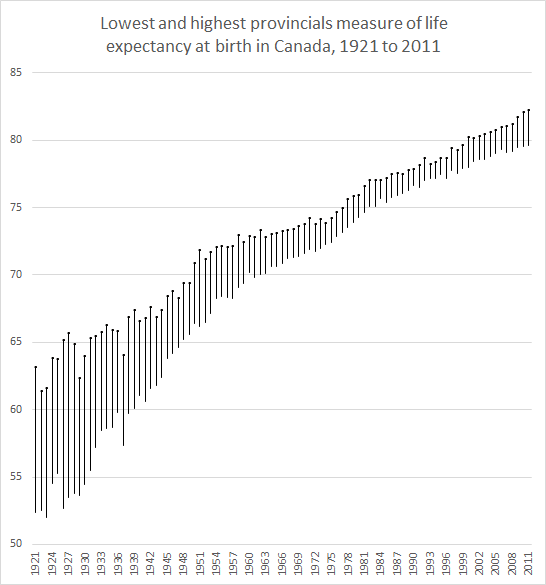
I’ve been playing around with some data for a paper I have been trying to write about the economic history of Canada in the 20th century. In the process, I assembled the data from the Base de données sur la longévité canadienne regarding life expectancy at birth. Then, I thought that it would be interesting to see how large were the differences between the provinces and how fast did they close. They closed pretty dramatically during the 20th century – see for yourself.

LifeExpectancyCanada

Pride and Subsidies

Freakonomics had an episode on the dramatic impact of subsidies on the visual effects (VFX) industry. Long story short: 1) VFX companies operate on razor thin margins, 2) the industry chases subsidies from competing local governments–Canada and London are  currently important locations, 3) Californian politicians want to bring these jobs back to LA, but doing so would probably be a net burden.

(Let’s put aside the issue of the state of California trying to play central planner by effectively creating different tax rates for different industries. That’s a bad idea for reasons we can explore later.)

Putting yourself in the head of a Californian, something about the policy feels right (maybe not for the typical NOL reader, but probably for the median voter). I’m sure you could convince the median voter that these subsidies are a bad idea, economically. But even so, I’d be willing to bet that you’d still get significant support.

I’m confident that if you were to talk this issue over with a representative sample of California voters–or X industry in Y region for similar industry upheavals–you could convince them of the probable negative impact of such policy and still see many voters at least weakly supporting the policy. Why? Because being able to point to a movie and say “that awesome explosion was made in my backyard,” is worth some degree of sacrifice for these people.

Perhaps people want our government to give us something to be proud of (God knows they give us enough things to be ashamed of!). Perhaps people have some latent willingness to pay to be able to say that some high status industry is in their community/city/state/country.

We like pride, but it costs us. This puts us squarely in the domain of economics. How do we figure out how to make the trade off between pride, and the price we must pay for it? Some cases seem easy, at least in hindsight–the sacrifice of the civil rights movement was a small price to pay for the pride generated–but cases like the VFX industry, aren’t so obvious, but still high stakes.

I don’t think we’re likely to be able to figure out the bill. We can be proud of NASA, movies, the post office, and whatever else. But how much of the cost can we attribute to engaging in activities that make us proud? We get the same issue in markets. I have more than brand loyalty for Honda (the maker of my motorcycle); I’m also proud to associate with Honda as an innovative company with a history of liberating the world’s poor.

A clever statistician or economist could estimate some important facts about how people tend to make these trade offs. Doing so could help us make better decisions, but can’t ultimately replace our own judgment.

Given the uncertainty we face we really have to make a decision about whether to err on the side of over- or under-provision of pride goods–and this is true in a variety of settings.

I suspect that the “let 1000 flowers bloom” approach is the appropriate one here. We don’t want to have one Secretary of Pride deciding to err on the side of over-provision and the result is that a bunch of children die from preventable causes so that we can all feel proud about how cool the latest domestically produced Fast and Furious movie is going to be. On the other hand, it would be a tragedy of slavery was never ended because it would interrupt business as usual.

Markets, civil society, and government face different sorts of pros and cons with respect to how they might make these trade offs. Arguing about them could create a new academic discipline at the intersection of ethics, economics, and sociology.

In all three spheres, there will be many very bad decisions made. But if you aren’t free to be wrong, you aren’t free. The question to ask is what sort of pride goods will tend to survive, and in which spheres?

What we can say for sure is that private, voluntary exchange and cooperation (free markets and civil society) at least allow us to choose our associations. And they require us to choose, and choose again on a regular basis. Our nation is mostly based on luck. Where we live tends not to change much. Voting with your feet is costly, so we should expect it to be that much harder to dismantle big mistakes. The political process routinely results in outcomes we’re ashamed of (about half of voters are ashamed of the results every presidential election!).

There aren’t markets in pride so it’s hard to know how the benefits compare to the costs. But we can (and do) exhibit pride in markets. We should probably do more of it. And perhaps we should also be more skeptical of government, even though we normally think of them as providing pride goods. On the margin, anyways, I think this is a good direction for most people to move. Be proud of your community because the people have whatever unique traits they do. Be proud of the brands you buy from for their contributions to the state of the art. Be proud of your local sports team.

The GDP, real wages and working hours of France since the 13th century

Every few years, an economic historian in training spends thousands of hours in archives assembling a long quantitative essay. It’s the work of monks (in fact, when you go far back in history, you also end up working with monks and nuns – which was my case on Canadian economic history). It’s the kind of work that requires patience, attention to details and (did I say it already?) patience.

I did that for my own work on Canadian economic history. For two years, I locked myself in the archives of two religious congregations to collect and transcribe close to a million price and wages information. For these two years, I did not write one single paper. I just collected the data and constituted a list of the papers I could write. However, once its finished, you may party like a sailor fresh off the boat because you end up with a wealth of data to answer hundreds of questions. When I finished my own thing on Canada, I was thrilled as I thought it constituted a great advance in quantitative knowledge (which I could use to assess tougher historical questions).

However, compared to the work of Leonardo Ridolfi, my own work looks like a dwarf (I confess envy here).  Ridolfi spent hundreds of hours assembling a quantitative essay on France’s economy since 1250. This is monumental!  France has generally been a statistical abyss (except for demography and some price series) especially when compared to England. Yet, the country is highly relevant to western economic history. After all, the question of why did the Industrial Revolution take place in Britain is the mirror of asking why it did not happen in France. As a result, Ridolfi’s work fills one of the largest voids in the field of economic history and will end up being one of the most cited dissertations for the next ten years I expect.

He constructed estimates of real wages, prices, incomes and working hours. As such, he provided the widest possible statistical portrait possible which (I wont get into details here) circumvents tons of empirical complications that may limit the quality of each variable taken separately (see for example the manner in which GDP is calculated and the role that estimating working hours plays).

I invite anyone interested in economic history to read his work. But, I will give you the main conclusion I gathered: France was not as poor as many believed. I recently pointed this out in an article which I am trying to get published, but Ridolfi’s work proves my point beyond my wildest expectations. I assembled the most relevant figures below.

Ridolfi.png

How to take over Syria, Roman edition

While Trump’s decision to bomb a Syrian airfield in response to use of chemical weapons by the Syrian government got the lion’s share of the press attention about American involvement in Syria (probably because of the contrast with Obama’s preference for diplomacy despite his “red line” threat), the more important strategic operations have not been discussed as fully. Building upon the successful establishment of two airfields last year, the US has expanded or established bases at crucial locations and begun to attack key targets in the northern part of Syria that show an excellent understanding of the topography and logistics of the region. These developments may be the linchpin in choking off traffic and crippling supply and movement of ISIL, and should contribute to the long-term goal of securing Hasakah and Raqqah provinces. What is interesting in all of this, perhaps due to the historical expertise of National Security Adviser H.R. McMaster, is that this logistical focus mimics the attack routes that were vital to invasions of the area from Alexander the Great down to Julian the Apostate.

The Euphrates River as an ancient supply highway

In the era of Alexander the Great, supply and communication were important constraints on military action; the logistics of his march through Syria are extremely well described by Donald Engels. Essentially, because of the lack of water sources in surrounding areas, the rough Taurus Mountains to the north and Arabian Desert to the south, and the provisions and easy transport supplied by it, the Euphrates River was a common “highway” for military movement in antiquity. Controlling and utilizing it was essential to control of the trade and military actions between the Mediterranean coast and Mesopotamia. In his defense against Alexander, Darius III kept his army on the Euphrates, and Alexander surprised him by crossing northern Mesopotamia to follow the Tigris River (near Mosul, which ISIL also recognized as vital) instead. However, almost every major invasion of the area from the west has gone through what is now southeastern Turkey to reach the headwaters of the Euphrates, including those of Trajan, Septimius Severus, and Julian the Apostate. Crassus reaped the gruesome rewards of avoiding the Taurus/Euphrates route.

The Euphrates valley was important not only as a military route, but also as a source of agricultural income and a crucial portion of the early Silk Road. Therefore, the nation that controlled the northern Euphrates valley could finance their military through control of trade and taxation (which Zenobia’s husband used to assert his own quasi-independence from a city that ISIL has ironically destroyed), a fact that has changed only in the economic transition from agricultural production to petroleum extraction. Now, ISIL not only taxes and sells oil to support its endeavors, but it knew from the outset to seize strategic locations on the route and even wanted to use the Euphrates river as its logo!

The mountains north of the Euphrates

The famous historian and general, Xenophon, was part of an army that followed the Euphrates down to a fateful battle at Cunaxa, and his retreat through the Taurus Mountains and ancient Armenia involved encounters with natives who were extremely capable in skirmishing on mountainous terrain. Both Xenophon and Mark Antony learned how difficult this route was, and the successful Kurdish defense of the Sinjar mountains and victories in the mountains of northeastern Syria using small arms and mobile forces while conceding villages is reminiscent of these ancient raiding methods. Though bombing obviously differs in technology and methods from ancient infantry, it also involves avoiding direct battle in order to destroy resources and harass enemy armies in motion, and so the American strategies based on assaults from the Rmeilan and Incirlik airfields over the past year have used the same attrition tactics to wear down ISIL strongholds.

What comes next?

If ancient campaigns can tell us anything, it may be that the US is transitioning from bombing from afar to more direct assaults on the cities, roads, and resources of ISIL along the northern Euphrates. The US still holds bases in northwestern Syria, defending the western flank of Kurdish-controlled territory and providing a buffer to Turkey (which, along with Turkish efforts to stop individual penetration of the border, should mitigate ISIL recruitment and international travel). Now that it has augmented this by creating bases that choke off routes to the headwaters of the Euphrates and allow closer engagement with ISIL since January, the US seems to be poised to contain ISIL attacks with greater alacrity and support Kurdish ground assaults on the ISIL capital of Raqqa. The escalation may be as support in the race to Raqqa and to take advantage of victories in eastern half of the campaign in Mosul, and comparison to the campaigns cited above would indicate that the US and Kurds are moving much slower than ancient campaigns, but using the same routes, attacking targets in similar ways, and with the same respect for topography and logistics.

Race as a bundle and its implications

As I mentioned in my last post, I have been given the topic of race increased thought recently.

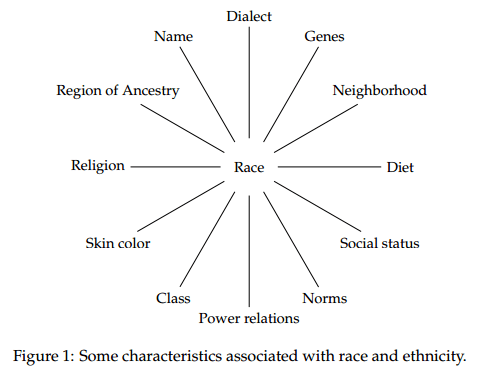
One of the recent developments in political science has been thinking of race not as a dichotomous variable, but as a bundle of related but distinct characteristics. Race is not simply phenotype, but a mixture of such things as one’s dialect, diet, and socioeconomic status among other things.

RaceBundle

The idea to me seems obvious, which makes me inclined to believe it. The thing is, if we take this broader approach to what race is, what are the implications for prior work not only in regards to race but the effect of demographic characteristics generally.

Race is already difficult to conduct research in because it is assigned at birth which makes it difficult to manipulate and which influences other characteristics we would ordinarily ‘control’ for in statistical analysis. To my knowledge there isn’t a ‘race ray’ that we can use to randomly assign being ‘black’ in an experiment. Tracing causality is possible, but difficult enough even in ideal situations.

Take for example the gender wage gap argument. When you control for education, presence of children, and other characteristics the gap in wages between males and females vanishes. However many of these characteristics are impacted by one’s gender. While females are not discriminated against ceteris paribus, being female does increase one’s likelihood of having to be the primary care taker for children and has historically decreased educational outcomes. In this broader sense there is a gender wage gap.

What can be done about it though? Men can try to share more of the house duties with their wives, but my general observation in life has been that children prefer being cared for by their mothers over their fathers. Should we try to do something about it? Are there advantages to one member of the household specializing in housework?

Or, if you prefer to think of the question purely in regards to race let us consider crime rates by race. I am not convinced that blacks have any higher propensity to crime than whites. However blacks are more likely to grow up in poverty and have lower educational outcomes than other races, which in turn leads to higher crime rates statistically speaking. Where should the arrow of causality be pointed towards: race, education, socioeconomic status?

Race is a difficult concept to think about. However it is precisely the difficulty with discussing it which begs that it be thought about more. I believe we liberals have a particular duty to think about race more because if we don’t then our ideological rivals will continue to dominate the conversation.

See here for an un-gated draft of the relevant paper: Sen, Maya, and Omar Wasow. “Race as a Bundle of Sticks: Designs that Estimate Effects of Seemingly Immutable Characteristics.” Annual Review of Political Science 19 (2016): 499-522.

On the reversal of fortune, urbanization and Canada

One of the more famous articles of economist Daron Acemoglu is his 2002 article on the reversal of fortunes where he points out that countries colonized by Europeans in 1500 that were relatively rich then are relatively poor now. In the paper, they use urban density as a proxy for economic development at that point in time.

I was not particularly convinced by this because of the issue of ruralization in colonial economies. I am still not convinced in fact. As many scholars interested in American colonial history point out, the country de-urbanized (ruralized) during the colonial era as cities grew at a slower pace than the general population. As such, the share of the US population in rural areas increased. But Jeffrey Williamson and Peter Lindert documented that in 1774, the United States were the richest place in the world (beating England on top of being more egalitarian). 

This is normal. Economies on the frontier had land to labor ratios that were the exact opposite of those in Europe. The opportunity cost of congregating in one area was high given the abundance of land that could be brought under cultivation. This is why the Americas (North America at least) was the Best Poor Man’s Country. As such, areas with low population density are not necessarily poor (even if urbanization is a pretty strong predictor of wealth).

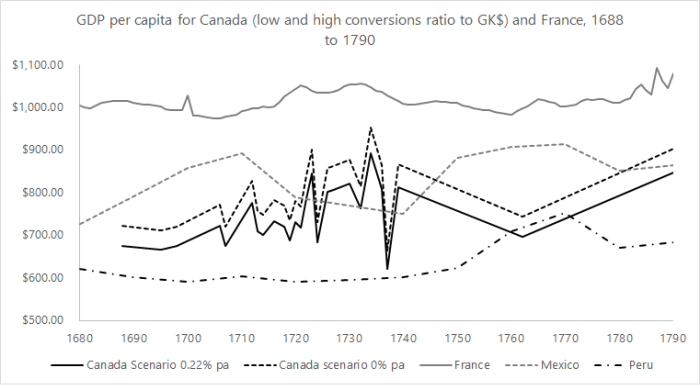
This is where Canada comes in. Today, the country easily fits in the “relatively rich” group. According to the figures 1 and 2 in the work of Acemoglu, Johnson and Robinson, it would have been in the “relatively poor” group well behind countries in Latin America. However, I recently finished compiling the Canadian GDP figures between 1688 and 1790 which I can now compare with those of Arroyo Abad and Van Zanden for Peru and Mexico. With my Canadian data (see the figure below), we can see that Canada was as poor as Latin America around 1680 (the start date of my data).

GelosoGDP.png

So, Canada was a relatively poor country back which was equally poor (or moderately richer) than Latin American countries. Why does that matter to the reversal of fortune story? Well, with the urbanization data, one shows that the non-urbanized of 1500 are the rich of the today. With the GDP data for the 1680s, we see that the more urbanized countries were also poorer than the less urbanized countries.

Now, my argument is limited by the fact that I am using 1680s GDP rather than 1500 GDP. But, one should simply extend the urbanization series to circa 1700 and the issue is resolved.  In any case, this should fuel the skepticism towards the strength of the reversal of fortune argument.

Bruce Lee’s Application Of Taoist Philosophy In Jeet Kune Do

Bruce Lee - Jeet Kune Do

Bruce Lee was born on November 27, 1940 and died on July 20, 1973. Even though he was just 32 upon his death, he had achieved so much in his limited lifetime. He was recognized by Time magazine as one of the 100 most influential people of the 20th century.[1] He was a cha cha champion in Hong Kong at age 18, a world renowned martial artist and a Chinese actor who was not only immensely popular in Asia, but who also made his breakthrough in Hollywood at a time when oriental actors were rarely accepted for lead roles. What is less known among the public is his keen interest in philosophy, a subject he studied at the University of Washington. Writing about where his interest in philosophy came from, he wrote:

My majoring in philosophy was closely related to the pugnacity of my childhood. I often asked myself these questions: What comes after victory? Why do people value victory so much? What is ‘glory’? What kind of ‘victory’ is ‘glorious’?[2]

In one of my previous posts, I discussed the similarities between the libertarian concept of Spontaneous Order and the Taoist concept of the Tao. In this post I will discuss the application of Taoist philosophy in Jeet Kune Do (‘the way of the intercepting fist’), the martial arts that Bruce Lee founded in his mid-20s, and its roots in Taoist philosophy. I will identify several Taoist aspects that form the philosophical foundation of Jeet Kune Do. First however, I will give an anecdote of his wife Linda Cadwell on Bruce Lee’s initial motivation to develop Jeet Kune Do at all.

Bruce Lee’s initial motivation for Jeet Kune Do
Bruce Lee started teaching martial arts to Westerners in his newly founded Jun Fan Gung Fu Institute, a training gym in Oakland, California. Then by late 1964, Bruce Lee received a letter with the signatures of the most important elder Chinese martial arts masters in San Francisco who did not

look favourably on Bruce’s teaching martial art to Westerners, or actually to anyone who was not Chinese. So strongly did they harbour this historically bound belief, that a formal challenge was issued to Bruce, insisting that he participate in a confrontation, the result of which would decide whether he could continue to teach the ‘foreign devils’. (Cadwell, 1998, p. 8)

Without hesitation, Bruce Lee accepted the challenge. Linda Cadwell remembers the fight that followed as a pivotal point in Bruce Lee’s life:

Within moments of the initial clash, the Chinese gung fu man [Bruce Lee’s contender] had proceeded to run in a circle around the room, out a door that led to a small back room, then in through another door to the main room. He completed this circle several times, with Bruce in hot pursuit. Finally, Bruce brought the man to the floor, pinning him helplessly, and shouted (in Chinese), ‘Do you give up?’ After repeating this question two or three times, the man conceded, and the San Francisco party departed quickly. The entire fight lasted about three minutes, leaving James and me ecstatic that the decisive conquest was so quickly concluded. Not Bruce. Like it was yesterday, I remember Bruce sitting on the back steps of the gym, head in hands, despairing over his inability to finish off the opponent with efficient technique, and the failure of his stamina when he attempted to capture the running man. For what probably was the first time in his life, Bruce was winded and weakened. Instead of triumphing in his win, he was disappointed that his physical condition and gung fu training had not lived up to his expectations. This momentous event, then was the impetus for the evolution of Jeet Kune Do and the birth of his new training regime. (Cadwell, 1998, pp. 11-12)

Now that we know that Jeet Kune Do originated from Bruce Lee’s discontent with the physical condition he had achieved through traditional gung fu training, I will discuss how Bruce Lee was striving for a new martial arts that was superior to the already existent ones, and how this martial arts is ultimately rooted in Taoist philosophy.

Jeet Kune Do as a way of life
Bruce Lee had, throughout his whole life, always been intrigued by the question how to find his true potential, and how to express himself honestly. He wrote:

“Ever since I was a child I have had this instinctive urge for expansion and growth. To me, the function and duty of a quality human being is the sincere and honest development of one’s potential”.[3]

“When I look around, I always learn something, and that is to always be yourself, express yourself, to have faith in yourself. Do not go out and look for a successful personality and duplicate him. They always copy mannerism; they never start from the root of their being: that is, how can I be me?”[4]

Bruce Lee believed that the answers to both questions – how can I find my true potential and how can I be me so that I can express myself honestly – are ultimately related to one another.

1. Be one with the Tao; be formless like water, and be pliable
Bruce Lee believed that the person who is trained within a particular martial arts style and who clings to it indefinitely or a person who is only trained within a particular philosophical doctrine becomes self-delusional. He thought that the person who is incapable of exceeding his style or doctrine is stiff and narrow-minded. His narrow-mindedness makes him blind to observe objectively and to see the truth. He is what Bruce Lee calls, ‘the traditional man’. Bruce Lee wrote:

One can function freely and totally if he is ‘beyond system.’ The man who is really serious, with the urge to find out what truth is, has no style at all. He lives only in what is. (Bruce Lee, 1975, p. 17)

But in classical styles, system becomes more important than the man! The classical man functions with the pattern of a style! (Bruce Lee, 1975, p. 18)

How can there be methods and systems to arrive at something that is living? To that which is static, fixed, dead, there can be a way, a definite path, but not to that which is living. Do not reduce reality to a static thing and then invent methods to reach it. (Bruce Lee, 1975, p. 18)

Classical forms dull your creativity, condition and freeze your sense of freedom. You no longer ‘be,’ but merely ‘do,’ without sensitivity. (Bruce Lee, 1975, p. 19)

You cannot see a street fight in its totality, observing it from the viewpoint of a boxer, a kung-fu man, a karateka, a wrestler, a judo man and so forth. You can see clearly only when style does not interfere. You then see it without ‘like’ or ‘dislike;’ you simply see and what you see is the whole and not the partial. (Bruce Lee, 1975, p. 24)

He thought that committing himself to styles limits both his potential and his self-expression. This critique is however not only limited to martial arts. He extended this critique to Confucianism, a philosophy which he considered as too rigid, and too narrowly focused on set rules and traditions. According to Bruce Lee, man ceases being a human being and instead becomes a mechanical man, a product of mere tradition if he reveres and just follows rules and mannerisms. The philosophy that perfectly fits Bruce Lee’s vision of a self-expressive and ‘style-less’ martial arts is the epistemologically anarchistic Taoism. How can a person, according to Bruce Lee and Taoism, find his true potential and express himself honestly? The answer is to become formless, pliable, and forever adaptable just like the Tao is formless, pliable, and forever in flux.

The Tao Te Ching states the following metaphor of life (flexibility and softness) and death (rigidity and hardness):

A man is born gentle and weak.
At his death he is hard and stiff.
Green plants are tender and filled with sap.
At their death they are withered and dry.
Therefore the stiff and unbending is the disciple of death.
The gentle and yielding is the disciple of life.
Thus an army without flexibility never wins a battle.
A tree that is unbending is easily broken.
The hard and strong will fall.
The soft and weak will overcome. (Tao Te Ching, Chapter 76)

Both Lao Tze and Bruce Lee took water as the ultimate metaphor for that which is flexible and soft. Bruce Lee maintains that in order to fulfil your true potential and express yourself honestly you should become like water, formless. To be like water means to be an objective observant, relaxed and to be flowing with life – to be one with the Tao.

In the Tao Te Ching one can find the following lines:

Under heaven nothing is more soft and yielding than water.
Yet for attacking the solid and strong, nothing is better;
It has no equal.
The weak can overcome the strong;
The supple can overcome the stiff. (Tao Te Ching, Chapter 78)

There is a story about Bruce Lee’s discovery of what it means to be like water and to be united with the Tao. I am not sure about the authenticity of the story, but I will share it nonetheless as it helps to illustrate the significance of being formless in combat or in life:

Bruce, at the age of seventeen, had been training in gung fu for four years with Sifu Yip Man, yet had reached an impasse. When engaged in sparring Bruce found that his body would become tense, his mind perturbed. Such instability worked against his goal of efficiency in combat.

Sifu Yip Man sensed his trouble, and approached him. ‘Lee,’ he said, ‘relax and calm your mind. Forget about yourself and follow the opponent’s movements. Let your mind, the basic reality, do the counter-movement without any interfering deliberation. Above all, learn the art of detachment.’

Bruce Lee believed he had the answer to his problem. He must relax! Yet there was a paradox: the effort in trying to relax was inconsistent with the effortlessness in relaxing, and Bruce found himself back in the same situation.

Again Sifu Yip Man came to Bruce and said, ‘Lee, preserve yourself by following the natural bends of things and don’t interfere. Remember never to assert yourself: never be in frontal opposition to any problem, but control it by swinging with it.’

Sifu Yip Man told Bruce to go home for a week and think about his words. Bruce spent many hours in meditation and practice, with nothing coming of it. Finally, Bruce decided to go sailing in a junk (boat). Bruce would have a great epiphany. ‘On the sea, I thought of all my past training and got mad at myself and punched the water. Right then at that moment, a thought suddenly struck me. Wasn’t this water the essence of gung fu? I struck it, but it did not suffer hurt. I then tried to grasp a handful of it but it was impossible. This water, the softest substance, could fit into any container. Although it seemed weak, it could penetrate the hardest substance. That was it! I wanted to be like the nature of water.

Therefore in order to control myself I must accept myself by going with, and not against, my nature. I lay on the boat and felt that I had united with Tao; I had become one with nature.[5]

Bruce Lee emphasized the importance of ‘a style of no style’ that he later would regret the name Jeet Kune Do as a name implies limitations or specific parameters. Bruce Lee wanted it to resemble the Tao, nameless and of almost supernatural power. Chapter one of the Tao Te Ching states:

The Tao that can be told is not the eternal Tao.
The name that can be named is not the eternal name. (Tao Te Ching, Chapter 1)

See this video in which Bruce Lee asserts that we should be like water:

2. Break rules and conventions and have no way as your way
Jeet Kune Do does not limit itself to styles. It takes from other styles what is useful, discards what is useless, and adds what is uniquely our own. The slogan of the Jeet Kune Do logo reads two things: (a) take no way as your way, and (b) take no limitation as your limitation. As styles, rules, conventions, mannerisms limit us we should deconstruct and transcend them. Jeet Kune Do is therefore iconoclastic. Bruce Lee wrote:

Jeet Kune Do favors formlessness so that it can assume all forms and since Jeet Kune Do has no style, it can fit in with all styles. As a result, Jeet Kune Do utilizes all ways and is bound by none and, likewise, uses any techniques or means which serve its end. (Bruce Lee, 1975, p. 12)

What are the characteristics of a martial arts with no style? According to Bruce Lee, it becomes open-minded, non-traditional, simple, direct, and effective.

Bruce Lee contended that:

Jeet Kune Do does not beat around the bush. It does not take winding detours. It follows a straight line to the objective. Simplicity is the shortest distance between two points. (Bruce Lee, 1975, p. 12)

In Enter the Dragon, there is a scene in which an ostentatious man asks Bruce Lee what his style is. Bruce Lee answers: “You can call it the art of fighting without fighting”. Being challenged by the man to show this style, Bruce Lee cunningly proposes to take a boat to a nearby island where they can fight. When the man set foot on the boat, Bruce Lee let the boat drift away and pulls it on a line. The essence of the story is that (a) one should not be pretentious as that is not honest self-expression, and (b) a fight should be won in the most direct and easiest manner, preferably without the use of violence.[6]

You can find the videoclip here:

In order to break with traditions and conventions means that we should also get rid of our past attachments. This is what Bruce Lee meant when he metaphorically said that we should ‘empty our cup’.

3. Empty your cup and learn the art of dying
To empty your cup means to get rid of your self-delusion so that you can look at the world from a new and refreshed perspective. In order to find your true potential and your nature, you should first be self-conscious. You should know what you want, what you desire, what your strengths and weaknesses are, your pride, your fears, your accomplishments, your ambitions and eventually get rid of all that as they maintain an ego that interferes with who you truly are – a fluid personality who cannot be narrowly defined by your desires, fears, achievements etc.

In the Tao Te Ching one can read:

Empty yourself of everything.
Let the mind become still.
The ten thousand things rise and fall while the Self watches their return. (Tao Te Ching, Chapter 16)

This is frightening for most of us, because it confronts us with our own prejudices; we may find that our traditions that have previously given us a sense of security may be baseless. However, Bruce Lee did not only want us to break with the archaic, but he also showed us an alternative – a way of creating new values and skills to supersede the old. In this respect, Bruce Lee’s views of how to progress in life is very much in line with the iconoclastic Nietzschean übermensch: we must first break with traditions and try to rise above our culture so that a higher being can emerge from our renewed self-creation. This is how I personally interpret Bruce Lee’s saying that we should learn the “art of dying”.

In a famous scene in Longstreet, Bruce Lee taught us not to make a plan of fighting, he told us to empty our mind, and to be formless like water. The “art of dying” is the “art of being non-fixed” – the art of being a different person tomorrow than we are today by letting go our past attachments including our ambitions. I believe it is similar to the Nietzschean ideal of self-creation: continuously subjecting our current values to our personal judgements, breaking down ‘lower values’ and creating ‘higher values’. The art of dying is hence a metaphor for continuously breaking down our past selves, values, attachments, pride, desires (dying) and creating our new selves (being reborn) so that we can continuously improve. The “art of dying” is therefore also the “art of self-forgetfulness”, a skill that is characteristic of the ‘baby’ who is its self-propelling wheel in Nietzsche’s story of the ‘three metamorphoses’ from Thus Spoke Zarathustra.

See here the scene of Longstreet:

Bruce Lee wrote:

Empty your cup so that it may be filled; become devoid to gain totality. (Bruce Lee, 1975, p. 14)

Emptying our cup precedes our discovery of new truths or new values so that hopefully we can find ourselves and become our own standard. Bruce Lee told us not to despair when we cannot find solace within our past attachments as the creation of personal values is vastly more valuable.

See here a great explanation of ‘emptying our cup’:

The logical consequence of self-creation is that one becomes his own standard.

4. Become your own standard and accept life
According to Bruce Lee, we should not worry about what others think of us. He advised us not to look for a personality to duplicate as that would be a betrayal to our selves – one might call this practice ‘other-expression’ instead of ‘self-expression’. Being our own standard also encompasses the acceptance of disgrace and losses as much as accepting grace and victories. How else can we accept ourselves and fulfill our own potential?

The Tao Te Ching advises us the following:

Accept disgrace willingly.
Accept misfortune as the human condition.

What do you mean by “Accept disgrace willingly”?
Accept being unimportant.
Do not be concerned with loss or gain.
This is called “accepting disgrace willingly.”

What do you mean by “Accept misfortune as the human condition”?
Misfortune comes from having a body.
Without a body, how could there be misfortune?

Surrender yourself humbly; then you can be trusted to care for all things.
Love the world as your own self; then you can truly care for all things. (Tao Te Ching, Chapter 13)

5. Wei Wu Wei
Lastly, I would like to discuss another aspect of ‘having no way as your way’. To have ‘no way as your way’, is also Bruce Lee’s expression for following the Taoist doctrine of ‘wei wu wei’ (‘action without action’ or ‘effortless action’). Bruce Lee maintained that when a person is truly in control of himself, he experiences his action without consciously forcing his actions to happen. Self-consciousness is initially required for the understanding of ourselves, but to be truly expressing ourselves through our actions we must move into a state where we act unconsciously. I think it is best comparable with the English expression of ‘being in a state of flow’. Bruce Lee said:

I’m moving and not moving at all. I’m like the moon underneath the waves that ever go on rolling and rocking. It is not, ‘I am doing this,’ but rather, an inner realization that ‘this is happening through me,’ or ‘it is doing this for me.’ The consciousness of self is the greatest hindrance to the proper execution of all physical action. (Bruce Lee, 1975, p. 7)

This idea is expressed as follows in the Tao Te Ching:

Tao abides in non-action (‘wu wei’),
Yet nothing is left undone. (Tao Te Ching, Chapter 37)

Footnotes
[1] See http://www.ranker.com/list/time-magazine-100-most-important-people-of-the-20th-century/theomanlenz?format=SLIDESHOW&page=55http://www.ranker.com/list/time-magazine-100-most-important-people-of-the-20th-century/theomanlenz?format=SLIDESHOW&page=55

[2] I do not remember where I have found this quote.

[3] Idem

[4] Idem

[5] From http://www.becoming.8m.net/bruce02.htm

[6] The scene is actually based on an old Japanese Samurai folk tale. The tale goes as follows:

“While travelling on a ferry, a young samurai began bullying and intimidating some of the other passengers, boasting of his fighting prowess and claiming to be the best in the country with a samurai sword. When the young warrior noticed how unmoved [Tsukahara] Bokuden [a legendary Japanese swordsman] was, he was enraged and not knowing who he was dealing with challenged the old master to a duel. Bokuden told him;

‘My art is different from yours. It consists not so much in defeating others but in not being defeated.’

He continued to inform him that his school was called The Mutekatsu Ryu meaning ‘to defeat an enemy without hands’. The young samurai saw this as cowardice and demanded satisfaction so he told the boats-man to stop at an island so they could do battle there.

However when he jumped into the shallow waters to make his way to the fight venue, Bokuden got hold of the boats-man’s pole and proceeded back to deeper waters minus a now irate young samurai. The wise old master laughed and shouted to his would be adversary; ‘Here is my no sword school!’” (See, http://www.historyoffighting.com/tsukahara-bokuden.php)

Bibliography
History Of Fighting. Retrieved from http://www.historyoffighting.com/tsukahara-bokuden.php

Lao Tze. Tao Te Ching. Retrieved from http://www.schrades.com/tao/taotext.cfm?TaoID=1

Lee, B. (1975). Tao Of Jeet Kune Do. Santa Clarita: Ohara Publications.

Little, J. (1998). Bruce Lee: The Art Of Expressing The Human Body. North Clarendon: Tuttle Publishing.
On Liberalism & Race

Race has occupied my thoughts for the past few months. I have traditionally been against giving too much thought to race. Progressives, I think, abuse claims of racism to shut down discussions and pass questionable public policies; e.g. “We need state provided health care because the current system is racist against people of color.”. Conservatives likewise use racism (nativism really) to justify restrictive migration policies. My default position has been that liberals should seek to reduce the role of race of society. I am no longer convinced that this is a viable goal.

My earlier position was based on my childhood experience growing up in 1990s Los Angeles. I grew up in the city’s Koreatown district. The corner grocery store was owned by an Indian. We had a mosque in the block that catered to the neighborhood’s Bengali population. This being Los Angeles there was of course a mixture of Hispanics from Mexico, El Salvador, Argentina, and other nations. With so many groups clustered together in a small place you would expect frequent violence – but there wasn’t. Property crimes (petty theft mostly) were common given the general poverty in the area, but inter-group violence wasn’t common. The reason for peace was because the United States’ market oriented institutions discouraged such violence. All the groups were too busy trying to make money to have time to escalate inter-group conflict beyond making fun of one another in private. I grew up hearing plenty of jokes at the expense of Salvadoreans and Asians, but I never saw any actual violence against them. I figured that this was evidence that a liberal society would in the long run be able to make race irrelevant by making it too costly to be racist.

The events of the past few months have made me skeptical of this. Liberal society certainly makes racism costly and reduces inter-group conflict. However liberal society does not eliminate all inter-group conflict or remove the underlying differences across races.

Given that liberalism cannot eliminate racism, what should the liberal position on race be? I have no solid answer. Thoughts?

BC’s weekend reads

  1. From a nation of romantic philosophers, Russia is today a bastion of rationalism and pragmatism
  2. India’s merchant class aided the British instead of the Indian elite
  3. Why is Ethiopia building a space program?
  4. When Charlie Chaplin met Pablo Picasso