Bruce Lee’s Application Of Taoist Philosophy In Jeet Kune Do

Bruce Lee - Jeet Kune Do

Bruce Lee was born on November 27, 1940 and died on July 20, 1973. Even though he was just 32 upon his death, he had achieved so much in his limited lifetime. He was recognized by Time magazine as one of the 100 most influential people of the 20th century.[1] He was a cha cha champion in Hong Kong at age 18, a world renowned martial artist and a Chinese actor who was not only immensely popular in Asia, but who also made his breakthrough in Hollywood at a time when oriental actors were rarely accepted for lead roles. What is less known among the public is his keen interest in philosophy, a subject he studied at the University of Washington. Writing about where his interest in philosophy came from, he wrote:

My majoring in philosophy was closely related to the pugnacity of my childhood. I often asked myself these questions: What comes after victory? Why do people value victory so much? What is ‘glory’? What kind of ‘victory’ is ‘glorious’?[2]

In one of my previous posts, I discussed the similarities between the libertarian concept of Spontaneous Order and the Taoist concept of the Tao. In this post I will discuss the application of Taoist philosophy in Jeet Kune Do (‘the way of the intercepting fist’), the martial arts that Bruce Lee founded in his mid-20s, and its roots in Taoist philosophy. I will identify several Taoist aspects that form the philosophical foundation of Jeet Kune Do. First however, I will give an anecdote of his wife Linda Cadwell on Bruce Lee’s initial motivation to develop Jeet Kune Do at all.

Bruce Lee’s initial motivation for Jeet Kune Do
Bruce Lee started teaching martial arts to Westerners in his newly founded Jun Fan Gung Fu Institute, a training gym in Oakland, California. Then by late 1964, Bruce Lee received a letter with the signatures of the most important elder Chinese martial arts masters in San Francisco who did not

look favourably on Bruce’s teaching martial art to Westerners, or actually to anyone who was not Chinese. So strongly did they harbour this historically bound belief, that a formal challenge was issued to Bruce, insisting that he participate in a confrontation, the result of which would decide whether he could continue to teach the ‘foreign devils’. (Cadwell, 1998, p. 8)

Without hesitation, Bruce Lee accepted the challenge. Linda Cadwell remembers the fight that followed as a pivotal point in Bruce Lee’s life:

Within moments of the initial clash, the Chinese gung fu man [Bruce Lee’s contender] had proceeded to run in a circle around the room, out a door that led to a small back room, then in through another door to the main room. He completed this circle several times, with Bruce in hot pursuit. Finally, Bruce brought the man to the floor, pinning him helplessly, and shouted (in Chinese), ‘Do you give up?’ After repeating this question two or three times, the man conceded, and the San Francisco party departed quickly. The entire fight lasted about three minutes, leaving James and me ecstatic that the decisive conquest was so quickly concluded. Not Bruce. Like it was yesterday, I remember Bruce sitting on the back steps of the gym, head in hands, despairing over his inability to finish off the opponent with efficient technique, and the failure of his stamina when he attempted to capture the running man. For what probably was the first time in his life, Bruce was winded and weakened. Instead of triumphing in his win, he was disappointed that his physical condition and gung fu training had not lived up to his expectations. This momentous event, then was the impetus for the evolution of Jeet Kune Do and the birth of his new training regime. (Cadwell, 1998, pp. 11-12)

Now that we know that Jeet Kune Do originated from Bruce Lee’s discontent with the physical condition he had achieved through traditional gung fu training, I will discuss how Bruce Lee was striving for a new martial arts that was superior to the already existent ones, and how this martial arts is ultimately rooted in Taoist philosophy.

Jeet Kune Do as a way of life
Bruce Lee had, throughout his whole life, always been intrigued by the question how to find his true potential, and how to express himself honestly. He wrote:

“Ever since I was a child I have had this instinctive urge for expansion and growth. To me, the function and duty of a quality human being is the sincere and honest development of one’s potential”.[3]

“When I look around, I always learn something, and that is to always be yourself, express yourself, to have faith in yourself. Do not go out and look for a successful personality and duplicate him. They always copy mannerism; they never start from the root of their being: that is, how can I be me?”[4]

Bruce Lee believed that the answers to both questions – how can I find my true potential and how can I be me so that I can express myself honestly – are ultimately related to one another.

1. Be one with the Tao; be formless like water, and be pliable
Bruce Lee believed that the person who is trained within a particular martial arts style and who clings to it indefinitely or a person who is only trained within a particular philosophical doctrine becomes self-delusional. He thought that the person who is incapable of exceeding his style or doctrine is stiff and narrow-minded. His narrow-mindedness makes him blind to observe objectively and to see the truth. He is what Bruce Lee calls, ‘the traditional man’. Bruce Lee wrote:

One can function freely and totally if he is ‘beyond system.’ The man who is really serious, with the urge to find out what truth is, has no style at all. He lives only in what is. (Bruce Lee, 1975, p. 17)

But in classical styles, system becomes more important than the man! The classical man functions with the pattern of a style! (Bruce Lee, 1975, p. 18)

How can there be methods and systems to arrive at something that is living? To that which is static, fixed, dead, there can be a way, a definite path, but not to that which is living. Do not reduce reality to a static thing and then invent methods to reach it. (Bruce Lee, 1975, p. 18)

Classical forms dull your creativity, condition and freeze your sense of freedom. You no longer ‘be,’ but merely ‘do,’ without sensitivity. (Bruce Lee, 1975, p. 19)

You cannot see a street fight in its totality, observing it from the viewpoint of a boxer, a kung-fu man, a karateka, a wrestler, a judo man and so forth. You can see clearly only when style does not interfere. You then see it without ‘like’ or ‘dislike;’ you simply see and what you see is the whole and not the partial. (Bruce Lee, 1975, p. 24)

He thought that committing himself to styles limits both his potential and his self-expression. This critique is however not only limited to martial arts. He extended this critique to Confucianism, a philosophy which he considered as too rigid, and too narrowly focused on set rules and traditions. According to Bruce Lee, man ceases being a human being and instead becomes a mechanical man, a product of mere tradition if he reveres and just follows rules and mannerisms. The philosophy that perfectly fits Bruce Lee’s vision of a self-expressive and ‘style-less’ martial arts is the epistemologically anarchistic Taoism. How can a person, according to Bruce Lee and Taoism, find his true potential and express himself honestly? The answer is to become formless, pliable, and forever adaptable just like the Tao is formless, pliable, and forever in flux.

The Tao Te Ching states the following metaphor of life (flexibility and softness) and death (rigidity and hardness):

A man is born gentle and weak.
At his death he is hard and stiff.
Green plants are tender and filled with sap.
At their death they are withered and dry.
Therefore the stiff and unbending is the disciple of death.
The gentle and yielding is the disciple of life.
Thus an army without flexibility never wins a battle.
A tree that is unbending is easily broken.
The hard and strong will fall.
The soft and weak will overcome. (Tao Te Ching, Chapter 76)

Both Lao Tze and Bruce Lee took water as the ultimate metaphor for that which is flexible and soft. Bruce Lee maintains that in order to fulfil your true potential and express yourself honestly you should become like water, formless. To be like water means to be an objective observant, relaxed and to be flowing with life – to be one with the Tao.

In the Tao Te Ching one can find the following lines:

Under heaven nothing is more soft and yielding than water.
Yet for attacking the solid and strong, nothing is better;
It has no equal.
The weak can overcome the strong;
The supple can overcome the stiff. (Tao Te Ching, Chapter 78)

There is a story about Bruce Lee’s discovery of what it means to be like water and to be united with the Tao. I am not sure about the authenticity of the story, but I will share it nonetheless as it helps to illustrate the significance of being formless in combat or in life:

Bruce, at the age of seventeen, had been training in gung fu for four years with Sifu Yip Man, yet had reached an impasse. When engaged in sparring Bruce found that his body would become tense, his mind perturbed. Such instability worked against his goal of efficiency in combat.

Sifu Yip Man sensed his trouble, and approached him. ‘Lee,’ he said, ‘relax and calm your mind. Forget about yourself and follow the opponent’s movements. Let your mind, the basic reality, do the counter-movement without any interfering deliberation. Above all, learn the art of detachment.’

Bruce Lee believed he had the answer to his problem. He must relax! Yet there was a paradox: the effort in trying to relax was inconsistent with the effortlessness in relaxing, and Bruce found himself back in the same situation.

Again Sifu Yip Man came to Bruce and said, ‘Lee, preserve yourself by following the natural bends of things and don’t interfere. Remember never to assert yourself: never be in frontal opposition to any problem, but control it by swinging with it.’

Sifu Yip Man told Bruce to go home for a week and think about his words. Bruce spent many hours in meditation and practice, with nothing coming of it. Finally, Bruce decided to go sailing in a junk (boat). Bruce would have a great epiphany. ‘On the sea, I thought of all my past training and got mad at myself and punched the water. Right then at that moment, a thought suddenly struck me. Wasn’t this water the essence of gung fu? I struck it, but it did not suffer hurt. I then tried to grasp a handful of it but it was impossible. This water, the softest substance, could fit into any container. Although it seemed weak, it could penetrate the hardest substance. That was it! I wanted to be like the nature of water.

Therefore in order to control myself I must accept myself by going with, and not against, my nature. I lay on the boat and felt that I had united with Tao; I had become one with nature.[5]

Bruce Lee emphasized the importance of ‘a style of no style’ that he later would regret the name Jeet Kune Do as a name implies limitations or specific parameters. Bruce Lee wanted it to resemble the Tao, nameless and of almost supernatural power. Chapter one of the Tao Te Ching states:

The Tao that can be told is not the eternal Tao.
The name that can be named is not the eternal name. (Tao Te Ching, Chapter 1)

See this video in which Bruce Lee asserts that we should be like water:

2. Break rules and conventions and have no way as your way
Jeet Kune Do does not limit itself to styles. It takes from other styles what is useful, discards what is useless, and adds what is uniquely our own. The slogan of the Jeet Kune Do logo reads two things: (a) take no way as your way, and (b) take no limitation as your limitation. As styles, rules, conventions, mannerisms limit us we should deconstruct and transcend them. Jeet Kune Do is therefore iconoclastic. Bruce Lee wrote:

Jeet Kune Do favors formlessness so that it can assume all forms and since Jeet Kune Do has no style, it can fit in with all styles. As a result, Jeet Kune Do utilizes all ways and is bound by none and, likewise, uses any techniques or means which serve its end. (Bruce Lee, 1975, p. 12)

What are the characteristics of a martial arts with no style? According to Bruce Lee, it becomes open-minded, non-traditional, simple, direct, and effective.

Bruce Lee contended that:

Jeet Kune Do does not beat around the bush. It does not take winding detours. It follows a straight line to the objective. Simplicity is the shortest distance between two points. (Bruce Lee, 1975, p. 12)

In Enter the Dragon, there is a scene in which an ostentatious man asks Bruce Lee what his style is. Bruce Lee answers: “You can call it the art of fighting without fighting”. Being challenged by the man to show this style, Bruce Lee cunningly proposes to take a boat to a nearby island where they can fight. When the man set foot on the boat, Bruce Lee let the boat drift away and pulls it on a line. The essence of the story is that (a) one should not be pretentious as that is not honest self-expression, and (b) a fight should be won in the most direct and easiest manner, preferably without the use of violence.[6]

You can find the videoclip here:

In order to break with traditions and conventions means that we should also get rid of our past attachments. This is what Bruce Lee meant when he metaphorically said that we should ‘empty our cup’.

3. Empty your cup and learn the art of dying
To empty your cup means to get rid of your self-delusion so that you can look at the world from a new and refreshed perspective. In order to find your true potential and your nature, you should first be self-conscious. You should know what you want, what you desire, what your strengths and weaknesses are, your pride, your fears, your accomplishments, your ambitions and eventually get rid of all that as they maintain an ego that interferes with who you truly are – a fluid personality who cannot be narrowly defined by your desires, fears, achievements etc.

In the Tao Te Ching one can read:

Empty yourself of everything.
Let the mind become still.
The ten thousand things rise and fall while the Self watches their return. (Tao Te Ching, Chapter 16)

This is frightening for most of us, because it confronts us with our own prejudices; we may find that our traditions that have previously given us a sense of security may be baseless. However, Bruce Lee did not only want us to break with the archaic, but he also showed us an alternative – a way of creating new values and skills to supersede the old. In this respect, Bruce Lee’s views of how to progress in life is very much in line with the iconoclastic Nietzschean übermensch: we must first break with traditions and try to rise above our culture so that a higher being can emerge from our renewed self-creation. This is how I personally interpret Bruce Lee’s saying that we should learn the “art of dying”.

In a famous scene in Longstreet, Bruce Lee taught us not to make a plan of fighting, he told us to empty our mind, and to be formless like water. The “art of dying” is the “art of being non-fixed” – the art of being a different person tomorrow than we are today by letting go our past attachments including our ambitions. I believe it is similar to the Nietzschean ideal of self-creation: continuously subjecting our current values to our personal judgements, breaking down ‘lower values’ and creating ‘higher values’. The art of dying is hence a metaphor for continuously breaking down our past selves, values, attachments, pride, desires (dying) and creating our new selves (being reborn) so that we can continuously improve. The “art of dying” is therefore also the “art of self-forgetfulness”, a skill that is characteristic of the ‘baby’ who is its self-propelling wheel in Nietzsche’s story of the ‘three metamorphoses’ from Thus Spoke Zarathustra.

See here the scene of Longstreet:

Bruce Lee wrote:

Empty your cup so that it may be filled; become devoid to gain totality. (Bruce Lee, 1975, p. 14)

Emptying our cup precedes our discovery of new truths or new values so that hopefully we can find ourselves and become our own standard. Bruce Lee told us not to despair when we cannot find solace within our past attachments as the creation of personal values is vastly more valuable.

See here a great explanation of ‘emptying our cup’:

The logical consequence of self-creation is that one becomes his own standard.

4. Become your own standard and accept life
According to Bruce Lee, we should not worry about what others think of us. He advised us not to look for a personality to duplicate as that would be a betrayal to our selves – one might call this practice ‘other-expression’ instead of ‘self-expression’. Being our own standard also encompasses the acceptance of disgrace and losses as much as accepting grace and victories. How else can we accept ourselves and fulfill our own potential?

The Tao Te Ching advises us the following:

Accept disgrace willingly.
Accept misfortune as the human condition.

What do you mean by “Accept disgrace willingly”?
Accept being unimportant.
Do not be concerned with loss or gain.
This is called “accepting disgrace willingly.”

What do you mean by “Accept misfortune as the human condition”?
Misfortune comes from having a body.
Without a body, how could there be misfortune?

Surrender yourself humbly; then you can be trusted to care for all things.
Love the world as your own self; then you can truly care for all things. (Tao Te Ching, Chapter 13)

5. Wei Wu Wei
Lastly, I would like to discuss another aspect of ‘having no way as your way’. To have ‘no way as your way’, is also Bruce Lee’s expression for following the Taoist doctrine of ‘wei wu wei’ (‘action without action’ or ‘effortless action’). Bruce Lee maintained that when a person is truly in control of himself, he experiences his action without consciously forcing his actions to happen. Self-consciousness is initially required for the understanding of ourselves, but to be truly expressing ourselves through our actions we must move into a state where we act unconsciously. I think it is best comparable with the English expression of ‘being in a state of flow’. Bruce Lee said:

I’m moving and not moving at all. I’m like the moon underneath the waves that ever go on rolling and rocking. It is not, ‘I am doing this,’ but rather, an inner realization that ‘this is happening through me,’ or ‘it is doing this for me.’ The consciousness of self is the greatest hindrance to the proper execution of all physical action. (Bruce Lee, 1975, p. 7)

This idea is expressed as follows in the Tao Te Ching:

Tao abides in non-action (‘wu wei’),
Yet nothing is left undone. (Tao Te Ching, Chapter 37)

Footnotes
[1] See http://www.ranker.com/list/time-magazine-100-most-important-people-of-the-20th-century/theomanlenz?format=SLIDESHOW&page=55http://www.ranker.com/list/time-magazine-100-most-important-people-of-the-20th-century/theomanlenz?format=SLIDESHOW&page=55

[2] I do not remember where I have found this quote.

[3] Idem

[4] Idem

[5] From http://www.becoming.8m.net/bruce02.htm

[6] The scene is actually based on an old Japanese Samurai folk tale. The tale goes as follows:

“While travelling on a ferry, a young samurai began bullying and intimidating some of the other passengers, boasting of his fighting prowess and claiming to be the best in the country with a samurai sword. When the young warrior noticed how unmoved [Tsukahara] Bokuden [a legendary Japanese swordsman] was, he was enraged and not knowing who he was dealing with challenged the old master to a duel. Bokuden told him;

‘My art is different from yours. It consists not so much in defeating others but in not being defeated.’

He continued to inform him that his school was called The Mutekatsu Ryu meaning ‘to defeat an enemy without hands’. The young samurai saw this as cowardice and demanded satisfaction so he told the boats-man to stop at an island so they could do battle there.

However when he jumped into the shallow waters to make his way to the fight venue, Bokuden got hold of the boats-man’s pole and proceeded back to deeper waters minus a now irate young samurai. The wise old master laughed and shouted to his would be adversary; ‘Here is my no sword school!’” (See, http://www.historyoffighting.com/tsukahara-bokuden.php)

Bibliography
History Of Fighting. Retrieved from http://www.historyoffighting.com/tsukahara-bokuden.php

Lao Tze. Tao Te Ching. Retrieved from http://www.schrades.com/tao/taotext.cfm?TaoID=1

Lee, B. (1975). Tao Of Jeet Kune Do. Santa Clarita: Ohara Publications.

Little, J. (1998). Bruce Lee: The Art Of Expressing The Human Body. North Clarendon: Tuttle Publishing.
On Liberalism & Race

Race has occupied my thoughts for the past few months. I have traditionally been against giving too much thought to race. Progressives, I think, abuse claims of racism to shut down discussions and pass questionable public policies; e.g. “We need state provided health care because the current system is racist against people of color.”. Conservatives likewise use racism (nativism really) to justify restrictive migration policies. My default position has been that liberals should seek to reduce the role of race of society. I am no longer convinced that this is a viable goal.

My earlier position was based on my childhood experience growing up in 1990s Los Angeles. I grew up in the city’s Koreatown district. The corner grocery store was owned by an Indian. We had a mosque in the block that catered to the neighborhood’s Bengali population. This being Los Angeles there was of course a mixture of Hispanics from Mexico, El Salvador, Argentina, and other nations. With so many groups clustered together in a small place you would expect frequent violence – but there wasn’t. Property crimes (petty theft mostly) were common given the general poverty in the area, but inter-group violence wasn’t common. The reason for peace was because the United States’ market oriented institutions discouraged such violence. All the groups were too busy trying to make money to have time to escalate inter-group conflict beyond making fun of one another in private. I grew up hearing plenty of jokes at the expense of Salvadoreans and Asians, but I never saw any actual violence against them. I figured that this was evidence that a liberal society would in the long run be able to make race irrelevant by making it too costly to be racist.

The events of the past few months have made me skeptical of this. Liberal society certainly makes racism costly and reduces inter-group conflict. However liberal society does not eliminate all inter-group conflict or remove the underlying differences across races.

Given that liberalism cannot eliminate racism, what should the liberal position on race be? I have no solid answer. Thoughts?

BC’s weekend reads

  1. From a nation of romantic philosophers, Russia is today a bastion of rationalism and pragmatism
  2. India’s merchant class aided the British instead of the Indian elite
  3. Why is Ethiopia building a space program?
  4. When Charlie Chaplin met Pablo Picasso

French Africa

This is a meandering essay; although it’s about history, it’s a bit personalized, for effect. In other words, it’s far from straightforwardly scholarly history but I think it’s all or mostly true. Be patient, at one point it will become about the former French African colonial empire and socio-cultural strata it deposited in France, and there to this day.

Acting Uncool

Often, in my dotage, I sneak a look at TV5, the French language cable channel. Often too, I fall asleep on the couch while watching its usually – but not always – insipid programs. One day, a short documentary catches my attention. It’s about sexual harassment of French women on the public way. It catches my attention because it’s not obvious to me what would pass for sexual harassment in France, I mean, this side of grabbing and such. So, it turns out that the makers of the documentary had placed a man with a hidden camera near a cafe on a street with a bad reputation. The street is near to one of the main railroad stations in Paris, guaranteeing a two-way flow of commuters, including women, of course.

In the course of twenty minutes, the documentary displays about thirty episodes of “sexual harassment.” I am only a man, of course, and thus limited, and a skeptic, but the worst harassment I witness takes the form of annoying mouth noises that I am not talented enough to reproduce with words. Mostly, there are gauche invitations to have a cup of coffee. The documentary ends with the expected boring, trite lamentations, blah, blah. There is zero mention of a striking fact: All the harassers without exception sport a thick North African accent.

I say a “thick” accent to signify recent arrival in France. The accent normally erodes in a few years or months. I imagine the harassers were young immigrants from small villages in Algeria and Morocco trying artlessly to deal with the knowledge that they were now in a society where sex could theoretically be had outside of marriage and outside of prostitution. Some may have been merely lonely and naively hoping to make a French friend. Political correctness clashes with political correctness: Harassing women, even if only verbally, is terrible but mentioning that the harassers all proceed from Muslim countries is terrible too. So, make the documentary and shut up about the obvious!

This is not a very interesting story, of course; I know this. Would anyone expect probably poorly educated rural young men from sex-segregated societies to learn to be cool with women as they are stepping off the boat? It will take quite a while, at best. For some, it will never happen; they will remain uncool forever. Then, they will marry an immigrant woman from their area of origin. Again, it would be absurd to expect anything else. In the same vein, would it be reasonable to imagine that all those immigrants would quickly come to appreciate the importance of the separation of religion from governance (of “church and state”) when it’s anathema in Islam?

Is it possible that a few will never appreciate at all the beauty of such separation? Is it possible that their ignorance, or their hostility, will be passively transmitted to their offspring, together with pork avoidance, for example? Will (would) that transmission have a cumulative effect on French society? France contributed more than its share of apprentice terrorists to ISIS, even would-be war brides, even young women ready for the sexual jihad. The one thing may have little to do with the other. And, it’s true that a startling number of the above are converts from Christianity or, more likely, from atheism.

French people who are not racist, or even “Islamophobic” in any mechanistic sense, carry this sort of question on their minds all the time. Some French people who have been in France for a long time but have Muslim names become themselves attached to secularism (la laïcité). They also discreetly worry about the very same issue. Those who will actually talk about it appear more worried than their fellow citizens with names like mine, or like “Pierre Dupont.” This is all impressionistic, of course. There is no survey. For one thing, it’s illegal in France to gather data about ethnicity.

How did it come to this, you might wonder. Why are these guys in France at all, the ones acting uncool in every conceivable meaning of the word?

Quitting Algeria

In 1962, the French Republic and the Algerian nationalists of the Front de Libération Nationale (“FLN”) came to an agreement about Algerian independence. That was after 130 years of French colonization and eight years of brutal war, including war against civilians, from both sides. The colonization had been in depth, with hundreds of thousands of French settlers convincing themselves that Algeria was a kind of second France, resembling the original in every way. Except, that is, for the inconvenient prior presence of numerous exotically dressed people who were neither Christians nor free-thinkers. Except for the fact that many of the French settlers were newly minted poor immigrants from Spain and Italy.

At Independence, I participated in the evacuation of large number of French civilians from the country as a little sailor. I mean “French French.” By that time and belatedly, the presumably Muslim population had been granted citizenship. Too little, too late. Probably in an an effort to divide to conquer, the numerous (Arabic speaking) Algerian Jews had all been granted citizenship in the 1880s. In the days of evacuation, the number of (old) French who wanted to leave was much greater than French authorities had planned for. An aircraft carrier – emptied of its planes – had to be used. It was a pathetic show, complete with broken, uncomprehending old grandmothers who had probably never set foot in France. There were no deluxe suitcases in sight but there were used mattresses. Some factions within the FLN were threatening the French with death if they did not go immediately; others would have liked to keep them, or some of them. The death threats prevailed.

It was too bad that the French left in such large numbers. It made the transition to independence technically more difficult than it could have been. It gave the upper hand in Algeria to those who had the best guns rather than to those who could govern, or to the people. It was a pity for all concerned. The French refugees faced an uncertain and harsh future in France, for the most part. For the Algerians, many positions were left for a while without competent personnel, including a budding oil industry in the Sahara. There was a shortage of medical doctors for many years.

Make a mental note of this fact: The French French were not the only ones fleeing. They were accompanied by tens of thousands of families with Muslim names and whose native language was other than French. They were Algerians who had chosen the wrong side in the war of independence and who feared to be massacred in the new Algeria (correctly so, it turned out). Those joined the other hundreds of thousands who had been living in France for economic reasons beginning with WWI.

I think of those events as a double tragedy or a tragedy leading to a tragedy. The Algerian independence fighters who had prevailed by shedding quantities of their blood were definitely not (not) Islamists. In most respects, intellectually and otherwise, they were a lot like me at the time, moderate, democratic leftists. In fact, I once spent a moving three hours drinking coffee with a convalescing FLN soldier my age, in a third country. He and I had most things in common, including the French language. (More needs to be said about communities of language.)

The true Algerian revolutionaries were soon replaced in power in Algiers however by the professional soldiers of an army that had never really fought because it had been formed outside Algeria while partisan-style forces battled the French army. The military is still in power, fifty-five years later. I think of their regime as a classical but fairly moderate kind of fascism. It has bloodily fought Islamism to a standstill on Algerian soil so, everyone pretends to like them.

The Poor Politics of Colonialism

I went back to Algeria – as a tourist, a spear fisherman, believe it or not- six years after independence. I was warmly received and I liked the people there. They felt like cousins, the sort of cousins you played with in childhood but have not seen in adulthood. I think now, as I thought in 1962, that the nationalists were on the right side of the argument but I miss Algeria nevertheless. It’s like a divorce that should not have happened if someone had been more reasonable. Even such a short time after the events, events I had lived through as an adult, it was difficult to comprehend what had gone wrong. It was difficult to find any trace of hatred for the French. A young man I wanted to thank for a favor done asked me to take him to a restaurant where he could eat Brie, made expensive by a tariff. (Do I have the talent to make up this anecdote?)

I blame the astonishing incompetence of a French political class that failed in the course of 130 years to invent a form of citizenship that would have accommodated a large and fast growing Muslim population. At the time, it was widely argued that the Muslims insisted on being ruled by a mild form of Sharia insofar as their personal affairs, such as marriage and divorce, were concerned. Such an arrangement was incompatible with the strictly secular laws of the French Republic, of course, they were told. The Muslim numerical majority thus had to remain subjects, with only individual access to citizenship, more or less like any Finn or any Bulgarian. I don’t know if this was a genuine obstacle or an excuse for a simple case of yielding to the local French population who did not wish to live under Muslim rule, even if only for local affairs. In spite of their well publicized humanitarian and liberal values, French parties of the left played a prominent part in colonization and in the attendant repression of native populations. The late Socialist Pres. Mitterand, for example, was vigorously policing Algeria when he was a young politician (who had had one foot in the Resistance and one foot in Vichy, earlier, another story, of course).

A brief history of imperialism

After completing the military conquest of Algeria in 1847, which had been arduous, France soon developed a vague appetite for easy territorial gains overseas. The age-old British rival’s imperialism probably inspired the French. By WWI, France had placed under its control, Algeria’s neighbors Tunisia and Morocco (the latter, split with Spain), and the present countries of Mali, Niger, Mauritania, Senegal, Guinea, Cote d’Ivoire, Burkina Faso, Chad, Benin, the Central African Republic, Gabon, and the Congo (the small one, next to the Belgian Congo). During World War I, France also took Togo, and the southern half of Cameroon from Germany. We must add Djibouti on the Red Sea and the large island of Madagascar in the Indian Ocean.

Most – but not all – of the population in the colonies was Muslim. Possibly close to half were native speakers of Arabic dialects. However in North Africa, large minorities knew no Arabic but were speakers of several varieties of Tamazigh (“Berber”). French colonial power did not fail to utilize this linguistic dichotomy, as you might expect. Be it as it may, at the close of WWII, you could travel straight south from Algiers on the Mediterranean to Pointe Noire, (across the river Congo from Kinshasa in the larger and better known Belgian Congo) without ever leaving French control.

The possession of a colonial empire seems to have generated monopolistic profits for a few French people, the extraction of which were accompanied by routine atrocities in some parts. The horrors of French rule in the equatorial colonies where hevea -rubber trees – grew, was documented by the great writer André Gide in his travel narrative Un Voyage au Congo. National possession of the empire gave the average French person much psychic income, I think. At least, it facilitated fantasizing – under the gray French skies – about palm trees and warm seas. And adventurous but skill-less young Frenchmen could always find jobs easily in the southern colonies, overseeing native (black) labor just for being white, French, and knowing the common language (French) well.

All the sub-Saharan African countries achieved independence peacefully in the late fifties or early sixties. Morocco and Tunisia had preceded them in 1956. Before that, in Sétif, Algeria, a peaceful demonstration against the French government was put down in 1945 in a massacre where thousands perished. In 1947, an attempted insurrection against French colonial power in faraway Madagascar was ended with another bloodbath. One concrete objection to colonialism is that it regularly places mediocre men in charge of the destinies of many others, some of whom are not mediocre. Those who gave the order to shoot in both Sétif and Madagascar where low level public servants.

Compare

There is an intuitive tendency to view colonialism largely or completely in terms of the culture of the colonial power. This is probably wrong. What matters is the circumstances of the colonial acquisition and the use to which it was put. The contrasting cases of Algeria and Senegal are instructive in this respect.

Algeria was conquered militarily between 1830 and 1847 in a thoroughly ravaging war. Note that 1830 was only 18 years after the Waterloo defeat. The Napoleonic era’s stupendous French military victories (excepting Waterloo) were fresh in the collective consciousness. Plus, the political entity centered in Algiers had been far from a bucolic and peaceful place before the French conquest. Its economy relied heavily on piracy and various forms of slaving. It made a likely prey. No one or almost no one was going to miss it. (It’s a mystery why Thomas Jefferson ran out of breath before he got to that Barbary state.) Algeria always mattered because it seemed a likely colony of settlement. It became one, a good one, in spite of the existence of a large native population.

The balance of France’s African colonies – with the exception of Tunisia that was wrested from nominal Ottoman rule by a brief military invasion – was acquired without much purposefulness and with little fighting. A large swath of land near the Equator was taken without a fight by an Italian adventurer, a naturalized Navy officer, a contemporary of Stanley. Brazza was usually accompanied only by a handful of native troops. Wherever he went, he cheekily raised the French flag and abolished slavery. The capital of the Congo bears his name to this day (indicating that he left a pretty good memory).

The smallish country of Senegal in western Africa is a special case of French colonization. French political presence there dates back to the 17th century, first in the form of slave trading posts. Later, the four main cities of Senegal were re-formed as French political municipalities. This, in the absence of a significant local French population. The inhabitants of those cities obtained French citizenship in 1792, that is, earlier than many inhabitants of France. They were eligible to vote and to be elected. French power over the countryside extended slowly from those four towns meeting little resistance.

This special case matters because the assimilationist current in Senegal was strong before independence in 1960 and it continued after independence. Today, it’s difficult to find a Senegalese who does not speak good to excellent French. The unknown percentage who can write do it in French. Interestingly, the casual racism guiding the interaction with the natives of the few French administrators and military personnel, plus a handful of businessmen, was largely suspended when they dealt with the Senegalese. (Personally, I think labels matter, “citizen,” for example. Obviously, that’s another story.)

The narrative of the colonization of Senegal is fairly important because it shows one case where a Muslim country (95%) is explicitly friendly toward the West and well informed about it (via the French language). It is also politically stable and democratic although it is poor (GDP/capita of only about $2,600 around 2015). It’s a case of successful intellectual colonization. I have even personally heard English-speaking Africans accuse Senegalese intellectuals of the same sins of arrogance and obstinacy that usually stick to Paris Left Bank intellectuals. Something went right in Senegal.

By the time of WWII, much of public opinion – including the still-large officer class – was enamored with the notion of France as a great Muslim power.

Colonial strata within France

Every new acquisition of territory in Africa generated a new wave of emigrants to France: students, low-level civil servants climbing the bureaucratic ladder, and some laborers. Public school teachers of native extraction – a large number – would go to France for training through what was intended as a revolving door. There, some would find true love, marry and stay. Every loss of a colony did the same as every acquisition because – as I have mentioned – not everyone knows how to choose the right side in a conflict. Every war also brought Africans to France, as soldiers and as laborers both. Many won French citizenship and remained too. Over the twentieth century that African-originated population grew inside France because immigrants, mostly from rural areas, usually multiply faster than the more urban host population. All immigrants and all their children and all their grandchildren attended the Republic’s schools, or, more rarely, the few Catholic schools.

There was comparatively little true racism, racism by color. (Read the subtle observations of the black American writer Richard Wright, for example.) The existence on the soil of Metropolitan France of a long assimilated black West Indian population may have contributed to deny conventional racism much traction. Despised cultural traits and a condition of economic inferiority on the one hand, and skin color on the other, just did not coincide well enough.

The relative rarity of color sentiment and its shallowness, does not mean that the French were or are free of prejudice, of course. For more than one century, the worst jobs in the country were occupied by immigrants from North Africa, mostly Algeria. Those were people from deeply rural, primitive regions, literate in no language. For most of that period, they lived in ghettos, while their wives and children remained behind in a Maghreb that was always fairly near.

Those people were subject to systematically poor treatment. It was made much worse by the Algerian war of independence that was fought partly in France, with numerous acts of terrorism. French French people never knew enough about Islam until recently and they were too religiously indifferent to call that prejudice “Islamophobic,” I think. What is now the largest political party in France, the Front National, used to be overtly anti-Muslim. Under new leadership, it has cleaned up its act in this respect, avowedly because that stance was doing it more electoral harm than good. It’s now against all immigration. In the current (2017) presidential campaign, some people with Muslims names have said publicly that they would vote for the Front. (They remain a curiosity, I am guessing.)

I am trying to be fair and descriptive here. Two relevant stories. When I was a teenager, I worked part time in an expensive hotel in Paris. Luxury hotels are like theaters; they have a public stage and a backstage. There was a middle aged guy who was the fix-everything man. He was knowledgeable and he had all the tools of most trades. His name was “Ahmed” backstage but it became magically “Jean” when he was in the public area. The great and luminous French movie star Isabelle Adjani (b. 1955) kept her half Algerian origins in the closet for half of her career. To be fair, when she disclosed that she was the daughter of an Algerian Amazigh (a Muslim) a consensus quickly formed that her secrecy had been silly. It’s also possible that she feared the nude scenes in her movies would meet with dangerous disapproval from her father’s group of origin.

In the end, there is a large sub-population in France today that traces its ancestry to various parts of Africa, north, west, and central. By American standards, some are black, some are white. Many or most are citizens. Many are not but have a legal right to live in France by virtue of some international post-colonial agreement or other. Some almost have that right. Many – and still coming – don’t have any such right at all but their cousin lives there. Their children all attend school. They all arrive knowing some French from the schooling in their countries of origin. Given the comparatively effective (comparatively) French school system, and given the unsmiling, generalized French contempt for multilingualism, they all end up “French” in some sense, knowing the French language well, familiar with the fundamentals of civics, well versed in basic French history.

Muslim identity

The only trait that consistently differentiates some, or probably most people of African origin from the rest of the French population, is their presumed Muslim identity. (Notably, you almost never hear of people of African descent who are Christian, or even nothing at all.) Islam matters as a cultural fact, even irrespective of genuine religious sentiment, because it prevents mixing to a large extent, and especially, intermarriage. Previous immigrants, from Poland, Germany, Italy, Spain, and more recently, Portugal all tended to marry French. Even more so did their daughters. Muslims from Africa mostly don’t except that a few men marry non-Muslim women.

I say “presumed” Muslim identity because there is no rigorous way to estimate the current Muslim population in France. That too, is forbidden. Going by names – which is often done – is sure to give bad results. It’s likely that most French people with a Muslim name are like the bulk of other French people, religiously indifferent.  Hence name counting inflates the number of Muslims in any meaningful sense. Still, there are many mosques in France and many recriminations about their being in insufficient number. There is a large, monumental, highly visible mosque near central Paris. It shelters the headquarters of the official national organization that represents the interests of French Muslims with the government. I don’t know how representative that representative organization currently is, of course.

People with Muslim first names and last names are everywhere in France, over the latitude and longitude of the territory but also from the bottom – sweeping the streets of Paris – to the top of the socioeconomic pyramid. (A while ago, I was half in love with a French woman named Rachida Dati. She was a minister in Pres. Sarkozy’s cabinet. It did not work out!) The first French soldier to die in the NATO expedition in Bosnia was named El Hadji. The Paris cop terrorists killed outside of Charlie Hebdo also had a Muslim name.

There are many other markers of long-term African presence in France. Here are some, pell-mell: Best couscous in the world. The North African Arabic word for “fast” is commonly used in French, including by people with 32 ancestors born in France. One of the many vocables for the male appendage in French, also one of the most commonly used, is straight from Arabic. (Don’t count on me to satisfy you salacious curiosity; do your own research.) Paris is the world center for the promotion and recording of rich West African music. Same for most fiction and poetry in French, including a significant production from Africa. The strange, often baffling intellectual movement “la négritude“(“negroeness,” I think) developed in France. The largest or second largest collection (after that of the British Museum, maybe) of black African art in the world is in a Paris museum, etc.

Cultures

Those who know me, in person or through Notes On Liberty, or Liberty Unbound, those who spend even a little time on my blog (factsmatter.worldpress.com), or on my FB page will have heard me lamenting loudly the sterility of contemporary French culture. I cry torrents, especially over the impoverishment and the muddiness of the current French public French language, I mean, as spoken in France, specifically.* For the past fifty years, the French have had precious little to show by way of visual arts, or music and much of their contemporary literature projects the very cold of the grave. Aided by endless government subsidies, the French make many mediocre movies whose slowness and technical imperfection passes for intellectual depth, especially among a certain category of Americans.  (On this topic of government help to the French movie industry, you might read Delacroix and Bornon: Can Protectionism Ever Be Respectable? A Skeptic’s Case for the Cultural Exception, with Special Reference to French Movies.” [pdf])

French public figures talk like teenagers and they generally don’t know how to finish a sentence. If a member of the French intelligentsia speaks to you about Iraq, for example, say a journalist at prestigious Le Monde, you know no more about Iraq when he is finished than you did when he begun; you may know less. It was not always like this. (And, I will not insist that the decline of French culture and language are due to my emigration to the US at age 21 but the dates coincide pretty well.) Incidentally, the museums are still good; actually, the whole country of France is like an attractive museum that would have a superlative cafeteria attached. But I digress. This is all to let you know of a certain critical pessimistic state of mind of mine.

Still, there are French cultural phenomena that continue to interest me. One is a “culture” TV show with a strong political component that’s tougher on politicians than anything we do in the US. (It’s called, “On nest pas couchés.“) Another is a pure political show, also hard on the politicians interviewed there. (It’s called simply, “L’ Emission politique.“)

So, another time, I am watching French TV intently because there is a retrospective show on the anarchizing singer/composer George Brassens who died in 1981. Brassens is the closest thing France has – except for Edith Piaf –  to a secular modern saint. He wrote elegant poems addressed to ordinary people that the intellectual elite also admired. He also put to music Victor Hugo and even the medieval poet François Villon. He sang all with a distinctive stage presence.

That night several current stars of French popular song have been gathered in one setting to each sing one or more of Brassens’s songs. A man named “Slimane” takes one of the three or four most popular, most familiar of Brassens’ pieces and sings it in a deliberately Arabized manner. When he is finished, the eyes of several women singers sparkle. I am strongly moved myself. Slimane has given new life to a classic. No one will ever forget his hybrid rendition of the song.

This is yet another time, I am dozing on the couch (again) after a good French political show I mentioned elsewhere. The TV is still on, of course. Something stops me from falling right asleep; something drags me back to consciousness. This has never happened to me before. What’s waking me is the clarity of the language used by a youngish man being interviewed for one of those culture/literature shows that abound on French television.** The man to whom the voice belongs enunciates precisely; his words are well chosen without being precious; his grammar is impeccable; he finishes every one of the sentences he begins; he does not stutter. He speaks like a man who has thought of what he is speaking about.

Soon, I am alert enough to realize that the fine speaker of French is on the show to flog his newly published book. The book is about conversations he has had in his mind with the writer/philosopher Albert Camus. Now, Camus died in 1960, by the look of it, before the current writer on Camus was born. Camus has a special place in the minds and hearts of several generations of a certain category of French men that used to include me. He is one of the fathers of popular “existentialism.” (I have to use the qualifier and the quote marks to avoid the predictable correction by pedants who will push quotes in German into my email to prove that Camus is in no way a real existentialist. WTF!) Camus received the Nobel in literature in 1957 but that’s not why we care about him. I cannot describe here in detail the particular category of French men who revere him but here is a pointer: Early on in his fame Camus broke up very publicly with his good buddy, the better known Jean-Paul Sartre because Sartre would not denounce Stalinism.

The young writer on TV is black. I am told he is a well-known rapper in France. His name is Abd el Malik. Anecdotal evidence about nothing, some will say. Will it influence me in the future in spite of my good social science training? You bet. How can I avoid it? How can millions of French people ignore this kind of episode irrespective of their views on immigration? That man’s short presentation was like a ray of sunshine in a uniformly dark forest. Why should they not let it impress them?

The story does not end here, Camus himself was a Frenchman from Algeria, obviously not a Muslim. He was born to a widowed, half-deaf and illiterate Spanish immigrant woman who cleaned houses to support herself and Albert. The French are not so much confused about the legacies of their former colonial Empire as they are faced with a confounding reality.


* French is well spoken in various places, in Senegal, first, in much of urban Morocco and Tunisia, and among the Haitian elite, of all places. Romanians and Lebanese also tend to speak a very classical French as a second language.

**I say this with a little bitterness because, as someone who is still practicing being a commercially unsuccessful American writer, I regret strongly that we don’t have a plethora of such shows in the US of A.

Dear Mr. Pirie, refrain from using the “neoliberal” label

A few days ago, Madsen Pirie of the Adam Smith Institute announced the publication of the Neoliberal Mind.  Basically, Pirie accepts the grab-everything-we-don’t-like tag that many would-be thinkers have tried for decades to stick upon what we can refer to as the “liberal right” (I prefer the French expression of droite libérale). All he does is take the same message that classical liberals have been using for centuries and puts a new label on it.

It is a PR stunt. To be fair, I have often made the joke that there should be a New Liberal Party of Canada so that its members may be called the “neoliberals” so as to ridicule those who use the word. As such, I am poorly placed to frown upon Pirie’s book. Nonetheless, I wish that Pirie (and the folks at the Adam Smith Institute) would refrain from using the label.

Why? Because for years, the word “neoliberal” has been the most efficient sorting tool to separate the wheat from the chaff.

There is no generally agreed upon definition of “neoliberalism”. Everyone has its own spin on it. Sometimes, academics who use that word sometimes to mean what classical liberalism entails. In other instances, they speak about subsidies to certain companies as “neoliberalism”. Once, and I am not joking, I debated a policy analyst from a left-wing think tank who told me that rising levels of public spending to GDP could be qualified as  part of a “neoliberal” agenda.

A concept without a concise definition which is meant to collect into a bag everything that is not liked is not a relevant one.

Generally, those who use the word have this épouvantail (the word strawman has a scarier sound in French) of the beast they claim to slay. But it is generally a caricature that does not hold basic scrutiny. They argue that “neoliberals” value profit and are “cold utility maximizers” who draw everything they believe from the cold hands of the economic sciences. They are generally unaware that economists (which are often lumped in the same bag as the main promoters of “neoliberalism”) adhere to no such simplicity. One merely needs to read James Buchanan, Vernon Smith, Elinor Ostrom, Deirdre McCloskey, Max Hartwell, William Easterly to be cleansed of this simplistic (and simpleton) view of the human mind. Using a concept that is ill-defined and does not even survive the most basic of ideological Turing tests has no value.

In the end, the sole value of those who spew the word “neoliberalism” is that they signal to readers and scholars that their work might be worth avoiding. To be fair, some of those who use the word produce interesting research and comments. Generally, they tend to use the word parsimoniously and they make it a point of honor to define it in clear and unambiguous terms. They are an exception and, generally, good research tends to be absorbed in the mainline if the point is valid. As such, the word “neoliberalism” is useful because it sorts out the wheat from the chaff.

I understand the PR value of accepting the cloak – which is what Pirie is doing. However, are we not forsaking the best weapon to identify bad social science in so doing?

Military Dictatorship in Brazil: Was it worth it?

The title of this text can already cause controversy since many understand that there was no dictatorship in Brazil, but a series of military governments that could not be classified as dictatorial. But the fact is that, in 1964, Castelo Branco became president in place of João Goulart, being succeeded by Costa e Silva, Medici, Geisel and João Figueiredo. Calling this dictatorship or not, the fact is that João Goulart was deposed and Castelo Branco occupied the presidency to avoid that the country was taken by groups sympathetic to the communism, making Brazil a “Big Cuba”. And it is against this fact that I ask if it was worth it: was it worth having 21 years of military governments to prevent a socialist government from being implanted in Brazil?

A socialist government was implemented in Brazil in 2003 by popular vote. Although political propaganda in 2002 had proclaimed an inclination towards the center of the political spectrum, the fact is that the PT never completely abandoned its socialist inclinations. It could even be said that FHC is worthy of the same comment: although less inclined to the left, the PSDB does not carry “democratic socialism” in the name for nothing. In light of this, I ask if it was worth having 21 years of military governments in Brazil. In 1988, just three years after João Figueiredo left the presidency of the country, a Constitution was promulgated with a strong Progressive character. In 1994, less than 10 years after the last military president stepped down, Brazil elected a “Third Way” president. In 2002 a president with a past of explicit connections with socialism came to power, and in 2011 the country happened to be governed by a former guerrilla warrior. If the objective of placing the military in power has been to avoid the implantation of socialist governments in Brazil, it can be said that this goal was not achieved. It was only postponed for just over 21 years.

What is socialism? Why is it so bad? Even without any empirical research, I am quite sure that most of the Brazilian population would not know how to answer these questions. In a similar vein, I am quite convinced that most of the country’s “literate class” (artists, academics, and intellectuals of all kinds) is sympathetic to socialism. Many of the political parties in Brazil carry “socialism” or “communism” in the name.

What did the military governments offer in exchange for socialism? Although they had varied characteristics, most of the governments between 1964 and 1985 tended to be a modernized version of Positivism. Positivism states that all knowledge (tradition, common sense, religion) will be superseded by positive scientific knowledge. Another way of defining it is to say that only what is empirically proven is true. Positivism, however, presents some problems. First, it is self-defeating, that is, it does not stand up to its own validation criteria: “Only what is empirically proven is true.” Is this empirically proven? Is it empirically proven that “only that which is empirically proven is true”? No. And it could not even be. Another difficulty is to carry out the empirical tests. It is possible, even with constraints, to conduct empirical tests in a controlled environment (in laboratories) to test theories and hypotheses. But it is not possible to declare the universality of the results, even if the tests are performed a very large number of times.

This “problem of induction” (to draw universal conclusions from particular, albeit many, observations) was famously answered by Karl Popper: in Popper’s definition, the aim of science is not to prove universal truths, but to affirm with confidence a set of information. In other words, nothing is “scientifically proven,” but many things are scientifically falsified by the lack of favorable evidence. Ludwig von Mises answered the problem of induction in another way: not everything has to be empirically tested to be considered true. There are truths that are self-evident, even without any empirical test. Despite the differences, both Popper and Mises offered possibilities of non-positivistic sciences (in the sense of systematic knowledge), especially valid for the study of human beings living in society.

Positivism and Marxism are sister doctrines. Both emerged in the 19th century in response to liberalism. The origin of liberalism lies in Christianity, if not in the affirmation of the existence of the Christian God in all the details presented by the Bible, at least in elements such as Natural Law and an anthropology similar to that of Christian teaching. Positivism and Marxism have moved away from Christianity by adopting a materialist view of reality (it only exists, or at least it only matters what we can experience empirically) and by denying the natural limitations of the human being.

Following von Mises, the Austrian School rejects the positivist methodology, and therefore is classified as heterodox. Although we should avoid anachronisms, the tendency of classical economists was the same: from introspection and axioms, rather than from empirical tests. It is not a matter of despising the scientific method altogether, quite the opposite! The scientific method is excellent for taking the man to the moon and discovering the cure of diseases. It just is not fit for a human “science.” To believe so is to fall into a “fatal conceit”. The military that governed Brazil between 1964 and 1985 can be accused of this fatal conceit. They generally believed that they could rule the country as if it were a barracks.

In conclusion: was it worth it? Certainly avoiding Socialism is a great and necessary goal. But combating it with Positivism is not the right path. Two mistakes do not make a hit. Was there the possibility of combating socialism with liberalism? I think not. Brazil didn’t have the liberal tradition necessary to confront socialism and other forms of authoritarianism or totalitarianism (and maybe it still hasn’t). Looking back, we can only regret that the options were so bad. Looking forward, we can try to improve our options by building a true liberalism in Brazil.

What makes robust political economy different?

17760989_10211701794931604_8034787751519057151_o

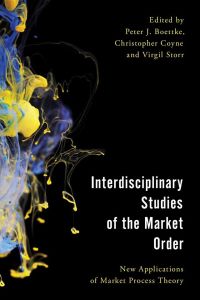
I encountered what would later become important elements of Mark Pennington’s book Robust Political Economy in two articles that he wrote on the limits of deliberative democracy, and the relative merits of market processes, for social and ethical discovery, as well as a short book Mark wrote with John Meadowcroft, Rescuing Social Capital from Social Democracy. This research program inspired me to start my doctorate and pursue an academic career.  Why did I find robust political economy so compelling? I think it is because it chimed with my experience of encountering the limits of neo-classical formal models that I recount in my chapter, ‘Why be robust?’, of a new book, Interdisciplinary Studies of the Market Order.

While doing my master’s degree in 2009, I took a methodology course in rational choice theory at Nuffield College’s Center for Experimental Social Science. As part of our first class we were taken to a brand new, gleaming behavioural economics laboratory to play a repeated prisoners’ dilemma game. The system randomly paired anonymous members of the class to play against each other. We were told the objective of the game was to maximise our individual scores.

Thinking that there were clear gains to make from co-operation and plenty of opportunities to punish a defector over the course of repeated interactions, I attempted to co-operate on the first round. My partner defected. I defected a couple of times subsequently to show I was not a sucker. Then I tried co-operating once more. My partner defected every single time in the repeated series.

At the end of the game, we were de-anonymised and it turned out, unsurprisingly, that I had the lowest score in the class. My partner had the second lowest. I asked her why she engaged in an evidently sub-optimal strategy. She explained: ‘I didn’t think we were playing to get the most points. I was just trying to beat you!’

The lesson I took away from this was not that formal models were wrong. Game theoretic models, like the prisoners’ dilemma, are compelling and productive analytical tools in social science, clarifying the core of many challenges to collective action. The prisoners’ dilemma illustrates how given certain situations, or rules of the game, self-interested agents will be stymied from reaching optimal or mutually beneficial outcomes. But this experience suggested something more complex and embedded was going on even in relatively simple social interactions.

The laboratory situation replicated the formal prisoners’ dilemma model as closely as possible with explicit rules, quantified ‘objective’ (though admittedly, in this case, low-value) payoffs, and a situation designed to isolate players as if they were prisoners in different cells. Yet even in these carefully controlled circumstances, it turns out that the situation is subject to multiple interpretations and understandings.

Whatever the textual explanation accompanying the game, the score on the screen could mean something different to the various players. The payoffs for the representative agents in the game were not the same as the payoffs in the minds of the human players. In a sense, my partner and I were unwittingly playing different games (although I lost within either rules of the game!).

When we engage with the social world, it is not only the case that our interests may not align with other people. Social interaction is open-ended. We do not know all the possible moves in the game, and we do not know much about the preference set of everyone else who is playing. Indeed, neither they nor we know what a ‘complete’ set of preferences and payoffs would look like, even of our own. We can map out a few options and likely outcomes through reflection and experience but even then we may face outcomes we do not anticipate. As Peter Boettke explains: ‘we strive not only to pursue our ends with a judicious selection of the means, but also to discover what ends that we hope to pursue.’

In addition, the rules of the game themselves are not merely exogenous impositions on us as agents. They are constituted inter-subjectively by the practices, beliefs and values of the actors that are also participants in the social game. As agents, we do not merely participate in the social world. We also engage in its creation through personal lifestyle experimentation, cultural innovation, and establishing shared rules and structures. The social world thus presents inherent uncertainty and change that cannot be captured in a formal model that assumes fixed rules of the game and the given knowledge of the players.

It is these two ideas, both borrowed from the Austrian notion of catallaxy, that makes robust political economy distinct. First, neither our individual ends, nor means of attaining them, are given prior to participation in a collective process of trial and error. Second, the rules that structure how we interact are themselves not given but subject to a spontaneous, evolutionary process of trial and error.

I try to set out these ideas in a recent symposium in Critical Review on Mark Pennington’s book, and in ‘Why be robust?’ in Interdisciplinary Studies of the Market Order edited by Peter Boettke, Chris Coyne and Virgil Storr. The symposium article is available on open access and there is a working paper version of my chapter is available at the Classical Liberal Institute website.

The End of the Past


On Branko Milanovic’s recommendation, I read Aldo Schiavone’s The End of the Past. Scholarly and elegantly written, it provides one of the best imaginative reconstructions of the ancient Roman economy.

Previous posts have touched on the economies of late antiquity, the modernist primitivist debate, and diagnosed problems in many recent assessments of the ancient economy (here, here, here, and here). I want to use Schiavone’s book to revisit a question raised by Peter Temin in The Roman Market Economy. How advanced was the Roman economy? Specifically, how did it compare to the economy of Europe in late medieval or early modern times? Was the Roman economy only as developed as that of Europe circa 1300 or was it as advanced as that of western Europe on the eve of the Industrial Revolution in say 1700.

This question is not mere idle speculation. It matters for our understanding of the causes of long-run economic growth whether an industrial revolution could have happened in Song China or ancient Rome. This type of counterfactual history is crucial for pinning down the casual mechanisms responsible for sustained growth, especially as historians like Bas van Bavel are now proposing explicitly cyclical accounts of growth in societies as varied as early medieval Iraq and the Dutch Republic (see The Invisible Hand? (OUP, 2016))

Temin’s GDP estimates suggest that Roman Italy had comparable per capita income to the Dutch Republic in 1600. The Empire as a whole, he suggests, may have been comparable to Europe in 1700 (Temin 2013, 261). My gut reaction is that this is plausible as an upper-bound. Schiavone (who was writing several years before Temin), however, raises important points that I had fully not considered previously.

Schiavone opens with an account of a speech given by Aelius Aristides celebrating the wealth of the Roman empire in the mid-2nd century AD.

“Whatever each culture grows and manufactures cannot fail to be here at all times and in great profusion. Here merchant vessels arrive carrying these many commodities from every region in every season and even at every equinox, so that the city takes on the appearance of a sort of common market for the world. One can see cargoes from India and even from southern Arabia in such numbers that one must conclude that the trees in those lands have been stripped bare, and if the inhabitants of those lands need anything, they must come here to beg for a share of what they have produced….

Your farmlands are Egypt, Sicily, and all of cultivated Africa. Seaborne arrivals and departures are ceaseless, to the point that the wonder is, not so much that the harbor has insufficient space for all these merchant vessels, but that the sea has enough space (if it really does). Just as there is a common channel where all waters of the Ocean have a single source and destination, so that there is a common channel to Rome and all meet here: trade, shipping, agriculture, metallurgy— all the arts and crafts that are or ever were and all things that are produced or spring from the earth. What one does not see here does not exist” (Aristides, The Roman Oration).

This is a panegyric addressed to flatter the emperor but its emphasis on long-distance trade, commerce, manufacturing is highly suggestive. Such a speech is all but impossible to imagine in an predominantly rural and autarkic society. Aristides is painting a picture of a highly developed commercialized economy that linked together the entire Mediterranean and beyond. Even if he is grossly exaggerates, the imagine he depicts must have been plausible to his audience. In evaluating the Roman economy in the age of Aristides, Schaivone notes that:

“Until at least mid-seventeenth century Amsterdam, so expertly described by Simon Schama — the city of Rembrandt, Spinoza, and the great sea-trade companies, the product of the Dutch miracle and the first real “globalization of the economy — or at least, until the Spanish empire of Philip II, the total wealth accumulated and produced in the various regions of Europe reached levels that were not too far from those of the ancient world” (Schiavone, 2000, 94).

This is the point Temin makes. Whether measured in terms of the size of its largest cities — Rome in 100 AD was larger than any European city in 1700 — or in the volume of grain, wine, and olive oil imported into Italy, the scale of the Roman economy was vast by any premodern standard. Quantitatively, then, the Roman economy looks as large and prosperous as that the early modern European economy.

Qualitatively, however, there are important differences that Schiavone draws out and which have been obscured in recent quantitative debates about GDP estimates.

Observe that Roman history leaves no traces of great mercantile companies like the Bardi, the Peruzzi or the Medici. There are no records of commercial manuals of the sort that are abundant from Renaissance Italy; no evidence of “class-struggle” as we have from late medieval Europe; and no political economy or “economics”, that is, no attempts to systematize one’s thoughts and insights concerning the commercial world. The ancient world, in this view, only superficially resembled that of early modern Europe. Seen from this perspective, the latter contained the potential for sustained growth; the former did not. Why is this?


The most obvious institutional difference between the ancient world and the modern was slavery. Recently historians have tried to elevate slavery and labor coercion as crucial causal mechanism in explaining the industrial revolution. These attempts are unconvincing (see this post) but slavery certainly did dominate the ancient economy.

In its attempt to draw together the various strands through which slavery permeated the ancient economy, Schiavone’s chapter “Slaves, Nature, Machines” is a tour de force. At once he captures the ubiquity of slavery in the ancient economy, its unremitting brutality—for instance, private firms that specialized in branding, retrieving, and punishing runaway slaves — and, at the same time, touches the central economic questions raised by ancient slavery: to what extent was slavery crucial to the economic expansion of period between 200 BCE and 150 AD? And did the prevalence of slavery impede innovation?

It is impossible to do justice to the argument in a single post. Suffice to say that after much discussion, and many fascinating interludes, Schiavone suggests that ultimately the economic stagnation of the ancient world was due to a peculiar equilibrium that centered around slavery.

One can think of this equilibrium as resting on a two legs. The first is the observation that the apparent modernity of the ancient economy — its manufacturing, trade, and commerce rested largely on slave labor. The expansion of trade and commerce in the Mediterranean after 200 BC both rested on, and drove, the expansion of slavery. Here Schiavone note that the ancient reliance on slaves as human automatons — machines with souls — removed or at least weakened, the incentive to develop machines for productive purposes.

The existence of slavery, however, was not the only reason for the neglect of productive innovation. There was also a specific cultural attitude that formed the second leg of the equilibrium:

“None of the great engineers and architects, none of the incomparable builders of bridges, roads, and aqueducts, none of the experts in the employment of the apparatus of war, and none of their customers, either in the public administration or in the large landowning families, understood that the most advantageous arena for the use and improvement of machines — devices that were either already in use or easily created by association, or that could be designed to meet existing needs — would have been farms and workshops”

The relevance of slavery colored ancient attitudes towards almost all forms of manual work or craftsmanship. The dominant cultural meme was as follows: since such work was usually done by the unfree, it must be lowly, dirty and demeaning:

“technology, cooperative production, the various kinds of manual labor that were different from the solitary exertion of the peasants on his land — could not but end up socially and intellectually abandoned to the lowliest members of the community, in direct contact with the exploitation of the slaves, for whom the necessity and demand increased out of all proportion . . . the labor of slaves was in symmetry with and concealed behind (so to speak) the freedom of the aristocratic thought, while this in turn was in symmetry with the flight from a mechanical and quantitative vision of nature”

Thus this attitude also manifest itself in the disdain the ancients had for practical mechanics:

Similar condescension was shown to small businessmen and to most trade (only truly largely-scale trade was free from this taint). The ancient world does not seem to have produced self-reproducing mercantile elites. Plausible this was in part because of the cultural dominance of the landowning aristocracy.

The phenomenon coined by Fernand Braudel, the “Betrayal of the Bourgeois,” was particularly powerful in ancient Rome. Great merchants flourished, but “in order to be truly valued, they eventually had to become rentiers, as Cicero affirmed without hesitation: ‘Nay, it even seems to deserve the highest respect, if those who are engaged in it [trade], satiated, or rather , I should say, satisfied with the fortunes they have made, make their way from port to a country estate, as they have often made it from the sea into port. But of all the occupations by which gain is secured, none is better than agriculture, none more delightful, none more becoming to a freeman’” (Schiavone, 2000, 103).

Such a cultural argument fits perfectly with Deirdre McCloskey’s claim in her recent trilogy that it was the adoption of bourgeois cultural norms and specifically bourgeois rhetoric that distinguished and caused the rise of north-western Europe after 1650 (here, here, and here).


Having taken note of the existence of such a powerful equilibrium — one resting on both material and cultural foundations, we can now return to Schiavone’s argument for why a modern capitalist economy did not develop in antiquity. He argues that given the prominence of slavery and the prestige of the landowning elite, economic expansion and growth of the kind that took place between c. 200 BCE to 150 CE was not self-reinforcing. It generated a growth efflorescence that lasted several centuries, but it ultimately undermined itself because it was based on an intensification of the slave economy that, in turn, reinforced the cultural supremacy of the landowning aristocracy and this cultural supremacy in turn eroded the incentives responsible for driving growth.

Compare and contrast with early modern Europe. The most advanced economies of early modern Europe, say England in 1700, were on the surface not too dissimilar to that of ancient Rome. But beneath the surface they contained the “coiled spring”, or at least the possibility, of sustained economic growth — growth driven by the emergence of innovation (a culture of improvement) and a commercial or even capitalist culture. According to Schiavone’s assessment, the Roman economy at least by 100 CE contained no such coiled spring.

We are not yet at the point when we can decisively assess this argument. But the importance of culture and the manner in which cultural and material factors interacted is clearly crucial. The argument that the slave economy and the easy assumptions of aristocratic superiority reinforced one another is a powerful one. For whatever historical reasons these cultural elements in the Roman economy were relatively undisturbed by the rise of merchants, traders and money grubbing equites. Likewise slavery did not undermine itself and give rise to wage labor.

Why this was the case can be left to future analysis. The full answer to the question why this was the case and a more careful consideration of the counterfactual “could it have been otherwise” are topics deserving their own blog post.

Coup and Counter Coup III (Gülenists and Kemalists)

My last post established the party structure in Turkey. The flow of events since the attempted coup of fifteenth July and the emergency regime instituted on twentieth July is that of a government assault on opposition. Democracy as liberal democracy continues to give way to illiberal majoritarianism. Liberal democracy has never existed in its purest form in Turkey, but there was more of it ten years ago and it looks like becoming further diluted. Initial indications that the state of emergency would be three months only, rather than the constitutionally allowed maximum of six months have been undermined by constant renewal with no debate and no indication of when the renewals will end.

When the AKP first came to power its campaign materials included claims that it would end the use of the state of emergency as a tool of government. A long period of emergency rule in the southeast (that is where ethnic Kurds are a majority) had only recently ended. The AKP is now the party that has turned the state of emergency into a permanent state tool for the whole of Turkey. If it ends, it will only be if next month’s referendum gives President Erdoğan the further powers he is seeking, and he sees that as sufficient to compensate for the loss of emergency powers. The ‘presidential’ regime proposed, in reality a regime of elective authoritarianism with an enfeebled National Assembly and judiciary, would turn some emergency powers, particularly rule by decree with the force of law, into ‘normal’ practices.

Not only was the three month period of state of emergency a mislead to dissipate any opposition to the emergency regime, it was dishonestly presented as purely a means to crack down on the Gülenists (followers of the religious community leader Fetullah Gülen who lives in the United States) involved in the coup attempt. The investigation of the coup quickly turned into broad persecution of any associate of the Gülen movement, along with any one connected with Kurdish autonomy movements and the far left in general.

Anyone too loudly questioning the government’s methods, going back to criticisms during the night of the coup with regard to using the mosques to call people to protest and encouraging civilians to put themselves in danger at such protests (hundreds did die), or the mob violence atmosphere of that night, has been accused of Gülenism and been persecuted. Persecution has taken the form of loss of employment, arrest, detention and prison sentences, all relying on emergency powers. Opponents of the AKP have been very willing to believe accusations of Gülenism and to ignore, or downplay, the injustices taking place.

The role of the Gülenists in the coup is debated, though mostly outside Turkey. Most people in Turkey, including myself, have observed the power and ruthlessness of the group, and do not see another plausible candidate. If the idea of a Gülenist conspiracy seems like conspiracy theory, there are real conspiracies and only conspiracy theory could explain why the coup is believed to be Gülenist, if it is not true there has been a Gülenist conspiracy. It was pointed out years ago by the well known Turkish-American economist and Harvard professor Dani Rodrik that Gülenist police, prosecutors and judges had falsified evidence of an army coup with civilian collaborators and given long jail sentences, enabling officers to rise up who participated in the July coup attempt. Ahmet Şik, a journalist now in prison, wrote a well known  book exposing the Gülenists in their infiltration and manipulation of the state and was imprisoned himself now. Amongst the twisted actions of the emergency empowered states, Şik has now been imprisoned on charges of Gülenism.

Maybe other malcontents including some hardcore Kemalists participated, but the initial reaction of hard core Kemalists after the coup was to support Erdoğan. In one case this appears to have meant a radical move from complete opposition to Erdoğan to complete support. That is Doğu Perinçek, one of the most extraordinary characters in Turkish politics, a marginal figure in prison under more than one regime, who has never gained real electoral support who nevertheless finds his way to the centre of events. Perinçek has renamed his ‘Workers Party’, ‘Nation Party’ and may have acted as a contact with Putin through Aleksandr Dugin, a Russian nationalist thinker who enjoys an ambiguous relationship with the Russian President. Perinçek is a novelistic parody of a Kemalist who somehow found his way into real life. He does act as a point of reference for an ‘anti-imperialist’, that is anti-American and anti-EU form of Kemalism, which sees the Baath party (that is the authoritarian pan-Arabist ‘Renaissance’ party of the Assad regime in Syria and in the past of the Saddam regime in Iraq) as a natural ally.

Less colourful characters in the army with comparable views, who were sacked or retired during the faked trials orchestrated by the Gülenists, have come back apparently working with Erdoğan on a Eurasian perspective, as an alternative to the EU and Nato. This position existed in some senior army people before the AKP came to power, though the overall army line was to support NATO and the application process for the EU. The alliance with Putin is now looking ragged, as the Russian troops are clearly co-operating with a Kurdish group in Syria, PYD, defined as terrorist partners of the PKK by the Turkish government. The immediate atmosphere in July and soon after pushed some significant proportion of Kemalists towards Erdoğan as an enemy of their two old enemies: Gülenists and the PKK. The mainstream inheritor of the Kemalist legacy, the CHP, has continued to oppose Erdoğan and the emergency regime, even if rather cautiously and in fear of persecution if they go ‘too far’.

(A discursive approach is taking over from narration of events and future posts will probably proceed in the same way as I try to build a rounded account of Turkey since July 2016, with some historical background. The next post should give some account of other aspects of Kemalist legacy along with the polarisations the AKP seeks and uses to maintain its position.)