Globalization: Its Context and Its Virtues

In my spare time I try to read literary masterpieces and popular non-fiction. The latest book that I’ve picked up is Charles Mann’s 1493: Uncovering the New World Columbus Created. I picked it up because the author’s previous work 1491, had a profound impact on my way of thinking about the world. The new book doesn’t disappoint. An excerpt:

One way to summarize [scholar’s] efforts might be to say that to the history of kings and queens most of us learned as students has been added a recognition of the remarkable role of exchange, both ecological and economic.

[…] In some respects this image of the past – a cosmopolitan place, driven by ecology and economics – is startling to people who, like me, were brought up on accounts of heroic navigators, brilliant inventors, and empires […] It is strange, too, to realize that globalization has been enriching the world for nigh on five centuries.

Indeed. I want to use this quote to level two separate criticisms, one at the Left and one at the Right. Continue reading

The UN vote on Palestinian Question: Some Comments

Recently the UN voted to make the Palestinian territories as a “non-member observer state,” rather than a “non-member observer entity.” The vote was 73% to 5% with 22% abstaining.

As I’ve previously noted, I think the UN is a now-worthless organization, and CNN gives a good interpretation of the facts on the ground here if you’re interested.

My own take on this vote is scrambled, so bear with me as I lay it out here.

The Israelis have objected to this vote because they argue that the Palestinians are trying to forego direct negotiations with the Israelis. This is a fair objection.

However, the Israelis often argue that their state was legitimized when the UN voted in favor of a 1947 partition plan (the vote was 72% to 13% with 15% abstaining). That is to say, there were no direct negotiations between the Israelis and the Palestinians when the partition of Palestine was being drafted by the UN.

Much of the property owned by Jews in Israel today was acquired legally.

I think that the UN move by the Palestinians is a good one for two reasons:

  1. It gave the Israelis a taste of their own medicine by applying their own legal logic against them.
  2. It follows an ingenious tactic that the Israelis recently unveiled with the inclusion of expelled Jews from Arab states during the wars in the middle of last century.

To conclude, I favor a one state solution. I don’t like the idea of defining states in terms of religious or ethnic denominations, but I think the two-state solution is a good one to pursue for the time being. Both sides are guilty of practicing diplomacy in bad faith, but I have to hand it to the Palestinians on this one. It’s a stroke of genius.

God I’m Lazy…

Economist Tyler Cowen defends Hayek and Friedman from a recent hit piece in a center-left magazine. He writes:

Solow neglects to mention that Milton Friedman turned out to be right on most of the issues he discussed (though targeting money doesn’t work), that MPS economists shaped at least two decades of major and indeed beneficial economic reforms across the world, or that some number of the economists at MIT envied the growth performance of the Soviet Union and that such remarks were found in the most popular economics textbook in the profession.

Read the whole thing.

Also, some stuff I’ve read over the past couple of days (weeks?):

  1. Should the U.S. Help Break Up Somalia?
  2. It’s not quite what it sounds like. Read the whole thing!

  3. Redrawing the Map.

Can you tell what’s been on my mind lately? A couple more:

  1. How Corrupt Are Ivy League Admissions? Ask Asians and Asian-Americans…
  2. Longtime reader (and a blogger far more popular than NoL) Hank asks a good question. Feel free to help your humble blogger out!

Around the Web

  1. Free Baluchistan! More on secession, this time in Pakistan. I’d highly recommend taking a gander at this one.
  2. The Economist has great article critiquing France’s “new” relationship with Africa. It appears to be just like the old one.
  3. Six Nations passports, issued in Canada for the indigenous, are more than just travel documents. Or are they?
  4. Bacevich has an article at Foreign Policy suggesting that NATO should become an all-European alliance.
  5. More on secession: Welcome to New Bohemia (this time from the Left).

Secession within the EU?

While I’m on the topic of secession, I thought I’d point readers to the upcoming vote in Catalonia to see if they want to secede from Spain. Central to my arguments for secession is the role that new states would have within a broader free trade zone (like the U.S. or the E.U.). For Catalonia, the British paper Telegraph reports:

Catalonia wants to collect its own taxes, to control how they are spent and it seems prepared to break away from Spain to do so.

But with a clear road map yet to be outlined the process of separating from Spain promises to be burdened with hurdles.

While Catalans prize their role as citizens of Europe, EU officials have warned that membership of the union won’t be automatic. Instead Catalonia would have to gain admission, joining the queue of a list of new European nations seeking membership, and the process would likely be blocked by a vengeful Spain.

This is key to not only Catalonia’s success, but also the success of secessionist movements everywhere. If regions within current states want independence, they have to be sure to not confuse political independence with economic independence. The latter will only lead to poverty. I highlight this point because new states formed during the beginning of the post-colonial revolution of the 60’s and 70s thought that economic independence was the key to liberty. How wrong they were. Continue reading

The Case for More States in Africa? Anarchy, State or Utopia?

Yes please! There is an old article in the Atlantic arguing that more states are just what Africa needs, and I’d like to highlight why I think more states are a good thing, and at the same time pick up Dr. Delacroix’s argument on states and libertarianism from a little while back and explain why I think that more states are a good thing and why Dr. Delacroix doesn’t really understand libertarian thought.

Now, I know more states seems at first glance to be a counterintuitive position for a libertarian to take, but upon second glance I hope to show you why this isn’t true.

First up, from the Atlantic‘s article:

The idea that Africa suffers from too few secessionist campaigns, too few attempts to carve a few large nations into many smaller ones, flies in the face of conventional wisdom. One of the truisms of African politics is that traditional borders, even when bequeathed by colonizers without the least sympathy for African political justice, ought to be respected. The cult of colonial borders has been a cornerstone not only of diplomacy between African nations but of the assistance programs of foreign governments and multinational non-governmental organizations.

I’ve pointed this out from a number of different angles previously here on the blog, so I don’t want to delve too deeply into this, but the article, written by a professor of journalism at Arizona State, has more: Continue reading

Around the Web: “I’m Stuffed” Edition

I’m so full from food and dessert it’s not even funny. I’m back home in NorCal, too. I hope your holiday has been everything that mine has and more.

  1. Immigration: Giant low-hanging fruit.
  2. Have you ever heard of Opera, the browser? I have, and I tried it out at one point, but Google’s Chrome is where its at. Anyway, Opera is the most used browser in Belarus…and no where else. Find out why, in the Atlantic.
  3. Some literary history. From FEE.
  4. China in Revolt.
  5. Contra #4, Hayek in China.

Happy holidays to you all, and tell your moms I said ‘hi’!


What Exactly is Profit, Anyway?

Co-editor Fred Foldvary explains over at FEE’s revamped website:

We also need to distinguish economic revenue from accounting revenue.  Suppose a thief enters a house and steals $1,000 of loot.  To break into that house he bought a tool for $100.  Ignoring the opportunity cost of his time, the thief’s accounting revenue is $1,000, and his cost is $100.  Is the $900 net gain a profit in the economic sense?

Stolen loot is not real profit because it is a forced transfer of goods or money from the victim to the thief.  True profit is a net gain from production and exchange.  If someone gives you a gift of $100, it too is just a transfer.

If instead of directly stealing wealth someone uses the government to forcibly take money from some and give it to others, the gain is also not true profit.

Read the rest here.

Methodological Individualism

That’s the title to co-blogger Warren Gibson’s latest piece in the Freeman. I wish I could copy and paste the whole thing, but you’ll have to settle for this juicy tidbit:

Let’s start with what methodological individualism is not.  It has nothing to do with “rugged individualism.”  It is not ideology at all.  It is a term that describes the essential nature of human thought and action.  It is a bedrock principle on which Mises grounds his entire exposition of economics.

“The Hangman, not the state, executes a criminal.”  This is Mises’s pithy summary of methodological individualism […]

When we think about the hangman from the point of view of praxeology (Mises’s name for the science of human action) we are not concerned with the social or psychological factors that may have influenced his action, nor the neural firings in his brain, nor the musculoskeletal actions in his arm.  We are simply observing that actions are always initiated and carried out by individuals and are always motivated by the individual’s expectation of being better off as a result of the chosen action rather than some alternative.

Do read the whole thing.

Israelis Deliberately Slaughter Palestinian Civilians; Assad Cool!

As I write, the Israeli Air Force has killed almost twenty Gazans including an important terrorist leader. It did this as a part of its never-ending self-defense against terrorism emanating from Gaza. I wouldn’t be surprised if the number of Gazan dead rose to near one hundred in a short time.

In the past, Israel exchanged hundreds of Palestinian prisoners for one Israeli captive. Once it was against the corpse of an Israeli. The same sort of strange arithmetic prevails with respect to the civilian victims of Israeli military action, according to world-wide liberal opinion. Collateral killings of Arabs by Israeli Jews are unspeakable atrocities. When Arabs deliberately target and massacre Arabs though it’s not really so bad, not really. Mark my word, it will take only days, if not hours, for the liberal media to treat the twenty, or the hundred victims, of Israeli action as more reprehensible than President Assad 20,000 ( and counting).

Look again: 100/20,000.

It’s pretty clear anyway that Arabs killed by other Arabs just get up and dust themselves off when the cameras are gone.

I hope the new Islamist government of Egypt understands that any Israeli government will nuke parts of Egypt rather than see Israel, the state, and even more importantly, its population, seriously threatened. I am not confident that it does understand. Islamists are a parochial lot (ah, ah!) with feet firmly planted in the seventh century. I fear their ignorant, bellicose fantasies. Continue reading

Around the Web

  1. Ron Paul’s Farewell Speech to Congress.
  2. A decent briefing of the Israeli-Gaza conflict. I hope to have more on this in the near future. From the LA Times.
  3. Free Speech on Campus? Yeah right. Universities are some of the most reactionary places in a given society, and the free speech codes they have built up over the past 60 years plainly shows this bias. Quick thought: if universities are so reactionary, why are they dominated by hard Leftists? Gold star to anyone who ventures to answer this! From the WSJ.
  4. Old Soviet jokes become the new American reality. Written by an immigrant from the former Soviet Union. Take it with a pinch of salt, though…

Go Bruins!

That is all.

I’m originally from northern California, by way of Utah (long story: ask me about it sometime!), but I love Los Angeles! One of the world’s greatest cities.

In case you are wondering, UCLA’s football team just beat Southern Cal and won the division title in the nation’s toughest football conference. I don’t care what you say, but until I see some SEC teams come out West and play our boys, I’ll continue to argue that the West plays the best football in the country.

As for Southern Cal, well, there’s always basketball season…

Atomic Radiation and Mental Health

The average level of radiation to which inhabitants of the beautiful city of Denver  are exposed is .9 rem (zero point nine). The level of radiation in the hots spots around the damaged Fukushima nuclear reactor was .1 rem (zero point one).  Yes, it’s nine times lower near Fukushima than in Denver.

Denver residents concerned about the effects exposure to radiation have on their health should evidently have moved to the Japanese hot spots for greater safety, it seems to me. I hear the price of real estate plummeted in that area.

The first paragraph is drawn from “The Panic Over Fukushima” in the Review section of the Wall Street Journal of August 18 – 19 2012. The article is by Richard Muller, PhD,  a Professor of Physics at the University of California, Berkeley. (But what does he know?)

The cynical deduction in the second paragraph is mine, of course. Here are more.

Shouldn’t alarmists employ their high capacity for panic in connection with large and certain killers of people such as road accidents and the myriads of illnesses that unwashed hands cause?

How difficult is it to understand that nuclear energy is the cheapest and the safest alternative to poisonous coal emissions and to “blood for oil”? Yes, it’s that simple. Continue reading

Around the Web

  1. The Future of Freedom Foundation has revamped its website. Be sure to give those guys some love.
  2. Reason on the Israeli airstrikes in Gaza.
  3. For some reason I keep coming back to this blog. The writing is just superb.

Have a good weekend!

Warren Harding’s Fiscal Cliff

The economy is in rough shape right now but suppose it were even worse: unemployment at 12% rather than 8%; GDP falling at a 17% annual rate rather than rising slowly.  A close advisor to the President counsels an array of interventions to stimulate the economy but is ignored.  Instead, the President cuts Federal spending in half and engineers drastic reductions in income  tax rates for all groups.  Meanwhile the Federal Reserve, rather than cranking up the printing presses for a round of monetary stimulus, snoozes through the whole year.

Now there’s a fiscal cliff for you.  If today’s thinking about the fiscal cliff of Jan. 1, 2013 held true, surely such policies would tank the economy big-time.

The foregoing scenario actually happened.  The year was 1920, the President was Warren G. Harding and his close advisor was none other than Herbert Hoover, who as President from 1929 to 1933 would have his way – raising taxes, jawboning wages, and slapping a killer tariff on the economy, thereby doing a great deal to turn the rather mild downturn of 1929-30 into the Great Depression which, with lots of help from Franklin Roosevelt, would plague the nation for another decade.
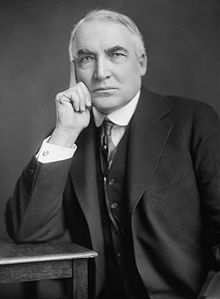
So what happened in Harding’s time?  Things were pretty rough for a while but by the summer of 1921, signs of recovery were already visible.  The following year, unemployment was back down to 6.7% and hit 2.4% by 1923 (source: Thomas Woods, “The Forgotten Depression of 1920″).  A budget surplus arose resulting in a noticeable decline in the national debt.  Business confidence soared and the 1920’s boom was off and running.

President Harding has gotten a bad rap from history because of the scandals that erupted during his administration as well as his chronic womanizing and his passion for the bottle.  But in the countdown of 20th century Presidents that I might do for this blog should I ever get ambitious, I will start with Harding as the least bad President of that sad century and work my way down from there.  I’ll let you  guess who I will honor as the Worst President of the Century.

How does the looming fiscal cliff compare with the policies of 1920?  In case you’ve been hiding under a rock lately (not a bad way to ride out the election campaign!), the fiscal cliff is the set of automatic tax increases and spending cuts that were agreed to when the debt ceiling was raised in 2011.  Congress decided to force its future self to act by lighting a time bomb that it would surely – surely! – defuse before it could go off.  The fuse has now burned to within 1/8 inch of the bomb.

The bomb’s tax increases and spending cuts would reduce the deficit by an estimated $600 billion in one year.  That may be the most accurate estimate but it’s only an estimate.  Congress can set tax rates but tax revenues depend on the size of the tax base.  If highly productive people, those who would take the biggest hit, decide to Go Galt, the tax base could shrink.  And as Jeff Hummel likes to point out, tax rates, particularly the top marginal rates, have varied drastically over the years and yet tax receipts have not varied much from 20% of GDP, excepting the World War II years.

Not only might tax receipts fall short, but expenditures could rise if additional welfare payments such as unemployment benefits or food stamps were to rise.

But let’s assume the fiscal cliff happens and the deficit is indeed reduced by $600 billion. Using figures for the fiscal year just ended, we would still have a $400 billion deficit which would have to be financed by borrowing.  As always, this would be new borrowing, on top of the borrowing needed to roll over the daily stream of maturing debt.  And we mustn’t forget the Social Security Trust Fund which until last year has mitigated the deficit by “investing” its surpluses (FICA tax revenues minus benefit payments) in Treasury securities.  Those FICA surpluses have now turned to deficits which for the present are offset by interest payments on Trust Fund holdings but will eventually require the Trust Fund to stop rolling over maturing securities and, should the trend continue, to deplete its holdings entirely.  All of these developments exacerbate the main federal deficit.  The same applies to the much smaller Medicare Trust Fund.

So I say, with a glance over my shoulder at 1920, bring on the fiscal cliff!  Let the cuts happen, thereby ending a lot of wasteful and harmful spending – particularly “defense” spending.  Let tax rates rise; people will work around them.

But it won’t happen because too many special interests will rise up to prevent it:

  • There are enough military personnel, military contractors, their suppliers, relatives and hangers-on to prevent significant cuts in defense spending.
  • The 27% cut in Medicare physician fees will lead doctors to brush away their Medicare patients like flies, sending those patients hobbling off to howl at their their Congressmen.
  • Millions of middle class people will gasp when their tax preparer tells them they’ve been caught in the dreaded Alternative Minimum Tax trap.  Others will escape the trap only to find that their ordinary income tax rates have risen substantially.
  • Still more millions will see their FICA (Social Security) tax rate revert to the 2010 rate of 6.2% from the current 4.2% “stimulus” figure.

The fiscal cliff won’t happen, at least not all of it, except perhaps for a brief period in January which will be fixed retroactively.  And so, though I hate to say it, I think the longer-term odds of pulling out of our fiscal death spiral are pretty slim.  Many think the government will resort to the time-honored remedy of the printing press, but Jeff Hummel has made a solid argument as to why this option won’t work and why there will be a default on Treasury securities instead.

Hummel also urges economists to do whatever they can to warn people not to count on government largess.  Most young people have written off Social Security for their future and that’s a good thing.  (Not so good for Social Security recipients like me who are increasingly unemployable yet hope to live another 25 years.)  We must take responsibility for our own health care, first by watching our health habits and second by cultivating a personal relationship with a physician, perhaps offering him or her cash payments.  We should be leery of Treasury Securities or of banks, mutual funds, etc. that rely heavily on these securities.  Sock away a few gold and silver coins.

We’re in for a rough ride, I fear, over the next few years.  But the sun will still rise and tangible assets will remain.  Provided enough of us have taken precautions, social unrest will be manageable and maybe, just maybe, the cancer that is called Social Democracy will be shaken off once and for all.