In the Ruins of Public Reason, Part III: When the Barbarians Are at the Gates; Fascism, Bullshit, and the Paradox of Tolerance

Note: This is the third in a series of essays on public discourse. Here’s Part 1 and Part 2

Three years ago, I started this essay series on the collapse of public discourse. At the time, I was frustrated by how left-wing and progressive spaces had become cognitively rigid, hostile, and uncharitable to any and all challenges to their orthodoxy. I still stand by most everything I said in those essays. Once you have successfully identified that your interlocutors are genuinely engaging in good faith, you must drop the soldier mindset that you are combating a barbarian who is going to destroy society and adopt a scout mindset. For discourse to serve any useful epistemic or political function, interlocutors must accept and practice something like Habermas’ rules of discourse or Grice’s maxims of discourse, where everyone is allowed to question or introduce any idea to cooperatively arrive at an intersubjective truth. The project of that previous essay was to therapeutically remind myself and any readers to actually apply and practice those rules of discourse in good-faith communication.

However, at the time, I should have more richly emphasized something that has been quite obviously true for some time now: most interlocutors in the political realm have little to no interest in discourse. I wish more people had such an interest, and still stand by the project of trying to get more people, particularly in leftist and libertarian spaces, to realize that when they speak to each other, they are not dealing with barbarian threats. However, recent events have made it clear that the real problem is figuring out when an interlocutor is worthy of having the rules of discourse applied in exchanges with them. Here is an obviously non-exhaustive list of such events in recent times that make this clear: 

  1. The extent to which Trump himself, as well as his advisors and lawyers, engage in lazy, dishonest, and bad-faith rationalizations for naked, sadistic, unconstitutional executive power grabs.
  2. The takeover of the most politically influential social media by a fascist billionaire rent-seeker has resulted in a complete fragmentation and breakdown of the online public square
  3. The degree to which most on the right and many on the left indulge in insane conspiracy theories, which have eroded and destroyed the epistemic norms of society, for reasons of rational irrationality.
  4. Even the Supreme Court, the institution that ostensibly is most committed to publicly justifying and engaging in good-faith reasoning about laws, is now giving blatantly awful, authoritarian opinions so out of step with their ostensibly originalist and/or textualist legal hermeneutics and constitutionalist principles (not to mention the opinions of even conservative judges in lower courts). It certainly seems the justices are just as nakedly corrupt and intellectually bankrupt as rabble-rousing aspiring autocrats. Indeed, the court is in such a decrepit state of personalist capture by an aspiring fascist dictator that they aren’t even attempting to publicly justify ‘shadow docket’ rulings in his favor. One can only conclude conservative justices are engaging in bad-faith power-grabs for themselves, whether they intend to or not. Although this has always been true of statist monocentric courts to some extent, recent events have only further eroded the court’s pretenses to being a politically 

All these were obvious trends three years ago and have very predictably only gotten more severe.  You may quibble with the extent of my assessment of any individual example above. Regardless, all but the most committed of Trumpanzees can agree that there is a time and place to become a bit dialogically illiberal in times like these. Thus, it is time to address how one can be a dialogical liberal when the barbarians truly are at the gates. The tough question to address now is this: what should the dialogical liberal do when faced with a real barbarian, and how does she know she is dealing with a barbarian? 

This is an essay about how to remain a dialogical liberal when dialogical liberalism is being weaponized against you. This essay isn’t for the zealots or the trolls. It’s for those of us who believed, maybe still believe, that democracy depends on dialogue—but who are also haunted by the sense that this faith is being used against us.

Epistemically Exploitative Bullshit

I always intended to write an essay to correct the shortcomings of the original one. I regret that, for various personal reasons, I did not do so sooner. The sad truth is that a great many dialogical illiberals who are also substantively illiberal engage in esoteric communication (consciously or not). That is, their exoteric pretenses to civil, good-faith communication elide an esoteric will to domination. Sartre observed this phenomenon in the context of antisemitism, and he is worth quoting at length:

Never believe that anti‐Semites are completely unaware of the absurdity of their replies. They know that their remarks are frivolous, open to challenge. But they are amusing themselves, for it is their adversary who is obliged to use words responsibly, since he believes in words. The anti‐Semites have the right to play. They even like to play with discourse for, by giving ridiculous reasons, they discredit the seriousness of their interlocutors. They delight in acting in bad faith, since they seek not to persuade by sound argument but to intimidate and disconcert. If you press them too closely, they will abruptly fall silent, loftily indicating by some phrase that the time for argument is past. It is not that they are afraid of being convinced. They fear only to appear ridiculous or to prejudice by their embarrassment their hope of winning over some third person to their side.

If then, as we have been able to observe, the anti‐Semite is impervious to reason and to experience, it is not because his conviction is strong. Rather, his conviction is strong because he has chosen first of all to be impervious.

What Sartre says of antisemitism is true of illiberal authoritarians quite generally. Thomas Szanto has helpfully called this phenomenon “epistemically exploitative bullshit.” 

One feature of epistemically exploitative bullshit that Szanto highlights is that epistemically exploitative bullshit need not be intentional. Indeed, as Sartre implies in the quote above, the ‘bad faith’ of the epistemically exploitative bullshitter involves a sort of self-deception that he may not even be consciously aware of. Indeed, most authoritarians (especially in the Trump era) are not sufficiently self-aware or intelligent enough to consciously realize that they are deceiving others about their attitude towards truth by spouting bullshit. As Henry Frankfurt observed, bullshit is different from lying in that the liar is intentionally misrepresenting the truth, but the bullshitter has no real concern for truth in the first place. Thus, many bullshiters (especially those engaged in epistemically exploitative bullshit) believe their own bullshit, often to their detriment.

However, the fact that epistemically exploitative bullshit is often unintentional, or at least not consciously intentional, creates a serious ineliminable epistemic problem for the dialogical liberal who seeks to combat it. It is quite difficult to publicly and demonstrably falsify the hypothesis that one’s interlocutor is engaging in epistemically exploitative bullshit. This often causes people who, in their heart of hearts, aspire to be epistemically virtuous dialogical liberals to misidentify their interlocutors as engaging in epistemically exploitative bullshit and contemptuously dismiss them. I, for one, have been guilty of this quite a bit in recent years, and I imagine any self-reflective reader will realize they have made this mistake as well. We will return to this epistemic difficulty in the next essay in this series.

To avoid this mistake, we must continually remind ourselves that the ascription of intention is sometimes a red herring. Epistemically exploitative bullshit is not just a problem because bullshitters intentionally weaponize it to destroy liberal democracies. It is a problem because of the social and (un)dialectical function that it plays in discourse rather than its psychological status as intentional or unintentional. 

It is also worth remembering at this point that it is not just fire-breathing fascists who engage in epistemically exploitative bullshit. Many non-self-aware, not consciously political, perhaps even liberal, political actors spout epistemically exploitative bullshit as well. Consider the phenomenon of property owners—both wealthy landlords and middle-class suburbanites—who appeal to “neighborhood character” and environmental concerns to weaponize government policy for the end of protecting the economic rents they receive in the form of property values. Consider the similar phenomenon of many market incumbents, from tech CEOs in AI to healthcare executives and professionals, to sports team owners, to industrial unions, to large media companies, who all weaponize various seemingly plausible (and sometimes substantively true) economic arguments to capture the state’s regulatory apparatus. Consider how sugar, tobacco, and petrochemical companies all weaponized junk science on, respectively, obesity, cigarettes, and climate change to undermine efforts to curtail their economic activity. Almost none of these people are fire-breathing fascists, and many may believe their ideological bullshit is true and tell themselves they are helping the world by advancing their arguments. 

The pervasive economic phenomenon of “bootleggers and Baptists” should remind us that an unintentional form of epistemically exploitative bullshit plays a crucial role in rent seeking all across the political spectrum. This form of bullshit is particularly hard to combat precisely because it is unintentional, but its lack of intentionality in no way lessens the harmful social and (un)dialectical functions it severe.

Despite those considerations, it is still worth distinguishing between consciously intentional forms of aggressive esotericism and more unintentional versions because they must be approached very differently. Unintentional bullshitters do not see themselves as dialogically illiberal. Therefore, responding to them with aggressive rhetorical flourishes that treat them contemptuously is very unlikely to be helpful. For this reason, the general (though defeasible) presumption that any given person spouting epistemically exploitative bullshit is not an enemy that I was trying to cultivate in the second part of this essay series still stands. In the next essay, I will address how we know when this presumption has been defeated. However, for now, let us turn our attention to the forms of epistemically exploitative bullshit common today on the right. We have now seen how epistemically exploitative bullshit can appear even in technocratic, liberal settings. But that phenomenon takes on a more virulent form when fused with authoritarian intent. This is what I call aggressive esotericism.

Aggressive Esotericism

The corrosiveness of these more ‘liberal’ and technocratic forms of epistemically exploitative bullshit discussed above, while serious, pales in comparison to more bombastically authoritarian forms of it. The truly authoritarian epistemically exploitative bullshiter aims at more than amassing wealth by capturing some limited area of state policy. While he also does that, the fascist aims at the more ambitious goal of dismantling democracy and seizing the entire apparatus of the state itself.

 Let us name this more dangerous form of epistemically exploitative bullshit. Let us call this aggressive esotericism and loosely define it as the phenomenon of authoritarians weaponizing the superficial trappings of democratic conversation to elide their will to dominate others. This makes the fascistic, aggressive esotericist all the more cruel, destructive, and corrosive of society’s epistemic and political institutions.

It is worth briefly commenting on my choice of the words “aggressive esotericism” for this. The word “esoteric” in the way I am using it has its roots in Straussian scholars who argue that many philosophers in the Western tradition historically did not literally mean what their discursive prose appears to say. Esoteric here does not mean “strange,” but something closer to “hidden,” in contrast to the exoteric, surface-level meaning of the text. We need not concern ourselves with the fascinating and controversial question of whether Straussians are right to esoterically read the history of Western philosophy as they do. Instead, I am applying the general idea of a distinction between the surface level and deeper meaning of a text, the sociological problem of interpreting both the words and the deeds of certain very authoritarian political actors. 

I choose the word “aggressive” to contrast with what Arthur Melzer calls “protective,” “pedagogical,” or “defensive” esotericism. In Philosophy Between the Lines Melzer argues that historically, philosophers often hid a deeper layer of meaning in their great texts. In the ancient world, Melzer argues, this was in part because they feared theoretical philosophical ideas could disintegrate social order (hence the “protective esotericism”), wanted their young students to learn how to come to philosophical truths themselves (hence the “pedagogical esotericism”), or else wanted to protect themselves from authorities for ‘corrupting the youth’  (as Socrates was accused) with their heterodox ideas. 

As the modern world emerged during the Enlightenment, Melzer argues esotericism continued as philosophers such as John Locke wrote hidden messages not just for defensive reasons but to help foster liberating moral progress in society, as they had a far less pessimistic view about the role of theoretical philosophy in public life (hence their “political esotericism”). Whether Melzer is correct in his reading of the history of Western political thought need not concern us now. My claim is that many authoritarians (both right-wing Fascists and left-wing authoritarian Communists) invert this liberal Enlightenment political esotericism by engaging—both in words and in deeds, both consciously and subconsciously, and both intentionally and unintentionally—in aggressive esotericism. Hiding their esoteric will to domination behind a superficial façade of ‘rational’ argumentation.

Aggressive esotericism is a subset of the epistemically exploitative bullshit. While aggressive esotericism may be more often intentional than more technocratic forms of epistemically exploitative bullshit, it is not always so. You might realize this when you reflect on heated debates you may have had during Thanksgiving dinners with your committed Trumpist family members. Nonetheless, this lack of intention doesn’t cover up the fact that their wanton wallowing in motivated reasoning, rational ignorance, and rational irrationality has the selfish effect of empowering members of their ingroup over members of their outgroup. This directly parallels how the lack of self-awareness of the technocratic rentseeker ameliorates the dispersed economic costs on society.

Aggressive Esotericism and the Paradox of Tolerance

Even if one suspects one is encountering a true fascist, one should still have the defeasible presumption that they are a good-faith interlocutor. Nonetheless, fascists perniciously abuse this meta-discursive norm. This effect has been well-known since Popper labelled it the paradox of tolerance.  

The paradox of tolerance has long been abused by dialogical illiberals on both the left and the right to undermine the ideas of free speech and toleration in an open society, legal and social norms like academic freedom and free speech, and to generally weaken the presumption of good faith we have been discussing. This, however, was far from Popper’s intention. It is worth revisiting Popper’s discussion of the Paradox of Tolerance in The Open Society and Its Enemies:

Unlimited tolerance must lead to the disappearance of tolerance. If we extend unlimited tolerance even to those who are intolerant, if we are not prepared to defend a tolerant society against the onslaught of the intolerant, then the tolerant will be destroyed, and tolerance with them. In this formulation, I do not imply, for instance, that we should always suppress the utterance of intolerant philosophies; as long as we can counter them by rational argument and keep them in check by public opinion, suppression would certainly be most unwise. But we should claim the right even to suppress them, for it may easily turn out that they are not prepared to meet us on the level of rational argument, but begin by denouncing all argument; they may forbid their followers to listen to anything as deceptive as rational argument, and teach them to answer arguments by the use of their fists. We should therefore claim, in the name of tolerance, the right not to tolerate the intolerant. We should claim that any movement preaching intolerance places itself outside the law, and we should consider incitement to intolerance and persecution as criminal, exactly as we should consider incitement to murder, or to kidnapping, or as we should consider incitement to the revival of the slave trade.

His point here is not so much to sanction State censorship of fascist ideas. Instead, his point is that there are limits to what should be tolerated. To translate this to our language earlier in the essay, he is just making the banal point that our presumption of good-faith discourse is, in fact, defeasible. The “right to tolerate the intolerant” need not manifest as legal restrictions on speech or the abandonment of norms like academic freedom. This is often a bad idea, given that state and administrative censorship creates a sort of Streisand effect that fascists can exploit by whining, “Help, help, I’m being repressed.” If you gun down the fascist messenger, you guarantee that he will be made into a saint. Further, censorship will just create a backlash as those who are not yet fully-committed Machiavellian fascists become tribally polarized against the ideas of liberal democracy. Even if Popper himself might not have been as resistant to state power as I am, there are good reasons not to use state power.

Instead, our “right to tolerate the intolerant” could be realized by fostering a strong, stigmergically evolved social stigma against fascist views. Rather than censorship, this stigma should be exercised by legally tolerating the fascists who spout their aggressively esoteric bullshit even while we strongly rebuke them. Cultivating this stigma includes not just strongly rebuking the epistemically exploitative bullshit ‘arguments’ fascists make, but exercising one’s own right to free speech and free association, reporting/exposing/boycotting those, and sentimental education with those the fascists are trying to target. Sometimes, it must include defensive violence against fascists when their epistemically exploitative bullshit manifests not just in words, but acts of aggression against their enemies. 

The paradox of tolerance, as Popper saw, is not a rejection of good-faith dialogue but a recognition of its vulnerability. The fascists’ most devastating move is not to shout down discourse but to simulate it: to adopt its procedural trappings while emptying it of sincerity. What I call aggressive esotericism names this phenomenon. It is the strategic abuse of our meta-discursive presumption of good faith.

Therefore, one must be very careful to guard against mission creep in pursuing this stigmergic process of cultivating stigma in defense of toleration. As Nietzsche warned, we must be guarded against the danger that we become the monsters against whom we are fighting. I hope to discuss later in this essay series how many on the left have become such monsters. For now, let us just observe that this sort of non-state-based intolerant defense of toleration does not conceptually conflict with the defeasible presumption of good faith.

In the next part of this series, I turn to the harder question: when and how can a dialogical liberal justifiably conclude that an interlocutor is no longer operating in good faith?

You vote is your voice–but actions speak louder than words

On voting day, with everyone tweeting and yelling and spam-calling you to vote, I want to offer some perspective. Sure, ‘your vote is your voice,’ and those who skip the election will remain unheard by political leaders. Sure, these leaders probably determine much more of your life than we probably would like them to. And if you don’t vote, or ‘waste’ your vote on a third party or write in Kim Jong Un, you are excluded from the discussion of how these leaders control you.

But damn, if that is such a limited perspective. It’s like the voting booth has blinders that conceal what is truly meaningful. I’m not going to throw the traditional counter-arguments to ‘vote or die’ at you, though my favorites are Arrow’s Impossibility Theorem and South Park’s Douche and Turd episode. Instead, I just want to say, compared to how you conduct your life, shouting into the political winds is simply not that important.

The wisdom of the stoics resonates greatly with me on this. Seneca, a Roman philosopher, tutor, and businessman, had the following to say on actions, on knowledge, on trust, on fear, and on self-improvement:

  • Lay hold of today’s task, and you will not need to depend so much upon tomorrow’s. While we are postponing, life speeds by. Nothing is ours, except time. On Time
  • Each day acquire something that will fortify you against poverty, against death, indeed against other misfortunes as well; and after you have run over many thoughts, select one to be thoroughly digested that day. This is my own custom; from the many things which I have read, I claim some one part for myself. On Reading
  • If you consider any man a friend whom you do not trust as you trust yourself, you are mightily mistaken and you do not sufficiently understand what true friendship means. On Friendship
  • Reflect that any criminal or stranger may cut your throat; and, though he is not your master, every lowlife wields the power of life and death over you… What matter, therefore, how powerful he be whom you fear, when every one possesses the power which inspires your fear? On Death
  • I commend you and rejoice in the fact that you are persistent in your studies, and that, putting all else aside, you make it each day your endeavour to become a better man. I do not merely exhort you to keep at it; I actually beg you to do so. On the Philosopher’s Lifestyle

Seneca goes on, in this fifth letter, to repeat the stoic refrain of ‘change what you can, accept what you cannot.’ But he expands, reflecting that your mind is “disturbed by looking forward to the future. But the chief cause of [this disease] is that we do not adapt ourselves to the present, but send our thoughts a long way ahead. And so foresight, the noblest blessing of the human race, becomes perverted.”

Good leadership requires good foresight, but panic over futures out of our control pervert this foresight into madness. So, whether you think that Biden’s green promises will destroy the economy or Trump’s tweets will incite racial violence, your actions should be defined by what you can do to improve the world–and this is the only scale against which you should be judged.

So, set aside voting as a concern. Your voice will be drowned out, and then forgotten. But your actions could push humanity forward, in your own way, and if you fail in that endeavor, then no vote will save you from the self-knowledge of a wasted life. If you succeed, then you did the only thing that matters.

Throwing the Bums out is Insufficient

It’s election season (those quite weeks between October and November three years later) which means a resurgence in political economy superstitions! A particular tempting one is the Throw the Bums Out Theory of Governance.

The theory goes like this: things are awful, awful people are in positions of power, therefore we need to get rid of those awful people.

As instincts go, it’s not the worst. But it’s Twitter level thinking. Yeah, it’s worth celebrating the regression to the mean that will be the end of Trump’s presidency. I’m looking forward to the “regular” amounts of corruption and embarrassment. But those “regular” amounts are still problematic. The lesser of two evils still sucks. The mean we’re regressing to is the real problem.

In other words: the political outcomes we get reflect the underlying political reality (give or take). As Mencken said: we get what we want good and hard. Political outcomes involve (mostly bad) luck, but Trump wasn’t some utterly random accident. He happened because enough American voters wanted that (more than the next best alternative, anyways).

Throwing the bums out is cathartic, but there’s no shortage of bums to replace them.

The problem is not the bums, it’s the system as a whole. Trump was able to screw things up so badly because we’ve set up ground rules that a) gave him the ability, and b) required more competence than he was ready or able to apply. But elections don’t choose the qualified candidates, they choose the popular candidates. And if one thing is obvious in 2020, it’s that we can’t count on magically educating our political opponents into having the enlightened views necessary for us to make sure the best candidates are always the most popular.

In the long-run, the task is to make incompetent morons less important–something I hope everyone can agree is a worthwhile goal (#neverHillary, #neverTrump). The current system means ideological tribes have to be constantly warring with each other to make sure presidential power doesn’t get into the wrong hands. Can we please agree that this is a terrible system?

We can lower the stakes. We can push power back to the state and local level (and give people an incentive to actually pay attention to local issues!). Let’s take a break from partisan entertainment–as fun as Project Lincoln is, let’s face it, they’re not convincing anyone–and get to the hard task of being a self-governing society. Let’s ask how we could set things up so we don’t have to worry about the next Clinton or Trump.

Until we change the system, we’re going to keep seeing more of the same. Let’s shift the conversation away from “that candidate’s terrible, how can we defeat them?” and towards “this setup attracts terrible candidates, how can we fix that?”!

“Return to the Bronze Age… national nudism”

It seems that the alt-right (have we normalized it past the point of quotation marks?) is seriously studied almost exclusively by the political left, and demsoc journalists of the Vice variety, who will study anything edgy. This is a shame, because the alt-right was a point on the political axes chart that has grown to a blob, with its own online mythos, layered culture, and, recently, mass shooters.

The alt-right is an interesting group to study. I’m as interested in them as the Posadists, and agree with them about as much. They are no friends of liberty, so, given the 2016-and-on talk of toxic forces latching onto libertarian institutions, it seems appropriate that the libertarian mind analyze more thoroughly just what the deal is – rather than having the left stoke a pipeline theory ad infinitum.

I’m reading a recent work that is very popular among the alt-right (and other groups), and, in fairness, I do not know whether or not it is “deplorably” alt-right yet. Bronze Age Mindset came out last year and caught mainstream media attention this year, written by an irreverent anonymous author who, like any modern philosopher, has highly public blue thumbs. It’s about some sort of modern scourge, a return to greatness (a familiar theme by this point), and sex politics, I think.

It feels peculiar pausing my ongoing reading – Feyerabend, Land and Krafft-Ebing – for a piece that seems like a 200-page version of Real Social Dynamics, but the alt-right is here, it is, I still think, growing, and I don’t yet think we’ve seen the worst it will do, unfortunately.

If Bronze Age Pervert is one of the in-house philosophers of the alternative right, we should treat his work with the same critical stewardship. I’ll post a review when I’m finished with it.

The long-run risks of Trump’s racism

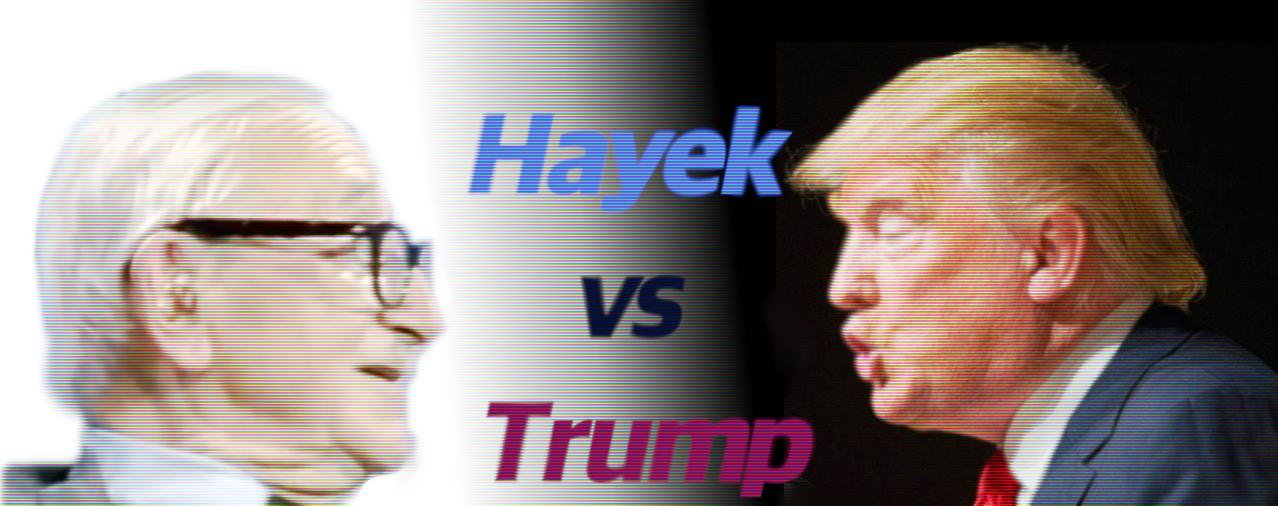
hayekvstrump

This week, the United States and much of the world has been reeling from Trump’s xenophobic statements aimed at four of his Democratic opponents in Congress. But the U.S. economy continues to perform remarkably well for the time being and despite his protectionist spasms, Trump is widely considered a pro-growth, pro-business President.

This has led some classical liberals to consider Trump’s populist rhetoric and flirtations with the far right to be a price worth paying for what they see as the safest path to keeping the administrative state at bay. Many classical liberals believe the greater risk to liberty in the U.S. is inevitably on the left with its commitment to expanding welfare-state entitlements in ways that will shrink the economy and politicize commercial businesses.

In ‘Hayek vs Trump: The Radical Right’s Road to Serfdom’, Aris Trantidis and I dispute this complacency about authoritarianism on the right. In the article, now forthcoming in Polity, we re-interpret Hayek’s famous The Road to Serfdom in light of his later work on coercion in The Constitution of Liberty.

We find that only certain forms of state intervention, those that diminish the rule of law and allow for arbitrary and discriminatory administrative oversight and sanction, pose a credible risk of turning a democratic polity authoritarian. A bigger state, without more discretionary power, does not threaten political liberty. Although leftwing radicals have in the past shown disdain for the rule of law, today in the U.S. and Europe it is the ideology of economic nationalism (not socialism) that presently ignores democratic norms. While growth continues, this ideology may appear to be compatible with support for business. But whenever the music stops, the logic of the rhetoric will lead to a search for scapegoats with individual businesses in the firing line.

Several countries in Europe are much further down the 21st road to serfdom than the U.S., and America still has an expansive civil society and federal structures that we expect to resist the authoritarian trend. Nevertheless, as it stands, the greatest threat to the free society right now does not carry a red flag but wears a red cap.

Here is an extract from the penultimate section:

The economic agenda of the Radical Right is an extension of political nationalism in the sphere of economic policy. While most Radical Right parties rhetorically acknowledge what can be broadly described as a “neoliberal” ethos – supporting fiscal stability, currency stability, and a reduction of government regulation – they put forward a prominent agenda for economic protectionism. This is again justified as a question of serving the “national interest” which takes precedence over any other set of values and considerations that may equally drive economic policy in other political parties, such as individual freedom, social justice, gender equality, class solidarity, or environmental protection. Rather than a principled stance on government intervention along the traditional left-right spectrum, the Radical Right’s economic agenda can be described as mixing nativist, populist and authoritarian features. It seemingly respects property and professes a commitment to economic liberty, but it subordinates economic policy to the ideal of national sovereignty.

In the United States, President Trump has emerged to lead a radical faction from inside the traditional right-wing Republican Party on a strident platform opposing immigration, global institutions, and current international trade arrangements that he portrayed as antagonistic to American economic interests. Is economic nationalism likely to include the type of command-and-control economic policies that we fear as coercive? Economic nationalism can be applied through a series of policies such as tariffs and import quotas, as well as immigration quotas with an appeal to the “national interest.”

This approach to economic management allows authorities to treat property as an object of administration in a way similar to the directions of private activity which Hayek feared can take place in the pursuit of “social justice.” It can take the form of discriminatory decisions and commands with a coercive capacity even though their authorization may come from generally worded rules. Protectionism can be effectuated by expedient decisions and flexible discretion in the selection of beneficiaries and the exclusion of others (and thereby entails strong potential for discrimination). The government will enjoy wide discretion in identifying the sectors of the economy or even particular companies that enjoy such a protection, often national champions that need to be strengthened and weaker industries that need to be protected. The Radical Right can exploit protectionism’s highest capacity for partial discriminatory applications.

The Radical Right has employed tactics of attacking, scapegoating, and ostracizing opponents as unpatriotic. This attitude suggests that its policy preference for economic nationalism and protectionism can have a higher propensity to be arbitrary, ad hoc and applied to manipulate economic and political behavior. This is perhaps most tragically demonstrated in the case of immigration restrictions and deportation practices. These may appear to coerce exclusively foreign residents but ultimately harm citizens who are unable to prove their status, and citizens who choose to associate with foreign nationals.

Make neo-Nazis flop off Broadway: public choice and Tina Fey’s sheetcaking

tumblr_n2evlqgunn1sbf1mqo4_500

A week ago a white supremacist rally in Charlottesville protesting the taking down of Confederate Memorial statues turned fatally violent. Other protests were due to take place this weekend in multiple U.S. cities, including New York (now postponed). How should citizens and public authorities deal with this upsurge in violent neo-Nazi protest? I am with Tina Fey on this one: don’t show up, have some cake, and encourage the NYPD to prevent violence.

Some on the left have tried opportunistically and mistakenly to associate Virginian school public choice scholarship with the far-right. This is a sadly missed opportunity because James Buchanan’s theory of club goods helps explain how far-right street protests emerge and suggest how authorities might best subdue them. I draw on John Meadowcroft’s and Elizabeth Morrow’s analysis of the far-right English Defence League (EDL).

Continue reading

Trump Jr.

Last school year I had to deal with a pair of students (Tweedledee and Tweedledum) I caught cheating on a takehome final. When confronted with the evidence, each insisted that it was the other’s fault, and that only that other student should face any consequences.

Bear in mind that if they complete their degrees, they would be in the top 30% of the population in terms of educational attainment. In today’s world, that basically means they’re among the best and brightest, they’re high status, and they’re “the future”. If we could meaure status on a linear scale, getting a college degree still pushes you high up on that scale. 

At the time I figured that they were at least towards the bottom of that top 30%. Certainly, I still hope they’ll grow out of it. Unfortunately, Draco Malfoy’s Junior’s latest scandal shows that being bad at cheating isn’t the social hinderance we might have hoped for.

Related link: http://reason.com/blog/2017/07/13/how-trump-apologists-will-defend-the-ind

Two points that bear repeating

  1. We could have elected Hitler and it wouldn’t have turned out significantly worse than if Clinton had won.
  2. The left and right aren’t speaking the same language, and whoever fails to take the first step (which is to not blame the other side) shares the larger share of the blame.

I just listened to the post election episode of the excellent series, The United States of Anxiety. Two interviews stand out: the Trump supporter who fails (I think) to understand the genuine (albeit overblown) fear of a black teenager, and the Trump opponent who fails to understand that trump supporter. (There was also a notably boring interview with another Trump opponent, some hand wringing by the hosts, and some genuinely insightful commentary from Chris Arnade stuffed into the back corner of the episode.)

Maybe I’m in a privileged position because I used to see myself as part of the right and now see myself as part of the left (what’s left of it). Many people on the left are being sore losers about this election and they’re making things worse. I’m talking about humans, not (necessarily) politicians. That’s what’s really disappointing.

To be fair, it’s a common pool problem. We each get social capital brownie points for being angry (“10 reasons you should be angry” gets more Internet points than “difficult social science that requires you to do things you don’t like“), and we don’t get the same rewards for sober reflection (or maybe NOL is a sensible echo chamber? Agree with me in the comments.).

The fact remains that in-group signalling trumps ideological inclusion. The result could mean wild swings of power between the right and the left with due process (and the blessings of civilization… like tolerance, economic growth, freedom, and social mobility) being steamrolled in the process.

It’s fun to blame Facebook, the media, politicians, or anyone else but ourselves. The truth is, consumer sovereignty is far stronger a force than is commonly accepted. We aren’t the victims, we’re the perpetrators. It feels good to have an ideologically tight-knit Internet cocoon and so we spend more time listening to our podcasts (talk radio) while driving our Priuses (pickups) past the coast (vast ocean of farms).

And we’ll always have some of that, but we’ve got important disagreements that we have to resolve… not permanently, but for the next generation or so. All sides (libertarians have to participate too; I don’t think we’re to blame, but some people do) have to eat some humble pie and try to genuinely understand what the others are talking about. They aren’t all morons (and we aren’t all geniuses).

What really struck me in those interviews (mostly the second, longer, better quality one by the well spoken liberal academic) was that they weren’t speaking as though they were really trying to convince their intellectual opponents. Patty (Trump supporter) was happy and felt like she was finally part of the decision making process in DC (whether that’s true is another issue). He was speaking to a liberal

Both sides need to try to adopt the language of the other side. You should be trying to convince them! Why should you expect any degree of success when you say shit like “just look at the evidence [you big dummy!]” as though they don’t think they’ve been looking at legitimate evidence. You’re both falling for confirmation bias.

The way forward is intellectual humility. Will that happen? Not a chance, but that’s all the more reason for me to shout into the void. Culture changes slowly.

People will always disagree, and always should. Ideologies have blind spots and need to depend on critics from the other ideologies to account for them. The policy we get reflects the desires of those who might do something about it. Even dictators have to walk a thin line to stay in power. What seems to be at issue here is meta-policy (Buchananian constitutional issues… not the literal constitution, but informal shared understandings about how government wields power). Right now the position from the two big camps is “to the victor go the spoils.” That’s happening because each camp has closed themselves off to the other. It’s similar to what Bastiat said; when we don’t get gains from ideological trade and cooperation, we get political strife.

Everything will be fine

Eight years ago I identified more with the right. Obama represented a charismatic leader with scary ideologies and an uncertain background. (McCain represented a very old man who didn’t seem to care much about freedom.) Obama had a cult of personality and looked ready to dismantle society.

What do I think now? I think he’s handled his position gracefully (though I haven’t been following too closely… gov’t is ~1/5 of the economy and I intend to keep it <1/5 of my life), and he’s done a good deal of harm (further entrenching the role of insurance in health care finance, drone strikes, etc.). But I don’t think he did any more harm than a Republican candidate in his position. The world didn’t end, and despite a big recession, freedom ultimately proved to be a hearty weed rather than a delicate flower.

I think Trump will follow a similar trajectory. He’ll make things worse, but the outcome won’t be dramatically different (overall) than if Clinton had won. Different special interests will be rewarded, and different special interest groups will suffer. But overall, four years from now we’ll be a little less free, a bit more rich (though probably going through a recession… that would have happened under either candidate), and ready for some more political change.

Bill Burr’s got it right: nothing’s going to change. Meet the new boss, same as the old boss.