My favorite posts at NOL this year

Last week I promised y’all a post on my favorite reads at NOL this year. I almost always keep my promises, so below is a long-ish list of essays I really enjoyed reading and learning from this year.


My absolute favorite essay of 2016 at NOL was Barry Stocker’s analysis of the attempted coup in Turkey. Dr Stocker has spent a quarter of a century in the Turkish-speaking world and all of his acquired wisdom of the region is on display in the piece. Barry didn’t post much here this year, but I am hoping that, given the geopolitical situation in his neck of the woods (Dr Stocker teaches political philosophy at Istanbul Tech), he’ll be able to provide much more insight into the challenges the region will face in 2017.

Jacques, who has become sidetracked ever since Donald Trump became the GOP nominee, had an excellent post titled “A Muslim Woman and the Sea” that everyone should read. I don’t agree with it, but the quality of his writing almost demands that you read through the entire piece. In it is the peaceful nostalgia for both youth and French Algeria, the almost careless way he describes his surroundings, and the slow, deliberate manner in how he attacks his enemies. It is all on display for you, his audience, to devour at your leisure. Dr Delacroix is a world-class storyteller.

Mark Koyama’s piece on Jewish communities in premodern Europe garnered a lot of praise, but I found his post on medieval China to be much more fascinating. In the post, Dr Koyama summed up his recent paper (co-authored with UCLA Anderson’s Melanie Meng Xue) on literary inquisitions during the Qing era (1644-1912). What they did was tally up the number of times the state dragged scholars and artists to court in order to accuse them of delegitimizing the Qing government. This had the unfortunate (but predictable) effect of discouraging discussion and debate about society in the public sphere, which stifled dissent and emboldened autocratic impulses.

Chhay Lin had a number of great posts here, some of which were picked up by major outlets like RealClearWorld and 3 Quarks Daily, and Notes On Liberty is lucky to have such a cool cat blogging here. My favorite post of his was the one he did on his childhood in a Cambodian refugee camp along the Khmer-Thai border. What an inspiring story! I hope there are more to come in 2017. (Chhay Lin, by the way, splits his time at NOL with SteemIt, so be sure to check him out there).

Zak Woodman had lots of good posts in his debut year (including NOL‘s most-read article), but the two I enjoyed most were his thoughts on empathy in cultural discourse and his Hayekian take on safe spaces. Both pieces took a libertarian line on the freedom of speech, but Mr Woodman’s careful articles, which are as much about being true to the original meaning of some of the 20th century’s best thinkers as they are about libertarianism, suggests that he has a bright future ahead of him as one of the movement’s deeper thinkers (he’s an undergraduate at UM-Ann Arbor). I look forward to his thoughts in 2017.

Bruno Gonçalves Rosi burst on to NOL‘s scene this year with a number of posts (in both English and Brazilian Portuguese). His blistering critiques of socialism were fundamental and – to me, at least – reminiscent of the debates between libertarians and statists here in the United States in the 1970s and 1980s. My favorite of Dr Rosi’s 2016 posts, however, was his reflection of the 2016 Rio Paralympics that took place in the late summer (at least it was late summer here in Texas). Bruno brilliantly applied the Games to the famous argument about inequality between 20th century American philosophers Robert Nozick and John Rawls. I hope the piece was but a glimpse of what’s to come from Dr Rosi, who also has a keen interest in history and international relations.

Lode Cossaer is probably busy with his very intriguing dissertation (“the institutional implications of the tension between universal individual rights and group self governance”), but he did manage to find some time to dip his feet into the blogging pool with a few insightful posts. My favorite was his explanation of Donald Trump’s Carrier move, which was blasted from all sides of the political spectrum (including libertarians) for being a prime example of “crony capitalism.” Cossaer, in his own delightfully contrarian manner, pointed out that there is a trade-off between the rule of law and lower taxes. This trade-off might not be pretty, but it exists regardless of how you feel about it. Lode, in my opinion, is one of very few thinkers out there who can walk the tight-rope between Rothbardian libertarianism and plain ole’ classical liberalism, and he does so ruthlessly and efficiently. I hope we can get more contrarianism, and more insight into Cossaer’s dissertation, in 2017.

Vincent has been on a roll this month, and I simply cannot choose any single one of his 2016 posts for recognition. His pêle-mêle comments on the debate between historians and economists over slavery is well-worth reading, especially his insights into how French Canadians are portrayed by economic historians in graduate school, as are his thoughts on the exclusion of Native Americans from data concerning living standards in the past. These posts highlight – better than his more famous posts – the fact that economists, along with political philosophers and anthropologists, are doing way better historical work than are traditional historians. Dr Geloso’s post on fake news as political entrepreneurship did a wonderful job, in my eyes, of highlighting his sheer passion for history and his remarkable ability to turn seemingly boring topics (like “political entrepreneurship”) into hard talking points for today’s relevant policy debates.

Federico is still practicing corporate law in Argentina, so every article he writes at NOL is done so in his free time. For that I am deeply grateful. His early August question, “What sort of meritocracy would a libertarian endorse, if he had to?” was intricately stitched together and exemplifies Federico’s prowess as one of the world’s most novel scholars of Hayekian thought. I also enjoyed, immensely, a careful, probing account of human psychology and our ability to act in this short but rewarding post on homo economicus. I look forward to a 2017 filled with Hayekian insights and critical accounts of social, political, and economic life in Buenos Aires.

Rick spent the year at NOL blogging about whatever the hell he wanted, and we were all rewarded for it. Dr Weber is obviously emerging as important conduit for explaining how “politics” works in democratic societies, and perhaps more importantly how to be a better, happier person within the American system. I hope Rick continues to explore federalism though a public choice lens, but I also suspect, given Dr Weber’s topics of choice this year, that Elinor Ostrom would have been interested in what he has to say as well. 2017 awaits! Here is Rick breaking down Trump’s victory over Clinton. You won’t get a finer explanation for why it happened anywhere else. Oh, and how about a libertarian argument for an FDA?

Michelangelo, who is now a PhD candidate in political science at UC Riverside, won my admiration for his brave post on safe spaces and the election of Donald Trump. While 2017 may be composed of uncertainties, one thing that is known is that Trump will be president of the United States. We need to be wary and vocal (just as we were with Bush II and Obama).  Michelangelo was in top form in his piece “…Why I Don’t Trust the Police,” so much so that it stuck with me throughout the year. It is libertarianism at its finest.

William Rein, a sophomore (“second-year”) at Chico State, has been impressive throughout the year. His thoughts do very well traffic-wise (literally thousands of people read his posts), and it’s all well-deserved, but I thought one of his better pieces was one that was relatively slept on: “Gogol Bordello & Multiculturalism.” Mr Rein points out that Political Correctness is destroying fun, and the election of Donald Trump is merely the latest cultural challenge to PC’s subtle tyranny. William weighed in on the safe spaces concept as well and, together with Zak’s and Michelangelo’s thoughts, a coherent libertarian rationale has formed in response to this cultural phenomenon. If you want to know which clouds young libertarian heads are in, NOL is a great place to be.

Edwin initiated the best debate of the year here at NOL with his post on classical liberalism, cosmopolitanism, and nationalism. Barry replied (in my second-favorite post of his for 2016), and Dr van de Haar responded with a third volley: “Classical Liberalism and the Nation-State.” At the heart of their disagreement was (is?) the concept of sovereignty, and just how much the European Union should have relative to the countries comprising the confederation. Dr Stocker concluded the debate (for 2016, anyway) with a final post once again asserting that Brexit is bad for liberty. For Edwin and Barry, sovereignty and international cooperation are fundamental issues in Europe that are not going away anytime soon. NOL is lucky to have their voices and, like Dr Stocker, I hope Dr van de Haar will be able to provide us with many more fascinating and sometimes contrarian insights in 2017.

Lucas Freire wasn’t able to post much here this year (he is doing postdoc work in South Africa), but his post on economics in the ancient world is well worth reading if you are at all interested in methodology and the social sciences. Dr Freire has continually expressed interest in blogging at NOL, and I am almost certain that 2017 will be his breakout year.

Those are my picks and I’m sticking to ’em (with apologies to Rick). Notewriters are free to publish their own lists, of course, and if readers would like to add their own in the ‘comments’ I’d be honored (you can always email me, too). The post I most enjoyed writing this year, by the way (thanks for asking…), was a snarky one questioning the difference between Saudi Arabia and Islamic State. Thanks for everything.
On the trade off between the rule of law and lower taxes

The recent Carrier deal has caused some controversies in liberty-oriented circles. For example, The Mises Institute published a defense of the deal, arguing (along other lines, please read the article yourself):

there is nothing inherently wrong with an administration focused on keeping jobs in America — especially if this is accomplished by relieving tax and regulatory burdens.

The point I wish to make here is a general point, so I won’t go into the specifics of the Carrier deal. Among other reasons: I don’t know the specifics of the deal (I don’t know the content and I don’t know how the deal came to pass.) What I wish to do here is to argue the general case on how to view these kinds of tax exceptions.

The point we ought to remember, I think, is that there are a trade offs between two important liberal values, although they are important in different ways. On the one hand, we have the idea of rule of law, the idea that the law is general, not specific, applies to everyone rather than some, and that it’s not designed to favor some because it should serve an open-ended order. Things that contribute to such a legal order are ipso facto prima facie good, things that take away from such a legal order are ipso facto prima facie bad.

On the other hand we have the idea that taxes are bad. Things that lower taxes are prima facie good, things that increase taxes are prima facie bad.

But neither of these things trump all other considerations. Let me give you two examples.

  • Suppose there was a law that said that the taxes on, for example, business started by family members of politicians are automatically exempted from taxes. Would this be a good law?
  • Suppose there was a law that said that everyone has to be drafted and has to serve mandatory military service overseas, except the family members of politicians. Again: would this be a good law?

In both of these questions, the answer depends on the liberty-inspired framework you use to answer the question. If you think the value of the rule of law outweighs the value of individual liberty of those family members (who are, after all, not responsible for the actions of their political family members) than you think these are bad laws. If you think the increase in individual liberty for those family members is more important than the violation of a rule of law principle, than you think these are good laws. My point is not to say how one should determine this, my point is that there are two liberty-inspired frameworks that can justify an outcome, and both of these frameworks are relevant in determining what kind of laws we ought to support.

To make the issue slightly more applicable: is the increased damage on the rule of law (created by allowing a specific exception on the general laws on taxes) larger or smaller than the benefits that allow a company to have less taxes?

Some people have tried to argue by analogy – for example, comparing it to the draft. The problem is that analogies quickly run into the problem of changing the relative values of the two important concepts. For example: is it a good thing that women are exempted from the draft? Yes, this seems like obviously a good thing. Would it be a good thing that male children of politicians would be automatically exempted from the draft? This seems like less obviously a good thing.

Would it be a good thing if white people were automatically exempted from the draconian drug laws? Maybe it would, but maybe that also lowers the chance of getting rid of the drug laws altogether. Different margins matter in these kinds of evaluations.

The wrong thing to think is that all policies are pro tanto good just because they increase liberty on some margin for some people, especially if this allows for the prolonging of bad policies by the current ruling class. Some policies can be bad on some margins and good on others and reasonable people can disagree whether the complete net effect of this is good for all.

Maybe it’s a good thing that some people are exempted from evil laws (such as taxes), but it’s not good that the political class gets to choose who does so. Because those who will be exempted will be those who are connected to the political class. So one can absolutely like lower taxes, oppose politicians’ power to choose who is exempted and oppose that, and still be happy for a company that they got a tax cut. (Unless, of course, the company itself is evil. This is certainly possible if they are partners in, for example, the wars that the USA commits.)

So tl;dr. As I posted somewhere on facebook:

Rule of law and lower taxes are two good things. A president (or important person connected to the ruling class such as the president elect) getting to pick and choose winners isn’t desirable, but a tax break is. A higher tax isn’t desirable, but a rule of law is.

Trying to argue the case based on principle seems wrong. It depends on the margins. In the case of the draft, the margin *against* rule of law seems important enough to say it’s a clear victory for liberty to not have women included.

In the case of tax breaks, this is less obvious and reasonable people can come out on different sides of this, I think.

Can we use tax data to measure living standards (part 2)?

Yesterday, my post on the differences in per capita income and total income per tax unit caused some friends to be puzzled by my results. To their credit, the point can be defended that tax units are not the same as households and the number of tax units may have increased faster than population (example: a father in 1920 filled one tax unit even though his household had six members, but with more single households in the 1960s onwards the number of tax units could rise faster than population for a time).

The problems regarding the use of tax units instead of households is not new. In fact, it is one of the sticking point advanced by skeptics like Alan Reynolds (see his 2006 book) and, more recently, by Richard Burkhauser of Cornell University (see his National Tax Journal article here).

Could it be that all the differences between GDP per person and income per tax unit are caused by this problem? Not really.

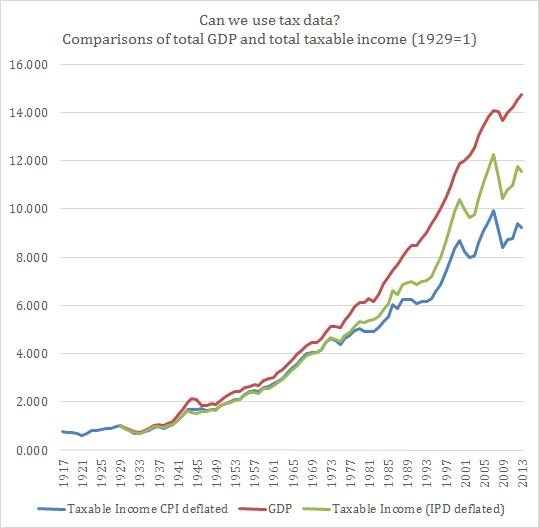
There is an easy to see if the problem is real. Both measures are ratios (income over a population). Either the numerator is wrong or the denominator is wrong. Those who view tax units as the problem argue that the problem is the denominator. I do not agree since I believe that the numerator is at fault. The way to see this is simply to plot total income reported by all tax units and compare this with real GDP. What’s the result?

Even with tax-reported income being deflated with the Implicit Price Deflator (IPD) instead of the consumer price index, we end up with a difference (in 2013) of roughly 3 orders of magnitude between GDP and tax-reported income relative to the 1929 base point. Basically, GDP has increased by a factor of 14.749 since 1929 while IPD-deflated tax-reported income has only increased by a factor of 11.546.

TaxData

As a result, I do not believe that the problem is the tax unit issue. The problem seems to be that tax data is not capturing the same thing as GDP is!

Basic income: a debate where demand magically disappears!

For a few months now, the case for the basic income has resurged (I thought it died with Milton Friedman in 2006, if not earlier). In the wake of this debate, I have been stunned by the level of disconnect between the pundits and what the outcome of the few experiments of basic income have been. The most egregious illustration of this disconnect is the case of the work disincentive.

To be clear, most of the studies find a minor effect on labor supply overall which in itself does not seem dramatic (see Robert Moffitt’s work here). Yet, this is a incomplete way to reflect on the equilibrium effect of a massive reform that would be a basic income.

Personally, I think that there is a good reason to believe that the labor supply reaction would be limited. At present, many tax systems have”bubbles” of increasing marginal tax rates. In some countries like Canada, the phasing out of tax credits for children actually mean that the effective marginal tax rate increases as income increases from the low 20,000$ to the mid 40,000$. As a result, a basic income would flatten the marginal tax rate for those whose labor supply curve is not likely to bend backward. In such a situation, labor supply could actually increase!

Yet, even if that point was wrong, labor supply could shift but without any changes in total labor provided. Under most basic income proposals, tax rates are dropped significantly as a result of a reduced bureaucracy and of a unified tax base (i.e. the elimination of tax credits). In such a situation, marginal tax rates are also lowered. This means greater incentives to invest (save) and acquire human capital. This will affect the demand for labor!

A paper in the Journal of Socio-Economics by  Karl Widerquist makes this crucial point. None of the experiments actually could estimate the demand-side reaction of the market. Obviously, a very inelastic labor demand would mean very little change in hours worked and the reverse if it was very elastic. But what happens if the demand curve shifts? Widerquist does not elaborate on shifts of the demand curve, but they could easily occur if a basic income consolidates all transfers (in kind and conditional monetary) allows a reduction in overall spending and thus the tax take needed to fund activities. In that case, demand for labor would shift to the right. A paper on the health effects of MINCOME in Manitoba (Canada) shows that improvement in health outcomes are cheaply attained through basic income which would entail substantial health care expenditures reduction.

I have surveyed the articles compiled by Widerquist and added those who have emerged since. None consider the possibility of a shift of the demand curve. Even libertarian scholars like Matt Zwolinski (who has been making the case forcibly for a basic income for sometime now) have not made this rebuttal point!

Yet, the case is relatively straightforward: current transfers are inefficient, basic income is more efficient at obtaining each unit of poverty reduction, basic income requires lower taxes, basic income means lower marginal tax rates, lower marginal tax rates mean more demand for investment and labor and thus more long-term growth and a counter-balance to any supply-side effect.

I hope that the Bleeding Heart Libertarians will take notice of this crucial point in favor of their argument!

Natural Rights and Taxation

A moral right is a correlative or flip side of a moral wrong. The right to have X means that it is morally wrong or evil to deny the holder from having X by stealing or destroying it. The right to do X means it is evil for others to forcibly prevent a person from doing X.

People have the natural right to do anything that does not coercively harm others, and the natural right to be free from coercive harm. Natural rights are based on natural moral law, as expressed by the universal ethic. By the universal ethic, all acts, and only those acts, which coercively harm others are evil. I and others have written on natural moral law, easily searched on the Internet.

A legal privilege is a special power or income granted to particular people because of their political status. A king is privileged because of his inheritance and laws regarding this. A slave owner is privileged to own another human being. There are no privileges in natural moral law, since one of the premises from which the universal ethic is derived is human moral equality, an equality of moral worth, implemented as equality before the law and equal legal rights.

In the Constitution of the United States, the 9th Amendment states, in its entirety, “The enumeration in the Constitution, of certain rights, shall not be construed to deny or disparage others retained by the people.” The other rights are common-law and natural rights. Therefore the U.S. Constitution recognizes natural rights, and all laws in the USA should be consistent with the 9th Amendment, although in practice, the 9th is ignored and not widely understood.

This brings us to two court cases. In Murdock v. Pennsylvania, 319 U.S. 105 (1943), the Supreme Court stated that a law requiring solicitors to purchase a license was an unconstitutional tax on the Jehovah’s Witnesses’ right to freely exercise their religion. The Court ruled that “The state cannot and does not have the power to license, nor tax, a Right guaranteed to the people,” and “No state shall convert a liberty into a license, and charge a fee therefore.”

In another case, the Court ruled similarly, that “If the State converts a right (liberty) into a privilege, the citizen can ignore the license and fee and engage in the right (liberty) with impunity.” (Shuttlesworth v. City of Birmingham, Alabama, 373 U.S. 262).

The principles behind the statements of the Court have to apply generally. The federal and state governments may tax privileges, but may not tax a natural right. Since people have a natural right to engage in labor for wages, taxes on wages violate natural rights and therefore the Constitutional rights recognized by the 9th Amendment. Taxes on trade and goods also violate natural rights, which is why state laws claim, incorrectly, that, when they impose a sales tax, they are taxing the privilege of selling goods. (For example, it is written that “California assesses a sales tax on sellers for the privilege of doing business in California.”)

If natural rights are violated by taxing wages, the same applies to the products of labor and the income from the products. Thus a person has the natural right to fully keep and trade produced goods and the financial counterparts as shares of companies and their incomes.

The U.S. Constitution does provide government with the power to tax. Article I, Section 8, states, “The Congress shall have power to lay and collect taxes, duties, imposts and excises.” The 16th Amendment restricts the income tax to being levied as an indirect tax, but otherwise did not alter or add to the powers of Article I.

There is an apparent contradiction. Article I empowers government to tax imports and goods, and other taxes, but the 9th Amendment prohibits taxing acts which are natural rights.

Clearly the founders did not oppose taxing as such. But the letter and spirit of the law have to go beyond the intents of the founders. The Constitution also did not explicitly outlaw slavery, despite its recognition of preexisting rights. When slavery was later abolished, this was in accord with justice as prescribed by natural moral law and the 9th.

If a parent says to a child, you may go outside and play, and also says, do not throw rocks at the squirrels, the permission to play does not imply that anything goes. Thus when the Constitution authorizes taxes, but then, in an Amendment, says, by implication as recognized by the Supreme Court, that government may not tax a right, then the power of taxation has been constrained.

The U.S. Constitution creates an imposed but limited government, and the founders recognized the need for revenues. The sources of government revenue boil down to two original sources: labor and land. There is human exertion, and there is what nature provides.

Since human exertion and its gains are a natural right, the only source left is nature’s resources, land. Thus the moral question is whether the ownership of land is a natural right. This issue is, of course, much disputed. In my judgment, the moral law of property is, “To the creator belongs the creation, and where there is no creator, the benefits belong to the people in equal shares.” The universal ethic is based on the premise, from the nature of humans being, as John Locke wrote, “all equal and independent,” the independence being that thinking and feeling occur individually.

The benefits of land are measured as its economic rent. Therefore, the rent belongs to the people, and by natural moral law, the individual right of the possession of land is conditional on paying the rent to the rightful owners, the people. A tax on land rent does not violate the natural rights of the title holder.

Although the rent really belongs to the people and not to an imposed government, since government is already an imposition, it violates natural rights the least when rent is used for public revenues to pay for public goods that generally benefit the people. The people receive the rent in kind rather than in cash.

If consistently implemented, the 9th Amendment, backed up by the Murdock case, implies that the income tax as well as excise taxes should not tax the right of labor and trade. The greatest challenge of humanity is to recognize the full spectrum of human natural moral rights.

—————————————————

A similar article by me appears in progress.org as “Rights and Privileges”.

Republican Tax Plans are Misguided

Predictably, Republican candidates are showcasing tax plans offering goodies for everybody. When some spoilsport has the nerve to point out the worsening deficit that would result, the most common retort is that the tax cut will spur economic growth enough to overcome the higher deficit. Some day. Somehow.

Of course lower tax rates will spur growth so that the loss in tax revenue will be less than proportional to the cut in tax rates. But it is foolish to think that we’re ensconced on the far side of the Laffer curve, for those who know that phrase, which simply means that tax rates are so high that cuts will produce higher revenue.

What about the claim that a flat tax is fairer than the graduated rates we have now? Perhaps, but how does one judge the fairness of any tax? The usual answer is that taxes should be based on the taxpayer’s ability to pay. But that is a nebulous concept at best. It means that somehow we figure out how much income is necessary and how much is up for grabs by politicians  Do we need a cell phone, cable TV, air conditioning? Who’s to say?

At least a flat tax would treat everybody alike. Or would it? Under a flat tax, where everybody hands over the same percentage of their income, those who earn a lot pay more money than those who don’t. Why? Do the high earners consume more government services? Are high earners bad people who deserve punishment?

I concede that some tax schemes could be fairer than others. For example, much as I might like the idea of complete tax exemption for septuagenarian European-American males, I’ll grant that would be a bit unfair. But in the end no tax can be entirely fair because taxation is coercive activity: stealing if you like.

Don’t get me wrong: I like tax cuts, preferably across the board, but targeted cuts are fine with me too. But the focus on the tax code is misplaced. The root problem is the amounts of real goods and services that are consumed by politicians and bureaucrats. Whether they are financed by taxation or borrowing is a secondary issue.

Republicans should be drawing up lists of programs to reduce or eliminate. “Defense” spending should be at the top of the list. The list should be broad enough that everybody’s ox is gored. Who knows, this approach might actually gain some traction with the fed-up electorate.

Critics of Markets have Intervention Denial

There is a meme, an infectious idea, that has spread like a mental plague among advocates of greater governmental intervention. This idea is “intervention denial,” the claim that the US and other developed economies have had complete economic freedom. The critics of markets usually use deliberately mind-numbing language such as “capitalism,” although sometimes they do claim more starkly that today’s economies are a “free market” and practice “free banking” and “free trade.”

Many examples of intervention denial can be found by searching for the submeme “unbridled capitalism” as well as “greed” combined with “capitalism” or statements such as “people over profits.” For example, there is a web article titled “Unbridled Capitalism and the Blight of Greed” which defines “capitalism” as “the economic system in which the pursuit of wealth remains in the control of individuals, free from government regulation or interference.” The article states that “Capitalism, after all, suffers from a fatal flaw – Greed.” Intervention denial has infected well-meaning people in high places, such as the Pope, who declared, “Unbridled capitalism has taught the logic of profit at any cost.”

“Denial” in this context means the refusal to believe in evidence. For example, Holocaust denial is the refusal to accept the enormous evidence of mass murders by the Nazis. There are science denials of various sorts. Intervention denial is one of the most destructive memes in the mental universe human beings live in, because intervention denial blocks effective solutions to social problems.

Consider the claim that the US has had destructive “free banking.” This false meme originated in historians who called the US banking system prior to the civil war “free banking,” even though the banks were tightly controlled by state governments, such as prohibiting banks from establishing branches beyond the state. In true free-market money and banking, there is no restriction or imposed cost on any currency, account, or financial institution so long as its operation is honest and peaceful.

The intervention deniers claim that the USA has a free market in money and banking, disregarding the obvious facts that the US financial system is tightly regulated by the Federal Reserve (“the Fed”), the FDIC, the SEC, and the US Treasury Department. These institutions and Congress bailed out the financial system after the interventions caused the Depression of 2008, as they did with previous busts. The US dollar and interest rates are controlled by the central planning of the Fed. This is the system that intervention deniers call a “free market.”

In a truly free market, there would be no restriction, tax, subsidy, or mandate that alters honest and peaceful human action. Those who claim the US economy is “unbridled” talk as though there were no regulations nor any taxation, let alone subsidies. The extent and effects of regulations on the US economy can be read in the study “Ten Thousand Commandments” published by the Competitive Enterprise Institute, as well as the regulations data base of the Mercatus Center at George Mason University. The economic damage done by intervention can also be read in the on-going study “Economic Freedom of the World,” at freetheworld.com.

How can an economy be “unbridled” if enterprise, consumption, and produced wealth are all afflicted with heavy taxation? Intervention deniers talk as though there were no income tax, federal excise taxes, state sales taxes, value-added taxes, and taxes on buildings and equipment. A truly free market would also not have any subsidies, such as the billions of dollars now going into the big farms, along with other corporate welfare.

All these interventions – taxes, subsidies, restrictions, and mandates – distort prices, wages, interest rates, profits, and quantities. The social problems we can observe: unemployment, low wages, unaffordable housing, slow growth, recessions, pollution, can be traced back to government intervention. Consider pollution, for example. Intervention deniers claim that “capitalism” and “greed” result in pollution and environmental destruction. But a truly free market is free of subsidies. When firms and their customers do not pay the full social cost of the products, as the social cost of pollution is imposed on others, that is an implicit subsidy. In a truly free market, with full enforcement of property rights, pollution is treated as a trespass, an invasion of others’ property, requiring full compensation. The problem is not that firms and markets are unbridled, but that ecological destruction is subsidized. The subsidies combine with a legal system that bridles the population with a legal inability to sue the polluters for damages.

There is indeed a bridle to a free market: laws prohibiting force and fraud. A pure market economy consists of voluntary human action. The bridle is on thieves, not on peaceful and honest producers, traders, and consumers.

When interventions are pointed out to the deniers, they respond that these taxes, restrictions, subsidies, and mandates are of little significance. This is similar to Holocaust deniers who respond that perhaps a few Jews and Gypsies were murdered by the Nazis, but not on the large scale that they deny. Intervention deniers do not deny the existence of the Federal Reserve system, but they claim it is a private free-market organization. Deniers of all sorts reject data and other evidence, use undefined terms such as “capitalism” and “greed,” and point to their favored authors, articles, and data as though these present unbridled truth.

“Greed” means wanting and taking more than one morally deserves. A person morally deserves that which is earned by labor and received from voluntary gifts. The honest acquisition of wealth may be avarice, but not greed. Thieves are greedy, and those who indirectly steal by getting government to do or protect their forced taking are also greedy. Intervention denial is ultimately a refusal to think it through, to fully understand the ethics, politics, and economics of human life.

Senator Rand Paul on Taxes: Chip off the Old Block

Sen. Rand Paul, the nominally Republican presidential candidate, has inherited an uncommon trait from his father. He manages to inspire distrust in his credibility even as he conveys a message I want to hear and believe. On Thursday June 18th 2015, he had an op-ed in the Wall Street Journal about his proposed tax reform. Any national tax reform involves fiendishly difficult calculations about complex matters. Sen. Paul wants to junk the whole repulsive, disgusting, oppressive income tax and the IRS in favor of a flat tax. Music to my ears but difficult to believe his assertion that this replacement would be revenue neutral.

I don’t especially want federal revenue neutrality. I want the federal government’s share of GDP to decline. Yet, I understand that Mr Paul wishes to avoid conducting two discussions in one. (Junk the personal income tax; decrease the power of the federal government.) So, he has not done anything wrong there.

My problem is that in the course of a longish piece, he misuses grossly two sets of simple, basic economic terms. In this second paragraph, he refers to “duties and tariffs…” Toward the last third, he states something about “small businesses” and “corporations.” Both statements would be unacceptable in a sophomore basic economics class, even in a introduction to economics in a reasonably good high school.

Here is the first mistake: duties and tariffs are the same object. A “duty” is a tax on imports (or, very rarely, on exports). A tariff is the mechanism used to levy such taxes. It could be 10% of the value of the import or it could be $1 per bottle, for example. (Both methods are common.) That’s it. Referring to “duties and tariffs” proves beyond any doubt that you don’t understand the ordinary and oldest form of taxation. It looks bad in an essay devoted to …taxation.

Contrasting, or building any sort of parallel construction between “small business” and “corporations” is a common mistake but it does not belong under the pen of an elected politician who wants, as his main contribution, to overturn the way we have been financing most government for fifty years. “Small” businesses are in fact small. “Corporations” can be of any size, including two people, such a dentist and his wife. Most American corporations are small. The word corporation refers to a legal arrangement. It has nothing to do with the size of the business.

It’s as if Sen Paul did not know simple stuff when he talks about complex stuff. It’s as if, even more seriously from the standpoint of his credibility, he had no one to proofread his writing for blatant errors. It’s as if he were so convinced of knowing everything that he did not need -ever – anyone looking over his shoulder. If these two mistakes are the product of carelessness, they also imply hubris. That’s worse than simple ignorance because it has no cure in a grown man.

How can I trust someone to unravel the complex relationship between taxes, government revenue, economic growth, and personal liberty when he sounds like one of my indifferent former students?

A Quiz on Public Finance

How well do you understand public finance? Below is a quiz. Answer whether the statements are true or false, and briefly explain why. If you think that the statement is only sometimes true, or true under particular conditions, say “maybe” and explain. My answers follow the quiz, but first write down your own answers.

1. After a high tax on land value is in place, it will impose a burden on landowners and reduce the productivity and efficiency of the economy.
2. The most efficient way to pay for a city bus service is to make the bus riders pay for the full cost.
3. The best way to decide whether a club should have a party is by a yes-no vote, with the majority of those voting deciding the outcome.
4. No decentralized pricing system can optimally provide collective consumption.
5. Subsidies that reduce the price of goods below the cost of production typically have net benefits to society.
6. The best policy for government budgets is always to avoid deficits, hence to finance all spending from current revenues such as taxes and fees.
7. The best way to handle pollution is with restrictive regulations, as these are less costly than pollution taxes or permits.
8. The least worst tax for the USA would be a flat-rate income tax with no deductions or credits.
9. The least worst tax for the USA would be a national sales tax that replaces the income tax.
10. A pure free market generally fails to provide adequate public goods and to efficiently and equitably handle externalities such as congestion and pollution.

Answers

1. False. A tax on land value reduces the price of land and replaces what would have been paid in mortgage interest. A land-value tax pushes land to its most productive use, increasing productivity and efficiency.

2. False. The best way to pay for mass transit is to charge riders only when the service would otherwise be too crowded, and just enough to prevent congestion. The rest of the cost is best paid for from the increase in the land rent generated by the transit.

3. False. The best way to decide on a club party is the method called “demand revelation.” Each member records the most he would pay for the party. The amounts are added up. If the total is greater than the cost, have the party. To keep the members honest, if any member changed the outcome, relative to stating one’s cost, that person has to compensate the group an amount equal to the net loss of everyone else (their stated values minus their costs). This method is better because it measures how much the members want the party, not just whether they want it.

4. False. Collective consumption paid for by land rent can be decentralized, because the rent reflects the demand to be located there, and the land will not flee, hide, or shrink when its rent is tapped to pay for collective goods.

5. False. The social cost of taxes that pay for subsidies is greater than the gain to consumers.

6. False. Government borrowing can be a good policy if the funds are spent for investments that are more productive than if the funds were spent in private investments. Otherwise, the budget should not have a deficit.

7. False. A charge or tax on pollution, based on its damage, is more effective than regulations and permits, and the funds can replace taxes that harm the economy.

8. False. A land-value tax is better for the economy than a flat-rate income tax.

9. False. A land-value tax is better for the economy than a national sales tax.

10. Some textbooks say this is true, but the better answer is, False. Private communities such as homeowners’ associations and shopping centers can and do provide public goods from the site rentals. In a pure market, pollution is trespass that requires compensation. Private transit can have congestion charges. A pure free market would have contractual governance that could adequately provide public goods and prevent pollution and congestion.

Unemployment is Completely Unnecessary

In U.S. government statistics, a person is unemployed if he is 16 years of age or more, and that person is able and willing to work at prevailing wages. The labor force includes the employed and the unemployed. If one is not employed for wages because one does not wish to work or to seek work, that person is not in the labor force, and not counted as unemployed.

The unemployment rate in the USA is now about six percent, down from a peak of ten percent in 2009. About one percent of the labor force is in “frictional” unemployment, meaning that the worker is between jobs or recently graduated from school and engaged in job search, or about to be hired. When the economy is depressed, there is “cyclical” unemployment, those not working as firms reduce employment. There is also the “structural” unemployment of workers losing their jobs in declining industries, and the seasonal unemployment of those employed only during a season such as in resorts or during harvests.

An economy is in full employment when the only unemployment is frictional. The economic puzzle is why there is any other unemployment. Cyclical unemployment is no mystery, as firms have fewer sales as demand falls, and falling demands become a downward spiral as falling purchases by some become falling production by others. The recession ends when materials prices and real estate rentals have fallen so low that production becomes profitable again.

Since recessions are caused by monetary and fiscal subsidies, a pure market economy would have neither, so it would have no recessions and no cyclical unemployment. So the puzzle consists of chronic unemployment, those unable to obtain work even during prosperous times. Most of the unemployed have been out of work for months or years. Those long unemployed have even more difficulty finding employment, because employers wonder why that person can’t find any job.

Some economists consider idle labor to have a positive side. You car is not wasted when you don’t use it, because it provides the service of availability. Empty seats in a theater have value because the theater needs that capacity for popular shows. Likewise, in this viewpoint, idle labor provides workers when firms need to hire. Also, the unemployed need time to engage in job search, so they are busy even if unemployed. But one can be employed at least part time while looking for better work, and while idle labor may be good for employers, it is bad for workers who need the income, and for taxpayers who have to support those not working.

In a pure market economy, there would not be any unemployment at all. There would be no seasonal unemployment, because workers could find other jobs in other seasons. There would be no structural unemployment, because workers could shift to other industries, and work in temporary jobs while searching for full-time employment. Even workers in frictional unemployment would be able to work some of the time, since job search is not full-time.

One of the premises of economics is that human desires are unlimited. There is always a demand for something. That demand provides an opportunity for workers to be employed to satisfy that desire. In a pure market economy, one could also be easily self-employed. Any person who is not totally incapacitated would be able to offer some service at some wage. If the wage one can obtain is too low to bother with working, then that person would not wish to work, not be in the labor force, and not be unemployed.

Unemployment exists because there are barriers that prevent labor from having access to land and capital goods. If the cost of hiring a worker is greater than his productivity, he will not be hired. In a pure market, the wage would be set where the quantity of labor supplied by workers equals the quantity demanded by employers.

Government policy raises the cost of labor above the pure market wage. Minimum wage laws prevent employers from hiring the least productive workers. On top of the minimum wage are imposed costs: the employer’s share of payroll taxes, mandated medical insurance, worker accident insurance, and the unemployment compensation tax. The firm also has to withhold taxes from wages and send then to the government. There is also a litigation risk and cost of hiring labor, as labor laws promote excessive litigation to combat malpractice, discrimination and sexual harassment. Also, union labor monopolies, and laws favorable to unions, push up the wages of union workers at the expense of less employment. Finally, laws making it costly to fire workers raise the cost of hiring them, creating more unemployment.

In a full-employment economy, when firms seek to expand, they would pull workers away from other firms, or pulled into the labor force, by offering higher wages and better conditions. There is no need for idle labor.

The best policy for labor is full employment. Labor laws that seek to protect workers end up imposing barriers that prevent employment. Full employment requires hiring flexibility and the removal of government-imposed costs. Full employment requires the elimination of taxes on labor, exchange, production, and consumption. Public revenue from land rent or land value could replace all these labor-hampering taxes, while promoting the productive use of land which would further increase wages.

A shift in taxation from labor to land would both increase employment and increase wages, while letting the worker keep his wage. It is not unemployment that is a puzzle, but rather why workers are not demanding the abolition of their wage-tax burden.

The 100th Anniversary of the Defeat of Economic Land

The year 2014 is the 100th anniversary of an economics article that was the final nail in the coffin of classical economics, as it marked the victory of the neoclassical economics war against land. This was a victory so great that economists today do not even realize that there had been such an academic war.

Alvin Saunders Johnson (1874-1971) was an American economist at several universities, including Columbia, the University of Chicago, and Cornell. He was a co-founder of the New School at New York City. In 1902 he wrote “Rent in Modern Economic Theory: An Essay in Distribution.” Johnson, along with other economists who were turning the classical theories of the 1800s into the neoclassical doctrines of the 1900s, generalized “rent,” from the yield of land, into any surplus above opportunity cost, i.e. above the cost needed to put a resource to its most productive use. For example, a movie star paid $1 million to act in a movie, whose next best opportunity is being a salesman earning $100,000, has an economic rent of $900,000.

In 1914, Johnson published “The Case against the Single Tax” in The Atlantic Monthly. As has been well explained by Prof. Mason Gaffney in The Corruption of Economics, Johnson played a major role in suppressing, by falsification, the land-tax ideas of Henry George. Land is now visible everywhere except in academic economics. For example, the generation of land value by public goods is not even mentioned in the general textbooks.

Johnson correctly stated that a tax on the entire rent of land would bring the purchase price down to zero, but he expressed it as: “the value kernel of landed property will have been seized by the state.” In policy analysis, we need to examine inflammatory vocabulary. The moral case for land-value taxation rests in the proposition that the benefits of nature belong to all humanity equally, that the creation of local land values by population and commerce belongs in equal shares to the members of those communities, and that the rentals generated by public works may be used to pay the providers, whether this be private-sector or government providers. None of this is confiscation or seizing by the state.

In Georgist ethics, the people own the rent, not the chiefs of state. A government may justly act as the agent of the people to protect their property, such as the atmosphere, from damage, and a government may, as the agent of the people, collect the rent to distribute it among them, or to use to pay for public goods. The premise that the rent belongs to the people implies that the rent is not being seized from the landowners as though these title holders are the morally legitimate owners, but rather that the state is facilitating the collection of the rent to the proper owners, the people. Hence the terminology used by Johnson taints his analysis and begs the question of the proper ownership of land rent.

Johnson continues his attack by calling the single tax on land value “propaganda for the universal confiscation of land.” Henry George had unfortunately stated in Progress and Poverty that “It is not necessary to confiscate land; it is only necessary to confiscate rent.” The Latin origin of “confiscate” is “confiscare,” from “fiscus” meaning the government’s treasury. Fiscal policy is about governmental revenue and spending. Thus in linguistic origin, to confiscate means simply to tax, to transfer assets to the public treasury. But in modern popular usage, to “confiscate” means to take by force, with the implication that the state is seizing property that was legitimately owned. And despite George’s statement that it is only the rent, not the land itself, that is being “confiscated,” Johnson attacks the single tax as confiscating the land.

Moreover, by dismissing the theory behind the single tax as “propaganda,” Johnson denigrated the logic and evidence for land-value taxation in an anti-scholarly manner, and thus he himself indulged in propaganda.

Johnson’s mixing up the ownership of land and of its rent is also shown by his statement that if all the value of land is taxed, the revenue would cover the costs of government, “provided, of course, that the public can manage the lands as efficiently as they are now managed by their private owners.” This despite the statement of George that “I do not propose either to purchase or to confiscate private property in land.” Land-value taxation would not disturb private titles; it would not alter private control and possession. The government would not “manage the lands.”

Johnson states that much of the financial wealth of the middle class is in land value, and that the full taxation of land value would take more value from them than they would regain in the removal of other taxes. Of course in 1914, the 16th Amendment had just been enacted in 1913, and the middle class did not yet suffer from the income tax.

Nevertheless, Johnson’s statement is illogical. Suppose the total land rent is $1 trillion, and the cost of government is half of that; then the rent does not disappear, but is distributed back to the people in cash. So the effect of land value taxation would be to equalize the ownership of the rent, and a person who owned an average amount of rent would get half back in cash, and half back, ideally, in valued public goods. If government is squandering some of the rent, then the remedy is to give it all back to the people. Then the average land owner is in a neutral position.

Johnson falsely declared that “The Single Tax is, then, essentially a device for the spoilation of the middle class.” One could justly say that Johnson’s malicious attack was a device for the spoilation of the remedy for poverty, depressions, and land conflicts. What has spoiled the middle class is high taxes on their wages and on the goods they buy. Johnson’s falsifications were the spoilation of a policy that could have promoted sustainable prosperity and prevented needless economic inequality. Johnson’s propaganda succeeded in helping squash land-value taxation, but to the ruin of economies worldwide.

With the neoclassical victory against land, most economists today suffer from cognitive dissonance. Even if economists reject an egalitarian view of natural resources, they know that the supply of land is inelastic, so public revenue from land rent avoids the excess burden that other taxes have. But they do not extend this knowledge to the rest of theory and to policy. Mason Gaffney calls this the “corruption of economics.” I call it “academic brain freeze.” At any rate, it is worth marking the 100th anniversary of Johnson’s attack.

Blaming Finance, Ignoring Real Causes

The fall 2014 Cato Journal has an article, ‘The Financial Crisis: Why the Conventional Wisdom Has It All Wrong,” [pdf] by Richard Kovacevich, Chairman Emeritus of Wells Fargo. The author is correct in saying that the conventional wisdom is wrong in blaming the slow recovery on the “uniqueness of a financially led economic recession.” The US economy recovered from the severe 1980 recession within two years, while now the economy is creeping like a turtle.

The economic cause of recovery and growth is simple. Economic investment – the production of capital goods – drives the business cycle. Recessions are caused by a sharp fall in investment. Then, as the prices of raw materials fall, and as land rent drops, a depression reduces these costs of production, therefore increasing profits, so investment recovers. Government can boost the recovery by further reducing the costs of production, by decreasing the taxes and regulations it imposed previously. This is the “supply side” policy of increasing investment and production by reducing the costs of regulations and taxes.

But this time around, the federal government did the opposite. Costly regulations have magnified, with an anti-supply-side effect. Every year, there are thousands more regulations that hamper enterprise, and finally, regulations plus taxes have achieved the tipping point of making it too costly for enterprise to invest and hire labor.

After the Crash of 2008, the federal government had two basic policy options: it could help the economy recover with market-enhancing supply-side policies, or else the government could enact the welfare-state agenda of greatly increased governmental medical services. The government chose the latter option, which imposed even greater costs on enterprise and labor.

When the recession hit the economy in 2008, one of the responses was TARP, the Troubled Asset Relief Program. As the article states, one of the problems with TARP was that it did not focus on the troubled banks, but imposed the policy on all banks. The banks that were not troubled had to obtain the funds and then pay interest on them. TARP imposed the impression that all banks were in trouble, which destroyed confidence, and then Congress responded to the turmoil by imposing 25,000 pages of Dodd-Frank regulations.

None of the financial regulations, going back to the Great Depression, confront the causes of the boom and bust. The fundamental cause is massive subsidies to land values. The Cato article focused on the financial industry, but the more fundamental issue is government policy regarding real estate. The problems of the financial industry originate in their financing of real estate.

The history of the Americas has been that of grabbing land and enslaving labor. In the American colonies, the British government promoted European settlement to control land and to profit from trade. After the defeat of the French in 1763, the United Kingdom changed policy to avoid conflict with the people of Quebec and with the Indians, by restricting western speculation and migration. That annoyed the landed interests enough to declare independence, and to establish a constitution that would better extend and protect land speculation. Huge grants of land were given to railroads, veterans, colleges, and speculators.

After the public domain was disposed of, the government continued the subsidy of the large landed interests with implicit policies that are invisible to the public and to most economists. The provision of public works, welfare to the poor and elderly, and artificially cheap credit, all generate greater land rent and land value. This amounts to a vast redistribution of wealth from workers, tenants, and enterprise owners, to landowners, especially the concentrated owners of commercial and farm land.

With a fixed supply of land, much of the gains from an economic expansion is captured by higher land rent and land value, which then attracts speculation that carries real estate prices to unsustainable heights. When land values crash, they bring down with them the financial system that provided the loans. None of the financial regulations touch this basic cause, and land-value seeking is so deeply ingrained in American culture that people favor it even at the price of high taxes, high unemployment, and the destruction of liberty.

Ask a typical American, “Would you favor a tax reform that eliminates taxes on your wages, on interest from your financial assets, and on buildings, replaced by a tax only on land values?” The answer is, “No! I would rather suffer unemployment, insecurity, crime, poverty, and loss of liberty, than have my precious land taxed!”

“OK, then, would you favor the complete replacement of government’s public goods with private, contractual, provision that eliminates the subsidy to land values?” “No! We need government to provide these things!”

Then you ask, “So why do you want the word ‘liberty’ put on our coins?” The answer is, “I want liberty so long as it is not put into practice!”

And that is why government deals with the superficial financial appearances, and not the implicit reality that causes the booms and busts.

The California Solar Energy Property-Tax Exemption

California exempts solar energy equipment from its property tax. The exemption will last until 2025. The California Wind Energy Association has complained that this exemption puts solar energy at an artificial advantage relative to other renewables such as windmills. Biomass, the use of biological materials such as wood and leftover crops, is also at a relative disadvantage.

Rather than eliminate the solar tax exemption, the other energy industries should seek to eliminate the property tax on all energy capital goods. With this exemption, the government of California is recognizing that property taxes on capital goods – buildings, machines, equipment, inventory – impose costs that reduce production and innovation. Since this tax is toxic, the property tax should be removed from all improvements.

The best revenue neutral tax shift would be to increase the property-tax revenue from land value by the same amount as the reduction in the taxation of capital goods.

The other energy industry chiefs call the solar property-tax exemption a subsidy. We need to distinguish between absolute and relative subsidies. An absolute subsidy occurs when government provides grants to firms, or limits competition. A relative subsidy occurs when one firm or industry receives a greater subsidy than its competitors. All absolute subsidies are also relative subsidies, because they exist relative to the rest of the economy. But if the subsidy is not in funds or protection, but from lower rates on industry-destructive taxes, this is a relative but not an absolute subsidy.

Suppose that there are patients in a hospital suffering from continuous poisoning. The doctor stops poisoning one patient, and he recovers. But the other patients are still being poisoned. The other patients complain that it is not fair for one patient to be singled out for favored treatment. But the just remedy is not to resume poisoning the recovered patient, but to stop poisoning the others. The taxation of capital goods is economic poison, which the state recognizes would poison the solar energy industry they seek to promote. But why poison the other industries? The property tax should exempt all capital goods, all improvements.

A broader issue is the subsidies to energy. All forms of energy, except human muscles, are subsidized by the state and federal governments. Energy from oil and coal are implicitly subsidized by exempting them from the social costs of their environmental destruction. There is no economic need for any subsidies. But to obtain the true costs of energy, governments should also eliminate taxes not only on their capital goods but also on their incomes and sales. We cannot know whether renewable energy can stand on its own until we eliminate all the government interventions, including taxes, subsidies, and excessive regulations.

Since a radical restructuring of public finances is politically impossible today, a politically feasible reform would be to exempt all capital goods investments from the property tax. If this needs to be revenue-neutral, California could replace its cap-and-trade policy with levies on emissions. The relative subsidy to solar power is unfair to the other energy industries, but the real unfairness is the property tax on their investments.
————————————–
This article first appeared at http://www.progress.org/views/editorials/the-california-solar-energy-property-tax-exemption/

Is Australia’s Carbon Tax Repeal Really Market Enhancing?

Some libertarians cheer whenever there is any tax repeal. However, we need to distinguish taxes in form versus taxes in substance. Taxes in substance have no relation to a benefit or penalty attached to the payment. Taxes in form, but not in substance, pay funds to the government, but are tied to some benefit or compensation for damages.

It is standard economic theory that the best way to prevent pollution, as with other negative The effects, is to make the polluter, hence also the buyer of its products, pay the social cost of the pollution. The economist Arthur Cecil Pigou provided a thorough explanation in his 1920 book The Economics of Welfare. A tax on pollution has since then been called “Pigovian.”

One of the most discussed Pigovian taxes has been on the use of carbon-based fuels such as coal, natural gas, and oil. A “carbon tax” can be on the fuel inputs or on the emission outputs. The most effective Pigovian levy is on the emissions, as that provides an incentive to reduce pollution such as by capturing the carbon before it gets spewed out. If the polluter does not compensate society for dumping on the commons, then in effect it gets subsidized, as it sells its output at less than the total social cost of production.

Many countries have been confronting pollution with inefficient policies such as regulations, credits for offsetting pollution with purchases of forest lands, and permits that can be traded. Australia enacted what was called a “carbon tax” with the Clean Energy Act of 2011, implemented in July 2012. But this was not a Pigovian tax. The Act created a “carbon price mechanism,” a cap-and-trade emissions trading scheme that at first set a price per ton of emissions. This mandated price had the effect of a ‘carbon tax’. But after 2015, the mechanism would have transitioned to a trading scheme.

However, in 2013 the newly elected prime minister sought a repeal of the “carbon tax” emissions trading scheme. In 2014, parliament passed the repeal.

The opponents of emissions taxes claim that this increases costs to business and households. This is narrowly true, but policy should consider the total costs to society. The pollution imposes a social cost on Australia and the rest of the world. This is not a cost paid in explicit money, but costs in the form of illness, a less productive environment, and possible effects on the climate.

The opponents of emission levies overlook that the absence of compensation for the pollution costs is in effect a subsidy to the polluters and their customers. A pollution charge is not a tax in substance, but rather the prevention of this subsidy, and compensation for dumping toxic materials on other people’s property.

The repeal did not provide a replacement, and this creates uncertainty for business about any future anti-pollution policy. This policy uncertainty reduces investment and growth.

The best way to implement a pollution tax is as a replacement of other taxes. Taxes in income, sales, and value added impose the excess burden of higher costs and less output and employment. If politicians are concerned with tax costs, why are they not repealing these taxes? When a pollution tax replaces such market-hampering taxes, the total costs paid by consumers does not increase, but rather shifts in favor of less- polluting products.

Actually, the revenue obtained from Australia’s brief carbon tax was used to compensate taxpayers and affected companies. But the most effective policy would have been to have an explicit tax on pollution instead of a trading scheme, and to lower other tax rates, along with a transitional compensation to those with net losses.

Some opponents claim that Pigovian charges would be good if applied globally, but in a single country, would put its industries at a disadvantage. But that would not happen with a “green tax shift,” the replacement of inefficient taxes with a “green tax” on pollution. A green tax shift would reduce the environmental cost of pollution while not increasing the total tax costs for the country’s economy.

California Times Six

I live in California. It’s a great state. Too great.

A proposition to split California into six states may be on the ballot in 2016. “Six Californias” has announced that it has collected sufficient signatures. Why six? California’s population of over 38 million is six times lager than the US state average. The ruling powers may find a way to block the proposal, as some opponents claim that the signature gathering was unlawful. If “Six Californias” does get on the 2016 ballot, in my judgment, this will be a rare chance for fundamental reforms.

Many Californians have said that the state is too big to govern effectively. But the governance problem is not size, but structure. After the property-tax limiting Proposition 13 was adopted in 1978, taxes and political power shifted from the counties and cities to the state government. California could be governed well if decentralized, but the concentration of fiscal power to the state has made the state among the highest taxed and worst regulated in the USA.

There have been many attempts to reform the lengthy California constitution, but they have all failed. Attempts to replace the Proposition 13 have gone nowhere. The best option is to start over. Creating new states would provide six fresh starts.

Critics of the six-state plan say that the wealth of the new Californias would be unequal. The Silicon Valley state would include the high-tech wealthy counties of San Francisco, San Mateo, and Santa Clara, among others. The promoter of this initiative, Timothy Drapers, happens to be a Silicon Valley entrepreneur.

But the current 50 US states are also unequal in wealth. The income inequality problem is a national and global problem. Income can become more equal without hurting production by collecting the land rent and distributing it equally among the population. Since the critics of Six Californias are not proposing or even discussing this most effective way to equalize income, their complaints should be dismissed as irrelevant, immaterial, and incompetent.

US states have been split in the past. Maine was split off from Massachusetts in 1820, and West Virginia was carved out of Virginia in 1863.

If the initiative passes, a board of commissioners would draw up a plan to divide the state’s assets and liabilities among the six new states. A good way to do this would be to divide the value of the assets by population, but to divide the liabilities (including both the official debt and the unfunded liabilities such as promised pensions) by the wealth of each state. That would go a ways to deal with the inequality problem.

California’s complex water rights could be simplified by eliminating subsidies, instead charging all users the market price of water. There could continue to be a unified water system with a water commission with representatives from the six state.

If this measure is approved by the voters and by Congress, each state will design a constitution. The new constitutions should be brief, like the US Constitution, in contrast to the lengthy current California constitution that contains many provisions best left to statute law.

The new constitutions should retain the declaration of rights in the current state constitution, including Article I, Section 24: “This declaration of rights may not be construed to impair or deny others retained by the people.” This wording, similar to the US 9th Amendment, recognizes the existence of natural and common-law rights. This text should be strengthened with something like this: “These rights of the people include the natural right to do anything which does not coercively invade the properties and bodies of others, notwithstanding any state interest or police power.”

These new constitutions will be an opportunity to replace California’s market-hampering tax system with economy-enhancing levies on pollution and land value. There should be a parallel initiative stating that if Six Californias passes, the states will collect all the land rent within their jurisdictions and distribute the rent to all six states based on their populations. A tax on land value is by itself market enhancing, better than neutral, because it promotes an efficient use of land, it reduces housing costs for lower-income folks, and eliminates real-estate bubbles. Combined with the elimination of taxes on wages, business profits, and goods, the prosperity tax shift would raise wages and make California the best place in the world for labor and business.

This is all a dream, but the past dreams of abolishing slavery, having equal rights for women, and eliminating forced segregation all came true. This proposition will at least provide a platform for discussing such fundamental reforms.
—————————————-
This article was first published at http://www.progress.org/views/editorials/california-times-six/