“If you work for peace, stop paying for war”

The most omnipresent slogan of libertarianism in the digital age is the one that argues, or maybe just declares, taxation is A, theft is B, and A is B. Everyone has a gut feeling about being stolen from or coerced into losing his or her property, and so whether it’s extortion or theft anyone is apt to understand what “taxation is theft” means on a primitive level.

Even if anyone can understand what it means, it seems there’s little agreement about what it encourages — since, “the government’s up to no good again” doesn’t really have a telos behind it and pitching a preferred state of arrangements is useless without appropriate connected action.

I was thinking about this, and ran into a short essay by Gina Lunori that looks to answer the question, with the same frustration.

I heard someone praise a conscientious objector who refused
to fight in Iraq, and I asked him if he was still paying taxes. He told
me that the government hadn’t created a “conscientious objector”
category for taxpayers, so he was sorry to say he wasn’t able to
stop paying. As if you only have a conscience when the
government issues you a permit for one!

I told him I know people who’ve stopped paying their taxes
without waiting for permission, just by lowering their income and
living below the tax threshold. He told me that he wasn’t prepared
to make that kind of sacrifice. If I had a pocket calculator I could
have told you the maximum price of his conscience. If I had a
quality postal scale I probably still couldn’t discern its weight.

Like Walter Mitty these armchair peaceniks burn their draft
cards in their daydreams, meanwhile the people who serve in the
military in their place are equipped, and shipped, and paid for by Walter Mitty’s tax dollar.

The biggest obstacles to change aren’t the few who are
abusing the government, but the many who are submitting to it and
facilitating the abuse.

A government that loved liberty would be trying at every
opportunity to expand and protect that liberty. Our government
tries everything it can to evade the few protections that have
survived since its founding. Look at how shamelessly it has
whisked people off to Cuba — Cuba! — in order to sweep them out
from under the protection of the Constitution.

A person who loves liberty would not shovel coal into a
tyrant’s engine just to earn a higher salary. Why does a person in
the United States who claims to love freedom, and who is
intelligent enough to understand that the government is freedom’s
enemy, still feel that it’s worthy of respect to be a taxpayer, and the
more salary — and therefore the more taxes — the more respect?
If you love liberty, if you hate war, you should at once withdraw
your support from the government. Withdrawing your moral
support isn’t enough — it’s your practical support that the
government feeds on — it doesn’t give a damn what your opinions
are.

This is something you must do because you know the
difference between right and wrong and you know, when you look
the facts straight in the face, that when you willingly give practical
support to the government you participate in its wrongs. But this is
more than a matter of personal integrity.

Imagine the power of this statement. What if every person
who felt that the government had lost their moral support also
withdrew their practical support? What if only one in ten did? It
would be the beginning of the end. It would be that nonviolent
revolution we’re praying for.

Maybe the best tests of intellectual integrity are consistency and hypocrisy. How do the people that swear off voting as aggression feel about funneling taxed income to the government to enable its aggression? How do the people that mantra “taxation is theft” feel about surrendering their goods, each and every year, in a way they would never, ever tolerate from a burglar?

The Yellow Vests: Update

In the ninth weekend of demonstrations, the politics of envy seem to dominate. (Soak the rich again!) The Government must give us more money. Lower some taxes but impose or re-impose others especially the former tax on wealth.

Far behind: Introduce a degree of popular initiative in the political process: allow groups of citizens to initiate legislation, to implement it, and to abrogate it.

I can’t tell if those who want more money are the same as those who demand popular initiative in legislation. It’s a problem with grass root movements. They make attribution difficult.

Pres. Macron’s response is all over the place. It sounds like the work of an old man although the pres. is only 41. I think I know why this is: Nearly all the past thirty presidents and prime ministers are graduates from the one same school. Maybe they just crib the class notes of their predecessors.

Notably, Mr Macron’s response – contained in an open letter – to the nation includes more “save the Planet” proposals as if he had forgotten that an environmentalist tax set the barrels of powder on fire to begin with. Little chance he will be heard by the Yellow Vests although his open letter may serve to rally the main part of the population around him as the lesser of several evils.

Notably, the president, on his own, mentioned the possibility of limiting immigration although that’s not high in any of the Yellow Vests demands. Curious.

The president’s proposed themes are supposed to be debated widely and on a national scale. They are expected to give rise to suggestions on how to govern France. The suggestions will be collected at the municipal level (a good idea; the French like their mayors) in complaint books called “cahiers de doléances.” The latter sounds to me like a very bad idea. The last time those words were used on a large scale, was around 1788-89. The ruling circles lost their heads soon afterwards. (I mean literally.)

Keep things in perspective: If you add all the demonstrators nationally in every town any Saturday, you arrive at a very small number although it’s made up of persistent people . They are persistent because they represent a large minority facing serious, possibly unsolvable problems. Many ordinary French people have grown weary of the disruptions the Yellow Vests have caused. There is also huge revulsion against the acts of violence that accompany Yellow Vests demonstrations (not necessarily their own acts).

Cool heads counsel the president to dissolve the National Assembly and to call for new elections. Supposedly, this would bring up elected representatives more in tune with the people’s mood. My own guess is that new elections would result in the isolation of the Yellow Vests and bring an end to their movements. Just guessing.

Did I forget anything?

Nightcap

  1. Parmesan cheese and Sunbucks Coffee Scott Sumner, EconLog
  2. In search of the true Dao Ian Johnson, ChinaFile
  3. The ‘flower men’ of Saudi Arabia Molly Oringer, BBC
  4. French anti-tax revolts are nothing new Murray Rothbard, Free Market

Nightcap

  1. After Federalist No. 10 Greg Weiner, National Affairs
  2. Photos of the Paris “Yellow Vest” Riots Alan Taylor, the Atlantic
  3. A century of HIV Thomas McDow, Origins
  4. The long, entwined history of America First and the American dream Kevin Kruse, the Nation

Afternoon Tea: “Dividing Power in the First and Second British Empires: Revisiting Durham’s Imperial Constitution”

In his Report on the Affairs of British North America, Lord Durham proposed that “internal” government be placed in the hands of the colonists themselves and that a short list of subjects be reserved for Imperial control. Janet Ajzenstat maintains that Durham did not intend to formally restrict the authority of the new colonial legislature by dividing power. This paper argues otherwise: that Durham’s recommendation fell squarely within a tradition of distinguishing between the internal and external affairs of the colony. This was the imprecise but pragmatic distinction that American colonists invoked during the Stamp Act crisis as a means of curtailing imperial authority over internal taxation while maintaining their allegiance to the British Crown. It also was a division that Charles Buller relied upon in a constitution for New South Wales that he proposed prior to sailing to Canada as Durham’s principal secretary. Durham likely was drawing upon this tradition when he made his recommendation, a distinction that began to crumble away almost immediately. In the result, Canadians inherited a robust semblance of self-government, just as colonists during the Stamp Act crisis had desired, but without the need for revolution.

This is from David Schneiderman, a law professor at the University of Toronto. Here is the link.

Are Swedish University Tuitions Fees Really Free?

University tuition fees are always popular talking points in politics, media, and over family dinner tables: higher education is some kind of right; it’s life-changing for the individual and super-beneficial for society, thus governments ought to pay for them on economic as well as equity grounds (please read with sarcasm). In general, the arguments for entirely government-funded universities is popular way beyond the Bernie Sanders wing of American politics. It’s a heated debate in the UK and Australia, whose universities typically charge students tuition fees, and a no-brainer in most Scandinavian countries, whose universities have long had up-front tuition fees of zero.

Many people in the English-speaking world idolize Scandinavia, always selectively and always for the wrong reasons. One example is the university-aged cohort enviously drooling over Sweden’s generous support for students in higher education and, naturally, its tradition of not charging tuition fees even for top universities. These people are seldom as well informed about what it actually means – or that costs of attending university is probably lower in both England and Australia. Let me show you some vital differences between these three countries, and thereby shedding some much-needed light on the shallow debate over tution fees:

The entire idea with university education is that it pays off – not just socially, but economically – from the individual’s point of view: better jobs, higher lifetime earnings or lower risks of unemployment (there’s some dispute here, and insofar as it ever existed, the wage premium from a university degree has definitely shrunk over the last decades). The bottom line remains: if a university education increases your lifetime earnings and thus acts as an investment that yield individual benefits down the line, then individuals can appropriately and equitably finance that investment with debt. As an individual you have the financial means to pay back your loan with interest; as a lender, you have a market to earn money – neither of which is much different from, say, a small business borrowing money to invest and build-up his business. This is not controversial, and indeed naturally follows from the very common sense principle that those who enjoy the benefits ought to at least contribute towards its costs.

Another general reason for why we wouldn’t want to artificially price a service such as university education at zero is strictly economical; it bumps up demand above what is economically-warranted. University educations are scarce economic goods with all the properties we’re normally concerned about (has an opportunity cost in its use of rivalrous resources, with benefits accruing primarily to the individuals involved in the transaction), the use and distribution of which needs to be subject to the same market-test as every other good. Prices serve a socially-beneficial purpose, and that mechanism applies even in sectors people mistakenly believe to be public or social, access to which forms some kind of special “human right.”

From a political or social-justice point of view, such arguments tend to carry very little weight, which is why the funding-side matters so much. Because of debt-aversion or cultural reasons, lower socioeconomic stratas of societies tend not to go to university as much as progressives want them to – scrapping tuition fees thus seems like a benefit to those sectors of society. When the financing of those fees come out of general taxation however, they can easily turn regressive in their correct economic meaning, disproportionately benefiting those well off rather than the poor and under-privileged they intended to help:

The idea that graduates should make no contribution towards the tertiary education they will significantly benefit from it, while expecting the minimum wage hairdresser in Hull, or waiter in Wokingham to pick up the bill by paying higher taxes (or that their unborn children and grandchildren should have to pay them due to higher borrowing) is highly regressive.

Although not nearly enough people say it, university is not for everyone. The price tag confronts students, who perhaps would go to university to fulfill an expectation rather than for any wider economic or societal benefit, with a cost as well as a benefit of attending university.

Having said that, I suggest that attending university is probably more expensive in your utopian Sweden than in England or Australia. The two models these three countries have set up look very different at first: in Sweden the government pays the tuition and subsidies your studies; in England and Australia you have to take out debt in order to cover tuition fees. A cost is always bigger than no cost – how can I claim the reverse?

With the following provision: Australian and English students don’t have to pay back their debts until they earn above a certain income level (UK: £18,330; Australia: $55,874). That is, those students whose yearly earnings never reach these levels will have their university degree paid for by the government regardless. That means that the Scandinavian and Anglophone models are almost identical: no or low costs accrue for students today, in exchange for higher costs in the future provided you earn enough income. Clearly, paying additional income taxes when earning high incomes but not on low incomes (Sweden) or paying back my student debt to the government only if I earn high incomes rather than low (England, Australia) amounts to the same thing. Changing the label of a financial transfer from the individual to the government from “debt-repayment” to “tax” has very little meaning in reality.

In one way, the Aussie-English system is somewhat more efficient since it internalises costs to only those who benefited from the service rather than blanket taxing everyone above a certain income threshold: it allows high-income earners who did not reach such financial success from going to university to avoid paying the general penalty-tax on high-incomes that Swedish high-earners do.

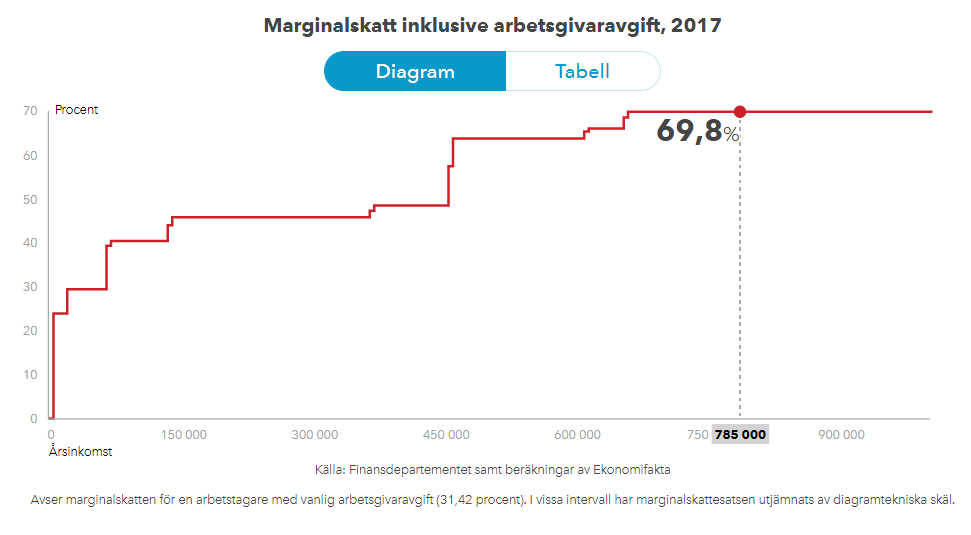
Let me show the more technical aspect: In England, earning above £18,330 places you at a position in the 54th percentile, higher than the majority of income-earners. Similarly, in Australia, $55,874 places you above 52% of Aussie income-earners. For Sweden, with the highest marginal income taxes in the world, a similar statistics is trickier to estimate since there is no official cut-off point above which you need to repay it. Instead, I have to estimate the line at which you “start paying” the relevant tax. What line is then the correct one? Sweden has something like 14 different steps in its effective marginal tax schedule, ranging from 0% for monthly incomes below 18,900 SEK (~$2,070) to 69.8% for incomes above 660,000 SEK (~$72,350) or even 75% in estimations that include sales taxes of top-marginal taxes:


If we would place the income levels at which Australian and English students start paying back the cost of their university education, they’d both find themselves in the middle range facing a 45.8% effective marginal tax – suggesting that they would have greatly exceeded the income level at which Swedish students pay back their tuition fees. Moreover, the Australian threshold would exchange into 367,092 SEK as of today, for a position in the 81st percentile – that is higher than 81% of Swedish income-earners. The U.K., having a somewhat lower threshold, converts to 217,577 SEK and would place them in the 48th percentile, earning more than 48% of Swedish income-earners – we’re clearly not talking about very poor people here.

The fact that income-earners in Sweden face a much-elevated marginal tax schedule as well as the simplified calculations above do indicate that despite its level of tuition fees at zero, it is more expensive to attend university in Sweden than it is in England or Australia. Since Australia’s pay-back threshold is so high relative to the income distribution of Sweden (81%), it’s conceivably much cheaper for Australian students to attend university than for it is for Swedish students, even though the tuition list prices may differ (the American debate is much exaggerated precisely because so few people pay the universities’ official list prices).

Letting governments via general taxation completely fund universities is a regressive measure that probably hurts the poor more than it helps the rich. The solution to this is not some quota-scholarships-encourage-certain-groups-version but rather to a) increase and reinstate tuition fees where applicable or b) cut government funding to universities, or ideally get government out of the sector entirely.

That’s a progressive policy in respect to universities. Accepting that, however, would be anathema for most people in politics, left and right.

RCH: death and taxes

I’ve been so busy I forgot about my Tuesday column over at RealClearHistory (I have a Friday column, too). Last week’s column was about the trial and execution of two Italian-born anarchists in Massachusetts:

The anarchism of Nicola Sacco and Bartolomeo Vanzetti was left-wing and violent. Very violent. The two young men were admirers of Luigi Galleani, an Italian anarchist who advocated violence as the best way to achieve a more anarchist world. Sacco and Vanzetti, the executed, were part of an American syndicate dedicated to Galleani’s ideals. This syndicate was responsible for bombings, assassination attempts, printing and distributing bomb-making books, and even mass poisonings in the United States. The Galleanists were so violent that they sat atop a list of the federal government’s most dangerous enemies. On April 15, 1920, an armed robbery at the Slater and Morrill Shoe Company in Braintree, Mass., went awry and two men, a guard and an accountant (“paymaster”) were killed by the robbers. Sacco and Vanzetti were accused, convicted, and sentenced to death.

This week’s column focused on Shays’ Rebellion:

The Shaysites, as supporters of Daniel Shays came to be known, eventually grew to thousands of men, and the movement grew confident enough that it planned to seize a federal armory. However, the governor of Massachusetts, James Bowdoin, directed a local militia leader (William Shepard) to protect the armory. The armory, though, was federal property, and the militia was operating under state direction, so the seizure of the armory in the name of protecting it from rebels had the potential to ignite a powder keg of legal ramifications throughout the war-torn eastern seaboard.

Y’all stay sane out there!

Between anarchy and minarchism

While sometimes we think of ideologies in strict terms of left and right, more and more frequently we look at political schemas that incorporate a dimension for statism. Big government is possible for both conservatives and progressives; so, maybe, is minarchy. If minarchy is possible, and achievable, it must attain popular support less it be thwarted by revolution or contrarian voting. From this, maybe it makes sense that a minarchism utilize fundamental values from each side, in order to be pragmatic and achieve democratic (and thereby maybe stable) ends. Here there may even be room for an ultraminarchy.

In Anarchy, State and Utopia, Robert Nozick defended a minimal state slightly more restrained than traditional classical liberalism. This minimal state arises through natural market forces from statelessness, and serves to enforce contracts and produce monopolistic law. Nozick, although countering his fellow Harvard academic Rawls, was also responding to the natural law anarchists, who criticized coercive states for violating human rights — which, in the American tradition, often boil down to rights of property and self-ownership.

However, before arriving at the minimal, night-watchman state, Nozick articulates an ultraminimal state, i.e. a private protection agency that claims exclusionary right over the use of force for a given geographical area. It has its voluntary clients; the extension of coverage to others makes the agency a “state” as it introduces taxation.

In ASU the state is an entity formed from an invisible hand to produce heavily right-libertarian functions of government like protecting negative rights. Because of this, the minarchist state was a refuge for archist libertarians to claim as their own, relatively consistent with centuries of Western liberal thought. Accordingly, in response, the anarchists question the viability of a lasting minimal state — cue David Friedman in Machinery of Freedom:

“It took about 150 years, starting with a Bill of Rights that reserved to the states and the people all powers not explicitly delegated to the federal government, to produce a Supreme Court willing to rule that growing corn to feed to your own hogs is instate commerce and can therefore be regulated by Congress.”

Government grows; modern government grows really, really fast. Minimalism hasn’t seemed to last. So the question is, what sorts of minimal governance could last?

The traditional ultraminimal and minimal state are concerned with, as stated, traditionally libertarian public functions such as police, the judiciary, and possibly roads and maybe even national defense. The problem with these utilities is that they feel wildly inadequate to the modern American used to entitlements, welfare, or, e.g., a president. The privatization of nearly all federal departments — even when their failures are widely acknowledged — is seen as wild enough for John Oliver to entertain millions of viewers, at the blight of Gary Johnson, and make hardcore eliminativism a losing electoral program. The contemporary world is too complicated, or our enemies are too powerful, or the market is too corrupt for the reinstitution of laissez-faire in the 21st century.

Nevertheless we want a smaller government, or no government, and losing to the tide isn’t a good death; we’d rather fight, and we’d rather win. A lasting minarchism satisfies the broad purposes of limited governance — basic liberty, protection, and preserving the benefits of the market — while sufficiently completing modern democratic demands, lest it erode into statism or collapse internally. (Keep in mind that statelessness, at least this week, is not a winning platform.)

Here’s what I think lies between anarchism and minarchism: the redistributive state. We can make a couple assumptions which I think are likely true: (1) every public service, including public goods, currently monopolized by the state could be provided (and, maybe, could be provided better) by the market and non-coercive communities instead, and (2) the entitlement theory of distributive justice offered by Nozick is correct, i.e. holdings are just if acquired by peaceful initial acquisition, voluntary exchange or gifting, or rectification of a previous unjust acquisition. Taking these assumptions, and leveraging the fact that the American populace will not currently settle for brutalist governance, the redistributive state (RS) seeks only to collect tax revenues and redistribute money progressively.

Instead of offering vouchers, EBT, or public options like housing, schools, security and roads, a RS would only tax its citizens and reallocate revenue based on some progressive variables like income, net worth or consumption. (These details are less important, for now.) The only administration is something like an Internal Revenue Service, Census Bureau, and investigation unit suffused together, with over ninety-five percent of the current staff eliminated, with tax escapees adjudicated through non-state means.

An RS violates rights based on a Lockean or Kantian conception; it also does something which sounds pretty socialist to right-wing circles. For this reason, though minarchist, it may not be libertarian. However, the pragmatic element is also very utilitarian and liberal, which may interest bleeding-hearts; and, being essentially one big welfare program, it may intrigue American leftists currently eyeing a state takeover of health care and socialized education. We would do well to keep in mind that Friedrich Hayek and Milton Friedman were not averse to basic income either — a redistributive state operates a universal basic allowance and abandons the productive functions of the state. I think it is generally clear that, in a situation where we are already giving a person $X in the illiquid form of schools, transfer payments, utilities, roads, defense, firefighters, social planning, arts, retirement investing, mail service, etc., instead we should just give that person $X to spend however they see fit, to reap more competitive pressure from consumer exposure to prices and to align their dollars with their own individual values. If anyone disagrees, they might be too top-down to consider minarchism in any scenario.

The RS has many benefits over our current, vague understanding of contemporary government. In the first case, the reductionist perspective of right-wing anarchists, such as the stationary bandits theory, is validated, and a lot of the mysterious machinery and ivory-tower political philosophy is dissolved. Some of the bright spots of recent cameral formalist thought are validated, too, without the unpleasant baggage. (And armchair philosophizing about the Rousseauian general will is finally put to rest.) And, for the Marxists, their critique of the state as a tool of the capitalist class, which is true enough, is answered, since the state now greatly serves labor more than capital: some of the income of the upper classes is directly confiscated from them and allocated to the lower classes. Also, the state ceases to be paternalistic — it no longer chooses what food is available through SNAP, or issues health and safety warnings; it just straight-up hands out the money without assuming value for consumers. It doesn’t determine what is taught in schools, or what color the roads are, or which country gets bombed on Tuesday.

Perhaps most popularly, the RS has the potential to all but eliminate bureaucracy. With one small administrative branch which functions like a hyper-specialized agency, there is little room or need for massive proliferation and government by permanent staffers, where we find ourselves now. Likely, all seats will be elected positions along with some underlings, with the marginal tax brackets pre-established constitutionally and open to a similar amendment process. But, that can all be figured out later.

Now, there are some obvious flaws for an RS. First of all, the very wealthy, prima facie, have little incentive to stay in a redistributive state. Their money is seized and without tangible benefit for themselves, like roads or security. They have to buy those things on their own dime. The redistributive state is the antithesis of Galt’s Gulch. The primary answer to this I can think of is that, in a society with less state omnipotence (in contrast to today, where everyone’s first answer to a problem starts with a “g”) community ties will be closer — the rich will want to pay their “fair share.” This is the Hoppean trust in private charity, except that it’s now “forced private” charity. Also, taxes would be much, much lower than the current situation and hopefully tolerable. The taxes are also going directly to other citizens instead of politician’s wallets, oil tycoons, and potassium chloride. Furthermore, they’re paying to live in — the government still has a coercive and unjustified monopoly on land — the freest nation in the world. An RS is significantly freer than the other statist regimes, and less stressful. Government plays no role at all in everyday life.

One other flaw — maybe an inherent flaw of government brightly illuminated by a raw redistributive state — is what Murray Rothbard saw as an eternal tension between net tax-payers and net tax-consumers. To the extent that the RS administration is elected, and to the extent that politicians have platforms, a lot rests on whether or not taxes will be raised (read: redistribution will increase) or not. The left will continually be concerned with income inequality, regardless of whether or not everyone is well-off. The goalposts might keep climbing, to where taxation is no longer about fairness or the difference principle, but about punishment. At the same time, dialectically, the very wealthy will want to keep the maximum amount of their money and protect profit, regardless of my arguments above. Raw societal tensions like these probably require a dynamic form of governance, with fluctuations in party dominance, but the RS is too brutalist to feature such parties or other contrivances. The only hope here, I guess, is that the tension will be less than in the current system we have, where people openly talk about murdering the other party. And very likely it will be. (Also, the market will correct much of the gratuitous wealth disparity presently built upon rent-seeking — so it becomes an empirical question about what levels of inequality create what levels of tension, as there will be large inequality in any non-patterned system of holdings.)

In conclusion, a redistributive state would be baldly organized around theft (in a libertarian interpretation) and using people as means rather than ends. To that extent it is hardly libertarian. It achieves Nozick’s end of minimal government but distorts the typical functions we correlate with small government. Still, it’s ultraminarchical, preserves innovation, balances right-wing virtues like liberty and industry and left-wing virtues like equality and positive freedom, and, for a radical populace not quite keen on revolution, has the potential to be politically attractive. It serves welfarist functions demanded by 21st century citizens without the corporatist empire of the present. Also, no one starves. For all of this, even if a redistributive state is not perfection incarnate, it seems far better than the current system, and provides a culturally-celibate political framework to possibly achieve success in totally disparate societies from the United States. I think it’s a useful, radical place to look for bipartisan solutions to a complicated and overwhelmingly statist world.

I’m pretty sure I’m the first one to suggest a state organized baldly and singularly around redistribution of private income, either because it’s too stupid or it’s too grossly unattractive, so I welcome all feedback. But, if voluntarist alternatives are possible at all, this implies all the state is is a redistributor anyway. The idea of an RS just accepts this conclusion and makes it efficient. Keep in mind I haven’t elaborated on the many complications of UBI, which is an entire field to articulate more extensively, and which has its own numerous difficulties. For now the only question is would this form of government be possible.

North Korea at the North Sea?

Yesterday, both Houses of Dutch Parliament jointly opened the parliamentary year, which is always held on the third Tuesday in September, and is known as “Budget Day.” Normally, there is not much pomp and glory in the Low Lands, but on “Little Princes Day” (as the day is literally called), we go all-out: the King and Queen are driven in a horse-pulled carriage to the Hall of Knights, the oldest part of the parliamentary buildings (built around 1250), surrounded by military troops in full ceremonial dress. The King reads his speech (actually written by and under full political responsibility of the Prime Minister and cabinet) from a huge throne, announcing the government’s plans for the next year. Male ministers in morning coats, ladies in dresses and hats, with the powerful elites also assembled.

king and queen
King Willem-Alexander and Queen Maxima entering the Hall of Knights (source)

After the reading, the Royal couple make their way back to one of their palaces in the centre of The Hague, returning once to greet the masses from the balcony.

Meanwhile, the Minister of Finance officially presents the 2018 budget to the Lower House. The separate budgets of all departments are laws, which will have to pass both Houses before 31 December. This process is normally preceded by a two day debate on “the general state of the country,” but this year it is skipped because there is only a caretaker government in office. It awaits the finalization of negotiations for a new government, which started right after the elections on 15 March. Still no government is formed, although it is widely expected that a four-party coalition will be presented within a few weeks, consisting of small Christian left wingers, centre Christian Democrats, and two social liberal parties, D66, and Prime Minister Mark Rutte’s VVD.

Although much improved since the low point of the Great Recession, around 2011-2012, the public finances are still shocking from a classical liberal perspective. The income of the national government is 285 billion Euro (around 338.5 billion USD), which is 43% of GDP.

It consists mainly of several mandatory insurance premiums for collective arrangements (112.2 billion Euro), income tax (55.4 billion; the highest bracket of 51.5% tax applies to all personal income over 68.507 Euro), and VAT (52.8 billion). The rest are mainly specific taxes, related to companies, the environment, excises, dividends, et cetera. In 2011, the public share of GDP was still 47%, while in the 1980s it reached peaks of around 60%. Not exactly anywhere near an ideal liberal situation, no matter what liberal persuasion you are. Personally, I would argue that 25% should be the max for a decent set of state tasks, but I am sure that makes me some weird Northern European commie in some American libertarian eyes!

The situation is even more dire if we see where that money is spent. Health care (80.4 billion euro) and social security (79 billion) are always in competition as the largest spending departments. So that is 56% of the budget already and both increase annually, no matter the economic circumstances. The third post is public education (35.4 billion), followed by funds for provinces and municipalities (24.4 billion), foreign affairs and foreign aid (12), police and judiciary (10.3), defense (8.4), and infrastructure and environment (also 8.4), with the other departments taking parts of the rest. Despite a very rare expected budgetary surplus of 7.8 billion in 2018, the national debt is still 53.7% of GDP. Perhaps not bad in international comparison, still not good for any liberal.

These numbers are only part of the story, because there are also numerous local taxes, and the number of liberty-inhibiting regulations, from European, national, provincial and local origin are staggering. There is not one really free market, and there are hardly parts of individual life not regulated or influenced by the state. A comparison with North Korea is of course still far-fetched, yet socialism is alive and kicking on the North Sea shores.

In my view it is evidence of the remarkable power of capitalism that The Netherlands is still one of the richest countries on earth, a global top 15 economy (GDP per capita), with only 17 million inhabitants. No matter how hard you curb it, the capitalist system still delivers amazing results. Of course, the opportunity costs of the Dutch regulatory state are very high. In terms of personal liberty there are not many better places on the planet. Yet in other fields it is a different story. Economic freedom is a mess, which means that the material aspects of personal freedom are seriously restricted. Yet the worst is the mentality. Sadly, most Dutch have traveled the whole Hayekian Road to Serfdom, making a shift to classical liberalism highly unlikely.

Some Thoughts on State Capacity

State capacity is an important topic and the subject of much recent attention in both development economics and economic history. Together with Noel Johnson I’ve recently written a survey article on the topic (here). At the same time, many libertarians and classical liberals are uncomfortable with the concept (see here and here). I think these criticisms are useful but misplaced. Addressing them will hopefully move the debate forward in a useful fashion.

Here I will just focus one issue. This is the argument recently made by Alex Salter that state capacity is a black box. Alex notes correctly that we have a detailed and convincing theory for how markets can lead to economic growth (by directing resources to their most efficient use). In contrast, according to Alex:

“State capacity, by itself, addresses neither the information issue nor the incentive issue. While governance institutions obviously began centralizing at the beginning of the modern era, this is just a morphological description of what happened to institutions. On its own, that’s insufficient as a causal explanation”.

I think Alex and other critics are on the wrong track here. State capacity is not alternative explanation for economic growth to that offered by markets. The relevant question is what impeded market development before, say, 1700, and what enabled the growth of markets after around 1700. The evidence provided by a body of research suggests that prior to 1700 market development was impeded by political fragmentation both within and between states. Critics of the state capacity argument should engage with this literature.

A second claim Alex makes is that we lack a theory for why the more centralized states that arose after 1700 were less rent-seeking and predatory than their weaker and more internally fragmented predecessors. But in fact we have a fairly good understanding of many of the mechanisms responsible for the demise of the more costly forms of recent seeking that characterized medieval and early modern Europe. This understanding is based on the work of James Buchanan and Mancur Olson.

The basic argument is this. Medieval and early modern states were mostly devices for rent-extraction and rent-seeking. But this rent-extraction and rent-seeking was largely decentralized. They collected taxes through a variety of costly and inefficient means (such as selling monopolies). They then spent the tax revenue on costly wars.

Decentralized rent-extraction was costly and inefficient. For example, it is well known that weights and measures varied from place to place in preindustrial Europe. What is less well known is that there were institutional reasons for this, as each local lord wanted to use his own measures in order to extract more surplus from the peasants who were forced to grind their grain using his mill. Local cities similarly used their own systems of weights and measures in order to extract surplus from traveling merchants. This benefited each local lord and city authority but imposed a large deadweight loss on the economy at large.

The logic of internal tariffs was similar. Each local lord or city would choose their internal tariffs in order to maximize their own income. But we know from elementary microeconomics that in this setting each local authority will set these tariffs “too high” because they will not take into account the effect of their tax rate on the tax revenue of their neighbors who also set their tariffs too high.

When early modern European rulers invested in state capacity, they sought to abolish or restrict such internal tariffs, to impose uniform taxes, and to standardize weights and measures. This resulted in a reduction in deadweight loss as when the king set the tax rate he considered the tax revenue he gets from his entire realm, and internalized the negative externality mentioned above.  The reasoning is identical to that which states that a single combined monopolist may be preferable to an up-stream and down-stream monopolist. When it comes to a public bad (like rent-seeking) a monopolist is preferable to competition.

Political Decentralization and Innovation in early modern Europe

My full review of Joel Mokyr’s A Culture of Growth is forthcoming in the Independent Review. Unfortunately, it won’t be out until the Winter 2017 issue is released so here is a preview. Specifically, I want to discuss one of the main themes of the book and my review: the role of political decentralization in the onset of economic growth in western Europe.

This argument goes back to Montesquieu and David Hume. It is discussed in detail in my paper “Unified China; Divided Europe’’ (forthcoming in the International Economic Review and available here). But though many writers have argued that fragmentation was key to Europe’s eventual rise, these arguments are often underspecified, fail to explain the relevant mechanisms, or do not discuss counter-examples. Mokyr, however, has an original take on the argument which is worth emphasizing and considering in detail.

Mokyr focuses on how the competitive nature of the European state system provided dynamic incentives for economic growth and development. This argument is different from the classic one, according to which political competition led to fiscal competition, lower taxes, and better protection of property rights (see here). That argument rests on a faulty analogy between competition in the marketplace and competition between states.  The main problem it encounters is that while firms can only attract customers by offering lower prices (lower taxes) or better products (better public goods), states can compete with violence. Far from being competitive, low tax states like the Polish-Lithuanian commonwealth were crushed in the high-pressure competitive environment that characterized early modern Europe. The notion that competition produced low taxes is also falsified by the well-established finding that taxes were much higher in early modern Europe than elsewhere in the world.

It is also not the case that political fragmentation is always and everywhere good for economic development. India was fragmented for much of its history. Medieval Ireland was fragmented into countless chiefdom prior to the English conquest. Perhaps we can distinguish between low-intensity but fragmented state systems which tended not to generate competitive pressure such as medieval Ireland or South-East Asia and high-intensity fragmented state systems such as early modern Europe or warring states China. But even then it is not clear that a highly competitive and fragmented state system will be good for growth. In general, political fragmentation raised barriers to trade and impeded market integration. Moreover a competitive state system means more conflict or more resources spent deterring conflict. For this reason political fragmentation tends to result in wasteful military spending. It can be easily shown, for instance, that a much higher proportion of the population spent their lives in the economically wasteful activity of soldiering in fragmented medieval and early modern Europe than did in either the Roman empire or imperial China (see Ko, Koyama, Sng, 2018).

Innovation and Decentralization

What then is Mokyr’s basis for claiming that political fragmentation was crucial for the onset of modern growth? Essentially, for Mokyr the upside of Europe’s political divisions was dynamic. It was the conjunction of political fragmentation with a thriving trans-European intellectual culture that was crucial for the eventual transition to modern growth. The political divisions of Europe meant that innovative and heretical thinkers had an avenue of escape from oppressive political authorities. This escape valve prevented the ideas and innovations of the Renaissance and Reformation from being crushed after the Counter-Reformation became ascendant in southern Europe after 1600. Giordano Bruno was burned in Rome. But in general heretical and subversive thinkers could escape the Inquisition by judiciously moving across borders.

Political fragmentation enabled thinkers from Descartes and Bayle to Voltaire and Rousseau to flee France. It also allowed Hobbes to escape to Paris during the English Civil War and Locke to wait out the anger of Charles II in the Netherlands. Also important was the fact that the political divisions of Europe also meant that no writer or scientist was dependent on the favor of a single, all powerful monarch. A host of different patrons were available and willing to compete to attract the best talents. Christina of Sweden sponsored Descartes. Charles II hired Hobbes as a mathematics teacher for a while. Leibniz was the adornment of the House of Hanover.

The other important point that Mokyr’s stresses is Europe’s cultural unity and interconnectedness. As I conclude in my review, Mokyr’s argument is that

“the cultural unity of Europe meant that the inventors, innovators, and tinkers in England and the Dutch Republic could build on the advances of the European-wide Scientific Revolution. Europe’s interconnectivity due to the Republic of Letters helped to give rise to a continent-wide Enlightenment Culture. In the British Isles, this met a response from apprentice trained and skilled craftsmen able to tinker with and improve existing technologies.  In contrast, political fragmentation in the medieval Middle East or pre-modern India does not seem to have promoted innovation, whereas the political unity of Qing China produced an elite culture that was conservative and that stifled free thinking”.

It is this greater network connectivity that needs particular emphasize and should be the focus of future research into the intellectual origins of growth in western Europe. At present we can only speculate on its origins. The printing press certainly deserves mention as it was the key innovation that helped the diffusion of ideas. Mokyr also points to the postal system as a crucial institutional development that enabled rapid communication across political boundaries. Other factors include the development of a nascent European identity and what Chris Wickham calls, in his recent book on medieval Europe, “the late medieval public sphere” (Wickham, 2016). These developments were important but understudied complements to the fragmented nature of the European state system so frequently highlighted in the literature.

A Tax is Not a Price

Auto_stoped_highwayAccording to The Economist, the latest US federal budget includes incentives for “congestion pricing” of roads.

Ostensibly, this is about reducing congestion. But some municipalities like the idea of charging for roads because it represents a new revenue stream. This creates an incentive to charge a price above cost. When a firm does this, we call it a “monopoly price.”

But when a government monopoly forces you to pay a fee to use a good or service, do not call it a price. It is a fee that a government collects by fiat. In other words, it is a tax.

A price is a voluntary exchange of money for a good or service. The emphasis on voluntary is important, because it is this aspect of the price that enables economic calculation for what people really want.  Even a free market “monopolist” (however unlikely or conceptually vague it may be) engages in voluntary exchange.

On the other hand, a bureaucrat “playing market” by imposing fees on government-controlled goods and services will not have the same results as a market process. For starters, unlike a person making decisions on their own behalf, a government bureaucrat has to guess at costs. Under a voluntary system, a cost is the highest valued good or service you voluntarily give up in order to attain a goal. But the bureaucrat is dealing with other people’s money.

To “objectively” determine costs, in order to set “fair” prices, is a chimera. In the words of Ludwig von Mises, “[a] government can no more determine prices than a goose can lay hen’s eggs.”

Should we tax churches? A Georgist Proposal

Recently President Trump enacted a series of executive orders with the aim of extending religious liberty. This has gotten me to think about churches and tax policy. Just to be clear, in this post I will not discuss the details of Trump’s orders. I care about the broad concept here.

Churches in the United States are exempt from certain taxes due to their classification as charities. I have often been in favor of this designation. Taxes can easily serve as a way for the state to discriminate against groups subtly. I could easily imagine a tax that targets churches with kneeling pews (e.g. Catholic churches) and therefore disadvantages them relative to denominations that have less kneeling involved. I could also imagine a system, similar to some European countries, where the state collects the tithe on behalf of the church. This arrangement would favor larger, state recognized, churches at the expense of smaller start up denominations. In both cases taxes can be used by the state to effectively discriminate between churches.

Some time ago though it was pointed out to me that NOT taxing churches could also lead to discrimination against them. Take the case of property taxes. When urban planners draw up zones (residential, commercial, mixed use etc.) they effectively have the power to exclude churches from certain neighbors. Even without official census data it is not difficult to notice where certain religions sort within the city,  and so a zealous planner could easily discriminate by denomination. When church property IS taxed there is a strong disincentive against this type of discrimination because it reduces potential city revenues. Even if a given planner may be willing to discriminate nonetheless, he would find himself fired by his tax-obsessed superiors. When church property ISN’T taxed this incentive is reversed. Since church property can’t be taxed cities lose out on potential tax revenue when they zone an area for a church over taxable property. A devout religious urban planner may easily be pressured to minimize the number of churches to maximize tax revenues. I suspect a Catholic urban planner would prefer to reduce the number of Protestant churches, so this is a scenario where minority denominations could easily find themselves zoned out of existence.

The current concern about whether churches should be allowed to be engaged in politics would be moot if they were taxed. The legal reason churches are limited in their political speech is that they are classified as charities. Certain crowds would be angry about allowing churches being involved in politics* anyway, but I suspect many politicians would be fine to look the other way in exchange for the increased tax revenues.

How can we balance the pros of taxing churched (helping them avoid being discriminated by zoning and gaining political speech) versus the cons (discrimination by taxation)? I think the answer is a georgist tax on land. It achieves the goal of taxing churches without discriminating against any given denomination.

Thoughts?
_______

*For the record I personally oppose my church, the Catholic Church, from getting involved in politics. I am fine with the priest lecturing against the evils of abortion, but I don’t want to hear his thoughts on the optimal income tax rate.

A Common Conservative Fallacy

I believe folly serves liberals better than it serves conservatives. Our way is the rational way while liberals tend to rely on their gut-feelings and on their sensitive hearts which make them comparatively indifferent to hard facts. That’s why they voted for  Pres. Obama. That’s why they voted for Mrs Bill Clinton against all strong evidence (known evidence, verifiable, not just suppositions) of her moral and intellectual unsuitability. That’s why many of them still can’t face emotionally the possibility of buyer’s remorse with respect to Mr Obama. That’s why they can’t collectively face the results of the 2016 election. So, conservatives have a special duty to wash out their brains of fallacy often.

It’s the task of every conservative to correct important errors that have found their way into fellow conservatives’ mind. Here is one I hear several times a week, especially from Rush Limbaugh (whom I otherwise like and admire). What’s below is a paraphrase, a distillation of many different but similar statements, from Limbaugh and from others I listen to and read, and from Internet comments, including many on my own Facebook:

“Government does not create jobs,”

and

“Government does not create wealth (it just seizes the wealth created by business and transfers it to others).”

Both statements are important and both statements are just false. It’s not difficult to show why.

First, some government actions make jobs possible that would not exist, absent those actions. Bear with me.

Suppose I have a large field of good bottom land. From this land I can easily grow a crop of corn sufficient to feed my family, and our poultry, and our pig, Gaspard. I grow a little more to make pretty good whiskey. I have no reason to grow more corn than this. I forgot to tell you: This is 1820 in eastern Ohio. Now, the government uses taxes (money taken from me and from others under threat of violence, to be sure) to dig and build  a canal that links me and others to the growing urban centers of New York and Pennsylvania. I decide to plant more corn, for sale back East. This growth in my total production works so well that I expand again. Soon, I have to hire a field hand to help me out. After a while, I have two employees.

In the  historically realistic situation I describe, would it not be absurd to declare that the government gets no credit, zero credit for the two new jobs? Sure, absent government tax-supported initiative, canals may have been built as private endeavors and with private funds. In the meantime, denying that the government contributed to the creation of two new jobs in the story above is not true to fact.

Second, it should be obvious that government provides many services, beginning with mail delivery. Also, some of the services private companies supply in this country are provided elsewhere by a branch of government. They are comparable. This fact allows for an estimation of the economic value of the relevant government services. Emergency services, ambulance service, is a case in point. Most ambulances are privately owned and operated in the US while most ambulances are government-owned and operated in France. If you have a serious car accident in the US, you or someone calls a certain number and an ambulance arrives to administer first aid and to carry you to a hospital if needed. Exactly the same thing happens in France under similar circumstances. (The only difference is that, in France, the EM guy immediately hands you a shot of good cognac. OK, it’s not true; I am kidding.)

In both countries, the value of the service so rendered is entered into the national accounting and it does in fact appear in the American Gross Domestic Product for the year (GDP) and in the French GDP, respectively. The GDP of each country thus increases by something like $500 each time an ambulance is used. Incidentally, the much decried GDP is important because it’s the most common measure of the value of our collective production. One version of GDP (“PPP”) is roughly comparable between countries. When the GDP is up by 3,5 % for a year, it makes every American who knows it, happy; also some who don’t know it. When the GDP shrinks by 1%, we all worry and we all feel poorer. If the GDP change shrinks below zero for two consecutive quarters, you have the conventional definition of a recession and all hell breaks lose, including usually a rise in unemployment.

Exactly the same is true in France. The government-provided French ambulance service has exactly the same effect on the French GDP.

Now think of this: Is there anyone who believes that the equivalent service supplied in France by a government agency does not have more or less the same value as the American service provided by a private company? Would anyone argue that the ambulance service supplied in France, in most ways identical to the service in America, should not be counted in the French GDP? Clearly, both propositions are absurd.

Same thing for job creation. When the French government agency in charge of ambulances hires an additional ambulance driver, it creates a new job, same as when an American company hires an ambulance driver.

By the way, don’t think my story trivial. “Services” is a poorly defined category. It’s even sometimes too heterogeneous to be useful (not “erogenous,” please pay attention). It includes such disparate things as waitressing, fortune-telling, university teaching, and doing whatever Social Security employees do. Yet it’s good enough for gross purposes. Depending on what you include, last year “services” accounted for something between 45% and 70% of US GDP. So, if you think services, such as ambulance service, should not be counted, you should know that it means that we are earning collectively about half to three quarters less than we think we do. If memory serves, that means that our standard of living today is about the same as it was in 1950 or even in 1930.

Does this all imply that we should rejoice every time the government expands? The answer is “No,” for three reasons. These three reasons however should only show up after we have resolved the issue described above, after we have convinced ourselves that government does provide service and that it and does create real jobs, directly and indirectly. Below are the three questions that correspond to the three reasons why conservatives should still not rejoice when government enlarges its scope. Conservatives should ask these three questions over and over again:

1 Is this service a real service to regular people or is it created only, or largely, to serve the needs of those who provide it, or for frivolous reasons? Some government services fall into this area, not many, I think. Look in the direction of government control, inspection, verification functions. Don’t forget your local government.

Often, the answer to this question is not clear or it is changing. Public primary and secondary education looks more and more like a service provided largely or even primarily to give careers to teachers and administrators protected by powerful unions. It does not mean that the real, or the expected service, “education,” is not delivered, just that it’s often done badly by people who are not the best they could be to provide that particular service; also people who are difficult or impossible to replace.

2   Is this particular service better provided by government or by the private sector? Is it better provided by government although the provision of the service requires collecting taxes and then paying out the proceeds to the actual civil servants through a government bureaucracy? That’s a very indirect way to go about anything, it would seem. That’s enough reason to be skeptical. The indirectness of the route between collecting the necessary funds and their being paid out to providers should often be enough to make government service more expensive than private, market-driven equivalent services. Note that the statement is credible even if every government employee involved is a model of efficiency.

The US Post Office remains the best example of a  situation where one would say  the private sector can do it better.

Only conservatives dare pose this question with respect to services one level of government or other has been supplying for a long time or forever. The Post Office is inefficient; if it were abolished, the paper mail would be delivered, faster or cheaper, or both. Some paper mail would not be delivered anymore. Many more of us would count it a blessing than the reverse. While there is a broad consensus across the political spectrum that children should be educated at collective expense, there is growing certitude that governments should not be in the business of education. In many parts of the country, the public schools are both expensive and bad. Last time I looked, Washington DC was spending over $20,000 per pupil per year. Give me half that amount and half the students or better will come out knowing how to read, I say. (It’s not the case now.)

3   This is the most serious question and the most difficult to answer concretely: Does the fact that this service is provided by government (any level) have any negative effect on our liberties? This is a separate question altogether. It may be that the government’s supply of a particular service is both inefficient and dangerous to freedom. It may be however that government supply is the most efficient solution possible and yet, I don’t want it because it threatens my freedom. As a conservative, I believe that my money is my money. I am free to use it to buy inefficiently, in order to preserve liberty, for example. I am not intellectually obligated to be “pragmatic” and short sighted.

To take an example at random, if someone showed me, demonstrated beyond a reasonable doubt, that Obamacare would reduce the cost of health care without impairing its quality, if that happened, I would still be against it because of the answer I would give to the third and last question above.

I don’t want a any government bureaucracy to make decisions that are ultimately decisions of life and death on my behalf. The possibility of blackmail is too real. Even thinking about it is likely to make some citizens more docile than they otherwise would be. So much power about such real issues must have a chilling effect on the many.

The rule of thumb is this: Every expansion of government reduces individual freedom. That’s true even if this expansion creates and efficient and effective government agency, say, a real good Post Office we don’t even know how to dream of. And this is not an abstract view. The well-intentioned and in other ways laudable recognition of homosexual marriage was followed in short order by threats and fines against a hapless baker who declined to bake a cake for a gay wedding. We must keep in mind at all times that, of course, the power to fine, like the power to tax, is the power to destroy.

An efficient but ethically objectionable government service is not something I worry much about, in the case of Obamacare specifically, by the way. It is inefficient, ineffective and dangerous to individual liberty all at once.

Conservatives don’t do enough to proclaim that their opposition to big government has an ethical basis, that it’s a moral position independent of the quality of big government. This silence makes if easy for liberals to caricature conservatives as just selfish grouches who don’t want to pay taxes.

Most of the time, I don’t want to pay taxes because I don’t want to be forced. I would gladly give away twice the amount of my taxes if there were a way to do it voluntarily instead of paying taxes.

I am so opposed to this kind of force that I think even the undeserving and obscenely rich should not be despoiled by the government. It’s an ethical position, not a pragmatic one. And, it sure cannot be called “selfish.” (WTF!)