The Cruel, Conceited Follies of Trump’s Foreign Policy: 2026 Edition

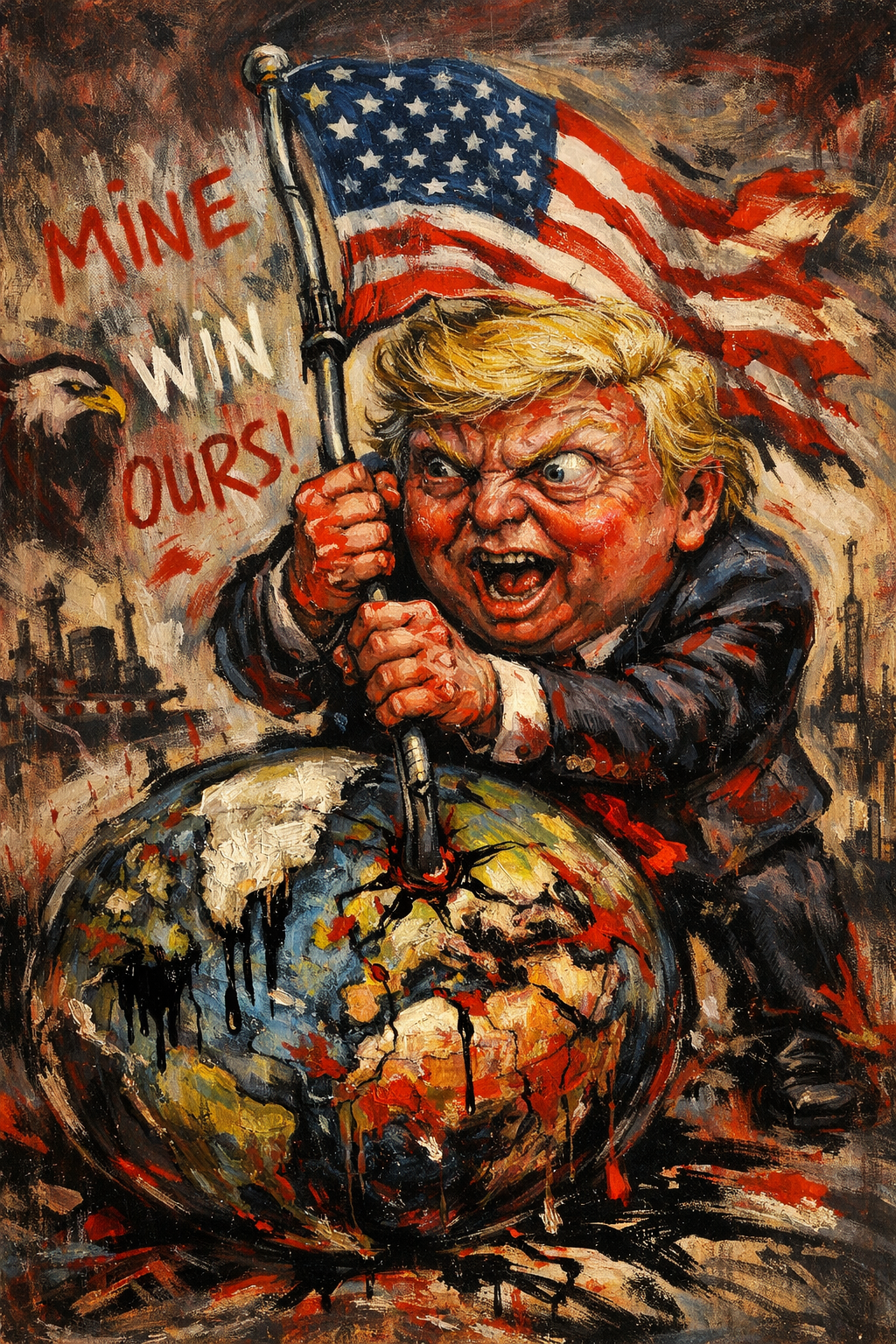
A neo-expressionist painting of Trump jamming an American Flag into the Globe with "Yours Win Ours" written in blood in the background, a bald eagle, and pastiches of factories and oil refineries.

Trump has now taken extralegal military action in Venezuela. Trump is strongly considering such action in Iran. And Trump keeps flirting with aggressive globally destabilizing military annexation of Greenland, a NATO ally. Many people are acting perplexed. After all, didn’t libertarian “genius” and totally-not-delusional-reactionary Walter Block tell us back in 2016 that libertarians should vote for Trump because he is anti-war? After this proved to be false the first term, didn’t totally-not-delusional-reactionary Walter Block then tell us again case for libertarianism was that he was anti-war and anti-foreign intervention, and that he was super cereal this time?

Sarcasm aside, I think it is worth revisiting why Trump’s foreign policy turn towards a radical sort of imperialist interventionism is so evil and unsurprising. I was confident back in 2016 that he was always going to be an old-school imperialist who uses US military conquest purely for resource extraction in a way that would be far worse than neocon warmongering. I wrote at the time, following Zach Beauchamp (who continues to emphasize this point), that Trump’s foreign policy was neither the neo-conservative interventionism of the Clintons and Bushes of the world, nor the principled anti-interventionism of libertarian scholars like Christopher Coyne and Abigail Hall, nor even the nationalist isolationism of paleoconservatives like James Buchanan. Instead, Trump’s foreign policy has always (quite consistently, since he was still a pro-choice democrat in the 90s) been about advancing inchoate national economic and political interestswhich really just means the interests of the politically connected.

This connection between Trump’s completely crankish economic nationalism and his imperialist foreign policy is even tighter now than it was then. It seems Trump is likely facing a rejection of his unconstitutional overreach of unilaterally applying economically suicidal tariffs from SCOTUS. The tariffs, which originally, might I add, were based on perhaps the single dumbest attempt to do economics I have ever seen, appeared to be lifted straight from ChatGPT, given that his main economic advisor on these matters, Peter Navarro, is literally a fraudster. As a result, he now seems to be manufacturing a national security crisis so he can impose tariffs without congress’ blessing.

But I do not want to revisit Trump’s imperialist foreign policy just to gloat. I also want to revisit and restate why this foreign policy is unbelievably unjust and self-destructive. What I wrote back in 2016 is still worth reposting at length:

First, Trump’s style of Jacksonian foreign policy is largely responsible for most of the humanitarian atrocities committed by the American government. Second, Trump’s economic foreign policy is antithetical to the entire spirit of the liberal tradition; it undermines the dignity and freedom of the individual and instead treats the highest good as for the all-powerful nation-state (meaning mostly the politicians and their special interests) as the end of foreign policy, rather than peace and liberty. Finally, Trump’s foreign policy fails for the same reasons that socialism fails. If the goals of foreign policy are to represent “national interest,” then the policymaker must know what that “national interest” even is and we have little reason to think that is the case, akin to the knowledge problem in economic coordination.

… This is because the Jacksonian view dictates that we should use full force in war to advance our interests and the reasons for waging war are for selfish rather than humanitarian purposes. We have good reason to think human rights under Trump will be abused to an alarming degree, as his comments that we should “bomb the hell out of” Syria, kill the noncombatant families of suspected terrorists, and torture detainees indicate. Trump is literally calling for the US to commit inhumane war crimes in the campaign, it is daunting to think just how dark his foreign policy could get in practice.

To reiterate: Trump’s foreign policy views are just a particularly nasty version of imperialism and colonialism. Mises dedicated two entire sections of his chapter on foreign policy in Liberalism: The Classical Tradition to critiquing colonialism and revealing just how contrary these views are to liberalism’s commitment to peace and liberty. In direct opposition to Trump’s assertions that we should go to war to gain another country’s wealth and resources and that we should expand military spending greatly, Mises argues:

“Wealth cannot be won by the annexation of new provinces since the “revenue” deprived from a territory must be used to defray the necessary costs of its administration. For a liberal state, which entertains no aggressive plans, a strengthening of its military power is unimportant.”

Mises’ comments on the colonial policy in his time are extremely pertinent considering Trump’s calls to wage ruthlessly violent wars and commit humanitarian crises. “No chapter of history is steeped further in blood than the history of colonialism,” Mises argued. “Blood was shed uselessly and senselessly. Flourishing lands were laid waste; whole peoples destroyed and exterminated. All this can in no way be extenuated or justified.”

Trump says the ends of foreign policy are to aggressively promote “our” national interests, Mises says “[t]he goal of the domestic policy of liberalism is the same as that of its foreign policy: peace.” Trump views the world as nations competing in a zero-sum game and there must be one winner that can only be brought about through military conquest and economic protectionism, Mises says liberalism “aims at the peaceful cooperation between nations as within each nation” and specifically attacks “chauvinistic nationalists” who “maintain that irreconcilable conflicts of interest exist among the various nations[.]” Trump is rabidly opposed to free trade and is horrifically xenophobic on immigration, the cornerstone of Mises’ foreign policy is free movement of capital and labor over borders. There is no “congruence” between Trump and any classically liberal view on foreign policy matters in any sense; to argue otherwise is to argue from a position of ignorance, delusion, or to abandon the very spirit of classical liberalism in the first place.

…Additionally, even if we take Trump’s nationalist ends as given, the policy means Trump prefers of violent military intervention likely will not be successful for similar reasons to why socialism fails. Christopher Coyne has argued convincingly that many foreign interventions in general fail for very similar reasons to why attempts at economic intervention fail, complications pertaining to the Hayekian knowledge problem. How can a government ill-equipped to solve the economic problems of domestic policy design and control the political institutions and culture of nations abroad?  Coyne mainly has the interventionism of neoconservatives and liberals in mind, but many of his insights apply just as well to Trump’s Jacksonian vision for foreign policy.

The knowledge problem also applies on another level to Trump’s brand of interventionism. Trump assumes that he, in all his wisdom as president, can know what the “national interest” of the American people actually is, just like socialist central planners assume they know the underlying value scales or utility functions of consumers in society. We have little reason to assume this is the case.

Let’s take a more concrete example: Trump seems to think one example of intervention in the name of national interest is to take the resource of another country that our country needs, most commonly oil. However, how is he supposed to know which resources need to be pillaged for the national interest? There’s a fundamental calculation problem here. A government acting without a profit signal cannot know the answer to such a problem and lacks the incentive to properly answer it in the first place as the consequences failure falls upon the taxpayers, not the policy makers. Even if Trump and his advisors could figure out that the US needs a resource, like oil, and successfully loots it from another country, like Libya, there is always the possibility that this artificial influx of resources, this crony capitalist welfare for one resource at the expense of others, is crowding out potentially more efficient substitutes.

For an example, if the government through foreign policy expands the supply of oil, this may stifle entrepreneurial innovations for potentially more efficient resources in certain applications, such as natural gas, solar, wind, or nuclear in energy, for the same reasons artificially subsidizing these industries domestically stifle innovation. They artificially reduce the relative scarcity of the favored resource, reducing the incentive for entrepreneurs to find innovative means of using other resources or more efficient production methods. At the very least, Trump and his advisors would have little clue how to judge the opportunity cost of pillaging various resources and so would not know how much oil to steal from Libya. Even ignoring all those problems, it’s very probable that it would be cheaper and morally superior to simply peaceably trade with another country for oil (or any other resource) rather than waging a costly, violent, inhumane war in the first place.

Having said all that, there is plenty I got wrong in picturing Trump as an old-school imperialist. During Trump’s first term, I underestimated the extent to which institutional constraints would stop him from acting on his worst nationalist and imperialist impulses. But this term, those constraints are gone. The Mattises, Tillersons, Boltons, and Pences of the world have been replaced with the Vances, Noems, Rubios, and Hegseths. As a result, thinking of Trump as an old-school imperialist and nationalist is becoming more accurate since he is allowed to act on his irrational, deranged impulses.

Second, I failed to distinguish sufficiently between resource extraction through indirect means of violent regime change, tariffs, weapons supply, and 19th-century colonialist-style direct annexation versions of it. I do still think that if Trump really did what he most consistently wants he would do quite a bit of annexation and old school colonialism (see his comments on Greenland and Canada), but he seems a bit more content than I projected back then to use military force to install stooges and puppet regimes for resource extraction (as he has sought to do in both Gaza and now Venezuela). Which, to your point, is not as different from the Nixon/Bush/Clinton/Reagan type intervention as reactionary centrists would have you believe, but the nakedness of the extractive nationalist motivation does mark a difference that encourages even more brazenly cruel, more illegal, and more strategically incoherent and unpredictable interventionist warmongering.

Thirdly, and most obviously, I greatly overestimated his coherence on foreign policy. Whether it is him handicapping US influence in the Pacific by withdrawing from the TPP while implementing tariffs on Chinese goods to seem tough in the first term, which just gave China more leverage in the region. Or whether it’s his delusional flip-flopping on Russia and Ukraine based on who he talked to last, constantly this term. Or whether it’shis random provocation against Iran in 2019 by killing one of their generals. Or whether it’s his insane flip-flopping between Nuclear War talk and sychophancy with North Korea. Or the total randomness of his attacking Venezuela for more domestic than foreign policy reasons now. He is simply far more impulsive and deranged than I would have predicted in 2016. This part of that old article seems especially stale now:

After all, it doesn’t matter so much the character of public officials as the institutional incentives they face. But in matters of foreign policy problems of temperament and character do matter because the social situation between foreign leaders in diplomacy can often make a huge difference.

I did hedge that by allowing that Trump may be a uniquely unfit person so as to constitute a sui-generis case. But I should have been more emphatic about that: Trump really is a uniquely world-historically dangerous monster, and he has gotten more and more incoherent and impulsive over the years with his cognitive decline.

Finally, the biggest miss in my analysis of Trump’s foreign policy back then is that I put far too much emphasis on Trump’s focus on material goods, thinking he really just thought of geopolitics like a 12-year-old approaches a turn-based strategy game like Risk in just accruing more stuff. But in reality, his approach is far more disturbing and vile than even that. It is not simply about getting oil for US oil companies. In the case of Venezuela, oil execs do not seem so gun-ho. As one private equity investor told the Financial Times last week, “No one wants to go in there when a random fucking tweet can change the entire foreign policy of the country.” Indeed, the political risk is so big there Exonn’s CEO has called Venezuela “uninvestable” and Trump is trying to force oil companies to misallocate capital to Venezuela.

Narrow left-wing materialists’ critiques like mine misfire because they treat material resources as the main thing. It is not the oil per se that Trump wants, but what the oil represents. He is instead approaching international geo-politics like an 8-year-old driven by malignant narcissism: he wants symbols of nationalist masculine domination. Indeed, when asked why he wanted Greenland, Trump was quoted as saying:

Because that’s what I feel is psychologically needed for success. I think that ownership gives you a thing that you can’t do, whether you’re talking about a lease or a treaty. Ownership gives you things and elements that you can’t get from just signing a document.

Indeed, the fact that Greenland looks big on a Mercator projection of the earth has as much to do with why Trump wants it as the oil. As Trump continues his authoritarian assaults on individual liberty domestically and pursues semiotic nationalist domination internationally, one can only vainly pray that something keeps his dark, demonic, twisted sadist fantasies in check without devolving into a true civilization-level threat.

Legal Immigration Into the United States (Part 4): Bad and Worse Immigrants, and Fallacies

A study by the Center for Immigration Studies indicates wide variations in immigrant families’ propensities to receive welfare, according to their country of origin. Unfortunately, the study was published in 2011. Based on the Center’s appearances on television, it’s fair to say that it’s mostly anti-immigration although I am sure this is an oversimplification.

The score for Mexicans is 57%, 33% for Russians, 19% for Chinese, 14% for Indians, and only 12.5% for (the ever-saintly) Canadians. But the report of these seemingly clear differences may harm rational decision making in the way I warn against above. There are three reasons.

First, by emphasizing country of origin, the table seems to assume that different national groups have been in the US for the same length of time. In fact, nearly all immigrants arrive poor. Now, suppose that the average time in country for Mexicans is one year, and ten years for the Chinese. The 38 percentage point gap might vanish if the Chinese immigrants captured by the table had also been in the country for only one year.  Obviously, those are made up figures. I don’t know what we would find if proper control for length of stay in country had been applied. It would have to be an average length of stay which complicates both data gathering and interpretation again although it can be done.

Second, immigrants from different countries probably belong to systematically different classes. This would affect their propensity to go on welfare, irrespective of national culture of origin. Suppose that all Indian immigrants are medical doctors or engineers, and all Mexicans casual laborers. This difference would suffice to account for the 43 point welfare gap between the two groups. The statement, “Indians are much less likely to go on welfare than Mexicans,” in this case, may be more about doctors and laborers than about Indians and Mexicans. That’s irrespective of time in-country. Note that I am not arguing that the two groups are equally desirable as immigrants but that their respective desirability may have nothing to do with the national propensity to go on welfare by Mexicans, specifically. I can think of arguments in favor of admitting more doctors and also arguments in favor of more laborers, factoring in the cost of their possible landing on welfare for a while. Note that the gap in two categories’ propensity to go on welfare may have no ethical meaning associated with nationality of origin. After all, we don’t know what the welfare participation of Mexican immigrants would be if they were at all doctors.

Third, we have to look at immigrants contributions, positive and negative, across several generations, as we do in connection with Latino youth gangs, for example. In fact, immigrants of the same national origin may be objectionable today while their children may be desirable for American society tomorrow. An example: Suppose all Mexican immigrants are young, married, unschooled laborers from rural backgrounds. Such people tend to have many children – more than, say, unmarried, older men from the best engineering schools in India. The first group will be more likely to go on welfare than the second and it will supply America society in the next generation with more contributors to the Social Security fund. In this scenario, paradoxically, the large number of Mexican immigrants may compensate for the likely lower income of their children compared to both the native-born and other immigrants’ children.

[Editor’s note: In case you missed it, here is the link to Part 3]

Legal Immigration Into the United States: Introduction (Part 1 of 6)

This an essay about legal immigration. It includes a theoretical framework, essential facts, and subjective opinions. In this old-fashioned piece, there is no pretense of scholarly detachment. It’s a personal endeavor that I hope will be useful to others. I don’t have a hidden agenda but topical preferences I think I make clear. Footnote 1 describes my qualifications to discuss immigration. You might surmise that I have a more pro-immigration bias than most small-government conservatives but not than most libertarians (but who knows about them?). I deal with American immigration, specifically. I present rough figures only, trying to add some orders of magnitudes to the current complicated media narrative, and to establish distinctions that don’t always occur naturally. I don’t aim at precision. If mistakes of fact slip into my story, I hope readers will draw attention to them and thus, perhaps, start a conversation here. My few policy recommendations are all tentative but I hope they are logically linked both to orders of magnitudes and to conceptual distinctions.

I choose to address legal immigration specifically for two categories of reasons. First, there are reasonably good, trustworthy figures regarding legal immigration, while numbers for illegal immigration are largely estimated from data gathered for other purposes and often according to wobbly rules. Second, the relationship between legal immigration and illegal immigration is complicated enough to justify an essay all of its own. Here is a sample: Many illegal immigrants, especially many Mexicans, argue that there would be less illegal immigration into the US if there were more doors open through legal immigration. Yet, as I show below, to a considerable extent legal immigration facilitates illegal immigration and thus increases the numbers of illegal immigrants. So the numerical relationship between the two appears both negative and positive. In a co-authored article (referenced in Footnote 2) I examined the complex links between legal and illegal immigration in the special and numerically important case of Mexicans. Though that article dates back to 2009, it remains remarkably current in some respect. In the present essay I only refer tangentially to illegal immigration and only insofar as it serves my main object. Continue reading

Nationality, Ethnicity, Race, Culture, and the Importance of Citizenship for the Individual

Judging by some of the fruitful dialogues that have gone on here in the distant past and just the other day, I’d say that there is still a lot of work to do regarding a few concepts that seem to have meaning to them but are not really well-defined or well-understood.

I am writing about nationality, ethnicity, race, and culture, of course.

Dr Stocker and myself have taken aim at nationality before, and Michelangelo has taken aim at ethnicity while Jacques has taken a few cracks at race and ethnicity. Mike has some notes on ethnic identity as well. Culture has been discussed here at NOL before, but an effort to systematically define it has not been undertaken. (Update 12/8/14: Matthew has also taken a crack at ethnicity.)

The problem of these concepts can best be illustrated with a hypothetical (with apologies to Matthew!): There is a tribe in the state of Kenya known as the Maasai. In Kenya the Maasai are more than a tribe, though. The Maasai are considered by both the Maasai themselves and their neighbors to be an ethnic group. The Maasai and their neighbors within Kenya also consider themselves to be Kenyans. The Maasai have a distinct culture that sets them apart in some way from other ethnic groups in Kenya. Most Kenyans, including the Maasai, consider themselves to be racially black.

Now suppose that a single Maasai man from Kenya goes to Syria, or Belgium, or Canada, or China for a vacation. The Maasai man is suddenly no longer Maasai, for all intents and purposes. He still has a nationality, and an ethnic, a cultural, and a racial component to him, though. The Maasai man’s ethnicity suddenly becomes Kenyan rather than Maasai abroad. So, too, does his culture become Kenyan or simply African. He is still black racially. Notice, though, that these concepts mean different things in different contexts.

Suppose further that our Maasai man goes to Ghana for a vacation. Ghana is in west Africa, whereas Kenya is on the east coast. Africa is huge, and the gulfs between societies on the west coast and east coast of sub-Saharan Africa are cavernous. Nevertheless, our Maasai man is likely to be able to identify ethnically as a Maasai in Ghana. He is likely to be able to identify as part of the Kenyan nation. Culturally, though, our Maasai man is also going to be identified as Kenyan rather than Maasai.

Confused? Yeah, me too.

Here is another way to confuse you. The Ashanti people of Ghana are considered by others in the region to be a nation, but not an ethnic group. The Ashanti belong, instead, to a pan-regional group of people known as the Akan, and the Akan are considered to be the ethnic group while the smaller Ashanti group is considered to be a nation. This, of course, comes into conflict with what it means to be a Ghanaian. In Europe or Asia or the New World, a member of the Ashanti nation would be considered instead as a member of the Ghanaian nation.

In sub-Saharan Africa everybody who is not black is white. So Persians, Arabs, Eskimos, Armenians, Koreans, Japanese, French, English, Dutch, and Brahmins are all racially white to Africans. Africans base their distinctions between whites on their different behavioral patterns. So a Sudanese man may be working with two groups of white people but he only distinguishes them (suppose one is Chinese and one is English) by how they behave toward each other, toward him and his associates, and in relation to the rules of the game established in Sudan. Race is the most prominent feature of foreigners in Africa, but curiosity about differences between whites abounds.

The combinations for confusion are endless. I have not even broached the topic of what is means to be ‘American’, for example.

This is where the importance of viewing the world as made up of individuals comes into play. This is where the abstract legal notion of individual rights becomes an important component of good governance and internationalism.

I think we could all agree that is does no good to ignore these confusing identities and attempting instead to cram them into a specific framework (“Western individualism”). This is where economists go wrong, but paradoxically it’s also where they are most right.

As I noted a couple of days ago, economics as a discipline tends to be more hierarchical but also more successful than the other social science disciplines. I didn’t have enough space to note there that this hierarchy is limited to a very small segment of society. Is it at all possible to establish a hierarchy of sorts, a unified code of laws that protects the individual but prevent this hierarchy of last resort from becoming the norm in other ways? A hierarchy that leaves plenty of space for independent networks and fragmented communities of choice?

I don’t even know how these question tie in to my title. I simply know that they do. Somehow.

Nations, States, and Foreign Policy Fantasies

Below is my attempt to make sense of the world, especially that of the Middle East. It’s best viewed in tandem with two earlier posts on the subject, and deals with military intervention (as opposed to outright war).

This post concerns the issue of scholars, journalists, intelligent laymen, and activists continually evoking the nation-state as their point of reference for discussing and analyzing foreign affairs. Here are two general examples:

I don’t think all nation-states are morally equal.

And,

The list of nation-states involved in the Syrian fiasco are few in number.

This is logical as far as it goes, and there is something to be said for using the nation-state as a tool for better understanding the world around us, but in the post-colonial, developing world there are no nations attached to the states there.

Let me see if I can explain. The nation-state is a rare and parochial political unit found only in Europe and in parts of East Asia. Notice the hyphenation of the words “nation” and “state.” These are two very different concepts, and yet they are applied – together – nonchalantly in nearly every study or report to be found on international relations.

The interwar economist and patron saint of the present-day libertarian movement, Ludwig von Mises, studied nations after World War I out of a desire to better understand why large-scale violence occurs and how it can be prevented. I appeal to the authority of Mises on this matter because of the attempt by some libertarians today to simply disparage understandings of collectivist concepts such as “nation” with a brusque “the world is composed of individuals and nothing else, so your argument is invalid as well as incoherent.” It is true that individuals should be at the forefront of any question asked about society, but attempting to do so with tabula rasas won’t get you anywhere.

Here is Mises on nations, in the first chapter of his excellent 1919 book Nation, State, and Economy (pdf; and one of only two books I’ve read by Mises), making my point for me much better than I could ever hope to do:

If we wish to gain insight into the essence of nationality, we must proceed not from the nation but from the individual. We must ask ourselves what the national aspect of the individual person is and what determines his belonging to a particular nation. (34)

When a libertarian points out that the world is composed of individuals he is correct, but when he brushes aside any and all attempts to understand collectivist ideas such as nationalism he puts himself at an intellectual disadvantage. Perhaps this is because many libertarians, especially the post-Ron Paul 2008 ones, don’t want to think things through anymore. Perhaps it’s power they crave, rather than liberty and truth.

At any rate, Mises continues his thoughts on nationality with this sentence: “We then recognize immediately that this national aspect can be neither where he lives nor his attachment to a state. (34)” Nationalism isn’t even a phenomenon that can be tied to a specific geographical location, much less a specific state. (It’s worth noting that this is still the rough understanding of “nation” that sociologists and anthropologists have today. Many other theories about the “nation” have been swept away into the dustbin of history. I point this out because classical liberals tend to produce works that stand the test of time, and this is because of their commitment to the individual.) How can a conception of “nationhood” not be directly tied to territorial or political attachment?

I don’t claim to know, but here is how I break this recognition down. The tie-in to US foreign policy is coming, I promise.

The New World (Canada, the US and Latin America) is home to a small number of large republics that broke away from an imperial center at some point in the past. This is a very different arrangement from the large number of small nation-states in Europe and Japan/Korea mentioned earlier. There is no Brazilian nation to speak of. No American nation or Colombian nation to brag about. Only Brazilian, or American, or Colombian citizens are found in the republics of the New World.

While there are arguments to be made about the seriousness of nationalism in the New World republics, I don’t pay them much heed because the distinction between ‘citizen’ and ‘nation’ explains well Europe’s and Japan’s inability to assimilate immigrants as successfully as the republics of the New World.

The chronic bouts of fascism afflicting Latin America (and FDR’s United States) are largely the result of attempts to create a nation out of citizens.

In the Old World not consisting of Europe and Japan/Korea (i.e. the developing, post-colonial world), there is a small number of Western-educated elites who have been attempting, like the caudillos of Latin America, to create nations where there are none. These nation-builders are, consistent with their conformist Western education, national socialists. They borrow from liberalism its secularism but not its other laissez-faire underpinnings.

The advocates of Western military intervention, including Dr van de Haar and Dr Delacroix here at NOL, firmly believe that replacing the “bad” national socialists, such as Saddam Hussein, Hosni Mubarak, and Bashar al-Assad, with “good” national socialists will bring about viable, meaningful change in the region. Just sprinkle some fairy dust and – poof! – the new batch of national socialists will behave differently.

When pressed on this inevitable scenario, libertarian-ish military interventionists will renege on removing a dictatorship and replacing it with an alternative (which, again, will itself inevitably become a dictatorship). They recognize the futility of such an enterprise. Instead, they change tact and argue that a protracted bombing campaign would be a better option. This option, of course, has the effect of prolonging a conflict, which is blatantly at odds with the supposed humanitarianism of a military intervention in the first place.

The military interventionist simply assumes that a nation actually exists in these post-colonial, developing states, but nationhood is a concept that is limited to a small elite. An elite, I might add, that is just as illiberal as its Islamist (and other conservative) enemies.

Historians have long attributed the rise of the nation-state in Europe to wars and the absence of a hegemonic power. The decentralized nature of Eurasia’s backwater western region created the nations and states of Europe. Wars forced states to harness the potential of their citizens through political, economic and social nation-building. The lack of a hegemon forced these same states to compromise in otherwise uncompromisable situations.

Prolonging the war in Syria through a protracted bombing and arming campaign against ISIS, as military interventionists advocate, will not only keep the blood flowing, it will prevent a clear winner from emerging. “Humanitarian” intervention will prevent dialogue about what it means to be a nation. Indeed, it will prevent dialogue period.

If military interventionists truly want freedom and a lasting peace for the Middle East (and it is not clear that this is what they want) they would do well to stop relying upon the logical inconsistencies that they have fed to themselves over the past century. No amount of fairy dust or unicorn shit will be able to compensate for their fatal conceit.

What is missing from the Middle East is a vibrant sense of nationhood. It is no accident that the peoples in the Middle East with a strong sense of nationhood – the Turks, the Palestinians, the Kurds, and the Israelis – have had to fight for survival over the last 100 years or so to create, to retain, and to promote the cause of their nations.

Preventing dialogue, preventing compromise, and preventing victory in Syria by inadvertently playing different sides off on each other is not a humanitarian option. It’s not even a good “smart power” option. The military power of the West has been overrated for about a hundred years now. Its true power rests in the international institutions – international governmental organizations (IGOs) – it has been creating piecemeal over the past five hundred years. I blogged about wielding this influence most recently here and here. (and here is an older one). Also, open borders is an option that is never entertained by the international relations community (which is probably because it can only be implemented with some sort of political integration).

From the Comments: Secession and Nationalism in the Middle East

My dear, brave friend Siamak took the time to craft a very insightful rebuttal to my argument on supporting decentralization in the Middle East. He writes:

Brandon,

First of all thanks a lot for your attention to my comment…

You know that I have problems in English and maybe that’s the cause of some mis-understandings…

Look my friend. I did understand what you mean but the problem is sth else… As a libertarian I’m not completely against decentralization in the method you mentioned (I mean dealing with new nations)… USSR was a great example for this… My problem is that you can’t compare today’s med-east with USSR. Soviet Union was a country formed by some “nations”. Nation has a unique meaning. I think the best meaning for that is a set of people with close culture and common history which “want” to stay together as a nation. A country like Iran is formed of many ethnics including: Fars, Azeri (I’m Azeri), Kurd, Mazani, Gilani, Turkemen, Balooch, Sistani, Arab, etc. If you come and visit the whole part of this country you can see that all of them believe that they are Iranian. I don’t know that much about Arabian countries but I think that’s the same. Even all of them are Arabs and speak the same language but there are big cultural differences between for example Egypt and Saudi Arabia!

My reaction to your post has got a reason. 8 years of Ahmadinejad presidency, not only killed the economy, culture and any kind of freedom, But made us a weak country in mid-east. What I see today is that some little groups created and supported by Azerbaijan, Turkey, Qatar and Emirates are working so hard to make Arabian and Azeri groups to separate from Iran. They even do terrors for their aims. What I see is decentralization in mid-east not only doesn’t solve any problem but makes new problems! Makes new never-ending ethical wars.

You mentioned about US Imperialism. (I hate this word, Because when the leader speaks from three words he speaks two is “Enemy” and one is “Imperialism”! :D ) One of the biggest problems in mid-east is Al-Qaida, which everybody knows that without the support of the united states they couldn’t be this big. You in your post didn’t say that you think US should start the decentralization of mid-east, But you believe decentralization and Schism is good for the peace of mid-east. My objection is to this belief. Arabs are very nationalist. Iranians and Afghans are nationalists too. Changing the current map of mid-east will bring new problems. A big problem of mid-eastern countries is their governments. But Governments are not the only problem… The problem is not “just democracy”, It’s not even “Just modernism”! In some parts the problem is “Savagery”! The people are a big problem. If anybody wants peace for mid-east they should economic relationships more and more… We libertarians know the power of free business. Don’t be afraid of central powerful governments. Even sometimes their power is useful. We are in a Transient status between “Savagery & Civilization”, “Tradition & Modernism” and “Dictatorship (Even Totalitarianism) & Democracy”.

If the western countries want to help Democracy, Modernism, Civilization and peace they should make economical relations. Sanctions just gives the right to Islamic Radical groups and makes them stronger… As you mentioned Imperialism just gives them credit. Any decentralization makes new problems. The Communist Soviet Union was a block of different nations that their only common point was Communism. New Nations that are formed on the basis of ethnics just makes new dictator governments and new enemies. Mid-east is different from Soviet Union. I hope that this time I have less grammar mistakes! :)

Siamak, by the way, is a citizen of Iran and ethnically an Azeri. I always prize the views and arguments of foreigners in matters of philosophy, culture and policy. All individuals bring diversity to my world, but when the voice speaks with an accent and carries experience that I know nothing about, it – well – it makes my world and my life that much richer.

With that being said, I don’t buy Siamak’s argument. largely because I don’t see much of a difference between the Soviet Union and Iran ethnically-speaking. That is to say, I think Siamak’s argument falls flat because both the Soviet Union and Iran have numerous nations within their borders, so the distinction between the two states doesn’t quite add up.

I think the rest of Siamak’s argument stands up pretty well.