A short note from New Delhi on the 2018 Eastern Economic Forum

Chinese President Xi Jinping recently attended the Eastern Economic Forum (EEF), hosted by the Russian city of Vladivostok, which was held on September 11th and 12th of 2018. President Xi (who became the first Chinese President to attend the EEF) met with Russian President Vladimir Putin for the third time in as many months. Significantly, Japanese Prime Minister Shinzo Abe also attended the Forum, which was titled “The Russian Far East: Expanding the Range of Possibilities.”

Both Xi and Putin repeatedly referred to not just their close personal rapport (Chinese President Xi Jinping, while referring to their individual ties, stated that his and Putin’s ‘friendship was getting stronger all the time’), but also the deepening of economic and strategic ties between Russia and China, as well as the convergence on key global issues (neither side missed the opportunity to target the US for it’s inward looking economic policies).

China was also participating in military exercises, held in Siberia, which have been dubbed ‘Vostok 2018’ (Beijing clarified that these military exercises were not targeted at any third party). The military exercise (September 11-17, 2018) involves 300,000 troops, 1,000 planes, and a number of warships. China sent over 3,000 People’s Liberation Army personnel for the military exercises.

China-Russia Economic Times

A number of issues were discussed during the course of the Forum. Both sides agreed that there was a need to accelerate bilateral economic ties. Trade has witnessed a significant rise in recent years, while in 2017 it was estimated at over $80 billion. In 2018, bilateral trade could surpass $100 billion. Chinese investments in Russia have also been increasing. According to the Russia-China Investment Fund (RCIF; set up in 2012), 150 representatives from China and Russia have already identified 73 projects estimated at $100 billion. Also according to the RCIF, 7 projects estimated at well over $4 billion have already been undertaken.

Both sides also agreed to promote stronger synergies between the Belt and Road Initiative (BRI) and the Eurasian Economic Union (EEU).

Given the fact that the Forum was held in Russia’s Far Eastern Region (RFE), the need to increase Chinese investment in the RFE was high on the agenda. President Xi stated that China has always been a key participant in development projects in the Eastern parts of Russia. China’s Shandong Hi-Speed Group is also likely to invest in highway projects in the RFE.

Recent years have witnessed an increasing Chinese economic presence in Khabarovsk, which is the second largest city in the Eastern Region and 800 kilometres from Vladivostok. It may also be pertinent to point out that a large number of Russians have been uncomfortable with the growing Chinese economic clout, as well as immigrants. In 2010, the Chinese population in the Russian Far East was estimated at less than 30,000, though according to some estimates the population is much higher.

Protectionism

Both Russia and China warned against growing economic protectionism. Xi stated that he was all for greater international cooperation, and even lashed out at the growing tendency towards protectionism. Xi’s views were echoed by Putin, who stated that ‘the world and global economy are coming up against new forms of protectionism today with different kinds of barriers which are increasing.’

Putin made the point that protectionism was a threat, especially to Asia-Pacific (significantly, the current Trump administration has been using the term ‘Indo-Pacific,’ much to the chagrin of the Chinese).

What was also significant was that Xi came down heavily on ‘unilateralism’ at a time when China itself is being accused of ‘expansionist tendencies’ and promoting ‘Debt Trap Diplomacy.’ What was even more interesting was a reference to ‘UN Charter.’

The message emanating from the forum was clear: that the economic as well as strategic partnership between Moscow and Beijing is likely to strengthen, and both will try to develop an alternative narrative to that currently emerging from Washington.

Significance of meeting: Why India would be watching

New Delhi would be observing the Forum and meetings between Putin and Xi, since it’s own relations between Russia and China are of vital importance. While Russia is important in the security context, economic ties with Beijing are important for New Delhi.

New Delhi attaches immense significance to ties with Moscow

There are many in analysts in New Delhi who argue that India should be cautious in strengthening strategic ties with the US, given that this could cause friction in New Delhi’s relations with Moscow (Russia’s improved defense ties with Pakistan are often cited as a consequence of New Delhi moving too close to Washington DC). There are others who argue that New Delhi’s ties with Moscow are robust and time-tested, and will not be impacted by close ties with Washington DC. Russian President Vladimir Putin will be visiting India in October 2018 (for the 19th annual India-Russia Summit), while Indian External Affairs Minister Sushma Swaraj, during her Moscow visit, met with Deputy Prime Minister Yuri Borisov. Both of them jointly chaired the 23rd India-Russia Inter-Governmental Commission on Trade, Economic, Scientific, Technical, and Cultural Cooperation (IRIGC-TEC) meeting. A number of issues, including the need to boost bilateral trade and enhance people-to-people contact, were discussed. Significantly, this was Swaraj’s third visit to Russia in 11 months and she stated that India accorded ‘high priority’ to ties with Russia.

The fact that Swaraj’s visit to Russia took place after a successful 2+2 dialogue with the US, where a number of important defense agreements including COMCASA were signed, shows that New Delhi realizes the importance of ties with Russia. India is likely to sign a deal with Russia for the procurement of the S-400 air defence system, even though the USA has not given India any assurances with regard to a waiver from CAATSA (Countering America’s Adversaries through Sanctions Act) if India purchases defence equipment from Russia. During the visit, India is also likely to go ahead with an agreement with Russia for four frigates for the Indian Navy. While two of these will be manufactured in Kaliningrad, two will be manufactured in Goa.

New Delhi-Beijing ties

The issue of trade tariffs, which was highlighted by Putin and Xi, has also not gone unnoticed by New Delhi. One of the reasons (apart from the desire for peace and tranquility on borders) why India has been pro-actively reaching out to China is a convergence on economic issues. In fact, days after the 2+2 Summit, US President Trump, while referring to India and China, stated that the US has been providing subsidies to India and China for far too long and can not afford to do so any longer.

In terms of investments, there has not been much progress so far due to political disputes, but there is scope for greater economic cooperation between both countries through enhanced connectivity. New Delhi, on its part, should be open to projects like BCIM Corridor (Bangladesh, China, India, Myanmar). The recent proposal out of Beijing to start a railway line from Kunming to Kolkata may not seem possible in the short run, but in the long run it is definitely worth examining, and would give a boost to economies of India’s Eastern and North Eastern states. Interestingly, on September 9th, 2018, Myanmar signed a memorandum of understanding (MoU) with China for agreeing to establish the China-Myanmar Economic Corridor (CMEC). New Delhi should see this connectivity project as an opportunity rather than an obstacle.

Conclusion

New Delhi, while enhancing strategic cooperation with Washington, needs to keep in mind that there is a plethora of economic as well as other issues of global importance where New Delhi can find common ground with Beijing and Moscow. India bilaterally shares robust economic ties with China, and a strategic relationship with Russia. All three countries are also working closely in BRICS as well as SCO. New Delhi also needs to keep in mind that while strategic ties with Washington are important, Trump’s unpredictability will compel New Delhi to keep all its options open and think in a nuanced manner. While historically New Delhi shares close ties with Moscow, the logic of geography can not be ignored in the context of India-China ties.
Nightcap

  1. 9/11: Lessons Irfan Khawaja, Policy of Truth
  2. Thwarting Trump, or the voters? Ross Douthat, NY Times
  3. The role of religion in Anglophone democracies Bruce Clark, Erasmus
  4. A tale of two Asia policies Zack Cooper, War on the Rocks

Nightcap

  1. Why don’t Japanese and Taiwanese militaries talk to each other? Katsuya Yamamoto, National Interest
  2. The fraud of foreign aid Kenan Malik, Guardian
  3. What V. S. Naipaul taught me about posturing P. Kishore Saval, American Affairs
  4. India’s stealth war on liberal democracy Shikha Dalmia, the Week

China and the liberal vision of the Indo-Pacific

Mike Pompeo’s recent speech (titled ‘America’s Indo-Pacific Economic Vision’) at the Indo-Pacific Business Forum hosted by the US Chamber of Commerce in Washington, DC, has been carefully observed across Asia. Beijing has understandably paid close special attention to it. Pompeo emphasized the need for greater connectivity within the Indo-Pacific, while also highlighting the role which the US was likely to play (including financial investments to the tune of $113 million in areas like infrastructure, energy, and digital economy). The US Secretary of State, while stating that this vision was not targeted at anyone, did make references to China’s hegemonic tendencies, as well as the lacunae of Chinese connectivity projects (especially the economic dimension).

The Chinese reaction to Pompeo’s speech was interesting. Senior Chinese government officials were initially dismissive of the speech, saying that such ideas have been spoken in the past, but produced no tangible results.

A response article in the Global Times is significant here. Titled ‘Indo-Pacific strategy more a geopolitical military alliance’ and published in the communist state’s premier English-language mouthpiece, what emerges clearly from this article is that Beijing is not taking the ‘Indo-Pacific vision’ lightly, and neither does it rule out the possibility of collaboration. The article is unequivocal, though, in expressing its skepticism with regard to the geopolitical aspect of the Indo-Pacific vision. Argues the article:

[…] the geopolitical connotation of the strategy may lead to regional tensions and conflicts and thus put countries in the region on alert.

The piece is optimistic with regard to the geo-economic dimension, saying that American investment would be beneficial and would promote economic growth and prosperity. What must be noted is that while the US vision for an ‘Indo-Pacific’ has been put forward as a counter to the Belt and Road Initiative (BRI) of China, the article also spoke about the possible complementarities between the US vision for an ‘Indo-Pacific’ and China’s version of BRI. While Pompeo had spoken about a crucial role for US private companies in his speech, the article clearly bats in favor of cooperation between the Indian, Japanese, Chinese, and US governments, rather than just private companies. This is interesting, given the fact that China had gone to the extent of dubbing the Indo-Pacific vision as “the foam on the sea […] that gets attention but will soon dissipate.”

While there is absolutely no doubt that there is immense scope for synergies between the Indo-Pacific vision and BRI, especially in the economic sphere, China’s recent openness towards the Indo-Pacific vision needs to be viewed in the following context.

First, the growing resentment against the economic implications of some BRI projects. In South Asia, Sri Lanka is a classical example of China’s debt trap diplomacy, where Beijing provides loans at high interest rates (China has taken over the strategic Hambantota Project, since Sri Lanka has been unable to pay Beijing the whopping $13 billion). Even in the ASEAN grouping, countries are beginning to question the feasibility of BRI projects. Malaysia, which shares close economic ties with Beijing, is reviewing certain Chinese projects (this was one of the first steps undertaken by Mahathir Mohammad after taking over the reigns as Prime Minister of Malaysia).

Secondly, the Indo-Pacific vision has long been dubbed as a mere ‘expression’ that lacks gravitas in the economic context (and even now $113 million is not sufficient). Developments over recent months, including the recent speech by Pompeo, indicate that the American Department of State seems to be keen to dispel this notion that the Indo-Pacific narrative is bereft of substance. Here it would be pertinent to point out that Pompeo’s speech was followed by an Asia visit to Indonesia, Malaysia, and Singapore.

The US needs to walk the course and, apart from investing, it needs to think of involving more countries, including Taiwan and more South Asian countries like Sri Lanka and Bangladesh in the Indo-Pacific partnership.

The Indo-Pacific also speaks in favor of democracy as well as greater integration, but countries are becoming more inward-looking, and their stands on democracy and human rights are more ambiguous than in the past. Japan is trying to change its attitude towards immigration, and is at the forefront of promoting integration and connectivity within the Indo-Pacific. Neither the US, nor India, Japan, or Australia have criticized China for its human rights violations against the Uighur minority in Xinjiang province.

Here it would also be important to state that there is scope for China to be part of the Indo-Pacific, but it needs to look at certain projects beyond the rubric of the BRI. A perfect instance is the Bangladesh, China, India, Myanmar (BCIM) Corridor, which India was willing to join, but China now considers this project as a part of BRI.

In conclusion, Beijing can not be excluded from the ‘Indo-Pacific’ narrative, but it cannot expect to be part of the same, on its own terms. It is also important for countries like the United States and India to speak up more forcefully on key issues pertaining to freedom of speech and diversity (and ensure that these remain robust in their own respective countries), given that one of the objectives of the Indo-Pacific vision is a ‘Free and Open Indo-Pacific’.

Nightcap

  1. Zombie history: a bleak vision of the past and present Sophie Pinkham, the Nation
  2. Pakistan’s elections and the precarious future of the China-Pakistan Economic Corridor Andrew Small, War on the Rocks
  3. Populism in less developed countries is somewhat different Pranab Bardham, 3 Quarks Daily
  4. The BRICS hit the wall Guy Sorman, City Journal

Finally, the US is getting serious about the Indo-Pacific

China has not been particularly comfortable with the Trump Administration’s repeated use of the term ‘Indo-Pacific’ instead of ‘Asia-Pacific’ (of late, it has been quite scathing in it’s criticism). The term ‘Indo-Pacific’, which has been used for a few years, has now gained more attention after a few developments:

First, during Trump’s Asia visit in 2017, in which he visited Japan, Vietnam, and attended the ASEAN Summit, he used this term on more than one occasion.

Before his India visit in October 2017, former Secretary of State Rex Tillerson articulated a vision for a ‘Free and Fair Indo-Pacific’. Tillerson, while pitching for a greater role for India in the Indo-Pacific, also highlighted the need for preventing illiberal multilateralism. Said the former US Secretary of State:

We need to collaborate with India to ensure that the Indo-Pacific is increasingly a place of peace, stability, and growing prosperity — so that it does not become a region of disorder, conflict, and predatory economics.

The use of the term ‘Indo-Pacific’ was followed by the revival of the Quad Grouping (India, Australia, US, Japan). Senior officials of these four countries met on the eve of the East Asia Summit, held in Manila, and discussed ways to strengthen cooperation for promotion of a ‘Free and Fair Indo-Pacific’.

There have been a number of meetings between representatives of Japan, the US, and India to discuss a wide range of issues such as maritime cooperation, connectivity, and strengthening collaboration between these countries

China’s criticism of Indo-Pacific and Quad

China dismissed the Indo-Pacific as an ‘attention grabbing idea’, while the Quad too has been criticized by Beijing. Foreign Minister Wang Yi, while commenting on the Quad, likened the Quad to ‘foam on the sea’ that ‘will soon dissipate’ once the attention due to headlines turns elsewhere.

The Indo-Pacific narrative did lack a vision

One issue on which it is hard to disagree with Beijing, and those skeptical about the ‘Indo-Pacific’, is the fact that countries who have joined hands for promoting a Free and Fair Indo-Pacific (as a sort of counter narrative to China’s Belt and Road Initiative), did not have clarity in terms of enhancing connectivity and economic linkages. They have met on a number of occasions to discuss connectivity projects and a myriad of other issues but nothing substantial has emerged so far. This lack of effort, according to many, has been one of the main reasons for the Indo-Pacific narrative not being taken seriously (even by US allies). The other problem, of course, has been the Trump administration’s differences with allies like Japan and South Korea on economic and geopolitical issues.

US rolls out an economic vision for the Indo-Pacific

At the Indo-Pacific Business Forum, organized by the US Chamber of Commerce, Secretary of State Mike Pompeo articulated a broader economic vision for the Indo-Pacific, while also speaking about the likely role of the US in promoting cooperation.

First, Pompeo yet again reiterated the US desire for a Free and Open Indo Pacific, and how the US was fervently opposed to the hegemonic tendencies of certain countries (in a clear reference to China).

Second, at a time when a number of countries, such as Malaysia and Sri Lanka, are beginning to question the financial feasibility of China’s Belt and Road Initiative-related projects, Pompeo’s words are significant. It may also be pointed out that his address at the US Chamber of Commerce was made days before he began his Asia trip (which included visits to Malaysia, Indonesia, and Singapore).

Third, Pompeo spoke about the $113 million investment in areas such as digital economy, energy, and infrastructure. Pompeo dubbed this investment as a ‘…down payment on a new era in US economic commitment to peace and prosperity in the Indo-Pacific region’.

Fourth, the US Secretary of State also spoke about the potential role of the US private sector in promoting economic growth, prosperity, and cooperation in the Indo-Pacific. In an interview with CNBC, Pompeo stated:

We want private industry with the assistance of the United States government, understanding that we’re going to support this effort, we’re going to have private industry go in and develop relationships. When American businesses come to these countries, they’ll thrive

China’s reaction to Pompeo’s speech

China was dismissive of the US commitment towards Indo-Pacific, and Chinese foreign ministry spokesman Geng Shuang stated that even in the past, there has been talk of cooperation between Japan, the US, and Australia working jointly for developing infrastructure, but so far not much has been achieved.

While there is absolutely no doubt that an alternative narrative is needed to China, the US also needs to be more predictable in terms of economic and strategic relations with key players in the Indo-Pacific. One of Washington’s closest allies in the past, Japan, has been extremely uncomfortable with not just the tariffs, but also on Trump’s handling of strategic issues (such as the North Korea issue).

The example of Indian and Japanese Companies in South Asia

If differences can be ironed out, there is clear space for companies of different countries to work together in the Indo-Pacific. India and Japan have already taken the lead in Sri Lanka and Bangladesh (two countries likely to play an important role in the Indo-Pacific). In Bangladesh, Marubeni and Larsen and Toubro shall work jointly for supplying electrical and mechanical railway systems for Phase 6 of the Dhaka Mass Rapid Transport. In Sri Lanka, Petronet, along with Japanese companies, is setting up an LNG terminal near Colombo (L&T has already been working with Marubeni for setting up a 400 MW gas plant in Habibgant district, Bangladesh). Petronet will hold 47.5 per cent stake in the project while Japan’s Mitsubishi and Sojitz Corp will take 37.5 per cent stake, while the remaining 15 percent stake will be held by a Sri Lankan company.

Conclusion

Pompeo’s emphasis – on the need for greater transparency in investments, US support for areas such as technology in the Indo-Pacific, and a more pro-active role for the private sector in the Indo-Pacific – all make sense. A lot will depend upon Donald Trump’s approach on critical geopolitical and economic issues, and whether he is able to take along key allies such as Japan. A lot will also depend upon relations of countries, especially Japan and India, with China. In recent months, Japan and India have been trying to recalibrate economic ties with Beijing (a number of Japanese companies are in fact participating in the BRI). While this in no way implies that the narrative of the Indo-Pacific will lose its relevance, it does remain to be seen whether Japan and India would put it on high priority.

Pompeo’s speech is interesting, and it remains to be seen how companies from other countries react and whether they explore the possibility of investing in big ticket connectivity projects.

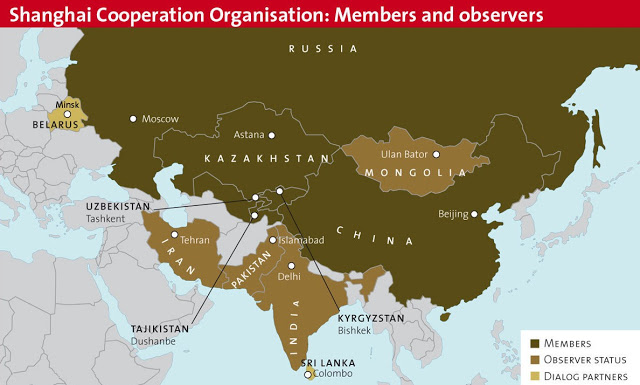
Eye Candy: Shanghai Cooperation Organization

NOL map SCO 2018
Source

First off, Shanghai and Warsaw are two very different cities, and because of that I think the SCO is a different animal than the Warsaw Pact. For one thing (aside from the difference in the two cities, one being selected for its geographical prominence, the other for its commercial acumen), the Warsaw Pact was a military alliance led by the Soviet Union, while the SCO is dedicated to political and economic cooperation as well as military security. Notably, the security aspect of the SCO is dedicated to coordinating state-led efforts against terrorism and separatism rather than against a rival alliance.

I don’t see anything wrong with multilateral efforts undertaken by states other than the US. I don’t see any need to worry, fret, or otherwise suspect the SCO of undermining world peace and prosperity. The fact that the SCO is made up of cooperating autocratic regimes rather than democratic ones does not faze me. The SCO has been making overtures to the democracies of India, Iran, and Sri Lanka (be sure to check out Tridivesh’s excellent take on India and the SCO), and multilateral cooperation among states is in itself an exercise in political participation among equals, albeit not at an individual level.

There is also cause to be happy that China and Russia have bound themselves up in such a prominent cooperative venture, too, given the two powers’ history of fighting each other. The SCO is contributing to peace and prosperity, and while it appears on the surface that the venture is designed to be a rival of the Western-built world order, the Shanghai Cooperation Organization actually contributes to it.

(h/t Nick)

Could free speech have led to overseas empires?

Tridivesh’s recent post on China’s multilateral struggles got me thinking about the difference between the United States and China when it comes to coalition-building and international affairs more broadly.

I don’t think the Chinese are purposely attempting to smaller countries in debt so that Beijing may have a shorter leash for them. I think Beijing simply doesn’t know what it’s doing, and is proceeding apace with multilateral initiatives like the BRI through a trial-and-error process. Unfortunately, trial-and-error processes only work if there is a mechanism to identify the error that takes place during the trial. In the West, we call this mechanism “free speech.” In China, free speech ruins order and is thus discouraged at best and disposed of at worst.

China’s expansionist efforts will probably, as a result of the lack of free speech, end poorly for the regime. Beijing’s reputation will suffer, and it will have to resort to more coercive tactics to secure its alliances and influence over its smaller neighbors.

This thought process, in turn, got me thinking about how the West came to churn out so many powerful worldwide empires in such a short span of time, and how these empires managed to coexist with each other at various points in time. Given China’s troubles with establishing hegemony, the fact that the United Kingdom, the Netherlands, France, and the United States were able to achieve what they achieved is amazing. Throughout most of history, empires (or wanna-be empires) have sought to expand abroad while keeping order at home, just like China is doing today. In the sixteenth-century West, order at home was rejected in favor of liberty at home, and as a result the few societies that tried liberty ended up being able to afford overseas empires, where order was sought instead of liberty!

The short-sightedness of imperialists continues to astound me. If liberty at home leads to opportunities to establish colonies abroad, why on earth would you try to stamp out liberty in the colonies you’ve been able to establish thanks to liberty? Imagine if the people living in Indonesia, or India, or Algeria, or the Philippines, had all the liberty that Americans and western Europeans had. Alas…

Hegemony is hard to do: China, globalization, and “debt traps”

As a result of an increasingly insular United States, with US President Donald Trump’s imposition of tariffs, China has been trying to find common cause with a number of countries, including US allies such as Japan, India and South Korea, on the issue of globalization.

While unequivocally batting in favor of an open economic world order, Chinese President Xi Jinping has also used forums like Boao to speak about the relevance of the Belt and Road Initiative (BRI) (also known as the One Belt and One Road Initiative, or OBOR). At the Boao Forum (April 2018), the Chinese President sought to dispel apprehensions with regard to suspected Chinese aspirations for hegemony:

China has no geopolitical calculations, seeks no exclusionary blocs and imposes no business deals on others.

There is absolutely no doubt that the BRI is a very ambitious project, and while it is likely to face numerous obstacles, it is a bit naïve to be dismissive of the project.

Debt Trap and China’s denial

Yet China, in promoting the BRI, is in denial with regard to one of the major problems of the project: the increasing concerns of participant countries about their increasing external debts resulting from China’s financial assistance. This phenomena has been dubbed as a ‘debt trap’. Chinese denialism is evident from an article in the English-language Chinese daily Global Times titled ‘Smaller economies can use Belt and Road Initiative as leverage to attract investment’. The article is dismissive of the argument that BRI has resulted in a debt trap:

It is a misunderstanding to worry that China’s B&R initiative may elevate debt risks in nations involved in massive infrastructure projects. Countries are queuing up to cooperate with China on its B&R initiative, but many Western observers claim the initiative will create a problem of debt sustainability in countries and regions along the routes, especially those with small economies.

The article begins by citing the example of Djibouti in Africa, and how infrastructure projects are generating jobs and also helping in local state-capacity building. It then cites other examples, like that of Myanmar, to put forward the point that accusations against Beijing of promoting exploitative economic relationships with participant countries in the BRI is far from the truth.

The article in Global Times conveniently quotes Myanmar’s union minister and security adviser, Thaung Tun, where he dubbed the Kyaukpu project a win-win deal, but it conveniently overlooked the interview of Planning and Finance Minister, Soe Win, who was skeptical with regard to the project. Said Soe Win in an interview with Nikkei:

[…] lessons that we learned from our neighboring countries, that overinvestment is not good sometimes.

Soe Win also drew attention to the need for projects to be feasible, and for the need to keep an eye on external debt (Myanmar’s external debt is nearly $10 billion, and 40 percent of this is due to China).

The case of Sri Lanka, where the strategically important Hambantota Port has been provided on lease to China (for 99 years) in order to repay debts, is too well known.

The new government in Malaysia, headed by Mahathir Mohammed, has put a halt on three projects estimated at over $22 billion. This includes the $20 billion East Coast Railway Link (ECRL), which seeks to connect the South China Sea (off the east coast of peninsular Malaysia) with the strategically important shipping routes of the Straits of Malacca to the West. A Chinese company, China Communications Construction Co Ltd, had been contracted to build 530km stretch of the ECRL. On July 5, 2018 it stated that it had suspended work temporarily on the project, on the request of Malaysia Rail Link Sdn Bhd.

The other two projects are a petroleum pipeline spread 600km along the west coast of peninsular Malaysia, and a 662km gas pipeline in Sabah, the Malaysian province on the island of Borneo.

During a visit to Japan, Mahathir had categorically said that he would like to have good relations with, but not be indebted to, China, and would look at other alternatives. The Malaysian PM shall also be visiting China in August 2018 to discuss these projects.

Conclusion

While Beijing has full right to promote its strategic interests, and also highlight the scale and relevance of the BRI, it needs to be more honest with regard to the issue of the ‘debt trap’ (especially if it claims to understand the sensitivities of other countries, and does not want to appear to be patronizing). While smaller countries may be economically dependent upon China, the latter should dismiss the growing resentment against some of its projects at its own peril. Countries like Japan have already sensed the growing ire against the Chinese, and have begun to step in, even in countries like Cambodia (considered close to China). A number of analysts are quick to state that there is no alternative to Chinese investment, but the worries in smaller countries with regard to Chinese debts proves the point that this is not the case. China needs to be more honest, at least, in recognizing some of its shortcomings in its dealings with other countries.

A note on India’s performance at the recent SCO Summit

The Shanghai Cooperation Organization (SCO) Summit, from June 9-10, went largely as expected. The Indian Prime Minister, Narendra Modi, met the Chinese President, Xi Jinping, on the sidelines of the summit. New Delhi’s proposal to have an informal summit, in India in 2019, on the lines of the Wuhan Summit (held in April 2018) was accepted by the Chinese. Agreements were also signed between both countries with regard to sharing hydrological data on the Brahmaputra River, and export of non-Basmati varieties of rice from India. Another issue, which was discussed during the Modi-Xi meeting, was the joint capacity development project in Afghanistan, which was first proposed during the Wuhan Summit.

Commenting on his meeting with the Chinese President, Modi tweeted:

Met this year’s SCO host, President Xi Jinping this evening. We had detailed discussions on bilateral and global issues. Our talks will add further vigour to the India-China friendship.

Modi’s meetings with leaders of other member countries

The Indian PM met other leaders of member countries, including the presidents of Tajikistan and Uzbekistan. While there was no formal meeting with the Pakistani President Mamnoon Hussain, Modi did shake hands with Hussain and exchange pleasantries. Interestingly, Chinese President Xi Jinping, during his address, had spoken about the presence of both leaders, as well as entry of both countries into the SCO. Said the Chinese President: Continue reading

A short note on the India-Pakistan thaw

Over the past couple of months, both India and Pakistan have been trying to lower the temperatures through some good gestures and reconciliatory statements, while both sides have reiterated their commitment to amicably resolve the issue of harassment of diplomats. India and Pakistan have also agreed to some humanitarian gestures with regard to prisoners languishing, on both sides, in jails.

There have also been indicators that the two neighbors are keen to revive economic ties and give a boost to bilateral trade, which is way below potential.

In the month of March, Indian High Commissioner to Pakistan, Ajay Bisaria, while addressing the Lahore Chamber of Commerce and Industry, spoke about the need for greater bilateral trade:

We should not talk about negative and positive lists rather we should work on the windows of opportunities. At present, over $5 billion trade is being done through third country but after removal of non-tariff barriers, liberalisation of visa and normalisation of mutual relations, the two-way trade could touch a high $30 billion.

Bisaria, while addressing the Employers Federation of Pakistan and the South Asian Forum of Employers, reiterated the need to increase the level of trade, and also said that if South Korea and North Korea could work towards resolving their serious differences, there is no reason why India and Pakistan could not.

Interestingly, in the month of April, Pakistan High Commissioner to India, Sohail Mahmood, met with the Chief Minister of Punjab (India), Captain Amarinder Singh, and discussed possible areas where both countries can cooperate. Not only was there an emphasis on reviving people-to-people contact between the two Punjab’s, but also to give a boost to trade through the Wagah-Attari land route. In the two phases (2004-2007 and then 2011-2014), when India and Pakistan made headway in terms of connectivity and economic linkages, the two Punjab’s played a pivotal role. The area of Punjab, of course, was split by the British Partition of 1947.

Change in mindset of Pakistan Army and RUSI report

What is interesting is a commentary, authored by Kamal Alam, published by premier British think-tank RUSI (Royal United Services Institution), which emphatically argues that there is a paradigm shift in the mindset of the Pakistani military, under the leadership of current Chief of Army Staff, Qamar Ahmed Bajwa, and a genuine realization for the need to move away from a zero-sum approach.

Alam’s commentary refers to an address by Bajwa last year, where he made a case for India being part of the $60 billion China Pakistan Economic Corridor (CPEC). The Pakistan army chief stated:

The Pakistan army is now no more insecure and feels confident of its future and that he welcomes Indian participation in Pakistan’s flagship infrastructure project, the China Pakistan Economic Corridor (CPEC).

Alam, to strengthen his argument, also points to some other instances, such as Bajwa’s speech at the passing-out parade of cadets at the Pakistan Military Academy in Kakul, where the Pakistan Army Chief referred to the necessity of dialogue between both countries, and an invite to the Indian Military attache, Sanjay Vishwasrao, and other senior diplomats posted at the Indian High Commission, for the military parade to mark Pakistan’s National Day. The diplomats attended the parade alongside Vishwasrao.

Another interesting development flagged by Alam is the military drill (conducted under the umbrella of Shanghai Cooperation Organisation) in September 2018, where both India and Pakistan along with other member nations will participate.

Alam’s commentary has quoted a number of other high level members of the Pakistan army who have spoken in favor of mending ties, and also argues that a change in the Pakistan army’s mindset has been visible since 2013.

In December 2016, Pakistan’s Southern Command Lt General, Amir Riaz, while speaking at an awards distribution ceremony at Balochistan FC Headquarters, invited India to join CPEC and ‘share the fruits of future development by shelving the anti-Pakistan activities and subversion.’ Riaz, as Director General of Military Operations in 2013, had met his counterpart at Wagah to reduce tensions across the Line of Control.

According to Alam, Major General Ahmed Hayat, the Director-General-Analysis of the Inter-Services-Intelligence for Pakistan, had authored, in 2013, what was dubbed as the India Plan. While agreeing that engagement and not conflict was the answer, the report sought to identify the appropriate time to reach out to India from a position of strength.

Points of contention moving forward

While Alam’s report has generated a lot of interest, a few facts need to be borne.

First, the recent meeting between Modi and Xi, where China, without making a mention of Pakistan, committed to flag terrorism as a key concern. In recent months, China has given some indicators that it may be willing to re-think its approach towards terrorism emanating from Pakistan. Pakistan is now likely to be put on the watchlist of an international financial watchdog, Financial Action Task Force (FATF). Beijing was initially opposed to this move, but relented after India lent its support to Beijing for the Vice Presidency of FATF.

China has of course been pitching for a better relationship between New Delhi and Islamabad for some time, keeping in mind its own economic interests, and has even asked New Delhi to be part of CPEC. New Delhi has been steadfast in its opposition to China’s One Belt One Road (OBOR) Initiative, given the fact that CPEC passes through disputed territory, but with the changing dynamics in the New Delhi-Beijing relationship, it is likely that Bajwa and the upper echelons of India’s diplomatic corps are making the right noises to look good to the international community, especially China.

Second, the incumbent PML-N civilian government in Pakistan, which has been completely overwhelmed in the past two years with the weakening of former Prime Minister Nawaz Sharif. The fall of Sharif began with the joint Tahir Ul Qadri-Imran Khan protests (backed by the Pakistan army) in 2014, and ever since the Panama Case leaks in April 2016, things have spiraled downhill for Sharif. In July 2017, Nawaz Sharif was disqualified by the Supreme Court from holding any public office, and had to resign as Prime Minister of Pakistan. In April 2018, he was disqualified from holding any position for life.

Sharif, who has on more than one occasion dubbed political rival and former cricket star Imran Khan, Chairman of Pakistan-Tehreek-E-Insaaf (PTI) as ‘laadla’ (favorite) of the army, has also argued that the judiciary and military are jointly conspiring against him. One of the points of divergence between Sharif and the army were relations with India, as Sharif has always batted for better relations with New Delhi.

There is absolutely no doubt that Imran’s relations with the army have improved considerably according to some. Imran has also publicly praised the army chief, recently calling Bajwa “probably the most pro-democratic man [Pakistan] has ever seen.” There is a good chance that PTI, backed by the military establishment, may win in the upcoming elections of 2018. The commentary, and Bajwa’s statements, could be a message to India that New Delhi will have to engage with the military in case PTI were to come to power.

In this context, Bajwa has been trying to cultivate the image of a pragmatist not opposed to peace. A few months ago in an article written for The News, the prominent left-leaning Pakistani journalist Sohail Warraich wrote:

The Bajwa doctrine stands for regional peace and, like China, wants to make peace with India while keeping our differences on core issues. The doctrine is ready for peaceful negotiations but without compromising on the Kashmir issue. The doctrine is fully aware of the Chinese advice to Pakistan that instead of war, other peaceful measure be negotiated for Kashmir issue.

Conclusion

It is important for New Delhi to wait and watch, while engaging with the business community and Pakistan’s vibrant civil society is absolutely essential. Not much should be read into Bajwa’s remarks. They should be taken note of, and not dismissed, but it is a bit premature to be optimistic. After all, the army has been backing the Milli Muslim League (MML), a civil front of the JuD, headed by the Mumbai terror attack mastermind, Hafiz Saeed.

It will also be interesting to see the ultimate outcome of the upcoming election in July.

New Delhi needs to deal with whoever is in power in Pakistan, and the army is an important power center there. A civilian government (possibly PTI) beholden to the establishment will not address India’s concerns the way a firm civilian government which has the fervent backing of the people (this may not happen in the imminent future, but is a reality) would. The Pakistan Army Chief’s words would have had more meaning if he had backed Nawaz Sharif’s attempts towards improving ties with India, and not joined hands with the judiciary to plot his downfall.

Beijing and the India-Pakistan conundrum

During the course of the Shanghai Cooperation Organization (SCO) meeting in China, and days before Indian Prime Minister Narendra Modi arrived in China for his summit with Chinese President Xi Jinping, an editorial in Pakistan’s premier English-language daily (Daily Times) titled ‘China’s re-assurance on CPEC‘ made an interesting point:

If anything Beijing has been asking Islamabad to engage with New Delhi and keep tensions to a minimum. Such an environment is also conducive to timely completion of various projects under CPEC [China-Pakistan Economic Corridor] and transforming South and Western Asia into a high economic growth zone. Keeping the economy first is a lesson that our state has yet to learn from its big brother in the hood.

Zardari’s recommendation in 2012

Interestingly, during his meeting with former Indian Prime Minister Dr Manmohan Singh, in April 2012, former Pakistan President Asif Ali Zardari (Pakistan People’s Party — PPP) had also stated that Pakistan and India should seek to follow the Pakistan-China model of engagement. Zardari meant that, like India and China, India and Pakistan too should follow an incremental approach, with more frequent high level interactions and a heavy focus on economic cooperation.

It might be mentioned that between 2012 and 2013 some important leaps were made in the economic sphere between both countries, with the most noteworthy development being the setting up of the Integrated Check Post (ICP) at Attari (Amritsar, India). The ICP’s motive was to accelerate bilateral trade through the only land crossing (Attari-Wagah) between India and Pakistan. During this period, a number of high level delegations interacted, including the Commerce Ministers of both countries.

Pakistan also seemed prepared to grant India MFN status, but a change of government (along with domestic opposition from certain business lobbies as well as hardliners) in Islamabad (2013) and then New Delhi (2014) meant that this decision could not go ahead. Since then, relations have been tense, and there has been no opportunity to make any progress on this.

Tensions in the past 4 years: CPEC and terrorism emanating from Pakistan Continue reading

3 key problems with Trump’s style of functioning

The removal of Rex Tillerson as Secretary of State (who was replaced by Mike Pompeo, Director of the CIA) reiterates three key problems in US President Donald Trump’s style of functioning: First, his inability to get along with members of his team; second, impulsive decisions driven excessively by ‘optics’ and personal chemistry between leaders; and, finally, his inability to work in a system even where it is necessary.

Tillerson, who had differences with Trump on issues ranging from the Iran Nuclear Deal (which Trump has been wanting to scrap, though his stance was moderated by Tillerson) to the handling of North Korea, is not the first member (earlier senior individuals to be sacked are, amongst others, Michael Flynn, who was National Security Adviser, and Chief Strategist Steve Bannon) to exit hurriedly. Gary Cohn, Director of the National Economic Council, quit recently after opposing the US President’s tariffs on imports of steel and aluminium.

The US President tweeted this decision:

Mike Pompeo, Director of the CIA, will become our new Secretary of State. He will do a fantastic job! Thank you to Rex Tillerson for his service! Gina Haspel will become the new Director of the CIA, and the first woman so chosen. Congratulations to all!

The US President admitted that Tillerson’s style of functioning was very different from his own (alluding to the latter’s more nuanced approach on complex issues).

Interestingly, the US President did not even consult any of his staff members, including Tillerson, before agreeing to engage with North Korean Dictator Kim Jong Un. The South Korean National Security Advisor, Chung Eui Yong, had met with Trump and put forward the North Korean dictator’s proposal of a Summit.

The US President agreed to this proposal. Commenting on his decision to engage with Kim Jong Un, Trump tweeted:

Kim Jong Un talked about denuclearization with the South Korean Representatives, not just a freeze. Also, no missile testing by North Korea during this period of time. Great progress being made but sanctions will remain until an agreement is reached. Meeting being planned!

While Chung stated that the Summit would take place before May 2018, White House has not provided any specific dates.

There is absolutely no doubt that, at times, bold steps need to be taken to resolve complex issues like North Korea. Trump’s impulsive nature, however – refusing to go into the depth of things or seeking expert opinion – does not make for good diplomacy.

In fact, a number of politicians and journalist have expressed their skepticism with regard to where North Korean negotiations may ultimately lead. Ed Markey a Democratic Senator from Massachusetts, stated that Trump “must abandon his penchant for unscripted remarks and bombastic rhetoric to avoid derailing this significant opportunity for progress.”

In a column for the Washington Post, Jeffrey Lewis makes the point that there is a danger of Trump getting carried away by the attention he receives. Says Lewis in his column:

Some conservatives are worried that Trump will recognize North Korea as a nuclear-weapons state. They believe that an authoritarian North Korea will beguile Trump just as it did his erstwhile apprentice, American basketball player Dennis Rodman. They fear that Trump will be so overjoyed by the site of tens of thousands of North Koreans in a stadium holding placards that make up a picture of his face that he will, on the spot, simply recognize North Korea as a nuclear power with every right to its half of the Korean peninsula.

All Trump’s interlocutors have realized that while he is unpredictable, one thing which is consistent is the fact that he is prone to flattery. During his China visit, for instance, Trump was so taken aback by the welcome he received and the MOU’s signed with Chinese companies that he started criticizing his predecessors.

Finally, while Trump, like many global leaders, has risen as a consequence of being an outsider to the establishment, with people being disillusioned with the embedded establishment, the US President has still not realized that one of Washington’s biggest assets has been strategic alliances like NATO and multilateral trade agreements like NAFTA. The United States has also gained from globalization and strategic partnerships; it has not been one way traffic.

It remains to be seen how Tillerson’s removal will affect relations with key US allies. If Trump actually goes ahead with scrapping the Iran nuclear deal (2015), it will send a negative message not just to other members of the P5 grouping, but also India. In the last three years, India has sought to strengthen economic ties with Iran and has invested in the Chabahar Port Project. New Delhi is looking at Iran as a gateway to Afghanistan and Central Asia. If Tillerson’s successor just plays ball, and does not temper the US President’s style of conducting foreign policy, there is likely to be no stability and consistency and even allies would be skeptical.

Japan on its part would want its concerns regarding the abduction of Japanese citizens by Pyongyang’s agents, decades ago, to not get sidelined in negotiations with North Korea. (13 Japanese individuals were abducted in 2002, 5 have returned but the fate of the others remains unknown.) Prime Minister Shinzo Abe has made the return of the abductees a cornerstone of his foreign policy, and his low approval ratings due to a domestic scandal could use the boost that is usually associated with the plight of those abductees.

The removal of Tillerson underscores problems with Trump’s style of functioning as discussed earlier. The outside world has gotten used to the US President’s style of functioning and will closely be watching what Tillerson’s successor brings to the table.

Pittsburgh, not Paris: What’s a libertarian response?

A lot has been said about Trump pulling the US out of the Paris Accords. Leftists have been apoplectic, foaming at the mouth even. Conservatives are baffled, if they have anything to say at all. What should libertarians think?

Libertarians in the United Kingdom, States, and Provinces are generally unilateralists (not isolationists), whereas libertarians in Europe, South Africa, and Latin America are generally multilateralists. I’m of the opinion that American libertarians are wholly wrong to claim that their foreign policy is libertarian. It’s not libertarian at all. Unilateralism is combative rather than cooperative and relies on nationalism rather than internationalism to make its arguments.

Multilateralism forces factions to come to a consensus, thus slowing down government action at the international level, while also forcing factions to interact with each other in a diplomatic manner at that same international level. Unilateralism allows states to do whatever they want, regardless of what others may think. Now let me remind you of what libertarianism stands for: peace, prosperity, and freedom through mutually beneficial exchange and agreed-upon rules that can be changed provided they go through the proper channels (legislation, judiciary, executive). (Am I wrong here?)

Which sounds more libertarian to you?

Now that we have issues of doctrine out of the way, what’s really interesting to note is the Left’s inability to see what Trump is actually doing: wagging the dog. Trump’s term as executive is not going well (surprise, surprise). And so, he does a mean-spirited thing that he hopes will distract.

Here’s how I see the Paris Accords (chime in if you disagree):

  • They (it?) have not, and will not – ever – accomplish anything in regard to climate change, but
  • because of this it is also an organization that is wholly non-threatening. It’s just a bunch of countries getting together, in good faith, to solve a problem (real or imagined)

Some hardline factions on the conservative wing in the US didn’t like that the Paris Accords are essentially glorified intern conventions, and some Leftist factions on the American Left absolutely revere green initiatives (even if they’re no good at greening anything other than lobbyist’s pocketbooks), so Trump pulled the plug.

#covfefe

Some thoughts on the Olympic Games and cosmopolitanism

Right now my city, Rio de Janeiro, is hosting the Summer Olympic Games. It is in many ways a great moment, and it is especially good to see people from so many parts of the world together in relative harmony. In other words, a good example of cosmopolitanism. The cosmopolitanism in the city today reminds me of the attempts of multilateralism that marked Brazilian (and world) foreign policy in previous governments, but that now seem to fade away. The two terms, cosmopolitanism and multilateralism, are not exactly synonyms, but are closely related: multilateral policies should work in bringing peoples together in a more cosmopolitan world. Concerning that, I think of a multilateralism that does not work in bringing people together through cosmopolitanism, and one that can work in that way.

When the Cold War was over, multiple theories were presented to explain what would happen to a world without the tension between two superpowers. Some suggested that the US would reign as a lone superpower; others that it would embrace some form of benign hegemony, in a New World Order. Others still believed that US power was in decline, and that the World would see more multilateralism in the 21st century. This last view was especially dear in Brazil, but as the 21st century progresses, it does not seem to hold as much water anymore.

One great example of multilateralism substituting American hegemony was the integration of Western Europe, but that does not seem to be the case anymore. It is true that beginning shortly after WWII European countries experienced growing levels of regional integration, culminating with the European Union and the Euro in the 1990s. But even then, economists warned politicians and the general public that such a level of integration was not possible, at least not without a central government in Europe. Successive economic crises, Brexit, and the harsh questioning of immigration policies show today that economists were right back then.

Another example of multilateralism celebrated in the 1990s was the growing importance of the UN. Successive humanitarian missions and interventions in several countries suggested that that UN could now surpass the dawn that marked the relationship between USA and USSR in the previous period. Optimism went so far as to discuss themes such as the ‘obligation to intervene’, substituting previous understandings of state sovereignty. But as the years go by, cases like Haiti, Rwanda, Sudan, and many others show that the optimism was at best too high.

Finally and more recently, Brazil and other underdeveloped and developing countries focused greatly on South-South Cooperation, trying to substitute the more standard paradigm of North-South Foreign Aid. This materialized in initiatives such as UNASUR and BRICS. Although presented as a new development, that was actually very reminiscent of The Non-Aligned Movement, The Group of 77, and other initiatives from the 1960s and 1970s. Now, as Brazil, Venezuela, Ecuador, Bolivia, Turkey, China, Russia, and several other countries face growing levels of economic and political hardship, attempts to “overcome American hegemony” seem but preposterous.

New forms in multilateralism in Europe, the Global South, and even the World (in the UN) did not work because they are not really democratic, as they claim to be. Behind a rhetoric of democracy, empowerment of the poor, and so on, they are just new forms of mercantilism: political elites trying to control the economy, not just at the national level, but the international one as well. The point was never to actually bring people together, but to maintain the status quo by avoiding real competition.

The multilateralism that can bring about cosmopolitanism, and that somewhat shows in the Summer Olympic Games in Rio, is one characterized by spontaneous order. People do come together: that is the natural ways of things. The desire to trade spontaneously brings different peoples closer to one another, and as they are closer they realize how much they have in common, and also what can be learnt from the differences. It is not always a peaceful dealing, but the more people are educated to tolerate the differences and to benefit from them, the more cosmopolitan they become.

A top down approach to cosmopolitanism is just a deformed clone of the real thing. Even if some results appear, they always seem to fall somewhere in the uncanny valley, and anyway, the results do not last very long. A bottom up cosmopolitanism is the real thing, and if only elites let it be, it can grow stronger, bring more wealth, and even a little more peace to the world.