The real threat to democracy in Brazil

Earlier this week, Ricardo Lewandowski, a judge in Brazil’s Supreme Federal Court, was in a commercial flight. The passenger sitting next to him turned to the judge and said: “I am ashamed of Brazil’s Supreme Federal Court”. Lewandowski’s reaction was to threaten the passenger with jail. He turned to him and said, “tell me, do you want to go to jail?”  The passenger was indeed stopped by the police at the destination, but released right after. The video of the exchange is easily found on Youtube.

Lewandowski came to the Supreme Court appointed by former president Lula da Silva, today serving time in jail for corruption and still indicted for several crimes. He has been criticized several times for favoring Lula and his party.

I wonder if the press, that complains so much about Jair Bolsonaro being a threat to democracy in Brazil, will have the same treatment for Lewandowski. When you cannot criticize in public a public server or a public institution without being stopped by the police, democracy is no longer in place.

Since the 19th-century Brazilian judges and magistrates believe they are above the law. It is just a sad fact in Brazilian history. The challenge for Brazil is to show people like Lewandowski that they are just humans, open to criticism, like everybody else.

Nightcap

  1. The weaponization of Milton Friedman Shikha Dalmia, the Week
  2. Social media lessons Robin Hanson, Overcoming Bias
  3. Seneca on ‘mercy’ and ‘anger’ Barry Stocker, NOL
  4. Wisdom from Armen Alchian David Henderson, EconLog

Nightcap

  1. On the inexhaustible desire to keep talking about Marx Jonathan Wolff, Times Literary Supplement
  2. The promise of polarization Sam Tanenhaus, New Republic
  3. Anglo-Saxon England was more cosmopolitan than you think Rhiannon Curry, 1843
  4. DC unfriends Silicon Valley Declan McCullagh, Reason

Legal Immigration Into the United States: Introduction (Part 1 of 6)

This an essay about legal immigration. It includes a theoretical framework, essential facts, and subjective opinions. In this old-fashioned piece, there is no pretense of scholarly detachment. It’s a personal endeavor that I hope will be useful to others. I don’t have a hidden agenda but topical preferences I think I make clear. Footnote 1 describes my qualifications to discuss immigration. You might surmise that I have a more pro-immigration bias than most small-government conservatives but not than most libertarians (but who knows about them?). I deal with American immigration, specifically. I present rough figures only, trying to add some orders of magnitudes to the current complicated media narrative, and to establish distinctions that don’t always occur naturally. I don’t aim at precision. If mistakes of fact slip into my story, I hope readers will draw attention to them and thus, perhaps, start a conversation here. My few policy recommendations are all tentative but I hope they are logically linked both to orders of magnitudes and to conceptual distinctions.

I choose to address legal immigration specifically for two categories of reasons. First, there are reasonably good, trustworthy figures regarding legal immigration, while numbers for illegal immigration are largely estimated from data gathered for other purposes and often according to wobbly rules. Second, the relationship between legal immigration and illegal immigration is complicated enough to justify an essay all of its own. Here is a sample: Many illegal immigrants, especially many Mexicans, argue that there would be less illegal immigration into the US if there were more doors open through legal immigration. Yet, as I show below, to a considerable extent legal immigration facilitates illegal immigration and thus increases the numbers of illegal immigrants. So the numerical relationship between the two appears both negative and positive. In a co-authored article (referenced in Footnote 2) I examined the complex links between legal and illegal immigration in the special and numerically important case of Mexicans. Though that article dates back to 2009, it remains remarkably current in some respect. In the present essay I only refer tangentially to illegal immigration and only insofar as it serves my main object. Continue reading

Do You have Silver?

In an episode of the Netflix medieval series The Last Kingdom, the protagonist Uthred, trying to purchase a sword from a blacksmith in a town he is just passing by, is instantly asked “Do you have silver?”.

In one scene, insignificant to the plot, the series creators neatly raised some fundamental questions in monetary economics, illustrating the relative use of credit and cash and the importance of finality.

For many centuries, the very payment system between people set severe constraints on what kinds of transactions they could – or dared – engage in. There are two main ways of providing payments (with quite a few variations within these categories): cash or credit.

Cash (sometimes referred to as ‘money transactions’) refers to payments with direct finality; the economic chain is instantly settled, and gives rise to no other economic relation. Examples here would be pure barter (where one object is traded for another) or commodity money (where an object is traded for a common media of exchange, with history providing countless fascinating examples: cattle, skin, olive oil, feathers, pearls etc).

The other category, credit, involves trading someone else’s liability or incurring a new one. Modern credit cards easily comes to mind: swiping that card settles the trade between the vendor and the customer who used the card only by creating two new (future) economic relations – a promise by the credit card company to transfer funds to the vendor, and a promise by the customer to pay the credit card company at the end of the month. The same features can be – and were – applied in many early societies; I give you some of my items, and you owe me; later I may transfer this “claim” to somebody else is the community in exchange for something I wanted, and instead of owing me, you owe them.

Some of the difficulties of monetary economics are here quickly revealed. In order for credit to work, a sufficient level of trust, repeated dealings or enforcement mechanisms must exist. If one or more parties do not trust each other, the two are unlikely to trade again or cannot socially or legally force the other into upholding his or her contract, they may refuse the deal up-front and lose the benefits of trade (the “backward induct,” in Game Theory-speak). Nevertheless going through with this transaction requires a different payment system: instant finality, such as provided with cash. Here’s the conundrum that troubles monetary economists:

The frictions that are needed to make money essential typically make credit infeasible and environments where credit is feasible are ones where money is typically not essential (Ugolini, The Evolution of Central Banking, p. 169)

If we trust each other enough (or have enough repeat dealings and a system of keeping track of everyone’s debts), there is no need for cash. If there is need for cash, that means we do not trust each other (or can’t keep track/enforce debts), indicating the presence of “frictions” that make us reluctant to use credit at all.

Let’s go back to our Last Kingdom protagonist. It is clear that the two characters are strangers (no previous dealings, no trust) and from simply passing through a village, no reason for the blacksmith to believe that there may be repeat dealings. A credit transaction is thus clearly out of question. Instead he directly asks for silver (cash), which initially seems to solve the problem. However, two further issues emerge:

  1. if all transactions were like this, the amount of cash everyone must carry around in the economy would be enormous. A common problem in medieval and even early modern societies were the lack of coins. If enough cash was simply not there and recourse to credit system unfeasible, we quickly realise how difficult transacting would be.
  2. even if the customer had enough cash, the very reason they were reluctant to use credit in the first place (no trust, no repeat dealings, no credible enforcement) harms their ability to transact in cash. Howso? Because both parties can opportunistically defect from the agreement. If the sword is paid for up front, the blacksmith can take the money and run – since they are strangers and unlikely to meet again, the cost of cheating is comparatively low. If the sword is paid for at delivery, the customer can easily renege on payment once delivery is obtained.

Is there no way out?

Uthred and the blacksmith use a method most of us are familiar with – indeed, probably even used as kids – pay half up-front, and half on delivery, with the possibility of a bonus payment (tip) at the end. Risk-minimising, yet offering payoff through the gains from trade.

Good monetary economics does precisely that: illustrating how monetary systems, including payment systems, can facilitate transactions and expand rather than limit the available gains from trade. It concerns itself with one of those spheres of (economic) life that we don’t notice until they breaks down. Try completing everyday transactions in countries with small-change shortage for a neat flashback to eighteenth century Britain or U.S., or in countries impaired by hyperinflation or sanctions. Monetary economics, in essence, is fascinating in its complexity of otherwise quite mundane things. Thanks to The Last Kingdom team for illustrating that.

Doctor Who – a commentary on Brexit?

The Doctor has always had a special preference for the Brits. They flit in and out of the wondrous and often alien-infested towns of England, woo them with their British (briefly Scottish) accent and manage to introduce to the kids (it was originally intended to be an educational program for the kids) some moral propositions. The last few seasons have been famously against war and violence of any sort. The regenerated Doctor retains the abhorrence for violence as a means for conflict resolution. And it is conflict resolution that the Doctor sees as their purpose of life. To find out who, in the big, vast universe, needs help and to give help whenever asked for.

The latest season is iconic. The Doctor is a female for the first time. The Doctor has reached the end of their regeneration cycles. This is to be the last and final life of the alien problem solver who seems to love humanity more than they ever will. But in the two episodes that have been released, the Doctor has also thrown sufficient shade at Brexit and the events that have unfolded since. The first episode contains a superbly written but not so subtle speech about evolving while retaining past identities. With their signature kindness, they try to convince the villain that change is possible, and it does not require jettisoning who we were to become a better version of ourselves. The second episode reinforces the importance of sticking together. The moment where the Doctor triumphantly yells ‘Stronger Together!’ is especially noticeable. Many see the message of diversity in the inclusion of a female ethnic companion (although the Doctor has previously had POCs as companions), the dynamic between the two male companions (a white male step-grandfather and a black male step-grandson) mirrors the generation gap that was evident in the Brexit vote.

The symbolism is relevant for two reasons. Firstly, the Doctor has not displayed political undertones previously. The change reflects how the creators and possibly the entertainment industry views their jobs. Perhaps the seepage is unintentional. It must be difficult to disentangle oneself from the events unfolding all around you. Secondly, and most importantly, as a series that has come to be a part of the British culture, the Doctor wields considerable power. The Doctor represents England in science fiction. The Doctor promoting teamwork sends a powerful message about inclusion (albeit with not much debate, but we have a season left for that!).

The timelessness of the series is both a gift and a curse. Just like the chauvinist Doctors of the past have been judged harshly (by the new-age Doctor them self), the latest Doctor too runs the risk of judgment from future generation. Or maybe they will be revered and celebrated for being so sure of their position. Just like Brexit, we won’t know. For now, let us travel across time and relative dimension in space and hope for the best, just like the Doctor.

Nightcap

  1. Yoram Hazony and the New Nationalism Samuel Goldman, Modern Age
  2. The archive of comics sponsored by South Africa’s Apartheid government William Worger (interview), Africa is a Country
  3. Photo essay on the Soviet squelching of the Prague Spring Alan Taylor, the Atlantic
  4. Failed states and failed civilizations Nick Nielsen, The View from Oregon

Nightcap

  1. End the double standards in reporting political violence David French, National Review
  2. Campaign politics and the origins of the Vietnam War Rick Brownell, Historiat
  3. Hussein Ibish on Muslim identity Irfan Khawaja, Policy of Truth
  4. Friends of freedom and Atlantic democratization Micah Alpaugh, Age of Revolutions

Nightcap

  1. Lessons of the Westphalian Peace for the Middle East Andreas Kluth, Handelsblatt
  2. Is Democracy Dying? Francis Fukuyama (interview), Hromadske
  3. Yes, the Press Helps Start Wars Ted Galen Carpenter, American Conservative
  4. The Most Hawaiian Stephanie Lee, Coldnoon

Animation Review #1: Burn the Witch

I am a big fan of animation, but I often have to ‘turn my brain off’ to enjoy a comic trying to make political commentary. With rare exceptions, like the Incredibles series, the industry has a strong statist bent. The industry is so statist that Superman: Red Son, a story line with the premise that Superman landed in the Soviet Union instead of the United States, ends with the message that communism would work if only it were a bit more democratic. Note that I say statist bent, as opposed to leftist bent. They are smaller in number, but there are several conservative comics (e.g. the Kingsman) that leave a statist aftertaste.

I can’t do much on the supply side of liberty-friendly comics, but I can at least highlight those comics that I think fellow libertarians might enjoy via blog posts.

First off is Burn the Witch, a new comic series published by Shonen Jump. I was pleasantly surprised when I read through Tite Kubo’s Burn the Witch. Tite Kubo is best known for authoring Bleach, a comic about Japanese school children fighting demons in fantasy Mexico.

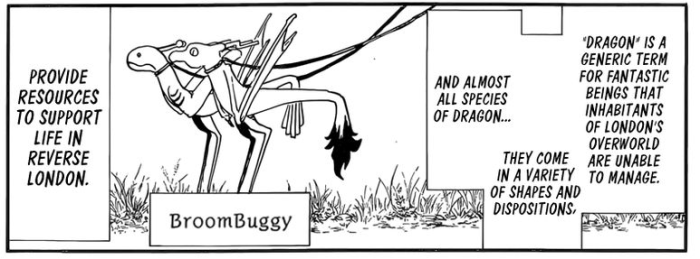
Dragons.png

Burn the Witch is about Anglo-Japanese school children fighting demons in fantasy Britain. The twist? Unlike their counterparts in fantasy Mexico, the British demons (referred to as ‘Dragons’ in-series) aren’t killed outright. Instead they are raised for the resources they provide. Only ‘bad’ demons who are killing humans or otherwise causing destruction are killed. It is noteworthy that the protagonists refer to themselves as ‘conservationists’. They kill the occasional demon, providing the story with action scenes when doing so, but their primary purpose is to conserve them. In an off hand comment the protagonists note that their fantasy Mexican counterparts are barbaric and indiscriminately kill their demons.

Contrary to the protagonist’s comments, it isn’t that individual fantasy Mexicans are barbaric so much that fantasy Mexico doesn’t recognize property rights in demons. Since no one has a property right in demons, no one has an incentive to conserve, much less domesticate, them in fantasy Mexico. Fantasy Britain enjoys strong property rights and consequently has minimal problems associated with its demons. One of the protagonists is ethnically from fantasy Mexico, but seems to be thriving under fantasy Britain’s rules. The story’s lesson? Property rights matter.

Only one chapter of Burn the Witch has been published thus far, and it’s unclear if it’ll become a recurring series, but I like what I’ve seen so far.

Thoughts? Comments? As always, write in the comments below. If you’re a fan of animation and a fellow libertarian, consider joining the anime libertarian alliance facebook group.

The Politics of the Incredibles (minimal spoilers)

I saw an early release of the Incredibles 2 last night. I wasn’t expecting too much given Pixar’s history with sequel. Finding Dorothy, Monsters University and the Cars sequels were okay, but below average for Pixar. I am happy to report that the Incredibles 2 was a pleasant exception. Not only did the film re-capture the magic of the original, it made a point that many readers and fellow Notewriters should appreciate: legality doesn’t equal right.

The film starts off directly after the events of the first film. The titular Incredibles family fights off the Underminer, a mining themed super villain. Instead of getting praised for their actions though, they get arrested. Superheroes are still illegal. The events of the past film haven’t changed that. One of the characters wisely remarks, “Politicians don’t understand why someone would do the right thing for its own sake. They’re scared of the idea.”

The family is let go, but they’re at a low point. Their home has been destroyed. They’re unemployed and broke. They’re gifted with super powers, but they live in a world where they can’t legally use them. That’s when a businessman approaches them and asks – why not use their super powers? The businessman proposes that the family continue to use their powers illegally, and convince the government to change the law after the public has been shown how useful superheroes are. This leads to a funny exchange where the characters argue about how they’re being asked to be illegal in order to become legal.

I won’t spoil the remainder of the film, but I love the businessman character’s early scenes. It’s refreshing to see a corporate character, and his disregard for legislated morality, portrayed in a positive light. Tony Stark/Iron Man starts off this way in the early MCU films, but makes a u-turn by Captain America: Civil War. This new character, for better or worse, stands by his beliefs.

The tension between legislation and morality isn’t a new theme for Pixar. The idea of breaking the rules to do what’s right was a central feature of Monsters University as well. It’s a lesson I think many children, and their parents, could benefit to learn. Legislation isn’t morality.

I give the film a solid 9/10. It’s around Wall-E or Up levels of quality. It’s easily one of the funniest Pixar films in a while. The animated short before the film is, as standard for Pixar, a tear jerker. Bring some tissues.

Thoughts? Opinions? Post in the comments.

Turkey elections: Elections, Rappers, Media, Micro-Party, Rigging, Iraq

The Turkish State’s War On Rap

The election campaign has not slowed down the Erdoğanist state in its efforts to punish anyone who deviates from Erdoğan’s ideal of obedient, socially conservative, and conformist citizens. One of the best known Turkish rappers, Ezhel, with very leftist and counter culture lyrics, has been arrested recently for ‘encouraging drug use’. A prosecutor ordered his detention, which was implemented after he voluntarily went to the police station to answer a ‘complaint’, with no warning about detention. Onur Dinç (known as Khontkar), and Young Bego have also been detained. They can all be found on Spotify and YouTube. Listening on Spotify generates a little income for people who deserve a bit of solidarity at the moment.

İnce’s Presidential Campaign

An interview on HaberTürk TV with the leading opposition candidate for President of Turkey, Muharrem İnce (from the secularist, centre-left Republican People’s Party), has gone down very well. The interviewers let İnce express his views and had a selfie with him afterwards. HaberTürk TV is a private channel but, like all commercial private channels, accepts (and has no real choice) the biases and silences imposed by the Erdoğanist-AKP regime.

It is normal for Erdoğan himself to phone media groups and complain about coverage, demanding firings of journalists, where the bias is not as complete as he requires. So how long are these journalists, and the responsible manager, going to survive? A manager on another private channel was fired (officially ‘left for personal reasons’, ha ha ha) after allowing a very brief segment on the second most popular opposition, and more right wing, candidate, Meral Akşener. Will these HaberTürk people survive until the election? Are they more willing to push the limits because the opposition is doing better than expected?

On recent polls (leaving aside companies who enjoy close relations with the Erdoğanists) only rigging (or some extreme situation) can now stop 1. the opposition winning a majority in the National Assembly (could be stopped on current polling by stealing/losing about 2/3% points from HDP, a Kurdish rights-leftist party which appears to be between 1 and 3% points above the 10% election threshold). The main left-right opposition list seems to be about 3 points behind the right wing government list 2. the presidential election going to a second round, i.e. Erdoğan cannot get 50%+ of the vote in a several-candidate field (except by rigging at least 7% points of votes cast) and might lose in the run off.

I can only presume the interviewers of İnce will be out of a job if Erdoğan and the AKP-dominated electoral list do win by some means, and HaberTürk will suffer other penalties. Yes, polls can be wrong and they don’t all show the same thing, but those most favourable to the government tend to be run by cronies and there is widespread suspicion that in the current atmosphere in Turkey, some voters would prefer not to tell a stranger they are voting for an opposition party, particularly HDP. This is confirmed by the relation between opinion polls and the final result in last year’s referendum on moving to a presidential system (in which the final result itself may have been affected by losing and faking ballots, and by the difficulty that many voters in the Kurdish southeast had with getting to polling stations, a tactic the regime is setting up for this time as well).

The AKP-Erdoğanist Media Strategy: Why Turkish Media promotes an ex-terrorist micro-party.

Presenting the Opposition

Following on from the above, though İnce gets a lot less coverage on all media, including state media which is legally required to provide balanced coverage, than Erdoğan for the Presidential campaign, he gets far more than the more nationalist-conservative opposition candidate Meral Akşener (who would be the first female President of the Republic). She is polling behind İnce, but mostly by a moderate margin. She receives almost no coverage, her campaign is in fact a completely banned subject in the Erdoğan-controlled media (that is all state media and all the major private media groups).

Clearly the Erdoğan strategy (and we can be sure that he dictates it, without any delegation of overall strategy to campaign organisers) is to promote İnce as the only opposition candidate, in the belief that Akşener is a more of a threat to conservative support for himself. I used to believe this, but as far as we can tell from polls, İnce is leading in the first round and would do as well as Akşener in a second round play-off, both going down to very narrow defeat. This strategy has a high chance of backfiring by enabling someone further from Erdoğan in politics to become President.

The media manipulations may not make much difference since people open to voting for the opposition are going to treat the Erdoğanist media with scepticism and seek other news sources, but it is at least worth noting what the strategy is. It might be that the main aim is to make electors forget that Akşener’s party İYİ (Good) exists, on a common list with İnce’s party, but voters for the list can choose between them. It is unlikely that many voters are unaware of Akşener, the İYİ party, and the common list, and those that are unaware must be hardcore Erdoğanists who will not switch support to anyone in this election for any reason.

Promoting a Micro-Party

The most bizarre aspect of Erdoğanist coverage of the elections is that Hür Dava Partisi receives a great deal more coverage than İYİ. Hür Dava Partisi means Free Cause Party and the Turkish name is usually contracted to Hürda Partisi or Hüda Par. It was founded by people who had supported the Kurdish religious terrorist group Hizbollah. This is nothing to do with Hizbollah in Lebanon, which is a Shi’a group. Hizbollah in Turkey is defunct and was Sunni Muslim, as is Hüda Par.

It advocates religious law in Turkey and operates only in southeastern provinces where ethnic Kurds are in a majority, and has no more than 5% support in any individual province, giving it overall less than 5% in the whole region and less than 1% in the whole country. For it to receive much election coverage is of course absurd. The reason this happens is in the hope that the more religious Kurdish voters who are dissatisfied with the AKP after voting for it in the past (AKP is the second party in the region) will vote for Hüda Par instead of the secular-leftist HDP, which is the leading party in the region. The aim is to keep the HDP vote below 10% nationally, the electoral threshold for the National Assembly.

I don’t think it is possible that Hüda Par can soak up those votes sufficiently, but from the Erdoğanist point of view, it is worth trying and might just keep HDP below 10% in conjunction with electoral trickery such as moving polling stations away from HDP areas to make it less easy for them to vote and the possibility of outright electoral fraud, particularly in those polling stations where opposition observers may not turn up, in remote very pro-AKP areas. Electoral law has been changed recently to make removal of ballot boxes by the police easier and to legalise the illegal decision of the Supreme Election Council to count unstamped ballot papers in last year’s referendum.

On current polling, the opposition electoral list is a few percentage points behind the Erdoğanist list, so keeping the HDP out of the National Assembly would give his list an overall majority. This is why a micro-party of extreme religious conservative Kurds gets a high level of coverage in the Turkish media compared with conservative nationalists in İYİ who oppose Erdoğan and have created the third largest party in Turkey in terms of opinion polling.

Resisting Electoral Fraud

The possibility of electoral fraud and the use of fraud to keep HDP out of the National Assembly to the advantage of the Erdoğanists has of course been noted by the opposition and they are co-operating to work against this. The electoral list which comprises the second, third, and fourth parties in Turkey (secular centre-left CHP, nationalist conservative İP, and religious conservative SP) is cooperating with the HDP in a platform to ensure a fair and accurate count of votes. That the more nationalist parts of the opposition list and the Kurdish autonomy leftist people are able to work together on this is itself a good sign. There are no guarantees that the platform can prevent decisive fraud, but at least it will make fraud more difficult and shows there is unity in a very diverse opposition against the AKP-Erdoğan abuse of power.

Iraq Surprise?

I’ve seen a report that Turkish army units in the Kurdistan Regional Government of Northern Iraq, which have been stationed in a mountainous border part of the region for some years by ‘invitation’ (or possibly in reality extreme pressure), are moving closer to the PKK (Kurdish separatist and extreme left terrorists of Turkey) base in Kandil. Kandil is in the mountains and provides obvious difficulties for an army aiming to destroy the PKK. It is inherently difficult to observe, fire on, occupy, and completely control a mountainous region. It is a certainty that the PKK has contingency plans to move its base through the mountain, dispersing it if necessary.

I cannot predict if the Turkish Armed Forces will attack the Kandil base soon, or if it can succeed in a mixture of eradication and control. The PKK is a dangerous terrorist organisation and should be eliminated, but whether it can be eliminated in practice, without lessening the reasons some Turkish Kurds want to fight for it (very misguided people in my view) is another matter.

What I can say at the moment is I won’t be surprised if there is an offensive against Kandil before the election on June 24th, particularly if polling shifts against Erdoğan and his electoral list, or if the Turkish lira resumes its decline against foreign currencies. The consequences, militarily and political, are not matters I can think through at present.
Turkish Elections: Some Hope

What with being rather exhausted by an accumulation of projects in recent months, I have been extremely absent from Notes On Liberty. Teaching is over for the summer and I hope to make up for lost ground across a few areas, but first I must address the current situation in Turkey.

There will be early elections on 24th June for the National Assembly and the Presidency. If no candidates win an overall majority for the presidency, there will be a run off between the two leading candidates on 8th July. The National Assembly is elected through proportional representation (d’Hondt system, if you’re interested in the details). The elections were scheduled for November next year, so they are very early. The reason offered by the government is the need to complete the transition to a strongly presidential system in view of supposed administrative uncertainty interfering with government until the last stage of the constitutional change, which is triggered by the next election after last year’s constitutional referendum, and the supposed need for ‘strong’ presidential government to deal with the present situation in Syria and Iraq.

However, anyone who is not a hopelessly naive follower of regime publicity knows that the real reasons are the decline in the economy and the rise of a right-wing party opposed to the current regime, which could erode the regime’s electoral base. I use the term ‘regime’ deliberately to refer to the fusion of the AKP (dominant political power), the personalised power of President Erdoğan and the state apparatus, including the judiciary. There is no state independent of a party power which itself has become subordinate to the will of one man. The police, judiciary, and prosecution service are quite obviously biased towards the government. Civil society has not escaped the hegemonising pressure. All the main media companies are controlled by cronies of Erdoğan and the AKP. Both state media and the main commercial media present a government point of view with little coverage of the opposition. Private media companies are of course entitled to push their own opinions, but these opinions are in reality dictated by Erdoğan, with the calculated intention of excluding opposition points of view except in highly parodic and manipulated terms. The construction industry is forced to support Erdoğan in order to obtain contracts for the endless pubic projects and projects officially or de facto guaranteed by the tax payer. This instrument of political control is enhanced through endless, often grandiose projects regardless of the state of public and private debt. In this politics, interest rates are artificially low with the consequence that inflation is rising and the currency is constantly devalued in international markets.

A lot of the above will be already understood by readers, but particularly after a long break in writing I think it is important to set the scene for the elections. Whatever the AKP says in public about economic performance, officials have admitted in private that they are worried about an economic crisis before the regular date for the elections. It is also clear that the AKP hoped to keep the new right-wing party IYI (Good) out of the elections because of the complex registration process to participate in elections, amongst other things requiring registration of a minimum number of provincial branches. IYI is a break away from the well established Nationalist Action Party (MHP), and is already larger in members with more opinion poll support, so its exclusion would be particularly absurd.

The IYI Party’s problems with registration were resolved in ways that are part of the hope that does exist in this election. The main opposition party (and oldest party in Turkey), the leadership of the Republican People’s Party (CHP), which has a left-wing and secularist identity, allowed (or maybe insisted) that enough of its deputies in the National Assembly join the small group of IYI defectors from the MHP to guarantee an automatic right to electoral participation.

President Recep Tayyıp Erdoğan was only able to change the constitution to make it a very strongly presidential system, rather than a parliamentary system as it had been, because the MHP changed its position after years of critcising Erdoğan. The pretext was ‘unity’ after the attempted coup of 2016, though it was clear the whole country was against it anyway. The real reason was that the MHP has been losing support under a leader who has become unpopular and the only hope of staying in the National Assembly, given a 10% threshold, was an electoral deal with the AKP (which stands for Justice and Development Party). The election law was changed so that parties can form joint electoral lists in which voters can choose between parties in the list when voting, and the party concerned can have deputies so long as the votes within the list allow at least one to get into the National Assembly. In effect, the percentage threshold to enter the National Assembly has been reduced to less than 1%. This seemed to the AKP to be a great achievement allowing them to compensate for declining support of both AKP and MHP by joining them in one list and bringing in another small nationalist party.

However, the opposition has moved to make more use of the new rules. The CHP and IYI have formed a joint list, which also include SP (Felicity Party), a religious conservative party which has common roots with the AKP and is the sixth party in Turkey in support (about 2.5 % in recent polls). A small centre right party has candidates on the IYI list within the joint list. The Liberal Democrat Party, which is classical liberal and libertarian in orientation, but is very small, has a candidate who used to be LDP leader on the CHP list within the list. This is a bit complicated, but the success of putting this complex alliance together shows there is hope of various forces opposed to the authoritarian slide for various reasons uniting around common goals of a more restrained state, rule of law, less personalisation of power and a more consensual institutionally constrained style of government.

The other important force is HDP (People’s Democratic party), itself an alliance of small leftist groups with a Kurdish identity and leftist party which has strong support in the southeast. The HDP promotes peace in the southeast through negotiation between the state and the PKK (Kurdistan Workers’ party) armed insurgent/terrorist group. There is no organic link I can see between the HDP and the PKK, but the overlapping aims of the PKK and HDP for Kurdish autonomy and political recognition of the PKK has always made it easy to label the HDP as terrorist. It is simply not possible in these circumstances to include it in a broad opposition list, particularly given the attempts of the regime to block the HDP from any political activity: labeling it “terrorist,” arresting its leaders and many mayors leading to central government take over of HDP municipalities in the southeast. However, the opposition on current poll ratings needs the HDP to get past the 10% threshold to deprive the AKP-MHP list of a majority in the National Assembly. The main list might do it on its own, but this is less than certain. There is a risk of electoral rigging influencing the result, particularly in the southeast which is under even more authoritarian security state conditions than the rest of the country. It is therefore important for the HDP to get clearly more than 10% and to get votes from people who might otherwise vote CHP, outside the southeast to get pass any dirty tricks.

This is already long so I will stop and return to the Turkish elections soon. I hope readers have got to the end of this and have a reasonable background now for future posts.

“The staying power of ‘Citizen Kane'”

That’s the title of my Tuesday column over at RealClearHistory. An excerpt:

The relevant socio political commentary is more interesting, in part because people today still use the film to attack media moguls they don’t like (such as Fox News’ Rupert Murdoch). One narrative about the film’s sociopolitical impact even likens the film to a subtle anti-fascist, and pro-war, production because of the attention it draws to the immense power media moguls wield, and the incentive structures they face (and produce). This argument has at least some bite to it, as one of America’s most powerful media moguls in the 1940s, William Randolph Hearst, refused to give the film any sort of advertisement in any of his many publications. This blackballing on the part of the powerful led, of course, to the Citizen Kane’s relative flop at the box office.

Read the rest, baby!

Nightcap

  1. The Left’s Double Standard on the Power of Media Madeline Grant, CapX
  2. What Happens Next for British Left? Zoe Williams, Times Literary Supplement
  3. Americans are richer and happier than Europeans Scott Sumner, EconLog
  4. South Africa decides Zimbabwe is an instruction manual Johnathan Pearce, Samizdata