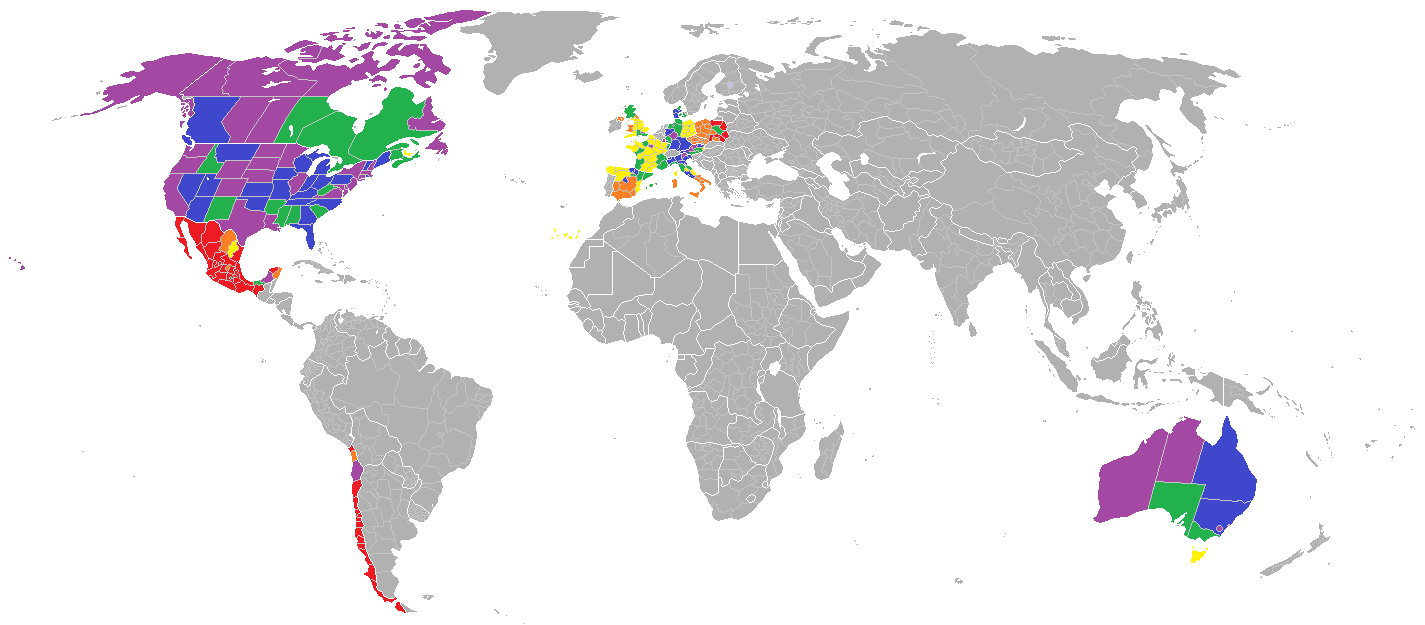
Eye Candy: the GDP (PPP) per capita of OECD Administrative Units (UPDATED)

Here is what I was able to patch together in my free time.

The countries I’ve filled in were about half of the OECD. The data is hard to get on administrative units elsewhere in the world (I got my data from the OECD website), but it was also hard to get for OECD states. The reason it was hard is because OECD data collectors divide up administrative units into two separate categories (TL2 and TL3) that sometimes correlate to traditional administrative units (such as California or New South Wales) and are sometimes arbitrary creations of EU or OECD bureaucrats designed specifically for data collection (rather than for understanding the historical trajectory of regions within a state).

Does this make sense?

To make matters worse, sometimes the TL2 category correlated with an actual administrative unit with political representation in a capital, and sometimes the TL3 category was the actual administrative unit with political representation. So I had to thumb through the nitty-gritty details of how OECD states send representatives to central parliaments and then match those real-life details to the data collectors TL2 and TL3 categories.

Does this make sense?

The map above highlights the US, Canada, Australia, Germany, France, the UK, Spain, Poland, Austria, Italy, Czech Republic, Chile, Denmark, and Mexico. These countries are all TL2 states.* I have no idea what that is supposed to mean for data collectors, but it means to dorks like me that their TL2 categories send political representatives to capital cities, whereas their TL3 categories likely send political representatives to regional capitals.

Does this make sense?

I have continued entering the data that the OECD has provided for the GDP (PPP) per capita of TL3 units (which send political representatives to capital cities), but the map I downloaded does not outline TL3 units (it only outlines TL2 units). So unless I want to spend time carving out TL3 units onto a TL2 map I am going to have to stop filling out the map. I’m all for collaboration on this, of course.

Here is the table I have (very slowly) been working on, but when I colored in the map above (the TL2 states), I divided them up into six groups based on highest GDP (PPP) per capita to lowest. The richest administrative units were purple, followed by blue, followed by green, followed by yellow, followed by orange, followed by red. So: purple is rich, red is poor. Got it? Because I started adding the TL3 states to the table, and because the map doesn’t allow for me to add the TL3 states to it, I forgot the range of the colored TL2 units. Dividing them up into six groups is a pretty easy task, though, so you should just trust my coloring scheme.

The map I created doesn’t have a very good zoom-in function, but what I found interesting is that Europe has a lot more economic inequality than the US, Canada, and Australia. Look at France. It’s mostly yellow, and the only purple (rich) administrative unit is Paris metro. This suggests, of course, that wealth in France is concentrated in the capital. The UK looks just like France (as does Spain). Germany is divided in half (as is Italy), and Austria and Denmark are cool, rich colors. Canada and Australia only have one yellow province each, and the US has none. Mexico looks just as Michelangelo described it, and Chile looks like Spain.

This is the OECD page I’ve been using. Here’s how I find regional GDP (PPP) per capita:

  • select “Regions and Cities”
  • select “Large (TL2) and Small (TL3) regions” – remember it’s either/or here: either TL2 or TL3 but not both
  • select “regional GDP per capita”
  • Then for measures (top of table) select “per head, current prices, current PPP”

I’ve been using 2011.

This pdf lists the “territorial grids” (TL2 and TL3 regions) of the OECD. The pdf didn’t help me figure out which regions send political representatives to capital cities and which are arbitrary, bureaucratic creations (I got to do that on my own!), but lists can definitely be helpful. In many cases I was able to figure out which units are politically viable and which are arbitrary for data collecting purposes just by looking at the list.

Finally, here is a map – courtesy of kelsocartography.com – of the world’s administrative units, at the TL2 level. Lots of work to do.
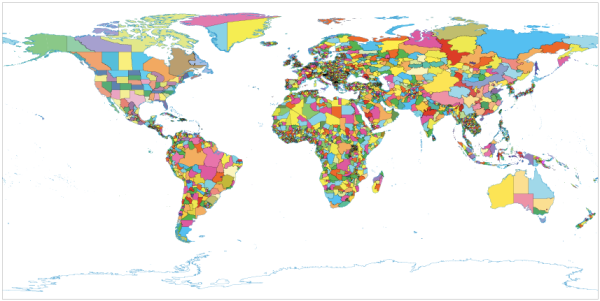
A good map of the world's administrative units
Here is a map of the world’s administrative units (courtesy of kelsocartography.com), but not necessarily the units that data collectors use to calculate GDP (PPP) per capita.

I like using the GDP (PPP) per capita of administrative units because I think it gives a much more stark picture of life around the world. I have pointed out before that the UK is now poorer than Mississippi, but breaking down the UK in the same manner as we do the US reveals that not only is the UK poorer than the poorest US state, the purchasing power parity of British citizens within the UK looks a lot more unequal than what we see in the United States. What is going on in the UK? The NHS can’t be that bad.

* – Oops, except for Denmark (it’s TL3)

UPDATED (3/11/2015): Continue reading

The European Union Needs More States, Not More Territory

The recent uproar over the upcoming vote on the potential secession of Scotland from Great Britain illustrates well the European Union’s foreign policy weaknesses. The EU’s potential to increase the number of states within its borders without having to expand its geographic space is an overlooked avenue to reaching a bolder, more sophisticated foreign policy.

Regional aspirations for more political autonomy have been voiced since the time of the creation of Germany and Italy in the late 19th century, but wars, nationalism, economic concerns, and fear of wars (along with the presence of the American military, of course) have largely kept these aspirations on the fringe of domestic political debates in Europe.

Steven Erlanger’s 2012 piece in the New York Times explains well why this is changing and what is currently happening in the European Union:

The great paradox of the European Union, which is built on the concept of shared sovereignty, is that it lowers the stakes for regions to push for independence.

Erlanger also goes on to quote a scholar at the European Council on Foreign Relations:

‘The whole development of European integration has lowered the stakes for separation, because the entities that emerge know they don’t have to be fully autonomous and free-standing,’ said Mark Leonard, the director of the European Council on Foreign Relations. ‘They know they’ll have access to a market of 500 million people and some of the protections of the E.U.’

The European Union has essentially taken the place of the nation-state as the chief entity in charge of standardizing trading policies in Europe. This political setup is a great opportunity for regions that have been absorbed into larger nation-states to assert more fiscal and political independence because of these regions’ new interdependence with a larger part of the European economy. The confederation has provided an opportunity for smaller states to emerge while at the same time providing these small state polities with a range of options and allies that are often missing from small states’ repertoires. The best of both worlds has a chance to flower: local governance and total participation in world trade.

This is better understood with a quick historical sketch of 19th and 20th century Europe in mind.

In the last decades of the 19th century the large nation-states of central Europe – Germany and Italy – had just been formed after centuries of being composed of hundreds of small polities. These small polities were parochial, and many of these polities’ elite factions had erected protectionist barriers around their small territories. These newly established nation-states were flanked on their eastern borders by cosmopolitan-but-despotic empires operating from Vienna, Moscow and Istanbul, and to the south were small Muslim polities haphazardly connected to the Ottoman Empire and economically dependent on Mediterranean piracy and Saharan trade routes. To the north and west: oceans and the seafaring, imperial regimes of Great Britain, the Netherlands, and France.

A map of Europe in 1800 AD. Look at how many polities are in what is now Germany and Italy. Thanks goes to euratlas.com

The formation of these larger nation-states were undertaken, generally speaking, in order to unify territories considered to be connected under various broad cultural domains into a cohesive political units and mercantile trading blocs.

After Germany and Italy achieved political unification, programs geared towards creating economic spheres of influence within the territory of the new nation-states began to be implemented. The creation of nation-states in central Europe had the contradictory result of opening up free trade zones within the territories of nation-states while simultaneously erecting new trading barriers that targeted individuals and factions not connected with the new nation-states. Free trade won in the domestic arena of these new states, but it also lost out internationally.

The political unification of these nation-states did not go down well with a myriad of factions. The reasons for resistance were varied, but suffice it to say that there was an intense backlash against the centralization of power and the nationalization of everyday life in the new nation-states of central Europe.

To counter regional resistance, proponents of political centralization argued that political union halted the wars that had wracked Europe for centuries (the economic benefits of freer trade were touted as well, but this argument did not have the same clout as it does today). However, this intellectual argument was framed in nationalistic terms, so when it trickled down into the public sphere of European life what emerged was a solid case against regional fracture that involved one part peace and one part national chauvinism.

The end result of this was the destruction of Europe through two large-scale, horrific wars.

The European Union has succeeded where the nation-states of Germany and Italy failed: by creating a massive free trade zone that eliminates protectionism (as the German and Italian nation-states did), and the necessity of cultural chauvinism (“nationalism”)  to maintain legitimacy (which the German and Italian nation-states could not do), the European Union has provided Europe with an incredible opportunity to build a lasting peace.

Adopting a requirement for member states  to incorporate a constitutional option that allows for referendums on secession would be a bold move that would not only bring a higher level of sophistication to EU foreign policy, but also fluster Moscow without edging closer to its borders (think about the example this would set in Russia’s own self-styled federation).

Bad News Bears: Ukraine, Russia and the West

No, I’m not talking about the Bruins choking in Pasadena earlier tonight. I’m talking about the Ukrainian government’s decision to balk at the latest Western offer for integration.

Well, at least I think it’s bad. The New York Times has all the relevant information on what happened between Kiev and the West. According to the Grey Lady, Kiev either balked at an IMF offer or had its arm twisted by Moscow. Both scenarios seem plausible, but I’d like to dig a bit deeper.

Ukrainians have been hit hard by this global recession, and last year they elected a government that is much more pro-Russia than it is pro-West. Unfortunately, I think the economy is only a small fragment of what ails the people in the post-colonial, post-socialist state of Ukraine (some people have started labeling “post-” states as “developmentalist” states; I like it but I’m not sure readers would). First of all, here are some relevant maps:

Ethno-linguistic map of Ukraine
2012 presidential election results in Ukraine
Map of per capita income in Ukraine

Notice a pattern? Yeah, me too. Basically, Ukraine is split along ethnic lines between Russians and Ukrainians and instead of recognizing this fact and focusing on property rights reforms first and foremost, the Ukrainians have decided to try their hand at democracy (on the inability of democracy to solve political problems in multi-ethnic states, see Ludwig von Mises’s Nation, State and Economy 72-84).

The conflation of democracy with property rights as freedom has been the single biggest mistake of all societies in the post-war world. From Ghana to Indonesia to Iraq to India to Ukraine, elites have focused their efforts on implementing democracy rather than property rights, and the inevitable, unfortunate results (“dictatorship and poverty”) continue to frustrate me. I’m sure the people who actually have to live under these conditions don’t like it much either.

Wouldn’t it be better if the current Ukrainian state  split into (at least) two independent states? I ask because it seems to me that having (at least) two different states will cut the number of losers in half (losers of elections in “post-” societies truly are losers; it’s nothing like having to “live under” Obama or Bush) and make the new, smaller governments more accountable and more accessible to the people.

The other aspect of Kiev’s rejection of Western integration that troubles my mind is that of the attitudes towards liberalization of Ukrainian society that many people obviously harbor.

For example:

  • Ukrainian-speaking Ukrainians overwhelmingly support more integration with the West. There are demonstrations (and I use this term loosely; riots may soon start) against the government’s decision to balk at the West going on right now.
  • And Russian-speaking Ukrainians (being Ukrainian can be either an ethnic thing or political thing [“citizenship”], which just goes to show you how stupid anything other than individualism is, but I digress) overwhelmingly support Moscow.

Yet it seems to me that both sides take the “pro-” and “anti-” stances that they do more out of spite for the other side than out of an understanding of what liberalization actually entails (I base this hunch on my watching of the recent elections here in the US). It’s also not clear to me that a pro-Western tilt would actually lead to more liberalization.

It may be easy for the Ukrainian-speaking Ukrainians to integrate and work with the West, but I think the Russian-speaking Ukrainians have good cause to look upon pro-Western deals with suspicion. After all, the Russian speakers are the richest faction in Ukraine, and freer trade with the West  would seriously undermine their political power (why do you think Russian-speaking Ukrainians have all the good jobs?).

Perhaps Evgeniy can enlighten us on the Russian perspective.

If Evgeniy doesn’t have the time you could just read Daniel Larison’s thoughts on the matter (Dr Larison is a historian with a PhD from the University of Chicago who specializes in the Slavic world).

Eye Candy

Just below the fold…

Continue reading

Around the Web

  1. The Reality of Feel-Good Government. James Bovard on “federal service” programs
  2. Will Wilkinson says “I smoke pot and I like it” (there’s more to the piece than just a confession)
  3. Map of police officers per 100,000 people in Europe
  4. Filming North Korea’s Film Industry
  5. Stephen Walt weighs in on the Snowden affair: What, me worry?
  6. Sex in the Arab World. An interview with Shereen El Feki

Eye Candy

It’s just beneath the fold…

Continue reading

Around the Web

  1. Implementing ObamaCare: “Grate” expectations
  2. Further problems with ObamaCare implementation
  3. US Health Care System Doesn’t Need Price Controls, It Needs Price Signals
  4. Australians of reddit: What North American Animal Scares the F*** Out of You?
  5. Distribution of train lines around the world
  6. The End of Europe’s Welfare States
  7. Dear Class of 2013: You’re pampered, privileged and oversexed—but at least your employment prospects are dim

Eye Candy

Just below the fold.

Continue reading

Eye Candy

Just beneath the fold. Continue reading

Eye Candy

Just below the fold… Continue reading

From the Comments: China and the Future of Nationalism

Riffing off of my recent post on Chinese porn searches, Dr. Delacroix writes:

This piece is opening a big closed book about contemporary China. Many Western intellectuals keep pretending that Chinese society and contemporary Chinese culture are inscrutable. I am one of these but I can’t fool myself forever: The pretense is largely a way to avoid commenting on what we really, readily see […]

Think of the psychological implications of having no interest in seeing how others do it! Does it imply anything about the extent of the otherness of others?

Dr. Delacroix goes on to encourage more research on China in the near future and rightly points out that libertarians have not adequately studied the region. I wholeheartedly agree on this point. Libertarianism is extremely weak in most areas of intellectual pursuit. In fact, the only reason libertarianism has any clout at all in academia is because it has a strong showing in two of the most important academic fields of inquiry: economics and philosophy. Perhaps this blog will contribute towards shrinking that gap.

My own impulse is to look at institutions for cultural, economic and political explanations of society. I’ll have more on this later, but another fascinating post by Shanghaiist on the Russian state’s recent debut on Weibo (the Chinese version of Twitter) is worth highlighting. From the report:
Continue reading

Maps in History

I’m thinking of starting a new project of putting up maps that I think will help to enhance my own perception of history and the struggle between power and liberty. Hopefully it catches on. I’ll probably have a small vignette to go along with some of the maps, some of the time. At least I hope to. This’ll help me clarify my own thoughts and perhaps even help to clarify the thoughts of others. So without further adieu: Continue reading

Around the Web

At Last, Some Bright Spots in Indian Country (if you can’t view it, just copy and past the title and Google it).

The enduring failure of democracy promotion abroad.

Borderlines. A blog about maps.

More Musings on Colonialism

I recently attended an excellent lecture at Cabrillo College, located in central California, by an International Relations scholar who focused on the effects of colonialism. We took a solid look at the ‘World Systems Theory’ of why the developing world is, well, developing, and it was great to go over this school of thought’s main arguments.

For those of you who don’t know, World Systems Theory is a Marxian analysis that basically states that poor countries are poor because of the effects of colonialism, and the evidence supporting their claims is pretty damn solid. Basically, the World Systems theorists argue that when the various European powers gained outright control of non-European lands (this process in itself took centuries, by the way, and I deplore the historical narrative that argues Europeans set out to conquer foreign lands and divide up the spoils of war for reasons outlined in the link provided), the European powers set up states that were designed specifically to export raw agricultural materials to European factories, to be produced by European workers, and to be consumed by European (and elite non-European) consumers.

This is pretty much what happened, and explains why most of the developing world is dependent upon raw commodity exports (that are shipped to European markets) for most of their well-being. Unfortunately, the very solutions that the World Systems theorists propose to dismantle the structural inequalities that exist in this world will (and have) actually led to more of the same structural inequality.

Allow me to explain. Continue reading