Classical Liberalism and the Nation State

Barry’s response to my earlier post is another interesting read, yet it is also rather broad brush historical. I think he is erroneous if he claims that ‘it did not occur to classical liberals, on the whole, to question the state system as they knew it’. In fact the founding fathers of classical liberalism, David Hume and Adam Smith, were very much aware of other, often cosmopolitan ideals of world order. Yet they argued that the nation was attached to individual emotion, which could not be the case for entities beyond the nation state. This was also the position of later classical liberals such as Von Mises and Hayek, as I show in Classical Liberalism and International Relations Theory (Palgrave, 2009).  Let me elaborate a little, also in the wider context of international political theory.

Liberalism is the political expression of individualism, yet cooperation of individuals in groups is valued positively. For classical liberals the nation, or the country, is the largest group in society which is the object of human passion, both positive in the sense of national pride and negative in the sense of shame and humiliation. Hume noted that there are few men entirely indifferent to their country, and both he and Adam Smith underlined that humans sympathise more with people to whom they are close than with strangers or foreigners. Feelings for the nation are strong, natural motivational forces for individuals.[i]

This also applies in the age of modern states and nationalism. Despite the atrocities committed in the name of national glory throughout the twentieth century, Mises and Hayek never predicted nor called for the end of the nation state. Mises thought that language was the essence of nationality, and with the fragmentation of the polyglot Austro-Hungarian Empire in mind he argued that multi-language countries were doomed to failure. His solution was an increase in possibilities for individual self-determination and group secession, but not in the expectation that this would lead to a world without sovereign states.[ii] Hayek saw the nation as a prime source of human bonding and individual loyalty, but recognised the negative aspects of nationalism. He valued the nation, but nationalism was a poison,[iii] not least because he saw a strong relation between nationalism and imperialism. After all, it is a small step from thinking good about one’s country to trying to rule and civilise allegedly inferior others. Often, although certainly not in all cases, the nation as a group is politically organised as a sovereign state. In the classical liberal view, states are the most important actors in international relations.

To maximise individual freedom the state should only have a limited number of tasks. The state is an important protector of natural rights, but history has shown that it is also the biggest abuser of these rights. The principle of the rule of law intends to protect the negative liberty of individuals. Classical liberals think the state can best be bound by a combination of constitutions; separation of the legislative, executive and judicial powers; and the limitation of positive law.

In international affairs this means that states should be cautious about concluding and ratifying treaties and other forms of positive law. These are often binding commitments that are very hard to change or to get rid of, with a large possible negative impact on individual freedom. Some international agreements may be useful to smooth the working of the international society of states, or to settle practical matters. But the dangers of overregulation are just as real in world politics as they are in national politics. Besides some specific cross-border issues, the classical liberal rule of thumb is that there is no need for international state action if there is no domestic state task.

Consequently, attempts to build a better world by establishing international organisations and regimes are rejected. Mises and Hayek were strong critics of the League of Nations and its successor the United Nations, and Hayek was a fierce critic of the International Labour Organization. Their main concern was that these and other organisations were taking up tasks they should not perform, just like overactive states in national circumstances. Social constructivism is bad, no matter at what level it is performed.[iv]

In Degrees of Freedom (Transaction, 2015)  I have tried to illuiminate the differences between the different forms of liberalism (and conservatism, also see my earlier post on the differences between them entitled “Let’s clear up the liberal mess”), including their views in international relations. In summary it looks like this:

Liberalism, Conservatism and International Relations

Classical liberalism Social liberalism Libertarianism Conserva

tism.

Nation as limit of individual sympathy Yes No No Yes
State as prime actor in world politics Yes No No Yes
International governmental

institutions/regimes

No Yes No No
Can war be eliminated No Yes Yes No
Does trade foster peace? No Yes Yes No

Source: Edwin van de Haar, Degrees of Freedom. Liberal Political Philosophy and Ideology (Transaction Publishers, 2015).

That also explain partly why Barrry can rightly argue that the ideas of Kant, Mill and to a lesser extent Montesquieu differ from those of Hume, Smith, Mises and Hayek: they are not classical liberals but social liberals.

Notes:

[i] Hume, Treatise,79, 317; Adam Smith, The Theory of Moral Sentiments (Indianapolis: Liberty Fund, 1982), 299; also Edwin van de Haar, ‘David Hume and International Political Theory: A Reappraisal,’ Review of International Studies, 34:2 (April 2008), 225–242.

[ii] Ludwig von Mises, Nation, State, and Economy. Contributions to the Politics and History of Our Time (New York and London: Institute for Humane Studies & New York University Press, 1983), 39–40, 82.

[iii] Friedrich Hayek, Studies in Philosophy, Politics and Economics (New York: Simon and Schuster, 1967), 143.

[iv] Mises, Nation, State and Economy, 90–91; Ludwig von Mises, Omnipotent Government. The Rise of the Total State and Total War (Grove City: Libertarian Pres, 1985), 292–294; Friedrich Hayek, The Road to Serfdom (London: Routledge, 1997), 176.

The Case for the UK staying in the EU

Leaving the European Union would not be a gain for liberty in the United Kingdom. This is true as a matter of general principles and is reinforced by the nature of the Leave campaign which has targeted sections of the population hostile to immigration, open markets, and free trade. Much of the Leave campaigning which has not appealed to such base arguments has at the very least appealed to a version of populist democratic sovereignty at odds with the restraints on government and the state at the heart of classical liberal and libertarian thought.

Even if we try to separate some pure classical liberal version of the Leave campaign from the crudity of the campaign, as some natural supporters of leave wish had happened to the extent they ate voting for Remain rather than go along with such an obnoxious campaign, we are still left with the question of why it liberty advocates should support Leave.

I have sometimes seen references to national sovereignty as a classical liberal doctrine. If this means never sharing sovereignty at a transnational level, then it is simply a false claim. Immanuel Kant advocated a world federation to prevent war. Kant is not often put at the centre of the history of classical liberal thought. His ideas about political institutions, individual rights, and the limits of government certainly belong in the classical liberal sphere. We should distinguish between what Kant said and what later German Idealists said, a rather big issue, and appreciate how close he is to the way of thinking of Montesquieu and Smith and even advances upon them in showing a clearer understanding of the role of representative assemblies in modern politics.

More recently F.A. Hayek advocated federation between liberal democracies. The creation and evolution of the European Union has been and continues to be supported by European political parties of a classical liberal persuasion, those liberal parties which remained most true to the principles of their nineteenth century founders and precursors. Thinkers on the left, like Albert Camus and George Orwell, known for their particular commitment to liberty and their opposition to an authoritarian state were enthusiasts for European integration. Many conservatives of the more free market and limited government sort like Ludwig Erhard (founder of Germany’s post-war, post-Nazi market economy) and John Major (UK Prime Minister from 1990 to 1997, who went further than Margaret Thatcher in privatisation and deregulation) have been and are advocates of the European Union.

The unrestrained sovereignty of the nation-state is not only not an inherently liberal idea, it is dangerous to liberalism. There is nothing illiberal in transnational rules and institutions that restrain states from violence against their own citizens, attacks on individual rights, economic protectionism, and market rigging. The European Union is particularly successful with regard to the economic and market issues at the national level.  It adds huge institutional weight to the work of the Council of Europe which promotes human rights through its court in Strasbourg. The existence of the European Court of Justice is of profound importance in ensuring that national governments and peoples are accustomed to regarding the decisions of nation states as subordinate to and accountable to a judicial process enforcing transnational laws.

The EU is open to a great deal of criticism with regard to its tendencies towards over-regulation, but this represents the median attitude of the member governments, not an imposition on the nation-states of Europe. Since the UK economy is at the more free market deregulated end of the European Union, there is some plausibility in saying the UK might go further down that road if it left the EU. However, before it joined the EU it was looking less market oriented than the EU states of the time. The period during which the UK has moved from the more statist to the more limited state end of the European nations has been during the period of EU membership. The precedents do not favour the UK becoming more classically liberal because it leaves the EU and the Leave campaign has appealed to the most insular, nationalist, anti-immigrant, anti-foreigner, and anti-free trade sections of the UK population.

It is possible to imagine the UK as a more libertarian kind of place in the EU, but a much more plausible use of the liberal imagination is to think of ways in which the UK can work with allies in the EU for a a less regulatory and centralised EU. This has already worked as in the adoption of the European Single Market and the diminishing role of the European Commission, the ‘bureaucratic’ part of the EU. The Commission employs as many bureaucrats as the larger local government units in the UK and is tiny compared with any national bureaucracy. Its members are nominated by national governments subject to confirmation of the European Parliament. Power has shifted from the Commission to the bodies in which national government representatives meet, the European Council and the Council of the European Union.

The Leave campaign in the UK, including self-styled free marketers in the Conservative Party, is committed to leave the Single Market as well as the European Union itself, in large part to terminate free movement of EU citizens across its borders. The reasoning offered to prevent this movement of human capital is in terms of anti-foreigner sentiment. This is not something than can be recognised as a pro-liberty program. The pro-liberty choice is to keep free movement of goods, investment, and labour within the EU while working to reform the more interventionist tendencies of the European Union, to stymie the regulatory drift which started hitting industrial market economies decades before the EU was created and which cannot be solved by smashing up the EU.

Libertarians and Pragmatists on Democracy Part 2: Classical Liberal and Libertarian Criticisms of Democratic Institutions

Note: This is part of a series on democracy. It is assumed the reader is familiar with part one prior to reading, in which the basic direction of this series is introduced and democracy is more concretely defined. This post is meant to do be a non-comprehensive, though fairly inclusive, look at a variety of views of democracy in classical liberal thought. The next post will survey progressive and pragmatist views of democracy, and the final post will argue that the truth in classical liberalism and pragmatism perspectives on democracy lead to a defense of market anarchy.

As alluded to in the introduction to this series, democracy has occupied a tricky place in the history of classical liberal thought. Despite the fact that the prevalence of democratic institutions in the West is at least partially a result of the influence of classical liberalism (in fact, I’d argue classical liberalisms’ role has been extremely significant in this regard), classical liberals have always been at best ambivalent to democracy. In recent years, libertarians have been critical and outright hostile towards democracy. For this reason, I’d argue that classical liberalism is, on net, critical of democracy, and there is a lot to learn from these criticisms. As a matter of housekeeping, it is important to note that I am using the term “democracy” in the second sense—as a system of political decision making—through most of this section unless otherwise noted.

Early Liberalism’s Cautious Enthusiasm for Democracy

At classical liberalism’s conception, democracy was in many ways the end-goal. No doubt, most classical liberals of the Enlightenment preferred democracy to the absolutist monarchism that had dominated Europe in their times. John Locke’s entire political project can be read as a criticism of absolutism, and he tended to more democratic views. In his Second Treatise on Government “democracy” is only mentioned twice by name in Chapter 10, mostly to define it in contrast to oligarchy and monarchy. However, throughout Locke there is a tendency to emphasize what we today would call “popular sovereignty”—a concept which strikes at the heart of the appeal of democracy. As Peter Laslett writes in his introduction to the Cambridge edition of Locke’s Two Treatises:

In his analysis of politics in terms of force as well as in rightful authority Locke is closer to the thought of our own day on the subject of sovereignty than the assumptions of his own time. Behind the superior power of the legislative in his system there is always to be seen the finally supreme, all-important power of the people themselves, again conceived of as a force, though justified once more by the concept of trust. It was a power which would only rarely display itself, and, as we have tried to show, there is considerable obscurity about the actual circumstances in which it could come to action and more about what it might achieve. Nevertheless, this residual power must be called Locke’s idea of what we now think of as popular sovereignty.

Drawing off of Locke, the American founders; inherited a skepticism towards absolutism and a little bit of faith in popular sovereignty. Of course, there is a slight difference in the founders’ conception of popular sovereignty and Locke’s in that it is far more individualist; in fact, it might be more accurate to say the founders did not so much believe in popular sovereignty as individual self-governance, but there is still an affinity between Locke and most of the founders’ on this point. Contra most west coast Straussians (ahem, Tom West and Harry Jaffa), it is important to note that the founders’ were influenced by much more than the classical liberal philosophy of John Locke. They, particularly John Madison, John Dickinson, and most of the early federalists, were just as influenced (if not more-so) by classical Greek and Roman political philosophy and the style of old whig conservatism of Burke and his contemporaries as classical liberalism. This can be illustrated in their perspective on democracy.

Though certainly wary of democracy’s dangers, most of the founders overall could still be described as democratic in some sense of the term. Of course, this point must be nuanced with the founders’ healthy criticisms of democracy influenced by classical liberal thought, whiggish conservatism, and Aristotelianism. Maddison is probably the most frequently cited example of an American founder who waxed pessimistic about democracy, given his writings on the “problem of factions” in Federalist No. 10. To be sure, most of the founders, as Ben Franklin famously said at the end of the constitutional convention, would have probably preferred the term “republic” to “democracy.”

Because of Madison’s Federalist No. 10 and a variety of quotes that were harshly critical democracy from the founders (many of which are false), a number of right-wingers today, particularly populist and nationalistic constitutional conservatives, argue that the founders were not democratic at all and are adverse to anything that refers to America as a “democracy.” To be sure, America is not a pure democracy, however there is little doubt that the founders still had at least some affinity for democracy, particularly in contrast to absolutist monarchy, with the possible exception of Hamilton sometimes (I would also argue that Hamilton was the least classically liberal of the founders and is largely my least favorite founder, but that’s another issue).

Further,  it is obvious the constitution incorporated democratic decision-making far more than any other of that time; in fact, the preamble beginning with “We the People” screams of the democratic, Lockean notion of popular sovereignty. Further, there is little doubt that even the America of the founders can be described as “democratic” at least in the third sense of the term (as a general term for modern Western governments).

Finally, some of the founders were pretty avidly pro-democratic, particularly Thomas Jefferson. As Jefferson wrote to John Taylor:

It must be acknowledged that the term “republic” is of very vague application in every language… Were I to assign to this term a precise and definite idea, I would say purely and simply it means a government by its citizens in mass, acting directly and personally according to rules established by the majority; and that every other government is more or less republican in proportion as it has in its composition more or less of this ingredient of direct action of the citizens.

Note how Jefferson’s definition of a “republic” is virtually indistinguishable from the way democracy is typically defined (in the second sense). Of course, Jefferson, especially in his later years in his later years was skeptical about the workability of this democratic/republican vision, writing “[s]uch a government is evidently restrained to very narrow limits of space and population. I doubt if it would be practicable beyond the extent of a New England township.” Nonetheless, it’s hard to consider Jefferson anti-democratic, especially in his younger years, when the notion of Jeffersonian democracy has been so influential in the history of American politics or if one considers Jefferson’s excuberance for the much more populist French Revolution prior to the Reign of Terror.

The Decline of Democracy in Classical Liberal Thought

After the founder’s era, however, experience with real-world democratic institutions began to contrast sharply with the theoretical hopes Enlightenment-era liberals had for democracy. The Jacobin reign of terror and aftermath of the French Revolution were sobering reminders of the dangers of the tyranny of the majority. As Edmund Burke wrote in Further Reflections of the French Revolution such a Democracy is a thing which cannot subsist by itself” and the specter of Robespierre led Burke to continually warn of mob-rule and the excesses of democracy. In America, the extremely low level of decorum in early elections (particularly in 1800 between Jefferson and Adams) must have made the more aristocratic and conservative of the founders (the likes of Washington, Hamilton, and John Dickinson) fearful of the direction in which their experiment was going.

By the Jacksonian era, it is safe to say that most classical liberal observers were waxing a bit more pessimistic on the prospects of democracy than their intellectual ancestors. The rise of a populist president in Andrew Jackson who had committed so many acts of tyranny against the Native Americans, the democratization of religious faith by the likes of Lorenzo Dow in the Second Great Awakening, and the growing of democracy into almost a political religion were signals of a disturbing trend to many of the surviving founders and European liberals like Mill and de Tocqueville. In fact, Jefferson even said of Jackson, in an interview with Daniel Webster:

I feel much alarmed at the prospect of seeing General Jackson President.  He is one of the most unfit men I know of for such a place.  He has had very little respect for laws and constitutions, and is, in fact, an able military chief.  His passions are terrible.  When I was President of the Senate, he was Senator; and he could never speak on account of the rashness of his feelings.  I have seen him attempt it repeatedly, and as often choke with rage.  His passions are, no doubt, cooler now; he has been much tried since I knew him, but he is a dangerous man.

No doubt, Jefferson’s critique of Jackson’s inability to control his passions mirror Plato’s critique of the “democratic soul” in the Republic.

However, it wasn’t until Alexis de Tocqueville’s famous Democracy in America that the classical liberal view of democracy truly turned critical. De Tocqueville saw democracy’s influence in America as resulting in the decline of an aristocratic class that “furnished the best leaders of the American revolution.” Socioeconomic egalitarianism was far from the worst of democracy’s problems in de Tocqueville’s eyes. He saw the concept of popular sovereignty as leading to “unlimited power of the majority” that was corroding the checks and balances of the American constitution in every branch of government. Indeed, there has perhaps never been as eloquent a critic of “tyranny of the majority” as de Tocqueville.

In England, JS Mill also was beginning to see the dangers of excessive democracy. Much of On Liberty can be read as building on and responding to de Tocqueville. For example, his warnings against the tyranny of majority opinion in the first chapter of On Liberty echo de Tocqueville’s concerns and are worth quoting at length (also, note how much of this anticipates much of the later insights of the Virginia School of Political Economy):

The notion, that the people have no need to limit their power over themselves, might seem axiomatic, when popular government was a thing only dreamed about, or read of as having existed at some distant period of the past. Neither was that notion necessarily disturbed by such temporary aberrations as those of the French Revolution….In time, however, a democratic republic came to occupy a large portion of the earth’s surface, and made itself felt as one of the most powerful members of the community of nations; and elective and responsible government became the subject of the observations and criticisms which wait upon a great existing fact. It was now perceived that such phrases as “self-government” and “the power of the people over themselves” do not express the true state of the case. The “people” who exercise the power are not always the same people with those over whom it is exercised; and the “self-government” spoken of is not the government of each by himself, but of each by all the rest. The will of the people, moreover, practically means, the will of the most numerous or the most active part of the people; the majority, or those who succeed in making themselves accepted as the majority: the people, consequently, may desire to oppress a part of their number; and precautions are as much needed against this as against any other abuse of power. The limitation, therefore, of the power of government over individuals, loses none of its importance when the holders of power are regularly accountable to the community, that is, to the strongest party therein.

…Like other tyrannies, the tyranny of the majority was at first, and is still vulgarly, held in dread, chiefly as operating through the acts of public authorities. But reflecting persons perceived that when society is itself the tyranny—society, collectively, over the separate individuals who compose it—its means of tyrannizing are not restricted to the acts which it may do by the hands of its political functionaries….Protection, therefore, against the tyranny of the magistrate is not enough: there needs to be protection also against the tyranny of the prevailing opinion and feeling[.]

By the generation of liberals after Mill, the insight that democracy itself can turn into tyranny became influential on the continent as well. French liberals such as Bastiat and Germans such as Mises became critical of democratic institutions. Both Bastiat and Mises noted how democracies are ultimately controlled by public opinion which can, often times, be irrational. Bastiat took note of this in regards to protectionist economics writing, “Protectionism is too popular for its adherents to be regarded as insincere. If the majority had faith in free trade, we should have free trade.” Mises elaborated on Bastiat’s insights more writing in Human Action:

Democracy guarantees a system of government in accordance with the wishes and plans of the majority. But it cannot prevent majorities from falling victim to erroneous ideas and from adopting inappropriate policies which not only fail to realize the ends aimed at but result in disaster.

(Note: Bryan Caplan has a great, more detailed analysis of Bastiat and Mises’ criticisms of democracy, it is highly recommended.)

Most of these problems of the tyranny of the majority highlighted by de Tocqueville and Mill, as well as the issue of a completely misinformed public, seemed confirmed in World War II after the rise of fascism via the democratic process in Germany and Italy.

Public Choice Theory and Democracy’s Continued Decline

In the middle of the twentieth century, classical liberals became influenced by a field of study that seemed to confirm and deepen their worst fears of democracy. I’m referring, of course, to the public choice theory of the Virginia School of Political Economy associated with the likes of James Buchanan, Richard Wagner, and Gordon Tulloch. It is important to note at this point, of course, that public choice theory itself is not a part of classical liberalism as it is a positive scientific research program that simply applies economic analysis to the political process that has been contributed to by libertarians, conservatives, and liberals like rather than any sort of political ideology; however, many of the founders of Public Choice Theory were themselves classical liberals and there is little doubt that this style of economic thinking has had more influence on libertarianism than any other political philosophy.

The new public choice theory found that democracy could result not only in the potential tyranny of the majority, but also in horrible policies thanks to the accumulation of special interests (akin to Madison’s analysis of the problem of factions). The idea that voters are rationally ignorant, the insight that elected representatives do not act in the public interest but out of their own rational self-interest and those of their lobbyist friends, and a number of concepts from the short-sightedness effect to the Arrow’s impossibility theorem seemed to cast poor prospects on democracy’s ability to protect individual liberty. The fact that so many democracies were adopting horrible Keynesian economic policies, and the explanation that this is due to the self-interest of politicians, caused further doubt on the compatibility of free markets and democratic institutions. Later insights from public choice theory revealed that voters were not only ignorant but also systemically biased and irrational, as Bryan Caplan’s Myth of the Rational Voter argued, only added to this anxiety.

This is not to say, of course, that classical liberals since the mid-nineteenth century have been wholly opposed to democracy. Indeed, Mill, Bastiat, Mises, and most of the public choice economists continued to prefer representative democracy strongly limited by a well-designed (well, at least for Buchanan) constitution to alternative systems of political organization. Even Mises in Liberalism: In the Classical Tradition defended democracy on the following grounds:

In the long run, no government can maintain itself in power if it does not have public opinion behind it, i.e., if those governed are not convinced that government is good….There is, therefore, in every form of polity a means for making the government at least ultimately dependent on the will of the governed, viz., civil war, revolution, insurrection. But it is just this expedient that liberalism wants to avoid. There can be no lasting economic improvement if the peaceful course of affairs is continually interrupted by internal struggles…Here is where the social function of democracy finds its point of application. Democracy is that form of political constitution which makes possible the adaptation of the government to the wishes of the governed without violent struggles.

The attitude of FA Hayek in The Constitution of Liberty towards democracy is perhaps the most typical attitude of most classical liberals and libertarians since the days of de Tocqueville, and the majority of libertarians in mainstream political discourse today. Hayek defends a heavily limited concept of democracy as a means to the end of individual liberty; as the most efficient of current possible political constitutions to ensure the freedom of the individual. He echoes Mises in the fifth chapter entitled “Majority Rule” where he writes:

If democracy is a means rather than an end, its limits must be determined in the light of the purpose we want it to serve. There are three chief arguments by which democracy can be justified, each of which may be regarded as conclusive. The first is that, whenever it is necessary that one of several conflicting opinions should prevail and when one would have to be made to prevail by force if need be, it is less wasteful to determine which has the stronger support by counting numbers than by fighting. Democracy is the only method of peaceful change that man has yet discovered.

Modern Libertarianism’s Hostile Opposition to Democracy

Since Hayek penned those words in 1960, before many of the most depressing insights of public choice had risen to prominence, classical liberals and libertarians—particularly more radical anarchists—have grown even more skeptical of democracy and are, at times, outright hostile to it. Hayek himself in his next major work on political theory, Law, Legislation, and Liberty, waxed a bit more pessimistic on constitutional representative democracy than he did in The Constitution of Liberty. Just thirteen years after he spent over five-hundred pages defending and articulating liberal constitutionalism, he opens the introduction to the first volume of his next major work by declaring “The first attempt to secure individual liberty by constitutions has evidently failed.” Though he still proclaims the destruction of liberty that was running rampant in the immediate aftermath of World War II was “not a necessary consequence of democracy,” he laments the role democracy had played in recent politics:

If I am right, it would indeed seem that the particular form of representative government which now prevails in the Western world, and which many feel they must defend because they mistakenly regard it as the only possible form of democracy, has an inherent tendency to lead away from the ideals it was intended serve. It can hardly be denied that, since this type of democracy has come to be accepted, we have been moving away from that ideal of individual liberty of which it had been regarded as the surest safeguard, and are now drifting towards a system which nobody wanted.

In other corners of classical liberal thought, the prospects for democracy were even grimmer. This hostile attitude is perhaps best exemplified by Hans Herman Hoppe’s book Democracy: The God that Failed. Hoppe argues that democracy suffers from a problem akin to the tragedy of the commons; whereas medieval monarchies, aristocracies, and feuds had some sense of ownership over the state, democracies have no clear sense of ownership and so democratic representatives have little incentive to make good policies that protect liberty and economic prosperity.

Though Hoppe spends far too much of the book on anti-intellectual, abrasive, and, at times, bigoted (in the literal meaning of the term) polemics, there is some truth to his central insight and it certainly has a resonance with the public choice research on the short-sightedness effect. I doubt that Hoppe’s insights have the radical implications he draws of by necessity (mainly that monarchy is preferable to democracy); there might be a case to be made that pre-democratic institutions had lower taxes and better protection of property rights, on virtually every non-tax matters it is fairly obvious that such governments were far more tyrannical. Freedom of movement, which was so important to Mises in Liberalism and is among our most important of liberties, was non-existent in feudal Europe; indeed, serfs in many European manors were little more than slaves, pieces of property tied to their land, rather than sovereign, free individuals. Further, social freedom and freedom of religion were virtually non-existent in such polities; homosexuals were executed, Muslims and Jews were persecuted, and there were a number of other violations of human rights I doubt even Hoppe (in his implicit and occasionally explicit homophobia) would defend. (Of course, Hoppe would throw a fit because his argument is purely deductive and a priori whereas mine actually uses empirical evidence, but his simpleton, idiosyncratic, and laughably unintelligent economic methodology and epistemology is another topic.) I highly doubt even the most dogmatic Rothbardian Hoppe-lover would rather live in a medieval Europe feudal manor or monarchy than a modern democracy, despite their flashy polemics.

More recently, Michael Huemer has had criticisms of democracy’s morality in his book (which I highly recommend) The Problem of Political Authority. Heumer’s argument throughout the book is that all attempts to justify the legitimacy of government authority or to argue that there is any real consent between real-world governments and citizens fail, and a better form of government may be found in market anarchism. He notes how democracy has created a false identification of voting with actual consent that can morally legitimize government, and argues against all attempts to claim that citizens of democracies—real world or hypothetical—are under legitimate authority by virtue of the fact that they are living in a democracy. In another chapter, Huemer analyzes the problematic psychology of authority and how democracy contributes to the idolization of government.

Even more recently, Jason Brennan has a forthcoming book out that is perhaps more critical of democracy than any other classical liberal—save perhaps Hoppe—aptly titled Against Democracy. Brennan argues, like Huemer, that our relationship to democracy is non-consensual. In line with most public choice theory, he argues that democracy is truly the “rule of the irrational and the ignorant” and that democratic deliberation, voting, and electoral participation actually makes people worse, more biased, more irrational citizens. Brennan, instead, defends what he dubs “epistocracy”—a sort of aristocratic rule of the knowledgeable. (I have yet to read through Brennan’s book as it hasn’t been released yet and I’m basing this entirely off of reviews and Brennan’s other writings, particularly BHL blog posts, so I may be butchering some of the details of his argument in this description.)

Clearly, the classical liberals—from de Tocqueville to Jason Brennan—have very good reason to be skeptical of democracy, and perhaps even to feverishly oppose democracy. I still do not take the conclusions to the extremes of Hoppe and (at least from my limited knowledge of his writing on this topic) Brennan. I would agree with Hayek and Mises that constitutional representative democracy is the nth best alternative to other systems such as feudalism, absolutist monarchy, and any form of authoritarianism. (Although my general opposition to nation-states for both anarchist and communitarian reasons makes me more critical of democracy than most moderate classical liberals.)

However, it is clear that democracy is far from the best of all possible governmental arrangements. At the very least, the truth that Aristotle emphasized in his Politics that it matters not so much the make-up of the government (rule of the many, few, or one) but the quality of government, whether it is tyrannical or not. There is very good reason to believe, due to most of the arguments by the great thinkers discussed above, that democracy is, unfortunately, more likely than not to lead to tyranny—even if it is less likely to do so than the existing alternatives.

Having said that, perhaps not all is lost for the spirit of democracy. In the next post, I will analyze the pragmatist conception of democracy perhaps most popular among American twentieth-century liberals and progressives. This conception of democracy is far more than a form of political decision making discussed by the classical liberals, but a broader social epistemology and philosophy as mentioned in the introduction. I hope it will be clear by the end of the next post in this series that it is possible to affirm some of the philosophical commitments of democracy extolled by thinkers such as John Dewey, Sidney Hook, and Richard Rorty without necessarily embracing democracy as a political decision-making progress or, as Hayek would argue, democracy as it presently exists.
Unanimous direct democracy

I was recently introduced to a few positive arguments for this in R. P. Wolff’s In Defense of Anarchism. Lacking the book to cite, he was absorbed with the problems of democracy, namely, the triumphant majoritarian democracy, in the manner that the minority suffers exclusion from representative processes and alienation in their laws. Philosophically he thinks contemporary liberalism leads to an illegitimate government, and anarchism is the only legitimate form of governance.

He proposed a possible method in which unanimity might be lost (as is the case in any large enough governed society), but directness and egalitarianism sustained and an authentic “rule by the people” enacted: socially-funded television sets, installed at large community centers or subsidized for private homes, with featured debates at every election season. Specialists, e.g., in fields like economics, American history and foreign policy, could feature, from various recesses of the political spectrum, to explain the more complicated issues in a collaborative, unpedantic effort. Middle Eastern history, for example, could be briefly clarified before candidates discuss their stances. (Of course, biases would find an entry point through specialists. Further discussion is necessary for this.) At the end of the week of debates, once issues are clarified and nominees understood, the remote control could be used to cast a vote for each member of the household according to the census. This system would greatly increase voter participation, and make domestic politics worthwhile for the average citizen, returning policy-making to everyone affected.

This is an idea of working within the current society on a system for better voter say: it should be judged on these merits as such.

Is it feasible? Is it at all admirable? Discuss.

New issues of Econ Journal Watch, Reason Papers out

Many of you already know that two of NOL‘s Senior Editors are associated with Econ Journal Watch, thus making its publication a family affair. Fred is on the editorial board and Warren is its math reader. Here are some of the highlights I found worth noting in the latest issue:

Eli Heckscher’s Ideological Migration Toward Market Liberalism: Benny Carlson explores the intellectual evolution of a great Swedish economist.

Symposium:
Classical Liberalism in Econ, by Country: Authors from around the world tell us about their country’s culture of political economy, in particular the vitality of liberalism in the original political sense, historically and currently, with special attention to professional economics as practiced in academia, think tanks, and intellectual networks.

New contributions:

Young Back Choi and Yong Yoon: Liberalism in Korea

Pavel Kuchař: Liberalism in Mexican Economic Thought, Past and Present

(All of the papers from this symposium, which has carried across multiple issues of EJW, are collected at this page.)

You can download the whole issue here (pdf).

Dr Khawaja, an Editor-at-Large for Reason Papersreports (2/2/16) on the latest issue over at Policy of Truth:

The latest issue of Reason Papers, vol. 37, number 2 is now out; officially, it’s the Fall 2015 issue, but we only just managed to put it up on the website last night. This link will take you to a monster-size PDF to the whole issue (almost 250 pages). This link will take you to the journal’s Archive page, where you can access individual articles for this or any past issue (you have to scroll down a bit). Finally, this link will take you to three (time sensitive) Calls for Papers issued by the journal’s editors: one on “the philosophy of play” (March 1, 2016); one a fifteen-year retrospective on 9/11 (July 1, 2016); and one an Authors-Meet-Critics symposium on Douglas Den Uyl and Douglas Rasmussen’s forthcoming book The Perfectionist Turn: From Meta-Norms to Meta-Ethics (February 1, 2017).

My own small contribution to Reason Papers can be found here (pdf).

Liberalism and Sovereignty

More than a year ago I promised Jacques a post on sovereignty and while I am not always able to follow up very quickly, I tend to do what I promise. So here it is! Jacques’ main cri de coeur was why (classical) liberals should care about sovereignty at all.

When it comes to the theoretical discussion about sovereignty (the literature is huge), I think there is no better start than the work of international relations theorist Robert Jackson. Or better and broader: any thinking about international relations benefits from this Canadian, former Boston University professor, especially his magnum opus The Global Covenant: Human Conduct in a World of States (Oxford University Press, 2000). But this is a side step.

In his 2008 book Sovereignty: Evolution of an Idea (Polity Press) he argues that:

sovereignty is an idea of authority embodied in those bordered territorial organizations we refer to as states, and is expressed in their various relations and activities, both domestic and foreign. It originates from the controversies and wars, religious and political of sixteenth and seventeenth century Europe. It has become the fundamental idea of authority of the modern era, arguably the most fundamental.

Also in regions where other kinds of arrangements existed before Western imperialism.

It is at the same time both an idea of supreme authority in the state, and an idea of political and legal independence of geographically separate states. Hence, sovereignty is a constitutional idea of the rights and duties of the governments and citizens or subjects of particular states. It is also an international idea of multiple states in relation to each other, each one occupying its own territories and having foreign relations and dealing with others, including peaceful and cooperative relations as well as discordant relations and periodical wars.

Of course a lot of popular and academic discussion follows from this, for example about the particular form of sovereignty (popular, or not), the relation between power and sovereignty, sovereignty and globalization, or if and when sovereignty may be breached to protect others through intervention. Yet here I solely  focus on the relation between sovereignty and liberal political theory.

Concerning the domestic supremacy side of sovereignty a lot has been written by liberals. Most liberals (classical, social, and even libertarian minarchists, such as Ayn Rand or Robert Nozick; see my Degrees of Freedom for the precise definitions) realize some form of state is needed to protect individual rights. A state embodied with sovereignty. At the same time most liberals (social liberals less so, because they favor a relatively large state) recognize the state is also the largest danger to individual freedom. How to balance the two is the perpetual question of liberal political thought, one also without a definitive answer or solution, so far.

Less attention has been given to the international side of sovereignty. There are a number of libertarians, such as the anarcho-capitalist Murray Rothbard, or his intellectual successor Hans-Hermann Hoppe, who think there should not be states, hence no issues of sovereignty exist once their stateless world has materialized (they remain largely silent about how to reach that situation). Yet it seems to me the thinking should not stop there. These same thinkers romanticize the idea of secession, yet seem to overlook that those seceded groups or communities also need to deal with other seceded groups and communities. They are a bit lazy when stating everybody should look after themselves, and only defend themselves in case of attack by others. If everything would be nice and neat among people this might be ok. Yet of course history shows (also in those areas where sovereignty never played a big role before Western imperialism) that people interfere all the time in each others affairs, some rulers may have malign intentions, others belief some parts of the seceded lands belong to their community, let alone issues about religion, et cetera. In short, chances on a peaceful world with the occasional conflict that can be solved by self defense are zero.

Funnily enough, social liberals share the idea of the possibility of a world peace and cosmopolitan harmony. They also favor the abolition of sovereign states, not through secession but through the pooling of sovereignty at the transnational level, with the European Union as an example and a world federation as the ultimate end goal. This seems just as unrealistic, as even the EU is still mainly governed from the member states, as the current refugee crisis and the possible dissolution of the Schengen agreement illustrates. More generally, the pooling of sovereignty proves rather difficult, also in other parts of the world. ASEAN in South East Asia is an example.

More realistic are classical liberals, such as Hume, Smith, and Hayek, who acknowledged an emotional tie between the individual and his country, as well as the constant need to defend individual property rights against invasion by others, through standing armies, diplomacy, some international treaties, the balance of power, et cetera.  Human nature does not allow for starry eyed fantasies about international harmony, let alone international peace. Hence, it is rather normal to care about external sovereignty, as it is foremost a means of protection.  Not the sole means, but an important and fundamental institution of international relations.

BC’s weekend reads

  1. Introducing… Jesus and Mo
  2. On private property and the commons
  3. Why Merkel’s Kindness to Asylum Seekers Could Reflect a German Soft Spot for Islam
  4. Why I find the Mthwakazi monarchy restoration unjustified
  5. September (a song about me)
  6. From the Far Right to the Far Left
  7. Beyond Neoliberalism (book review)

Is the European Union Collapsing?

Lately, the European Union (EU) stumbles from crisis to crisis. After a long hot spring dominated by the financial crisis in Greece, we now see the collapse of the system based on the Schengen Treaty, which secures the free movement of people within most countries of the EU. The upheaval is the result of the huge numbers of refugees entering the EU, mostly from Syria, Eritrea and Sudan. It is expected that Germany alone will offer asylum to approximately 1 million people this year. With no end of the refugee wave in sight more and more countries are either closing their borders, building fences, or reintroducing border patrols. The situation in Hungary seems worst, especially in the temporary refugee camps. This weekend we saw footage of guards throwing food into the hungry crowds, just like zoo keepers do when feeding the wild beasts. An absurd lack of civilization.

Both crises have at least two factors in common, namely issues of sovereignty and property rights. Sovereignty is claimed back by European politicians, who previously made arrangements at the European level, yet are now confronted by their electorates who want to end the infringements of their property rights. In the case of Greece it was about (mostly) Northern European leaders who were pressed by public opinion to stop paying for the support of what was seen as an almost bankrupt country. Certainly in Germany and The Netherlands it was seen that Greece made a mess of things which itself needed to sort out (this was the dominant perception, I underline that I do not say this is also the right presentation of all relevant facts). In the current refugee crisis public opinion also welcomes large numbers of people who –again as it is widely perceived- are seen a poor sods fleeing from a terrible war. Yet at the same time the people understand that the refugees, no matter how well educated some of them are, also need to receive all kinds of welfare arrangements and will go through an often hard process of integration into society. This against the background of more than a decade of heated debate about immigration and integration in most (Western) EU countries.

In both questions the politicians eventually tend to back out, by reclaiming national sovereignty. Not directly, as this would be embarrassing. So Greece got its third support package, and in the refugees crisis it is underlined that ‘temporary border patrols’ and even ‘border closings’ are still within the letter of the Schengen Treaty. There is also talk of centralizing the intake of refugees at the European level, instead of the current principle of ‘first country of entry is the country where asylum should be requested. This may well be a good idea given the fact that refugees will  arrive (as the US experience also makes clear). Yet it is hard to predict how the negotiations will end, because there are large objections against the European Commission spreading refugees among the EU member states at its own peril.

The bigger picture however could well reveal that both events mark the end of the movement towards ‘ever closing union’, the old purpose mentioned in the Treaty Of Rome (1957), the most important founding treaty of European integration. That is significant, because if I am right in my assessment it means we are experiencing a real turning point. There are a number of contributing factors, most of which have been identified before, but that does not make them less significant, such as a lack of European identity among the European people, and the desire to accept only a minimum amount of European policy, due to the much stronger desire to make national decisions, which are easier to correct by the electorates. This, by the way, is fully in line with classical liberal thinkers such as Hayek, Hume or Smith.

Does this mean the EU is about to collapse? Hardly likely. The economic basis is still strong and while large the current problems can be paid for and sorted out eventually. Yet if integration stops here it will also mean that the EU will never get a serious common foreign policy or a common defense policy either, both of which have been tried –and failed- over the past decades. So the EU will then only be a ‘super free trade zone’, with a common trade policy, and strong legal apparatus also spreading out over many non-economic issues.  This raises many more issues, but that goes beyond the purpose of this contribution. For one thing: these are once again exciting times in Europe!

Larry Siedentop’s Straw Dog

I finally had the chance to finish reading Larry Siedentop’s Inventing the Individual: The Origins of Western Liberalism.

download

It is a great book, and especially informative for those not well-versed in the intellectual history of political ideas within (mainly) Christian thought. The arguments starts with the Ancient traditions, to the early years of Christianity, all the way to the fifteenth century. According to Siedentop (p. 332) the main goal of the book is:

‘to show that in its basic assumptions, liberal thought is the offspring of Christianity. It emerged as the moral intuitions generated by the Christianity were turned against an authoritarian model of the church. The roots of liberalism were firmly established in the arguments of the philosophers and canon lawyers by the 14th and 15th centuries: belief in the fundamental equality of status as the proper basis for a legal system; belief in that enforcing moral conduct is a contradiction in terms; a defense of individual liberty, through the assertion of fundamental or ‘natural rights’ and, finally, the conclusion that only a representative form of government is appropriate for  a society resting on the assumption of moral equality’.

Siedentop clearly succeeds in making this point. As said, the book can be warmly recommended. The question is, however, why does he care about this issue? Siedentop (pp. 334-338) clarifies that he wants to fight the dominant idea that liberalism sprang from the Renaissance, and that liberalism almost equates secularism, or is even anti-religion, at least in the public sphere.

You do not need to be a scholar of the liberal history of ideas to raise more than a few eyebrows here. What liberalism is Siedentop taking up for argument? He is unclear about this, as he does not care to define this liberalism, nor does he provide references to liberal thinkers. That is where the trouble starts.

Undoubtedly there are some modern social-liberals who claim that liberalism is secular and that the state and lawmaking should be strictly neutral in religious terms. Arblaster in The Rise and Decline of Western Liberalism even explicitly refutes any liberal traces before the Renaissance. Unclear is how dominant these voices are, especially outside academia. One thing is certain, these do not comprise classical liberals.

In the Scottish Enlightenment, in many ways the birth grounds of classical liberalism, the place of religion in life, and religion as a source of morality, was discussed. In contrast to most other thinkers, -Smith included- Hume even criticized religion, albeit most openly  after his death in Dialogues concerning Natural Religion. Yet to my knowledge, no thinker actually denied the role of Christianity as a source of  important ideas, certainly not the  role of individuality.

Modern writers, who are more aware of classical liberalism as a tradition do not deny this either. Let me give a few examples.

Hayek in an essay on liberalism (in New Studies in Politics, Philosophy Economics and the History of Ideas) writes that it traces back to classical antiquity and certain medieval traditions. He actually attacks ‘some nineteenth century writers’ who denied ‘that the ancient knew individual liberty in the modern sense’. In his general overview entitled Liberalism, John Gray (then still in his liberal days), also neatly points to the pre-modern and early modern times for the development of liberal ideas as we now know them. David Schmidtz and Jason Brennan pay their due respect to these older sources in A Brief History Of Liberty and the same goes for George H. Smith in The System of Liberty, and David Boaz in The Libertarian Mind.

Of course, none of them made detailed studies of these influences because their books had different purposes than Siedentop’s. Yet all deal with it in a few paragraphs or even a separate chapter, making clear to their readers that (classical) liberalism has older roots then the Renaissance, that there are important Medieval and Ancient thinkers who all left their mark on the development of (classical) liberal thought.

Siedentop wrote a great book, that unfortunately is a straw dog as well: his portrayal of ‘liberalism’ is erroneous, either deliberately or not. It denies the views of the founding and one of the main liberal variants. That is sloppy, to say the least, for such a learned and experienced scholar. With the use of these general terms Siendentop’s attack is simply off target. He should have taken far more time to define the ‘liberalism’ and the liberal scholars subjected by his attack.

Myths of Sovereignty and British Isolation, VIII. Germany’s post WWII contribution to market liberalism

World War Two was largely won by the United States and the British Empire in alliance with the USSR. The idea of Britain’s place in the world being defined by its relationship with the US, a relationship in which the US is inevitably the leading partner, and is a very popular – even defining – idea for the predominant brand of sovereigntist-Eurosceptism in the UK. There is surely some paradox in holding onto a sovereigntist view, in which national sovereignty is understood in an absolute manner and national life is understood to be highly distinct, and even unique, while giving the dominant role to another country in matters of international relations, diplomacy, foreign policy, defence, intelligence and the unlimited number of areas which these are likely to spill over into, including trade and commerce.

The sovereigntist-Eurosceptic position in Britain tends to portray not only the EU as threatening sovereignty, but Germany as a threat to sovereignty as the strongest country in the EU. However it is clear enough that Germany is less strong than the United States, so what is the problem? The problem might be defined by the Eurosceptics as that the UK has transferred some sovereignty to the EU reducing the role of the British parliament, but if defence and diplomacy policy is dominated by the United States, along with other areas, there is an inevitable loss of effective parliamentary sovereignty. That the loss of sovereignty is not legally defined should not be the issue, and leaves open the possibility of greater loss of sovereignty because it is not defined by laws or treaties.

Returning to the issue of Germany, the standard sovereigntist position in Britain is dominated by those claiming to be small state free market advocates, and claim that an EU which includes Germany is allegedly a mere instrument of German interests, thus posing a threat to the possibility of a less statist Britain in economics and other matters. As the sovereigntist-Eurosceptics are normally for limiting immigration, their claim to superior purity in matters of individual rights and state power is itself lacking in credibility.

Moving back to more strictly economic issues (though of course free market economics requires a free labour market which means open immigration), Germany has not always been seen as more statist than Britain. There was a period in which Britain administered part of Germany, that is during the occupation of Germany by the Allies after World War Two, shared between the UK, USA, France, and the USSR. The occupation zones evolved into the Federal Republic of Germany (FRG) in the west and the socialist-communist Soviet satellite state, the German Democratic Republic in the east.

The FRG famously experienced an economic miracle in the post-war period. The main architect was Ludwig Erhard, who was strongly influenced by the Freiburg School of free market economists, itself heavily influenced by the Austrian School of Friedrich Hayek and Ludwig von Mises. Erhard had a particularly strong connection with the economist Wilhelm Röpke, who was not a member of faculty at Freiburg University, but was close to that school and was linked with it through the journal Ordo.

The economic liberalism of that period is sometimes known as Ordo liberalism, which is one of great moments in the history of market liberalism. It was a moment which came out of struggle with the British and American occupation authorities who enforced price controls, and other statist measures, and were not supportive of Erhard’s moves to liberalise the price mechanism and other aspects of the market. Erdhard had to defy the occupation authorities in announcing the end of price controls in the period in which German self-government was emerging in the period before the FRG was formed.

Erhard and Röpke developed a program in which federal Germany had a ‘social market economy’, meaning a free market economy, accompanied by a social welfare program to establish minimum living standards and the establishment of those institutions and polices thought most likely to promote a functional market economy and social consensus behind the market economy, as an antidote to the economics and politics of totalitarian statism in what had been Nazi Germany and the existing soviet model Germany in the east.

So successful and influential was this, it was a model, at least rhetorically, for the Margaret Thatcher led government elected in Britain in 1979. Thatcher’s major intellectual influence in British politics was Keith Joseph, who promoted the idea of freeing Britain from statism and collectivism by following the German social market economy. This is not something the surviving Thatcherites, and their successors who are prominent in sovereigntist-Eurosceptic circles, like to emphasise at all. This maybe goes back to the time that German unification became a possibility in the late 1980s as the Soviet Union ended its dominance of large parts of central and eastern Europe.

Thatcher as an imperial nostalgia British nationalist was instinctively opposed to a stronger Germany. Ever since Germany has been damned as a malign influence the sovereigntist Europsceptics, eager to bury memories of the long post-war period in which Germany was more of a market liberal country than Britain. They like to portray Germany as such a statist monster in economic decline that many would be surprised to check the tables of national GDP per capita (including tables adjusted for dollar based purchasing power parity) and see that Germany is ahead of Britain by a significant margin. The comparison should also take into account the issue that despite Margaret Thatcher’s nationalist reservations, the German people exercised their right to unify peacefully and democratically, so that the current Federal Republic of Germany carries the weight of eastern regions, which used to be socialist-communist and have yet to overcome the negative consequences for prosperity and enterprise culture. There are certainly some measures by which Germany has a more statist economy now than Britain, including the levels of public spending and the role of banks linked to regional governments, which suggests an inherently robust market economy, stronger than Britain’s in some ways, able to survive the less market liberal aspects of German political economy.

The period in which Margaret Thatcher did introduce more market based economics and public policy in Britain, an admirable achievement despite her less admirable inclinations towards national, social, and cultural conservatism, began with a centre-left government in the FRG, which had been far more market oriented than the centre-left government which preceded Thatcher in Britain. The FRG under Helmut Schmidt, at least towards the end of his term made cuts to public spending and the public deficit, which mean that it made a contribution, if a very moderate one, to the general shift of industrial democracies towards market liberalisation associated with the 1970s in its beginnings and with the 1980s in its strongest phase.

Myths of Sovereignty and British Isolation, V: Britain and European Models

The last post looked at how Montesquieu’s The Spirit of the Laws, the biggest classic of Enlightenment political thought, certainly in size and probably in importance, does not offer Britain as the model of liberty for Europe. Rounding off that argument, Germany produced its own important liberty oriented thought at the end of the eighteenth century in the work of Immanuel Kant and Wilhelm von Humboldt, in which they do not offer Britain as a model. Of course at this time Britain stood as an example of liberty, particularly in the exact period from 1792 when the French Revolution had turned highly violent and dictatorial, and European monarchies were tending to become more conservative-authoritarian in reaction.

Nevertheless, the opening phase of the French Revolution developed a much more complete vision of a equal citizens under laws they had made themselves through representative citizens than Britain itself. France was the home of great liberal thinkers such as Benjamin Constant (like Rousseau and Voltaire, Swiss in origin) and Germaine de Stael, who were  horrified by the descent of the French Revolution into state terror and then Bonapartist dictatorship. Switzerland and the variety of German states within the loose structure of an empire (the Holy Roman Empire of the German Nation) gave them ideas for liberty.

Going back to Germany itself, there was a strong element of aesthetic liberalism, focused on the cultivation of individuality and individuality sensibility, which drew on the growth of German culture at that time and the history of many different states and state forms, that includes Johann Wolfgang von Goethe, Friedrich Schiller, and Friedrich Schlegel that had a European wide influence, including in Britain.

On the level of what was going in European nations during the eighteenth century is should be noted that the death penalty was abolished in the state of Tuscany in northern Italy in the late eighteenth century at a time when Britain was famous for widespread use of the death penalty, not just for murder and treason but for small crimes in property. The French Revolution inspired severe attacks on civil liberties in Britain and one of many rounds of state force to keep the Irish down, when the United Irishmen revolted in 1798 for Irish self-government.

Britain was largely ahead of the rest of Europe at the end of the wars with Revolutionary and Bonapartist France, but that was in large part because Britain had worked very hard to finance and encourage autocratic monarchies to take back control of Europe. Napoleon was no friend of liberty, though some British sovereigntist-Eurosceptics nevertheless celebrate him, as in Andrew Robert’s recent biography Napoleon the Great. Not for the first time a British sovereigntist shows signs of wishing to imitate European nations at times when they seem most aggressively sovereign, while holding to British separateness and superiority.

As the nineteenth century unfolded, Britain started as a nation where the existence of an elected parliament, a limited form of monarchy in the process of becoming a purely symbolic monarchy, and strong legal institutions allows a case for saying that Britain was leading the way in liberty, at least for those belonging to the most marginal and dominated parts of the state territory. However, that picture applies less and less after 1830, when the July Revolution put in place a system in France, under the Orléanist monarchy, comparable to that in Britain for promoting law, liberty, and commerce. It must be said that the preceding system introduced after the defeat of Napoleon under the restored Bourbon monarchy was directly modeled on Britain’s, but could not work like the British system, given the different national context. A lesson in the dangers of thinking that liberty can be exported and designed from abroad.

The 1848 cross-European ‘Springtime of the Peoples’ undermined the relative advantages of the British system further as republics and monarchies limited by constitutions were proclaimed in various parts of Europe. There was a big autocratic reaction reversing most but not all of this. Denmark made the most progress, with peaceful demonstrations leading to a constitutional monarchy and an elected national assembly. France reverted to autocracy under the Second Empire of Napoleon III (nephew of the famous Napoleon). However, the Second Empire did have elected bodies and however objectionable Louis-Napoleon’s seizure of sovereign power was, he was a moderate autocrat presiding over a continuing growth of civil and commercial society. If we look at models for liberty in Europe, Britain was certainly important, but so was France. Even under Napoleon III, France was a long way ahead of most of Europe in the liberties of its people and the vibrancy of the economy.

If we look at one of the most important events in nineteenth century Europe, the Risorgimento which turned Italy from multiplicity of more or less autocratic states, including the Austrian armies more of less resting on church domination of society and Austrian armies, into a unified nation; France was important in providing a model of a relatively secular liberal catholic society and in pushing for a more modernist liberal form of government in Italy. Napoleon III’s behaviour was opportunistic and designed to revive French power in Europe, but nevertheless he seems to have had a genuine sentimental attraction  to the idea of a free and unified Italy. Camillo Benso, Count of Cavour, as chief minister of Sardinia-Piedmont was the major political architect of a unified Italy was impressed by both the French and British models. The ideological architect of the Risorgimento, Giuseppe Mazzini, largely lived in London and was impressed by the British type of constitutionalism and political culture, but nevertheless was also a republican and European federalist more influenced at the level of political thought by the French revolutionary and republican heritage. The military architect of the Risorgimento, Giuseppe Garibaldi, was popular in Britain, but belonged to the French republican revolutionary heritage, which he worked to spread in South America before returning to Italy.

Next post, Britain and Europe after the Springtime of the Peoples

New issue of Econ Journal Watch is out

For those of you just tuning in to NOL, Fred is an editor for the journal, and Warren is its math reader.

Evolution, moral sentiments, and the welfare state: Many now maintain that multilevel selection created a sympathetic species with yearnings for social solidarity. Several evolutionary authors on the political left suggest that collectivist politics is an appropriate way to meet that yearning. Harrison Searles agrees on evolution and human nature, but faults them for neglecting Hayek’s charge of atavism: The modern polity and the ancestral band are worlds apart, rendering collectivist politics inappropriate and misguided. David Sloan Wilson, Robert Kadar, and Steve Roth respond, suggesting that new evolutionary paradigms promise to transcend old ideological categories.

Evidence of no problem, or a problem of no evidence? In 2009, Laura Langbein and Mark Yost published an empirical study of the relationship between same-sex marriage and social outcomes. Here Douglas Allen and Joseph Price replicate their investigation, insisting that conceptual problems and a lack of empirical power undermine any claim of evidence on outcomes. Langbein and Yost reply.

The progress of replication in economics: Maren Duvendack, Richard W. Palmer-Jones, and W. Robert Reed investigate all Web of Science-indexed economics journals with regard to matters concerning replication of research, including provision of the data and code necessary to make articles replicable and editorial openness to publishing replication studies. They explain the value of replication as well as the challenges, describe its history in economics, and report the results of their investigation, which included corresponding with journal editors.

A Beginner’s Guide to Esoteric Reading: Arthur Melzer describes techniques and devices used in esoteric writing.

Symposium:
Classical Liberalism in Econ, by Country (Part I): Authors from around the world tell us about their country’s culture of political economy, in particular the vitality of liberalism in the original political sense, historically and currently, with special attention to professional economics as practiced in academia, think tanks, and intellectual networks.

Chris Berg: Classical Liberalism in Australian Economics

Fernando Hernández Fradejas: Liberal Economics in Spain

Mateusz Machaj: Liberal Economics in Poland

Patrick Mardini: The Endangered Classical Liberal Tradition in Lebanon: A General Description and Survey Results

Miroslav Prokopijević and Slaviša Tasić: Classical Liberal Economics in the Ex-Yugoslav Nations

Josef Šíma and Tomáš Nikodým: Classical Liberalism in the Czech Republic

All the links are pdfs. The website is here.

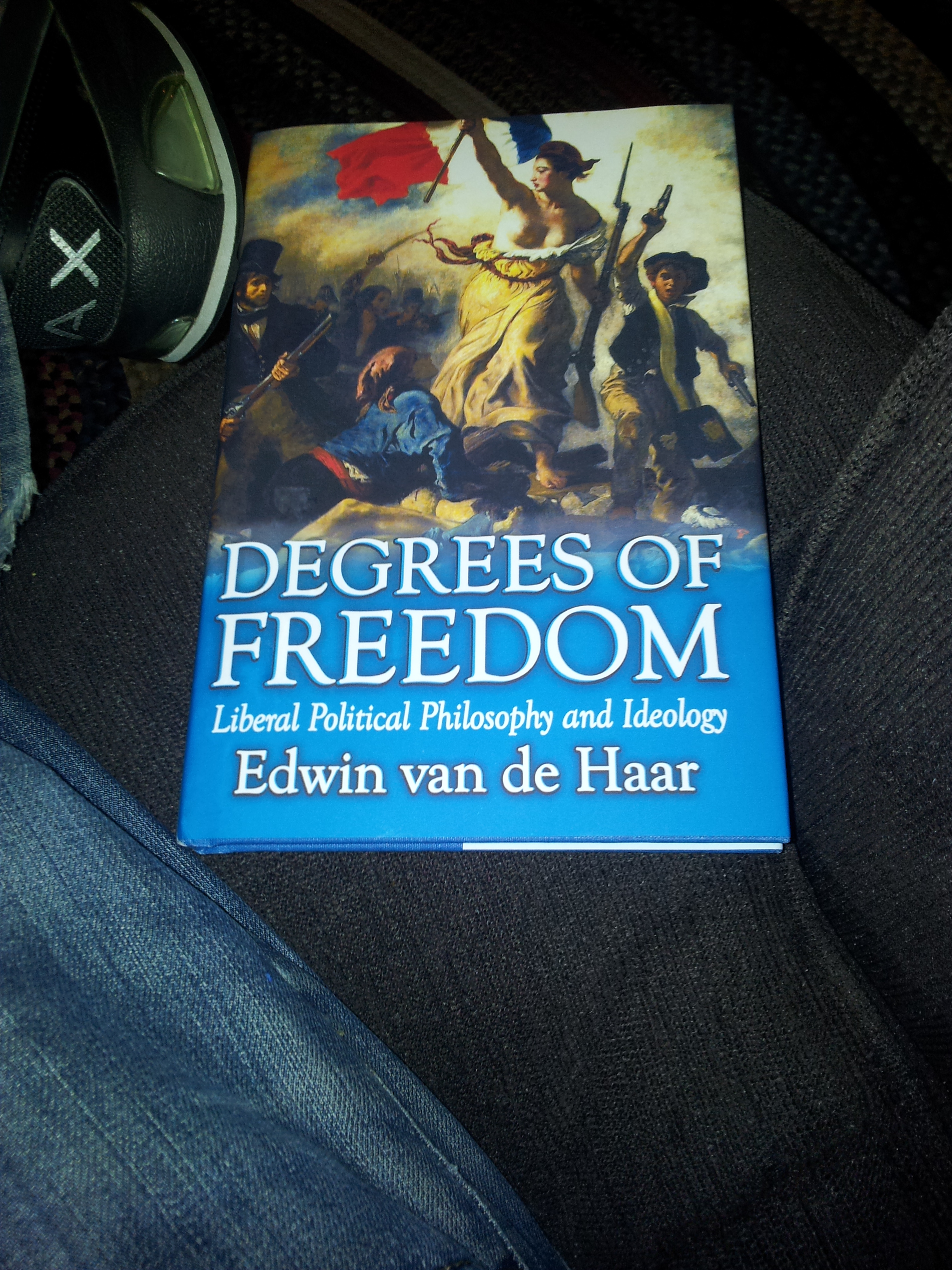
Look at what just arrived in my hands

Van de Haar's "Degrees of Freedom: Liberal Political Philosophy and Ideology"
Van de Haar’s “Degrees of Freedom: Liberal Political Philosophy and Ideology”

It’s Dr van de Haar’s newest book, straight from the Netherlands. You can pick up your own copy here (mine was a gift from Dr V, one of the many perks of being an annoying blog editor!). He’s got more books that you can find either on his ‘About…’ page here at NOL or on the sidebar. Thanks Dr van de Haar!

I know Dr Khawaja (of Policy of Truth infamy) was thinking of getting this book reviewed for Reason Papers, too. I don’t have the training in political philosophy to do the job, but I can say, just by reading through the first couple of pages in his introduction, that I could have benefited immensely from this book if I had been introduced to it in Political Science 101.

Aside from the introduction, I also briefly read through Edwin’s section near the back of the book (pgs. 120-126) titled ‘The Neoliberal Phantom’, and believe that it would be very useful for liberals of all stripes when confronted with poorly constructed anti-liberal arguments (the geographer – NOT anthropologist – David Harvey, for example, gets the full Dutch treatment from Dr van de Haar). It should be noted that this section is probably (again, I don’t have any training in this area) a little less useful for academics confronting more sophisticated attacks against liberalism, but it’s a very good primer for intense undergraduates and graduate students who have to deal with the relentless, poorly reasoned attacks on liberalism in their studies and at seminars.

When I read the whole thing I’ll be sure to post a review here at the blog. If I get word of somebody who wants to review Dr van de Haar’s book for Reason Papers (check out what’s on tap right now, by the way), I’ll try to post the good news here, too.

How about war, Professor Wall?

The Cambridge Companion to Liberalism

There is a lot of truth, insight and wisdom in this Cambridge Companion to Liberalism. But how on earth is it possible that there is no substantial mentioning, let alone analysis, of the political philosophy of liberalism and international relations? At least a weird omission by the editor, Professor Steven Wall, I must say….

Some Quick Facts About Nepal

Dr J suggested I post some thoughts on the recent, devastating earthquake in Nepal, but I don’t know if I have much to add. Over at Policy of Truth, one of Dr Khawaja’s friends was in Nepal when the quake happened and there are some photos that his friend was able to take. And a development economist has some good advice on giving to Nepal.

Instead, I’ll just break down some interesting tidbits about the country. I can’t do any better than Wikipedia (minus most of the links):

Nepal […] is a landlocked country located in South Asia. With an area of 147,181 square kilometres (56,827 sq mi) and a population of approximately 27 million, Nepal is the world’s 93rd largest country by land mass and the 41st most populous country. It is located in the Himalayas and bordered to the north by the People’s Republic of China, and to the south, east, and west by the Republic of India. Nepal is separated from Bangladesh by the narrow Indian Siliguri Corridor and from Bhutan by the Indian state of Sikkim. Kathmandu is the nation’s capital and largest metropolis.

The mountainous north of Nepal has eight of the world’s ten tallest mountains, including the highest point on Earth, Mount Everest, called Sagarmāthā (सगरमाथा) in the Nepali language. More than 240 peaks over 20,000 ft (6,096 m) above sea level are located in Nepal. The southern Terai region is fertile and humid.

Hinduism is practiced by about 81.3% of Nepalis, the highest percentage of any country. Buddhism is linked historically with Nepal and is practiced by 9% of its people, followed by Islam at 4.4%, Kiratism 3.1%, Christianity 1.4%, and animism 0.4%. A large portion of the population, especially in the hill region, may identify themselves as both Hindu and Buddhist, which can be attributed to the syncretic nature of both faiths in Nepal.

A monarchy throughout most of its history, Nepal was ruled by the Shah dynasty of kings from 1768—when Prithvi Narayan Shah unified its many small kingdoms —until 2008. A decade-long Civil War involving the Communist Party of Nepal (Maoist), followed by weeks of mass protests by all major political parties, led to the 12-point agreement of 22 November 2005. The ensuing elections for the 1st Nepalese Constituent Assembly on 28 May 2008 overwhelmingly favored the abolition of the monarchy and the establishment of a federal multiparty representative democratic republic. Despite continuing political challenges, this framework remains in place, with the 2nd Nepalese Constituent Assembly elected in 2013 in an effort to create a new constitution.

Nepal is a developing country with a low income economy, ranking 145th of 187 countries on the Human Development Index (HDI) in 2014. It continues to struggle with high levels of hunger and poverty. Despite these challenges, the country has been making steady progress, with the government making a commitment to graduate the nation from least developed country status by 2022.

Nepal’s GDP (PPP) per capita stands at about Intl$ 2,300 according to the World Bank, which is lower than Bangladesh and on par with Senegal (in west Africa), and Tanzania and South Sudan (both in east Africa). GDP (PPP) per capita is, of course, my favorite unit of measurement for comparing the health and wealth of societies.

I couldn’t find much information on ethnic groups, but the number of religions practiced, plus the number of languages spoken by significant portions of the population and coupled with the decade-long civil war between Maoists and monarchists, is enough to suggest – to me – that the country has no tradition of liberalism whatsoever, and will thus likely remain in poverty for a long, long time – despite the fact that a federal state has recently been implemented from the bottom up.

Ideas matter, though at the same time, the question of federalism versus liberalism seems a lot like the question about the chicken or the egg. If a Maoist insurgency and a reactionary monarchy can give way to a liberal federation in the middle of the Indian-Chinese border I’ll disavow learning altogether and take up the cloth in liberalism’s name!

I am hoping Dr Ranjan – a South Asian specialist – can jump in and provide us with some insight as well, but spring is a busy time for scholars.