- Canada’s Jews: Maple Leaves and Mezuzahs Bruce Clark, Erasmus
- We’re still no closer to the end of Pi Oliver Roeder, FiveThirtyEight
- Why is Trump turning his back on Iran’s Christians? Doug Bandow, the Skeptics
- What’s divine about divine law? Jacob P. Ellens, Law and Liberty
Iran
India’s near-abroad: Iran’s regional moves
Close attention was paid by sections of India’s strategic community (and understandably so) to the statement of Iranian Minister of Foreign Affairs, Dr Javad Zarif, during his visit to Pakistan, in which he extended an invitation to Pakistan to join the ambitious Chabahar Project (about 70 kilometres from China’s ambitious Gwadar Project).
Zarif, while delivering a lecture at the Institute of Strategic Studies Islamabad (ISSI), stated:
We offered to participate in the China-Pakistan Economic Corridor (CPEC). We have also offered Pakistan and China to participate in Chahbahar
He further went on to state that Iran’s ties with India were not in any way targeted at Pakistan, just as Islamabad’s ties with Riyadh were not against Iran.
Surprise in India
This invitation surprised many in India, given the fact that it has provided financial assistance for Phase 1 of the project and will operate two berths. During Iranian President Hassan Rouhani’s visit in February 2018, one of the tangible outcomes was the lease contract signed by IPGL (Indian Port Global Limited) and Iran’s Port and Maritime Organization, for operating Phase 1 (Shahid Beheshti Port) over an 18-month period. The joint statement also made a clear reference to India’s unwavering commitment to the Chabahar-Zahedan Rail Line, which will enable transportation of goods all the way up to the Afghan border. The Indian side also stated that it would like to see Chabahar as part of the INSTC (International North South Transport Corridor). The INSTC will help in connecting India to Russia and Europe, via Iran.
Chabahar as India’s answer to Gwadar
Many in India have looked at Chabahar as India’s answer to the Gwadar Project, and of course its gateway to Afghanistan and Central Asia. The project is especially important to New Delhi because it enables India to bypass Pakistan, which has flatly refused to give India access to Afghanistan and Central Asia. In 2016, during Indian Prime Minister Narenda Modi’s visit to Iran, India, Iran, and Afghanistan had signed a three nation transport and transit corridor pact to enhance connecitivity. While leaders of all three countries spoke about the relevance of this agreement in the context of connectivity, the Iranian President had made it clear that it was not targeted at anyone. Said Rouhani:
[This pact is] not against any other country […] it is beneficial to the entire region.
India also sent a consignment of wheat (15,000 tonnes) to Afghanistan through the Chabahar Port in 2017. The shipment was dispatched from Kandla (Gujarat, India) and reached Chabahar in Iran. From Chabahar it was transported by road to Nimroz Province in Afghanistan.
India’s response
Replying to Zarif’s statements in a press briefing, India’s Spokesman Raveesh Kumar stated that:
[It is the] prerogative of the government of the Islamic Republic of Iran to choose its partners for the development of infrastructure facilities there.
Kumar also explained the strategic relevance of the project given its geo-political importance.
India-Iran ties beyond the Chabahar Port
Ever since the signing of the nuclear agreement in 2015 between Iran and the P5+1 countries, business linkages – and not just the Chabahar Project – between Iran and India have gotten a fillip. In 2017, India’s oil imports from Iran went up to 4.37 million barrel per day, even though there was a dip between April-December 2017 due to tensions between both countries on the Farzand B gas field. (Iran was supposed to award the gas field to India, but there have been differences on terms and conditions.) During Rouhani’s visit, both countries decided to address the obstacles related to banking and taxation, in order to bring about closer economic linkages.
Iran has thus emerged as an important strategic and trade partner for India.
What may have surprised sections of Indian government, along with its strategic thinkers, would be the Iranian invitation given to Pakistan, in spite of bilateral tensions between the two. In May 2017, for example, the Iranian Army Chief, Major General Mohammad Bagheri, had threatened to strike terror camps in Baluchistan (Pakistan) after the killing of ten Iranian guards by Jaish-Al-Adl in the Sistan-Baluchestan province. Said Baqeri:
[…] unless Pakistan control[s] the borders, arrest[s] the terrorist[s] and shut[s] down their bases […] we will hit their safe havens and cells wherever they are.
Since then tensions between the United States and Iran have also risen, and the latter has a close relationship with China. This has reshaped the Pakistan-Iran dynamic.
New Delhi’s real challenge
The real challenge for India in the near future is the hawkish stand of US President Donald Trump’s most recent appointee: Michael Pompeo (who was earlier head of the CIA, a main American intelligence agency). Trump is also likely to replace his current National Security Advisor, HR Mcmaster, and one possible replacement is John Bolton (former US Ambassador to the United Nations), a known hawk on Iran.
Pompeo would go along with Trump, and have no qualms in scrapping the Iran Nuclear Deal in May 2018, the next date when the issue comes up for consideration.
Pompeo’s predecessor, Rex Tillerson, had differed with Trump on this issue on more than one occasion. During the election campaign, Trump had criticized the Nuclear Agreement. He had dubbed the agreement a ‘disaster’ and ‘the worst deal ever negotiated’. In an address to a Pro-Israel Lobby group, AIPAC, the US President had gone to the extent of stating that dismantling the deal would be his first priority.
Tillerson, no dove on Iran by any stretch of imagination, had categorically stated that dismantling the deal was not in US interests, though the US President disagreed. Commenting on their disagreements about Iran, Trump had stated:
When you look at the Iran deal, I think it’s terrible […] it was okay. I wanted to either break it or do something, and he felt a little bit differently. So we were not really thinking the same.
Tillerson was closely working with European countries to rework the deal, and address some of the Trump administration’s concerns.
The Chair of the Senate Foreign Relations Committee, Bob Corker, has also predicted that Trump will walk out of the Deal: “The Iran deal will be another issue that’s coming up in May, and right now it doesn’t feel like it’s going to be extended.”
More aggressive Saudi Arabia
Saudi Arabia is likely to become more aggressive after the exit of Tillerson. In fact, on the eve of Saudi Crown Prince Mohammed Bin Salman’s arrival in the US, the Saudi Foreign Minister, Adel al-Jubeir, criticized the Iran Nuclear deal. Said the Saudi Foreign Minister:
Our view of the nuclear deal is that it’s a flawed agreement.
During the Saudi Prince’s visit, Trump too did not miss out on an opportunity to lambast the Iran nuclear agreement. While commenting on the future of the deal, the US President stated:
The Iran deal is coming up soon and you will see what will happen […] Iran hasn’t been treating that part of the world, or the world appropriately.
According to the Arab News it was also decided that the United Arab Emirates, Saudi Arabia, and the US would set up a trilateral security forum which would look not just at issues pertaining to Middle East and Iran, but also South Asia.
Conclusion
India would be advised to be cautious, and while some sections the Right have been ecstatic with Trump’s stance vis-à-vis Pakistan (not to mention China), New Delhi needs to be prepared for some turbulence as a consequence of the recent changes within the Trump Administration. New Delhi needs to articulate its strategic and economic interests in Iran, not just to the US, but also to Saudi Arabia. In the past, the US has not objected to Iran’s close ties with India, but it remains to be seen whether or not Trump and his team will exhibit flexibility and pragmatism vis-à-vis Iran.
New Delhi has a myriad of foreign policy challenges, and Trump’s rigidity towards Iran is likely to be a major one in the near future.
Nightcap
- Unconventional Trump successful in Korea Jung Woo Lee, New Statesman
- Iran’s mullahs are out of answers Ali Safavi, RealClearWorld
- Cultural costs of high housing prices in England Chris Dillow, Stumbling and Mumbling
- The new challenge to ObamaCare Randy Barnett, Volokh Conspiracy
3 key problems with Trump’s style of functioning
The removal of Rex Tillerson as Secretary of State (who was replaced by Mike Pompeo, Director of the CIA) reiterates three key problems in US President Donald Trump’s style of functioning: First, his inability to get along with members of his team; second, impulsive decisions driven excessively by ‘optics’ and personal chemistry between leaders; and, finally, his inability to work in a system even where it is necessary.
Tillerson, who had differences with Trump on issues ranging from the Iran Nuclear Deal (which Trump has been wanting to scrap, though his stance was moderated by Tillerson) to the handling of North Korea, is not the first member (earlier senior individuals to be sacked are, amongst others, Michael Flynn, who was National Security Adviser, and Chief Strategist Steve Bannon) to exit hurriedly. Gary Cohn, Director of the National Economic Council, quit recently after opposing the US President’s tariffs on imports of steel and aluminium.
The US President tweeted this decision:
Mike Pompeo, Director of the CIA, will become our new Secretary of State. He will do a fantastic job! Thank you to Rex Tillerson for his service! Gina Haspel will become the new Director of the CIA, and the first woman so chosen. Congratulations to all!
The US President admitted that Tillerson’s style of functioning was very different from his own (alluding to the latter’s more nuanced approach on complex issues).
Interestingly, the US President did not even consult any of his staff members, including Tillerson, before agreeing to engage with North Korean Dictator Kim Jong Un. The South Korean National Security Advisor, Chung Eui Yong, had met with Trump and put forward the North Korean dictator’s proposal of a Summit.
The US President agreed to this proposal. Commenting on his decision to engage with Kim Jong Un, Trump tweeted:
Kim Jong Un talked about denuclearization with the South Korean Representatives, not just a freeze. Also, no missile testing by North Korea during this period of time. Great progress being made but sanctions will remain until an agreement is reached. Meeting being planned!
While Chung stated that the Summit would take place before May 2018, White House has not provided any specific dates.
There is absolutely no doubt that, at times, bold steps need to be taken to resolve complex issues like North Korea. Trump’s impulsive nature, however – refusing to go into the depth of things or seeking expert opinion – does not make for good diplomacy.
In fact, a number of politicians and journalist have expressed their skepticism with regard to where North Korean negotiations may ultimately lead. Ed Markey a Democratic Senator from Massachusetts, stated that Trump “must abandon his penchant for unscripted remarks and bombastic rhetoric to avoid derailing this significant opportunity for progress.”
In a column for the Washington Post, Jeffrey Lewis makes the point that there is a danger of Trump getting carried away by the attention he receives. Says Lewis in his column:
Some conservatives are worried that Trump will recognize North Korea as a nuclear-weapons state. They believe that an authoritarian North Korea will beguile Trump just as it did his erstwhile apprentice, American basketball player Dennis Rodman. They fear that Trump will be so overjoyed by the site of tens of thousands of North Koreans in a stadium holding placards that make up a picture of his face that he will, on the spot, simply recognize North Korea as a nuclear power with every right to its half of the Korean peninsula.
All Trump’s interlocutors have realized that while he is unpredictable, one thing which is consistent is the fact that he is prone to flattery. During his China visit, for instance, Trump was so taken aback by the welcome he received and the MOU’s signed with Chinese companies that he started criticizing his predecessors.
Finally, while Trump, like many global leaders, has risen as a consequence of being an outsider to the establishment, with people being disillusioned with the embedded establishment, the US President has still not realized that one of Washington’s biggest assets has been strategic alliances like NATO and multilateral trade agreements like NAFTA. The United States has also gained from globalization and strategic partnerships; it has not been one way traffic.
It remains to be seen how Tillerson’s removal will affect relations with key US allies. If Trump actually goes ahead with scrapping the Iran nuclear deal (2015), it will send a negative message not just to other members of the P5 grouping, but also India. In the last three years, India has sought to strengthen economic ties with Iran and has invested in the Chabahar Port Project. New Delhi is looking at Iran as a gateway to Afghanistan and Central Asia. If Tillerson’s successor just plays ball, and does not temper the US President’s style of conducting foreign policy, there is likely to be no stability and consistency and even allies would be skeptical.
Japan on its part would want its concerns regarding the abduction of Japanese citizens by Pyongyang’s agents, decades ago, to not get sidelined in negotiations with North Korea. (13 Japanese individuals were abducted in 2002, 5 have returned but the fate of the others remains unknown.) Prime Minister Shinzo Abe has made the return of the abductees a cornerstone of his foreign policy, and his low approval ratings due to a domestic scandal could use the boost that is usually associated with the plight of those abductees.
The removal of Tillerson underscores problems with Trump’s style of functioning as discussed earlier. The outside world has gotten used to the US President’s style of functioning and will closely be watching what Tillerson’s successor brings to the table.
Nightcap
- Xi Jinping Looking More and More Like Mao Doug Bandow, National Interest
- Fear, Loathing, and Zulm in Iran Mehrad Vaezinejad, History Today
- India, Pakistan, and Balochistan: A History of Trouble Ahsan Butt, the Diplomat
- A History of Craft Beer in America Derek Thompson, the Atlantic
*The Islamic Enlightenment* | A critical review
De Bellaigue, Christopher. (2017) The Islamic Enlightenment: The Struggle Between Faith and Reason 1798 to Modern Times. Liveright Publishing Corporation (Norton & Company) New York, London.
In 1798, in view of the Pyramids, a French expeditionary force defeated the strange caste of slave-soldiers, the Mamlukes, who had been ruling Egypt for several centuries. The Mamlukes charged the French infantry squares on horseback, ending their charge with the throwing of javelins. The Mamlukes were thus eliminated from history. The French lost 29 soldiers. In the conventional narrative, the battle woke up the whole Muslim world from its long and haughty slumber. The defeat, the pro-active reforms of Napoleon’s short-lived occupancy, and the direct influence of the French scholars he had brought with him lit the wick of the candle of reform or, possibly, of enlightenment throughout the Islamic world.
De Bellaigue picks up this conventional narrative and follows it to the beginning of the 20th century with a dazzling richness of details. This is an imperfect yet welcome thick book on a subject seldom well covered.
This book has, first, the merit of existing. Many people of culture, well-read people with an interest in Islam – Islam the sociological phenomenon, rather than the religion – know little of the travails of its attempted modernization. Moreover, under current conditions of political correctness the very subject smells a little of sulfur: What if we looked at Muslim societies more closely and we found in them some sort of intrinsic inferiority? I mean by this, an inferiority that could not easily be blamed on the interference of Western, Christian or formerly Christian, capitalist societies. Of course, such a finding could only be subjective but still, many would not like it, and not only Muslims.
Second, and mostly unintentionally, possibly inadvertently, the book casts a light, an indirect light to be sure, on Islamist (fundamentalist) terrorism. It’s simple: Enlightened individuals of any religious background are not likely to be also fanatics willing to massacre perfect strangers. Incidentally, I examine this issue myself in a fairly parochial vein, in an essay in the libertarian publication Liberty Unbound: “Religious Bric-à-Brac and Tolerance of Violent Jihad” (January 2015). With his broader perspective, with his depth of knowledge, De Bellaigue could have done a much better job of this than I could ever do. Unfortunately he ignored the subject almost entirely. It wasn’t his topic, some will say. It was not his period of history. Maybe.
BC’s weekend reads
- “‘It’s true you have better hair than I do,’ Trump said matter-of-factly. ‘But I get more pussy than you do.’ Click.“
- “French elites have convinced themselves that their social supremacy rests not on their economic might but on their common decency.”
- “Chelsea Clinton seems to have a more crippling want: fashionability—of the sort embraced by philanthropic high society.”
- Iran’s Guardian Council announces presidential candidate list
Liberty or “Security”: An Old Debate, A Familiar Straw Man
Ho hum. Jacques wants his government to do three things in the name of fighting Muslim terrorism (not to be confused with other, more numerous kinds of terrorism): 1) allow for an armed, perpetually-on-alert military to be active on US soil, 2) allow for a surveillance state that can do as it pleases in regards to Muslims only, and 3) initiate ideological quotas for Muslim immigrants.
The entire ‘comments’ thread is well worth reading, too. Dr Amburgey, who came from the same doctoral program as Jacques, brings the quantitative fire; Dr Khawaja, the qualitative. Jacques has responded to each of them.
The absurdity of Delacroix’ argument speaks for itself. I will come back to it shortly, but first I want to address a couple of his points that are simply made in bad faith. Observe:
(Yes, Mohammed did behead every man of a vanquished enemy tribe on the battlefield. Incidentally, they were Jews. The Prophet then “married ” their wives, he raped them, in others words. Bad example? Talk about this genuine part of Muslim tradition?)
Murdering and raping Jews is a “Muslim tradition”? I am sure this is news to Uighurs in China and the Javanese of Indonesia. I think there is a good case to be made for a present-day Arab cultural chauvinism that rests in part on what could be called “Muslim tradition,” but this is not a nuance that Jacques – the retired college professor – cares to address. I wonder why. If we’re going to go back to the 7th century to find cultural defects, can anybody think of something nasty that was going on in what is now France at the time? In what is now the US? What an odd historical anecdote to include in an argument.
Here, too, is another whopper:
One article of faith among literalist Muslims is that government must come from God. That’s why the Supreme Leader of the Shiite Islamic Republic is explicitly a cleric, couldn’t be an elected civilian or a general. This belief also explains the search for a Caliphate among Sunni jihadists, a polity where administrative and religious powers are one and the same.
What is a “literalist Muslim”? Nevermind. The government of Iran, its structure, is based on Plato’s Republic, not the Qur’an. The “Supreme Leader” Jacques identifies is based on the notion of a philosopher-king, not a Shiite cleric. This was done to protect the new dictatorship from its many enemies, including those loyal to the old dictatorship (the one supported by the United States; the one that Washington installed after helping to remove a democratically-elected Leftist government during the Cold War). The rhetoric of the Iranian dictatorship is explicitly religious, but in reality it’s just plain, old-fashioned despotism.
In a similar vein, “Sunni jihadists” (to use Jacques’ term) do not search for a Caliphate because of a belief that government should come from God, but instead look to a mythical Caliphate that they believe existed from the 7th to early 20th centuries as inspiration for creating a society that cannot be pushed around by murderous Western governments. Pretending that Arab Sunnis want to create a Caliphate in order to strengthen the link between government and God can only be described as “dishonest” when it comes from the mouth of a sociologist with a doctorate from Stanford.
At best, it could be argued that Jacques is simply making these types of points because they are pervasive throughout American society, and thus we – as libertarians of all stripes – have our work cut out for us. Now that I think about it, Jacques’ argument is so silly that it has to be an exercise in critical thinking. Nobody of his stature could say something so stupid, right?
Those are just two examples of, uh, the misrepresentation of reality by Jacques. There are many more, and I don’t think he got those myths from an academic journal. He got them from Fox News. That’s not good. That means libertarians are not taking advantage of their right to free speech, like conservatives and Leftists do. Why aren’t you blogging more often?
I’d like to turn back to his policy proposals. Here they are again:
- an armed, perpetually-on-alert military on US soil,
- a surveillance state that can do as it pleases in regards to Muslims only, and
- ideological quotas for Muslim immigrants.
The first two proposals look like they were copied directly from the playbook of the Third Reich (I hope you’ll reprimand me in the ‘comments’ section if you think I am being overly dramatic, or strawmanning Jacques’ argument). Just replace “US” with “Germany” and “Muslims” with “Jews” and voila, you have an answer for your Muslim (“Jewish”) problem. (RE Policy #3: National socialists, of course, don’t like anybody immigrating to their territories, whereas Jacques, in his infinite kindness and wisdom, seeks only to allow those who think like him into his territory.)
Again, Jacques’ argument is silly. It is both vulgar and unintelligent. It is misinformed. And yet I have to ask: Who is winning the PR battle here, conservatives on the one side or left-liberals and libertarians on the other?
Everyone carries a part of society on his shoulders; no one is relieved of his share of responsibility by others. And no one can find a safe way out for himself if society is sweeping toward destruction. Therefore, everyone, in his own interests, must thrust himself vigorously into the intellectual battle. None can stand aside with unconcern; the interest of everyone hangs on the result. Whether he chooses or not, every man is drawn into the great historical struggle, the decisive battle into which our epoch has plunged us.
That’s from Ludwig von Mises, the libertarian Austrian (and Jewish) economist who had to flee his homeland as the Third Reich took power. Speak your mind!
The Framework Agreement on Iranian Nuclear Everything: Questions
Today, the day after President Obama announced in the Rose Garden a “framework agreement” intended to limit the Islamic Republic of Iran’s pursuit of nuclear weapons, I read the Wall Street Journal account carefully but it did not help. I don’t understand it. It may just be too early for a good analysis. In the meantime several questions loom large in my mind.
- If I don’t understand the details, do I believe in an agreement with a hostile country described by a man who promised that “you could keep your doctor”?
- Do I believe that this agreement is to the advantage of the United States? The question arises because it was negotiated principally by two men with a track record. The first, Pres. Obama, succeeded in exchanging five terrorist generals for a single American soldiers who is a deserter according to those who were on the battlefield with him. The second, the current Secretary of State, demonstrated that you could leave the Palestinian/Israeli relationship in an even worse state than you found it.
- The President and the Secretary of State did not manage, as a part of this supposedly momentous agreement, to get three Americans held by Iran released. One of them is a former Marine. It should have been a tiny footnote to the main text. Ah, well, there is no text, just an oral argument! Frankly, in the bigger picture the freeing of three people is a small, symbolic thing. Symbols matter a lot though when you don’t have access to the hard facts. I don’t, you don’t.
- Is the mullahs’ government – that always cheated in the past – going to abstain from lying, this time? If it does not, is this agreement going to be the cause of the death of thousands of innocent Iranians (as collateral damage)? I ask because, the next administration may not have the current administration’s difficult-to-believe indulgence. It may just decide to take care once for all of a sore festering for twenty years. If an American administration does no such thing, what is the likelihood that a future (future) government of Israel will take the chance to see millions of Jews murdered? This is not gratuitous fear mongering. Two days before the announcement, an Iranian general was on TV affirming that Israel has no right to exists.
- Do I believe that our European partners will stand firm and renew their sanctions if Iran is caught cheating? The question arises because they were salivating on all their national TV at the prospect of selling, selling anything in Iran once the sanction were lifted.
On the bright side, the lifting of some sanctions will unleash a torrent of Iranian oil on the world market. This will further depress of global oil prices. One more thorn in the foot of the gangster Putin.
What’s up with Oil and the Saudis?
In case you haven’t noticed, the price of oil has dropped dramatically and has not rebounded as yet. As I write, the price of the most common form of crude oil is under $54 per barrel, about half of what it was in mid-2014. What’s going on?
Several factors contributed to the fall. One was increased U.S. production, much of it shale oil. Also, U.S. consumption has not been rising apace with GDP in part because of higher fuel efficiency. Demand in Europe and Japan is muted due to low growth or recession.
Those things did not happen suddenly, however, so the drop would appear to be overdone. Large producers, who have a lot of pricing power, would normally cut production in this circumstance. (Pricing power means a change in their production has a noticeable effect on the world price.) The Saudis have considerable pricing power and their production decisions are controlled by their government. Why have they not cut production? I believe they are engaging in predatory pricing.
Predatory pricing is illegal in the U.S. and elsewhere, under anti-trust law. Predatory pricing occurs when a supplier cuts his prices for the purpose of bankrupting a competitor, or at least driving the competitor out of the market. The predator is willing to suffer losses or reduced profits temporarily, while holding the prices low. Once the competitor is gone, the predator’s pricing power will have increased enough that he can raise prices a lot and make up for losses suffered during the period of predation. Predatory pricing is definitely possible in free markets but is very risky for several reasons: (1) the predator can’t be sure how long it will take to ruin his competitor, (2) he can’t be sure how long he can maintain low prices without sustaining ruinous losses or perhaps face a shareholder rebellion, (3) it’s possible the competitor, or someone who has bought his assets in bankruptcy, will come back to life and start competing as before. For these reasons (and others, such as the difficulty facing regulators who are supposed to distinguish predatory motives from “innocent” business strategy), I believe there is no reason to outlaw predatory pricing.
The situation is a little different in the international oil market because the Saudis and many other major players are government controlled. They are not constrained (much) by the market forces outlined above. They are not accountable to shareholders and are only vaguely responsible to the population of Saudi Arabia. They have substantial latitude to pursue political motives even if their profits suffer. And anti-trust law does not operate across national borders.
What might the Saudis want to accomplish politically? They hate Russia and Iran, both of which rely heavily on oil exports. They don’t hate the U.S., at least not openly, but they surely wouldn’t mind sticking it to U.S. and Canadian shale oil producers. Those producers are largely market-driven and thus have limited ability to withstand predatory pricing. The Saudis could indeed drive smaller firms out of the market, and also less profitable operations of larger firms.
That might not be such a bad thing. There has been a huge land rush into shale oil and fracking. In any such boom, whether in energy, mining, or computers, many small firms fall by the wayside. If the Saudis ruin some marginal firms or projects, that’s not such a bad thing.
We little guys are sitting pretty. We’re paying a lot less for gasoline. If we hold shares of the major oil firms we’re probably OK, as their share prices have held up and their dividends look solid. The same is true of the pipeline operators. Only if we hold shares of marginal energy firms or oilfield service companies are we in any trouble.
So – go for it, Saudis! Stick it to the evil governments of Russia and Iran and help us clean out some of our marginal energy operations.
Deviant Tendency: An inside look at the politics of Iran
[Editor’s note: the following is a short essay by Payam Ghorbanian. Payam was born in Tehran, Iran. He got his bachelor of science in Engineering from Zanjan University in Zanjan, Iran. He has been participating in liberal political activities and he was involved with some think tanks in Iran. He is doing research in the field of international relations and Iran’s foreign policy as an independent activist. He is now living in San Jose, California.
I am excited to post his thoughts because of their potential as a conduit for intercultural dialogue and exchange. I have left his essay largely intact, but did break up some of his longer paragraphs for clarity’s sake. Thanks to Payam for taking the time to write this, and you can find his other essay at Notes On Liberty here, here, and here]
Last month was kind of exciting for me. Mahmoud Ahmadinejad’s brother said “… my brother has gotten rid of his deviant friends…”. The term “Deviant Tendency” has been using in Iran for calling Mr. Esfandiar Rahim Mashaei and his followers. Mr. Mashaei had been represented by Ahmadinejad for being the next president of Iran but the Guardian Council of the Constitution turned that willing down. Therefore Ahmadinejad left his office while he was so disappointed and at that time he said that the council has just deprived Iran of having a distinguished president. Although with “Approbation Supervision”, which implies the right for acceptance or rejection of elections legality and candidate’s competency, probably just the supreme leader and his followers can be qualified through the barrier of the Guardian Council.
I do not really care about this rumor whether or not Ahmadinejad and Mashaei are separated, the issue would be what Mr Mashaei’s political and social views are and what it is wrong with that. Also why the supreme leader and his followers do not like him? Why they tried to make him isolated even though he has no official title? As you might know during the second term of Ahmadinejad’s presidency, Mashaei was the chief of staff of the president of Iran. But why are they still scared of him? I should mention this that from my point of view, I am 100 percent sure that they (Ahmadinejad and Mashaei) just made this ending relations story up to have this chance for getting qualified for the next presidency election. But why are the supreme leader’s followers so excited of hearing that rumor? Apparently they still like Ahmadinejad but just him and as they said there would not be another chance for the combination of Ahmadinejad plus Mashaei to survive.
Now pay attention to these quotes:
“The area of Islamism has come to end, we had an Islamic revolution in 1979 but the area of Islamism is finished”
or
“Today, Iran is friend with American and Israeli people, No nation in the world is our enemy.”
These sentences and quotes have been told by the nearest person to Mahmoud Ahmadinejad, who is Mr. Rahim Mashaei. Obviously one could talk about these ideas in the free world and no one is going to be prosecuted because of that. However, talking about ending of Islamism inside a revolutionary country like Iran would be insane. I believe these types of moderation comments about Islam and also talking about people of Israel and United States not to be enemy of the Iranian people were all about politics, and Mr. Mashaei did not believe in what he said. But what were his points at that time?
It was the time that Green Movement and protestors confronted against rigged election. I would say Mashaei did all these things to reduce pressures over Ahmadinejad and in order to deceiving and poisoning the people’s mind, those people of the middle class who desperately believe in the new relations between Iran and the free world. Also I believe Mashaei did all these things to be a target instead of AhmadiNejad, which is literally about what old friends do for each other.
In Iran and especially in Shia beliefs of Islam, an ultimate savior of humankind and the final Imam of the twelve Imams will emerge with Jesus Christ and will set the kingdom of heaven on the earth to bring peace and justice to the world. It is the belief that the twelfth Imam disappeared hundreds of years ago and went into occultation state, but he will definitely re-appear around the end of the world, before the Day of Judgment. Before the Islamic revolution in Iran and probably before uprising of Ayatollah Khomein, there was a common trend that Shia would wait up until its survivor comes back. However, Khomeini argued that government should be run with traditional Islamic rules and for this to happen a leading Islamic jurist must provide “Guardianship” and as he said “Wilayat” over the people. This guardianship would be remained till the Twelfth Imam returns.
At that time this theory was accepted by the revolutionists and as the result of that, the last king of Iran felt down and “Wilayat AL Faqih” (guardianship of the Islamic Jurists) popped up. The terms of your majesty were destroyed and the Imam and the Wilayat was established and then the supreme leader was considered as the twelfth Imam’s deputy, which means that his orders are the lord’s orders and any questions or criticizes would be called as hostility against the twelfth Imam. This chart will help you out to understand more clearly about the hierarchy of Imams in Shia.
When I was living in Iran I always heard some rumors about the distinguished people who they or their followers believe that they are in connection with the twelfth Imam. They claim they can talk to him in person and get orders from him without any problem. Probably in the past they could take advantage of people’s stupidities. However, they had never been accepted by the politicians inside Iran before Ahmadinejad’s presidency started. Now you can tell why they have been called as Deviant Tendency. Mashaei claimed that he could talk to the twelfth Imam in person and he believed that when we can have access to the real source, why we should follow his deputy, who does not have any confirmation from the real lord.
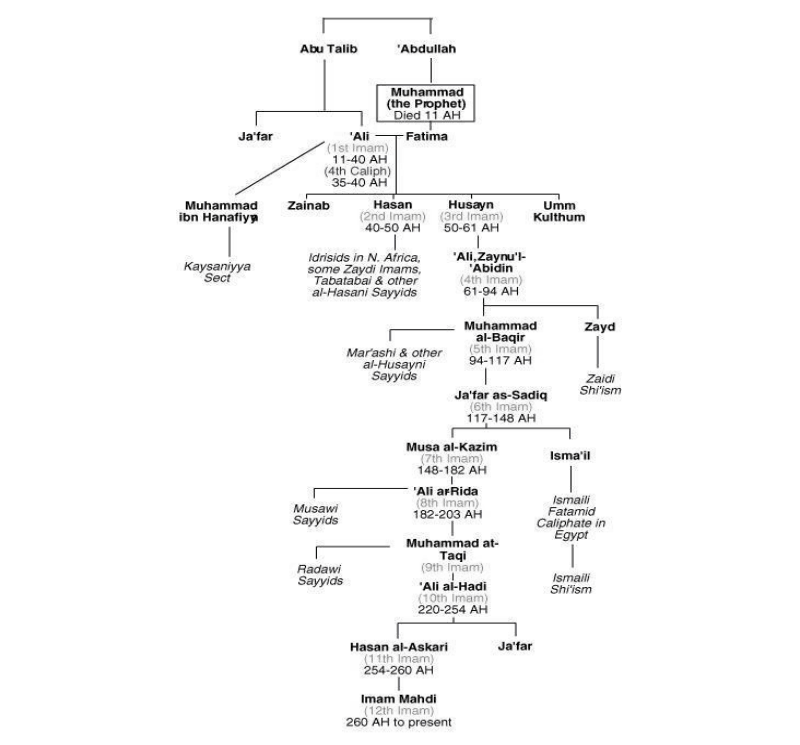
Before Mashaei tried to extend his theory, the revolutionary guard crippled all of his ambitions subsequently. His followers were arrested and he was about to get caught too but it seemed that Ahmadinejad was completely in agreement with what he was saying. Ahmadinejad tried to protect Mashaei but as you know he lost the protection of the supreme leader. As a result, his authority dropped considerably. He got teased and he lost his connections and finally he got kicked out of the power circle and all of these were about his friendship with Mashaei, which he truly believed in him.
And now the new game has just started. First it was announced by Ahmadinejad’s brother that there would not be any connection between his brother and the deviant tendency. Then Ahmadinejad had a speech in Mashahd, one of the most religious cities in Iran where the 8th Imam of Shia has been buried, and he said:
“… the only way to overcome the enemies of the nation is standing on the value of our goals in the same way that Khomeini has showed us. I would totally remain on that way to serve the nation and revolution and its values and principles.”
He also tried to imply on revolution principles, the principles that revolutionists believe has been neglected after Rohani became a president.
Iraq: Four Comments
Another debacle with Pres. Obama snoozing at the helm.
Four comments about the debacle in Iraq:
- What the US built there did not pass any test except that the the Kurdish north is still peaceful and prosperous. Why this costly state- building endeavor failed is worth thinking about.
- There is no reason to treat the borders of Iraq as sacred. Iraq, the state, was cobbled together distractedly by the Brits on the ruins of the Turkish empire. Its dismemberment is long overdue even if it’s on sectarian lines.
- The existence of a jihadist, Islamist state in the center of the Mideast is not the worse possible outcome from an American standpoint. After all, in Afghanistan, our armed forces aided by the Brits toppled an Islamist government in 2001 in three months flat. A country, a nation-state makes a good target for conventional forces.
- If the US does not intervene militarily on the side of the more or less legitimate government of Maliki, Iran will (and the US will have again looked like a paper tiger inviting attack).
Around the Web
- Are Iran and Israel trading places?
- Morocco’s mentally ill await deliverance from their demons
- Bangkok’s ‘Mexican’ Gangsters (think about the infinite promise of globalization while you browse through this short, mostly photographic, essay)
- ¿Qué tiene de malo el muro?
- 10 Questions Libertarians Can’t Answer, and Hope You Won’t Ask!
From the Comments: What’s the difference between state-sponsored terrorism and geopolitics?
In a recent thread on the conflict in Crimea, a proposal to use the CIA – the overseas spying agency of the US government – against a small Russian population in the exclave of Kaliningrad was put forth by Professor Amburgey. My response followed as thus:
Suppose that VEVAK – Iran’s intelligence agency – created an industrial accident in regards to Toronto’s water supply. You and I would rightly consider this state-sponsored terrorism, regardless of whether or not Tehran took any sort of official blame.
Now suppose that the CIA created an industrial accident in regards to Kaliningrad’s water supply. I would consider this state-sponsored terrorism. You would consider this ________ (please fill in the blank).
Dr Amburgey responded with a “savvy geopolitcs.” The only thing I noticed here is the double standard in place. Why do we label violence undertaken by certain factions or organizations “terrorism” and the same type of violence undertaken by other factions or organizations as “geopolitics” (or “patriotism” or “war”)?
There is no difference. Categorizing the actions that both you and your enemy undertake as two different things is a good way to ensure that everything remains exactly the same. How utterly conservative!
 Notes On Liberty