The most depressing thing with Chetty et al.

The Chetty et al. paper has been on my mind over the weekend (see Saturday’s post). The one thing that has moved more or less in line with the absolute mobility measure of Chetty et al. has been…the size of government.

I know that as soon as some of you read the last four words on the previous paragraphs, your eyes rolled. However, even from a social-democratic perspective, it is depressing! It is not the first time I make this observation.   In the pages of Essays in Economic and Business HistoryI recently reviewed Unequal Gains (authored by Peter Lindert and Jeffrey Williamson and published at Princeton University Press) and I observed that the “great leveling” they observed from the 1910s to the 1970s had a lot to do with the northward migration of American blacks, the closing of the gender wage gap and the convergence of the southern states. I also observed that the increase in inequality in the United States after 1970 occurred at the same time as an the state grew more in size and scope (see blog post here).

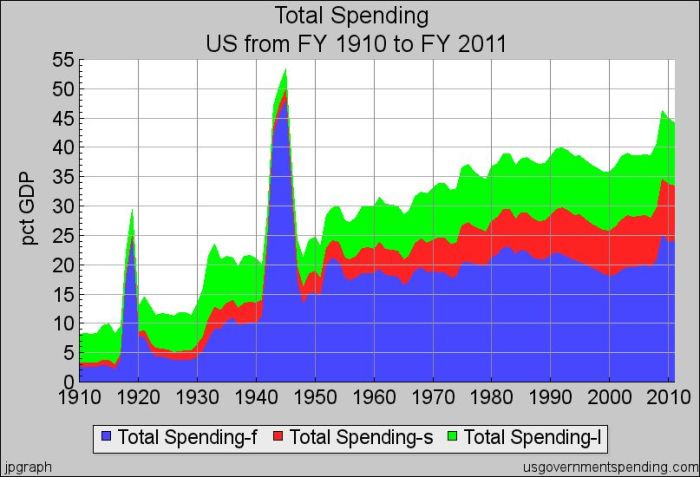
However, as I mentioned elsewhere, I am very skeptical of the tax-based data on inequality in the United States and I am afraid to push that point. However, the Chetty et al. data provides further confirmation: trends in inequality/social mobility deteriorates as the state becomes more active (see the graph below).

sizegov

Now, I am aware that the causality can cut both ways. It may be that inequality (economic mobility) is rising (falling) in spite of increasing state action, it may be that state action is fueling the the rise (reduction) of inequality (economic mobility) or it may be that the state has no effects whatsoever on the evolution. Regardless of which of the three viewpoints you tend to adopt (I lean towards a mixture the second option – see my paper with Steve Horwitz here which is under consideration for publication), the implications are immensely depressing with regards to social policy in the last 75 years.

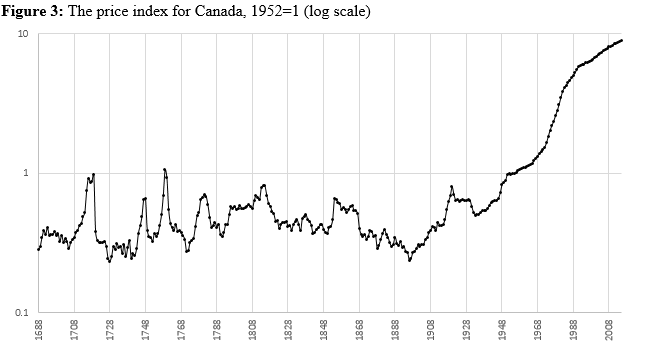
Prices in Canada, 1688 to 2015

I have just finished my working paper creating a price index for Canada that covers the period from 1688 to 1850 in order to link with the existing datasets that cover up to 2015. Here is the result (and the paper is currently consideration for publication). The paper is here and it shows how much prices have changed in Canada since the late 17th century.

pricescanada

Testing the High-Wage Economy (HWE) Hypothesis

Over the last week or so, I have been heavily involved in a twitterminar (yes, I am coining that portemanteau term to designate academic discussions on twitter – proof that some good can come out of social media) between myself, Judy Stephenson , Ben Schneider , Benjamin Guilbert, Mark Koyama, Pseudoerasmus,  Anton Howes (whose main flaw is that he is from King’s College London while I am from the LSE – nothing rational here), Alan Fernihough and  Lyman Stone. The topic? How suitable is the “high-wage economy” (HWE) explanation of the British industrial revolution (BIR).

Twitter debates are hard to follow and there is a need for summaries given the format of twitter. As a result, I am attempting such a summary here which is laced with my own comments regarding my skepticism and possible resolution venues.

An honest account of HWE

First of all, it is necessary to offer a proper enunciation of HWE’s role in explaining the industrial revolution as advanced by its main proponent, Robert Allen.  This is a necessary step because there is a literature attempting to use high-wages as an efficiency wage argument. A good example is Morris Altman’s Economic Growth and the High-Wage Economy  (see here too) Altman summarizes his “key message” as the idea that “improving the material well-being of workers, even prior to immediate increases in productivity can be expected to have positive effects on productivity through its impact on economic efficiency and technological change”. He also made the same argument with my native home province of Quebec relative to Ontario during the late 19th century. This is basically a multiple equilibria story. And its not exactly what Allen advances. Allen’s argument is that wages were high in England relative to energy. This factors price ratio stimulated the development of technologies and industries that spearheaded the BIR. This is basically a context-specific argument and not a “conventional” efficiency wage approach as that of Allen. There are similarities, but they are also considerable differences. Secondly, the HWE hypothesis is basically a meta-argument about the Industrial Revolution. It would be unfair to caricature it as an “overarching” explanation. Rather, the version of HWE advanced by Robert Allen (see his book here) is one where there are many factors at play but there is one – HWE – which had the strongest effects. Moreover, while it does not explain all, it was dependent on other factors that contributed independently.  The most common view is that this is mixed with Joel Mokyr’s supply of inventions story (which is what Nick Crafts has done). In the graph below, the “realistically multi-causal” explanation is how I see HWE. In Allen’s explanation, it holds the place that cause #1 does. According to other economists, HWE holds spot #2 or spot #3 and Mokyr’s explanations holds spot #1.
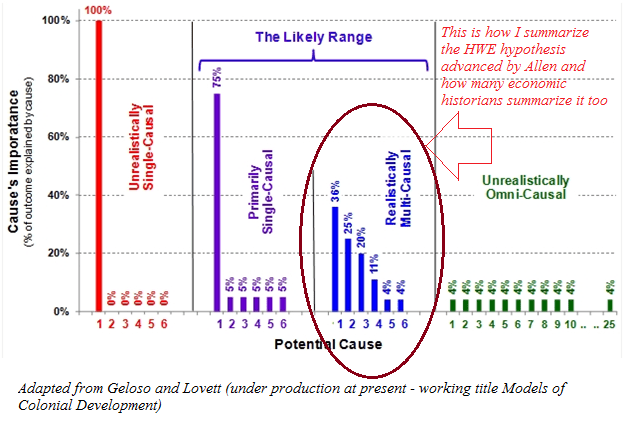
hwe

In pure theoretical terms (as an axiomatic statement), the Allen model is defensible. It is a logically consistent construct. It has some questionnable assumptions, but it has no self-contradictions. Basically, any criticism of HWE must question the validity of the theory based on empirical evidence (see my argument with Graham Brownlow here) regarding the necessary conditions. This is the hallmark of Allen’s work: logical consistency. His work cannot be simply brushed aside – it is well argued and there is supportive evidence. The logical construction of his argument requires a deep discussion and any criticism that will convince must encompass many factors.

Why not France? Or How to Test HWE

As a doubter of Allen’s theory (I am willing to be convinced, hence my categorization as doubter), the best way to phrase my criticism is to ask the mirror of his question. Rather than asking “Why was the Industrial Revolution British”, I ask “Why Wasn’t it French”. This is what Allen does in his work when he asks explicitly “Why not France?” (p.203 of his book). The answer proposed is that English wages were high enough to justify the adoption of labor-saving technologies. In France, they were not. This led to differing rates of technological adoptions, an example of which is the spinning jenny.

This argument hinges on some key conditions :

  1. Wages were higher in England than in France
  2. Unit labor costs were higher in England than in France (productivity-adjusted wages) (a point made by Kelly, Mokyr and Ó Gráda)
  3. Market size factors are not sufficiently important to overshadow the effects of lower wages in France (R&D costs over market size mean a low fixed cost relative to potential market size)
  4. The work year is equal in France as in England
  5. The cost of energy in France relative to labor is higher than in England
  6. Output remained constant while hours fell – a contention at odds with the Industrious Revolution which the same as saying that marginal productivity moves inversely with working hours

If most of these empirical statements hold, then the argument of Allen holds. I am pretty convinced by the evidence advanced by Allen (and E.A. Wrigley also) regarding the low relative of energy in England. Thus, I am pretty convinced that condition #5 holds. Moreover, given the increases in transport productivity within England (here and here), the limited barriers to internal trade (here), I would not be surprised that it was relatively easy to supply energy on the British market prior to 1800 (at least relative to France).

Condition #3 is harder to assess in terms of important. Market size, in a Smithian world, is not only about population (see scale effects literature). Market size is a function of transaction costs between individuals, a large share of which are determined by institutional arrangements. France has a much larger population than England so there could have been scale effects, but France also had more barriers to internal trade that could have limited market size. I will return to this below.

Condition #1,2,4 are basically empirical statements. They are also the main points of tactical assault on Allen’s theory.  I think condition #1 is the easiest to tackle. I am currently writing a piece derived from my dissertation showing that – at least with regards to Strasbourg – wages in France presented in Allen (his 2001 article) are heavily underestimated (by somewhere between 12% and 40% using winter workers in agriculture and as much as 70% using the average for laborers in agriculture). The work of Judy Stephenson, Jane Humphries and Jacob Weisdorf has also thrown the level and trend of British wages into doubts. Bringing French wages upwards and British wages downwards could damage the Allen story. However, this would not be a sufficient theory. Industrialization was generally concentrated geographically. If labor markets in one country are not sufficiently integrated and the industrializing area (lets say the “textile” area of Lancashire or the French Manchester of Mulhouse or the Caën region in Normandy) has uniquely different wages, then Allen’s theory can hold since what matters is the local wage rate relative to energy. Pseudoerasmus has made this point but I can’t find any mention of that very plausible defense in Allen’s work.

Condition #2 is the weakest point and given Robert Fogel’s work on net nutrition in France and England, I have no problem in assuming that French workers were less productive. However, the best evidence would be to extract piece rates in textile-producing regions of France and England. This would eliminate any issue with wages and measuring national productivity differences. Piece rates would perfectly capture productivity and thus the argument could be measured in a very straightforward manner.

Condition #4 is harder to assess and more research would be needed. However, it is the most crucial piece of evidence required to settle the issue once and for all. Pre-industrial labor markets are not exactly like those of modern days. Search costs were high which works in a manner described (with reservations) by Alan Manning in his work on monopsony but with much more frictions. In such a market, workers may be willing to trade in lower wage rates for longer work years. In fact, its like a job security argument. Would you prefer 313 days of work guaranteed at 1 shilling per day or a 10% chance of working 313 days for 1.5 shillings a day (I’ve skewed the hypothetical numbers to make my point)? Now, if there are differences in the structure of labor markets in France and England during the 18th and 19th centuries, there might be differences in the extent of that trade-off in both countries. Different average discount on wages would affect production methods. If French workers were prone to sacrifice more on wages for steady employment, it may render one production method more profitable than in England. Assessing the extent of the discount of annual to daily wages on both markets would identify this issue.

The remaining condition (condition #6) is, in my opinion, dead on arrival. Allen’s model, in the case of the spinning jenny, assumed that labor hours moved in an opposite direction as marginal productivity. This is in direct opposition to the well-established industrious revolution. This point has been made convincingly by Gragnolati, Moschella and Pugliese in the Journal of Economic History. 

In terms of research strategy, getting piece rates, proper wage estimates and proper labor supplied estimates for England and France would resolve most of the issue. Condition #3 could then be assessed as a plausibility residual.  Once we know about working hours, actual productivity and real wages differences, we can test how big the difference in market size has to be to deter adoption in France. If the difference seems implausible (given the empirical limitations of measuring effective market size in the 18th century in both markets), then we can assess the presence of this condition.

My counter-argument : social networks and diffusion

For the sake of argument, let’s imagine that all of the evidence favors the skeptics, then what? It is all well and good to tear down the edifice but we are left with a gaping hole and everything starts again. It would be great to propose a new edifice as the old one is being questioned. This is where I am very much enclined towards the rarely discussed work of Leonard Dudley (Mothers of Innovation). Simply put, Dudley’s argument is that social networks allowed the diffusion of technologies within England that fostered economic growth. He has an analogy from physics which gets the point across nicely. Matter has three states : solid, gas, liquid. Solids are stable but resist to change. Gas, matter are much more random and change frequently by interacting with other gas, but any relation is ephemeral. Liquids permit change through interaction, but they are stable enough to allow interactions to persist for some time. Technological innovation is like a liquid. It can “mix” things together in a somewhat stable form.

This is where one of my argument takes life. In a small article for Economic Affairs, I argued (expanding on Dudley) that social networks allowed this mixing (I am also expanding that argument in a working paper with Adam Martin of Texas Tech University). However, I added a twist to that argument which I imported from the work of Israel Kirzner (one of the most cited books in economics, but not by cliometricians – more than 7000 citations on google scholar). Economic growth, in Kirzner’s mind,  is the result of entrepreneurs discovering errors and arbitrage possibilities. In a way, growth is a process of discovering correcting errors. An analogy to make this point is that entrepreneurs look for profits where the light is while also trying to move the light to see where it is dark. What Kirzner dubs as “alertness” is in fact nothing else than repeated and frequent interactions. The more your interact with others, the easier it becomes for ideas to have sex. Thus, what matters is how easy it is for social networks to appear and generate cheap information and interactions for members without the problem of free riders. This is where the work of Anton Howes becomes very valuable. Howes, in his PhD thesis supervised by Adam Martin who is my co-author on the aforementioned project (summary here), showed that most innovators went in frequent with one another and they inspired themselves from each other. This is alertness ignited!

If properly harnessed, the combination of the works of Howes and Dudley (and also James Dowey who was a PhD student at the LSE with me and whose work is *Trump voice* Amazing) can stand as a substitute to Allen’s HWE if invalidated.

Conclusion

If I came across as bashing on Allen in this post, then you have misread me. I admire Allen for the clarity of his reasoning and his expositions (given that I am working on a funded project to recalculate tax-based measures in the US used by Piketty to account for tax avoidance, I can appreciate the clarity in which Allen expresses himself). I also admire him for wanting to “Go big or go home” (which you can see in all his other work, especially on enclosures). My point is that I am willing to be convinced of HWE, but I find that the evidence leans towards rejecting it. But that is very limited and flawed evidence and asserting this clearly is hard (as some of the flaws can go his way). Nitpicking Allen’s HWE is a necessary step for clearly determining the cause of BIR. It is not sufficient as a logically consistent substitute must be presented to the research community. In any case, there is my long summary of the twitteminar (officially trademarked now!)

P.S. Inspired by Peter Bent’s INET research webinar on institutional responses to financial crises, I am trying to organize a similar (low-cost) venue for presenting research papers on HWE assessment. More news on this later.

The Uniqueness of Italian Internal Divergence

A few weeks ago, I got engaged in a twitter debate with Garett Jones, Pseudoerasmus and Anna Missiaia (see her great work here) about institutions in Italy. During the course of that discussion, I was made aware that I held a false belief. Namely, the belief that since the late 19th century, there had only been a minor divergence within Italy. In reality, there has been considerable divergence within the country since the late 19th century.

In the wake of the Italian referendum, it is worth examining how big is this divergence. Below is a map of regional GDP per capita taken from Europa.ec.  The southern regions of Italy have GDP per capita below 75% of the European average while some of the northern regions have GDP per capita above 125% of the European average. The IStat database suggest similar levels of divergence across regions in Italy.

Gross_domestic_product_(GDP)_per_inhabitant_in_purchasing_power_standard_(PPS)_in_relation_to_the_EU-28_average,_by_NUTS_2_regions,_2014_(¹)_(%_of_the_EU-28_average,_EU-28_=_100)_RYB2016.png

So, how much divergence was there – say a little a more than one hundred years ago? Well, according to the great work of Felice (see here in the Economic History Review and here), there were more similarities back in the 19th century than there are today. Take the Liguria which – in 1891 – had per capita value added of 44% above national average. Take also Campania which was 3% below the national average. Today, the IStat data places Liguria 9% above national average but the region of Campania is 37% below the national average. Overall, regardless of how you present the data , divergence has increase. Just expressed at coefficient of variations, there has been an increase. In 1891, the coefficient of variation stood at 22.95% while it stood at 28.95% in 2013.

italiangdp

This makes Italy into an oddity. My own work shows that in Canada, since the 19th century, there has been considerable convergence (see article in Economics Bulletin). The same happened in the United States (see this paper by Michener and McLean), in England (here and here) and in Sweden (here). Among western countries, increased internal divergence is rare and Italy is the prime case example. And this is a strong indictment. Either Italy as a whole shares the same steady-state status and something is preventing upwards convergence from the South or Italy has two different economies with two different steady-states. In both cases, the implications are depressing.

What if fake news was merely an attempt at political entrepreneurship?

Fake news! The new plague that besets mankind! That is largely the new name given to what 19th century folks would have called “yellow journalism“.

Yellow journalism was sensationalist to the point of distorting the news in order to carry a very emotional message. Generally embedded in that message was a political narrative supporting progressive reforms (not all yellow journalists were progressive but it seems that most were).

The aim of many progressives was to design a new society, to reform the old society by getting rid of old institutions. In many cases, economic historians have documented that these reforms (like with prohibition, workers compensation, antitrust) ended up serving very narrow interest groups who either allied themselves with reforming zealots (as in bootleggers helping baptists pass Sunday sales bans), gained through the restriction of competition or gained at the expense of future workers and minorities. But it is not as if the “previous” order was paradise. The postbellum era prior to the progressive era was highly protectionist, used public funds to bailout poorly performing railways and solicited the federal army to deal with natives rather than peacefully deal with them.  Basically, both eras had their political entrepreneurs who found their way in the political process to obtain favors.

Progressives who indulged in yellow journalism merely wanted to replace one set of political entrepreneurs with another. Just like the Alt-Right, from which emanates most of the fake news. In a way, both are exactly the same. Many members of the Alt-Right are not interested in restraining government abuses, they’re in favor of redirecting government indulgences towards them (Trump did promise less immigration with paid maternity leaves and no reduction in social transfers). Some are well-meaning like the baptists of lore. But there are still bootleggers (example: Steven Mnuchin from Goldman Sachs) who co-opt the process in order to continue indulging in rent-seeking just as they did before.

Are we about to swap one bad set of institutions for another? Given that all I see is the same type of political entrepreneurs (after all, Bannon from the flagship of the fake news alt-right outlet Breitbart is now a member of the government) as those we saw during the progressive era, I am inclined to respond “yes”.

England circa 1700: low-wage or high-wage

A few months ago, I discussed the work of my friend (and fellow LSE graduate) Judy Stephenson on the “high-wage economy” of England during the 18th century. The high-wage argument basically states that high wages relative to capital incite management to find new techniques of production and that, as a result, the industrial revolution could be initiated. Its a crude summary (I am not doing it justice here), but its roughly accurate.

In her work, Judy basically indicated that the “high-wage economy” observed in the data was a statistical artifact. The wage rates historians have been using are not wage rates, they’re contract rates that include an overhead for contractors who hired the works. The wage rates were below the contract rates in an amplitude sufficient to damage the high-wage narrative.

A few days ago, Jane Humphries (who has been a great inspiration for Judy and whose work I have been discretely following for years) and Jacob Weisdorf came out with a new working paper on the issue that have reinforced my skepticism of the wages regarding England. A crude summary of Humphries and Weisdorf’s paper goes as such: preindustrial labor markets had search costs, workers were willing to sacrifice on the daily wage rate (lower w) in order to obtain steady employment (greater L) and thus the proper variable of interest is the wage paid on annual contracts.

While their results do not affect England’s relative position (it only affects the trend of living standards in England), it shows that there are flaws in the data. These flaws should give us pause before proposing a strong theory like the “high-wage economy” argument. Taken together, the work of Stephenson (whom I am told is officially forthcoming), Humphries and Weisdorf show the importance of doing data work as the new data may overturn some key pieces of research (maybe, I am not sure, there is some stuff worth testing).

Josh Barro and the Gold Standard

A few days ago, when it was announced that former Cato Institute president John Allison was under consideration for treasury secretary, Josh Barro of Business Insider dismissed the man as a “nutcase”. Why? Because Allison believes that the Federal Deposit Insurance Corporation (FDIC) generates a moral hazard that contributes to financial crises (a statement I agree with).

This slur irked one of the economists at Cato, George Selgin, who took to twitter to challenge Barro. In the exchange, at one point, Barro indicated that the desire of libertarians to return to the gold standard confirms the “nuttiness” of libertarians and the people at Cato.

And here, Barro allows me to make a comment on the gold standard. The sympathy towards the gold standard is not sympathy towards gold per se, but rather sympathy for reducing the capacity of governments to exercise discretion. Basically, each time you hear some academic economist mention the gold standard, what that economist means is rules-based monetary policy.

The gold standard era (1875-1914) was not an image of perfect monetary policy. It is not a lost paradise that we ought to strive to. However, the implicit rules imposed by the system did favor more stability that would have been the case with discretion during that era. In fact, the era of central banking with the Federal Reserve has not been that great relative to the gold standard era (and in the world of central banks, the Fed is pretty good). A lot of the scorn that the gold standard era has received had to do with regulatory policy towards banks (notably regarding restrictions on branch banking which forced more volatility) or with the role of changes in international demand for assets (see here). Thus, in spite of its many flaws, the gold standard was not that bad (but it was not* gold per se that was helpful – it was the shunning of discretion by governments).

To be sure, I do not favor a return to a gold standard era. What I do like, and what I think John Allison likes as well, is the return to rules-based monetary policy. Josh Barro should have been intellectually generous and understand this key distinction. By not making that distinction, of which he must be aware given his background, he debased the debate over monetary policy.

A Note on the Econometric Evaluation of Presidents

Sometimes, I feel that some authors simply evolve separately from all those who might be critical of their opinions. I feel that this hurts the discipline of economics since it is better to confront potentially discomforting opinions. And discomforting opinions are never found in intellectually homogeneous groups. However, a recent paper in the American Economic Review by Alan Blinder and Mark Watson suffers exactly from this issue.

Now, don’t get me wrong, the article is highly interesting and provides numerous factoids worth considering when debating economic policy and politics. Basically, the article considers the differences in economic performance under different presidents (and their party affiliation). Overall, it seems that Democrats have a slight edge – but in large part because of “luck” (roughly speaking).

However, no where in the list of references do we find an article to the public choice theory literature. And its not as if that field had nothing to say. There are tons of papers on policy decisions and the form of government. In the AER paper, this can be best seen when Blinder and Watson ask if it was Congress, instead of the president, that caused the differences in performance. That is a correct robustness check, but it is still a mis-specification. There is a strong literature on “divided government” in the field of public choice.

In the case of the United States, this would be presidents and congresses (or even different chambers of congress) of different party affiliation. Generally, government spending is found to grow much more slowly (even relative to GDP) when congress and the White House are held by different parties. Why not extend that conclusion to economic growth? I would not be surprised that lagged values of divided government (mixed partisanships in t minus one) would have a positive on non-lagged growth rates (growth in t-zero).

Now, this criticism is not sufficient to render uninteresting the Blinder-Watson paper. However, it shows that some points fall flat when two fields fail to link together. Public choice theory, in spite of the wide fame of James Buchanan (Nobel 1986), Gordon Tullock and affiliates (or off-spawns) like Elinor Ostrom (Nobel 2009), is still clearly unknown to some in the mainstream.

And that is a disappointment…

A depressing take on inequality

Recently, I reviewed Unequal Gains (Princeton University Press) which is basically the magnum opus of economic historians Peter Lindert and Jeffrey Williamson. In the pages of Essays in Economic and Business HistoryI survey the history of growth and inequality in the United States since 1700 that they portrayed in their book.

Coming out of their book, I could not help feel depressed and simultaneously vindicated in my classical liberal outlook of the world. While they avoid the Pikettyesque tendency to create “general laws” of inequality, their results suggest that inequality has risen in spite of massive government intervention since the 1920s.

To be clear, Unequal Gains is probably the best book you can get on understanding the dynamic of inequality. Although I am biased in their favor since both authors have given me great help in my academic career, the book should overthrow Capital in the 21st century as the reference work on inequality. Throughout the book, they use normal economic theory to explain why inequality increased or decreased (discrimination, capital flows, immigration, changes in labor force participation, urbanization, relative factor scarcities, uneven supply shocks, changes in returns to human capital, regional income differences). They constantly eschew general laws. From the book, we should understand that inequality is context-specific. Like a recipe, difference mixes of the ingredients of inequality will yield different courses. This is the main strength of the book (plus the tons of data).

And this is also why it is depressing. The vast majority of inequality before 1910 in the United States would have been the result of market forces (immigration, urbanization, capital flows, relative factor scarcities, regional income differences) and not of governmental decisions. I believe that the pre-1910 level of inequality is sensibly overestimated and that, while not gigantic, government policies did have a non-negligible role in raising inequality. Nonetheless, most of these inequalities are hard to judge negatively. More immigrants from poor Italy may depress (I do not agree with that claim, but people like G.Borjas of Harvard could make this claim) wages in the United States in 1900 and increase inequality, but the migration of the Italian to America leaves no one worse off while improving the living standard of the Italian migrant. Urbanization, as part of the industrialization, is a hard process to fault and criticize. So, inequalities before 1910 are simply an issue of explaining their levels and trends.

After 1910 however, there is what Lindert and Williamson call the “great leveling” where there is an important decrease in inequality which ends in 1970. This is where I become depressed. In my paper, I highlighted that most of the fall in inequality between 1910 and 1970 occurs because or regional convergence, gender wage convergence and racial wage convergence. Between the 1910s and 1970s, differences in per capita state-level incomes narrowed dramatically (and they have since slightly widened). Between 1910 and 1970, thanks to the migration of blacks to the north, wages between whites and blacks grew closer together. Between 1910 and 1970, thanks to the arrival of household amenities like running water, appliances and electricity, women joined the labor force and the gender wage gap narrowed. None of these factors have anything to do with redistributive policy. Now, I am not claiming that redistributive policy had no impact on inequality measures (that would be empirically false). What I am claiming is that numerous forces were at play – some of which were related to non-governmental factors. Between 1910 and 1970, if one looks at ratios of government spending to GDP, there is a massive increase in the size of government. And yet, many factors of convergence had little to do with government.

08-government-debt.jpg

Since the 1970s, inequality has surged again – and this is in spite of the fact that governments are growing larger in many respects. While spending is at all levels seems to be either stable or growing, regulatory barriers like licensing regulations and rent-seeking arrangements in the form of corporate bailouts have multiplied. Thus, the rise of inequality occurs in spite of a very active state. Not only that, but I am working on papers with John Moore of Northwood University to study inequality from 1890 to 1940 because we believe that the level is overestimated and misunderstood and (by definition) that this affects the trendline of inequality in the 20th century. If inequality in the 1920s falls slightly, the U-shaped curve of inequality (very high before 1910 falling to 1970 and increasing thereafter) described by Piketty and others becomes a flatter upward slopping curve (maybe more like a J-shaped curve). If me and John are correct (we are still crunching numbers and collecting data) inequality increased with state intervention.

And that is highly depressing. Now, I am a classical liberal who believes that state intervention should be limited. But it is not beyond to recognize that when the state throws tons of money of something, it might get a few things the way it wants (a broken clock is still right twice a day). Thus, I expected some social programs to have an impact (and I still believe that on a case-by-case basis, some social programs do reduce inequality) but I did not expect such a disappointing performance. One could even say “depressing” performance.

Nonetheless, I would suggest to everyone to read Unequal Gains and throw out Capital in the 21st century. 

Note: To be clear, Lindert and Williamson are not making the claim I am making here. While their book is predominantly a “positive economics” work, they do propose some policy courses to reduce inequality and argue favorably for redistributive policy. This is merely my “positive take” on their book.

Why Britain, in the Great Depression, is the best example in favor of NGDP targeting

A few weeks ago, I finished reading Scott Sumner’s The Midas Paradox. As an economic historian, I must say that this is by far the best book on the Great Depression since the Monetary History of the United States. Moreover, it is the first book that I’ve read that argues simply that the Great Depression was the result of a sea of poor (and sometimes good) policy decisions. However, coming out of the book, there was one thing that came to mind: Sumner is underselling his (very strong) case.

In essence, the argument of Sumner looks considerably like that of Milton Friedman and Anna Schwartz: The Federal Reserve allowed the money supply to contract dramatically up to 1932, turning what would have been a mild recession into a depression.  However, Sumner adds a twist to this. He mentions that after the depth of the monetary contraction had been reached, there was a reflation allowing an important recovery during 1933. This is standard AS-AD macro of a (very late) expansionary policy to allow demand to return to equilibrium. Normally, that would have been sufficient to allow the rebound. Basically, this is the best case for NGDP targeting: never let nominal expenditures fall below a certain path because of a fall in demand.  The problem, according to Sumner, is that the recovery was thwarted by poor supply-side policies (like the National Industrial Recovery Act, the Agricultural Adjustment Act etc.). The positive effects of the policy were overshadowed by poor policy. And thus, the depression continued.

To be fair, Sumner is not the first to emphasize the “real” variables side of the Great Depression. I am especially fond of the work of Richard Vedder and Lowell Galloway, Out of Work, which is a very strong candidate for being the first econometric assessment of the effects of poor supply-side policies during the Great Depression. I was also disappointed (but not too much since Sumner did not need to make this case) to see that no mention was made of the Smoot-Hawley tariff as a channel for monetary transmission (as Allan Meltzer argued back in 1976) of the contraction. Nonetheless, Sumner is the first to bring this case so cogently as a story of the Great Depression. Thus, these small issues do not affect the overall potency of his argument.

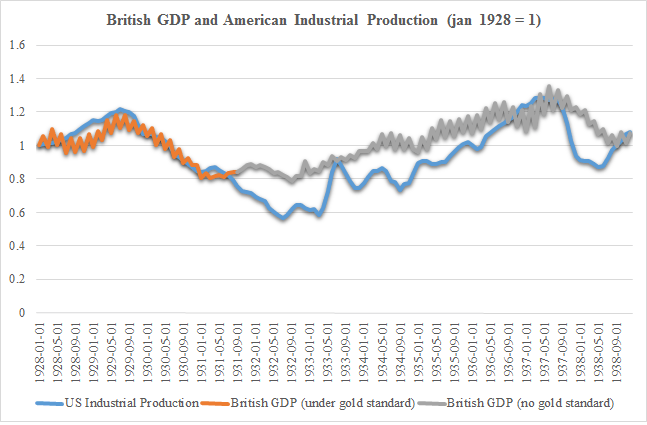
The problem, as I mentioned earlier, is that Sumner is underselling his case! I base this belief on the experience of England at the same time. Unlike the United States, the British decided to apply their piss-poor supply-side policies during the 1920s – well before the depression.  The seminal paper (see this one too) on this is by Stephen Broadberry (note: I am very biased in favor of Broadberry given that he is my doctoral supervisor) who argued that the supply shocks of the 1920s caused substantial drops in hours worked and although the rise of unemployment benefits played a minor role, the vast majority of the causes were due to the legal encouragement of cartel formation. As a result, there were no supply-side shocks during the depression to create noise. However, England did have a demand-side expansionary policy in 1931. Even if it was by accident more than by design, England left the gold standard in September 1931. This led to the equivalent of an easy monetary policy and the British economy stopped digging and expanded afterwards. The Great Depression was not a pleasant experience for the British, but it was not even close to the dreadful situation in the United States. As a result, we can see whether or not it was possible to exit the Great Depression by virtue of a monetary policy. I’ve combined the FRED dataset on monthly industrial production and the monthly GDP estimates for inter-war Britain produced by Mitchell, Solomou and Weale (see here) to see what happened in England after it left the gold standard. As one can see, the economy of Britain rebounded much more magnificently than that of the United States in spite of supply-side constraints.

GBUSA

Sumner should expand on this point! To be fair, he does talk about it briefly. Not enough! A longer discussion of the British case provides him with the “extra mile” to cover the distance against competing theories. The absence of supply shocks in Britain during the Depression confirm his story that the woes of the United States during the 1930s are due to initially poor monetary policy and then poor supply-side policies. In my eyes, this is a strong confirmation of the importance of the NGDP level target argument!

With such a point made, it is easy to imagine a reasonable counterfactual scenario of what economic growth would have been after monetary easing in 1933 in the absence of supply-side shocks. Had the United States kept very unregulated labor and product markets, it is quite reasonable to believe (given the surge seen in 1933 in the Industrial Production data) that the United States would have returned to 1929 levels. In the absence of such a prolonged economic crisis, it is hard to imagine how different the 1930s and 1940s would have been but it is hard to argue that things would have been worse.

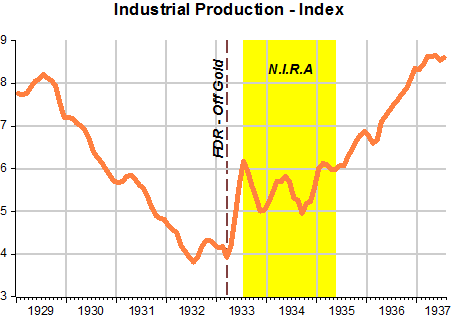
UPDATE: From the blog Historinhas, Marcus Nunes sent me the graph below confirming the importance of the NIRA shock on eliminating all the benefit from easy money after 1933.

J Goodman (1)

The High Wage Economy: the Stephenson critic

A recent trend has emerged in economics. The claim is that high wages can have a dynamic positive effect on market economies.  The intuition is that high wages increase productivity because they incite management to find new techniques of production. In essence, its an argument about efficiency wages: efficiency wages increase incentives to innovate on the part of managers, they can also incite workers to acquire more human capital and work harder and more diligently.

In economic history, this claim has been taken up by scholars like Robert Allen (see his work here for the general public) who argues that the Industrial Revolution took place in England because of high wages. The high-wages of England in the 17th and 18th centuries (relative to all other areas in Europe), together with cheap energy, created an incentive for capital-intensive methods of production (i.e. the industrial revolution). In fact, a great share of the literature on the desirability of high wages for economic development has emanated from the field of economic history.

I have always been skeptical of this argument for two reasons. The first is that efficiency wages is a strange theory that relies on debatable assumptions about labor (strangely, I have been convinced of this point by Austrian scholars like Don Bellante and Pavel Ryksa). The second is that numerous scholars have advanced large criticisms of the underlying data. Robert Allen – the figurehead proponent of the high wage argument – has been constantly criticized by historians like Jane Humphries (see here) for the quality of the data and assumptions used. Allen defends himself on numerous occasions and many of his replies (mainly those on the role of family size in living standards) show that his initial case might have been too conservative (i.e. he is more “correct” than he claims).

Until a year or two ago, I was agnostic on the issue even though I was skeptical. That was until I met Judy Stephenson – a colleague at the London School of Economics. Judy did what I really like to do – dig for data (yes, I am weird like that). She went to the original sources of data used by Allen and others and she looked at what any Law-and-Economics buffs like me like to look at – transaction costs and contracting models.

She recently published her work as a working paper at the LSE and what she found is crucial! Labor was not hired directly, it was hired through contractors who charged costs on the basis of days worked. But this did not translate into wages actually paid to workers. The costs included risks and overheads for contractors. Somewhere between 20% and 30% of the daily costs were not given to workers as wages. Thus, the wage series used to claim that England (Stephenson concentrates on London though) had high wages are actually 20% to 30% below the level often reported. They are also substantially close to those in western Europe.

Thus, the high wage story for England seems weaker. This little piece of historical evidence brought about by Judy is something to think about carefully when one makes the argument that high wages are conducive to growth. Since most of the argument brought to the public was informed largely by this argument in economic history, it makes sense to be cautious when thinking about it in the future.

Women and secular stagnation

As an economic historian, I’ve always had a hard time with the idea of secular stagnation. After all, one decade of slow growth is merely a blip on the twelve millenniums of economic history (I am not that interested with the pre-Neolithic history, but there is some great work to be found in archaeology journals). Hence, Robert Gordon’s arguments fall short on me.

That was until I was sparked to react to a comment by Emily Skarbek at Econlib. Overall, she is skeptical of Gordon’s claims of secular stagnation. But not for the same reasons. She claims that there are many improvements in welfare that we are not capturing through national income accounts. This is basically the same point as the one made by the great Joel Mokyr (the gold standard of economic historians).

It is true that national accounts have some large conceptual problems regarding measuring output when there are massive technological changes. Yet, all these problems don’t go in the same direction. More precisely, they don’t all lead to underestimation of growth.

My favorite example of one that leads us to overestimate growth is the one I keep giving my macroeconomics students at HEC Montreal. Assume an economy with a labor-force participation rate of 50%. Basically, only males work. All women stay at home for household chores and childcare. In that case, all measured output is male-produced output. Since national accounts don’t consider household production, all the output of women in the households of this scenario is non-existent.

Now assume a technological change causing a shift of 10% of women to the workforce at the same wage rate as men. That boosts labor participation rate to 55% and output by 5%. However, that would largely overestimate growth caused by this shift. After all, when my grandmothers were raising my parents, they were producing something. It was not worthless output. Obviously, if my grandmothers went to work, there was some net added value, but not as much as 5%. However, according to national account, the net increase in GDP is … 5%.

Obviously wrong right? Now, think of the economic history of the last 100 years. Progressively, female labor-force participation increased as marriages were delayed and family sizes were reduced. Unmarried women stayed on the market longer. Then, the introduction of new household technologies allowed some married women to join the labor force more actively. Progressively, women accumulated more human capital and became more active in the labor force. So much that in many western countries, both genders have equal labor-force participation rates.

As they shifted from household production to market production, we considered that everything they did was a net added value. We never subtracted the value of what was produced before. Don’t get me wrong, I am happy that women work instead of toiling inside a household to handwash dirty clothes. Yet, it would be both statistically incorrect and morally insulting to say that what women did in the household had no value whatsoever. 

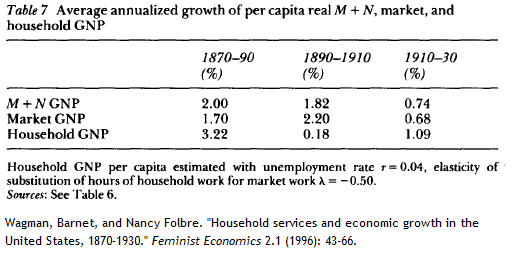
The role of household production in reducing the quality of growth estimates goes back to the 1870s! A 1996 article in Feminist Economics (which I use a lot in my own national account sections of macroeconomics classes) shows the following changes in growth rates when we account for the value of household production. Instead of increasing to 1910 and then falling to 1930, growth in the United States falls to 1930. While the growth rates remain appreciable, they nonetheless indicate a massively different interpretation of American economic history.

SecularStagnation


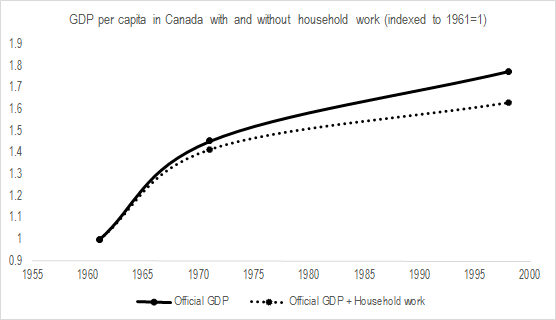
Sadly, I do not possess a continuation of such estimates to later points in time for the United States. I know there is an article by the brilliant Valerie Ramey in the Journal of Economic History, but I am not sure how to compute this to reflect changes in overall output. I intend to try to find them for a short piece I want to submit later in 2016. Yet, I do have estimates for my home country of Canada. Combining a 1979 paper in the Review of Income and Wealth with a working paper from Statistics Canada, it seems that the value of household production falls from 45% of GNP in 1961 to 33% in 1998. When we adjust GDP per capita to consider the changes in household work in Canada, the growth path remains positive, but it is less impressive.

SEcularStagnation2

I am not saying that Gordon is right to say that growth is over. I am saying that the accounting problems don’t all go in the direction of invalidating him. In fact, if my point is correct, proper corrections would reduce growth rates dramatically for the period of 1945 to 1975 and less so for the period that followed. This may indicate that “slow growth” was with us for most of the post-war era. That’s why I reacted to the blog post of Skarbek.

It also allows me to say the thing that is the best buzz-kill for economics students: national accounting matters!

Malthusian pressures (as outcome of rent-seeking)

Nearly a week ago, I intervened in a debate between Anton Howes of King’s College London whose work I have been secretly following  (I say “secretly” because as an alumnus of the London School of Economics, I am not allowed to show respect for someone of King’s College) and Pseudoerasmus (whose identity is unknown but whose posts are always very erudite and of high quality – let’s hope I did not just write that about an alumnus of King’s College). Both bloggers are heavily involved in my first field of interest – economic history.

The debate concerned the “Smithian” counter-effect to “Malthusian pressures”. The latter concept refers to the idea that, absent technological innovation,  population growth will lead to declining per capita as a result of marginally declining returns. The former refers to the advantages of larger populations: economies of scale, more scope for specialization and market integration thanks to density. Now, let me state outright that I think people misunderstand Malthusian pressures and the Smithian counter-effect.

My point of is that both the “Smithian counter-effect” and “Malthusian pressures” are merely symptoms of rent-seeking or coordination failures. In the presence of strong rent-seeking by actors seeking to reduce competition, the Smithian counter-effect wavers and Malthus has the upper hand. Either through de-specialization, thinner of markets, shifting to labor-intensive technologies, market disintegration and lower economies of scale, rent-seeking diminishes the A in a classical Cobb-Douglas function of Total Factor Productivity (Y=AKL). This insight is derived from my reading of the article by Lewis Davis in the Journal of Economic Behavior and Organization which contends that “scale effects” (another name for a slight variant of the “Smithian counter-effect) are determined by transaction costs which are in turn determined by institutions. If institutions tend to favor rent-seeking, they will increase the likelihood of coordination failure. It is only then that coordination failures will lead to “Malthusian pressures” with little “Smithian counter-effect”. Institutions whose rules discourage rent-seeking will allow markets to better coordinate resource use so as to maximize the strength of the “Smithian counter-effect” while minimizing the dismal Malthusian pressures.

In essence, I don’t see the issue as one of demography, but as one of institutions, public choice and governance. I am not alone in seeing it this way (Julian Simon, Jane Jacobs and Ester Boserup have documented this well before I did). Why the divergence?

This is because many individuals misunderstand what “Malthusian pressures” are. In an article I published in the Journal of Population Research, me and Vadim Kufenko summarize the Malthusian model as a “general equilibrium model”. In the long run, there is an equilibrium level of population with a given technological setting. In short-run, however, population responds to variation in real wages. Higher real wages from a “temporary” positive real shock will lead to more babies. However, once the shock fades, population will adapt through two checks: the preventive check and the positive check. The preventive check refers to households delaying family formation. This may be expressed through later marriage ages, planned sexual activities, contraception, longer stays in the parental household and greater spacing between births. The positive check refers to the impact of mortality increasing to force the population back to equilibrium level. These checks return to the long-term equilibrium. Hence, when people think of “Malthusian pressures”, they think of population growth continuing unchecked with scarce ressources. But the “Malthusian model” is basically a general equilibrium model of population under fixed technology. In that model, there are no pressures since the equilibrium rates of births and deaths are constant (at equilibrium).

However, with my viewpoint, the equilibrium levels move frequently as a result of institutional regimes. They determine the level of deaths and births. “Poor” institutions will lead to more frequent coordination failures which may cause, for a time, population to be above equilibrium – forcing an adjustment. “Poor” institutions would also lead to an inability to respond to a change in constraints (i.e. the immediate environment) by being rigid or stuck with path-depedency problems which would also imply the need for an adjustment.  “Good” institutions will allow “the Smithian counter-effect” to intervene through arbitrage across markets to smooth the effect of local shocks, a greater scope for specialization etc.

My best case for illustration is a working paper I have with Vadim Kufenko (University of Hohenheim) and Alex Arsenault Morin (HEC Montréal) where we argue that population pressures as exhibited by the very high levels of infant mortality rates in mid-19th century Quebec were the result of institutional regimes. The system of land tenure for the vast majority of the population of Quebec was “seigneurial” and implied numerous regressive transfers and monopoly rights for landlords. This system was also associated with numerous restrictions on mobility which limited the ability of peasants to defect and move. However, a minority of the population (but a growing one) lived under a different institution which did not impose such restrictions, duties and monopolies. In these areas, infant mortality was considerably lower. We find that, adjusting for land quality and other factors, infant mortality was lower in these areas for most age groups. Hence, we argued that what was long considered as “Malthusian pressures” were in fact “institutional pressures”.

Hence, when I hear people saying that there are problems linked to “growing population”, I hear “because institutions make this a problem” (i.e. rent seeking).

Was Murphy Foolish to Take Caplan’s Bet?

A few days ago, Bryan Caplan posted on his bet with Robert Murphy regarding inflation. Murphy predicted 10% inflation. He lost … big time. However, was he crazy to make that bet?  In other words, what could explain Caplan’s victory?

Murphy was not alone in predicting this, I distinctly remember a podcast between Russ Roberts and Joshua Angrist on this where Roberts tells Angrist he expected high inflation back in 2008. Their claims were not indefensible. Central banks were engaging in quantitative easing and there was an important increase of the state money supply. There was a case to be made that inflation could surge.

It did not. Why?

In a tweet, Caplan tells me that monetary transmission channels are much more complex than they used to be and that the TIPS market knew this. Although I agree with both these points, it does not really explain why it did not materialize. I am going to propose two possibilities of which I am not fully convinced myself but whose possibility I cannot dismiss out of hand.

Imagine an AS-AD graph. If Murphy had been right, we should have seen aggregate demand stimulated to a point well above that of long-run equilibrium. Yet, its hard to see how quantitative easing did not somehow stimulate aggregate demand.  Now, if aggregate demand was falling and that quantitative easing merely prevented it from falling, this is what would prove Murphy wrong. However, all of this assumes no movement of supply curves.

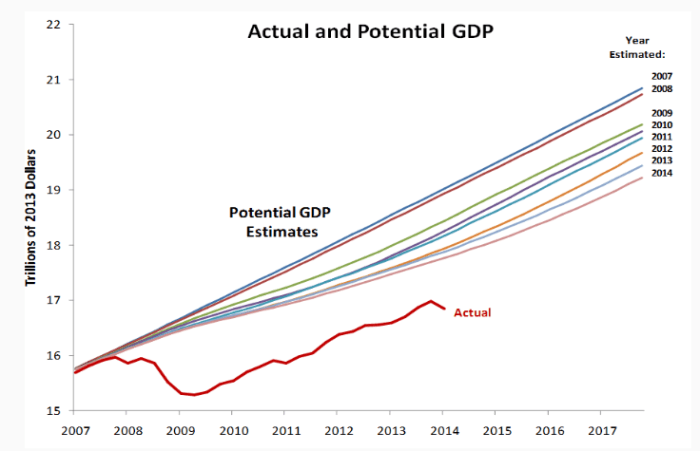
While AD falls and before monetary policy kicks in, imagine that policies are adopted that reduce the potential for growth and productivity improvement. In a way, this would be the argument brought forward by people like Casey Mulligan in work on labor supply and the “redistribution recession” and Edward Prescott and Ellen McGrattan who argue that, once you account for intangible capital, the real business cycle model is still in play (there was a TFP shock somehow). This case would mean that as AD fell, AS fell with it. I would find it hard to imagine that AS shifted left faster than AD. However, a relatively smaller fall of AS would lead to a strong recession without much deflation (which is what we have seen in this recession). Personally, I think there is some evidence for that. After all, we keep reducing the estimate for potential GDP everywhere while the policy uncertainty index proposed by Baker, Bloom and Davids shows a level change around 2008.  Furthermore, there has been a wave – in my opinion of very harmful regulations – which would have created a maze of administrative costs to deal with (and whose burden is heavy according to Dawson and Seater in the Journal of Economic Growth). That could be one possibility that would explain why Murphy lost.

download

There is a second possibility worth considering (and one which I find more appealing): the role of financial regulations. Now, I may have been trained mostly by Real Business Cycle guys, but I do have a strong monetarist bent. I have always been convinced by the arguments of Steve Hanke and Tim Congdon (I especially link Congdon) and others that what you should care about is not M1 or M2, but “broad money”. As Hanke keeps pointing out, only a share of everything that we could qualify broadly as “money” is actually “state money”. The rest is “private money”. If a wave of financial regulations discourages banks to lend or incite them to keep greater reserves, this would be the equivalent of a drop of the money multiplier. If those regulations are enacted at the same time as monetary authorities are trying to offset a fall in aggregate demand, then the result depends on the relative impact of the regulations. The data for “broad money” (Hanke defines it as M4) shows convincingly that this is a potent contender. In that case, Murphy’s only error would have been to assume that the Federal Reserve’s policy took place with everything else being equal (which was not the case since everything seemed to be moving in confusing directions).

globr-asia-nov-2014-1bg

In the end, I think all of these explanations have value (a real shock, a banking regulation shock, an aggregate demand shock). In 25 years when economic historians such as myself will study the “Great Recession”, they will be forced to do like they do with Great Depression: tell a multifaceted story of intermingled causes and counter-effects for which no single statistical test can be designed. When cases like these emerge, it’s hard to tell what is happening and those who are willing to bet are daredevils.

P.S. I have seen the blog posts by Scott Sumner and Marcus Nunes regarding my NGO /NGDP claims. They make very valid points and I want to take decent time to address them, especially since I am using the blogging conversation as a tool to shape a working paper.

Pesos, medidas e as instituições

Douglas Allen, em seu ótimo, The Institutional Revolution, defende a tese de que uma revolução institucional teria precedido a famosa revolução industrial. Texto importante, é que, para mim, já é candidato a livro-texto básico de qualquer bom curso de História Econômica.

Como sempre, senti falta de alguma coisa mais, digamos, tropical, no livro. Bom, mas como é que vou cobrar isto de um livro que não se propõe a contar a história das instituições em Portugal? Não posso. Isto é mais uma deixa para os pesquisadores brasileiros. Dica de amigo, quem sabe, para alguém que deseje fazer uma dissertação de mestrado sobre o tema.

Mas eu sou uma pessoa perigosamente curiosa. Fiquei intrigado com a questão dos pesos e medidas. No argumento do autor, a questão dos pesos e medidas, ou melhor, a questão da padronização de pesos e medidas, está diretamente relacionada com a mensuração de produtos, o que gera uma importante alteração nos custos de se trocar mercadorias (ou seja, nos custos de transação). Afinal, nada mais óbvio do que achar mais interessante comprar um quilo de abacate sem levar para casa meio quilo do mesmo.

No caso do Brasil colonial, então, pensei, deveria ser como em Portugal. Para checar isto, consultei este documento. Vejamos alguns trechos:

No que se refere às unidades de medidas adotadas ao longo do período colonial, o quadro não difere, como é natural, daquele oferecido por Portugal. A vara, a canada e o almude constituíam as medidas de uso mais comum, ainda que seu valor pudesse variar de região para região. Os produtos importados traziam consigo suas próprias medidas e, quanto mais geograficamente restrita uma atividade econômica, mais específico era o sistema de medidas utilizado. (…)

Vale dizer: nada muito diferente do restante da Europa.

Assim, a primeira menção expressa à atividade metrológica, em documentos coloniais, refere-se precisamente à fiscalização do funcionamento de mercados locais. Como em Portugal, o funcionário colonial mais diretamente envolvido com a fiscalização de pesos e medidas era o almotacé, mencionado pelas Ordenações Manuelinas e Filipinas e previsto pela organização do município de São Vicente, em 1532. Em número de dois, eleitos mensalmente pela Câmara Municipal, os almotacés tinham como atribuição básica manter o bom funcionamento dos mercados e do abastecimento de gêneros, além de fiscalizar obras e manter a limpeza da cidade. Como parte de suas responsabilidades, deveriam verificar mensalmente, com o escrivão da almotaçaria, os pesos e as medidas. Tal disposição estimulava, dada a dispersão e a diversidade dos municípios, a multiplicação dos padrões de medidas.

Veja só a importância do ofício. Alguém imaginaria que carregar uma régua ou uma fita métrica, hoje em dia, seria uma profissão digna de tanta importância? Bem, numa época em que o governo descobre que medir ajuda a maximizar sua receita, nada mais natural, não? Até eleição para o cargo havia.

No caso dos gêneros estancados ou submetidos a controles mais rígidos, a Coroa cuidava da melhor organização das atividades metrológicas. O estabelecimento do monopólio do tabaco, por exemplo, levou à criação, em 1702, do Juiz da Balança do Tabaco, nas alfândegas de Salvador e Recife. No caso das minas, o regimento do Intendente do Ouro, de 26 de setembro de 1735, mencionava expressamente sua obrigação de manter as balanças e marcos da Intendência aferidos, pesando o ouro corretamente, sem prejuízo das partes nem da Fazenda Real, atribuição expressamente mantida no regimento de 1751.

Como se percebe, a questão institucional é indissociável da questão econômica. Veja aí o depoimento do próprio autor: tem monopólio? Quem é o “dono” do monopólio? A Coroa. Reza o dito popular – e a teoria econômica – que “o olho do dono engorda o cavalo” – e não é diferente neste caso.

Pois bem, falta-nos – alô, colegas de História Econômica! – um estudo mais detalhado do papel dos almotacés (ou me falta mais pesquisa e leitura, vai saber…), não falta? Vou procurar meu exemplar de Fiscais e Meirinhos para rejuvenescer, digamos assim, meu interesse pelo tema.

Novamente, percebemos que a História Econômica não precisa nos dar sono.