Glass-Steagall and Deregulation: What Went Wrong?

Nothing, really. Consortium members Warren Gibson and Jeffrey Rogers Hummel write in the Freeman on Glass-Steagall and what its repeal in the 1990’s meant for the economic crisis that began in 2008:

The timing of the repeal of Glass-Steagall makes this deregulatory move a convenient scapegoat for the financial crisis. But the crisis began with the housing collapse, a result of government encouragement of unsound lending practices. Financial firms took too much risk with mortgage-backed securities, in part because of moral hazard engendered by government guarantees and partly because bond rating firms were not as independent as was once thought. The limited liability that the investment banks gained when they became corporations may also have amplified moral hazard. There is no good reason to believe that Glass-Steagall, had it remained in effect, would have prevented any of these problems.

I highly recommend this piece. Lots of good history behind the law as well as a very clear explanation of the different types of banking services, what they do, and how they are created.

Elites and Housing Segregation: What Gives?

Virginia Postrel has a provocative post on How Elites Built America’s Economic Wall up at Bloomberg (ht Wilson Mixon). The gist of the post is summed up as follows:

Housing prices have always been steeper in high-income places, but the difference is much greater than it used to be […] This segregation has social and political consequences, as it shapes perceptions — and misperceptions — of one’s fellow citizens and “normal” American life. It also has direct and indirect economic effects. “It’s a definite productivity loss,” Shoag says. “If there weren’t restrictions and you could build everywhere, it would be productive for people to move. You do make more as a waiter in LA than you do in Ohio. Preventing people from having that opportunity to move to these high-income places, making it so expensive to live there, is a loss.” That’s true not only for less-educated workers but for lower earners of all sorts, including the artists and writers who traditionally made places like New York, Los Angeles and Santa Fe cultural centers.

This excerpt gets a high place for my Obvious Statement of the Year Award, but are elites listening? Government regulations hurt workers and drive out competition. This is a given, but I have some questions I thought readers could help me answer.

My questions are both broad and messy: Continue reading

Who Stole Our Trillions?

When asked about the recent bankruptcy of the City of San Bernardino, California Governor Jerry Brown had this to say:  “We have to realize this country has been dealt a very heavy blow: trillions and trillions of dollars in the wealth of America has been destroyed by very powerful people, some of whom have never been punished.”

Let’s see what sense we can make of this.  “Wealth of America” presumably means real assets: homes, businesses, land, etc.  Taken literally, this makes no sense.  Where are the smoldering ruins?  The financial crisis did a lot of damage but little or no physical damage.  What did happen is that malinvestments were revealed.  Tracts of houses built in places like the California Central Valley on the presumption that home values could never decline were left empty or unfinished.  Wealth was indeed destroyed: not tangible wealth but wealth in the sense of people’s expectations of ever-rising future house prices.

The housing crash was a necessary if painful cleanup of the damage done by policies that created the boom in the first place.  What were those policies? A rough summary:

  • Government policies aimed at expanding homeownership.  Loans to marginal buyers were encouraged by government-sponsored entities, particularly Fannie Mae and Freddie Mac.
  • Low interest rates engineered by the Greenspan Fed during 2001-2005.
  • Tax deductions for mortgage interest.
  • And yes, private greed.  Institutions like Countrywide were churning out low-doc loans, no-doc loans, neg-am loans and God knows what else in defiance of common sense.  They were, of course, responding to incentives as a dog would respond to a piece of meat left on the kitchen counter.  But they are not dogs and should have known better.

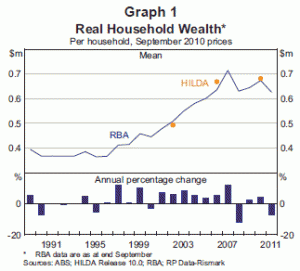
Now, what about those trillions and trillions?  Indeed, total real (inflation-adjusted) household wealth has fallen by moImagere than a trillion in the last few years – all the way back to 2005 levels.  In other words, a lot of illusory “wealth” that was the result of the government-created boom has been taken off the books.  Painful?  Sure, you can no longr refi and take cash out for a vacation.  Your house is no longer an ATM.  We’ve sobered up and that’s good.

It’s so easy for a politician like Brown to spout sound-bite demagoguery and get away with it.  The majority of voters, full of nonsense fed to them by public mis-education, lap it up.  The truth is often complicated and ill-suited to sound bites.  That’s why economics can be both frustrating and satisfying.  Personally, I find it satisfying to try to understand the truth and convey it in class or in a blog.   I urge bright young people to consider economics as a career and consider people like GMU professor and prolific writer Don Boudreaux as a role model.

An Ominous Expansion of Eminent Domain

A new assault on private property is in the works and it hasn’t gotten much attention – yet.  Needless to say, it goes by an Orwellian name, in this case the “Homeownership Protection Act.”  As summarized recently by Kathleen Pender in the San Francisco Chronicle, the scheme has been hatched by two cities in San Bernardino County and has not taken effect yet but is under serious consideration.  A new agency called a “Joint Powers Agreement” would be formed to do the dirty work.

The idea is to use the power of eminent domain to seize mortgages – not houses but mortgages owed to lenders by homeowners who have defaulted or are under water.  Using Ms. Pender’s example, suppose there is a $300,000 mortgage on a house worth $200,000.  The agency decides the mortgage balance should be $190,000 which would leave the homeowner with $10,000 in equity.  It seizes the mortgage and compensates the mortgage holder in an amount such as $170,000.  A new mortgage in the amount of $190,000 is then issued by a private firm which would reimburse the agency some lesser amount, say $180,000.  Thus the private firm pockets $10,000 up front and the agency another $10,000. One such firm, Mortgage Resolution Partners, has already been formed in San Francisco for this purpose.

There are some technical questions.  How is the house value determined?  By appraisers, presumably, but we saw in the housing bubble how useless their numbers were.  And what if the mortgage had been securitized, i.e., put into a mortgage-backed security?  The Federal Reserve holds a lot of these securities.  What if a local government entity tried to seize a mortgage that was ultimately owned by the Fed?  Wouldn’t that be fun?

Technical questions aside, the whole idea portends a massive new assault on private property by ravenous politicians and bureaucrats and their private co-conspirators.

Eminent domain has generally been understood as a way of solving holdout problems when a “public” project is proposed.  Such projects typically require acquisition of property from a number of owners and can’t be built at all unless and until all owners are willing to sell.  A single holdout can ruin the project.  Thus eminent domain has almost always been used to seize real property (land and buildings) as opposed to personal property such as mortgages.  (Private solutions to holdout problems have been proposed.)

The only ultimate limitation on the use of eminent domain is a clause in the Fifth Amendment to the U.S. Constitution which says “nor shall private property be taken for public use without just compensation.”  That clause is of course wide open to varying interpretations of “public use” and “just compensation.”

A landmark Supreme Court 5-4 decision in 2005 held that the City of New London could seize a modest house owned by Suzette Kelo and hand it over to a private developer.  The house and surrounding buildings were seized and destroyed but the project went bust and the land is still vacant.  This was a significant extension of the notion of “public use.”  Justice Stevens in his decision to uphold the City noted that “a public purpose will often benefit individual private parties.”

Indeed.  Can there ever be a public project that does not benefit some private party?  Any public project necessarily diverts resources to some private party such as a contractor or neighbors whose property values are enhanced.  Turning the proposition around, almost any private project throws off some public benefits.  Kelo opened the door to conspiracies of private developers and public officials to launch almost any sort of assault on anyone’s private property.

The “just compensation” clause is also gravely problematic.  Suzette Kelo loved her little pink house.  Its market value wasn’t nearly enough to compensate for the emotional loss she suffered when she was kicked out.  Values, as distinct from prices, are subjective and are revealed by voluntary transactions.

In addition to the obvious grave immorality of this latest assault on private property, consider the incentive problems that it raises.  Future savers will be reluctant to invest their savings in mortgages or financial products containing mortgages knowing they could be expropriated.  Homeowners will find loans harder to get, thanks to the “Homeowner Protection Act.”  (Echoes of Ludwig von Mises: government interventions invariably make things worse for their ostensible beneficiaries.) There will be a marginal shift away from saving toward consumption.  Economic growth will be marginally slowed, for which politicians will blame the free market and plump for yet more expansions of government power.

Should the San Bernardino project go forward, it will be very likely to end up at the Supreme Court.  The Kelo and Obamacare decisions do not bode well for the result.
“Stocks Slammed as Dow Erases 2012 Gains”

That’s the title to a headline piece over at CNN.

The Dow Jones industrial average (INDU) plunged 275 points, or 2.2%, the biggest one-day drop since November. The blue-chip index gave up all its gains for the year, and is now 99 points below where it finished 2011. The S&P 500 (SPX) lost 32 points, or 2.5%, and the Nasdaq (COMP) dropped 80 points, or 2.8%.

Ouch. The cause of the plunge?

“The U.S. employment report was simply terrible,” said Marc Chandler, global head of currency strategy at Brown Brothers Harriman.

The May jobs report showed only 69,000 jobs were added to payrolls, less than half the 150,000 jobs forecast by economists surveyed by CNNMoney. The unemployment rate ticked higher for the first time in a year, rising to 8.2%.

I take three things away from this: Continue reading