- The rule of robots in Stiglitz and Marx Branko Milanovic, globalinequality
- Freud and property rights Bill Rein, NOL
- China at its limits: beyond its borders Joshua Bird, Asian Review of Books
- Who’s Afraid of Tribalism Blake Smith, Quillette
Is minimalism immoral?
I came across a simple but important question on Quora: Is it wrong to aspire to be a minimalist? Doesn’t this negatively affect the country’s GDP?
I see two big lessons here: 1) wise use of metrics requires wisdom… i.e. appropriate interpretation and critical thinking. 2) Maximization is just one version of one part of the whole story. (There are also important questions to ask about what we can expect from others, but I’ll leave that for the comments.)
Readers of NOL should be familiar with the notion that GDP is only an imperfect proxy for well being. But not everyone is so we have to repeat ourselves. There’s what we’re after, and there’s what we can measure, and the two are not the same. GDP is a really clever way to aggregate total production in an economy, but production is only valuable to the extent we’re producing the things that actually improve people’s lives. It’s easy for busy people to confuse a proxy measure for the latent variable we actually care about, so we need someone whispering in the emperor’s ear “the metric is not the mission.”
Economics is easier to describe using the simplifying assumption that people want more stuff. It’s easy to forget that people also want more leisure (and so less work). This is a subtle reappearance of the seen and unseen. We can see when someone gets a cool new car and we can’t see when someone has a fun evening with friends and family. We have to check our bias towards trying to get more stuff and remember that reducing work is another feature of human flourishing.
Nightcap
- Why did Israel attack the USS Liberty? Rick Brownell, Historiat
- Slouching toward Bethlehem Joyce Chaplin, Times Literary Supplement
- Looking back on the festivals of the Revolution Mike Follert, Age of Revolutions
- Beasts of Rebellion Jonathan Saha, Colonizing Animals
Nightcap
- The case against deporting immigrants convicted of crimes Ilya Somin, Volokh Conspiracy
- What happens when photographers turn their cameras on society’s outcasts? Joe Lloyd, 1843
- Trump’s dangerous game David Henderson, EconLog
- Indonesia clamps down on independence effort in Papua Joe Cochrane, NY Times
Eye Candy: the Arab world’s administrative divisions
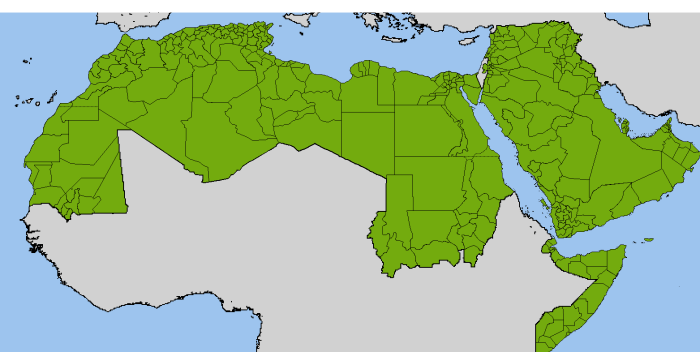
Imagine if these divisions were all states in a federal republic. Myself, I think some of them,maybe even half of them, could be combined, but if that ever happened, and the resulting combined administrative divisions of the Arab world federated, the region would be in much better shape. (The federation of Arabia would need a Senate, of course.)
What if the OECD did the same? Or simply the US and it’s closest allies?
Nightcap
- The Art of War re-translated and reconsidered Peter Gordon, Asian Review of Books
- Interview with Svetlana Alexievich (life behind the Iron Curtain) Julian Tompkin, Deutsche Welle
- Mutually nonconsensual sex (Title IX is a joke) Caitlin Flanagan, the Atlantic
- Reagan’s Right Turn George Nash, Modern Age
Nightcap
- Exquisite Rot: Spalted Wood and the Lost Art of Intarsia Daniel Elkind, Public Domain Review
- Classic books: Like ice in children’s hands Alberto Manguel, Times Literary Supplement
- Our aquatic universe Tim Folger, Aeon
- From eternity to here: the Rome we have lost Ingrid Rowland, Commonweal
Freedom of Religion Secures Other Rights As Well
Ethan’s post on “The Why of Religious Freedom” inspired me to add one more to his list of reasons why freedom of religion deserves special treatment and protection. The freedom of religion preserves other freedoms we hold dear. Even those who do not wish to belong to an organized religion or to hold strong religious opinions have their freedoms secured because of the protection granted to religious freedom.
Freedom of religion, the first freedom protected by the US Constitution’s First Amendment, is part of having freedom of speech. Imagine a country where you could say anything you wanted, except those ideas and principles you hold most dear to your heart. How free would you feel your speech actually is? If you have freedom of the press and can print any opinion or argument you care to, unless it is about your conscience, how free is your press? To say that you may express your political opinion and vote unless you have religious reasons for that opinion similarly denies the equal protection clause of the 14th amendment.
Freedom of religion is also a guarantor of freedom of assembly. This last weekend while in Atlanta for the Teaching Professor Conference in Atlanta, my colleagues and I toured Rev. Dr. Martin Luther King Jr.’s church and neighborhood. The civil rights movement for many years worked through the churches because it was the only place African Americans were freely allowed to assemble together in many areas. As they assembled, they had the freedom to speak out against the injustices and oppressions they faced and work together to overcome them.
As Rev. King put it, “Freedom is like life. It cannot be had in installments. Freedom is indivisible – we have it all, or we are not free” (The Case Against “Tokenism”). To extend that argument, when we say ‘freedom of religion’ it is the people who are free, free to believe how they will, to speak and gather and act according to their beliefs freely. In “The Ethical Demands For Integration,” Rev. King argued:
“A denial of freedom to an individual is a denial of life itself. The very character of the life of man demands freedom. In speaking of freedom … I am not talking of the freedom of a thing called the will [or in our case, religion]. The very phrase, freedom of the will [religion], abstracts freedom from the person to make it an object; and an object almost by definition is not free. But freedom cannot thus be abstracted from the person … . So I am speaking of the freedom of man, the whole man.”
If we cannot be free in our religious thoughts and exercise – whether connected with an organized religion or not – we cannot be a free people.
RCH: the Ottoman Empire
My subject for this weekend’s RealClearHistory column is battles that shaped the Ottoman Empire. Here is an excerpt:
On June 4, 1915, the Third Battle of Krithia was fought between the Ottoman Empire and its Allied enemies, composed of mostly French and British troops. The Ottomans won, handily and somewhat surprisingly. The Allies had to retreat and regroup as a result, and the Balkans campaign had to go through a more careful re-think by Allied strategists.
World War I marked the end of the Ottoman Empire, of course, but the “sick man of Europe” had more fight in it than many Western historians give it credit for. Scholarship on the Ottoman Empire has improved over the years, but there is still plenty of opportunity to do more. The Ottoman Empire spanned three continents, after all, and lasted for 623 years.
The Ottoman Empire was actually one of three multi-ethnic, multi-religious empires in Europe that perished as a result of World War I, along with Austria-Hungary and tsarist Russia. To the east of the Ottomans were two other, long-lasting empires, the Persian empire ruled by the Qajar dynasty (which perished in 1925) and the Mughal empire of India (which perished in 1857). These eastern empires are referred to by many historians as “gunpowder empires” and they controlled the Eurasian trade routes that Chinese and especially European merchants used for exchanging goods and ideas. Here are 10 battles that shaped the Ottoman Empire:
Please, read the rest. And have a good weekend.
Nightcap
- Tech platforms and the knowledge problem Frank Pasquale, American Affairs
- Exploring the New Science of Psychedelics Mick Brown, Literary Review
- A new history of Islamic mysticism Kamal Gasimov, Voices on Central Asia
- Within the triangle of politics, philosophy, and religion Aurelian Craiutu, Law & Liberty
Nightcap
- Britain’s Open Doors Policy Chris Dillow, Stumbling and Mumbling
- About those Ancestry dot com commercials… Ryan Anderson, Anthro{dendum}
- The Unfinished World Nick Nielsen, The View from Oregon
- “State Capacity” is Sleight of Hand Bryan Caplan, EconLog
Nightcap
- The secrets of Katyn Louis Proyect, CounterPunch
- Europe’s curse of wealth Branko Milanovic, globalinequality
- The new Europeans Christopher de Bellaigue, NY Review of Books
- Nuclear diplomacy between Brazil and Argentina Sara Kutchesfahani, War on the Rocks
Turkey elections: Elections, Rappers, Media, Micro-Party, Rigging, Iraq
The Turkish State’s War On Rap
The election campaign has not slowed down the Erdoğanist state in its efforts to punish anyone who deviates from Erdoğan’s ideal of obedient, socially conservative, and conformist citizens. One of the best known Turkish rappers, Ezhel, with very leftist and counter culture lyrics, has been arrested recently for ‘encouraging drug use’. A prosecutor ordered his detention, which was implemented after he voluntarily went to the police station to answer a ‘complaint’, with no warning about detention. Onur Dinç (known as Khontkar), and Young Bego have also been detained. They can all be found on Spotify and YouTube. Listening on Spotify generates a little income for people who deserve a bit of solidarity at the moment.
İnce’s Presidential Campaign
An interview on HaberTürk TV with the leading opposition candidate for President of Turkey, Muharrem İnce (from the secularist, centre-left Republican People’s Party), has gone down very well. The interviewers let İnce express his views and had a selfie with him afterwards. HaberTürk TV is a private channel but, like all commercial private channels, accepts (and has no real choice) the biases and silences imposed by the Erdoğanist-AKP regime.
It is normal for Erdoğan himself to phone media groups and complain about coverage, demanding firings of journalists, where the bias is not as complete as he requires. So how long are these journalists, and the responsible manager, going to survive? A manager on another private channel was fired (officially ‘left for personal reasons’, ha ha ha) after allowing a very brief segment on the second most popular opposition, and more right wing, candidate, Meral Akşener. Will these HaberTürk people survive until the election? Are they more willing to push the limits because the opposition is doing better than expected?
On recent polls (leaving aside companies who enjoy close relations with the Erdoğanists) only rigging (or some extreme situation) can now stop 1. the opposition winning a majority in the National Assembly (could be stopped on current polling by stealing/losing about 2/3% points from HDP, a Kurdish rights-leftist party which appears to be between 1 and 3% points above the 10% election threshold). The main left-right opposition list seems to be about 3 points behind the right wing government list 2. the presidential election going to a second round, i.e. Erdoğan cannot get 50%+ of the vote in a several-candidate field (except by rigging at least 7% points of votes cast) and might lose in the run off.
I can only presume the interviewers of İnce will be out of a job if Erdoğan and the AKP-dominated electoral list do win by some means, and HaberTürk will suffer other penalties. Yes, polls can be wrong and they don’t all show the same thing, but those most favourable to the government tend to be run by cronies and there is widespread suspicion that in the current atmosphere in Turkey, some voters would prefer not to tell a stranger they are voting for an opposition party, particularly HDP. This is confirmed by the relation between opinion polls and the final result in last year’s referendum on moving to a presidential system (in which the final result itself may have been affected by losing and faking ballots, and by the difficulty that many voters in the Kurdish southeast had with getting to polling stations, a tactic the regime is setting up for this time as well).
The AKP-Erdoğanist Media Strategy: Why Turkish Media promotes an ex-terrorist micro-party.
Presenting the Opposition
Following on from the above, though İnce gets a lot less coverage on all media, including state media which is legally required to provide balanced coverage, than Erdoğan for the Presidential campaign, he gets far more than the more nationalist-conservative opposition candidate Meral Akşener (who would be the first female President of the Republic). She is polling behind İnce, but mostly by a moderate margin. She receives almost no coverage, her campaign is in fact a completely banned subject in the Erdoğan-controlled media (that is all state media and all the major private media groups).
Clearly the Erdoğan strategy (and we can be sure that he dictates it, without any delegation of overall strategy to campaign organisers) is to promote İnce as the only opposition candidate, in the belief that Akşener is a more of a threat to conservative support for himself. I used to believe this, but as far as we can tell from polls, İnce is leading in the first round and would do as well as Akşener in a second round play-off, both going down to very narrow defeat. This strategy has a high chance of backfiring by enabling someone further from Erdoğan in politics to become President.
The media manipulations may not make much difference since people open to voting for the opposition are going to treat the Erdoğanist media with scepticism and seek other news sources, but it is at least worth noting what the strategy is. It might be that the main aim is to make electors forget that Akşener’s party İYİ (Good) exists, on a common list with İnce’s party, but voters for the list can choose between them. It is unlikely that many voters are unaware of Akşener, the İYİ party, and the common list, and those that are unaware must be hardcore Erdoğanists who will not switch support to anyone in this election for any reason.
Promoting a Micro-Party
The most bizarre aspect of Erdoğanist coverage of the elections is that Hür Dava Partisi receives a great deal more coverage than İYİ. Hür Dava Partisi means Free Cause Party and the Turkish name is usually contracted to Hürda Partisi or Hüda Par. It was founded by people who had supported the Kurdish religious terrorist group Hizbollah. This is nothing to do with Hizbollah in Lebanon, which is a Shi’a group. Hizbollah in Turkey is defunct and was Sunni Muslim, as is Hüda Par.
It advocates religious law in Turkey and operates only in southeastern provinces where ethnic Kurds are in a majority, and has no more than 5% support in any individual province, giving it overall less than 5% in the whole region and less than 1% in the whole country. For it to receive much election coverage is of course absurd. The reason this happens is in the hope that the more religious Kurdish voters who are dissatisfied with the AKP after voting for it in the past (AKP is the second party in the region) will vote for Hüda Par instead of the secular-leftist HDP, which is the leading party in the region. The aim is to keep the HDP vote below 10% nationally, the electoral threshold for the National Assembly.
I don’t think it is possible that Hüda Par can soak up those votes sufficiently, but from the Erdoğanist point of view, it is worth trying and might just keep HDP below 10% in conjunction with electoral trickery such as moving polling stations away from HDP areas to make it less easy for them to vote and the possibility of outright electoral fraud, particularly in those polling stations where opposition observers may not turn up, in remote very pro-AKP areas. Electoral law has been changed recently to make removal of ballot boxes by the police easier and to legalise the illegal decision of the Supreme Election Council to count unstamped ballot papers in last year’s referendum.
On current polling, the opposition electoral list is a few percentage points behind the Erdoğanist list, so keeping the HDP out of the National Assembly would give his list an overall majority. This is why a micro-party of extreme religious conservative Kurds gets a high level of coverage in the Turkish media compared with conservative nationalists in İYİ who oppose Erdoğan and have created the third largest party in Turkey in terms of opinion polling.
Resisting Electoral Fraud
The possibility of electoral fraud and the use of fraud to keep HDP out of the National Assembly to the advantage of the Erdoğanists has of course been noted by the opposition and they are co-operating to work against this. The electoral list which comprises the second, third, and fourth parties in Turkey (secular centre-left CHP, nationalist conservative İP, and religious conservative SP) is cooperating with the HDP in a platform to ensure a fair and accurate count of votes. That the more nationalist parts of the opposition list and the Kurdish autonomy leftist people are able to work together on this is itself a good sign. There are no guarantees that the platform can prevent decisive fraud, but at least it will make fraud more difficult and shows there is unity in a very diverse opposition against the AKP-Erdoğan abuse of power.
Iraq Surprise?
I’ve seen a report that Turkish army units in the Kurdistan Regional Government of Northern Iraq, which have been stationed in a mountainous border part of the region for some years by ‘invitation’ (or possibly in reality extreme pressure), are moving closer to the PKK (Kurdish separatist and extreme left terrorists of Turkey) base in Kandil. Kandil is in the mountains and provides obvious difficulties for an army aiming to destroy the PKK. It is inherently difficult to observe, fire on, occupy, and completely control a mountainous region. It is a certainty that the PKK has contingency plans to move its base through the mountain, dispersing it if necessary.
I cannot predict if the Turkish Armed Forces will attack the Kandil base soon, or if it can succeed in a mixture of eradication and control. The PKK is a dangerous terrorist organisation and should be eliminated, but whether it can be eliminated in practice, without lessening the reasons some Turkish Kurds want to fight for it (very misguided people in my view) is another matter.
What I can say at the moment is I won’t be surprised if there is an offensive against Kandil before the election on June 24th, particularly if polling shifts against Erdoğan and his electoral list, or if the Turkish lira resumes its decline against foreign currencies. The consequences, militarily and political, are not matters I can think through at present.
Nightcap
- When New York became a global metropolis Francis Morrone, City Journal
- Asia everywhere Peter Miller, Views
- The artist who was too empathic Kito Nedo, artnet
- Berlin’s Jewish revival Matthew Engel, New Statesman
The Why of Religious Freedom
The blogosphere has exploded over wedding cake. The Supreme Court has splattered the internet with fondant and rage. Baker Jack Phillips, who refused to bake a cake for a same-sex wedding, has achieved a modest win: human rights commissions cannot exhibit a hostility toward religion when enforcing anti-discrimination laws.
When a major religious-rights case hits the news, I’ve noticed a pattern. The outrage extends not to just the individual case but to the concept of religious freedom generally. Angry bloggers and tweeters love to insert scare quotes around the phrase “religious freedom,” as if donning latex gloves to handle toxic sludge. And the Colorado judge below certainly showed deep disdain for Mr. Phillips’ religious beliefs, which is perhaps the major reason that Phillips won. This pattern of skepticism toward religious freedom writ large signals that we should perhaps retreat to first principles. Why do religious practices and beliefs receive special treatment? Continue reading
 Notes On Liberty