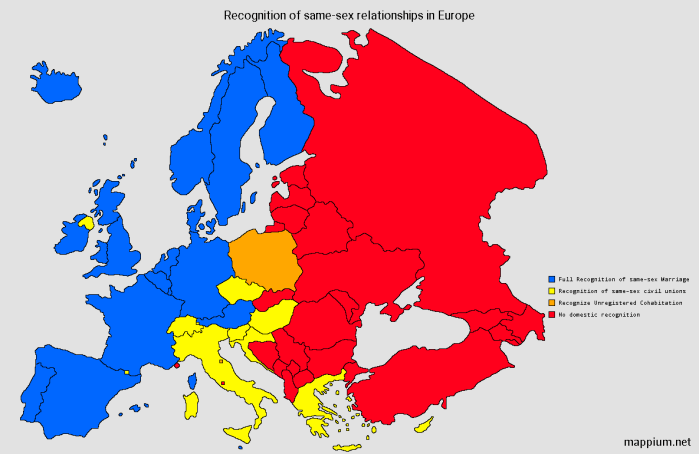
Opponents of gay marriage might have trouble explaining this one, at least in the free world.
Too many shadows whispering voices. Faces on posters too many choices. If when why what how much have you got…
Opponents of gay marriage might have trouble explaining this one, at least in the free world.
Too many shadows whispering voices. Faces on posters too many choices. If when why what how much have you got…
The European Union (EU) has put forward a plan for enhancing connectivity within Asia, and has been dubbed as the Asia Connectivity Strategy.
The EU does not want to give an impression that the Asia Connectivity Strategy (ACS) is a counter to the Belt and Road Initiative (BRI). Yet, senior officials of the EU, while commenting on the broad aims and objectives of the project, have categorically stated that the primary goal of the Asia Connectivity Strategy is enhancing connectivity (physical and digital) while also ensuring that local communities benefit from such a project, and that environmental and social norms are not flouted (this is a clear allusion to the shortcomings of the BRI). There are no clear details with regard to the budget, and other modalities of the project (EU member countries are likely to give a go ahead for this project, before the Asia-Europe Meeting in October 2018). The EU has categorically stated that it would like to ensure that the ACS is economically sustainable.
Other alternatives to BRI: the US
It is not just the EU, but also the US, along with Japan and Australia, which are trying to create an alternative vision to the BRI.
We shared the stage with other graphene projects as BitSpark, DasCoin, PayGer, BitCrab, RuDEX and many others. I look forward to work together with anyone that seeks to decentralize our future, that has a vision in which every human being is free, and where blockchain technology provides the tools to secure our rights to life, liberty, and property.
Stan Larimer was there as well, and he had something interesting to say about how BitShares will import EOS technology through a middle-layer. This will greatly benefit the whole BitShares/Graphene community, including Serey.
Regarding my own presentation, I have made the case that Blockchain is not only a technological revolution, but essentially a social, political and economic revolution. I believe it’s a tool that will move us into a more decentralized world that was envisioned by the earliest internet adopters. As more internet applications were built, it became clear that it would not become as decentralized as these adopters hoped. These applications suffered from a centralized system in which data was stored and controlled on a single or a small number of servers. Those who controlled these servers, the men-in-the-middle, dictated the rules of the platform. They could look into your data, modify your data, prevent you from accessing your data etc.
Blockchain eliminates these so-called “men-in-the-middle”. Its censorship-resistant property provides many great opportunities for developing countries where the rule of law are often weak or underdeveloped. One opportunity that I have been trying to seize in Cambodia is the creation of a social media platform that could not be controlled or censored by a single party. As Cambodians are becoming more tech savvy, and more connected to the outside world through internet access, it’s a great time to roll out a Blockchain-based social media platform where people can express themselves freely. The advantage of a social media is that it’s easier to build the network effect that can reach critical mass in a relatively short period of time. Once we gain enough momentum, I would like to tokenize the national currency, the Riel, develop a Serey Wallet, and provide anyone who has access to the internet the opportunity to open a wallet (bank account) for free and use our tokenized Riel for e-commerce, remittances, savings, loans etc. Although Cambodia has experienced tremendous economic growth in the past two decades and the World Bank has moved Cambodia’s status from a lower-income bracket to a lower-middle-income bracket, 83% of Cambodians still remain unbanked.
Doing so, I hope we will promote freedom of expression and an intellectual society in Cambodia, as well as help banking the unbanked.
Below, you can find my slides for the presentation.
It turns out that SCOTUS appointments have had a long history of dividing American society. An excerpt:
9. Roger Taney (1836-64). Taney rose up the political ranks as Andrew Jackson’s right-hand man. Jackson tried to get him on the Supreme Court in 1835 but his nomination was rejected by anti-Jacksonian Whigs in the Senate. After the Whigs were swept away in the 1836 election campaign, Jackson renominated Taney, but this time for the position of Chief Justice, and he was confirmed 21-15 after a bitter debate in the Senate. The Taney court is responsible for the Dred Scott case that tore the fledgling republic apart, and for helping Jackson abolish the national bank. Taney and Lincoln clashed often, too, as Taney ruled that Lincoln’s suspension of habeas corpus was unconstitutional, but Taney never did go home during the Civil War and served out his term as Chief Justice until his death in 1864. He holds the second-longest tenure of any Chief Justice.
Please, read the rest, and try to remember: this divisiveness is a feature of the system, not a bug.
On September 9, 2018 Myanmar and China signed a memorandum of understanding (MoU) for establishing the China-Myanmar Economic Corridor (CMEC), as part of China’s ambitious Belt and Road Initiative (BRI). The corridor will traverse a distance of approximately 1700 kilometres and seeks to connect Kunming (in China’s Yunnan Province) with Myanmar’s key economic points – Mandalay, Yangon, and Kyauphkyu.
According to the MOU, both sides have agreed to collaborate in a number of areas. Some of the important areas identified for collaboration by both countries are: infrastructure, construction, manufacturing, agriculture, transport, finance, human resources development, telecommunications, and research and technology.
Chinese Foreign Minister Wang Yi had first announced the proposal to build CMEC during his meeting with Myanmar’s State Counselor Aung San Suu Kyi in November 2017. The MOU had been finalized in February 2018.
The CMEC is an ambitious project from which Myanmar could benefit immensely. Yet, there have been apprehensions with regard to the economic feasibility of the project, and Myanmar does not want to meet the fate of other countries which have fallen into what has been dubbed as a ‘Debt Trap’.
Opposition to Kyauphkyu
There has been skepticism with regard to the BRI project in general, and China’s involvement in the SEZ and Sea Port to be set up in Kyauphkyu (a coastal town in the Rakhine Province) in particular. Large sections of the population have been questioning the economic rationale of the project – and the benefits for Myanmar. CITIC (China’s biggest financial conglomerate) was awarded both projects, but it had to reduce its stake from 85 percent to 70 percent in the Sea Port after vehement opposition from the local population. Locals found the 85-15 arrangement unreasonable. Fearing a debt trap, the NLD government in Myanmar has also reduced the initial value of the Sea Port project – a whopping $7.3 billion USD to $1.3 billion. There has been opposition to the SEZ as well (mainly on environmental grounds), and while the initial Chinese take in the SEZ (originally valued at $2.7 billion) was 51 percent, it is likely to be revised.
U Kan Zaw, a Minister in the erstwhile Than Sein government (and Chairman of the Kyauphkyu SEZ tender committee), confessed that Myanmar was not very keen for Chinese investment (it had sought investments from the UK and Europe), but it was not left with any other option once other countries declined to invest.
China beginning to acknowledge shortcomings of BRI projects
Of late Beijing has expressed a willingness to re-examine some aspects of BRI-related projects (including CMEC and the China Pakistan Economic Corridor – CPEC). On the face of it, at least Beijing seems open to addressing the worries of countries which are part of the BRI.
Chinese media itself is trying to send a message that Beijing is responsive to concerns of countries which are part of the BRI initiative. A recent example is an article in CGTN on CMEC, which acknowledged not just the drawbacks of the project, but also the fact that the response to CMEC has been tepid so far in Myanmar. Said the article:
CMEC is temporarily suffering from a cold reception, we believe that it is an excellent endeavor.
The authors of the article also makes a significant point: that Chinese businessmen are not familiar with Myanmar. While the article could be referring to the lack of familiarity with Myanmar’s policies, many host countries have been critical not just of the ‘one sided’ nature of Chinese economic investments, but their unwillingness to understand local cultures, and the fact that they remain aloof from the local population.
On a number of occasions, Chinese businessmen have even misbehaved with locals. In Pakistan, on two occasions, Chinese businessmen have beaten up policeman, and this did not go down well with the local population.
While alluding to the failure of big ticket infrastructure projects, the article also refers to the need for Chinese investments in ‘light industry’ as opposed to ‘heavy industry’ (in a reference to infrastructural mega projects, such as those which were scrapped by Malaysian Prime Minister Mahathir Mohammad).
One of the interesting aspects of CMEC is that Myanmar was keen to have third party investments, and not restrict itself only to Chinese investments. Investments will come from countries in South East Asia and East Asia — Thailand, South Korea, and Japan. While China’s economic presence in Myanmar is staggering, this has not gone unchallenged and of late countries like South Korea are also increasing their presence in Myanmar. The authors of the CGTN article also try to pitch for Chinese cooperation with other countries, arguing that joint investments will mean not only lesser economic and political burden for China, but that they could also reduce hostilities between Western and Chinese companies.
Finally, the article speaks about the need for greater cooperation between Myanmar and China in the sphere of agriculture (especially aquaculture), and that this cooperation should be economically beneficial for the local population.
Conclusion
It remains to be seen whether China will actually acknowledge the genuine concerns of countries participating in the BRI, and whether or not it will actually take some tangible steps to address the apprehensions. As stated earlier, Beijing seems slightly more flexible in its negotiations, but whether this is a short term trend (which many would argue is a consequence of Malaysian PM Mahathir Mohammad’s straight talking with China) or not remains to be seen.
China may be further compelled to change its approach towards overseas economic investments after the recent electoral rout of Abdulla Yameen (outgoing Maldivian President), considered to be pro-China. One trend which is clearly emerging, as was evident from the electoral verdict of Maldives, was that leaders (many of whom position themselves as strongmen) blindly following Chinese diktats for short term economic goals does not go down well with ordinary citizens, and China may need to address its perception problem by looking beyond Cheque book Diplomacy.
(new title)
Recently, China’s consular general in Kolkata, Ma Zhanwu, while speaking at a function, proposed a bullet train connecting Kunming (in China’s Yunnan Province) with Kolkata, the capital of India’s eastern state of West Bengal. Said Ma:
With joint efforts of India and China, a high-speed rail link could be established between the two cities.
It would be pertinent to point out that the proposal for a bullet train connecting Kunming and Kolkata had been discussed earlier at the Greater Mekong Subregion (GMS) meet in 2015. In fact, enhancing connectivity between India and China through the Kolkata-Kunming multi-modal corridor (officially the Bangladesh-China-India-Myanmar Economic Corridor, or BCIMEC), which covers a distance of 2,800 kilometres, has been under discussion for over 2 decades, through the Track II K2K (Kolkata-Kunming) dialogue. During former India Prime Minister Manmohan Singh’s China visit, in October 2013, sister city relations were established between Kunming and Kolkata.
In recent years, China has been pro-actively reaching out to West Bengal Chief Minister Mamata Banerjee, and has invited her to visit on repeated occasions, though she has been unable to visit (she was all set to visit in June 2018, but her trip was cancelled at the last moment). Apart from this, a number of Chinese investors have expressed interest in investing in West Bengal and even attended the Bengal Global Business Summit 2018.
Given the increasing emphasis on connectivity with South East Asia, through India’s North East (one of the key aims of India’s ‘Act East Policy’), it was believed that the BCIMEC would tie in neatly with India’s vision for connectivity.
However, tensions between India and China – due to the Doklam standoff as well as Beijing’s insistence that BCIMEC be included in its official Belt and Road Initiative (BRI) – have contributed to a wane in New Delhi’s interest in the project, at least for the time being. The Rohingya crisis, and more general tensions between Bangladesh and Myanmar, are also a major impediment to the project.
The China Myanmar Economic Corridor: Why New Delhi should pay close attention
While a high speed train is an ambitious project, New Delhi can not be closed to the BCIMEC and should pay close attention to the China-Myanmar Economic Corridor (the Memorandum of Understanding for this project was signed on September 9, 2018). While the China-Myanmar Economic Corridor (CMEC) has been under discussion for some time, there have been numerous debates with regard to the economic implications for Myanmar (the Kyaukphyu Deep Sea Port project, as well as Special Economic Zones, have been contentious). The increasing debate on the issue of ‘debt trap diplomacy’ has only increased apprehensions within sections of the Myanma government (the stake of Chinese conglomerate CITIC in the deep sea port has been reduced from 85 percent to 70 percent due to domestic pressures). Myanmar has also made it clear that it would not like to depend only on Chinese investments, and the recently-signed MOU categorically states that third party investments from Japan, South Korea, and Thailand in CMEC projects are more than welcome. Interestingly, an article on CMEC in Chinese media acknowledges some of the apprehensions vis-à-vis CMEC, and also bats for closer cooperation between China and other Asian and Western countries.
The proposal for the bullet train connecting Kolkata-Kunming came days after the agreement had been signed between China and Myanmar. China would like to extend this corridor all the way to India (while speaking about rail connectivity between Kunming and Kolkata, the Chinese diplomat also spoke about an industrial cluster along the route).
How should New Delhi play it?
While New Delhi’s objections to the BRI are valid, it does need to shed blinkers. It is free not to participate in those components of the project with which it is not comfortable, but there are projects, like the BCIMEC, where it can easily find common ground with China. This will give a boost to India’s infrastructure in the eastern and northeastern part of the country, and complement it’s Act East Policy. If third countries are allowed to invest in CMEC, Indian companies should explore opportunities, as this will enhance their presence in Myanmar while also bolstering the Act East Policy.
China’s narrative in South Asia
Post the Wuhan Summit, there has been a clear change of narrative from the Chinese side. China has expressed its keenness to work jointly with India in Afghanistan – in capacity-building projects. This was unthinkable a few years ago.
China’s burgeoning economic relationship with Nepal has sent alarm signals in New Delhi. China’s decision to give Nepal access to its ports (Tianjin, Shenzhen, Lianyungang and Zhanjiang) raised the hackles in New Delhi. Pragmatists realize that New Delhi can not dictate Nepal’s ties with China, and the fact is that Kathmandu would like to benefit economically from its ties with both China and India.
Interestingly, China has been urging Nepal to strengthen economic ties with India. During his visit to Beijing, Nepal’s Prime Minister, K.P. Oli, made an unequivocal pitch for strong ties between Kathmandu and New Delhi (as well as Kathmandu and Beijing). He stated that the economic progress of both India and China was an opportunity for Nepal, and stated that Nepal wanted to emerge as a bridge between both countries, and would not like to get embedded in zero sum geopolitical games. Nepal’s former Prime Minister, Prachanda, during his visit to India, also referred to the need for close ties with both India and China.
India should also keep in mind a few other points
While many in New Delhi are pointing to Malaysian Prime Minister Mahathir Mohammad’s stand against Chinese projects, it is important to keep in mind that while the Malaysian PM has scrapped a few projects, he has continued to reiterate the relevance of the China-Malaysia relationship (there is need for nuance). Second, it is one thing to point out the shortcomings of the BRI project, but India needs to prove its own track record in big ticket connectivity projects (New Delhi has been extremely slow when it comes to the implementation of connectivity projects within the neighbourhood). Third, there are areas where India is already working with China, so rigidity and paranoia do not make much sense. If even Japan is willing to participate in certain projects of BRI, there is absolutely no reason why India should not at least be open to elements of the project. It is also important to look at connectivity from an economic dimension and not a narrow security prism as large sections of India’s strategic community do. Finally, New Delhi can not put all its eggs in the American basket. While India’s strategic relationship with the US has witnessed an improvement, and Washington has repeatedly spoken about the need for greater connectivity within the ‘Indo-Pacific’, the US is not likely to invest significantly in economic connectivity projects. India thus can not be totally dismissive of Beijing-led connectivity initiatives.
While New Delhi needs to exhibit pragmatism, Beijing on its part needs to address the concerns of India, and other countries, with regard to the BRI.
 Notes On Liberty