Back in Brazil: more impressions

Another thing that calls my attention in Brazil (or rather, in Rio de Janeiro) are the crazy traffic jams. All day long, traffic moves painfully slowly. Really. There is no rush hour. Every hour is rush. The reason is not hard to understand: there are way too many buildings for too few streets and poor options in mass transportation.

Thinking about this, I came across this excellent text. It is in Portuguese, so for those who can’t read it, I’ll summarize. Basically, zoning laws in Rio de Janeiro through the 20th century were completely crazy, following a very nasty relationship between politicians and real state companies. A company wanted to build taller buildings and profit, the city hall would not oppose, especially when a luxurious apartment was waiting for the mayor. The result is that old neighborhoods like Tijuca and Botafogo simply have no space on the streets for so many cars.

But what is the problem with many tall buildings? That’s what New York is all about, and I simply love the Big Apple! Well, that’s true, but NY has something that Rio doesn’t: a great mass transit system. Rio has four subway lines. Or three. Wait, maybe it’s just one. Here is the thing: on paper, Rio has four subway lines, which already makes no sense, since it only has lines 1, 2 and 4. Line 3 was planned but never built. Line 4 is just an extension of line 1, and line 2 trains enter line 1 (!). Although the system was privatized in the 1990s, it is very clear that it maintains a very suspicious connection with the state government. Sergio Cabral, Rio’s former governor, and presently in jail, was married to a lawyer who defended the Metro company. It is also clear that bus companies subsidize politicians who maintain their interests. In sum, Cariocas are hostages to a terrible public transport system that favors a criminous relationship between big companies and politicians.

Rio ends up representing very well a problem we see all over Brazil: people believe this is capitalism. Because of that, they vote for socialist parties. It should be painfully obvious from the examples of USSR, Cuba, Venezuela, Nicaragua, North Korea, China, Vietnam, Eastern Europe, and so many others that socialism simply doesn’t work. But here is the thing: people in Rio (and actually in Brazil and Latin America in general) suffered and suffer so much under crony capitalists that they can’t help but thinking that socialism might be the answer.

Hear, World! Socialism failed, just like Mises predicted. But as long as people suffer under crony capitalists, it will still be appealing, be it in a poor neighborhood or a college campus in the US, be it in a poor country in Latin America. The job is not done. Freedom isn’t free. We still have a long way to go freeing people from evil.

Back in Brazil: first impressions

After almost two years living in the US, I’m back in Brazil, more precisely in Rio de Janeiro, for a short visit. When I left Brazil two years ago, I was hoping that Bolsonaro would be elect president and that with that things would start to change for the better. I still have hope, but change is slower than I would wish.

Things in Brazil are crazily expensive. One liter of milk is almost 4 reais. One liter of gasoline is 5 reais. Considering that a poorly skilled worker makes less than 2 thousand reais, imagine how much it costs to live in Rio de Janeiro. If you live in the US, just remember how much you pay for a gallon of milk or gasoline. And also how much a poor, very simple worker makes in the US.

But thankfully Brazil has universal healthcare! Only that hospitals have always been terrible here. Seems to me that Brazilian TV has a video that they just play in a loop, showing how terrible it is. Sadly, mainstream media continues to ask the government for better health (and better education, and better services in general) instead of admitting that government-run services will simply never be good.

Brazilians (or at least people in Rio) are also very aggressive. I believe I understand why. Everyone here has been deeply hurt.  “It´s the law of the jungle”. Or “grab what you can and let the devil take the hindmost”. Injustice has hurt these people pretty deeply.

So, yeah. Keeping desiring Socialism! Keep supporting the likes of Bernie Sanders and Alexandria Ocasio-Cortez. Nothing has helped poor people over the years more than free markets. Few things have hurt them more than socialism. Coming back to Brazil, I can tell.

Will the conservatives usher in a federal Europe?

Bill Wirtz does a great job reporting, in the American Conservative, on recent developments in European politics. Basically, the “populists,” who are socially conservative by European standards and anti-immigrant, are not actually opposed to the European Union. In fact, these right-wing parties are building international coalitions as you read this in order to better wield the dormant power of the EU; nobody is “actively seeking to leave the EU.”

Wirtz concludes that the anti-immigrant populist parties will spell the end of the European Union as we know it, but how can this be if these populists now want to use the EU rather than leave it? Wirtz is a great reporter but I think he wanted to mock Europhiles and the dreams of Euro-federalists rather than think things through. I’m happy to pick up where he leaves off, though.

For example, what if these populists succeed in federating Europe, rather than breaking it up? It’s not as radical as it sounds. The populists are small-d democrats. The populists are actively working with each other in an internationalist framework. The populists share the same anti-immigrant goals. The populist parties of Europe share the same opinion of Western civilization and believe their way of life is under threat. The populists realize that the EU can help them achieve their goals, and they share an affinity for some semblance of local (“national”) sovereignty. The ideological underpinning of these populist parties seems to be, then, that their way of life – their freedom – is under threat, and that they are not united and therefore susceptible to outside threats, and that the European Union is a great way to help them achieve some semblance of unity and security. Why not federate? Why not cure the mischiefs of faction?

Conservatives have a long track record of supporting radical change if it suits their worldview, too. The best example of this in politics is Otto von Bismarck, the Prussian diplomat who patched together a unified German state in a federal manner, but you don’t have to stop there. Examples abound everywhere.

The populists and could-be federalists aren’t going to usher in a new era of fascism, either. Today’s anti-immigrant sentiments are very different from the anti-Semitism that has plagued Europe for centuries. While I am disappointed that the European elections were essentially won by the anti-immigration faction, I am not surprised. I would not be surprised, either, to see a strong federalist push by these populists.

Some lessons from Brazil

Jair Bolsonaro has been in government for almost six months now. I believe I can proudly say that I saw this coming before many people: Bolsonaro would be the next president in Brazil. However, he might not be the best person for the job.

In my assessment, Bolsonaro is not the usual politician. As John Mearsheimer brilliantly observed, politicians lie. A lot. It should be a given: dogs bark, cats climb on trees, and politicians lie. Bolsonaro, as far as I can tell, doesn’t. And that might be part of the problem: he always speaks his mind. Nothing is concealed, even when strategy might call for that.

In the past week, Bolsonaro sent an open letter to some of his followers (not written by him) manifesting how hard it is to govern Brazil. The letter sounds like a vent for the president’s frustration: “You Either Die A Hero, Or You Live Long Enough To See Yourself Become The Villain”. But what Bolsonaro means by all that is not clear. For all sorts of reasons, corruption is a living part of Brazilian politics. Actually, of politics in general, just a little more down there. So why the president sounds surprised by that?

Some people in the press speculated that Bolsonaro plans a coup. Call that it is impossible to govern with the current congress and just close it. To be sure, that is not unthinkable, and Brazil has historical precedents for that. But that doesn’t sound like something that Bolsonaro would do. Sounds more like that he is trying to bypass Congress and govern with direct popular support.

Brazilian congress is fabulously corrupt, and Bolsonaro still enjoys great popularity. Maybe he wants to use that to press Congress for the changes Brazil needs. In any case, it is a good opportunity to remember some lessons: power corrupts and absolute power corrupts absolutely. Or, in other words, if men were angels, we wouldn’t need government. And if we were governed by angels, we wouldn’t need checks and balances. But we are not governed by angels. Therefore, checks and balances are necessary. The downside is that this makes the government slow when important changes are necessary. The temptation is to close democratic institutions and just do things the old fashion way: through a dictatorship. I don’t think that is where Brazil is going right now. But it’s important to remember that we need way more than a president. We need people who really understand and appreciate freedom. An uneducated people on these matters will always grow impatient and vote for an easy solution.

How US foreign policy hurts Christians worldwide

Christians are the most persecuted religious group worldwide. The 20th century produced more Christian martyrs than any other period in history. During a great part of that century, Christians were mostly persecuted by totalitarian regimes in communist countries like the USSR and China. Today persecution still comes from communist governments, such as the ones in China, Cuba and North Korea, but mostly Christians are persecuted in countries where Muslims control the government. With that in mind, I would like to answer two questions: Why is that and can Christians in the West do something about it?

Typically, Christians (and other religious groups) are persecuted by totalitarian governments. The definition of a totalitarian regime is that it can comport no opposition or dissidence. A totalitarian regime is characterized by the attempt to control your whole life, including your religious life. Totalitarian regimes fear losing control over their population. Christians gathering for worship are mistaken for a seditious group. This is the reason why these governments persecute Christians.

Until World War I, US foreign policy was mostly characterized by what is typically defined as isolationism. US presidents since the Founding Fathers understood that Europe was a mess and that the US would do well to keep away from political entanglements with it. This changed with Woodrow Wilson. Wilson understood that it was the US’ mission to rebuild the World after its own image. With that in mind, he struggled, against the US population, to get the country into World War I.

US involvement in World War I proved to be essential for that war and for all US foreign policy since then. The tendency in Europe, since the 17th century, was for major wars to end with a new power equilibrium. This is not hard science, but pretty much every hundred years Europeans would fight a major war and then rest for another hundred. That was so with the 30 Years War, the War of Spanish Succession, and the Napoleonic Wars. All these conflicts had one thing in common: the emergence of a new great power in Europe moved other countries to balance that power. The tendency, in the end, was equilibrium. That was the case with World War I: the European system was balanced after the Napoleonic Wars. However, towards the end of the 19th century, Germany emerged as a new great power. Other countries allied against it. This scenario was delayed by Otto von Bismarck’s brilliant foreign policy but proved ultimately inevitable.

World War I should end like any other European War since the 17th century: that generation realizes that it is impossible for a single country to dominate the entire continent, diplomats accept the status quo and anyway, everybody becomes war-weary and more inclined to peace. But US intervention prevented that from happening. My hypothesis (that I have no idea how to test) is this: without US intervention, World War I would finish with peace without winners. It would be considered a draw. With US intervention, however, France managed to punish Germany for the War. Germany, on its part, became vengeful against France. England understood that it was better to stay on the other side of the channel. World War I became only the first half of a major conflict that continued some twenty years later with World War II. If in World War I US involvement was optional, in World War II it became inevitable. And after World War II came the Cold War, and the US hasn’t stop ever since.

US involvement in World War I had a number of consequences. German revanchism against France gave way to the rise of Nazism. In Russia, the Bolsheviks rose to power as well. Another effect of World War I was the end of the Turco-Ottoman Empire. Following Woodrow Wilson’s vision, that empire was to be divided into several countries, according to several ethnic groups identified by westerners. In actuality, England and France took the chance to divide the Middle East into several colonies. Christians were persecuted in Nazi-Germany and the USSR. The Middle East is a mess to this day. Before World War I, American missionaries were welcomed in the Turco-Ottoman Empire.

British ones were not, because that empire understood (I suppose correctly) that they would be hard to separate from the imperialist interests of Great Britain. The US mostly took England’s place in this regard. To make matters worse, oil was the fuel of the second industrial revolution that began at the end of the 19th century. Soon after, it was discovered that the Middle East had some of the greatest deposits on the planet. The US became the first world superpower, and to maintain that it needed oil. Lots of oil. It is a vicious cycle.

In sum, I am blaming Woodrow Wilson and his foreign policy for everything bad that happened ever since. The Founding Fathers had a very good foreign policy, that made the US and US citizens welcomed worldwide. Woodrow Wilson broke that pattern, much because he was a liberal Christian who thought that the US role was to make the world democratic by force.

I don’t think it’s too late to change. It might be unthinkable to just withdraw from every international commitment the US has today, but it is definitely time for a gradual change. A world without major US military intervention may be – counterintuitively – a world safer for Christians.

Theories of International Relations: Realism

Someone (I don’t remember who) said that International Relations is the academic discipline of disagreement. Internationalists disagree on mostly everything, beginning by how to view their object of study. With that said, the discipline of International Relations has been historically dominated mostly by two theoretical schools, Realism and Liberalism. Some other minor schools, such as Constructivism and the English School also have significant influence. With that in mind, I believe it might be useful to post something here about the theory of International Relations.

Although the chronology is highly disputed, it can be defended that Realism is the first theory of International Relations, going back to Thucydides in Ancient Greece or to Machiavelli in late medieval/early modern Europe. In any case, Realism is arguably the most influential theory of International Relations, partially for its influence in actual statecraft (in opposition to academic thinking). Realists come in many shapes and colors, but I believe that most of them present some core characteristics:

The first thing that most (or in this case, all) Realists believe in is that the international system is anarchic. Actually, this is something that virtually any student of International Relations believes in, because… it is! When we say that the international system is anarchic, we are not saying that it is a mess or a state of permanent war. In international relations, the definition of anarchy is more simple: it means that there is no formal hierarchy of power between countries. Of course, countries have a clear hierarchy of power, with some being much more powerful than others. However, all countries are formally sovereign and independent. Countries recognize themselves as their ultimate authority. Each one of them.

A second thing that Realists believe is that countries (or in the more technical vocabulary, states) are the main actors of the international relations. Although we can speak of international corporations and international institutions, in the end, the actors that really matter are countries, especially great powers. That is so mainly because they have military capabilities. Coca-Cola may have lots of money, but not an army.

Finally, Realists believe that countries have a relationship of competition. They tend to see each other as potential enemies. Maybe not actual enemies, but certainly potential ones. Because of that, countries have to defend themselves against one another.

There are many more characteristics that we could add to this list, but I believe that these are the essential points of realist thinking in International Relations. Realists call themselves realists because they believe they see reality as it is, not in an idealized manner. I tend to agree. I believe that history proves that unfortunately, International Relations work in a realistic way. And this is something that, I believe, is key for at least many realists, and that is too often misunderstood: realists are not saying that international relations should be this way. They are saying that [sadly] they are this way. If you analyze international relations objectively, you will find out that countries (even the ones you like) and politicians (even the ones you believe are so nice) act in very selfish ways.

Realists are accused of leaving little or no room for change. But is this a fair assessment? I wish! But most other schools of International Relations fail to present plausible ways in which the international system could be improved, leading to more peace and prosperity for all.

Venezuela, still going down

Venezuela crisis seems far from being solved, and the country now is entering into actual civil war. Some thoughts on that:

Contrary to leftist conspiracy theory and popular belief, the CIA does not interfere in other countries every other week. The last major US intervention to take down a government in a big country was in Iran in 1953. In the long run, considering the Iranian Revolution of 1979, it didn’t go too well. Therefore, it is understandable that today people in the White House are cautious.

Also contrary to popular belief and leftist conspiracy theory, the US hasn’t interfered much in Latin America in the past seventy years or so. Interventions in Central America and the Caribean were commonplace in the first decades of the 20th century (mostly during the progressivist government of Woodrow Wilson) but mostly cooled down in the 1930s.

Latin America in general and Venezuela, in particular, has little democratic experience, and this has nothing to do with outside forces. The counties in the region simply tented to make bad choices, rejecting classical liberalism in favor of mercantilism and political centralization.

Internationally, I believe that John Mearsheimer presented the most convincing theory to date: all countries desire to be superpowers. That’s the best way to feel safe in an anarchic world. However, given the dimensions of our planet and the current state of our technology, it is impossible for any country to be a global hegemon. Given that, they try the next best thing: to be regional hegemons and to stop other countries from being hegemons in their regions. The US is clearly the hegemon in the American continent. China and Russia are not happy with that and will try anything to change it. In the last few decades, both countries invested heavily in Venezuela, including its military capabilities.

On a regional level, Brazil could balance Venezuela to some extent. But it can’t, because the Worker’s Party trashed the country, while at the same time helped Venezuela. Brazil is too busy solving its own problems.

Sadly, Venezuela is by itself. While Nicolas Maduro has oil to buy his generals, and they don’t suffer from a conscience crisis, the humanitarian crisis will endure.

Brazil, 1984

Danilo Gentili, one of Brazil’s most famous and popular comedians, was convicted and sentenced to seven months of prison time for defaming Maria do Rosário, a Brazilian federal congresswoman with a suggestion that she was a whore in a YouTube video. I wrote about Maria do Rosário before here.

Danilo has been literally on the Worker’s Party blacklist for many years because of his political remarks against it. His “crime” this time, according to the official sentence, was to offend a congressperson. The same kind of defamation against a “normal” citizen would not lead him to jail. Here is what happened: in his twitter account, Danilo criticized Maria do Rosário, saying that she was a hypocrite. The reason was because José de Abreu, a Brazilian actor famous for supporting the Worker’s Party, spit on the face of a woman in a restaurant after she criticized his political positions. Abreu did that shortly after Jean Wyllys, a former Brazil congressman, spit on Jair Bolsonaro. Maria do Rosário, who always presents herself as a feminist, defended José de Abreu. Danilo commented in the case in his twiter account saying that Maria do Rosário was a hypocrite. The congresswoman sent Danilo an official congress letter asking him to delete his twits. The comedian answered putting the letter inside his paints and then sending it back, an action he recorded on video and uploaded to YouTube.

In a similar case, not too long ago, Supreme Court judge Enrique Ricardo Lewandowski threatened with jail an airplane passenger who, turning to him, said he was ashamed of the Supreme Court. Lewandowski is often perceived as defending the Worker’s Party and its interests.

Why do I so frequently write in English about Brazil? In part because I want a broader audience who doesn’t know Portuguese to know what is going on there. As far as I know, for quite some time people outside Germany or the USSR thought that they were doing pretty well. Little did they know. Also because I want to offer a counterpoint to the (more often than not) leftist media that calls Bolsonaro a far-right racist, misogynist. Finally, because I hope that people from outside who read this might engage with the cause of freedom in Brazil. George Soros and others are engaging with the cause of slavery. They count on you not caring about it.

As I wrote before, Brazilian democracy is under threat. And it is not because of Jair Bolsonaro.

School choice at the Supreme Court

Another school funding case is knocking at the U.S. Supreme Court’s door. This case, Espinoza v. Walborn, hales from Montana, where the state’s fledgling school-choice program was killed moments after it left the crib. The Court now has a chance to revive it and land a major victory for educational choice across the country.

Montana’s first school-choice law, passed in 2015, took the form of a tax-credit scholarship program. If a taxpayer donated to an approved scholarship organization, she could claim up to $150 of the donation as a tax credit. The scholarship organizations then dished out scholarships to help parents afford to put their kids through private school.

Then the Montana Department of Revenue gutted it. The Department promulgated a rule that none of that scholarship money could go to religious private schools. This basically killed the program, since the vast majority of private schools in Montana–and in most states–are religious schools.

The Department claimed that the state constitution prohibited the scholarship dollars from going to religious schools because of the state ban on indirect public aid to religious schools. This is an absurd argument. The scholarship funds are privately donated dollars–they never touch a public coffer. The fact that someone can claim a tax credit hardly means that the donation becomes “public funds” because of diverted revenue. Such an argument, extended to its logical conclusion, would mean that all money is the government’s, and when it graciously declines to tax us, that extra money of ours is in fact part of the public fisc.

Nonetheless, the government prevailed at the Montana Supreme Court. In fact, the Court did the state one better–they just invalidated the whole tax-credit program, even for the few parents who might use a scholarship to send their kids to a secular school.

It’s a terrible blow to parents in Montana trying to find some genuine variety in education. But it also gives the Supreme Court a chance to right a wrong that has been festering in education policy for well over a century. The Supreme Court should hold that barring religious schools from accessing a neutral and generally available funding program violates the Free Exercise Clause and the Equal Protection Clause of the U.S. Constitution.

The portion of Montana’s state constitution that laid the tax-credit program in an early grave is known as a Blaine Amendment, named after 19th-century Congressman James Blaine. In 1875, Blaine proposed a federal constitutional amendment that would, among other things, prohibit states from funding “sectarian” schools with public money. Blaine’s federal amendment failed, but many states passed state-level amendments to the same effect, and Congress managed to make inclusion of such amendments a condition of statehood for new states entering the union.

The history is clear that these amendments are rooted in anti-Catholic bigotry. As the United States transitioned to a public school system, public schools had a distinctly Protestant flavor (often state-endorsed or even state-forced). Catholic migrants therefore began forming and attending private religious schools of their own. The backlash was fierce, and anti-Catholic sentiment often expressed itself in hostility to Catholic schools. James Blaine’s proposed amendment was a key manifestation of this bigotry.

And the bigotry lives on today. Ironically, however, now opponents of genuine choice in education have retrofitted Blaine Amendments as a partisan weapon to combat vouchers, tax credits, and education savings accounts. Montana’s law is only the most recent victim. If the Supreme Court doesn’t grant this case and strike down these state laws rooted in religious bigotry, it won’t be the last.

Nazism: left or right? (again)

A few days ago, Brazil’s Foreign Affair’s Minister declared that Nazism “derives from the left”. Asked about his minister’s remark, president Jair Bolsonaro confirmed that he understands Nazism as a left-wing movement.

The understanding that Nazism is a left-wing movement is growing among Brazilian conservatives, especially those who support Bolsonaro’s government. On the other side of the debate, Bolsonaro’s adversaries ridiculed his remark or manifested concern with his “historical revisionism”.

Seems to me that classifying Nazim as a left-wing movement is not a Brazilian exclusivity. Political commentators from other countries (such as Dinesh D’Souza) are saying the same thing. It is probably more accurate to say that Brazilians are following a trend.

This trend, however, is not new. One of Friedrich Hayek’s main points in Road to Serfdom was to tell social democrats (who were indeed democrats in the classical liberal sense of the word) that they were closer to Nazis than they would like to admit. Hayek’s remark was as polemic then as it is now, but mainly because he is saying the truth: as Milton Friedman said, “The society that puts equality before freedom will end up with neither. The society that puts freedom before equality will end up with a great measure of both.” If I remember correctly, it was also Friedman who said that in order to obtain perfect equality more government would be necessary, which would completely undermine the desire for equality, for those in government would most certainly not be equal to everyone else.

The standard in Political Science is, of course, to call Nazim a right-wing movement. However, we see in moments like this how political and how little scientific Political Science can be. What many people observe is that Nazism shares a lot with communism: both are violent, both emphasize the collective (and not the individual), both rely on popular leaders, and so on. Of course, there are also differences: Nazism has nothing of the class-struggle so central to communism and certainly doesn’t appeal to the cosmopolitanism present in “workers of the World, unite!”.

With all that said, I have a growing feeling that there are only two political tendencies: “live and let live” and all others. Some people can’t stand the possibility of having others living a different lifestyle from them. Some people can’t stand people who disagree. Some people like to blame others. Some people truly believe that those who think and do like they do are superior to everyone else. These people come together and ask the government to force everyone else to comply.

Conservatives vs Liberals vs Libertarians

What I’m going to say here is far from original, but I believe it is worth reminding from time to time. Yes, there is a lot of over-simplification here, but bear with me! This is the difference between conservatives, liberals, and libertarians (or at least this libertarian who writes):

Gun control:

  • Liberal: Guns are dangerous! People should not have guns!
  • Conservative: From my cold dead hands!
  • Libertarians: I personally don’t like guns and I wouldn’t like to have one. But I believe that people who so desire should have the right to own guns.

Drugs:

  • Liberal: Marijuana is less dangerous than alcohol and should be legalized!
  • Conservative: Marijuana is a gateway into heavier drugs and should be prohibited!
  • Libertarian: Although I personally never did drugs and have no desire to do so, nor have deep knowledge of how particular drugs are heavier than legalized substances or not, I believe that people who want to do drugs should not be prohibited from doing so.

Foreign Policy:

  • Liberal: We have to send more foreign aid. It is our moral responsibility! And who are we to judge which nations are democratic or not?
  • Conservative: The world is a dangerous place and it is our responsibility to police it!
  • Libertarian: Although I can see that the World is a dangerous place and I feel personally obligated to do something to help those in need, I don’t believe it is the role of the government to interfere in other nations.

Labor laws:

  • Liberal: We have to protect the poor!
  • Conservative: Capitalism is God’s way of deciding who is poor and who is smart!
  • Libertarian: I feel for the poor, and I believe we should do something to help. I believe that some governmental policies predictably hurt the poor and therefore should be changed. However, I believe that helping the poor should be mainly done by individuals and independent organizations, not by the government.

Crime in general:

  • Liberal: He is a victim of society!
  • Conservative: The chair!!!
  • Libertarian: External circumstances can explain and even attenuate certain crimes, but never justify it. On the other hand, if we are cruel towards criminals, we are becoming just like them. Also, throwing people in jail is very clearly an awful and simplistic way of dealing with crime and should think of other ways of punishment, always having reconciliation as an ideal.

Economics:

  • Liberal: We need more government oversight!
  • Conservative: The market will solve everything!
  • Libertarian:

Immigration:

  • Liberal: Open the border!
  • Conservative: Build a wall!
  • Libertarian: Completely opening the borders is abandoning any notion of nation-state. Nevertheless, we should be welcoming, though thoughtful, about immigration.

Education:

  • Liberal: Your kids are mine!
  • Conservative: We need to bring prayer back to public schools!
  • Libertarian: Education is fundamentally religious and reflects the values we aim to have. Maybe the state can have a very limited role in it, but the main responsibility belongs to the parents, who likely will instill their values on the children.

Politics in general:

  • Liberal: My party will solve everything!
  • Conservative: My party will solve everything!
  • Libertarian: There are no perfect solutions, especially not through politics. Do you want to change the World? Start by cleaning your room.

Brazil’s Military Coup, 55 years later

Fifty-five years ago, in 1964, Brazilian president João Goulart was overthrown and substituted by Castelo Branco, a military president. Until 1985 the country was governed by military presidents. To this day people are still debating the coup (some even denying that there was a coup), much because the victims and perpetrators are still commanding the debate. In light of that, I’d like to offer some thoughts about 1964 here.

In 1789, only thirteen years after the American Revolution, a small group of Brazilian discontents planned an independent attempt in the region of Minas Gerais. The movement failed miserably, leaving one infamous victim, Tiradentes, who would much later be considered the patron of Brazilian independence. In the following years Brazil saw many other revolts and independence attempts, but in 1808 a significant change of events took over the country: instead of fighting in Europe a war against Napoleon he believed he could not win, Dom João VI, the Portuguese prince-regent, decided to move his capital from Lisbon to Rio de Janeiro. However, some years later Dom João had to choose between staying in Brazil or losing his crown. He decided to go back to Portugal. His son, Dom Pedro I, remained in Brazil as a new prince-regent. Legend has it that, when embarking back to Europe, João turned to Pedro and said, “make the independence of this country before someone else does.”

And he did: on September 7, 1822, Dom Pedro I proclaimed Brazil’s independence and became the country’s first emperor. His son, Dom Pedro II, would succeed him in 1840 and rule until 1889 when the monarchy was overthrown, and the republic established. Now, just imagine if the king or prince of England or Spain proclaimed himself emperor of America. Well, that’s what happened in Brazil. It seems to me that people forget how absurd this scenario really was.

Fast-forward: Dom Pedro I followed his father’s steps in 1831. He had to choose between staying in Brazil or jeopardizing his family’s position in Europe. He went back to Portugal but left his son to become emperor in Brazil. Because Dom Pedro II was still only four years old, that wouldn’t happen until almost a decade later. And so, the 1830s were a very turmoiled time in Brazilian history. The country was ruled by several regents and was about to be torn apart. This favored speeding up Dom Pedro II’s coronation. Although he was only 14 years old, his rise to power helped to heal several wounds and bring a union to Brazil. The country’s subsequent history, at least until the proclamation of the republic in 1889, was lived under the shadow of the 1830s. To a high degree the Brazilian elites were afraid that without a strong central power, represented by the emperor, the country would fall apart, much like Hispanic America. On top of that, Brazilian economy was majorly dependent on African slaves, and the same elites were afraid that the Haitian Revolution of 1803 would be emulated in their country in the absence of a strong centralized government.

These are in my view the basics of Brazilian history in the 19th century. To prevent regional fragmentation (as in Hispanic America) or a slave revolution (as in Haiti) a very strong and centralized government was established. Liberal on the surface, but very far from that in reality. I don’t question that in the absence of this choice Brazilian history might have been quite different. However, I think that it is important to notice that Brazilian political history didn’t have a very democratic beginning.

As I already mentioned, the monarchy in Brazil ended in 1889. Dom Pedro II suffered a textbook coup d’état: some economic elites colluded with the military (mostly the army) and took over the power. The first forty years of Brazilian republic were notoriously oligarchic, ruled mostly by the coffee elites of the states of São Paulo and Minas Gerais. These elites, however, tasted their own medicine when, in 1930, Getúlio Vargas took over power by force. He would be the country’s dictator until 1945.

Vargas deserves special attention, both because of his long time in power and his enduring influence. On many occasions, he has been classified as a fascist, or something close to that. Populist is also a label that has been associated with him. I prefer to label him as “getulist”. To be sure, Vargas had some resemblance to fascists in Europe and populists in Latin America, but I understand that this is mainly so because all these governments share in their anti-liberalism, centralization of power and tendency to extreme violence.

Vargas peacefully stepped down from power in 1945, only to come back (democratically elected!) in 1951. He committed suicide in 1954. The whole period of 1945-1964 was lived under his shadow. Many tried to be his successor. Juscelino Kubitsheck, president from 1956 to 1961, began his political career as Vargas’ protégé and remained faithful to the mentor until Getúlio’s death. Leonel Brizola, governor of Rio Grande do Sul (1959-1963) – Vargas’ home state – also tried to continue Getúlio’s legacy. Even more so did Brizola’s brother in law, João Goulart, president from 1961 until the 1964 coup.

Even more than Juscelino Kubitsheck, João Goulart began his political career as a protégé of Getúlio Vargas, but never achieved the political brilliance of his mentor. Jango, as he was called, was not a communist by any means. Very much like Vargas, his ideology was a confused mix of positivism, laborism, populism and any other -isms. Very pragmatic. However, above all, Jango was a fool. He was unable to understand that the World had changed. What was successful for Vargas in the 1930s could not be reproduced in the 1960s. Because of that, amid the Cold War scenario he was mistaken for a communist by some. Others, more pointedly, realized that he was too oblivion to the communist threat Brazil was facing.

Communists had been trying to come to power in Brazil (rarely democratically) since the 1920s. The Cold War only intensified this threat. After the Cuban Revolution of 1959 many feared that Brazil would be the next domino to fall.

And this is in short, the scenario in which the military came to power in Brazil in 1964. As late Brazilian economist Roberto Campos very lucidly pointed, democracy was sadly not an option for Brazil in 1964. The country had to choose between a right-wing or a left-wing dictatorship. I believe they chose correctly. The communists took power in Cuba in 1959. They are still there. The military seized control in Brazil in 1964. They pacifically laid over power 21 years after and never tried to come back. I am not saying that a right-wing dictatorship is a good solution against leftism. Anyone who reads this here is reading his prejudices solely. What I am saying is that Brazil sadly has little democratic tradition and had even less 55 years ago. Therefore, we should not be surprised that the military took over power in 1964. Surprisingly would be if things happened in any other way. I don’t celebrate the military government of 1964-1985. Just the opposite: as with so many things in Brazilian history (or in life!) it is not something to celebrate. Just to accept and live with it.
Michel Temer, Brazil’s former president, sent to jail

Maybe Brazil is trying to set a record. With Luis Inacio Lula da Silva already sentenced, Michel Temer was sent to jail this Thursday. Temer was Dilma Rousseff’s vice-president and came to power with her impeachment in 2016. Temer is now also one of the prisoners made by Operation Car-Wash, formerly lead by judge Sergio Moro, currently president Jair Bolsonaro’s minister of justice.

Temer’s party, the MDB (until recently PMDB), is known for being a centrist party with little to none ideological leanings. In many ways, it is similar to Mexico’s Institutional Revolutionary Party. In his time in power, however, Temer made a fairly good job. Although not an enthusiast of free markets, he made some reforms that Brazil desperately needs, showing that only really radical people on the left deny that free markets are the way to prosperity. The problem is that Temer’s party is too deeply entangled in private interests (as his prison shows) to go deeper into the reforms the country needs.

The left’s standard narrative is that Temer made a coup in Dilma’s impeachment. Of course, nothing could be further from the truth. Brazil leftists are more and more like members of  Flat Earth Society. Temer was Dilma’s vice-president, and this alone shows that he could not be too far from corruption.

Overall, Operation Car Wash is already one of the greatest blows against corruption in Brazilian history. To have two former presidents in jail might be bad for other countries. But in Brazil, it is a reason to celebrate. The law finally applies to everyone and anyone.

Britain’s Pornographer and Puritan Coalition

D1dm1BuWkAAYreQ

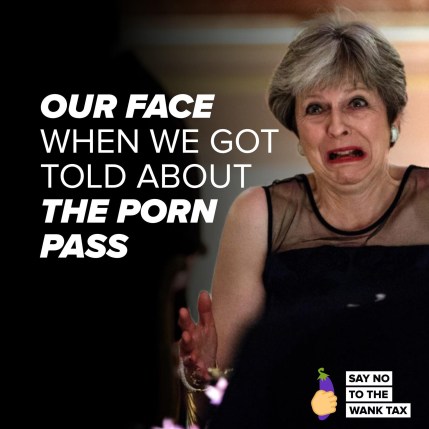
Brexit isn’t the only ridiculous thing happening in the United Kingdom. In April, the British government is rolling out statutory adult verification for pornography websites and content platforms. This requires all adult content providers to have proof of age or identity for all their users, whether a passport or a credit card (or more ludicrously a ‘porn pass’ that Brits wishing to browse anonymously will have to buy from local newsagents). The government plans to require internet service providers to block pornography websites that are not in compliance with adult verification once the system is in place. For those with university institutional access, Pandora Blake has written a timely explanation and critique published in Porn Studies: ‘Age verification for online porn: more harm than good?’.

Technical challenges with rolling out the system have led the dominant pornography search platform owner, MindGeek, to develop proprietary solution, AgeID, in cooperation with regulators. This cooperation between the dominant commercial pornography platform supplier and a Conservative government publicly intent on restricting access to pornography might appear surprising. However, it can be explained by a particular pattern of regulatory capture identified in public choice theory as a Bootlegger and Baptist coalition. Bruce Yandle observed that throughout the 20th century, evangelical Christians in the United States agitated for local restrictions on the sale of alcohol with the avowed aim of reducing consumption but with the secondary effect of increasing demand for alcohol for illegal bootleggers. Hence both interest groups, apparently opposed in moral principle came to benefit in practice. We now have a classic British case study. In this case, MindGeek is not acting as a literal bootlegger. It intends to be fully legally compliant with the filtering regime. However, the law will block all non-compliant competitors without a comparable verification system. They can gain a competitive advantage with a proprietary technical solution to the barrier introduced by the government.

Introducing identity verification systems has high fixed costs and low marginal costs. It is costly to develop or implement but easy to scale once integrated. The larger the pornography enterprise, the more easily these costs can be absorbed without the risk that it will not be worthwhile to serve the British market. For many smaller international pornography websites, without in-house legal advice or technical expertise, it might prove uneconomical to serve British users directly. So MindGeek’s platforms could become the least-cost legal gatekeeper between small enterprises producing pornographic content and the British public. The government is raising transaction costs to accessing pornography in a way that impacts larger and smaller platforms asymmetrically and favors one dominant platform in particular.

Both the premise of this policy and its likely impact on the market for pornography is unpromising. At its most benign, this could be a characterized as a ‘nudge’ against the consumption of pornography and reducing access of inappropriate content to minors. But these limited benefits have costs for both producers and consumers. On the consumption side, it increases risks to data security and privacy because it will plausibly tie records of pornographic access to verified identities, with a clear likelihood of being to infer an individual’s sexuality from private browsing. This could represent a particular vulnerability for LGBTQ identifying individuals who live in communities where there is still stigma attached to minority sexual orientations.

On the supplier side, it takes what already appears to be a market with strong tendencies towards a winner-takes-all model, and then augments it so that a dominant platform has a legally enforceable competitive advantage over potential rivals in the market. Ultimately, it threatens to further strengthen the bargaining position of a single corporate pornography platform against the sex workers who supply their content.

Italy and the Belt and Road Initiative

There has been a growing scepticism with regard to the Belt and Road Initiative (BRI) project in many quarters, due to the lack of transparency with regards to terms and conditions as well as the economic implications for countries which are part of the project. A report published in April 2018 by the Center for Global Development (CGD) in Washington flagged 8 countries (including Pakistan, Maldives, Laos, and Djibouti) where the level of debts are unsustainable.

Apart from the red flag raised by a number of researchers, the removal of Pro-China leadership in countries like Malaysia, Maldives, and Sri Lanka has also resulted in problems with the BRI project, and China’s economic dealings (which are clearly skewed in favour of Beijing) with other countries is drawing more attention.

The most vocal critic of China’s economic links has been Malaysian Prime Minister Mahathir Mohamad. During a visit to China in August 2018, Mahathir, alluded to China’s trade relations with poorer countries as ‘a new version of colonialism’. Mahathir later on denied that his statement was targeted at China or the BRI. The fact is that the Malaysian Prime Minister did scrap projects estimated at well over $20 billion (which includes a rail project, East Coast Link, as well as two gas pipelines).

Top officials in the Trump Administration, including US Vice President Mike Pence, have also been critical of the BRI project for a variety of reasons. The major criticism from US policy makers has been the economic ‘unsustainability’ of the project as well as the point that the project is skewed in favour of China.

Italy to join BRI Continue reading