Natural Rights and Taxation

A moral right is a correlative or flip side of a moral wrong. The right to have X means that it is morally wrong or evil to deny the holder from having X by stealing or destroying it. The right to do X means it is evil for others to forcibly prevent a person from doing X.

People have the natural right to do anything that does not coercively harm others, and the natural right to be free from coercive harm. Natural rights are based on natural moral law, as expressed by the universal ethic. By the universal ethic, all acts, and only those acts, which coercively harm others are evil. I and others have written on natural moral law, easily searched on the Internet.

A legal privilege is a special power or income granted to particular people because of their political status. A king is privileged because of his inheritance and laws regarding this. A slave owner is privileged to own another human being. There are no privileges in natural moral law, since one of the premises from which the universal ethic is derived is human moral equality, an equality of moral worth, implemented as equality before the law and equal legal rights.

In the Constitution of the United States, the 9th Amendment states, in its entirety, “The enumeration in the Constitution, of certain rights, shall not be construed to deny or disparage others retained by the people.” The other rights are common-law and natural rights. Therefore the U.S. Constitution recognizes natural rights, and all laws in the USA should be consistent with the 9th Amendment, although in practice, the 9th is ignored and not widely understood.

This brings us to two court cases. In Murdock v. Pennsylvania, 319 U.S. 105 (1943), the Supreme Court stated that a law requiring solicitors to purchase a license was an unconstitutional tax on the Jehovah’s Witnesses’ right to freely exercise their religion. The Court ruled that “The state cannot and does not have the power to license, nor tax, a Right guaranteed to the people,” and “No state shall convert a liberty into a license, and charge a fee therefore.”

In another case, the Court ruled similarly, that “If the State converts a right (liberty) into a privilege, the citizen can ignore the license and fee and engage in the right (liberty) with impunity.” (Shuttlesworth v. City of Birmingham, Alabama, 373 U.S. 262).

The principles behind the statements of the Court have to apply generally. The federal and state governments may tax privileges, but may not tax a natural right. Since people have a natural right to engage in labor for wages, taxes on wages violate natural rights and therefore the Constitutional rights recognized by the 9th Amendment. Taxes on trade and goods also violate natural rights, which is why state laws claim, incorrectly, that, when they impose a sales tax, they are taxing the privilege of selling goods. (For example, it is written that “California assesses a sales tax on sellers for the privilege of doing business in California.”)

If natural rights are violated by taxing wages, the same applies to the products of labor and the income from the products. Thus a person has the natural right to fully keep and trade produced goods and the financial counterparts as shares of companies and their incomes.

The U.S. Constitution does provide government with the power to tax. Article I, Section 8, states, “The Congress shall have power to lay and collect taxes, duties, imposts and excises.” The 16th Amendment restricts the income tax to being levied as an indirect tax, but otherwise did not alter or add to the powers of Article I.

There is an apparent contradiction. Article I empowers government to tax imports and goods, and other taxes, but the 9th Amendment prohibits taxing acts which are natural rights.

Clearly the founders did not oppose taxing as such. But the letter and spirit of the law have to go beyond the intents of the founders. The Constitution also did not explicitly outlaw slavery, despite its recognition of preexisting rights. When slavery was later abolished, this was in accord with justice as prescribed by natural moral law and the 9th.

If a parent says to a child, you may go outside and play, and also says, do not throw rocks at the squirrels, the permission to play does not imply that anything goes. Thus when the Constitution authorizes taxes, but then, in an Amendment, says, by implication as recognized by the Supreme Court, that government may not tax a right, then the power of taxation has been constrained.

The U.S. Constitution creates an imposed but limited government, and the founders recognized the need for revenues. The sources of government revenue boil down to two original sources: labor and land. There is human exertion, and there is what nature provides.

Since human exertion and its gains are a natural right, the only source left is nature’s resources, land. Thus the moral question is whether the ownership of land is a natural right. This issue is, of course, much disputed. In my judgment, the moral law of property is, “To the creator belongs the creation, and where there is no creator, the benefits belong to the people in equal shares.” The universal ethic is based on the premise, from the nature of humans being, as John Locke wrote, “all equal and independent,” the independence being that thinking and feeling occur individually.

The benefits of land are measured as its economic rent. Therefore, the rent belongs to the people, and by natural moral law, the individual right of the possession of land is conditional on paying the rent to the rightful owners, the people. A tax on land rent does not violate the natural rights of the title holder.

Although the rent really belongs to the people and not to an imposed government, since government is already an imposition, it violates natural rights the least when rent is used for public revenues to pay for public goods that generally benefit the people. The people receive the rent in kind rather than in cash.

If consistently implemented, the 9th Amendment, backed up by the Murdock case, implies that the income tax as well as excise taxes should not tax the right of labor and trade. The greatest challenge of humanity is to recognize the full spectrum of human natural moral rights.

—————————————————

A similar article by me appears in progress.org as “Rights and Privileges”.

Book Review: Hans-Hermann Hoppe – Economic Science and the Austrian Method

I decided to read Hans-Hermann Hoppe’s Economic Science And The Austrian Method (1995) in order to grasp a deeper philosophical understanding of the Austrian School’s methodology of economic inquiry. I was especially interested in Immanuel Kant’s influence on Ludwig von Mises and how Mises had used Kant’s epistemological insights to construct praxeology, the study of human action (economics included) that is purely deductive in nature.

Those who are acquainted with scientific methodologies in the field of economics may have heard of the controversies surrounding praxeology. Living in an empirical age, many people may be inclined to question the validity of a science that claims to arrive at economic laws from pure deduction whose validity can be established independently from observations. Praxeological propositions are indeed much more “like those of logic and mathematics, a priori” (Mises, 1966, p. 32). Such a science may strike the skeptics as being disquietly dogmatic.

In this book review, I will firstly give a brief discussion why it is important at all to discuss the epistemological foundations of economic science. Thereafter, I will discuss Hoppe’s thesis. I will describe the philosophical aspects of praxeology that can be traced back to Kantian epistemology. I will moreover summarize Hoppe’s critique of empiricism and historicism, and why Mises believed that economics is essentially praxeology. Lastly, I will give my personal thoughts on the book.

Why should we discuss the epistemological foundations of economic science?
The most immediate answer to this question is that different epistemological foundations lead to different methodologies and different theories, which can lead to different interpretations of real-life phenomena. Take for example the interpretation of an historical economic event, the Great Depression. Murray Rothbard, because he is working within the context of praxeology makes use of the praxeological Austrian Business Cycle Theory. This theory focuses on the expansion of the money supply as an explanation of the onset of the ‘boom’ in the 1920’s which eventually resulted in the ‘bust’ in 1929. Milton Friedman and Anna Schwartz in A Monetary History Of The United States (1963), while not applying the ABCT, have focused only on the contraction of the money supply and the resulting higher interest rates in 1928 as the main cause of the Great Depression. Their application of different economic methods has led them to look for different possible historical causes of the Great Depression which has effectively resulted in different accounts of the same historical event. It therefore matters what economic methods are employed in economic research.

Now that we have established the importance of inquiring epistemological foundations and methodologies of economic science, I will turn to Hoppe’s thesis.

Kant and synthetic a priori propositions
Working within the rationalist tradition of Leibniz and Kant, Mises attempts to present the proper way through which economic science – a science that according to Mises falls within the broader science of human action, praxeology – should be conducted. He resorts to the Kantian conception of the nature of knowledge and explains praxeology in terms of Kantian terminology. Hence, Hoppe firstly directs the reader to Kantian epistemology.

Kant had developed the idea that all propositions are either analytic or synthetic and either a priori or a posteriori. The difference between analytic and synthetic propositions is that the former is true by virtue of their meaning or as Kant would have phrased it himself, “the predicate B belongs to the subject A as something that is (covertly) contained in this concept A” (Kant, 1781, A:6-7). Take for instance the following proposition: “Bachelors are unmarried.” This proposition is analytic, because the predicate, ‘unmarried’, is part of the concept of a bachelor. Analytic propositions are regarded as tautological propositions; they simply restate the definition or a concept incorporated within a word and therefore they do not tell us anything meaningful about the world. A synthetic proposition on the other hand is a proposition whose predicate concept is not contained in the subject’s concept. It could therefore express something meaningful about the world. An example of a synthetic proposition is: “All bachelors are unhappy.” The concept ‘unhappy’ is not contained within the definition of ‘bachelor’, and expresses something meaningful about ‘bachelors’.

The distinction between a priori and a posteriori is as follows: a priori propositions are propositions whose justification does not rely upon experience, but solely on logical reasoning. The justifications of a posteriori propositions on the other hand, do rely upon experience. Examples of a posteriori propositions are “Some bachelors I have met are unhappy” or “Siddharta Gautama left the palace.”

The big question is: do synthetic a priori propositions exist? Kant certainly believed that they do exist, “and it is because Mises subscribes to this claim that he can be called a Kantian” (Hoppe, 1995, p. 18). In Critique of Pure Reason (1781), Kant contended that synthetic a priori propositions do exist and as an example he took mathematics (Kant, 1781, p. 55). The statement “7 + 5 = 12” is not dependent on experimentation and the concept 12 is not contained in either the definitions of 7 or 5. According to Kant, a priori propositions are derived from self-evident axioms. We can find such axioms by reflecting upon ourselves and understanding ourselves as knowing subjects. However, how can truth claims derived from reflection in our mind have any basis in reality? Is Kant here running into the problem of idealism – a notion that it is the mind that constructs reality and superimposes itself upon reality in such a way that it fits within the mind’s necessary laws?

According to Hoppe, Kant had not given a satisfactory response to this issue and future thinkers would have to take on the challenge of solving this problem. Hoppe believes that Mises had done so successfully when he had averred that action provides the link between mind – body and between mind – external world: “[W]e must recognize that such necessary truths are not simply categories of our mind, but that our mind is one of acting persons. Our mental categories have to be understood as ultimately grounded in categories of action” (Hoppe, 1995, p. 20). It is through action that the mind and reality are related: “[A]cting is a cognitively guided adjustment of a physical body in physical reality” (Hoppe, 1995, p. 70).

Another issue that arises with regards to the possibility of synthetic a priori propositions, and which I have found quite confusing myself is the following: does Hoppe suggest that we can arrive at knowledge without any experience of ourselves or the external world at all? No, according to Hoppe “the truth of a priori synthetic propositions derives ultimately from inner, reflectively produced experience” (Hoppe, 1995, p. 19). This experience is phrased by Stolyarov II as “the mind’s identification of facts about actually existing entities, including the identifier himself” (Stolyarov II, 2007, p. 53). In this sense, the action axiom is experientially-derived, but it is not subjected to the empiricists’ narrow view that all knowledge must be testable, verifiable, or falsifiable.

Empiricism, Historicism, and Praxeology
When Mises systematically constructed the foundations of praxeology, he faced a double-challenge; (A) empiricism which was quickly becoming the main influence in the economics discipline, and (B) historicism which was then a prevailing ideology at German-speaking universities.

(A) Empiricism
Empiricism is the “philosophy which thinks of economics and the social sciences in general as following the same logic of research of that, for instance, of physics” (Hoppe, 1995, p. 28). Hoppe writes that empiricism is governed by the following two related basic propositions:

(1) that empirical knowledge, knowledge about reality, must be subjected to falsifiability and verifiability by observational experience;
(2) and that empiricist research formulates their explanations in terms of causality, i.e. “if A, then B”. (Hoppe, 1995, pp. 28-29)

Hoppe continues to write that the validity of empirical statements

can never be established with certainty… The statement will always be and always remain hypothetical… Should experience confirm a hypothetical causal explanation, this would not prove that the hypothesis was true. Should one observe an instance where B indeed followed A as predicted, it verifies nothing… Later experiences could still possibly falsify it. (Hoppe, 1995, p. 29)

Empirical knowledge is hence contingent on historical facts. Neither confirmation nor falsification by observational experience can prove that a relationship between phenomena does not or does exist. By emphasizing that our knowledge of reality must stem from observational experience, they directly deny a science that avers that a priori knowledge can give us any meaningful explanation of real phenomena. However, as Hoppe and Mises point out, the statement that meaningful synthetic a priori propositions cannot exist is itself a synthetic a priori proposition. Mises has put this empiricist contradiction the following way in The Ultimate Foundation of Economic Science (1962):

The essence of logical positivism [logical empiricism] is to deny the cognitive value of a priori knowledge by pointing out that all a priori propositions are merely analytic. They do not provide new information, but are merely verbal or tautological, asserting what has already been implied in the definitions and premises. Only experience can lead to synthetic propositions. There is an obvious objection against this doctrine, viz., that this proposition that there are no synthetic a priori propositions is in itself a … synthetic a priori proposition, for it can manifestly not be established by experience. (Mises, 1962, p. 5)

Hoppe mentions a second contradiction of empiricism which regards historical events. Empiricists believe that particular events may cause any particular human action. They attempt to find such causal relationships in order to explain historical events. However, in order to do so, empiricists must assume that causality within historical sequences exists through all times. This assumption itself is not based on experiential observations, and must presuppose a priori knowledge that “time-invariantly operating causes with respect to actions exist” (Hoppe, 1995, p. 36). In addition, Hoppe identifies a third contradiction with respect to social phenomena. The empiricists believe that in order to confirm and falsify hypotheses, one must be able to learn from historical and social experience. If one would deny this, then why should one engage in empirical research at all? This however presupposes that “one admittedly cannot know at any given time what one will know at a later time and, accordingly, how one will act on the basis of this knowledge” (Hoppe, 1995, p. 37). Admitting that humans learn from historical and social experience, one cannot deny that empirical causal constants in human action do not exist. “The empiricist-minded social scientists who formulate prediction equations regarding social phenomena are simply doing nonsense” (Hoppe, 1995, p. 38). Predicting human action is not a science according to Hoppe.[1]

The empiricists are mistaken in applying the methodology of the natural sciences into the fields of social science in order to predict human actions. Unlike natural elements, human beings can and do act differently under equal conditions. Thus, social history cannot yield any knowledge that can be employed for predictive purposes. Relating this to the quantity theory of money; if the money supply for instance increases, one can still not predict whether the demand of money will change as this is entirely dependent on human action. Nonetheless, one could assert that if the demand for money stays constant and the money supply increases, then the purchasing power of money will fall (Hoppe, 1995, pp. 44-45).

(B) Historicism
Historicism, the second challenge that Mises had to face, does not take nature as its model but literary texts. Historicists believe that there are no objective laws in economics, and that “historical and economic events are whatever someone expresses or interprets them to be” (Hoppe, 1995, p. 54). Historicism is therefore extremely relativist. However, according to Hoppe also historicism is fundamentally self-contradictory. If there are only interpretations and hence no constant time-invariant relations, then there is also no historicist constant truth about history and economics. If historicism does not give us any reason to believe in its doctrine, why should we adhere to its epistemological philosophy if its proposition implies that they themselves may not be true?

Next to his refutations of empiricism and historicism, Mises had hoped that he could demonstrate the existence of true synthetic a priori propositions. Such propositions would (1) not be derived from experience, and (2) they must yield self-evident axioms so that when one tries to deny it one is involved in self-contradiction. Mises believes that these two requirements are met by the axiom of action – the proposition that human beings act and display intentional behaviour (Hoppe, 1995, pp. 60-61). According to Mises, purposeful human behaviour exhibits a person’s pursuit of an end which he attempts to reach through the employment of particular means (at least time and body). The fact that a person pursues a particular goal with his action reveals that he places a relatively higher value (preference) on the goal than any other goals of action that he could have thought of at the beginning of his action. Human action also happens sequentially, implying that the actor can only pursue one goal at a time in which he has to forego other valuable goals temporally. Action therefore also implies choices and costs. An action furthermore implies loss (and profit), because every action accompanies a certain degree of uncertainty, whether the goal achieved has resulted in the value one has expected can only be known in retrospect. All these categories of action – values, ends, means, choices, preferences, costs, profit, loss, and time – are at the heart of economics (Hoppe, 1995, pp. 61-63). This insight establishes economics as a science of human action. Or as Hoppe asserts more precisely,

all true economic theorems consist of (a) an understanding of the meaning of action, (b) a situation or situational change – assumed to be given or identified as being given – and described in terms of action-categories, and (c) a logical deduction of the consequences – again in terms of such categories – which are to result for an actor from this situation or situational change (Hoppe, 1995, pp. 63-64).

The existence of the categories of action is derived a priori from the axiom of action, and not through observation. Any attempt to disprove it is futile, since “a situation in which the categories of action would cease to have a real existence could itself never be observed or spoken of, since to make an observation and to speak are themselves actions” (Hoppe, 1995, p. 63).

My thoughts on Hoppe’s book
The book serves as an excellent summary of praxeological philosophy and is a must-read for anyone who wants to start learning more about the subject. Reading the book, one feels that it is extremely concise (around 80 pages), but also dense. Hoppe directly discusses the essential philosophical aspects that one must know in order to understand praxeology as developed by Mises, and fortunately he leaves many footnotes for further reading.

I believe that Hoppe has skillfully shown that economics is part of praxeology, and that it indisputably deals with such categories of human action as values, ends, means, choices, preferences, profit, loss, time, and causality. He has furthermore provided a well-reasoned critique of the empiricist and historicist-hermeneutical interpretations of economics by showing that they are necessarily self-contradictory.

Understanding that economics should not be conducted within the methodological framework of the natural sciences has severe implications to the ways we should deal with data of real world phenomena. If, like praxeologists claim, we cannot predict human action then there is also little reason to believe that effective social engineering is possible. The fundamentals of the praxeological methodology are therefore also immediately relevant within discussions on the roles of the state in planning the economy.

Footnotes
[1] Hoppe calls it entrepreneurship.

Bibliography
Friedman, M. & Schwartz, A.J. (1963). A Monetary History of the United States 1867-1960. Princeton: Princeton University Press.
Hoppe, H.H. (1995). Economic Science and the Austrian Method. Auburn: Ludwig von Mises Institute.
Kant, I. (1781). Critique of Pure Reason. (W.S. Pluhar, Trans.) Indianapolis: Hackett Publishing Company, Inc.
Mises von, L. (1942). Social Science and Natural Science. In R.M. Ebeling (Ed.) Money, Methods, and the Market Process (pp. 3-15). Retrieved from http://mises.org
Mises von, L. (1966). The Ultimate Foundation of Economic Science. Retrieved fromhttp://mises.org
Stolyarov II, G. (2007). The Compatibility of Hoppe’s and Rothbard’s Views of the Action Axiom. The Quarterly Journal of Austrian Economics, 10, 2, pp. 45-62.

Philosophical Research on Seasteading

The Seasteading Institute has recently published my philosophical dissertation on ‘Seasteading’. You can find it in the key research section of their Law and Policy page: http://www.seasteading.org/law-and-policy/.

Wayne Gramlich and Patri Friedman[1] founded the Seasteading Institute in 2008 in order to promote the seasteading movement, which has intellectually attracted mostly libertarian-minded individuals. The institute has also attracted funding from Paypal cofounder and early facebook investor Peter Thiel.[2]

A seastead is a permanent habitable dwelling on the ocean that preferably lies outside governmental waters. The Seasteading Institute believes that the creation of permanent societies on the seas can provide an experimentation space for innovative forms of socio-political organizations. The ultimate aim of seasteading is that newly emerging societies will inspire social changes around the world and contribute to human flourishing. First seasteads will be small-scale projects and they may even be constructed within existing governmental territories. However, seasteads could expand organically as technologies improve and innovative ideas of the functions of seasteads would emerge. One of the core ideas of seasteading is that an open experimentation space for social organizations will lead to progress in social rules and legislations, just as an experimentation space for new technologies leads to technological progress.

It is undeniable that social rules and legislations heavily influence all aspects of life, including technological progress and social well-being. One could for example compare North and South Korea, two countries that separated from each other in 1945. Both countries have had more or less the same culture and similar natural resources. However, what differs is their form of social organization; the North came under communist rule, whereas the South embraced western-style capitalism and democracy. Almost 70 years later, the differences in wealth, technological advancement, and social well-being are striking. South-Korea’s GDP per capita is for example 18 times larger, its internet penetration is more than 815 times greater, its life expectancy rate is 10 years longer, and the heights of South Korean pre-school boys are on average 4 centimeters longer. (Taylor, 2013, April 8).

The Seasteading Institute believes that, given that social progress and well-being heavily depend on how society is structured, mankind could make a huge step forward by letting social entrepreneurs start up seasteads to compete with governments in the industry of law-making and by letting millions engage in the experimentation with new forms of social organization.

In the paper, I provide a philosophical investigation of the concept of seasteading from a libertarian anarchist perspective. My investigation revolves around the following research question: “given that governments are resistant to structural changes of governance, how can mankind discover better forms of social organization?”

I argue that seasteading can fulfill that important role of moving mankind forward by experimenting with and finding new forms of social organizations that are best for human flourishing.

In the first chapter, I maintain that one core focus of political philosophy is to deal with the realities of value pluralism and political disagreements. I also contend that the most common form of social organization, representative democracy, does not satisfactorily deal with these realities. Hence, we should look for political possibilities beyond representative democracies. In order to discover these possibilities, we should experiment with new forms of social organization.

Chapter two discusses why there is currently little experimentation with social orders. I approach the issue from a meta-system level perspective and contend that all land on earth is more or less already claimed by states, which leaves little opportunity for people to start new societies on land. By applying the theory of monopoly economics, I maintain that the state’s monopoly on jurisdiction and coercion does not encourage them to provide good rules of law. It rather makes states extremely resistant to large-scale social changes. The obvious solution for finding better forms of governance then would be the introduction of competition into the industry of governments.

Chapter three deals with the epistemological attitude required for the experimentation space. I maintain that this attitude consists of having a sociological imagination, being epistemologically modest, realizing that social order can emerge spontaneously, and that the utopian dream of a single perfect society is impossible.

Chapter four discusses seasteading as the means by which the experimentation space could be realized. By homesteading the seas, a community can build and test new forms of social organization outside the scope of current governments’ control. It could generate new knowledge on social orders, thereby contributing to political philosophy and the social sciences. It could moreover also ease political tensions between citizens with different comprehensive doctrines.

Finally, I raise two objections to seasteading and address them accordingly.

If you would like to see an awesome seastead design, you should watch this video here:

Footnotes
[1] It may be interesting to know that Patri Friedman is the grandson of Milton Friedman and the son of libertarian anarchist David Friedman.

[2] Peter Thiel, previously a student of Political Philosophy at Stanford University, is also founder of the libertarian-minded newspaper The Stanford Review. He is a venture capitalist who is very much influenced by the Austrian School of Economics. With this in mind, it may not be surprising that the early mission of PayPal was to give its users more control over their money by enabling them to switch currencies. The goal of PayPal was to make it, in Thiel’s words (1999), “nearly impossible for corrupt governments to steal wealth from their people through their old means [inflation and wholesale currency devaluations] because if they try the people will switch to dollars or Pounds or Yen, in effect dumping the worthless local currency for something more secure” (Jackson, 2004).

References
Jackson, E.M. (2004). The PayPal Wars: battles with eBay, the media, the mafia, and the rest of planet earth. Los Angeles: World Ahead Publishing, Inc.
Taylor, A. (2013, April 8). A Crazy Comparison of Life in North Korea and South Korea. Retrieved from http://businessinsider.com
Thiel, P. (2009). The Education of a Libertarian. Retrieved from http://cato-unbound.org

Chuang Tzu: The natural disposition of man is Political Anarchism

Chuang Tzu

I just read this great article on ‘Anarchism and Taoism’. I find the Taoist case for anarchism extremely compelling. They sought after the harmonious nature of spontaneous order, the Tao, and internalized it into a tremendously rich personal philosophy of life. It makes me wonder: can a person ‘live’ a Libertarian life? Libertarianism is mostly regarded as a political philosophy in the west, but can it, like the Taoists believe, be regarded as a way of life that is most fulfilling on a personal level as well? These are questions that I still have to find out for myself.

After reading the article on Anarcho-Taoism, I’d like to share a small part of Chuang Tzu’s thoughts on the natural disposition of man here:

Horses live on dry land, eat grass and drink water. When pleased, they rub their necks together. When angry, they turn round and kick up their heels at each other. Thus far only do their natural dispositions carry them. But bridled and bitted, with a plate of metal on their foreheads, they learn to cast vicious looks, to turn the head to bite, to resist, to get the bit out of the mouth or the bridle into it. And thus their natures become depraved.

As with horses, so it is with human beings. Left to themselves they live in natural harmony and spontaneous order. But when they are coerced and ruled, their natures become vicious. It follows that princes and rulers should not coerce their people into obeying artificial laws, but should leave them to follow their natural dispositions. To attempt to govern people with manmade laws and regulations is absurd and impossible: ‘as well try to wade through the sea, to hew a passage through a river, or make a mosquito fly away with a mountain!’. In reality, the natural conditions of our existence require no artificial aids. People left to themselves will follow peaceful and productive activities and live in harmony with each other and nature.

In an essay ‘On Letting Alone’, Chuang Tzu asserted three hundred years BC the fundamental proposition of anarchist thought:

There has been such a thing as letting mankind alone; there has never been such a thing as governing mankind. Letting alone springs from fear lest men’s natural dispositions be perverted and their virtue left aside. But if their natural dispositions be not perverted nor their virtue laid aside, what room is there left for government?

Lao Tze, The First Libertarian

Lao TzeFrom the very first moment I read into Taoist philosophy, 5 years ago, I had grown extremely fond of Taoism. It also bears many similarities with the political philosophy of libertarianism. In this post I would like to trace the libertarian concept of Spontaneous Order to the Tao.

Lao Tze (~6th century BC) is regarded as the founder of Taoism. He is also the writer of the Tao Te Ching, one of the most translated books in history, which consists of 81 short chapters about leadership, modesty, and how to live in accordance with your own nature.

From the perspective of a personal philosophy of life, the Tao Te Ching teaches you to flow with life and to be in touch with your inner self so that your actions never contradict your personal being, and so that you can live a truly authentic and enriched life. This may sound too lofty to some, but reading the book one will realize how practical the philosophy actually is. To illustrate the practicality of Taoism, I have written about an interesting application of Taoism in Bruce Lee’s Jeet Kune Do – the martial arts that Bruce Lee had developed – in this post of mine.

One can also read the Tao Te Ching from the perspective of political philosophy. Taoism proposes a society in which there is little or even no central authority (government), since the government is counterproductive and the grand source of social misery. Taoism is therefore libertarian, and stands very much in contrast with Confucianism with its multifarious laws and regulations. Mr. Libertarian, Murray Rothbard, had recognized that Lao Tze was the first libertarian intellectual who saw the government as “a vicious oppressor of the individual, and ‘more to be feared than fierce tigers’” (Rothbard, 1995, p. 23). Taoists and Libertarians believe that society functions most efficient and most just when the government does not meddle and regulate the people.

The skeptics may ask: how can there be order without a central authority? Some modern philosophers, like for example Hobbes, have referred to this anarchistic state as the ‘state of nature’; a state of “a mere war of all against all; and in that war all men have equal right unto all things” (Hobbes, 1651, p. 34). Taoists and Libertarians however, believe that this view is wrong. They believe that it is in the nature or instinct of individuals to be collectivist, because the person who lives in solitude is hardly able to survive in nature. In order to survive, human beings will naturally develop collective customs and laws to work out their disputes. The collective coordination of human beings has therefore always “depended decisively on instincts of solidarity and altruism” (Hayek, 1988, p. 12).

What, according to the Taoist and the Libertarian encourages society to become well-functioning? The Taoist calls it the ‘Tao’, and the libertarian calls it ‘Spontaneous Order’.

Tao and Spontaneous Order

The two concepts, Tao and Spontaneous Order, are similar to one another. Spontaneous Order is a spontaneous emergence of self-organized order out of seeming chaos. One can find such examples in language, the internet, the free market etc. Without any central authority we have realized language, internet, and productive orders that are so complex that not a single person would have been able to create by himself. No one can predict how the order will look like, because it is forever in flux. It can therefore only be experienced and observed. From our observation we can find that the Spontaneous Order is better than any artificial human construct.

Likewise, the Tao is an underlying natural order of the universe whose essence cannot be described in words, but which can only be experienced and observed in nature. In the first verse of the Tao Te Ching, Lao Tze writes:

The Tao that can be told is not the eternal Tao.
The name that can be named is not the eternal name. (Tao Te Ching, Chapter 1).

The Tao is neither a thing nor a substance. It is a universal trend that flows in the natural world. According to the Taoist, one can be in touch with the Tao and achieve most when one does not act against the nature of things (‘wu wei’). Lao Tze therefore writes:

Whenever you advise a ruler in the way of Tao,
Counsil him not to use force to conquer the universe.
For this would only cause resistance.
Thorn bushes spring up wherever the army has passed.
Lean years follow in the wake of a great war. (Tao Te Ching, Chapter 30)

Tao abides in non-action,
Yet nothing is left undone.
If kings and lords observed this,
The ten thousand things [world] would develop naturally. (Tao Te Ching, Chapter 37)

The more laws and restrictions there are,
The poorer people become.
The sharper men’s weapons,
The more trouble in the land.
The more ingenious and clever men are,
The more strange things happen.
The more rules and regulations,
The more thieves and robbers.

Therefore the sage says:
I take no action and people are reformed.
I enjoy peace and people become honest.
I do nothing and people become rich.
I have no desires and people return to the good and simple life. (Tao Te Ching, Chapter 57)

Why are the people starving?
Because the rulers eat up the money in taxes.
Therefore the people are starving.
Why are the people rebellious?
Because the rulers interfere too much.
Therefore they are rebellious.
Why do the people think so little of death?
Because the rulers demand too much of life.
Therefore the people take death lightly.
Having little to live on, one knows better than to value life too much. (Tao Te Ching, Chapter 75)

The Taoists have this concept called ‘mutual arising’, which means that order comes into being through a harmonious interplay of different forces. This is expressed as follows by Lao Tze:

The Tao begot one. One begot two. Two begot three.
And three begot the ten thousand things.
The ten thousand things carry yin and embrace yang.
They achieve harmony by combining these forces. (Tao Te Ching, Chapter 42)

We, human beings, are incapable of understanding how these forces play out against each other. Every time we interfere with the Tao, unintended consequences will happen. Since we cannot apprehend what forces have led to the unintended consequences, we will create more unintended consequences by trying to offset the previous unintended consequences. Man can therefore fall into a state of perpetual interference with nature and become evermore unnatural. Is that not the state we are in right now; the state of unnaturalness due to our thousandfold petty laws that attempt to regulate our conduct, relationships, and ethics?

Is it realistic to have no central government and expect spontaneous orders to emerge?

It certainly is realistic. Bruce Benson has written an insightful book called The Enterprise Of Law: Justice Without The State (2011) in which he discusses historic examples of how law and order emerged spontaneously. Many scholars are currently acknowledging that during the time of the expansion of the American frontier, those areas where people moved faster westward than the central government was not wild or lawless. It was actually more peaceful than modern day America. For an interesting read into this issue, see Anderson & Hill’s ‘An American Experiment in Anarcho-Capitalism: The Not So Wild, Wild West’ (1979).

See also this talk of Thomas Woods on the ‘not so wild, wild west’:

Bibliography

Anderson, T.L. & Hill, P.J. (1979). An American Experiment in Anarcho-Capitalism: The Not So Wild, Wild West. Journal of Libertarian Studies, 3, 1, 9-29.

Benson, B. (2011). The Enterprise Of Law: Justice Without The State. San Francisco: Independent Institute.

Hayek, F.A. (1988). The Fatal Conceit: the errors of socialism. London: Routledge.

Hobbes, T. (1651). De Cive. (H. Warrender, Ed.) New York: Oxford University Press.

Lao Tze. Tao Te Ching. Retrieved from http://www.schrades.com/tao/taotext.cfm?TaoID=1

Rothbard, M.N. (1995). Economic Thought Before Adam Smith: An Austrian Perspective on the History of Economic Thought Volume I. Retrieved from http://mises.org

A Matter of Legitimacy

Dictionaries give us two definitions of “legitimacy”: “the quality of being legal” and “the quality of being reasonable and acceptable”. The two meanings are intertwined: we expect reasonability from the laws and we infer the content of a law we do not properly know from what we regard as reasonable. Unreasonable laws are not acceptable to the people and Cesare Beccaria warned us about how unreasonable prohibitions engender more and new crimes.

Political Realism and Legal Positivism cross their paths when it is time to discuss what is the ultimate foundation of obligation, both political and legal: facts and force. An overwhelming force deployed upon individuals and peoples will always be able to impose what is reasonable and acceptable. For Thomas Hobbes, as fear is not a sufficient reason for annulment of covenants, the feeling of terror from the subject to the sovereign does not challenge the legitimacy of his power.

Libertarianism is, in principle, a political stance on the state that denies its legitimacy or, at least, denies unlimited sovereignty. And we stress “in principle” because we want to point out that not all versions of Libertarianism accomplish the said aims. In this regard, we want to single out one crucial trait of every Libertarian political theory: is it possible a stateless order of cooperative coordination between individual plans? Does its existence depend upon our own volition and agreement? We want to make a distinction between two strains of Libertarianism: the one which affirms the possibility of a stateless society and the one which does not.

Paradoxically, the affirmation of the possibility of a stateless order of cooperation legitimates the Hobbesian stance on unlimited sovereignty: having at their disposal the alternative of a stateless political order, individuals opt freely for a Leviathan. What we have to decide now is the extension of the power of the government, but at this point there is no restriction left to the power of the Leviathan to determine its own limits.

On the other hand, for the strain of Libertarianism that regards the absence of a state as impossible or not desirable ­because, for example, the justice is an artificial virtue that demands a government to enforce it­, the state is a fact that has no reasonable alternatives. As the theft that compels us to choose between our bag or our life, there are no reasonable options left to us but accepting the power of the state. As David Hume pointed out, tacit conventions as the stability of the possessions require a political order to enforce it. Therefore, the factual power of the state will be legit only as long as it enforces the tacit order of human cooperation that allows individuals to fulfil their plans. Notwithstanding this last strain of Libertarianism does not deny the legitimacy of the state, it does consistently deny the legitimacy of any type of unlimited sovereignty.

How Can Crypto-currencies Democratize Society?

Yesterday, September 26th of 2015, I attended the Reinvent Money event in Rotterdam, the Netherlands, that was organized by Paul Buitink. The goal of the event was to bring people together for a grand discussion on the future of our monetary system. This discussion on monetary reforms is totally necessary if one considers the current problems with the euro and Greece, banking scandals, the rise of bitcoin and the blockchain technology, and peer-to-peer lending.

The speakers list consisted of many prominent thinkers and activists who could share with a crowd that was mostly in favor of crypto-currencies their thoughts about the current monetary system and whether money should be reinvented.

Willem Middelkoop was the first speaker and talked about the Big Reset of the monetary system that is currently orchestrated by high level officials. Jakob de Haan, head of the research department at the Dutch Central Bank, was the second speaker and stated that he does not believe in an upcoming Big Reset. While defending central banks, he argued that central banks are necessary in order to stabilize the currency and he sees five aspects that central banks should fulfill:

  1. central bank independence;
  2. central bank transparency;
  3. using monetary policy instruments to stabilize the economy;
  4. banking supervision of not only independent commercial banks, but of the whole economy. In his opinion, the central bank should supervise the entire economic system instead of primarily addressing individual institutions;
  5. macro-prudential policies to avoid crises.

Other speakers included Max Keiser, Stacy Herbert, Vit Jedlicka (president of Liberland), Stephan Antonopoulos, Simon Dixon, Joris Luyendijk, Prof. Antal Lekety and some others. Some wanted to go back to a gold-based monetary system, others truly wanted to reinvent money through crypto-currencies, and a few wanted the system to stay as it is structurally. As a voluntaryist, I was quite disappointed that the pro-crypto-currency speakers saw it as a means to democratize society. I don’t fully understand what they mean with the word ‘democratize’ and how crypto-currencies could do that, but I’ve noticed that those speakers saw it as a means to make our political system more democratic. Maybe, they mean ‘anti-authoritarian’ as crypto-currencies would indeed limit the monetary powers of the government and the central bank. However, I’ve always understood it as a de-political money system that is disruptive enough to do away with the myth that government is needed at all to stabilize our currency, and hence that it would bring us closer toward a voluntaryist society – not toward a more democratic system. A democratic system, in my opinion, means a system in which the majority rules. Crypto-currencies give every individual the full ownership of their money. Thus taking personal financial affairs entirely outside the scope of government meddling, also if that government is democratically chosen.

Is the European Union Collapsing?

Lately, the European Union (EU) stumbles from crisis to crisis. After a long hot spring dominated by the financial crisis in Greece, we now see the collapse of the system based on the Schengen Treaty, which secures the free movement of people within most countries of the EU. The upheaval is the result of the huge numbers of refugees entering the EU, mostly from Syria, Eritrea and Sudan. It is expected that Germany alone will offer asylum to approximately 1 million people this year. With no end of the refugee wave in sight more and more countries are either closing their borders, building fences, or reintroducing border patrols. The situation in Hungary seems worst, especially in the temporary refugee camps. This weekend we saw footage of guards throwing food into the hungry crowds, just like zoo keepers do when feeding the wild beasts. An absurd lack of civilization.

Both crises have at least two factors in common, namely issues of sovereignty and property rights. Sovereignty is claimed back by European politicians, who previously made arrangements at the European level, yet are now confronted by their electorates who want to end the infringements of their property rights. In the case of Greece it was about (mostly) Northern European leaders who were pressed by public opinion to stop paying for the support of what was seen as an almost bankrupt country. Certainly in Germany and The Netherlands it was seen that Greece made a mess of things which itself needed to sort out (this was the dominant perception, I underline that I do not say this is also the right presentation of all relevant facts). In the current refugee crisis public opinion also welcomes large numbers of people who –again as it is widely perceived- are seen a poor sods fleeing from a terrible war. Yet at the same time the people understand that the refugees, no matter how well educated some of them are, also need to receive all kinds of welfare arrangements and will go through an often hard process of integration into society. This against the background of more than a decade of heated debate about immigration and integration in most (Western) EU countries.

In both questions the politicians eventually tend to back out, by reclaiming national sovereignty. Not directly, as this would be embarrassing. So Greece got its third support package, and in the refugees crisis it is underlined that ‘temporary border patrols’ and even ‘border closings’ are still within the letter of the Schengen Treaty. There is also talk of centralizing the intake of refugees at the European level, instead of the current principle of ‘first country of entry is the country where asylum should be requested. This may well be a good idea given the fact that refugees will  arrive (as the US experience also makes clear). Yet it is hard to predict how the negotiations will end, because there are large objections against the European Commission spreading refugees among the EU member states at its own peril.

The bigger picture however could well reveal that both events mark the end of the movement towards ‘ever closing union’, the old purpose mentioned in the Treaty Of Rome (1957), the most important founding treaty of European integration. That is significant, because if I am right in my assessment it means we are experiencing a real turning point. There are a number of contributing factors, most of which have been identified before, but that does not make them less significant, such as a lack of European identity among the European people, and the desire to accept only a minimum amount of European policy, due to the much stronger desire to make national decisions, which are easier to correct by the electorates. This, by the way, is fully in line with classical liberal thinkers such as Hayek, Hume or Smith.

Does this mean the EU is about to collapse? Hardly likely. The economic basis is still strong and while large the current problems can be paid for and sorted out eventually. Yet if integration stops here it will also mean that the EU will never get a serious common foreign policy or a common defense policy either, both of which have been tried –and failed- over the past decades. So the EU will then only be a ‘super free trade zone’, with a common trade policy, and strong legal apparatus also spreading out over many non-economic issues.  This raises many more issues, but that goes beyond the purpose of this contribution. For one thing: these are once again exciting times in Europe!

The Poverty Of Democracy

I have been a strong proponent of democracy until the Spring of 2012 when I picked up Hans-Hermann Hoppe’s Democracy: The God That Failed. Since then, I have never looked at democracy with the same warm feelings again. Now, in this post, I would like to explore why democratic political representation is an impossibility and why it deals poorly with value pluralism – the fact that society holds various fundamental values that are in conflict with each other. In addition, I would like to urge that we should look for other political possibilities and stop maintaining that democracy is the end of all forms of social organization.

What most people find attractive about democracy is its underlying idea that the electorate is an embodiment of the general will of the public as if the public has reached some kind of general agreement on public policies and legislation. It is believed that with regular elections, the rulers are in power for a limited time and they “will be compelled by the threat of dismissal to do what public opinion wants them to do” (Popper, 1963, p. 345). Gerard Casey writes in Libertarian Anarchy (2012) that “[T]he central characteristic of representation by agency is that the agent is responsible to his principal and is bound to act in the principal’s interest” (Casey, 2012, p. 125). It is however questionable to what extent the electorate can truly represent the constituency and to what extent the public voice can be considered univocal. We must also beware of attributing “to the voice of the people a kind of final authority and unlimited wisdom” (Popper, 1963, p. 347). When society holds a vox populi vox dei attitude, it can easily slip into a tyranny of the majority. A society ruled by public opinion by no means guarantees social justice.

It is important to realize that the notion of representation is highly questionable. According to public choice theory, political agents cannot possibly truly represent their constituencies when members of a society have different comprehensive doctrines, hold different values, and have different interests. Public choice theory applies economic methods in the field of political theory and provides some interesting insights that are relevant for political philosophy. It maintains that politics is ruled by clashing opinions among policy makers and clashing opinions among members of the constituency. One may for example desire to build new roads with public funds, another may want to use public funds for the modernization of the military and defense, a third may desire to spend more on social welfare, a fourth on education etc.

Given that we live in a world of value pluralism, it is difficult for policy makers to pursue and represent the ‘public interest’. Furthermore, special minority interest groups may have incentives to organize themselves in order to influence public policies through lobbying. When the expected gain of lobbying of such minority interest groups is greater than the cost of lobbying efforts, they have greater incentive to influence legislators. Large interest groups, such as taxpayers in general, have fewer incentives to campaign for particular legislations, because the benefits of their actions, if they are successful, are spread much more widely among each individual taxpayer.

When the principal believes that the cost of being politically active – keeping oneself up-to-date with political actualities and being involved with political campaigns – is not worth the benefits, the principal may become ‘rationally ignorant’ of politics. This gives representatives more incentives not to pay attention to the public interests. Rationally ignorant principals do not know who their representatives are or what they do. This consequently discourages the politicians’ feeling of accountability for their actions and it encourages the politicians to sell themselves to donors and to pursue personal agendas. Different interests, incentives, and ideologies among principals and political agents therefore result in unequal representation.

I believe that Casey is right when he asserts that there is

“no interest common to the constituency as a whole, or, if there is, it is so rare as to be practically non-existent. That being the case, there is nothing that can be represented” (Casey, 2012, p. 125).

Imagine that there is a piece of legislation that our representatives can either pass or not with 35 per cent of the public in favour of the legislation and 65 per cent who oppose it. If our representatives pass the legislation, they will represent the 35 per cent and ignore the interests of the 65 per cent. If they do not pass the legislation, they will represent the 65 per cent and cease to represent the interests of the 35 per cent.

“In this very normal political scenario, it is not that it is difficult to represent a constituency – it is rather that it is impossible” (Casey, 2012, p. 125).

A representative democracy is therefore actually quite inadequate in dealing with a pluralistic society as it cannot fulfill its promise: representing the will of the peoples. Democracy is moreover a system that is inherently violent, because it divides people along the lines of their comprehensive doctrines. People with similar political thoughts organize themselves into groups to campaign against people who hold conflicting ideas. In a democracy, these people then vote for their preferred ruler to rule over people who may have contrasting views or who may be indifferent to political issues at all. It has never happened that the turnout at elections is 100 per cent. According to Eurostat.com, the average turnout rate in Europe is around 43 per cent. Nonetheless, the 43 per cent are choosing political agents who are expected to represent the 57 per cent of the non-voting constituency. The violent nature of democracy is that with every vote the voter attempts to enforce their preferred rulers or legislation unto others. This basically makes it a system in which people lose their political autonomy to other voters.

I believe that in order to deal more adequately with value pluralism we have to look for political possibilities that lie beyond a representative democracy. Instead of considering democracy as the end of all forms of social organization, we should ask ourselves how we could discover better forms of social organization.

References
Popper, K. (1963). Conjectures and Refutations. London: Routledge.

Casey, G. (2012). Libertarian Anarchy: against the state. London: Continuum International Publishing Group.

Milton on Free Political Institutions: ‘The Tenure of Kings and Magistrates’ (1649), ‘A Treatise of Civil Power in Ecclesiastical Courts’ (1659), ‘The Ready and Easy way to Establish a Free commonwealth’ (1660)

“He was, as every truly great poet has ever been, a good man; but finding it impossible to realize his own aspirations, either in religion or politics, or society, he gave up his heart to the living spirit and light within him, and avenged himself on the world by enriching it with this record of his own transcendental ideal.” (Comment on John Milton by the English poet Samuel Taylor Coleridge, 1772-1834)

For my introduction to Milton see here, for my post on freedom of the press in Milton see here.

Milton made important arguments for the kind of political institutions which would serve liberty, as well as discussing to goal of freedom in discussion of opinion. Though there are two basic Milton texts identified here, I will not attempt to distinguish them here, let alone take into consideration every possibly relevant text by Milton. This is a period of rapid change in political institutions in England (also applying but unevenly and differently in Ireland and Scotland; at this time Wales has to be considered part of England), of experimentation including the execution of King Charles I just before the publication of the first essay identified was published and the institution of a Commonwealth and Free State, in that year, and of reaction in the sense of royal Restoration in the year that the last essay identified was published. Context matters and so does change, but I think for the purposes of this post as opposed to a blog about the details of Milton’s life as a man of letters and politics, this will be mostly an overview rather than a tracking of Milton’s evolution.

As with his views on free speech, Milton’s views on political institutions mix religious commitments with knowledge of English history and great scholarship of ancient texts. The knowledge of ancient texts to some degree overlaps with the knowledge of religious texts, which is one reason why intensified study of the Bible in the sixteenth and seventeenth century tended to serve general cultural development and liberty.

Milton’s objections to monarchy are partly established through his reading of the Old Testament/Hebrew Bible where he argues that God warned the ancient Jews against adopting the institution of monarchy. Anyone interested in following up which parts of Hebrew scripture Milton is using here should start with the First Book of Samuel, Chapter 8. Disasters that befall the Biblical Jews are in some measure the consequence of ignoring God’s counsel in this matter. Of course, many have seen the Bible as justifying not just monarchy, but absolute monarchy so Milton goes to some effort to argue that monarchy was a second best institution for the Jews from God’s point of view and that the Jews never gave their monarchs absolute power.

The view that Milton has then, of the rights and powers of kings, is that they are established by covenant with the community and not a divine authority which the community must obey. The idea of covenant is important in Christianity, with regard to the view that the ancient Jews had a covenant with God as his chosen people and that Christ offered a new covenant for all humans willing to follow him as the son of God. These covenants were very much emphasised in the Protestant culture of the sixteenth and seventeenth centuries, which thought it was returning to a relation with God obscured by centuries of Catholic interposition of church hierarchy between believer and divine word.

The idea of covenant moved quite quickly from theology to political and legal thought in Hugo Grotius (1583-1645), a Dutch theologian and legal-political thinker who was one of the major shapers of modern thought in these matters. Milton does not emphasise him in these essays, but he was certainly an influence. For Grotius, the covenant is at the centre of theology, and influences his view of the obligation to obey law and government, though he does not use the language of covenant greatly in that context. The point being in political terms that in some way laws and political institutions rest on some choice of the community to obey them. In Grotius’s thinking, this is more about the reason for obedience than an incitement to rebellion where laws and institutions lack popular backing, but the latter aspect is necessary outcome. This ambiguity carries on into the Leviathan of Thomas Hobbes (1551) which takes a foundational social covenant (defined more in legalistic than theological terms) as the basis of absolute obedience to the sovereign, but certainly influences the view of John Locke’s Essay Concerning Civil Government (1690) according to which ‘the people’ (in practice Locke meant the upper classes reğresented in Parliament) the right to overthrow government.

So Milton precedes Locke’s view that rebellion against unjust government is lawful, even admirable, and that laws are uniquely made by ‘the people’ in Parliament and never by a monarch. Milton himself draws on earlier historical precedent for this view of government as based on contract and the right of rebellion against government which ignores that contract. Particularly important is the Dutch Revolt of the late Sixteenth Century, in which merchant towns rebelled for political, commercial, and religious reasons against the absolutist Catholic monarchy of Spain which had acquired them for rather accidental dynastic reasons in recent history. Final agreement with Spain took a long time, but the new Dutch Republic quickly established the possibility of a mercantile republic in modern Protestant Europe and offered support to those who considered republics to be more Protestant than monarchies. Milton draws further on recent Scottish history, pointing out that a Protestant Scottish parliament had deposed Mary, Queen of Scots, in the preceding century. In general, Milton argues that the idea of monarch contradicts the idea of an ordinary human with an ordinary body, with legal accountability like anyone else, and so can never be incorporated properly into a state of free citizens.

Though monarchy which obeys such agreements is allowable from Milton’s point, it is not ideal and is very likely to decay into outright tyranny. Nevertheless he offers examples of how great monarchs of European history, including Roman Emperors, accepted that their power was only justified by serving law and the good of the community. As Milton emphases the last great Roman Emperor Justinian (ruling from Constantinople towards the end of the period during which any Roman Emperor controlled much territory beyond Anatolia and the Balkans) produced the greatest codification of Roman law, making himself the servant of law, not god on Earth. In any case is monarchy might be just about tolerable in many societies for Milton, the proper practice of Protestant Christianity certainly required a freedom from the religious and institutional church authority demanded by kings. Protestant ideas of free discussion of religious ideas and self-governing groups of believers could not thrive under a king (which was a reasonable estimate since Protestant Dissenters were not really equal citizens until the nineteenth century when the monarchy had become largely ceremonial, and indeed the last monarch who really struggled for a more than figurehead role, George III, was en enemy of religious emancipation).

Milton developed a view of how a republic, or commonwealth, might survive over the long term, certainly a longer term than the period it lasted in England, in its purest form only from 1649-52, and then the Lord Protectorship of Oliver Cromwell until 1658 and his heir Richard Cromwell until 1660. He thought that while the country might need a new parliament in 1660, once elected it should serve permanently, replacing dead or absent members through its own method. What Milton seems to advocate here though is not a permanent republican law, but something necessary to institute a permanent republic. Milton thinks of the beginnings of  a republic as embattled and as needing to act more like an army than a fully stabilised and secure civil republic should. Both the chance for election and eligibility to vote can be restricted while the republic secures itself against selfish internal a faction and external danger. Here Milton runs into the problem Niccoló Machiavelli, an ardent republican despite frequent misrepresentations, encountered in The Prince, how to get a people that is not very republican and maybe not very ready for a republic to the point where civic virtue and understanding of public good are strong enough for a workable republic.

Milton’s life and public service under the take over of the English republic by the quasi-monarch Oliver Cromwell, followed by his life and exile from public life under the restored monarchy, is the context for the quotation from Coleridge at the head of this post. For Milton, republicanism and associated ideals, became more and more associated with some better and other world. After the Restoration Milton certainly became the author of poetry rather than political essays, producing in particular Paradise Lost, a religious epic which places him just below Shakespeare in general evaluation of English literature. We could look there for a more ‘transcendental’ exploration of republicanism and liberty, and I had hoped to do so. However, this task will be deferred as I think a responsible investigation of republicanism in Milton’s poetry, though a recognised area of discussion, is just too big and different to incorporate into this sequence of posts. Later I hope.

Contra Argumentation Ethics

The proposition in argumentation ethics is that “arguing for any political position other than libertarian anarchism is logically inconsistent” (wiki).  This proposition was set forth in 1988 by Professor Hans-Hermann Hoppe of the University of Nevada at Las Vegas. The basic idea is that the non-aggression principle is a premise implied in every argument, and so it cannot be logically denied in any doctrine. The concept of argumentation or discourse ethics had been developed by several German philosophers, such as Jürgen Habermas.

The non-aggression principle is that aggression – the initiation of force or fraud against a person –  is morally evil. The argumentation proposition is that non-aggression is a presupposition of every argument, and so the concept cannot be logically denied within an argument. If a person argues that slavery is justified, the contradiction is that by engaging in argument with another person, he is implying that they are both seeking to arrive at truth by persuasion as equal independent non-slave parties. Since the person who argues for slavery is not using force to make the other person a slave, that implies that he is thereby rejecting slavery. It is then logically and performatively inconsistent for him to argue that enslaving any other person would be justified.

The prevailing argument for a libertarian ethic, based on natural moral law, is based on human nature applied to human action, rather than argumentation. The two premises set forth by John Locke in his Second Treatise of Government are human independence and equality.

Independence is the biological statement that persons think and feel as independent beings. Equality means that human beings have an equal moral worth, which is the basis of Jefferson’s statement that we are created equal, and is the basis of equality before the law. The equality premise is based on the observation that there is no inherent master-slave relation among human beings, and so equality is more consistent with human biology than any inherent moral superiority of any race, sex, or culture.

Hoppe states that concept of human nature is too diffuse to provide a determinate set of premises for natural law. Locke’s premises of independence and equality indeed have fuzzy edges, such as for beings not yet born, but they seem to be clear enough for practical purposes. Libertarians have no consensus on issues such as abortion, capital punishment, land value subsidies, the use of the military, and the justification of imposed government, but argumentation does not resolve such issues either. One needs additional premises to solve issues such as personhood, e.g. under which conditions is a human organism a person with rights. After all, one cannot have discourse with a newly born baby.

The concept of argumentation ethics has been rejected by several libertarian scholars, for example the article in The Journal of Libertarian Studies (Spring 2006) by Robert Murphy and Gene Callahan. They point out that at most, argumention establishes self-ownership only to one’s mind and mouth, and only during the argument. A slave owner can argue with a slave while the slave is in chains, and then murder the slave. The superiority of the slave owner is not refuted by the owner’s asking the slave whether he prefers to be strangled or shot with a bullet.

As pointed out by Murphy and Callahan, a statist may believe that under particular conditions, the initiation of force is justified, even though when this is discussed, the parties are equally in their ability to argue.

Another refutation was made by Jason Brennan in “Hoppe’s Argumentation Ethics Argument Refuted in Under 60 Seconds.” Brennan first presents two definitions. “A liberty right is something that grants me permission to do something. A claim right is something that entails others have obligations, responsibilities, or duties toward me.”

He then writes:

“all I need to avoid a performative contradiction here is for me to have a liberty right to say, ‘I propose such and such.’ I need not presuppose I have a claim right to say ‘I propose such and such.’ Instead, at most, I presuppose that it’s permissible for me to say, ‘I propose such and such’. I also at most presuppose that you have a liberty right to believe what I say. I do not need to presuppose that you have a claim right to believe what I say. However, libertarian self-ownership theory consists of claim rights… Hoppe’s argument illicitly conflates a liberty right with a claim right, and so fails.”

Yet another refutation of argumentation is made in “Justopia” by Justin:

“That flaw is revealed by showing that intent matters. This flaw eliminates the performative contradiction aspect because one cannot, without further information, determine whether many of the statements that Hoppe would claim are performative contradictions actually are performative contradictions.”

The Lockean foundation for natural moral law does not suffer from such flaws. Based on its premises from human nature, the universal ethic has three basic rules:

  1. Acts which are welcomed benefits are good.
  2. All acts, and only those acts, which coercively harm others are evil.
  3. All other acts are neutral.

It is curious why some natural-law libertarians have not accepted Locke’s libertarian ethic and have instead turned to German discourse philosophy. Perhaps the answer involves psychology and sociology rather than pure philosophy. At any rate, argumentation ethics is not the answer.

(This article also appears in http://www.progress.org )

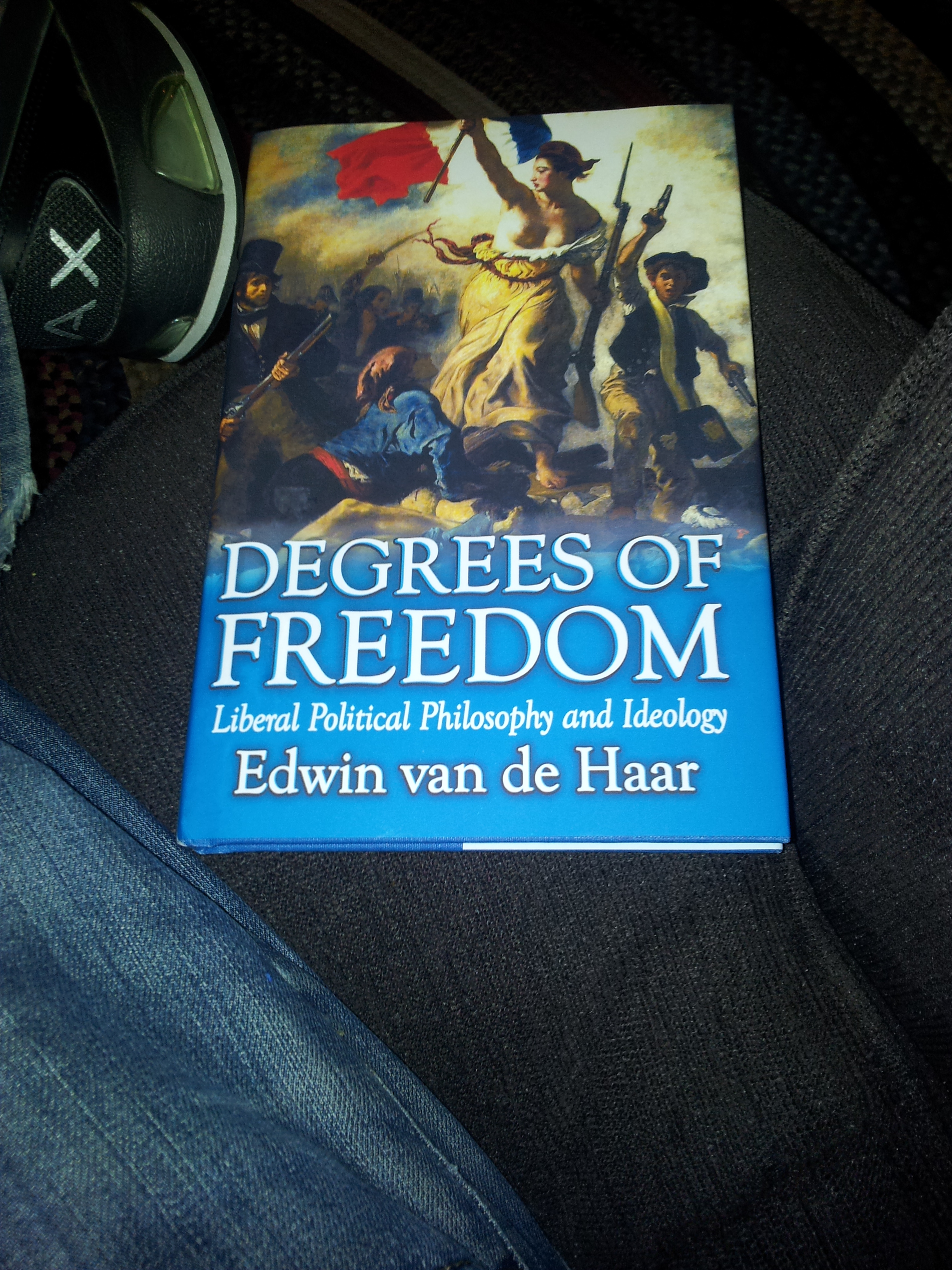
Look at what just arrived in my hands

Van de Haar's "Degrees of Freedom: Liberal Political Philosophy and Ideology"
Van de Haar’s “Degrees of Freedom: Liberal Political Philosophy and Ideology”

It’s Dr van de Haar’s newest book, straight from the Netherlands. You can pick up your own copy here (mine was a gift from Dr V, one of the many perks of being an annoying blog editor!). He’s got more books that you can find either on his ‘About…’ page here at NOL or on the sidebar. Thanks Dr van de Haar!

I know Dr Khawaja (of Policy of Truth infamy) was thinking of getting this book reviewed for Reason Papers, too. I don’t have the training in political philosophy to do the job, but I can say, just by reading through the first couple of pages in his introduction, that I could have benefited immensely from this book if I had been introduced to it in Political Science 101.

Aside from the introduction, I also briefly read through Edwin’s section near the back of the book (pgs. 120-126) titled ‘The Neoliberal Phantom’, and believe that it would be very useful for liberals of all stripes when confronted with poorly constructed anti-liberal arguments (the geographer – NOT anthropologist – David Harvey, for example, gets the full Dutch treatment from Dr van de Haar). It should be noted that this section is probably (again, I don’t have any training in this area) a little less useful for academics confronting more sophisticated attacks against liberalism, but it’s a very good primer for intense undergraduates and graduate students who have to deal with the relentless, poorly reasoned attacks on liberalism in their studies and at seminars.

When I read the whole thing I’ll be sure to post a review here at the blog. If I get word of somebody who wants to review Dr van de Haar’s book for Reason Papers (check out what’s on tap right now, by the way), I’ll try to post the good news here, too.

Epistemological modesty and unintended consequences

What has attracted me most to libertarianism – next to the Non-Aggression Principle – is its attitude towards our knowledge which can be described as epistemologically modest. Epistemology is a branch of philosophy that is concerned with our knowledge: how do we know what we know, what is the nature of our knowledge, what is its scope, and what is justified belief? Libertarianism is modest in the sense that it promotes an awareness of how little we know about the social forces in our society, and what the particular consequences are when certain social forces are at play.

In ‘The Pretense of Knowledge’ (1974), Friedrich Hayek had given an excellent account on the libertarian epistemological modesty. He writes that when policy makers are epistemologically immodest – meaning that they unjustly believe that they truly understand the social world to the extent that they can plan or direct certain social forces to achieve certain ends – they will do more harm than good in their efforts to improve the social order. Hayek argues that each individual knows just a fraction of what is collectively known. Since knowledge is decentralized and each individual has unique information with regards to his or her particular circumstances, it is best to leave those with local knowledge to take decisions on how to plan their lives. Unfortunately, many do-gooders ignore Hayek’s advice and attempt to plan and control society. The dangers of epistemological immodesty are visible all around us. Take for example the NATO-led war campaign against Gaddafi in Libya in 2011. The meddling with Libya’s internal affairs has led to many unintended consequences that were totally unforeseen by most politicians: in a country that was previously relatively peaceful, manifold precious lives have perished, many have been wounded, many children have become orphaned, millions of people are trying to flee the civil war and to find refuge in other countries, ISIS has taken control of several parts in Libya, and terrorism has now become more widespread. Politicians who believed that they knew enough about the social forces in Libya, and how they could overthrow Gaddafi and turn it into a peaceful democracy have been dead wrong.

The epistemologically modest libertarian knows that military, economic, and political interventionism, always leads to unintended consequences. It is therefore best to refrain ourselves from such interventions as much as possible. This anti-planning sentiment had been graciously expressed by the American physicist Robert Oppenheimer when he discussed world affairs:

It is perfectly obvious that the whole world is going to hell. The only possible chance that it might not is that we do not attempt to prevent it from doing so.[1]

[1] I cannot verify the authenticity of this quote. It was attributed to Robert Oppenheimer by Alan Watts.

Around the Web: Notewriters Edition

Woah, it’s been a slow week here at NOL. I can’t speak for anybody else, but I’ve been busy. Michelangelo and Edwin have both recently had their work published by the Cato Institute, and that’s cool.

I wish, of course, that my fellow Notewriters would toot their own horns a little more often, especially on the blog, but rest assured loyal readers, we’re staying busy.

New issue of Reason Papers is out

“A Journal of Interdisciplinary Normative Studies.” Check it out (pdf). Yours truly makes an appearance at the end of the journal, if you’re interested (I critique the student libertarian movement using an informal ethnographic method).

Here is the rest of the line-up:

Symposium: Christine Vitrano’s The Nature and Value of Happiness

Human Happiness and Virtue: Are They Related and, If So, How? —John Kleinig

Happiness, Pleasure, and Satisfaction —Christopher Rice

Response to My Critics —Christine Vitrano

Symposium: Emergencies

Consent-Based Permission to Kill People and Break Their Things —Stephen Kershnar

Catastrophic Events versus Infectious Disease Outbreak: Distinct Challenges for Emergency Planning —Thomas May et al.

Discussion Notes

Happiness or Life, or Both: Reply to Ole Martin Moen —David Kelley

Reply to Danny Frederick’s “Review Essay: Mark D. Friedman’s Nozick’s Libertarian Project: An Elaboration and Defense” —Mark D. Friedman

Reply to Mark Friedman —Danny Frederick

Articles

Fetuses Are Like Rapists: A Judith-Jarvis-Thomson-Inspired Argument on Abortion —Stephen Kershnar

The Scope of Attorney Confidentiality —Clifton Perry

Portraits of Egoism in Classic Cinema II: Negative Portrayals —Gary James Jason

Don’t Be an Ass: Rational Choice and Its Limits —Marc Champagne

Review Essay

Review Essay: Philip Booth’s . . . and the Pursuit of Happiness: Wellbeing and the Role of Government —Gary James Jason

Book Reviews

Robert Audi’s Moral Perception —Danny Frederick

Paul Blackledge’s Marxism and Ethics —Dan Swain

Gerhard Böwering et al.’s The Princeton Encyclopedia of Islamic Political Thought —Adam Walker

Afterwords

The Symbolic Clash of Whiplash —Robert Begley

In Search of Student Radicalism: YAL, SFL, and the GOP —Brandon Christensen

Be sure to check out the easy-to-navigate archives, too. Browsing through these issues is well-worth your time. Here (pdf), for example, is an issue with an excellent symposium on Sari Nusseibeh’s What Is a Palestinian State Worth?