- Making economic predictions is useless Branko Milanovic, globalinequality
- In praise of “austerity” Alberto Alesina, City Journal
- Suicidal tendencies Irfan Khawaja, Policy of Truth
- The study of history, strategic culture, and geopolitical conflict still matters Francis Sempa, ARB
Links
Nightcap
- Public and private pleasures (the coffeehouse) Phil Withington, History Today
- The historical state and economic development in Vietnam Dell, Lane, & Querubin, Econometrica
- The liberal world order was built with blood Vincent Blevins, New York Times
- Bowling alone with robots Kori Schake, War on the Rocks
Nightcap
- On the new conservative movement in the United States C Bradley Thompson, American Mind
- The sense of shame and the politics of humiliation Thomas Laqueur, Literary Review
- Money, modern life, and the city Daniel Lopez, Aeon
- Space exploration, and comparative coranavirus lockdowns Scott Sumner, MoneyIllusion
Nightcap
- Alesina was one of the most creative economists of his time Guido Tabellini, Il Foglio
- Alberto Alesina. A free-spirited economist Papaioannou & Stantcheva, VOXEU
- “Nation-Building, Nationalism, and Wars” Alesina, Reich, & Riboni, NBER
- The case against Mars Byron Williston, Boston Review
Nightcap
- The humbling of Dominic Cummings Harry Lambert, New Statesman
- Pandemic futarchy design Robin Hanson, Overcoming Bias
- Quite the IR controversy has broken out Jarrod Hayes, Duck of Minerva
- Republics, Extended and Multicultural William Voegeli, Claremont Review of Books
Nightcap
- The optimistic case for Hong Kong Anka Lee, Politico
- Taking political and economic frictions seriously Kevin Bryan, A Fine Theorem
- Patriarchy, fascism, and Dominic Cummings Maria Farrell, Crooked Timber
- Manga Soviet Union World War II Bunna Takizawa, Asahi Shimbun
Launching our COVID-19 visualization
I know everyone is buried in COVID-19 news, updates, and theories. To me, that makes it difficult to cut through the opinions and see the evidence that should actually guide physicians, policymakers, and the public.
To me, the most important thing is the ability to find the answer to my research question easily and to know that this answer is reasonably complete and evidence-driven. That means getting organized access to the scientific literature. Many sources (including a National Library of Medicine database) present thousands of articles, but the organization is the piece that is missing.
That is why I launched StudyViz, a new product that enables physicians to build an updatable visualization of all studies related to a topic of interest. Then, my physician collaborators built just such a visual for COVID-19 research, presenting a sunburst diagram that users can select to identify their research question of interest.
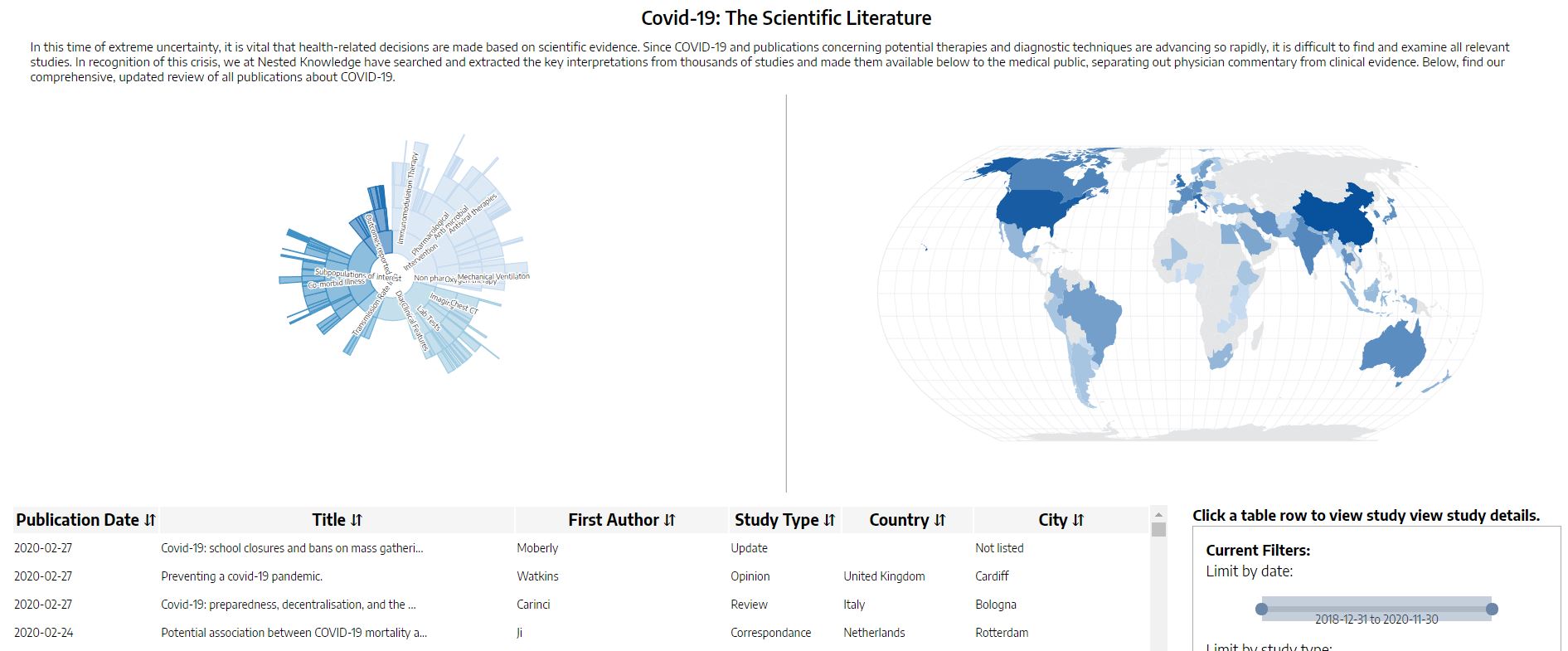
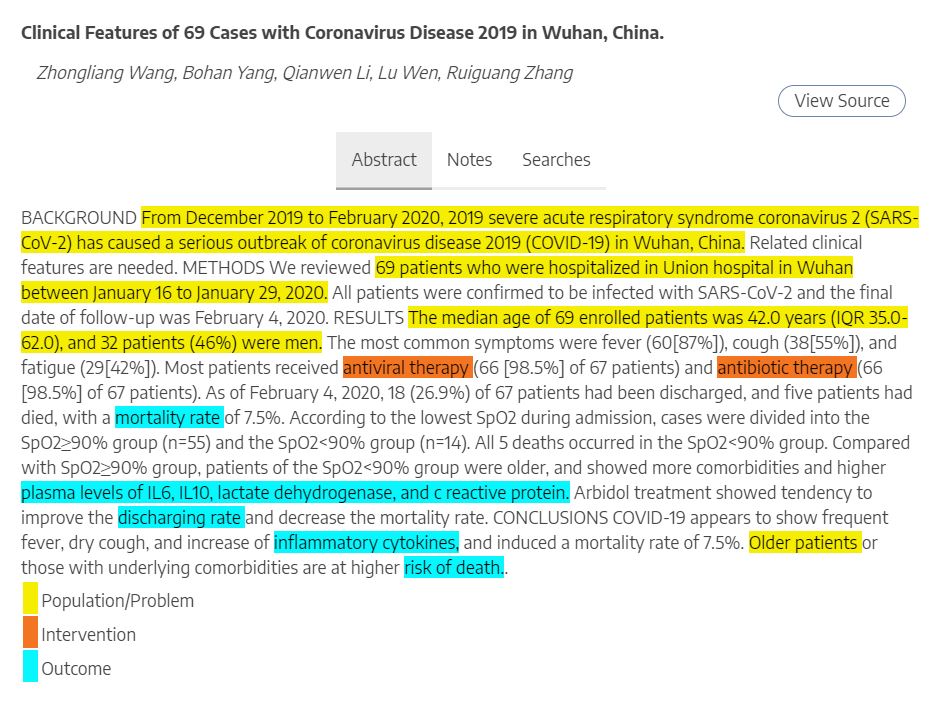
For instance, if you are interested in the impact of COVID-19 on pregnant patients, just go to “Subpopulations” and find “Pregnancy” (or neonates, if that is your concern). We nested the tags so that you can “drill down” on your question, and so that related concepts are close to each other. Then, to view the studies themselves, just click on them to see an abstract with the key info (patients, interventions, and outcomes) highlighted:
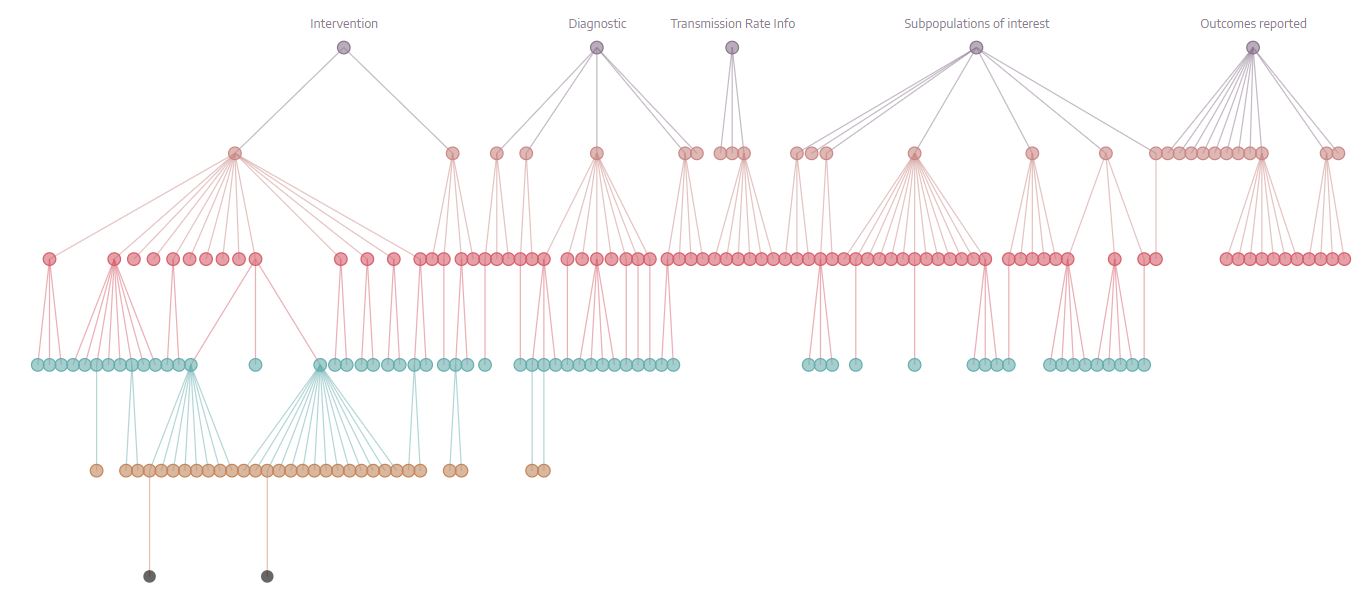
This is based on a complex concept hierarchy built by our collaborators and that is constantly evolving as the literature does:
Even beyond that, we opened up our software to let any researchers who are interested build similar visuals on any disease state, as COVID-19 is not the only disease for which organizing and accessing the scientific literature is important!
We are seeking medical coinvestigators–any physician interested in working with us, simply email contact@nested-knowledge.com or contact us on our website!
Nightcap (again)
(Ooops, lol. I hope all of NOL‘s American readers had a good Memorial Day, and that everybody else had a good Monday. The Glasner piece is an excellent discussion of the Austrian School of Economics.)
- An Austrian (School) tragedy David Glasner, Uneasy Money
Nightcap
- An Austrian (School) tragedy David Glasner, Uneasy Money
Nightcap
- The surprising lexical history of infectious disease Charles McNamara, Commonweal
- Immigration and virologic hysteria Michael Agovino, Not Even Past
- Against scarcity Marilynne Robinson, NYRB
- Can we escape from information overload? Tom Lamont, 1843
Nightcap
- Is Turkey moderating its foreign policy? Fehim Tastekin, Al-Monitor
- On Rudyard Kipling’s World War I-era book Lance Morrow, City Journal
- Habsburgs: The rise and fall of a world power John Adamson, Literary Review
- The end of the New World Order Ross Douthat, New York Times
Nightcap
- Oliver Williamson (RIP) and the Austrians Peter Klein, Mises Daily
- On the pioneer of Indian nationalism Soni Wadhwa, Asian Review of Books
- The politics of Star Trek Timothy Sandefur, Claremont Review of Books
- The psychology of entrenched privilege Côté et al., PSPB
Nightcap
- Tea and capitalism and China too Andrew Liu, Aeon
- America’s immigration paradox David Nasaw, New York Times
- Covid-19 and the power transition from the US to China Meisel & Moyer, Duck of Minerva
- “The Jakarta Method” (American foreign policy) Branko Milanovic, globalinequality
Nightcap
- Keen insights into American Higher Ed Irfan Khawaja, Policy of Truth
- About a possibly divine boy William Deresiewicz, Atlantic
- Warlike democracies Michael Federici, Modern Age
- In praise of grand strategy Ehrhardt & Ryan, War on the Rocks
Nightcap
- The seen and the unseen Chris Dillow, Stumbling & Mumbling
- Donald Trump doesn’t want authority Ross Douthat, New York Times
- Richard Rorty as a post-Straussian David Kretz, JHIblog
- Ancient and modern liberty Daniel Mahoney, Claremont Review of Books
 Notes On Liberty