RCH: Crazy Horse’s last battle

I’m back at it over at RealClearHistory. An excerpt:

When the Indian wars were underway, the battles were characterized as two very different peoples fighting against each other. Today, this view is still espoused, but the logic underneath has changed. Today, the American Indian fighting the American soldier has come to be viewed as more of a civil war than a clash of civilizations. The Native Americans are deeply intertwined in our culture, our history. As historical research gets better, thanks in part to the fact that our society continues to get wealthier and wealthier, the indigenous actors who helped shape American history receive more attention, empirically and theoretically.

Crazy Horse’s last battle in Montana against the U.S. Army highlights this civil war better than most. The Sioux and Cheyenne were not being pursued to be eliminated, but to be domesticated and transformed, by a benevolent government with the best of intentions, into American citizens.

Please, read the rest.

RCH: the Christmas Battles in Latvia

That’s the subject of this weekend’s column over at RealClearHistory. An excerpt:

9. The battles didn’t actually take place on Christmas Day. They actually occurred in early January. However, under the old czarist Julian calendar, the battles occurred over the Christmas season, from Dec. 23-29. The Germans were caught by surprise because even though it was January in the West, it was Christmas season in Russia and the Germans believed the Russians would be celebrating their Christmas rather launching a major counter-offensive.

And

3. The Siberians were eventually slaughtered. The Siberians who refused to fight were not necessarily betraying their Latvian brothers-in-imperium. They knew they were cannon fodder. And, indeed, when the Siberians finally went to reinforce the Russian gains made, they were greeted with a massive German counter-offensive. The Siberians (and others) were left for dead. They received no food, no weapons, and no good tidings of comfort and joy.

Please, read the rest (and tell your friends about it). It’s my last post at RCH for the year, so there’s lots of links to other World War I-themed articles I wrote throughout 2018.

RCH: Playing catch-up (Churchill, Rosa Parks, and Christmas in the New World)

I hope y’all have been enjoying my “nightcaps.” I have a wife, a toddler, and another little one due next month so life is too hectic to write much, but I have been plugging away at RealClearHistory and here are a few of the ones I’ve done over the past 14 days or so:

We’re still here. We still love blogging. Thanks for stickin’ around. The year ain’t over yet, and 2019 at NOL figures to be the best one ever. I’ll be back soon with my end of the year posts, one for most popular notes and one highlighting my personal favorites.


*for copyright reasons RCH had to use a different photo for the piece, but I submitted this one. It’s waaaaay cooler.

Forging ahead, falling behind and fighting back: British economic growth from the industrial revolution to the financial crisis

Nick Crafts can be viewed as the doyen of British economic history. His major publications date back to the 1970s – a favorite of mine is this piece from 1977 on the role played by chance in determining whether the Industrial Revolution would occur in England or France.  He is also the joint author of the Crafts-Harley interpretation of the Industrial Revolution.  But, perhaps because the majority of his research focuses on British economic history, he remains highly underrated outside of the UK.  His new book Forging ahead, falling behind and fighting back: British economic growth from the industrial revolution to the financial crisis summarizes much of his research.

I’ve reviewed it for the Economic History Review. But given the whims of academic publishing, it may be a long time until my review appears in print so I’ve decided to post a preview of my draft below.

**************************

Why was Britain the first industrial nation and the workshop of the world? Why was it eventually caught up and overtaken? Why once it had fallen behind the United States, did it fall further behind its European rivals in the Post-War period? And how did it recover its relative position in the 1980s and 1990s? All these questions are addressed in Nicholas Crafts’s slim new book.

In Forging ahead, falling behind and fighting back, Crafts provides a macroeconomic perspective on the British economy from 1750 to today. The word macro is advisory. Crafts surveys the British economy from 1000 feet, through the lens of growth theory and growth accounting. The upside of this approach is that he delivers a lot of insight in a small number of pages. Readers looking for discussions of individual inventors, innovations, politicians, or discussion of specific policy decisions can look elsewhere.

The first part of the book provides an overview of the Crafts-Harley view of the British Industrial Revolution. This view emphasizes the limited scope of economic change in the early 19th century. On the eve of the Industrial Revolution, the British economy already had a comparatively modern structure, with many individuals working outside agriculture. Growth between 1770 and 1850 was highly reliant on a few key sectors and TFP growth was modest (0.4% a year). Most workers remained employed in traditional sectors of the economy. It took until the second half of the 19th century for the benefits of steam, the general purpose technology of the age, to fully diffuse through the economy. Nonetheless, from a long-run perspective, the achievements of this period, a small but sustained increases in per capita GDP despite rapid population growth, were indeed revolutionary.

An important theme of the book is institutional path dependency. Characteristics of Britain’s early position as an industrial leader continued to shape its political economy down to the end of the 20th century. Crafts mentions two interesting instances of this. First, Britain’s precocious reliance on food imports from the early 19th century onwards left a legacy that was favorable of free trade. Elsewhere in the world democratization in the late 19th century often led to protectionism, but in Britain, it solidified support for free trade because, after the expansion of the franchise, the median voter was an urban worker dependent on cheap imported bread. Second, industrial relationships were shaped the nature of the economy in the 19th century. Britain thus inherited a strong tradition of craft unions that would have consequences in conflicts between labor and capital in the 20th century.

The second part of the book considers the late Victorian, Edwardian, and inter-war periods. It was in the late 19th century that the United States overtook Britain. A venerable scholarship has identified this period as one of economic failure. Crafts, however, largely follows McCloskey in exonerating Edwardian Britain from the charge of economic failure. The presence of fierce competition limited managerial inefficiencies in most areas of the economy; though there were notable failures in sectors where competition was limited such as the railways. The main policies errors in this area were thus ones of omission rather than commission: more could have been done to invest in R&D and support basic science – an area where the US certainly invested in more than the UK.

The seeds of failure, for Crafts, were sown in the interwar period. Traditionally these years have been viewed relatively favorably by economic historians, as the 1930s saw a shift away from Industrial Revolution patterns of economic activity and investment in new sectors. However, in a comparative light, TFP growth in the interwar period was significantly slower than in the US. The new industries did not establish a strong export position. This period also saw the establishment of a managed economy, in which policymakers acceded to a marked decline in market competition. Protectionism and cartelization kept profits high but at a cost of long-run productivity growth that would only be fully revealed in the post-war period.

Most economic historians view the postwar period through the lens of Les Trente Glorieuses. But in Britain, it has long been recognized that this was an era of missed opportunities. Simple growth accounting suggests that Britain underperformed relative to its European peers. Thus though the British economy grew faster in these years than in any other period; it is in this period that Britain’s relative failure should be located.

Crafts examines this failure using insights from the literature on “varieties of capitalism” which contrasts coordinated market economies like West Germany with liberal market economies like the United States or Britain. In the favorable conditions of postwar recovery and growth, coordinated market economies saw labor cooperate with capital enabling both high investment and wage restraint. Britain, however, lacked the corporatist trade unions of France or West Germany. As a legacy of the Industrial Revolution, it inherited a diverse set of overlapping craft unions which could not internalize the benefits of wage restraint and often opposed new technologies or managerial techniques. Britain functioned as a dysfunctional liberal market economy, one that became increasingly sclerotic as the 1960s passed into the 1970s.

An important insight I got from this book is that government failure and market failure are not independent.  Examples of government failure from the postwar period are plentiful. Industrial policy was meant to “pick winners.” But “it was losers like Ross Royce, British Leyland ad Alfred Herbert who picked Minsters” (p. 91). Market power became increasingly concentrated. Approximately 1/3 of the British economy in the 1950s was cartelized and 3/4 saw some level of price fixing. Britain’s exclusion from the EEC until the 1970s meant that protective barriers were high, enabling inefficient firms and managerial practices to survive. High marginal rates of taxation and weak corporate governance encouraged managers to take their salary in the form of in-kind benefits, and deterred innovation. Labor relations became increasingly hostile as the external economic environment worsened following the end of Bretton Woods.

Britain recovered its relative economic position after 1979 through radical economic reforms and a dramatic shift in policy objectives. Though of course, the Thatcher period saw numerous missteps and policy blunders, what Crafts argues was most important was that there was an increase in product market competition, a reduction in market distortions, and a reduction of trade union power, factors provided the space that enabled the British economy to benefit from the ICT revolution in the 1990s.

Rarely does one wish a book to be longer. But this is the case with Forging Ahead, Falling Behind, and Fighting Back. In particular, while a short and sharp overview of the Industrial Revolution is entirely appropriate, given the number of pages written on this topic in recent years, the last part of the book does need extra pages; the argument here is too brief and requires more evidence and substantive argumentation. One wishes, for instance, that the theme of institutional path dependency was developed in more detail. Despite this, Forging Ahead, Falling Behind, and Fighting Back is a notable achievement. It provides a masterly survey of British economy history tied together by insights from economic theory.

Eye Candy: The HDI of BRICS

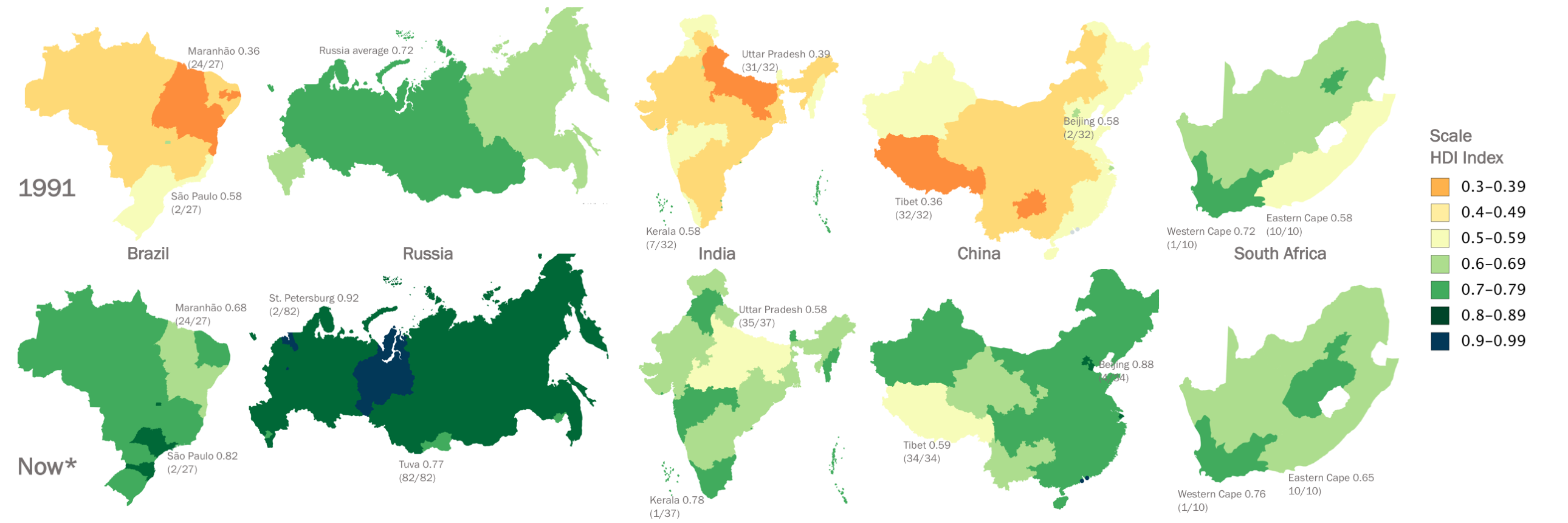
Phew, that’s a lot of acronyms. But this is a great map:

NOL map BRICS subunits
Click here to zoom

Orange and yellow is bad, green and blue is good. HDI stands for “Human Development Index,” which is a measurement that’s not nearly as good, in my opinion, for understanding how wealthy and happy a population is. Nevertheless, HDI is still one of the better measurements (Top 5, again in my opinion) out there. Here’s the wiki on HDI.

The maps are colored according to “subunits,” or provinces (which are like American states, such as Nebraska).

Brazil, India, and South Africa are multi-party democracies, while the other two are not. So what do all five have in common?

The Americanism of Aureliano Cândido Tavares Bastos

Life has been very busy, and so I am not blogging nearly as much as I would like to. Nevertheless, I would like to share my last published paper with you guys. Here is the abstract:

Aureliano Cândido Tavares Bastos was one of the main ideologists of the Brazilian Liberal Party in the 1860s and 1870s. Through several books, pamphlets and articles, Tavares Bastos defended that Brazil should follow a greater political and administrative decentralization, granting greater autonomy to the provinces. Another way to summarize Tavares Bastos’s political thinking is to say that he had great admiration for the United States, and understood that Brazil should, within the possibilities, copy more the political model of this country. Thus, this text interprets the political thinking of Tavares Bastos emphasizing as central factor of this the proposal that Brazil should not only more closely copy US federalism, but also get closer to the US in its foreign policy.

I do believe that Tavares Bastos is a great political thinker in Brazilian history and even beyond. Someone very worth knowing. Today Brazil is turning right, and the debate between Conservatives, Classical Liberals, and Libertarians is getting hotter. That is one reason why I believe Tavares Bastos is important today. A classical liberal, he opposed the nationalists/conservatives of his day. Here is the link for the complete article.

Afternoon Tea: “Confucian Constitutionalism in Imperial Vietnam”

The phantasm of “Oriental despotism” dominating our conventional views of East Asian imperial government has been recently challenged by the scholarship of “Confucian constitutionalism.” To contribute to our full discovery of the manifestations of Confucian constitutionalism in diverse Confucian areas, this paper considers the case of imperial Vietnam with a focus on the early Nguyễn dynasty. The investigation reveals numerous constitutional norms as the embodiment of the Confucian li used to restrain the royal authority, namely the models of ancient kings, the political norms in the Confucian classics, the ancestral precedents, and the institutions of the precedent dynasties. In addition, the paper discovers structuralized forums enabling the scholar-officials to use the norms to limit the royal power, including the royal examination system, the deliberative institutions, the educative institution, the remonstrative institution, and the historical institution. In practical dimension, the paper demonstrates the limitations of these norms and institutions in controlling the ruler due to the lack of necessary institutional independence. At the same time, it also suggests that the relative effectiveness of these norms and institutions could be achieved thanks to the power of tradition. The study finally points out several implications. First, the availability of the constitutional norms and institutions in the tradition is the cultural foundation for the promotion of modern constitutionalism in the present-day Vietnam. Second, the factual material concerning the Vietnamese experiences can hopefully be used for further study of the practice of Confucian constitutionalism in East Asia and further revision of the “Oriental despotism” - based understanding of imperial polity in the region. Third, the findings may also be useful for a more general reflection on pre-modern constitutionalism.

That is from Son Ngoc Bui, a legal scholar at the Chinese University of Hong Kong’s law school. Here is a link.

Afternoon Tea: “Highland Chiefs and Regional Networks in Mainland Southeast Asia: Mien Perspectives”

This article is centered on the life story of a Mien upland leader in Laos and later in the kingdom of Nan that subsequently was made a province of Thailand. The story was recorded in 1972 but primarily describes events during 1870–1930. The aim of this article is to call attention to long-standing networks of highland-lowland relations where social life was unstable but always and persistently inclusive and multiethnic. The centrality of interethnic hill-valley networks in this Mien case has numerous parallels in studies of Rmeet, Phunoy, Karen, Khmu, Ta’ang, and others in mainland Southeast Asia and adjacent southern China. The implications of the Mien case support an analytical shift from ethnography to ethnology—from the study of singular ethnic groups that are viewed as somehow separate from one another and from lowland polities, and toward a study of patterns and variations in social networks that transcend ethnic labels and are of considerable historical and analytical importance. The shift toward ethnology brings questions regarding the state/non-state binary that was largely taken for granted in studies of tribal peoples as inherently stateless.

This is from Hjorleifur Jonsson, an anthropologist at Arizona State University’s School of Human Evolution and Social Change. Here is a link.

Afternoon Tea: “Dividing Power in the First and Second British Empires: Revisiting Durham’s Imperial Constitution”

In his Report on the Affairs of British North America, Lord Durham proposed that “internal” government be placed in the hands of the colonists themselves and that a short list of subjects be reserved for Imperial control. Janet Ajzenstat maintains that Durham did not intend to formally restrict the authority of the new colonial legislature by dividing power. This paper argues otherwise: that Durham’s recommendation fell squarely within a tradition of distinguishing between the internal and external affairs of the colony. This was the imprecise but pragmatic distinction that American colonists invoked during the Stamp Act crisis as a means of curtailing imperial authority over internal taxation while maintaining their allegiance to the British Crown. It also was a division that Charles Buller relied upon in a constitution for New South Wales that he proposed prior to sailing to Canada as Durham’s principal secretary. Durham likely was drawing upon this tradition when he made his recommendation, a distinction that began to crumble away almost immediately. In the result, Canadians inherited a robust semblance of self-government, just as colonists during the Stamp Act crisis had desired, but without the need for revolution.

This is from David Schneiderman, a law professor at the University of Toronto. Here is the link.

Afternoon Tea: “Magna Carta for the World? The Merchants’ Chapter and Foreign Capital in the Early American Republic”

This Article examines the early modern revival and subtle transformation in what is here called the merchants’ chapter of Magna Carta and then analyzes how lawyers, judges, and government officeholders invoked it in the new American federal courts and in debates over congressional power. In the U.S. Supreme Court in the early 1790s, a British creditor and an American State debated the meaning and applicability of the merchants’ chapter, which guaranteed two rights to foreign merchants: free entry and exit during peacetime, without being subjected to arbitrary taxes; and, in wartime, the promise that their persons and goods would not be harmed or confiscated, unless their own king attacked and confiscated English merchants. In other words, no harm to enemy aliens, except as retaliation. Tit for tat.

The idea that reciprocity was a fundamental mechanism of international (and interpersonal) relations became something like a social science axiom in the early modern Enlightenment. Edward Coke claimed to find that mechanism in the merchants’ chapter and publicized it to lawyers throughout the emerging British Empire and beyond. Montesquieu lauded the English for protecting foreign commerce in their fundamental law, and Blackstone basked in that praise. American lawyers derived their understanding of the merchants’ chapter from these sources and then, in the early Republic, stretched the principle behind it to protect foreign capital, not just resident merchants. The vindication of old imperial debt contracts would signal to all international creditors that, in the United States, credit was safe. Federalists then invoked the chapter outside of the courts to resist Republican attempts to embargo commerce and sequester foreign credit. For Republicans, doux commerce had become the Achilles heel of the great Atlantic empires: their reliance on American trade could be used to gain diplomatic leverage without risking war. For Federalists, economic sanctions threatened not just their fiscal policy but their entire vision of an Atlantic world that increasingly insulated international capital from national politics. They all agreed, however, that the role of foreign capital in the American constitutional system was a central issue for the new and developing nation.

This is from Daniel J. Hulsebosch, a historian at NYU’s law school. Here is the link.

Eye Candy: Kalmar Union, circa 1400

NOL map Kalmar Union 1400

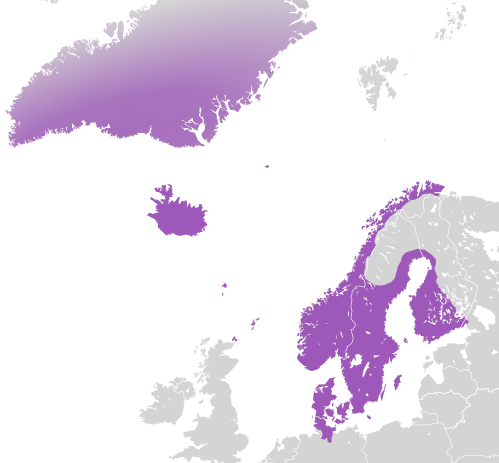
The Kalmar Union lasted from 1397 to 1523. Here is a wiki on it. Imagine Denmark, Norway, and Sweden united as a single country when it came to foreign affairs, but each of them having plenty of room to govern themselves domestically. The main rivalry here was the “monarchy” of Kalmar and the aristocracies of both Sweden and Denmark. This domestic rivalry, coupled with fact that its neighborhood included the Holy Roman Empire and the Hanseatic League, means that the Kalmar Union is probably one of the more interesting polities in European history. Yet I know next to nothing about it…

Afternoon Tea: “Shareholder Activism at the Dutch East India Company 1622-1625”

This paper explores the reason for the absence of control rights of shareholders in the Dutch East India Company (VOC) and the background of the conflict between shareholders and directors that arose in 1622/1623 when the VOC Charter of 1602 was extended.

The VOC was the result of a merger between several companies that had been trading in the East Indies between 1594 and 1602. The legal structure of most of these “pre-companies” which were incorporated for a single voyage to the East Indies, prevented shareholders from having actual influence. In most of these companies, the shareholders invested their money, not in the company itself, but via one of the individual directors. The relationship between a shareholder and most of the precompanies was therefore indirect, which impeded the exercise of control rights. Furthermore, shareholders may not really have been interested in their control rights given the high returns and the expectations of the newly opened trade route.

When these pre-companies were merged into the VOC in 1602, nothing changed with respect to the absence of shareholder control rights. The VOC, however, was established for a longer period and had to meet other more long-term challenges than those faced by the pre- companies. The failure to adapt the control structure to suit the different circumstances may have been a source of the conflicts that arose between the directors and shareholders between 1602 and 1623.

In 1622, upon extension of the 1602 Charter, a significant conflict erupted between the shareholders and directors. The so called dissenting participants complained about the numerous conflicts of interests that had been arising between the various directors and the VOC. They accused the directors of abuse of power, short-selling and self-enrichment. They argued that shareholder approval was required for the VOC to turn to the capital market to borrow funds. They also demanded that large investors be entitled to vote on the appointment of new directors. As the dissenting participants supported their arguments by referring to the English East India Company, the corporate governance of the EIC is briefly described.

Publishing their complaints in pamphlets, the shareholders mobilized public opinion and attempted to convince merchants not to invest in the Dutch West India Company, which was being incorporated at the same time. They exerted pressure on the government to ensure that more rights were granted to the shareholders when the VOC Charter was extended. To a limited extent, the activism of the “dissenting participants” was successful. The 1623 Charter granted certain rights to large investors, including the right to nominate new candidates for appointment as director. The 1623 Charter further regulated insider trading by the directors and encouraged the directors to pay a yearly dividend to the shareholders. In addition, a committee of nine shareholders was entrusted with the supervision of the VOC directors. This corporate body was known as the “Lords Nine” (Heren IX).

This is from Matthijs de Jongh, a judge in the Netherlands. Here is the link.

Afternoon Tea: “Albert Venn Dicey and the Constitutional Theory of Empire”

In the post-1945 world, constitutionalism has transcended the nation-state, with an array of transnational arrangements now manifesting constitutional characteristics — so says a growing number of scholars. This paper reveals an earlier but largely forgotten discourse of transnational constitutionalism: the constitutional theory of the British Empire in the late-nineteenth and early twentieth centuries. Focusing on the work of Albert Venn Dicey, the paper shows that, when the Empire was at the height of its power and prestige, British constitutional scholars came to see the Empire as a constitutional order and project. For Dicey, a committed constitutionalist and imperialist, the central dynamic of the imperial constitutional order was balancing British constitutional principles with imperial unity. This paper focuses in particular on parliamentary sovereignty, a constitutional principle that for Dicey was both necessary for and dangerous to the Empire’s integrity. An exercise in intellectual history, the paper rethinks Dicey’s work and the constitutional tradition in which Dicey has played such an integral part, seeking to bring empire back into the picture.

This is from Dylan Lino, a legal theorist at the University of Western Australia’s Law School. Here is the link.

RCH: Vietnam War armistice, Southeast Asian kingdoms, and abolitionism in America

I’ve been behind on links to my RealClearHistory columns. So, without further adieu:

and

Afternoon Tea: “The Johor-VOC Alliance and the Twelve Years Truce: Factionalism, Intrigue and International Diplomacy, C.1606-1613”

Using published and unpublished documents of Dutch, Portuguese and Malay provenance, the present study explores how news of the Twelve Years Truce in December 1609 negatively impacted politics and commerce at the court of the Kingdom of Johor. Since 1603, Johor had emerged as one of the principal allies of the Dutch East India Company (VOC) in the region of the Singapore and Melaka Straits, and after 1606 it had proven itself as a worthy ally in the company’s war on the Iberian powers across Southeast Asia. It will be argued that confusion resulting from the news of the truce on the ground in Asia exacerbated factionalism at the court. The Johor ruler, Ala’udin Ri’ayat Shah III, and especially his younger sibling Raja Bongsu, were incensed and evidently felt they had been left to carry on the struggle against Portuguese Melaka on their own. Unable to continue the war effort without Dutch funds, subsidies and ammunition, the pro-Portuguese faction at the Johor court brokered a peace with the Estado da Índia in October 1610. This deal led to the fall of Raja Bongsu and his pro-Dutch faction at the court. This essay provides the political and historical backdrop to the writing and revision of the Sejarah Melayu, or Malay Annals, in or around 1612.

This is from Peter Borschberg, a historian at the National University of Singapore. Here is a link.