On the point of quantifying in general and quantifying for policy purposes

Recently, I stumbled on this piece in Chronicle by Jerry Muller. It made my blood boil. In the piece, the author basically argues that, in the world of education, we are fixated with quantitative indicators of performance. This fixation has led to miss (or forget) some important truths about education and the transmission of knowledge. I wholeheartedly disagree because the author of the piece is confounding two things.

We need to measure things! Measurements are crucial to our understandings of causal relations and outcomes.  Like Diane Coyle, I am a big fan of the “dashboard” of indicators to get an idea of what is broadly happening.  However, I agree with the authors that very often the statistics lose their entire meaning. And that’s when we start targeting them!

Once we know that this variable becomes the object of target, we act in ways that increase this variable. As soon as it is selected, we modify our behavior to achieve fixed targets and the variable loses some of its meaning. This is also known as Goodhart’s law whereby “when a measure becomes a target, it ceases to be a good measure” (note: it also looks a lot like the Lucas critique).

Although Goodhart made this point in the context of monetary policy, it applies to any sphere of policy – including education. When an education department decides that this is the metric they care about (e.g. completion rates, minority admission, average grade point, completion times, balanced curriculum, ratio of professors to pupils, etc.), they are inducing a change in behavior which alters the significance carried by this variable.  This is not an original point. Just go to google scholar and type “Goodhart’s law and education” and you end up with papers such as these two (here and here) that make exactly the point I am making here.

In his Chronicle piece, Muller actually makes note of this without realizing how important it is. He notes that “what the advocates of greater accountability metrics overlook is how the increasing cost of college is due in part to the expanding cadres of administrators, many of whom are required to comply with government mandates(emphasis mine).

The problem he is complaining about is not metrics per se, but rather the effects of having policy-makers decide a metric of relevance. This is a problem about selection bias, not measurement. If statistics are collected without an intent to be a benchmark for the attribution of funds or special privileges (i.e. that there are no incentives to change behavior that affects the reporting of a particular statistics), then there is no problem.

I understand that complaining about a “tyranny of metrics” is fashionable, but in that case the fashion looks like crocs (and I really hate crocs) with white socks.

In health care, expenditures to GDP may be misleading!

In debates over health care reform in the US, it is frequent for Canada’s name to pop up in order to signal that Canada is spending much less of its GDP to health care and seems to generate relatively comparable outcomes. I disagree.

Its not that the system presently in place in the US is so great, its that the measure of resources expended on each system is really bad. In fact, its a matter of simple economics.  Imagine two areas (1 and 2), the first has single-payer health care, the other has fully-private health care.

In area 2, prices ration access to health care so that people eschew visits to the emergency room as a result of a scraped elbow. In area 1, free access means no rationing through price and more services are consumed. However, to avoid overspending, the government of area 1 has waiting lists or other rationing schemes. In area 2, which I have presented as an ideal free market for the sake of conversation,  whatever people expend can be divided over GDP and we get an accurate portrait of “costs”. However, in area 1, costs are borne differently – through taxes and through waiting times. As such, comparing what is spent in area 1 to what is spent in area 2 is a flawed comparison.

So when we say that Canada spends 10.7% of GDP on health care (2013 numbers) versus 17.1% of GDP in the US, is it a viable comparison? Not really.  In 2008, the Canadian Medical Association produced a study evaluating the cost of waiting times for four key procedures : total joint replacement surgery, cataract surgery, coronary artery bypass
graft (CABG) and MRI scans. These procedures are by no means exhaustive and they concern only “excessive” waiting times (rather than the whole waiting times or at least the difference with the United States). However, the CMA found that, for the 2007 (the year they studied), the cost of waiting was equal to 14.8$ billion (CAD).  Given the size of the economy back in 2007, this represented 1.3% of GDP. Again, I must emphasize that this is not an exhaustive measure of the cost of waiting times. However, it does bring Canada closer to the United States in terms of the “true cost” of health care.  Any estimate that would include other wait times would increase that proportion.

I know that policy experts are aware of that, but it is so frequent to see comparisons based on spending to GDP in order to argue for X and Y policy as being relatively cheap.  I just thought it was necessary to remind some people (those who decide to read me) that prudence is mandatory here.

What should universities do?

The new semester is here so it’s time for me to figure out what the hell I’m supposed to be doing in the weird world of modern American university life. Roughly speaking, the answer is going to be “do the stuff that professors do to help universities do what universities do.” So what do universities do? What are they supposed to do?

Universities occupy a few different niches in society. I’m usually tempted to think of universities like a business. And in that framework, I justify my salary by providing something of value to those students. At my school, something like 90% of the operating budget comes out of students’ pockets.

But that’s an overly narrow view. Students pay to go to school because they expect they’ll get value from it, but they also go to school because them’s the rules–if you want to enter adult society, university is the front gate. In this framework, I justify my salary by serving as a gatekeeper. Even though it’s students paying, the (nebulous) principal I’m obliged to is the collection of people already inside the walls.

But wait! There’s more! Universities are (in no particular order):

  • A repository of knowledge,
  • A generator of new knowledge,
  • A place people go to learn,
  • A place people go to prove themselves,
  • A place people make friends and have fun (in a way that may be hard to replicate),
  • A business (engaging in mutually beneficial exchange),
  • A special interest group,
  • An institution that holds a particular (privileged) position in a wider cultural landscape.

Any one of these functions is a can of worms in its own right. When we start to consider tradeoffs between each function (and the many less visible functions I’ve surely missed), it gets downright intractable. I’m going to focus on the student-focused aspects of university life.

The mainstream view:

University is a place students get educated. This education helps them get jobs because employers value it. Students might also learn things that help them be better citizens.

The mainstream view doesn’t seem far off from what I’ve got in mind until you get your hands dirty and start disentangling what that view says. Here are three big problems inherent in that mainstream view:

  1. The education-for-job myth.
  2. The definition problem.
  3. The one-size-fits-all problem.

The Job-training myth

We’re told that students go to school to learn valuable skills. I think that’s true, but not in the usual way. Any specific skills students learn in school are a) incredibly general, or b) out of date. My students might learn some interesting ways of looking at the world (general knowledge), but a lot of what I teach is completely useless in the workforce (“Johnson, draw me a demand curve, stat!”). But students do learn valuable skills incidentally. They learn to manage their time (ideally), how to be conscientious, and in general they’re socialized so that they can fit in with adult society.

Lately I’ve been thinking of college as a form of upfront consulting. Instead of going to school when you’ve got a specific problem to solve, go when you’re young and have nothing better to do. Since you’re getting the consulting before you know what sort of problems you’ll face in the future, we couldn’t possibly give you exactly the right bundle of knowledge.

College exposes students to lots of different ideas that might combine in unexpected ways. Your class in underwater basket weaving might seem like a waste of time until some day 30 years later you are trying to solve some problem that turns out to make a lot more sense if you think of it like wet wicker (I’m looking at you civil engineers!).

Some of what I (and my colleagues) do helps prepare students for their careers, but mostly I’m trying to help them be better–better thinkers, better able to understand and appreciate, better able to enjoy life.

The definition problem

The word “Education” means a lot of things to a lot of people. More often than not, people use the word without being clear about what they mean. Often it means “job training.” Sometimes it means “enlightening.” Other times it means “making you agree with me.” In practice, it means surviving enough classes that you get a piece of paper indicating as much.

It should be recognized as a vague and nebulous word instead of being pigeonholed. It isn’t a binary state (I was ignorant, now I’m educated). It’s helpful to think of people as being more or less educated, but the state of your education isn’t something we can really objectively compare to my state of education.

There are lots of important but nebulous things in our lives: health, happiness, moral worth. Their vagueness makes them difficult, but it isn’t going away.

It isn’t hard to convince people that education is nebulous, but it is hard to get people to behave as though they really understand that.

Homogenization and commodification

Once people start thinking of education as some objective thing we can pull off a shelf and give to someone, we run into the real problems. This unexamined view leads to bureaucracies that attempt to standardize and commodify education.

Don’t get me wrong, I get why people would try to do this. We want everyone to get education (and moral training, and good health, and…). And as long as we’re worried about that, we’re going to worry about making sure everyone gets the best education possible. But “the best” gives the false impression that there’s one right answer.

A top-down approach isn’t the right way to achieve the goal of widespread education. Attempting to systematically scale up education provision kills the goose that lays the golden eggs. We should fight against attempts to commodify university (which currently happens via accreditation-as-gateway-to-subsidy and the general expansion of bureaucracy through administration).

So what should universities do?

There are different margins on which we can justify our existence, but it’s not obvious how to balance our tasks: teaching, researching, advocating, etc.. Given the high degree of uncertainty, I’d argue for pluralism… different schools (and professors) should be trying different things. As universities adapt to the future, it’s important that they don’t all try to adapt in the same way at the same time.

I think a big part of the problem is that we’ve been too successful at rent seeking. All money/privilege/goodies comes with strings attached, and more money comes with more strings. We’re always going to get a little tangled up in those strings, but in the last couple generations we’ve hamstrung ourselves. Accreditation and assessment have become the most important things a modern university does, which distracts from our more fundamental goals.

A bottom up approach doesn’t mean less education, just different education. A more modest education system would change the mix of costs and benefits faced by stakeholders. Employers might rely less on degree signalling, which means hiring managers and potential employees exercising more judgement in sending and evaluating quality signals. I don’t know exactly what would happen, but flexibility is valuable for the nebulous goals universities are supposed to be pursuing.

But at the moment we seem to be in an equilibrium. Students are expected to go to school, schools are expected to deliver on promises they can’t really fulfill, and we go through the motions of keeping schools accountable in a way that basically misses the point.

So what will I do this semester? I’m going to keep talking about interesting stuff to students. I’m going to keep working towards getting tenure. But I’m also going to quietly subvert attempts to commodify university.


On Monopsony and Legal Surroundings

A few days ago, in reply to this December NBER study, David Henderson at EconLog questioned the idea that labor market monopsonies matter to explain sluggish wage growth and rising wage inequality. Like David, I am skeptical of this argument. However, I am skeptical for different reasons.

First, let’s point out that the reasoning behind this story is well established (see notably the work of Alan Manning). Firms with market power over a more or less homogeneous labor force which must assume a disproportionate amount of search costs have every incentive to depress wages. This can lead to reductions in growth as, notably, it discourages human capital formation (see these two papers here and here as examples). As such, I am not as skeptical of “monopsony” as an argument.

However, I am skeptical of “monopsony” as an argument. Well, what I mean is that I am skeptical of considering monopsony without any qualifications regarding institutions. The key condition to an effective monopsony is the existence of barriers (natural and/or legal to mobility). As soon as it is relatively easy to leave a small city for another city, then even a city with a single-employer will have little ability to exert his “market power” (Note: I really hate that word). If you think about it simply through these lenses, then all that matters is the ability to move. All you need to care about are the barriers (legal and/or natural) to mobility (i.e. the chance to defect).

And here’s the thing. I don’t think that natural barriers are a big deal. For example, Price Fishback found that the “company towns” im the 19th century were hardly monopsonies (see here, here, here and here). If natural barriers were not a big deal, they are certainly not a big deal today. As such, I think the action is largely legal. My favorite example is the set of laws adopted following the Emancipation of slaves in the United States which limited the mobility (by limiting the chances of Northerners hiring agents to come who would act as headhunters in the South). That is a legal barrier (see here and here). I am also making that argument regarding the institution of seigneurial tenure in Canada in a working paper that I am reorganizing (see here).

What about today? The best example are housing restrictions? Well, housing construction and zoning regulations basically make the supply of housing quite inelastic. The areas where these regulations are the most severe are also, incidentally, high productivity areas. This has two effects on mobility. The first is that low-productivity workers in low-productivity areas cannot easily afford to move to the high-productivity area. As such, you are reducing their options of defection and increasing the likelihood that they will not look. You are also reducing the pool of places to apply which means that, in order to find a more remunerative job, they must search longer and harder (i.e. you are increasing their search costs). The second effect is that you are also tying workers to the areas they are in. True, they gain because the productivity becomes capitalized in the potential rent from selling any property they own. However, they are in essence tied to the place. As such, they can be more easily mistreated by employers.

These are only examples. I am sure I could extend the list to reach the size of the fiscal code (well, maybe not that much). The point is that “monopsony” (to the extent that it exists) is merely a symptom of other policies that either increase search costs for workers or reduce the number of options for defections. And I do not care much for analyzing symptoms.

Paul Romer, the World Bank and Angus Deaton’s critique of effective altruism

220px-Paul_Romer_in_2005

Last week Paul Romer crashed out of his position as Chief Economist at the World Bank. He had already been isolated from the rest of the World Bank’s researchers for criticizing the reliability of their data. It seems there were several bones of contention, including the accusation that Chile’s current social democratic government falsified data contributing to some of its development indicators. Romer’s allergic reaction to the World Bank’s internal research processes has wider implications for how we think about policy research in international NGOs.

Continue reading

In the Search for an Optimal Level of Inequality

Recently, the blog ThinkMarkets published a post by Gunther Schnabl about how Friedrich Hayek’s works helped to understand the link between Quantitative Easing and political unrest. The piece of writing summarized with praiseworthy precision three different stages of Friedrich Hayek’s economic and political ideas and, among the many topics it addressed, it was mentioned the increasing level of income and wealth inequality that a policy of low rates of interest might bring about.

It is well-known that Friedrich Hayek owes the Swedish School as much as he does the Austrian School on his ideas about money and capital. In fact, he borrows the distinction between natural and market interest rates from Knut Wicksell. The early writings of F.A. Hayek state that disequilibrium and crisis are caused by a market interest rate that is below the natural interest rate. There is no necessity of a Central Bank to arrive at such a situation: the credit creation of the banking system or a sudden change of the expectancies of the public could set the market interest rate well below the natural interest rate and, thus, lead to what Hayek and Nicholas Kaldor called “the Concertina Effect.”

At this point we must formulate a disclaimer: Friedrich Hayek’s theory of money and capital was so controversial and subject to so many regrets by his early supporters – like said Kaldor, Ronald Coase, or Lionel Robbins – that we can hardly carry on without reaching a previous theoretical settlement over the apportations of his works. Until then, the readings on Hayek’s economics will have mostly a heuristic and inspirational value. They will be an starting point from where to spring new insights, but hardly a single conclusive statement. Hayekian economics is a whole realm to be conquered, but precisely, the most of this quest still remains undone.

For example, if we assume – as it does the said post – that ultra-loose monetary policy enlarges inequality and engenders political instability, then we are bound to find a monetary policy that delivers, or at least does not avoid, an optimal level of inequality. As it is explained in the linked lecture, the definition of such a concept might differ whether it depends on an economic or a political or a moral perspective.

Here is where I think the works of F.A. Hayek have still so much to give to our inquiries: the matter is not where to place an optimal level of inequality, but to discover the conditions under which a certain level of inequality appears to us as legitimate, or at least tolerable. This is not a subject about quantities, but about qualities. Our mission is to discover the mechanism by which the notions of fairness, justice, or even order are formed in our beliefs.

Perhaps that is the deep meaning of the order or equilibrium that it is reach when, to use the terminology of Wicksell and Hayek’s early writings, both natural and market interest rates are the same: a state of affairs in which the most of the expectancies of the agents could prove correct. The solution does not depend upon a particular public policy, but on providing an abstract institutional structure in which each individual decision could profit the most from the spontaneous order of human interaction.

SMP: The Macro Bifurcation

One of the major issues in contemporary macroeconomics concerns monetary policy since the 2008 crisis. For many, if not most, of the major central banks, the conventional channels through which the money supply changes do not work anymore. For instance, by paying interest on reserves, the Federal Reserve has moved from adjusting the money supply to influencing the banks’ money demand. Some central banks have even maintained that money supply does not affect inflation anymore.

Continue reading at the Sound Money Project.

Can you manage what you can’t measure?

Disclaimer: I’m not a macroeconomist, but I play one in Principles classes. Feel free to point out my errors in the comments.

Economics is filled with imperfect measures of important concepts. GDP, unemployment rates, and price indices all have significant flaws. Measures of entrepreneurship are even worse.

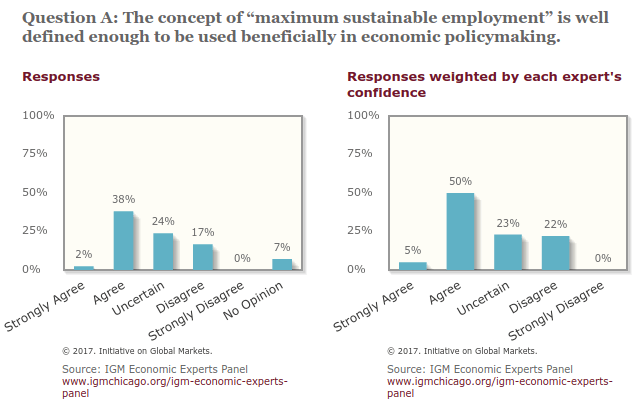
The Chicago Booth IGM Experts’ Panel recently posted an interesting result about the problems with unemployment:

IGMChicago_EmploymentandtheUSEconomy

The question is: “The concept of “maximum sustainable employment” is well defined enough to be used beneficially in economic policymaking.”

That’s 42 economists asked, 34 with an opinion (including “uncertain”), and about half of the sentiment is positive. And that sounds about right to me. I read this question as “can we engage in macroeconomic policy that doesn’t do long-run harm?” And if I were to describe my opinion probabilistic, it would look like these results. We could probably do “good policy” with a low degree of precision (i.e. useful enough for severe situations) if 1) we magically didn’t have to deal with political squabbling and 2) explicitly limited our goals to the short run.

Respondents agreeing emphasize that it’s “good enough.” But what does that mean? What level of precision and control are we looking at here?

Here’s the basic situation: given the underlying economic reality (everyone’s individual preferences, capabilities, knowledge, etc.) it makes sense to have some limited number of unemployed people at any given time. Unemployment rate is a measure of “how far are we from 0,” not, “how far are we from the ideal level?” That raises the following questions:

  • How accurately can we know what’s going on in the world?
  • How accurately can we know what’s supposed to be going on in the world?
  • How precisely can we affect the world?

The aggregate macroeconomic theory and empirics of the 1960’s were seriously imprecise. Trying to target macroeconomic policy would be like doing eye surgery with a hand grenade. In that sort of world, your best medicine is probably chicken soup and bed rest.

Here in the present we have much better data and computation. And it’s going to get better. Facebook already has data precise enough to track the exact effects of policy down to the individual level.

But think about a precise outcome and imagine what sort of policy would be required to get there. Let’s say our outcome is “get Rick to buy a new car.” Some mix of low interest rates, the right set of subsidies, and ideal circumstances might move things in that direction. But that sort of surgical outcome is just never going to be possible through legitimate macroeconomic policy (and definitely not monetary policy*). The size of the problem just means that Butterfly Effect problems will prevent macroeconomic policy from having household-level precision, even if the data could (in principle) measure the effect.

Less precise outcomes seem plausible (e.g. “get middle class households in the north east to buy 30-60,000 new cars”), but not without making a lot of second order problems. It’s not so much a “middle of the road leads to socialism” situation as a multiplier effect from a convergent series. Push a billion over there, create big distortions, follow those up with medium distortions, and finally let small remaining problems fizzle out on their own. Throw in public choice issues and it seems obvious that the efficiency cost of precise interventions won’t scale up nicely.

We’re now in a world where our theoretical and empirical tools are more precise than our implementation tools. We’re no longer trying to do surgery with a hand grenade. But that doesn’t mean we’ve got a laser scalpel either. It’s more like we’ve got we’ve got laser-like measuring tools but our implementation tools are blunt objects. If we aren’t careful, we’ll spend our time swatting flies with sledge hammers.

All told, it seems possible that we could engage in fairly targeted macroeconomic policy. But as the scale increases, the marginal cost will rise rapidly (maybe less so with the right institutions). Better timing might increase the effectiveness of each dollar spent*, but overall, it seems like things have to be really bad before the government should consider anything too ambitious.

Manage an economy’s economic health using imperfect measures like unemployment rate is about like trying to manage your physical health using heart rate and body mass index figures. Can we do “good enough”? Only to a limited extent. We could stop eating garbage and get some exercise. But there isn’t some magic combination of vitamins and crystals that will stop cancer. Anyone who tells you otherwise is a) trying to sell you something and b) trying to convince themselves they’re in control of the uncontrollable.

In terms of macroeconomic policy, we should start by caring about fundamentals (i.e. long run economic development) and be skeptical of people promising to control the business cycle.


*And let’s face it, we aren’t likely to get decent macroeconomic policy (in terms of efficiency, timing, and appropriateness of policy to circumstances) out of Congress until there’s a serious cultural shift.

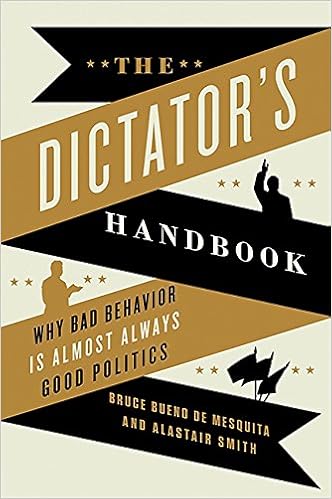
The Dictator’s Handbook

I recently pointed you towards a book that has turned out to be a compelling and interesting read.

At the end of the day, it’s a straightforward application of public choice theory and evolutionary thinking to questions of power. Easy to understand theory is bundled with data and anecdotes* to elucidate the incentives facing dictators, democrats, executives, and public administrators. The differences between them are not discrete: they all face the same basic problem of compelling others’ behavior while facing some threat of replacement.

Nobody rules alone, so staying in power means keeping the right people happy and/or afraid. All leaders are constrained by their underlings. These underlings are necessary to get anything done, but they’re also potential rivals. For Bueno de Mesquita and Smith the crucial facts of a political order are a) how big a coalition (how many underlings) the ruler is beholden too and b) how replaceable the members of that coalition are.

The difference between liberal and illiberal orders boil down to differences in those two parameters. In democracies with a larger coalition and less replaceable coalition members, rulers behave better.


I got a Calculus of Consent flavor from Dictator’s Handbook. At the end of the day, collective decision making will reflect some version of “the will of the people… who matter.” But when we ask about the number of people who matter, we run into C of C thinking. Calling for bigger coalitions is another way of calling for an approach to an effective unanimity rule (at least at the constitutional stage).

In C of C the question of the optimal voting rule (majority vs. super majority vs. unanimity) boils down to a tradeoff between the costs of organizing and the costs of externalities imposed by the ruling coalition. On the graph below (from C of C) we’re comparing organization costs (J) against externality costs (I) (the net costs of the winning coalition’s inefficient policies). The idea is that a unanimity rule would prevent tyranny of the majority (i.e. I is downward sloping), but that doesn’t mean unanimity is the optimal voting rule.

Figure 18.  Click to open in new window.

But instead of asking “what’s efficient” let’s think think about what we can afford out of society’s production, then ask who makes what decisions. In a loose sense, we can think of a horizontal line on the graph above representing our level of wealth. If we** aren’t wealthy enough to organize, then the elites rule and maximize rent extraction. We can’t get far up J, so whichever coalition is able to rule imposes external costs at a high level on I.

But I‘s height is a function of rent extraction. Rulers face the classic conundrum of whether to take a smaller piece of a larger pie.

The book confirms what we already know: when one group can make decisions about what other groups can or must do, expect a negative sum game. But by throwing in evolutionary thinking it shed light on why we see neither an inexorable march of progress nor universal tyranny and misery.

As you travel back in time, people (on average) tend to look more ignorant, cruel, and superstitious. The “default state” of humanity is poverty and ignorance. The key to understanding economics is realizing that we’ve bootstrapped ourselves out of that position and we aren’t done yet.

The Dictator’s Handbook helped me realize that I’d been forgetting that the “default state” of political power is rule by force. The liberalization we’ve seen over the last 500 years has been just the first part of a bootstrapping process.

Understanding the starting point makes it clear that more inclusive systems use ideas, institutions, capital, and technology to abstract upward to more complex levels. Something like martial honor scales up the exercise of power from the tribe (who can The Chief beat up) to the fiefdom (now the Chief has sub-chiefs). Ideology and identity can tie fiefdoms into nation-states (now we’ve got a king and nobility). Wealth plus new ideologies create more inclusive and democratic political orders (now we’ve got a president and political parties). But each stage is built on the foundation set before. We stand on the shoulders of giants, but those giants were propped up by the non-giants around them.

Our world was built by backwards savages. The good news is that we can use the flimsier parts of the social structure we inherited as scaffolding for something better (while maintaining the really good stuff). What exactly this means is the tricky question. Which rules, traditions, organizations, and processes are worth keeping? How do we maintain those? How/when do we replace the rest? And what does “we” even mean?

Changing the world involves uncertainty. There are complex interrelations between every part of reality. And the knowledge society needs is scattered through many different minds. To make society better, we need buy-in from our neighbors (nobody rules alone). And we need to realize that the force we exert will be countered by an equal and opposite force some plural, imperfectly identifiable, maybe-but-probably-not equal, and only-mostly-opposite forces. There are complex and constantly shifting balances between different coalitions vying for power and the non-coalitions that might suddenly spring into action if conditions are right. Understanding the forces at play helps us see the constraints to political change.

And there’s good news: it is possible to create a ruling coalition that is more inclusive. The conditions have to be right. But at least some of those conditions are malleable. If we can sell people on the right ideas, we can push the world in the right direction. But we have to work at it, because there are plenty of people pitching ideas that will concentrate power and create illiberal outcomes.


*I read the audiobook, so I’m basically unable to vouch for the data analysis. Everything they said matched the arguments they were making, but without seeing it laid out on the page I couldn’t tell you whether what they left out was reasonable.

**Whatever that means…

SMP: The War on Cash: What Do You Have to Hide?

The war on cash we see starting to take place in recent times has a dangerous component. Besides the technical arguments in favor (and against) the efficiency gains of a cash-less economy, politicians are putting forward the argument that only those who have something to hide would oppose to a cash-less economy.

The problem is that this rhetoric implies that any individual is guilty of something until proven innocent. The presumption of innocence, one of the most basic principles of a free society, is being dangerously inverted.

Some economists, including Harvard’s Ken Rogoff, want to minimize the circulation of cash. Such proposals are usually justified on the grounds that they would (1) reduce criminal activity and tax evasion while also (2) helping central banks execute monetary policy when interest rates are at the zero lower bound. Both arguments have been challenged on this blog (here, here, and here).

Continue reading at SMP.

SMP: Separating the Technology of Bitcoin from the Medium of Exchange

At the Sound Money Project I have a comment on the importance of distinguishing between the bitcoin technological innovation and its use as a means of exchange. A solid technological innovation does meant that bitcoin is necessarily properly coded to be a successful monetary experiment.

Bitcoin is back in the spotlight as its price has soared in recent weeks. The most enthusiastic advocates see its potential to become a major private currency. But it is important to remember bitcoin is a dual phenomenon: a technological innovation and a potentially useful medium of exchange. One might recognize the technology as a genuine innovation without accepting its usefulness as a medium of exchange.

Continue reading at SMP.

Rules for Rulers

Watch to the end for details about the book (by Bruce Bueno de Mesquita and Alastair Smith) this video is based on.

  1. I think readers of NoL will enjoy this nicely condensed public-choice-y analysis of the constraints involved in operating (and thus changing) a government.
  2. The audiobook is available on Overdrive, so you can borrow it from your library. I’m just started listening to it and I’m enjoying it immensely.
  3. I suddenly found myself as the benevolent dictator of some country. My long-term objective is to shape my society into a libertarian utopia. Here’s my plan to deal with the constraints discussed in the video: all of my advisors are required to play devil’s advocate when I propose some change. Yes-men will be summarily executed. Assuming I stay benevolent but also ruthless, does my devil’s advocate scheme work out? Please discuss in the comments. Anyone who doesn’t earnestly try to poke holes in my idea will be sent to the work camps.

Sound Money Project Relaunch

The Sound Money Project has relaunched this November at the American Institute for Economic Research (AIER) under the direction of William J. Luther.

Other than Luther and myself, you’ll see regular posts by Scott Burns, James Caton, Alexander W. Salter, and Brian C. Albrecht.

Digging Deeper into Populism: A Short Reply to Derril Watson

Derril Watson offer some critical remarks on my short post about populism in Latin America. In short, Watson is arguing that (1) I’m stating something obvious (populism diminishes economic freedom) and (2) that I’m wrong when I say that populism fails to produce economic growth.

Seems I haven’t been quite clear, because I state none of the above. The intention of my post is not to show that populism decreases economic freedom, I think this is uncontroversial. The point of the post is to show, with a very simple calculation, how fast economic freedom is reduced. I might be wrong, but I have the impression that most individuals do not realize how fast they can loose their economic liberties under this type of government. This is the message carried in the title of the post “How fast does populism destroy economic freedom in Latin America?” rather than “Does populism destroy economic freedom in Latin America?”

With respect to the second point, my claim is not that under populism there is no growth of GDP, my claim is that “populist governments failed to increase GDP per capita consistently faster than the region.” My original post is just a small bite of a paper that is still work in progress and I’ll share in due time. I wasn’t expecting this claim to be controversial. Still, the figure below shows the ratio of GDP per capita (PPP) of each of he countries I observe with respect to Latin America. All countries are centered in year 0 as the first year of populism as defined in my original post. That’s the first dot in the graph. The second dot shows either the last data available or the end of populism. None of these countries show a consistent higher growth rate than the rest of the region.

Populism - Fig 1

It seems to me that Watson is confusing growth with recovery. The fact that economic growth produces a growth in GDP does not mean that a growth in GDP is due to economic growth. The recovery mentioned by Watson in Argentina happens after the largest crisis in the history of the country and the largest default worldwide at the time. As I mentioned in my post, Argentina hits stagflation in 2007. This suggests to me a rapid recovery with no significant growth and built upon an unsustainable policy (for instance, Argentina fails to improve its relative income with respect to the region, it rather stagnates in 2007 and starts to fall a few years after.) I can show a large increase in my personal GDP as measured by consumption by depleting my savings (consuming my capital stock at the country level). I wouldn’t call that personal economic growth. The Kirchner government, for instance, failed to reduce poverty below the levels seen in the 1990s. It does, of course, if that is compared with the poverty levels around the years of the crisis (which is what Watson’s table is doing.) It should also be kept in mind that official poverty measures in Argentine were hampered by the government.

There’s still another important issue regarding GDP measures of Argentina. As it became well known, GDP series were hampered by the government (also inflation and poverty rates were hampered.) By 2014 official GDP values were overestimating the size of the economy by 24%. Another sign is the evolution of real wages in Argentina, which hits a ceiling again in 2007 with a level similar to the one at the end of 2001 (just before the crisis). In 2008, 2009, and 2010 real wages decline.

As a final comment, I’m not sure to what comment of mine Watson refers to. I don’t see a comment entry of mine in my original post, nor I remember doing so. In any case, I don’t get into the definition of populism precisely for how difficult that task can be. The problem of defying populism is one of the areas covered in my yet unfinished paper.

Digging Deeper into Populism

TL;DR summary: The one thing most populist governments studied had in common was a declining protection for property rights. Focus there next time.

Nicolás Cachanosky explained that populism in five Latin American countries had led to a rapid deterioration in their economic freedom, intimating that this also led to a relative drop in living standards compared to other South American countries. Given that the two primary economic strategies of populism are control and spend (Dornbusch and Edwards 1991 quoting Carbonetto et al. 1987), it would be shocking if a populist government did not reduce economic freedom. That’s the idea! However, there is more we could learn about how populism reduces economic freedom by doing a little more to identify exactly what it was that populist governments did. First, I think it’s useful to go a little further back, to compare how trends were looking before* populism (say by 1991) to how those trends changed with the election of a populist government. Second, I’m going to take a more careful look at how and why economic freedom decreased.

It is funny to me that when Cachanosky’s response to his first commenter is to ask for a definition and a measure before being willing to debate a correction; that suggests he really ought to have been more careful to define populism in his post. In fairness, that’s a tall order*: much of the literature on populism has been trying to define it and there is still no consensus as far as I can tell. Are we focusing primarily on increasing statism, whether it is called populism or progressivism or socialism or cronyism? Or is there something special about the populist brand of statism that we should be looking out for? To the extent populism is a “power to the people” movement, Libertarianism itself could try to appropriate the populist brand and claim they are taking power back from the government for the people! I don’t think this is what Cachanosky has in mind. :). I tend to think that he is focused mostly on statism and for the purposes of his post, it doesn’t matter whether it’s populism or socialism that caused it, so please assume when I say “populism” hereafter, I mean increased state control over the economy.

Even given that, populism/statism exists on a continuum. There is a marked difference between a determined populist government that nationalizes wide swathes of an economy rapidly in order to redistribute riches to the common people and someone in an unnamed developed country who uses populist rhetoric to get elected and keep his base happy only to turn around once in office and enact largely pro-business deregulations and strengthen conservative social mores.

Because of this, it’s important to make distinctions between the 5 countries in question (Argentina, Bolivia, Brazil, Ecuador, and Venezuela). To demonstrate that, let me focus on Argentina and Brazil. Mueller and Mueller (2012) contrast Brazil and Argentina’s responses to the global food price crisis in 2006-08, during this populist period in both countries. There have been very few checks and balances on executive power in Argentina, allowing the Kirchners to enact “opportunistic price controls and intrusive export bans, generating significant discontent and investment disincentives” (pg 3). In Brazil, the checks on the presidency to prevent a repeat of the late 80s/early 90s inflation led to “the surprising conversion of President Lula once in office in 2003, reneging the leftish policy agenda his party had defended for years in the opposition, only to continue the fiscally disciplined macroeconomic policies of his predecessor” (pg 5). These kinds of difference are very important to understand what happens and when and why.This table shows how Heritage’s Economic Freedom in the World survey ranked the five countries Cachanosky singles out as populist in 1995 when the survey started, the year when they elected a populist government, and 2015; I then add five other South American countries for comparison. 10 represents high economic freedom and 1 very low freedom. The astute reader will notice that I am using the raw scores rather than country rankings as Cachanosky does because I suspect it matters more for economic growth what happens within my country rather than thinking economic growth will collapse because a handful of other countries on other continents become more free while I stay put where I am: I will look worse by comparison, but not be worse.

Heritage Overall
1991 start 2015
Argentina (2003) 6.8 5.6 4.4
Bolivia (2006) 5.8 5.8 4.7
Brazil (2002) 5.1 6.2 5.6
Ecuador (2007) 5.7 5.5 4.9
Venezuela (1999) 6 5.6 3.4
Heritage overall
1995 2005 2015
Chile 7.1 7.8 7.9
Colombia 6.5 6 7.2
Paraguay 6.6 6.1 6.8
Peru 5.7 5.3 6.1
Uruguay 6.3 6.7 6.9

To delve into the Argentina/Brazil comparison again, the survey shows Argentina scoring markedly higher than Brazil in 1995. This situation had already reversed itself by 2003 and the start of populism. Since then Argentina has continued to fall rapidly while Brazil has turned reversed its progress. Delving deeper into those numbers, Argentina has become markedly less free in terms of almost every category Heritage measures (respect for property rights in 2001-2003, government integrity 2006-2008, tax burden, government spending since 2011, business freedom in 2002, and monetary, investment, and financial freedom in 2003), while Brazil’s primary sin was an increase in spending in 2006 and an increase in taxes to pay for it. That’s it. This shows a real deterioration in Argentinian freedom before populism, a trend only continued and exacerbated by the Kirchners, while Brazil has shown both improvement and decline, with a much different, constrained form of policy making. Argentinian populism and Brazilian are far from the same phenomenon.

In Bolivia and Ecuador, property rights fell in 2001 and investment freedom by 2005 before populism in either country and both slid down steadily after electing a populist government; both countries have improved in government integrity, taxes got worse in Ecuador in 2008 with spending increasing massively in 2010, and financial freedom worsened after populism started. Venezuela saw the largest decrease in respect for property rights right after electing Chavez and again in 2008. In contrast to other countries, Chavez initially reduced government spending and kept taxes roughly constant, with spending not increasing again until after 2008. Business and financial freedom declined steadily, investment freedom plummeted in 2004, and monetary freedom only declined in 2014.

We see then five rather different patterns, even though most of them saw the same sort of decline of 1.2-1.4 points. The key feature in all but Brazil is the decrease in respect for property rights shortly after the election of a populist government. Spending also tends to be higher in these five countries, though all happened during the global food price crisis and the US/EU financial crisis when spending also increased by many non-populist countries as well. Otherwise, there is very little in common among the five countries, with some embracing freer trade and others fleeing it, some cracking down on monetary and financial freedoms with others largely ignoring them. Our five ‘control’ countries saw an improvement in economic freedom from 2005-201, particularly in Colombia.  Colombia and Peru reduced their respect for property rights in 2002, but later repented; Paraguay has not held property rights in even modest esteem since 1998.

All of this suggests the place to look in future research is to the importance of declining respect for property rights among populist governments as a driver of economic freedom and economic growth.

And that brings us to the second of Cachanosky’s points – that this drop in economic freedom in those five countries led to shrinking economies compared to other economies in the region. First off, to be clear, all five of these populist economies experienced rapid economic growth during the time period in question, and this economic growth was much higher than the economic growth enjoyed in the decade before populism started. This would lead pro-populists to conclude that populism was actually quite good. Cachanosky admits that even though Argentina fell farther in the economic freedom rankings than its peers, its GDP/capita actually increased. He excuses this as being “largely explained as recovery after the 2001 crisis and by consuming capital stock, not as an expansion of potential output.” Unfortunately for his story, Argentina’s GDP/capita in terms of real USDollars not only surpassed its pre-crisis level (around $12300 in 1998), but rose to $17500 – a 42% increase during its populist period. (All numbers from www.gapminder.org are PPP$ inflation-adjusted.) In every single case he cites, GDP/capita rose while the headcount poverty rate fell dramatically.

However, compare their growth to the five control countries, and compare the time period before and after in each case:

GDP/cap (PPP$) Growth poverty (% below $3/day)
1991 start 2015 91-start start-15 1991 start 2014
Argentina (2003) 9330 10300 17500 10.40 69.90 3.9 19.1 4.3
Bolivia (2006) 3850 4370 6150 13.51 40.73 30.4 32.4 12.7
Brazil (2002) 10300 11600 15400 12.62 32.76 35.8 24.5 7.56
Ecuador (2007) 7690 7810 10800 1.56 38.28 36.5 32.9 10.2
Venezuela (1999) 16100 14200 15800 -11.80 11.27 N/A N/A N/A
GDP/cap (PPP$) Growth poverty (% below $3/day)
1991 2003 2015 91-start start-15 1991 2003 2014
Chile 9750 15500 22500 58.97 45.16 N/A N/A N/A
Colombia 7780 8680 12400 11.57 42.86 22.7 26.6 13.2
Paraguay 6040 5870 8040 -2.81 36.97 7.9 19.4 7
Peru 5290 6880 11500 30.06 67.15 33.9 27.2 9
Uruguay 10100 11500 19900 13.86 73.04 2.1 5.2 1.3

The 2003-2015 period was good across the board in South America, with most growing at least 30% more from 2003ish-2015 compared to 1991-2003. Similarly, poverty rates fell markedly from 2003-2014 in every country for which I have Gapminder data. So the claim is not that populism resulted in negative economic growth. The issue is that the average growth in the non-populist countries was around 1% per year higher than in the populist countries. Thus, to the populist-supporter who points to the high growth of Argentina et al as proof that populism works, the response is that growth was even higher in their non-populist neighbors and poverty is lower in them as well.

Now the unfortunate thing for drawing a clear causal interpretation from these correlations is that economic growth was also higher in the non-populist countries in the before period as well, perhaps due in part to having higher economic freedom to begin with. Growth in the freedom-preserving countries was slightly more than 1% per year higher, and that is driven predominantly by Chile. If Chile had had a more average 11-13% growth during that time period, we would be able to show more conclusively that the economic growth gap increased after populism. So, really, the claim that populism caused a lower economic growth in those countries doesn’t hold up very well – economic growth was lower in those countries before populism as well. It may well be that economic growth would have been higher in Argentina, Bolivia, Ecuador, and Venezuela had they maintained or improved their respect for property rights, but the raw data doesn’t tell us that without significantly more controls and doing some proper regressions.


* – One of the problems of this exercise is that to get “before” populism, you need to go back a hundred years or so. Ah well.