Public libertarian intellectuals

Consider the post-Hayek/Rothbard/Friedman era of libertarianism.

Who has stepped up to fill their shoes? It’s hard to say, but 4 academics who stand out are Tyler CowenMike MungerRobert Higgs, and Bryan Caplan. Their scholarly output is comparable to our own Jacques Delacroix, and their influence within the libertarian quadrant is – or was at some point in time – much greater than Jacques’.

All four of these scholars cut their teeth blogging. The blog is how they teach. The blog is how they vent. The blog is how they share news and knowledge. The blog is how they went from well-respected to essential. All four write opinion pieces for professional outlets, but that’s not how they became essential to libertarians across the globe. Sharing their day-to-day thoughts about the world, to the world (and not just their walled-off social media accounts), is how they were able to step up and usher libertarianism into the next generation.

As the new year approaches, I encourage you to think about what liberty means to you. (Is it best left in the hands of professional Libertarians? You know the incentives they face. You know the choices they’ve made.) I also encourage you to be bold in your goofiness. Be strange! Be strong. Be artsy. Be rude (but never cruel). The professional outlets will always be there, waiting patiently to edit out your voice from The Message. Make 2020 the year a new generation of libertarians stepped up and took on the burden of responsible citizen-scholarship.

Sunday Poetry: Junger’s War Observations

Without noticing it, I heavily built my reading schedule this year around of what one might call a “post-liberal reading list”. The idea, that the demise of social institutions might be the inevitable consequence of an ongoing individualization of society struck me as initially convincing. I am currently in search of good examinations on the ultimate effect Liberalism has on the development of social institutions. Hopefully, Steven Horwitz’ “Hayek’s Modern Family” will provide me with some compelling arguments to refute the post-liberal agenda.

Not directly being post-liberal, but pointing towards the importance of “homecoming and belonging”, Sebastian Junger’s book “Tribe” has had a lasting influence on me. I found the following observations of a war refugee voluntary reentering Sarajevo during its siege both fascinating and devastating.

“What catastrophes seem to do – sometimes in the span of a few minutes – is to turn back the clock on ten thousand years of social evolution. […]

“‘I missed being that close to people. I missed being loved in that way’, she told me. ‘In Bosnia – as it is now – we don’t trust each other anymore; we became really bad people. We didn’t learn the lesson of the war, which is how important it is to share everything you have with humans being close to you. The best way to explain it is that the war makes you an animal. We were animals. It’s insane – but that’s the basic human instinct, to help another human being who is sitting or standing or lying close to you.’

I asked Ahmetašević if people had ultimately been happier during the war. 
‘We were the happiest,’ Ahmetašević said. Then she added: “And we laughed more.'”

I wish you all a pleasant Sunday.

Psychedelics versus modern philosophy

Anyone who studies philosophy has run into the assumption that psychoactive drugs and philosophy go hand-in-hand. Really, after analytic and continental, and whatever other traditions people come up with, there could be another sect, that of “stoner philosophy,” which is something like Mister Rogers, Alan Watts and Bob Ross thrown into a peaceful blender. This is when you’re sitting around getting high, wondering if aliens exist, instead of sitting in a classroom, wondering if other people’s minds exist.

A historical study of this connection, from East to West, would probably scandalize a lot of “serious” philosophers, and show some regular inebriation, but in general, I think the two are opposed (tragically or not). Particularly, the institutionalization of philosophy, when “natural philosophy” and “moral philosophy” etc all became separated some time after Hobbes, is opposed to what it sees as a lay way of thinking about the world. As my philosophy of science professor told me – you become a philosopher when you have your doctorate.

Professional philosophers and “psychonauts” are in opposition to each other. The analytics and continentals have spent centuries building elaborate systems – developing monstrous levels of specificity, so as to make their work completely incomprehensible to the rest of the world – and earning credentials to close the gates of access. Meanwhile, the casual or professional tripper is able to buy a tab for less than $10 and experience, or imagine they experience, market-price existentialism without reading a page of Camus.

The professional philosopher sneers in bad faith at psychedelic profundity because it makes them seem irrelevant.

On the other hand, the inarticulate tripper is not in such a great place. The psychonaut rests on intuition, and is probably not equipt with the critical thinking and logical itinerary to make sense of the journey on the comedown. A trip promises insight but also promises that neither your epistemic priors nor a rational reconstruction will be enough to establish its validity – by its very nature. (Psychedelic knowledge is “revealed,” not “discovered,” right?) You might get an insight that looks good, but is bad, without you knowing it. (I wrote about this in college. Holy shit my writing was bad.)

What happens when you irrationally, psychonautically attach to an idea that’s immune to logical tinkering? If you believe something for irrational reasons you’ll hang on to it for even longer than something that you believed for rational reasons, because new rational reasons can talk you out of a logogenetic idea, but not an irrationally-formed one. Depending on the centrality of the belief, of course.

The psychonaut claims easy knowledge, but could have trouble organizing it in the other, orderly web of belief of his coldly-discovered priors. However, this kind of knowledge has taken a high prestige today, with help from accredited social figures like Steve Jobs dosing LSD. In a way, the win of casual inebriated profundity is a “people’s victory” over the esoteric, pretentious toils of the professional philosophers. If you can figure out Truth by serotonin-fucking yourself on any day of the week then there’s no need to study Heidegger… and there’s even less reason to get a PhD in phenomenology, making institutional philosophy obsolete.

So, philosophers will be opposed to the psychonauts because it trivializes their hard-earned degrees (bad faith), and trivializes all their carefully crafted logic (slightly less bad faith). Psychonauts will be opposed to the philosophers for their specialized field which must explicitly reject such spontaneous routes to knowledge. The people taking psychedelics find themselves fighting some sort of anti-scientific elitism war, doing Feyerabend’s work. The tension is worse with the professional, modern philosophical class, but still exists in general.

A survey of history would show a lot of intertwining, but ultimately, I think the newer age of philosophy has a lot more overlap with other drugs than psychedelics (specifically Epicurean as opposed to elucidatory drugs, e.g. Adderall, analgesics, cocaine) — which is its own interesting question.

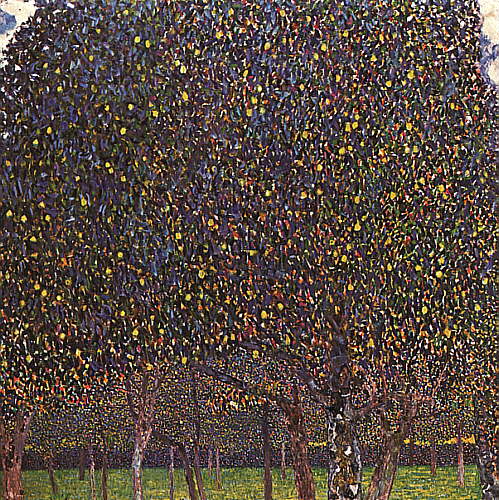
Afternoon Tea: Pear Tree (1903)

This is from Gustav Klimt, my favorite artist of all time. Click here to zoom. I just started getting in to his “nature” stuff. He and Egon Schiele made cool landscapes. Have a good rest of the day!

Sunday Poetry: Camus about Europe

Albert Camus is the most influential writers to me (See here why). This passage is from his third “Letter to a German Friend” (1944), depicting his unbroken love for European culture in the dark times of the second world war.

“Sometimes on a street corner, in the brief intervals of the long struggle that involves us all, I happen to think of all those places in Europe I know well. It is a magnificent land moulded by suffering and history. I relive those pilgrimages I once made with all the men of the West: the roses in the cloisters of Florence, the gilded bulbous domes of Krakow, the Hradschin and its dead palaces, the contorted statues of the Charles Bridge over the Vltava, the delicate gardens of Salzburg. All those flowers and stones, those hills and those landscapes where men’s time and the world’s time have mingled old trees and monuments! My memories have fused together such superimposed images to make a single face, which is the face of my true native land. … It never occurred to me that someday we should have to liberate them from you. And even now, at certain moments of rage and despair, I am occasionally sorry that the roses continue to grow in the cloister of San Marco and the pigeons drop clusters from the Cathedral of Salzburg, and the red geraniums grow tirelessly in the little cemeteries of Silesia.”

I wish you all a pleasant Sunday.

True heroes of capitalism

Steve Jobs, Elon Musk, Bill Gates, John D. Rockefeller, and so forth and so forth. The list of successful entrepreneurs who have become household names is long. To an extent they are the heroes of capitalism, they succeeded, often against all odds, though often with crucial help of far more unknown others, yet they did it and changed whole industries, if not the lives of all people on the globe.

Capitalism is about freedom, to have the liberty to start a business, to start selling a new product or new service. Or if you’re a big company: the freedom to buy somebody’s else’s idea, or to invest huge amounts into research, development, and/or (re)design. It is one of the most important pillars of our civilization, this process built on economic freedom, trade, specialization, barter, openness for odd things or tolerance for people who venture into new directions. Despite many setbacks, opposing ideas and much room for improvement, all around the globe, it still all adds up to what we are now: the richest and most healthy people in the world of all times. And this is not meant teleological, it is certainly not the end of the development, there is more to come, of course.

However, capitalism is built on failure. It is only in a limited number about the success stories, in far more cases it is about hard failure. For every success there are many more failures, people who went bust, companies that did not make it. In the US this is a fact more known and far more accepted than in Europe. Here, if you went broke, you would be indebted for the rest of your life and seen as a social failure as well. Happily, that stigma is not as strong as it used to be, but it is sure not out of existence either.

Therefore, the true heroes of capitalism are those who fail. The men and women who put in their life savings, or take a big loan, to start a business, or take over a franchise, or what have you. Working their ass off, taking risks, without any sight on a certain reward. Also, at least here in The Netherlands and surely elsewhere too, without the social security that employees may count on.

Still, they go for it, they chase their dream, to remain independent, because they hate to work for a boss or manager, because they believe in their great idea, because they want to get rich, or a combination of these elements. And then they fail, have to fire their personnel who depend on them, they can’t pay the bills anymore, file for bankruptcy, and have to accept that their dream is over.

That is hard. I want to congratulate them though. Because without them, our capitalist system would remain static, since no new ideas would drip into the economy. In short: capitalism would grind to a hold. So thank you, all you failed entrepreneurs, for putting in the effort, for trying and working hard. You are true heroes.

Generic Thanksgiving Post

Addendum: I wrote this post this morning, hit post, and returned to my oven. The apple pie was pretty good, the pecan was better. The stuffing and gravy were great.

While my oven pre-heats, let me give my top(ish) three things I’m thankful for:

  1. My dog Lola. This sweet little pooch entered my life this January and she’s absolutely melted my heart. Here we are on her first camping trip:

2. Capitalism. Yeah, you knew what you were signing up for when you came to this URL. For all the problems with giving any humans any authority at all, even our half-assed American capitalism does a pretty decent job of allowing me the opportunity to have a literal feast every Thanksgiving.

3. The little Internet. Not all that’s online is Google, Facebook, or Amazon. There are still cool little pockets of the Internet where a few dozen weirdos get together and make something beautiful.

I recently learned about the tildeverse a community of communities of people sharing a common web-connected computer like in ye olden days of pre-Google internet. Back before it was the Information Super Highway. Back before it ruined democracy by allowing humans to act like humans at scale. Playing around on an under-powered server is a pretty niche hobby, but there are tons of these long tail groups out there.

The friendly communities that create forums, the weird projects, the sync-tubes; the beautiful bubbles: these are the places that keep that old spirit of the Internet alive. The Internet giants are scary, but they’re not the only game in town; I’m deeply thankful for that.

Also stuffing. And gravy.

Happy Thanksgiving! Be excellent to each other!

Why some countries are stuck in poverty

It is fairly common for young children in Brazil (or at least in Rio de Janeiro, the part of the country I know better) to call adults “uncle” or “aunt”. My closest friends’ children call me uncle and I’m totally ok with that. I do see them as my nephews and nieces. That also happens in schools: children up to 11 or 12 call the teachers “aunt”. Some people think that this is normal or even cute. However, I studied in a school that strictly forbid children to call the teachers aunt. The teachers were supposed to be called simply “teacher”. One interchange became folkloric in my house: “Am I your father’s sister? Am I your mother’s sister? Am I married to your uncle? Then I’m not your aunt.” Ouch! As gruff as it might sound, that’s the mentality I grew up with. My mother was also never totally comfortable with some of my friends calling her “aunt”.

One of my favorite interpretations of Brazil came from Sérgio Buarque de Holanda (1902-1982). In his book Raízes do Brasil (Brazil roots, 1936) he made an analysis of the country, saying that the problem with Brazilians is that they are cordial. Using Max Weber’s categories, Holanda said that Brazilians don’t know how to conduct formal, impersonal relationships. It is really hard for them (or I should say, for us) to understand that the guy in office is the guy in office and not our friend.

I would say that many times I saw Holanda’s interpretation in action. Students who thought they were my friends and that because of that I would go easy on their exams. Colleagues who thought I wouldn’t fine them when I was working in the library. People I barely knew, who were friends of my friends, who thought I would give them answers for the exams. I managed to be friends of some students, but that was the exception. Most students had a hard time distinguishing between “Bruno, my friend” and “Bruno, my professor”. Worse, some, I don’t know how, came to the conclusion that I was their friend.

Lula da Silva, Brazil’s former president, presented himself as a father. He introduced Dilma Rousseff, his successor, as a mother. Getúlio Vargas, the horrendous dictator from the 1930s was widely known as “the father of the poor”. I’m sad to say that Jair Bolsonaro, Brazil’s current and supposedly right-wing president, doesn’t really scape this logic. It may be nice and cute when little children call adults aunt or uncle, but it sickens me when grownups use this language. Even more so, when they use it to people they don’t even know!

Sergio Buarque de Holanda is one of the few things from college I profited from reading. It helped me to escape the Marxist bog that is much of Brazilian humanities academia. Years later I read Good Capitalism, Bad Capitalism and I discovered that Brazil was not alone. That is the problem with many so-called capitalist countries that still lag behind. They are not really capitalist in the sense that the US, much of Western Europe or Japan and other Asian countries are, and one of the main reasons for that is that people don’t know how to conduct impersonal, formal relationships. The teacher is not your aunt, and the country is not a big family.

The public intellectuals we don’t deserve

Joakim’s latest post is so good that I can’t help but add my own thoughts. I disagree with nearly all of Joakim’s picks (though Jared Diamond and Niall Ferguson are good choices), but I can’t put my finger on why this is. So, in the hopes that maybe you can figure out why my list is so different than Joakim’s, here are my six public intellectuals, and the fields they write about, that everybody should know (aside from my fellow Notewriters, of course):

Evolution: Joe Henrich, an anthropologist at Harvard and author of 2016’s The Secret of Our Success, a book that has done better than any other at explaining cultural evolution and its relationship to biology and genetics. Dr Henrich is the guy doing all of that excellent work on WEIRD (Western, educated, industrialized, rich, democratic) people, too. Here is a pdf to a recent article of his on the Roman Catholic Church.

History: With apologies to Kevin, Charles C. Mann is the author whose work on history should be more popular. Mann’s 1491 (2005) is not only what revisionary work should look like, but it’s also a great primer on the history of science. 1493 (2012) was not as groundbreaking as 1491 but it’s still the best work of popular history out there that explains the world we live in today. Mann’s focus on history as a global phenomenon and on the history of science is what sets him apart from all of the others. His The Wizard and The Prophet came out earlier this year.

Exchange: The science of exchange has gone through a bit of a down spell lately, and for good reason: many in the profession have long claimed to be prophets. Tyler Cowen is not one of those economists. His public conversations and blogging and have done wonders for those who follow along, and his books are breezy, informative, and entertaining. My favorite Cowen book is 2009’s Create Your Own Economy, and his newest, Big Business: A Love Letter to an American Anti-Hero, came out earlier this year. His popular work strives to balance a moderate attitude towards all ideas while still leaning strongly on the counter-intuitive ideas that have helped make economics stand out among its peers in the social sciences.

Ethics: Yes, ethics is still important, and John Lachs is the philosopher we don’t deserve. Lachs, a Vanderbilt professor, authored 2014’s Meddling: On the Virtue of Leaving Other People Alone, which is a great, easy-to-read book on an idea that should be much more popular.

Literature: Nnedi Okorafor. Okorafor’s voice has the potential to revitalize conversations on literature throughout the world. Okorafor dabs mostly in the realm of science fiction and fantasy, but she also writes for Marvel Films and Dark Horse Comics. Start with her Binti trilogy. Literature needs a big change in order for people to start talking about books again, and Okorafor has the potential and the swagger to make that happen.

Inequality: The left is almost entirely unreadable on the most important topic in the world today, with the notable exception of Branko Milanovic (his 2018 2016 book Global Inequality is wonderful, and I’ve heard nothing but good things about his newest book: Capitalism, Alone), and conservatives, led by Ross Douthat, have retreated inward and focused on their well-worn hobbyhorses: church attendance, community, and familiarity (Yoram Hazony’s The Virtue of Nationalism is perhaps the hottest book from this sector of the political quadrant). Unfortunately, inequality has always been best dealt with by libertarians, and nobody from the libertarian camp has felt quite comfortable enough, or been good enough, to step up and write the book that needs to be written. Oh wait, that can’t be right. Deirdre McCloskey exists. I’m tempted to put Bourgeois Equality on the list, but a 700+ page book just doesn’t count as popular. Will Why Liberalism Works, her newest book (2019), finally catapult her into the broader consciousness of the West? Let us hope so, but we don’t deserve her.

Contempt for capitalism

Scarcity is merely contempt for that which is easily obtained.

                                                                                               ~ Seneca (attributed)[1]

While I am aware that many of the NOL writers do not agree with Jordan Peterson, I think he is correct when he says that many of the contemporary problems faced by society are the product of prosperity. The essence of his argument is that in an evolutionary sense mankind has two sets of priorities: 1) necessities of life and 2) social standing attached to life meaning. For the first time in history, we are living at a point where the necessities of physically staying alive, e.g. housing, food, medical care, etc. are obtainable and now people are free to fixate on the second set of priorities. The point where I personally diverge from Peterson and those of a traditional “conservative” inclination is that I do not think it is incumbent upon broader society to provide a sense of meaning or status for others.

In an interview with Christina Hoff Sommers and Danielle Crittenden of AEI for their Femsplainers podcast, Peterson illustrated his argument with an anecdote from his childhood on the Canadian plains. He described how, despite college being free in Canada at the time, he was the only one from his high school class to go onto tertiary education. Some but not all of the cause, he said, was ignorance. He observed that much of the reasoning related to an inability to delay gratification. At the time, his hometown was an oil center and was flush with money from the boom of the 1980s. Consequently, going to work immediately and making a lot of money was more attractive for high school seniors than was attending university. For the next decade this strategy worked. But, as Peterson recounted, when he was in the final year of his PhD, two things happened: 1) the wells supporting the town ran dry and 2) the oil bubble burst.

Unsurprisingly, what were a blip on the radar and a minor hiccup in the global and historical scope were disastrous for Peterson’s hometown. What became apparent in the fallout was a softening of character and mind. Counterintuitively, men who had no problem rising at 4:00 AM and working in subzero temperatures for sixteen hours were shown to be fragile in the face of greater adversity. Having manufactured an identity that emphasized the pointlessness of skill acquisition but also placed great importance upon high income, these beneficiaries of the oil bubble were devastated when their incomes disappeared and their lack of relevant skills left them unemployable and consequently without status. In the following decades, the town became one of many others of the rustbelt variety, plagued by unemployment, substance abuse, and apathy. It was this sequence that Peterson said caused him to start thinking in terms of the evolutionary stages of development. For us, the most relevant takeaway is the limitations of money on conferring status.  

As Alvin Saunders Johnson (1874 – 1971) wrote in his article “Influences affecting the development of thrift (1907)” in which he lamented the loss of capitalist mentality among the American people,

It is obvious that the more closely society is knit together, the greater the influence of social standards upon economic conduct. The solitary frontiersman shapes his economic conduct with very little regard for the opinion of other frontiersmen with whom he may occasionally associate. The one rich man in a community of poor men is scarcely at all under the dominance of social economic standards.

Saunders ultimately concluded that increased status anxiety or social dissatisfaction was, however counterintuitively, a sign of progress. After all, the real life of a frontiersman was quite different from that romanticized in Zane Grey books. Therefore, assuming that no one really wants to live a subsistence existence, a world in which people are materially comfortable, even if subjected to social pressures, is inherently better.

The concerns induced by social pressure are external to material wellbeing since a positive environment for the latter ensures that people can live above subsistence without difficulty. Social pressure is hardly objective, and because of its variable nature, symbolized in Johnson’s essay by a “suburbanite touring car,” which was both unproductive and quickly superseded by newer vehicles, sweeping claims about feelings of social pressure must be denied validity. Johnson presented the thirst, which he observed in 1907, for status symbols as both positive and negative. Positive because it indicated greater prosperity; Negative because it created a different set of societal problems. As society became increasingly removed from a subsistence existence, the human cycle of craving and acquisition – which in a hunter-gatherer environment meant survival of winter – developed into an obstacle, rather than a necessary tool. The contemporary extension to Johnson’s line of reasoning correlates to Peterson’s assertion that the fixation of broader society on status is a natural sequitur to achieving a level of prosperity sufficient for the basic needs of all to be addressed.

While the topic of interest to Johnson was thrift and capitalist mentality, or rather the lack of it, on the part of the American people, his essay contained an interesting and pertinent observation regarding land practices. Remembering that he wrote this particular essay in 1907, he remarked on an agricultural real estate bubble existing in the Midwest, his native region. The reason he thought it was important was that he maintained it demonstrated two points in the spending-thrift, status- (genuine) capitalist paradigm. Property prices and valuations had risen, he argued, past the productive potential and therefore market value of the real estate in question. This rise was driven, he said, by the farmers themselves who spent lavishly on land because of an association of ownership with status, even if they were then unable to use the land effectively and therefore unable to recoup the investment. He predicted that land purchased under these circumstances was not a good investment. Further he added that when the bubble collapsed, not only would there be monetary loses, there would also be ego and identity crises as those farmers who saw the value of their holdings diminish would feel as though they had lost social standing, even if they didn’t lose a single acre. However since, Johnson observed that many of the farmers he knew, and upon whom he based his hypotheses, had repeatedly mortgaged their current holdings in order to buy additional pieces, the economist predicted property forfeiture as well.

A prototype Austrian economist, though born and raised on the Nebraska plains, Johnson made no moral judgements about the acquisitive instinct or the needless purchase of property. The pettiness exemplified by Thorstein Veblen (1857 – 1929) and his claim that curved driveways was a pointless display of wealth and status because they used space that might be put to better use (The Theory of the Leisure Class, 1899) was simply not a factor in Johnson’s works. Johnson’s conclusion on improper land acquisition and use was based purely on dollars and cents: for a farmer, unprofitable land was not an investment, and no amount of wishful thinking would make it into one. Johnson’s predictions about an impending time of property price collapse and hurt egos came to pass in the 1920s with the agricultural depression, which was in full swing by 1924. The bubble burst was possibly delayed by World War I. The Dust Bowl and Great Depression of John Steinbeck’s The Grapes of Wrath was an epilogue to a situation that had begun many decades before.

In 1922, shortly before the agricultural bubble burst spectacularly, Johnson wrote another article, “The Promotion of Thrift in America,” in which he warned, again, that the American land-owning farmer was overleveraged. He also identified the existence of a tenant farmer class whose status was due to lending policies which encouraged current owners to become overleveraged through easy mortgages, thereby inflating property prices, but prevented first-time buyers from entering the market. The dispute between NIMBY and YIMBY is hardly new. To further exacerbate the situation, the agricultural sector had begun to receive federal subsidies as part of the war effort. While Johnson didn’t mention this in his article, the subsidies further distorted the connected real estate market as they made farming appear more profitable than it was. In response to criticism for his decision to refuse to subsidize agriculture in any way, Calvin Coolidge, who was desperately trying to salvage the American economy and took a firm anti-subsidy, anti-price control approach, said, “well, farmers never have made much money.” Johnson’s predictions from 1907 came true, but Coolidge’s 1926 decision on subsidies received the blame.   

What relevance, one might reasonably ask, has a set of observations from 1907 on the investment attitudes of, primarily Midwestern, American farmers have today? Why should these observations be combined with comments on status, work, and society made by a controversial academic? The reason is best exemplified by Sen. Marco Rubio’s article in the National Review titled “The case for common good capitalism.” It was an apology of soft socialism swaddled in pseudo-religious sanctimony culled piecemeal from various Catholic encyclicals. Since Kevin Williamson already dissected the article and its flaws, there is no need to rebut Rubio at this juncture. The overarching thesis to Rubio’s piece is that society has robbed the working man of dignity. The logic is tangled, to say the least, and it crescendos to the conclusion that a shadowy, disembodied society has mugged the working man and taken his dignity (or sense of status). The basic equations appear to be as follows:

  • burst property bubble = conspiracy to deny ownership, at least dignified ownership, to average Joe
  • loss of jobs for unskilled labor = denial of right to work;
  • lack of workforce-owned corporations = some vague travesty that is tied to denial of ownership.

For this last, Johnson in “The Promotion of Thrift in America” specifically mentioned such corporate arrangements as complete failures because they created hostility between employers and employees, and in fact reduced employee-loyalty, since the latter believed that such arrangements were intended to defraud them of their wages.

In his two articles, Johnson frankly argued that only the middle-classes and up practiced thrift and engaged in capital acquisition and investment. He dedicated most of “The Promotion of Thrift in America” to expounding upon the ways that the “wage earners (polite speak for working class back in the 1920s),” farmers, and the lower-middle class not refused to pursue capitalist behavior but would respond with active hostility when thrift campaigners (yes, there was an save-and-be-a-capitalist campaign in the aftermath of World War I, right up there with the temperance movement![2]) suggested that they should. The crux of the issue, one which Rubio’s article refuses to recognize, is that, like in the 1920s, the roots of broader societal complaints lie decades in the past. The efforts to create a quick fix are therefore both futile and infantile. Every couple of decades a specific subgroup, be it the overleveraged farmers of the early twentieth century or the unskilled oil workers of Peterson’s youth, discovers that its values are defective and that the signs its members believed to be markers of status are liabilities. Eventually the price of the decisions built on these misplaced values and symbols must be paid. In order for the payment to occur in a way that does not unjustly burden the rest of society, we must recognize that the scarcity experienced by the indebted subgroup lies more in their contempt for the genuine capitalist way of life than in any wrong society has inflicted upon them.


[1] Despite attribution to Seneca, I have been unable to find this aphorism among his works currently in my library, and I would be very appreciative if someone could tell me in which work he wrote this phrase (if indeed he did).

[2] Interesting which of the two movements gained enough political clout to have its agenda inscribed in the Constitution.  
Intellectuals You Should Know About

I read a lot. Wide, deep and across quite a number of different fields. As a self-proscribed ‘writer’ and ‘editor’, reading much is both satisfying an intellectual desire and a professionally useful practice in familiarize myself with various styles, voices and topics. A common tip for aspiring writers is to read someone they admire and try to imitate their style; at this, at least, I am somewhat successful, as a friend recently told me that my style reminded him of Deirdre McCloskey. Full of idolized admiration for Deirdre’s work, I couldn’t imagine a higher praise.

As readers, the eternal curse of modernity is our laughable inability to keep up with the couple of millions of books that are published every year. Not to mention written materials on blog or respectable outlets or in magazines and journals. As consumers of the written word, we are completely outstripped, utterly defenseless and overwhelmingly inundated.

When in September I published my discussion of geographer and anthropologist Jared Diamond’s impressive work, I got a lot of feedback of astonishment from friends and family – including the friend that praised me for occasionally (accidentally…?) write like McCloskey: “Wow,” he said, “I’ve never heard of him before!”

Huh, I thought. I wonder what other household names of public intellectuals are not read as much as they deserve.

My exact reaction of astonishment was more like a gaping “What?!”, betraying my wanna-know-everything attitude, slight elitism and writer lifestyle. Contrary to the belief that our times is one of all talking and no listening (well, writing and no reading), it takes a vast amount of reading before you can produce anything that others want to read. Sure, anybody with a laptop and an internet connection can start a blog and flush out their thoughts (I did so for years) but it takes knowledge to say something intelligent and interesting – knowledge acquired by extensive reading.

It also takes a lot of practice to develop a voice of one’s own. Authors with astonishing and recognizable writing styles are made, not born.

What, then, should you read?

In light of this surprise, I decided to make a list of intellectuals I would advise anybody to read. Note that this is not a list of the most important thinkers ever, nor is it a collection of the most profound academic contribution to various disciplines. Instead it’s a gathering of writers whose popular writing (often in addition to their rigorous academic work) is exactly that – popular. That means that a lot of others liked them (and if you’re anything like others, you might too) and more importantly: a lot of smart people you meet are rather likely refer to these authors or to the ideas contained in their work. Here are 11 authors I would consider to be household names and whose writing will make you a much smarter and interesting person.

Jared Diamond

Let’s begin our list with aforementioned Jared Diamond, whose trilogy on humanity is compulsory reading for pretty-much everyone. This year he released Upheaval, which received very mixed responses and that I decided to skip after hearing his pitch on Sam Harris’ Making Sense podcast. Diamond’s publisher maintains that this is the third installment of his “monumental trilogy” of how civilizations rise and fall, but to me that was The World Until Yesterday: 

  • Guns, Germs and Steel is the book that definitely made Diamond a well-known name, the kind of Big Picture civilizational economic history we have recently seen in Yuval Harari’s work – the author of Sapiens: A Brief History of Humankind, that strangely boring book that everyone seems to be reading these days – or the less well-known but more captivating Columbia professor Ruth DeFries’ The Big Ratchet. If you like, you could describe this Pulitzer prize-winning book as well-written geographical reasons for why the West is rich and the Rest isn’t. If that’s your thing, read away.
  • Collapse: How Societies Choose to Fail or Succeed, the book that my September piece was mostly concerned with, is a dense story of many different human civilizations falling apart: Easter Islanders, Native Americans in the dry southwest or central America and my favourite chapter: The Greenland Norse. Complemented with the Fall of Civilizations podcast and Dan Carlin’s recent book The End is Always Near would make you ridiculously interesting to talk to in these hyper-catastrophist times. Upheaval is a natural extension of Collapse so if you crave more, that one is for you.
  • I would rather point to The World Until Yesterday for Diamond’s third gem as it is a deep dive into the lives of traditional societies in general, but in practice mostly New Guinean societies. Somehow, Diamond made anthropology exciting!

Paul Collier

Rapidly moving up in controversy, Paul Collier is an Oxford development economist whose work most intellectuals have a distinctly firm opinion about. His popular claim to fame rests on:

  • Exodus, a very cool (and prescient!) take on global migration. Highly recommended.
  • The Bottom Billion, for a plunge into global poverty and development economics. It might be slightly outdated (published in 2007) as many of the 60 failing countries he identifies have seem quite some growth in the last decade.

I should also recommend his latest book, Future of Capitalism, but I wasn’t very impressed with it. In these times of political polarization, populist uprisings, urban-rural divides and worries about AI, it is still a relevant read.

Whenever Collier speaks, you want to listen.

The Four Horsemen of Atheism (or “New Atheism”):
Christopher Hitchens, Sam Harris, Richard Dawkins, and Daniel Dennett

to which we should add the “one Horse-woman“, Ayaan Hirsi Ali, whom I’m ashamed to only know as “the wife of Niall Ferguson” (yes, my background is money and history, OK, not politics or religion…).

Together, these 5 brilliant minds may have helped many out of their religiosity, but their contributions loom much larger than that. As most of the Western world has gradually abandoned faith, their religious inclinations have turned to other areas: environmentalism (Mike Munger’s take on recycling never gets old!), invented hierarchies or social justice. The writings of these five horsemen can be hugely beneficial here too. Some recommended reading includes:

Speaking of Ferguson, as I’m a big financial history guy, I am shamelessly squeezing in this prolific writer, professor (well, Senior Fellow at Hoover institution nowadays) and public intellectual:

I should also mention his two-volume biography of Henry Kissinger (first volume 2015, next probably finished next year), which I ignored (politics is boring) and his recent book The Square and the Tower, which I heard very bad things about – and so downgraded for now.

Steven Pinker

Ah, this Harvard cognitive scientist and linguist-turned-public-intellectual is a must-read. His top trilogy, which I voraciously consumed last fall, includes:

  • The Blank Slate, the best description of this book that I ever heard came from Charlotta Stern, sociologist at Stockholm University: every sound argument against the “Nurture Only”-idea that biology doesn’t matter compiled into a single book. Yes, you want to read it.
  • The Better Angels of Our Nature, a Big Picture humanity-scale look at violence, resurrecting Norbert Elias’ Civilizing Process theory to explain why we hurt and kill each other less than at probably any point in human history. Nassim Nicholas Taleb (see below) is decidedly not convinced
  • Enlightenment Now! The Case for Reason, Science, Humanism, and Progress, as if Better Angels wasn’t Big Picture enough, here’s the ultimate case for why humanity is doing pretty well, why doomsday sayers are wrong on every count and why we shouldn’t despair. Many of the topics of Better Angels re-occur in Enlightenment Now!, but I don’t regret reading both as Pinker’s prose is easy to follow and his content well-sourced should you require more convincing. Originally a cognitive scientist, he has a ton of more books you might wanna check out – The Language Instinct, for instance, ranks pretty high on my Next Up list:
  • The Language Instinct
  • How the Mind Works
  • The Stuff of Thought

Matt Ridley

Speaking of optimistic people taking a Big Picture view of humanity, zoologist and science writer Matt Ridley is a must. Tall (like me!), Oxford-educated (like me!) and techno-optimist (like me!), no wonder I like him.

At last, How Innovation Works is schedule for May 2020. 

Nassim Nicholas Taleb

Oh, boy – here’s a controversial one. Frequently does he get into loud and hostile arguments with other high-profile intellectuals, and rarely does he pull any punches. His popular writing is found in the “Incerto” serie – the Latin term for ‘doubt’ or ‘uncertainty’ that capture Taleb’s core work. The set of books are together described as “an investigation of luck, uncertainty, probability, opacity, human error, risk, disorder, and decision-making in a world we don’t understand:”

They are intended to push One Big Idea: that we frequently overlook how random the world is, ascribing causality where none belongs and overestimate what we can know from (relatively recent) past events. Black Swans, the proverbial unpredictable event, dominates the social sciences in Taleb’s view. While the 2000-odd pages worth of the Incerto series may seem daunting, the books (and even the individual chapters) are designed not to fall very far from each other. The interested reader can, in other words, pick any one of them and work backwards in accordance with whatever is of interest. You wanna read all – or any – of them.

Having read Fooled by Randomness first, I’ve always held that highest. Be ready for a lot of sarcastic and frequently hostile (but thoughtful) objections of things you took for granted.

In sum: just bloody read more

Any selection of important contemporary intellectuals is arbitrary, highly skewed and super-unfair. There are more, many more, whose fantastic writings deserve attention. As I said, the eternal curse of modernity is our laughable inability to keep up with avalanche of cool stuff written every year.

As readers, we are overrun – and the only thing you can do to keep is is to read more. Read widely.

Above are some amazing thinkers. Drop me a line or tweet me with readings you would add to a list like this.

Sunday Poetry: Adorno about traffic lights

I hate the Frankfurt School. Even more, I hate Theodor W. Adorno. Apart from his atrocious Sociology (I think his philosophy is ridiculous too, but I have not dealt with it in depth yet), he had a very bizarre opinion on Jazz.
However, he seemed to be a heavy fan of traffic lights. In 1962 he wrote the following words to the local newspaper:

“When crossing the Senckenberg plant, near the corner of Dantestraße, one of our secretaries was run over and seriously injured after a passerby had been killed in an accident at the same place a few days earlier. On the way to university, one has to run across the street in an unworthy way, as if one was running for his life. If a student, or a professor, is in the state that is actually appropriate for him, namely in his mind, then the threat of death is immediately prevalent.” 

In consequence of his rant, albeit 25 years later, the city built the now-famous Adorno-Ampel in Frankfurt near his faculty. Kind of lovely anecdote.

I wish you all pleasant Sunday.

Sunday Poetry: Rilke’s “Autumn Day”

It has been a more than stressful week. To indulge in Rilke’s dreamy thoughts is not only a perfect stress-relief but also a chance to reminisce about the most beautiful moments of this autumn.

Rainer Maria Rilke – Autumn Day

“Lord: it is time. Great was the summer’s feast.
Now lay upon the sun-dials your shadow
And on the meadows have the winds released

Command the last fruits to round their shapes;
Grant two more days of south for vines to carry,
to their perfection thrust them on, and harry
the final sweetness into heavy grapes.

Who has not built his house, will not start now.
Who is now by himself will long be so,
Be wakeful, read, write lengthy letters, go
In vague disquiet pacing up and down
Denuded lanes, with leaves adrift below.”


I wish you all a pleasant Sunday.

Rawls, Antigone and the tragic irony of norms

Is civil disobedience justified when it invokes a moral objection to target a law that has been enacted through a legitimate process? The reason societies seek to establish a legitimate process in law making is because they want to set up common rules and norms which people who disagree with them will still have to abide by. However, history shows us many instances in which, even in a democratic system, civil disobedience both triggered and animated a debate on legitimately enacted rules and, often, led to their revision as well as the reform of the procedural rules that allowed their enactment in the first place.

Rawls’ position on civil disobedience struggles with this question. His position is that, once society has set up principles of justice in an institutional setting, acts of civil disobedience are just insofar as they appeal to the sense of justice of the majority and should be willing to bear the consequences of their actions. We may read the Rawlsian perspective as follows: these acts are still of value because they re-launch a process of public reasoning regarding the law itself.

However, the implications from this statement are broader and baffling. First, we don’t know how far this revision can go. Will it be allowed to cast doubt on the basic principles of justice which society previously agreed to observe? Can it challenge the procedural source of legitimacy for the contested norms?

Second, civic disobedience cannot be reduced to appeals to a sense of justice demanding the revision of law through the same process. Instead, the rationale behind civil disobedience reminds us that there will always be competing conceptions of justice that go as far as challenging the source of legitimacy – what some have come to accept as the just process may no longer seen as just by others. A society’s prior decision at a single historical moment that this is a just process for law making does not end the debate over different perceptions of justice concerning both norms and processes.

Moreover, acts of civil disobedience appear in moments in which different moral norms clash and judgment should be passed regarding which one takes precedence over the other. Episodes in the US history, particularly regarding the civil rights of African Americans, epitomize the important role of acts of disobedience in invoking a higher moral ground against norms approved by the majority through the institutions of a democratic system. We have learnt from history that these moments spawned animosities and brought about new episodes of conflict. They were emotionally disturbing episodes.

This implies that social contract theories tend to adopt an a-historical approach to norm-building and a, strangely- a-social view of public reasoning. Norm-building is seen as cleansed of emotions and often dismissive of the idea that there will be unintended and unforeseen consequences. A reduced historical and social conception of justice is what acts of civil disobedience reminds us of. The process of defining justice as norms and as process remains an open turf for never-ending, reflective social interactions that no constitutional moment can capture, crystallise and entrench indefinitely.

These three elements – the historicity and sociability of norms, normative contradiction, and the emotional dimension in the conflict over norms – is manifested in Sophocles’ masterpiece, Antigone. Sophocles’ theatrical play on civil disobedience was written around 441 BC, about 2,400 years before Rawls’s work. It conveys a nuanced message on norms, normative debates, public deliberation and reasoning, and sees the social nature of all as a human tragedy.

The play is set in the aftermath of a civil war in Thebes and the final battle which Thebes survives the attack of seven exiled Theban generals. One of the generals, Polynices, son of King Oedipus, fights his own brother, Eteocles, a defender of the city. In that fight, the two brothers kill each other.

Creon, the legitimate King of Thebes and uncle of the two brothers, issues a public order for Eteocles to be buried with honours and for Polynices to be left outside the walls to rot unburied as punishment for his betrayal. Creon also orders that whoever tries to bury Polynices’s body shall be arrested and executed.

Polynices’s sister, Antigone, defies Creon’s order and secretly buries her brother in accordance with the religious tradition that demands that the dead must be buried. Soon after, Antigone gets arrested and is brought by guards before Creon and the city. She chooses not to apologize for her actions or claim ignorance of law. Instead, she confronts Creon by invoking that the law of the gods is superior to the law of men.

Creon sentences her to death, publicly stating that everyone should be treated equally before the law. He would make no exception for her niece. Creon presents himself as a just leader who firmly adheres to ‘equality before the law’ even if that means he would sentence to death one of closest family members. The law, he stresses, is above everyone.

Antigone’s public act with an emotional appeal to the law of gods initially fails to trigger sympathy from the people of Thebes and Creon insists on his sentence. Antigone is taken off stage to be buried alive in a cave.

Creon’s own son and Antigone’s fiancé, Haemon, rushes to defend Antigone but he too fails to convince his father to change his decision. Even against his son, Creon reiterates his conviction that the law takes precedence over personal relations. But gradually the people of Thebes, the chorus of the play, changes its stance and starts showing more sympathy to Antigone’s drama.

In the next scene, a respected prophet named Tiresias makes a public interference. He tells Creon and the city that their neglect of the moral law will displease the gods and will bring more sorrow and pain to Creon’s family and the city of Thebes. The leader of the chorus changes his mind and asks Creon to reconsider his decision and set Antigone free. We are witnessing here that public is changing its views following a morally charged debate triggered by an act of civil disobedience. Antigone disobeyed the law guided by her love for her brother, but she was also honouring the law of the gods. Creon decides to spare Antigone. Emotions and fears have a drastic effect on public perceptions political decision making.

But Creon’s decision came too late. Antigone committed suicide. So did Haemon and, following the news of his death, her mother and Creon’s wife, Eurydice. The play ends with Creon devastated, isolated, discredited and vulnerable, and the city of Thebes descending back into chaos.

Rather than a clear clash between a hero and a villain, the two protagonists are tragic figures and so is the city itself. Creon wants to demonstrate that he is a prudent ruler who obeys the law that he rightfully sets. But he has to listen to the people he commands. His confrontation with Antigone is his own public act in which he defends his decision. The chorus, representing the people, initially sides with Creon but turns against him after observing a human drama unfolding and after hearing the menacing words of a prophet about the incoming doom. Perceptions of justice are drastically reshaped through an interplay of feelings, reasons and fears. Deliberation is emotionally charged.

Unlike Rawls, Sophocles’ theatrical play presents us with a richer blend of public reasoning, emotions, emotive responses, and unforeseen and unintended consequences in a debate over clashing norms and perceptions of justice. Creon – the personification of equal rules for everyone including his own relatives – is the legitimate political authority but his decision creates a personal and civic catastrophe. Thebes descends into a spiral of death and civil unrest. A just act of disobedience triggers a spiral of turmoil and tragedy. Emotions and personal affections guide decisions that produce unforeseen dramatic developments for the protagonists and the city as a whole.

The Greek drama is purposefully presented as a morally inconclusive story. Antigone had no initial intentions to make her actions a public statement and did not wish to bring down the entire political system. But after her arrest she did make a dramatic public defence of her stance invoking the moral law. Creon was surprised and angered, torn between his adherence to the rule of law and his duty towards his family. The Theban public watches all this astounded, emotional and anxious. This is far from a society that can be equilibrated into an orderly state. It cannot even rest secure about its own convictions.

Sophocles grasped much of what political theory tends to shy away from: the complexity and ambiguity surrounding normative thinking in human societies that tends to bring about tragic or fatal results for every system of norms shaken by its own contradictions. In short, Sophocles lyrically presents us the tragic irony of norms creation. Rather than taking a nomothetic stance, his play helps us reflect on the tragedy of human interactions from a nearly anthropological viewpoint.  

Sophocles allows the audience to pass their own judgment through both logical and emotional engagement. The audience is baffled by the merits of each of the opposing viewpoints – Creon’s defence of formal equality before the law and Antigone’s defence of a higher moral ground. But it is also touched and distraught by how tragic the protagonists are, trapped in the consequences of their own moral standing and reasoning. In Sophocles’ play, society is watching and reflecting on behaviors and norms through pathos, ethos and logos. After each performance, the verdict is a flow of tears rather than a canonical judgment.

You’re Not Worth My Time

In our polarized and politically intolerant times, intellectuals worry about the divisions in our societies. You might call it inequality or absence of social mobility, racism or rigid social structures but all pundits seem to agree that despite our apparent cosmopolitanism, many people’s opinions on lifestyles, politics, or economics are diverging. More so, their opinions about others’ opinions is less accepting. We disapprove of people that believe the wrong things, and we shun them in favor of like-minded people.

Economists like Paul Collier (The Future of Capitalism), Raghuram Rajan (The Third Pillar), and Branko Milanovic (Capitalism, Alone) are producing well-publicized books about how the social world of our current societies are collapsing – “coming apart at the seams”, as Collier phrases it. A recent book on technology and the environment by MIT researcher Andrew McAfee, states the following:

more and more people are choosing to have fewer ties to people with dissimilar values and beliefs, opting instead to spend more time among the like-minded. The journalist Bill Bishop calls this phenomenon ‘the big sort’. (2019:227)

The observation could have come straight out Jonathan Haidt, a scholar I greatly admire. Why do we do this Bishop-style sorting? A common assessment is that having people challenging my beliefs hurts my identity and I don’t like it. We rather go for echo chambers.

Let me be contrarian and obnoxious for a minute and defend this Big Sort: is it really that bad to distance oneself from those with different views and opt for like-minded people?

The Irrelevance of Political Opinion

It’s long been recognized by social scientists that politics drive people apart (together with ‘Economics’, ‘Religion’ and ‘Abortion’, forming the acronym R.A.P.E, the avoidance of which is key to successful social conversations). From being friendly customers in a decentralized marketplace, politics urges us to become enemies and opponents, demands that we confiscate one another’s stuff rather than cooperate in creating value for each other. Bringing up your position on some labor market reform or the taxation of the rich (of which your familiarity is probably quite limited) is likely to deteriorate a relation rather than improve it.

Here’s the thing: Life is much more important than politics. Life is the experiences we’ve had, the sunrises we’ve seen, the friends and relationships we’ve had and lost and the stories that came with them. Not to mention the food we ate and the things we did. What your stance is on the environment or what you think the long-term consequences of QE is going to be are all very secondary issues. They might be much more interesting to those of us who care about such things, but for the majority of people, they remain pretty immaterial.

What happens when you trumpet these R.A.P.E. topics in your indecent search for like-minded people – or even an experience-widening tolerant search for opponents? Consider the typically loud liberty-minded American: within five minutes in his (yes, his) presence, you know what his views are and he throws them in people’s faces whether they like it or not. Your group of acquaintances, likely consisting of people who couldn’t care less, gets annoyed. While some people may engage in serious conversations about politics or economics (or religion or abortion) once in a while, their lives are generally concerned with more worthwhile topics. Having some loud-mouthed libertarian invade their everyday life with provocative statements and logical argument is not just annoying, it is bad manners.

I can lecture anyone and everyone I meet on the brilliancy or markets or how Scottish banks operated in the 18th century, with the sole outcome that I will have no friends or even acquaintances. Sharing your political and economic views rarely endear you to other people; it merely makes you a nuisance.

In short: Don’t be an arse. Stop ruining our great time with mindless, hurtful, harmful politics.

What about the perspectives and knowledge of others?

If you must invade others’ lives with your pesky politics, speaking to people with diverging opinions and different background might be interesting and fruitful. Key words “might be”. More accurate words: “is rarely”.

It is true that you might learn some exciting things from random strangers, but it’s unlikely. Most people are less informed about the world than I am (if you doubt that, ask your conversation partners to take Rosling’s Gapminder test) – what are they going to “teach” me but inaccuracies and misinformation…?

Sure, my car-loving friends can teach me something *fascinating* about some new car, a topic a could care less about. My baseball-crazy friends could recount the latest Sox game or why Tom Brady is the greatest – oh, ye, that’s a different sport. Soz. But is an environmentalist really going to teach me anything worth knowing about the impacts of climate change? (No, how could they – they don’t understand markets or even capitalism). Is an Occupy Wall Streeter going to lecture me about how financial markets work and what banks really do? How is my mother contributing to my perspectives on monetary policy when the sheer extent of her monetary wisdom comes from a novel where the ostensibly private Federal Reserve was purchased and controlled by some millionaire?

Don’t get me wrong: these are all amazing people that I highly cherish. I enjoy spending time with them and sharing stories about life. Point is: I’m under no illusion that they offer intellectually valuable perspectives that I could benefit from.

If I wanted to get such perspectives, I’d much rather spend time around two kinds of people: smart or curious. The majority of people you meet are neither:

Smart People are those who actually know things about the world, and I don’t meant boring things like why Israel celebrates this or that holiday, why the sky is blue (OK, that could be cool) or how one assembles a roof out of palm leaves. I mean a fair and favorable view of markets and a data-driven optimism. I mean a basic grasp of statistics. I mean a big picture understanding of what matters and the intellectual capabilities to explore them.

Curious people are those of whatever political persuasion that have thick enough skin to have their positions questioned and willing to reason to reach mutual understanding. One does not have to be smart or well-informed to be interesting – it’s enough to be sceptical and hungry for knowledge.

They rarely make ’em like that no more. So I take my probability-informed chances and avoid politically-minded people.

Elitist and Snobby?

Probably. But consider this: I have 24 hours a day, of which I sleep maybe 8. For maybe another 8 a day, I need to produce value, and so can’t be interrupted by loud and obnoxious libertarians (or environmentalists, or anthropologists or whoever). The last third of my days contain a lot of tasks: washing, workout, food, reading, wonders of the world. At best, it leaves a couple of hours a day for curious intellectual disputes. Let’s say 3. Statistically, I have another 56 years to live, for little over 60,000 hours worth of intellectual endeavors. There is an almost an endless supply of materials from interesting people out there – actually smart people: authors of books and journal articles, podcast interviews, lectures etc, all on topics that interest me. And more is produced every day. For every hour you take away from me with your “enriching perspectives” and uninformed opinions, I lose an hour of engaging with the treasure trove of actually smart people. Besides, the depth of their knowledge, the clarity of their formulation, the well-researched (and sourced!) material and examples they bring are almost certainly better than whatever you’re about to bring me. Consider the opportunity cost for me of having to listen to you “bumble-f**k your way through it“, as my beloved Samantha (Lily Collins) says in Stuck in Love. Even if you only take 10 minutes of my time, is whatever you’re about to say better than 1/360,000 of the sum of humanity’s current (and future) literary, statistic and economic treasure?

I don’t think so either. It’s simply not worth it.

This is a good reason to stick to people of similar mindset – people who are curious and open to having every argument re-examined, every proposition questioned. People with thick enough skin and sharp enough intellect not to mistake your objection for insult. People who might jump that 1/360,000 bar.

It’s not really the content of someone’s ideas that we’re shunning; it’s the intolerance and ignorance that we’re avoiding, carefully taking the opportunity cost into account. Talking to people who don’t share those views – the meta-views of intellectual discourse if you wish – is mostly a waste of time. The book on my desk is almost certainly more valuable.

With all due respect, you’re simply not worth my time.