AEM Europe and PCPE in Prague, April 21-24 2016

I have recently returned home from 4 days of Prague, Czech Republic, where I attended two conferences: Austrian Economics Meeting Europe and the Prague Conference on Political Economy. After having been secluded from Austrian economists and Libertarians for almost 2 years, it felt like a homecoming to be surrounded again by people who share similar thoughts. This was after all the only place in the last two years where I was able to fully express my (´controversial´) ideas about society. Being surrounded by tremendously smart people – you have to be rather smart and geeky to give up part of your free time or professional work in order to visit conferences and discuss philosophy, politics and economics – within the beautiful city of Prague made it a wonderful experience.

The AEME came about after the summer of 2014 when those from Europe who visited Mises University that year decided to come together again to discuss classical liberal ideas in the spirit of Carl Menger, Ludwig von Mises, Friedrich von Hayek and Murray Rothbard. The first AEME event took place in 2015 in Vienna, Austria, the city where the Austrian School of economic thought emerged from the works of Carl Menger, Eugen von Böhm-Bawerk, Friedrich von Wieser, and others. The Austrian School is famous for its methodological struggle against the Prussian Historical School and their idea that economics is culture- and time-specific and therefore does not contain universal validity. The Austrian School is also famous for such theoretical contributions as the subjective theory of value (as opposed to Marx’ labour theory of value), theory of marginal utility, opportunity cost doctrine, Austrian business cycle theory, the time structure of production and consumption, methodological individualism and the economic calculation problem that was first formulated by Ludwig von Mises in 1920 and later expanded upon by Friedrich von Hayek to show that pricing systems in socialist economies were necessarily deficient. From a socio-political perspective, the School argues for limited government and some even for libertarian anarchism.

AEME pub
AEME participants sharing their last evening in Prague in a local pub

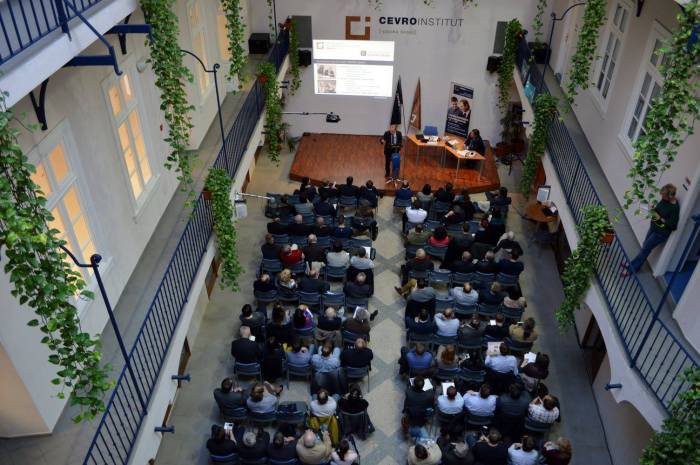
What was great about the second AEME is that it took place right before the PCPE conference at the CEVRO Institute. Most of us who attended AEME have stayed two extra days to attend the PCPE conference as well. The CEVRO Institute is a private university founded in 2005 that is located in the very centre of the city of Prague. The university prides itself in its emphasis on freedom, markets, and its innovative character that is for example manifested in its PPE (Philosophy, Politics, Economics) programme taught by such international illustrious professors as Michael Munger who is also director of Duke University’s PPE programme, Peter Boettke who is the director of the F.A. Hayek Program at George Mason University, David Schmidt who is director of the Center for the Philosophy of Freedom at the University of Arizona, Boudewijn Bouckaert who was the former dean of the Faculty of Law at the University of Ghent, and Josef Sima who is the president of the CEVRO Institute. The institute has invited several prominent speakers for its conference. Prof. Mark Pennington (London School of Economics) was for example invited to present “Why most things should probably be for sale”. Prof. Benjamin Powell who is the director of the Free Market Institute at Texas Tech University, the University to which I almost applied to to pursue my PhD in the academic year of 2015 but eventually decided to work as a software engineer, was there as well to speak about “Migration, Economic Calculation, and the European Situation.” Prof. Mario Rizzo (New York University) had the honour to be the keynote speaker and spoke about “The four pillars of new paternalism” which was followed by commentaries from Prof. Pascal Salin, former president of the Mont Pelerin Society.

PCPE 2016
Mario Rizzo’s welcome speech to PCPE

The second day of the PCPE conference, there were 27 speakers spread over 9 sessions on such topics as economic theory, anarcho-capitalism, the Austrian School, entrepreneurship, cryptocurrencies, the role of family and more. I was one of the speakers and spoke on the “Philosophical investigation of seasteading as the means to discover better forms of social organization”. The thesis of my talk was that one core focus of political philosophy is to deal with the realities of value pluralism and political disagreements. I contended that the most common form of social organization, representative democracy, does not satisfactorily deal with these realities. Therefore, we should look for political possibilities beyond representative democracies and that in order to discover these possibilities, we should experiment with new forms of social organizations. By approaching the issue from a meta-system level perspective and realizing that governments are resistant to structural societal changes we should then introduce competition into the industry of governments. Seasteading, the creation of habitable dwellings on the oceans, could serve as a means to introduce more competition in the industry and lessen political tensions between citizens who hold different comprehensive doctrines.

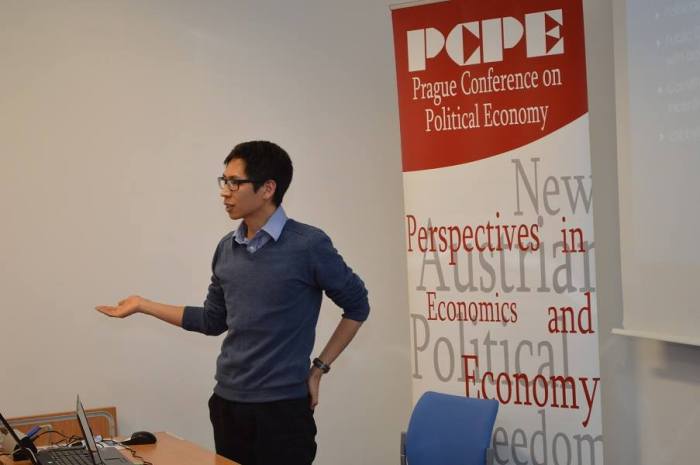
Chhay Lin - PCPE
Me speaking at PCPE about Seasteading as the means to deal with such political realities as value pluralism and political disagreements

If I could mention one thing that has made the most remarkable impression on me, it would be the warning issued by Prof. Stephen Baskerville (Patrick Henry College, USA) that the most immediate threat to our liberties is feminism and the social justice movement. He maintained in his talk that there is an ensuing crisis of the family which is perpetuated by the state. According to Prof. Baskerville, family courts can enter homes uninvited, take away people’s children, confiscate their property, and incarcerate them without trial, charge or counsel. With over 50% of all first marriages ending in divorce and more than half of all these divorces involving children, the greatest threat to our liberties is the colluding social work state bureaucracies with radical feminism. These groups have colluded to suppress information on such injustices. Listening to Baskerville’s talk, I felt the great urgency to engage in an intellectual battle against feminism and the social justice movement.

Other than the many intellectually invigorating moments, the city itself provided many magnificent sites. To mention several sights: we visited a beer garden, experienced a classical music concert at the Mirror Chapel, walked over the Charles Bridge, and visited the Prague Castle.

Prague Charles Bridge
The beautiful Charles Bridge crossing the river Vltava

All in all, the city of Prague, AEME and PCPE were an unforgettable experience! It has already been decided that next year’s AEME conference will take place in Krakow, Poland. The conference will be open for anyone who is interested in Austrian economics and libertarianism. For more information on AEME and the papers that were presented in the previous editions, you can find our website here. In case you are interested in studying at the CEVRO Institute and its MA PPE programme with specializations in “Austrian Economics”, “Studies of Transition”, and “International Politics”, you can visit their website here.

Vote Different. Be A Libertarian. Let Life Live

John McAfee’s latest political campaign ad is inspiring as it asks voters to vote libertarian. It is an homage to Apple’s “Think Different” ad as well as to individual freedoms, creativity and intellect.

The video shows ‘rebels’ and game-changers who have moved the world forward. You do find Steve Jobs, Elon Musk, Edward Snowden, Julian Assange, Peter Thiel, Bradley Manning, Ross Ulbricht, Martin Luther King, Ayn Rand and many more. You even see Bitcoin and crypto-capitalism which is simply another form of libertarian anarchism. Ending with the lift-off of a spaceshuttle, the ad presents a message of hope for libertarians and a message of progress as long as we “let life live”.

The same celebration of human individualism and message of hope was also apparent in McAfee’s earlier campaign ad that was released two weeks ago.

Are small autonomous political units economically viable?

Macau Skyline

I am at the moment enjoying my end-of-year-holidays in Macau, a micro-state next to Hong Kong and like Hong Kong also a Special Administrative Region (SAR) of China. Being a SAR basically means that Macau is allowed political and economic autonomy, but still belongs to the People’s Republic of China. This construction is also known as the “One Country, Two Systems” constitutional principle. Being here makes me realize once again the unique position of micro-states. Although I understand that GDP per capita is no measure of everyone’s personal income, I would still like to stress that Macau has the second highest GDP per capita income in the world in 2014 according to the World Bank and that the CIA has placed Macau at spot number 3. Macau has furthermore the 2nd highest life expectancy rate (CIA, 2012). Some other interesting facts about Macau:

  • 0% VAT;
  • max. personal income tax rate of professional practices is 12% and only for incomes above MOP424,000 (~ 53,000USD);
  • currently 30% of this professional tax is waived;
  • tax free income threshold stands at MOP144,000 (~ 18,000USD);
  • Macanese residence in possession of an ID-card receive a yearly refund of 60% of the professional tax paid, subject to a cap of MOP12,000 (~ 1,500USD);
  • Macau is also known as a gambling/entertainment hub of Asia with the gambling/entertainment industry making up around 50% of the economy.

It is sometimes claimed that small autonomous political units are economically unviable, but Macau – like Hong Kong, Singapore, Monaco, Liechtenstein, Luxemburg and more – disprove this claim. Two reasons that are often given for the unviability of small autonomous political units are (a) economies of scale is difficult to realize in small states, and (b) they are vulnerable to trade shocks because their size prevents the states from wide diversification in economic activities. If these reasons would hold, then we would certainly find that micro-states are generally poorer than larger states. However, Easterly and Kraay (1999) have empirically found that micro-states[1] are 40-50% richer than other states when controlled for location by continent, controlled whether they are oil producers, and controlled whether they are members of OECD. In addition, Easterly and Kraay have found that life expectancies in these states are about four years higher and that the under-five infant mortality is lower by 22 per thousand. This suggests that micro-states do not suffer from developmental disadvantages.

Micro-states have been particularly more successful, because without abundant access to land and labour they are pressured to specialize their national economies[2] and to engage in international trade. International trade is particularly important in order to acquire goods that cannot be produced nationally. This pressure to trade encourages peaceful inter-state cooperation. Moreover, due to its small size, public policies are easier to follow which tends to result in greater political transparency. It hence increases the incentives of citizens to become politically involved. The rule over a small territory makes public policy targets also more efficient, and as a result fewer taxes are required. Nevertheless, one could still argue that micro-states in Easterly and Kraay’s research are large enough to be economically viable, but that especially those states that consist of maybe as few as 100 members would suffer from developmental disadvantages. This however, is a question of what the smallest possible size is for an economically well-functioning state. It is an interesting question that I unfortunately cannot answer. I will nonetheless leave a note from Plato on the subject to emphasize the importance of the division of labour in any well-functioning state. In Plato’s Republic, Socrates asserts that the state arises from the division of labour through which goods are efficiently supplied so that its citizens’ needs are fulfilled. The smallest notion of the state, as Socrates then asserts, exists of at least four persons who can produce the greatest human necessities: a farmer, builder, weaver, and shoemaker. I do not share the opinion that these specific four occupations are necessities for a small state, but I think you get the gist: for a (minimal) state to function well, you need at least division of labour.

Reference
Easterly, W., & Kraay, A., (1999). Small States, Small Problems? The World Bank.

Footnotes
[1] Micro-states are defined by Easterly & Kraay as states with populations of 1 million or less. Some examples of the 33 investigated states are Belize, Cyprus, Gabon, Iceland, Luxemburg and Suriname.
[2] Specialization increases productivity, and hence competitiveness.

Giving Up On The Masses

In 2012, during Ron Paul’s second presidential candidacy as a Republican, I felt deflated with the masses again. Again, the masses were not going to vote a libertarian into office. It was the same year in which I read Murray Rothbard’s Ethics of Liberty and Hans-Hermann Hoppe’s Democracy: The God That Failed. What struck me at that time was the realization that democracy is actually an extremely poor political system to make society become more libertarian. Democracy is not even a guarantee whatsoever for political and economic freedoms. Its success is dependent on the uprightness of the masses, but where are the masses to stand up against war, bank bailouts, taxation, police aggression etc? If the government is truly a gang of thieves and murderers, as I believe it is, then the voting masses are advocates of theft, harassment, assault, and murder.

I do not believe that the masses are ready for freedom, because freedom means taking responsibility for one’s life and actions – a frightening prospect for the masses who lack the strength to face insecurities in life. Ingrained with fear of their own and their neighbours’ incapability to live a ‘responsible’ life, they are attracted to masters who can arrange their lives for them. The masses have also never thirsted for truth. Whoever can supply them with illusions is easily their master, and whoever attempts to destroy their illusions is always their victim. They want to be comfortable and cuddled to death. Thinking is too much hassle for the mass-man. The masses have moreover a love for egalitarianism and a disdain for those who are different, who are more successful and more beautiful. They hate freedom, because in freedom man naturally maintains his distance from his fellow human beings.

Being discontent with the masses and deflated in my philosophical views on politics and economics, I took Peter Thiel’s following dictum to heart: “The masses have given up on unregulated capitalism, so those who still support unregulated capitalism should give up on the masses.” Instead, I have put my hope on such technological advances of decentralization as cryptocurrencies, seasteading, 3D-printing, and localized energy conservation and production.

Urging Cambodians To Critique Their Culture

Brandon has recently referred to my comment that the Cambodian culture is ‘backward’ in this post. In response to that, I would like to share some more thoughts about the Cambodian culture and why I would urge all Cambodians (and all others) to critique their own culture.

I notice that some Cambodian people romantically adore their Khmer culture. Some people’s adoration stretches to the extent that they cannot accept any critiques about their culture as if critiquing the culture equals criticizing the person. Their adoration takes levels that are frightening me – examples are sentiments of supreme nationalism, the gullible belief in distorted histories that have pushed Cambodians into a victimized position that they gladly exploit in political and personal relations, and their willingness to fight and die for the country. To them, the excessive love of one’s culture or nation is noble, but to me it is ridiculous. It doesn’t require heart to love something, it requires more heart to critique the thing you love.

Several aspects of the Khmer culture that I find absolutely deplorable:

  • the hierarchical structure of its social life. Cambodian children are raised to respect and to be obedient toward their elders and toward Buddhist monks. Instilled with strict social rules, the Cambodians are unable to properly reflect on social values and social norms. Children are not encouraged to think for themselves, and to oppose their elders as the elders are always considered right. It should be no surprise that they grow up lacking self-reflective skills;
  • the people´s highly status oriented attitude and their low demeanor toward those who are more wealthy. Cambodian people are extremely status oriented and excessively adore those who enjoy a higher status. It is considered impolite to make eye contact with someone of higher status. In return, empowered by a feeling of superiority despite their plain stupidity, those of higher status look down on the lower classes;
  • their idleness and slowness, which seems to be common among most native South-East-Asians and which may be attributed to their tropical climate. Cambodian people are lazy and like to spend their time gazing around mind-numbingly;
  • its false and pretentious intelligentsia. The Cambodian intelligentsia are like dogs: they bark so much, but they know absolutely nothing! Equipped with beautiful words and eloquent expressions, their words are often empty of substance. They are good at doubtlessly regurgitating any knowledge or wisdom that they have read, but are incapable of critical thinking and of constructing their own ideas;
  • and worst of all its culture of self-pity. Cambodians like to pity their own existence and it is in this self-pity that their suffering is multiplied and their extreme egoism is revealed. This most self-destructive emotion which drowns them in a sea of depression is often used as a weapon to manipulate others, and is sometimes expressed through hysterical lamentations. See here and here for some examples of their miserable cries.

Although I know that my harsh critique of Cambodian culture does not please some Cambodians, they should know that in criticism there is often a desire to improve the people’s situation and to elevate them. It requires effort and energy to care enough about something to speak freely about it. I would urge all Cambodians who would like to improve their nation to gather the strength to stand above their culture so that they can look down on it, reflect on it, and critique it – even better, make fun of it and eventually transcend it.

Hence, Cambodian, go and indulge yourself in some self-mockery!

Why Few ‘Social Justice Warriors’ Actually Care About Social Justice

I notice that many people love to defend ‘equality for the sexes’, ‘equality for all ethnicities’, because ‘everyone is beautiful… everyone is awesome… everyone is sacred’. All these sound extremely good, noble and well, but I have realized throughout the years that most of these so-called ‘social justice warriors’ do not truly care about social justice at all as one cannot truly stand for justice without an inquisitive mind.

These people repeat everything that sounds good, but barely put any effort in understanding the issues at hand. They lack the critical faculty to subject ideals to severe critical scrutiny. For this reason, they are extremely susceptible for ideals that at first sight seem wonderful, but that are actually rotten and damaging. They also do not possess enough modesty in how little they know. Most social justice warriors are therefore irrationally and vehemently defending a cause they do not truly understand. The worst thing is that many of them refuse to explore the issues of social justice, to look for underlying evidence to support their arguments, to read, and to learn. Many of them are self-deceivers, and discussions with them often turn out to be a vexation as it is impossible to appeal to their reason.

I agree with Michael Huemer that actually most people who fight for a ‘noble cause’ “are chiefly moved, not by a desire for some noble ideal, but by a desire to perceive themselves as working for the noble ideal – not, for example, by a desire for justice, but by a desire to see themselves as promoting justice” (Huemer, 2012, p. 19). The ultimate test to find out whether a social justice warrior truly cares about justice is to have a rational conversation about issues of justice and see whether he is willing to defend his noble ideals rationally and whether he is open for learning.

Reference
Huemer, M. (2012). In Praise Of Passivity. Studia Humana, 1, 2, pp. 12-18.

The Incredible Bread Machine (R.W. Grant)

This is a legend of success and plunder
And a man, Tom Smith, who squelched world hunger.
Now, Smith, an inventor, had specialized
In toys. So, people were surprised
When they found that he instead
Of making toys, was BAKING BREAD!

The way to make bread he’d conceived
Cost less than people could believe.
And not just make it! This device
Could, in addition, wrap and slice!
The price per loaf, one loaf or many:
The miniscule sum of under a penny.

Can you imagine what this meant?
Can you comprehend the consequent?
The first time yet the world well fed!
And all because of Tom Smith’s bread.

A citation from the President
For Smith’s amazing bread.
This and other honors too
Were heaped upon his head.

But isn’t it a wondrous thing
How quickly fame is flown?
Smith, the hero of today
Tomorrow, scarcely known.

Yes, the fickle years passed by;
Smith was a millionaire,
But Smith himself was now forgot
Though bread was everywhere.

People, asked from where it came,
Would very seldom know.
They would simply eat and ask,
“Was not it always so?”

However, Smith cared not a bit,
For millions ate his bread,
And “Everything is fine,” thought he,
“I am rich and they are fed!”

Everything was fine, he thought?
He reckoned not with fate.
Note the sequence of events
Starting on the date
On which the business tax went up.
Then, to a slight extent,
The price on every loaf rose too:
Up to one full cent!

“What’s going on?” the public cried,
“He’s guilty of pure plunder.
He has no right to get so rich
On other people’s hunger!”

(A prize cartoon depicted Smith
With fat and drooping jowls
Snatching bread from hungry babes
Indifferent to their howls!)

Well, since the Public does come first,
It could not be denied
That in matters such as this,
The Public must decide.

So, antitrust now took a hand.
Of course, it was appalled
At what it found was going on.
The “bread trust,” it was called.

Now this was getting serious.
So Smith felt that he must
Have a friendly interview
With the men in antitrust.
So, hat in hand, he went to them.
They’d surely been misled;
No rule of law had he defied.
But then their lawyer said:

The rule of law, in complex times,
Has proved itself deficient.
We much prefer the rule of men!
It’s vastly more efficient.
Now, let me state the present rules.

The lawyer then went on,
These very simpIe guidelines
You can rely upon:
You’re gouging on your prices if
You charge more than the rest.
But it’s unfair competition
If you think you can charge less.

A second point that we would make
To help avoid confusion:
Don’t try to charge the same amount:
That would be collusion!
You must compete. But not too much,
For if you do, you see,
Then the market would be yours
And that’s monopoly!”

Price too high? Or price too low?
Now, which charge did they make?
Well, they weren’t loath to charging both
With Public Good at stake!

In fact, they went one better
They charged “monopoly!”
No muss, no fuss, oh woe is us,
Egad, they charged all three!

“Five years in jail,” the judge then said.
“You’re lucky it’s not worse.
Robber Barons must be taught
Society Comes First!”

Now, bread is baked by government.
And as might be expected,
Everything is well controlled;
The public well protected.

True, loaves cost a dollar each.
But our leaders do their best.
The selling price is half a cent.
(Taxes pay the rest!)

Book Review: Hans-Hermann Hoppe – Economic Science and the Austrian Method

I decided to read Hans-Hermann Hoppe’s Economic Science And The Austrian Method (1995) in order to grasp a deeper philosophical understanding of the Austrian School’s methodology of economic inquiry. I was especially interested in Immanuel Kant’s influence on Ludwig von Mises and how Mises had used Kant’s epistemological insights to construct praxeology, the study of human action (economics included) that is purely deductive in nature.

Those who are acquainted with scientific methodologies in the field of economics may have heard of the controversies surrounding praxeology. Living in an empirical age, many people may be inclined to question the validity of a science that claims to arrive at economic laws from pure deduction whose validity can be established independently from observations. Praxeological propositions are indeed much more “like those of logic and mathematics, a priori” (Mises, 1966, p. 32). Such a science may strike the skeptics as being disquietly dogmatic.

In this book review, I will firstly give a brief discussion why it is important at all to discuss the epistemological foundations of economic science. Thereafter, I will discuss Hoppe’s thesis. I will describe the philosophical aspects of praxeology that can be traced back to Kantian epistemology. I will moreover summarize Hoppe’s critique of empiricism and historicism, and why Mises believed that economics is essentially praxeology. Lastly, I will give my personal thoughts on the book.

Why should we discuss the epistemological foundations of economic science?
The most immediate answer to this question is that different epistemological foundations lead to different methodologies and different theories, which can lead to different interpretations of real-life phenomena. Take for example the interpretation of an historical economic event, the Great Depression. Murray Rothbard, because he is working within the context of praxeology makes use of the praxeological Austrian Business Cycle Theory. This theory focuses on the expansion of the money supply as an explanation of the onset of the ‘boom’ in the 1920’s which eventually resulted in the ‘bust’ in 1929. Milton Friedman and Anna Schwartz in A Monetary History Of The United States (1963), while not applying the ABCT, have focused only on the contraction of the money supply and the resulting higher interest rates in 1928 as the main cause of the Great Depression. Their application of different economic methods has led them to look for different possible historical causes of the Great Depression which has effectively resulted in different accounts of the same historical event. It therefore matters what economic methods are employed in economic research.

Now that we have established the importance of inquiring epistemological foundations and methodologies of economic science, I will turn to Hoppe’s thesis.

Kant and synthetic a priori propositions
Working within the rationalist tradition of Leibniz and Kant, Mises attempts to present the proper way through which economic science – a science that according to Mises falls within the broader science of human action, praxeology – should be conducted. He resorts to the Kantian conception of the nature of knowledge and explains praxeology in terms of Kantian terminology. Hence, Hoppe firstly directs the reader to Kantian epistemology.

Kant had developed the idea that all propositions are either analytic or synthetic and either a priori or a posteriori. The difference between analytic and synthetic propositions is that the former is true by virtue of their meaning or as Kant would have phrased it himself, “the predicate B belongs to the subject A as something that is (covertly) contained in this concept A” (Kant, 1781, A:6-7). Take for instance the following proposition: “Bachelors are unmarried.” This proposition is analytic, because the predicate, ‘unmarried’, is part of the concept of a bachelor. Analytic propositions are regarded as tautological propositions; they simply restate the definition or a concept incorporated within a word and therefore they do not tell us anything meaningful about the world. A synthetic proposition on the other hand is a proposition whose predicate concept is not contained in the subject’s concept. It could therefore express something meaningful about the world. An example of a synthetic proposition is: “All bachelors are unhappy.” The concept ‘unhappy’ is not contained within the definition of ‘bachelor’, and expresses something meaningful about ‘bachelors’.

The distinction between a priori and a posteriori is as follows: a priori propositions are propositions whose justification does not rely upon experience, but solely on logical reasoning. The justifications of a posteriori propositions on the other hand, do rely upon experience. Examples of a posteriori propositions are “Some bachelors I have met are unhappy” or “Siddharta Gautama left the palace.”

The big question is: do synthetic a priori propositions exist? Kant certainly believed that they do exist, “and it is because Mises subscribes to this claim that he can be called a Kantian” (Hoppe, 1995, p. 18). In Critique of Pure Reason (1781), Kant contended that synthetic a priori propositions do exist and as an example he took mathematics (Kant, 1781, p. 55). The statement “7 + 5 = 12” is not dependent on experimentation and the concept 12 is not contained in either the definitions of 7 or 5. According to Kant, a priori propositions are derived from self-evident axioms. We can find such axioms by reflecting upon ourselves and understanding ourselves as knowing subjects. However, how can truth claims derived from reflection in our mind have any basis in reality? Is Kant here running into the problem of idealism – a notion that it is the mind that constructs reality and superimposes itself upon reality in such a way that it fits within the mind’s necessary laws?

According to Hoppe, Kant had not given a satisfactory response to this issue and future thinkers would have to take on the challenge of solving this problem. Hoppe believes that Mises had done so successfully when he had averred that action provides the link between mind – body and between mind – external world: “[W]e must recognize that such necessary truths are not simply categories of our mind, but that our mind is one of acting persons. Our mental categories have to be understood as ultimately grounded in categories of action” (Hoppe, 1995, p. 20). It is through action that the mind and reality are related: “[A]cting is a cognitively guided adjustment of a physical body in physical reality” (Hoppe, 1995, p. 70).

Another issue that arises with regards to the possibility of synthetic a priori propositions, and which I have found quite confusing myself is the following: does Hoppe suggest that we can arrive at knowledge without any experience of ourselves or the external world at all? No, according to Hoppe “the truth of a priori synthetic propositions derives ultimately from inner, reflectively produced experience” (Hoppe, 1995, p. 19). This experience is phrased by Stolyarov II as “the mind’s identification of facts about actually existing entities, including the identifier himself” (Stolyarov II, 2007, p. 53). In this sense, the action axiom is experientially-derived, but it is not subjected to the empiricists’ narrow view that all knowledge must be testable, verifiable, or falsifiable.

Empiricism, Historicism, and Praxeology
When Mises systematically constructed the foundations of praxeology, he faced a double-challenge; (A) empiricism which was quickly becoming the main influence in the economics discipline, and (B) historicism which was then a prevailing ideology at German-speaking universities.

(A) Empiricism
Empiricism is the “philosophy which thinks of economics and the social sciences in general as following the same logic of research of that, for instance, of physics” (Hoppe, 1995, p. 28). Hoppe writes that empiricism is governed by the following two related basic propositions:

(1) that empirical knowledge, knowledge about reality, must be subjected to falsifiability and verifiability by observational experience;
(2) and that empiricist research formulates their explanations in terms of causality, i.e. “if A, then B”. (Hoppe, 1995, pp. 28-29)

Hoppe continues to write that the validity of empirical statements

can never be established with certainty… The statement will always be and always remain hypothetical… Should experience confirm a hypothetical causal explanation, this would not prove that the hypothesis was true. Should one observe an instance where B indeed followed A as predicted, it verifies nothing… Later experiences could still possibly falsify it. (Hoppe, 1995, p. 29)

Empirical knowledge is hence contingent on historical facts. Neither confirmation nor falsification by observational experience can prove that a relationship between phenomena does not or does exist. By emphasizing that our knowledge of reality must stem from observational experience, they directly deny a science that avers that a priori knowledge can give us any meaningful explanation of real phenomena. However, as Hoppe and Mises point out, the statement that meaningful synthetic a priori propositions cannot exist is itself a synthetic a priori proposition. Mises has put this empiricist contradiction the following way in The Ultimate Foundation of Economic Science (1962):

The essence of logical positivism [logical empiricism] is to deny the cognitive value of a priori knowledge by pointing out that all a priori propositions are merely analytic. They do not provide new information, but are merely verbal or tautological, asserting what has already been implied in the definitions and premises. Only experience can lead to synthetic propositions. There is an obvious objection against this doctrine, viz., that this proposition that there are no synthetic a priori propositions is in itself a … synthetic a priori proposition, for it can manifestly not be established by experience. (Mises, 1962, p. 5)

Hoppe mentions a second contradiction of empiricism which regards historical events. Empiricists believe that particular events may cause any particular human action. They attempt to find such causal relationships in order to explain historical events. However, in order to do so, empiricists must assume that causality within historical sequences exists through all times. This assumption itself is not based on experiential observations, and must presuppose a priori knowledge that “time-invariantly operating causes with respect to actions exist” (Hoppe, 1995, p. 36). In addition, Hoppe identifies a third contradiction with respect to social phenomena. The empiricists believe that in order to confirm and falsify hypotheses, one must be able to learn from historical and social experience. If one would deny this, then why should one engage in empirical research at all? This however presupposes that “one admittedly cannot know at any given time what one will know at a later time and, accordingly, how one will act on the basis of this knowledge” (Hoppe, 1995, p. 37). Admitting that humans learn from historical and social experience, one cannot deny that empirical causal constants in human action do not exist. “The empiricist-minded social scientists who formulate prediction equations regarding social phenomena are simply doing nonsense” (Hoppe, 1995, p. 38). Predicting human action is not a science according to Hoppe.[1]

The empiricists are mistaken in applying the methodology of the natural sciences into the fields of social science in order to predict human actions. Unlike natural elements, human beings can and do act differently under equal conditions. Thus, social history cannot yield any knowledge that can be employed for predictive purposes. Relating this to the quantity theory of money; if the money supply for instance increases, one can still not predict whether the demand of money will change as this is entirely dependent on human action. Nonetheless, one could assert that if the demand for money stays constant and the money supply increases, then the purchasing power of money will fall (Hoppe, 1995, pp. 44-45).

(B) Historicism
Historicism, the second challenge that Mises had to face, does not take nature as its model but literary texts. Historicists believe that there are no objective laws in economics, and that “historical and economic events are whatever someone expresses or interprets them to be” (Hoppe, 1995, p. 54). Historicism is therefore extremely relativist. However, according to Hoppe also historicism is fundamentally self-contradictory. If there are only interpretations and hence no constant time-invariant relations, then there is also no historicist constant truth about history and economics. If historicism does not give us any reason to believe in its doctrine, why should we adhere to its epistemological philosophy if its proposition implies that they themselves may not be true?

Next to his refutations of empiricism and historicism, Mises had hoped that he could demonstrate the existence of true synthetic a priori propositions. Such propositions would (1) not be derived from experience, and (2) they must yield self-evident axioms so that when one tries to deny it one is involved in self-contradiction. Mises believes that these two requirements are met by the axiom of action – the proposition that human beings act and display intentional behaviour (Hoppe, 1995, pp. 60-61). According to Mises, purposeful human behaviour exhibits a person’s pursuit of an end which he attempts to reach through the employment of particular means (at least time and body). The fact that a person pursues a particular goal with his action reveals that he places a relatively higher value (preference) on the goal than any other goals of action that he could have thought of at the beginning of his action. Human action also happens sequentially, implying that the actor can only pursue one goal at a time in which he has to forego other valuable goals temporally. Action therefore also implies choices and costs. An action furthermore implies loss (and profit), because every action accompanies a certain degree of uncertainty, whether the goal achieved has resulted in the value one has expected can only be known in retrospect. All these categories of action – values, ends, means, choices, preferences, costs, profit, loss, and time – are at the heart of economics (Hoppe, 1995, pp. 61-63). This insight establishes economics as a science of human action. Or as Hoppe asserts more precisely,

all true economic theorems consist of (a) an understanding of the meaning of action, (b) a situation or situational change – assumed to be given or identified as being given – and described in terms of action-categories, and (c) a logical deduction of the consequences – again in terms of such categories – which are to result for an actor from this situation or situational change (Hoppe, 1995, pp. 63-64).

The existence of the categories of action is derived a priori from the axiom of action, and not through observation. Any attempt to disprove it is futile, since “a situation in which the categories of action would cease to have a real existence could itself never be observed or spoken of, since to make an observation and to speak are themselves actions” (Hoppe, 1995, p. 63).

My thoughts on Hoppe’s book
The book serves as an excellent summary of praxeological philosophy and is a must-read for anyone who wants to start learning more about the subject. Reading the book, one feels that it is extremely concise (around 80 pages), but also dense. Hoppe directly discusses the essential philosophical aspects that one must know in order to understand praxeology as developed by Mises, and fortunately he leaves many footnotes for further reading.

I believe that Hoppe has skillfully shown that economics is part of praxeology, and that it indisputably deals with such categories of human action as values, ends, means, choices, preferences, profit, loss, time, and causality. He has furthermore provided a well-reasoned critique of the empiricist and historicist-hermeneutical interpretations of economics by showing that they are necessarily self-contradictory.

Understanding that economics should not be conducted within the methodological framework of the natural sciences has severe implications to the ways we should deal with data of real world phenomena. If, like praxeologists claim, we cannot predict human action then there is also little reason to believe that effective social engineering is possible. The fundamentals of the praxeological methodology are therefore also immediately relevant within discussions on the roles of the state in planning the economy.

Footnotes
[1] Hoppe calls it entrepreneurship.

Bibliography
Friedman, M. & Schwartz, A.J. (1963). A Monetary History of the United States 1867-1960. Princeton: Princeton University Press.
Hoppe, H.H. (1995). Economic Science and the Austrian Method. Auburn: Ludwig von Mises Institute.
Kant, I. (1781). Critique of Pure Reason. (W.S. Pluhar, Trans.) Indianapolis: Hackett Publishing Company, Inc.
Mises von, L. (1942). Social Science and Natural Science. In R.M. Ebeling (Ed.) Money, Methods, and the Market Process (pp. 3-15). Retrieved from http://mises.org
Mises von, L. (1966). The Ultimate Foundation of Economic Science. Retrieved fromhttp://mises.org
Stolyarov II, G. (2007). The Compatibility of Hoppe’s and Rothbard’s Views of the Action Axiom. The Quarterly Journal of Austrian Economics, 10, 2, pp. 45-62.

Small Thought On The Terrorist Attack in Paris, France

What the attack in Paris has made clear to me is that there is a deep hatred amongst people against the west. I believe that much of this hatred stems from the same roots from which my discontents with the west had also grown – western interventionist policies with foreign nations. I also sense such discontents among the few people that I know from Pakistan, Nigeria, Afghanistan, Iraq, Morocco, and Serbia.

My displeasures with the west originate from the personal stories of my parents who, before they became victims of the Khmer Rouge, were also victims of American bombings of Cambodia – a fact that is not widely known. The bombardments that started in 1965 ended in 1973, and had killed hundreds of thousands of Cambodians. Indeed, before the Khmer Rouge took power over Cambodia in 1975 and before they sent all people to the rural areas to grow foodstuffs for ‘Angkar’ (the Organization/the State), there were already widespread famines and scores of displaced people due to the bombings. It had created a chaotic climate in which the anti-western, anti-capitalist, and anti-imperialist propaganda of the Khmer Rouge found their way into people’s minds – mostly into the minds of those poor rural Cambodian people that were suffering most from the secret bombings. Ben Kiernan writes in ‘Bombs over Cambodia’ (2004):

Years after the war ended, journalist Bruce Palling asked Chhit Do, a former Khmer Rouge officer, if his forces had used the bombing as antiAmerican propaganda. Chhit Do replied:

“Every time after there had been bombing, they would take the people to see the craters, to see how big and deep the craters were, to see how the earth had been gouged out and scorched . . . . The ordinary people sometimes literally shit in their pants when the big bombs and shells came. Their minds just froze up and they would wander around mute for three or four days. Terrified and half crazy, the people were ready to believe what they were told. It was because of their dissatisfaction with the bombing that they kept on co-operating with the Khmer Rouge, joining up with the Khmer Rouge, sending their children off to go with them. . . . Sometimes the bombs fell and hit little children, and their fathers would be all for the Khmer Rouge.”

Cambodia, together with Laos, still remains one of the heaviest bombed countries in the history of the world.[1] My parents were just 7-8 years old at the advent of the secret bombings. Imagine that a drone would bomb the school of your child or the hospital in which your loved ones are, would you not feel enraged? Would you not want to take revenge on those that are responsible?

A pre-moral person looks at the consequences of the actions. He sees the attacks, he acknowledges the dead, he becomes emotional and judges firmly. A moral person withholds his judgements and attempts to comprehend the causes of the attackers’ actions. I do not want to justify the killings of the French people, but I would like to emphasize that if we were really to honor the victims, we should reflect on the question why there are people that hate the west so fiercely. Maybe our society itself is part of a larger machine that is the origin of foreign hatred against the west. We must not only realize that religious fundamentalism is a danger to the world, but that there is a more contemptible false idol which is democratic fundamentalism – the uncritical acceptance that democracy is equal to liberty, that it is always superior and that, if necessary, it should be spread with violence.

As long as we, as a society, fail to reflect on ourselves and the political system we participate in, we will never find a fundamentally peaceful solution.

Footnote
[1] See Ben Kiernan’s ‘Bombs Over Cambodia: New Light On US Air War

Philosophical Research on Seasteading

The Seasteading Institute has recently published my philosophical dissertation on ‘Seasteading’. You can find it in the key research section of their Law and Policy page: http://www.seasteading.org/law-and-policy/.

Wayne Gramlich and Patri Friedman[1] founded the Seasteading Institute in 2008 in order to promote the seasteading movement, which has intellectually attracted mostly libertarian-minded individuals. The institute has also attracted funding from Paypal cofounder and early facebook investor Peter Thiel.[2]

A seastead is a permanent habitable dwelling on the ocean that preferably lies outside governmental waters. The Seasteading Institute believes that the creation of permanent societies on the seas can provide an experimentation space for innovative forms of socio-political organizations. The ultimate aim of seasteading is that newly emerging societies will inspire social changes around the world and contribute to human flourishing. First seasteads will be small-scale projects and they may even be constructed within existing governmental territories. However, seasteads could expand organically as technologies improve and innovative ideas of the functions of seasteads would emerge. One of the core ideas of seasteading is that an open experimentation space for social organizations will lead to progress in social rules and legislations, just as an experimentation space for new technologies leads to technological progress.

It is undeniable that social rules and legislations heavily influence all aspects of life, including technological progress and social well-being. One could for example compare North and South Korea, two countries that separated from each other in 1945. Both countries have had more or less the same culture and similar natural resources. However, what differs is their form of social organization; the North came under communist rule, whereas the South embraced western-style capitalism and democracy. Almost 70 years later, the differences in wealth, technological advancement, and social well-being are striking. South-Korea’s GDP per capita is for example 18 times larger, its internet penetration is more than 815 times greater, its life expectancy rate is 10 years longer, and the heights of South Korean pre-school boys are on average 4 centimeters longer. (Taylor, 2013, April 8).

The Seasteading Institute believes that, given that social progress and well-being heavily depend on how society is structured, mankind could make a huge step forward by letting social entrepreneurs start up seasteads to compete with governments in the industry of law-making and by letting millions engage in the experimentation with new forms of social organization.

In the paper, I provide a philosophical investigation of the concept of seasteading from a libertarian anarchist perspective. My investigation revolves around the following research question: “given that governments are resistant to structural changes of governance, how can mankind discover better forms of social organization?”

I argue that seasteading can fulfill that important role of moving mankind forward by experimenting with and finding new forms of social organizations that are best for human flourishing.

In the first chapter, I maintain that one core focus of political philosophy is to deal with the realities of value pluralism and political disagreements. I also contend that the most common form of social organization, representative democracy, does not satisfactorily deal with these realities. Hence, we should look for political possibilities beyond representative democracies. In order to discover these possibilities, we should experiment with new forms of social organization.

Chapter two discusses why there is currently little experimentation with social orders. I approach the issue from a meta-system level perspective and contend that all land on earth is more or less already claimed by states, which leaves little opportunity for people to start new societies on land. By applying the theory of monopoly economics, I maintain that the state’s monopoly on jurisdiction and coercion does not encourage them to provide good rules of law. It rather makes states extremely resistant to large-scale social changes. The obvious solution for finding better forms of governance then would be the introduction of competition into the industry of governments.

Chapter three deals with the epistemological attitude required for the experimentation space. I maintain that this attitude consists of having a sociological imagination, being epistemologically modest, realizing that social order can emerge spontaneously, and that the utopian dream of a single perfect society is impossible.

Chapter four discusses seasteading as the means by which the experimentation space could be realized. By homesteading the seas, a community can build and test new forms of social organization outside the scope of current governments’ control. It could generate new knowledge on social orders, thereby contributing to political philosophy and the social sciences. It could moreover also ease political tensions between citizens with different comprehensive doctrines.

Finally, I raise two objections to seasteading and address them accordingly.

If you would like to see an awesome seastead design, you should watch this video here:

Footnotes
[1] It may be interesting to know that Patri Friedman is the grandson of Milton Friedman and the son of libertarian anarchist David Friedman.

[2] Peter Thiel, previously a student of Political Philosophy at Stanford University, is also founder of the libertarian-minded newspaper The Stanford Review. He is a venture capitalist who is very much influenced by the Austrian School of Economics. With this in mind, it may not be surprising that the early mission of PayPal was to give its users more control over their money by enabling them to switch currencies. The goal of PayPal was to make it, in Thiel’s words (1999), “nearly impossible for corrupt governments to steal wealth from their people through their old means [inflation and wholesale currency devaluations] because if they try the people will switch to dollars or Pounds or Yen, in effect dumping the worthless local currency for something more secure” (Jackson, 2004).

References
Jackson, E.M. (2004). The PayPal Wars: battles with eBay, the media, the mafia, and the rest of planet earth. Los Angeles: World Ahead Publishing, Inc.
Taylor, A. (2013, April 8). A Crazy Comparison of Life in North Korea and South Korea. Retrieved from http://businessinsider.com
Thiel, P. (2009). The Education of a Libertarian. Retrieved from http://cato-unbound.org

Notes On Liberty ART

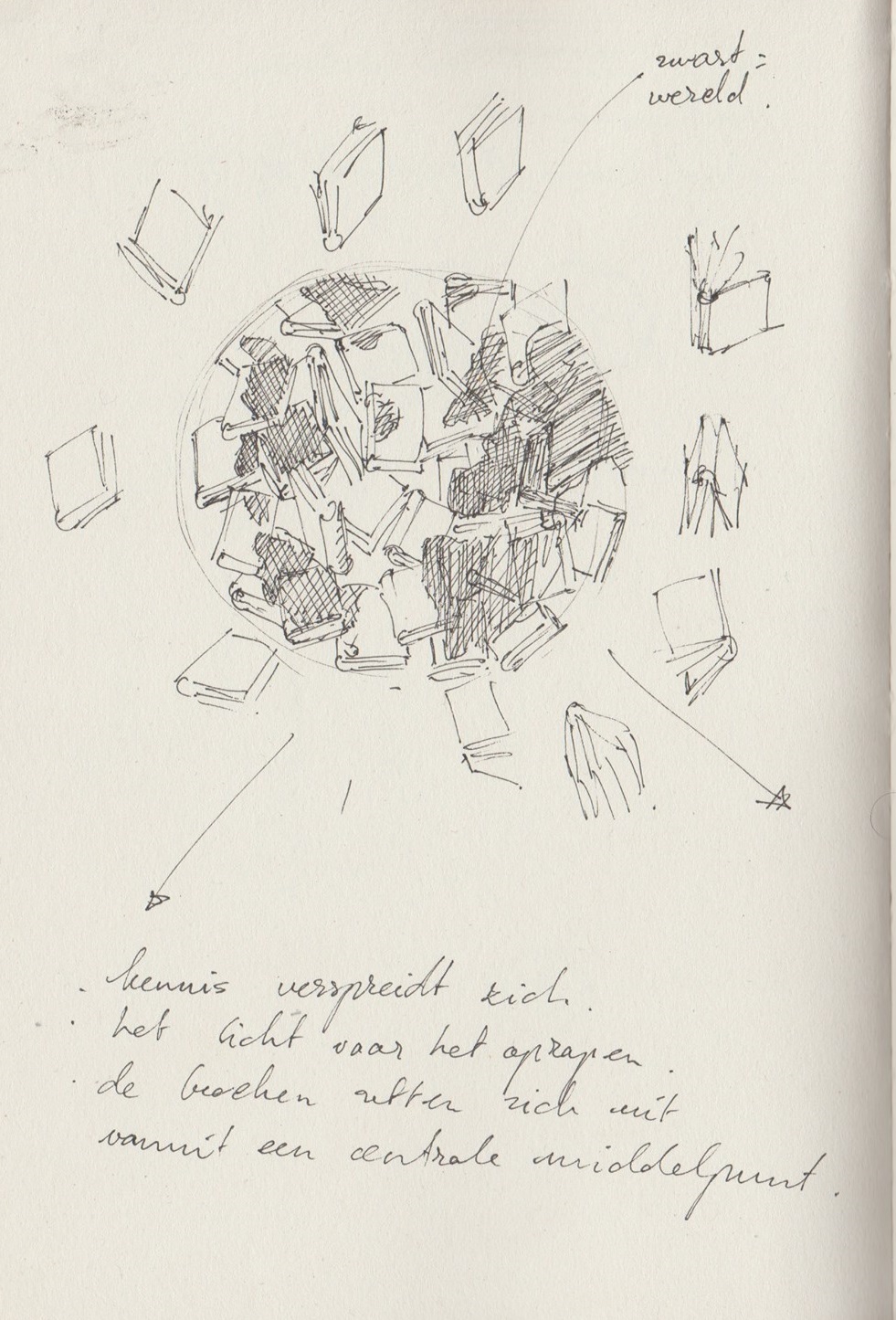
Cheerted Keo, who is a friend of mine and an aspiring Cambodian artist by way of Holland, is in the process of creating a banner or logo for our “Notes On Liberty” website. Inspired by the subtitle ‘Spontaneous thoughts on a humble creed’ and by Friedrich Hayek’s insights on ‘dispersed knowledge’, he has come up with an art work that represents our libertarian philosophy. His work symbolizes Hayek’s key observation that information is decentralized and that each individual knows just a small fraction of what is collectively known. The result of that, as Hayek has clearly stated in his seminal work The Use of Knowledge in Society (1945), is that it is best to let those with local knowledge make their own decisions in how to plan their own lives.

Although I know that the product is not finished yet, I would already like to share his work in progress with you – click on the images to enlarge them.

Cheerted Keo Notes on Liberty sketchCheerted Keo Notes On Liberty wipCheerted Keo Notes on Liberty wip 2

Please share your thoughts with us about the work. He is making the art work for free, but I thought it would be great to give him some exposure in return. Thus, if you appreciate his work, please spread word about this awesome up-and-coming artist.

If you would like to know more about Cheerted Keo’s works, you can visit his website here: www.ckeo.nl. He is quickly building up his portfolio, has had several exhibitions and is also selling some of his art works.

‘The Bitcoin Gospel’ and its Critiques

Last weekend, November 1st 2015, a Dutch television network broadcast a splendid documentary on Bitcoin entitled ‘The Bitcoin Gospel’ (Het Bitcoin Evangelie). It started off with Roger Ver, also known as Bitcoin Jesus in the Bitcoin community for his active promotions of the cryptocurrency, who is standing in his living room in Tokyo sending Bitcoins to the value of 100 Euros into the living rooms of the Dutch. The first person who scans the QR code of the ‘private key’ gets access to a Bitcoin wallet which holds 100 Euros worth of Bitcoins. At the moment of writing, that same amount of Bitcoin has more than doubled to 217.28 Euros. It is a powerful demonstration of how easy currency flows from one side of the planet to the other. If he would have made the transaction through the traditional way, it would have taken several days and it could have cost him up to 30 Euros. Using Bitcoins, he could send the money practically costless, and almost instantly without the need of any intermediaries.

You can watch the full documentary here:

If I could point out my two most favorite scenes, it would be the beginning scene (0:00 – 2:14) in which we can see Roger Ver’s impressive demonstration of Bitcoin transactions and the ending scene (43:43 – 48:24) where the myth making of its founder, Satoshi Nakamoto, is discussed and where an emotional and teary-eyed Roger Ver talks about the subversive nature of Bitcoins against political injustices.

The documentary however, also featured critics of the cryptocurrency – hence providing a balanced perspective of Bitcoins. Its main critic was Izabella Kaminska, a financial blogger at the Financial Times. She has offered several interesting critiques to which I would like to respond in this article.

1) The first critique that Kaminska offers is that Bitcoin prices are too volatile.
Kaminska reminds the viewers of the turbulent swings in Bitcoin prices. Indeed, if one would take a look at the price chart one would see that Bitcoin did rise 800 percent from $129.46 to $1,165.89 in the three month period from September to November 30 in 2013. Within the next four months, the price would plumb to $344.24. The value of Bitcoin is still extremely volatile – it has ranged between $184.32 and $481.51 in the year 2015.

Bitcoin Chart

In my opinion however, Bitcoin’s volatility is not necessarily deplorable. Its volatility is due to its small market and the experimental phase it is still in. The total market capital of Bitcoins currently stands at $5,676,100,709. It effectively means that only a small amount of money flows into or out of the market can already have huge implications for its price movements. It is therefore only natural that its price is still volatile. Volatility also offers prospects of possible gains, hence attracting more capital from investors. Total investments into Bitcoin related projects in 2015 is already more than double that for 2014. (Coindesk, 2015) The more investments are made into Bitcoin related projects, the greater the chance that Bitcoin will be widely accepted so that eventually in the long run products and services can be denominated in Bitcoins. Hopefully, this will make Bitcoins gain the same relatively low-volatility attribute of many fiat currencies.

2) Kaminska’s second critique is that buying Bitcoins does not benefit the economy as it is not loaned out to provide entrepreneurs with investment capital.
Kaminska contends that Bitcoins are simply sitting idly in people’s wallets – it has no interest, it has no yield, and she even claims that the persons who hold them believe that they have “a right to future income flows as if they are investing.” The statement that those who hold Bitcoins think that they have a right to future income flows is quite bold. Bitcoins are like any other investments in that they are always subjected to uncertainties. No serious investor believes that he has a right to profits. The Bitcoin investor is like an entrepreneur – he knows that he can only make a profit if he anticipates future conditions correctly. The notion that one should not hoard Bitcoins or cash or gold corresponds with the false notion that

“Unspent dollars means reduced sales, and as sales decline, profits drop, layoffs increase, and the total social income decreases, making less money available for consumption. Hoarding induces more hoarding as the economy sinks into a downward spiral.” (Smith, 2009)

What this notion does not take into account is that hoarding is an expression of people’s freedom to achieve personal goals or to deal with economic uncertainties. As George Ford Smith (2009) writes in ‘The Case for Hoarding’, the increased demand for money also makes prices fall. Those who are not hoarding are therefore actually benefitting from the decline in prices.

3) Kaminska’s third critique is that Bitcoin has transferred power from the existing elite to the new 1% of the Bitcoin economy, thereby going against the ‘democratization’ effects of Bitcoins that has been preached by its prononents.
In my view, it is only justified that those who have done the research into Bitcoins and who have taken the high risk to invest in new inventions also have a higher rate of return. Similarly, those who were pioneers by investing in Facebook or Microsoft during their inception period also deserve potentially higher rates of return as these companies were running higher risk of failures. If the first adopters of Bitcoins would not have had the opportunity to make enormous amounts of money, they would not have had investment incentives, it would not have got this successful and this critique of Kaminska would not even have been possible.

4) Kaminska had also argued that the Bitcoin community is extremely absolutist and driven by political ideology which is thrusted on everyone else.
She maintains that when she is paying for coffee she just wants the benefits of a working payment network and smooth transactions, not support for a certain political ideology. The idea that payment systems can be apolitical is an illusion. Governments have always had vested interests in the moneys of its citizens as its existence is entirely dependent on taxation and money creation. Any decision to meddle with the government’s schemes of taxation and manipulation of the money supply is hence always politically charged. It seems to me that she is holding an idealized view of our society if she believes that using USD does not support any political-economic system. Her statement that the Bitcoin community is thrusting their political ideology on everyone else is highly arguable as well. The government is an institution that holds the unjust power to determine which currency can serve as legal tender and which goods – including currencies – can be traded or should be outlawed. Unlike governments, the Bitcoin community does not hold the power to initiate force upon the people. It cannot thrust the adoption of the payment network on all citizens. Indeed, Bitcoin is a free market invention that allows, but not forces, anyone to join the payment network voluntarily.

Kaminska is right, when one uses Bitcoins one is supporting the libertarian political ideology. If one pays with Bitcoins, one is supporting a decentralized payment network through which transaction costs have virtually fallen to zero and through which it is much more difficult for governments and banks to track one’s financial transactions. The really relevant question however is not whether you are supporting a political ideology. The question that should be asked is: should we prefer to give our governments, and central banks the power to manipulate the value of our currency or should we prefer the separation of state and money?

References
Coindesk, (2015). State Of Bitcoin. Retrieved from http://www.coindesk.com/research/state-of-bitcoin-q3-2015/
Smith, G.F., (2009). The Case For Hoarding. The Free Market. Retrieved from https://mises.org/library/case-hoarding

Buddha, A Lonely Human Rebel

Although I do not consider myself a Buddhist, I have always had much respect for Gautama Buddha and I have always regarded him as an exemplary person.

What I find most sympathetic about Buddha are his humanness, his epistemological modesty, and his insistence to use reason and scientific inquiry to understand the world and to free oneself from social dogmas and religious oppression. It is for these reasons that Gautama Buddha could be considered contumacious or rebellious; he argued tenaciously against the superstitious practices and beliefs of Hinduism. He encouraged his followers to cultivate the mind and develop reason, because he considered it to be an essential element of ‘magga’ or the eightfold path to enlightenment (right understanding, right intention, right speech, right action, right livelihood, right effort, right mindfulness, and right concentration).

Smith & Novak write in Buddhism (2003) that there are six aspects of religion that “surface so regularly as to suggest that their seeds are in the human makeup” (Smith & Novak, 2003, p. 22), and that Gautama Buddha rebelled against all these aspects. The six aspects are:

  1. Authority – which was hereditary and exploitative as brahmins were charging exorbitantly for their services;
  2. Rituals – which became the people’s mechanical means to achieve quick miraculous results in life;
  3. Speculation – which entirely lost its experiential base;
  4. Tradition – which inhibited people from progress. One example is the tradition to instruct religious discourse in Sanskrit, making the brahmins’ knowledge effectively unavailable for the common people;
  5. Divine grace – which became confused with fatalism as to undercut human responsibility. Think for instance about the misinterpretation of ‘karma’ that was abused in order to maintain and rationalize the caste system;
  6. Mystery – which became confused with mystification and led to a perverse obsession with miracles and the occult. (Smith & Novak, 2003, p. 23)

According to Gautama Buddha, they were all too prevalent in the Hinduism of his days and he regarded them to be oppressive of human flourishing. As a revolt against the superstitious Hindu culture, Gautama Buddha preached a philosophy that is:

A. Devoid of authority – he tried to break the brahmins’ monopoly on religious teachings. In addition, he challenged everyone to utilize their own rationality and stop passively relying on the brahmins to tell them what to do.

B. Devoid of rituals – he believed that rites and ceremonies bind the human spirit.

C. Devoid of speculation – the monk Malunkyaputta, troubled by Gautama Buddha’s silence on metaphysical speculations, said:

whether the world is eternal or not eternal, whether the world is finite or not, whether the soul is the same as the body, or whether the soul is one thing and the body another, whether a Buddha exists after death or does not exist after death, whether a Buddha both exists and does not exist after death, and whether a Buddha is non-existent and not non-existent after death, these things the Lord does not explain to me, and that he does not explain them to me does not please me, it does not suit me (Kyimo, 2007, p. 206).

D. Devoid of tradition – he wanted a break from the archaic and he wanted to teach the peoples in their vernacular. On the question why his teachings should be followed, Gautama Buddha answers:

Do not go upon what has been acquired by repeated hearing; nor upon tradition; nor upon rumor; nor upon what is in a scripture; nor upon surmise; nor upon an axiom; nor upon specious reasoning; nor upon a bias toward a notion that has been pondered over; nor upon another’s seeming ability; nor upon the consideration, ‘The monk is our teacher.’ Kalamas, when you yourselves know: ‘These things are bad; these things are blamable; these things are censured by the wise; undertaken and observed, these things lead to harm and ill,’ abandon them.[1]

What Gautama Buddha is effectively saying here is that everything should be questioned; every tradition, every holy book, and even teachers including himself. He taught everyone to use reason and the scientific methodology of inquiry, and he emphasized on doing good and abandoning evil.

E. Emphasizes intense self-effort and opposes fatalism – everyone can become enlightened. He taught everyone that actions are meaningful and that everyone contains the power to change their lives immediately for the better. Everyone was considered responsible for their own actions and happiness. This puts heavy responsibilities on all individuals to make the best of their lives.

F. Devoid of the supernatural – he condemned divination and reliance on Brahma (God). (Smith & Novak, 2003, pp. 24-28) He could not conceive of Brahma who considered himself “the Supreme one, the Mighty, the All-seeing, the Ruler, the Lord of all, the Maker, the Creator, the Chief of all appointing to each his place, the Ancient of days, the Father of all that is and will be”[2] to inflict so much suffering on the peoples:

If the creator of the world entire
They call God, of every being be the Lord
Why does he order such misfortune
And not create concord?
If the creator of the world entire
They call God, of every being be the Lord
Why prevail deceit, lies and ignorance
And he such inequity and injustice create?
If the creator of the world entire
They call God, of every being be the Lord
Then an evil master is he, (O Aritta)
Knowing what’s right did let wrong prevail![3]

At the same time, Gautama Buddha appeared to be one of us: fallible, sensitive, and insecure about life. Despite his immense influence, he remained humble enough as to never claim to be a son or a prophet of God – nor did he ever claim to understand the beginnings of the universe. His teachings were entirely devoted to alleviate man from his misery.

Talking about the Three Greatest Men In History (1935), H.G. Wells said of Gautama Buddha that:

[Y]ou see clearly a man, simple, devout, lonely, battling for light – a vivid human personality, not a myth. Beneath a mass of miraculous fable I feel that there also was a man. He, too, gave a message to mankind universal in its character. Many of our best modern ideas are in closest harmony with it. All the miseries and discontents of life are due, he taught, to selfishness… Before a man can become serene he must cease to live for his senses or himself. Then he merges into a greater being. Buddha in different language called men to self-forgetfulness 500 years before Christ. In some ways he was nearer to us and our needs. He was more lucid upon our individual importance in service than Christ and less ambiguous upon the question of personal immortality. (Wells, 1935, July 13)

Footnotes
[1] From Kalama Sutta: The Instruction to the Kalamas.

[2] From Digha Nikaya 1: Brahmajala Sutta.

[3] From Bhuridatta Jakata.

Bibliography
Examiner. (1935, July 13). Greatest In History. Retrieved from www.trove.nla.gov.au/ndp/del/article/51945346?searchTerm=GLOBE%20READER%20DIGEST%20&searchLimits=

Gunasekara, V.A. (1997). The Buddhist Attitude To God. Retrieved from http://www.budsas.org/ebud/ebdha068.htm

Kalama Sutta: The Instruction to the Kalamas. (1994), Transl. Soma Thera. Retrieved from www.accesstoinsight.org/tipitaka/an/an03/an03.065.soma.html

Kyimo. (2007). The Easy Buddha. London: Prospect House Publishing.

Smith, H., & Novak, P. (2003). Buddhism: A Concise Introduction. New York: HarperOne.

The Crypto Anarchist Manifesto (1988)

Crypto-anarchism is a subversive philosophy that extends anarchism into the world of cyberspace. Crypto-anarchists attempt to protect their privacy and political freedom through the use of information technologies. Timothy May, one of the co-founders of Cypherpunk and writer of the ‘Crypto Anarchist Manifesto’, describes Crypto-anarchism as

“the cyberspatial realization of anarcho-capitalism, transcending national boundaries and freeing individuals to make the economic arrangements they wish to make consensually.”

In this article I would like to post Timothy May’s ‘Crypto Anarchist Manifesto’, which was first spread among like-minded tech-anarchists in mid-1988 at the “Crypto ’88” conference. The Manifesto was also discussed at the first physical Cypherpunk meeting in 1992. Most people have never heard of Cypherpunk, but they might know their most notable member: Julian Assange, founder of Wikileaks.

See here the full Manifesto:

A specter is haunting the modern world, the specter of crypto anarchy.[1]

Computer technology is on the verge of providing the ability for individuals and groups to communicate and interact with each other in a totally anonymous manner. Two persons may exchange messages, conduct business, and negotiate electronic contracts without ever knowing the True Name, or legal identity, of the other. Interactions over networks will be untraceable, via extensive re- routing of encrypted packets and tamper-proof boxes which implement cryptographic protocols with nearly perfect assurance against any tampering. Reputations will be of central importance, far more important in dealings than even the credit ratings of today. These developments will alter completely the nature of government regulation, the ability to tax and control economic interactions, the ability to keep information secret, and will even alter the nature of trust and reputation.

The technology for this revolution–and it surely will be both a social and economic revolution–has existed in theory for the past decade. The methods are based upon public-key encryption, zero-knowledge interactive proof systems, and various software protocols for interaction, authentication, and verification. The focus has until now been on academic conferences in Europe and the U.S., conferences monitored closely by the National Security Agency. But only recently have computer networks and personal computers attained sufficient speed to make the ideas practically realizable. And the next ten years will bring enough additional speed to make the ideas economically feasible and essentially unstoppable. High-speed networks, ISDN, tamper-proof boxes, smart cards, satellites, Ku-band transmitters, multi-MIPS personal computers, and encryption chips now under development will be some of the enabling technologies.

The State will of course try to slow or halt the spread of this technology, citing national security concerns, use of the technology by drug dealers and tax evaders, and fears of societal disintegration. Many of these concerns will be valid; crypto anarchy will allow national secrets to be trade freely and will allow illicit and stolen materials to be traded. An anonymous computerized market will even make possible abhorrent markets for assassinations and extortion. Various criminal and foreign elements will be active users of CryptoNet. But this will not halt the spread of crypto anarchy.

Just as the technology of printing altered and reduced the power of medieval guilds and the social power structure, so too will cryptologic methods fundamentally alter the nature of corporations and of government interference in economic transactions. Combined with emerging information markets, crypto anarchy will create a liquid market for any and all material which can be put into words and pictures. And just as a seemingly minor invention like barbed wire made possible the fencing-off of vast ranches and farms, thus altering forever the concepts of land and property rights in the frontier West, so too will the seemingly minor discovery out of an arcane branch of mathematics come to be the wire clippers which dismantle the barbed wire around intellectual property.

Arise, you have nothing to lose but your barbed wire fences!

Footnote

[1] This is clearly a wordplay on the opening sentence of Karl Marx’ and Friedrich Engels’ The Communist Manifesto which reads: “A spectre is haunting Europe—the spectre of communism.”

South Park’s ‘Safe Space’: A Parody On Stepford Students

Do you know what Stepford students are? This article by Brendan O’Neill explains:

They’re everywhere. On campuses across the land. Sitting stony-eyed in lecture halls or surreptitiously policing beer-fuelled banter in the uni bar. They look like students, dress like students, smell like students. But their student brains have been replaced by brains bereft of critical faculties and programmed to conform. To the untrained eye, they seem like your average book-devouring, ideas-discussing, H&M-adorned youth, but anyone who’s spent more than five minutes in their company will know that these students are far more interested in shutting debate down than opening it up.

Stepford students demand the ‘right to feel comfortable’. Their eyes “glazed with moral certainty”, they demand ‘safe spaces’ – spaces where no student would feel threatened or unwelcome. They seek safety from words, ideas, Zionists, ‘blurred lines’, Nietzsche etc. This new generation of students believe that self-esteem is more important than everyone else’s liberty to speak up their mind. At some universities, like Brown University, ‘safe spaces’ have been set up so that students can take refuge from ‘disturbing ideas’.

Now comes the greatest part: the concept of ‘safe spaces’ has been discussed in South Park’s latest episode. It is hilarious!