Rules for Rulers

Watch to the end for details about the book (by Bruce Bueno de Mesquita and Alastair Smith) this video is based on.

  1. I think readers of NoL will enjoy this nicely condensed public-choice-y analysis of the constraints involved in operating (and thus changing) a government.
  2. The audiobook is available on Overdrive, so you can borrow it from your library. I’m just started listening to it and I’m enjoying it immensely.
  3. I suddenly found myself as the benevolent dictator of some country. My long-term objective is to shape my society into a libertarian utopia. Here’s my plan to deal with the constraints discussed in the video: all of my advisors are required to play devil’s advocate when I propose some change. Yes-men will be summarily executed. Assuming I stay benevolent but also ruthless, does my devil’s advocate scheme work out? Please discuss in the comments. Anyone who doesn’t earnestly try to poke holes in my idea will be sent to the work camps.

Why Immigrants Are Superior

I am endlessly interested in issues of emigration/immigration. In part, this is because it’s the place where my personal experience, and my wife’s, intersect with my training and with my professional life as a sociologist. There is a deeper reason I try to explain below a little circuitously; bear with me.

I think that how humans form into groups is the central question about our species. The question arises because every adult individual without exception is simultaneously a member of several groups and categories. Thus, I am a husband (member of a very small group, at least under monogamous conditions), a member of the sociological discipline/ profession, a member of the teaching professions broadly defined (but never an “educator”!), a small-time member of a local radio station (KSCO Santa Cruz, 1080AM), a Republican but nevertheless, a libertarian (with a small “l”), and an American. Yet, as a former Frenchman I am also a member, though somewhat passive, of a culture group, roughly the francophone group.

All the above memberships are in groups. I also belong to several categories that don’t qualify as groups because they never meet and because they have little sense of themselves as belonging together. So, I am a male (decidedly so), a moderately overweight person past middle age (but athletic!), a parent, a tax-payer, and I also belong to the secret, vast, worldwide category of humans who lack hair on the second phalanx of their index finger. In America, I am also a white man. The latter category is a little problematic because it’s ill-defined, like all matters that have to do with race. It means that most Americans on looking at me would guess, probably correctly, that all or most of my ancestors lived in Europe ten thousand years ago. Do the count of your own memberships for yourself and you will be amazed.

Memberships are not all equal, especially at a given time. Some memberships become activated while others lie dormant. Individuals activate one membership over the others depending on circumstances and often, depending on their stage in the life cycle. The presence of others frequently triggers the activation of long-dormant membership, as when a thirty-something bumps into a couple of old high-school buddies. Finally, sometimes, individuals are forced to activate one membership to the near-exclusion of others. This happens most often in connection with the nation and religious denominations, including secular religions such as Communism in the old days. The penultimate sentence is a description of totalitarianism, political, religious, and other. It’s the most parsimonious definition I know.

Emigration matters because every act of emigration implies a reasonably conscious decision to de-activate a group membership that is salient in much, but not in all, the world: nationality. Emigrants may not be completely clear about how definitive their decision to move is but they always know that it entails an abrupt shutting off of whatever comfort one derives from being inside that particular group.

Emigration, immigration, after one begins to live in another country, typically remains emotionally costly for a long time. Besides, frequently, distance from others one loves, there are subtle issues of self-worth I cannot discuss here (but that I will discuss at some future time, especially if asked). In the classical age of worldwide, and American, emigration, it tended to be final. Travel was slow and expensive. If you did not like it in the new place, often, you just had to suck it up. (This is broadly true although turn-of-the-century American records show that surprising numbers of recent European immigrants left the US every year.) Today, the extraordinarily low cost of air travel means that nearly every dissatisfied immigrant may go home. In 2009, there were very few parts of the world for which a one-way ticket cost more than a thousand dollars. That would be under seven weeks worth of after-taxes minimum wage at worst. Tickets from the US to Europe, for example cost less than one third that amount off-season. In the same year, the average US wage was about $20 per hour. Estimating deductions of 25%, the net hourly wage was thus around $15. Hence, there were few if any parts of the world that could not be reached at the cost of net savings amounting to 70 hours of average wages (less than two weeks).

For emigrants to contiguous countries or proximate countries, such as Turks to Germany, Romanians to France, or Mexicans to the US, the option of going home is even more open, of course.

What I am trying to establish here is that emigration is normally a doubly voluntary act. Immigrants first volunteer to be in the country of immigration. Then, they keep volunteering by not taking up the option of moving back home, of re-emigrating.

Two things should follow from this volunteer condition: First, if they don’t like the country to which they have moved, immigrants have no one to blame but themselves. I know I am repeating myself but the imagery is so attractive, I can’t resist: If you come to the party, especially if you come uninvited (99% of immigrants, I would guess), don’t criticize the food, or the interior decoration, or the guests’ intellectual level.

Although there is a widespread impression to the contrary, it seems to me that few immigrants break this simple rule of their own accord. Rather, more commonly, they fall under the sway of political organizations who presume to speak on their behalf. These organizations are often political in nature. They seek to exploit the voting power of people unfamiliar with the national political customs. It’s in their interest to create and inflame feelings of deprivation. Moreover, since immigrants more often than not enter the host social structure near the bottom, they are frequently taken over by labor unions who do the same. In the US, specifically, recent immigrants are sometimes annexed by radical organizations with a long history of America-hatred. These influences confuse some immigrants, putting them in mental contradiction with their own choices. They do a great deal of damage by retarding immigrants’ emotional integration into American society. Note that I refer to integration rather than to “assimilation,” a cultural construct. Societies differ in the extent to which they expect immigrants to fit into the national culture, Canada little, France a great deal, with the US somewhere between the two.

Finally, organizations led by native-born who pretend to speak for immigrants also do the latter a great deal of harm by creating false impressions in the general public. The main false impression is that immigrants are more difficult to integrate than they really are. In the US, you seldom hear about the millions of immigrants who think that everything is just peachy or better.

The second consequence from the voluntary nature of the status of immigrants is seldom discussed: Immigrants make better citizens than the average native-born. Over 90% of Americans, for example, only took the trouble to be born in the right country. That’s akin to choosing your parents carefully. There is not much merit in it, first because it just happened. Secondly, most native-born citizens of any country would not have enough information to choose the land of their birth over others if the thought crossed their minds. Here again, the exception proves (“tests”) the rule: It’s possible to make such a choice since millions do, by emigrating, precisely. This would include the tens of thousands of Americans who live abroad more or less permanently.

Immigrants, by contrast, choose and keep choosing merely by staying put. Their choice is deliberate, conscious and informed. Their appreciation for the country of their immigration is a form of adult love. It should be superior to the baby-love of many of the native-born who only know one mother. If I were still a scholar, I would have a topic for a good study here. I would begin to endeavor to find data to test what is now a compelling hypothesis. But I am not, so it will remain this as far as I am concerned.

Immigrants into the US, specifically, possess superior qualities, whatever their national origin. First, they are usually hard workers, because this country offers some of the least generous social benefits (“welfare”) in the developed world. To sponge off “the system” in this country takes a great deal of skill. (A pregnant idea but I won’t go there in this essay.) Immigrants into this country must also comprise a large proportion of enterprising people, for the same reason. (There, I think data exist that demonstrate the validity of this claim.) Moreover, immigrants into the US have to be more adventurous, braver, than the native-born, on average. To change one’s living conditions drastically takes more courage, more tolerance of risk, and more imagination than moving to the next suburb.

I believe, accordingly, that American exceptionalism is rooted in exceptional institutions but that it is fertilized by wave after wave of immigration of a superior kind.

The following link will take you to an article about illegal immigration specifically that I published in the Independent Review with Russian immigrant Sergey Nikiforov: “If Mexicans and Americans could Cross the Border…“.

Sound Money Project Relaunch

The Sound Money Project has relaunched this November at the American Institute for Economic Research (AIER) under the direction of William J. Luther.

Other than Luther and myself, you’ll see regular posts by Scott Burns, James Caton, Alexander W. Salter, and Brian C. Albrecht.

Digging Deeper into Populism: A Short Reply to Derril Watson

Derril Watson offer some critical remarks on my short post about populism in Latin America. In short, Watson is arguing that (1) I’m stating something obvious (populism diminishes economic freedom) and (2) that I’m wrong when I say that populism fails to produce economic growth.

Seems I haven’t been quite clear, because I state none of the above. The intention of my post is not to show that populism decreases economic freedom, I think this is uncontroversial. The point of the post is to show, with a very simple calculation, how fast economic freedom is reduced. I might be wrong, but I have the impression that most individuals do not realize how fast they can loose their economic liberties under this type of government. This is the message carried in the title of the post “How fast does populism destroy economic freedom in Latin America?” rather than “Does populism destroy economic freedom in Latin America?”

With respect to the second point, my claim is not that under populism there is no growth of GDP, my claim is that “populist governments failed to increase GDP per capita consistently faster than the region.” My original post is just a small bite of a paper that is still work in progress and I’ll share in due time. I wasn’t expecting this claim to be controversial. Still, the figure below shows the ratio of GDP per capita (PPP) of each of he countries I observe with respect to Latin America. All countries are centered in year 0 as the first year of populism as defined in my original post. That’s the first dot in the graph. The second dot shows either the last data available or the end of populism. None of these countries show a consistent higher growth rate than the rest of the region.

Populism - Fig 1

It seems to me that Watson is confusing growth with recovery. The fact that economic growth produces a growth in GDP does not mean that a growth in GDP is due to economic growth. The recovery mentioned by Watson in Argentina happens after the largest crisis in the history of the country and the largest default worldwide at the time. As I mentioned in my post, Argentina hits stagflation in 2007. This suggests to me a rapid recovery with no significant growth and built upon an unsustainable policy (for instance, Argentina fails to improve its relative income with respect to the region, it rather stagnates in 2007 and starts to fall a few years after.) I can show a large increase in my personal GDP as measured by consumption by depleting my savings (consuming my capital stock at the country level). I wouldn’t call that personal economic growth. The Kirchner government, for instance, failed to reduce poverty below the levels seen in the 1990s. It does, of course, if that is compared with the poverty levels around the years of the crisis (which is what Watson’s table is doing.) It should also be kept in mind that official poverty measures in Argentine were hampered by the government.

There’s still another important issue regarding GDP measures of Argentina. As it became well known, GDP series were hampered by the government (also inflation and poverty rates were hampered.) By 2014 official GDP values were overestimating the size of the economy by 24%. Another sign is the evolution of real wages in Argentina, which hits a ceiling again in 2007 with a level similar to the one at the end of 2001 (just before the crisis). In 2008, 2009, and 2010 real wages decline.

As a final comment, I’m not sure to what comment of mine Watson refers to. I don’t see a comment entry of mine in my original post, nor I remember doing so. In any case, I don’t get into the definition of populism precisely for how difficult that task can be. The problem of defying populism is one of the areas covered in my yet unfinished paper.

Digging Deeper into Populism

TL;DR summary: The one thing most populist governments studied had in common was a declining protection for property rights. Focus there next time.

Nicolás Cachanosky explained that populism in five Latin American countries had led to a rapid deterioration in their economic freedom, intimating that this also led to a relative drop in living standards compared to other South American countries. Given that the two primary economic strategies of populism are control and spend (Dornbusch and Edwards 1991 quoting Carbonetto et al. 1987), it would be shocking if a populist government did not reduce economic freedom. That’s the idea! However, there is more we could learn about how populism reduces economic freedom by doing a little more to identify exactly what it was that populist governments did. First, I think it’s useful to go a little further back, to compare how trends were looking before* populism (say by 1991) to how those trends changed with the election of a populist government. Second, I’m going to take a more careful look at how and why economic freedom decreased.

It is funny to me that when Cachanosky’s response to his first commenter is to ask for a definition and a measure before being willing to debate a correction; that suggests he really ought to have been more careful to define populism in his post. In fairness, that’s a tall order*: much of the literature on populism has been trying to define it and there is still no consensus as far as I can tell. Are we focusing primarily on increasing statism, whether it is called populism or progressivism or socialism or cronyism? Or is there something special about the populist brand of statism that we should be looking out for? To the extent populism is a “power to the people” movement, Libertarianism itself could try to appropriate the populist brand and claim they are taking power back from the government for the people! I don’t think this is what Cachanosky has in mind. :). I tend to think that he is focused mostly on statism and for the purposes of his post, it doesn’t matter whether it’s populism or socialism that caused it, so please assume when I say “populism” hereafter, I mean increased state control over the economy.

Even given that, populism/statism exists on a continuum. There is a marked difference between a determined populist government that nationalizes wide swathes of an economy rapidly in order to redistribute riches to the common people and someone in an unnamed developed country who uses populist rhetoric to get elected and keep his base happy only to turn around once in office and enact largely pro-business deregulations and strengthen conservative social mores.

Because of this, it’s important to make distinctions between the 5 countries in question (Argentina, Bolivia, Brazil, Ecuador, and Venezuela). To demonstrate that, let me focus on Argentina and Brazil. Mueller and Mueller (2012) contrast Brazil and Argentina’s responses to the global food price crisis in 2006-08, during this populist period in both countries. There have been very few checks and balances on executive power in Argentina, allowing the Kirchners to enact “opportunistic price controls and intrusive export bans, generating significant discontent and investment disincentives” (pg 3). In Brazil, the checks on the presidency to prevent a repeat of the late 80s/early 90s inflation led to “the surprising conversion of President Lula once in office in 2003, reneging the leftish policy agenda his party had defended for years in the opposition, only to continue the fiscally disciplined macroeconomic policies of his predecessor” (pg 5). These kinds of difference are very important to understand what happens and when and why.This table shows how Heritage’s Economic Freedom in the World survey ranked the five countries Cachanosky singles out as populist in 1995 when the survey started, the year when they elected a populist government, and 2015; I then add five other South American countries for comparison. 10 represents high economic freedom and 1 very low freedom. The astute reader will notice that I am using the raw scores rather than country rankings as Cachanosky does because I suspect it matters more for economic growth what happens within my country rather than thinking economic growth will collapse because a handful of other countries on other continents become more free while I stay put where I am: I will look worse by comparison, but not be worse.

Heritage Overall
1991 start 2015
Argentina (2003) 6.8 5.6 4.4
Bolivia (2006) 5.8 5.8 4.7
Brazil (2002) 5.1 6.2 5.6
Ecuador (2007) 5.7 5.5 4.9
Venezuela (1999) 6 5.6 3.4
Heritage overall
1995 2005 2015
Chile 7.1 7.8 7.9
Colombia 6.5 6 7.2
Paraguay 6.6 6.1 6.8
Peru 5.7 5.3 6.1
Uruguay 6.3 6.7 6.9

To delve into the Argentina/Brazil comparison again, the survey shows Argentina scoring markedly higher than Brazil in 1995. This situation had already reversed itself by 2003 and the start of populism. Since then Argentina has continued to fall rapidly while Brazil has turned reversed its progress. Delving deeper into those numbers, Argentina has become markedly less free in terms of almost every category Heritage measures (respect for property rights in 2001-2003, government integrity 2006-2008, tax burden, government spending since 2011, business freedom in 2002, and monetary, investment, and financial freedom in 2003), while Brazil’s primary sin was an increase in spending in 2006 and an increase in taxes to pay for it. That’s it. This shows a real deterioration in Argentinian freedom before populism, a trend only continued and exacerbated by the Kirchners, while Brazil has shown both improvement and decline, with a much different, constrained form of policy making. Argentinian populism and Brazilian are far from the same phenomenon.

In Bolivia and Ecuador, property rights fell in 2001 and investment freedom by 2005 before populism in either country and both slid down steadily after electing a populist government; both countries have improved in government integrity, taxes got worse in Ecuador in 2008 with spending increasing massively in 2010, and financial freedom worsened after populism started. Venezuela saw the largest decrease in respect for property rights right after electing Chavez and again in 2008. In contrast to other countries, Chavez initially reduced government spending and kept taxes roughly constant, with spending not increasing again until after 2008. Business and financial freedom declined steadily, investment freedom plummeted in 2004, and monetary freedom only declined in 2014.

We see then five rather different patterns, even though most of them saw the same sort of decline of 1.2-1.4 points. The key feature in all but Brazil is the decrease in respect for property rights shortly after the election of a populist government. Spending also tends to be higher in these five countries, though all happened during the global food price crisis and the US/EU financial crisis when spending also increased by many non-populist countries as well. Otherwise, there is very little in common among the five countries, with some embracing freer trade and others fleeing it, some cracking down on monetary and financial freedoms with others largely ignoring them. Our five ‘control’ countries saw an improvement in economic freedom from 2005-201, particularly in Colombia.  Colombia and Peru reduced their respect for property rights in 2002, but later repented; Paraguay has not held property rights in even modest esteem since 1998.

All of this suggests the place to look in future research is to the importance of declining respect for property rights among populist governments as a driver of economic freedom and economic growth.

And that brings us to the second of Cachanosky’s points – that this drop in economic freedom in those five countries led to shrinking economies compared to other economies in the region. First off, to be clear, all five of these populist economies experienced rapid economic growth during the time period in question, and this economic growth was much higher than the economic growth enjoyed in the decade before populism started. This would lead pro-populists to conclude that populism was actually quite good. Cachanosky admits that even though Argentina fell farther in the economic freedom rankings than its peers, its GDP/capita actually increased. He excuses this as being “largely explained as recovery after the 2001 crisis and by consuming capital stock, not as an expansion of potential output.” Unfortunately for his story, Argentina’s GDP/capita in terms of real USDollars not only surpassed its pre-crisis level (around $12300 in 1998), but rose to $17500 – a 42% increase during its populist period. (All numbers from www.gapminder.org are PPP$ inflation-adjusted.) In every single case he cites, GDP/capita rose while the headcount poverty rate fell dramatically.

However, compare their growth to the five control countries, and compare the time period before and after in each case:

GDP/cap (PPP$) Growth poverty (% below $3/day)
1991 start 2015 91-start start-15 1991 start 2014
Argentina (2003) 9330 10300 17500 10.40 69.90 3.9 19.1 4.3
Bolivia (2006) 3850 4370 6150 13.51 40.73 30.4 32.4 12.7
Brazil (2002) 10300 11600 15400 12.62 32.76 35.8 24.5 7.56
Ecuador (2007) 7690 7810 10800 1.56 38.28 36.5 32.9 10.2
Venezuela (1999) 16100 14200 15800 -11.80 11.27 N/A N/A N/A
GDP/cap (PPP$) Growth poverty (% below $3/day)
1991 2003 2015 91-start start-15 1991 2003 2014
Chile 9750 15500 22500 58.97 45.16 N/A N/A N/A
Colombia 7780 8680 12400 11.57 42.86 22.7 26.6 13.2
Paraguay 6040 5870 8040 -2.81 36.97 7.9 19.4 7
Peru 5290 6880 11500 30.06 67.15 33.9 27.2 9
Uruguay 10100 11500 19900 13.86 73.04 2.1 5.2 1.3

The 2003-2015 period was good across the board in South America, with most growing at least 30% more from 2003ish-2015 compared to 1991-2003. Similarly, poverty rates fell markedly from 2003-2014 in every country for which I have Gapminder data. So the claim is not that populism resulted in negative economic growth. The issue is that the average growth in the non-populist countries was around 1% per year higher than in the populist countries. Thus, to the populist-supporter who points to the high growth of Argentina et al as proof that populism works, the response is that growth was even higher in their non-populist neighbors and poverty is lower in them as well.

Now the unfortunate thing for drawing a clear causal interpretation from these correlations is that economic growth was also higher in the non-populist countries in the before period as well, perhaps due in part to having higher economic freedom to begin with. Growth in the freedom-preserving countries was slightly more than 1% per year higher, and that is driven predominantly by Chile. If Chile had had a more average 11-13% growth during that time period, we would be able to show more conclusively that the economic growth gap increased after populism. So, really, the claim that populism caused a lower economic growth in those countries doesn’t hold up very well – economic growth was lower in those countries before populism as well. It may well be that economic growth would have been higher in Argentina, Bolivia, Ecuador, and Venezuela had they maintained or improved their respect for property rights, but the raw data doesn’t tell us that without significantly more controls and doing some proper regressions.


* – One of the problems of this exercise is that to get “before” populism, you need to go back a hundred years or so. Ah well.

“The Impossibility of a University”

I was just reading David Friedman’s The Machinery of Freedom. He published the first edition in 1973. Amidst the wild ride of the contemporary American university (Evergreen State College being the most heinous single episode), one passage seems especially prescient.

From chapter twelve in the third edition:

The modern corporate university, public or private, contains an implicit contradiction: it cannot take positions, but it must take positions [sides]. The second makes the demand for a responsible university appealing, intellectually as well as emotionally. The first makes not merely the acceptance of that demand but its very consideration something fundamentally subversive of the university’s proper ends.

It cannot take positions because if it does, the efforts of its members will be diverted from the search for truth to the attempt to control the decision-making process. If it takes a public position on an important matter of controversy, those on each side of the controversy will be tempted to try to keep out new faculty members who hold the other position, in order to be sure that the university makes what they consider the right decision. To hire an incompetent supporter of the other side would be undesirable; to hire a competent one, who might persuade enough faculty members to reverse the university’s stand, catastrophic. Departments in a university that reaches corporate decisions in important matters will tend to become groups of true believers, closed to all who do not share the proper orthodoxy. They so forfeit one of the principal tools in the pursuit of truth — intellectual conflict.

A university must take positions. It is a large corporation with expenditures of tens of millions of dollars and an endowment of hundreds of millions. It must act, and to act it must decide what is true. What causes high crime rates? Should it protect its members by hiring university police or by spending money on neighborhood relations or community organizing? What effect will certain fiscal policies have on the stock market, and thus the university’s endowment? Should the university argue for them? These are issues of professional controversy within the academic community.

A university may proclaim its neutrality, but neutrality as the left quite properly argues, is also a position. If one believes that the election of Ronald Reagan or Teddy Kennedy would be a national tragedy, a tragedy in particular for the university, how can one justify letting the university, with its vast resources of wealth and influence, remain neutral?

The best possible solution within the present university structure has been not neutrality but the ignorance or impotence of the university community. As long as students and faculty do not know that the university is bribing politicians, investing in countries with dictatorial regimes, or whatever, and as long as they have no way of influencing the university’s actions, those acts will not hinder the university in its proper function of pursuing truth, however much good or damage they may do in the outside world. Once the university community realizes that the university does, or can, take actions substantially affecting the outside world and that students and faculty can influence those actions, the game is up.

There is no satisfactory solution to this dilemma within the structure of the present corporate university. In most of the better universities, the faculty has ultimate control. A university run from the outside, by a state government or a self-perpetuating board of trustees, has its own problems. A university can pretend to make no decisions or can pretend that the faculty has no control over them, for a while. Eventually someone will point out exactly what the emperor is wearing.

With an activist culture in place, the university endures more and more blows to its truth-seeking abilities. UC Berkeley spent an estimated $600,000 on security for Ben Shapiro a couple months ago, after the chaos and protests of the past year. Staff cut seating in half, worried that protesters would dismantle chairs and throw them onto the audience on the bottom floor. Now, so I hear, student clubs are having difficulty hosting evening meetings on campus, as the administration makes up for the expenses by cutting down on electricity usage and janitorial services. Club stipends, of course, are down. All of this damages the educational environment.

My friends went to see Ben, and watched a woman with a “Support the First Amendment! Shalom Shapiro!” sign get dragged into a crowd and beat up. (Not reported by major media; falsely reported as a knifing by right-wing media.) David identified the internal problem of the corporate university, which I believe we see escalating; the external problem is when outsiders — most of the violent rioters in Berkeley since the beginning of 2017 — understand the political power of the university and the speech that goes on there, and seek to control the process of intellectual conflict through physical force. Both are advanced in accordance with the political involvement of the students as well as the teachers.

Libertarian sighted at the Daily Beast

Ooops, I mean cited, not sighted:

Nor was it the case that there was a direct correlation between Protestant countries and prosperity. In a paper published in the journal Social Forces Jacques Delacroix and Francois Nielsen conclude that “there is little empirical support” for the common interpretation of Weber’s Protestant Work Ethic. This idea probably comes “from selected anecdotal evidence fortified… by the perceived well-being of contemporary Protestant countries.” In other words, Protestantism does not make people rich even if, in some cases, Protestants think that it does.

Rest the rest. h/t Uncle Terry

Oh, and Mark has an essay up on institutions over at Aeon that ties in well with the Daily Beast piece.

Don’t forget about the back-and-forth between Mark and Bruno on the Protestant Reformation here at NOL: Part one (Bruno), part two (Mark), and part three (Bruno).

Catalonia: a philosophical case for Secession

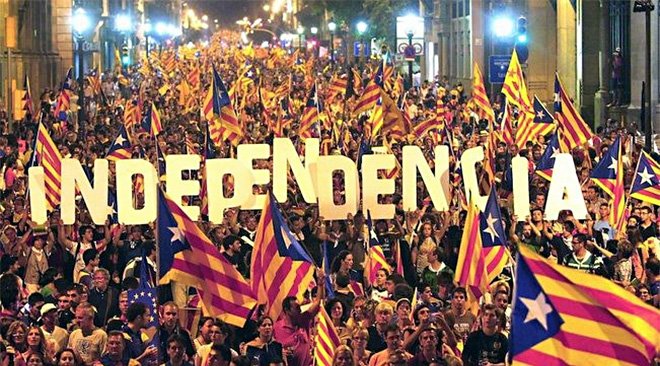
Yesterday, the Catalan government has overwelmingly voted for independence from Spain and to establish an independent republic. 70 were in favour, 10 were against, and 2 votes were blank. Unfortunately, it was rejected by the central governments of Spain and many other countries. Nonetheless, the Catalan case may inspire the other independence movements in Europe.

In this post I’d like to provide a philosophical case for the ethical right of secession based on a libertarian perspective of self-ownership. My argument is exclusively theoretical, although a discussion on how secession could be achieved practically would be interesting as well. I may save that for a post in the future.

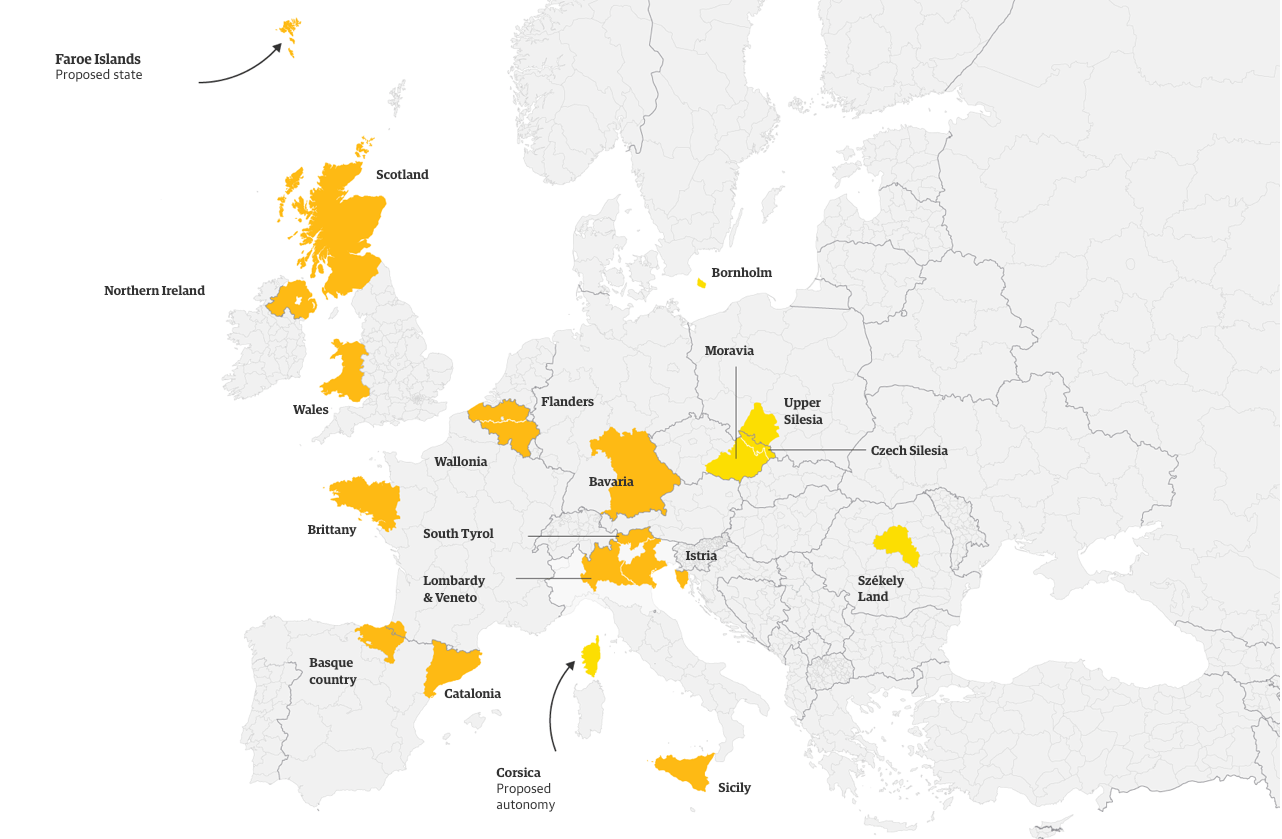
Below, you can find a map of other places in Europe with strong secessionist movements:

Structure of my argument

My argument is deductive and runs as follows:

  1. People have the right of self-ownership in accordance with the non-aggression principle, and based on the natural rights philosophy put forward by the political philosopher Murray Rothbard;
  2. If people have the right of self-ownership, they also have the right of voluntary association, voluntary formation of communities, and the right to choose their own leaders;
  3. Sometimes the state that the individual belongs to, violates the rights of the individual to the extent that the individual does not feel associated with it anymore;
  4. Under such circumstances the individual may perceive the state as an unacceptable aggressor, and he is justified to revolt by separating himself from the state. He can form communal associations to secede as a new political unit;
  5. There is no limit to secession. Provinces have the right to secede from a state, a district from the province, a town from the district, a neighbourhood from the town, a household from the neighbourhood, and an individual from the household.

The right of self-ownership and property rights

In For a New Liberty (1973), Murray Rothbard deduces natural law from the essential nature of human beings. He writes that it is in man’s nature to use his mind in order to select values, ends and the means to attain these ends so that he can “act purposively to maintain himself and advance his life”. He furthermore contends that it is absolutely “antihuman” to interfere violently with a man’s “learning and choices” as “it violates the natural law of man’s needs”. Therefore, man’s nature should be protected through his right of self-ownership. This right asserts that man has the absolute right to “own” his body and “to control that body free of coercive interferences”. This right includes the practice of such essential activities as thinking, learning, valuing, and choosing ends and means without any coercion, since such activities are necessary for the enhancement of man’s life.

From this natural right follows the right to do anything with one’s body, including the right to form free associations and communities, and the right not to be violated in one’s self-ownership. Thus, one has the right to associate oneself with the leader of one’s choice, but not the right to impose a leader unto someone else. Likewise, people should be free to join and to leave communities voluntarily.

In addition to the right of free association, people also have property rights. Rothbardian property rights are directly derived from self-ownership rights, and are based on the Lockean homesteading theory. It states that since man owns his person, he owns his labour, and therefore he also owns the fruits thereof. John Locke (1689) has put homesteading theory in the following way:

… every man has a property in his own person. … The labour of his body and the work of his hands, we may say, are properly his. Whatsoever, then, he removes out of the state of nature hath provided and left it in, he hath mixed his labour with it, and joined it to something that is his own, and thereby makes it his property.

Given that man has the right of self-ownership, and that he must employ natural objects for his survival, then the sculptor has the right to own the product he has made through the mixing of his labour. In other words, by producing something with one’s energy through the utilization of unowned nature, one has, as Rothbard calls it, “placed the stamp of his person upon the raw material”. One therefore rightfully owns the product. Any violation of self-ownership and property rights should hence be regarded as an act of aggression.

The state

The state is nonetheless a social institution that has historically interfered most often with people’s self-ownership and property rights. Max Weber has recognized it as an institution with a territorial monopoly of compulsion in his essay ‘Politics as a Vocation’ (1919). Hoppe, in Democracy – the God that failed (2001), asserts that every government will use this monopoly to exploit its citizens in order to increase its wealth and income.

“Hence every government should be expected to have an inherent tendency toward growth”. (Hoppe)

State exploitation happens in the form of expropriation, taxation, and regulation of private property owners. A state at best respects the rights of individual sovereignty and private property, but because its functioning is dependent on the expropriation of its citizens’ wealth there is a natural conflict between the state and its citizens. According to Franz Oppenheimer (1908), the state can impossibly finance itself without its productive citizens. It can only take that what has already been produced, and therefore it can only exist as a result of the “economic means”. However, this confiscation often involves state violence and aggression as nearly no one is willing to give up on his property voluntarily.

Under such circumstances, it is understandable that conflicts may arise between citizens and the state; sometimes resulting in citizens’ feelings of dissociation from their governments.

Secession

Frédérik Bastiat maintains in The Law (1850) that if everyone has the right to “his person, his liberty, and his property”, then

“a number of men have the right to combine together to extend, to organize a common force to provide regularly for this defense.”

Following Bastiat’s reasoning, I believe that citizens who feel dissociated can then revolt and opt for secession as a form of self-defense against state aggression on their self-ownership and property. Any state that does not recognize its citizens’ rights of secession does not sufficiently recognize the sovereignty of its people. Secession is a powerful means of political action to show the people’s discontent with their leaders. If secession would be impermissible, then the people who want to disassociate themselves from the state have the following three options:
(1) continue living under the oppressive state rule;
or (2) revolt against the state;
or (3) emigrate to another state.

By doing (1), the people continue living under perpetual state aggression, and their sovereignty is continually violated.

If the people choose option (2), then there will be severe and costly consequences which can involve war and destruction of private property. In addition, there are also no guarantees that the revolt against the state will be successful. For these two reasons, this option seems to most secessionists to be the least preferable of the three.

The people can alternatively choose (3) and emigrate to another state. This alternative is often used as an argument against secession under the presumption that those who are unhappy within one particular state, should simply emigrate. However, the cost of emigration can be so significantly high that it is unfeasible. One has for example the costs of finding information on the procedure of emigration, becoming accepted by the other state, finding a new workplace etc… The state can also exert barriers of emigration through tedious bureaucratic processes and passport controls, which makes emigration even more unattractive.

Who are morally justified to secede?

Following man’s right of free association, the answer should be: anyone, as long as it happens on a voluntary basis. Even though most secessionist movements are built on a common ethnicity or common cultural heritage, such precepts are not necessary to justify secession. Moreover, secessionists should not be prescribed any form of social organization as they should be free to choose their own form of government. This means that a multitude of social organizations are possible, including those that are currently non-existent. By being epistemologically modest of what governmental form is best, communities are allowed to experiment and find their own form of government. This will eventually add to our understanding of human social organizations.

Lastly, it is important to note that if secession is ethical, ultimately based on the principle of self-ownership, then it follows that the individual has the right to secede as well.

This right cannot be exclusively granted to groups, because only individuals can have ownership of their own bodies. Self-ownership cannot be shared, just like the mind cannot be shared. The mind is an attribute, inherent only to individuals, and collectives only derive their rights from the rights of their individual members. Therefore the right of self-ownership must necessarily imply the right to practice unlimited secession.

As Rothbard would assert, provinces should have the right to secede from a state, a district from the province, a town from the district, a neighbourhood from the town, a household from the neighbourhood, and an individual from the household. This logical consequence is anarchism.

Conclusion

In setting forward a natural rights defense of self-ownership, I have concluded that individuals have the right to free association and property rights. Unfortunately, states sometimes violate these rights to the extent that its people do not want to be associated with their state anymore. Under such circumstances they retain the right to secede. Secession should however not only be limited to communities. Single individuals also bear the right to secede, since only individuals can possess self-ownership, and since groups can only derive their rights from its individual members.

A long read

According to Instapaper this article at Wait But Why is a “139 minute read.” And it was time well spent.

It’s about a new Elon Musk venture, Neuralink, but there’s plenty non-Musk stuff in there of interest. I’m agnostic on whether Elon Musk is or isn’t the next coming of the (anti-) Christ. What’s really interesting is the background material this article gives, building up a highly entertaining natural history of knowledge. The section below really captures the main thrust of that story, but it’s worth reading anyways.

minimal tribal knowledge growth before language

And this:

That leads into a discussion of how brains work, that “soft pudding you could scoop with a spoon.” Here are some excerpts:

I’m pretty sure that gaining control over your limbic system is both the definition of maturity and the core human struggle. It’s not that we would be better off without our limbic systems—limbic systems are half of what makes us distinctly human, and most of the fun of life is related to emotions and/or fulfilling your animal needs—it’s just that your limbic system doesn’t get that you live in a civilization, and if you let it run your life too much, it’ll quickly ruin your life.

And…

Which leads us to the creepiest diagram of this post: the homunculus.

The homunculus, created by pioneer neurosurgeon Wilder Penfield, visually displays how the motor and somatosensory cortices are mapped. The larger the body part in the diagram, the more of the cortex is dedicated to its movement or sense of touch. A couple interesting things about this:

First, it’s amazing that more of your brain is dedicated to the movement and feeling of your face and hands than to the rest of your body combined. This makes sense though—you need to make incredibly nuanced facial expressions and your hands need to be unbelievably dexterous, while the rest of your body—your shoulder, your knee, your back—can move and feel things much more crudely. This is why people can play the piano with their fingers but not with their toes.

Second, it’s interesting how the two cortices are basically dedicated to the same body parts, in the same proportions. I never really thought about the fact that the same parts of your body you need to have a lot of movement control over tend to also be the most sensitive to touch.

Finally, I came across this shit and I’ve been living with it ever since—so now you have to too. A 3-dimensional homunculus man.17

This is too far outside my area of specialization to say, but it’s certainly an entertaining read that seems to fit with what I know about these topics (although the section on neurology could be made up as far as I know).

From there it builds up to the moon shot idea Musk apparently has in mind: building the core technology for a high bandwidth mind-computer interface. This would be the ultimate logical extreme of a trend towards better interfaces that’s been going on since before punch cards. If you think over the natural history of knowledge, it becomes clear that this idea is ultimately just a few dozen steps further down a path we’ve been on for billions of years.

And the implications of taking it that far are profound. The pros and cons of that power are huge. Consider how much more powerful your brain is with paper and pencil than without. Or a computer. Or a computer with a GUI and a copy of Excel. Once you can plug into your computer Matrix-style, all those awesome hot keys that let you zip through your computer like a pro will be like roller skates next to a rocket sled. And the two-way link would mean we could genuinely exercise some self control… for example,  by running a computer program that zaps you when you eat too much chocolate cake.

Readers of this blog will hear Hayek warning you! Such a device gives you a lot of power to manipulate a complicated thing in ways we may never be able to understand.

But this type of personal power might be a necessary bulwark against government or corporate power. Network externalities have already locked us in to Google and Facebook. A Byzantine government has created rent-seeking opportunities that puts enormous power in the hands of the politically connected. The NSA is terrifying. And machine learning will continue to get better, giving those entrenched players even more ability to understand and manipulate large numbers of people. (I’m not endorsing this forecast, just listing it as a possibility.)

In any case, even if Neuralink is just an April Fool’s joke I missed out on till now, this article provides a theory of knowledge that’s well worth reading.

In the near future I’ll argue why you need such a theory of knowledge. Stay tuned.

Lunchtime Links

  1. oil and Kurdistan
  2. after Raqqa, Iraq’s army turns on Kurdistan
  3. “There has been a common and unfortunate tendency among many analysts and policy makers to underestimate the strength of Iraqi nationalism”
  4. separatist movements in Europe don’t actually want independence
  5. GREAT topic, but poor methodology, poor theory, poor use of data, and bad faith
  6. meh (try this book review instead)
  7. Law without the State [pdf]

A quick rant on NY’s Excelsior Scholarship

Long Island Business News had a cover story last week: “Free for all?

And the answer is no.

NoL readers don’t need to be reminded that there ain’t no such thing as a free lunch. But I want to focus on the “for all” aspect. And the answer there is also no. This is a program that benefits the middle class and simply won’t be available for the poorest kids in the state.

There are a lot of different programs for paying for schooling costs, and I don’t want to get bogged down in specifics. So here’s (roughly) how this new program works: full time students whose family income is below (approximately) the 75th percentile get more money for school. That money goes away if they stop meeting those criteria.

This is not going to be helpful to poor students who don’t have to resources necessary to go to school full time. It sounds inclusive, but they might as well make the income requirement family income between the 60th and 75th percentile.

In the best case scenario, we might end up getting a positive return on this program (generating more tax revenues from more productive workers). But we still have to ask about what alternatives were possible.

Here are three problems with that outcome:

  1. If those kids were going to go to school anyways, then we’re just creating a common pool problem where costs and benefits aren’t compared by the relevant decision makers.
  2. If some of those kids weren’t going to go to school otherwise, then we’ve increased the pressure on poor kids to get a college degree without helping them out. And if we’re thinking of this like an investment, the returns would be higher on getting more poor kids to go through school.
  3. If this program doesn’t have a return on investment high enough to offset the costs, then that budget line has to compete with some other program (tax returns would be nice, or investment in infrastructure, or something else).

I don’t expect any legislation to solve the problem once and for all. But this program is more likely to make the underlying problems worse, at the expense of poor people, and with little net gain. Not only is this bad economics, it’s not even in line with the more honorable goals of progressives. It’s simply a way for politicians to buy votes with other people’s money.

On Nancy MacLean’s Thesis

Nancy MacLean’s Democracy in Chains continues to yield surprises. Just a few days ago, Phil Magness now shows a “typo” that plays a significant role in MacLean’s thesis.

Despite all these detailed scrutiny of her work, it is not clear that MacLean understand the type of error is being pointed out about her book. There are two types of errors regarding a thesis: (1) the thesis is correctly defined, but the proof is flawed, or (2) the thesis is incorrectly defined, in which case there is no need to test the thesis. What MacLean and her supporters don’t seem to realize is that Democracy in Chains is built on the second error, not on the first one. Instead of ignoring her critics, MacLean should be up to the academic game and engage accordingly. Her behavior is very telling. If her research is so solid, what’s the problem?

Consider he following example. Let’s say you find a book built on the thesis that Milton Friedman was a french communist who lived in the 18th century. You don’t need to read this book to know that the author is wrong on her argument. This book on Friedman is both factually (Friedman did not live in the 18th century and was not French) and theoretically (Friedman was not a communist) wrong. This is how wrong MacLean’s thesis on Buchanan is for anyone with some minimal exposure to his work and Public Choice.

There a few reasons why someone would still read Democracy in Chains. For instance, if the book is a preach to the choir To try to understand how such a misguided thesis can actually be supported by by an author with so little knowledge and expertise on Buchanan and Public Choice. Etc. But a reason why MacLean thinks that their critics are unwilling to consider her thesis is because she is unaware her error is the second one mentioned above. Her thesis is just wrong from the go.

White Supremacists

“White supremacy” has become a central part of the left’s narrative. In an hour and a half of casual news watching on television in early October 2017, for example, I heard three references to white supremacy. That’s more than I did in the decade 2005 to 2015, I believe.

One utterance came from the sports channel ESPN’s African-American commentator Jemele Hill who called president Trump a “white supremacist.” She added that he surrounded himself with white supremacists. Perhaps, by implication of the term “surround,” she meant several millions of his 63 million voters, or even all of them. This kind of verbal hysteria is not new and neither are intemperate television commentators but, in the recent past, such breathless declarations would have been laughed out of the park or negatively sanctioned, or both. Not anymore. Ms Hill’s statement was not exactly an isolated incident either.

In the first two weeks of October 2017, I hear the word “supremacist” on radio or television at least once a day. I am sure it has not happened before in my fifty years in this country (as an immigrant). This new tolerance makes some sense in political context.

For the inconsolable of Pres. Trump’s election, I suspect – but I don’t know for a fact – that the claim is by way of passing the baton at a time when the investigation on “Russian collusion” to elect him, now in its thirteenth month, is going nowhere. If he did not betray the country, what can we accuse him of that’s difficult for decent minded people to forgive, they ask? Digging into this country’s complex and troubled past is always a good bet if you are looking for dirt to throw at an American.

Mr Trump’s own intemperate comments – although never directed at the usual African-Americans targets of real supremacists – helped identify a valuable, superficially semi-plausible charge. The sudden emergence in the collective consciousness of unhappy young white Americans on the occasion of the 2016 election also contributed. (“…in the collective consciousness…;” they were around before that.) Unhappy young whites can but with little effort be turned into the racist rednecks of countless movies. Thus, the white supremacy narrative may be part of a half-blind collective endeavor to discredit for the long term the social forces thought to be associated with the sensational defeat in 2016 of a moderate liberal (and a feminist to boot; more on this below).

My first impression of the reality of a white supremacist movement, based on reading and listening to radio – including National Public Radio – about five days a week, besides watching television, is that there isn’t actually much going on nationwide in this respect. Yet, I am mindful of the fact that I live in “progressive” Santa Cruz, in liberal California. In neither place would one expect to bump casually into white supremacists. And if there were one, he would probably just clench his teeth and keep his mouth shut. In lily-white Santa Cruz, on the contrary, a black supremacist would probably be elected mayor on the first try without really campaigning. (OK, I may be exaggerating a little, here.)

I realize also that my reading habits as a conservative may not lead to chance encounters with supremacist tripe.* So, I wonder: What’s the actual situation? To try and explore this question more deeply, I use a two-step strategy. I look first for existing credible empirical reports on the topic. Second, I look for what should be the products of white supremacist groups, the tracks they should logically be expected to leave on the internet and elsewhere. But first, a brief historical detour. Continue reading

Markets for Secrets?

In a world without intellectual property, would it be possible to buy and sell secrets? I suggest the answer is yes. In this post, I provide both a theoretical framework for such markets, as well as pointing to real life examples of such markets already existing.

Introduction

In a previous post, we talked about why information is the only public good. But of course, it’s possible to keep information private. Such private information is called a secret. Currently, entrepreneurs and inventors have two choices when they have what they believe is a profitable secret: they can either keep recipe, industrial process, or so on, a secret, and be protected by “trade secret” laws; or they can “publicize” their secret in exchange for a patent (which they can use to either issue injunctions against competitors or to extract royalties).

But there has been a lot of economics literature in recent years that challenges the status of intellectual property (IP). Most famously, there is Michele Boldrin and David K. Levine’s book Against Intellectual Monopoly, where they detail both an empirical and theoretical case against the economics of intellectual property. Furthermore, patent lawyer Stephan Kinsella’s book Against Intellectual Property gives a principled legal and ethical case against IP.

Continue reading

How fast does populism destroy economic freedom in Latin America?

The turn of the twentieth century has seen an increase in populist government in Latin America. That populism is no friend of free markets is well known. And even if their movement against free markets if fairly quick, it is common for individuals to loose track of how fast they are loosing their economic freedoms.

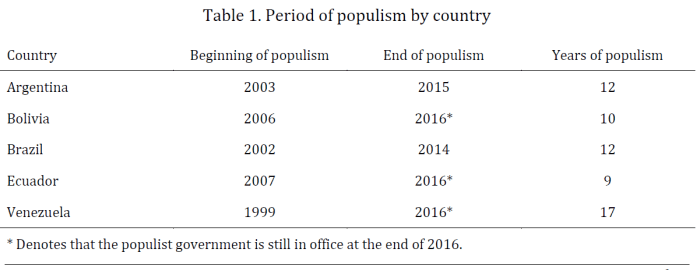
There are five cases of populist governments in Latin America that can work as benchmarks for the region. In particular, we can look at the behavior of governments in Argentina, Bolivia, Brazil, Ecuador, and Venezuela for the time frames depicted in the following table.

Table 1

During this time period, populist governments failed to increase GDP per capita consistently faster than the region. The only exception is Argentina. But its fast increase in GDP is largely explained as recovery after the 2001 crisis and by consuming capital stock, not as an expansion of potential output. It is no accident that Argentina met stagflation in 2007. In the last three issues of the Economic Freedom of the World (Fraser Institute) Argentina ranks among the bottom 10 free economies in the world.

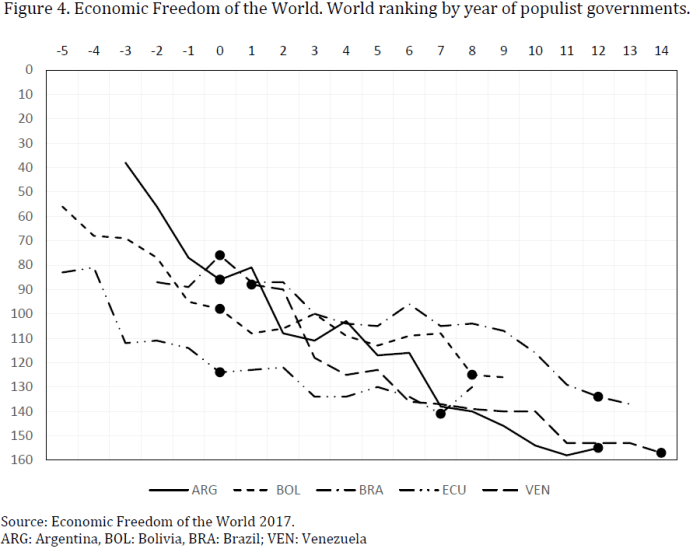
The following figure shows the fall in ranking of each country in the Economic Freedom of the World.

Figure 1

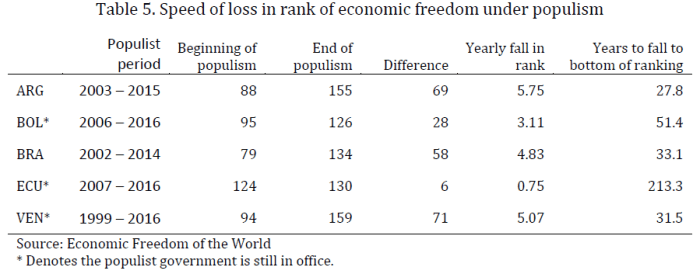
We can translate the information shown in the above into loss of ranking position per year of populist government. This is what is shown in the next table.

Table 2

This table offers a few readings:

  1. Argentina is the country that fall in the ranking of economic faster than its peers.
  2. Ecuador shows a very slow fall. This is due to two reasons: (1) Ecuador already starts from a low ranking position. (2) The last year of the index (2015) shows an improvement (without this improvement the fall is quite sharp as well.) Ecuador does not represent a case of “good populism.”

What this table is showing is that if an individual is born in any of these countries ranking 1st in economic freedom the same year a populist government takes office, then the same country will rank at the bottom of the world before he retires. In the case of Argentina, in 27.8 years the country will be at the bottom of the list, this means that by the time this individual starts to work, Argentina will already have a very repressed economy. By retiring time, this individual will have no experience of living and working in a free economy.

This numbers are not just descriptive of populism in Latin American countries. They also serve as a sort of warning for Europe and the United States, regions that have already seen some signs of populist behavior in their governments and political groups in the last few years. Populism can be emotionally attractive, but is very dangerous for our economic freedoms.