On doing economic history

I admit to being a happy man. While I am in general a smiling sort of fellow, I was delightfully giggling with joy upon hearing that another economic historian (and a fellow  Canadian from the LSE to boot), Dave Donaldson, won the John Bates Clark medal. I dare say that it was about time. Nonetheless I think it is time to talk to economists about how to do economic history (and why more should do it). Basically, I argue that the necessities of the trade require a longer period of maturation and a considerable amount of hard work. Yet, once the economic historian arrives at maturity, he produces long-lasting research which (in the words of Douglass North) uses history to bring theory to life.

Economic History is the Application of all Fields of Economics

Economics is a deductive science through which axiomatic statements about human behavior are derived. For example, stating that the demand curve is downward-sloping is an axiomatic statement. No economist ever needed to measure quantities and prices to say that if the price increases, all else being equal, the quantity will drop. As such, economic theory needs to be internally consistent (i.e. not argue that higher prices mean both smaller and greater quantities of goods consumed all else being equal).

However, the application of these axiomatic statements depends largely on the question asked. For example, I am currently doing work on the 19th century Canadian institution of seigneurial tenure. In that work, I  question the role that seigneurial tenure played in hindering economic development.  In the existing literature, the general argument is that the seigneurs (i.e. the landlords) hindered development by taxing (as per their legal rights) a large share of net agricultural output. This prevented the accumulation of savings which – in times of imperfect capital markets – were needed to finance investments in capital-intensive agriculture. That literature invoked one corpus of axiomatic statements that relate to capital theory. For my part, I argue that the system – because of a series of monopoly rights – was actually a monopsony system through the landlords restrained their demand for labor on the non-farm labor market and depressed wages. My argument invokes the corpus of axioms related to industrial organization and monopsony theory. Both explanations are internally consistent (there are no self-contradictions). Yet, one must be more relevant to the question of whether or not the institution hindered growth and one must square better with the observed facts.

And there is economic history properly done. It tries to answer which theory is relevant to the question asked. The purpose of economic history is thus to find which theories matter the most.

Take the case, again, of asymetric information. The seminal work of Akerlof on the market for lemons made a consistent theory, but subsequent waves of research (notably my favorite here by Eric Bond) have showed that the stylized predictions of this theory rarely materialize. Why? Because the theory of signaling suggests that individuals will find ways to invest in a “signal” to solve the problem. These are two competing theories (signaling versus asymetric information) and one seems to win over the other.  An economic historian tries to sort out what mattered to a particular event.

Now, take these last few paragraphs and drop the words “economic historians” and replace them by “economists”.  I believe that no economist would disagree with the definition of the tasks of the economist that I offered. So why would an economic historian be different? Everything that has happened is history and everything question with regards to it must be answered through sifting for the theories that is relevant to the event studied (under the constraint that the theory be consistent). Every economist is an economic historian.

As such, the economic historian/economist must use advanced tools related to econometrics: synthetic controls, instrumental variables, proper identification strategies, vector auto-regressions, cointegration, variance analysis and everything you can think of. He needs to do so in order to answer the question he tries to answer. The only difference with the economic historian is that he looks further back in the past.

The problem with this systematic approach is the efforts needed by practitioners.  There is a need to understand – intuitively – a wide body of literature on price theory, statistical theories and tools, accounting (for understanding national accounts) and political economy. This takes many years of training and I can take my case as an example. I force myself to read one scientific article that is outside my main fields of interest every week in order to create a mental repository of theoretical insights I can exploit. Since I entered university in 2006, I have been forcing myself to read theoretical books that were on the margin of my comfort zone. For example, University Economics by Allen and Alchian was one of my favorite discoveries as it introduced me to the UCLA approach to price theory. It changed my way of understanding firms and the decisions they made. Then reading some works on Keynesian theory (I will confess that I have never been able to finish the General Theory) which made me more respectful of some core insights of that body of literature. In the process of reading those, I created lists of theoretical key points like one would accumulate kitchen equipment.

This takes a lot of time, patience and modesty towards one’s accumulated stock of knowledge. But these theories never meant anything to me without any application to deeper questions. After all, debating about the theory of price stickiness without actually asking if it mattered is akin to debating with theologians about the gender of angels (I vote that they are angels and since these are fictitious, I don’t give a flying hoot’nanny). This is because I really buy in the claim made by Douglass North that theory is brought to life by history (and that history is explained by theory).

On the Practice of Economic History

So, how do we practice economic history? The first thing is to find questions that matter.  The second is to invest time in collecting inputs for production.

While accumulating theoretical insights, I also made lists of historical questions that were still debated.  Basically, I made lists of research questions since I was an undergraduate student (not kidding here) and I keep everything on the list until I have been satisfied by my answer and/or the subject has been convincingly resolved.

One of my criteria for selecting a question is that it must relate to an issue that is relevant to understanding why certain societies are where there are now. For example, I have been delving into the issue of the agricultural crisis in Canada during the early decades of the 19th century. Why? Because most historians attribute (wrongly in my opinion)  a key role to this crisis in the creation of the Canadian confederation, the migration of the French-Canadians to the United States and the politics of Canada until today. Another debate that I have been involved in relates to the Quiet Revolution in Québec (see my book here) which is argued to be a watershed moment in the history of the province. According to many, it marked a breaking point when Quebec caught up dramatically with the rest of  Canada (I disagreed and proposed that it actually slowed down a rapid convergence in the decade and a half that preceded it). I picked the question because the moment is central to all political narratives presently existing in Quebec and every politician ushers the words “Quiet Revolution” when given the chance.

In both cases, they mattered to understanding what Canada was and what it has become. I used theory to sort out what mattered and what did not matter. As such, I used theory to explain history and in the process I brought theory to life in a way that was relevant to readers (I hope).  The key point is to use theory and history together to bring both to life! That is the craft of the economic historian.

The other difficulty (on top of selecting questions and understanding theories that may be relevant) for the economic historian is the time-consuming nature of data collection. Economic historians are basically monks (and in my case, I have both the shape and the haircut of friar Tuck) who patiently collect and assemble new data for research. This is a high fixed cost of entering in the trade. In my case, I spent two years in a religious congregation (literally with religious officials) collecting prices, wages, piece rates, farm data to create a wide empirical portrait of the Canadian economy.  This was a long and arduous process.

However, thanks to the lists of questions I had assembled by reading theory and history, I saw the many steps of research I could generate by assembling data. Armed with some knowledge of what I could do, the data I collected told me of other questions that I could assemble. Once I had finish my data collection (18 months), I had assembled a roadmap of twenty-something papers in order to answer a wide array of questions on Canadian economic history: was there an agricultural crisis; were French-Canadians the inefficient farmers they were portrayed to be; why did the British tolerate catholic and French institutions when they conquered French Canada; did seigneurial tenure explain the poverty of French Canada; did the conquest of Canada matter to future growth; what was the role of free banking in stimulating growth in Canada etc.

It is necessary for the economic historian to collect a ton of data and assemble a large base of theoretical knowledge to guide the data towards relevant questions. For those reasons, the economic historian takes a longer time to mature. It simply takes more time. Yet, once the maturation is over (I feel that mine is far from being over to be honest), you get scholars like Joel Mokyr, Deirdre McCloskey, Robert Fogel, Douglass North, Barry Weingast, Sheilagh Ogilvie and Ronald Coase (yes, I consider Coase to be an economic historian but that is for another post) who are able to produce on a wide-ranging set of topics with great depth and understanding.

Conclusion

The craft of the economic historian is one that requires a long period of apprenticeship (there is an inside joke here, sorry about that). It requires heavy investment in theoretical understanding beyond the main field of interest that must be complemented with a diligent accumulation of potential research questions to guide the efforts at data collection. Yet, in the end, it generates research that is likely to resonate with the wider public and impact our understanding of theory. History brings theory to life indeed!
Immigration and Jobs – Reprise

A good op-ed in the March 24 issue of the Wall Street Journal by Mark Krikorian forces me to go back to one of my recent postings on immigration: “Immigration and Jobs.”

Krikorian is executive director of the Center for Immigration Studies in Washington D.C. Mr Krikorian accuses everyone in America of “not facing the facts” about current and recent immigration. He insists that some questions must be posed instead of skirted. I agree, of course, but I don’t know that it’s true that people are not facing the facts. I think instead that many busy and fair people are hearing contradictory statements and that they don’t have a good framework to think things through. Krikorian states that he rests his case on an authoritative study by the National Academies of Science, Engineering and Medicine. The academies are a respected source. I take it seriously if Krikorian reports accurately. (Be aware that I have not read the study in question.)

Krikorian’s most troubling assertion is as follows: All Americans benefit from immigrants being in the US. This benefit is entirely extracted from the higher wages Americans competing with immigrants would receive absent wage lowering immigrants’ competition. In other words: Americans who compete with immigrants receive lower wages than they should; everyone else benefits from these lower wages.

I think that’s obviously overstating the case. There must be at least one immigrant generating product (GDP) that would not otherwise exist in the American economy. Maybe, there are two. One is in Silicon Valley, inventing a product – like the personal computer forty years ago – that will eventually cause the employment of thousands, or millions. The second is in Kansas, saving from demolition a beat-down hotel that provides immediate employment for two-to–four minimum wage-earning maids. (Both entrepreneurs are Indians, obviously). In general, immigrants might benefit all by offering additional, or better, services than do the native born. I develop this thesis below.

Krikorian seems to be operating from a standpoint where the work pie to be shared by Americans and by immigrants is of a permanently fixed size. This erroneous perspective, in turn, may well come from a respectable desire to stick close to research findings. Research that also (also) takes into account immigrants’ contribution to increasing the size of the pie is doable but it’s more difficult to perform and to integrate with previous findings than research that relies on a static representation of reality.

Let me admit that I don’t have any numbers at my disposal and that any reasonably credible set of numbers could blow out of the water everything I am going to say below.

First, it’s obvious that there are currently many unfilled jobs in the US. Organized labor and anti-immigration spokespeople will argue that all those jobs would be filled if the wages offered were high enough. I am skeptical of this argument for two reasons. First, Silicon Valley employers affirm vigorously that they just don’t find enough would-be employees with the required skills, at any price. I tend to believe them to some extent because they evidently spend energy and resources raiding each other for expensive existing personnel. This kind of practice suggests true, absolute scarcity. I have mentioned in one of the companion essays the difficulty farmers encounter in recruiting pickers even when they offer wages significantly superior to both the minimum wage and to the going wage in my job-poor area. I would argue that their difficulties are rooted in the same problem facing Silicon Valley employers: a shortage of local competence. Picking strawberries, for example, is not easy at all. And it requires a certain attitude, or fortitude, that is not common anymore among Americans, as I have argued elsewhere.

Second, presented below, a forbidden argument. But I must make a disclosure before I move to it: I am one of the 43 million foreign-born people now living in the US. I studied in the US and I was permanently admitted on a variant of a B1 visa. I had a main career as a university professor. I don’t believe that an extra teaching position was ever added in any university to accommodate me. (It happens for some foreigners, a very few, of star quality, like Einstein; I wasn’t one of them, let’s face it.) Of course, to obtain any university position, I had to possess the same credentials as native-born Americans who also wanted the position. (That’s right, there is no affirmative action track for white Europeans!) Good university positions are surprisingly competitive to obtain; earning tenure is even more competitive. Every position I obtained, I got from winning against similarly situated native-born.

Each time, I won the gold, if you will. This simple fact would seem to suggest that I was at least slightly better in conventional terms than those native-born who did not get the position. This fact implies at minimum that had I not competed for the position my students would have been served at best by a silver medalist. (I choose the Olympics language on purpose, from a surfeit of honesty. It’s not absurd to argue that the quality difference between the gold and the silver winners is insignificant or even accidental: On a different day, with a different wind, perhaps, the silver winner would have won the gold. But there is more.)

Like many but not all immigrants, I grew up in a language different from English, French in my case. So. I had to achieve the same credentials as my competitors in what was for me a second language. Forgive me for seeming to brag but doesn’t this indicate an intellectual competence over and above what the formal credentials express? If you doubt this shameless assertion, ask yourself how many native-born Americans are able to teach anything – besides the English language – in any francophone university anywhere. And I am not an extreme case of talent among immigrants to the US. I know a man, a distinguished biological scientist, who grew up in the African language Wolof, went to secondary school in French, to college and graduate school in English. Would you guess he possesses a certain mental nimbleness uncommon among determined monolinguals?

I will reluctantly take another step. I do it reluctantly because it is sure to lose me some friends. I will use my own case as an immigrant for an example because it’s the case I know best. It’s about the cultural endowment we carry around over and above, or aside from mastery of a foreign language.

Let me say right away that I don’t contend that I enjoy a 100% understanding of American culture, even after fifty years. I don’t understand the rules of baseball, for example. I never bothered to learn because the game seems boring. Yet, I must be conversant with a lot of national culture, just for having acquired my professional credentials and, even more so, for navigating everyday life in my society of adoption. The point is that the acquisition of another culture does not entail a one-for-one exchange, like changing clothes, for example. Much, most of what the immigrant brings with him, he retains, as one might easily assume. When I was learning American culture, I was not leaving French culture behind with the hat-check girl.

The first thing that immigrants, those who immigrate as adults, keep is mastery of their native language. This may sound mysterious to a monolingual person. It’s true that one can become “rusty” in a language one does not use. The quality of self-expression, for example, may deteriorate over time spent abroad. Yet, it’s very unlikely that an immigrant will lose the ability to watch the news in his native language, or to read a newspaper. So, I follow the news in English, of course, but also in French, some of the time. The reporting of the same events do not overlap perfectly, far from it. So, I am learning things I probably would not learn if I knew no French. (That’s in addition to carrying in my head much disorderly information from my society of origin. More below.) In my job as a teacher and as a scholar, I was routinely able to draw on broader information than did my native-born colleagues. I wouldn’t say (although I am tempted) that I had twice as large a store of information at my fingertips as they did but that I had definitely more than they.

So, in fact, I am arguing – with little embarrassment – that I must have been a better teacher and scholar than most (not all) of my native-born colleagues with similar credentials by virtue of being an immigrant.* There may be no metrics allowing an assessment of this outrageous claim. That’s because what college professors actually do is so mysterious. (Another story.)

It’s also true that to measure accurately the added work value of immigrants you have to find a way to factor in laziness, which varies much among individuals. In my case, I suspect strongly that if I had been native born, I could not have had the normal academic career I enjoyed, given my above-average level of laziness. In other words, the informational advantage associated with being a bilingual immigrant may have paid the fare for my laziness. Had I been the same person, with the same formal credentials, except less lazy, however, my presence would have much benefited American society. This detour supports my main argument of course: It does not make much sense to deny that competent bilingualism adds to normally credentialed efficacy. This is true in an occupation such as university teaching. It’s true though possibly to a lesser extent, for a plumber who will, at least, be a better citizen than a comparably situated monolingual. This is all common sense. No hard data are needed to give this scenario credence although hard figures might destroy it.

It should be fairly clear that a second language is like another tool in one’s personal toolbox. Immigrants have yet more, other additional tools that may be more elusive, more difficult to describe. I am giving it a try. All of us approach new situations through a filter that is made up partly of our past experiences, through the colander of past experiences if you will. Many of the experiences that compose the sifting device are repetitive, partly superfluous: The tenth car accident you witness does not have the same power to influence your driving as the first. There is often an excess of material in the sifter. This means that whatever the sifting process accomplishes would be accomplished as well, or nearly as well, on the basis of fewer past experiences.

My experiences in my society of origin do not perfectly duplicate those of a similarly situated native-born American. For example, I lived through a school system that was much more authoritarian than he experienced. I take from this the strong impression that my experiences in my society of origin adds to my experiences in my society of choice to give me a better sifter than what exists among the native-born population. It does this in a non-repetitive way (unlike, say, the 9th car accident.) I don’t mean that I have twice as large a sifter as they do but perhaps that I have 125% of what they carry in their heads.

This second extra tool in my tool box is factually associated with the first, bilingualism, but it’s not the same thing. An Australian, with a perfect command of English and perfectly innocent of knowledge of another language would carry the same extra tool as I do. The advantage gained through this second tool is difficult to express. It’s tacit. (I have never read anything about the topic.) I believe that my experience of another society – again, independently of bilingualism – acts like a second pair of glasses. I think I am able to watch events and people from one perspective, and then, to some extent, from a second perspective. I suspect it does not give me extra-depth but an edge in exercising common criticality. Possibly, it acts like a few IQ points that would be added to my measured IQ. Again, this thesis is very exploratory, supported by no real numbers. I must add that this second tool associated with being an immigrant is free from the effects of education. I think I have observed the expected extra resourcefulness among Mexican immigrants I knew to be semi-literate (in Spanish) performing ordinary manual jobs, in construction and in repair work, for example.

In conclusion: I and hundreds of other immigrants I have observed contribute to the society in which we live over and above the contributions of the native-born. Thus, we add to the general well-being even if we are paid exactly the same as the native-born.

The above is a short string of arguments in favor of immigration. None of it is a call for open borders. I subscribe to the lifeboat view of immigration. Too numerous immigrants could easily sink the boat that made them swim to developed societies in the first place. (According to retired foreign service officer Dave Seminara’s review of relevant studies – that I have not read – 150 million people world wide would like to move to the US, including 34% of Mexicans.) In addition, there are non-economic arguments against large-scale immigration that I support although they may be even more difficult to describe than what I tried to explain above. My analysis supports instead an active stance to design immigration policies that make rigorously the conceptual distinction between immigrants we need and immigrants in need. This distinction is not inimical to any refugee policy whatsoever; perhaps, the reverse is true.


* Please, don’t try to factor in a putative superior European education brought to the job of being an American academic as an alternative explanation. I am a French high school dropout.

The Protestant Reformation and freedom of conscience

This year we celebrate 500 years of the Protestant Reformation. On October 31, 1517, the then Augustinian monk, priest, and teacher Martin Luther nailed at the door of a church in Wittenberg, Germany, a document with 95 theses on salvation, that is, basically the way people are led by the Christian God to Heaven. Luther was scandalized by the sale of indulgences by the Roman Catholic Church, believing that this practice did not correspond to the biblical teaching. Luther understood that salvation was given only by faith. The Catholic Church understood that salvation was a combination of faith and works.

The practice of nailing a document at the door of the church was not uncommon, and Luther’s intention was to hold an academic debate on the subject. However, Luther’s ideas found many sympathizers and a wide-spread protestant movement within the Roman Catholic Church was quickly initiated. Over the years, other leaders such as Ulrich Zwingli and John Calvin joined Luther. However, the main leaders of the Roman Catholic Church did not agree with the Reformers’ point of view, and so the Christian church in the West was divided into several groups: Lutherans, Anglicans, Reformed, Anabaptists, later followed by Methodists, Pentecostals and many others. In short, the Christian church in the West has never been the same.

The Protestant Reformation was obviously a movement of great importance in world religious history. I also believe that few would disagree with its importance in the broader context of history, especially Western history. To mention just one example, Max Weber’s thesis that Protestantism (especially Calvinism, and more precisely Puritanism) was a key factor in the development of what he called modern capitalism is very accepted, or at least enthusiastically debated. But I would like to briefly address here another impact of the Protestant Reformation on world history: the development of freedom of conscience.

Simply put, but I believe that not oversimplifying, after the fall of the Roman Empire and until the 16th century, Europe knew only one religion – Christianity – in only one variety – Roman Catholic Christianity. It is true that much of the paganism of the barbarians survived through the centuries, that Muslims occupied parts of Europe (mainly the Iberian Peninsula) and that other varieties of Christianity were practiced in parts of Europe (mainly Russia and Greece). But besides that, the history of Christianity was a tale of an ever-increasing concentration of political and ecclesiastical power in Rome, as well as an ever-widening intersection of priests, bishops, kings, and nobles. In short, Rome became increasingly central and the distinction between church and state increasingly difficult to observe in practice. One of the legacies of the Protestant Reformation was precisely the debate about the relationship between church and state. With a multiplicity of churches and strengthening nationalisms, the model of a unified Christianity was never possible again.

Of course, this loss of unity in Christendom can cause melancholy and nostalgia among some, especially Roman Catholics. But one of its gains was the growth of the individual’s space in the world. This was not a sudden process, but slowly but surely it became clear that religious convictions could no longer be imposed on individuals. Especially in England, where the Anglican Church stood midway between Rome and Wittenberg (or Rome and Geneva), many groups emerged on the margins of the state church: Presbyterians, Baptists, Congregationalists, Quakers, and so on. These groups accepted the challenge of being treated as second-class citizens, but maintaining their personal convictions. Something similar can be said about Roman Catholics in England, who began to live on the fringes of society. The new relationship between church and state in England was a point of discussion for many of the most important political philosophers of modernity: Thomas Hobbes, John Locke, Edmund Burke, and others. To disregard this aspect is to lose sight of one of the most important points of the debate in which these thinkers were involved.

The Westminster Confession of Faith, one of the most important documents produced in the period of the Protestant Reformation, has a chapter entitled “Of Christian Liberty, and Liberty of Conscience.” Of course there are issues in this chapter that may sound very strange to those who are not Christians or who are not involved in Christian churches. However, one point is immediately understandable to all: being a Christian is a matter of intimate forum. No one can be compelled to be a Christian. At best this obligation would produce only external adhesion. Intimate adherence could never be satisfactorily verified.

Sometime after the classical Reformation period, a new renewal religious movement occurred in England with the birth of Methodism. But its leading leaders, John Wesley and George Whitefield, disagreed about salvation in a way not so different from what had previously occurred between Luther and the Roman Catholic Church. However, this time there was no excommunication, inquisition or wars. Wesley simply told Whitefield, “Let’s agree to disagree.”

Agreeing to disagree is one of the great legacies of the Protestant Reformation. May we always try to convince each other by force of argument, not by force of arms. And that each one has the right to decide for themselves, with freedom of conscience, which seems the best way forward.

Ending supply management would not cost $30b

In Canada, the debates over supply management – the system of production quotas and import duties limiting the supply of dairy and poultry products – has intensified in recent years.  For ten years now (literally), I have been writing, testifying and researching this insane system which moves the supply curve leftwards (even if some try to deny it in some non-nonsensical arguments stating that prices would be higher if the supply increased).

One of the groups that has been spewing non-sense is, obviously, the dairy farmers union. In one of their often-made claim, which some politicians are taking up, is that ending the policy would cost $30 billions.

That is incorrect, widely off the mark and not properly contextualized.

First of all, the number relates to the market value of the quotas (see here). Many farmers bought the quotas many years ago at a much lower price and as such, compensation would be slightly below the $30 billions. More importantly, most quotas are acquired through mortgages by farmers. These mortgages represent a value of $30 billions (capital and interest). However, farmers are riskier borrowers than governments. If the government bought back all the mortgages, it would actually become the borrower (it would hold the liability). However, since the Canadian government is at a lesser risk of insolvency than farmers, it can easily renegotiate with banks for a haircut. In fact, banks would easily accept this. They know that the government won’t default on this which means the risks on their balance sheets have just dropped dramatically and they now hold a much safer asset. I guess that they would be willing to negotiate a form of haircut on the assets that would be somewhere between the new (risk-adjusted) value and the old value.

Secondly, who the hell said the quotas needed to be bought back in one shot? Farmers could be offered a choice between many options. First, there would be the option buy-back plan that gives them 50% (in government t-bills) of the value of the share of the mortgage that they paid. The second would be a higher percentage spread out over many years. The third could be over 100% of the value of the permit in tax credits. Basically, if a farmer has paid $200,000 of a $1,000,000 mortgage, the government would commit to pay the difference to the creditor institution and offer more than $200,000 in tax breaks to farmers and their families. For example, a farmer with a tax liability of 25,000$ every year would end up paying no taxes for 10 years (as such, he would 125% of the value of his quota). As such, the cost is spread over 10 years making this a $3 billion expense annually.

And what about the context? Well, according to the famous article (recently published) on the burden of supply management, the cost in higher prices is equal to 0.84% of household income. In short, this means 0.84% of the Canadian economy or $17.3 billion a year or $173 billion over 10 years. Now, this is annually – the savings are recurrent – and the estimates does not account for the fact that productivity gains might finally allow Canadian farms to benefit from the international increase in demand. So, the $173 billion figure is pretty conservative and yet, the inaccurate $30 billion figure accounts only for roughly 17.3% of the benefits. In terms of return on investments, I am pretty sure this qualifies as a great move through which you would not even need to go down the Australian route (imposing a transitory tax for ten years).

I am sorry, but there is no way that the cost of the buyback should be considered a deterrent especially if a buyback plan is spread out over many years.

Auftragstaktik: Decentralization in military command

Many 20th century theorists who advocated central planning and control (from Gaetano Mosca to Carl Landauer, and hearkening back to Plato’s Republic) drew a direct analogy between economic control and military command, envisioning a perfectly functioning state in which the citizens mimic the hard work and obedience of soldiers. This analogy did not remain theoretical: the regimes of Mussolini, Hitler, and Lenin all attempted to model economies along military principles. [Note: this is related to William James’ persuasion tactic of “The Moral Equivalent of War” that many leaders have since used to garner public support for their use of government intervention in economic crises from Great Depression to the energy crisis to the 2012 State of the Union, though one matches the organizing methods of war to central planning and the other matches the moral commitment of war to intervention, but I digress.] The underlying argument of the “central economic planning along military principles” was that the actions of citizens would be more efficient and harmonious under direction of a scientific, educated hierarchy with highly centralized decision-making than if they were allowed to do whatever they wanted. Wouldn’t an army, if it did not have rigid hierarchies, discipline, and central decision-making, these theorists argued, completely fall apart and be unable to function coherently? Do we want our economy to be the peacetime equivalent of an undisciplined throng (I’m looking at you, Zulus at Rorke’s Drift) while our enemies gain organizational superiority (the Brits had at Rorke’s Drift)? While economists would probably point out the many problems with the analogy (different sets of goals of the two systems, the principled benefits of individual liberty, etc.), I would like to put these valid concerns aside for a moment and take the question at face value. Do military principles support the idea that individual decision-making is inferior to central control? Historical evidence from Alexander the Great to the US Marine Corps suggests a major counter to this assertion, in the form of Auftragstaktik.

Auftragstaktik

Auftragstaktik was developed as a military doctrine by the Prussians following their losses to Napoleon, when they realized they needed a systematic way to overcome brilliant commanders. The idea that developed, the brainchild of Helmuth von Moltke, was that the traditional use of strict military hierarchy and central strategic control may not be as effective as giving only the general mission-based, strategic goals that truly necessitated central involvement to well-trained officers who were operating on the front, who would then have the flexibility and independence to make tactical decisions without consulting central commanders (or paperwork). Auftragstaktik largely lay dormant during World War I, but literally burst onto the scene as the method of command that allowed (along with the integration of infantry with tanks and other military technology) the swift success of the German blitzkrieg in World War II. This showed a stark difference in outcome between German and Allied command strategies, with the French expecting a defensive war and the Brits adhering faithfully and destructively to the centralized model. The Americans, when they saw that most bold tactical maneuvers happened without or even against orders, and that the commanders other than Patton generally met with slow progress, adopted the Auftragstaktik model. [Notably, this also allowed the Germans greater adaptiveness and ability when their generals died–should I make a bad analogy to Schumpeter’s creative destruction?] These methods may not even seem foreign to modern soldiers or veterans, as it is still actively promoted by the US Marine Corps.

All of this is well known to modern military historians and leaders: John Nelson makes an excellent case for its ongoing utility, and the excellent suggestion has also been made that its principles of decentralization, adaptability, independence, and lack of paperwork would probably be useful in reforming non-military bureaucracy. It has already been used and advocated in business, and its allowance for creativity, innovation, and reactiveness to ongoing complications gives new companies an advantage over ossified and bureaucratic ones (I am reminded of the last chapter of Parkinson’s Law, which roughly states that once an organization has purpose-built rather than adapted buildings it has become useless). However, I want to throw in my two cents by examining pre-Prussian applications of Auftragstaktik, in part to show that the advantages of decentralization are not limited to certain contexts, and in part because they give valuable insight into the impact of social structures on military ability and vice versa.

Historical Examples

Alexander the Great: Alexander was not just given exemplary training by his father, he also inherited an impressive military machine. The Macedonians had been honed by the conquest of neighboring Illyria, Thrace, and Paeonia, and the addition of Thessalian cavalry and Greek allies in the Sacred Wars. However, as a UNC ancient historian found, the most notable innovations of the Macedonians were their new siege technologies (which allowed a swifter war–one could say, a blitzkrieg–compared to earlier invasions of Persia) and their officer corps. This officer corps, made up of the king’s “companions,” was well trained in combined-arms hoplite and cavalry maneuvers, and during multiple portions of his campaign (especially in Anatolia and Bactria) operated as leaders of independent units that could cover a great deal more territory than one army. In set battles, the Macedonians showed a high degree of maneuverability, with oblique advances, effective use of reserves, and well-timed cavalry strikes into gaps in enemy formations, all of which depended on the delegation of tactical decision-making. This contrasted with the Persians, who followed standards into battle without organized ranks and files, and the Greek hoplites, whose phalanx depended mostly on cohesion and group action and therefore lacked flexibility. [Also, fun fact, the Macedonians had the only army in recorded history in which bodies of troops were identified systematically by the name of their leader. This promoted camaraderie and likely indicates that, long-term, the soldiers became used to the tactical independence and decision-making of that individual. Imagine dozens of Rogers’ Rangers.]

The Roman legion: As with any great empire, the Macedonians spread through their military innovations, but then ossified in technique over the next 150 years. When the Romans first faced a major Hellenistic general, Pyrrhus, they had already developed the principles of the system that would defeat the Macedonian army: the legion. In the early Roman legion, two centuries were combined into a maniple, and maniples were grouped into cohorts, allowing for detachment and independent command of differing group sizes. Crucially, centurions maintained discipline and the flexible but coordinated Roman formations, and military tribunes were given tactical control of groups both during and between battles. The flexibility of the Roman maniples was shown at the Battle of Cynoscephalae, in which the Macedonian phalanx–which had frontal superiority through its use of the sarissa and cohesion but little maneuverability–became disorganized on rough ground and was cut to pieces on one flank by the more mobile and individually capable Roman legionaries, This (as well as many battles in the Macedonian and Syrian Wars proved) showed the value of flexibility and individual action in a disciplined force, but where was the Auftragstaktik? At Cynoscephalae, after defeating one flank, the Romans on that flank dispersed to loot the Macedonian camp. In antiquity, this generally resulted in those troops becoming ineffective as a fighting force, and many a battle was lost because of pre-emptive looting. However, in this case, an unnamed tribune–to whom the duty of tactical decisions had been delegated–reorganized these looters and brought them to attack the rear of the other Macedonian flank, which had been winning. This resulted in a crushing victory and contributed to he Roman conquest of Greece. Decentralized control was also a hallmark of Julius Caesar himself, who frequently sent several cohorts on independent campaigns in Gaul under subordinates such as Titus Labienus, allowing him to conquer the much more numerous Gauls through local superiority, lack of Gallic unity, and organization. Also, at the climactic Battle of Alesia, Caesar used small, mobile reserve units with a great deal of tactical independence to hold over 20 km of wooden walls against a huge besieging force.

The Vikings: I do not mean to generalize about Vikings (who could be of many nations–the term just means “raider”) when they do not have a united culture, but in their very diversity of method and origin, they demonstrate the effectiveness of individualism and decentralization. Despite being organized mostly based on ship-crews led by jarls, with central leadership only when won by force or chosen by necessity, Scandinavian longboatmen and warriors exerted their power from Svalbard to Constantinople to Sicily to Iceland and North America from the 8th to 12th centuries. The social organization of Scandinavia may have been the most free (in terms of individual will to do whatever one wants–including, unfortunately, slaughter, but also some surprisingly progressive women’s rights to decisions) in recorded history, and this was on display in the famous invasion of the Great Heathen Army. With as few as 3,500 farmer-raiders and 100 longboats to start, the legendary sons of Ragnar Lothbrok and the Danish invaders, with jarls as the major decision-makers of both strategic and tactical matters for their crews, won a series of impressive battles over 20 years (described in fascinating, if historical-fiction, detail in the wonderful book series and now TV series The Last Kingdom), almost never matching the number of combatants of their opponents, and took over half of England. The terror and military might associated with the Vikings in the memories of Western historians is a product of the completely decentralized, nearly anarchic methods of Scandinavian raiders.

The Mongols: You should be sensing a trend here: cultures that fostered lifelong training and discipline (and expertise in siege engineering, which seems to have correlated with the tactics I describe, as the Macedonians, Romans, and Mongols were each the most advanced siege engineers of their respective eras) tended to have more trust in well-trained subordinates. This brought them great military success and also makes them excellent examples of proto-Auftragstaktik. The Mongols not only had similar mission-oriented commands and tactical independence, but they also had two other aspects of their military that made them highly effective over an enormous territory: their favored style of horse-archer skirmishing gave natural flexibility and their clan organization allowed for many independently-operating forces stretching from Poland to Egypt to Manchuria. The Mongols, like the Romans, demonstrate how a force can have training/discipline without sacrificing the advantages based on tactical independence, and the two should never be mixed up!

The Americans in the French and Indian War and the Revolutionary War: Though this is certainly a more limited example, there were several units that performed far better than others among the Continentals. The aforementioned Rogers’ Rangers operated as a semi-autonomous attachment to regular forces during the French and Indian War, and were known for their mobility, individual experience and ability, and tactical independence in long-range, mission-oriented reconnaissance and ambushes. This use of savvy, experienced woodsman in a semi-autonomous role was so effective that the ranger corps was expanded, and similar tactical independence, decentralized command, and maneuverability were championed by the Green Mountain Boys, the heroes of Ticonderoga. Morgan’s Rifles used similar experience and semi-autonomous flexibility to help win the crucial battles of Saratoga and Cowpens, which allowed the nascent Continental resistance to survive and thrive in the North outside of coastal cities and to capture much of the South, respectively. The forces of Francis Marion also used proto-guerrilla tactics with decentralized command and outperformed the regulars of Horatio Gates. Given the string of unsuccessful set-piece battles fought by General Washington and his more conventional subordinates, the Continentals depended on irregulars and unconventional warfare to survive and gain victories outside of major ports. These victories (especially Saratoga and Cowpens) cut off the British from the interior and forced the British into stationary posts in a few cities–notably Yorktown–where Washington and the French could siege them into submission. This may be comparable to the Spanish and Portuguese in the Peninsular War, but I know less about their organization, so I will leave the connection between Auftragstaktik and early guerrilla warfare to a better informed commenter.

These examples hopefully bolster the empirical support for the idea that military success has often been based, at least in part, on radically decentralizing tactical control, and trusting individual, front-line commanders to make mission-oriented decisions more effectively than a bureaucracy could. There are certainly many more, and feel free to suggest examples in the comments, but these are my favorites and probably the most influential. This evidence should cause a health skepticism toward argument for central control on the basis of the efficiency or effectiveness demonstrated in military central planning. Given the development of new military technologies and methods of campaign (especially guerilla and “lone wolf” attacks, which show a great deal of decentralized decision-making) and the increasing tendency since 2008 to revert toward ideas of central economic planning, we are likely to get a lot of new evidence about both sides of this fascinating analogy.

How dairy farmers unions in Canada are distorting the facts about supply management

Under heat recently as President Trump has criticized supply management in Canada and retaliated against it, the different provincial associations representing dairy farmers have moved on the offensive. To promote the virtues of this system meant to reduce production in order to prop up prices through the use of trade tariffs, production quotas and price controls (how can we call those virtues), these unions have produced numerous infographics to make their case. It is even part of what they dub their These-infographics-show-that-diary-prices-are-lower-in-Canada-than-elsewhere, that milk is still a cheap drink relative to other type of drinks and those prices, supposedly, increase more slowly than elsewhere. All of these graphics are dishonest and must be dismantled.

The most egregious of these infographics – present in the “lobby day kit” – shows the price of milk in Australia (1.55 CAD), Canada (1.45 CAD) and New Zealand (1.65 CAD). They are seemingly using 2014 prices. First of all, they use data that conflicts massively with the reports of Statistics Canada that suggest that milk prices hover between 2.33$ to 2.48$ per liter.  Their data is provided by AC Nielsen but no justification is presented as to why they are better than Statistics Canada. The truth is that it is not better. Participants in Nielsen surveys come from a self-selected pool of storeowners who wish to participate and are then selected by Nielsen to be part of the data collection. Then, they can record prices. It should be mentioned that not all regions of Canada are covered in the data. Although the Nielsen data does have some uses (especially with regards to market studies), it hardly measures up Statistics Canada when comes the time to evaluate price levels. This is because the government agency collects information from all regions and tries a broader sweep of retailers in order to create the consumer price index.

But an even larger problem is that, in their comparison of prices, they don’t mention that New Zealand taxes milk. In New Zealand, all food items are subjected to sales tax, which is not the case in Canada and Australia. Hence, when they compare retail prices, they are comparing prices that exclude taxes and prices that include taxes. One would like to find if they acknowledge this fact in the methodological mentions, but there are none!

Using prices available at Numbeo.com and Expatisan.com and the exchange rates made available by the Bank of Canada, we can correct for this problem of theirs. Simply changing prices source leads to a massively different result with regards to Australia whose milk prices are lower than in Canada. Secondly, once we adjust for the sales tax in New Zealand, we find that prices in New Zealand are lower than in Canada. In fact they are lower than in one of Canada’s cheapest market, Montreal (let alone Toronto or Vancouver).  So the infographic they show in order to lobby governments is a fabrication.

Table 1: The real price of milk

Using Numbeo.com (regular milk)
Unadjusted Adjusted for taxes
 Australia  $           1.59  $                 1.59
 New Zealand  $           2.26  $                 1.97
 Canada  $           1.99  $                 1.99
 Using Expatisan.com (whole milk)
 Unadjusted  Adjusted for taxes
 Sydney  $           1.82  $                 1.47
 Wellington  $           2.42  $                 2.10
 Montreal  $           2.87  $                 2.87

Source: Numbeo.com and Expatisan.com, consulted May 16th 2014 and the Bank of Canada’s currency converter. Note: using the Statistics Canada price would make Canada’s situation even worse by comparison.

This is part of a pattern of deceit since they also massage data for numerous other graphs that are presented to Canadians in efforts to convince them of the virtues of supply management. One other example is an infographic that presents a figure of nominal milk prices in Australia before and after the abolition of supply management. Given that prices seem more volatile after 2000 and that they increase more steeply, they try to make us believe that liberalization was a failure. This is not the case. Any sensible policy analyst would deflate nominal prices by the general price index to control for inflation. When one does just that using the data from the Australian Bureau of Statistics, one sees that real prices stabilized in the first ten years of deregulation after increasing roughly 15% in the decade prior. And since 2010, real prices have been falling constantly.

Other examples abound. In one instance, the Quebec union of dairy farmers circulated an infographic meant to show that nominal prices for dairy products increased faster in the United States than in Canada. Again, they omit inflation. Since 1990 (their own starting date), prices of dairy products have risen more slowly than inflation – indicating a decline in real prices. In Canada, the opposite occurred – inflation increased more slowly than dairy prices indicating an increase of the real price.

The debate around supply management is complicated. The policy course to adopt in order to improve agricultural productivity and lower prices for Canadians is hard to pinpoint. But whatever position one may hold, no one is well-served by statistical manipulations offered by the unions representing dairy farmers.

Minimum wages: The economist as a psychologist

Both Ludwig von Mises and F.A. Hayek are known for arguing that there is no such thing as a good economist who is only an economist. For these two thinkers, a good economist-as-scientist also needs to know history, philosophy of science, ethics, and physics. Mises and Hayek are thinking of what an economist-as-scientist should be familiar with and have some minimum knowledge beyond his discipline.

I would add that the economist as public educator, that is, when the economist talks as an economist to non-economists, also needs some awareness of psychology. I may not be using the term “psychology” in the most proper way, but I mean the awareness to understand what the interlocutor feels and needs and then figure out how to communicate economic insights in a way that will not be automatically (emotionally or psychologically) rejected; how to make someone accept an economics outcome they do not want to be true. How to break the bad news with empathy? This is a challenge I try to get my students to understand as one day they, too, will be economists out of the classroom in the real world.

A few days ago I found myself unexpectedly in the “psychologist” position. Only seconds after meeting for the first time two persons dropped the question: “So, what do you think about increasing the minimum wages, should we do it?” I knew nothing about these two individuals, and the only thing they knew about me was that I’m an economics professor. The answer to such a question is an Econ 101 problem: if you increase the minimum wage (above the equilibrium price) some lucky workers will get a wage increase at the expense of other ones loosing their jobs.

The first question I asked myself was “what do these two nice ladies actually want, the analytical/scientific answer, or do they want instead the ‘professor’ to confirm their bias?” This might be a delicate discussion since they may well have a loved one in the minimum wage market.

The first thing to get out of the way is that my answer as an economist is not ideologically driven or does not respond to secret political agendas. How can that be made clear? One way is to show the economics profession’s consensus on the subject from an impersonal position. I explained to them that any economics textbook from any author from any country in the world used in any university would say the same thing: “If you put the price of labor above its equilibrium (a minimum wage), it will produce a disequilibrium (unemployment). You cannot fix the price outside equilibrium and at the same time remain in equilibrium.” Yes, as Ben Powell reminds us, even Paul Krugman agrees on this. By mentioning a worldwide consensus there is no room for ideological or political agendas. It is important to mention that economics is not always about politics. The economic analysis of minimum wages has nothing to do with being a Democrat or a Republican; the political position of each party may differ, but those are not economic analyses, those are political strategies.

The next step was to deal with the issue that if such a consensus exists, why are there mentions of studies showing no harmful effects of increases in minimum wages. This is no mystery either. A well known reason of why an increase in minimum wages does not increase unemployment is because in fact there is no such increase. The politician may say he is increasing the minimum wage, but he does not say that the minimum wage is being located just above the equilibrium level and therefore he is not doing much. Another reason is to look at the effect of a minimum wage increase in a small location where low skilled workers can get another job in the next town without the need to move and therefore they will not show up as unemployed. This is another case of an ineffective increase in minimum wages. Or maybe the minimum wage increases but a benefit goes down. The total compensation to the employee does not change, its composition does.

But can the economist show his claim? Is there more clear evidence that the effects of increasing minimum wages does do harm than the complicated cases where there are no harmful effects? Again, I went geographically large. First, I compared the U.S. with Europe, which has higher minimum wages with respect to the U.S. In Europe you find higher unemployment rates, higher unemployment in the youth population, and also higher long-term unemployment. Second, I brought the case of the U.S. Fair Labor Standard Act of 1938, which fixed the minimum wage at 25 cents per hour. This law included Puerto Rico where the many workers were earning between 3 to 4 cents. Bankruptcies and unemployment skyrocketed. It was in fact unions who asked Congress to make an exception for Puerto Rico, which took two years to consider. For two years people in Puerto Rico were forced to work in the black market or fail to make a minimum income. Want more cases? See here. “See,” the psychologist says, “minimum wages are very dangerous; you can seriously harm yourself. Is that a bet you really want to make?”

Two issues remain to be explained after dealing with these three problems, (1) objection to minimum wage increases is not (necessary) an ideological or political position, (2) studies that deny the effect are doubtful for easy reasons to understand, and (3) if you look at a sample broad enough the economist’s prediction is right there.

First, when an economist objects to an increase in minimum wages it does not mean we do not want wages to go up. We are just saying that a minimum wage increase is not the right way to do it. I wish it were so easy, but the laws of demand and supply inform otherwise. I guess most economists would advocate for minimum wages if their negative effects were not real. Second, explain Milton Friedman’s lesson that a policy is valued by its results, not by its intentions. The economist objects because of the unintended effects of fixing the price of labor outside equilibrium, not because we wouldn’t like to see real wages increasing.

On Evonomics, Spelling and Basic Economic Concepts

I am a big fan of exploring economic ideas into greater depth rather than remaining on the surface of knowledge that I accumulated through my studies. As such, I am always happy when I see people trying to promote “alternatives” within the field of economics (e.g. neuroeconomics, behavioral economics, economic history, evolutionary economics, feminist economics etc.). I do not always agree, but it is enjoyable to think about some of the core tenets of the field through the work of places like the Institute for New Economic Thinking. However, things like Evonomics do not qualify for this.

And this is in spite of the fact that the core motivation of the webzine is correct: there are problems with the way we do economics today (on average). However, discomfort towards the existing state of affairs is no excuse for shoddy work and holding up strawmen that can be burned at the stake followed by a vindictive celebratory dance. The most common feature of those who write for Evonomics is to hold such a strawman with regards to rationality. It presents a caricature where humans calculate everything with precision and argue that if, post-facto, all turns out well then it was a rational process. No one, I mean no one, believes that. The most succinct summary  of rationality according to economists is presented by Vernon Smith in his Rationality in Economics: Constructivist and Ecological Forms. 

Such practices have led me to discount much of what is said on Evonomics and it is close to the threshold where the time costs of sorting the wheat from the chaff outweighs the intellectual benefits.

This recent article on “Dierdre” McCloskey may have pushed it over that threshold. I say “Dierdre” because the author of the article could not even be bothered to write correctly the name of the person he is criticizing. Indeed, it is “Deirdre” McCloskey and not “Dierdre”. While, ethymologically, Dierdre is a variant of Deirdre from the Celtic legend that shares similarities to Tristan and Isolde, the latter form is more frequent. More importantly, Dierdre is name more familiar to players of Guild Wars. 

A minor irritant which, unfortunately, compounds my poor view of the webzine. But then, the author of the article in question goes into full strawman mode. He singles out a passage from McCloskey regarding the effects of redistributing income from the top to the bottom. In that passage, McCloskey merely points out that the effects of equalizing incomes would be minimal.  The author’s reply? Focus on wealth and accuse McCloskey of shoddy mathematics.

Now, this is just poor understanding of basic economic concepts and it matters to the author’s whole point. Income is a flux variable and wealth is a stock variable. The two things are thus dramatically different. True, the flux can help build up the stock, but the people with the top incomes (flux) are not necessarily those with the top wealths (stock). For example, most students have negative net worth (negative stock) when they graduate. However, thanks to their human capital (Bryan Caplan would say signal here), they have higher earnings. Thus, they’re closer to the top of the income distribution and closer to the very bottom of the wealth distribution.  My grandpa is the actual reverse. Before he passed away, my grandpa was probably at the top of the wealth distribution, but since he passed most of his time doing  no paid work whatsoever, he was at the bottom of the income distribution.

Nevermind that the author of the Evonomics article misses the basic point of McCloskey (which is that we should care more about the actual welfare of people rather than the egalitarian distribution), this basic flaw in understanding why the difference between a stock and flux leads him astray.

To be fair, I can see why some people disagree with McCloskey. However, if you can’t pass the basic ideological Turing test, you should not write in rebuttal.

Geopolitics and Asia’s Little Divergence: State Building in China and Japan After 1850

Crossposted at the Medium

Why did Japan successfully modernize in the 19th century while China failed to do so? Both China and Japan came under increasing threat from the Western powers after 1850. In response, Japan successfully undertook a program of state building and modernization; in China, however, attempts to modernize proved unsuccessful and the power of the central state was fatally weakened. The failure to build a modern state led to China’s so-called lost century while Japan’s success enabled it to become the first non-western country to industrialize. In a paper with Chiaki Moriguchi (Hitotsubashi University) and Tuan-Hwee Sng (NUS), we explore this question using a combination of historical evidence and formal modeling.

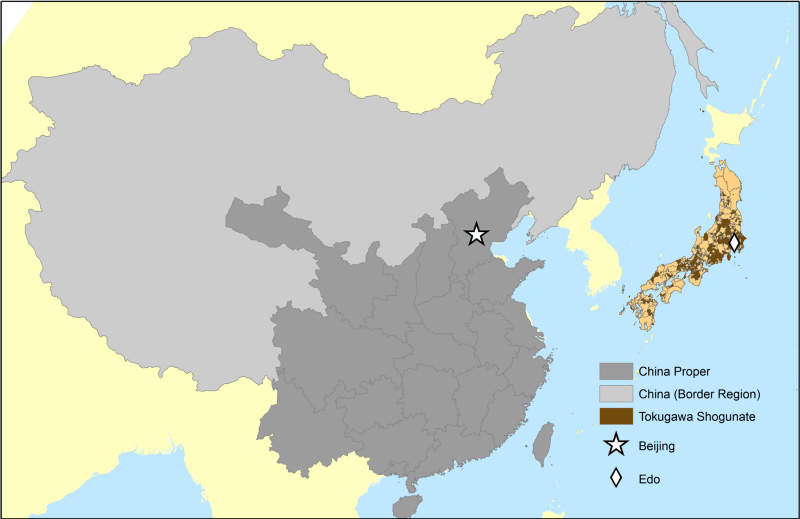
On the surface this East Asian “little divergence” is extremely puzzling. Qing China, as late as the end of the eighteenth century, was a powerful centralized empire. An impersonal bureaucracy selected by exams, and routinely rotated, governed the empire. In contrast, the institutions of Tokugawa Japan are usually described as feudal. The shogun directly ruled only 15% of the country. The remainder was divided into 260 domains ruled by lords known as daimyo who collected their own taxes, possessed their own armies, and issued their own currencies. To the outside observer China would have seemed much more likely to have been able to establish the institutions or a centralized state than Japan.

Figure 1: Qing China and Tokugawa Japan

For much of the early modern period (1500–1700) China and Japan possessed military capabilities that made them more than a match for any western power. This changed dramatically after the Industrial Revolution and their vulnerability exposed by the Opium War (1839–1840) and the Black Ships Incident of 1853, respectively. During the First Opium a small number of British ships overpowered the entire Chinese navy, while Commodore Perry’s show of force in landing in Japan in 1853 convinced the Japanese of western naval superiority. Within a few years, political elites in both countries recognized the need to modernize if only to develop the military capacity required to fend off this new danger.

* * *

koyamajapanperry
Figure 2: Commodore Perry in Japanese eyes

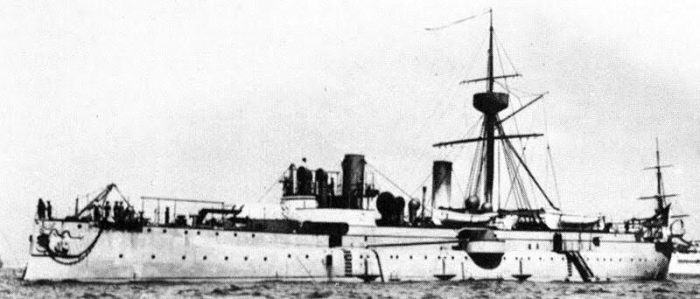
In China, after the suppression of the Taiping Rebellion, there were attempts at modernizing — notably the Self-Strengthening movement associated with Li Hongzhang and others. Recent scholarship has reevaluated this movement positively. At the purely military-technological level it was in fact quite successful. The Jiangnan Arsenal and the Fuzhou Shipyard saw the successful importation of western military technology into China and the Chinese were soon producing modern ships and weaponry. However, these developments were associated with a process of political decentralization as local governors took on more and more autonomy. The importation of military technology was not associated with more far-reaching societal or political reforms. There was no serious attempt to modernize the Qing state.

In contrast, Japan, following the Meiji Restoration, embarked on whole scale-societal transformation. The daimyo lost all power. Feudalism was abolished. Compulsory education was introduced as was a nationwide railway system. A new fiscal system was imposed in the teeth of opposition from farmers. The samurai were disarmed and transformed from a military caste into bureaucrats and businessmen.

Qing China and the newly modernized Meiji Japan would collide in the first Sino-Japanese war (1894–1895). Before the war, western observers believed China would win in part because of their superior equipment. But the Chinese lacked a single national army. It was the Beiyang army and the Beiyang fleet that fought the entire Japanese military force. The fact that Japan had undergone a wholesale transformation of society enabled them to marshal the resources to win a rapid victory.


koyamabaiyanfleet
Figure 3: The Jingyuan, one of the ships in the Baiyang fleet

* * *

Why did the Japanese succeed in modernizing while Qing China failed to do so? Historians have proposed numerous explanations. In our paper, however, rather than focusing on cultural differences between Japan and China, we focus on how different geopolitical incentives shaped their decisions to invest in state capacity and state centralization.

Before the mid-19th century China only faced a threat from inner Asia from where historically nomadic invasions had routinely invaded and threatened the sedentary population of the Chinese plain. Due to this threat, historically China tended to be a centralized empire with its capital and the bulk of its professional army stationed close to the northern frontier (see Ko, Koyama, and Sng (2018)). In contrast, Japan faced no major geopolitical threats prior to 1850. This meant that it could retain a loose and decentralized political system.

After 1850 both countries faced major threats from several directions. China was threatened on its landward borders by Russian expansionism and from the coast by Britain and France (and later Germany and the United States). Japan was threatened from all directions by western encroachment.

We build a simple model which allows for multidirectional geopolitical threats. We represent each state as a line of variable length. States have to invest in state capacity to defend against external geopolitical threats. Each state can use centralized fiscal institutions or decentralized fiscal institutions.

If there is strong threat from one direction, as China faced prior to 1850, the dominant strategy is political centralization. In the absence of major geopolitical threats decentralization may be preferable as was the case in Tokugawa Japan.

The emergence of a multidirectional threat, however, changes things. A large country facing a multidirectional threat may have to decentralize in order to meet the different challenges it now faces. This is what happened in China after 1850. In contrast, for a small state with limited resources, an increase in the threat level makes centralization and resource pooling more attractive. For a small territory like Japan, the emergence of non-trivial foreign threats renders political decentralization untenable.

We then consider the incentives to modernize. Modernization is costly. It entails social dislocation and creates losers as well as winners, the losers will attempt to block any changes that hurt their interests. We show that for geographically compact polities, it is always a dominant strategy to modernize in the face of a multidirectional threat as the state is able to manage local opposition to reform. This helps to explain why all members of the Japanese political elite came around to favoring rapid modernization by the late 1860s.

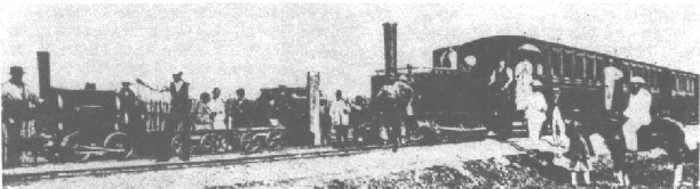
Consistent with our model, modernization was more difficult and controversial in China. The Qing government and particularly the Empress Dowager famously opposed the building of railroads. The most well-known example of this was the Wusong Road in Shanghai. Built using foreign investment it was dismantled in 1877 after locals complained about it. The Qing state remained reactive and prepared to kowtow to local powerholders and vested interests rather than confront them. Despite local initiatives, no effort was made at wholesale reforms until after China’s defeat at the hands of Japan in 1895.

koyamaindustrialization
Figure 4: The Wusong Railroad in 1876

* * *

By 1895 it was too late, however. The attempts of the Qing state to reform and modernize led to its collapse. Needless to state, East Asian’s little divergence would have lasting consequences.

Japan’s modernization program astonished foreign observers. Victory over Russia in 1904 propelled Japan to Great Power status but also set Japan on the path to disaster in the World War Two. Nevertheless, the institutional legacy of Japan’s successful late 19th century modernization played a crucial role in Japan’s post-1945 economic miracle.

Following the collapse of the Qing dynasty China fragmented further entering the so-called warlord era (1916–1926). Though the Nationalist regime reunified the country and began a program of modernization, the Japanese invasion and the Second Sino-Japanese War (1937–1945) devastated the country. The end result was that China came to be reunified by the Communist party and to experience more conflict and trauma until it began to embrace market reforms after 1979.

From the Comments: Weber, Geloso on inequality

How did I not see these before? Rick chimed in on Zak’s post about inequality and libertarianism awhile back. As usual, he tries to give the opposition the benefit of the doubt:

Taking public choice logic seriously means considering the political distortions/impediments to proposed policy. Taking inequality seriously is the flip side of that. Perceptions of (and attitudes towards) inequality matter and libertarians (and conservatives) would do well to acknowledge it.

I suspect that the problem is that 1) (like any ideology) we’ve got a blind spot, and inequality is in that spot. 2) Our liberal friends can see into that blind spot. 3) They’ve got a blind spot that leads them to make silly policy prescriptions (e.g. ignoring public choice roots of inequality and instead calling for policies that would reduce growth). And as a result, 4) we’re turned off by discussion of inequality before considering it.

Vincent, in the usual French manner, has a different take:

Okay massive disagreement here:

A: Inequality is not something “measurable” in the sense of utility. I chose to be an economist. My income is X% below that of my wife who went to school fewer years than I did and her income grows faster than mine and she will live longer than me (in probabilistic terms given life expectancy differences M/F). According to that definition, my couple is an unequal one and growing more unequal. Yet, I would not trade her job for mine even if her job was twice as remunerative (she is an attorney). I chose a path of lesser income because it made me happy. Income maximization was, in that case, not synonymous with utility maximization. By definition, rich societies will have more cases like that since gains in marginal utility may not be associated with marginal gains in monetary income. See the issue of the backward-bending labor supply curve.

B: The literature on linking growth to inequality is VERY weak. Look at the empirical papers, the results often depend on the choice of variables and the time window. It NEVER accounts for what I mentioned in point A. More importantly, there is NO THEORETICAL LINK with neoclassical theory on this (with the notable exception of Herb Gintis and Sam Bowles and I am working on a paper tackling their logic) that is axiomatically consistent. An empirical observation without a theory that is logically sound (the most repeated is the general Keynesian argument about consumption, but that is very weak and that rebuttal is powerful in the theoretical papers) is basically rubbish.

C: The Great Gatsby Curve is also rubbish since most of the past observations are based on the weird assumptions that mobility based on father-sons is a proper estimate to compare with modern estimates. You can consult the very convincing rebuttals made by Scott Winship. Moreover, the Great Gatsby curve is again a case of empirical observations without theory. I don’t need any of this story to see that mobility is down (modestly) at the same time that labor market restrictions are up.

There is more discussion, too.

BC’s weekend reads

  1. ‘It’s true you have better hair than I do,’ Trump said matter-of-factly. ‘But I get more pussy than you do.’ Click.
  2. French elites have convinced themselves that their social supremacy rests not on their economic might but on their common decency.”
  3. Chelsea Clinton seems to have a more crippling want: fashionability—of the sort embraced by philanthropic high society.”
  4. Iran’s Guardian Council announces presidential candidate list

Ricardo and Ringo for a free-trade Brexit

maxresdefault

My colleague, Shruti Rajagopalan, points out that today is the 200th Anniversary of the publication of David Ricardo’s  On the Principles of Political Economy and Taxation. It was here that the notion of comparative advantage began confounding protectionists and nativists. Shruti offers this famous example of it in practice:

Apparently, when asked if Ringo Starr is the best drummer in the world, John Lennon quipped, “Ringo isn’t the best drummer in the world. He isn’t even the best drummer in the Beatles.” And while Lennon may have fancied himself a better singer, guitarist, songwriter, and drummer, than Ringo, the Beatles are still better off with Ringo at the drums.

The essence of comparative advantage is that you don’t need to possess a great talent to benefit from trade within a group, whether we are talking about individual people or nations. So long as there exists some variation in relative talents, people will be able to benefit from specialization and trade.

This message is as relevant as ever. The British Parliament has just voted to hold fresh elections. This is supposedly to strengthen the Prime Minister’s hand when negotiating new terms of trade when Britain leaves the European Union. Politicians act as if trade is dangerous, always a threat to the national interest unless carefully constrained. They negotiate complex deals and regulation on market access, essentially holding their own consumers hostage, preventing them from buying foreign goods unless other countries agree to open their own markets. They fear that their domestic producers will be out-competed by superior, or cut-priced, businesses from abroad.

What comparative advantage shows is that even if that happened to be true for every single industry, domestic businesses could still specialize so as to be competitive on the world market, and improve domestic living standards at the same time. Britain could open its ports and wallets to foreign goods and services with no tariffs, even without any reciprocal deal from the EU, and yet still benefit from trade.

Why? Because it doesn’t matter if you have to be the drummer, just so long as you are in the band.

But who will build the roads?!

It’s not a great time for Atlanta’s highways… they’ve just had another incident.

We could certainly overreact… freak occurrences happen in markets too. But maybe it’s not a freak occurrence. Maybe government just isn’t that good at providing infrastructure.

Would regulation stop the mistakes of rating agencies that contributed to the 2008 crisis?

I remember watching The Big Short and feeling great indignation at the S&P employee who told Steve Carell that rating agencies were pressured into issuing unreasonably high ratings because they were beholden to their customers. If true, this represented an unbelievable moral hazard, which is often cited as the reason for the failures of the ratings agencies–and as a reason for regulating these agencies.

However, more in-depth research and consideration reveals that this answer is incomplete and, in many ways, incorrect. Claire Hill, a law professor at the University of Minnesota Law School and director of the Institute for Law and Rationality, clearly and convincingly critiques this simplistic explanation by recognizing market influences and proposing alternate causes, which also means that if we are looking to avoid a future crisis, we need to look to alternative solutions to the regulatory measures that we currently employ. I don’t think it could be said better than she does in her abstract:

Why did rating agencies do such a bad job rating subprime securities? The conventional answer draws heavily on the fact that ratings are paid for by the issuers: Issuers could, and do, “buy” high ratings from willing sellers, the rating agencies.

The conventional answer cannot be wholly correct or even nearly so. Issuers also pay rating agencies to rate their corporate bond issues, yet very few corporate bond issues are rated AAA. If the rating agencies were selling high ratings, why weren’t high ratings sold for corporate bonds? Moreover, for some types of subprime securities, a particular rating agency’s rating was considered necessary. Where a Standard & Poor’s rating was deemed necessary by the market, why would Standard & Poor’s risk its reputation by giving a rating higher (indeed, much higher) than it knew was warranted?

Finally, and perhaps most importantly, giving AAA ratings to securities of much lower quality is something that can’t be done for long. A rating agency that becomes known for selling its high ratings will soon find that nobody will be paying anything for its ratings, high or low.

In my view, that issuers pay for ratings may have been necessary for the rating agencies to have done as bad a job as they did rating subprime securities, but it was not sufficient. Many other factors contributed, including, importantly, that rating agencies “drank the Kool-Aid.” They convinced themselves that the transaction structures could do what they were touted as being able to do: with only a thin cushion of support, produce a great quantity of high-quality securities. Rating agencies could take comfort, too, or so they thought, in the past – the successful, albeit short, recent history of subprime securitizations, and the longer history of successful mortgage securitizations.

“Issuer pays” did not so much make the rating agencies give higher ratings than they thought were warranted as it gave the agencies a “can do” mindset regarding the task at hand – to achieve the rating the issuers desired, working with them to modify the deal structures as needed. That the issuers were paying motivated the agencies to drink the Kool-Aid; having drunk the Kool-Aid, the agencies gave the ratings they did. My account casts doubt on the efficacy of many of the solutions presently being proposed and suggests some features that more efficacious solutions should have.

I very much recommend reading the full article, which gives more nuance and information about the weaknesses of proposed solutions for rating agency mistakes or malfeasance. This should also be food for thought concerning the general perspective we should have in examining “market failures,” as there are often market feedback systems that mitigate problems, and turning to regulation by reflex can cause unintended harm or even miss the mark entirely.


Reference: Hill, Claire. “Why Did Rating Agencies Do Such a Bad Job Rating Subprime Securities?” University of Pittsburgh Law Review (2010): 10-18. https://papers.ssrn.com/sol3/papers.cfm?abstract_id=1582539.

Emerging Political Realities in India

Whether one swallow it or not, Mahant Yogi Adityanath (Ajay Singh Bisht) -Chief Minister of Uttar Pradesh (UP)- is a new democratic reality of India, at least for present. He is well known for his questionable politics and political hold in and around Gorakhpur district in the eastern UP. Hindu Yuva Vahini (Hindu Youth Group) acts as his private brigade and has, allegedly, fomented and participated in communal activities. Even Yogi’s anti-minority diatribe during public meetings are well known. He is facing charges for rioting, related to intentional insult with intent to provoke breach of the peace, charges related to injuring or defiling place of worship with intent to insult the religion of any class, charges related to promoting enmity between different groups on grounds of religion, race, place of birth, residence, language, etc., and doing acts prejudicial to maintenance of harmony etc. All these were piled up during the non-Bhartiya Janta Party (BJP) governments at the Union and state levels. Instead of taking action against Yogi, his politics had been carefully nurtured during the rule of those governments. It is also alleged that they did so to keep the minorities with them. In past, this politics of fear has mechanically worked to serve the respective political interests of various political stakeholders.

With Yogi, as CM and the massive mandate BJP has got (won 312 seats out of 384 it contested), a question arises: is he a future or a temporary present? He may not be the future of India, but his politics is. He has an ability to divide the people in the name of religion, and at the same time can unite different castes of the Hindu community by arousing religious feelings. One of the reasons why most of the psephologists went wrong in their pre-poll analyses that they gave little attention to this uniting effect of the divisive politics. This pattern has taken years to develop. Analysts kept on writing and engage themselves into brain storming sessions on Mandal versus Kamandal while, on the ground, the two entered into a ‘comfortable’ symbiosis by making certain power related adjustments. In that adjustment, Kamandal has given political leadership to OBC, Dalits, and Schedule Tribes, and in return these leaders help in spread of Hindutva in their area and among their influence groups.

In contemporary India, one may analyse in a different way, but a larger reality is that the members, many of them, of the dominant Other Backward Castes or Dalits identify themselves as a Hindu first then a member of a non-upper caste group. They too believe that they are ‘different’ from the members of minority groups and, like majority members of the so called upper caste, many of them still practice social discriminations against the Muslims. This is evident during communal riots. This is essentially a result of Brahminization of a large section of OBCs, Dalits, and tribal groups carried out by the Hindu revivalist groups since the colonial era. This Brahminization dictates the cultural traits, behavioural pattern, and also dietary habits. Therefore, moral policing and forceful closure of chicken and mutton shops in UP find support from a substantive number of people. Moral policing is mean to regulate women’s sexuality and movement, and an attempt to check inter-caste mix up. Ad  banning of sale of meat is a form of  economic  attack  on  profession , largely, related with the members of  minority religious group and to those who do not adhere to Brahminical values.

As individuals wear multiple identities, they keep on changing them according to time and space. In the UP elections of 2017 majority of Hindu voters gave preference to their religious identity over the other identities. Almost all political parties are aware about this tenuous relationship between caste and religion, therefore no one shows enthusiasm or vocal about implementation of the recommendations of the Sachar Committee report to improve status of a large number of Indian Muslims.

One may ask that if this is the situation then why it did not work in Bihar in 2016. Well, in case of Bihar, BJP lost the election which was almost in its plate. Second, Nitish Kumar as a Chief Minister has always been considered to be a safety valve through whom others can ire their vent out while the upper castes can safeguard their political interests. In late 1990s he was a part of BJP’s such experiment in Bihar. In past he led coalition governments with BJP as an ally. Many such factors joined together to help him to develop similar political equation with the voters.

The results of a series of elections since 2014 general elections, with a few exceptions, prove that the BJP through its sister organizations has successfully captured the available political space in India, and is a dominant force with little or almost no opposition in coming years. Any challenge to its present position is possible only through a rise of an alternative politics from the below.