I am still working from home. The weather has been spectacular here over the past few days. I immediately head outside with the kids at 5 o’clock. We just run around and play. The younger one likes throwing the football around in the grass. The older one likes to play with the ants in the cracks of the sidewalk.
I was looking forward to going to Oslo this fall, but I just received news that the event has been postponed. I’ve still got the inaugural family camping trip to Ouachita to plan, so that’s exciting.
The political landscape here is much different than it is on the west coast or in Austin. Authority is decentralized. There are more black and Mexican people here, and fewer other minorities (including Central Americans). I have more black friends now than I ever did in California. It’s odd. In some ways, the non-South is now more racist than the old South. I can’t put my finger on it but I swear it’s true. You can carry on a friendly conversation with anybody here, something that’s missing out west and up north.
My guess is that this has something to do with the fact that segregation was blatantly racist in the South during the Cold War, and Washington felt it had to do something about it in order to win friends (despots) abroad. The racism in the north and the west was less blatant, and as a result nothing has ever been done about it.
I mean, I didn’t grow up with any black people. Or Mexicans. There are tons of them in California, but they don’t live in white residential areas. Down south, at least in the parts of Texas I’ve lived in, this is not the case. There are still “sides” of town, but at least we all share the same town. There’s still racism here, but the racism is more honest than, say, the zoning found up north and out west. This familiarity between blacks, Mexicans, and whites is something you as an individual have to work hard on to achieve in the non-South.
The federal government forcibly dismantled Jim Crow. It did so only after it conveniently ignored the 14th Amendment for decades, but at least it finally did so. There’s a place for Washington down here in Texas. Decentralized tyrannies are still tyrannies. I just started watching Waco, the Netflix series. It’s good. Washington is responsible for the deaths of several innocent women and children. It’ll never pay the price. Those people were just too strange for the broad public to really give a shit.
It’s a never-ending balancing act: finding a comfortable equilibrium between federal, state, and local governance. The feds are better at protecting the descendants of slaves than the state and local governments. But the state and local governments are better at protecting non-conformists and religious extremists than the federal government.
Libertarianism hasn’t been able to shake its racist stigma yet. Sure, leftists call us racists all the time, but a kernal of truth is still a kernal of truth. I have witnessed several people I once respected sweep libertarianism’s ugly, recent past under the rug and then turn to grab their paycheck. Libertarian Inc. has its place in our society, but it won’t be effective so long as the racist label sticks with us. And the racist label won’t come off until we grapple with the brutal truth of what we’ve become comfortable with and what we will tolerate.
On January 20, 2009, Barack Obama was sworn in as President of the United States. It was a historic moment. The United States of America had elected its first black President. I remember listening to the president’s inaugural speech on the radio. (I was driving from the Lake Tahoe area to Santa Cruz, officially moving to the Monterey Bay along with my girlfriend at the time, who had been accepted into UC Santa Cruz while we were in Ghana.) I got chills that ran down my spine. My nipples got hard. The hair on my arm stood up, revealing goosebumps.
I had enough respect for the republic’s history to know that I was listening to one of its greatest triumphs. A member of an ethnic minority, and a group that had been viciously oppressed at that, had been elected to the republic’s highest-ranking democratic office. American society was evolving in a way that made me proud. It was cool, but my elation was tampered due to a different evolution that was going on in my own way of thinking. My thoughts about how societies worked had been radically altered thanks to the presidential candidacy of a little-known Republican Congressman from Texas: Ron Paul.
I came across Ron Paul via YouTube videos that had been shared on MySpace. I was a product of the California public school system. The public school system has two tiers: a good one for rich people and an awful one for the rest of us. I came from a single parent household. My mother had a college degree and was part of the California public school system, but we were still in the “poor” category. In California’s public schools, a binary way of thinking about civics is introduced and hammered home from the age of 5 to the age of 18. Democrats are liberals who prefer higher taxes, listen to scientists, and believe in change, while Republicans are conservatives who prefer lower taxes, listen to Protestant ministers, and believe in maintaining the status quo. This is not a caricature. I believe this is how most Americans viewed civics up until the moment Ron Paul arrived on the national scene via his back-and-forth with Rudy Guilliani.
In short, I was uneducated but enthusiastic about reading and especially history. I had no career at that point in time (I was an informal carpenter’s apprentice from March through November, and a sandwich maker during the rainy holiday season). I became obsessed with Ron Paul videos online. I watched them over and over. I had never heard arguments like his before. I had no idea that you could be a Republican and be against wars on terrorism and drugs. I had no idea Democrats could be so “pragmatic” when it came to these wars. I watched Ron Paul over and over again. Instead of trying to soundbyte his message, he spoke of responsibility and hard money and corporations taking advantage of regulations to enrich themselves at the expense of everybody else. Never had I heard such ideas before!
I was slow to follow up on his reading suggestions, though. I went almost immediately to the websites of Lew Rockwell and the Mises Institute but what I found there was too radical for me. It was too straightforward. They were speaking of things that I considered, due to my public schooling and religious background, to be taboo. There was a hint of racism in some of the articles I saw at these sights. Perhaps because of the cruddy schooling I got in California, I was at the time of Ron Paul’s revolution a left-wing conspiracist of sorts. I marched against the invasion of Iraq in San Francisco. I marched in 2003 and 2004, when opposition was its zenith. I shared Immortal Technique’s music videos on MySpace (you know the ones). I proudly spouted socialist views online and at parties. Republicans were conservatives, and therefore racists and religious bigots. The whole of the American Right was thus unfit for my company.
Yet, slowly and surely, I kept visiting these two sites. The site I visited most often, though, was Campaign for Liberty, run by Anthony Gregory. It served as Ron Paul’s official campaign website and continued to drum up support and solidarity months after Obama had already been sworn into office. The authors on this site kept imploring me to check out this ‘n’ that from the Mises Institute or lewrockwell.com or Jacob Hornberger’s Future of Freedom Foundation. It was a long, slow process. Some of the things said on these sites never sat well with me. Yet, there were also articles on Native American reservations, anti-war movements in the American past, how property rights could save the environment, and how to bring down big corporations.
I gave in. Once the intellectual floodgates were opened, I found FEE, the Independent Institute, Cato, Reason, Cafe Hayek, EconLog, and Liberty. I read libertarian thought every day. I checked Campaign for Liberty when I woke up. During this time I decided to enroll in college. I enrolled at Cabrillo College near Santa Cruz. Cabrillo is located on the beach. It attracts PhDs. My professors there had doctorates from schools like Columbia, Cal and UCLA, UC San Diego, Washington University in Saint Louis, and a plethora of other good second-tier public universities. Ron Paul inspired me to learn, to think for myself.
I have appointed myself an old sage to the world. When your knees are creaky and every snotty eighteen-year-old treats you patronizingly, the least you can do to compensate is award yourself wisdom. Anyway, long story short, it’s a good excuse to spend much time on Facebook. I feel I am rendering a public service. I am continuing my teaching career there. It’s unpaid but the conditions are much better and all the students actually want to be in class.
Of course, it’s also true that Facebook is addictive. It’s not a bad addiction. For this old guy, it’s almost incredible to have frequent conversations with an MD in Pakistan, my niece in India, an old girlfriend in Panama, a young friend’s wife in Japan, and of course, many different kinds of French people. I even have a Facebook friend who lives in the mountains of Algeria; we have lively talks in French. Recently, a young woman who described herself as a Myanmar village girl reached out. (I know what you are thinking but if she is really one of those internet sex trolls, I salute the originality of her marketing strategy.) At all times a day and night, I have at least one Facebook friend who is not asleep. It’s pleasant in these days of confinement.
The same confinement, perhaps, slows me down and makes me more likely to tally up everything. As a result, a new impression has pierced my consciousness. Expressing contempt for democracy seems to be in vogue among people who identify as libertarians (with a small “l,” big “L” Libertarians have nearly vanished from my world. It could just be me.) This contempt reminds me that I have been asking the same question of libertarianism for now about fifty years, all with not much success.
I refer to the question of transition. I mean, what is it supposed to look like moving from wherever we are, in terms of governance, to a society with a drastically diminished government interference in individual lives? I have been receiving evasive answers, answers that don’t make even superficial sense, and swift escapes effected by changing the subject.
Let me say right away that I am not looking for a crushing reading assignment (a common punitive, passive-aggressive maneuver among intellectuals). Mine is a simple question. One should be able to sketch a rudimentary answer to it. Then, it would be up to me to follow through. Then, no excuse!
To my mind, there are only two extreme transition scenarios. One is the Somali scenario. The state falls apart under its own incapacity to limit internal aggression. It disappears or nearly so. When the point is reached where government authority extends only three blocks from the presidential palace to the north and east, and one block from the south and west, you pretty much have a stateless society. Goal reached!
The second scenario is a gradual change from the current “democratic” arrangements. I mean by this fair and reasonably honest elections followed by a peaceful transfer of power. I mean freedom of expression. And, disturbingly, this also includes courts of law. This is disturbing because courts without enforcement of their decisions are not really courts. This fact implies the threat of coercion, of course.
Now, I can imagine a situation like right now with the Corona Virus epidemic when governments (plural) demonstrate on a large scale their inability to do the obvious. The citizens often react to this sort of demonstration by asking for better and more government. However, it does not have to be that way. The combination of wide communication through the internet and – like now – of enforced leisure – may switch the dial. It’s conceivable that large numbers will get the idea that government that is at once heavy-handed, expensive, and incapable is not a good answer to much of anything. With that scenario one can imagine a collective demand for less government.
Strangely, this sort of scenario may be on display in France now, as I write. Well, this is not so strange after all. A deeply statist society where govt absorbs 55% of GDP and up may be exactly the best place to figure out that more government is not the answer. From this thought to the idea that less government may be the answer there is but one step. My intuition though is that it’s a big step. That’s because few people understand markets. No one but a handful of college professors seems to have read the moral philosopher Adam Smith. (Tell me that I am wrong.)
So, I would like for those who are more advanced than I am on this issue of transition (a low bar) to engage me. I am not interested in the same old ethical demonstrations though. Yes, the state is an instrument of coercion and therefore, evil. I already know this. In the meantime, the First Amendment to the Constitution of the United States does a fair job of protecting my freedom of speech, my freedom, of thought, my freedom of religion. I am not eager to leave this behind for the complete unknown. Are you? Why? How?
About 40 US deaths so far. The French have double that with 1/5 the population. My skeptical fiber is on full. Still I am washing my hands. When I run out of rubbing alcohol, I will use cheap brandy – of which I have plenty, of course. Oh, I almost forgot: I have decided to stop French kissing completely if the occasion arises! Extraordinary times require extraordinary measures! Count on me. I am wondering what the libertarian response should be to this public crises (plural).
Here’s Slate on the person I would vote for, if I voted. Instead, the Democrats are gifting the Republicans a Jewish socialist with a Brooklyn accent to run against Donald Trump…
As I write (10/22/19) the pause or cease-fire in Northern Syria is more or less holding. No one has a clear idea of what will follow it. We will know today or tomorrow, in all likelihood.
On October 12th 2019, Pres. Trump suddenly removed a handful of American forces in northern Syria that had served as a tripwire against invasion. The handful also had the capacity to call in air strikes, a reasonable form of dissuasion.
Within hours began an invasion of Kurdish areas of Syria by the second largest army in Europe, and the third in the Middle East. Ethnic cleansing was its main express purpose. Pres Erdogan of Turkey vowed to empty a strip of territory along its northern border to settle in what he described as Syrian (Arab) refugees. This means expelling under threat of force towns, villages, and houses that had been occupied by Kurds from living memory and longer. This means installing on that strip of territories unrelated people with no history there, no housing, no services, and no way to make a living. Erdogan’s plan is to secure his southern border by installing there a permanent giant refugee camp.
Mr Trump declared that he had taken this drastic measure in fulfillment of his (three-year old) campaign promise to remove troops from the region. To my knowledge, he did not explain why it was necessary to remove this tiny number of American military personnel at that very moment, or in such haste.
Myself, most Democrats, and a large number of Republican office holders object strongly to the decision. Most important for me is the simplistic idea that
There’s no reason to keep writing. I have an nine month-old (nine-month old?) boy and a twenty-nine month-old girl. My vote doesn’t matter. I’ve lost my zest for ideas and events. Nobody cares what a libertarian has to say anymore, anyway. We’re back in the wilderness, wandering aimlessly and pettily bickering with each other about the stupidest things. We had our moment, we truly did, and it got flushed down the toilet along with the big, racist turds we dropped in the porcelain bucket.
Something in the world of ideas has turned stale. Or, I’ve gone stale. I don’t think I have, though. I’ve been reading plenty of books and plenty of internet, and much of it is enjoyable and provides me with a better sense of the world I inhabit. Has the world of ideas always been this stale? Has “the world of ideas” been a Big Lie to begin with, a cover-up invented by political strategists to influence youth and vie for power?
Libertarianism itself is no longer what I thought it was. Consider Syria. What’s a libertarian to do? A libertarian from the US would probably say that his country’s military leaving Syria is a good thing. A libertarian from Syria would probably say that the US leaving Syria is a bad thing. Actually, this is pretty cool now that I’ve thought about it. What is the libertarian position on Syria? Abandon it and regroup somewhere else? Would this “somewhere else” then become a fortress of libertarianism? Would it become a launching pad for military action, for violent acts of aggression against an equally violent polity?
Libertarianism seems to work great in an American institutional context, but what happens when libertarianism moves abroad? Now, I’m not about to go all sideways (to borrow a phrase from an old black cook that I know here in Texas). I’m still a libertarian, but only because it’s the least bad option out there. The world could use more liberty. This liberty can be gained through non-violent indigenous means most of the time. As a citizen of the world’s big, bad hegemon, this is the position I have a duty to take. If I was born in, say, Kurdistan, though, or Angola, violence might be the best least bad option to take en route to more liberty.
Edwin’s 2014 post continues to impress. Is this because I am getting older? Is this because I have other shit to do besides ensure (online…) that liberty remains as pure as possible?
The most popular article I have ever written, in terms of views, has been, by far, “10 Places that Should Join the U.S.,” a short piece at RealClearHistory pining for an enlarged geographic area under the American constitution.
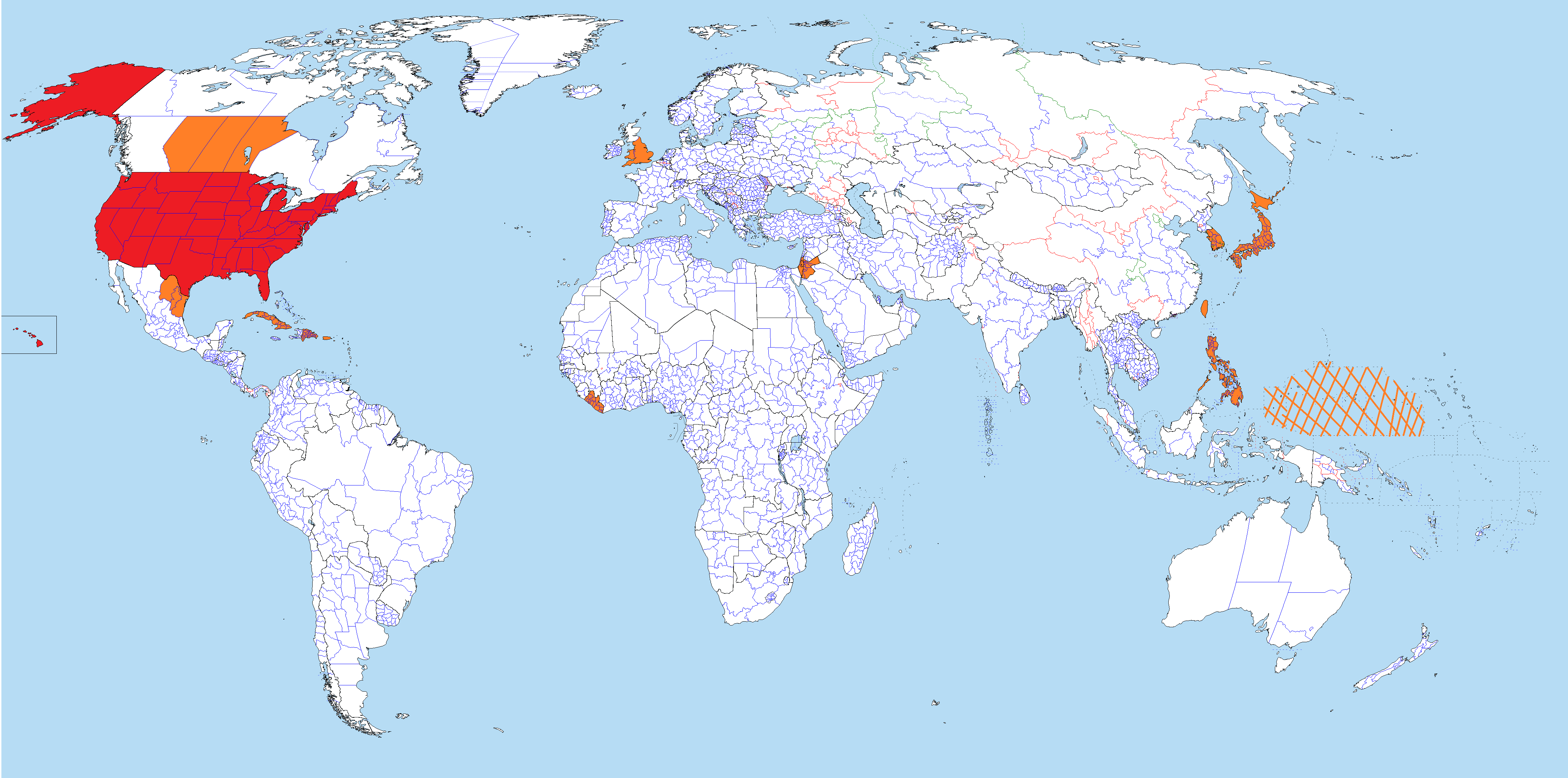
This is not a strange concept for longtime NOL readers. I’ve been pleading for stronger political ties between the U.S. and its allies for quite some time. There has been lots of push back to this argument, from everywhere. So I’m going to spend some more time explaining why I think it’d be a great idea for the American constitutional regime to expand geographically and incorporate more political units into its realm. Here is what an initial “federation of free states” would look like in, say, 2025:
In the map above I’ve got parts of Canada (the 3 “prairie provinces”) and Mexico (3 “ranching states”) joining the American federation. The prairie provinces of Canada – Alberta, Saskatchewan, and Manitoba – would be admitted as separate “states,” and would thus get to send 2 senators each to Washington. According to my napkin calculations, Alberta would only be sending 3 representatives to DC while Saskatchewan and Manitoba would only get 1 representative each in the House. The ranching states of Mexico – Coahuila, Tamaulipas, and Nuevo León – wold likewise be admitted as separate “states,” and would also get to send 2 senators each to Washington. These three states, which have plenty of experience with federalism already, are a bit more populated than the prairie provinces, but not by much. Nuevo León would send 4 representatives to DC, while Tamaulipas would send 3 and Coahuila, 2. Why be so generous to these polities? Why not lump them together into one unit each – a Mexican one and a Canadian one? Mostly because these new states would be giving up a lot to leave their respective polities. Military protection and the rule of law wouldn’t be enough, on their own, to persuade these states into joining the Federation of Free States. They’d need disproportionate representation in Washington, via their Senate seats, in order to leave Canada and Mexico and join the republic.
Antilles (Cuba, Dominican Republic, US Virgin islands, and Puerto Rico). This is a random collection of polities, I admit, and lumping them together into one “state” is even more random. But lump them together I would. On their own I don’t think these polities would do well in a federated system, even with their own Senate seats. There’s just not enough historical parliamentary experience in these Caribbean states. If they were lumped together, though, they’d be a formidable presence in Washington. While Antilles would only get 2 Senators, its combined population would be enough to send 19 representatives to the House, more than Florida, New York, and a gang of other influential states in the current union. At the heart of Antilles joining the US as a “state” in its union is a great trade off: sovereignty in exchange for the rule of law and democratic self-governance.
IsPaJo. Israel, Palestine, and Jordan would also be incorporated into 1 voting state, though I don’t have a good name for this state yet. This isn’t nearly as crazy as it sounds. The populations of these 3 polities would benefit immensely from living under the US constitution. Questions of property would be handled fairly and vigorously by the US court system, which is still widely recognized as one of the best in the world when it comes to property rights. Concerns about ethnic cleansing or another genocide would be wiped away by the fact that this new state is now part of the most powerful military in world history. Sure, this state would only get to send 2 Senators to Washington, but its representation in the House would be sizable: 18 representatives.
England and Wales (but not Scotland or Northern Ireland). England would be the crown jewel of the federation free states. The United Kingdom is dying. Scotland wants out. Northern Ireland wants to rejoin Ireland. In England, London is thriving but the rest of the country is suffering from the effects of de-industrialization. The kingdom’s once-vaunted military depends on the United States for nearly everything. Adam Smith put forth a proposal in his 1776 treatise on the wealth of nations that’s worth re-discussing here. Smith argued that the best way to avoid a costly war with the 13 American colonies was to give them representation to go along with taxation. He proposed that the U.K.’s parliament should add some seats and give them to North American representatives. This way both sides could avoid the whole “no taxation without representation” dispute. Smith further opined that, were this federation to happen, the center of the British empire would inexorably move in the direction of the North American colonies. England and Wales would both get to send 2 Senators to Washington, giving the Isle of Liberty 4 Senators in the upper house. Wales wouldn’t get much in the way of the lower house (only 2 representatives according to my napkin calculations), but England, in exchange for its sovereignty, would become the republic’s most populated “state” and would therefore get to dictate the terms of discourse within the republic in much the same way that California and Texas have been doing for the past 3 or 4 decades. That’s not a bad trade-off, especially if you consider how awful life has become in once-proud England.
Liberia. In 1821-22, the American Colonization Society founded a colony on the Pepper Coast of West Africa and called it Liberia. The aim of the colony was to provide freed slaves in the Americas a place to enjoy their freedom, since racism was still rampant in the Americas. The freedman quickly came into conflict with the locals (a clash of cultures that has continued into the present day). Liberia, governed by its New World migrants, declared its independence in 1847 but it wasn’t until 1862, in the early stages of the American Civil War, that the US recognized Liberia’s declaration. The African continent’s first and oldest republic, predating Ghana by over one hundred years, survived, as an independent entity, the Scramble for Africa in the late 19th century and has been at the forefront of regional coalition-building in Africa since the end of World War II (when the British and French empires collapsed). Liberia, like almost all republics, has decayed politically and socially, especially over the last few decades. Federating with the United States would do wonders for Liberians, and give the federation of free states a legitimate stamp on the African continent (and breath new life into America’s own republican decay). The West Africans would send 2 Senators to Washington, and about as many representatives as Louisiana or Kentucky.
Japan (8 “states”). With nearly 127 million people, Japan’s presence in the American federation would alter the latter’s composition fundamentally. Federating the United States with Japan also presents some logistical problems. As it stands today, Japan has 47+ prefectures, which are roughly the equivalent of US states. If we added them all as they are, the Japanese would get over 100 senate seats, which is far too many for a country with so few people. So, instead, I would bring Japan on board via its cultural regions, of which there are 8: Kantō, Kansai, Chūbu, Kyushu, Tōhoku, Chūgoku, Hokkaidō, and Shikoku. The country formerly known as Japan would get 16 Senate seats (which would be roughly divided between left and right) and the new “states” would be able to send a plethora of representatives, ranging from 32 for Kantō to 3 for Shikoku. In exchange for its sovereignty Japan would get the military protection from China it wants. The US would no longer have to worry about a free-rider problem with Japan, as its inhabitants would be citizens under the Madisonian constitution. It is true that a federation would lead to more non-Japanese people being able to migrate and take root in Japan, but this is a feature of federation, not a bug. (A federation of free states would devastate ethno-conservatism in several societies around the world.)
“Micronesia.” Made up of 8 current countries and territories in the Pacific Ocean, Micronesia is also a cultural territory that encompasses a huge swath of the Pacific. While it doesn’t have a whole lot of people, Micronesia has been important to US military efforts in the Pacific for centuries. Federating with the area is the least we could do for the inhabitants of the Northern Marianas, Guam, the Federated States of Micronesia, the Marshall Islands, Palau, Nauru, Kiribati, and Wake Island. Micronesia would only get 1 seat in the lower house, but with 2 sitting Senators in DC the area would finally get a say in how the United States conducts its business in the region.
Visayas, Mindinao, and Luzon. These 3 regions in the Philippines would do much to enrich the federation of free states. Like Japan above (and South Korea below), the Philippines has a complicated representative system that would need to be simplified in order to better fit the Madisionian constitutional system. Through this cultural-geographic compromise, the Philippines would be able to send 6 senators to Washington, but these three “states” would also get to send more representatives to Washington than New York, Pennsylvania, and a bunch of other current heavyweights. There is already a long history between Filipinos and Americans, and while the first half century was a rough one for both peoples, today Filipinos hold some of the most pro-American views in the world. Of course, Americans who live near Filipino communities in the United States know just how awesome Filipinos are.
Taiwan. Even though Washington doesn’t officially recognize Taiwan as a country (a deal Washington made with post-Mao reformers on the Chinese mainland, in exchange for peace and trade), the two polities are deeply intertwined. Taiwan spends billions of dollars on American military equipment, and the U.S. spends significant political capital protecting Taiwan from China’s bellicosity. Taiwanese statehood would not only bring two close societies even closer together, it would force China to either fight the United States or reveal itself to be a paper tiger. That’s a gamble I’m willing to take, since China is a paper tiger.
South Korea (5 “states”). Another wealthy free-riding ally of the United States, South Korea has 5 cultural regions that could easily become “states” in a trans-oceanic federation: Gangwon, Jeolla, Chungcheong, Gyeongsang, and Gyeonggi. This would give South Korea 10 senators and 50 representatives (spread out according to population size, just like all the other states in the union).
Altogether we’re looking at adding 29 states to the union. That’s a lot, but I think you’ll find that not only would we be expanding liberty but also limiting the size and scope of the federal government, and forcing it to do more of what it is supposed to do: provide a standardized legal system with plenty of checks & balances and maintain a deadly, defensive military.
Expanding liberty and the division of labor are not the only positive side-effects of an enlarged federation under the Madisonian constitutional system. Ending empire – which is expensive and coercive, and gives the United States a bad name abroad – would also be a key benefit of expanding the republic’s territory.
Most American libertarians are isolationists/non-interventionists. Most European libertarians are wishy-washy hawks. Neither position is all that libertarian, which is why I keep keep arguing that “a libertarian position in foreign affairs should emphasize cooperation, choice, and trade-offs above all else.” Non-interventionism is uncooperative, to say the least, but you could argue that it’s at least a position; the Europeans seem to take things on a case-by-case basis, which is what you’d expect from a people who haven’t had to make hard foreign policy decisions since 1945. Open borders is a cool slogan, but that’s just a hip way of arguing for labor market liberalization.
It’s time to open up our doors and start talking to polities about going all the way.
 Notes On Liberty