Flag Burning, the Bill of Rights, and Leaving America Behind: Fourth of July Special

Yes, the American Revolution was special. It’s not yet uncool to recognize facts. You are entitled to your mistaken and unsupported opinions, however; this is a free country. (Not thanks to you!)

First, there were no massacres. It may have been different if Britain had won, I don’t know. The Loyalists were treated harshly in many places. Many lost their property. Many became the English-speaking root of that milder version of ourselves, Canada. Americans were so generous-minded however that they even allowed Hessian (from Germany) mercenaries from the defeated British army to settle among them. Try to imagine any of the formerly occupied countries in Europe in 1945 allowing Russian SS from the German armed forces to stay behind and prosper! (Yes, there were Russian SS, thousands of them.)

Second, the US Constitution was and probably remains the most clear, exemplary embodiment of the healthy political idea of separating powers, a major step in uprooting the habit of despotism. (I may be wrong but I think the desirability of the separation of powers my have been enunciated earliest by the French philosopher Montesquieu. The French themselves mostly made a mess of the idea.)

Third, it took an embarrassingly long time but American constitution-builders eventually produced a wise list of specifically enunciated rights. A bill of rights is a necessity to protect political, intellectual, and religious minorities and, especially, individuals from the potential, and the very real, threat of tyranny of the majority.

The next to try a bill of rights, the French, did it only a few months later, also in 1789. With the privilege of having Ben Franklin right there in Paris to lend a hand, with Lafayette – who understood the idea well – involved, they also screwed up that one. Most of them don’t know it to this day, I think, but the insertion of one sentence in their Bill has the potential to nullify the whole: “Art. 6. La Loi est l’expression de la volonté générale.* “The Law, is the expression of the general will.” This general will, the will, the will of all, has the power to eradicate any of the individual rights carefully enunciated elsewhere in the same document. Correspondingly, today in France, there are concrete limitations on freedom of speech, for example, although freedom of speech is specifically guaranteed by the French Bill. These limitations were imposed in a carefully legal manner via acts of parliament, and signed by the president yet, they are still a form of despotism and a slippery slope. The little sentence above makes a constitutional challenge on these restrictions on speech difficult, if not impossible.

Incidentally, and going back to the US, there have been recent episodes of US flag burning by activists protesting – somehow – the Charleston church massacre. Go ahead, burn away, it’s your right so long as you don’t accidentally set afire a neighbor’s or public property! I feel forced to link this kind of petulant, childish behavior to a poll I saw recently that describes 50% of millennials as wishing to emigrate, to leave this country.** So, after voting massively for Mr Obama seven years ago, they want to escape the massive failures of his administration instead of staying put and contributing to reverse them. One the failures imputed to Mr Obama is wage stagnation. It has frozen many thirties-something in place, economically speaking. I am not sure it’s fair to blame Mr Obama but it’s done to every administration.

I know quite a bit about emigration/immigration as you might guess. So, I will presume to give potential emigrants advice: You may move to Australia, my friends. Australia will be glad to have you. The country is an admirably successful redneck project. You will enjoy the Australians’ great pubs. Of course, there is a good chance that the first night out to one of the pubs, you will open your mouths too wide. Then you may well end up beaten to a pulp in some dark alley. I don’t wish you such a fate; I disapprove of such rowdy behavior. If it comes to my attention, in the news or in the newspaper, I will not laugh openly. There will just be a little smirk on my face.  Have a good trip.

* 1789 Déclaration universelle des droits de l’homme et du citoyen

** Ordinarily, I am the first one to point out that fewer than two convergent polls from respected sources is nothing. So, take this with two grains of salt.
Can we count on juries?

Towards the end of this week’s Cracked Podcast an important issue was raised: juries are peopled by human beings and human beings are not naturally good at figuring out cause and effect. Over the last few hundred years the sort of evidence juries would have to evaluate were fairly simple; things like “does the glove fit?” (Okay, that’s a bad example.) But now juries are faced with expert witnesses discussing things like DNA evidence which requires a jury capable of interpreting statistical evidence. This is fine if the defendant has the money to hire their own expert witnesses, but for poor defendants they might well get railroaded by the ignorance of the jury. Is there anything that can be done?

Guantanamo: A Conservative Moral Blind Spot

A current Guantanamo detainee, Mohamedou Slahi, just published a book about his ordeal. The book is redacted of course but it still tells an arresting story.

M. Slahi was captured in 2000. He has been held in detention, mostly at Guantanamo prison since 2002 but in other places too . The motive was that he supposedly helped recruit three of the 9/11 hijackers and that he was involved in other terror plots in the US and Canada (unidentified plots.).

According to CNN:

Slahi admits to traveling to Afghanistan to fight in the early 1990s, when the US. was supporting the mujahedin in their fight against the Soviet Union. He pledged allegiance to al Qaeda in 1991 but claims he broke ties with the group shortly after.

He was in fact never convicted. He was not even formally charged with anything. Slahi has spent 13 years in custody, most of his young adulthood. If he is indeed a terrorist, I say, Bravo and let’s keep him there until the current conflict between violent jihadists and the US comes to an end. Terror jihadists can’t plant bombs in hotels while they are in Guantanamo. And, by the way, I am not squeamish about what those who protect us must do to people we suspect of having information important to our safety. I sometimes even deplore that we do to them is not imaginative enough. And, I think that the recent allegations to the effect that torture produces nothing of interest are absurd on their face.

But what if the guy is an innocent shepherd, or fisherman, or traveling salesman found in the wrong place? What if he is a victim of a vendetta by the corrupt police of his own country who delivered him over? What if he was simply sold to our intelligence services? What if, in short, he is has no more been involved in terrorism than I have? The question arises in Slahi’s case because the authorities had thirteen years to produce enough information, from him and from others, to charge him. They can’t even give good reasons why they think he is a terrorist in some way, shape or form. It shouldn’t be that hard. If he so much as lend his cellphone to a terrorist I am for giving him the longest sentence available. or simply to keep him until the end of hostilities (perhaps one century).

And if having fought in Afghanistan and having pledged allegiance to Al Qaeda at some point are his crimes, charge him, try him promptly even by a military commission, or declare formally, publicly that he is a prisoner not protected by the Geneva Conventions, because he was caught engaged in hostile action against the US while out of uniform and fighting for no constituted government. How difficult can this be?

I am concerned, because, as a libertarian conservative, I am quite certain that any government bureaucracy will usually cover its ass in preference to doing the morally right thing. (The American Revolution was largely fought against precisely this kind of abuse.) Is it possible that the Pentagon or some other government agency wants to keep this man imprisoned in order to hide their mistakes of thirteen years ago? I believe that to ask the question is to answer it.

This kind of issue is becoming more pressing instead of vanishing little by little because it looks like 9/11 what just the opening course. It looks like we are in this struggle against violent jihadism for the long run. Again, I am not proposing we go soft on terrorism. I worry that we are becoming used to government arbitrariness and mindless cruelty. I suspect that conservatives are often conflating their dislike of the president’s soft touch and indecision about terrorism with neglect of fairness and humanity. I fear we are becoming less American.

Let me ask again: What if this man, and some others in Guantanamo, have done absolutely nothing against us?

Of course, I hope the US will keep Guantanamo prison open as long as necessary. In fact, I expect fresh planeloads of real terrorist from Syria and Iraq to come in soon. I really hope that Congress will have the intestinal fortitude to call President Obama’s bluff on closing the prison. Congress has the means to stop it if it wants to.

Hume and Humboldt

Divergent dichotomies are not unusual to be found in Hayek’s writings. Besides the essay “Two Types of Mind”, we have his 1945 lecture “Individualism: True and False” on the difference between the British Enlightenment and the Continental Rationalism. Grounded in Edmund Burke’s Appeal from the New to the Old Whigs, Hayek traces the origin of true individualism to Bernard Mandeville, David Hume, Josiah Tucker, Adam Ferguson, Adam Smith and Edmund Burke himself. The XIX Century adds Lord Acton and Alexis de Tocqueville to the list. On the other hand, Hayek states that Jean Jacques Rousseau exemplifies the Rationalist individualism, which postulates isolated and self-contained individuals –whereas, for the former, the individual is determined by his existence in society. The “true variant” of individualism is the notion of “subject” of Hume’s philosophy: the outcome of repetitions, expectancies and habits. Finally, Hayek concludes his lecture with the censure to the German type of individualism, rooted in Wolfgang v. Goethe and Wilhelm v. Humboldt: the individualism expressed in the original development of the personality and defended in J. S. Mill’s On Liberty.

Notwithstanding in this 1945 lecture Hayek claims that this German individualism of self-development has nothing to do with what he regards as true individualism and it is “an obstacle to the smooth working of an individualistic system,” much later, in Law, Legislation, and Liberty, he will restate his opinion on Wilhelm v. Humboldt’s legacy.

This reconsideration of the value of liberty as the development of the unique and particular character of an individual will be acknowledge not only regarding legal theory but as well in his 1976 proposal of denationalization of currency. In his late writings, Hayek will endorse the development of the originality of character as an important trait for the competition to work as a discovery process.

The key to understand his shift onto this new type of individualism is closely related to Hayek’s involvement into the ideas of cultural evolution. The “true individualism” was important to state how a society can achieve certain order. The “Humboldt’s individualism” is needed to explain the dynamic of the evolution of that order. Hume’s notion of subject is related to the ideas of integration and convergence, to how an order may emerge. Humboldt’s ideal of self-development of the unique and original character of each individual implies differentiation and divergence. These two traits are the key to the adaptation to the changes in the environment that defines the notion of blind evolution. A social and political system that assures the development of differences has keen aptitudes to survive to the changes in its environment. At the level of the “true individualism”, individuals are made of institutions, repetitions and expectancies. But at the level “Humboldt´s individualism”, successful institutions are made of differences, divergent series of facts and adaptation.

(Originally published in http://www.fgmsosavalle.blogspot.com)

Around the Web

  1. Political scientist Jason Sorens on the elections in Europe (best summary I’ve read; it’s short, sweet, and to the point)
  2. Examining Piketty’s data sources for US wealth inequality (Part 4 of 4)
  3. Greece the Establishment Clause: Clarence Thomas’s Church-State Originalism
  4. Strong Words and Large Letters
  5. The African Muslim Fist-Bump
  6. Why US Intervention in Nigeria is a Bad Idea

Around the Web

  1. Recent Mexican reforms and the impact on the United States. From Gary Becker.
  2. Is the Pope’s Capitalism Catholic? Read this for the concise history lesson on Argentina rather than for the Pope’s opinion about public policy.
  3. Sandy Ikeda asks: Who is really threatened by innovation? Rick’s recent musing on political entrepreneurs can also shed some light on Ikeda’s question.
  4. The Liberty Constitution, Or, What About Slavery? Some libertarian legal theory for dat ass.
  5. Diplomacy.” A transcript of Rand Paul’s recent speech on US foreign policy.
  6. Why the world needs more globalization, not less.

The Tyranny of Darth Obama

Commentary by LA Repucci

 November 14th, Washington DC

President Obama spoke from the White House this morning regarding a proposed ‘fix’ to his failed health care policy in an effort to edify his fellow democrats through the next election cycle.

After publicly promising the American people that they could keep their insurance plans 30 times, the president has received flack due to the fact that millions are losing their insurance policies due to the Affordable Healthcare Act, commonly referred to as Obamacare.

In his address this morning, the president announced a ‘delay’ of the portions of the law to enable insurers to re-instate individual policies purchased on the “old individual market” to avoid losing their coverage…presumably, for another year.  Obama offered no details or legal explanation as to how this radical change in the law of the land would be implemented.

Okay — let’s suspend the fact that our Constitution very clearly states the government is prohibited from compelling the people to purchase a product or service.  Let’s pretend that the government, having betrayed this constitutional provision time and again (Social Security comes to mind), may simply call a compulsion to purchase a ‘tax’ as chief justice Roberts ruled regarding the health insurance mandate, circumvent one of the clearest directives of the US Constitution, and may compel the people to purchase a product or service. Even with this egregious transgression of the sovereignty of the people as a given, the State seems unable to obey its own new laws these days.  The federal government has been exposed time and again in the last few months (and decades) as the primary and frequent transgressor of our laws – the confirmed reports of illegal mass warrant-less surveillance are only the latest example of complete disregard for and perversion of the law to come from this administration.

There is a single mechanism by which our federal government transgresses the will of the people; one over-arching distortion of sanity by which the administration, law-makers and courts continue to exploit (at accelerating pace) and abridge the will of the people.  President Obama is merely the culmination of this singular corruption of constitutionality that transforms our nation from the rule of law toward the rule of tyrants.  As a student of constitutional law, Mr. Obama must know precisely what he is doing. Even if he didn’t, ignorance would not save his neck from the block that is the US constitution.

The truth is this:  all three branches of the federal government disregard the rule of law.  They are all traitors to the republic, and as such, should be tried, convicted, and sentenced for high treason.

How can a president (and constitutional scholar) mandate the people’s purchase of a product in clear violation of our supreme law, then claim the power to arbitrarily change his own law simply by decree?  The answer is two-fold.  First, a legitimate president cannot – a tyrant can and will do anything they please.  Second; as a tyrant by definition does not respect law in any case, once abridged, law may be changed without the legislative process or will of the governed, by decree.

Obamacare is unconstitutional – the state-appointed high-priests of the Supreme Court aren’t required to understand that simple point.  As an unconstitutional law issued by the fiat of a tyrant, supported by a false legislative process of ‘democracy’, it should be taken as given that law will now be dictated from the executive office out of hand, as the now impotent legislative and judicial bodies meekly question ‘can the president make law by decree? Law, by definition, is the littoral antipode of decree.

Dictation is the province of dictators – those who would destroy the rule of law and institute the rule of decree.  Ayn Rand prophesied this exact eventuality for American politics in her opus Atlas Shrugged, within the pages of characters decry ‘pragmatic, relative flexibility’ to be superior to principle.  When the state abandons duty to the law of the people, then it is the duty of the people to abandon the state.  A state that represents not the interest of the people, is anathema to the rule of law. According to Rand’s prophecy, this perversion of the very concept of law will accelerate dramatically as more ad-hoc tyrannical declarations are needed to patch the tower of babel created by the abomination that is the rule of man.  If Rand is right, this will all get much more absurd and destructive before it gets any better.

Obama’s decree this morning illustrates the now obvious point that the Affordable Health Care Act is HIS law, and not the law of the people.  The people change laws through the legislative process and the ballot — a tyrant changes his laws by decree.

Gravity is a law.  It needs no paper legislation, no judicial review, no vote of democratic tyranny to ‘be’ a law. It is a natural force acting upon reality whether people consent to it or not.  Markets are the same – they are a natural law.  They exist whether or not they are acknowledged by the state — and will continue to exist so long as there is a society within which to emerge and operate.  ‘Regulating’ an economy or market is akin to regulating gravity.  Paper law — Obama’s law, is not law at all. In fact, it is now specifically the opposite of law – it is the whim and decree of a despotic megalomaniac — it is Canute ordering the tides back.  Let’s all hope this tyrant drowns quickly so that our nation may once again be ruled by the laws of the natural universe, and the US government may return to performing its sole legitimate function – safeguarding the liberty of the people against tyrants like Obama.

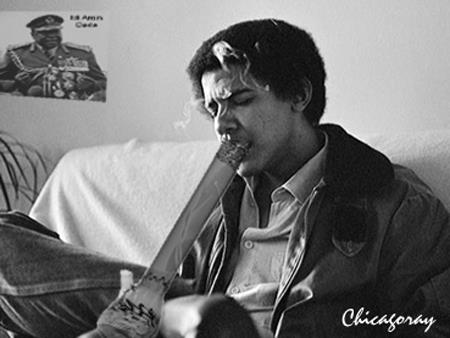
Image

Our President minored in bong rips, honoring his predecessors’ commitment to cocaine and drunk driving.

I am considering sending Mr. Obama a copy of Bastiat’s “The Law” – apparently, this foundational primer, along with Locke and Jefferson aren’t required reading in the Columbia University constitutional law curriculum.  Is it intellectually honest to assume that the nations’ chief executive is ignorant of the school of thought that is the genesis of our nations’ supreme law?  Likely not – either Mr. Obama is ignorant of the very nature and definition of law itself, or he is openly perverting its’ mechanisms in an effort to destroy the liberty of the people and supremacy of the Constitution.  Darth Sidious, evidently, trained another apprentice after the death of Vader.

Oh Jedi, where art thou?


Disgusted and Furious,

LA Repucci

I Have Been Summoned (Poll!)

So I have Jury Duty tomorrow morning. Early. I don’t know any of the details of the trial. I’ve been dreading it all week long but have gradually come to accept that there is no way out of it (or at least out of showing up the first day) so I might as well make the most of it. The problem is I don’t know what to expect. Will the lawyers cross examine me first? Or did that form I filled out a few months back suffice to make me a good juror (this is Montana after all, I’m sure we don’t have big-city standards)? I don’t think the form contained enough information about me for the prosecuting and defense teams to decide I am a good juror.  So I am inclined to think that there will be additional questioning. And if so, that would be my ticket out of it because if just one team of attorneys thinks that I would make a decisive, respectable, impartial juror, the court will probably dismiss me. And I would likely never be summoned again. To be honest, I don’t think I would make a “good” juror because I don’t like authority all that much. Not cops. Not judges. Not elected officials. And I absolutely loathe lawyers with rare exception. If they ask my opinion about any of of these things should I tell them or hold back?

Should I be honest (assuming they ask me the right kinds of questions) and tell them I think their courtroom — no, their entire system — is running a racket? This would basically be the cowardly way to reclaim my rights to my own person because they can’t do anything to you for expressing an opinion. The less cowardly way would be to refuse to show up, but that could put me in a world of trouble since all commands handed down by the state are in essence backed by the barrel of a gun. Talk about judicial fiat! (Pardon the monetary lingo.) Continue reading

Property Rights in Africa: More Decentralization Please

From the economist Camilla Toulmin:

While land registration is often proposed as a means of resolving disputes, the introduction of central registration systems may actually exacerbate them. Elite groups may seek to assert claims over land which was not theirs under customary law, leaving local people to find that the land they thought was theirs has been registered to someone else. The high costs of registration, in money, time, and transport, make smallholders particularly vulnerable to this.

You can read the rest of her article here [ungated version can be found here]. It goes on to elaborate upon how more decentralization is needed, as well as the need for more incorporation of indigenous legal practices. Highly recommended, but grab a cup of coffee first.

Arguments to ponder:

  1. James Buchanan’s work on public choice (elite groups seeking to capture the rent)
  2. Friedrich Hayek’s work on tacit knowledge and the inability to plan societies from the top
  3. Elinor Ostrom’s work on governing the commons and how states muddle the intricate “rules of the game”

Any thoughts? Suggestions for further reading?

What Would You Do?

I picked up a five things to-do list from Grover Cleveland over at Pileus Blog if he were supreme ruler of the land. He in turn got his 5 from a prompt by Angus over at Kids Prefer Cheese. If readers have any more Top 5 lists they’ve come across let me know and I’ll link them accordingly.

Anyway, here are Angus’s Top 5: Continue reading